Artificial Intelligence · arXiv:2610.19619 v1 · submitted 14 Oct 2026 · 50 references
Are AI Decision Models Biased? A Case Study of Jev
The paper says
“Do AI models designed for fast, structured decisions exhibit the cognitive and social biases observed in human judgment?”
more of the abstract
We evaluate Jev, a model described as a System One decision-maker, using 41,500 responses across cognitive reflection tasks, five classical cognitive-bias paradigms, and a pricing experiment testing ethnic and gender bias. At the level of selected answers, the results are largely encouraging. We confirm previous findings that Jev performs extremely well on cognitive reflection problems. We also observe that it generally avoids the characteristic choice patterns associated with several well-documented human biases, and exhibits only small differences among demographic groups in the tested pricing scenario. However, this apparent robustness conceals important vulnerabilities. Its judgments are sensitive to irrelevant numerical information and the ordering of response options. Moreover, several cognitive-bias manipulations substantially affect returned probabilities even when selected answers remain unchanged. Most strikingly, Jev answers a well-known probability problem correctly in every response but violates the same underlying probability rule in every response to an adapted version. We investigate this discrepancy using 15,000 additional responses across 30 conjunction tasks. Jev violates the rule in 54% of responses, with accuracy varying dramatically across formulations and answer orders. These findings suggest that evaluating decision models solely on familiar benchmarks and selected answers may substantially overstate their reliability in practical applications. They also identify vulnerabilities for developers to address and practical considerations for users integrating such models into automated decision-making systems.
from the abstract
Pith says
Machine review · deepseek-v4-flash · 15 Oct 2026 · what was read was not recorded · not checked by a person
It can be wrong. Challenge this review or reply to it.
Holds up. Well-executed case study with a strong conjunction robustness check; other bias tests are single-scenario and suggestive but not individually conclusive. This line is wrong
5 minor
How often objections from reviews like this one are right: not yet measured
Not checked: figures, code, what the 50 references say.
5 minor objections
The paper says, at §5.1, Figure 1
Pith says: minor objection 1 of 5
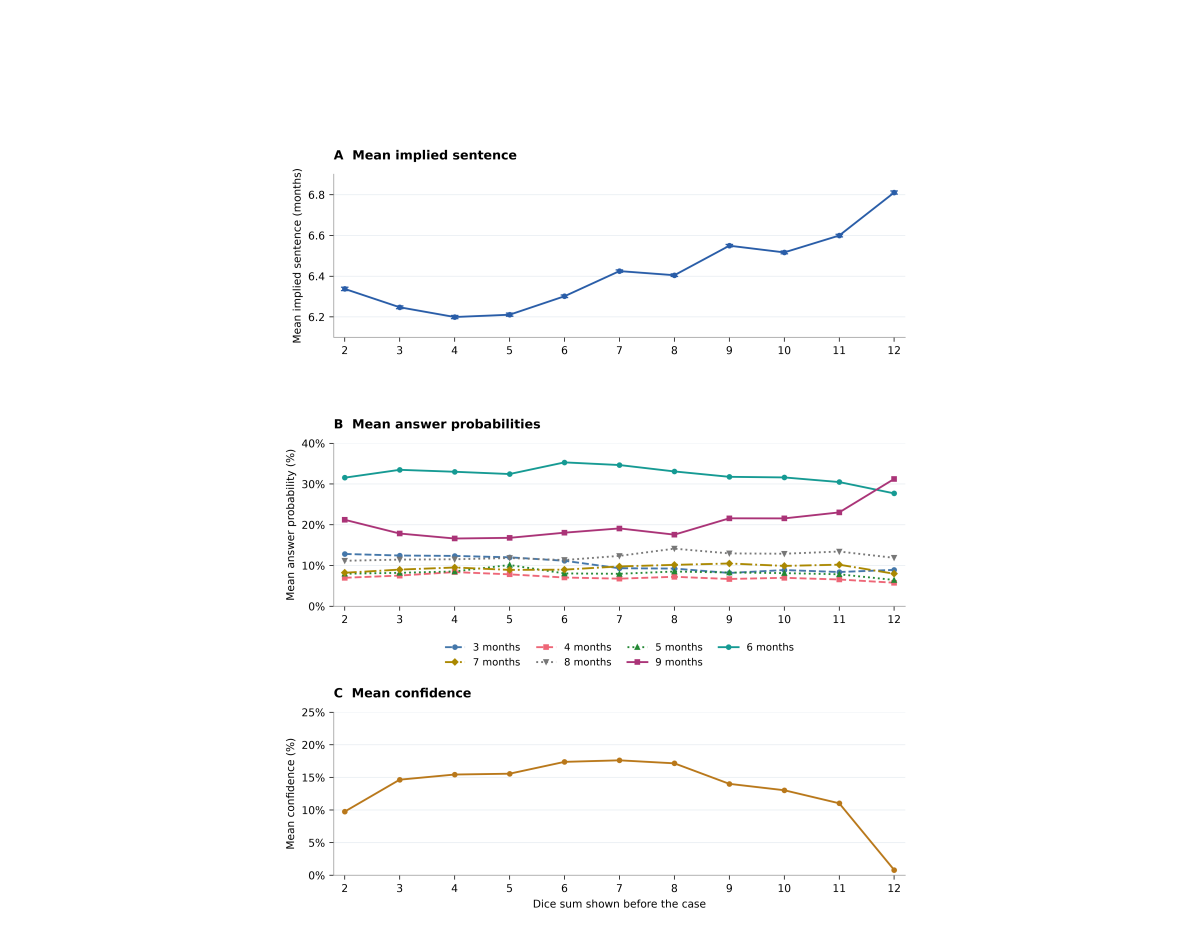
The mean implied sentence decreases from dice sum 2 to 4 before increasing from sum 5 onward. This non-monotonicity is not discussed. A brief comment on whether this reflects a floor effect or sampling variation would improve clarity.
The paper says, at §5.4, Sunk cost
Pith says: minor objection 2 of 5
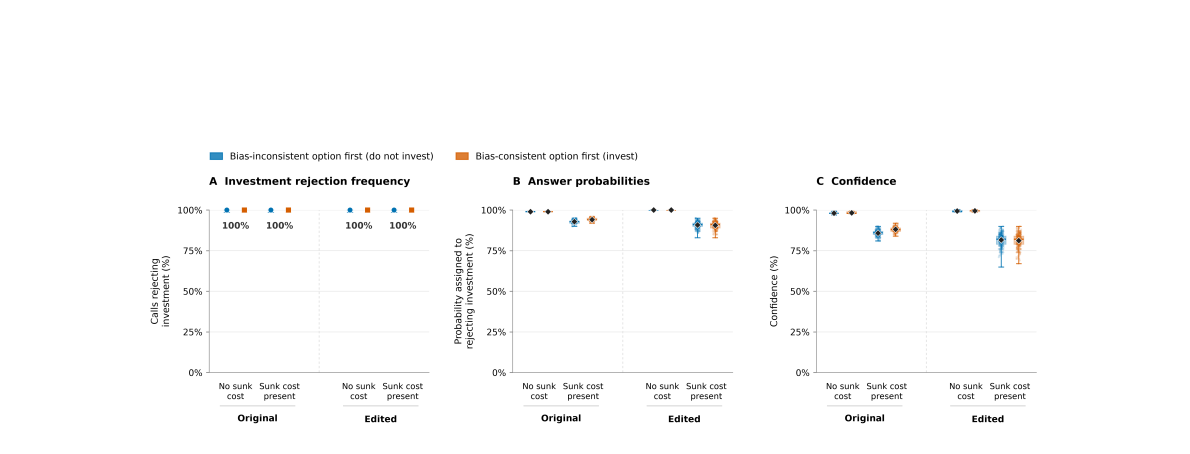
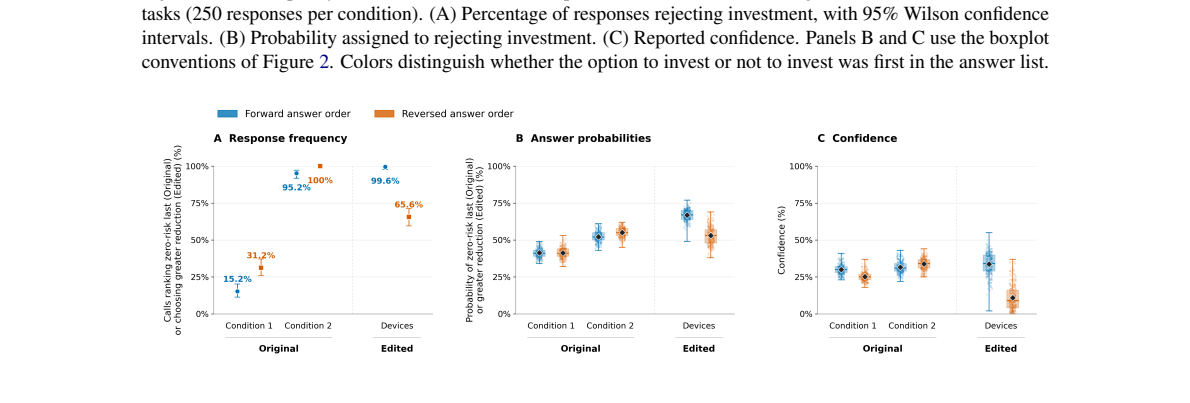
The text states 'All 2,000 responses reject investment.' Since the task is a Choice primitive, clarify that Jev selects the option corresponding to not investing (e.g., 'No'). The probability increases for the investment option are correctly reported but would benefit from explicit mention of the answer-option labels.
show 3 more
The paper says, at §5.5, Zero risk
Pith says: minor objection 3 of 5
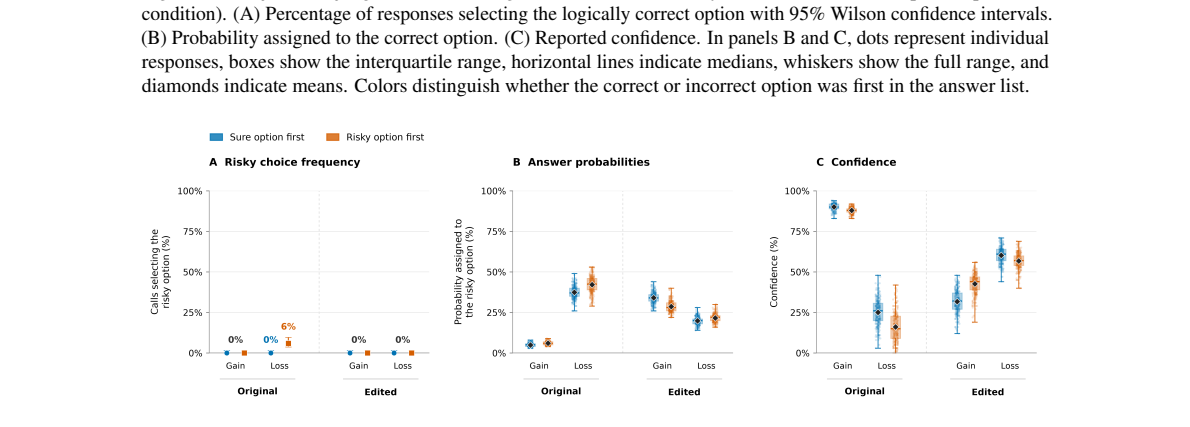
For the original version, the description of the ranking task could be expanded: how are the three alternatives presented and ranked? The current description is concise but assumes familiarity with the Baron et al. paradigm; a brief note on the response format would help readers not familiar with the original.
The paper says, at §9, Limitations
Pith says: minor objection 4 of 5
The paper states 'most paradigms use one original and one edited scenario.' For readers it would be helpful to list the number of scenarios explicitly for each bias (e.g., anchoring: 1, framing: 1, etc.) alongside the conjunction count (30), to underscore which finding is most robust.
The paper says, at §5.1, Anchoring
Pith says: minor objection 5 of 5
The confidence intervals are described as 'simultaneous 95% CI using a normal approximation with Bonferroni correction across all 55 pairwise comparisons.' This is appropriate; consider also stating the correction method in the main text (not only in the caption) for clarity.
What would settle it
For at least one non-conjunction bias (e.g., framing or sunk cost), design 10 additional adapted scenarios drawn from published psychology variants (e.g., McNeil et al. 1982; Arkes and Blumer 1985). Run the same Choice protocol with 250 responses per scenario and both answer orders. Count scenarios with a significant (95% CI) shift in selected answers or a meaningful shift in returned probability (>5 percentage points) between original and adapted. If ≥8 of 10 show such a shift, generality is supported; if ≤3, the current results may be wording-specific.
from the skeptic's reading
How the review went
4 readings by deepseek-v4-flash · 15 Oct 2026
- Reader holds up
- Skeptic agrees
- Editor wrote the verdict above
- Referee minor revision: 5 minor
Not run on this paper: the simulated authors' defence.
Pith did not check this review's objections against the paper.
The review in full
The review in brief, machine-written
The paper's main point is straightforward and important: evaluating a decision model on familiar benchmarks alone can substantially overstate its reliability. The conjunction experiments—30 scenarios, 15,000 responses—make that point convincingly. Jev goes from 100% correct on the original to 0% on an edited version, and across the full set it errs 54% of the time, with large variation by scenario and answer order. That is the paper's strongest contribution, and it is well supported.
Methodologically the paper is rigorous: large per-condition samples, Bonferroni-corrected confidence intervals, systematic reversal of answer order, and a clean separation of selected answers from returned probabilities. The social bias experiment is also extensive (125 names, 25,000 responses). The authors are honest about limitations—they flag that most bias paradigms except conjunction use only one original and one adapted scenario (sentence b197). That is the correct thing to do, and it means those results are suggestive rather than definitive.
Soft spots in proportion: For anchoring, the effect is tiny (0.3 months on a six-month baseline) and might not be practically meaningful. For framing, the probability effect reverses direction between the original and edited scenarios, which raises a question about whether the edited version measures the same thing. For sunk cost and zero risk, the choice-level results are mostly null (all reject investment; strongly favor harm reduction in original), and only probability scores shift. The central claim that the model is systematically biased across many paradigms rests heavily on the conjunction evidence; the other tasks provide weaker supporting data. The paper also tests only a single model (Jev), so generalizability to other decision models is unknown—but the title calls it a case study, so that boundary is fair.
Who this is for: researchers working on AI evaluation methodology, especially for structured decision models, and practitioners deploying models like Jev. The paper deserves a serious referee: it is empirically grounded, transparent, and the conjunction robustness check is a clear finding that merits attention. I would accept for peer review and expect the authors to further acknowledge the single-scenario limits for non-conjunction tasks, which they already do.
The strongest objection
The paper's central claim that benchmark-only evaluation substantially overstates reliability relies heavily on the conjunction task, where performance flips from perfect on the original to zero on an adapted version, robust across 30 scenarios (Section 6). For anchoring, framing, sunk cost, and zero risk (Sections 5.1, 5.3–5.5), each uses exactly one original and one adapted scenario, limiting generality. The paper acknowledges this: 'Repeated calls characterize output variation for these specific prompts, rather than performance across the broader population of problems associated with each bias' (sentence b197). Observed probability shifts and answer-order sensitivity in those paradigms are demonstrated for a single wording each. Without multiple variants or principled sampling, we cannot distinguish systematic tendencies from idiosyncratic responses. For example, the framing effect on probabilities reverses direction between original and edited scenarios (Section 5.3); if the edited scenario is non-representative, the reversal may be an artifact. The anchoring effect is tiny (0.3–0.5 months on ~6.3-month baseline), and it is unknown whether it persists across other anchoring contexts. The central claim would be much stronger if each bias were tested on multiple independently plausible adaptations.
The reader's weakest assumption identifies the same generality limitation for non-conjunction biases. The paper's own limitation statement (b197) confirms this. My attack elaborates why this matters for the central claim's breadth and proposes a concrete test to tighten it. The verdict remains unchanged because the paper is transparent about the limitation and the conjunction evidence is robust across 30 scenarios, providing strong support for the central claim for at least one important paradigm. The paper's cautious phrasing ('may substantially overstate') also protects against overgeneralization. Therefore, the concern does not warrant changing the acceptance verdict.
The referee's report
If the findings hold, the paper makes a strong methodological contribution by showing that a decision model can achieve perfect scores on classic bias tests while systematically failing on close variants. The conjunction robustness check provides credible evidence of a failure mode that benchmark-only testing would miss. The results are practically important for developers and users of specialized decision models, as they identify specific vulnerabilities (answer-order sensitivity, irrelevant numerical cues, and fragile generalization) that are not captured by standard accuracy metrics. The study is transparent about its limitations, which tempers the generality of the central claim for biases other than conjunction but does not undermine its core insight.
Pith's reading of the paper (a machine's summary, not the authors')
这篇论文试图证明,仅依靠标准基准测试和最终选择答案来评估AI决策模型会严重高估其实际可靠性。以System One模型Jev为例,它在经典的认知偏差测试(如合取谬误、框架效应等)的标准版本中表现完美,但在措辞或表述稍作调整的改编版本中系统性地失败。此外,Jev对答案选项的顺序高度敏感,无关数字信息也会影响其判断。这些发现揭示了当前评估实践的盲点,对将这类模型集成到自动化决策系统中的应用具有重要警示意义。
What carries the argument. 关键的实验操纵是“任务版本对比”(原始 vs 改编)和“答案顺序反转”(正向 vs 反向),辅以概率分布的详细分析。通过比较同一偏差范式下不同表述的性能,以及观察顺序变化对最终选择和概率的影响,论文揭示了模型表现的不一致性,而这种不一致性在只报告最终选择的标准评估中被完全掩盖。
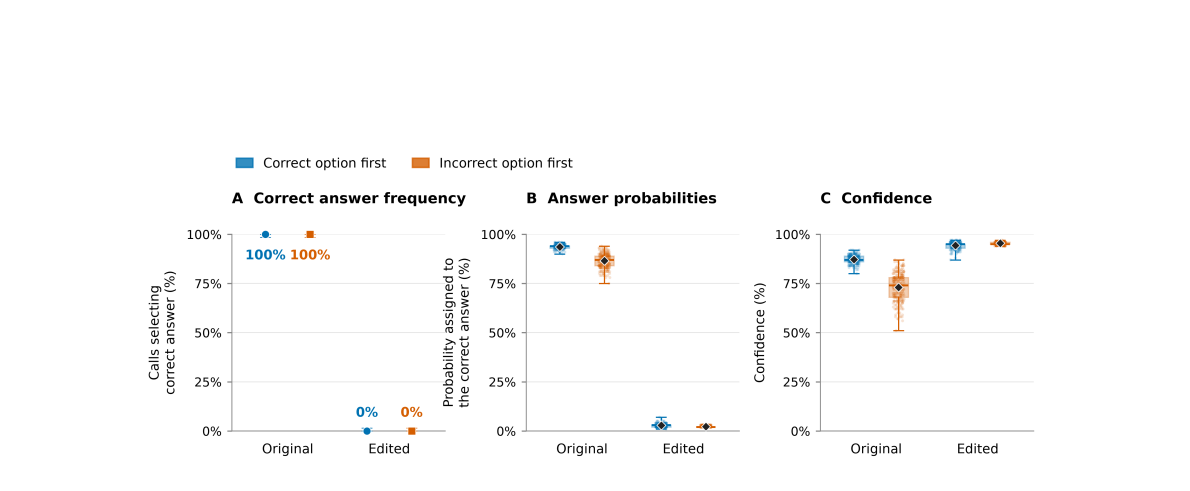
Core claim. 作者发现Jev在经典认知偏差任务(如合取谬误)的标准版本上达到100%正确率,但在措辞稍作调整的改编版本上却100%错误。通过30个合取场景的15,000次额外测试,Jev在54%的回答中违反合取规则,准确率随场景和答案顺序从0%到100%剧烈变化。这表明模型并非掌握了底层逻辑规则,而是依赖于训练数据中的表面模式。其他偏差(锚定、框架、零风险等)虽在最终选择上表现稳健,但概率分数和顺序敏感性同样揭示了隐蔽的脆弱性。
The premise it rests on. 论文假定观察到的失败模式代表了更广泛的系统性问题,但大部分偏差仅测试了一个原始和一个改编版本(除合取外),因此脆弱性可能局限于特定措辞,而非普遍存在于所有类似任务中。
If the paper is right (Pith's inferences, not the authors')
如果仅基于标准基准测试,会错误地认为Jev避免了合取谬误,而实际上它在多数变体中失败,这意味着当前AI决策模型的基准评估可能系统性地高估其能力。
答案顺序的微小变化可以彻底改变零风险情境中的最优选择(从99.6%下降到65.6%),对需要可靠一致输出的自动化决策系统(如金融交易、医疗诊断)构成严重风险。
即使最终选择不变,概率分数也会因锚定、框架等偏差显著变化,这可能改变下游行动(如自动处理阈值),影响实际部署的鲁棒性。
对无关数字信息的敏感性(锚定效应)表明模型缺乏过滤无关背景的能力,容易受到输入中偶然信息的操纵。
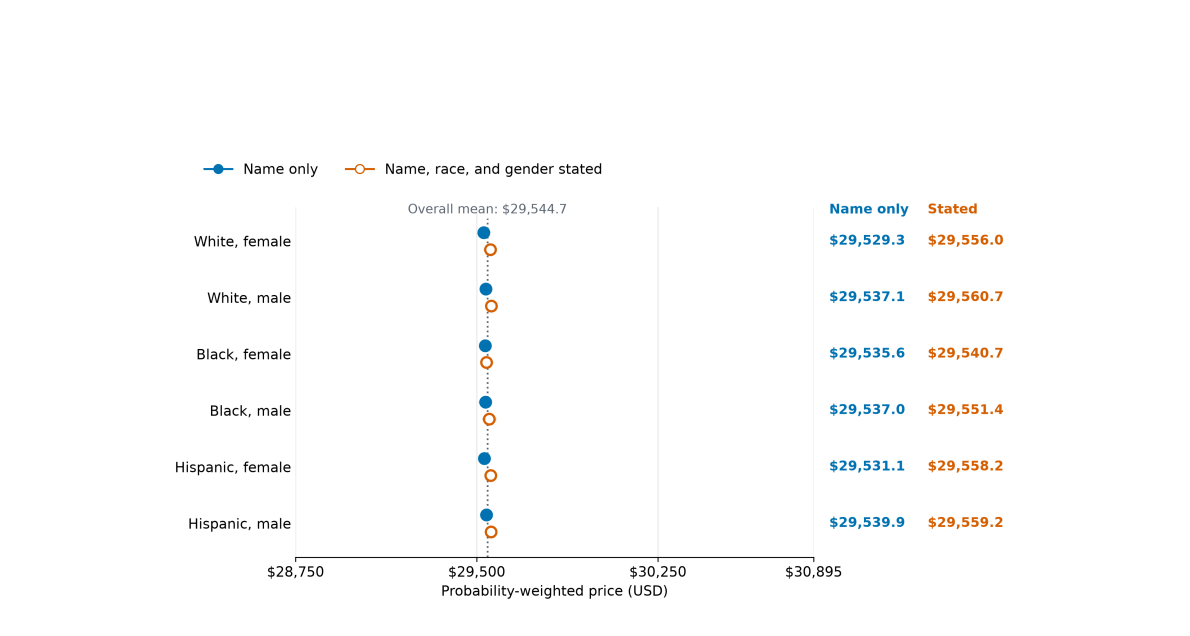
定价实验中人口统计差异很小,但方向与经典人类证据不一致,暗示这类模型可能在群体平等性上优于人类,但也可能无法捕捉真实世界的歧视模式,需要更细致的评估。
如果Jev的能力高度依赖于训练数据中特定表述的出现频率,那么评估应该包含对抗性压力测试,而不仅仅是标准基准;开发者应对模型进行基于逻辑规则的微调或后处理验证。
其他System One或类似快速决策模型(如Laya)可能共享类似的脆弱性,本研究的实验范式可跨模型应用以识别普遍性问题。
研究结果暗示,在必须严格遵守逻辑规则的场景(如法律推理、数学计算)中,不应依赖Jev的原始输出,而应加入外部验证或约束层。
Check this review
Pith stored no record of this review's passes and took no fingerprint of it. Reviews made by code from 13 Nov 2026 on carry both.
How often reviews like this one are right
Reviews like this one: written by deepseek-v4-flash, where what was read was not recorded.
How often objections from reviews like this one are right: not yet measured
Reviews by people
This review was written by a machine. No person has reviewed this paper on Pith yet. A scientist listed on Pith can review it for a fee, and their review is published here whatever it concludes.
The paper
Abstract
Do AI models designed for fast, structured decisions exhibit the cognitive and social biases observed in human judgment? We evaluate Jev, a model described as a System One decision-maker, using 41,500 responses across cognitive reflection tasks, five classical cognitive-bias paradigms, and a pricing experiment testing ethnic and gender bias. At the level of selected answers, the results are largely encouraging. We confirm previous findings that Jev performs extremely well on cognitive reflection problems. We also observe that it generally avoids the characteristic choice patterns associated with several well-documented human biases, and exhibits only small differences among demographic groups in the tested pricing scenario. However, this apparent robustness conceals important vulnerabilities. Its judgments are sensitive to irrelevant numerical information and the ordering of response options. Moreover, several cognitive-bias manipulations substantially affect returned probabilities even when selected answers remain unchanged. Most strikingly, Jev answers a well-known probability problem correctly in every response but violates the same underlying probability rule in every response to an adapted version. We investigate this discrepancy using 15,000 additional responses across 30 conjunction tasks. Jev violates the rule in 54% of responses, with accuracy varying dramatically across formulations and answer orders. These findings suggest that evaluating decision models solely on familiar benchmarks and selected answers may substantially overstate their reliability in practical applications. They also identify vulnerabilities for developers to address and practical considerations for users integrating such models into automated decision-making systems.
The paper's own sentences, arranged, kept beside the review and separate from it. Each label is drawn from a closed vocabulary; the number beside it is the probability the classifier gave that label. No sentence in this record was written by a model.
abstract compiled · 2026-10-15
The authors' main claim, as the classifier picked it out 1.00
“These findings suggest that evaluating decision models solely on familiar benchmarks and selected answers may substantially overstate their reliability in practical applications.”
How the main claim is stated: hedged possibility 0.99
What the abstract itself states, as probabilities: claims first 0.04 · states limitation 0.55 · human participants 0.11 · controlled comparison 0.11 · randomized assignment 0.03 · states quantitative result 0.99 · compares with prior results 0.85 · mentions code or data availability 0.03
The abstract, sentence by sentence
This table labels the abstract only (arXiv listing abstract v1). The number is the probability the classifier gave the label.
| Sentence | Role | The authors' own work | States the main conclusion | Strength |
|---|---|---|---|---|
| Do AI models designed for fast, structured decisions exhibit the cognitive and social biases observed in human judgment? | background 0.89 | 0.04 | 0.02 | unclear 0.93 |
| We evaluate Jev, a model described as a System One decision-maker, using 41,500 responses across cognitive reflection tasks, five classical cognitive-bias paradigms, and a pricing experiment testing ethnic and gender bias. | method 0.80 | 0.94 | 0.03 | asserted 0.97 |
| At the level of selected answers, the results are largely encouraging. | result 0.78 | 0.87 | 0.05 | asserted 0.99 |
| We confirm previous findings that Jev performs extremely well on cognitive reflection problems. | result 1.00 | 0.82 | 0.03 | asserted 1.00 |
| We also observe that it generally avoids the characteristic choice patterns associated with several well-documented human biases, and exhibits only small differences among demographic groups in the tested pricing scenario. | result 1.00 | 0.94 | 0.07 | asserted 1.00 |
| However, this apparent robustness conceals important vulnerabilities. | interpretation 0.75 | 0.54 | 0.15 | asserted 1.00 |
| Its judgments are sensitive to irrelevant numerical information and the ordering of response options. | result 1.00 | 0.90 | 0.05 | asserted 1.00 |
| Moreover, several cognitive-bias manipulations substantially affect returned probabilities even when selected answers remain unchanged. | result 1.00 | 0.94 | 0.06 | asserted 1.00 |
| Most strikingly, Jev answers a well-known probability problem correctly in every response but violates the same underlying probability rule in every response to an adapted version. | result 1.00 | 0.92 | 0.10 | asserted 1.00 |
| We investigate this discrepancy using 15,000 additional responses across 30 conjunction tasks. | method 0.94 | 0.95 | 0.02 | asserted 0.95 |
| Jev violates the rule in 54\% of responses, with accuracy varying dramatically across formulations and answer orders. | result 1.00 | 0.96 | 0.07 | asserted 1.00 |
| These findings suggest that evaluating decision models solely on familiar benchmarks and selected answers may substantially overstate their reliability in practical applications. | interpretation 1.00 | 0.75 | 0.87 | hedged possibility 0.99 |
| They also identify vulnerabilities for developers to address and practical considerations for users integrating such models into automated decision-making systems. | interpretation 0.81 | 0.69 | 0.12 | asserted 0.94 |
What kind of paper the classifier reports this is: empirical study 1.00 · evidence from observation or experiment 0.95
What was examined, and what was not
Sources read
- arXiv listing abstract v1
Not examined
- full text
- figures and tables
- references and citing sentences
- relations to other papers
Levels run
- P abstract
Not run
- S sections
- T body sentences
- C citations
- R cross-paper relations
How the labels were made
Compiled by classifier-1.13.0 via TypeSafe API, question bank abstract-p1-20260923, 2026-10-15: 1 request, 9,313 input tokens.
Every quoted sentence on this record is the authors'. Every label is from Pith's closed vocabulary, with the probability shown beside it. This record as JSON
Figures (6)
Figures are the authors', reproduced from the paper.
References (50)
- [1] Dual-Process Theories of Higher Cognition: Advancing the Debate , author=. Perspectives on Psychological Science , volume=. 2013 , doi= on Pith
- [2] Judgment under Uncertainty: Heuristics and Biases , author=. Science , volume=. 1974 , doi= on Pith
- [3] How black are Lakisha and Jamal? Racial perceptions from names used in correspondence audit studies , author=. Sociological Science , volume=. 2017 , publisher= on Pith
- [4] Racial/ethnic perceptions from Hispanic names: Selecting names to test for discrimination , author=. Socius , volume=. 2017 , publisher= on Pith
- [5] Selecting names for experiments on ethnic discrimination , author=. 2022 , institution= on Pith
- [6] Binz, Marcel and Schulz, Eric , journal =. Using cognitive psychology to understand. 2023 , doi = on Pith
- [7] Coda-Forno, Julian and Binz, Marcel and Wang, Jane X. and Schulz, Eric , booktitle =. 2024 , publisher = on Pith
- [8] Using Large Language Models to Simulate Multiple Humans and Replicate Human Subject Studies , author =. Proceedings of the 40th International Conference on Machine Learning , series =. 2023 , publisher = on Pith
- [9] Out of One, Many: Using Language Models to Simulate Human Samples , author =. Political Analysis , volume =. 2023 , doi = on Pith
- [10] Mei, Qiaozhu and Xie, Yutong and Yuan, Walter and Jackson, Matthew O. , journal =. A Turing test of whether. 2024 , doi = on Pith
- [11] A foundation model to predict and capture human cognition , author =. Nature , volume =. 2025 , doi = on Pith
- [12] Suri, Gaurav and Slater, Lily R. and Ziaee, Ali and Nguyen, Morgan , journal =. Do large language models show decision heuristics similar to humans? A case study using. 2024 , doi = on Pith
- [13] Hagendorff, Thilo and Fabi, Sarah and Kosinski, Michal , journal =. Human-like intuitive behavior and reasoning biases emerged in large language models but disappeared in. 2023 , doi = on Pith
- [14] Instructed to Bias: Instruction-Tuned Language Models Exhibit Emergent Cognitive Bias , author =. Transactions of the Association for Computational Linguistics , volume =. 2024 , doi = on Pith
- [15] Echterhoff, Jessica Maria and Liu, Yao and Alessa, Abeer and McAuley, Julian and He, Zexue , booktitle =. Cognitive Bias in Decision-Making with. 2024 , publisher =. doi:10.18653/v1/2024.findings-emnlp.739 , url = on Pithdoi:10.18653/v1/2024.findings-emnlp.739
- [16] Malberg, Simon and Poletukhin, Roman and Schuster, Carolin M. and Groh, Georg , booktitle =. A Comprehensive Evaluation of Cognitive Biases in. 2025 , publisher =. doi:10.18653/v1/2025.nlp4dh-1.50 , url = on Pithdoi:10.18653/v1/2025.nlp4dh-1.50
- [17] He, Jiangen and Liu, Jiqun , year =. Investigating the Impact of. 2502.14219 , archivePrefix = on PithPith's reviewarXiv
- [18] Chen, Zhen-Song and Jiao, Wei-Chen and Tsang, Y. P. and Wu, C. H. and Wang, Xian-Jia , journal =. Do. 2026 , doi = on Pith
- [19] Large Language Models Sensitivity to The Order of Options in Multiple-Choice Questions , author =. Findings of the Association for Computational Linguistics: NAACL 2024 , pages =. 2024 , publisher =. doi:10.18653/v1/2024.findings-naacl.130 , url = on Pithdoi:10.18653/v1/2024.findings-naacl.130
- [20] Large Language Models Are Not Robust Multiple Choice Selectors , author =. International Conference on Learning Representations , year = on Pith
show 30 more
- [21] Large Language Models are not Fair Evaluators , author =. Proceedings of the 62nd Annual Meeting of the Association for Computational Linguistics (Volume 1: Long Papers) , pages =. 2024 , publisher =. doi:10.18653/v1/2024.acl-long.511 , url = on Pithdoi:10.18653/v1/2024.acl-long.511
- [22] Benchmarking Cognitive Biases in Large Language Models as Evaluators , author =. Findings of the Association for Computational Linguistics: ACL 2024 , pages =. 2024 , publisher =. doi:10.18653/v1/2024.findings-acl.29 , url = on Pithdoi:10.18653/v1/2024.findings-acl.29
- [23] Parrish, Alicia and Chen, Angelica and Nangia, Nikita and Padmakumar, Vishakh and Phang, Jason and Thompson, Jana and Htut, Phu Mon and Bowman, Samuel R. , booktitle =. 2022 , publisher =. doi:10.18653/v1/2022.findings-acl.165 , url = on Pithdoi:10.18653/v1/2022.findings-acl.165
- [24] Social Bias Probing: Fairness Benchmarking for Language Models , author =. Proceedings of the 2024 Conference on Empirical Methods in Natural Language Processing , pages =. 2024 , publisher =. doi:10.18653/v1/2024.emnlp-main.812 , url = on Pithdoi:10.18653/v1/2024.emnlp-main.812
- [25] Evaluating and Mitigating Discrimination in Language Model Decisions , author =. 2023 , eprint = on Pith
- [26] Deu. Evaluating and Benchmarking the System One Model. 2026 , eprint = on Pith
- [27] Gao, Tianxiang and Li, Jinzhe and Li, Zhiyuan and Chang, Yi and Wu, Yuan , year =. More Choices, Fewer Decisions: Ordinal-Scale Bias in. 2609.38827 , archivePrefix = on PithPith's reviewarXiv
- [28] Li, Jiawei , year =. Fast Models, Slow Evidence: A Paired and Self-Audited Evaluation of System-1 Decision Models for. 2610.02267 , archivePrefix = on PithPith's reviewarXiv
- [29] Guo, Ruoqi and Liu, Yi and Deng, Gelei and Li, Yuekang and Zhao, Lida and Wu, Yutao and Chen, Simin and Zhang, Ying and Zhang, Leo Yu , year =. Just Ask. 2609.29429 , archivePrefix = on PithPith's reviewarXiv
- [30] Code Owns the Simulation, Jev Owns the Evaluation , author=. arXiv preprint arXiv:2610.01834 , year= on PithPith's reviewarXiv
- [31] Almeida, Diogo , title=. 2026 , month= on Pith
- [32] Cognitive Reflection and Decision Making , author=. Journal of Economic Perspectives , volume=. 2005 , doi= on Pith
- [33] Investigating an Alternate Form of the Cognitive Reflection Test , author=. Judgment and Decision Making , volume=. 2016 , doi= on Pith
- [34] Extensional versus Intuitive Reasoning: The Conjunction Fallacy in Probability Judgment , author=. Psychological Review , volume=. 1983 , doi= on Pith
- [35] The Conjunction Error and the Representativeness Heuristic , author=. Social Cognition , volume=. 1985 , doi= on Pith
- [36] The Conjunction Fallacy: A Task Specific Phenomenon? , author=. Personality and Social Psychology Bulletin , volume=. 1984 , doi= on Pith
- [37] Explaining the Enigmatic Anchoring Effect: Mechanisms of Selective Accessibility , author=. Journal of Personality and Social Psychology , volume=. 1997 , doi= on Pith
- [38] The Framing of Decisions and the Psychology of Choice , author=. Science , volume=. 1981 , doi= on Pith
- [39] On the Elicitation of Preferences for Alternative Therapies , author=. New England Journal of Medicine , volume=. 1982 , doi= on Pith
- [40] All Frames Are Not Created Equal: A Typology and Critical Analysis of Framing Effects , author=. Organizational Behavior and Human Decision Processes , volume=. 1998 , doi= on Pith
- [41] The Anchoring-and-Adjustment Heuristic: Why the Adjustments Are Insufficient , author=. Psychological Science , volume=. 2006 , doi= on Pith
- [42] The Psychology of Sunk Cost , author=. Organizational Behavior and Human Decision Processes , volume=. 1985 , doi= on Pith
- [43] Attitudes Toward Managing Hazardous Waste: What Should Be Cleaned Up and Who Should Pay for It? , author=. Risk Analysis , volume=. 1993 , doi= on Pith
- [44] Race and gender discrimination in bargaining for a new car , author=. The American Economic Review , pages=. 1995 , publisher= on Pith
- [45] Playing dice with criminal sentences: The influence of irrelevant anchors on experts’ judicial decision making , author=. Personality and Social Psychology Bulletin , volume=. 2006 , publisher= on Pith
- [46] Behavioral public HR: Experimental evidence on cognitive biases and debiasing interventions , author=. Review of Public Personnel Administration , volume=. 2020 , publisher= on Pith
- [47] An Investigation of the Rationality of Consumer Valuations of Multiple Health Risks , author=. The RAND Journal of Economics , volume=. 1987 , doi= on Pith
- [48] Knee-Deep in the Big Muddy: A Study of Escalating Commitment to a Chosen Course of Action , author=. Organizational Behavior and Human Performance , volume=. 1976 , doi= on Pith
- [49] Throwing Good Money After Bad: The Effect of Sunk Costs on the Decision to Escalate Commitment to an Ongoing Project , author=. Journal of Applied Psychology , volume=. 1990 , doi= on Pith
- [50] 2026 , howpublished = on Pith
Cited by 1 Pith paper
Reviewed papers on Pith that cite this one. The full citation record
Challenges and discussion
Disagree with the review, or know something it missed? Leave a comment, or challenge this review formally: a challenge becomes a permanent entry in this paper's record, and its decision is published here.
Come back by email
A short list of the week's newly reviewed papers. Nothing is sent until you confirm from your inbox, and every email has a link that stops it. No account.
No comments yet.
Sign in to comment