Artificial Intelligence · arXiv:2610.01834 v3 · submitted 1 Oct 2026
Code Owns the Simulation, Jev Owns the Evaluation
The paper says
“Judgment models such as \jev return, in a single call and without reasoning text, a probability for each described option. This makes them attractive as an agent's action-selection layer, but it is unclear which decisions they can be trusted with.”
more of the abstract
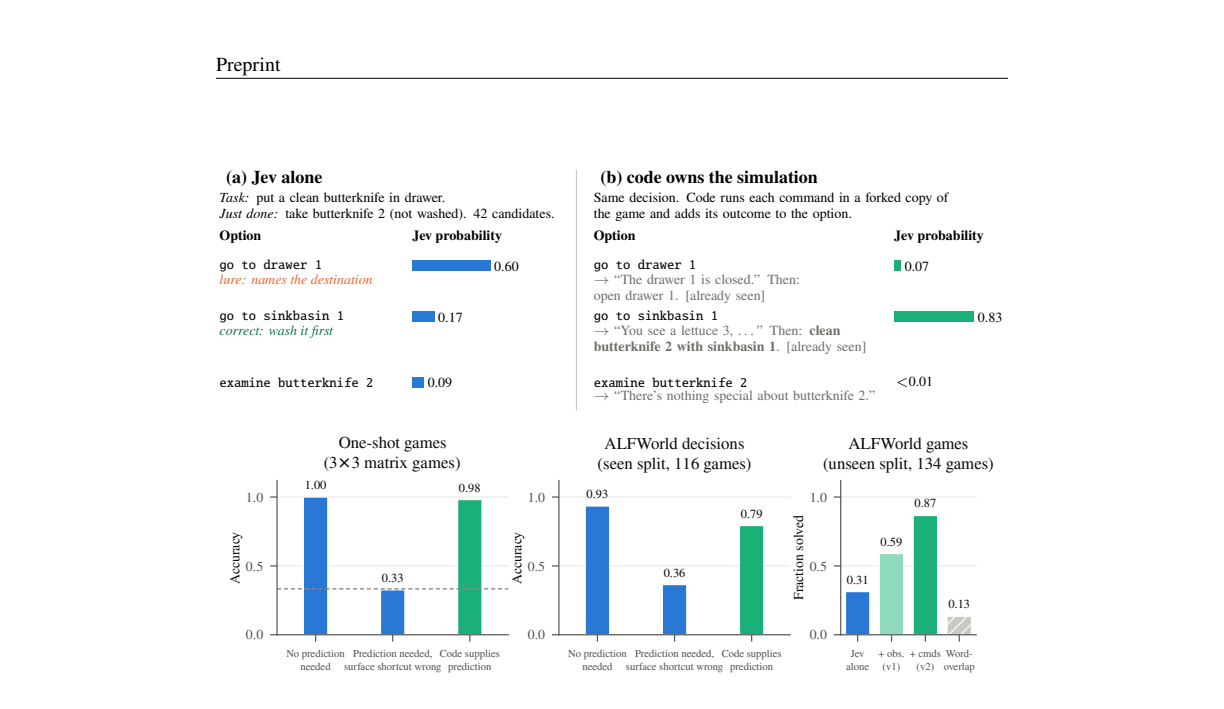
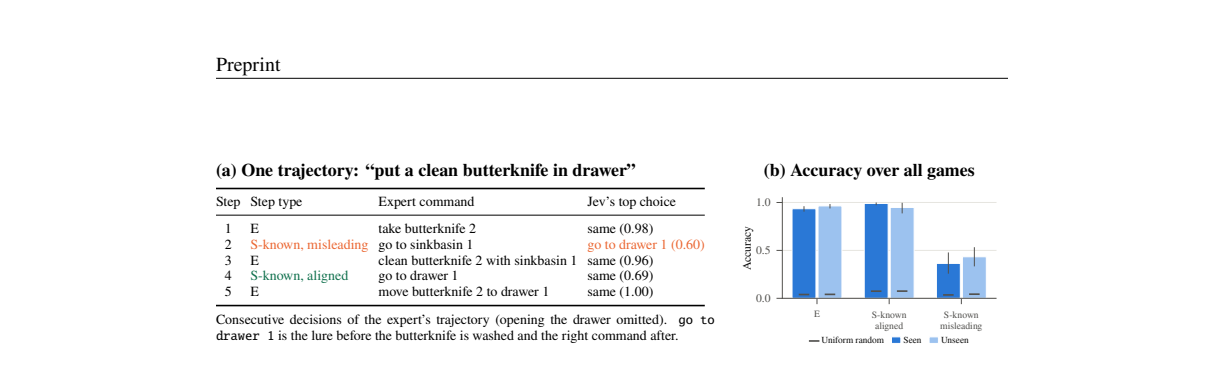
We test \jev on reflection tests, one-shot matrix games, the text game ALFWorld and robot control, and find a sharp boundary. \jev succeeds when the right option can be judged from what the input describes, which we call evaluation. Specifically, it solves 99% of the counterintuitive Cognitive Reflection Test questions. However, it fails when the right option depends on simulation (i.e., predicting something not in the input), such as the opponent's action or the subgoal that must come first. In games, \jev plays suboptimally as if its rational opponent acted at random, because the opponent's action is not given. In ALFWorld, \jev favors commands that mention an object or place named in the task description. For example, given the task “put a clean knife in the drawer”, \jev carries an unwashed knife straight to the drawer instead of first washing it at the sink. Surprisingly, many of these failures are not due to a lack of knowledge. Asked separately what the opponent will do, \jev usually answers correctly, and it responds well given the opponent's action. It fails when one call must both perform the simulation and evaluate based on it. This suggests letting code make the prediction or simulation. When code supplies it, such as a lookahead in ALFWorld and physics simulation in robot control, \jev becomes an expert controller through its general evaluation ability.
from the abstract
Pith says
Machine review · deepseek-v4-flash · 2 Oct 2026 · of version 1 of the paper; version 3 is newer · what was read was not recorded · not checked by a person
It can be wrong. Challenge this review or reply to it.
Holds up, with conditions. The evaluation/simulation split is a genuinely useful diagnosis and mostly well supported; the 'not a lack of knowledge' claim overreaches exactly where the stress-test says it does. This line is wrong
2 major objections · 3 minor
How often objections from reviews like this one are right: not yet measured
Not checked: figures, code, what the references say.
The paper says, at §4.3, Table 2, Appendix F
The review did not quote this passage.
Pith says: Objection 1 of 2 · major
The central causal clause — 'many of these failures are not due to a lack of knowledge' (abstract, §4.3, Contribution 2) — is not supported where the surface shortcut fails, and the paper's own Appendix F contains the contradicting numbers.
more of objection 1
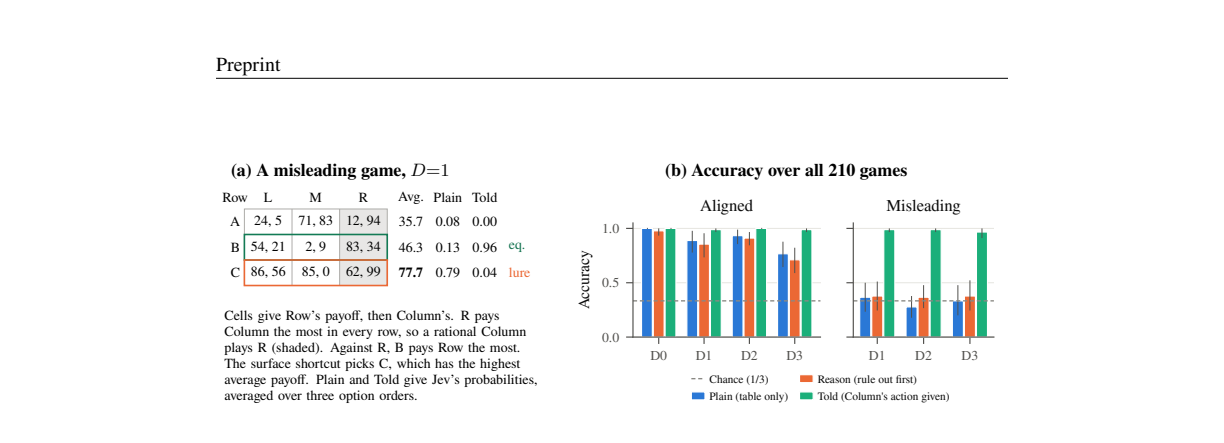
Jev's separate prediction is correct in 90% of the misleading games, but Appendix F reports that 88% of prediction calls pick the column with the highest average payoff to Column, and in the 17 misleading games where that column is not the equilibrium, Jev names Column's action correctly only 55% of the time. The main text does not reconcile this with the 90% figure. The consequence is that the write-back recovery (33%→94%) is an average over two very different regimes: in the roughly 73 misleading games where the level-1 column coincides with the equilibrium, Jev's separate prediction is right and write-back restores accuracy to near 100%, whereas in the 17 hard games write-back yields roughly 55%. Likewise, the evidence cited for 'knows but does not use' — plain condition accuracy of 32% with a right separate prediction vs 35% with a wrong one — is exactly what one expects if both the decision and the separate prediction are independent level-1 shortcuts (the choice is level-1 over Row's payoffs, the prediction is level-1 over Column's payoffs, Appendix C); it does not establish that Jev possesses a non-shortcut prediction and fails to deploy it. I recommend reporting the 17-game breakdown in the main text, presenting the 94% write-back number together with the hard-case 55%, and restating the cause as: Jev can evaluate a supplied prediction (told condition, 98%), but its separate prediction is the same surface shortcut used by its decision, so the joint-call failure is established only where the shortcut happens to answer the prediction question.
The paper says, at §6, Table 3
The review did not quote this passage.
Pith says: Objection 2 of 2 · major
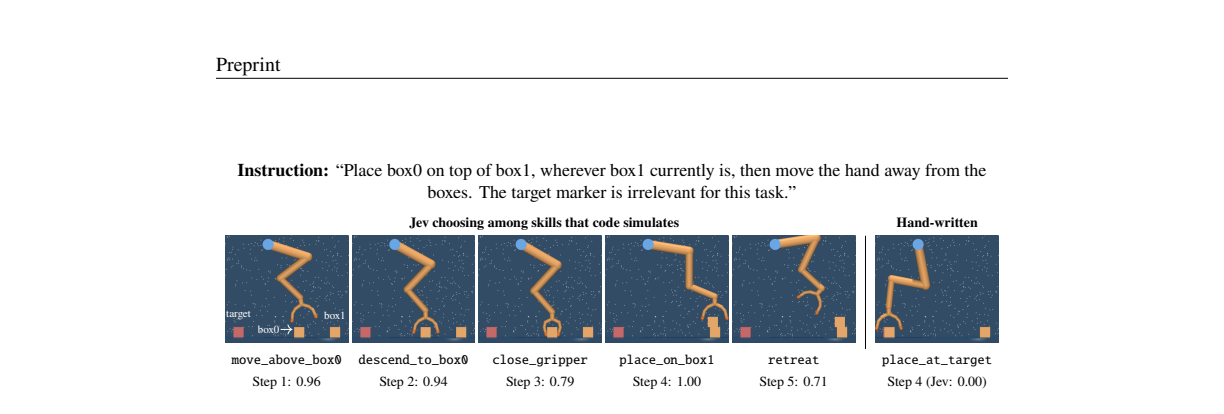
The robot-control comparison is not controlled in the way the games and ALFWorld comparisons are. In the raw-torque condition Jev chooses among five torque levels per actuator with a hand-authored description of each torque direction, whereas in the skills condition Jev chooses among IK-simulated skills and receives a heavily enriched state that code computes from the simulator (valid_primitives_now, last_outcome, held_box_relations, hand_to_target_m, etc.).
more of objection 2
The paper acknowledges the action-level difference but concludes from the contrast alone that 'code provides the simulation, so that Jev only needs to evaluate.' The conclusion conflates three changes: action interface, state enrichment, and the simulation content of the skills. ALFWorld had the right control (word-overlap rule with identical lookahead information); Stacker has only a random-choice baseline (1/20), which does not separate Jev's evaluation from the code-computed state fields. A concrete test would be to run the skills condition with the code-computed state fields removed (or with a non-simulating placeholder such as the last real outcome) to confirm the gain comes from Jev's evaluation of simulated outcomes rather than from the richer state description alone.
3 minor objections
The paper says, at Appendix B
Pith says: minor objection 1 of 3
The CRT control revision (88% on the first run, 96% on the reported run, with the lure result unchanged at 99%) is disclosed carefully and the fixes address genuine ambiguities, such as the type-2 control where 7 hours is defensible under a whole-jacket reading. I would recommend stating explicitly in the main text or Table 1 caption that the control numbers come from a revised run, so that readers do not attribute the 96% to the originally stated protocol.
The paper says, at Table 6
Pith says: minor objection 2 of 3
The two closed-loop runs differ by several games (42 vs 39, 79 vs 84, 116 vs 117). The variance is disclosed and is consistent with the 0.04 API noise reported in Appendix A, but the headline '31% to 87%' would be more precise presented with the Run 2 range; consider reporting a pooled interval over both runs in the figure caption.
show 1 more
The paper says, at Abstract and Figure 1
Pith says: minor objection 3 of 3
The rendered text contains missing spaces ('WetestJevonreflectiontests') and Figure 1's caption uses arrows and tags ('Then:') that are visually clear only in the compiled figure; the abstract spacing typos should be fixed at revision.
What would settle it
Re-run the write-back and prediction conditions of §4.3 / Appendix F restricted to the 17 misleading games (D≥1, three option orders) where Column's maximum-average-payoff action is not the equilibrium action. If decision accuracy with Jev's own prediction written into the state stays near Jev's 55% separate-prediction rate instead of approaching the 98% told-condition rate, the §4.3 recovery is an artifact of the ~73 games where the level-1 column coincides with the equilibrium, and the 'knowing is not using' clause must be narrowed to cases where the level-1 prediction is aligned. Also report told-condition accuracy on these 17 games: if told is near 100% while write-back is near 55%, the bottleneck is knowledge of the prediction, not the single-call structure.
from the skeptic's reading
How the review went
4 readings by deepseek-v4-flash · 2 Oct 2026
- Reader holds up, with conditions
- Skeptic partly agrees
- Editor wrote the verdict above
- Referee major revision: 2 major objections, 3 minor
Not run on this paper: the simulated authors' defence.
Pith did not check this review's objections against the paper.
The review in full
The review in brief, machine-written
Read this if you care about where to trust a judgment model as an action layer. The core claim is that Jev — a no-reasoning-text model returning probabilities over described options — is a reliable evaluator but not a simulator: it succeeds when the answer can be checked against the input, and fails when the right option requires predicting something not in the input (opponent's action, next subgoal, physics). That split is crisper than anything in the cited literature on LLM planning failures, and they support it across three strong domains: 99% on CRT lures, 210 matrix games with a depth regression showing alignment, not depth, drives accuracy, and ALFWorld with a fixed surface shortcut defined on the unseen split and tested on the seen one. The word-overlap control is a real plus — it shows the lookahead gain comes from Jev's evaluation, not from the extra text.
The soft spot is the headline causal clause, "many of these failures are not due to a lack of knowledge." The stress-test is right. The 90% separate-call prediction and 94% write-back recovery are aggregates dominated by the ~73 misleading games where Jev's level-1 prediction (highest average payoff to Column) happens to coincide with the equilibrium. In the 17 genuinely hard games, where the level-1 column is wrong, Jev names Column's action only 55% of the time — near chance — and write-back cannot recover. Appendix F contains these numbers, so nothing is hidden, but the limitation "partly post hoc" does not quantify how badly this cuts. The honest version: Jev uses a supplied prediction well (told, 97–99%; lookahead; physics sim), but its own separate-call prediction is itself a level-1 shortcut that fails exactly where the decision fails. "Knows but fails to use" holds where the shortcut is aligned; in the hard cases it does not know.
That does not sink the paper. The central diagnosis — evaluation works, simulation does not, code-supplied prediction restores performance — stands on the told condition, the ALFWorld lookahead, and the physics simulation, none of which rely on Jev's separate-call knowledge. The robot section is thin (20 and 40 episodes, no intervals) but honest, and the single-model/single-API limitation is stated plainly.
Who is it for: anyone building LLM-policy agents or deciding where "System One" style models can be trusted. It deserves a real referee. The main revision request is to reframe the cause claim so it does not oversell knowledge where the shortcut is wrong, and to make the game-probe analysis the centerpiece of that discussion. Accept for review.
The strongest objection
The paper's strongest causal clause — 'many of these failures are not due to a lack of knowledge' (abstract, §4.3, b9), adopted by the reader — rests on the separate-call probes. In games, Jev predicts Column's equilibrium action 90% of the time (§4.3, Table 2), writing Jev's own prediction back raises misleading-game accuracy from 33% to 94%, and the paper concludes the failure is a single call that must both simulate and evaluate. But Appendix F shows this prediction is itself the level-1 rule: 'Jev picks the column with the highest average payoff to Column in 88% of calls,' and in the 17 misleading games where that level-1 column is not the equilibrium, Jev names Column's action correctly only 55% of the time — near chance. Those 17 games are exactly the hardest cases, where the surface shortcut is wrong in both the decision (Row's max-average action) and the prediction (Column's max-average action). Because Jev's best response to a written action is near-perfect, write-back decision accuracy tracks prediction accuracy: it recovers (~100%) in the ~73 misleading games where the level-1 column is already the equilibrium, and yields roughly 55% in the 17 hard games, which produces the 94% aggregate. The aggregate therefore does not show that Jev 'knows but fails to use'; it shows that writing back an error-free prediction only helps where Jev's separate prediction already coincides with the level-1 shortcut. Where the shortcut is wrong, Jev does not know (55% prediction) and code writing back its own answer does not recover the decision. The same pattern is visible in ALFWorld's goal form (Table 2: predict 0.33, own-z 0.33). The paper discloses the level-1 nature (§4.3, Appendix F) and the authors concede the written content carries the gain, but the headline causal claim — failure stems from one call doing simulation-plus-evaluation rather than from missing knowledge — is only established inside the subset where the prediction shortcut is aligned.
The reader's weakest_assumption concerned the evaluation/simulation and aligned/misleading labels. I agree those labels are load-bearing, but I found a sharper, partially unacknowledged problem in the clause the reader adopted as the strongest claim: 'The failures are not from missing knowledge.' The games evidence for that clause decomposes by whether Jev's separate prediction is itself a correct level-1 guess. In the 17 misleading games where the level-1 column is not the equilibrium, Jev's separate prediction is only 55% correct, so the write-back remedy cannot recover those decisions; there the failure is genuinely a knowledge failure, not a single-call failure. The paper discloses the level-1 nature of the prediction probe and the 55%-in-17-games number, but the abstract and §4.3 framing ('Jev fails when one call must both perform the simulation and evaluate based on it') overstate the scope of the knowledge-not-lacking claim, and the 94% write-back aggregate hides that the recovery is concentrated in games where the shortcut already points the right way. This does not overturn the paper: the core diagnosis — Jev evaluates well, follows the surface shortcut when simulation is required, and benefits from code-supplied predictions — is coherent and reproducible as far as disclosed, and the reader's CONDITIONAL verdict already covers generality and labeling risks. My concern adds a third reason the verdict should stay conditional rather than rise to ACCEPT: the central causal mechanism, as stated, is only demonstrated within the aligned-prediction subset. Hence UNCHANGED, with the recommendation that the claim be narrowed or the hard-game write-back be shown to recover.
The referee's report
If the boundary holds, the paper has practical value: it identifies where judge-only decision layers can be trusted (choice among options whose goodness is in the input) and prescribes a concrete architecture (code or a separate call supplies the missing prediction). The strongest evidence is genuinely controlled. The ALFWorld surface shortcut was fixed on the unseen split and then tested on the seen split (Section 5.1, Appendix D); the games aligned/misleading split uses the standard level-1 rule of behavioral game theory rather than a rule invented to match Jev; the lookahead gain is contrasted with a word-overlap rule with the same lookahead information (18/134 vs 116/134); and the depth regression shows depth has no effect once alignment is included (Appendix C). The paper also ships a fitted quantal level-1 model, McNemar tests on the closed-loop gains, and disclosed run-to-run API variance.
Pith's reading of the paper (a machine's summary, not the authors')
The paper studies Jev, a judgment model that returns a probability for each described option in a single call without any reasoning text, and asks which decisions such a model can be trusted with. Across cognitive reflection tests, one-shot matrix games, the text game ALFWorld and robot control, it finds a sharp boundary: Jev succeeds when the right option can be judged from what the input already describes, which it calls evaluation, but fails when the right option depends on predicting something the input does not state, which it calls simulation. The failures are not a lack of knowledge: asked separately, Jev predicts the opponent's action 90% of the time and plays the best response 98% of the time once the action is given. The paper therefore traces the failure to a single call that must both perform the simulation and evaluate based on it, and shows that letting code supply the prediction — a lookahead in ALFWorld, physics simulation in robot control — turns Jev into a strong controller.
What carries the argument. The central object is the two-way split defined as Definition 1 and Definition 2 in Section 2: a decision needs only evaluation when the correct option can be judged from what the state and the option descriptions say, and it depends on simulation when finding the correct option requires a prediction $z$ carrying information not in the input. A fixed surface shortcut — the action with the highest average payoff in games, the commands mentioning task-named objects in ALFWorld — then splits simulation-dependent decisions into aligned ones, where the shortcut happens to pick a correct option, and misleading ones, where the shortcut picks the wrong lure. The load-bearing evidence is the contrast between Jev's near-perfect answers when the prediction is written into the option list or the state, and its chance-level performance in the plain single-call condition; a one-parameter softmax over average payoff, a soft version of the level-1 rule, reproduces its probabilities and barely improves when the equilibrium action is added as a feature.
Core claim. Jev is an evaluator, not a simulator. When the correct answer can be checked against what the input describes, it is almost always right: it avoids the intuitive lure on 99% of Cognitive Reflection Test questions, and its errors, when they occur, go almost entirely to the lure. When the correct answer requires a prediction not in the input, it follows a surface shortcut: in matrix games it plays as if a rational opponent acted at random, scoring actions by average payoff as a soft level-1 rule; in ALFWorld it favors commands that mention an object or place named in the task, carrying an unwashed knife to the drawer instead of first washing it at the sink. The decisive evidence that these failures are not ignorance is that the same model predicts the opponent's equilibrium action correctly 90% of the time in a separate call and chooses optimally 98% of the time once that action is stated, while a single call that must both predict and evaluate is right only 33% of the time. Stating the prediction in the input, whether from code's lookahead, physics simulation, or a second Jev call written back into the state, raises accuracy to 94–98% in misleading games, lifts solved unseen ALFWorld games from 31% to 87%, and lets Jev match a hand-written robot controller on the native task while exceeding it on new instructions.
The premise it rests on. The clean boundary rests on the authors' own labels of each decision as needing only evaluation or depending on simulation, and on the hand-chosen surface shortcut that defines the aligned versus misleading split; if those labels do not faithfully capture what a decision actually requires, the boundary is an artifact of labeling, a risk the paper partly concedes by acknowledging that its analysis of which predictions Jev can make from the input is partly post hoc.
If the paper is right (Pith's inferences, not the authors')
A judgment model without reasoning text is a trustworthy action-selection layer exactly when code or a separate call supplies the missing prediction; with the prediction given, Jev chooses optimally 98% of the time in games and solves 87% of unseen ALFWorld games with a code lookahead.
Adding an instruction to reason does not help, because an instruction adds no prediction: in misleading one-shot games Jev stays at chance even when told to rule out dominated actions first.
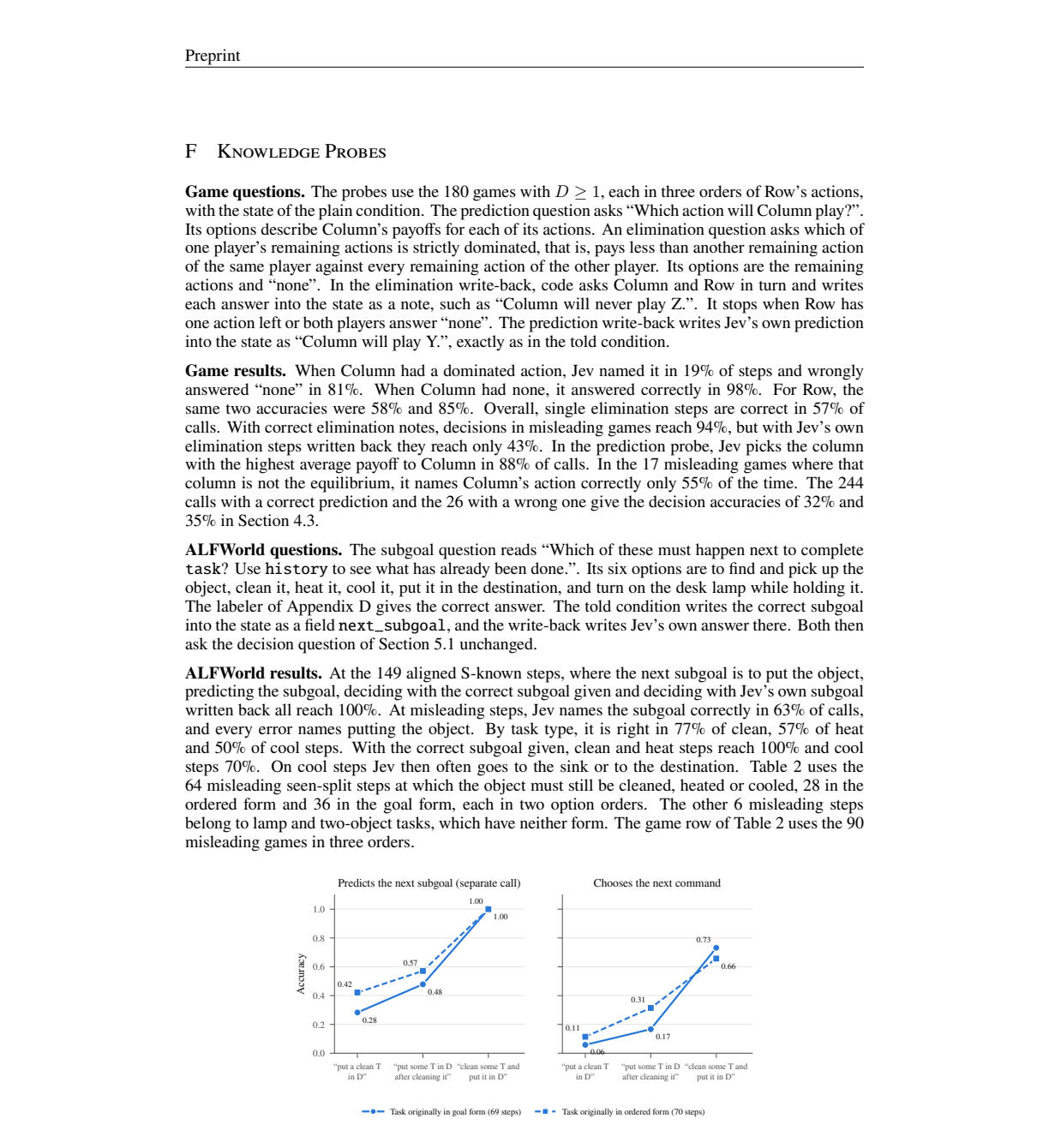
When Jev can state the missing prediction in a separate call, writing its own answer back into the state restores the decision (33% to 94% in misleading games); when it cannot, as with the goal-form subgoal of the unwashed knife, code must obtain the prediction from a simulator, a learned world model, or a larger reasoning model.
In robot control the same division holds: Jev with raw torque options never picks up a box, while Jev choosing among code-simulated skills matches a hand-written controller on the native task and generalizes to new instructions (22 of 40 episodes against 3), showing the evaluation ability rather than the controller text carries the generalization.
The boundary is most plausibly a property of judgment-style models in general rather than of Jev alone; the sharpest test is to rerun the one-shot games, ALFWorld probes, and the told/write-back conditions on any other model that answers without reasoning text, which the paper explicitly leaves open.
The diagnosis composes with model-based reinforcement learning: if 'code owns the world model, judgment owns the evaluation' is the design rule, then adding a learned forward model to the code side should extend the fix to settings where no exact copy of the environment exists, which the paper notes a real agent may lack.
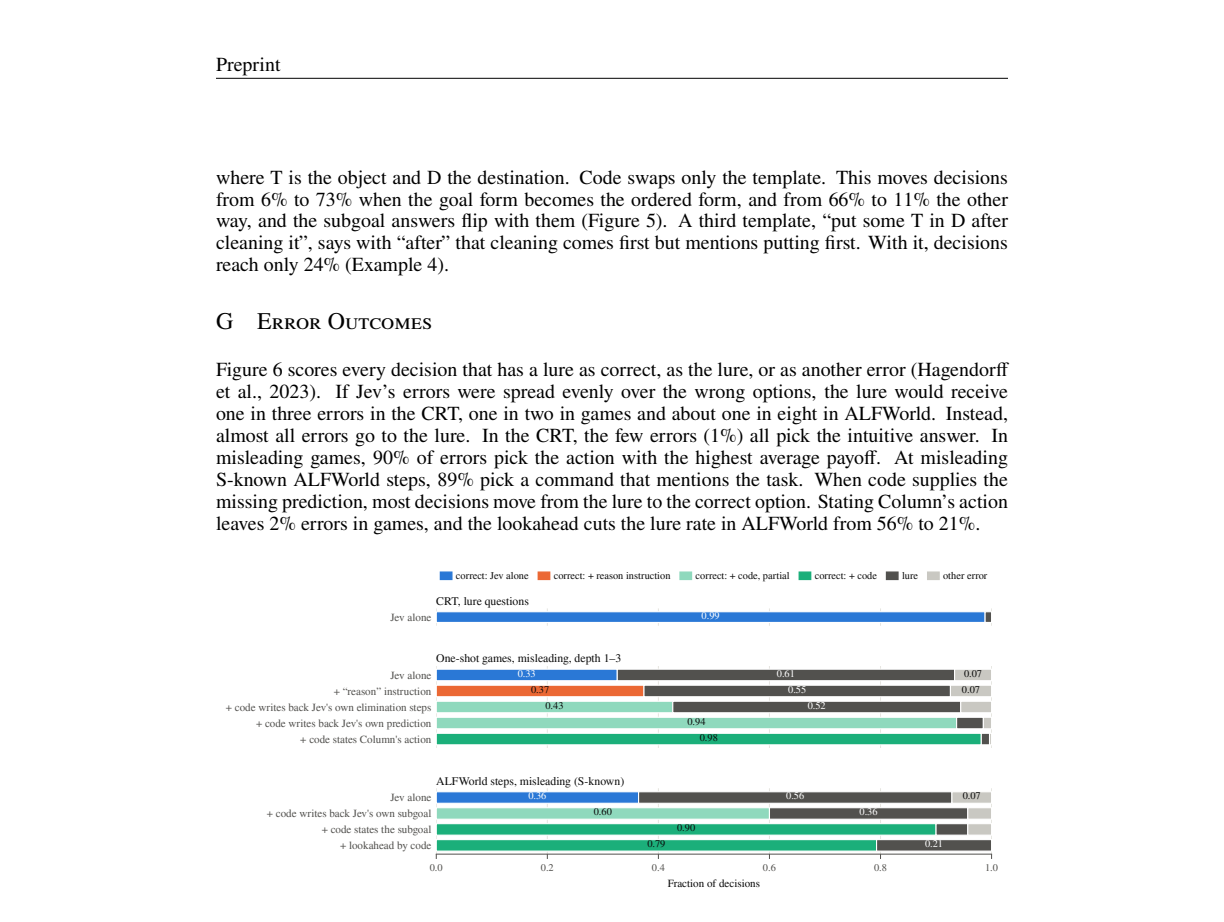
The lure-rate evidence (90% of misleading-game errors and 89% of misleading ALFWorld errors land on the lure) implies that benchmark success rates conceal a systematic per-decision failure mode that only decision-level labeling exposes, so aggregate scores understate both the model's evaluation strength and its simulation weakness.
The CRT control result (96% correct when the intuitive answer is right) rules out a generic anti-intuition bias, so the evaluation/simulation line is doing the explanatory work; a natural extension is to probe whether the boundary shifts when reasoning text is permitted and the model is free to chain multiple calls.
Check this review
Pith stored no record of this review's passes and took no fingerprint of it. Reviews made by code from 13 Nov 2026 on carry both.
How often reviews like this one are right
Reviews like this one: written by deepseek-v4-flash, where what was read was not recorded.
How often objections from reviews like this one are right: not yet measured
Reviews by people
This review was written by a machine. No person has reviewed this paper on Pith yet. A scientist listed on Pith can review it for a fee, and their review is published here whatever it concludes.
The paper
Abstract
Judgment models such as \jev return, in a single call and without reasoning text, a probability for each described option. This makes them attractive as an agent's action-selection layer, but it is unclear which decisions they can be trusted with. We test \jev on reflection tests, one-shot matrix games, the text game ALFWorld and robot control, and find a sharp boundary. \jev succeeds when the right option can be judged from what the input describes, which we call evaluation. Specifically, it solves 99% of the counterintuitive Cognitive Reflection Test questions. However, it fails when the right option depends on simulation (i.e., predicting something not in the input), such as the opponent's action or the subgoal that must come first. In games, \jev plays suboptimally as if its rational opponent acted at random, because the opponent's action is not given. In ALFWorld, \jev favors commands that mention an object or place named in the task description. For example, given the task “put a clean knife in the drawer”, \jev carries an unwashed knife straight to the drawer instead of first washing it at the sink. Surprisingly, many of these failures are not due to a lack of knowledge. Asked separately what the opponent will do, \jev usually answers correctly, and it responds well given the opponent's action. It fails when one call must both perform the simulation and evaluate based on it. This suggests letting code make the prediction or simulation. When code supplies it, such as a lookahead in ALFWorld and physics simulation in robot control, \jev becomes an expert controller through its general evaluation ability.
The paper's own sentences, arranged, kept beside the review and separate from it. Each label is drawn from a closed vocabulary; the number beside it is the probability the classifier gave that label. No sentence in this record was written by a model.
abstract compiled · 2026-10-02
The authors' main claim, as the classifier picked it out 0.61
“When code supplies it, such as a lookahead in ALFWorld and physics simulation in robot control, \jev{} becomes an expert controller through its general evaluation ability.”
How the main claim is stated: asserted 0.99
What the abstract itself states, as probabilities: claims first 0.04 · states limitation 0.70 · human participants 0.06 · controlled comparison 0.14 · randomized assignment 0.02 · states quantitative result 0.98 · compares with prior results 0.19 · mentions code or data availability 0.05
The abstract, sentence by sentence
This table labels the abstract only (arXiv listing abstract v1). The number is the probability the classifier gave the label.
| Sentence | Role | The authors' own work | States the main conclusion | Strength |
|---|---|---|---|---|
| Judgment models such as \jev{} return, in a single call and without reasoning text, a probability for each described option. | background 0.95 | 0.08 | 0.04 | asserted 1.00 |
| This makes them attractive as an agent's action-selection layer, but it is unclear which decisions they can be trusted with. | gap 0.78 | 0.06 | 0.05 | asserted 0.88 |
| We test \jev{} on reflection tests, one-shot matrix games, the text game ALFWorld and robot control, and find a sharp boundary. | contribution 0.77 | 0.97 | 0.12 | asserted 1.00 |
| \jev{} succeeds when the right option can be judged from what the input describes, which we call \emph{evaluation}. | result 0.86 | 0.81 | 0.40 | asserted 1.00 |
| Specifically, it solves 99\% of the counterintuitive Cognitive Reflection Test questions. | result 1.00 | 0.89 | 0.06 | asserted 1.00 |
| However, it fails when the right option depends on \emph{simulation} (i.e., predicting something not in the input), such as the opponent's action or the subgoal that must come first. | result 0.96 | 0.86 | 0.39 | asserted 1.00 |
| In games, \jev{} plays suboptimally as if its rational opponent acted at random, because the opponent's action is not given. | result 0.97 | 0.89 | 0.09 | asserted 1.00 |
| In ALFWorld, \jev{} favors commands that mention an object or place named in the task description. | result 1.00 | 0.92 | 0.04 | asserted 1.00 |
| For example, given the task ``put a clean knife in the drawer'', \jev{} carries an unwashed knife straight to the drawer instead of first washing it at the sink. | result 1.00 | 0.88 | 0.03 | asserted 1.00 |
| Surprisingly, many of these failures are not due to a lack of knowledge. | result 0.87 | 0.83 | 0.05 | asserted 0.98 |
| Asked separately what the opponent will do, \jev{} usually answers correctly, and it responds well given the opponent's action. | result 0.96 | 0.91 | 0.06 | asserted 0.96 |
| It fails when one call must both perform the simulation and evaluate based on it. | result 0.59 | 0.83 | 0.28 | asserted 1.00 |
| This suggests letting code make the prediction or simulation. | interpretation 0.79 | 0.24 | 0.49 | hedged possibility 0.99 |
| When code supplies it, such as a lookahead in ALFWorld and physics simulation in robot control, \jev{} becomes an expert controller through its general evaluation ability. | result 0.71 | 0.84 | 0.71 | asserted 0.99 |
What kind of paper the classifier reports this is: empirical study 0.99 · evidence from observation or experiment 0.96
What was examined, and what was not
Sources read
- arXiv listing abstract v1
Not examined
- full text
- figures and tables
- references and citing sentences
- relations to other papers
Levels run
- P abstract
Not run
- S sections
- T body sentences
- C citations
- R cross-paper relations
How the labels were made
Compiled by classifier-1.13.0 via TypeSafe API, question bank abstract-p1-20260923, 2026-10-02: 1 request, 10,108 input tokens.
Every quoted sentence on this record is the authors'. Every label is from Pith's closed vocabulary, with the probability shown beside it. This record as JSON
Figures (6)
Figures are the authors', reproduced from the paper.
Cited by 6 Pith papers
Reviewed papers on Pith that cite this one. The full citation record
- JevRisk: Zero-Shot Financial Risk Assessment with a Language Decision Model cs.LG · Nov 2026
- Stop Going in Circles:Loop-Triggered Routing for System 1 Decision Agents cs.AI · Nov 2026
- Actor, Judge, or Teacher? Understanding Decision Models in Long-Horizon Agents cs.AI · Nov 2026
- Jev with Foresight: Safe Language-Guided Autonomous Driving via a Language World Model cs.RO · Nov 2026
- Are AI Decision Models Biased? A Case Study of Jev cs.AI · Oct 2026
- Foundation Models for Autonomous Space Robotics: Architectures, Physical Adaptation, and Validation cs.RO · Oct 2026
Challenges and discussion
Disagree with the review, or know something it missed? Leave a comment, or challenge this review formally: a challenge becomes a permanent entry in this paper's record, and its decision is published here.
Come back by email
A short list of the week's newly reviewed papers. Nothing is sent until you confirm from your inbox, and every email has a link that stops it. No account.
No comments yet.
Sign in to comment