Robotics · arXiv:2610.23068 v1 · submitted 16 Oct 2026 · 124 references
Foundation Models for Autonomous Space Robotics: Architectures, Physical Adaptation, and Validation
The paper says
“Space robots must interpret tasks and act despite unfamiliar dynamics, difficult sensing conditions, and limited opportunities for human intervention. Foundation models offer reusable perceptual and behavioral knowledge, but their value depends on how that knowledge reaches physical execution.”
more of the abstract
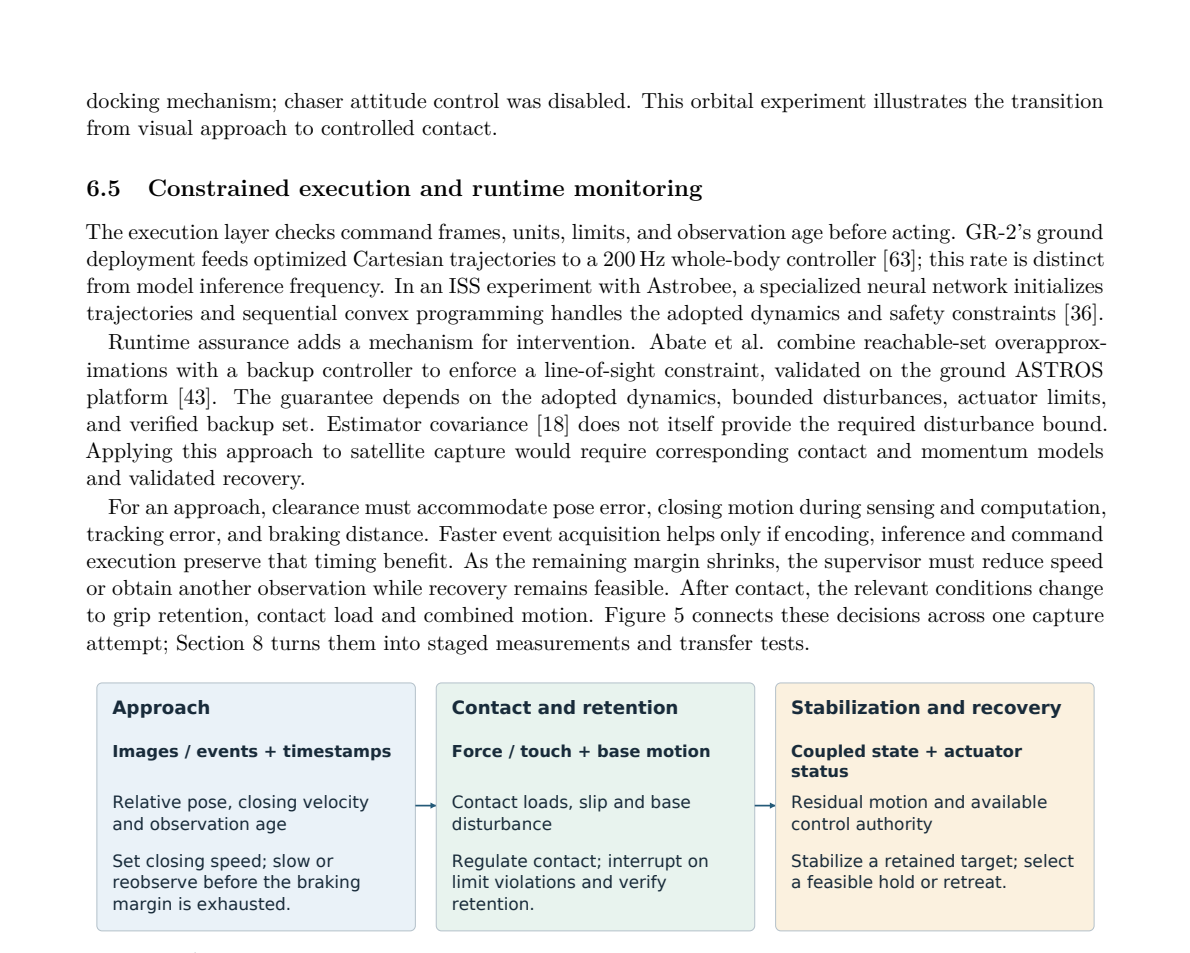
This critical review follows space-specific requirements through perception, prediction, planning, and action to deployment and validation, emphasizing orbital manipulation and proximity operations. Terrestrial comparisons establish benefits of particular pretraining stages and model interfaces; their transfer to space dynamics and constrained onboard operation remains insufficiently tested. Event cameras offer timely motion observations across strong illumination contrasts, while spiking neural networks provide possible routes to sparse local computation. We examine how sensor degradation, state estimation and computing choices affect feedback and recovery. Higher action throughput need not yield fresher feedback; lower processor power can also coexist with higher energy per inference. We organize validation as an iterative sim-to-ground-to-space pathway, connecting physical tests with telemetry-based diagnosis and closed-loop revalidation. A satellite-capture example links observations to approach, contact and recovery, while a corresponding protocol separates generalization from adaptation with limited target-domain interaction. These comparisons identify what models already contribute and the physical evidence needed to support autonomous space operation.
from the abstract
Pith says
Machine review · deepseek-v4-flash · 19 Oct 2026 · what was read was not recorded · not checked by a person
It can be wrong. Challenge this review or reply to it.
Holds up, with conditions. A well-structured critical survey that synthesizes space-robotics constraints with foundation-model architectures, but the central gap claim is uncheckable without the promised ancillary inventory. This line is wrong
1 major objection · 4 minor
How often objections from reviews like this one are right: not yet measured
Not checked: figures, code, what the 124 references say.
The paper says, at §1.3, §9.1
The review did not quote this passage.
A classifier read this sentence of the paper as acknowledging the concern (probability 0.71):
“Purposive selection limits complete- ness, and differences between tasks preclude pooled performance rankings.”
Pith says: Objection 1 of 1 · major
The paper's primary conclusion—that no existing work jointly tests task reuse, coupled dynamics, sustained computation, and recovery for foundation-model systems—rests on the completeness of a purposively selected literature (acknowledged in b39: 'Purposive selection limits completeness'). The authors state (§1.3) that 'unresolved candidates and a local unpublished survey were excluded' and promise an 'ancillary inventory' that is absent from the manuscript.
more of objection 1
Without this inventory, an external reader cannot verify whether an omitted study already constitutes such a joint test. If one exists, the paper's headline finding loses force. This is a load-bearing issue: the missing artifact makes the central conclusion uncheckable, not merely imprecise. The authors should provide the promised inventory or otherwise document the search process, exclusion criteria, and specific unresolved candidates to allow assessment of coverage.
4 minor objections
The paper says, at §1.2
Pith says: minor objection 1 of 4
The comparison with the multimodal space-robot review [7] is explicitly limited to its abstract (§1.2). While this is a valid choice given the review's scope, the authors should note potential misclassification risk if the full paper organizes evidence differently, or supplement with a sentence explaining that a deeper comparison was not feasible.
The paper says, at Table 6
Pith says: minor objection 2 of 4
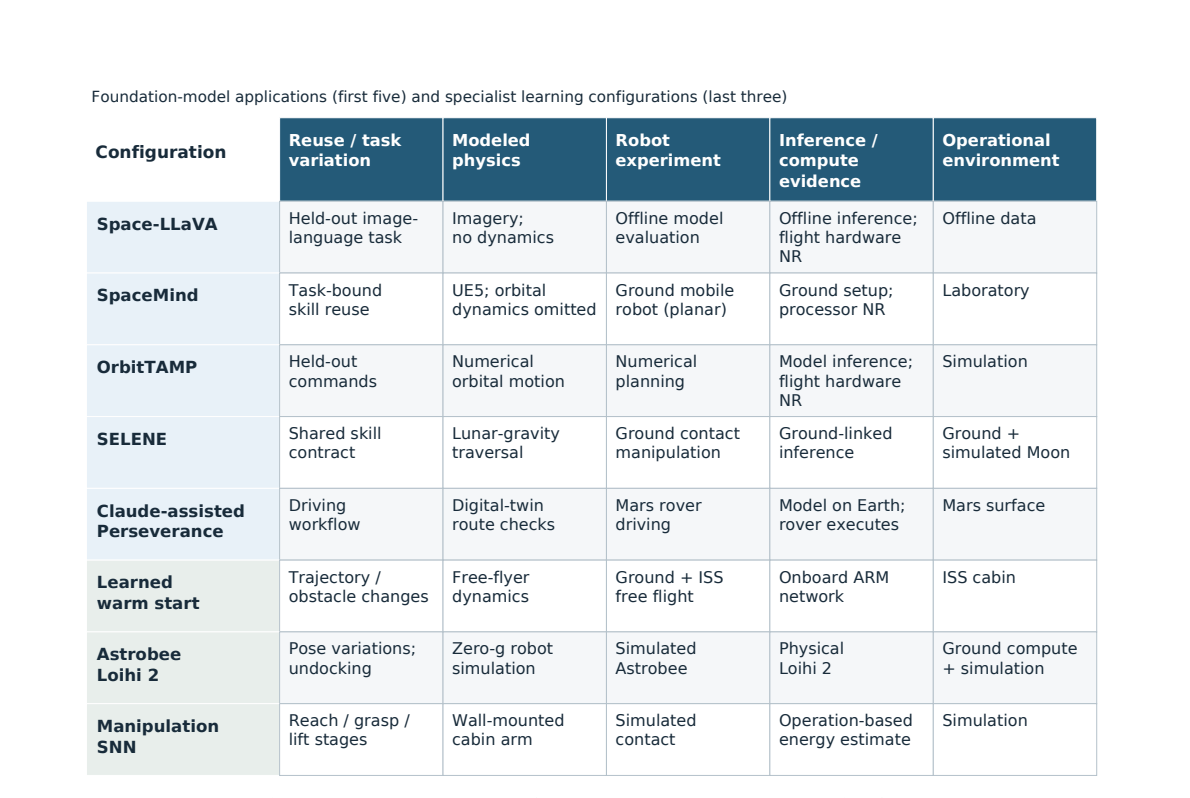
The row for Spike-driven VLA [90] reports that demonstration count is NR (not reported). Since this comparison is central to the energy–success tradeoff claim, the missing information weakens the inference. The authors should either obtain this detail from the source or qualify the finding more explicitly.
show 2 more
The paper says, at §8.5
Pith says: minor objection 3 of 4
The proposed evaluation protocol is detailed and well-motivated. However, it would benefit from a concise algorithmic summary or pseudocode to facilitate adoption by other researchers. The current prose is clear but somewhat lengthy.
The paper says, at §7.6
Pith says: minor objection 4 of 4
The discussion of radiation tolerance (e.g., RedNet [94], Loihi [115]) is thorough, but the transition to the conclusion that 'no thermal-vacuum or irradiation tests of the configurations shown are reported' could be more explicit about which specific configurations (e.g., which neuromorphic setup) lack such tests.
What would settle it
Obtain the promised ancillary inventory and the list of excluded candidates. Independently evaluate each excluded work against the paper's four criteria for a joint test (task reuse, coupled dynamics, sustained computation, recovery). If any qualifies, the main-gap conclusion is weakened. If none does, the claim stands as stated.
from the skeptic's reading
How the review went
4 readings by deepseek-v4-flash · 19 Oct 2026
- Reader holds up, with conditions
- Skeptic agrees
- Editor wrote the verdict above
- Referee major revision: 1 major objection, 4 minor
Not run on this paper: the simulated authors' defence.
Pith did not check this review's objections against the paper.
The review in full
The review in brief, machine-written
This paper does what a good critical survey should: it takes a concrete problem—how foundation models can actually work in space—and traces it through sensing, state estimation, action generation, and validation. The four-cell evaluation protocol in Section 8.5 is genuinely new thinking; it separates task composition from physical variation and demands an interaction budget for adaptation. That is a clean experimental template the field can use, and it is clearly better than the usual for-benchmark-only reporting.
The authors also deserve credit for repeatedly stating their own limitations. They say the literature selection is purposive and that unresolved candidates and a local unpublished survey were excluded. That is honest, and it makes the paper's internal logic consistent.
The soft spot is the one the stress-test note flags. The paper's headline finding—that no existing work jointly tests task reuse, coupled dynamics, sustained computation, and recovery—rests on an audit of the literature that the reader cannot repeat. The authors promise an ancillary inventory (Section 1.3) but do not ship it. Without that inventory, the central claim is plausible but not independently verifiable. This is not a hidden flaw; the authors acknowledge the selection limits. But the missing artifact makes the conclusion a statement of judgment rather than a checkable fact. That is a concern for a critical review that wants to shape research priorities.
A second issue is the reliance on several self-authored neuromorphic surveys. The paper leans on [9], [13], [52], [55] to argue that event and spike approaches are timely and power-relevant. Those sources are published and versioned, so it is not a citation cartel, but the clustering does narrow the range of viewpoints on neuromorphic readiness. The discussion would be stronger with more external corroboration.
Who should read this? Anyone working on space-manipulation autonomy or on deploying VLAs in resource-constrained settings. The paper gives a clear map of what has been tried and what conditions remain untested. It does not close any questions, but it sharpens the right ones.
Recommendation: send it to peer review. The paper is well argued and the missing inventory is a straightforward ask—the authors can supply it in a revision. A good referee will push for the inventory and for a few more external citations on the neuromorphic side, but the core work is solid.
The strongest objection
The paper's core assertion—that no existing work jointly tests task reuse, coupled dynamics, sustained computation, and recovery for foundation-model systems—rests on the completeness and correct classification of a purposively selected literature (§1.3). The authors state that 'unresolved candidates and a local unpublished survey were excluded' and promise an ancillary inventory that is absent from the manuscript. Without this inventory, an external reader cannot verify whether an omitted study already constitutes such a joint test. If one exists, the paper's central conclusion loses force. This is not a minor caveat; it is the single premise that supports the headline finding. The paper itself acknowledges the selection limits, but the missing artifact makes the claim uncheckable, not merely imprecise.
The reader's weakest_assumption identified the same concern: the literature survey's completeness and the missing ancillary inventory make the central premise unauditable. After reviewing the full text, I find no additional load-bearing error. The paper's argument is internally consistent, its limitations are largely explicit, and its proposed protocol is logically sound. The missing inventory is a practical verifiability problem, not a theoretical flaw. Hence the CONDITIONAL verdict remains appropriate: the paper should be accepted once the inventory is provided or the selection is clarified. My stress test does not introduce new objections; it reinforces the reader's identification of the key vulnerability.
The referee's report
If the central gap claim is correct, the paper provides valuable direction: the field should prioritize physical transfer experiments and validation infrastructure over scaling up models. It compiles a broad range of methods (VLMs, VLAs, event cameras, SNNs, world models, etc.) within a coherent space-requirements framework. The proposed evaluation protocol (Section 8.5) is a concrete contribution that could guide future work.
Pith's reading of the paper (a machine's summary, not the authors')
Foundation models—large pretrained models reused across tasks—show measurable benefits in terrestrial robot experiments, such as faster learning from limited data. This review asks whether those benefits survive the shift to space, where dynamics change (free-floating base motion), sensing is degraded by illumination extremes and radiation, and onboard power and cooling are tightly constrained. After surveying perception, planning, action, and validation studies, the authors conclude that while individual pretraining advantages have been demonstrated on the ground, no existing experiment jointly tests task reuse, coupled dynamics, sustained computation, and recovery under space-representative conditions. They identify event cameras and spiking neural networks as promising design options whose space-specific benefits also remain untested in closed-loop tasks. The paper's central contribution is to organize validation as a progressive sim-to-ground-to-space pathway and to propose a capture protocol that separates generalization from bounded-domain adaptation.
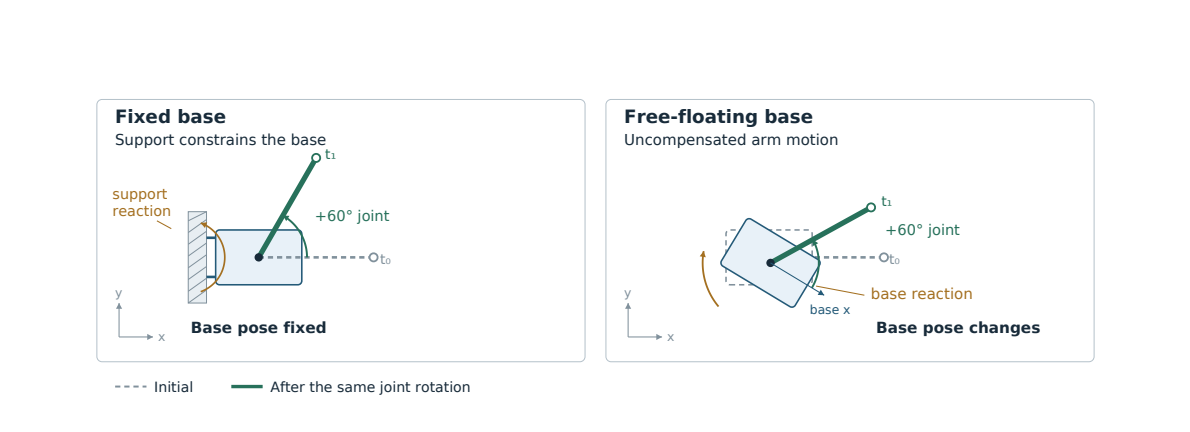
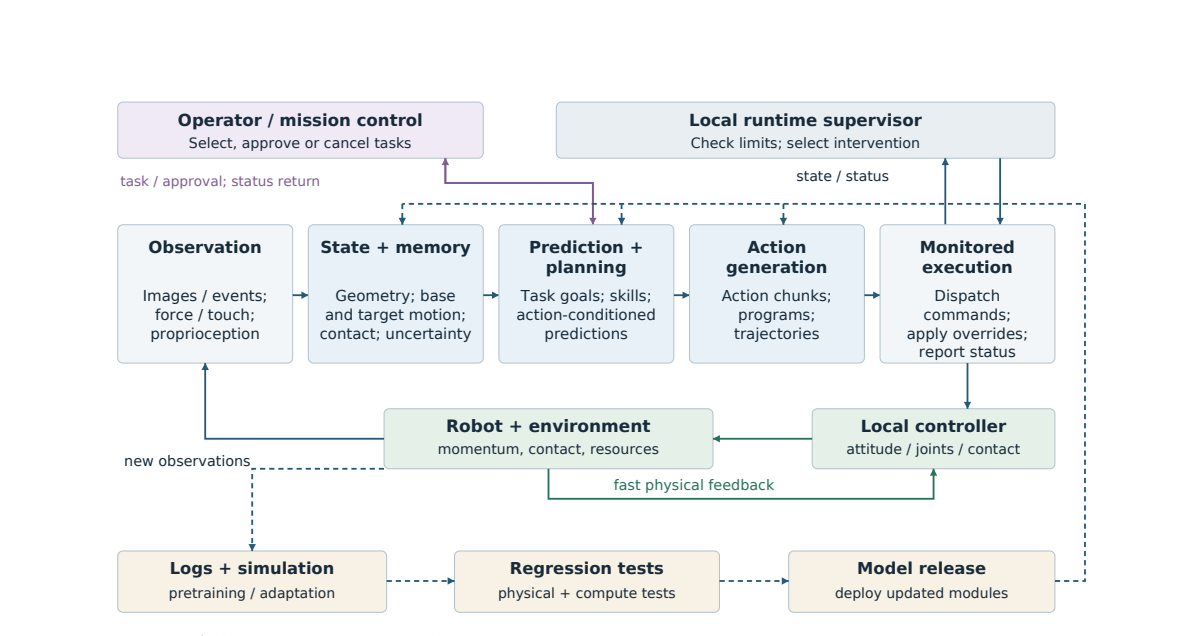
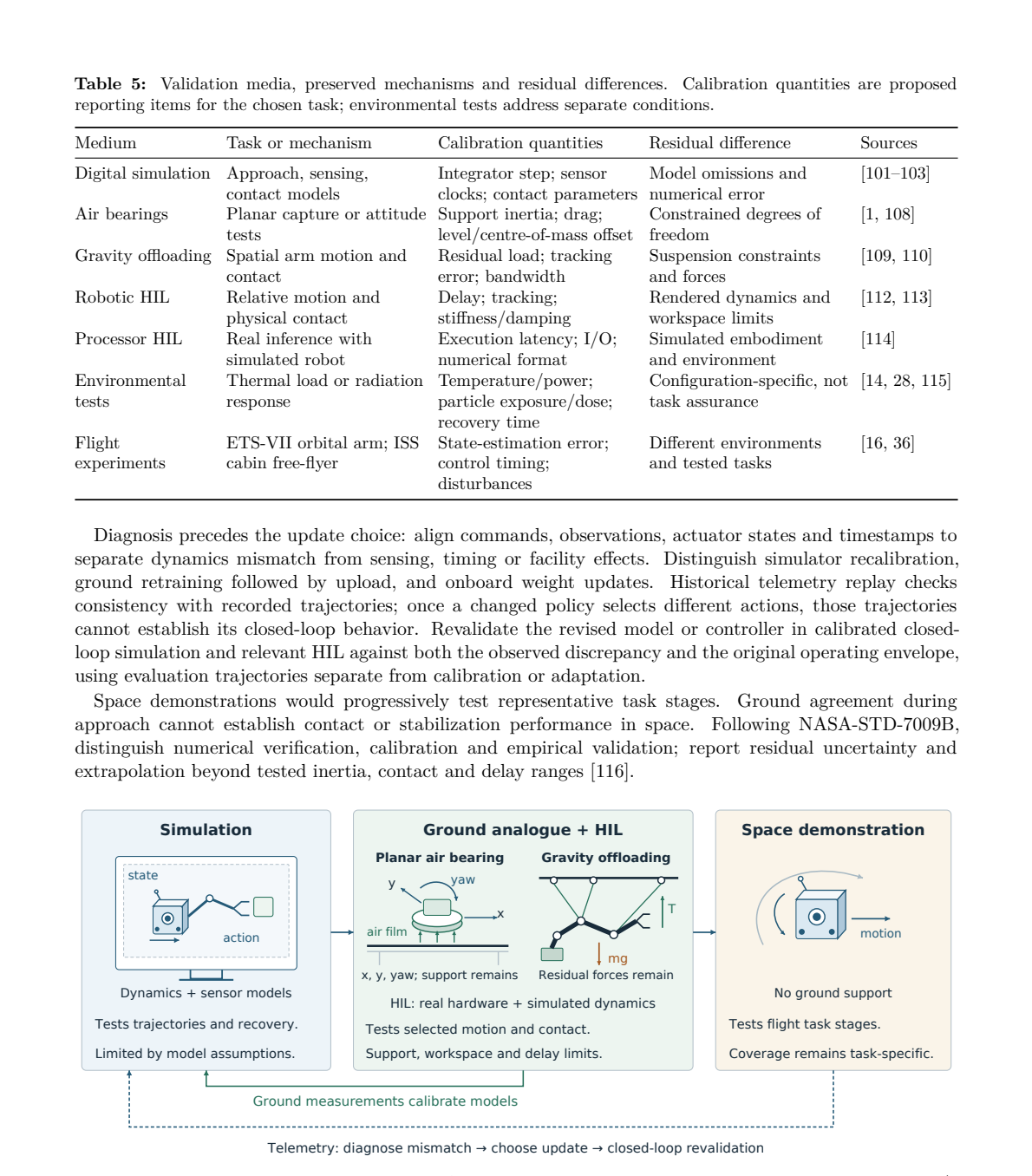
What carries the argument. The central organizing mechanism is the 'sim-to-ground-to-space validation pathway', a staged approach where a foundation-model system is tested first in digital simulation, then on ground testbeds (planar air bearings, gravity-offloading rigs, processor-in-the-loop), and finally in space demonstrations at increasing task fidelity. Each stage calibrates the next using telemetry-based diagnosis and closed-loop revalidation. A second key machinery is the proposed 'satellite-capture protocol', which crosses seen and unseen task compositions with seen and unseen physical conditions to separate held-out generalization from bounded-domain adaptation. The paper also emphasises the 'embodied closed-loop architecture' (Figure 3) that maps space operating conditions through perception, state estimation, prediction, action generation, and monitored execution, showing where foundation models could be integrated and where physical feedback must remain local.
Core claim. The paper's central claim is that the main gap preventing foundation-model systems from operating reliably in space is the absence of experiments that simultaneously test multiple necessary capabilities: reuse of pretrained knowledge on new tasks, operation under coupled free-floating dynamics, sustained inference within power and thermal budgets, and recovery from contact or sensor degradation. Controlled ground studies (e.g., Cosmos Policy on LIBERO, OpenVLA-OFT on LIBERO) show that video pretraining and action chunking provide measurable performance gains in terrestrial settings. However, these gains have not been demonstrated under the dynamics of an orbital manipulator, with the sensing challenges of specular reflections and radiation, or on the constrained compute hardware that a spacecraft can carry. The authors synthesize evidence from specialist space-robot experiments (ETS-VII, Astrobee, LeLaR) and neuromorphic computing benchmarks to argue that the field should invest in validation infrastructure—progressive sim-to-ground-to-space testing—rather than larger models alone.
The premise it rests on. The main gap conclusion rests on the completeness and correct interpretation of a purposively selected literature set frozen on 14 October 2026; if an omitted study or a misread source already performs a joint test of task reuse, coupled dynamics, sustained computation, and recovery, the paper's central claim loses force.
If the paper is right (Pith's inferences, not the authors')
Research priorities should shift from scaling foundation-model size to building validation infrastructure that reproduces space dynamics, contact, and resource constraints.
Event cameras and spiking neural networks, while offering theoretical advantages, must be tested in closed-loop orbital tasks before their benefits can be relied upon; current evidence is limited to component-level benchmarks or terrestrial manipulation.
The proposed capture protocol provides a reusable template for evaluating any foundation-model system for orbital manipulation, separating what the model generalizes from what it adapts to with limited target interaction.
Future flight experiments should report not only overall success but also base disturbance, contact loads, latency distributions, and energy per completed task, following the measurement framework in Table 4.
If the joint-test gap is real, then terrestrial benchmarks like LIBERO and CALVIN are insufficient predictors of space performance, and funding agencies should prioritize physical testbeds over cloud simulation.
The paper's emphasis on observation age (the delay between sensing and action) suggests that faster inference hardware without preserving that timing benefit may not improve task outcomes—a counterintuitive result for system designers.
The sim-to-ground-to-space pathway, while described for orbital capture, could be applied to other extreme-environment robotics (underwater, nuclear, subterranean) where dynamics and sensing differ from standard terrestrial settings.
The absence of thermal-vacuum and irradiation tests for any of the reviewed VLA configurations (noted in Section 8.3) indicates a systemic underinvestment in environmental qualification for learning-based space systems.
Check this review
Pith stored no record of this review's passes and took no fingerprint of it. Reviews made by code from 13 Nov 2026 on carry both.
How often reviews like this one are right
Reviews like this one: written by deepseek-v4-flash, where what was read was not recorded.
How often objections from reviews like this one are right: not yet measured
Reviews by people
This review was written by a machine. No person has reviewed this paper on Pith yet. A scientist listed on Pith can review it for a fee, and their review is published here whatever it concludes.
The paper
Abstract
Space robots must interpret tasks and act despite unfamiliar dynamics, difficult sensing conditions, and limited opportunities for human intervention. Foundation models offer reusable perceptual and behavioral knowledge, but their value depends on how that knowledge reaches physical execution. This critical review follows space-specific requirements through perception, prediction, planning, and action to deployment and validation, emphasizing orbital manipulation and proximity operations. Terrestrial comparisons establish benefits of particular pretraining stages and model interfaces; their transfer to space dynamics and constrained onboard operation remains insufficiently tested. Event cameras offer timely motion observations across strong illumination contrasts, while spiking neural networks provide possible routes to sparse local computation. We examine how sensor degradation, state estimation and computing choices affect feedback and recovery. Higher action throughput need not yield fresher feedback; lower processor power can also coexist with higher energy per inference. We organize validation as an iterative sim-to-ground-to-space pathway, connecting physical tests with telemetry-based diagnosis and closed-loop revalidation. A satellite-capture example links observations to approach, contact and recovery, while a corresponding protocol separates generalization from adaptation with limited target-domain interaction. These comparisons identify what models already contribute and the physical evidence needed to support autonomous space operation.
The paper's own sentences, arranged, kept beside the review and separate from it. Each label is drawn from a closed vocabulary; the number beside it is the probability the classifier gave that label. No sentence in this record was written by a model.
abstract compiled · 2026-10-20
The authors' main claim, as the classifier picked it out 0.63
“These comparisons identify what models already contribute and the physical evidence needed to support autonomous space operation.”
How the main claim is stated: asserted 0.97
What the abstract itself states, as probabilities: claims first 0.04 · states limitation 0.51 · human participants 0.03 · controlled comparison 0.11 · randomized assignment 0.01 · states quantitative result 0.03 · compares with prior results 0.35 · mentions code or data availability 0.02
The abstract, sentence by sentence
This table labels the abstract only (arXiv listing abstract v1). The number is the probability the classifier gave the label.
| Sentence | Role | The authors' own work | States the main conclusion | Strength |
|---|---|---|---|---|
| Space robots must interpret tasks and act despite unfamiliar dynamics, difficult sensing conditions, and limited opportunities for human intervention. | background 1.00 | 0.04 | 0.03 | asserted 1.00 |
| Foundation models offer reusable perceptual and behavioral knowledge, but their value depends on how that knowledge reaches physical execution. | background 0.93 | 0.07 | 0.11 | asserted 0.98 |
| This critical review follows space-specific requirements through perception, prediction, planning, and action to deployment and validation, emphasizing orbital manipulation and proximity operations. | contribution 0.90 | 0.54 | 0.10 | asserted 0.86 |
| Terrestrial comparisons establish benefits of particular pretraining stages and model interfaces; their transfer to space dynamics and constrained onboard operation remains insufficiently tested. | gap 0.99 | 0.10 | 0.26 | asserted 0.90 |
| Event cameras offer timely motion observations across strong illumination contrasts, while spiking neural networks provide possible routes to sparse local computation. | background 0.78 | 0.08 | 0.03 | hedged possibility 0.59 |
| We examine how sensor degradation, state estimation and computing choices affect feedback and recovery. | contribution 0.64 | 0.26 | 0.05 | unclear 0.63 |
| Higher action throughput need not yield fresher feedback; lower processor power can also coexist with higher energy per inference. | interpretation 0.67 | 0.22 | 0.07 | asserted 0.80 |
| We organize validation as an iterative sim-to-ground-to-space pathway, connecting physical tests with telemetry-based diagnosis and closed-loop revalidation. | method 0.90 | 0.51 | 0.12 | asserted 0.97 |
| A satellite-capture example links observations to approach, contact and recovery, while a corresponding protocol separates generalization from adaptation with limited target-domain interaction. | contribution 0.51 | 0.59 | 0.12 | asserted 0.98 |
| These comparisons identify what models already contribute and the physical evidence needed to support autonomous space operation. | interpretation 0.58 | 0.57 | 0.54 | asserted 0.97 |
What kind of paper the classifier reports this is: review 1.00 · evidence from literature 0.80
What was examined, and what was not
Sources read
- arXiv listing abstract v1
Not examined
- full text
- figures and tables
- references and citing sentences
- relations to other papers
Levels run
- P abstract
Not run
- S sections
- T body sentences
- C citations
- R cross-paper relations
How the labels were made
Compiled by classifier-1.13.0 via TypeSafe API, question bank abstract-p1-20260923, 2026-10-20: 1 request, 7,420 input tokens.
Every quoted sentence on this record is the authors'. Every label is from Pith's closed vocabulary, with the probability shown beside it. This record as JSON
Figures (7)

Figures are the authors', reproduced from the paper.
References (124)
- [9] Jianing Li, Dianze Li, Arren Glover, Xiaopeng Fan, Guoqi Li, Chiara Bartolozzi, Ryad B. Benosman, and Yonghong Tian. Neuromorphic Object Detection: An In-Depth Study and Future Directions. Proceedings of the IEEE , 114(5): 712–739, 2026. doi: 10.1109/JPROC.2026.3717677 on Pithdoi:10.1109/jproc.2026.3717677
- [13] Jianing Li and Yonghong Tian. Recent Advances in Neuromorphic Vision Sensors: A Survey. Chinese Journal of Computers, 44(6):1258–1286, 2021. doi: 10.11897/SP.J.1016.2021.01258. In Chinese; English title supplied by the authors on Pithdoi:10.11897/sp.j.1016.2021.01258
- [52] Yixuan Wang, Jianing Li, Lin Zhu, Xijie Xiang, Tiejun Huang, and Yonghong Tian. Learning Stereo Depth Estimation with Bio-Inspired Spike Cameras. In IEEE International Conference on Multimedia and Expo (ICME) , pages 1–6, 2022. doi: 10.1109/ICME52920.2022.9859975 on Pithdoi:10.1109/icme52920.2022.9859975
- [55] Shaoyu Liu, Jianing Li, Guanghui Zhao, Yunjian Zhang, Xin Meng, Fei Richard Yu, Xiangyang Ji, and Ming Li. EventGPT: Event Stream Understanding with Multimodal Large Language Models. In Proceedings of the IEEE/CVF Conference on Computer Vision and Pattern Recognition (CVPR) , ... on Pith
- [1] Evangelos Papadopoulos, Farhad Aghili, Ou Ma, and Roberto Lampariello. Robotic Manipulation and Capture in Space: A Survey. Frontiers in Robotics and AI , 8:686723, 2021. doi: 10.3389/frobt.2021.686723 on Pithdoi:10.3389/frobt.2021.686723
- [2] Issa A. D. Nesnas, Lorraine M. Fesq, and Richard A. Volpe. Autonomy for Space Robots: Past, Present, and Future. Current Robotics Reports, 2:251–263, 2021. doi: 10.1007/s43154-021-00057-2 on Pithdoi:10.1007/s43154-021-00057-2
- [3] Roya Firoozi, Johnathan Tucker, Stephen Tian, et al. Foundation Models in Robotics: Applications, Challenges, and the Future. arXiv:2312.07843v1, 2023 on PithPith's reviewarXiv
- [4] Zhiyuan Xu, Kun Wu, Junjie Wen, Jinming Li, Ning Liu, Zhengping Che, and Jian Tang. A Survey on Robotics with Foundation Models: toward Embodied AI. arXiv:2402.02385v1, 2024 on PithPith's reviewarXiv
- [5] Yafei Hu, Quanting Xie, Vidhi Jain, et al. Toward General-Purpose Robots via Foundation Models: A Survey and Meta-Analysis. arXiv:2312.08782v3, 2023. Revised 2024-10-01 on PithPith's reviewarXiv
- [6] Zeyuan Huang, Gang Chen, Zixuan Hao, et al. Artificial Intelligence-Enabled Space Robot Operations: Technologies, Challenges and Prospects. arXiv:2609.16880v1, 2026 on PithPith's reviewarXiv
- [7] Tao Luo, Yahang Zhang, and Yaobing Wang. Research Status and Application Prospects of Multimodal Large Models for Space Robotics. Spacecraft Engineering, 35(1):128–136, 2026. doi: 10.3969/j.issn.1673-8748.2026.01.017. In Chinese; title translated on Pithdoi:10.3969/j.issn.1673-8748.2026.01.017
- [8] Guillermo Gallego, Tobi Delbruck, Garrick Orchard, et al. Event-Based Vision: A Survey. IEEE Transactions on Pattern Analysis and Machine Intelligence , 44(1):154–180, 2022. doi: 10.1109/TPAMI.2020.3008413 on Pithdoi:10.1109/tpami.2020.3008413
- [10] Zhengyu Ma and Yonghong Tian. Theories and Methods for Large-Scale Brain-Inspired Neural Networks. Chinese Science Bulletin , 68(35):4764–4781, 2023. doi: 10.1360/TB-2023-0775. In Chinese; English title supplied by the authors on Pithdoi:10.1360/tb-2023-0775
- [11] Kento Kawaharazuka, Tatsuya Matsushima, Andrew Gambardella, Jiaxian Guo, Chris Paxton, and Andy Zeng. Real-World Robot Applications of Foundation Models: A Review. arXiv:2402.05741v1, 2024 on PithPith's reviewarXiv
- [12] Chiara Bartolozzi, Giacomo Indiveri, and Elisa Donati. Embodied neuromorphic intelligence. Nature Communications, 13:1024, 2022. doi: 10.1038/s41467-022-28487-2 on Pithdoi:10.1038/s41467-022-28487-2
- [14] NASA Small Spacecraft Systems Virtual Institute. 7.0 Thermal Control. State-of-the-Art of Small Spacecraft Technology, 2026 web edition, 2026. URL https://www.nasa.gov/smallsat-institute/sst-soa/thermal-control/ . Accessed 2026-10-15 on Pith
- [15] NASA Small Spacecraft Systems Virtual Institute. 8.0 Small Spacecraft A vionics. State-of-the-Art of Small Spacecraft Technology, 2026 web edition, 2026. URL https://www.nasa.gov/smallsat-institute/sst-soa/small-spacecraft-avionics/ . Accessed 2026-10-15 on Pith
- [16] Kazuya Yoshida. Engineering Test Satellite VII Flight Experiments for Space Robot Dynamics and Control: Theories on Laboratory Test Beds Ten Years Ago, Now in Orbit. The International Journal of Robotics Research , 22(5):321–335, on Pith
- [17] Yuji Takubo, Daniele Gammelli, Marco Pavone, and Simone D’Amico. OrbitTAMP: Grounding Language Models for Task and Motion Planning in Spacecraft Rendezvous. arXiv:2610.01093v1, 2026 on PithPith's reviewarXiv
- [18] Tae Ha Park and Simone D’Amico. Adaptive Neural Network-based Unscented Kalman Filter for Robust Pose Tracking of Noncooperative Spacecraft. Journal of Guidance, Control, and Dynamics , 46(9):1671–1688, 2023. doi: 10.2514/1.G007387 on Pithdoi:10.2514/1.g007387
show 80 more
- [19] Wenbo Zhao, Shengjie Wang, Yixuan Fan, Yang Gao, and Tao Zhang. SpaceOctopus: An Octopus-inspired Motion Planning Framework for Multi-arm Space Robot. arXiv:2403.08219v1, 2024 on PithPith's reviewarXiv
- [20] Yuxue Cao, Shengjie Wang, Xiang Zheng, Wenke Ma, Xinru Xie, and Lei Liu. Reinforcement Learning with Prior Policy Guidance for Motion Planning of Dual-Arm Free-Floating Space Robot. arXiv:2209.01434v1, 2022 on PithPith's reviewarXiv
- [21] Parna Niksirat, Adriana Daca, and Krzysztof Skonieczny. The effects of reduced-gravity on planetary rover mobility. The International Journal of Robotics Research , 39(7):797–811, 2020. doi: 10.1177/0278364920913945 on Pithdoi:10.1177/0278364920913945
- [22] Tae Ha Park, Marcus Märtens, Gérard Lecuyer, Dario Izzo, and Simone D’Amico. SPEED+: Next-Generation Dataset for Spacecraft Pose Estimation across Domain Gap. In IEEE Aerospace Conference, 2022. doi: 10.1109/AERO53065.2022.9843439 on Pithdoi:10.1109/aero53065.2022.9843439
- [23] S. Burmeister, S. Elgner, F. Preusker, A. Stark, and J. Oberst. Thermal Effects on Camera Focal Length in MESSENGER Star Calibration and Orbital Imaging. The International Archives of the Photogrammetry, Remote Sensing and Spatial Information Sciences , XLII-3:103–105, 2018. do... on Pithdoi:10.5194/isprs-archives-xlii-3-103-2018
- [24] Aubin Antonsanti, Cédric Virmontois, Jean-Marie Lauenstein, Alexandre Le Roch, Hugo Dewitte, and Vincent Goiffon. Probing Dark Current Random Telegraph Signal in a Small Pitch Vertically Pinned Photodiode CMOS Image Sensor After Proton Irradiation. IEEE Transactions on Nuclear ... on Pithdoi:10.1109/tns.2022.3160056
- [25] Jiawen Yu, Hairuo Liu, Qiaojun Yu, et al. ForceVLA: Enhancing VLA Models with a Force-aware MoE for Contact-rich Manipulation. arXiv:2505.22159v3, 2025 on PitharXiv
- [26] Ruoxuan Feng, Jiangyu Hu, Wenke Xia, Tianci Gao, Ao Shen, Yuhao Sun, Bin Fang, and Di Hu. AnyTouch: Learning Unified Static-Dynamic Representation across Multiple Visuo-tactile Sensors. arXiv:2502.12191v3, 2025 on PithPith's reviewarXiv
- [27] Lirui Wang, Xinlei Chen, Jialiang Zhao, and Kaiming He. Scaling Proprioceptive-Visual Learning with Heterogeneous Pre-trained Transformers. arXiv:2409.20537v1, 2024 on PithPith's reviewarXiv
- [28] Saad Memon, Rafal Graczyk, Jan Swakoń, Leszek Grzanka, Sebastian Kusyk, and Mike Papadakis. Proton Irradiation Characterization of an Open-Source ML Accelerator on a Zynq UltraScale+ MPSoC. arXiv:2609.05249v1, 2026 on PithPith's reviewarXiv
- [29] Wim Nijsink, Bruno Endres Forlin, Amirreza Yousefzadeh, and Marco Ottavi. Shooting Neutrons at Neurons: Radiation Testing of a Spiking Neural Network on Flash-Based FPGAs. arXiv:2605.00030v1, 2026 on PithPith's reviewarXiv
- [30] Peter Schmaus, Daniel Leidner, Ralph Bayer, Benedikt Pleintinger, Thomas Krüger, and Neal Y. Lii. Continued Advances in Supervised Autonomy User Interface Design for METERON SUPVIS Justin. In 2019 IEEE Aerospace Conference, 2019. doi: 10.1109/AERO.2019.8741885. 20 on Pithdoi:10.1109/aero.2019.8741885
- [31] Open X-Embodiment Collaboration. Open X-Embodiment: Robotic Learning Datasets and RT-X Models. arXiv:2310.08864v9, 2023. Revised 2025-05-14 on PithPith's reviewarXiv
- [32] Wenlong Huang, Fei Xia, Ted Xiao, et al. Inner Monologue: Embodied Reasoning through Planning with Language Models. arXiv:2207.05608v1, 2022 on PithPith's reviewarXiv
- [33] Moo Jin Kim, Karl Pertsch, Siddharth Karamcheti, et al. OpenVLA: An Open-Source Vision-Language-Action Model. arXiv:2406.09246v3, 2024 on PithPith's reviewarXiv
- [34] Michael Ahn, Anthony Brohan, Noah Brown, et al. Do As I Can, Not As I Say: Grounding Language in Robotic Affordances. arXiv:2204.01691v2, 2022 on PithPith's reviewarXiv
- [35] Danny Driess, Fei Xia, Mehdi S. M. Sajjadi, et al. PaLM-E: An Embodied Multimodal Language Model. arXiv:2303.03378v1, 2023 on PithPith's reviewarXiv
- [36] Somrita Banerjee, Abhishek Cauligi, and Marco Pavone. Deep Learning Warm Starts for Trajectory Optimization on the International Space Station. arXiv:2505.05588v3, 2025 on PithPith's reviewarXiv
- [37] Jacky Liang, Wenlong Huang, Fei Xia, Peng Xu, Karol Hausman, Brian Ichter, Pete Florence, and Andy Zeng. Code as Policies: Language Model Programs for Embodied Control. arXiv:2209.07753v4, 2022. Revised 2023-05-25 on PithPith's reviewarXiv
- [38] Yaodong Yang, Hongyao Tang, Yi Ma, Xingyu Fan, Weixun Wang, Jinpeng Li, and Tianpei Yang. Code Owns the Simulation, Jev Owns the Evaluation. arXiv:2610.01834v2, 2026. Revised 2026-10-10 on PithPith's reviewarXiv
- [39] Octo Model Team, Dibya Ghosh, Homer Walke, et al. Octo: An Open-Source Generalist Robot Policy. arXiv:2405.12213v2, 2024 on PithPith's reviewarXiv
- [40] Kevin Black, Noah Brown, Danny Driess, et al. π0: A Vision-Language-Action Flow Model for General Robot Control. arXiv:2410.24164v4, 2024. Revised 2026-01-08 on PithPith's reviewarXiv
- [41] Sherry Yang, Yilun Du, Kamyar Ghasemipour, Jonathan Tompson, Leslie Kaelbling, Dale Schuurmans, and Pieter Abbeel. Learning Interactive Real-World Simulators. arXiv:2310.06114v3, 2023. Revised 2024-09-26 on PithPith's reviewarXiv
- [42] Moo Jin Kim, Yihuai Gao, Tsung-Yi Lin, et al. Cosmos Policy: Fine-Tuning Video Models for Visuomotor Control and Planning. arXiv:2601.16163v1, 2026 on PithPith's reviewarXiv
- [43] Matthew Abate, Mark Mote, Mehregan Dor, et al. Run Time Assurance for Spacecraft Attitude Control Under Nondeterministic Assumptions. IEEE Transactions on Control Systems Technology , 2024. doi: 10.1109/TCST.2023.3340624 on Pithdoi:10.1109/tcst.2023.3340624
- [44] Philipp G. Knestel, Luisa Mayershofer, Anne Köpken, et al. NealAI: A RAG-based Chat Assistant Supporting Command of a Robotic Team from the ISS. In International Conference on Space Robotics (iSpaRo) , pages 684–691, on Pith
- [45] Matthew Foutter, Daniele Gammelli, Justin Kruger, Ethan Foss, Praneet Bhoj, Tommaso Guffanti, Simone D’Amico, and Marco Pavone. Space-LLaV A: a Vision-Language Model Adapted to Extraterrestrial Applications. arXiv:2408.05924v2, 2024. Revised 2025-01-18 on PithPith's reviewarXiv
- [46] Cristina Pérez-Ramos, Leopoldo Altamirano-Robles, and Miguel Chávez-Dagostino. Zero-shot semantic landmark-based visual odometry using foundation models for unstructured planetary exploration. Frontiers in Robotics and AI , 13: 1819714, 2026. doi: 10.3389/frobt.2026.1819714 on Pithdoi:10.3389/frobt.2026.1819714
- [47] Bowen Wen, Wei Yang, Jan Kautz, and Stan Birchfield. FoundationPose: Unified 6D Pose Estimation and Tracking of Novel Objects. In Proceedings of the IEEE/CVF Conference on Computer Vision and Pattern Recognition (CVPR) , pages 17868–17879, 2024. URL https://arxiv.org/abs/2312.08... on PithPith's reviewarXiv
- [48] Arunkumar Rathinam, Haytam Qadadri, and Djamila Aouada. SPADES: A Realistic Spacecraft Pose Estimation Dataset using Event Sensing. In IEEE International Conference on Robotics and Automation (ICRA) , 2024. doi: 10.1109/ICRA57147.2024.10611231 on Pithdoi:10.1109/icra57147.2024.10611231
- [49] Arunkumar Rathinam, Jules Lecomte, Jost Reelsen, Gregor Lenz, Axel von Arnim, and Djamila Aouada. Efficient Onboard Spacecraft Pose Estimation with Event Cameras and Neuromorphic Hardware. arXiv:2604.04117v1, 2026 on PithPith's reviewarXiv
- [50] Seth Roffe, Himanshu Akolkar, Alan D. George, Bernabé Linares-Barranco, and Ryad Benosman. Neutron-Induced, Single-Event Effects on Neuromorphic Event-Based Vision Sensor: A First Step and Tools to Space Applications. IEEE Access, 9:85748–85763, 2021. doi: 10.1109/ACCESS.2021.30... on PithPith's reviewarXiv
- [51] David Rodríguez-Martínez and C. J. Pérez del Pulgar. Fast Vision in the Dark: A Case for Single-Photon Imaging in Planetary Navigation. In 18th Symposium on Advanced Space Technologies in Robotics and Automation (ASTRA) , 2025. URL https://arxiv.org/abs/2510.10597v1. Reviewed ... on PitharXiv
- [53] David Rodríguez-Martínez, Dave van der Meer, Junlin Song, Abhishek Bera, C. J. Pérez del Pulgar, and Miguel Angel Olivares-Mendez. SPICE-HL3: Single-Photon, Inertial, and Stereo Camera dataset for Exploration of High-Latitude Lunar Landscapes. Scientific Data , 13:374, 2026. do... on Pithdoi:10.1038/s41597-026-06668-8
- [54] Jiazhou Zhou, Xu Zheng, Yuanhuiyi Lyu, and Lin Wang. EventBind: Learning a Unified Representation to Bind Them All for Event-based Open-world Understanding. In European Conference on Computer Vision (ECCV) , 2024. URL https://www.ecva.net/papers/eccv_2024/papers_ECCV/html/8931_... on Pith
- [56] Jiajun Zhai, Hao Shi, Shangwei Guo, Kailun Yang, and Kaiwei Wang. E-VLA: Event-Augmented Vision-Language-Action Model for Dark and Blurred Scenes. arXiv:2604.04834v2, 2026 on PithPith's reviewarXiv
- [57] Jiaxin Liu, Xun Xu, Zhenhao Zhang, Hanqing Wang, Ruiqi Chen, Shi Chang, Weiyu Guo, and Laurent Kneip. Event-VLA: Action-Conditioned Event Fusion for Robust Vision-Language-Action Model. arXiv:2606.29384v1, 2026 on PithPith's reviewarXiv
- [58] Jonathan Courtois, Benoît Miramond, and Alain Pegatoquet. Spiking monocular event based 6D pose estimation for space application. In Conference on AI in and for Space (SPAICE) , pages 394–399, 2024. doi: 10.5281/zenodo.13885633 on Pithdoi:10.5281/zenodo.13885633
- [59] Joshua Jones, Oier Mees, Carmelo Sferrazza, Kyle Stachowicz, Pieter Abbeel, and Sergey Levine. Beyond Sight: Finetuning Generalist Robot Policies with Heterogeneous Sensors via Language Grounding. arXiv:2501.04693v3, 2025 on PithPith's reviewarXiv
- [60] Danijar Hafner, Jurgis Pasukonis, Jimmy Ba, and Timothy Lillicrap. Mastering Diverse Domains through World Models. arXiv:2301.04104v2, 2023. Revised 2024-04-17 on PithPith's reviewarXiv
- [61] Joel Jang, Seonghyeon Ye, Zongyu Lin, et al. DreamGen: Unlocking Generalization in Robot Learning through Video World Models. arXiv:2505.12705v2, 2025 on PithPith's reviewarXiv
- [62] Mido Assran, Adrien Bardes, David Fan, et al. V-JEPA 2: Self-Supervised Video Models Enable Understanding, Prediction and Planning. arXiv:2506.09985v1, 2025. 21 on PithPith's reviewarXiv
- [63] Chi-Lam Cheang, Guangzeng Chen, Ya Jing, et al. GR-2: A Generative Video-Language-Action Model with Web-Scale Knowledge for Robot Manipulation. arXiv:2410.06158v1, 2024 on PithPith's reviewarXiv
- [64] Andrej Orsula, Miguel Olivares-Mendez, and Carol Martinez. Reward-Free Continual Adaptation for Resilient Space Robots. arXiv:2608.23452v1, 2026 on PithPith's reviewarXiv
- [65] Wenlong Huang, Chen Wang, Ruohan Zhang, Yunzhu Li, Jiajun Wu, and Li Fei-Fei. VoxPoser: Composable 3D Value Maps for Robotic Manipulation with Language Models. arXiv:2307.05973v2, 2023. Revised 2023-11-02 on PithPith's reviewarXiv
- [66] HongRun Chen, Li Yang, Long Sun, and HaoQing Yu. LLM-KGFP: A chain-of-thought-driven knowledge graph planner for autonomous rover operations in lunar polar shadowed regions. Advances in Space Research , 77(6):7406–7423, on Pith
- [67] Aodi Wu, Haodong Han, Xubo Luo, Ruisuo Wang, Shan He, and Xue Wan. SpaceMind: A Modular and Self-Evolving Embodied Vision-Language Agent Framework for Autonomous On-orbit Servicing. arXiv:2604.14399v1, 2026 on PithPith's reviewarXiv
- [68] Bingqi Huang, Bingchuan Wei, Yingkai Cai, and Zhaokui Wang. Toward Self-Evolving Lunar Robotic Autonomy Through Contract-Governed Skill Registration. Astronautics, 1(3):15, 2026. doi: 10.3390/astronautics1030015 on Pithdoi:10.3390/astronautics1030015
- [69] NASA Jet Propulsion Laboratory. NASA’s Perseverance Rover Completes First AI-Planned Drive on Mars. NASA/JPL mission report, 2026. URL https://www.nasa.gov/missions/mars-2020-perseverance/perseverance-rover/ nasas-perseverance-rover-completes-first-ai-planned-drive-on-mars/ . A... on Pith
- [70] R. Francis, T. Estlin, G. Doran, et al. AEGIS autonomous targeting for ChemCam on Mars Science Laboratory: Deployment and results of initial science team use. Science Robotics, 2(7):eaan4582, 2017. doi: 10.1126/scirobotics.aan4582 on Pithdoi:10.1126/scirobotics.aan4582
- [71] Allen Z. Ren, Anushri Dixit, Alexandra Bodrova, et al. Robots That Ask For Help: Uncertainty Alignment for Large Language Model Planners. arXiv:2307.01928v2, 2023 on PithPith's reviewarXiv
- [72] Alejandro Carrasco, Victor Rodriguez-Fernandez, and Richard Linares. Fine-tuning LLMs for Autonomous Spacecraft Control: A Case Study Using Kerbal Space Program. arXiv:2408.08676v1, 2024 on PithPith's reviewarXiv
- [73] Sida He, Lingxi Xie, Yunning Cao, et al. Robot Manipulation with GPT-6-Astra: Body Knowledge, Experience Reuse, Emergent Skills, and Sim2Real Transfer. arXiv:2609.31770v1, 2026 on PithPith's reviewarXiv
- [74] Galbot Team, Xuchuan Chen, Xiaoqian Cheng, Yu Deng, et al. Systematically Exploring the Capabilities of GPT-6 Astra as Embodied Policies. arXiv:2609.38537v1, 2026 on PithPith's reviewarXiv
- [75] Anthony Brohan, Noah Brown, Justice Carbajal, et al. RT-2: Vision-Language-Action Models Transfer Web Knowledge to Robotic Control. arXiv:2307.15818v1, 2023 on PithPith's reviewarXiv
- [76] Cheng Chi, Siyuan Feng, Yilun Du, Zhenjia Xu, Eric Cousineau, Benjamin Burchfiel, and Shuran Song. Diffusion Policy: Visuomotor Policy Learning via Action Diffusion. arXiv:2303.04137v1, 2023 on PithPith's reviewarXiv
- [77] Karl Pertsch, Kyle Stachowicz, Brian Ichter, et al. F AST: Efficient Action Tokenization for Vision-Language-Action Models. arXiv:2501.09747v1, 2025 on PithPith's reviewarXiv
- [78] Kevin Black, Manuel Y. Galliker, and Sergey Levine. Real-Time Execution of Action Chunking Flow Policies. arXiv:2506.07339v2, 2025. Revised 2025-12-05 on PithPith's reviewarXiv
- [79] Jingya Wang, Dehao Zhang, Shuai Wang, Malu Zhang, Yang Yang, and Haizhou Li. SpikingVLA: Asynchronous Spiking Vision-Language-Action Models. arXiv:2610.09710v1, 2026 on PithPith's reviewarXiv
- [80] Chengbo Yuan, Zicheng Zhang, Mingjie Zhou, et al. FTP-1: A Generalist Foundation Tactile Policy Across Tactile Sensors for Contact-Rich Manipulation. arXiv:2606.13102v3, 2026 on PithPith's reviewarXiv
- [81] Han Xue, Jieji Ren, Wendi Chen, Gu Zhang, Yuan Fang, Guoying Gu, Huazhe Xu, and Cewu Lu. Reactive Diffusion Policy: Slow-Fast Visual-Tactile Policy Learning for Contact-Rich Manipulation. arXiv:2503.02881v2, 2025. Revised 2025-04-01 on PithPith's reviewarXiv
- [82] Noriyasu Inaba, Mitsushige Oda, and Masato Hayashi. Visual Servoing of Space Robot for Autonomous Satellite Capture. Transactions of the Japan Society for Aeronautical and Space Sciences , 46(153):173–179, 2003. doi: 10.2322/tjsass.46.173 on Pithdoi:10.2322/tjsass.46.173
- [83] Samet Hicsonmez, Jose Sosa, Dan Pineau, Inder Pal Singh, Arunkumar Rathinam, Abd El Rahman Shabayek, and Djamila Aouada. Annotation Free Spacecraft Detection and Segmentation using Vision Language Models. arXiv:2602.04699v1, 2026 on PitharXiv
- [84] Kenneth Stewart, Samantha Chapin, Roxana Leontie, and Carl Glen Henshaw. Crossing the Sim2Real Gap Between Simulation and Ground Testing to Space Deployment of Autonomous Free-flyer Control. arXiv:2512.03736v1, 2025 on PitharXiv
- [85] Amir Taherin, Juyi Lin, Arash Akbari, Arman Akbari, Pu Zhao, Weiwei Chen, David Kaeli, and Yanzhi Wang. Cross-platform scaling of vision-language-action models from edge to cloud GPUs, 2026. URL https://arxiv.org/abs/2509.11480v2. Reviewed version 2, revised 26 January 2026; fi... on PitharXiv
- [86] Hongyu Wang, Chuyan Xiong, Ruiping Wang, and Xilin Chen. BitVLA: 1-bit vision-language-action models for robotics manipulation, 2026. URL https://arxiv.org/abs/2506.07530v2. Reviewed version 2, revised 1 March 2026; first submitted 2025 on PitharXiv
- [87] Moo Jin Kim, Chelsea Finn, and Percy Liang. Fine-Tuning Vision-Language-Action Models: Optimizing Speed and Success. arXiv:2502.19645v2, 2025. Revised 2025-04-28 on PithPith's reviewarXiv
- [88] Liwen Zhang, Dong Zhou, Shibo Shao, Zihao Su, and Guanghui Sun. Multimodal Spiking Neural Network for Space Robotic Manipulation. arXiv:2508.07287v1, 2025 on PithPith's reviewarXiv
- [89] Ruiqi Song, Dujun Nie, Siyu Teng, et al. SpikeVLA: Vision-Language-Action Models with Spiking Neural Networks. arXiv:2606.27807v1, 2026 on PithPith's reviewarXiv
- [90] Shuai Wang, Malu Zhang, Mingquan Liu, et al. Spike-driven Vision-Language-Action Model. arXiv:2609.39514v1, 2026 on PithPith's reviewarXiv
- [91] Jaden Clark, Changhao Wang, Yihuai Gao, Seongheon Hong, Hojung Choi, Mark Cutkosky, Yifan Hou, and Shuran Song. Multisensory Continual Learning: Adapting Pretrained Visuomotor Policies to Force. arXiv:2606.30988v4, 2026 on PithPith's reviewarXiv
- [92] Jason Yik, Korneel Van den Berghe, Douwe den Blanken, et al. The neurobench framework for benchmarking neuromorphic computing algorithms and systems. Nature Communications, 16:1545, 2025. doi: 10.1038/s41467-025-56739-4 on Pithdoi:10.1038/s41467-025-56739-4
- [93] Federico Paredes-Vallés, Jesse Hagenaars, Julien Dupeyroux, Stein Stroobants, Yingfu Xu, and Guido de Croon. Fully neuromorphic vision and control for autonomous drone flight. Science Robotics, 9:eadi0591, 2024. doi: 10.1126/scirobotics.adi0591. URL https://arxiv.org/abs/2303.0... on PithPith's reviewarXiv
- [94] Meiqi Wang, Han Qiu, Longnv Xu, Di Wang, Yuanjie Li, Tianwei Zhang, Jun Liu, and Hewu Li. A Case for Application-Aware Space Radiation Tolerance in Orbital Computing. arXiv:2407.11853v1, 2024 on PithPith's reviewarXiv
- [95] Xinghua Xue, Cheng Liu, Ying Wang, Bing Yang, Tao Luo, Lei Zhang, Huawei Li, and Xiaowei Li. Soft Error Reliability Analysis of Vision Transformers. arXiv:2302.10468v3, 2023. Revised 2024-04-26. 22 on PithPith's reviewarXiv
- [96] Lester Frias-Dominguez, Jose M. Badia, German Leon, Adrian Amor-Martin, and Jose A. Belloch. Dependability analysis and hardening of vision transformers against soft errors. The Journal of Supercomputing , 82:331, 2026. doi: 10.1007/s11227-026-08373-0 on Pithdoi:10.1007/s11227-026-08373-0
- [97] Oier Mees, Lukas Hermann, Erick Rosete-Beas, and Wolfram Burgard. CAL VIN: A Benchmark for Language-Conditioned Policy Learning for Long-Horizon Robot Manipulation Tasks. arXiv:2112.03227v4, 2021. Revised 2022-07-13 on PithPith's reviewarXiv
- [98] Bo Liu, Yifeng Zhu, Chongkai Gao, Yihao Feng, Qiang Liu, Yuke Zhu, and Peter Stone. LIBERO: Benchmarking Knowledge Transfer for Lifelong Robot Learning. arXiv:2306.03310v2, 2023 on PithPith's reviewarXiv
- [99] Xuanlin Li, Kyle Hsu, Jiayuan Gu, et al. Evaluating Real-World Robot Manipulation Policies in Simulation. arXiv:2405.05941v1, 2024 on PithPith's reviewarXiv
- [100] Aodi Wu, Jianhong Zuo, Zeyuan Zhao, Xubo Luo, Ruisuo Wang, and Xue Wan. SpaceSense-Bench: A Large-Scale Multi-Modal Benchmark for Spacecraft Perception and Pose Estimation. arXiv:2603.09320v1, 2026 on PitharXiv
The first 100 of 124 references are listed here. All of them are in this paper's citation record.
Challenges and discussion
Disagree with the review, or know something it missed? Leave a comment, or challenge this review formally: a challenge becomes a permanent entry in this paper's record, and its decision is published here.
Come back by email
A short list of the week's newly reviewed papers. Nothing is sent until you confirm from your inbox, and every email has a link that stops it. No account.
No comments yet.
Sign in to comment