Artificial Intelligence · arXiv:2610.01014 v1 · submitted 1 Oct 2026 · 20 references
From Discovery to Decision: Finite-Budget Recoverability in LLM Voting
The paper says
“Voting over multiple LLM responses is a common primitive in test-time scaling and ensemble inference. Collecting more responses can expand the candidate pool and increase the chance that a correct answer is discovered.”
more of the abstract
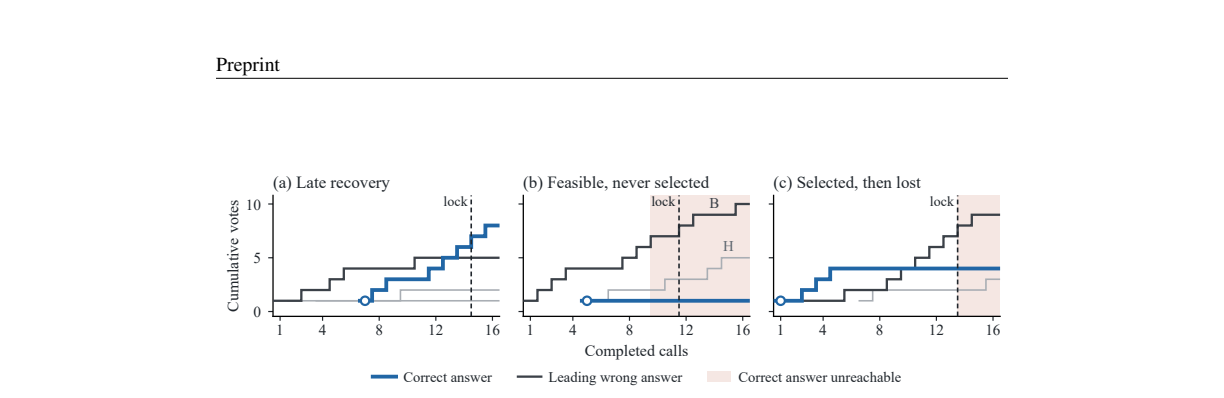
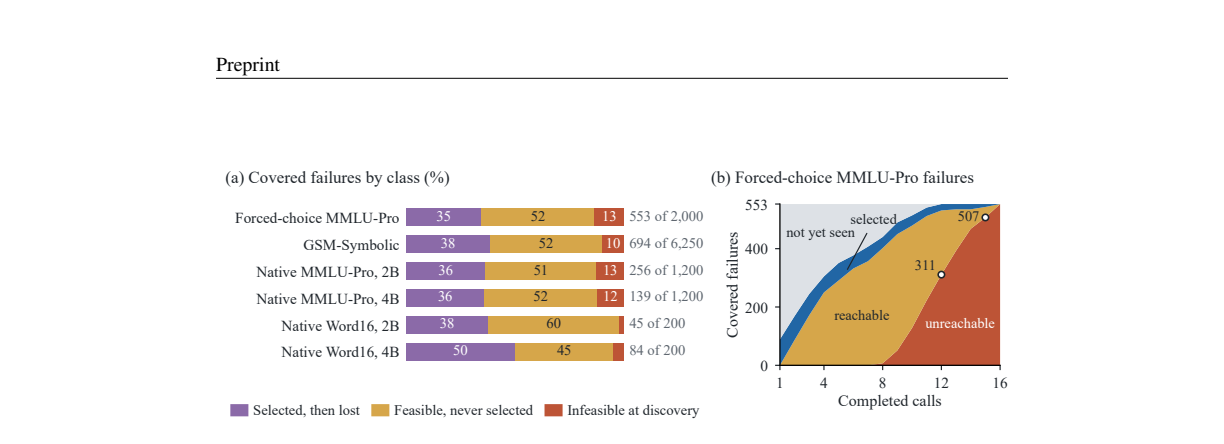
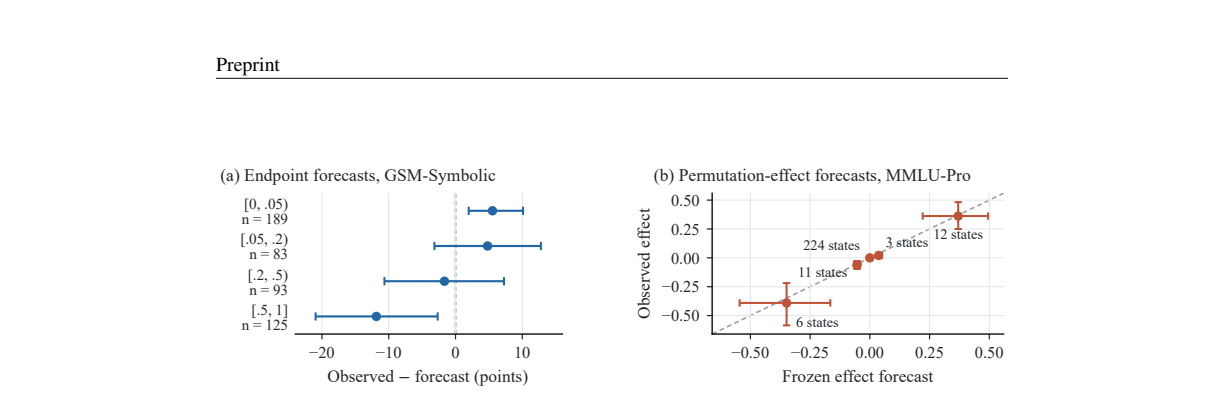
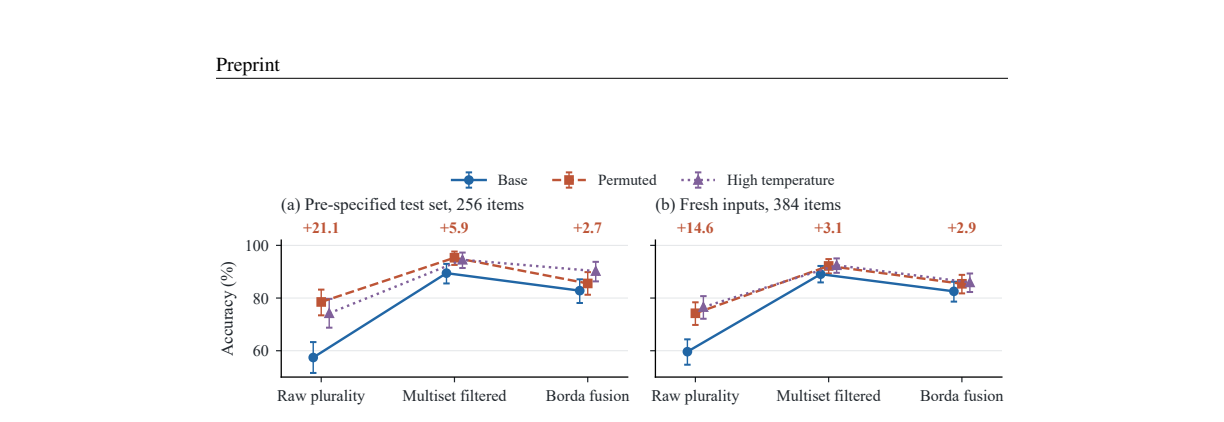
Under a fixed call budget, a discovered answer still needs to accumulate enough support within the remaining calls to become the final plurality winner, creating a discovery-to-decision gap. In this work, we characterize this gap through the realized vote state and remaining call budget. We derive a sharp recoverability threshold and show that, as sampling proceeds, the observed candidate set can only expand while the set of reachable endpoint winners can only contract, inducing a candidate-level conversion window. Under a specified iid response law, the same state yields exact finite-horizon endpoint probabilities. We further show that merging wrong-answer identities preserves single-call correctness and cannot improve plurality accuracy, and that the effect of redistributing wrong-answer probability depends on the realized vote state. Singleton reachability yields a gold-free exact locking certificate. For a known answer universe, its first trigger is the earliest prefix at which all admissible continuations yield the same fixed-budget output. Empirically, most discovered-but-unselected correct answers lose reachability only after discovery. In a controlled Word16 study, input permutation improves raw-plurality accuracy by 21.1 points with essentially unchanged single-call correctness. Exact locking saves 28-30% of calls at a 16-call budget while preserving every fixed-budget output.
from the abstract
Pith says
Machine review · deepseek-v4-flash · 2 Oct 2026 · what was read was not recorded · not checked by a person
It can be wrong. Challenge this review or reply to it.
Holds up, with conditions. The exact locking certificate is a clean, correct, parameter-free result worth refereeing; the savings layer leans on an iid response law the authors themselves leave unresolved. This line is wrong
2 major objections · 5 minor
How often objections from reviews like this one are right: not yet measured
Not checked: figures, code, what the 20 references say.
The paper says, at Abstract and §5 vs. Appendix H.4
The review did not quote this passage.
Pith says: Objection 1 of 2 · major
The headline figures 'Exact locking saves 28-30% of calls' and 'physical execution confirms request-time savings' are call-savings from sequential replay; Table 28 shows that batch-of-four request-time savings are only 14.4-19.7% for the same models, and that fully parallel fixed-16 beats every sequential and microbatched stopping rule in wall-clock.
more of objection 1
Since the paper itself invokes Tran and Kiela (2026) to justify cost-aware evaluation, the abstract's phrasing could mislead a reader into reading 28-30% as wall-clock savings in parallel deployment. Recommend one sentence at the first mention of the savings figure stating that these are sequential call savings and that batch-parallel request-time savings are smaller.
The paper says, at Section 5, public-data savings claims
The review did not quote this passage.
A classifier read this sentence of the paper as acknowledging the concern (probability 0.88):
“Dependence among calls remains unresolved. 4 ERRORCOMPETITIONSHAPESRECOVERABILITY Feasibility leaves open which reachable candidate will ultimately win.”
Pith says: Objection 2 of 2 · major
The sentence 'The predicted savings match large-budget public data' (with 39.6% and 47.1% at B=1024) is a plug-in prediction under the iid law of Theorem 5.3, not a model-free guarantee. The certificate's exactness does not transfer to these figures, and the authors themselves note that dependence among calls remains unresolved (b117).
more of objection 2
Since the deterministic replay claim and the public-data prediction claim sit close together in the same paragraph, a single sentence at that location restating that the large-budget figures are iid-model predictions (with the calibration caveat of b655) would sharpen the boundary between the model-free and model-dependent claims.
5 minor objections
The paper says, at §3.3 and Appendix F.1/F.3
Pith says: minor objection 1 of 5
The pooled AUC 0.825 [0.77,0.88] and the pooled calibration error -0.4 points combine two waves where wave 2 was added after wave 1 was inconclusive; the paper discloses this in the appendix and figure caption, but §3.3 presents the pooled numbers without a pointer to that caveat.
The paper says, at Table 23
Pith says: minor objection 2 of 5
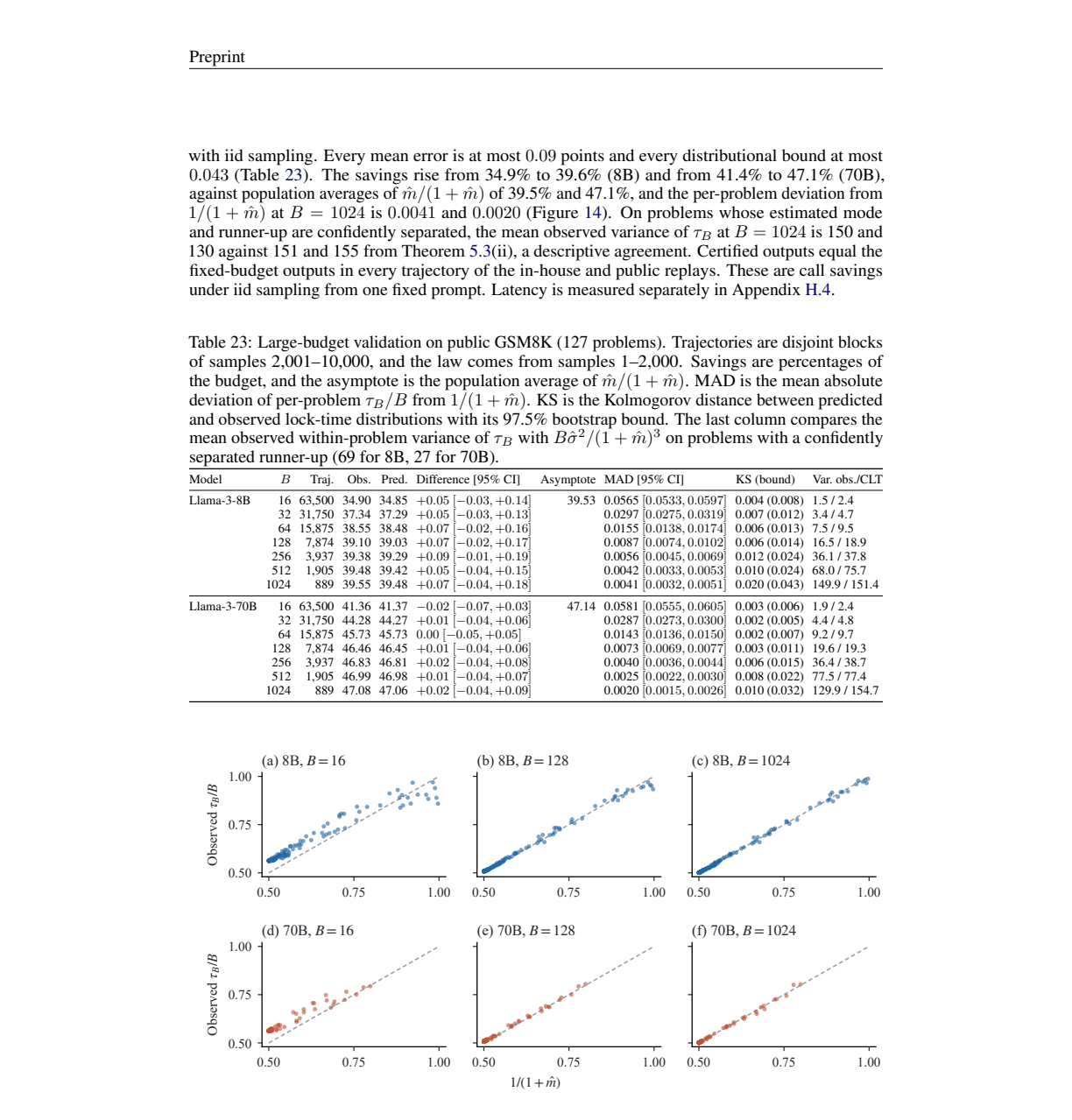
At B=1024 the 70B observed variance of tau_B is 129.9 versus 154.7 predicted by the CLT, a roughly 16% shortfall, while the 8B variance matches (149.9 vs 151.4). The 'descriptive agreement' hedge is appropriate; a one-line note on whether the shortfall is attributed to estimation error or to finite-sample effects would help the reader interpret the validation.
show 3 more
The paper says, at Appendix B.3, Eq. (10)
Pith says: minor objection 3 of 5
The exact multinomial formula is dense; a fully worked three-answer example with explicit counts (beyond the two-answer first-passage contrast) would substantially aid verification of the coefficient-extraction method.
The paper says, at Appendix F.5, Table 13 (sentence b699)
Pith says: minor objection 4 of 5
A full data table appears embedded inside a sentence of the results paragraph; it should be extracted into a proper table for readability.
The paper says, at Section 5, after Theorem 5.3
Pith says: minor objection 5 of 5
The sentence 'locking nears that ceiling only when the mode is nearly certain' is correct but worth stating with the explicit bound: savings fraction m/(1+m) is at most 1/2, attained only as m approaches 1, consistent with Table 23's asymptote column.
What would settle it
Take the stored 2,000 forced-choice MMLU-Pro (or 5,000 GSM) 16-call trajectories and fit a first-order Markov transition matrix over realized answers and abstention. Test H0: P(Z_{t+1}=a | Z_t=b) = P(Z_{t+1}=a) by a likelihood-ratio or permutation test on per-item sequences. Then simulate the locking rule under the fitted Markov law and compare the predicted lock-time distribution and mean savings at B=16 with the iid plug-in predictions. If the Markov and iid predictions differ by more than the paper's reported tolerance (roughly 1 point at B=16, or the 0.03 MAD bound at B=1024), the iid assumption is material to the savings claims; if they match, the concern is bounded. Either way the certificate's exactness is unaffected.
from the skeptic's reading
How the review went
4 readings by deepseek-v4-flash · 2 Oct 2026
- Reader holds up, with conditions
- Skeptic agrees
- Editor wrote the verdict above
- Referee minor revision: 2 major objections, 5 minor
Not run on this paper: the simulated authors' defence.
Pith did not check this review's objections against the paper.
The review in full
The review in brief, machine-written
Read this one for the deterministic core, not the hype. The reachability threshold and the exact locking certificate (Corollary 5.1) are elementary counting done right, with complete proofs in Appendix B. The claim that τB is the earliest prefix-only exact stop for a known answer universe (Remark 5.2) is argued carefully, and the certificate genuinely needs no independence or response-law estimate — it preserves errors along with correct outputs. The lock-time law is a clean random-walk derivation, and even the authors note it is gold-free. That part is solid and could be folded into future work immediately.
The paper is unusually honest, which earns it credit. It discloses that two of three pre-specified primary comparisons are inconclusive, that the MMLU-Pro permutation effect on the large holdout is essentially null (+0.26 points), that a second GSM wave was added after an inconclusive first, and that dependence among calls 'remains unresolved' (b117). The Word16 result — permutation gaining 21.1 points with unchanged single-call correctness — is well-supported on the stated cohorts, though the transfer to MMLU-Pro mostly evaporates.
Now the soft spots, in proportion. The quantitative savings predictions and the endpoint probabilities Qr rest on the iid response law, and the design never separates iid misspecification from estimation error (b655). The authors say so themselves. If LLM calls are autocorrelated — a wrong answer recurring once it appears — the predicted savings will be miscalibrated even with a perfect marginal-law estimate. That doesn't touch the certificate's safety, but it does mean the practical pitch (28–30% savings, match to public data) is only as strong as the iid assumption. Second, several cited context references are unpublished 2026 preprints; for the paper's own contributions they are background, but a referee should check whether any load-bearing citations are 'to appear.' Minor, not fatal.
Who it's for: anyone doing test-time scaling or efficient repeated sampling who wants a provably output-preserving early stop. The certificate deserves a real referee — the deterministic theory is important enough and clean enough that a serious editor should send it out, expecting revision on the probabilistic layer and the empirical framing rather than the core math.
The strongest objection
The deterministic claim of Corollary 5.1 and Remark 5.2 is sound: if the current leader is the only reachable endpoint winner, every admissible continuation, including dependent responses, abstentions, and the conservative unseen-answer rule, yields the same fixed-budget output, so tau_B is an exact output-preserving stopping time. My concern is one layer below, in the probabilistic claims that carry the savings predictions. Section 2.3 defines Q_{r+1}(v;p) = p_perp Q_r(v;p) + sum_y p_y Q_r(v+e_y;p), and Theorem 5.3 derives the lock-time law, both under the explicit assumption that future calls are iid with law p (b78, b174). If calls are actually dependent---for example, once a wrong answer appears it becomes more likely to recur, or the model's sampling state persists across calls in a batch---then Equation (4) is not the conditional endpoint probability: the next call's distribution depends on history, not only on the count vector and the marginal law p. Consequently the plug-in forecasts Q_r(v; p_hat) and the finite-budget lock-time predictions simulated under an iid law can be miscalibrated even with a perfect marginal-law estimate. The paper states that dependence among calls remains unresolved (b117) and that the design does not separate iid misspecification from estimation error (b655); it also acknowledges short-law calibration limits (b114). This matters because the practical pitch includes the claims that predicted savings match large-budget public data and that the lock-time law characterizes savings. The exact certificate does not depend on iid, so the central deterministic theorem stands; the vulnerable part is the quantitative savings layer.
Full text reviewed. The strongest claim is the exact locking theorem. I checked Corollary 5.1's equivalence against the L_y threshold, the all-a/all-w continuation argument, the subset argument for contraction, and the conservative open-universe rule; the argument is internally consistent and independent of iid. The empirical Word16 result is supported, and the MMLU-Pro null, the inconclusive primary comparisons, and the calibration limits are disclosed rather than hidden. The reader's weakest assumption is the iid response law, and this is the same concern I find most load-bearing: it does not touch the certificate, but it directly conditions the Q_r endpoint probabilities, the finite-budget lock-time predictions, and the asymptotic lock-time law. The paper's own b117 and b655 admit the gap. The reader's CONDITIONAL verdict is appropriate; I would not change it. A useful independent check is the Markov-versus-iid simulation test described above, which would separate dependence from estimation error by using the stored trajectories already collected. No ad hominem and no new fatal flaw: the deterministic core is exact and the probabilistic layer is where the quantitative savings claims remain conditional.
The referee's report
The deterministic contributions are parameter-free, correct for what they claim, and fully proved in Appendix B: the locking certificate holds without any independence or response-law assumption, and the B=16 replay savings (28-30%) are exact on the stored trajectories. This is a genuine, practically usable result for test-time scaling. The lock-time law is a clean random-walk derivation under the stated iid assumption and validates against GSM8K data within 0.1 points. The empirical methodology is unusually careful: multiple pre-specified studies, Holm corrections, fresh cohorts, and honest disclosure of negative results (the MMLU-Pro permutation hold-out effect +0.26, short-law calibration limits, and the unresolved dependence among calls, b117 and b655). If anything, the paper's scope statements are more conservative than its headlines require.
Pith's reading of the paper (a machine's summary, not the authors')
The paper argues that in fixed-budget plurality voting over repeated LLM responses, the realized vote state and the number of remaining calls determine everything worth knowing: which candidates can still win, how likely each is to win, and when the final answer is already decided. It derives a sharp recovery threshold stating exactly how many further calls a candidate needs before it can no longer become the endpoint winner, and shows that while the set of observed answers only grows, the set of reachable winners only shrinks. That contraction yields a "gold-free" decision-locking certificate: once the current leader is the only reachable winner, every admissible continuation of the remaining calls produces the same fixed-budget output, so stopping early preserves the full-budget answer exactly, with no independence assumption, no response-law estimate, and no tuning. The paper also shows that consolidating wrong-answer identities weakly hurts plurality accuracy, that transferring wrong-answer probability mass has an effect that depends on the realized vote state, and that permuting input representations across calls changes the structure of repeated errors. A reader should care because this separates a cheap, exact stopping rule - saving 28-30% of calls at a 16-call budget - from statistical stopping rules that save more calls but can change the output.
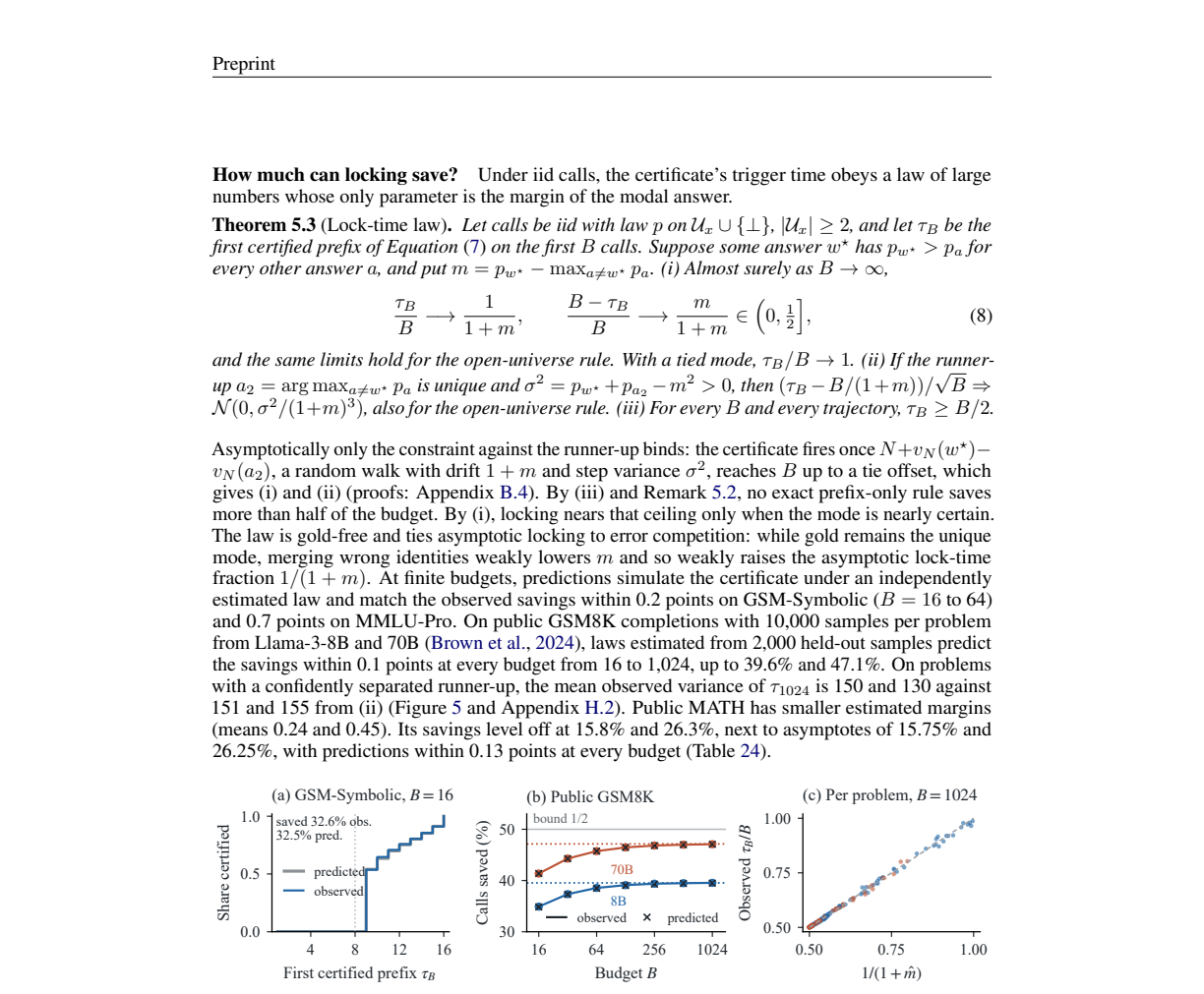
What carries the argument. The carrying object is the reachable-winner set $R_r(v)$ built from the threshold $L_y(v) = \max\{0,\, 1-v(y),\, \max_{a\ne y} (v(a)-v(y)+\delta_{a,y})\}$, the number of further all-$y$ votes needed for $y$ to win under fixed tie priority $\kappa_x$. The paper proves this set is exactly the set of answers some continuation of the remaining $r$ calls makes the endpoint winner, and that it contracts with every admissible update while the observed candidate set expands. The locking certificate is the case $R_r(v) = \{w\}$: the leader's lead over every rival is at least the remaining budget (plus tie adjustments), so even an all-rival continuation cannot unseat it. The certificate needs no independence, no response-law estimate, and no gold label, and it covers abstentions, adaptive proposal policies, and weighted votes; the lock-time law (Theorem 5.3) is obtained by tracking the random walk $S_N = N + V_N(w^\star) - V_N(a_2)$ against the runner-up, whose drift $1+m$ and step variance $\sigma^2$ give the savings fraction and the Gaussian fluctuation.
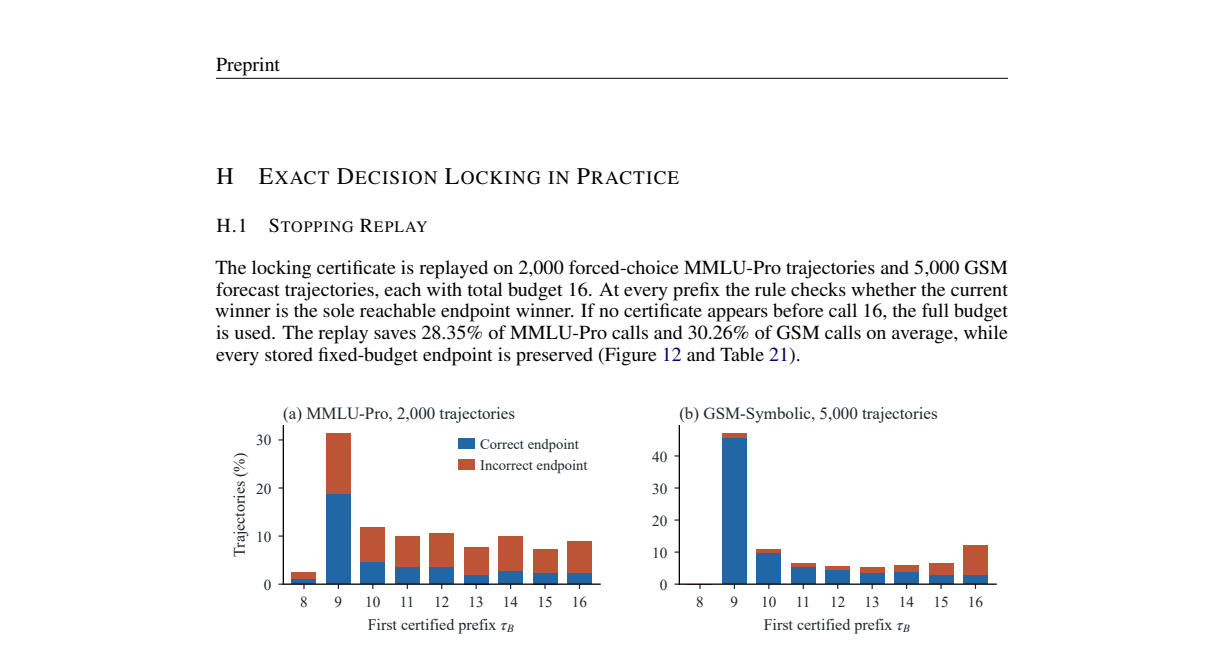
Core claim. The central claim is that the discovery-to-decision gap in fixed-budget LLM voting is governed entirely by the realized vote counts and the remaining call budget, through the reachable-winner set $R_r(v) = \{y \in U_x : L_y(v) \le r\}$, where $L_y(v)$ is the minimum number of additional all-$y$ calls needed for $y$ to beat every rival under the tie priority. As sampling proceeds the reachable set only contracts and the observed set only expands, so each candidate has a possibly empty, contiguous conversion window between first discovery and loss of reachability. From this, the paper proves a sharp endpoint locking condition: in a nonempty state with leader $w$, every admissible continuation yields the same fixed-budget plurality output if and only if $v(w) - v(a) \ge r + \mathbf{1}\{\kappa_x(a) > \kappa_x(w)\}$ for every rival $a$, i.e. $R_r(v) = \{w\}$. Stopping at the first certified prefix $\tau_B$ (Equation 7) therefore preserves the full-budget output exactly for every continuation, including dependent responses and abstentions, and for a known answer universe no prefix-only rule that must preserve the output can stop earlier (Corollary 5.1, Remark 5.2). Under an iid response law, the same state yields exact finite-horizon endpoint probabilities, and the paper proves a lock-time law (Theorem 5.3): the asymptotic saving fraction is $m/(1+m)$ where $m$ is the modal margin, with a central limit theorem for fluctuations, so no exact prefix-only rule can save more than half the budget. Empirically the reachability boundary is exact in every protocol, most discovered-but-unselected correct answers lose reachability only after discovery, and at a 16-call budget the certificate saves 28-30% of calls (up to 47.1% at large budgets on public data) while preserving every fixed-budget output.
The premise it rests on. The endpoint-probability forecasts, the lock-time savings predictions, and the savings claims all assume future calls are iid draws from a fixed per-item response law, which the authors state explicitly and acknowledge remains unverified because dependence among calls is left unresolved.
If the paper is right (Pith's inferences, not the authors')
Practitioners can stop repeated-sampling voting early at the first certified prefix $\tau_B$ and provably obtain the same answer as the full-budget plurality vote, with no calibration, independence assumption, or response-law estimate; the savings at a 16-call budget are 28-30%, rising toward the 1/2 ceiling as the modal answer becomes more dominant.
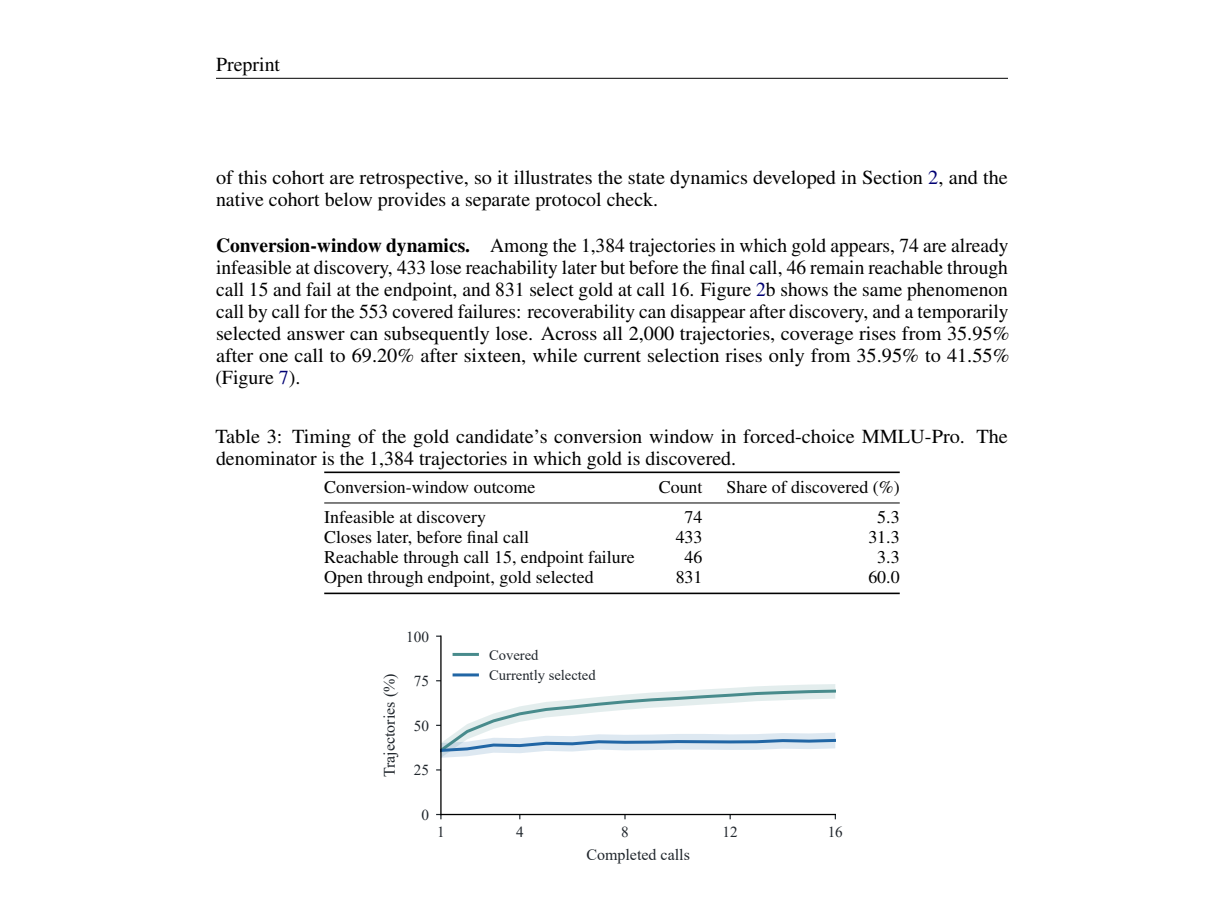
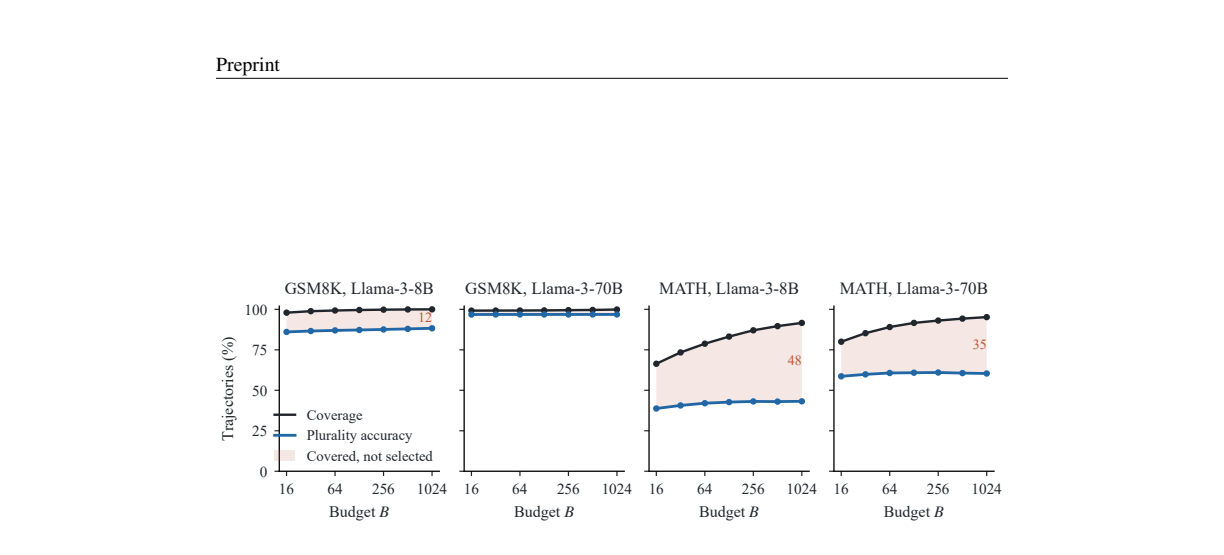
The discovery-to-decision gap is a measurable, state-determined phenomenon: across protocols, most covered failures are still recoverable at discovery and lose reachability only later, so when and whether a correct answer loses its chance to win is observable from vote counts alone.
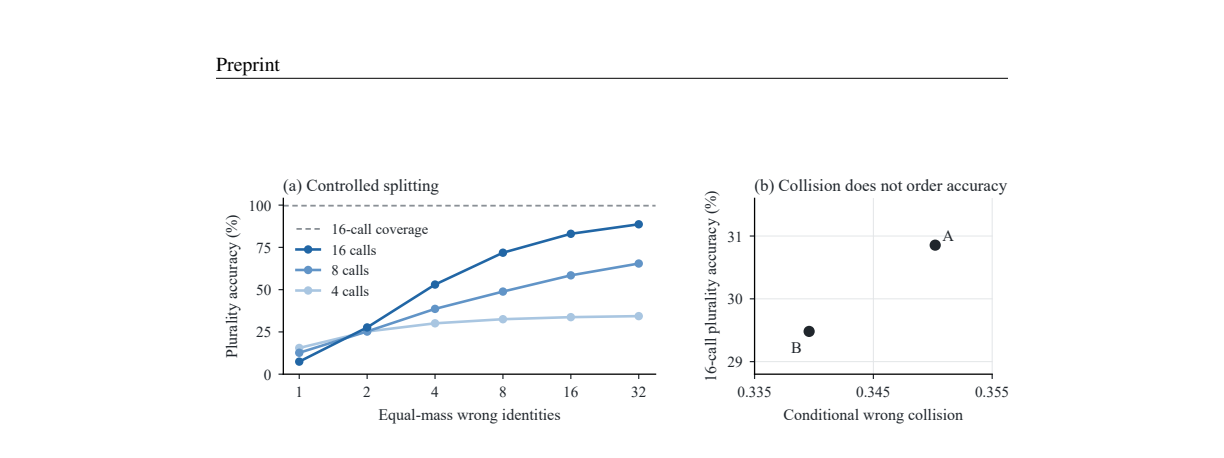
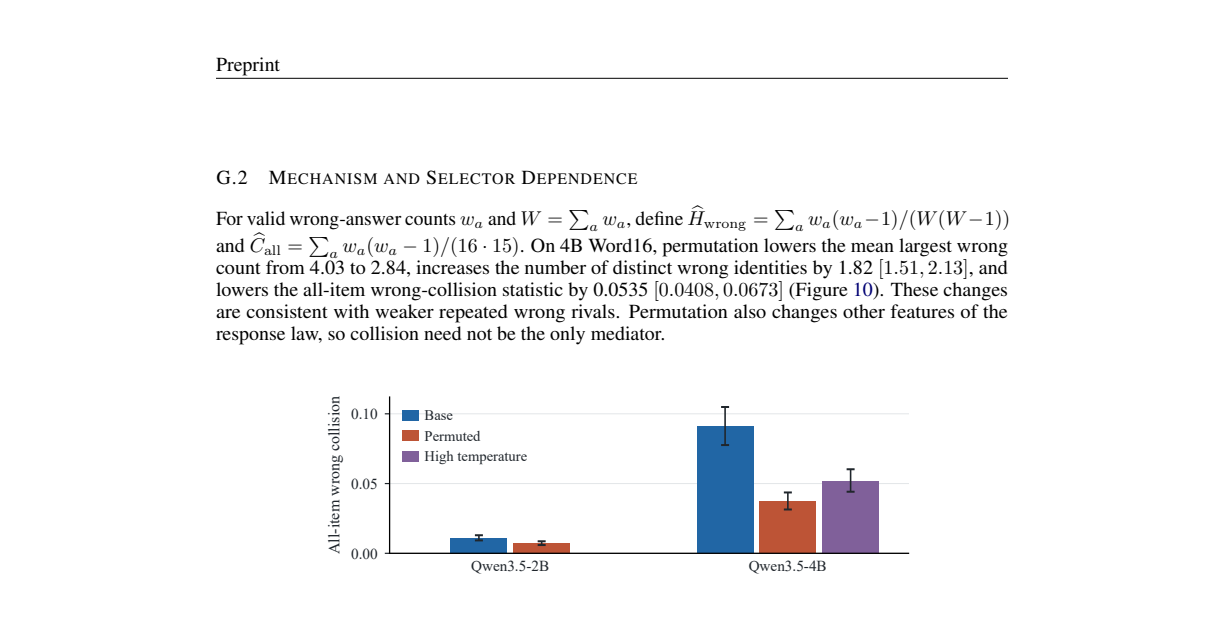
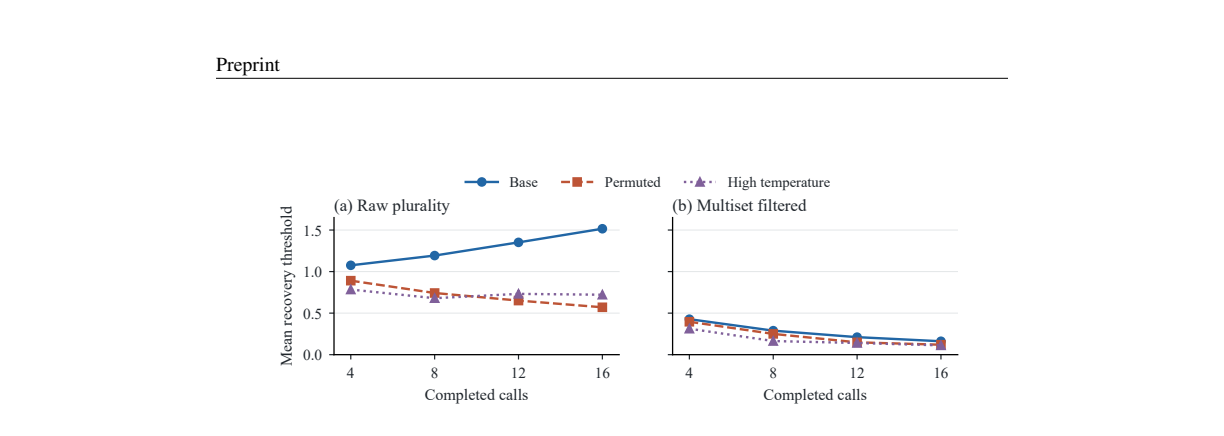
Aggregation gains can come from changing the structure of repeated errors rather than raising single-call accuracy: independently permuting Word16 inputs raised raw plurality accuracy by 21.1 points with single-call correctness essentially unchanged, and the gain is attenuated by selectors that remove or fuse repeated wrong answers.
Consolidating wrong-answer identities weakly decreases plurality accuracy while preserving single-call correctness, and the effect of moving wrong-answer probability mass between identities is state-dependent, so no law-level statistic such as collision rate alone orders endpoint accuracy.
For a known answer universe no prefix-only rule that must preserve the fixed-budget output can stop earlier than $\tau_B$, placing an exact lower bound on the savings any output-preserving early stop can achieve.
Because the locking certificate itself requires neither independence nor a response-law estimate, it is portable to any sampling regime - autocorrelated, adaptive, or nonstationary - so the same rule could serve as an end-to-end latency mechanism wherever calls are charged per token, although its expected savings would need re-estimation outside the iid setting.
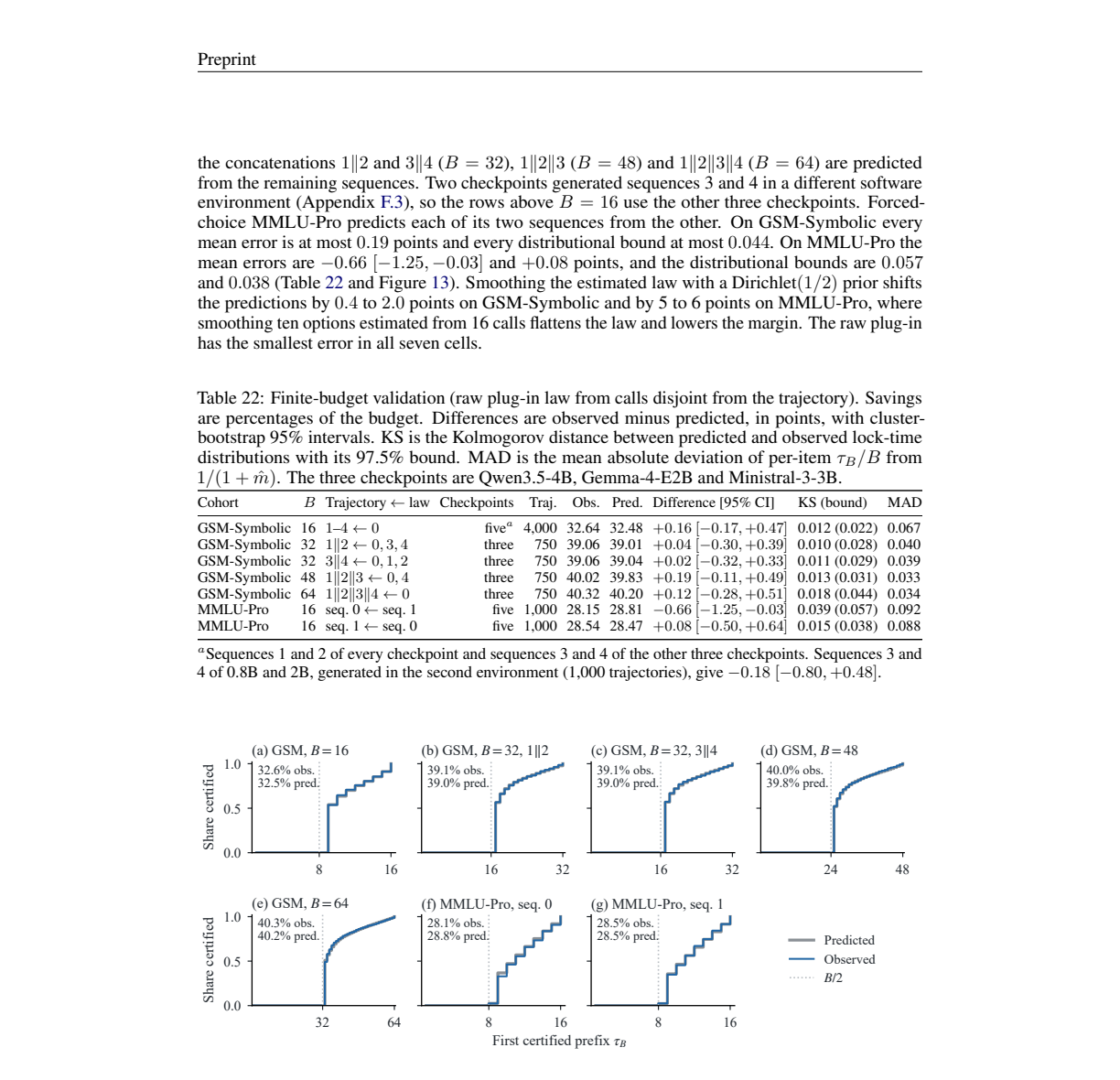
The modal-margin law suggests a cheap diagnostic for when test-time scaling has hit a ceiling: the lock-time fraction $\tau_B/B$ estimates $1/(1+m)$ without any gold label, so certifying early is itself a way to measure answer concentration and to detect regimes where further calls are unlikely to change decisions.
The merging proposition reframes when "more sampling hurts": harm is not caused by coverage but by recurring wrong-answer identities concentrating into strong rivals, implying that diversification of error structure - e.g. input permutation - could be a general lever wherever repeated sampling is used, not just in the Word16 setting tested here.
The exact endpoint recursion $Q_r(v;p)$ is a conditional-power quantity in the sense of sequential analysis, so the same state-based machinery could be extended from plurality to other aggregators (weighted plurality, runoff rules, Borda) whose possible-winner sets might admit similar contraction and locking certificates.
Check this review
Pith stored no record of this review's passes and took no fingerprint of it. Reviews made by code from 13 Nov 2026 on carry both.
How often reviews like this one are right
Reviews like this one: written by deepseek-v4-flash, where what was read was not recorded.
How often objections from reviews like this one are right: not yet measured
Reviews by people
This review was written by a machine. No person has reviewed this paper on Pith yet. A scientist listed on Pith can review it for a fee, and their review is published here whatever it concludes.
The paper
Abstract
Voting over multiple LLM responses is a common primitive in test-time scaling and ensemble inference. Collecting more responses can expand the candidate pool and increase the chance that a correct answer is discovered. Under a fixed call budget, a discovered answer still needs to accumulate enough support within the remaining calls to become the final plurality winner, creating a discovery-to-decision gap. In this work, we characterize this gap through the realized vote state and remaining call budget. We derive a sharp recoverability threshold and show that, as sampling proceeds, the observed candidate set can only expand while the set of reachable endpoint winners can only contract, inducing a candidate-level conversion window. Under a specified iid response law, the same state yields exact finite-horizon endpoint probabilities. We further show that merging wrong-answer identities preserves single-call correctness and cannot improve plurality accuracy, and that the effect of redistributing wrong-answer probability depends on the realized vote state. Singleton reachability yields a gold-free exact locking certificate. For a known answer universe, its first trigger is the earliest prefix at which all admissible continuations yield the same fixed-budget output. Empirically, most discovered-but-unselected correct answers lose reachability only after discovery. In a controlled Word16 study, input permutation improves raw-plurality accuracy by 21.1 points with essentially unchanged single-call correctness. Exact locking saves 28-30% of calls at a 16-call budget while preserving every fixed-budget output.
The paper's own sentences, arranged, kept beside the review and separate from it. Each label is drawn from a closed vocabulary; the number beside it is the probability the classifier gave that label. No sentence in this record was written by a model.
abstract compiled · 2026-10-02
The authors' main claim, as the classifier picked it out 0.69
“We derive a sharp recoverability threshold and show that, as sampling proceeds, the observed candidate set can only expand while the set of reachable endpoint winners can only contract, inducing a candidate-level conversion window.”
How the main claim is stated: asserted 1.00
What the abstract itself states, as probabilities: claims first 0.08 · states limitation 0.48 · human participants 0.03 · controlled comparison 0.62 · randomized assignment 0.05 · states quantitative result 0.99 · compares with prior results 0.60 · mentions code or data availability 0.03
The abstract, sentence by sentence
This table labels the abstract only (arXiv listing abstract v1). The number is the probability the classifier gave the label.
| Sentence | Role | The authors' own work | States the main conclusion | Strength |
|---|---|---|---|---|
| Voting over multiple LLM responses is a common primitive in test-time scaling and ensemble inference. | background 1.00 | 0.04 | 0.02 | asserted 1.00 |
| Collecting more responses can expand the candidate pool and increase the chance that a correct answer is discovered. | background 1.00 | 0.08 | 0.03 | hedged possibility 0.65 |
| Under a fixed call budget, a discovered answer still needs to accumulate enough support within the remaining calls to become the final plurality winner, creating a discovery-to-decision gap. | gap 0.64 | 0.14 | 0.12 | asserted 0.99 |
| In this work, we characterize this gap through the realized vote state and remaining call budget. | contribution 0.88 | 0.93 | 0.07 | asserted 0.98 |
| We derive a sharp recoverability threshold and show that, as sampling proceeds, the observed candidate set can only expand while the set of reachable endpoint winners can only contract, inducing a candidate-level conversion window. | result 0.86 | 0.95 | 0.36 | asserted 1.00 |
| Under a specified iid response law, the same state yields exact finite-horizon endpoint probabilities. | contribution 0.36 | 0.89 | 0.08 | asserted 0.99 |
| We further show that merging wrong-answer identities preserves single-call correctness and cannot improve plurality accuracy, and that the effect of redistributing wrong-answer probability depends on the realized vote state. | result 0.97 | 0.92 | 0.09 | asserted 1.00 |
| Singleton reachability yields a gold-free exact locking certificate. | result 0.67 | 0.86 | 0.09 | asserted 1.00 |
| For a known answer universe, its first trigger is the earliest prefix at which all admissible continuations yield the same fixed-budget output. | result 0.40 | 0.73 | 0.07 | asserted 0.98 |
| Empirically, most discovered-but-unselected correct answers lose reachability only after discovery. | result 0.99 | 0.91 | 0.09 | asserted 1.00 |
| In a controlled Word16 study, input permutation improves raw-plurality accuracy by 21.1 points with essentially unchanged single-call correctness. | result 0.99 | 0.92 | 0.07 | asserted 1.00 |
| Exact locking saves 28-30% of calls at a 16-call budget while preserving every fixed-budget output. | result 1.00 | 0.91 | 0.18 | asserted 1.00 |
What kind of paper the classifier reports this is: theoretical result 1.00 · evidence from proof or derivation 0.97
What was examined, and what was not
Sources read
- arXiv listing abstract v1
Not examined
- full text
- figures and tables
- references and citing sentences
- relations to other papers
Levels run
- P abstract
Not run
- S sections
- T body sentences
- C citations
- R cross-paper relations
How the labels were made
Compiled by classifier-1.13.0 via TypeSafe API, question bank abstract-p1-20260923, 2026-10-02: 1 request, 8,771 input tokens.
Every quoted sentence on this record is the authors'. Every label is from Pith's closed vocabulary, with the probability shown beside it. This record as JSON
Figures (16)


Figures are the authors', reproduced from the paper.
References (20)
- [1] Pranjal Aggarwal, Aman Madaan, Yiming Yang, and Mausam. Let’s sample step by step: Adaptive- consistency for efficient reasoning and coding with LLMs. InProceedings of the 2023 Conference on Empirical Methods in Natural Language Processing, pp. 12375–12396, on Pith
- [5] The mean prediction error stays within the±3-point tolerance for both models at every budget, law variant and identity scheme. In the primary cell (Qwen3-14B,B= 32 ) the observed saving exceeds the prediction by 0.16 points [−0.03,+0.39] , and the Kolmogorov distance is 0.009 ... on Pith
- [7] Gemma Team. Gemma 4 technical report.arXiv preprint arXiv:2607.02770, on PithPith's reviewarXiv
- [8] Aaron Grattafiori, Abhimanyu Dubey, Abhinav Jauhri, Abhinav Pandey, Abhishek Kadian, et al. The Llama 3 herd of models.arXiv preprint arXiv:2407.21783, on PithPith's reviewarXiv
- [10] Baihe Huang, Shanda Li, Tianhao Wu, Yiming Yang, Ameet Talwalkar, Kannan Ramchandran, Michael I. Jordan, and Jiantao Jiao. Sample complexity and representation ability of test-time scaling paradigms. InInternational Conference on Learning Representations, 2026a. Jingkai Huang,... on PithPith's reviewarXiv
- [11] Alexander H. Liu, Kartik Khandelwal, Sandeep Subramanian, et al. Ministral 3.arXiv preprint arXiv:2601.08584, 2026a. Yiqing Liu, Hantao Yao, Wu Liu, and Yongdong Zhang. EMS: Multi-agent voting via efficient majority-then-stopping.arXiv preprint arXiv:2604.02863, 2026b. Zhangyi... on PithPith's reviewarXiv
- [12] Raphael Tang, Crystina Zhang, Xueguang Ma, Jimmy Lin, and Ferhan Ture. Found in the middle: Permutation self-consistency improves listwise ranking in large language models. InProceedings of the 2024 Conference of the North American Chapter of the Association for Computational ... on Pith
- [13] Dat Tran and Douwe Kiela. Single-agent LLMs outperform multi-agent systems on multi-hop reasoning under equal thinking token budgets.arXiv preprint arXiv:2604.02460, on PithPith's reviewarXiv
- [14] An Yang, Anfeng Li, Baosong Yang, et al. Qwen3 technical report.arXiv preprint arXiv:2505.09388, on PithPith's reviewarXiv
- [15] 12 Preprint A RELATEDWORK Finite-budget sampling, error structure, and selection.Repeated sampling expands answer coverage (Brown et al., 2024; Schaeffer et al., 2025), and self-consistency aggregates repeated samples through the empirical answer mode (Wang et al., 2023; Feng ... on Pith
- [16] The selector improves the endpoint while its first safe stopping time becomes later. Cost comparisons must therefore specify which full-cap selector each certificate preserves. Conditional wrong collision can increase during this beneficial intervention. Consider iid probabili... on Pith
- [17] and 128 MATH problems (Hendrycks et al., 2021), generated at temperature 0.6 with few-shot prompts and a 512-token cap. GSM8K identities are those of Appendix H.2. For MATH, the final answer is extracted and normalized exactly as by the dataset’s own grader. An answer without ... on Pith
- [18] answered 100 problems of MATH-500 (Hendrycks et al., 2021; Lightman et al., 2024), 20 per difficulty level, in thinking mode. Generation used the native chat template with thinking enabled, temperature 0.6, top-p0.95 , top-k20 and at most 16,384 generated tokens. Each problem ... on Pith
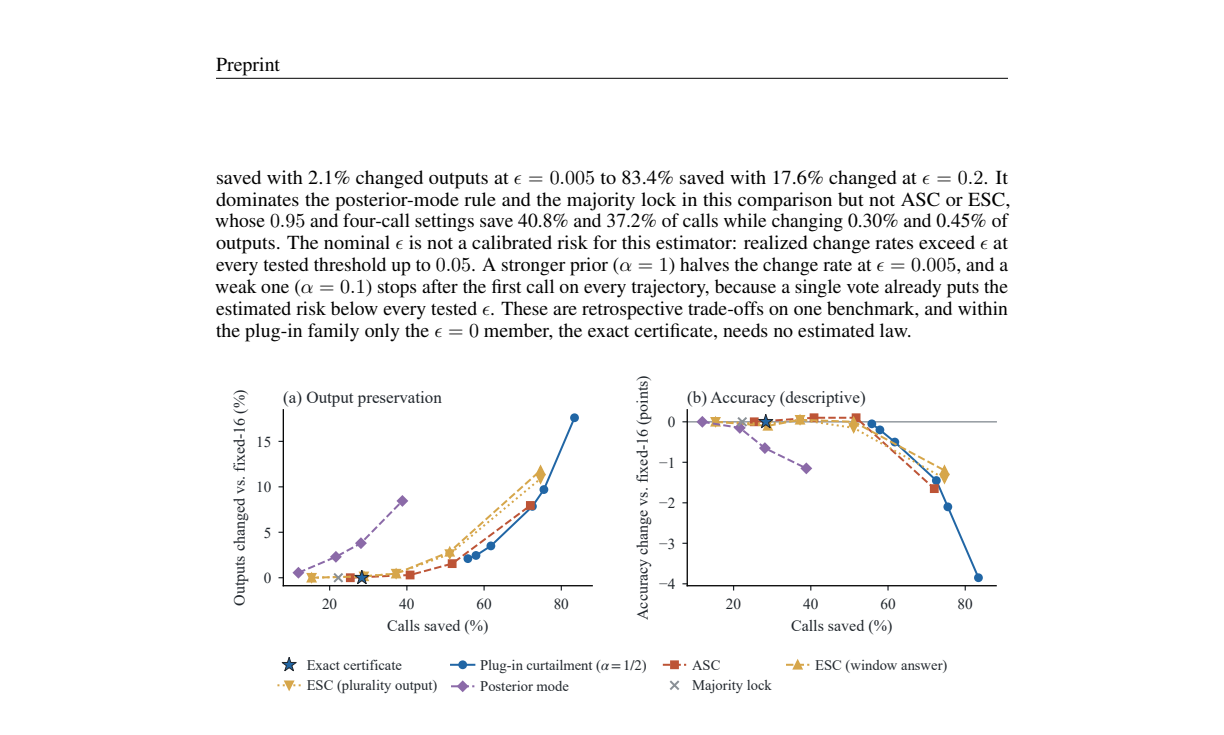
- [20] Changes are relative to fixed-16 plurality, and accuracy differences are percentage points with pointwise 95% intervals. Method Certificate ASC ESC Bayesian Changed outputs 0 1 6 22 Accuracy difference0(guaranteed)−0.083−0.083−0.750 95% interval[0,0] [−0.25,0] [−0.417,0.25] [−... on Pith
- [1963] Utkarsh Bahuguna. When self-consistency backfires: Majority vote hurts the majority of hard science problems for small LLMs.arXiv preprint arXiv:2608.11403, on PithPith's reviewarXiv
- [1995] Bradley Brown, Jordan Juravsky, Ryan Ehrlich, Ronald Clark, Quoc V . Le, Christopher Ré, and Azalia Mirhoseini. Large language monkeys: Scaling inference compute with repeated sampling. arXiv preprint arXiv:2407.21787, on PithPith's reviewarXiv
- [2021] Jie Hu. Oracle gap and signal fidelity: A fixed-pool diagnostic for test-time collaboration.arXiv preprint arXiv:2607.17531, on PithPith's reviewarXiv
- [2024] Wenbo Chen, Puheng Li, Mengyang Liu, Weijie Su, and Tianpei Xie. MARS: Margin-adversarial risk-controlled stopping for parallel LLM test-time scaling.arXiv preprint arXiv:2606.12935, on PithPith's reviewarXiv
- [2025] Karl Cobbe, Vineet Kosaraju, Mohammad Bavarian, Mark Chen, Heewoo Jun, Lukasz Kaiser, Matthias Plappert, Jerry Tworek, Jacob Hilton, Reiichiro Nakano, Christopher Hesse, and John Schulman. Training verifiers to solve math word problems.arXiv preprint arXiv:2110.14168, on PithPith's reviewarXiv
- [2026] Yong Yi Bay and Kathleen A. Yearick. When more sampling hurts: The modal ceiling and correlation ceiling of test-time scaling.arXiv preprint arXiv:2606.28661, on PithPith's reviewarXiv
Challenges and discussion
Disagree with the review, or know something it missed? Leave a comment, or challenge this review formally: a challenge becomes a permanent entry in this paper's record, and its decision is published here.
Come back by email
A short list of the week's newly reviewed papers. Nothing is sent until you confirm from your inbox, and every email has a link that stops it. No account.
No comments yet.
Sign in to comment