Machine Learning · arXiv:2610.01143 v1 · submitted 1 Oct 2026 · 12 references
Parameter-Efficient Distributionally Robust Adaptation of Tabular Foundation Models under Subpopulation Shift
The paper says
“Despite strong mean accuracy, tabular foundation models (TFMs) can perform poorly on underrepresented groups under subpopulation shift, where group proportions change between training and deployment. We propose DR-TFM, a parameter-efficient distributionally robust adaptation framework that requires no true group annotations.”
more of the abstract
DR-TFM adjusts attention to labeled context examples by fine-tuning an existing query scaling network or adding and training one, while keeping all other parameters fixed. We instantiate the framework with two robust objectives using estimated groups or source conditional distributions derived from training data. For TabPFN-3, adaptation updates only 0.016% of the pretrained model's parameters. Across five tabular benchmarks, DR-TFM achieves substantially higher average worst-group accuracy than pretrained TFMs and the compared robust baselines without true group annotations, while maintaining competitive mean group accuracy. DR-TFM also improves average worst-group accuracy on ACS Income and across four additional TFMs.
from the abstract
Pith says
Machine review · deepseek-v4-flash · 2 Oct 2026 · what was read was not recorded · not checked by a person
It can be wrong. Challenge this review or reply to it.
Holds up, with conditions. Solid, honestly-reported robustness gain on five tabular benchmarks via a cheap query-scaling lever, resting on a group-alignment premise the authors themselves show can fail; deserves a serious referee and heavy revision, not a desk reject. This line is wrong
2 major objections · 5 minor
How often objections from reviews like this one are right: not yet measured
Not checked: figures, code, what the 12 references say.
The paper says, at Place not named
The review did not quote this passage.
Pith says: Objection 1 of 2 · major
The method's load-bearing premise is that class-wise clustering of frozen embeddings yields pseudo-groups aligned with the subpopulations whose mixture proportions shift, and the paper's own data show this premise fails on documented settings. On MA-to-MI, DR-TFM (GR; k-means) worst-group accuracy drops to 66.43% versus TabPFN's 71.86% (Tables 16-17); on MA within-state, TabFM with DR-TFM falls 12.27 pp below the TabFM …
more of objection 1
… baseline (Table 25); and all five models in Table 25 degrade below their own baselines on both MA within-state and MA-to-MI. The authors attribute this to a mismatch between estimated and target evaluation groups (Appendix A.4, b610), but the paper reports no quantitative alignment measure (e.g., ARI or NMI between estimated clusters and the true attribute-by-label cells) on any benchmark, and the procedure contains no detection or guard: both the GroupDRO reweighting and the iterate-selection criterion (Appendix A.2.1) use the same estimated clusters, so misalignment silently optimizes and selects for the wrong worst case. I request a per-dataset alignment analysis, a report of how often the selection procedure picks a run that degrades below the pretrained baseline, and either a protection against misalignment or an explicit conditioning of the method's applicability on alignment holding.
The paper says, at Place not named
The review did not quote this passage.
Pith says: Objection 2 of 2 · major
The paper claims 'consistent improvements' in average worst-group accuracy across four additional TFMs (Table 5; abstract). That aggregate (averages of +14.99 to +24.63 pp on the five benchmarks) is driven by large gains on the tabular datasets, but Table 25 shows systematic per-setting degradation below the pretrained baseline: every evaluated model drops on both MA within-state (TabPFN -6.09 pp, TabFM -12.27 pp) and MA-to-MI (five models between -4.85 and -13.27 pp).
more of objection 2
Because the stated purpose is robustness against degrading on underrepresented groups, these per-setting results should be reported prominently rather than only through averages, the 'consistent improvements' wording should be conditioned on the settings where estimated groups align with the evaluation groups, and the shared cause of the MA-specific failure should be analyzed or at least discussed rather than left as an acknowledged appendix note.
5 minor objections
The paper says, at Appendix A.1, Proposition A.1
Pith says: minor objection 1 of 5
The alignment factor A(θ;πtr,πte) is defined in (10) as the quotient that makes (8) an equality, so the proposition's bound is an identity true by construction rather than a substantive inequality; consider presenting it as a definitional device and letting Proposition A.3 carry the theoretical content.
The paper says, at Appendix A.3.7 and Table 10
Pith says: minor objection 2 of 5
The GroupDRO group-size adjustment C is fixed at 5 with no sensitivity study, even though C directly governs how strongly small estimated groups are upweighted; a brief justification or a small C sweep would strengthen the efficiency and robustness claims.
show 3 more
The paper says, at Appendix A.3.7 and Table 12
Pith says: minor objection 3 of 5
The silhouette criterion selects two clusters per class (G=4) on every dataset, and the ablation shows G=4 is also the best-performing configuration (worst-group range of 11.18 pp across cluster counts for k-means); the paper should note whether silhouette landing on the best setting is expected or fortuitous.
The paper says, at Appendix A.3.4, Tables 15 and 17
Pith says: minor objection 4 of 5
With true groups available, DR-TFM (MS) (70.59 on the five benchmarks, 76.16 within-state) underperforms DR-TFM (GR) (73.66, 77.24) on both suites; a sentence explaining why the multi-source objective lags GroupDRO even with oracle structure would help readers calibrate the MS instantiation.
The paper says, at Appendix A.2.4
Pith says: minor objection 5 of 5
The query scaling network uses a fixed hidden width of 64 with no ablation on its capacity, although the efficiency claims depend on keeping θL small; a sentence on how the width was chosen would be useful.
What would settle it
For each of the eleven settings (five benchmarks plus six ACS within-state and transfer settings), compute the normalized mutual information or adjusted Rand index between the estimated cluster assignments and the true attribute-by-label evaluation groups on the loss-evaluation set, then regress the per-setting worst-group accuracy gain (DR-TFM (GR) minus TabPFN) on this alignment. If MA→MI shows the lowest alignment and gains are roughly monotone in alignment, the premise is confirmed necessary and the headline is conditional on it, leaving the verdict at CONDITIONAL. If instead a high-gain setting such as Bank shows alignment no better than the failing MA→MI setting, then the four-subpopulation alignment premise is not what drives the results, the robustness-specific mechanism claim would need revision, and the reader's conditional verdict would weaken toward ACCEPT.
from the skeptic's reading
How the review went
4 readings by deepseek-v4-flash · 2 Oct 2026
- Reader holds up, with conditions
- Skeptic agrees
- Editor wrote the verdict above
- Referee major revision: 2 major objections, 5 minor
Not run on this paper: the simulated authors' defence.
Pith did not check this review's objections against the paper.
The review in full
The review in brief, machine-written
The short version: this paper gives tabular foundation models a cheap robustness lever — 8,320 parameters on a query-scaling network, no group labels, roughly 24 seconds and 1 GB versus 214 seconds and 9 GB for full fine-tuning — and it largely works on the five benchmarks. Worst-group accuracy goes from 47.94 to 72.57 across them, with tight standard deviations over three seeds. That is a real, practically valuable result.
What is genuinely new is the combination: DRO-driven adaptation through a parameter-efficient query-scaling mechanism for TFMs. The pieces exist separately — GroupDRO over GEORGE-style pseudo-groups, the multi-source DRO of Kim et al. (2026), and the query-scaling network — but nobody has assembled them for subpopulation shift in tabular models, and the efficiency story is the strongest part.
Credit where due: the reporting is honest. The chi-square DRO variant underperforms the empirical mean and they say so plainly in the appendix. The true-group variant recovers the gains, which is a useful diagnostic. The cluster-count ablation shows their method far more stable than GEORGE. And the MA→MI degradation is acknowledged and attributed to estimated-group mismatch (Appendix A.4). Good practice.
The load-bearing premise is what I would press on: class-wise clustering of frozen embeddings must recover the subpopulations whose proportions shift, and both the DRO objective and the model-selection criterion use the same possibly-misaligned clusters, so a bad clustering silently optimizes the wrong worst case. The paper's own numbers show it can fail — on MA→MI, worst-group drops from 71.86 to 66.43 (Tables 16–17). They acknowledge this, but nothing in the procedure detects or guards against misalignment, and one alignment check would settle whether the headline gains require the premise.
Second soft spot: the cross-TFM extension overclaims. Averages hide real degradations — TabFM loses 12.27 pp on MA within-state worst-group and 13.27 on MA→MI (Table 25). "Consistent improvements" is too strong; per-setting reporting would fix it.
Minor: mean accuracy also rises, so part of the gain is general fine-tuning payback rather than robust reweighting — though Table 4 shows DRO adds roughly 25 pp over ERM at the same parameter count, so the robustness lever is doing real work. And no code or data is released; that should change for an empirical paper making efficiency claims.
Bottom line: referee it. The five-benchmark claim is credible and the efficiency angle is valuable. I would want the alignment question addressed head-on, per-setting cross-TFM reporting, and released code before this is done — a conditional accept, not a desk reject.
The strongest objection
DR-TFM (GR) minimizes the worst group loss over estimated groups (Algorithm 1, Eq. 11), so GroupDRO upweights whichever estimated cluster currently has the highest loss. The objective and the model-selection criterion (worst-group validation accuracy over estimated groups) are therefore aligned with the test worst-group (attribute×label cells) only if the estimated clusters track those subpopulations. This premise is acknowledged as fallible in Appendix A.4 (sentence b610: 'mismatch between the estimated groups used for adaptation and model selection and the target evaluation groups'), and the paper shows it concretely: on MA→MI, DR-TFM (GR; k-means) worst-group accuracy drops to 66.43% versus TabPFN's 71.86% (Tables 16–17), and TabFM degrades 12.27 pp on MA within-state worst-group accuracy (Table 25). Nothing in the procedure detects or guards against misalignment: both the DRO objective and the validation-based iterate selection use the same possibly-misaligned clusters, so a bad clustering silently optimizes the wrong worst case. A second observation: on the five benchmarks, mean group accuracy also rises sharply (e.g., Bank 73.07→85.01, +12 pp), so part of the worst-group gain reflects general prediction improvement from query-scaling fine-tuning rather than robust reweighting; the alignment premise is what must carry the robustness-specific part of the claim. I see no internal inconsistency in the five-benchmark headline; the concern is that the claim is conditional on an alignment that is unverified where it most matters and demonstrably absent in the transfer setting.
The paper's core TabPFN result is credible: large worst-group gains across five benchmarks with small standard deviations, an honest negative result (Appendix A.7 and Table 23, where χ²-DRO with the empirical-mean objective at α=1 outperforms every robust α<1), an acknowledged failure case (MA→MI, sentence b610), and a mechanistic simulation (Fig. 3) showing the intended attention reweighting. The single most load-bearing assumption is the group-estimation premise: the entire DRO objective (Eq. 11) is defined over estimated clusters, so if those clusters do not correspond to the subpopulations whose proportions shift, GroupDRO upweights the wrong worst case and can degrade true worst-group accuracy exactly as observed on MA→MI. The reader identified this premise as the weakest assumption, and I agree; my independent read of the mechanism (both the objective and the iterate-selection criterion depend on the same estimated groups, with no safeguard) reinforces rather than displaces that identification. The concrete check that would settle the matter is direct measurement of cluster-to-true-group alignment and its correlation with per-setting gains. The absence of released code or data is a reproducibility gap but not itself a load-bearing correctness objection. The five-benchmark headline holds together on its own terms, and the acknowledged failure case confirms rather than undermines the conditional reading, so I recommend no change from the reader's CONDITIONAL verdict.
The referee's report
If the reported numbers hold, the headline result is practically valuable: a 24.63 pp average worst-group gain at a 0.016% parameter budget with no true group labels, supported by tight per-seed standard deviations (about 1 pp on the five-benchmark average), a controlled comparison isolating the DRO objective from generic query-scaling adaptation (Table 20: DRO 72.57 vs ERM 47.34 worst-group), a cluster-count ablation (Tables 12-13), and an explicit negative appendix result (Section A.7). Evaluation is on held-out test sets with true attribute-by-label groups, so the five-benchmark headline is not prediction-as-fit circularity. The paper's value is primarily empirical; the theoretical section largely restates a definitional identity, and the method's gains are conditional on the estimated clusters tracking the shifted subpopulations, a premise the paper itself demonstrates can fail with measured degradations of 5-13 pp below baseline. The scope of the claims needs to be stated more carefully and supported by an alignment diagnostic.
Pith's reading of the paper (a machine's summary, not the authors')
This paper claims that a tabular foundation model such as TabPFN can be made robust to subpopulation shift — the situation where the same latent groups are present at training and test time but their mixture proportions differ — by adapting only a tiny query-scaling network that reweights how each query attends to its labeled context examples. The proposed DR-TFM framework instantiates this with two distributionally robust objectives, one using GroupDRO over clusters of frozen embeddings and one using multi-source DRO over constructed source subsets, and neither requires true group annotations. On five tabular benchmarks, DR-TFM (GR) raises average worst-group accuracy from 47.94% for pretrained TabPFN to 72.57%, a 24.63-point gain, while updating just 8,320 parameters (0.016% of the model) and running about nine times faster than standard fine-tuning. The claim matters because it suggests that substantial robustness to subpopulation shift can be bought at adaptation time with a negligible parameter budget rather than during pretraining.
What carries the argument. The load-bearing mechanism is the query scaling function $s_{\theta_L}(u) = \tfrac{1}{\sqrt{r}}\, b(n_c)\odot\left(1+\tanh(g_{\theta_L}(u))\right)$, a two-layer MLP with GELU that multiplies each coordinate of the projected query vector before scaled dot-product attention, thereby changing the log-attention ratio $\log(\alpha_i/\alpha_j) = (k_i-k_j)^\top (u\odot s_{\theta_L}(u))$ between any two context samples. Groups are estimated by clustering frozen 512-dimensional pretrained embeddings within each response class using k-means or a Gaussian mixture model, and DR-TFM (GR) runs GroupDRO with exponentiated-gradient updates over the estimated groups, while DR-TFM (MS) optimizes an objective over a Wasserstein input ball and a constrained mixture of source-conditioned predictions. All other model parameters stay frozen, so the routine updates only 8,320 parameters on TabPFN and selects the model by worst-group validation accuracy over the estimated groups.
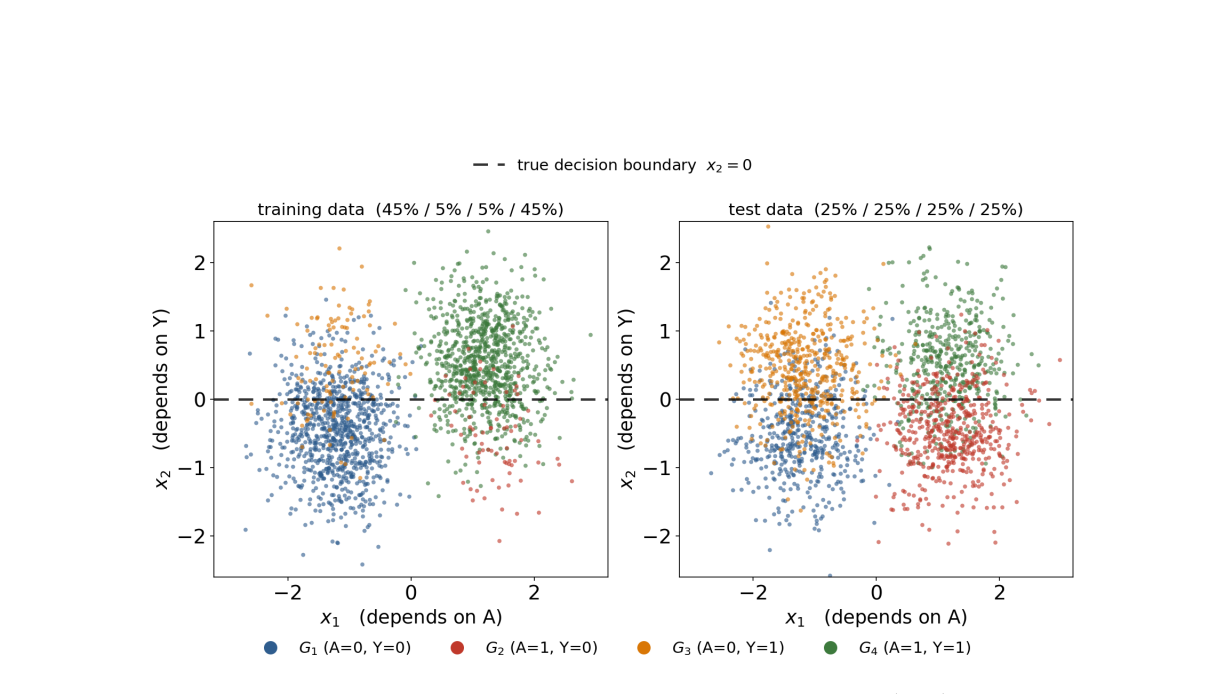
Core claim. On its own terms, the paper's central claim is that the pretrained representations of a tabular foundation model already encode the latent subpopulations, and that subpopulation shift degrades worst-group accuracy not because those representations are wrong but because the decoder's attention over context examples attends predominantly to majority-group samples. Query scaling under a robust objective redistributes attention so that minority test samples gather more weight from context samples in their own group: in the simulation, the median own-group attention weight for minority test samples rises from 0.23 to 0.56 after adaptation, while for majority samples it falls from 0.97 to 0.64. The paper argues this mechanism — adjusting how context contributes to predictions rather than modifying representations — is what delivers the reported gains, and it shows the same approach transfers to four additional foundation models, raising average worst-group accuracy by roughly 15 to 22 points on each. The paper also proves a decomposition showing that test-minus-train risk under a mixture shift is bounded by the total variation distance between mixture weights times the range of group risks, times an alignment factor in $[-1,1]$.
The premise it rests on. The method rests on the premise that clustering the frozen pretrained embeddings within each response class recovers the same latent groups whose mixture proportions shift, because GroupDRO then upweights whichever estimated group has the highest loss — if the clusters split data on spurious rather than structural axes, the objective optimizes the wrong worst case.
If the paper is right (Pith's inferences, not the authors')
Across five tabular benchmarks, DR-TFM (GR) raises average worst-group accuracy from 47.94% to 72.57% over pretrained TabPFN, a 24.63-point gain, while updating only 0.016% of the model's parameters.
DR-TFM (MS) lifts average worst-group accuracy by 21.37 points, and both instantiations keep mean group accuracy competitive with or slightly above TabPFN's.
The adaptation takes 23.8 seconds per result versus 214.1 seconds for TabPFN fine-tuning, using about one tenth of the peak GPU memory (1.07 GB versus 9.25 GB).
Group estimation by within-class clustering of frozen embeddings recovers enough structure that DR-TFM (GR) reaches 72.57% worst-group accuracy, within 1.09 points of the same method given true group labels (73.66%).
The query-scaling mechanism transfers to four other foundation models, with average worst-group accuracy gains of roughly 15 to 22 points on the five benchmarks.
The attention-redistribution result suggests a testable mechanism: worst-group accuracy under subpopulation shift in attention-based in-context learners may hinge on how evenly attention spreads across context groups, so any adaptation that diversifies majority-dominated attention might help even without a robust objective.
The MA-to-MI ACS transfer failure, which the paper attributes to estimated-group versus evaluation-group mismatch, implies that cluster quality is the operative condition; a cheap diagnostic measuring overlap between estimated clusters and plausible true subpopulations could predict when DR-TFM will help or hurt on a new dataset.
Because the scaling network is shared across attention heads and independent of encoder size, the same 8,320-parameter budget could plausibly adapt much larger in-context models; whether the gain-per-parameter ratio holds as models scale is a question the paper does not address.
The regression variant adapts the first linear layer of the output network rather than a query scaler, so the mechanism's general form may be 'retain frozen features, reweight their readout,' of which query scaling is one instance.
Check this review
Pith stored no record of this review's passes and took no fingerprint of it. Reviews made by code from 13 Nov 2026 on carry both.
How often reviews like this one are right
Reviews like this one: written by deepseek-v4-flash, where what was read was not recorded.
How often objections from reviews like this one are right: not yet measured
Reviews by people
This review was written by a machine. No person has reviewed this paper on Pith yet. A scientist listed on Pith can review it for a fee, and their review is published here whatever it concludes.
The paper
Abstract
Despite strong mean accuracy, tabular foundation models (TFMs) can perform poorly on underrepresented groups under subpopulation shift, where group proportions change between training and deployment. We propose DR-TFM, a parameter-efficient distributionally robust adaptation framework that requires no true group annotations. DR-TFM adjusts attention to labeled context examples by fine-tuning an existing query scaling network or adding and training one, while keeping all other parameters fixed. We instantiate the framework with two robust objectives using estimated groups or source conditional distributions derived from training data. For TabPFN-3, adaptation updates only 0.016% of the pretrained model's parameters. Across five tabular benchmarks, DR-TFM achieves substantially higher average worst-group accuracy than pretrained TFMs and the compared robust baselines without true group annotations, while maintaining competitive mean group accuracy. DR-TFM also improves average worst-group accuracy on ACS Income and across four additional TFMs.
The paper's own sentences, arranged, kept beside the review and separate from it. Each label is drawn from a closed vocabulary; the number beside it is the probability the classifier gave that label. No sentence in this record was written by a model.
abstract compiled · 2026-10-02
The authors' main claim, as the classifier picked it out 1.00
“Across five tabular benchmarks, DR-TFM achieves substantially higher average worst-group accuracy than pretrained TFMs and the compared robust baselines without true group annotations, while maintaining competitive mean group accuracy.”
How the main claim is stated: asserted 1.00
What the abstract itself states, as probabilities: claims first 0.05 · states limitation 0.19 · human participants 0.13 · controlled comparison 0.96 · randomized assignment 0.02 · states quantitative result 0.97 · compares with prior results 0.97 · mentions code or data availability 0.03
The abstract, sentence by sentence
This table labels the abstract only (arXiv listing abstract v1). The number is the probability the classifier gave the label.
| Sentence | Role | The authors' own work | States the main conclusion | Strength |
|---|---|---|---|---|
| Despite strong mean accuracy, tabular foundation models (TFMs) can perform poorly on underrepresented groups under subpopulation shift, where group proportions change between training and deployment. | background 0.96 | 0.12 | 0.04 | asserted 0.58 |
| We propose DR-TFM, a parameter-efficient distributionally robust adaptation framework that requires no true group annotations. | contribution 0.97 | 0.89 | 0.09 | asserted 0.99 |
| DR-TFM adjusts attention to labeled context examples by fine-tuning an existing query scaling network or adding and training one, while keeping all other parameters fixed. | method 0.99 | 0.79 | 0.04 | asserted 0.99 |
| We instantiate the framework with two robust objectives using estimated groups or source conditional distributions derived from training data. | method 0.98 | 0.90 | 0.04 | asserted 0.97 |
| For TabPFN-3, adaptation updates only 0.016% of the pretrained model's parameters. | result 0.79 | 0.93 | 0.04 | asserted 1.00 |
| Across five tabular benchmarks, DR-TFM achieves substantially higher average worst-group accuracy than pretrained TFMs and the compared robust baselines without true group annotations, while maintaining competitive mean group accuracy. | result 1.00 | 0.96 | 0.82 | asserted 1.00 |
| DR-TFM also improves average worst-group accuracy on ACS Income and across four additional TFMs. | result 1.00 | 0.94 | 0.19 | asserted 1.00 |
What kind of paper the classifier reports this is: method or tool 1.00 · evidence from observation or experiment 0.88
What was examined, and what was not
Sources read
- arXiv listing abstract v1
Not examined
- full text
- figures and tables
- references and citing sentences
- relations to other papers
Levels run
- P abstract
Not run
- S sections
- T body sentences
- C citations
- R cross-paper relations
How the labels were made
Compiled by classifier-1.13.0 via TypeSafe API, question bank abstract-p1-20260923, 2026-10-02: 1 request, 5,541 input tokens.
Every quoted sentence on this record is the authors'. Every label is from Pith's closed vocabulary, with the probability shown beside it. This record as JSON
Figures (7)



Figures are the authors', reproduced from the paper.
References (12)
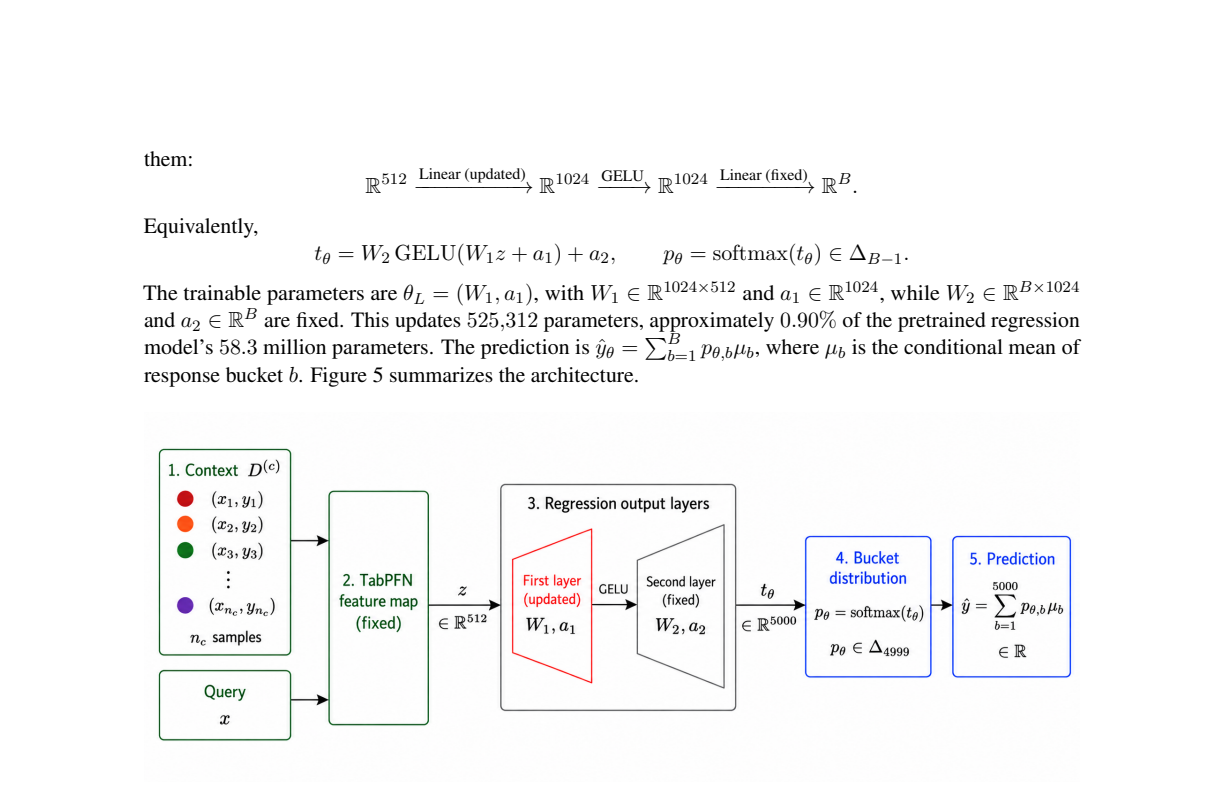
- [1] +a 2, p θ = softmax(tθ)∈∆ B−1. The trainable parameters areθL = (W1,a 1), withW1∈R 1024×512 anda1∈R 1024, whileW2∈R B×1024 anda2∈R B are fixed. This updates 525,312 parameters, approximately 0.90% of the pretrained regression model’s 58.3 million parameters. The prediction is ... on Pith
- [3] A.3.2 Datasets Benchmarks. • Adult (Becker and Kohavi, 1996). Census records. The task is to predict whether a person’s annual income exceeds $50K. • Bank (Moro et al., 2014). Marketing calls made by a Portuguese bank. The task is to predict whether the client subscribes to a ... on Pith
- [5] Further optimization settings are provided in Appendix A.3.7. A.2.3 Optimization for DR-TFM (MS) Source construction.We first prepare D(c) andD(e) as in Appendix A.2.1. We then form labeled source subsetsS1,...,S M fromD(c). Here, M denotes the number of retained sources. For ... on Pith
- [7] Groups.Evaluation groups are defined by pairing a binary attribute with the label. During training and model selection, true group labels are used only by the methods explicitly marked as using them. The evaluated attributes are the ones selected in Appendix B.2 of Tong et al.... on Pith
- [8] Categorical columns are one-hot encoded for the MLP-based baselines. 27 Table 6: The five tabular benchmarks and their splits. Dataset Train Validation Test Total Adult 26,048 6,513 16,281 48,842 Bank 32,551 8,138 4,522 45,211 Default 21,600 5,400 3,000 30,000 Shoppers 8,877 2... on Pith
- [10] Unless otherwise noted, results are averaged over seeds0,1, and2. 31 Schedule.Table 8 lists the training budgets and model selection criteria. The DR-TFM variants without true group labels use early stopping based on worst-group validation accuracy over estimated groups. For M... on Pith
- [16] 32 Hyperparameters for DR-TFM (MS).For both source constructions in Appendix A.3.4, we fix ϵ2 = 1, following Kim et al. (2026). With the uniform nominal vector, this radius allows all convex mixtures of the source conditionals. Kim et al. (2026) develop their method for unsupe... on Pith
- [17] A superscript∗ denotes access to true group labels. • GroupDRO (Sagawa et al., 2020). Minimizes the worst risk over the true groups. • Fair-TabICL (Kenfack et al., 2026). Selects in-context examples using the group label, either to balance the groups or by uncertainty in predi... on Pith
- [2020] (Appendix A.3.7). The assignments remain fixed throughout adaptation. The additional GMM variant fits a diagonal-covariance GMM within each class and assigns each training sample to the component with the largest posterior probability. It uses the same criterion to select the ... on Pith
- [2021] Moonjung Eo, Min-Kook Suh, Hye-Seung Cho, Jiwon Kim, Seoyoon Kim, Sangjun Nam, and Soonyoung Lee. EXAONE Tabular 1.0: Technical report.ArXiv:2608.25774, on PithPith's reviewarXiv
- [2025] and the training schedule used for query scaling. Table 20 reports the per-dataset results for input-adapter, full-backbone, encoder, decoder, and query-scaling adaptation. Tables 21 and 22 report the corresponding runtime and peak GPU memory per result. Fine-tuned parameters.... on Pith
- [2026] Léo Grinsztajn, Klemens Flöge, Oscar Key, Felix Birkel, Philipp Jund, Brendan Roof, Mihir Manium, Shi Bin Hoo, Magnus Bühler, Anurag Garg, et al. TabPFN-3: Technical report.ArXiv:2605.13986, on PithPith's reviewarXiv
Challenges and discussion
Disagree with the review, or know something it missed? Leave a comment, or challenge this review formally: a challenge becomes a permanent entry in this paper's record, and its decision is published here.
Come back by email
A short list of the week's newly reviewed papers. Nothing is sent until you confirm from your inbox, and every email has a link that stops it. No account.
No comments yet.
Sign in to comment