Machine Learning · arXiv:2608.25774 v1 · submitted 26 Aug 2026 · 34 references
EXAONE Tabular 1.0 : Technical Report
The paper says
“EXAONE Tabular is a compact tabular foundation model family for classification and regression via in-context learning, producing predictions without dataset-specific gradient updates.”
more of the abstract
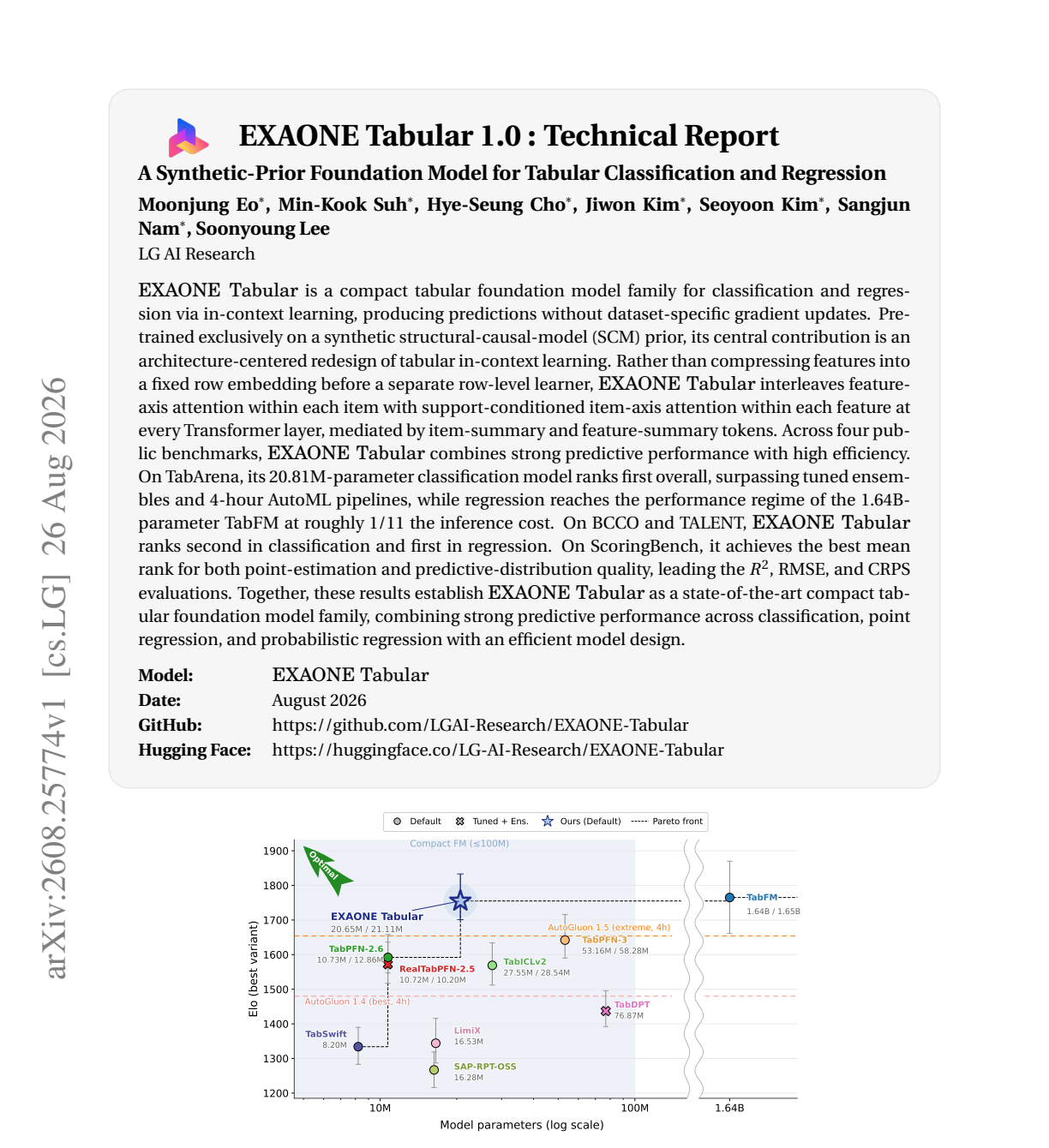
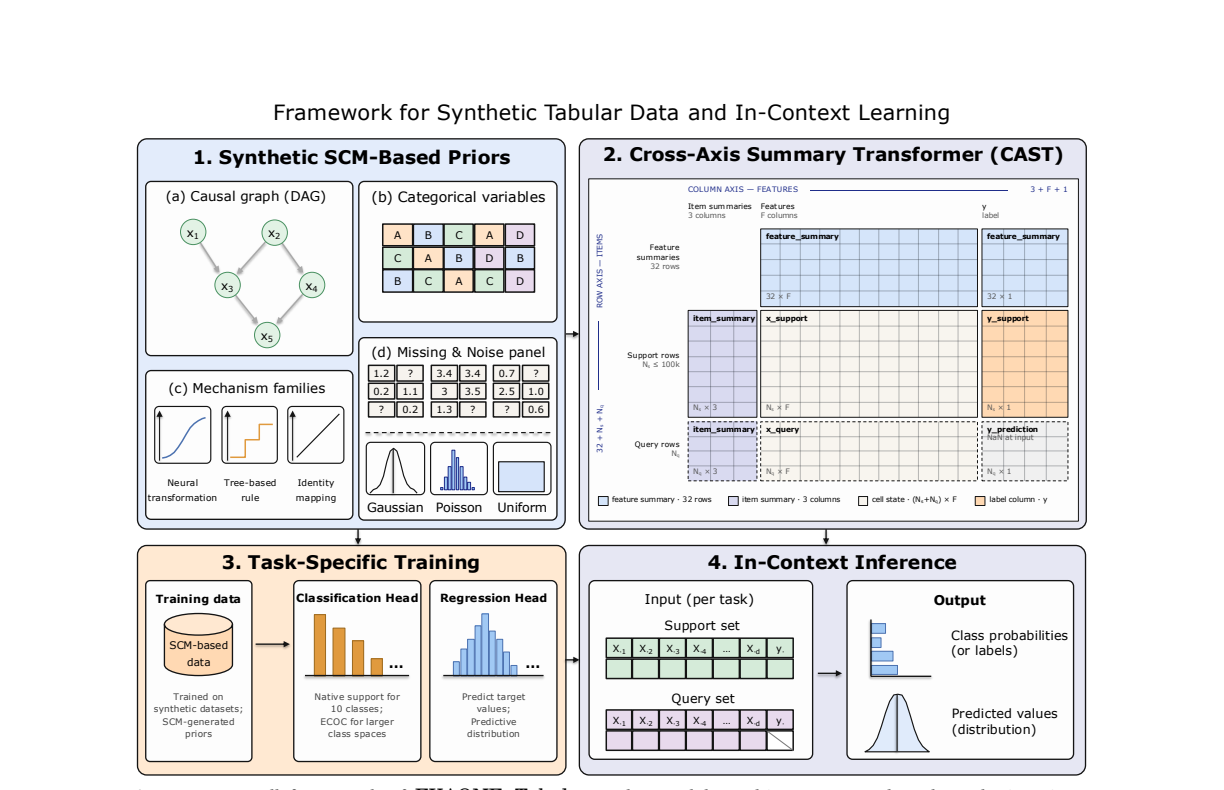
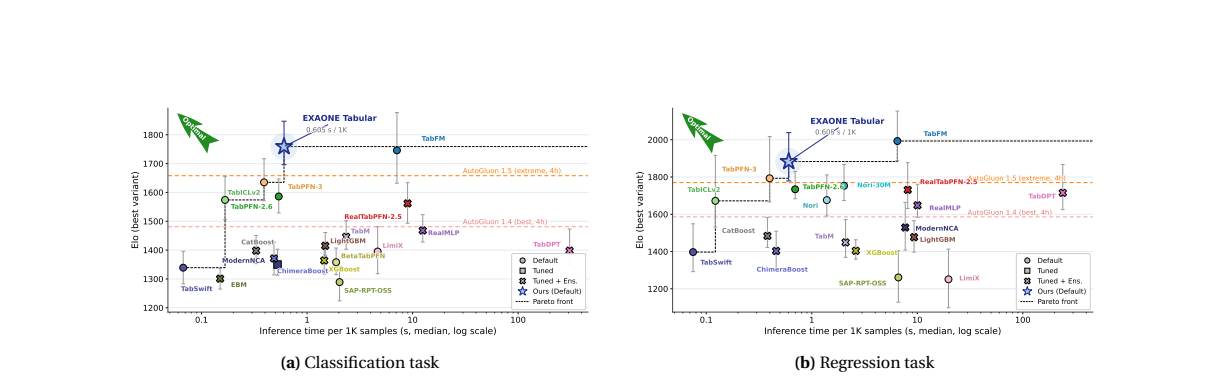
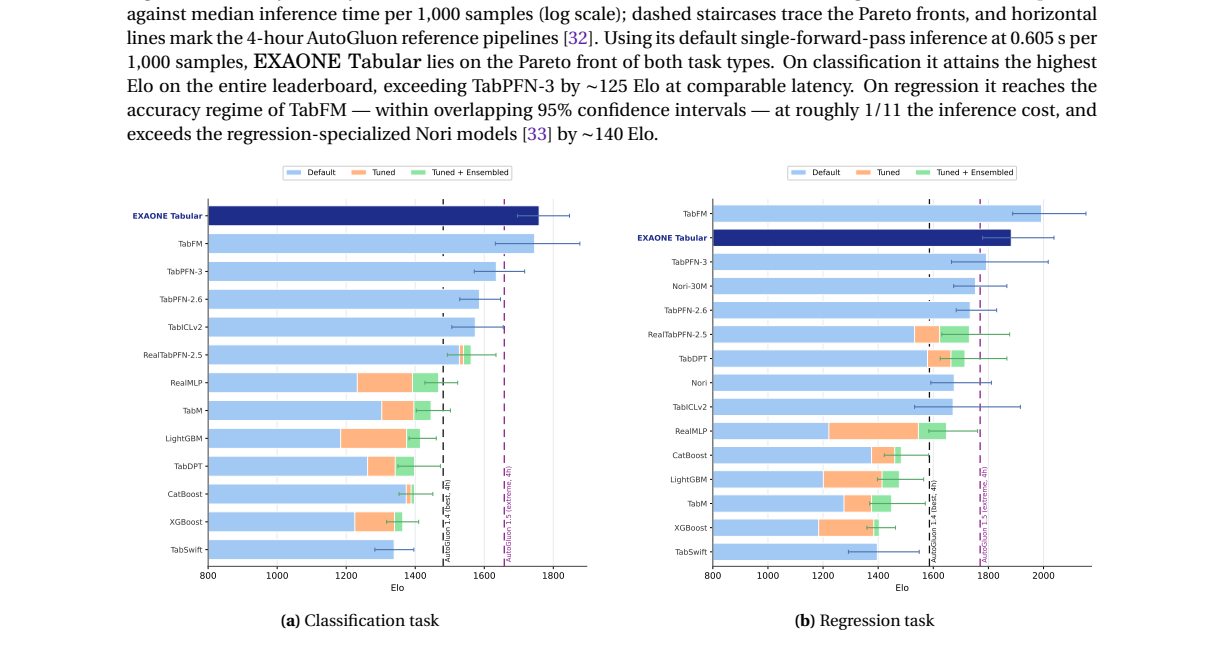
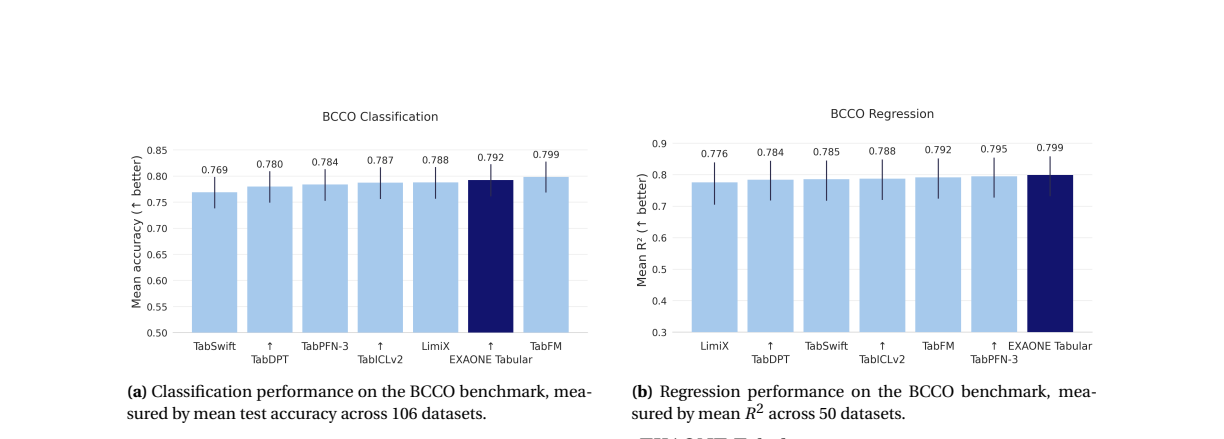
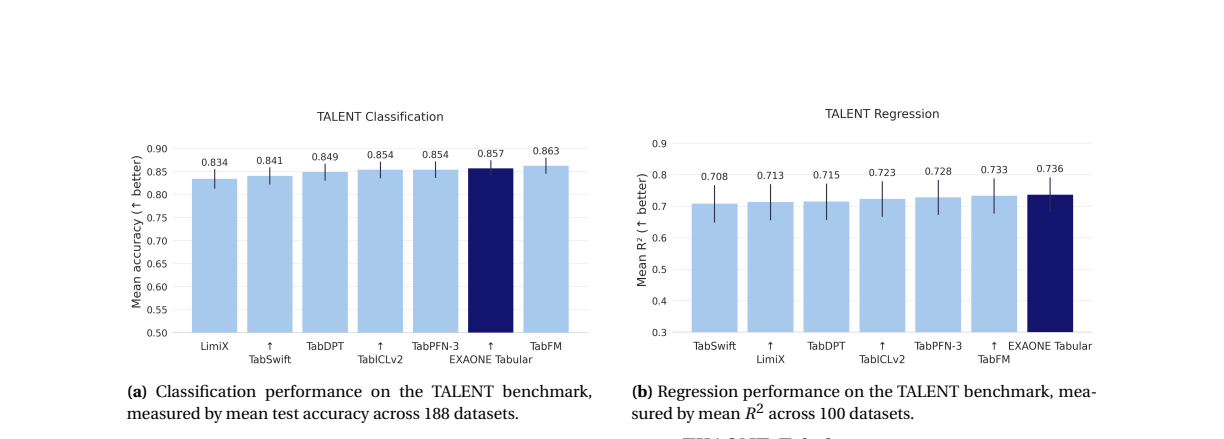
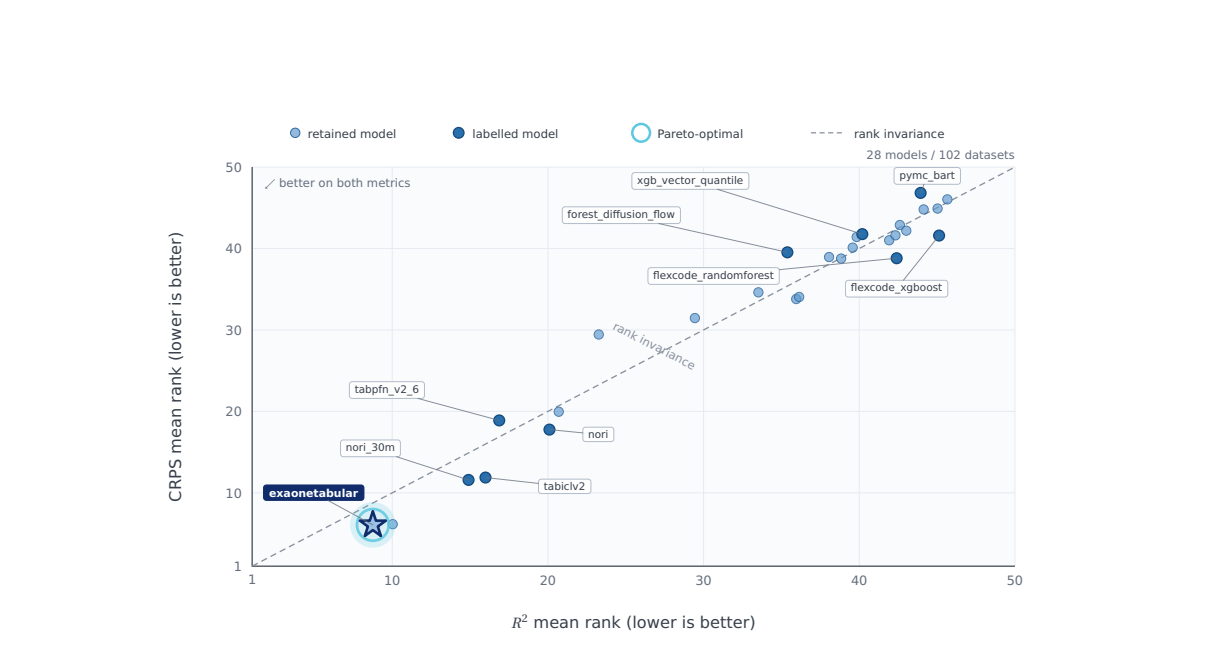
Pretrained exclusively on a synthetic structural-causal-model (SCM) prior, its central contribution is an architecture-centered redesign of tabular in-context learning. Rather than compressing features into a fixed row embedding before a separate row-level learner, EXAONE Tabular interleaves feature-axis attention within each item with support-conditioned item-axis attention within each feature at every Transformer layer, mediated by item-summary and feature-summary tokens. Across four public benchmarks, EXAONE Tabular combines strong predictive performance with high efficiency. On TabArena, its 20.81M-parameter classification model ranks first overall, surpassing tuned ensembles and 4-hour AutoML pipelines, while regression reaches the performance regime of the 1.64B-parameter TabFM at roughly 1/11 the inference cost. On BCCO and TALENT, EXAONE Tabular ranks second in classification and first in regression. On ScoringBench, it achieves the best mean rank for both point-estimation and predictive-distribution quality, leading the R2, RMSE, and CRPS evaluations. Together, these results establish EXAONE Tabular as a state-of-the-art compact tabular foundation model family, combining strong predictive performance across classification, point regression, and probabilistic regression with an efficient model design.
from the abstract
Pith says
Machine review · deepseek-v4-flash · 28 Aug 2026 · what was read was not recorded · not checked by a person
It can be wrong. Challenge this review or reply to it.
Holds up, with conditions. A genuine architectural contribution with strong benchmark results, but the paper's own ensemble-configuration wording undercuts the 'single-forward-pass' claims and must be clarified before the efficiency numbers are taken at face value. This line is wrong
3 major objections · 5 minor
How often objections from reviews like this one are right: not yet measured
Not checked: figures, code, what the 34 references say.
The paper says, at Section 2.4, Introduction, Figure 3
The review did not quote this passage.
Pith says: Objection 1 of 3 · major
The paper claims 'without post-hoc ensembling' and 'single-forward-pass inference' (Introduction and Figure 3 caption), but Section 2.4 states that 'The default number of test-time estimators is eight for classification.' These statements are internally inconsistent. Please clarify whether the TabArena results, Elo rankings, and timing measurements are based on a single forward pass or on an 8-member test-time ensemble.
more of objection 1
If the latter, the phrase 'without post-hoc ensembling' is inaccurate and should be revised, and the reported results should be described as ensemble results.
The paper says, at Section 4.3, Figure 3
The review did not quote this passage.
Pith says: Objection 2 of 3 · major
The efficiency comparison of 0.605 s versus 7.0 s per 1,000 samples is ambiguous. The paper does not specify whether 0.605 s is the total cost of the default 8 estimators, the cost of a single estimator, or the per-estimator cost.
more of objection 2
Similarly, it is unclear whether TabFM's 7.0 s corresponds to a single forward pass or to its default ensemble (which is 32 members on BCCO). Without this information, the claim of 'roughly 1/11 the inference cost' is not well-defined, and the comparison may be apples-to-oranges. Please report the estimator count and cost basis for each benchmark.
The paper says, at Section 2.3, Section 4
The review did not quote this passage.
Pith says: Objection 3 of 3 · major
The synthetic SCM prior is the only pretraining data, yet the paper provides no analysis of the prior's coverage or diversity relative to the evaluation benchmarks. Since the prior and the inference protocol (including preprocessing and ensembling choices) were designed by the same authors, there is a risk that the prior is implicitly tailored to these benchmarks.
more of objection 3
To support the claim of general zero-shot performance, please provide an analysis or ablation, such as measuring performance on datasets whose structure is deliberately outside the prior's distribution, or ablating key prior components.
5 minor objections
The paper says, at Abstract, Introduction
Pith says: minor objection 1 of 5
The phrase 'without post-hoc ensembling' conflicts with the default 8-estimator configuration described in Section 2.4; consider rephrasing to 'without dataset-specific tuning' and describing test-time ensembling as part of the default protocol.
The paper says, at Figure 1
Pith says: minor objection 2 of 5
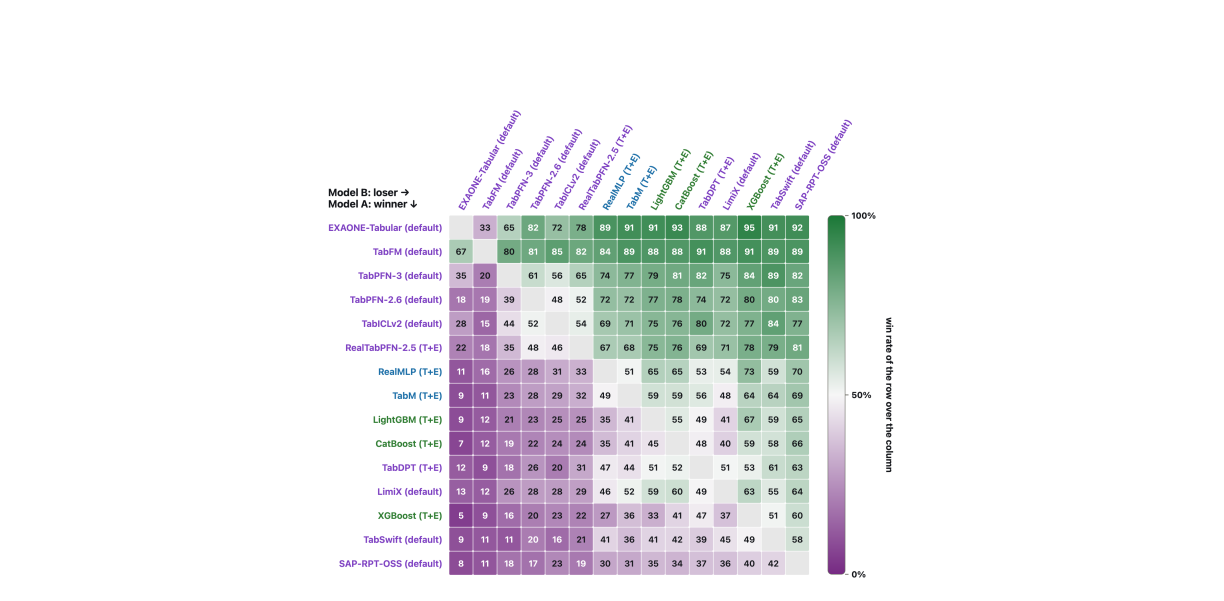
Figure 1 states that EXAONE Tabular is 'statistically tied' with TabFM; please specify the statistical test and significance level used to support this claim.
show 3 more
The paper says, at Section 4.4
Pith says: minor objection 3 of 5
The statement that TabFM uses 32 ensemble members while EXAONE uses 8 is informative; please report the ensemble sizes consistently for all benchmarks and figures, especially for TabArena where the comparison is central.
The paper says, at Section 4.2
Pith says: minor objection 4 of 5
The sentence 'For models with native categorical-feature support, we retained the default preprocessing pipeline' is vague; please list which models use native support and describe the default preprocessing for the others.
The paper says, at Section 4.3
Pith says: minor objection 5 of 5
Please clarify whether the timing measurements for EXAONE on TabArena were obtained on the same hardware as the baseline timings reported by the leaderboard, as hardware differences could affect the latency comparison.
What would settle it
Inspect the released GitHub repository's default configuration (e.g., the `exaonetabular` package defaults and any config files used for TabArena) to determine the exact number of estimators, preprocessing transforms, and ECOC settings used for the TabArena and ScoringBench submissions. Then rerun TabArena classification and regression with `ensemble_size=1` and with the actual default (reported as 8 for classification) on the same tasks, reporting Elo and median inference time per 1,000 samples for each configuration. If the single-estimator Elo remains first in classification and within TabFM's confidence interval in regression, and if the 1/11 cost ratio is computed on a per-forward-pass basis, the concern is resolved; otherwise the paper must restate its headline to 'fixed 8-estimator default ensemble' and report single-forward-pass performance separately.
from the skeptic's reading
How the review went
4 readings by deepseek-v4-flash · 28 Aug 2026
- Reader holds up, with conditions
- Skeptic partly agrees
- Editor wrote the verdict above
- Referee major revision: 3 major objections, 5 minor
Not run on this paper: the simulated authors' defence.
Pith did not check this review's objections against the paper.
The review in full
The review in brief, machine-written
You should know this paper is worth your time. The central claim — a 20.8M-parameter model matching or beating a 1.64B-parameter model on several tabular benchmarks — is plausible and largely supported by the evidence they present. The architecture, CAST, is a real tweak on the TabPFN-v2 line: interleaving feature-axis and item-axis attention while keeping cell-level representations, with persistent item- and feature-summary tokens. That is a clean, well-motivated design, and they position it clearly against TabICLv2, TabPFN-3, and TabFM. The synthetic SCM prior is inherited, but they train from scratch on it and release code and weights, which makes the work reproducible. What the paper does well: the evaluation is broad (TabArena, BCCO, TALENT, ScoringBench), they report bootstrap confidence intervals on BCCO/TALENT, and they are candid about the 12 TALENT datasets excluded due to class count. The pairwise win-rate analysis in Figure 5 is a nice addition. The results themselves are believable; nothing in the numbers looks cooked. Now the soft spots, in proportion. The stress-test concern is real. Section 2.4 says the default number of test-time estimators is eight for classification, yet the Introduction and Figure 3 say "single-forward-pass" and "without post-hoc ensembling." Those statements are in tension. If the TabArena results use an 8-member ensemble, then the "0.605 s per 1,000 samples" is the cost of the whole ensemble, not a single forward pass, and the comparison to TabFM's ~7.0 s is ambiguous unless you also state TabFM's estimator count (they do note 32 on BCCO, but not consistently). This is a reporting flaw, not a fatal one — the model still performs well with an 8-member default — but it has to be fixed before the headline efficiency claim is meaningful. Also minor: TabArena and ScoringBench numbers are taken on trust from official leaderboards; that is acceptable for a technical report but limits independent verification. The SCM prior's representativeness remains an assumption, but the zero-shot transfer to four external benchmarks is decent evidence in its favor. Bottom line: this is a solid contribution and deserves a serious referee. The authors should be required to state exactly how many estimators produced each reported number and to reconcile the "single-forward-pass" language with the 8-estimator default. I'd bring it to our reading group, and I'd cite the CAST architecture if I were working on tabular ICL. Recommend peer review, conditional on that clarification.
The strongest objection
Section 2.4 states: 'Both classification and regression support test-time ensembling... The default number of test-time estimators is eight for classification.' Yet the Introduction claims the classification model ranks first 'using a single fixed default configuration, without dataset-specific tuning or post-hoc ensembling,' and Figure 3 is captioned 'Using its default single-forward-pass inference at 0.605 s per 1,000 samples.' These statements are in tension. If the released default aggregates 8 preprocessing/permutation estimators, then the TabArena results in Figures 3–5 are ensemble results, not single-forward-pass results, and 'without post-hoc ensembling' is inaccurate. The efficiency comparison of 0.605 s vs TabFM's ~7.0 s (≈11.5×) is also ambiguous: is 0.605 s the total cost of 8 estimators (≈0.076 s per forward pass) or the cost of one estimator? And is TabFM's 7.0 s for one forward pass or for its default ensemble (which is 32 members on BCCO)? Without specifying the estimator count and cost basis for each benchmark, the central claim that a 20.81M model 'reaches TabFM's regression performance at roughly 1/11 the inference cost' is not well-defined. This is the most load-bearing concern because the headline superiority and efficiency claims both rest on this configuration. A related but secondary concern is the synthetic SCM prior's representativeness; however, the ensemble ambiguity is text-internal and directly testable.
The reader identified the synthetic SCM prior's representativeness as the weakest assumption. That is a legitimate generalization concern, but it is not the most load-bearing because the paper provides direct zero-shot evidence across four benchmarks; a critique of the prior alone would be a disagreement with consensus rather than an internal defect. The more immediate issue is the paper's own inconsistency about the default inference configuration. Section 2.4 makes the default classification ensemble size 8, while the abstract, introduction, and Figure 3 claim a single untuned default without post-hoc ensembling and call the inference 'single-forward-pass.' If the TabArena and ScoringBench numbers were produced with 8 estimators, the central top-ranking and efficiency claims are framed misleadingly. The 0.605 s vs 7.0 s cost comparison is ambiguous because it is unclear whether these are per-estimator or total costs, and whether TabFM's figure includes its 32-member ensemble. This is directly testable by inspecting the released defaults and rerunning with ensemble_size=1. Because this is an ambiguity rather than a demonstrated falsehood, the appropriate verdict remains CONDITIONAL; the paper should be accepted only after the authors clarify the ensemble configuration and report single-estimator results.
The referee's report
If the reported results hold, this is a significant contribution to tabular foundation models: a compact model with a novel architecture that achieves state-of-the-art performance across multiple public benchmarks, natively handles missing values, and does not require dataset-specific gradient updates. The paper includes bootstrap confidence intervals for BCCO/TALENT and uses public leaderboards for TabArena/ScoringBench, which increases transparency. However, the ambiguity around the default test-time ensemble size is load-bearing for the headline claims and must be resolved before the results can be fully assessed.
Pith's reading of the paper (a machine's summary, not the authors')
This paper claims that a compact tabular foundation model, roughly 21 million parameters, can reach the top of public tabular benchmarks through a careful architecture design rather than through large scale or real pretraining data. The model is trained exclusively on synthetic tables generated from structural causal models and predicts new datasets in one forward pass, without dataset-specific gradient updates. On TabArena, the 20.81M-parameter classification model ranks first in its single default configuration, above tuned ensembles and four-hour AutoML pipelines, and the regression model reaches the accuracy of the 1.64B-parameter TabFM at about one-eleventh of the inference cost. If these results hold, tabular prediction would no longer require per-dataset training or billion-parameter models for strong zero-shot performance.
What carries the argument. The load-bearing object is the Cross-Axis Summary Transformer (CAST), a 12-layer Transformer with 192-dimensional embeddings and 6 attention heads that, within each layer, runs feature-axis attention over each row's cells (joined by three item-summary tokens) and support-conditioned item-axis attention over each column's support cells (joined by 32 feature-summary tokens). Query rows cross-attend to the support context but not to each other, making predictions conditionally independent given the support set and enabling chunked inference. CAST is trained entirely on tables sampled from a five-stage structural-causal-model prior that generates DAGs, mechanism families, categorical and missing values, so the architecture must learn its inductive biases from synthetic tasks rather than from real datasets.
Core claim. On the paper's own terms, the central discovery is that interleaving row-wise and column-wise attention throughout a Transformer, while keeping every cell represented at every layer, is what unlocks strong tabular in-context learning in a small model. EXAONE Tabular's CAST architecture alternates feature-axis attention within each item with support-conditioned item-axis attention within each feature, using item-summary and feature-summary tokens to exchange information across the two axes. Pretrained from scratch on a synthetic SCM prior, the classification model (20.81M parameters) ranks first on TabArena in its untuned default setting, and the regression model (21.11M parameters) matches TabFM's accuracy regime at roughly 1/11 the inference cost; on BCCO and TALENT it ranks second in classification and first in regression, and on ScoringBench it leads in $R^2$, RMSE, and CRPS mean ranks.
The premise it rests on. The load-bearing premise is that synthetic SCM-generated tables capture the structural patterns — nonlinearity, causal dependencies, categorical values, noise, missingness — of real-world tabular data well enough that a model pretrained only on them transfers zero-shot to arbitrary public benchmarks.
If the paper is right (Pith's inferences, not the authors')
Dataset-specific training and hyperparameter tuning can be replaced by a fixed default configuration for a large share of tabular classification and regression tasks, if the benchmark results generalize.
A 1.64B-parameter tabular foundation model is not necessary for TabFM-level regression accuracy on these benchmarks; a model roughly 1/80 its size reaches the same performance regime at 1/11 the inference cost.
Missing values can be passed to the model as-is, so incomplete real-world tables do not need imputation before prediction.
Multiclass tasks beyond 10 classes are handled by the ECOC decomposition at inference time, adding compute rather than requiring a larger head or per-task retraining.
If the synthetic SCM prior transfers this broadly, the same generation recipe is a candidate for neighboring data types such as time series, survival data, or relational tables, though the paper does not test that transfer.
The paper does not isolate how much of the gain comes from CAST versus the SCM prior; an ablation with a staged architecture trained on the same prior would identify which component carries the accuracy.
A natural stress test is to push the context size or number of classes well beyond the reported settings and measure whether the interleaved design degrades gracefully; the report only notes the ECOC cost qualitatively.
The '1/11 inference cost' comparison reflects the regression model's single forward pass on TabArena; a full practical comparison would include the default eight-estimator ensemble and ECOC overhead, which the paper does not aggregate into one number.
Check this review
Pith stored no record of this review's passes and took no fingerprint of it. Reviews made by code from 13 Nov 2026 on carry both.
How often reviews like this one are right
Reviews like this one: written by deepseek-v4-flash, where what was read was not recorded.
How often objections from reviews like this one are right: not yet measured
Reviews by people
This review was written by a machine. No person has reviewed this paper on Pith yet. A scientist listed on Pith can review it for a fee, and their review is published here whatever it concludes.
The paper
Abstract
EXAONE Tabular is a compact tabular foundation model family for classification and regression via in-context learning, producing predictions without dataset-specific gradient updates. Pretrained exclusively on a synthetic structural-causal-model (SCM) prior, its central contribution is an architecture-centered redesign of tabular in-context learning. Rather than compressing features into a fixed row embedding before a separate row-level learner, EXAONE Tabular interleaves feature-axis attention within each item with support-conditioned item-axis attention within each feature at every Transformer layer, mediated by item-summary and feature-summary tokens. Across four public benchmarks, EXAONE Tabular combines strong predictive performance with high efficiency. On TabArena, its 20.81M-parameter classification model ranks first overall, surpassing tuned ensembles and 4-hour AutoML pipelines, while regression reaches the performance regime of the 1.64B-parameter TabFM at roughly 1/11 the inference cost. On BCCO and TALENT, EXAONE Tabular ranks second in classification and first in regression. On ScoringBench, it achieves the best mean rank for both point-estimation and predictive-distribution quality, leading the R2, RMSE, and CRPS evaluations. Together, these results establish EXAONE Tabular as a state-of-the-art compact tabular foundation model family, combining strong predictive performance across classification, point regression, and probabilistic regression with an efficient model design.
The paper's own sentences, arranged, kept beside the review and separate from it. Each label is drawn from a closed vocabulary; the number beside it is the probability the classifier gave that label. No sentence in this record was written by a model.
abstract compiled · 2026-09-23
The authors' main claim, as the classifier picked it out 1.00
“Together, these results establish EXAONE Tabular as a state-of-the-art compact tabular foundation model family, combining strong predictive performance across classification, point regression, and probabilistic regression with an efficient model design.”
How the main claim is stated: asserted 1.00
What the abstract itself states, as probabilities: claims first 0.08 · states limitation 0.08 · human participants 0.04 · controlled comparison 0.63 · randomized assignment 0.02 · states quantitative result 0.99 · compares with prior results 0.96 · mentions code or data availability 0.03
The abstract, sentence by sentence
This table labels the abstract only (arXiv listing abstract v1). The number is the probability the classifier gave the label.
| Sentence | Role | The authors' own work | States the main conclusion | Strength |
|---|---|---|---|---|
| EXAONE Tabular is a compact tabular foundation model family for classification and regression via in-context learning, producing predictions without dataset-specific gradient updates. | contribution 0.72 | 0.63 | 0.09 | asserted 1.00 |
| Pretrained exclusively on a synthetic structural-causal-model (SCM) prior, its central contribution is an architecture-centered redesign of tabular in-context learning. | contribution 0.93 | 0.75 | 0.12 | asserted 1.00 |
| Rather than compressing features into a fixed row embedding before a separate row-level learner, EXAONE Tabular interleaves feature-axis attention within each item with support-conditioned item-axis attention within each feature at every Transformer layer, mediated by item-summary and feature-summary tokens. | method 0.77 | 0.82 | 0.08 | asserted 1.00 |
| Across four public benchmarks, EXAONE Tabular combines strong predictive performance with high efficiency. | result 0.94 | 0.89 | 0.11 | asserted 1.00 |
| On TabArena, its 20.81M-parameter classification model ranks first overall, surpassing tuned ensembles and 4-hour AutoML pipelines, while regression reaches the performance regime of the 1.64B-parameter TabFM at roughly 1/11 the inference cost. | result 1.00 | 0.93 | 0.09 | asserted 1.00 |
| On BCCO and TALENT, EXAONE Tabular ranks second in classification and first in regression. | result 1.00 | 0.93 | 0.04 | asserted 1.00 |
| On ScoringBench, it achieves the best mean rank for both point-estimation and predictive-distribution quality, leading the $R^2$, RMSE, and CRPS evaluations. | result 1.00 | 0.94 | 0.09 | asserted 1.00 |
| Together, these results establish EXAONE Tabular as a state-of-the-art compact tabular foundation model family, combining strong predictive performance across classification, point regression, and probabilistic regression with an efficient model design. | interpretation 0.99 | 0.86 | 0.92 | asserted 1.00 |
What kind of paper the classifier reports this is: method or tool 1.00 · evidence from observation or experiment 0.74
What was examined, and what was not
Sources read
- arXiv listing abstract v1
Not examined
- full text
- figures and tables
- references and citing sentences
- relations to other papers
Levels run
- P abstract
Not run
- S sections
- T body sentences
- C citations
- R cross-paper relations
How the labels were made
Compiled by classifier-1.13.0 via TypeSafe API, question bank abstract-p1-20260923, 2026-09-23: 1 request, 6,456 input tokens.
Every quoted sentence on this record is the authors'. Every label is from Pith's closed vocabulary, with the probability shown beside it. This record as JSON
Figures (8)
Figures are the authors', reproduced from the paper.
References (34)
- [1] Minh-Khoi Pham et al. “Retrieval-Aligned Tabular Foundation Models Enable Robust Clinical Risk Prediction in Electronic Health Records Under Real-World Constraints”. In:arXiv preprint arXiv:2604.01841(2026) on PithPith's reviewarXiv
- [2] Jillian M. Clements et al. “Sequential Deep Learning for Credit Risk Monitoring with Tabular Financial Data”. In: arXiv preprint arXiv:2012.15330(2020) on PithPith's reviewarXiv
- [3] Ida Hector and Rukmani Panjanathan. “Predictive Maintenance in Industry 4.0: A Survey of Planning Models and Machine Learning Techniques”. In:PeerJ Computer Science10 (2024), e2016. 16 on Pith
- [4] Abdul Quadir Md et al. “A Review on Data-Driven Quality Prediction in the Production Process with Machine Learning for Industry 4.0”. In:Processes10.10 (2022), p. 1966 on Pith
- [5] Vahid Attari and Raymundo Arroyave. “Decoding Non-Linearity and Complexity: Deep Tabular Learning Ap- proaches for Materials Science”. In:Digital Discovery(2025). arXiv:2411.18717 on PitharXiv
- [6] Vadim Borisov et al. “Deep Neural Networks and Tabular Data: A Survey”. In:IEEE Transactions on Neural Net- works and Learning Systems35.6 (2024), pp. 7499–7519 on Pith
- [7] Tianqi Chen and Carlos Guestrin. “XGBoost: A Scalable Tree Boosting System”. In:Proceedings of the 22nd ACM SIGKDD International Conference on Knowledge Discovery and Data Mining. 2016, pp. 785–794.DOI:10.1145/ 2939672.2939785 on PitharXiv
- [8] Guolin Ke et al. “LightGBM: A Highly Efficient Gradient Boosting Decision Tree”. In:Advances in Neural Infor- mation Processing Systems. Vol. 30. 2017 on Pith
- [9] Liudmila Prokhorenkova et al. “CatBoost: Unbiased Boosting with Categorical Features”. In:Advances in Neural Information Processing Systems. Vol. 31. 2018 on Pith
- [10] Léo Grinsztajn, Edouard Oyallon, and Gaël Varoquaux. “Why Do Tree-Based Models Still Outperform Deep Learning on Typical Tabular Data?” In:Advances in Neural Information Processing Systems. Vol. 35. 2022, pp. 507– 520 on Pith
- [11] Samuel Müller et al. “Transformers Can Do Bayesian Inference”. In:International Conference on Learning Rep- resentations. 2022 on Pith
- [12] Noah Hollmann et al. “TabPFN: A Transformer That Solves Small Tabular Classification Problems in a Second”. In:International Conference on Learning Representations. 2023 on Pith
- [13] Noah Hollmann et al. “Accurate Predictions on Small Data with a Tabular Foundation Model”. In:Nature637 (2025), pp. 319–326.DOI:10.1038/s41586-024-08328-6 on Pithdoi:10.1038/s41586-024-08328-6
- [14] Jingang Qu et al. “TabICL: A Tabular Foundation Model for In-Context Learning on Large Data”. In:arXiv preprint arXiv:2502.05564(2025). Published at ICML 2025 on PithPith's reviewarXiv
- [15] Léo Grinsztajn et al. “TabPFN-3: Technical Report”. In:arXiv preprint arXiv:2605.13986(2026) on PithPith's reviewarXiv
- [16] Jingang Qu et al. “TabICLv2: A Better, Faster, Scalable, and Open Tabular Foundation Model”. In:arXiv preprint arXiv:2602.11139(2026) on PithPith's reviewarXiv
- [17] Nick Erickson et al. “TabArena: A Living Benchmark for Machine Learning on Tabular Data”. In:arXiv preprint arXiv:2506.16791(2025) on PithPith's reviewarXiv
- [18] Google Research.Introducing TabFM: A Zero-Shot Foundation Model for Tabular Data. Google Research Blog. June 2026.URL:https : / / research . google / blog / introducing - tabfm - a - zero - shot - foundation - model-for-tabular-data/ on Pith
- [19] Xingxuan Zhang et al. “LimiX: Unleashing Structured-Data Modeling Capability for Generalist Intelligence”. In: arXiv preprint arXiv:2509.03505(2025) on PitharXiv
- [20] Si-Yang Liu et al. “TALENT: A Tabular Analytics and Learning Toolbox”. In:arXiv preprint arXiv:2407.04057 (2024) on PithPith's reviewarXiv
show 14 more
- [21] Jonas Landsgesell, Pascal Knoll, and Tizian Wenzel.ScoringBench: A Benchmark for Evaluating Tabular Foun- dation Models with Proper Scoring Rules. 2026. arXiv:2603.29928 [cs.AI] on PithPith's reviewarXiv
- [22] Léo Grinsztajn et al. “TabPFN-2.5: Advancing the State of the Art in Tabular Foundation Models”. In:arXiv preprint arXiv:2511.08667(2025) on PithPith's reviewarXiv
- [23] Junwei Ma et al. “TabDPT: Scaling Tabular Foundation Models”. In:arXiv preprint arXiv:2410.18164(2024) on PitharXiv
- [24] Ken M. Nakanishi. “Scalable-Softmax Is Superior for Attention”. In:arXiv preprint arXiv:2501.19399(2025) on PithPith's reviewarXiv
- [25] Thomas G. Dietterich and Ghulum Bakiri. “Solving Multiclass Learning Problems via Error-Correcting Output Codes”. In:Journal of Artificial Intelligence Research2 (1995), pp. 263–286.DOI:10.1613/jair.105 on Pithdoi:10.1613/jair.105
- [26] Tri Dao et al. “FlashAttention: Fast and Memory-Efficient Exact Attention with IO-Awareness”. In:Advances in Neural Information Processing Systems. Vol. 35. 2022 on Pith
- [27] Markus N. Rabe and Charles Staats. “Self-attention Does Not NeedO(n 2) Memory”. In:arXiv preprint arXiv:2112.05682 (2021) on PithPith's reviewarXiv
- [28] Jingyuan Liu et al. “Muon Is Scalable for LLM Training”. In:arXiv preprint arXiv:2502.16982(2025) on PithPith's reviewarXiv
- [29] Ilya Loshchilov and Frank Hutter. “Decoupled Weight Decay Regularization”. In:International Conference on Learning Representations. 2019. 17 on Pith
- [30] Kaiyue Wen et al. “Understanding Warmup-Stable-Decay Learning Rates: A River Valley Loss Landscape Per- spective”. In:arXiv preprint arXiv:2410.05192(2024) on PithPith's reviewarXiv
- [31] Si-Yang Liu and Han-Jia Ye. “TabSwift: An Efficient Tabular Foundation Model with Row-Wise Attention”. In: arXiv preprint arXiv:2606.07345(2026) on PithPith's reviewarXiv
- [32] Nick Erickson et al. “AutoGluon-Tabular: Robust and Accurate AutoML for Structured Data”. In:arXiv preprint arXiv:2003.06505(2020) on PithPith's reviewarXiv
- [33] Synthefy.Nori: Regression-Specialized Tabular Foundation Models. Model release. 2026.URL:https://huggingface. co/Synthefy/Nori-30M on Pith
- [34] David Holzmüller, Léo Grinsztajn, and Ingo Steinwart. “Better by Default: Strong Pre-Tuned MLPs and Boosted Trees on Tabular Data”. In:Advances in Neural Information Processing Systems. Vol. 38. 2024. 18 on Pith
Cited by 11 Pith papers
Reviewed papers on Pith that cite this one. The full citation record
- TILE: Bridging LLMs and Table Foundation Models for Tabular Learning with Strings cs.LG · Oct 2026
- LimiX-2: A Contextual Mechanism Network Towards General Structured-Data Intelligence cs.AI · Sep 2026
- EEG Decoding in Context: A Framework for Tuning-Free EEG Foundation Models cs.LG · Nov 2026
- NVIDIA Kumo Tabular: Pushing the Accuracy-Efficiency Frontier for Tabular Prediction cs.LG · Nov 2026
- Beyond Foundation Models: PFN Priors Improve Tabular Hyperparameter Optimization cs.LG · Nov 2026
- OrionMoE-v1.0: A Mixture-of-Experts Foundation Model for Tabular In-Context Learning cs.LG · Oct 2026
- TabGift: A Context-Efficient Foundation Model for Tabular Data Generation cs.LG · Oct 2026
- Parameter-Efficient Distributionally Robust Adaptation of Tabular Foundation Models under Subpopulation Shift cs.LG · Oct 2026
- Support-Compiled Feature Folding: More Evidence at Lower Memory Across Tabular Foundation Models cs.LG · Sep 2026
- Mitra-v2 Technical Report cs.LG · Sep 2026
- Thinking in Depth: Retrospective Inference for Tabular Foundation Models cs.LG · Oct 2026
How the literature uses it
What this paper does with the arXiv papers it cites
What it cites · 8 sentences without a confident label
Uses the method or tool of 3 papers
-
Selected matrix-valued parameters, including most attention and feed-forward weight matrices, are optimized with Muon [ref] , which applies a momentum-based update followed by matrix orthogonalization.
Muon is Scalable for LLM Training · Optimization · 1.00
-
Training primarily uses Warmup-Stable-Decay (WSD) learning-rate schedules [ref] .
Understanding Warmup-Stable-Decay Learning Rates: A River Valley Loss Landscape Perspective · Learning-Rate Schedule · 0.99
-
The attention implementation dispatches between FlashAttention [ref] and Memory-Efficient Attention [ref] according to the sequence length and tensor configuration.
Self-attention Does Not Need $O(n^2)$ Memory · Inference · 1.00
Compares with 8 papers
-
On TabArena [ref] , the classification model ranks first among all evaluated methods using a single fixed default configuration, without dataset-specific tuning or post-hoc ensembling, while the regression model reaches the performance regime of the 1.64B-parameter TabFM [ref] at roughly 1/11 the inference cost.
TabArena: A Living Benchmark for Machine Learning on Tabular Data · Introduction · 0.95
-
For BCCO and TALENT, we conduct a controlled comparison against six tabular foundation models: TabSwift [ref] , TabDPT [ref] , TabPFN-3 [ref] , TabICLv2 [ref] , LimiX [ref] , and TabFM [ref] .
TabICLv2: A better, faster, scalable, and open tabular foundation model · Benchmarks · 1.00
-
For BCCO and TALENT, we conduct a controlled comparison against six tabular foundation models: TabSwift [ref] , TabDPT [ref] , TabPFN-3 [ref] , TabICLv2 [ref] , LimiX [ref] , and TabFM [ref] .
2410.18164 · Benchmarks · 1.00
Cites as background 10 papers
-
TabArena is a continuously maintained benchmark for tabular machine learning that provides curated datasets, standardized evaluation pipelines, and strong implementations of classical, neural, and foundation-model baselines [ref] .
TabArena: A Living Benchmark for Machine Learning on Tabular Data · TabArena Results · 0.82
-
Tabular foundation models challenge this convention by pretraining a reusable prediction algorithm across many tasks and applying it to a new dataset through in-context learning [ref] .
TabPFN-3: Technical Report · Introduction · 0.85
-
Tabular foundation models challenge this convention by pretraining a reusable prediction algorithm across many tasks and applying it to a new dataset through in-context learning [ref] .
TabICLv2: A better, faster, scalable, and open tabular foundation model · Introduction · 0.85
Challenges and discussion
Disagree with the review, or know something it missed? Leave a comment, or challenge this review formally: a challenge becomes a permanent entry in this paper's record, and its decision is published here.
Come back by email
A short list of the week's newly reviewed papers. Nothing is sent until you confirm from your inbox, and every email has a link that stops it. No account.
No comments yet.
Sign in to comment