Machine Learning · arXiv:2610.16990 v1 · submitted 12 Oct 2026 · 21 references
TabGift: A Context-Efficient Foundation Model for Tabular Data Generation
The paper says
“Tabular data generation aims to synthesize realistic samples from limited observations while faithfully capturing the underlying data distribution.”
more of the abstract
Tabular foundation models (TFMs), pretrained on diverse tabular tasks and adapted through in-context learning, have demonstrated strong predictive capabilities, suggesting the potential of extending this paradigm to tabular data generation. However, the strong predictive performance of TFMs often relies on sufficiently large context sets, whereas tabular generation is typically needed precisely when target data are scarce. Extending the foundation-model paradigm to generation therefore requires reliable distribution inference from only a limited context. To this end, we propose TabGift, a context-efficient tabular foundation model enabling both efficient distribution modeling and effective generation from only a few context samples. TabGift maps heterogeneous tables into a shared latent space with a pretrained tabular encoder, where an in-context diffusion model learns to denoise latent samples conditioned on a small set of clean examples. This design transfers generative priors across datasets and enables distribution inference from limited context, while a lightweight dataset-specific MLP decoder maps generated representations back to the original data space. Experiments on 7 classification and 11 regression datasets show that TabGift consistently outperforms representative baselines in synthetic data quality, with particularly strong gains under limited-context settings, while achieving substantially faster adaptation and generation.
from the abstract
Pith says
Machine review · deepseek-v4-flash · 14 Oct 2026 · what was read was not recorded · not checked by a person
It can be wrong. Challenge this review or reply to it.
The passes disagreed. Reader: holds up, with conditions. Skeptic: does not hold up. Referee: major revision.
TabGIFT has a promising architecture for few-shot tabular generation, but a load-bearing data-leakage issue (overlap between fine-tuning and evaluation datasets) undermines the central claim of consistent outperformance. This line is wrong
2 major objections · 5 minor
How often objections from reviews like this one are right: not yet measured
Not checked: figures, code, what the 21 references say.
The paper says, at Tables 3–6 and Section 5.1
The review did not quote this passage.
Pith says: Objection 1 of 2 · major
The evaluation datasets include several that also appear in the fine-tuning set. Specifically, 'adult' and 'pc3' appear in both the classification fine-tuning set (Table 4) and the evaluation set (Table 5); 'kin8nm' and 'superconductivity' appear in both the regression fine-tuning set (Table 3) and the evaluation set (Table 6).
more of objection 1
The paper does not state that these overlapping datasets were withheld or that any hold-out procedure was applied. Because TabGIFT's fine-tuning directly optimizes reconstruction on these datasets, their presence in evaluation can inflate reported downstream performance relative to baselines that never see any part of the evaluation data. This data leakage is a fundamental threat to the central claim that 'TabGIFT consistently outperforms representative baselines in synthetic data quality'. The authors must either (a) re-run the evaluation excluding all datasets that overlap with the fine-tuning set, or (b) provide clear, compelling evidence—such as per-dataset breakdowns—that the reported gains are not driven by the leaked datasets. The limitation statements in Section 6 do not mention this issue.
The paper says, at Section 5.3.1 and Table 1
The review did not quote this passage.
Pith says: Objection 2 of 2 · major
The paper claims 'consistently outperforms', but the results in Table 1 show that TabGIFT does not always outperform at larger context sizes. For example, at training size 512 in regression, TabGIFT achieves 0.8359, which is lower than BN (0.9722) and TabEBM (0.9772).
more of objection 2
In classification at size 512, TabGIFT (0.9526) is lower than BN (0.9867) and SMOTE (0.9980). The authors acknowledge this in the text (e.g., 'its relative advantage narrows'), but the abstract and introduction still use the strong phrase 'consistently outperforms'. This phrasing should be tempered to accurately reflect the results, e.g., 'outperforms in limited-context regimes'.
5 minor objections
The paper says, at Section 3.3
Pith says: minor objection 1 of 5
The description of how SwiftPFN is used without labels (constructing all-zero labels and a dummy test sample) is functional but could be clarified: the dummy test sample is a row of zeros, not a matrix. The text says '0^{1×F}' which is fine, but adding a sentence explaining that this ensures the model operates normally would improve readability.
The paper says, at Figure 1
Pith says: minor objection 2 of 5
The figure is clear overall, but the arrow from '?' train to '?syn' is ambiguous. Labeling the denoising steps (e.g., t=1,...,T) would help readers connect to the method description.
show 3 more
The paper says, at Section 5.3.3, Table 2
Pith says: minor objection 3 of 5
The runtime is reported only on the Adult dataset. Because runtime can vary with data dimensions, the authors should mention that results may differ on datasets with more features or samples. A note in the caption or text would be appropriate.
The paper says, at Section 6, Limitations
Pith says: minor objection 4 of 5
The paper already acknowledges that the SwiftPFN encoder is pretrained for prediction and not necessarily optimal for generation. This is a fair limitation. However, the discussion of the decoder could mention that the dataset-specific MLP decoder requires per-dataset training, which limits the zero-shot capability of the foundation model. This is already implicit but could be made explicit.
The paper says, at General
Pith says: minor objection 5 of 5
There are minor typographical issues: in the abstract, 'TABGIFTmaps' should have a space before 'maps'; in Section 1, 'TABGIFTbuilds' similarly. Also, the reference [dpg, 2025] appears parenthetically with 'dpg' which may be a placeholder.
What would settle it
Identify all evaluation datasets that overlap with the 72 fine-tuning datasets (list them). Re-run the entire evaluation protocol on a clean hold-out set of tabular datasets that are disjoint from OpenML-CC18 and OpenML-CTR23, e.g., from Kaggle tabular benchmark or other public repositories. Report relative downstream performance at training sizes 16–512 and statistical fidelity metrics. If TabGIFT's advantage narrows significantly or disappears, the central claim weakens.
from the skeptic's reading
How the review went
4 readings by deepseek-v4-flash · 14 Oct 2026
- Reader holds up, with conditions
- Skeptic disagrees: says it does not hold up Evaluation datasets overlap with fine-tuning datasets (adult, pc3, kin8nm, superconductivity appear in both), potentially inflating TabGIFT's reported gains.
- Editor wrote the verdict above
- Referee major revision: 2 major objections, 5 minor
Not run on this paper: the simulated authors' defence.
Pith did not check this review's objections against the paper.
The review in full
The review in brief, machine-written
Here‘s the quick read on TabGIFT. The idea is smart: take a pretrained tabular encoder (SwiftPFN), map heterogeneous tables into a shared latent space, then run in-context diffusion conditioned on a handful of clean samples. Lightweight per-dataset decoder finishes the job. This is a sensible way to amortize generative priors across datasets, and the paper shows that in the extreme small-data regime (16–64 samples) the method often beats per-dataset baselines and other foundation-model approaches like TabEBM. The experimental design is broad – 18 datasets, multiple metrics, ablations on training size – and the runtimes are honestly reported, with TabGIFT being fairly efficient.
The elephant in the room is the dataset overlap between fine-tuning and evaluation. The paper fine-tunes on 72 OpenML datasets (Tables 3, 4) and evaluates on 18 TALENT-tiny datasets (Tables 5, 6). But adult, pc3, kin8nm, and superconductivity appear in both sets. The authors never state that these were held out. Since fine-tuning directly optimizes reconstruction on those datasets, the model could be memorizing dataset-specific patterns rather than generalizing. That is a fundamental threat to the claim of “consistently outperforms representative baselines in limited-context settings.” The authors do acknowledge other limitations (encoder not generation-optimized, synthetic prior insufficient), but they don’t mention this one. I checked the appendix carefully – the tables list the same dataset names. The stress-test note is correct.
Other soft spots: the “consistently outperforms” language is also too strong at larger context sizes (256–512), where TabGIFT sometimes falls behind BN or TabEBM. The paper’s own numbers show this, yet the abstract and conclusion use absolute wording. That overclaim matters.
Who is this paper for? People working on tabular generation, especially those interested in foundation-model approaches for small data. The architectural choices are worth discussing. But the central empirical result is in doubt until the data-leakage question is resolved.
Recommendation: This paper deserves peer review, but the authors must clarify and ideally re-run the evaluation excluding any dataset that appears in the fine-tuning set. Without that fix, the main empirical claim is not reliable. I’d advise the editor to send it to review but to flag the overlap concern prominently.
The strongest objection
The paper's two-stage training uses 72 real-world datasets from OpenML-CC18 and OpenML-CTR23 for fine-tuning (Section 4.1, Tables 3–4). The evaluation uses 18 datasets from TALENT-tiny (Section 5.1, Tables 5–6). However, several datasets appear in both sets: 'adult' and 'pc3' appear in both classification tables (Table 4 train, Table 5 eval); 'kin8nm' and 'superconductivity' appear in both regression tables (Table 3 train, Table 6 eval). The paper does not state that these overlapping datasets were excluded from evaluation or that a hold-out was enforced. Because TabGIFT's fine-tuning directly optimizes reconstruction on these datasets, the model may have learned dataset-specific patterns, inflating its downstream performance relative to baselines that never see any part of the evaluation data. This data leakage is a fundamental threat to the central claim of 'consistently outperforming representative baselines in limited-context settings'. The authors' own limitation statement (Section 6) discusses insufficient synthetic pretraining but does not address this contamination. The observed advantage at small training sizes could partly reflect the model having been fine-tuned on the same datasets, rather than genuine generalization.
The paper's central claim rests on Table 1 results showing consistent outperformance. If those results are inflated by data leakage (evaluation datasets overlapping with fine-tuning data), the paper fails to demonstrate that TabGIFT generalizes to unseen datasets, which is the entire purpose of a foundation model. The reader's CONDITIONAL verdict noted over-claim for larger context sizes but did not flag this contamination, which is a more severe threat to the paper's conclusion. A clean evaluation on held-out datasets is required to support the claim; without it, the paper's main finding is unsupported.
The referee's report
If the claimed results hold, TabGIFT would be a practical contribution to tabular data generation under data scarcity. Its latent-space in-context diffusion design is novel and computationally efficient, and the extensive experimental evaluation across multiple metrics and training sizes provides a thorough characterization of performance. The paper also identifies an important tension between statistical fidelity and privacy protection, which is a valuable observation for the field. However, the significance is substantially tempered by the data leakage concern discussed in the major comments, which if confirmed would invalidate the central claim of consistent outperformance.
Pith's reading of the paper (a machine's summary, not the authors')
Tabular data generation is most needed when data are scarce, but existing generative models require large datasets to train or rely on long context sets. TabGift addresses this by combining a pretrained tabular encoder (SwiftPFN) with an in-context diffusion model that denoises samples in a shared latent space, conditioned on a small handful of clean examples. The encoder maps rows from any table into a 192-dimensional space, where an 18-layer Transformer learns to generate new points from the context alone; a lightweight dataset-specific MLP decoder then maps those points back to the original feature space. On 18 real datasets, TabGift achieves the best or near-best synthetic data quality when training data are limited to 16–128 samples, while also being substantially faster than most baselines. The paper notes a trade-off between statistical fidelity and privacy protection, with TabGift performing slightly weaker on privacy metrics.
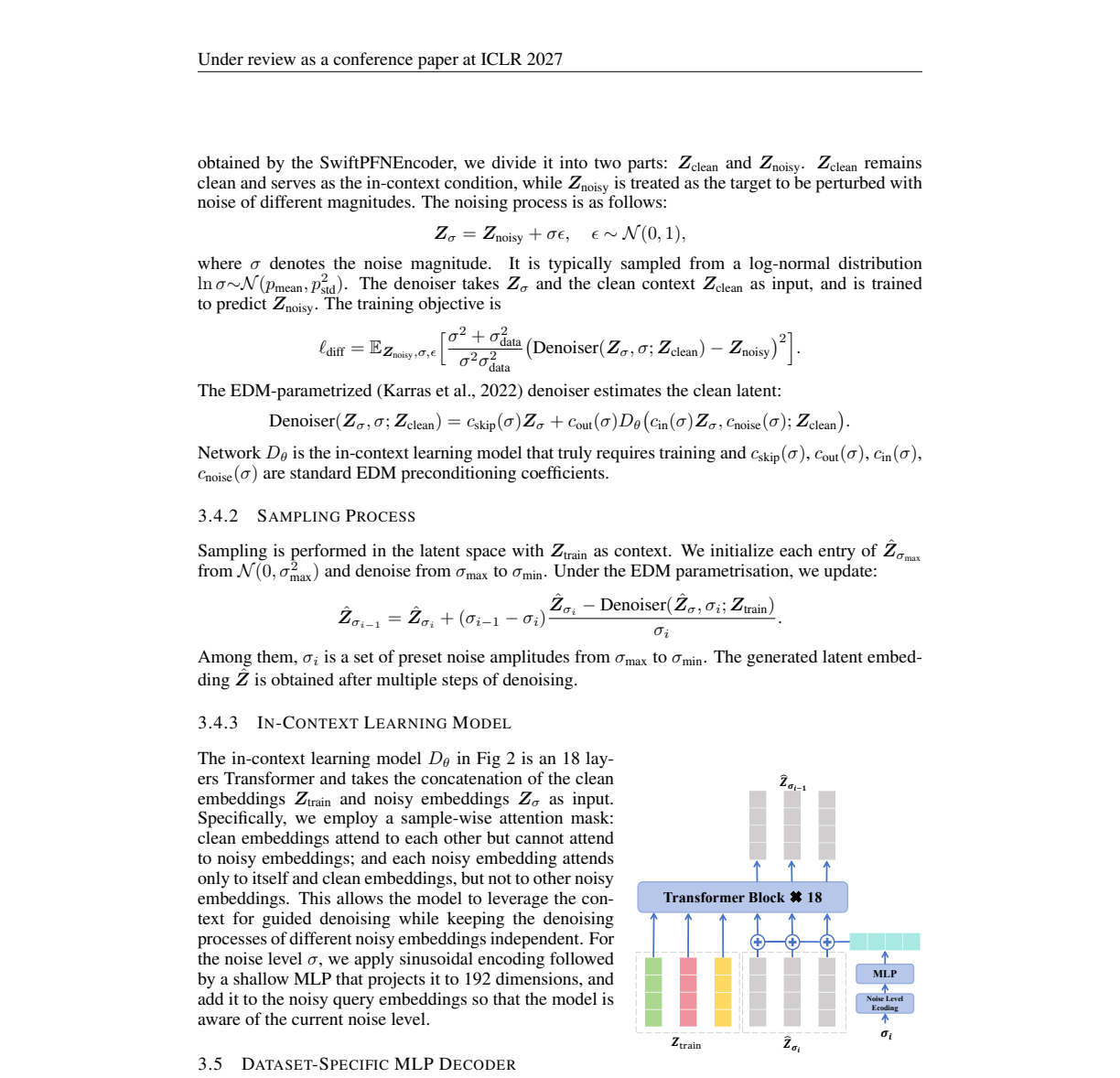
What carries the argument. The central design is a latent diffusion pipeline: a frozen SwiftPFN encoder produces 192-dimensional embeddings for each row of a heterogeneous table; an 18-layer Transformer denoiser with a sample-wise causal attention mask conditions on a small set of clean embeddings to denoise noisy queries using EDM preconditioning (log-normal noise schedule, cosine LR schedule); and a dataset-specific MLP decoder, trained for a few seconds per target table, maps generated latent embeddings back to the original feature space. Only the lightweight decoder requires per-dataset training; the encoder and denoising model are frozen after two-stage pretraining on synthetic and real data.
Core claim. TabGift claims that by transferring generative priors across datasets through a frozen prediction encoder and an in-context diffusion model, it can generate high-quality tabular data from only a few context samples—often outperforming dataset-specific models that train from scratch. This holds particularly in the scarce-data regime (training set sizes 16–128), where the context-efficient design avoids the memorization and overfitting that plague per-dataset generative methods. As data volume grows, the advantage narrows but TabGift remains competitive up to size 512.
The premise it rests on. SwiftPFN is pretrained for prediction, so its encodings are not necessarily optimal for generative modeling, and the entire pipeline relies on this suboptimal latent space; the paper acknowledges this as a limitation.
If the paper is right (Pith's inferences, not the authors')
In data-scarce domains (e.g., medical records, financial transactions) practitioners could use TabGift to generate large synthetic datasets for training downstream models, bypassing the need to collect and label many real examples.
Predictive tabular foundation models can serve as effective encoders for generation, suggesting that cross-task transfer from prediction to generation is viable and may reduce the per-dataset engineering burden.
TabGift's generation is significantly faster than mainstream alternatives: e.g., 10 seconds total for 1,024 synthetic samples compared to 135+ seconds for TabDDPM, making it practical for iterative or interactive use.
The paper highlights a systematic trade-off between statistical fidelity and privacy: methods that best match the distribution (including TabGift) tend to have lower distance to closest records, implying that privacy-preserving extensions or post-hoc filtering may be needed.
Because SwiftPFN is a prediction encoder, its latent space may discard or de-emphasize information irrelevant to prediction that could still be important for generation; a generation-specific autoencoder might improve both quality and transferability while removing the need for a per-dataset decoder.
The weak privacy performance suggests that TabGift is not immediately suitable for release of synthetic data under strict privacy constraints; differential-privacy training or output post-processing (e.g., truncating near-true samples) are natural next steps.
The method currently handles at most 50 features and 2,048 samples per table; for larger or higher-dimensional tables, the attention mechanism and the 192-dimensional bottleneck may need scaling or hierarchical extensions.
Check this review
Pith stored no record of this review's passes and took no fingerprint of it. Reviews made by code from 13 Nov 2026 on carry both.
How often reviews like this one are right
Reviews like this one: written by deepseek-v4-flash, where what was read was not recorded.
How often objections from reviews like this one are right: not yet measured
Reviews by people
This review was written by a machine. No person has reviewed this paper on Pith yet. A scientist listed on Pith can review it for a fee, and their review is published here whatever it concludes.
The paper
Abstract
Tabular data generation aims to synthesize realistic samples from limited observations while faithfully capturing the underlying data distribution. Tabular foundation models (TFMs), pretrained on diverse tabular tasks and adapted through in-context learning, have demonstrated strong predictive capabilities, suggesting the potential of extending this paradigm to tabular data generation. However, the strong predictive performance of TFMs often relies on sufficiently large context sets, whereas tabular generation is typically needed precisely when target data are scarce. Extending the foundation-model paradigm to generation therefore requires reliable distribution inference from only a limited context. To this end, we propose TabGift, a context-efficient tabular foundation model enabling both efficient distribution modeling and effective generation from only a few context samples. TabGift maps heterogeneous tables into a shared latent space with a pretrained tabular encoder, where an in-context diffusion model learns to denoise latent samples conditioned on a small set of clean examples. This design transfers generative priors across datasets and enables distribution inference from limited context, while a lightweight dataset-specific MLP decoder maps generated representations back to the original data space. Experiments on 7 classification and 11 regression datasets show that TabGift consistently outperforms representative baselines in synthetic data quality, with particularly strong gains under limited-context settings, while achieving substantially faster adaptation and generation.
The paper's own sentences, arranged, kept beside the review and separate from it. Each label is drawn from a closed vocabulary; the number beside it is the probability the classifier gave that label. No sentence in this record was written by a model.
abstract compiled · 2026-10-14
The authors' main claim, as the classifier picked it out 0.99
“Experiments on 7 classification and 11 regression datasets show that TabGift consistently outperforms representative baselines in synthetic data quality, with particularly strong gains under limited-context settings, while achieving substantially faster adaptation and generation.”
How the main claim is stated: asserted 1.00
What the abstract itself states, as probabilities: claims first 0.05 · states limitation 0.12 · human participants 0.03 · controlled comparison 0.86 · randomized assignment 0.01 · states quantitative result 0.77 · compares with prior results 0.97 · mentions code or data availability 0.02
The abstract, sentence by sentence
This table labels the abstract only (arXiv listing abstract v1). The number is the probability the classifier gave the label.
| Sentence | Role | The authors' own work | States the main conclusion | Strength |
|---|---|---|---|---|
| Tabular data generation aims to synthesize realistic samples from limited observations while faithfully capturing the underlying data distribution. | background 1.00 | 0.05 | 0.03 | asserted 0.97 |
| Tabular foundation models (TFMs), pretrained on diverse tabular tasks and adapted through in-context learning, have demonstrated strong predictive capabilities, suggesting the potential of extending this paradigm to tabular data generation. | background 1.00 | 0.06 | 0.04 | hedged possibility 0.75 |
| However, the strong predictive performance of TFMs often relies on sufficiently large context sets, whereas tabular generation is typically needed precisely when target data are scarce. | gap 0.87 | 0.09 | 0.04 | asserted 0.97 |
| Extending the foundation-model paradigm to generation therefore requires reliable distribution inference from only a limited context. | gap 0.81 | 0.06 | 0.06 | asserted 0.96 |
| To this end, we propose TabGift, a context-efficient tabular foundation model enabling both efficient distribution modeling and effective generation from only a few context samples. | contribution 0.99 | 0.83 | 0.22 | asserted 1.00 |
| TabGift maps heterogeneous tables into a shared latent space with a pretrained tabular encoder, where an in-context diffusion model learns to denoise latent samples conditioned on a small set of clean examples. | method 1.00 | 0.74 | 0.06 | asserted 0.99 |
| This design transfers generative priors across datasets and enables distribution inference from limited context, while a lightweight dataset-specific MLP decoder maps generated representations back to the original data space. | method 0.98 | 0.71 | 0.09 | asserted 0.99 |
| Experiments on 7 classification and 11 regression datasets show that TabGift consistently outperforms representative baselines in synthetic data quality, with particularly strong gains under limited-context settings, while achieving substantially faster adaptation and generation. | result 1.00 | 0.96 | 0.83 | asserted 1.00 |
What kind of paper the classifier reports this is: method or tool 1.00 · evidence from observation or experiment 0.98
What was examined, and what was not
Sources read
- arXiv listing abstract v1
Not examined
- full text
- figures and tables
- references and citing sentences
- relations to other papers
Levels run
- P abstract
Not run
- S sections
- T body sentences
- C citations
- R cross-paper relations
How the labels were made
Compiled by classifier-1.13.0 via TypeSafe API, question bank abstract-p1-20260923, 2026-10-14: 1 request, 6,325 input tokens.
Every quoted sentence on this record is the authors'. Every label is from Pith's closed vocabulary, with the probability shown beside it. This record as JSON
Figures (4)



Figures are the authors', reproduced from the paper.
References (21)
- [4] Table 3: Statistics of the OpenML regression datasets. Dataset #Features #Samples #Cat / #Num abalone 8 4,177 1 / 7 airfoil self noise 5 1,503 0 / 5 auction verification 7 2,043 6 / 1 concrete compressive strength 8 1,030 0 / 8 physiochemical protein 9 45,730 0 / 9 superconduc... on Pith
- [6] URLhttps://arxiv.org/abs/2605.13986. Xinyan Han, Yan Lu, Xiaoyu Lin, Yuanyuan Jiang, Yuanrui Wang, Xuanyue Li, Wenchao Zou, and Xingxuan Zhang. Breaking the quality-privacy tradeoff in tabular data generation via in-context learning.arXiv preprint, on PithPith's reviewarXiv
- [8] URLhttps://arxiv.org/abs/2609.17895. Tero Karras, Miika Aittala, Timo Aila, and Samuli Laine. Elucidating the design space of diffusion- based generative models. InAdvances in Neural Information Processing Systems, volume 35, pp. 26565–26577, on PithPith's reviewarXiv
- [9] Spotlight. Si-Yang Liu, Hao-Run Cai, Qi-Le Zhou, and Han-Jia Ye. Talent: A tabular analytics and learning toolbox.arXiv preprint arXiv:2407.04057, on PithPith's reviewarXiv
- [10] Junwei Ma, Apoorv Dankar, George Stein, Guangwei Yu, and Anthony Caterini. Tabpfgen: Tabular data generation with tabpfn. InNeurIPS 2023 Workshop on Table Representation Learning, on Pith
- [12] DOI: 10.1145/3819586. Judea Pearl.Causality: Models, Reasoning, and Inference. Cambridge University Press, 2nd edition, on Pithdoi:10.1145/3819586
- [13] Yefan Tao, Xiyuan Zhang, Xinyi Liu, Boran Han, Danielle Maddix, Haoyang Fang, Zhen Han, Jiading Gai, Xuanqing Liu, Michael Bohlke-Schneider, Yuyang Wang, Gerald Friedland, Kevan Mah, Chris Lee, and Chris Kong. Mitra-v2 technical report.arXiv preprint arXiv:2609.04540, on PithPith's reviewarXiv
- [15] 14 Under review as a conference paper at ICLR 2027 Chuhan Wu, Fangzhao Wu, Yang Cao, Yongfeng Huang, and Xing Xie. Fedgnn: Federated graph neural network for privacy-preserving recommendation.CoRR, on Pith
- [17] 15 Under review as a conference paper at ICLR 2027 APPENDIX A DATASETS A.1 OPENML This set of datasets comes from the OpenML-CC18 (Bischl et al., on Pith
- [1958] Introduction: Classical parametric models for regression and classification. Linear re- gression models continuous outcomes, while logistic regression models binary outcomes using a sigmoid function. Implementation: Use the open-source implementation in the python library scik... on Pith
- [2001] Introduction: An ensemble method that builds multiple decision trees and aggregates their predictions. It is robust to overfitting and can capture complex feature interactions. Implementation: Use the open-source implementation in the python library scikit- learn (Pedregosa et... on Pith
- [2002] Introduction: Synthetic Minority Over-sampling Technique generates new samples for minority classes via interpolation. It helps balance imbalanced datasets and improves clas- sifier performance on underrepresented classes. 17 Under review as a conference paper at ICLR 2027 Tab... on Pith
- [2008] 12 Under review as a conference paper at ICLR 2027 Noah Hollmann, Samuel M¨uller, Katharina Eggensperger, and Frank Hutter. Tabpfn: A transformer that solves small tabular classification problems in a second. InInternational Conference on Learning Representations 2023, on Pith
- [2011] Penghui Wang, Wei Liu, Hong Wang, Cheng-Yue Huang, Yu-Xi Sun, Zi-Rui Wang, Hong-Ming Huang, Quan Wang, Chun-Xiao Liu, Er-Li Meng, and Bin Wang. Xiaomi-tabldm: A tabular foundation model technical report.arXiv preprint arXiv:2609.03880, 2026a. Yanbo Wang, Jiaxuan You, Chuan Shi... on PithPith's reviewarXiv
- [2016] 11 Under review as a conference paper at ICLR 2027 Jillian M. Clements, Di Xu, Nooshin Yousefi, and Dmitry Efimov. Sequential deep learning for credit risk monitoring with tabular financial data.CoRR, on Pith
- [2019] Moonjung Eo, Min-Kook Suh, Hye-Seung Cho, Jiwon Kim, Seoyoon Kim, Sangjun Nam, and Soonyoung Lee. Exaone tabular 1.0: A synthetic-prior foundation model for tabular classification and regression.arXiv preprint arXiv:2608.25774, on PithPith's reviewarXiv
- [2021] Han-Jia Ye, Si-Yang Liu, Hao-Run Cai, Qi-Le Zhou, and De-Chuan Zhan. A closer look at deep learning on tabular data.arXiv preprint arXiv:2407.00956, on PitharXiv
- [2023] 13 Under review as a conference paper at ICLR 2027 Andrei Margeloiu, Xiangjian Jiang, Nikola Simidjievski, and Mateja Jamnik. Tabebm: A tabular data augmentation method with distinct class-specific energy-based models.Advances in Neural Information Processing Systems, 37:72094–72144, on Pith
- [2024] Bernd Bischl, Giuseppe Casalicchio, Matthias Feurer, Frank Hutter, Michel Lang, Rafael G. Mantovani, Jan N. van Rijn, and Joaquin Vanschoren. Openml benchmarking suites. arXiv:1708.03731v2 [stat.ML], on PithPith's reviewarXiv
- [2025] URLhttps://arxiv.org/abs/2511.08667. L´eo Grinsztajn, Klemens Fl ¨oge, Oscar Key, Felix Birkel, Philipp Jund, Brendan Roof, Mihir Ma- nium, Shi Bin Hoo, Magnus B ¨uhler, Anurag Garg, Dominik Safaric, Jake Robertson, Benjamin J¨ager, Simone Alessi, Adrian Hayler, Vladyslav Moro... on PithPith's reviewarXiv
show 1 more
- [2026] Sebastian Felix Fischer, Liana Harutyunyan, Matthias Feurer, and Bernd Bischl. Openml-ctr23 a curated tabular regression benchmarking suite. InAutoML Conference 2023 (Workshop), on Pith
Challenges and discussion
Disagree with the review, or know something it missed? Leave a comment, or challenge this review formally: a challenge becomes a permanent entry in this paper's record, and its decision is published here.
Come back by email
A short list of the week's newly reviewed papers. Nothing is sent until you confirm from your inbox, and every email has a link that stops it. No account.
No comments yet.
Sign in to comment