Machine Learning · arXiv:2610.10317 v1 · submitted 7 Oct 2026 · 14 references
Thinking in Depth: Retrospective Inference for Tabular Foundation Models
The paper says
“Tabular foundation models (TFMs) are pretrained across diverse tabular tasks and make predictions on a new table at inference time using its labeled examples as context.”
more of the abstract
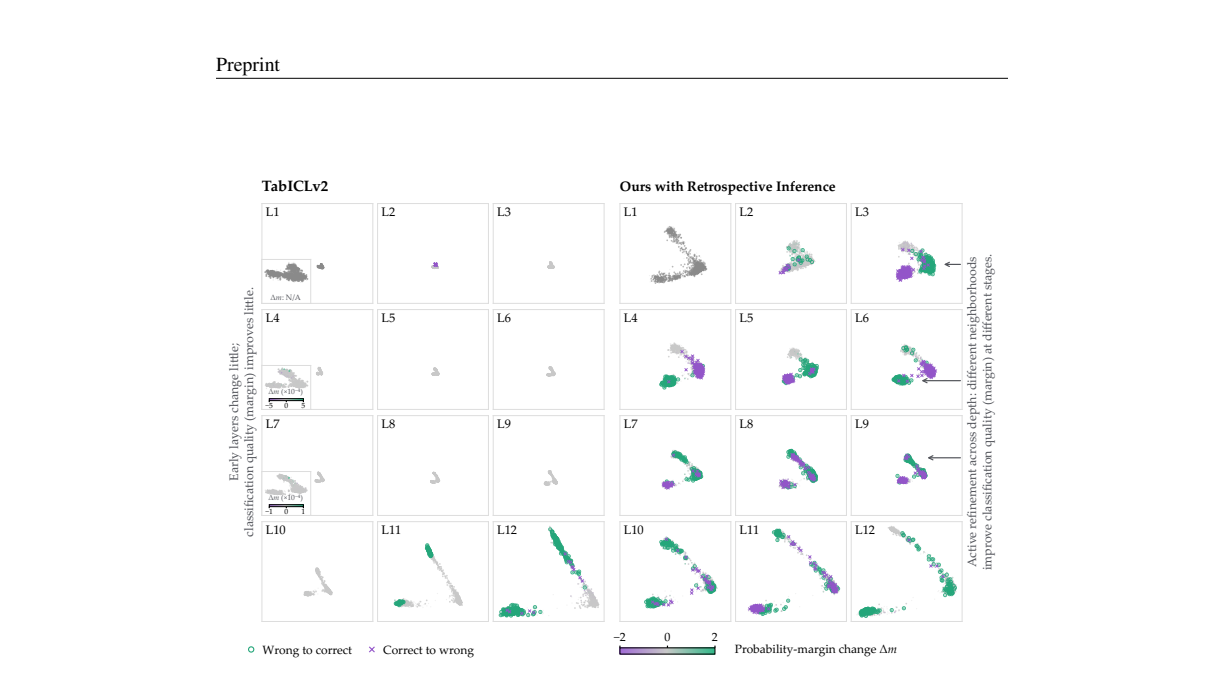
Most recent TFMs perform such in-context prediction with stacked Transformer layers, repeatedly transforming how examples are represented and compared. By tracing individual queries through several strong TFMs, we find that predictive refinement is highly uneven across depth and is often concentrated in later layers. This uneven refinement motivates us to reconsider how intermediate representations are constructed and reused throughout the network. We introduce Retro, a tabular foundation model based on retrospective inference, where later stages can explicitly revisit and recombine intermediate information produced earlier in the network. Retro organizes this process around two complementary operations: which intermediate information to revisit, and how the resulting contextual update should be shaped for each query. Attention Residuals address the former by adaptively reweighting contributions from different depths, while query-conditioned Gated Attention addresses the latter by modulating the attention output element-wise across representation dimensions. Our analysis shows that Retro shifts predictive refinement earlier and more broadly across depth, with different stages revising different subsets of queries in a pattern suggestive of multi-view refinement. Across TabArena, TALENT, and RelArena, Retro ranks among the top three and lies on the Pareto frontier. These results indicate that directly reusing intermediate representations provides a practical way to better exploit depth in TFMs.
from the abstract
Pith says
Machine review · deepseek-v4-flash · 8 Oct 2026 · what was read was not recorded · not checked by a person
It can be wrong. Challenge this review or reply to it.
Holds up, with conditions. A careful, honest architecture study whose benchmark claims hold up, but whose central attribution of gains to retrospective reuse needs a parameter-matched ablation before it is fully convincing. This line is wrong
2 major objections · 5 minor
How often objections from reviews like this one are right: not yet measured
Not checked: figures, code, what the 14 references say.
The paper says, at Section 6 / Figure 6 / Appendix E.2
The review did not quote this passage.
Pith says: Objection 1 of 2 · major
The component ablation (neither 822.3, gated-only 969.0, AttnRes-only 1093.1, both 1115.6) is the only direct evidence tying Retro's benchmark gains to the retrospective-reuse mechanism, and its configurations differ in parameter count: the readers add 4Ld = 24,576 parameters and the gate projections add L(d^2+d), about 3.15M at L=12, d=512 (Section 6; Appendix B.2).
more of objection 1
The paper's own numbers partly mitigate this concern for the dominant component: 270.8 of the 293.3-Elo gap comes from the AttnRes-only variant, whose 24,576 added parameters are negligible relative to the roughly 25M parameters of the 12-layer d=512 ICL stack alone, and gated-only gains less than AttnRes-only despite about 128 times more parameters. However, the gated-only versus neither and the both versus AttnRes-only contrasts are capacity-confounded, and the Section 7 conclusion that "directly reusing intermediate representations provides a practical way to better exploit depth" attributes the full package's gain to the reuse pathway. I request a matched-capacity control (for example, a 'neither' stack with comparably widened feed-forward blocks or an added layer group so that total parameters match the both-vs-neither difference), or failing that, an explicit argument from total parameter counts together with a statement that the gated component's marginal contribution is not capacity-controlled. Either would close the attribution gap; as written, the mechanism claim is not yet fully established, although the benchmark results would stand independently.
The paper says, at Section 6 (Pretraining; Figure 8)
The review did not quote this passage.
Pith says: Objection 2 of 2 · major
The claim that Retro "ranks above TabICLv2 in the overall rankings on TabArena and TALENT" compares Retro, pretrained with its own three-stage curriculum (500K/40K/10K updates, peak learning rates 8e-4/1e-4/2e-5, Muon/AdamW) on the TabICLv2 synthetic generator, against published TabICLv2 weights. The text states that further details follow Qu et al.
more of objection 2
(2026), but it does not say which pretraining choices are identical to TabICLv2's protocol and which differ. As a result, the 90.7-Elo (TabArena) and 76.1-Elo (TALENT) advantages over the backbone conflate architecture with pretraining protocol. This does not affect the internal four-configuration ablation, which shares one protocol, but it does affect the headline backbone comparison. Please state explicitly which elements of the pretraining recipe match TabICLv2 and which were changed, and phrase the improvement-over-backbone claim with that scope.
5 minor objections
The paper says, at Section 5.2 / Appendix D.1
Pith says: minor objection 1 of 5
The main text concludes from Figure 5 that "the trained models depend more on the learned update direction than on its norm." Appendix D.1 reports that the paired classification contrast has median 0.126, with only 23 of 38 datasets favoring direction (seven favoring magnitude, eight ties), so the mean-based interval [0.173, 1.217] is driven by a minority of datasets.
more of objection 1
The heterogeneity is honestly disclosed, but the main-text generalization should either report the median and sign distribution or be restricted to regression, where the contrast is positive on all 13 datasets.
The paper says, at Section 6 / Appendix E.2
Pith says: minor objection 2 of 5
The TALENT Elo intervals reflect dataset-order permutation variability rather than evaluation-seed or bootstrap uncertainty, and the intervals around the top TALENT methods overlap heavily (for example, Retro 1755.4 with lower endpoint 1312.3 versus TabFM 1856.0 with upper endpoint 2194.5). The same applies to the TabArena top-three distinction, where the EXAONE and Retro intervals overlap.
more of objection 2
The paper discloses the interval semantics in Appendix E.2; please surface this caveat at the point in Section 6 where the "ranks third/second/first by overall Elo" claims are made, since main-text readers will otherwise over-read the point estimates.
show 3 more
The paper says, at Appendix A.5 / Section 4
Pith says: minor objection 3 of 5
Because the fixed-readout diagnostic measures expression relative to a common final-layer decision rule rather than total information content, as the paper itself notes in Appendix A.5, the statements that refinement "is concentrated in later layers" and that Retro "shifts refinement earlier" are strictly readout-relative. A complementary per-layer refit probe (fitting a readout at each layer) would let the paper distinguish reorganization of information from information gain and would strengthen the design motivation without replacing the current, honestly hedged analysis.
The paper says, at Section 6 (Efficiency)
Pith says: minor objection 4 of 5
The parameter counts in Section 6 cover the added modules only, as Appendix B.2 notes. Reporting the total parameter counts of Retro and TabICLv2 and a per-batch cost breakdown between the added readers/gates and the backbone attention would let readers contextualize the 24,576-parameter reader addition and the 3.15M gate projections, and would directly inform the capacity-attribution question raised in the major comments.
The paper says, at Title page / Figure 1 / Tables 8-10
Pith says: minor objection 5 of 5
The running title on the title page reads "THINKING INDEPTH: RETROSPECTIVEINFERENCE FOR TABULARFOUNDATIONMODELS" with missing spaces, and the same model is labeled "TabPFN-Rel" in Figure 1 but "TabPFN-rel-local" in Tables 8-10. Please unify these labels and fix the title-page spacing.
What would settle it
Train a parameter- and FLOP-matched TabICLv2 control: keep the 12-layer ICL stack and all TabICLv2 components, but add roughly 3.17M parameters by increasing the ICL hidden width or feed-forward expansion ratio, so the baseline has the same total parameters and comparable per-sample inference FLOPs as Retro, with no historical reads and no gates. Use the same three-stage synthetic pretraining curriculum and evaluate on the same TabArena classification ablation pool with the same Elo and bootstrap protocol. If this control reaches or overlaps the 95% interval of the both=1115.6 Elo estimate, the Figure 6 gain cannot be attributed to retrospective reuse; if it stays near neither=822.3, the mechanism attribution is supported.
from the skeptic's reading
How the review went
4 readings by deepseek-v4-flash · 8 Oct 2026
- Reader holds up, with conditions
- Skeptic partly agrees
- Editor wrote the verdict above
- Referee major revision: 2 major objections, 5 minor
Not run on this paper: the simulated authors' defence.
Pith did not check this review's objections against the paper.
The review in full
The review in brief, machine-written
The reader's conditional verdict is fair. This is a careful, honest architecture study; the benchmark claims hold up on the evidence shown, and the central attribution of gains to retrospective reuse needs one control before I would call it established.
What is new: the retrospective-inference framing and the specific combination of block Attention Residuals plus query-conditioned Gated Attention inside a row-level tabular ICL stack. The mechanisms are adopted from Kimi Team (2026) and Qiu et al. (2025), and Xiaomi-TabLDM already uses lightweight Attention Residuals in tabular modeling, so this is a refinement with a clear story rather than a new mechanism.
What it does well: standard benchmark protocols, uncertainty intervals, thorough appendices, and transparent reporting. The depth diagnostic is carefully hedged in Appendix A.5, which explicitly states that the readout measures expression relative to a common final-layer rule rather than total information; the benchmark results stand independently of that diagnostic. There is no circularity: the model is pretrained on TabICLv2's synthetic generator and evaluated on held-out official splits with external comparison pools.
Soft spots. First, the component ablation lacks a parameter-matched control: the full configuration adds roughly 3.15M parameters over the backbone, so the ~293-Elo gap between neither and both could partly reflect added capacity. One observation cuts the other way: AttnRes-only adds about 24K parameters yet gains ~271 Elo, while the gate adds 3.15M parameters for only ~22 more Elo; a pure-capacity story would not obviously produce that ordering, but a matched-capacity TabICLv2 variant without the reuse pathway is the clean way to settle it. Second, the gating-direction claim is heterogeneous for classification: the mean paired contrast is 0.618 but the median is 0.126, with only 23 of 38 datasets favoring preserved direction. The paper reports this honestly in Appendix D.1, but the main text should carry the same qualification. Third, no code or weights are released, which matters more for an architecture contribution than for an analytical one.
Bottom line: the paper deserves a serious referee. The fixes are concrete and short, and the core empirical claims are plausible as stated. I would bring it to a reading group and cite it in work on tabular ICL architectures.
The strongest objection
The paper's strongest claim has two parts: Retro achieves top-three performance, and this performance comes from treating intermediate representations as reusable sources. The second part is the scientific contribution; the first could hold even if depth-reuse were irrelevant. The only direct evidence tying the mechanisms to the gains is the component ablation (Figure 6, Section 6, Appendix E.2): neither=822.3, gated-only=969.0, AttnRes-only=1093.1, both=1115.6 Elo. These configurations differ in parameter count. The retrospective readers add 4Ld=24,576 parameters, and the L gate projections add L(d^2+d)≈3.15M at L=12, d=512 (Section 6; Appendix B.2). No control adds equivalent capacity to the 'neither' stack without the reuse pathway, so the roughly 293-Elo gap between neither and both could be produced by extra parameters or optimization changes rather than by retrospective inference per se. The benchmark comparisons against TabICLv2 (TabArena 1741.6 vs 1650.9; TALENT 1755.4 vs 1679.3) have the same gap, since Retro's added modules are not matched by an equal-capacity TabICLv2 variant. I do not regard the frozen-readout caveat (Appendix A.5) as the load-bearing issue: it is explicitly acknowledged there, and the benchmark evidence is independent of it.
The reader's formal weakest_assumption is the frozen-readout diagnostic in Appendix A.2. That is a real caveat, but the paper acknowledges it in Appendix A.5 and the benchmark results do not depend on it, so I do not treat it as the most load-bearing point. The missing parameter-matched ablation, which the reader also lists in the rationale, is more decisive: the central conceptual claim is that retrospective reuse of intermediate representations is what improves prediction, and Figure 6 is the only direct evidence for that attribution. Because the four configurations differ by millions of parameters, a simpler capacity increase in the TabICLv2 backbone could plausibly reproduce the gains. This is an addressable empirical gap, not a logical contradiction, so the CONDITIONAL verdict stands; if the proposed control matched Retro's Elo, the conclusion would need to be weakened from 'reuse explains the gains' to 'a model with these modules is competitive.' Without released code or weights, the check cannot currently be run externally.
The referee's report
The paper's potential contribution is a concrete architectural lesson: depth in TFMs can be exploited by retaining intermediate group sums as explicitly readable sources, with a small added parameter count (24,576 for the readers) and nearly unchanged inference time, rather than only by stacking more layers. The empirical effort is solid in several respects: evaluations use held-out official splits and external comparison pools on three mainstream benchmarks; uncertainty intervals are reported (dataset bootstrap for TabArena and RelArena, order-permutation variability for TALENT, with the latter's semantics disclosed in Appendix E.2); and the depth diagnostic is carefully specified and explicitly hedged in Appendix A.5 as measuring expression relative to a common final-layer decision rule rather than total information content. The paper also discloses the main heterogeneity in its gating analysis itself (Appendix D.1: median contrast 0.126, 23 of 38 datasets favoring direction). No benchmark-derived constant feeds back into the method, so circularity is not a concern.
Pith's reading of the paper (a machine's summary, not the authors')
Tabular foundation models make predictions on a new table by passing its labeled rows and unlabeled queries through a stack of Transformer layers, and the paper shows this depth is used very unevenly: for TabICLv2, 84.4% of the absolute change in predictive margin occurs in the final third of the network. The paper argues this unevenness is not inevitable and proposes retrospective inference — keeping intermediate representations available so later stages can selectively revisit and recombine them — as a better organization of depth. It instantiates the idea in Retro, which pairs Attention Residuals, which reweight contributions from different depths for each row, with query-conditioned Gated Attention, which shapes the contextual update across dimensions. If the claim holds, refinement begins earlier and spreads across layers, different stages revise different queries, and the model ranks among the top three on TabArena, TALENT, and RelArena while lying on the performance–cost Pareto frontier. The practical upshot is that more of a tabular foundation model's depth can be made to pay for itself without redesigning pretraining.
What carries the argument. The carrying mechanism is retrospective inference, instantiated by two coupled operations. Block Attention Residuals keep a source bank containing the initial row encoding, the summed residual updates of completed two-layer groups, and the current group's partial sum; at each reading site a learned scorer produces row-dependent softmax weights over these sources, so each query can effectively choose which depths to revisit. Query-conditioned Gated Attention computes a per-row gate $g_{\ell i} = \sigma(z_{\ell i}W_g^\top + b_g^\top)$ from the normalized attention input and multiplies it element-wise into the concatenated attention-head outputs before projection, $A_{\ell i} = (g_{\ell i} \odot o_{\ell i})W_O^\top + b_O^\top$, shaping the direction as well as the size of the contextual update. The depth diagnostics rest on a separate instrument: a fixed linear readout, a logistic or Ridge predictor fitted to final-layer cross-fitted support embeddings and applied unchanged at every layer, which defines refinement as the change in true-class margin under a common final-layer decision rule.
Core claim. The paper's central claim is that predictive refinement in strong tabular foundation models is highly uneven across depth — in some architectures concentrated in the late layers — and that this reflects how intermediate information is disposed of, not just what each layer computes. Tracing individual queries with a fixed linear probe fitted to final-layer support embeddings and frozen across all layers, the authors report final-third shares of absolute margin movement of 84.4% for TabICLv2, 51.5% for TabPFN-3, and 61.1% for EXAONE-Tabular. Retro reorganizes the row-level in-context learning stack so that completed groups of residual updates stay in a source bank that every later reader can weight per row, and a learned sigmoid gate modulates the attention output element-wise before projection. Under the frozen readout the retrospective variant's early-motion share rises to 60.7% from TabICLv2's 15.6%, per-step query turnover more than doubles, and different stages revise different subsets of queries, a pattern the authors read as multi-view refinement. Evaluated with native prediction heads among the reported candidate sets, Retro ranks third on TabArena, second on TALENT, and first on RelArena by overall Elo, in each case above or close to its TabICLv2 backbone. Fixed-model interventions show the gate's learned direction, not its magnitude, carries the predictive benefit: replacing the direction costs 0.616 percentage points of classification accuracy, while replacing the magnitude costs −0.002.
The premise it rests on. The motivation for retrospective inference rests on the frozen-readout premise: refinement is measured with a logistic or Ridge probe trained only on final-layer support embeddings and applied unchanged at every layer, and the authors acknowledge this captures how predictive information is expressed under a common final-layer decision rule rather than the total information available in each representation.
If the paper is right (Pith's inferences, not the authors')
Depth in current tabular foundation models is under-exploited: by the paper's diagnostic, most of a deep stack contributes little to the final decision, and the same backbone with retrospective reads converts that idle depth into earlier, more distributed refinement.
Most of the gain comes from the aggregation path, not the gate: on TabArena classification, Elo in the four-configuration comparison rises from 822.3 with neither mechanism to 1093.1 with Attention Residuals alone, and to 1115.6 with both.
Retro keeps the backbone's width, depth, and pretraining recipe, adding roughly 3.15M gate parameters plus 24,576 aggregation parameters, so the benefit is obtainable as a near drop-in change to a row-level in-context learning stack rather than a new training paradigm.
Because replacing the gate's learned direction costs 0.616 percentage points of accuracy while replacing its magnitude costs essentially nothing, query-conditioned gating is best understood as a geometric shaper of contextual updates, a property later architectures can use directly.
A testable extension the paper does not pursue: apply the same retrospective aggregation to other row-level in-context learning backbones, such as TabPFN-3 or EXAONE-Tabular, and check whether the earlier-and-broader refinement pattern and the Elo gains transfer or are specific to the TabICLv2 hierarchy.
If the multi-view-refinement reading is right, the per-layer probes could be used at inference time to route individual queries to whichever layer is most confident, harvesting diversity across depth without ensembling — a cheap opportunity the paper leaves open.
The gate-exchange results suggest gates encode locally consistent update directions; a direct follow-up would test whether the gate's importance shrinks once the retrospective path supplies richer inputs, which would locate the two mechanisms' division of labor within Retro.
Check this review
Pith stored no record of this review's passes and took no fingerprint of it. Reviews made by code from 13 Nov 2026 on carry both.
How often reviews like this one are right
Reviews like this one: written by deepseek-v4-flash, where what was read was not recorded.
How often objections from reviews like this one are right: not yet measured
Reviews by people
This review was written by a machine. No person has reviewed this paper on Pith yet. A scientist listed on Pith can review it for a fee, and their review is published here whatever it concludes.
The paper
Abstract
Tabular foundation models (TFMs) are pretrained across diverse tabular tasks and make predictions on a new table at inference time using its labeled examples as context. Most recent TFMs perform such in-context prediction with stacked Transformer layers, repeatedly transforming how examples are represented and compared. By tracing individual queries through several strong TFMs, we find that predictive refinement is highly uneven across depth and is often concentrated in later layers. This uneven refinement motivates us to reconsider how intermediate representations are constructed and reused throughout the network. We introduce Retro, a tabular foundation model based on retrospective inference, where later stages can explicitly revisit and recombine intermediate information produced earlier in the network. Retro organizes this process around two complementary operations: which intermediate information to revisit, and how the resulting contextual update should be shaped for each query. Attention Residuals address the former by adaptively reweighting contributions from different depths, while query-conditioned Gated Attention addresses the latter by modulating the attention output element-wise across representation dimensions. Our analysis shows that Retro shifts predictive refinement earlier and more broadly across depth, with different stages revising different subsets of queries in a pattern suggestive of multi-view refinement. Across TabArena, TALENT, and RelArena, Retro ranks among the top three and lies on the Pareto frontier. These results indicate that directly reusing intermediate representations provides a practical way to better exploit depth in TFMs.
The paper's own sentences, arranged, kept beside the review and separate from it. Each label is drawn from a closed vocabulary; the number beside it is the probability the classifier gave that label. No sentence in this record was written by a model.
abstract compiled · 2026-10-08
The authors' main claim, as the classifier picked it out 1.00
“These results indicate that directly reusing intermediate representations provides a practical way to better exploit depth in TFMs.”
How the main claim is stated: hedged possibility 0.98
What the abstract itself states, as probabilities: claims first 0.06 · states limitation 0.08 · human participants 0.03 · controlled comparison 0.43 · randomized assignment 0.01 · states quantitative result 0.45 · compares with prior results 0.91 · mentions code or data availability 0.03
The abstract, sentence by sentence
This table labels the abstract only (arXiv listing abstract v1). The number is the probability the classifier gave the label.
| Sentence | Role | The authors' own work | States the main conclusion | Strength |
|---|---|---|---|---|
| Tabular foundation models (TFMs) are pretrained across diverse tabular tasks and make predictions on a new table at inference time using its labeled examples as context. | background 1.00 | 0.06 | 0.02 | asserted 1.00 |
| Most recent TFMs perform such in-context prediction with stacked Transformer layers, repeatedly transforming how examples are represented and compared. | background 1.00 | 0.06 | 0.02 | asserted 1.00 |
| By tracing individual queries through several strong TFMs, we find that predictive refinement is highly uneven across depth and is often concentrated in later layers. | result 0.96 | 0.95 | 0.08 | asserted 1.00 |
| This uneven refinement motivates us to reconsider how intermediate representations are constructed and reused throughout the network. | interpretation 0.65 | 0.51 | 0.05 | asserted 0.81 |
| We introduce Retro, a tabular foundation model based on retrospective inference, where later stages can explicitly revisit and recombine intermediate information produced earlier in the network. | contribution 0.76 | 0.86 | 0.11 | asserted 1.00 |
| Retro organizes this process around two complementary operations: which intermediate information to revisit, and how the resulting contextual update should be shaped for each query. | method 0.94 | 0.68 | 0.07 | asserted 0.99 |
| Attention Residuals address the former by adaptively reweighting contributions from different depths, while query-conditioned Gated Attention addresses the latter by modulating the attention output element-wise across representation dimensions. | method 0.99 | 0.65 | 0.06 | asserted 1.00 |
| Our analysis shows that Retro shifts predictive refinement earlier and more broadly across depth, with different stages revising different subsets of queries in a pattern suggestive of multi-view refinement. | result 0.85 | 0.95 | 0.32 | asserted 0.64 |
| Across TabArena, TALENT, and RelArena, Retro ranks among the top three and lies on the Pareto frontier. | result 1.00 | 0.93 | 0.15 | asserted 1.00 |
| These results indicate that directly reusing intermediate representations provides a practical way to better exploit depth in TFMs. | interpretation 1.00 | 0.83 | 0.74 | hedged possibility 0.98 |
What kind of paper the classifier reports this is: method or tool 1.00 · evidence from observation or experiment 0.96
What was examined, and what was not
Sources read
- arXiv listing abstract v1
Not examined
- full text
- figures and tables
- references and citing sentences
- relations to other papers
Levels run
- P abstract
Not run
- S sections
- T body sentences
- C citations
- R cross-paper relations
How the labels were made
Compiled by classifier-1.13.0 via TypeSafe API, question bank abstract-p1-20260923, 2026-10-08: 1 request, 7,558 input tokens.
Every quoted sentence on this record is the authors'. Every label is from Pith's closed vocabulary, with the probability shown beside it. This record as JSON
Figures (24)




Showing 22 of the paper's 24 figures. Figures are the authors', reproduced from the paper.
References (14)
- [7] Rupesh Kumar Srivastava, Klaus Greff, and J ¨urgen Schmidhuber. Highway networks.CoRR, abs/1505.00387, on PithPith's reviewarXiv
- [8] Table 2:TabArena: overall ranking.All 37 selected methods on 51 datasets. Method Elo↑Elo+ Elo−Average Rank↓ TabFM (default) 1882.9 109.9 99.5 4.31 EXAONE-Tabular (default) 1849.7 72.8 49.7 4.89 RETRO1741.6 84.3 72.5 7.26 TabPFN-3 (default) 1728.9 76.1 55.1 7.58 Xiaomi-TabLDM (... on Pith
- [9] Penghui Wang, Wei Liu, Hong Wang, Chengyue Huang, Yuxi Sun, Zirui Wang, Hongming Huang, Quan Wang, Zhenwei Xin, Ping Hou, Jie Yu, Chunxiao Liu, Erli Meng, and Bin Wang. Xiaomi- TabLDM: A tabular foundation model technical report.CoRR, abs/2609.03880, on PithPith's reviewarXiv
- [10] Zhenda Xie, Yixuan Wei, Huanqi Cao, Chenggang Zhao, Chengqi Deng, Jiashi Li, Damai Dai, Huazuo Gao, Jiang Chang, Liang Zhao, Shangyan Zhou, Zhean Xu, Zhengyan Zhang, Wangding Zeng, Shengding Hu, Yuqing Wang, Jingyang Yuan, Lean Wang, and Wenfeng Liang. mhc: Manifold-constraine... on PithPith's reviewarXiv
- [11] 11 Preprint Han-Jia Ye, Si-Yang Liu, Hao-Run Cai, Qi-Le Zhou, and De-Chuan Zhan. A closer look at deep learning methods on tabular datasets.CoRR, abs/2407.00956, on PitharXiv
- [12] Han-Jia Ye, Si-Yang Liu, and Wei-Lun Chao. A closer look at TabPFN v2: Understanding its strengths and extending its capabilities. InNeurIPS, 2025a. Han-Jia Ye, Huai-Hong Yin, De-Chuan Zhan, and Wei-Lun Chao. Revisiting nearest neighbor for tabular data: A deep tabular baselin... on PitharXiv
- [13] 12 Preprint A LAYER-WISEREPRESENTATIONANALYSIS This appendix specifies the diagnostic used in Sections 4 and 5 and reports aggregate depth statistics. Appendix B describes the retrospective computation, and Appendix C presents the full-depth cases. The fixed-readout analysis h... on Pith
- [2015] Yefan Tao, Xiyuan Zhang, Xinyi Liu, Boran Han, Danielle Maddix, Haoyang Fang, Zhen Han, Jiading Gai, Xuanqing Liu, Michael Bohlke-Schneider, Yuyang Wang, Gerald Friedland, Kevan Mah, Chris Lee, and Chris Kong. Mitra-v2 technical report.CoRR, abs/2609.04540, on PithPith's reviewarXiv
- [2016] Felix den Breejen, Sangmin Bae, Stephen Cha, and Se-Young Yun. Why in-context learning transformers are tabular data classifiers.CoRR, abs/2405.13396, on PithPith's reviewarXiv
- [2017] Kimi Team. Attention residuals.CoRR, abs/2603.15031, on PithPith's reviewarXiv
- [2022] L´eo Grinsztajn, Klemens Fl¨oge, Oscar Key, Felix Birkel, Philipp Jund, Brendan Roof, Mihir Manium, Shi Bin Hoo, Magnus B¨uhler, Anurag Garg, Dominik Safaric, Jake Robertson, Benjamin J¨ager, Simone Alessi, Adrian Hayler, Vladyslav Moroshan, Lennart Purucker, Philipp Singer, A... on PithPith's reviewarXiv
- [2024] Moonjung Eo, Min-Kook Suh, Hye-Seung Cho, Jiwon Kim, Seoyoon Kim, Sangjun Nam, and Soonyoung Lee. EXAONE Tabular 1.0: Technical report.CoRR, abs/2608.25774, on PithPith's reviewarXiv
- [2025] Cheng Luo, Zefan Cai, and Junjie Hu. Delta attention residuals.CoRR, abs/2605.18855, on PithPith's reviewarXiv
- [2026] Adrian Hayler, Klemens Fl¨oge, Alan Arazi, Rishabh Ranjan, Jure Leskovec, Felix Birkel, Brendan Roof, Anurag Garg, Kristina Collins, Lydia Sidhoum, Jonas M. K ¨ubler, Siyuan Guo, Oscar Key, Jan Hendrik Metzen, Rylee Grace, David Salinas, Arthur Cahu, Simon Bing, Benjamin J¨age... on PithPith's reviewarXiv
Challenges and discussion
Disagree with the review, or know something it missed? Leave a comment, or challenge this review formally: a challenge becomes a permanent entry in this paper's record, and its decision is published here.
Come back by email
A short list of the week's newly reviewed papers. Nothing is sent until you confirm from your inbox, and every email has a link that stops it. No account.
No comments yet.
Sign in to comment