Quantum Physics · arXiv:2610.01932 v1 · submitted 1 Oct 2026 · 41 references
Avoiding Exponentially Large Groups with Open Quantum System Technology
The paper says
“We propose a novel approach to state preparation by embracing the full power of open quantum systems. Instead of working with the whole unitary group in n qubits, we identify a small Lie group G in (n + 3) qubits.”
more of the abstract
The dimension of its Lie algebra is poly(n). Every state can be approximated starting from any fixed input state by repeatedly using partial trace and state preparation in the environment alongside group operations. Moreover, we also identify a single (open system magic) interaction Hamiltonian whose unitary group can be combined with open system quantum technology mentioned above to achieve transitivity on the space of all densities. Similarly, we show that all channels on n qubits can be approximated by using a larger environment, achieving channel universality. The interesting small groups we identify are derived from Lie algebras of local Pauli strings and lead to a new landscape of cheap and expensive states, densities, and channels.
from the abstract
Pith says
Machine review · deepseek-v4-flash · 2 Oct 2026 · what was read was not recorded · not checked by a person
It can be wrong. Challenge this review or reply to it.
Holds up, with conditions. The real contribution is the resource swap — a poly(n)-dimensional or even one-parameter coherent group stays universal for states and channels once you add repeated environment prep and trace-out — and the honest exponential lower bounds; the single thing to check before believing it is their own unpublished transitivity criterion, Theorem 3.2. This line is wrong
4 major objections · 4 minor
How often objections from reviews like this one are right: not yet measured
Not checked: figures, code, what the 41 references say.
The paper says, at §3.2, Theorem 3.2; §5, Theorems 5.1, 5.5; §7, Theorem 7.4
The review did not quote this passage.
Pith says: Objection 1 of 4 · major
The paper's main results all pass through the state-transitivity criterion quoted from [CGJ25, Thm 2.8, Ex 5.2], which asserts that SU(2^n) coherent control together with a single non-normal Lindblad generator makes the channel class state-transitive. The authors acknowledge that this is 'taken from [CGJ25]', but [CGJ25] is an unpublished preprint and this theorem is the single step that converts a small channel class into universal state preparation.
more of objection 1
Because Theorems 3.11, 5.1, 5.5, and 7.4 depend on it, the manuscript should either include a self-contained proof of the criterion, state precisely all of its hypotheses, or cite a published version. The related published work [MvEDSH25] and preprint [BSH12] provide context but do not, as cited here, replace the missing proof.
The paper says, at §6, Lemma 6.4 and Corollary 6.6
The review did not quote this passage.
Pith says: Objection 2 of 4 · major
The dimension count in Lemma 6.4 is not correct as printed. The diagonal algebra of EA, where EA has n+1 qubits, has complex dimension 2^{n+1}, not 2n+1; hence a bound by the full diagonal torus should have an exponent exponential in n (real dimension 2^{n+2}, up to constants), not the displayed 2(2n+1).
more of objection 2
With the printed polynomial exponent, Proposition 6.3 gives a density lower bound of order c(epsilon) 2^{2n}/n^2 for the single Hamiltonian, not the c(epsilon) 2^n/n claimed in Corollary 6.6. This is load-bearing for the single-Hamiltonian lower-bound statement in Theorem 1.1, so the dimension and the resulting exponents need to be corrected.
This review says the paper's mathematics is wrong. Pith did not check that against the paper's source.
The paper says, at §1, Theorem 1.1 versus §6, Theorem 6.7
The review did not quote this passage.
Pith says: Objection 3 of 4 · major
The quantitative lower bounds stated in Theorem 1.1 do not match the bounds proved in Section 6. For model (2), Theorem 1.1 states l(epsilon,G,V) >= c(epsilon) 2^n/n for pure-state preparation, while Theorem 6.7 and Proposition 6.3 yield c(epsilon) 2^n/(n^3 ln(1+n)) when d = O(n^2) for the Spin groups.
more of objection 3
Similarly, for the single magic Hamiltonian, Theorem 1.1 states c(epsilon) 2^n/(n^3(1+ln n)) for density preparation, whereas Corollary 6.6 states c(epsilon) 2^n/n. The displayed exponents should be reconciled and each should be traceable to Proposition 6.3.
The paper says, at Examples 5.4 and 7.6
The review did not quote this passage.
Pith says: Objection 4 of 4 · major
The concrete single-Hamiltonian examples rely on the assertion that lie(ip, iq) = su(2^n) for p = sum_k k|k><k| - (2^n+1)/2 I and q = sum_{j != k} |j><k|, but no proof or reference is given. This is stated as 'Note that p and q are traceless and lie(ip, iq) = su(2^n)' in Example 5.4 and used again in Example 7.6.
more of objection 4
Since these examples are meant to exhibit explicit open-system magic Hamiltonians, please supply a short proof (for instance, using the distinct eigenvalues of p and the off-diagonal structure of q) or a precise citation.
4 minor objections
The paper says, at §5, Theorem 5.5 proof
Pith says: minor objection 1 of 4
The proof says the off-diagonal part gamma of h is 'exactly the jump operator for the dephasing channel'; gamma = (X1 + iY1)/2 is the amplitude-damping jump operator |0><1|, not a dephasing jump operator. Please correct the terminology.
The paper says, at §6, Proposition 6.3 proof
Pith says: minor objection 2 of 4
In the display after the covering-number inequalities, the notation '22n' and '2n' should be written as 2^{2n} and 2^n; as rendered, the expressions are ambiguous and make the derivation hard to follow.
show 2 more
The paper says, at §2, Lemma 2.8 and Proposition 2.11
Pith says: minor objection 3 of 4
Proposition 2.11 refers to 'Theorem 2.8' and Definition 2.7 refers to the 'Lindbladian set of C_V(G)', but the cited object is the lemma labelled Lemma 2.8 and the notation is occasionally inconsistent; please align the cross-references.
The paper says, at §4, Remark 4.3
Pith says: minor objection 4 of 4
Remark 4.3 states that adding Y2Y3Y4Y5 to T2 gives 'a control group of dimension roughly sqrt(4n)', which is not obviously consistent with the stated Spin-group containment; please clarify what is being estimated.
What would settle it
Numerically settle whether the transitivity criterion of Theorem 3.2 actually holds. For n = 2 and n = 3 qubits, implement the protocol described in [CGJ25, Example 5.2]: the channel class generated by {Ad_U : U in SU(2^n)} and {e^{t L_a} : t >= 0} with a = |0><1| tensor I, closed under composition. (1) Cooling direction: verify that rho = (|0..0><0..0| + |1..1><1..1|)/2 maps to within epsilon of |0..0><0..0|; (2) mixed-state generation: verify that |0..0><0..0| maps to a target sigma with distinct eigenvalues, e.g. diag(0.5, 0.3, 0.15, 0.05) on n=2, by the diagonal-evolution + unitary-conjugation algorithm; (3) if any (rho, sigma) pair in a random battery is unreachable to diamond distance epsilon=1e-6, the criterion fails and Theorems 5.5 and 7.4 collapse.
from the skeptic's reading
How the review went
4 readings by deepseek-v4-flash · 2 Oct 2026
- Reader holds up, with conditions
- Skeptic agrees
- Editor wrote the verdict above
- Referee major revision: 4 major objections, 4 minor
Not run on this paper: the simulated authors' defence.
Pith did not check this review's objections against the paper.
The review in full
The review in brief, machine-written
What is actually new here is the resource swap. Instead of asking for the full unitary group, the authors show that a Lie algebra of dimension poly(n), or even a single one-parameter group generated by one fixed Hamiltonian, becomes state-transitive and channel-universal once you allow repeated preparation and trace-out of a one-qubit environment. That alone would be a curiosity; the reason the paper matters is that they then prove honest exponential lower bounds on the number of rounds. Small group, still universal, still expensive in rounds: that combination is the contribution, and it is not in the cited literature.
The in-paper machinery I checked holds up. Lemma 2.8's completion argument is correct — the telescoping bound converges because each Phi_{s/n} is in the composition-closed class. Fact 3.6's t2/2 L_gamma expansion is exact to O(t3), and it is the workhorse behind the gamma-magic theorem, which is clean. Proposition 9.1's bracket generation is standard local controllability, and the Section 6 covering-number lower bounds are robust. The authors are also fair about costs: they state plainly that universality does not make synthesis easy and that their constructions are not optimal.
The soft spot is exactly where the reader and stress-test put it, and I agree with them. Theorem 3.2, the amplitude-damping transitivity criterion, is quoted from the authors' own unpublished preprint [CGJ25], and every headline result — one-Hamiltonian density magic, channel universality — funnels through it. If it fails, Theorems 5.5 and 7.4 give you a handful of reachable channels. The external corroboration is real but indirect: [BSH12] is a preprint that predicts the result, and [MvEDSH25] is published in SIAM JCO but studies fast-unitary-control reachability, not this exact theorem. This is the load-bearing premise, and it is not resolved in the public literature yet.
Smaller issues: some generation facts are asserted rather than proved — lie(p,q) = su(2n) in Example 5.4, the su(FA) claim feeding Theorem 7.4, and Lemma 4.1's group containment. They look standard and checkable, but they are asserted. The text is also rough: garbled Figure 1 caption and numerous typos. Cosmetic, but it will cost them referees.
Verdict: this deserves a serious referee, not a desk reject. It is a significant idea with careful in-paper proofs and a single identifiable external hinge. The referee's job is to insist on the proof of Theorem 3.2, or at minimum confirmation that [CGJ25] is posted and independently checked, plus fleshing out those generation facts. If the theorem holds, this is an important resource-reduction result. Conditional accept is the right frame.
The strongest objection
Every headline result funnels through one external premise: Theorem 3.2, quoted as [CGJ25, Thm 2.8, Ex 5.2], asserting that SU(2^n) coherent control plus a single non-normal Lindblad generator L_a makes the channel class C_V(G) state-transitive. This is the engine that converts 'a small set of accessible channels' into 'universal density preparation'; it is cited, not proved here, from the authors' own unpublished preprint. It feeds Theorem 3.3 (extension to non-normal jumps on any qubit), Theorem 3.11 (γ-magic), Theorem 5.1 (αβγ-magic), and hence Theorem 5.5 ('one Hamiltonian suffices') and Theorem 7.4 (channel universality). If the criterion were false or carried hidden hypotheses (e.g., a subtle fixed-point or majorization condition on the reachable diagonal set), the one-parameter group G_H of Theorem 5.5 would generate only a few channels, and the paper's central claims would collapse. The external support is real but indirect: [BSH12] predicts the result (unpublished preprint), and [MvEDSH25] (published in SIAM J. Control Optim.) studies fast-unitary-control reachability but is not cited as proving Theorem 3.2 in this exact form. I independently spot-checked the in-paper machinery and found it correct: I re-derived Fact 3.6/Eq. (3.1) directly (the t^2 L_gamma expansion is exact to O(t^3)); Lemma 2.8's completion argument works because each Phi_{s/n} in C_V(G) gives Phi_{s/n}^n in C by composition closure, and the telescoping bound converges to exp(sL); Prop. 9.1's bracket-generation is standard local controllability ([BBBG09]); the su(N)-generation by {p,q} in Examples 5.4/7.6 is the standard distinct-eigenvalue-plus-connected-graph fact; and the Section 6 covering-number lower bounds are robust (the 2^{2n} arises from dim D(A) = 4^n - 1 with the paper's 'n' meaning Hilbert-space dimension). The single unresolved, load-bearing hinge remains Theorem 3.2.
The reader's weakest-assumption identification is exactly right, and my independent pass confirms it: Theorem 3.2 is the unique external hinge. I verified the in-paper argument chain that sits between the resources and the headline claims. Lemma 2.8 is valid: the proof does not require Phi_t to be a semigroup, only that each Phi_{s/n} lies in C_V(G), so Phi_{s/n}^n lies in C by composition closure, and the telescoping bound drives it to exp(sL). Fact 3.6/Eq. (3.1) I re-derived by hand from the block structure H = [[alpha, gamma*],[gamma,beta]]: expanding e^{itH}(|0><0| rho)e^{-itH} through second order and tracing out E reproduces Ad_{e^{it alpha}} + (t^2/2)L_gamma + O(t^3) exactly (the t^2 alpha rho alpha cross-term is what makes the identity work). Corollary 2.9's zigzagging argument is standard BCH, and the plus/minus signs are available because the one-parameter group {e^{itH}} contains both signs of t. Prop. 9.1's claim that {Z1, X1 + H_XYZ} generates su(2^n) is local controllability of the Heisenberg chain, [BBBG09]. Example 5.4's lie(ip,iq) = su(2^n) is the standard universal-generation fact for a diagonal matrix with distinct spectrum plus the complete-graph adjacency. Theorem 5.5 then genuinely reduces the whole construction to: (i) g({alpha,beta}) = su(A), (ii) gamma non-normal, (iii) the first-order extraction of alpha,beta and second-order extraction of L_gamma, all of which hold, conditional on Theorem 3.2's transitivity assertion. The lower-bound section is sound: Proposition 6.3's covering argument is a textbook net-counting bound and the exponents (4^n - 1)/2 and 2^n - 2 are consistent with dim D(A) and dim CP^{N-1}; the stated constants c(epsilon) absorb the log factors. Because the concern is genuine, already flagged, externally corroborated but provable only in the unpublished [CGJ25], CONDITIONAL remains the correct verdict. The proposed numerical test, if run at n=2,3 on the cooling and mixed-state-generation directions, plus a check of whether published [MvEDSH25] implies Theorem 3.2, would settle the matter.
The referee's report
If the quoted transitivity criterion is sound, the paper's conceptual message is significant: it shows that open-system operations can convert an exponentially small coherent-control resource, even a single one-parameter group, into universal state and channel synthesis, while the lower bounds in Section 6 delimit the cost of doing so. The in-paper machinery that I checked is mostly solid: Lemma 2.8's completion argument is correct, Corollary 2.9 follows from the zigzag formula, Fact 3.6's t^2 L_gamma expansion is right, and Proposition 9.1 gives a genuine bracket-generating proof for the XY-type Hamiltonian. The main unresolved risk is that every headline transitivity and universality result funnels through Theorem 3.2, which is quoted from an unpublished companion preprint rather than proved here. There are also several inconsistencies in the lower-bound statements that need correction before the quantitative claims can be trusted. I therefore view the central framework as defensible but requiring revision.
Pith's reading of the paper (a machine's summary, not the authors')
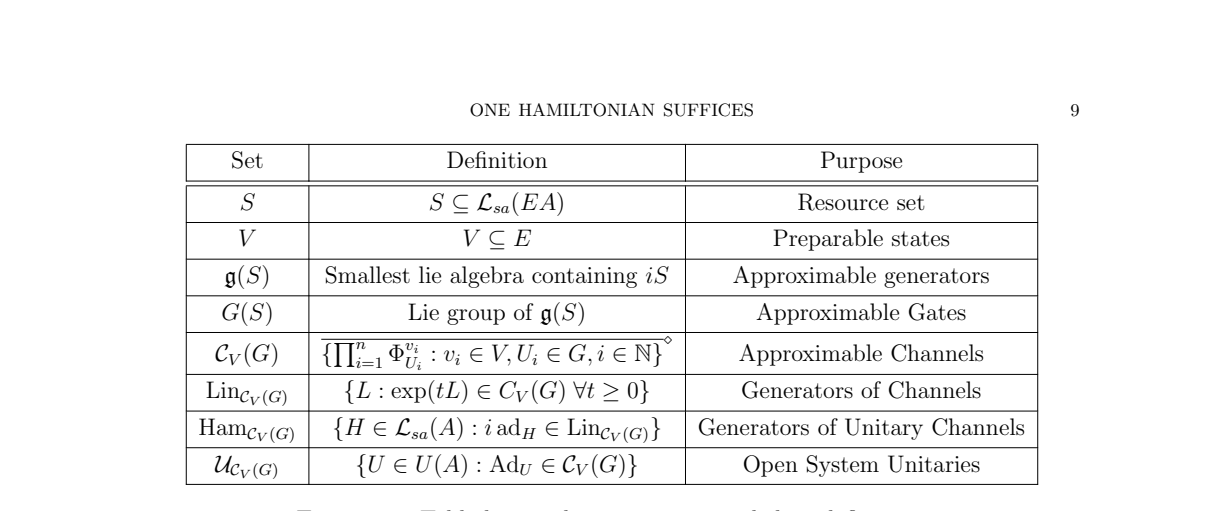
Closed-system quantum control normally demands access to the full unitary group on $n$ qubits, an object whose Lie algebra has dimension $4^n - 1$. This paper claims that universal state preparation survives without that group once open-system operations are allowed: prepare a small environment (one or three qubits) in a fixed state, evolve under a tiny unitary group — polynomial-dimensional, or even the one-parameter group of a single Hamiltonian — and trace the environment out. Repeated, these channel-building blocks move any $n$-qubit state to any other, and with a larger ancilla they approximate every quantum channel. The result replaces the exponentially large coherent control group with a fixed interaction Hamiltonian and a recyclable environment qubit, at the price of exponentially many rounds in the worst case, which the paper proves is unavoidable in these models.
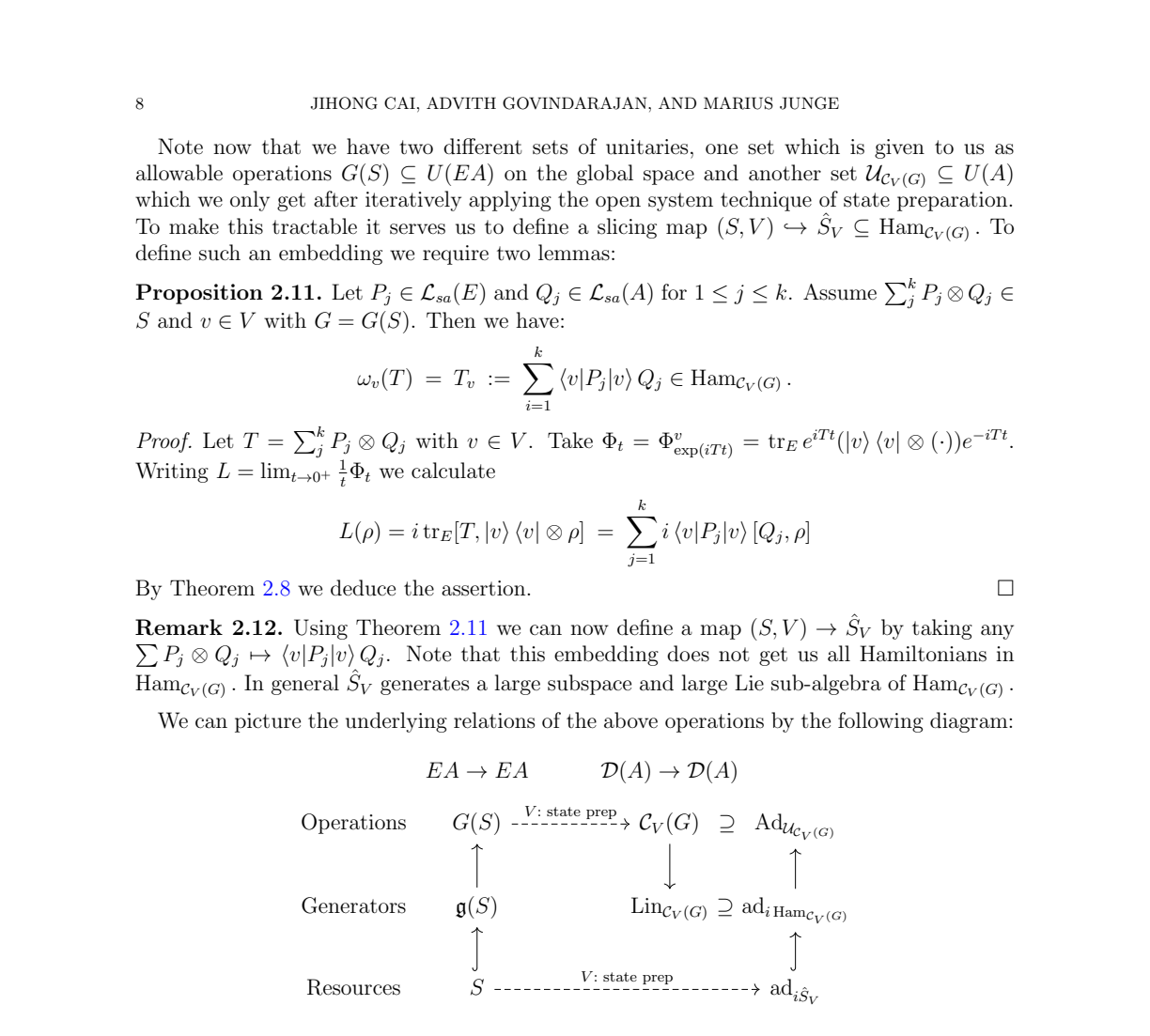
What carries the argument. The engine is the slicing map $\omega_v(H) = (\langle v| \otimes \mathrm{id})(H)$: prepare the environment in $|v\rangle$, evolve under $e^{itH}$ with $H$ in the small available Lie algebra, and trace the environment out. To first order in $t$ this yields the effective system Hamiltonian $\langle v|H|v\rangle$; to second order it yields the Lindbladian $L_\gamma$ whose jump operator is the off-diagonal block $\gamma = \langle v|H|v^\perp\rangle$. Because slicing is linear but not a Lie algebra homomorphism, one global Hamiltonian can produce many noncommuting system directions, so a one-dimensional group on the combined space can generate full $\mathfrak{su}(2^n)$ on the system. When $\gamma$ is non-normal ($[\gamma,\gamma^*] \neq 0$), the second-order term is an amplitude-damping generator, and the transitivity criterion of [CGJ25] — full coherent control plus one non-normal Lindblad generator suffices for state transitivity — makes the channel class transitive. For Theorem 5.5 the single Hamiltonian is the block matrix $h = \begin{pmatrix} Z_1 & (X_1+iY_1)/2 \\ (X_1-iY_1)/2 & X_1 + \sum_j (X_jX_{j+1}+Y_jY_{j+1}+Z_jZ_{j+1}) \end{pmatrix}$, whose diagonal blocks $\{Z_1, X_1 + H\}$ bracket-generate $\mathfrak{su}(2^n)$ and whose off-diagonal block equals $|0\rangle\langle 1|$ on qubit 1, a non-normal jump operator.
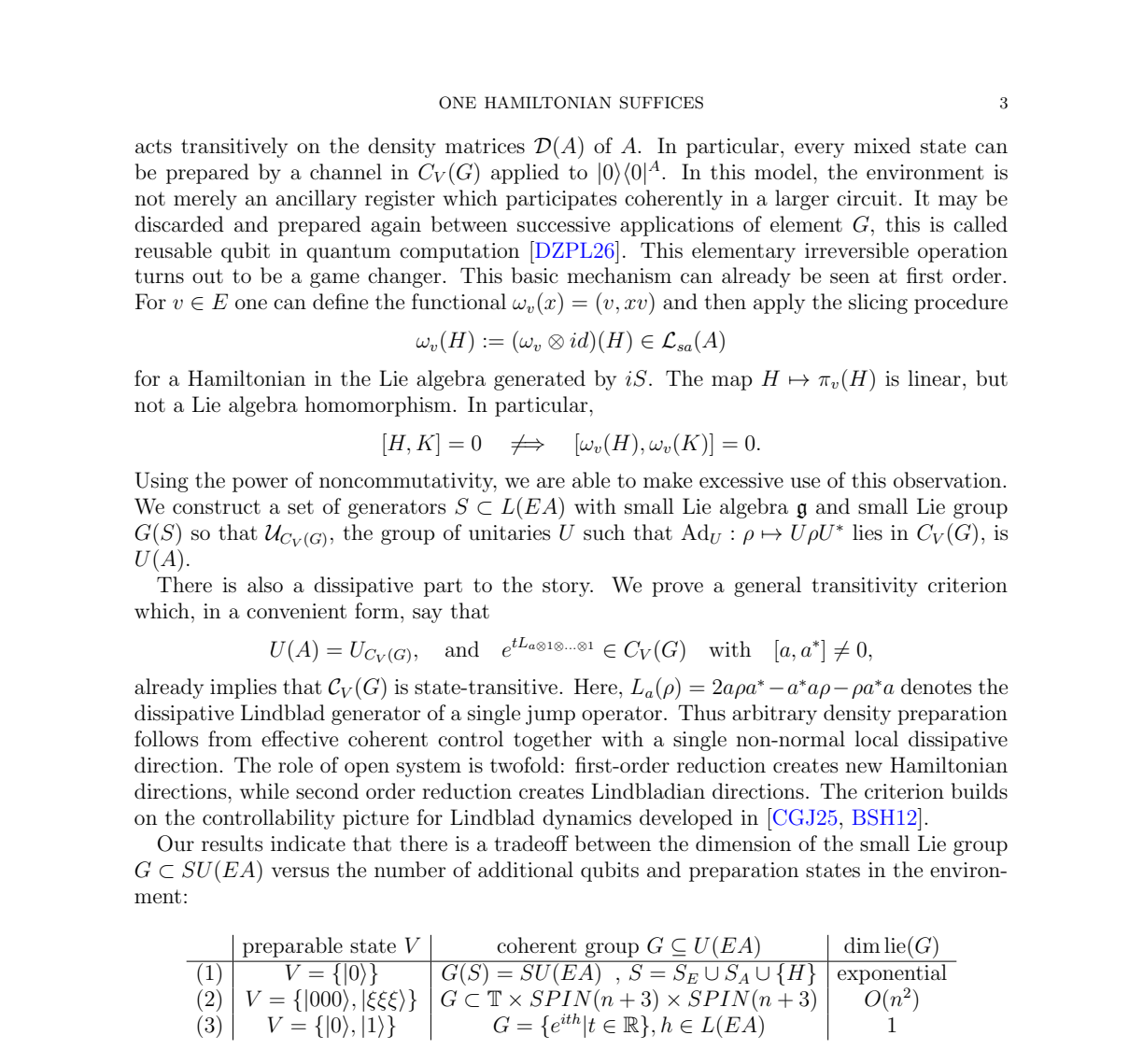
Core claim. On its own terms, the paper establishes that 'density magic' — the ability of a channel class to move any density matrix to any other — can be purchased with open-system operations instead of a large unitary group. A first construction uses local Pauli-string generators whose Lie algebra has dimension $O(n^2)$, giving $G \subset T \times \mathrm{Spin}(n+3) \times \mathrm{Spin}(n+3)$, and two environment states; slicing these generators against the environment yields full unitary control plus a non-normal dissipative direction, hence transitivity on all densities (Lemma 4.2). A second, more economical construction removes the resource set entirely: a single open-system magic Hamiltonian $h$, with $G = \{e^{ith} : t \in \mathbb{R}\}$ and the environment prepared in $|0\rangle$ or $|1\rangle$, is already state-transitive on all densities of $n$ qubits (Theorem 5.5). The same one-parameter group, with a Stinespring ancilla of dimension $2^{2n}$, approximates every quantum channel on $n$ qubits (Theorem 7.4). Finally the paper proves the universality has a cost: worst-case approximation length is exponential, at least $c(\varepsilon)\,2^n/n$ rounds for pure states and $c(\varepsilon)\,2^{2n}/n^3$ rounds for densities in the Spin model, and $c(\varepsilon)\,2^n/n^3$ rounds for densities with the single Hamiltonian (Theorem 1.1).
The premise it rests on. The load-bearing premise is the transitivity criterion that both constructions reduce to: full coherent control of $n$ qubits together with a single non-normal Lindblad generator, such as amplitude damping $L_{|0\rangle\langle 1|}$, makes the accessible channel class state-transitive on all density matrices. The paper takes this criterion from its companion work [CGJ25]; if the criterion failed, the small Spin groups and the single Hamiltonian $h$ would reach only a narrow set of states rather than all densities.
If the paper is right (Pith's inferences, not the authors')
Universal state preparation is reachable without ever implementing the full unitary group: an $O(n^2)$-dimensional Spin group with three environment qubits, or a single one-parameter group with one environment qubit prepared in $|0\rangle$ or $|1\rangle$, each acts transitively on all densities of $n$ qubits (Lemma 4.2, Theorem 5.5).
Channel universality follows from the same primitive: with a Stinespring ancilla of $2^{2n}$ dimensions, one fixed Hamiltonian and two environment preparations approximate every quantum channel on $n$ qubits in diamond norm (Theorem 7.4).
Universality does not trivialize synthesis: worst-case approximation length remains exponential, at least $c(\varepsilon)\,2^n/n$ rounds for pure states with the Spin model and $c(\varepsilon)\,2^{2n}/n^3$ or $c(\varepsilon)\,2^n/n^3$ rounds for densities in the Spin and single-Hamiltonian models respectively (Theorem 1.1).
The models define a concrete complexity landscape for open-system synthesis: states, densities, and channels can be cheap or expensive depending on the chosen Hamiltonian, group $G$, and environment set $V$, and the covering-number method supplies a quantitative measure of that cost.
Any platform that can realize the one fixed interaction Hamiltonian $h$ and repeatedly re-prepare an ancilla qubit inherits a universal state-preparation and channel-approximation primitive, because the coherent control group has only one parameter in the most economical model.
I read the two constructions as endpoints of a trade-off the paper leaves implicit: coherent control complexity (Lie algebra dimension) can be exchanged for more environment states and more rounds of open-system operations. A natural conjecture going beyond the paper's two examples is that any open-system model whose coherent group has polynomial dimension still needs exponentially many rounds for
A practical reading the authors only sketch: on hardware where one fixed interaction Hamiltonian is always available but arbitrary gates are expensive, the single-Hamiltonian protocol is a candidate universal primitive whose only overhead is re-preparing and discarding one ancilla qubit. Whether finite pulse errors or imperfect reprepation break transitivity is not analysed in the paper and would
The covering-number argument is metric rather than algebraic — it counts balls in the density space against balls in the coherent group — so it should transfer to platforms without Pauli-string structure, such as bosonic or continuous-variable systems, where the same technique could certify exponential worst-case lengths for any small coherent control group.
The authors' closing suggestion that the $O(n^2)$-dimensional Lie algebra might avoid barren-plateau regimes while retaining expressivity implies a possible separation between synthesis cost and variational trainability in open-system architectures; verifying that separation would require the variance analysis they cite, and is my inference rather than a claim the paper proves.
Check this review
Pith stored no record of this review's passes and took no fingerprint of it. Reviews made by code from 13 Nov 2026 on carry both.
How often reviews like this one are right
Reviews like this one: written by deepseek-v4-flash, where what was read was not recorded.
How often objections from reviews like this one are right: not yet measured
Reviews by people
This review was written by a machine. No person has reviewed this paper on Pith yet. A scientist listed on Pith can review it for a fee, and their review is published here whatever it concludes.
The paper
Abstract
We propose a novel approach to state preparation by embracing the full power of open quantum systems. Instead of working with the whole unitary group in n qubits, we identify a small Lie group G in (n + 3) qubits. The dimension of its Lie algebra is poly(n). Every state can be approximated starting from any fixed input state by repeatedly using partial trace and state preparation in the environment alongside group operations. Moreover, we also identify a single (open system magic) interaction Hamiltonian whose unitary group can be combined with open system quantum technology mentioned above to achieve transitivity on the space of all densities. Similarly, we show that all channels on n qubits can be approximated by using a larger environment, achieving channel universality. The interesting small groups we identify are derived from Lie algebras of local Pauli strings and lead to a new landscape of cheap and expensive states, densities, and channels.
The paper's own sentences, arranged, kept beside the review and separate from it. Each label is drawn from a closed vocabulary; the number beside it is the probability the classifier gave that label. No sentence in this record was written by a model.
abstract compiled · 2026-10-02
The authors' main claim, as the classifier picked it out 0.81
“Every state can be approximated starting from any fixed input state by repeatedly using partial trace and state preparation in the environment alongside group operations.”
How the main claim is stated: asserted 0.96
What the abstract itself states, as probabilities: claims first 0.12 · states limitation 0.13 · human participants 0.01 · controlled comparison 0.06 · randomized assignment 0.01 · states quantitative result 0.33 · compares with prior results 0.32 · mentions code or data availability 0.02
The abstract, sentence by sentence
This table labels the abstract only (arXiv listing abstract v1). The number is the probability the classifier gave the label.
| Sentence | Role | The authors' own work | States the main conclusion | Strength |
|---|---|---|---|---|
| We propose a novel approach to state preparation by embracing the full power of open quantum systems. | contribution 1.00 | 0.73 | 0.12 | asserted 0.94 |
| Instead of working with the whole unitary group in $n$ qubits, we identify a small Lie group $G$ in $(n+3)$ qubits. | contribution 0.58 | 0.90 | 0.11 | asserted 1.00 |
| The dimension of its Lie algebra is $\text{poly}(n)$. | result 0.53 | 0.82 | 0.06 | asserted 1.00 |
| Every state can be approximated starting from any fixed input state by repeatedly using partial trace and state preparation in the environment alongside group operations. | result 0.65 | 0.81 | 0.41 | asserted 0.96 |
| Moreover, we also identify a single (open system magic) interaction Hamiltonian whose unitary group can be combined with open system quantum technology mentioned above to achieve transitivity on the space of all densities. | contribution 0.71 | 0.91 | 0.20 | asserted 1.00 |
| Similarly, we show that all channels on $n$ qubits can be approximated by using a larger environment, achieving channel universality. | result 0.52 | 0.91 | 0.14 | asserted 1.00 |
| The interesting small groups we identify are derived from Lie algebras of local Pauli strings and lead to a new landscape of cheap and expensive states, densities, and channels. | interpretation 0.56 | 0.92 | 0.12 | asserted 1.00 |
What kind of paper the classifier reports this is: method or tool 0.56 · evidence from proof or derivation 0.92
What was examined, and what was not
Sources read
- arXiv listing abstract v1
Not examined
- full text
- figures and tables
- references and citing sentences
- relations to other papers
Levels run
- P abstract
Not run
- S sections
- T body sentences
- C citations
- R cross-paper relations
How the labels were made
Compiled by classifier-1.13.0 via TypeSafe API, question bank abstract-p1-20260923, 2026-10-02: 1 request, 5,565 input tokens.
Every quoted sentence on this record is the authors'. Every label is from Pith's closed vocabulary, with the probability shown beside it. This record as JSON
Figures (3)
Figures are the authors', reproduced from the paper.
References (41)
- [1] W. Forrest Stinespring , journal =. Positive Functions on on Pith
- [2] Watrous, John , year=. The Theory of Quantum Information , publisher= on Pith
- [3] Greg Kuperberg , year=. Breaking the cubic barrier in the. 2306.13158 , archivePrefix= on PitharXiv
- [4] Burgarth, Daniel and Bose, Sougato and Bruder, Christoph and Giovannetti, Vittorio , year=. Local controllability of quantum networks , volume=. Physical Review A , publisher=. doi:10.1103/physreva.79.060305 , number= on Pithdoi:10.1103/physreva.79.060305
- [5] D. Deutsch , journal =. Quantum Computational Networks , urldate = on Pith
- [6] Quantum computation, quantum state engineering, and quantum phase transitions driven by dissipation , author=. 2008 , eprint= on Pith
- [7] Engineering quantum dynamics , author =. Phys. Rev. A , volume =. 2001 , month =. doi:10.1103/PhysRevA.65.010101 , url = on Pithdoi:10.1103/physreva.65.010101
- [8] Completely positive dynamical semigroups of N -level systems. Journal of Mathematical Physics , keywords =. doi:10.1063/1.522979 , adsurl = on Pithdoi:10.1063/1.522979
- [9] Lindblad, G. On the Generators of Quantum Dynamical Semigroups , journal =. 1976 , doi = on Pith
- [10] Le Donne, Enrico , title =. 2021 , month = feb, howpublished = on Pith
- [11] Marius Junge and Jason Pollack and Luke Visser , year=. Universal computation with magic. 2609.14757 , archivePrefix= on PithPith's reviewarXiv
- [12] Jihong Cai and Advith Govindarajan and Marius Junge , year=. How Far do. 2504.04883 , archivePrefix= on PitharXiv
- [13] Jihong Cai and Advith Govindarajan and Marius Junge , year=. Dynamics from the classification theory of von on Pith
- [14] How to Transfer between Arbitrary n -Qubit Quantum States by Coherent Control and Simplest Switchable Noise on a Single Qubit , author=. 2012 , eprint= on Pith
- [15] Malvetti, Emanuel and vom Ende, Frederik and Dirr, Gunther and Schulte-Herbr\"uggen, Thomas , TITLE =. SIAM J. Control Optim. , FJOURNAL =. 2025 , NUMBER =. doi:10.1137/23M1594467 , URL = on Pithdoi:10.1137/23m1594467
- [16] Pisier, Gilles , TITLE =. 1989 , PAGES =. doi:10.1017/CBO9780511662454 , URL = on Pithdoi:10.1017/cbo9780511662454
- [17] Lawson, Jr., H. Blaine and Michelsohn, Marie-Louise , TITLE =. 1989 , PAGES = on Pith
- [18] Szarek, Stanis aw J. , TITLE =. Quantum probability (. 1998 , MRCLASS = on Pith
- [19] Bj\"orck, ke and Pereyra, Victor , TITLE =. Math. Comp. , FJOURNAL =. 1970 , PAGES =. doi:10.2307/2004623 , URL = on Pithdoi:10.2307/2004623
- [20] Ballester, C. and Pereyra, V. , TITLE =. Math. Comp. , FJOURNAL =. 1967 , PAGES =. doi:10.2307/2003232 , URL = on Pithdoi:10.2307/2003232
show 21 more
- [21] A Yu Kitaev , title =. doi:10.1070/RM1997v052n06ABEH002155 , year = on Pithdoi:10.1070/rm1997v052n06abeh002155
- [22] Aubrun, Guillaume and Szarek, Stanis aw J. , TITLE =. 2017 , PAGES =. doi:10.1090/surv/223 , URL = on Pithdoi:10.1090/surv/223
- [23] Pisier, Gilles , TITLE =. 2003 , PAGES =. doi:10.1017/CBO9781107360235 , URL = on Pithdoi:10.1017/cbo9781107360235
- [24] Paulsen, Vern , TITLE =. 2002 , PAGES = on Pith
- [25] N. L. Diaz and Diego García-Martín and Sujay Kazi and Martin Larocca and M. Cerezo , year=. Showcasing a. 2310.11505 , archivePrefix= on PithPith's reviewarXiv
- [26] Larocca, Martín and Thanasilp, Supanut and Wang, Samson and Sharma, Kunal and Biamonte, Jacob and Coles, Patrick J. and Cincio, Lukasz and McClean, Jarrod R. and Holmes, Zoë and Cerezo, M. , year=. Barren plateaus in variational quantum computing , volume=. Nature Reviews Phys... on Pithdoi:10.1038/s42254-025-00813-9
- [27] Ding, Zhiyan and Junge, Marius and Schleich, Philipp and Wu, Peixue , year=. Lower Bound for Simulation Cost of Open Quantum Systems:. Communications in Mathematical Physics , publisher=. doi:10.1007/s00220-025-05240-6 , number= on Pithdoi:10.1007/s00220-025-05240-6
- [28] Gerard Aguilar and Simon Cichy and Jens Eisert and Lennart Bittel , year=. Full classification of. 2408.00081 , archivePrefix= on PithPith's reviewarXiv
- [29] Dividing quantum channels , author=. Communications in Mathematical Physics , volume=. 2008 , publisher= on Pith
- [30] Ding, Zhiyan and Chen, Chi-Fang and Lin, Lin , year=. Single-ancilla ground state preparation via. Physical Review Research , publisher=. doi:10.1103/physrevresearch.6.033147 , number= on Pithdoi:10.1103/physrevresearch.6.033147
- [31] Campbell, Earl , year=. Shorter gate sequences for quantum computing by mixing unitaries , volume=. Physical Review A , publisher=. doi:10.1103/physreva.95.042306 , number= on Pithdoi:10.1103/physreva.95.042306
- [32] Campbell, Earl , year=. Random Compiler for Fast. Physical Review Letters , publisher=. doi:10.1103/physrevlett.123.070503 , number= on Pithdoi:10.1103/physrevlett.123.070503
- [33] Marvian, Iman , year=. Restrictions on realizable unitary operations imposed by symmetry and locality , volume=. Nature Physics , publisher=. doi:10.1038/s41567-021-01464-0 , number= on Pithdoi:10.1038/s41567-021-01464-0
- [34] Marvian, Iman and Liu, Hanqing and Hulse, Austin , year=. Rotationally Invariant Circuits: Universality with the Exchange Interaction and Two Ancilla Qubits , volume=. Physical Review Letters , publisher=. doi:10.1103/physrevlett.132.130201 , number= on Pithdoi:10.1103/physrevlett.132.130201
- [35] On Universal and Fault-Tolerant Quantum Computing , author=. 1999 , eprint= on Pith
- [36] Daniel Gottesman , year=. The. quant-ph/9807006 , archivePrefix= on PithPith's reviewarXiv
- [37] Javadi-Abhari, Ali and Treinish, Matthew and Krsulich, Kevin and Wood, Christopher J. and Lishman, Jake and Gacon, Julien and Martiel, Simon and Nation, Paul D. and Bishop, Lev S. and Cross, Andrew W. and Johnson, Blake R. and Gambetta, Jay M. , year=. Quantum computing with. ... on PithPith's reviewarXivdoi:10.48550/arxiv.2405.08810
- [38] A fault-tolerant neutral-atom architecture for universal quantum computation , author =. 2026 , journal =. doi:10.1038/s41586-025-09848-5 , url = on Pithdoi:10.1038/s41586-025-09848-5
- [39] Cleve, Richard , year=. An Introduction to Quantum Complexity Theory , ISBN=. doi:10.1142/9789810248185_0004 , booktitle= on Pithdoi:10.1142/9789810248185_0004
- [40] Bravyi, Sergey and Kitaev, Alexei , year=. Universal quantum computation with ideal. Physical Review A , publisher=. doi:10.1103/physreva.71.022316 , number= on Pithdoi:10.1103/physreva.71.022316
- [41] Ding, Zhiyan and Zhan, Yongtao and Preskill, John and Lin, Lin , year=. Simple and efficient end-to-end quantum thermal and ground state preparation , ISSN=. doi:10.1038/s41567-026-03389-y , journal= on Pithdoi:10.1038/s41567-026-03389-y
Challenges and discussion
Disagree with the review, or know something it missed? Leave a comment, or challenge this review formally: a challenge becomes a permanent entry in this paper's record, and its decision is published here.
Come back by email
A short list of the week's newly reviewed papers. Nothing is sent until you confirm from your inbox, and every email has a link that stops it. No account.
No comments yet.
Sign in to comment