Robotics · arXiv:2610.02120 v1 · submitted 1 Oct 2026 · 22 references
SkeleWAM: Skeleton World-Action Modeling for Efficient Robotic Manipulation
The paper says
“World action models (WAMs) combine robot action generation with future state prediction. Existing WAMs typically predict videos or learned visual latents, which represent interaction geometry only implicitly and may retain appearance information unrelated to control.”
more of the abstract
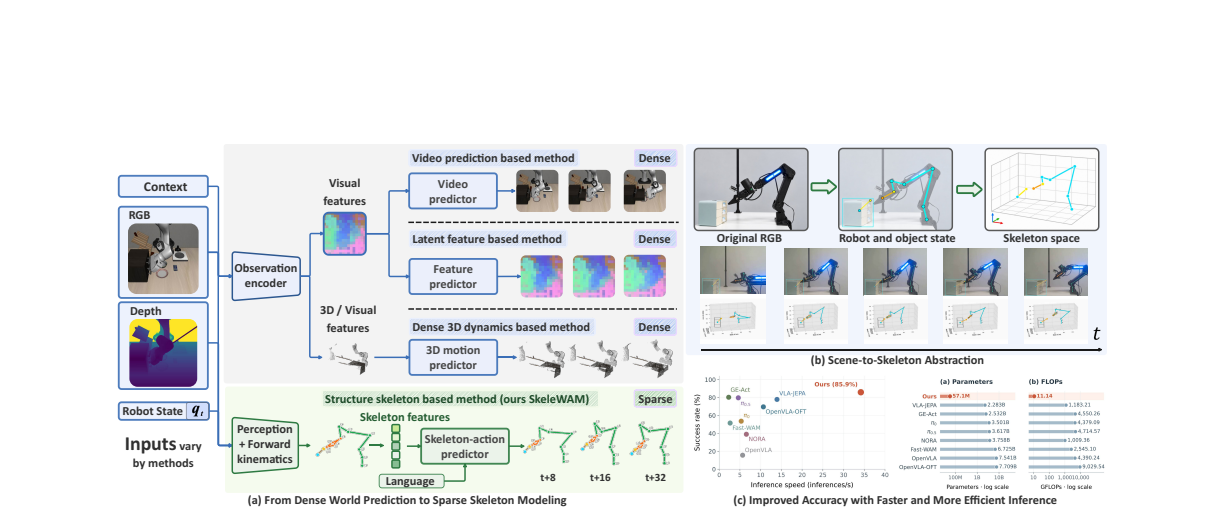
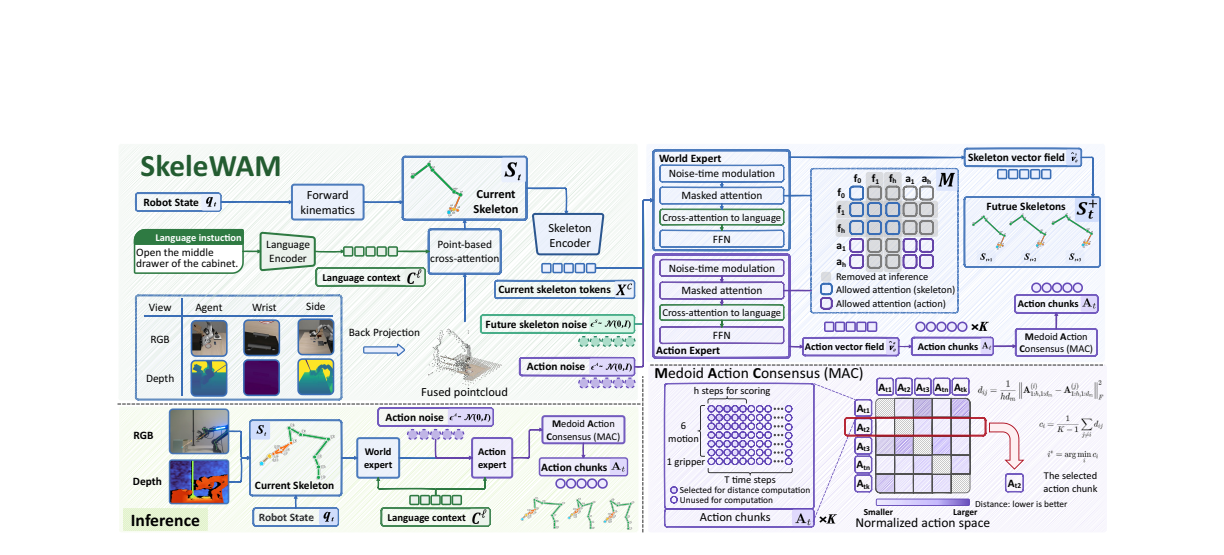
We introduce SkeleWAM, a compact WAM that represents a manipulation scene as a sparse 3D skeleton composed of robot joints, object centers, and interaction points. Constructed online from current RGB-D observations and robot proprioception, the skeleton provides a unified geometric state for action generation and future skeleton prediction. Future skeleton prediction provides additional geometric supervision for action learning without requiring visual reconstruction. At inference, SkeleWAM generates actions directly from the current skeleton and language instruction, while Medoid Action Consensus (MAC) serves as an auxiliary consensus strategy for stochastic action samples. On LIBERO-Plus, SkeleWAM achieves an overall success rate of 85.9% with 57.1M parameters, outperforming Cosmos-Policy by 3.7 percentage points. These results demonstrate that sparse 3D robot–object structure provides an effective state space for robust and parameter-efficient world action learning. The project is available at https://skelewam-project.github.io/.
from the abstract
Pith says
Machine review · deepseek-v4-flash · 2 Oct 2026 · what was read was not recorded · not checked by a person
It can be wrong. Challenge this review or reply to it.
Holds up, with conditions. A genuinely new skeleton-based WAM with a clean auxiliary-supervision ablation and an honest 1.8-point sim-state diagnostic; the fixed-topology assumption is a real, unprobed scope limit but not a defect within the tested regime. This line is wrong
2 major objections · 4 minor
How often objections from reviews like this one are right: not yet measured
Not checked: figures, code, what the 22 references say.
The paper says, at §3.2, Eq. (6), sentence b61
The review did not quote this passage.
Pith says: Objection 1 of 2 · major
The fixed-skeleton-topology assumption is load-bearing but untested and is not listed among the acknowledged limitations. Equation (6) fixes N = N_r + sum_m (1+L_m) as a constant, and sentence b61 states that 'Node identities, ordering, and connectivity remain consistent over time.'
more of objection 1
All attention masks (Eq. 8), future-skeleton targets (Eq. 3), and the flow-matching objective (Eq. 11) are defined on this fixed tokenization, so the model has no mechanism to represent objects appearing, disappearing, becoming fully occluded, or acquiring new interaction landmarks. The LIBERO-Plus perturbations in Table 1 alter camera, robot state, language, lighting, background, noise, and layout, but never change the object count or semantic roles; the sim-state diagnostic (b119) cannot rule out this limitation because simulator coordinates still provide complete, order-fixed landmarks for the same object set. The paper's conclusion (b7, b35) that sparse geometry is an effective representation for robust generalization is therefore untested outside the fixed-topology regime, and the acknowledged layout limitation (b118, b124, b174) is a different, narrower claim. I request either an explicit scope statement adding this assumption to the limitations, or, preferably, a probing experiment (e.g., a variant with an object appearing or disappearing mid-task, or with the same object set re-ordered).
The paper says, at §4.3, Table 2
The review did not quote this passage.
Pith says: Objection 2 of 2 · major
The real-world margin over the strongest baseline is within sampling noise. Over five tasks with 20 trials each (100 trials total), SkeleWAM scores 89 versus Cosmos-Policy's 87; a two-point difference over 100 Bernoulli trials is not statistically significant. The per-task differences are similarly small (e.g., Open Drawer 80 versus 85). Please report confidence intervals or per-task trial counts with a significance test, or soften the claim in §4.3 that SkeleWAM 'exceeds' Cosmos-Policy by 2 points.
4 minor objections
The paper says, at Table 1
Pith says: minor objection 1 of 4
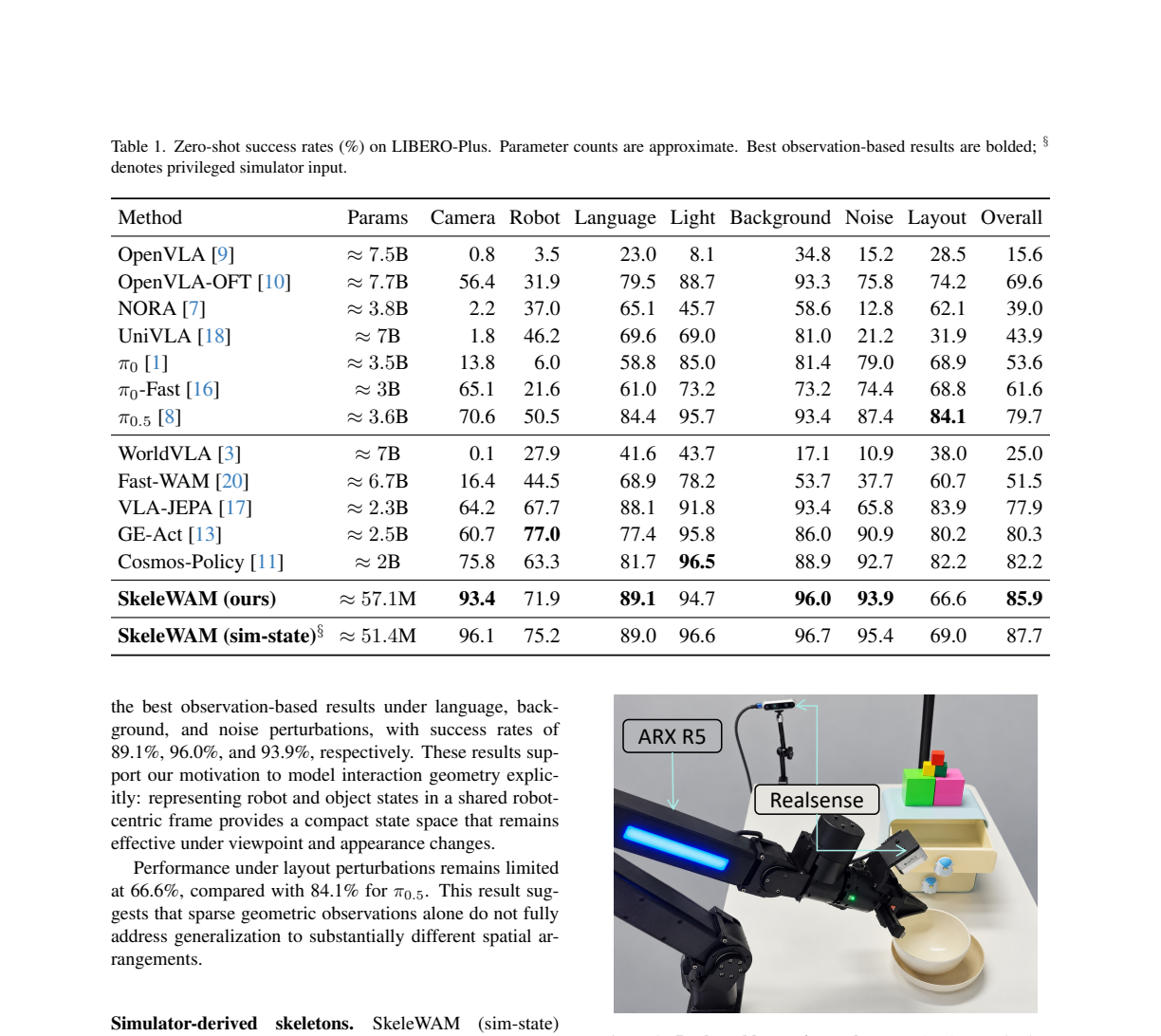
In the row for π0.5, the Language and Background entries appear concatenated as '84.179.7'; this is likely a missing delimiter and should be corrected to '84.1' and '79.7'.
The paper says, at §3.4, Eq. (11)
Pith says: minor objection 2 of 4
The setting of λ_s is not reported in the main text or in Table 3's ablation description. Since L_skeleton dominates the joint objective in tensor dimension (H_s×N×3 versus H_a×d_a) before weighting, please state the exact value of λ_s used, or confirm in the supplementary that the ablation in Table 3b holds it fixed when the skeleton loss is removed.
show 2 more
The paper says, at §4.1, baselines
Pith says: minor objection 3 of 4
The parameter counts in Table 1 are marked 'approximate'; for SkeleWAM the 57.1M figure excludes the frozen perception network. Please clarify whether the comparison includes the frozen perception backbone, since a fair efficiency comparison should report total deployed parameters.
The paper says, at §4.2, layout perturbations
Pith says: minor objection 4 of 4
The text at b118 and b124 explains the 66.6% layout result, but the sentence at b124 is interrupted by figure-caption text ('Realsense ARX R5 Figure 4...'). Please fix this typographical corruption in the final manuscript.
What would settle it
Use the trained SkeleWAM (sim-state) model with no retraining, and construct a held-out set of LIBERO-Plus layout variants in which, across different episodes, (i) one of the M objects is removed entirely, and (ii) a distractor object is added, so the skeleton node count must change. Keep the language instruction and action semantics identical, and supply the simulator's ground-truth coordinates for whatever objects are present. Measure success rate and whether the model runs without ad-hoc padding or manual remapping. If success collapses to near chance on the variable-object episodes, or if the model cannot be invoked at all without padding nodes to a fixed N, then the fixed-topology assumption is binding and the central claim is only supported for closed, fixed-object scenes.
from the skeptic's reading
How the review went
4 readings by deepseek-v4-flash · 2 Oct 2026
- Reader holds up, with conditions
- Skeptic agrees
- Editor wrote the verdict above
- Referee major revision: 2 major objections, 4 minor
Not run on this paper: the simulated authors' defence.
Pith did not check this review's objections against the paper.
The review in full
The review in brief, machine-written
You should read this one for the ablation discipline as much as the result. The core claim—that jointly training action generation with future-skeleton prediction gives 5.8 points over action-only—is directly supported by Table 3 panel b (85.9% vs 80.1%). That is a clean, honest ablation, and the sim-state diagnostic (87.7% vs 85.9%, a 1.8-point gap) is good practice: it isolates perception error from policy error. The MAC inference trick is simple and genuinely auxiliary (K=3 gives 85.9% vs 84.2% for K=1, and performance drops at K=5 and K=10, so it is not just more sampling). The skeleton composition ablation is also well done: centers plus interaction points beats either alone by 3.6 and 8.2 points respectively.
The load-bearing soft spot is the fixed-skeleton-topology assumption stated at sentence b61: node count, ordering, and connectivity are constant over time (Eq. 6 fixes N). The model has no mechanism for objects entering or leaving the scene, being fully occluded, or acquiring new contact landmarks. The paper reports layout generalization as its known weakness (66.6% in simulation, 69.0% even with simulator coordinates, sentences b118, b124, b174), but the topology limit is distinct and unprobed: layout perturbations move the same objects with the same semantic roles. No experiment exercises appearing/disappearing objects or partial occlusion. The paper does not list this among acknowledged limitations, and the conclusion's broader claim (b7, b35) goes beyond what the evidence supports. Worth noting, though, that the authors do explicitly acknowledge the layout gap at sentence b174, so they are not hiding the general weakness.
Minor issues: the 57.1M parameter count excludes the frozen perception network, which is fair to note but not misleading since the perception stage is frozen and shared. No variance estimates on any success rate. The ablation over He, K, and h is run on the benchmark that produces the headline number, so the 85.9% is mildly tuned, but the consensus window ablation shows only a 0.6-point spread, which limits the concern.
Verdict: this is a solid subfield contribution that deserves referee time. The central auxiliary-supervision claim holds within the fixed-topology regime; the open question is exactly how far that regime extends. I would push the authors to either probe topology changes explicitly or scope the claims in the conclusion to closed-object scenes.
The strongest objection
The central claim is that sparse, explicit robot–object geometry is an effective state space for robust world action modeling (b7, b35). This claim rests on the skeleton state defined in Eq. 2 and Eq. 6, where N = N_r + sum_m (1 + L_m) is a fixed integer across time. The paper states at b61 that 'Node identities, ordering, and connectivity remain consistent over time,' but this is treated as a working assumption, not a validated condition, and it is not listed among the acknowledged limitations (b118, b124, b174). If an object appears, disappears, is fully occluded, or a new contact landmark becomes relevant, the model has no mechanism to change N or remap nodes: the future skeleton (Eq. 3) and all attention masks are defined on a fixed tokenization. The LIBERO-Plus evaluation perturbs camera, robot, language, lighting, background, noise, and layout, but in all of these the same objects and the same interaction landmarks are present; layout changes move objects but do not change their count or semantic role. Thus the reported 85.9% success rate is obtained entirely inside the fixed-topology regime. The concern is not that the result is wrong within that regime; it is that the paper's headline inference, that sparse geometry generalizes as an effective representation for manipulation, is untested outside it. The sim-state diagnostic cannot rule this out because simulator coordinates still provide complete, order-fixed landmarks for the same object set. A model that is internally committed to fixed N could be brittle exactly where manipulation is hardest: novel objects, staged assembly, occlusion, and partial views.
The reader's weakest_assumption identifies exactly the same load-bearing condition that I find most consequential: the fixed skeleton topology defined by Eq. 6 and asserted in b61. The paper openly states the assumption, but it does not validate it, does not list it among its acknowledged limitations, and its experiments never vary object identity, object count, or landmark availability. Given that the central contribution is explicitly the sparsity and explicitness of the geometric state space, this is not a peripheral implementation detail: it determines whether the method is a general manipulation state representation or a specialized fixed-scene tabletop approach. Other concerns raised by the reader (missing variance estimates, parameter-count attribution, and hyperparameter tuning on the benchmark) are real but secondary; they affect the strength of the numerical comparison, not the structural validity of the method's scope. Because the reader already returned CONDITIONAL and my concern reinforces rather than overturns that judgement, I recommend UNCHANGED. The one concrete check that would settle whether the fixed-topology concern actually lands is a variable-object evaluation using sim-state coordinates to isolate perception noise, as described above.
The referee's report
If the claims hold, the paper makes a substantive contribution: it shows that an explicit, sparse geometric state can replace dense video or latent world prediction at a fraction of the parameter count, with honest ablations isolating the auxiliary-supervision contribution and a privileged-input diagnostic validating the frozen perception pipeline. The ablation design is notably clean: the decisive Table 3b comparison keeps the action backbone identical and varies only the future-skeleton objective, and the sim-state gap of 1.8 points convincingly localizes the perception-stage cost. The method is internally consistent, with skeletons derived from forward kinematics and a frozen external perception network rather than from the target actions, so the central comparison is not circular.
Pith's reading of the paper (a machine's summary, not the authors')
Most world action models (WAMs) either generate future videos or predict learned visual latents, representing robot-object geometry only implicitly and carrying appearance information that has nothing to do with control. SkeleWAM claims that the control-relevant content of a manipulation scene can be captured by a sparse 3D skeleton, the positions of the robot's joints, each object's center, and the object's interaction points, built online from RGB-D and proprioception. On the full LIBERO-Plus benchmark it reaches 85.9% overall success with 57.1M parameters, beating the strongest observation-based baseline, Cosmos-Policy (82.2%, roughly 2B parameters), by 3.7 points. The load-bearing structural claim is that jointly predicting future skeletons during training provides geometric supervision worth 5.8 points over action-only training, which shows that explicit interaction geometry, not pixel appearance, is what carries the learning. If right, the paper establishes that a sparse, explicit, parameter-light geometric state can substitute for expensive video or latent world prediction.
What carries the argument. The load-bearing objects are (i) the skeleton state $S_t \in \mathbb{R}^{N \times 3}$ of Eq. 6, a fixed-topology point cloud of robot joints, object centers, and interaction points expressed in a shared robot-centric frame; (ii) the joint flow-matching objective $L = L_{\text{action}} + \lambda_s L_{\text{skeleton}}$ (Eq. 11), which trains the same world-expert transformer to denoise both actions and future skeletons so that geometric prediction supervises representation learning; and (iii) Medoid Action Consensus, which at inference samples $K$ candidate action chunks from independent Gaussian initializations, scores each by its mean pairwise distance to the others over the first $h$ motion steps in normalized action space, and executes the medoid trajectory without any reward model. The fixed-topology requirement, that node identities, ordering, and connectivity remain constant over time (sentence b61), is what lets the skeleton be a single tensor, but it is also the property that prevents representing objects that appear, vanish, become occluded, or gain new contact landmarks.
Core claim. On its own terms, the paper's central claim is that the aspects of a scene that govern manipulation, robot configuration and object interaction geometry, have a sparse, explicit, canonical representation, and that modeling a world action model in this space is both sufficient and efficient. Formally the scene skeleton is $S_t = [J_t; P_{t,1}; \dots; P_{t,M}]$ (Eq. 6): robot joint positions plus, for each object, a center point and interaction points. The model jointly learns the action distribution and the distribution over future skeletons (Eqs. 4 and 11), with future skeleton prediction acting purely as auxiliary supervision that is discarded at inference. The ablation backing this is direct: removing the future-skeleton loss drops success from 85.9% to 80.1%, so the gain comes from co-training geometry, not from a bigger network. The paper further reports robustness under camera, language, background, and noise perturbations, and 89% average success on five real-world tasks; it also reports that layout generalization stalls at 66.6%, which the authors attribute to sparse geometry not capturing the variation needed for novel spatial arrangements.
The premise it rests on. The load-bearing premise is that the same objects with the same interaction landmarks are present and identifiable for the whole episode, so the skeleton's node set never changes; if an object appears, disappears, becomes occluded, or needs a new contact point, the fixed-shape state of Eq. 6 has no place to represent it, and no experiment in the paper tests that condition.
If the paper is right (Pith's inferences, not the authors')
A sparse explicit geometric state can substitute for video or latent world prediction: SkeleWAM reaches 85.9% overall success on LIBERO-Plus with 57.1M parameters, beating Cosmos-Policy (82.2%) and other VLA and WAM baselines that use 2B to 7.5B parameters.
Training-time future skeleton prediction is worth 5.8 points: removing the skeleton loss drops success from 85.9% to 80.1% with identical current-skeleton processing and inference, so geometric co-training, not architecture size, drives the gain.
The representation is robust to appearance change precisely because it discards appearance: SkeleWAM reaches 93.4% under camera perturbations (17.6 points over Cosmos-Policy), 96.0% under background change, and 93.9% under noise.
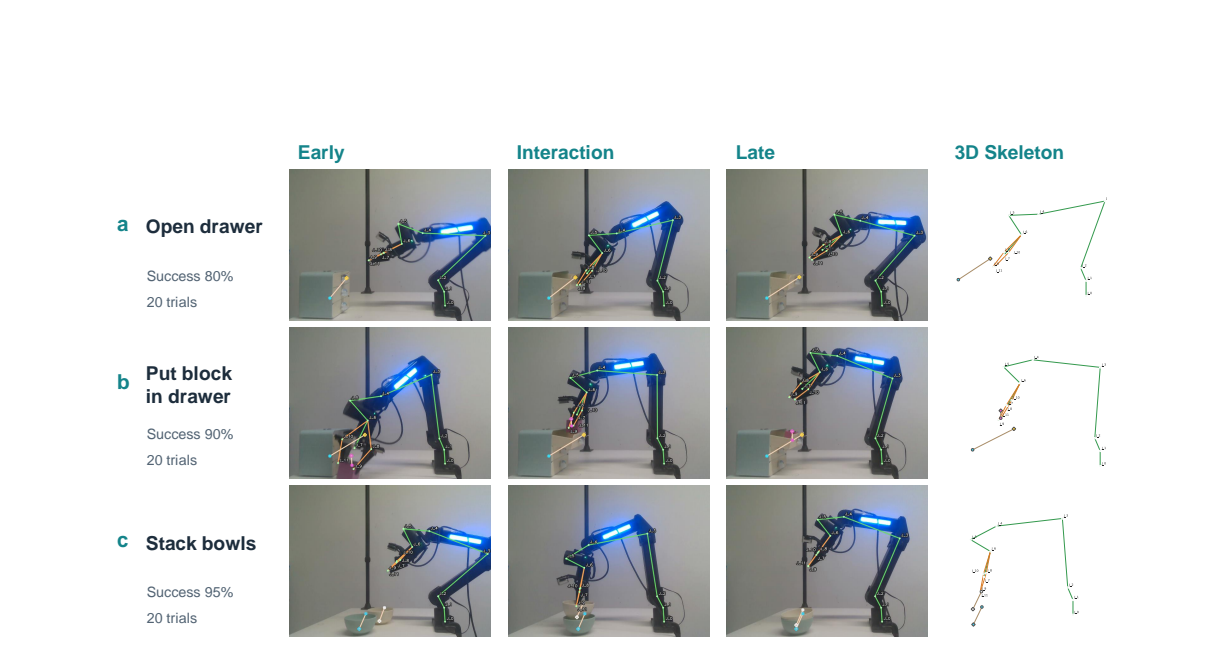
The method transfers to hardware: it achieves 89% average success across five real-world tasks on an ARX R5 robot, highest or joint-highest on four of the five tasks.
Sparse geometry alone does not generalize to novel spatial layouts: layout success is 66.6% and reaches only 69.0% even with privileged simulator coordinates, a limit the authors acknowledge as a residual policy-generalization gap.
The fixed-topology skeleton is likely what caps layout generalization, not the RGB-D perception: even with privileged simulator coordinates layout success only reaches 69.0%, so the bottleneck is the representation's inability to adapt node identity, ordering, or connectivity to rearranged scenes rather than noisy landmark estimates.
The 5.8-point gain from skeleton prediction suggests the supervision target matters more than the modality: a WAM that supervises with explicit interaction geometry piggybacks on a signal causally tied to the action, whereas pixel or latent targets dilute it and are the natural next thing to ablate against the reported 77.9% of VLA-JEPA and 51.5% of Fast-WAM on the same benchmark.
MAC is a plug-in, reward-free voting rule over flow samples: since it needs no value or reward model and only uses normalized action distances over a prefix, it could be transplanted to other flow-matching and diffusion policies as a general consensus step, and the reported flat profile across consensus windows (85.3 to 85.9%) suggests it is not sensitive to its hyperparameters.
Check this review
Pith stored no record of this review's passes and took no fingerprint of it. Reviews made by code from 13 Nov 2026 on carry both.
How often reviews like this one are right
Reviews like this one: written by deepseek-v4-flash, where what was read was not recorded.
How often objections from reviews like this one are right: not yet measured
Reviews by people
This review was written by a machine. No person has reviewed this paper on Pith yet. A scientist listed on Pith can review it for a fee, and their review is published here whatever it concludes.
The paper
Abstract
World action models (WAMs) combine robot action generation with future state prediction. Existing WAMs typically predict videos or learned visual latents, which represent interaction geometry only implicitly and may retain appearance information unrelated to control. We introduce SkeleWAM, a compact WAM that represents a manipulation scene as a sparse 3D skeleton composed of robot joints, object centers, and interaction points. Constructed online from current RGB-D observations and robot proprioception, the skeleton provides a unified geometric state for action generation and future skeleton prediction. Future skeleton prediction provides additional geometric supervision for action learning without requiring visual reconstruction. At inference, SkeleWAM generates actions directly from the current skeleton and language instruction, while Medoid Action Consensus (MAC) serves as an auxiliary consensus strategy for stochastic action samples. On LIBERO-Plus, SkeleWAM achieves an overall success rate of 85.9% with 57.1M parameters, outperforming Cosmos-Policy by 3.7 percentage points. These results demonstrate that sparse 3D robot–object structure provides an effective state space for robust and parameter-efficient world action learning. The project is available at https://skelewam-project.github.io/.
The paper's own sentences, arranged, kept beside the review and separate from it. Each label is drawn from a closed vocabulary; the number beside it is the probability the classifier gave that label. No sentence in this record was written by a model.
abstract compiled · 2026-10-02
The authors' main claim, as the classifier picked it out 1.00
“These results demonstrate that sparse 3D robot--object structure provides an effective state space for robust and parameter-efficient world action learning.”
How the main claim is stated: asserted 1.00
What the abstract itself states, as probabilities: claims first 0.07 · states limitation 0.10 · human participants 0.03 · controlled comparison 0.86 · randomized assignment 0.01 · states quantitative result 0.99 · compares with prior results 0.98 · mentions code or data availability 0.92
The abstract, sentence by sentence
This table labels the abstract only (arXiv listing abstract v1). The number is the probability the classifier gave the label.
| Sentence | Role | The authors' own work | States the main conclusion | Strength |
|---|---|---|---|---|
| World action models (WAMs) combine robot action generation with future state prediction. | background 1.00 | 0.06 | 0.02 | asserted 1.00 |
| Existing WAMs typically predict videos or learned visual latents, which represent interaction geometry only implicitly and may retain appearance information unrelated to control. | background 0.50 | 0.05 | 0.02 | hedged possibility 0.69 |
| We introduce SkeleWAM, a compact WAM that represents a manipulation scene as a sparse 3D skeleton composed of robot joints, object centers, and interaction points. | contribution 0.94 | 0.90 | 0.07 | asserted 1.00 |
| Constructed online from current RGB-D observations and robot proprioception, the skeleton provides a unified geometric state for action generation and future skeleton prediction. | method 0.98 | 0.83 | 0.05 | asserted 1.00 |
| Future skeleton prediction provides additional geometric supervision for action learning without requiring visual reconstruction. | method 0.66 | 0.61 | 0.08 | asserted 0.99 |
| At inference, SkeleWAM generates actions directly from the current skeleton and language instruction, while Medoid Action Consensus (MAC) serves as an auxiliary consensus strategy for stochastic action samples. | method 0.99 | 0.78 | 0.05 | asserted 1.00 |
| On LIBERO-Plus, SkeleWAM achieves an overall success rate of 85.9% with 57.1M parameters, outperforming Cosmos-Policy by 3.7 percentage points. | result 1.00 | 0.96 | 0.14 | asserted 1.00 |
| These results demonstrate that sparse 3D robot--object structure provides an effective state space for robust and parameter-efficient world action learning. | interpretation 1.00 | 0.79 | 0.92 | asserted 1.00 |
| The project is available at https://skelewam-project.github.io/. | future work 0.45 | 0.19 | 0.02 | asserted 0.61 |
What kind of paper the classifier reports this is: method or tool 1.00 · evidence from observation or experiment 0.96
What was examined, and what was not
Sources read
- arXiv listing abstract v1
Not examined
- full text
- figures and tables
- references and citing sentences
- relations to other papers
Levels run
- P abstract
Not run
- S sections
- T body sentences
- C citations
- R cross-paper relations
How the labels were made
Compiled by classifier-1.13.0 via TypeSafe API, question bank abstract-p1-20260923, 2026-10-02: 1 request, 6,859 input tokens.
Every quoted sentence on this record is the authors'. Every label is from Pith's closed vocabulary, with the probability shown beside it. This record as JSON
Figures (4)
Figures are the authors', reproduced from the paper.
References (22)
- [1] Kevin Black, Noah Brown, Danny Driess, Adnan Esmail, Michael Equi, Chelsea Finn, Niccolo Fusai, Lachy Groom, Karol Hausman, Brian Ichter, Szymon Jakubczak, Tim Jones, Liyiming Ke, Sergey Levine, Adrian Li-Bell, Mohith Mothukuri, Suraj Nair, Karl Pertsch, Lucy Xiaoyang Shi, Jam... on Pith
- [2] Anthony Brohan, Noah Brown, Justice Carbajal, Yevgen Chebotar, Xi Chen, Krzysztof Choromanski, Tianli Ding, Danny Driess, Avinava Dubey, Chelsea Finn, Pete Florence, Chuyuan Fu, Montse Gonzalez Arenas, Keerthana Gopalakr- ishnan, Kehang Han, Karol Hausman, Alex Herzog, Jas- mi... on PithPith's reviewarXiv
- [3] Jun Cen, Chaohui Yu, Hangjie Yuan, Yuming Jiang, Siteng Huang, Jiayan Guo, Xin Li, Yibing Song, Hao Luo, Fan Wang, Deli Zhao, and Hao Chen. Worldvla: Towards au- toregressive action world model, 2025. 3, 6 on Pith
- [4] Jialei Chen, Kai Wang, Kang Chen, Shuaihang Chen, Feng Gao, Wenhao Tang, Zhiyuan Li, Weilin Liu, Zhuyu Yao, Boxun Li, Yuanbo Xu, and Chao Yu. Lawam: Latent world action models for efficient dynamics-aware robot policies, on Pith
- [5] Cheng Chi, Siyuan Feng, Yilun Du, Zhenjia Xu, Eric Cousineau, Benjamin Burchfiel, and Shuran Song. Diffusion policy: Visuomotor policy learning via action diffusion. In Proceedings of Robotics: Science and Systems (RSS), 2023. 1, 2 on Pith
- [6] Senyu Fei, Siyin Wang, Junhao Shi, Zihao Dai, Jikun Cai, Pengfang Qian, Li Ji, Xinzhe He, Shiduo Zhang, Zhaoye Fei, Jinlan Fu, Jingjing Gong, and Xipeng Qiu. Libero-plus: In- depth robustness analysis of vision-language-action models, on Pith
- [7] Chia-Yu Hung, Qi Sun, Pengfei Hong, Amir Zadeh, Chuan Li, U Tan, Navonil Majumder, Soujanya Poria, et al. Nora: A small open-sourced generalist vision language action model for embodied tasks.arXiv preprint arXiv:2504.19854, 2025. 2, 6 on PithPith's reviewarXiv
- [8] Physical Intelligence, Kevin Black, Noah Brown, James Darpinian, Karan Dhabalia, Danny Driess, Adnan Esmail, Michael Equi, Chelsea Finn, Niccolo Fusai, Manuel Y . Gal- liker, Dibya Ghosh, Lachy Groom, Karol Hausman, Brian Ichter, Szymon Jakubczak, Tim Jones, Liyiming Ke, Devin... on Pith
- [9] Moo Jin Kim, Karl Pertsch, Siddharth Karamcheti, Ted Xiao, Ashwin Balakrishna, Suraj Nair, Rafael Rafailov, Ethan Fos- ter, Grace Lam, Pannag Sanketi, Quan Vuong, Thomas Kol- lar, Benjamin Burchfiel, Russ Tedrake, Dorsa Sadigh, Sergey Levine, Percy Liang, and Chelsea Finn. Ope... on Pith
- [10] Moo Jin Kim, Chelsea Finn, and Percy Liang. Fine-tuning vision-language-action models: Optimizing speed and suc- cess. InProceedings of Robotics: Science and Systems, on Pith
- [11] Moo Jin Kim, Yihuai Gao, Tsung-Yi Lin, Yen-Chen Lin, Yunhao Ge, Grace Lam, Percy Liang, Shuran Song, Ming- Yu Liu, Chelsea Finn, et al. Cosmos policy: Fine-tuning video models for visuomotor control and planning.arXiv preprint arXiv:2601.16163, 2026. 1, 3, 6 on PithPith's reviewarXiv
- [12] Lin Li, Qihang Zhang, Yiming Luo, Shuai Yang, Ruilin Wang, Fei Han, Mingrui Yu, Zelin Gao, Nan Xue, Xing Zhu, et al. Causal world modeling for robot control. InProceed- ings of Robotics: Science and Systems (RSS), 2026. 1 on Pith
- [13] Yue Liao, Pengfei Zhou, Siyuan Huang, Donglin Yang, Shengcong Chen, Yuxin Jiang, Yue Hu, Jingbin Cai, Si Liu, Jianlan Luo, Liliang Chen, Shuicheng Yan, Maoqing Yao, and Guanghui Ren. Genie envisioner: A unified world foun- dation platform for robotic manipulation, 2025. 3, 6 on Pith
- [14] Hao Luo, Wanpeng Zhang, Yicheng Feng, Sipeng Zheng, Haiweng Xu, Chaoyi Xu, Ziheng Xi, Yuhui Fu, and Zongqing Lu. Being-h0.7: A latent world-action model from egocentric videos, 2026. 1 on Pith
- [15] Octo Model Team, Dibya Ghosh, Homer Walke, Karl Pertsch, Kevin Black, Oier Mees, Sudeep Dasari, Joey Hejna, Charles Xu, Jianlan Luo, Tobias Kreiman, You Liang Tan, Lawrence Yunliang Chen, Pannag Sanketi, Quan Vuong, Ted Xiao, Dorsa Sadigh, Chelsea Finn, and Sergey Levine. Octo... on Pith
- [16] Karl Pertsch, Kyle Stachowicz, Brian Ichter, Danny Driess, Suraj Nair, Quan Vuong, Oier Mees, Chelsea Finn, and Sergey Levine. Fast: Efficient action tokenization for vision- language-action models.arXiv preprint arXiv:2501.09747, on PithPith's reviewarXiv
- [17] Jingwen Sun, Wenyao Zhang, Zekun Qi, Shaojie Ren, Zezhi Liu, Hanxin Zhu, Guangzhong Sun, Xin Jin, and Zhibo Chen. Vla-jepa: Enhancing vision-language-action model with latent world model, 2026. 3, 6 on Pith
- [18] Yuqi Wang, Xinghang Li, Wenxuan Wang, Junbo Zhang, Yingyan Li, Yuntao Chen, Xinlong Wang, and Zhaoxiang Zhang. Unified vision-language-action model. InInter- national Conference on Learning Representations, pages 80929–80944, 2026. 3, 6 on Pith
- [19] Seonghyeon Ye, Yunhao Ge, Kaiyuan Zheng, Shenyuan Gao, Sihyun Yu, George Kurian, Suneel Indupuru, You Liang Tan, Chuning Zhu, Jiannan Xiang, et al. World action models are zero-shot policies.arXiv preprint arXiv:2602.15922, 2026. 1, 3 on PithPith's reviewarXiv
- [20] Tianyuan Yuan, Zibin Dong, Yicheng Liu, and Hang Zhao. Fast-wam: Do world action models need test-time future imagination?arXiv preprint arXiv:2603.16666, 2026. 1, 3, 6 on PithPith's reviewarXiv
show 2 more
- [21] Yanjie Ze, Gu Zhang, Kangning Zhang, Chenyuan Hu, Muhan Wang, and Huazhe Xu. 3d diffusion policy: Gen- eralizable visuomotor policy learning via simple 3d repre- sentations. InProceedings of Robotics: Science and Systems (RSS), 2024. 1, 2 on Pith
- [22] Tony Z Zhao, Vikash Kumar, Sergey Levine, and Chelsea Finn. Learning fine-grained bimanual manipulation with low-cost hardware. InProceedings of Robotics: Science and Systems (RSS), 2023. 1, 2 9 on Pith
Cited by 1 Pith paper
Reviewed papers on Pith that cite this one. The full citation record
- Spiking World-Action Models for Robotic Manipulation cs.RO · Nov 2026
Challenges and discussion
Disagree with the review, or know something it missed? Leave a comment, or challenge this review formally: a challenge becomes a permanent entry in this paper's record, and its decision is published here.
Come back by email
A short list of the week's newly reviewed papers. Nothing is sent until you confirm from your inbox, and every email has a link that stops it. No account.
No comments yet.
Sign in to comment