Robotics · arXiv:2611.30041 v1 · submitted 23 Nov 2026 · 53 references
Spiking World-Action Models for Robotic Manipulation
The paper says
“World action models (WAMs) predict how the world responds to actions and offer a promising path toward general embodied intelligence, but they are large and run the network many times per plan, so they are hard to deploy on robots.”
more of the abstract
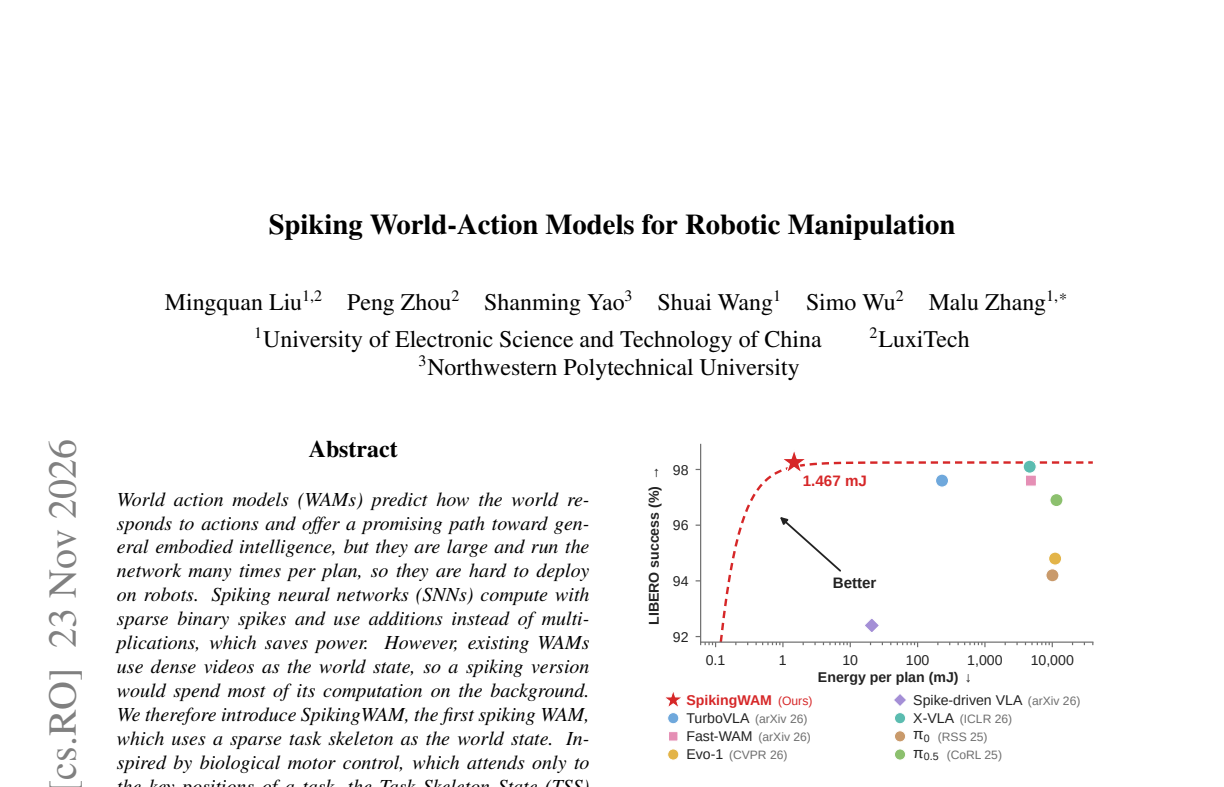
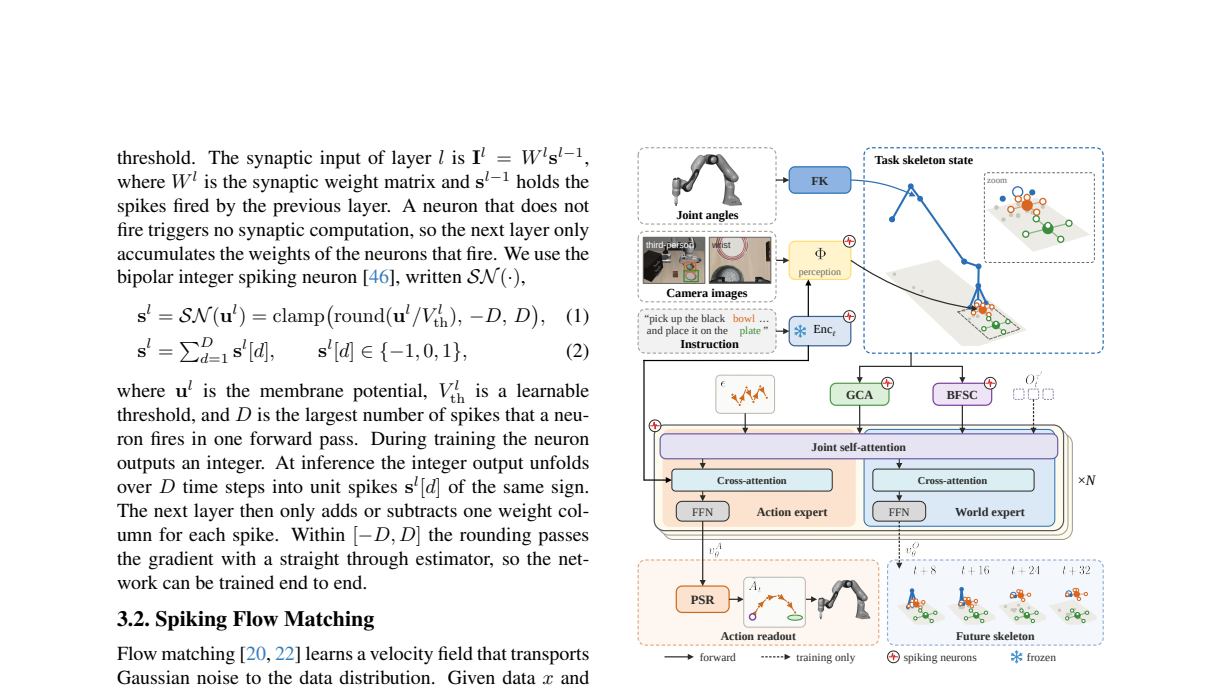
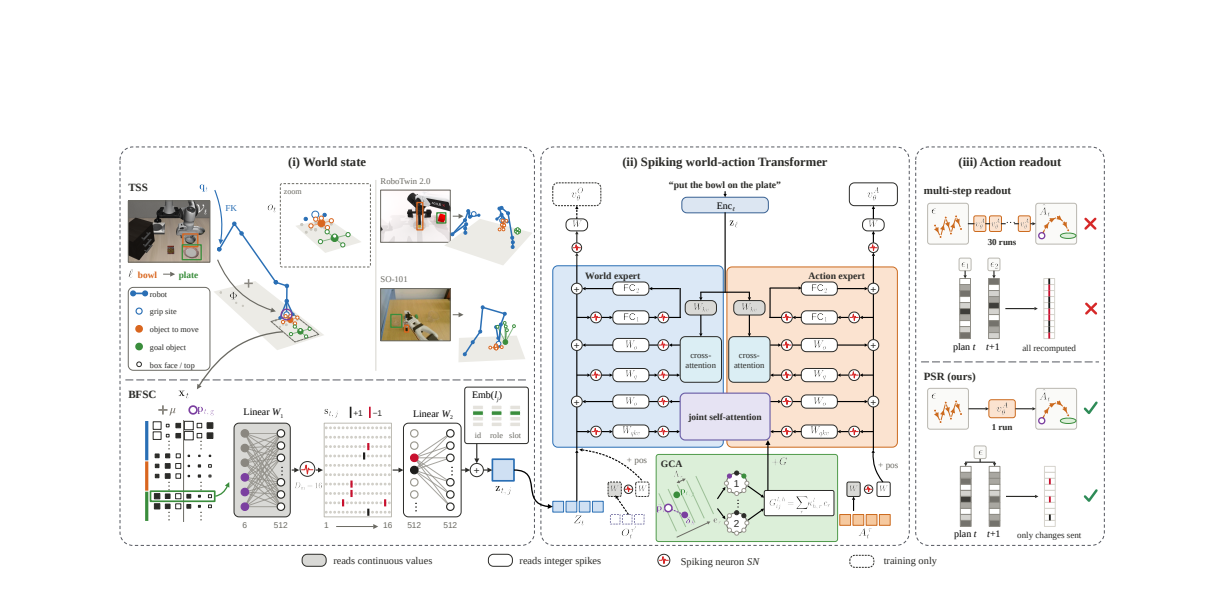
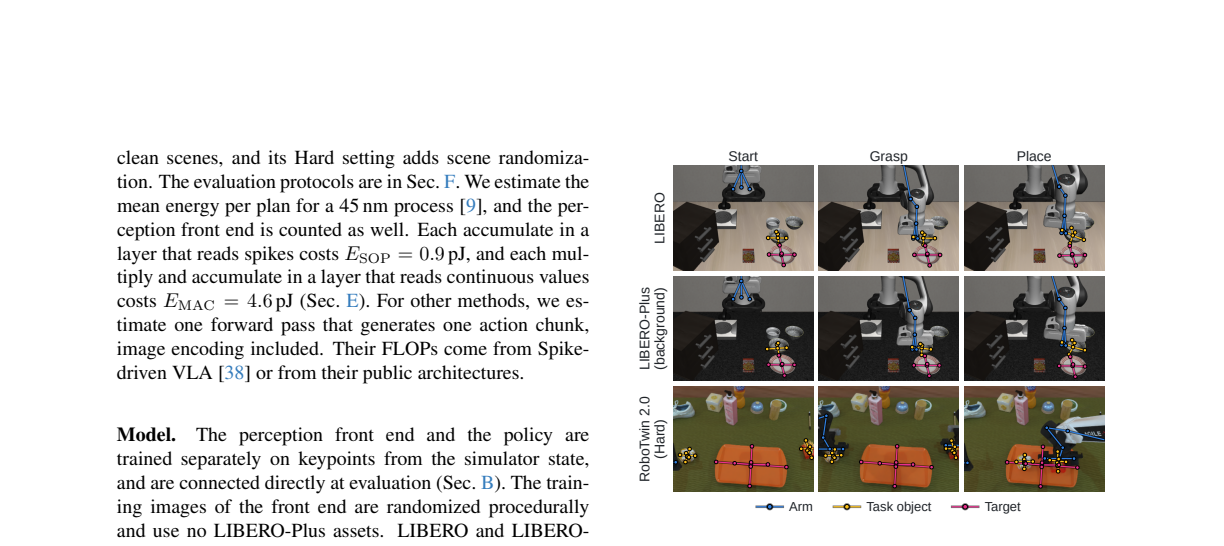
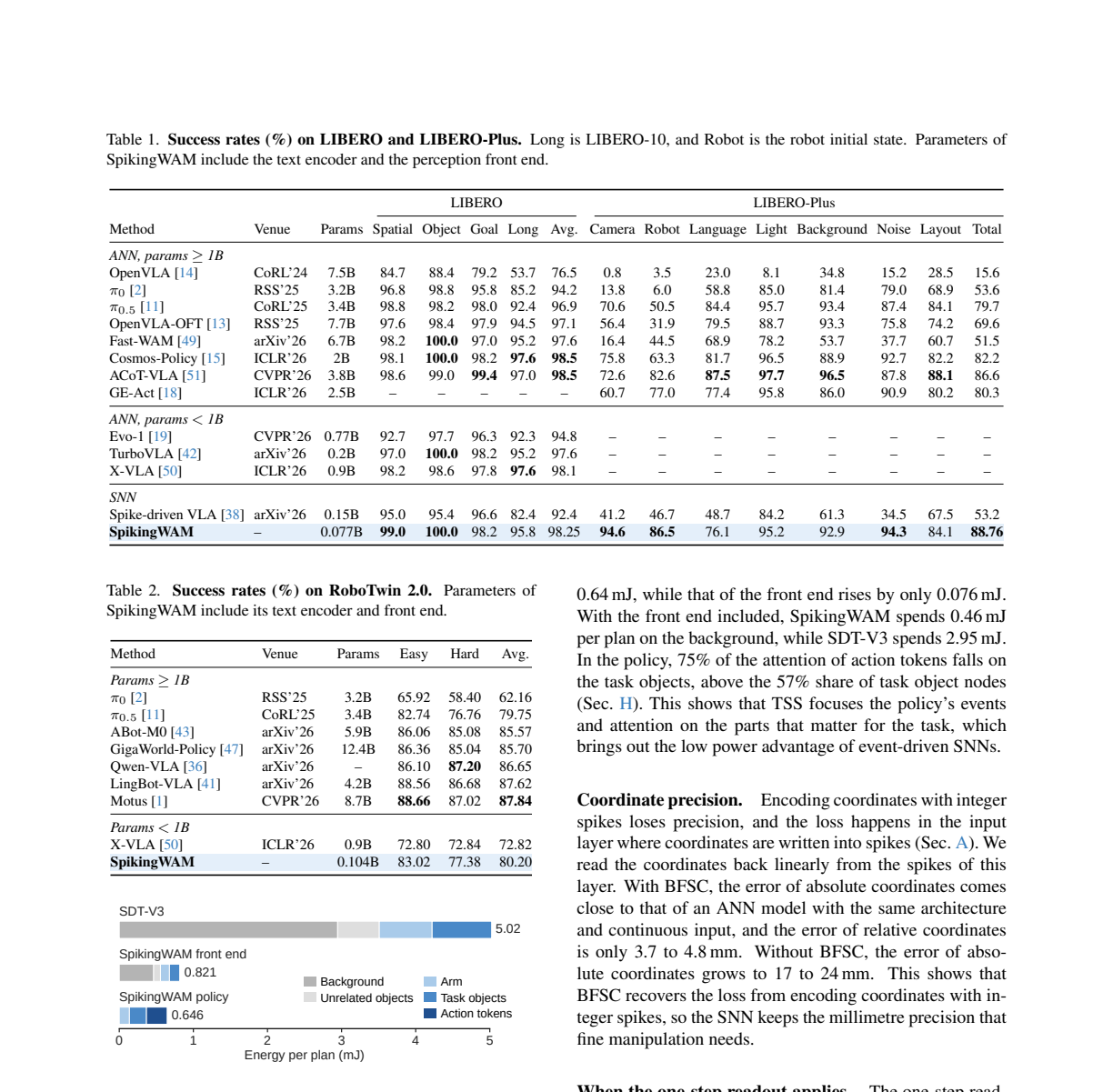
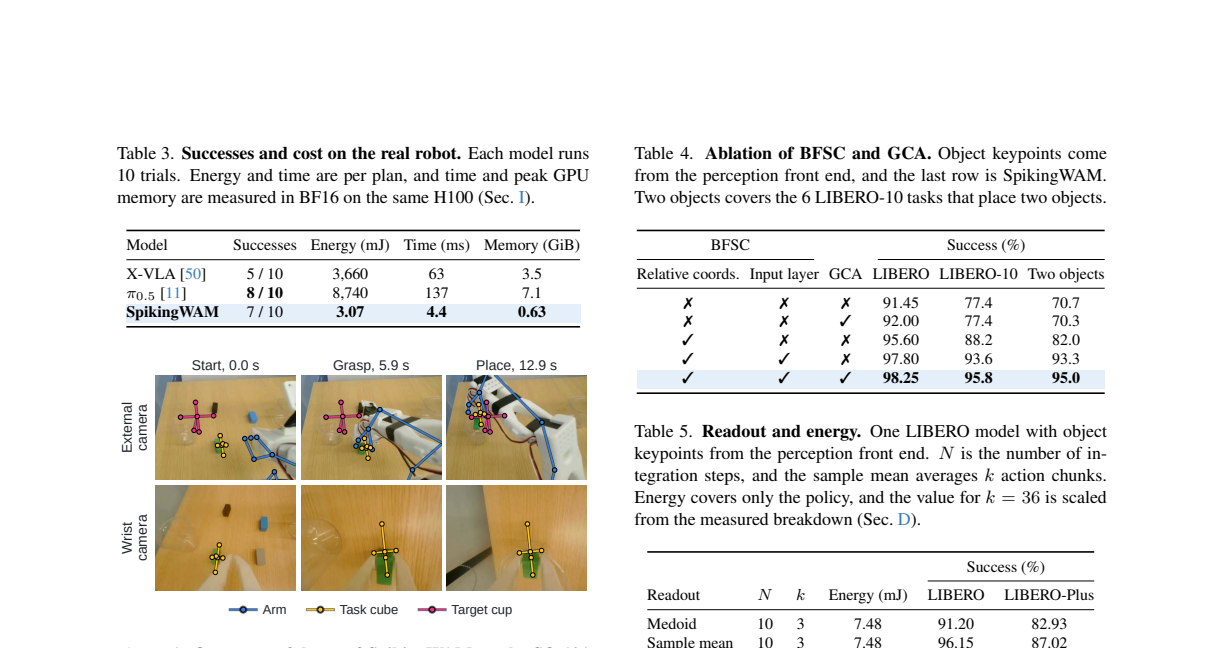
Spiking neural networks (SNNs) compute with sparse binary spikes and use additions instead of multiplications, which saves power. However, existing WAMs use dense videos as the world state, so a spiking version would spend most of its computation on the background. We therefore introduce SpikingWAM, the first spiking WAM, which uses a sparse task skeleton as the world state. Inspired by biological motor control, which attends only to the key positions of a task, the Task Skeleton State (TSS) keeps the keypoints of the arm and the task objects, and a small spiking front end estimates the object keypoints from images. Body Frame Spike Coding (BFSC) and Grid Coincidence Attention (GCA) keep millimetre precision, and the Persistent Single Step Readout (PSR) runs the network once per plan. On the simulated benchmarks LIBERO, LIBERO-Plus and RoboTwin 2.0, SpikingWAM achieves competitive success rates with far less energy than ANN methods and surpasses all compared methods on LIBERO-Plus. Real robot experiments further confirm its effectiveness. These results show that a task skeleton lets spiking networks implement WAMs at very low energy, offering a new solution for low power embodied intelligence. Project page: https://wxqnl.github.io/spikingwam/
from the abstract
Pith says
Machine review · deepseek-v4-flash · 24 Nov 2026 · read the full text (95,121 characters) · not checked by a person
It can be wrong. Challenge this review or reply to it.
Holds up. SpikingWAM is the first spiking world action model, achieving competitive success rates on three benchmarks with over 10x energy savings compared to ANN methods, and the review found no critical flaws. This line is wrong
4 minor
How often objections from reviews like this one are right: not yet measured
The paper, first character to last
The reviewer was given the whole text, 95,121 characters. Not checked: figures, code, what the 53 references say.
4 minor objections
The paper says, at Sec. 4.1 'Compared methods' (sec:setup) and App. E (app:energy)
Pith says: minor objection 1 of 4
The 92.67 mJ figure for SkeleWAM anchors the headline claim of 'far less energy than ANN methods' and the teaser figure, but it is not a number from the cited SkeleWAM paper: the original paper does not release its node definition or text encoder, so the authors reproduce SkeleWAM with their own node definition and frozen MiniLM token features.
more of objection 1
Because the central energy-gap claim for the WAM-vs-WAM comparison rests on this estimate, please release the reproduction code and configuration and explicitly label 92.67 mJ in the main text as an estimate computed from the authors' reproduction, rather than leaving that qualification to the appendix. The internal consistency of the counting, which applies the same rules to SpikingWAM's policy, is a strength; the remaining issue is checkability of the absolute number.
The paper says, at Sec. 4.3 'Analysis', paragraph 'When the one-step readout applies'
Pith says: minor objection 2 of 4
The cutoff that separates 'applies' from 'does not apply' (ratio at most 1.00 on LIBERO versus at least 2.00 on RoboTwin 2.0) is calibrated empirically on the two benchmarks in this study; a single sentence noting that a new benchmark may require re-estimating this cutoff would strengthen the claim that the check generalizes as a tool.
show 2 more
The paper says, at Sec. 4.4 'Real Robot Experiments'
Pith says: minor objection 3 of 4
The real-robot comparison is based on 10 trials per model, so the ordering 7/10 versus 8/10 versus 5/10 is not statistically strong; a sentence acknowledging the small sample alongside the per-plan cost numbers would help readers weigh the headline.
The paper says, at App. B 'Perception Front End', paragraph 'RoboTwin 2.0'
Pith says: minor objection 4 of 4
The RoboTwin 2.0 front end is trained partly on images from closed-loop episodes rolled out with the front end itself, which creates a mild self-distribution feedback loop; a sentence describing how this is kept stable (for example the augmentation policy or the data ratio between expert and closed-loop frames) would clarify the training protocol.
What would settle it
If a spiking WAM using the same TSS, BFSC, GCA, and PSR designs were evaluated on a manipulation benchmark requiring sub-millimetre precision (e.g., peg insertion with 0.5 mm tolerance) and failed while an ANN baseline succeeded, that would show the geometric precision mechanisms are insufficient. Alternatively, if the offline ratio check for PSR (distance from one-step mean to nearest sample divided by median nearest-neighbour distance among samples) were found to be ≤1 on a benchmark where closed-loop performance was poor, the heuristic would be falsified.
from Pith's summary of the paper
How the review went
5 passes by deepseek-v4-flash · 24 Nov 2026
- Reader holds up
- Skeptic concern withdrawn: the paper already says this
- Referee 4 minor
- Check against the paper kept 0 of 2 objections
- Editor wrote the verdict above
Not run on this paper: the simulated authors' defence.
Pith's passes raised 2 objections. A check against the paper's text kept 0, withdrew 1 (1 the paper already says) and moved 1 to the minor objections.
The review in full
The review in brief, machine-written
This paper introduces SpikingWAM, the first spiking world action model, and shows that a task skeleton representation lets spiking neural networks match the success rates of much larger ANN methods while using dramatically less energy. The design is thoughtful: the Task Skeleton State (TSS) focuses computation on task-relevant keypoints, Body Frame Spike Coding (BFSC) and Grid Coincidence Attention (GCA) preserve millimetre precision in integer spikes, and the Persistent Single Step Readout (PSR) runs the network once per plan. The experiments are extensive—three simulated benchmarks (LIBERO, LIBERO-Plus, RoboTwin 2.0), a real robot arm, ablation studies, and careful energy accounting. On LIBERO, SpikingWAM reaches 98.25% success with 1.467 mJ per plan, compared to 92.67 mJ for the ANN skeleton-based SkeleWAM. The paper is honest about its load-bearing assumption: the one-step readout gives the conditional mean, which is an executable action only when the conditional distribution is unimodal. The authors provide an offline check and fall back to a multistep readout when the check fails. The comparison with SkeleWAM uses a reproduction, but the paper describes the reproduction and the energy counting methodology clearly. The main soft spot is that the unimodality assumption is central to the energy savings, and the offline check is heuristic rather than a formal guarantee. However, the paper acknowledges this and the empirical results support the approach. The perception front end is trained separately on simulator keypoints and not fine-tuned on the policy's estimated skeletons, which could introduce a gap, but the closed-loop results show it works well. Overall, this is a solid, well-executed paper that makes a genuine contribution to low-power embodied intelligence. It deserves a serious referee and, if the unimodality assumption holds up under further scrutiny, could be an important step toward deploying world models on neuromorphic hardware.
The stress test's concern
Withdrawn: the paper already says this.
The paper says
“We check this condition offline with a ratio. It divides the distance from the mean to its nearest sample by the nearest neighbour distance among the samples (\cref{app:readout}). The ratio is at most 1.00 on every LIBERO task and at least 2.00 on every RoboTwin 2.0 task, so RoboTwin 2.0 reads out with the medoid chunk of 10 steps.”
The referee's report
If the reported numbers hold, this is a significant result: it is the first demonstration that a sparse skeleton world state lets a spiking network reach WAM-level control at energy roughly an order of magnitude below ANN methods, validated on three benchmarks and a real robot. Strengths I credit explicitly: the one-step readout derivation (eq:onestep from eq:vstar) is correct under the stated condition that the conditional action distribution is unimodal; the paper acknowledges that condition and validates its offline check against closed-loop results (PSR beats the medoid readout on LIBERO, while RoboTwin 2.0 deliberately falls back to the medoid readout); the energy counting is internally consistent with published SOP/MAC costs and is disclosed for the SkeleWAM reproduction; ablations isolate the contribution of each component; and the perception front end is trained without LIBERO-Plus assets, which avoids test contamination. The one claim I could not fully verify is the 92.67 mJ figure for SkeleWAM, which rests on the authors' own reproduction rather than on a number in the cited paper; this is disclosed but should be released or labeled more prominently.
Pith's reading of the paper (a machine's summary, not the authors')
The paper introduces SpikingWAM, the first spiking world action model, which predicts how the world responds to actions and generates action chunks using a spiking neural network. The key insight is to replace dense video representations with a sparse task skeleton (TSS) that keeps only the keypoints of the arm and task objects, inspired by biological motor control. To preserve millimetre precision in integer spikes, the authors propose Body Frame Spike Coding (BFSC) and Grid Coincidence Attention (GCA). A Persistent Single Step Readout (PSR) runs the network once per plan by taking the conditional mean of the action chunk and reusing computation between plans. On LIBERO, LIBERO-Plus, and RoboTwin 2.0, SpikingWAM achieves success rates comparable to large ANN methods while using orders of magnitude less energy per plan (1.467 mJ on LIBERO). The authors argue that a task skeleton is the key to making spiking WAMs practical for low-power embodied intelligence.
What carries the argument. The central object is the Task Skeleton State (TSS), which represents the world as a set of 3D keypoints of the arm and task objects, written into spikes via Body Frame Spike Coding (BFSC). BFSC encodes coordinates relative to the grip site and uses a wider input layer (Din > D) to reduce quantization error. Grid Coincidence Attention (GCA) adds a geometry term to self-attention by counting coincidences between grid spike codes of positions, recovering relative geometry precision lost in integer spike encoding. The Persistent Single Step Readout (PSR) runs the network once per plan by taking a single Euler step from pure noise (giving the conditional mean of the action chunk) and reusing computation between consecutive plans via incremental firing (delta updates). Together, these components let a spiking Transformer learn future skeletons and action chunks jointly, generating only actions at inference.
Core claim. The paper claims that a spiking neural network can serve as a world action model (WAM) — predicting both future world states and actions — if the world state is represented as a sparse task skeleton rather than dense video. The authors introduce SpikingWAM, which uses the Task Skeleton State (TSS) to keep only keypoints of the arm and task objects, Body Frame Spike Coding (BFSC) and Grid Coincidence Attention (GCA) to preserve millimetre precision in integer spikes, and a Persistent Single Step Readout (PSR) that runs the network once per plan. On LIBERO, LIBERO-Plus, and RoboTwin 2.0, SpikingWAM achieves success rates competitive with large ANN methods while using orders of magnitude less energy per plan (1.467 mJ on LIBERO). The authors argue that the choice of world state is key: a task skeleton lets the network concentrate its sparse events on task-relevant parts, making the energy savings of spiking computation practical for embodied control.
The premise it rests on. The one-step readout (PSR) assumes that the conditional distribution of action chunks is unimodal, so the conditional mean is an executable action; the paper checks this offline with a ratio but the check is heuristic and may not guarantee closed-loop performance in all scenarios.
If the paper is right (Pith's inferences, not the authors')
If the central claim holds, spiking WAMs could be deployed on neuromorphic hardware, enabling onboard planning on resource-constrained robots without cloud dependence.
The energy savings (more than an order of magnitude over ANN methods) would allow robots to plan more frequently in closed loop, potentially improving robustness in dynamic environments.
The task skeleton representation (TSS) could be adopted by non-spiking WAMs to reduce computation, even if they do not use spiking neurons.
The one-step readout (PSR) with offline unimodality check provides a general method to reduce sampling steps in flow-matching policies when the conditional distribution is unimodal.
The TSS representation could be extended to include semantic keypoints (e.g., object affordances) without increasing the event budget, potentially enabling more complex tasks like assembly or tool use.
The energy model used (45 nm process, 0.9 pJ per accumulate) is optimistic for current neuromorphic chips; a test on actual hardware (e.g., Intel Loihi 2) would reveal whether the theoretical savings translate to practice.
The offline unimodality check for PSR could be automated during training to decide the readout strategy per task, avoiding the need for manual tuning of integration steps.
The combination of BFSC and GCA might generalize to other domains requiring precise relative geometry in spiking networks, such as visual odometry or tactile sensing.
Check this review
What was read
The passes were given all 95,121 characters of the paper's LaTeX source.
Fingerprint of that text (SHA-256): 07c420e1c9536712883ae3547c1e633629c63d10f52452283828d39cbf6a1a8f
Pith does not keep that text. Rebuilt from the paper's source or PDF by the same code, it has this fingerprint if it is the same text. From a copy of Pith's code:
PYTHONPATH=. python scripts/review_input_check.py 2611.30041
The passes, in the order they ran
- Reader deepseek-v4-flash · medium effort · $0.0035 · instructions of the Reader, fingerprint f9ead7300382…
- Skeptic deepseek-v4-flash · medium effort · $0.0031 · instructions of the Skeptic, fingerprint 8f88c0f61488…
- Referee deepseek-v4-flash · medium effort · $0.0085 · instructions of the Referee, fingerprint a852d99aea0d…
- Check against the paper deepseek-v4-flash · medium effort · $0.0032 · instructions of the Check against the paper, fingerprint 6c7a6883d551…
- Editor deepseek-v4-flash · medium effort · $0.0028 · instructions of the Editor, fingerprint e7211f6a3d27…
- Circularity check deepseek-v4-flash · medium effort · $0.0027 · instructions of the Circularity check, fingerprint e9946e39d67b…
- Summary for the page deepseek-v4-flash · medium effort · temperature 0.2 · $0.0029 · instructions of the Summary for the page, fingerprint e4f56bf568e7…
The passes cost $0.027 in model calls together.
Version stamped on this review: pith-pipeline@v1.4.1-daily-deepseek-or-medium+deepseek/deepseek-v4-flash+p.d60f54226f00
Each link opens a pass's instructions as plain text, the exact bytes its fingerprint was taken over. Every stored set of instructions.
curl -s https://pith.science/methodology/prompts/f9ead730038216984cfb56d7cb34332bdf691828296a1de4245f3d6667d4bf56 | sha256sum
prints the fingerprint of the reader's instructions. The same works for every pass.
The receipt
The review's fingerprint was taken on 24 Nov 2026. The review you are reading still matches it.
Fingerprint of the review (SHA-256): 6969bf6346627401a678b5a1aee1951b240b4d61e7fc6194a2eecc9a96a0d107
curl -s 'https://pith.science/api/v1/verdicts/2611.30041?form=canonical' | sha256sum
prints the fingerprint of the review as it stands now. The rule, in four steps.
A matching fingerprint shows the review has not changed since that date. It does not show that the review is right.
How often reviews like this one are right
Reviews like this one: written by deepseek-v4-flash, from the paper's LaTeX source.
How often objections from reviews like this one are right: not yet measured
Reviews by people
This review was written by a machine. No person has reviewed this paper on Pith yet. A scientist listed on Pith can review it for a fee, and their review is published here whatever it concludes.
The paper
Abstract
World action models (WAMs) predict how the world responds to actions and offer a promising path toward general embodied intelligence, but they are large and run the network many times per plan, so they are hard to deploy on robots. Spiking neural networks (SNNs) compute with sparse binary spikes and use additions instead of multiplications, which saves power. However, existing WAMs use dense videos as the world state, so a spiking version would spend most of its computation on the background. We therefore introduce SpikingWAM, the first spiking WAM, which uses a sparse task skeleton as the world state. Inspired by biological motor control, which attends only to the key positions of a task, the Task Skeleton State (TSS) keeps the keypoints of the arm and the task objects, and a small spiking front end estimates the object keypoints from images. Body Frame Spike Coding (BFSC) and Grid Coincidence Attention (GCA) keep millimetre precision, and the Persistent Single Step Readout (PSR) runs the network once per plan. On the simulated benchmarks LIBERO, LIBERO-Plus and RoboTwin 2.0, SpikingWAM achieves competitive success rates with far less energy than ANN methods and surpasses all compared methods on LIBERO-Plus. Real robot experiments further confirm its effectiveness. These results show that a task skeleton lets spiking networks implement WAMs at very low energy, offering a new solution for low power embodied intelligence. Project page: https://wxqnl.github.io/spikingwam/
The paper's own sentences, arranged, kept beside the review and separate from it. Each label is drawn from a closed vocabulary; the number beside it is the probability the classifier gave that label. No sentence in this record was written by a model.
abstract compiled · 2026-11-24
The authors' main claim, as the classifier picked it out 1.00
“These results show that a task skeleton lets spiking networks implement WAMs at very low energy, offering a new solution for low power embodied intelligence.”
How the main claim is stated: asserted 1.00
What the abstract itself states, as probabilities: claims first 0.97 · states limitation 0.17 · human participants 0.03 · controlled comparison 0.80 · randomized assignment 0.01 · states quantitative result 0.16 · compares with prior results 0.96 · mentions code or data availability 0.47
The abstract, sentence by sentence
This table labels the abstract only (arXiv listing abstract v1). The number is the probability the classifier gave the label.
| Sentence | Role | The authors' own work | States the main conclusion | Strength |
|---|---|---|---|---|
| World action models (WAMs) predict how the world responds to actions and offer a promising path toward general embodied intelligence, but they are large and run the network many times per plan, so they are hard to deploy on robots. | background 0.96 | 0.07 | 0.03 | asserted 0.91 |
| Spiking neural networks (SNNs) compute with sparse binary spikes and use additions instead of multiplications, which saves power. | background 1.00 | 0.05 | 0.02 | asserted 1.00 |
| However, existing WAMs use dense videos as the world state, so a spiking version would spend most of its computation on the background. | gap 0.53 | 0.07 | 0.02 | asserted 0.90 |
| We therefore introduce SpikingWAM, the first spiking WAM, which uses a sparse task skeleton as the world state. | contribution 1.00 | 0.90 | 0.10 | asserted 1.00 |
| Inspired by biological motor control, which attends only to the key positions of a task, the Task Skeleton State (TSS) keeps the keypoints of the arm and the task objects, and a small spiking front end estimates the object keypoints from images. | method 0.95 | 0.72 | 0.05 | asserted 1.00 |
| Body Frame Spike Coding (BFSC) and Grid Coincidence Attention (GCA) keep millimetre precision, and the Persistent Single Step Readout (PSR) runs the network once per plan. | method 0.97 | 0.83 | 0.07 | asserted 1.00 |
| On the simulated benchmarks LIBERO, LIBERO-Plus and RoboTwin 2.0, SpikingWAM achieves competitive success rates with far less energy than ANN methods and surpasses all compared methods on LIBERO-Plus. | result 1.00 | 0.96 | 0.24 | asserted 1.00 |
| Real robot experiments further confirm its effectiveness. | result 1.00 | 0.92 | 0.06 | asserted 1.00 |
| These results show that a task skeleton lets spiking networks implement WAMs at very low energy, offering a new solution for low power embodied intelligence. | interpretation 1.00 | 0.88 | 0.91 | asserted 1.00 |
| Project page: https://wxqnl.github.io/spikingwam/ | future work 0.44 | 0.24 | 0.03 | unclear 0.96 |
What kind of paper the classifier reports this is: method or tool 1.00 · evidence from observation or experiment 0.78
What was examined, and what was not
Sources read
- arXiv listing abstract v1
Not examined
- full text
- figures and tables
- references and citing sentences
- relations to other papers
Levels run
- P abstract
Not run
- S sections
- T body sentences
- C citations
- R cross-paper relations
How the labels were made
Compiled by classifier-1.13.0 via TypeSafe API, question bank abstract-p1-20260923, 2026-11-24: 1 request, 7,658 input tokens.
Every quoted sentence on this record is the authors'. Every label is from Pith's closed vocabulary, with the probability shown beside it. This record as JSON
Figures (6)
Figures are the authors', reproduced from the paper.
References (53)
- [1] Hongzhe Bi, Hengkai Tan, Shenghao Xie, Zeyuan Wang, Shuhe Huang, Haitian Liu, Ruowen Zhao, Yao Feng, Chen- dong Xiang, Yinze Rong, Hongyan Zhao, Hanyu Liu, Zhizhong Su, Lei Ma, Hang Su, and Jun Zhu. Motus: A unified latent action world model. InIEEE/CVF Conference on Computer ... on Pith
- [2] Kevin Black, Noah Brown, Danny Driess, Adnan Esmail, Michael Robert Equi, Chelsea Finn, Niccolo Fusai, Lachy Groom, Karol Hausman, Brian Ichter, Szymon Jakubczak, Tim Jones, Liyiming Ke, Sergey Levine, Adrian Li-Bell, Mohith Mothukuri, Suraj Nair, Karl Pertsch, Lucy Xi- aoyang... on Pith
- [3] Christopher A. Buneo, Murray R. Jarvis, Aaron P. Batista, and Richard A. Andersen. Direct visuomotor transforma- tions for reaching.Nature, 416(6881):632–636, 2002. 2, 4 on Pith
- [4] Tianxing Chen, Zanxin Chen, Baijun Chen, Zijian Cai, Yibin Liu, Zixuan Li, Qiwei Liang, Xianliang Lin, Yiheng Ge, Zhenyu Gu, et al. RoboTwin 2.0: A scalable data gen- erator and benchmark with strong domain randomization for robust bimanual robotic manipulation.arXiv preprint ... on PithPith's reviewarXiv
- [5] Senyu Fei, Siyin Wang, Junhao Shi, Zihao Dai, Jikun Cai, Pengfang Qian, Li Ji, Xinzhe He, Shiduo Zhang, Zhaoye Fei, Jinlan Fu, Jingjing Gong, and Xipeng Qiu. LIBERO-Plus: A progressive robustness benchmark for visual-language- action models. InProceedings of the IEEE/CVF Confe... on Pith
- [6] Zhengyang Geng, Mingyang Deng, Xingjian Bai, J. Zico Kolter, and Kaiming He. Mean flows for one-step genera- tive modeling.arXiv preprint arXiv:2505.13447, 2025. 2 on PithPith's reviewarXiv
- [7] Michael S. A. Graziano, Gregory S. Yap, and Charles G. Gross. Coding of visual space by premotor neurons.Sci- ence, 266(5187):1054–1057, 1994. 2, 4 on Pith
- [8] Torkel Hafting, Marianne Fyhn, Sturla Molden, May-Britt Moser, and Edvard I. Moser. Microstructure of a spatial map in the entorhinal cortex.Nature, 436(7052):801–806, 2005. 2, 4 on Pith
- [9] Mark Horowitz. 1.1 computing’s energy problem (and what we can do about it). In2014 IEEE International Solid-State Circuits Conference Digest of Technical Papers (ISSCC), pages 10–14. IEEE, 2014. 6, 15 on Pith
- [10] Zhixing Hou, Maoxu Gao, Hang Yu, Mengyu Yang, and Chio-In Ieong. SDP: Spiking diffusion policy for robotic manipulation with learnable channel-wise membrane thresh- olds.arXiv preprint arXiv:2409.11195, 2024. 1, 2 on PithPith's reviewarXiv
- [11] Physical Intelligence, Kevin Black, Noah Brown, James Darpinian, Karan Dhabalia, Danny Driess, Adnan Esmail, Michael Equi, Chelsea Finn, Niccolo Fusai, Manuel Y . Gal- liker, Dibya Ghosh, Lachy Groom, Karol Hausman, Brian Ichter, Szymon Jakubczak, Tim Jones, Liyiming Ke, Devin... on Pith
- [12] Roland S. Johansson, G ¨oran Westling, Anders B ¨ackstr¨om, and J. Randall Flanagan. Eye-hand coordination in object manipulation.Journal of Neuroscience, 21(17):6917–6932, on Pith
- [13] Moo Jin Kim, Chelsea Finn, and Percy Liang. Fine-tuning vision-language-action models: Optimizing speed and suc- cess. InProceedings of Robotics: Science and Systems, on Pith
- [14] Moo Jin Kim, Karl Pertsch, Siddharth Karamcheti, Ted Xiao, Ashwin Balakrishna, Suraj Nair, Rafael Rafailov, Ethan P. Foster, Pannag R. Sanketi, Quan Vuong, Thomas Kollar, Benjamin Burchfiel, Russ Tedrake, Dorsa Sadigh, Sergey Levine, Percy Liang, and Chelsea Finn. OpenVLA: An ... on Pith
- [15] Moo Jin Kim, Yihuai Gao, Tsung-Yi Lin, Yen-Chen Lin, Yunhao Ge, Grace Lam, Percy Liang, Shuran Song, Ming-Yu Liu, Chelsea Finn, et al. Cosmos policy: Fine-tuning video models for visuomotor control and planning. InInternational Conference on Learning Representations (ICLR), 20... on Pith
- [16] Peter K ¨onig, Andreas K. Engel, and Wolf Singer. Integrator or coincidence detector? The role of the cortical neuron re- visited.Trends in Neurosciences, 19(4):130–137, 1996. 2, 4 on Pith
- [17] Yanjie Li, Sen Yang, Peidong Liu, Shoukui Zhang, Yunx- iao Wang, Zhicheng Wang, Wankou Yang, and Shu-Tao Xia. SimCC: A simple coordinate classification perspective for human pose estimation. InEuropean Conference on Com- puter Vision (ECCV), pages 89–106, 2022. 13 on Pith
- [18] Yue Liao, Pengfei Zhou, Siyuan Huang, Donglin Yang, Shengcong Chen, Yuxin Jiang, Yue Hu, Jingbin Cai, Si Liu, Jianlan Luo, Liliang Chen, Shuicheng Yan, Maoqing Yao, and Guanghui Ren. Genie envisioner: A unified world foun- dation platform for robotic manipulation. InInternatio... on Pith
- [19] Tao Lin, Yilei Zhong, Yuxin Du, Jingjing Zhang, Jiting Liu, Yinxinyu Chen, Encheng Gu, Ziyan Liu, Hongyi Cai, Yan- wen Zou, Lixing Zou, Zhaoye Zhou, Gen Li, and Bo Zhao. Evo-1: Lightweight vision-language-action model with pre- served semantic alignment. InIEEE/CVF Conference ... on Pith
- [20] Yaron Lipman, Ricky T. Q. Chen, Heli Ben-Hamu, Maxi- milian Nickel, and Matt Le. Flow matching for generative modeling. InInternational Conference on Learning Repre- sentations, 2023. 3 on Pith
show 33 more
- [21] Bo Liu, Yifeng Zhu, Chongkai Gao, Yihao Feng, Qiang Liu, Yuke Zhu, and Peter Stone. LIBERO: Benchmarking knowl- edge transfer for lifelong robot learning. InAdvances in Neu- ral Information Processing Systems, 2023. 2, 5 on Pith
- [22] Xingchao Liu, Chengyue Gong, and Qiang Liu. Flow straight and fast: Learning to generate and transfer data with rectified flow. InInternational Conference on Learning Rep- resentations, 2023. 3 on Pith
- [23] Daniel Neil, Jun Haeng Lee, Tobi Delbruck, and Shih-Chii Liu. Delta networks for optimized recurrent network compu- tation. InProceedings of the 34th International Conference on Machine Learning, pages 2584–2593, 2017. 5 on Pith
- [24] Peter O’Connor and Max Welling. Sigma delta quantized networks. InInternational Conference on Learning Repre- sentations, 2017. 5 on Pith
- [25] William Peebles and Saining Xie. Scalable diffusion models with transformers. InIEEE/CVF International Conference on Computer Vision, pages 4195–4205, 2023. 5, 14 on Pith
- [26] Aaditya Prasad, Kevin Lin, Jimmy Wu, Linqi Zhou, and Jeannette Bohg. Consistency policy: Accelerated visuo- motor policies via consistency distillation.arXiv preprint arXiv:2405.07503, 2024. 2 on PithPith's reviewarXiv
- [27] Nils Reimers and Iryna Gurevych. Sentence-BERT: Sen- tence embeddings using Siamese BERT-networks. InCon- ference on Empirical Methods in Natural Language Process- ing and International Joint Conference on Natural Language Processing, pages 3982–3992, 2019. 5 on Pith
- [28] Kaushik Roy, Akhilesh Jaiswal, and Priyadarshini Panda. Towards spike-based machine intelligence with neuromor- phic computing.Nature, 575(7784):607–617, 2019. 1 on Pith
- [29] Juyi Sheng, Hua Wang, and Mengyuan Liu. SkeleW AM: Skeleton world-action modeling for efficient robotic manip- ulation.arXiv preprint arXiv:2610.02120, 2026. 1, 2, 3, 15, 16 on PithPith's reviewarXiv
- [30] Juyi Sheng, Ziyi Wang, Peiming Li, and Mengyuan Liu. MP1: MeanFlow tames policy learning in 1-step for robotic manipulation. InProceedings of the AAAI Conference on Artificial Intelligence, 2026. 2 on Pith
- [31] Ruiqi Song, Dujun Nie, Siyu Teng, Baiyong Ding, Xiao- tong Zhang, Dong Li, Chenming Zhang, Yuchen Li, Hang- bin Wu, and Long Chen. SpikeVLA: Vision-language- action models with spiking neural networks.arXiv preprint arXiv:2606.27807, 2026. 1, 2 on PithPith's reviewarXiv
- [32] Jingwen Sun, Wenyao Zhang, Zekun Qi, Shaojie Ren, Zezhi Liu, Hanxin Zhu, Guangzhong Sun, Xin Jin, and Zhibo Chen. VLA-JEPA: Enhancing vision-language-action model with latent world model.arXiv preprint arXiv:2602.10098, on PitharXiv
- [33] Yinqian Sun, Feifei Zhao, Mingyang Lyu, and Yi Zeng. Spiking world model with multicompartment neurons for model-based reinforcement learning.Proceedings of the Na- tional Academy of Sciences, 122(50):e2513319122, 2025. 1, 2 on Pith
- [34] Josh Tobin, Rachel Fong, Alex Ray, Jonas Schneider, Woj- ciech Zaremba, and Pieter Abbeel. Domain randomization for transferring deep neural networks from simulation to the real world. InIEEE/RSJ International Conference on Intel- ligent Robots and Systems (IROS), pages 23–30,... on Pith
- [35] Qianhao Wang, Yinqian Sun, Enmeng Lu, Qian Zhang, and Yi Zeng. Brain-inspired action generation with spik- ing transformer diffusion policy model.arXiv preprint arXiv:2411.09953, 2024. 1, 2 on PithPith's reviewarXiv
- [36] Qiuyue Wang, Mingsheng Li, Jian Guan, Jinhui Ye, Sicheng Xie, Yitao Liu, Junhao Chen, Zhixuan Liang, Jie Zhang, Xintong Hu, et al. Qwen-VLA: Unifying vision-language- action modeling across tasks, environments, and robot em- bodiments.arXiv preprint arXiv:2605.30280, 2026. 7 on PithPith's reviewarXiv
- [37] Shuai Wang, Malu Zhang, Jingya Wang, Dehao Zhang, Yi- meng Shan, Jieyuan Zhang, Yichen Xiao, Honglin Cao, Hao- nan Zhang, Zeyu Ma, Yang Yang, and Haizhou Li. Bipolar self-attention for spiking transformers. InAdvances in Neu- ral Information Processing Systems, pages 101586–101611, on Pith
- [38] Shuai Wang, Malu Zhang, Mingquan Liu, Weihui Dai, De- hao Zhang, Jieyuan Zhang, Yimeng Shan, Zijian Zhou, and Yang Yang. Spike-driven vision-language-action model. arXiv preprint arXiv:2609.39514, 2026. 1, 2, 6, 7 on PithPith's reviewarXiv
- [39] Wenhui Wang, Furu Wei, Li Dong, Hangbo Bao, Nan Yang, and Ming Zhou. MiniLM: Deep self-attention distillation for task-agnostic compression of pre-trained transformers. In Advances in Neural Information Processing Systems, 2020. 5 on Pith
- [40] Zhendong Wang, Zhaoshuo Li, Ajay Mandlekar, Zhenjia Xu, Jiaojiao Fan, Yashraj Narang, Linxi Fan, Yuke Zhu, Yogesh Balaji, Mingyuan Zhou, Ming-Yu Liu, and Yu Zeng. One- step diffusion policy: Fast visuomotor policies via diffusion distillation.arXiv preprint arXiv:2410.21257, 2024. 2 on PithPith's reviewarXiv
- [41] Wei Wu, Fan Lu, Yunnan Wang, Shuai Yang, Shi Liu, Fangjing Wang, Qian Zhu, He Sun, Yong Wang, Shuailei Ma, et al. A pragmatic VLA foundation model.arXiv preprint arXiv:2601.18692, 2026. 7 on PithPith's reviewarXiv
- [42] Hengyi Xie, Chenfei Yao, Xianjin Wu, Xuanyang Xi, Yip- ing Tang, Di Xu, Yingying Zhu, Dingkang Liang, Xiang Bai, and Han Ding. TurboVLA: Real-time vision-language- action model at 32 Hz on an RTX 4090 with<1 GB VRAM. arXiv preprint arXiv:2607.27205, 2026. 2, 6, 7, 16 on PithPith's reviewarXiv
- [43] Yandan Yang, Shuang Zeng, Tong Lin, Xinyuan Chang, Dekang Qi, Junjin Xiao, Haoyun Liu, Ronghan Chen, Yuzhi Chen, Dongjie Huo, Feng Xiong, Xing Wei, Zhiheng Ma, and Mu Xu. ABot-M0: VLA foundation model for robotic manipulation with action manifold learning.arXiv preprint arXiv:... on PithPith's reviewarXiv
- [44] Man Yao, Jiakui Hu, Zhaokun Zhou, Li Yuan, Yonghong Tian, Bo Xu, and Guoqi Li. Spike-driven transformer. Advances in Neural Information Processing Systems, 36: 64043–64058, 2023. 2, 5, 14 on Pith
- [45] Man Yao, Jiakui Hu, Tianxiang Hu, Yifan Xu, Zhaokun Zhou, Yonghong Tian, Bo Xu, and Guoqi Li. Spike-driven transformer v2: Meta spiking neural network architecture inspiring the design of next-generation neuromorphic chips. arXiv preprint arXiv:2404.03663, 2024. 2, 5, 14 10 on PithPith's reviewarXiv
- [46] Man Yao, Xuerui Qiu, Tianxiang Hu, Jiakui Hu, Yuhong Chou, Keyu Tian, Jianxing Liao, Luziwei Leng, Bo Xu, and Guoqi Li. Scaling spike-driven transformer with effi- cient spike firing approximation training.IEEE Transactions on Pattern Analysis and Machine Intelligence, 47(4):2... on Pith
- [47] Angen Ye, Boyuan Wang, Chaojun Ni, Guan Huang, Gu- osheng Zhao, Hao Li, Hengtao Li, Jie Li, Jindi Lv, Jingyu Liu, Min Cao, Peng Li, Qiuping Deng, Wenjun Mei, Xi- aofeng Wang, Xinze Chen, Xinyu Zhou, Yang Wang, Yifan Chang, Yifan Li, Yukun Zhou, Yun Ye, Zhichao Liu, and Zheng Z... on PitharXiv
- [48] Seonghyeon Ye, Yunhao Ge, Kaiyuan Zheng, Shenyuan Gao, Sihyun Yu, George Kurian, Suneel Indupuru, You Liang Tan, Chuning Zhu, Jiannan Xiang, et al. World action models are zero-shot policies.arXiv preprint arXiv:2602.15922, 2026. 1, 2 on PithPith's reviewarXiv
- [49] Tianyuan Yuan, Zibin Dong, Yicheng Liu, and Hang Zhao. Fast-W AM: Do world action models need test-time future imagination?arXiv preprint arXiv:2603.16666, 2026. 1, 2, 5, 6, 7 on PithPith's reviewarXiv
- [50] Jinliang Zheng, Jianxiong Li, Zhihao Wang, Dongxiu Liu, Xirui Kang, Yuchun Feng, Yinan Zheng, Jiayin Zou, Yilun Chen, Jia Zeng, Ya-Qin Zhang, Jiangmiao Pang, Jingjing Liu, Tai Wang, and Xianyuan Zhan. X-VLA: Soft-prompted transformer as scalable cross-embodiment vision-languag... on Pith
- [51] Linqing Zhong, Yi Liu, Yifei Wei, Ziyu Xiong, Maoqing Yao, Si Liu, and Guanghui Ren. ACoT-VLA: Action chain- of-thought for vision-language-action models. InIEEE/CVF Conference on Computer Vision and Pattern Recognition (CVPR), 2026. 6, 7 on Pith
- [52] Zhaokun Zhou, Yuesheng Zhu, Chao He, Yaowei Wang, Shuicheng Yan, Yonghong Tian, and Li Yuan. Spikformer: When spiking neural network meets transformer. InInter- national Conference on Learning Representations, 2023. 2, 12 11 Spiking World-Action Models for Robotic Manipulation... on Pith
- [53] gives 155 : 56. The one-step single sample against the mean of 36 samples with 10 steps gives 30 : 38. PSR against a one-step single sample with new noise in each plan gives 41 : 30. PSR against the medoid chunk gives 170 : 29 on LIBERO and 1,001 : 416 on LIBERO-Plus. E. Energ... on Pith
Challenges and discussion
Disagree with the review, or know something it missed? Leave a comment, or challenge this review formally: a challenge becomes a permanent entry in this paper's record, and its decision is published here.
Come back by email
A short list of the week's newly reviewed papers. Nothing is sent until you confirm from your inbox, and every email has a link that stops it. No account.
No comments yet.
Sign in to comment