Artificial Intelligence · arXiv:2610.02762 v1 · submitted 2 Oct 2026 · 86 references
Dynamic LLM Routers are Often Misguided
The paper says
“Dynamic LLM routers promise to cut inference costs by sending each query to the cheapest model that can answer it correctly.”
more of the abstract
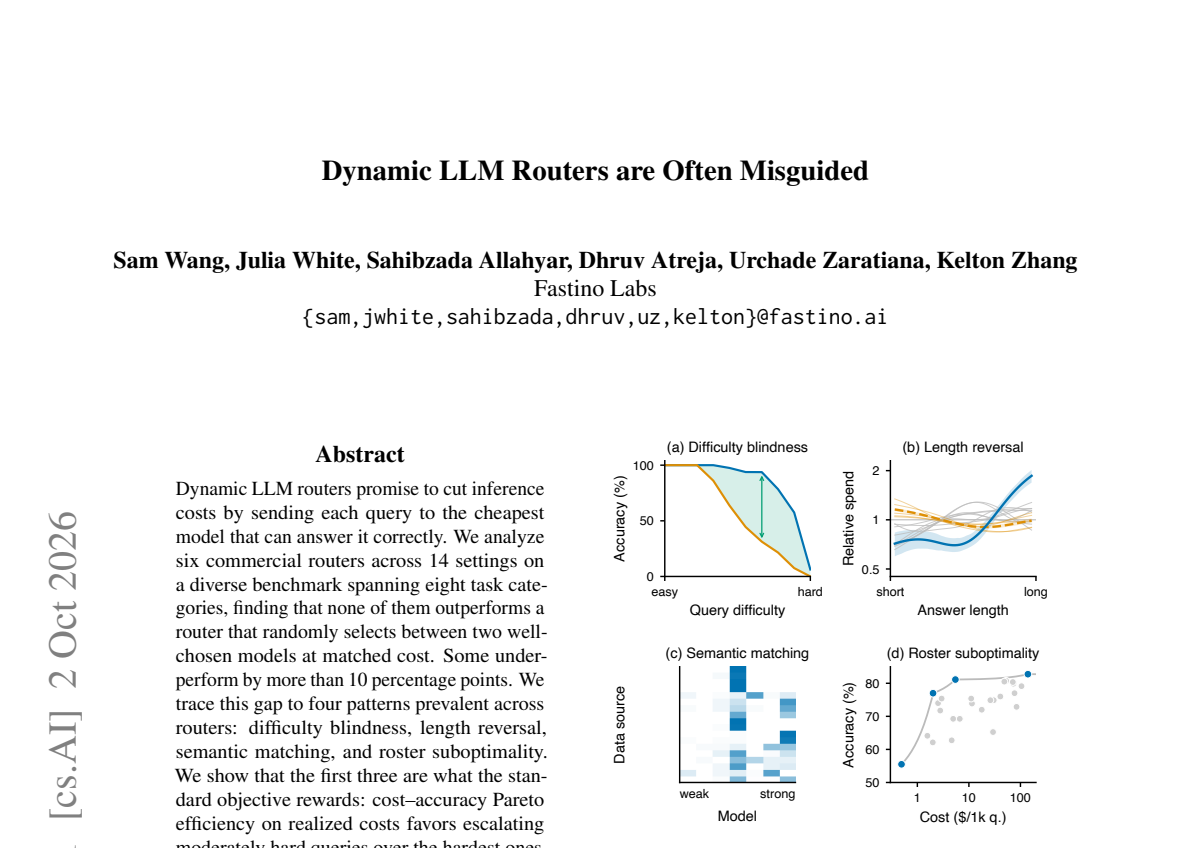
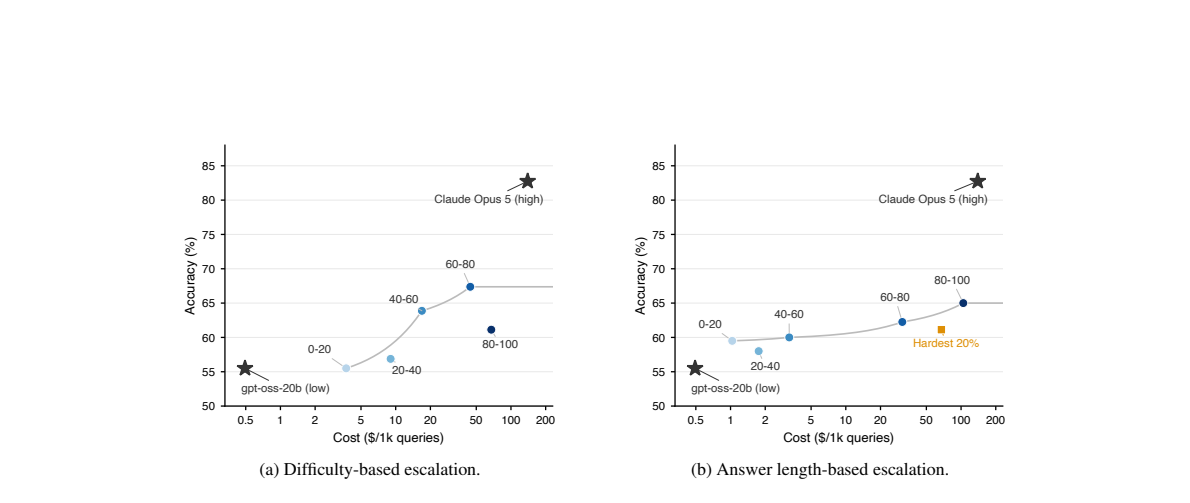
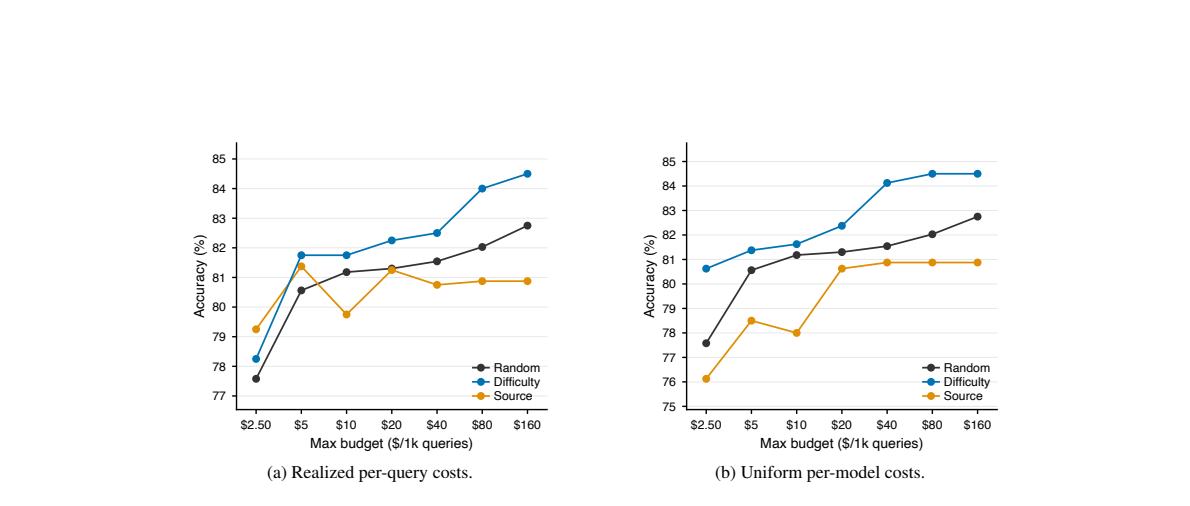
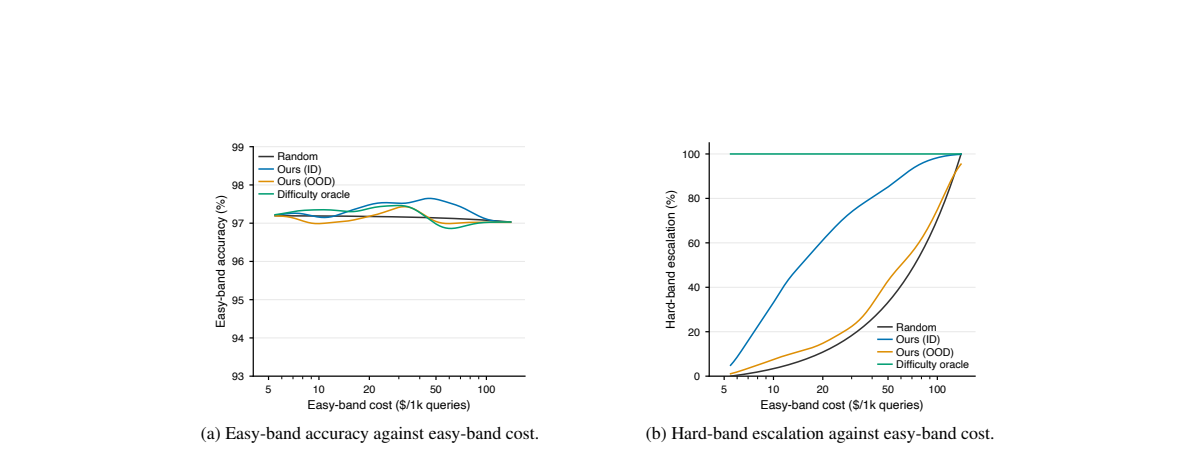
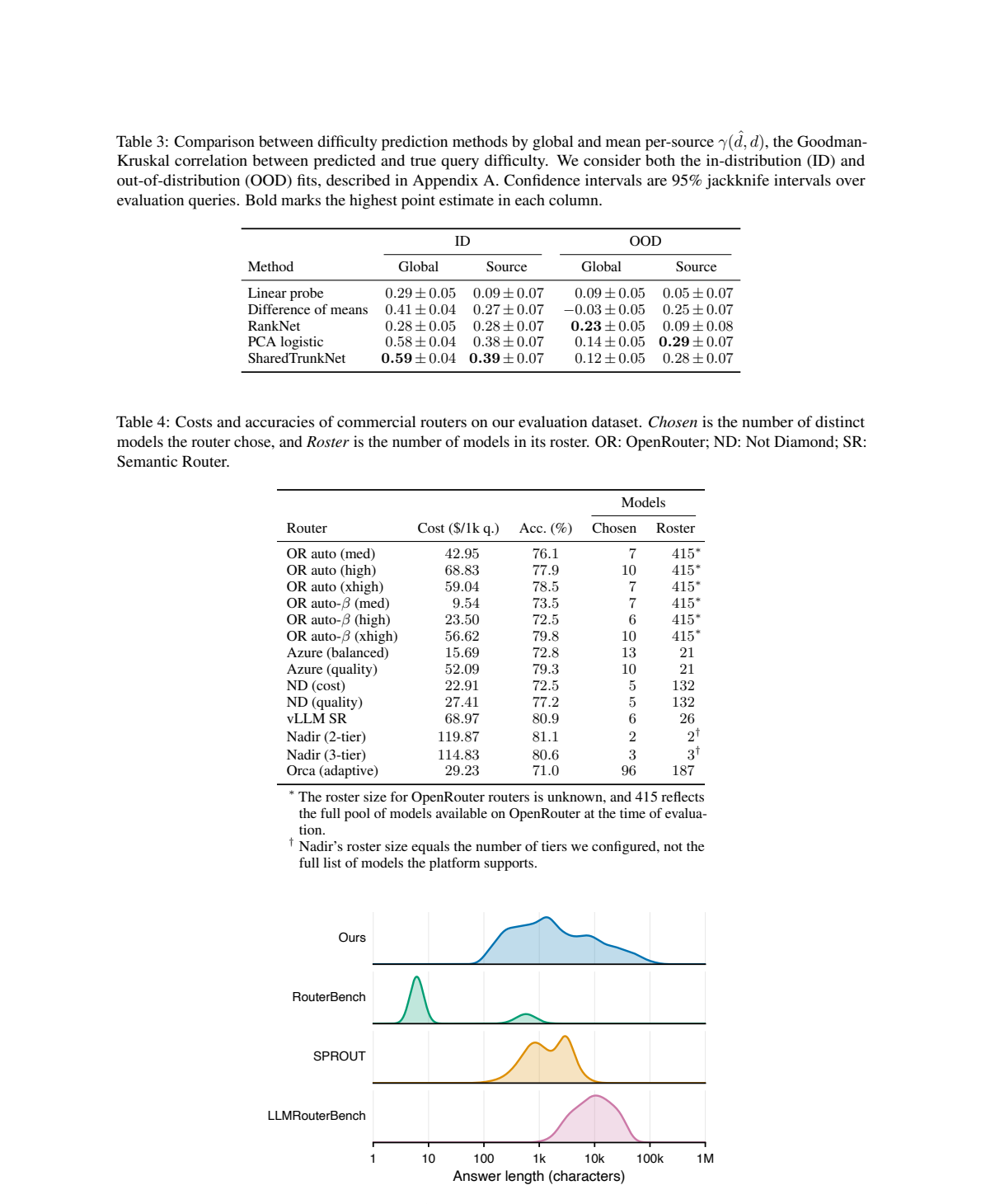
We analyze six commercial routers across 14 settings on a diverse benchmark spanning eight task categories, finding that none of them outperforms a router that randomly selects between two well-chosen models at matched cost. Some underperform by more than 10 percentage points. We trace this gap to four patterns prevalent across routers: difficulty blindness, length reversal, semantic matching, and roster suboptimality. We show that the first three are what the standard objective rewards: cost-accuracy Pareto efficiency on realized costs favors escalating moderately hard queries over the hardest ones, shorter queries over longer ones, and routing by a query's source over its difficulty. We also argue that the two assumptions that would justify large rosters, model granularity and model specialization, do not hold empirically. We propose an alternative evaluation methodology that does not reward these patterns, and as a proof of concept, we design a simple two-model router that avoids all four. Nevertheless, its gain over random routing is limited, because a well-chosen roster leaves little to route.
from the abstract
Pith says
Machine review · deepseek-v4-flash · 5 Oct 2026 · what was read was not recorded · not checked by a person
It can be wrong. Challenge this review or reply to it.
Holds up, with conditions. Solid, well-measured negative result on commercial routers; the mechanism story overreaches slightly in §5.1. This line is wrong
2 major objections · 5 minor
How often objections from reviews like this one are right: not yet measured
Not checked: figures, code, what the 86 references say.
The paper says, at §5.1
The review did not quote this passage.
Pith says: Objection 1 of 2 · major
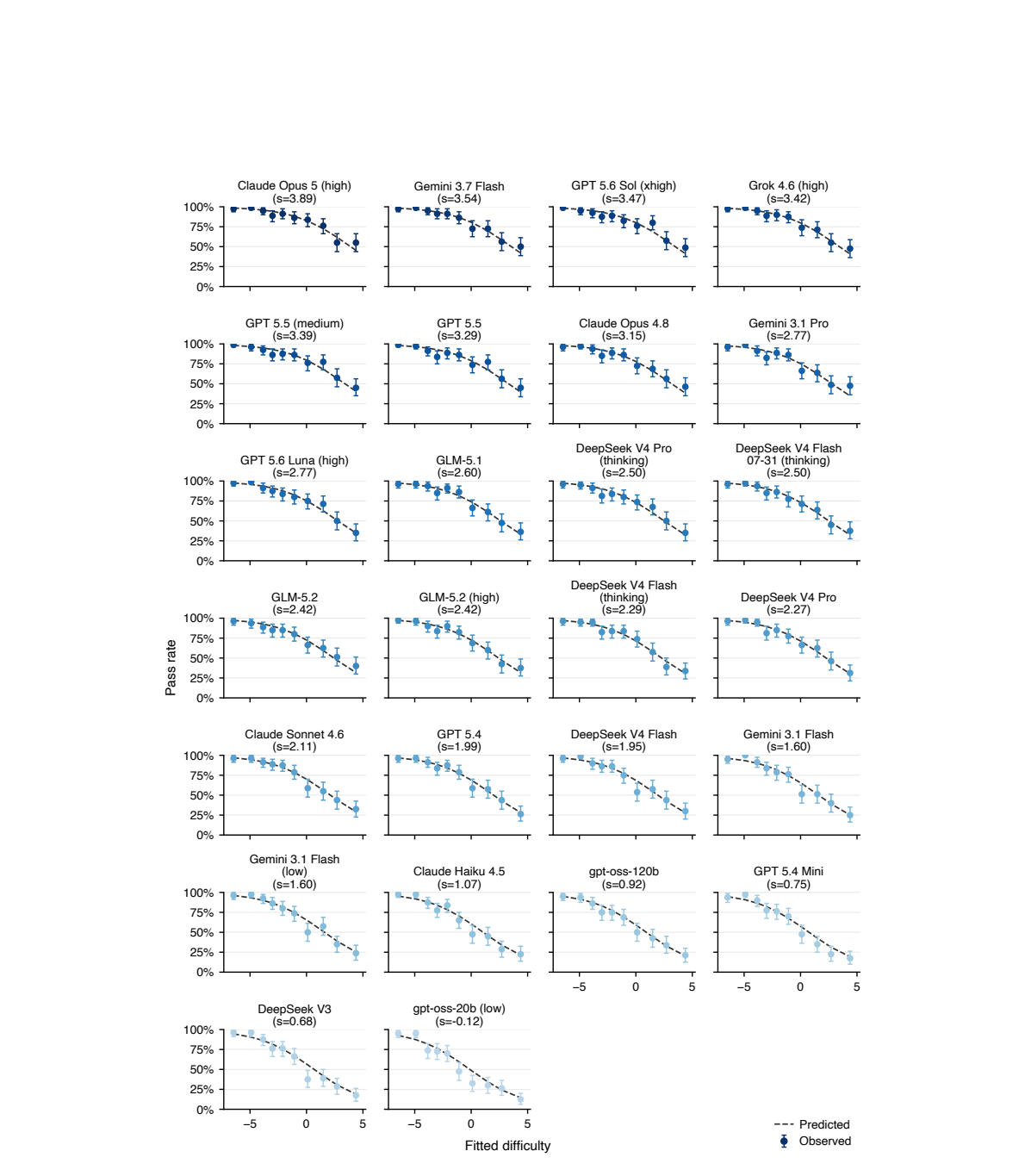
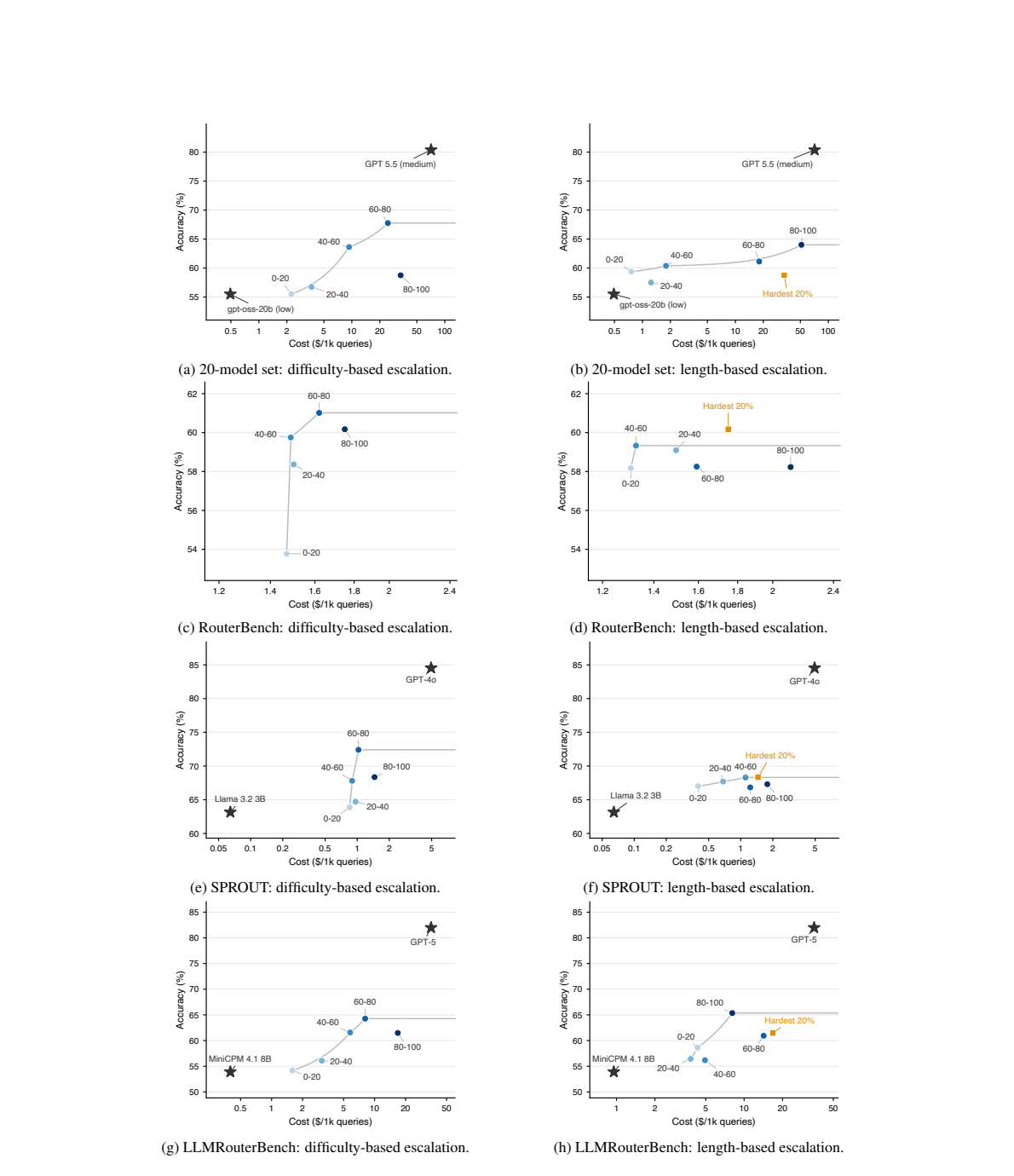
The claim that Pareto efficiency on cost and accuracy inherently rewards escalating moderately hard queries over the hardest ones rests on the one-parameter Rasch gain σ(θ1−d)−σ(θ2−d), which peaks at d=(θ1+θ2)/2 only when both models have the same discrimination slope. Under heterogeneous slopes, P(pass)=σ(s_i(θ_i−d_j)), the gain peak shifts toward the hard end when the stronger model has higher discrimination; Figure 11's …
more of objection 1
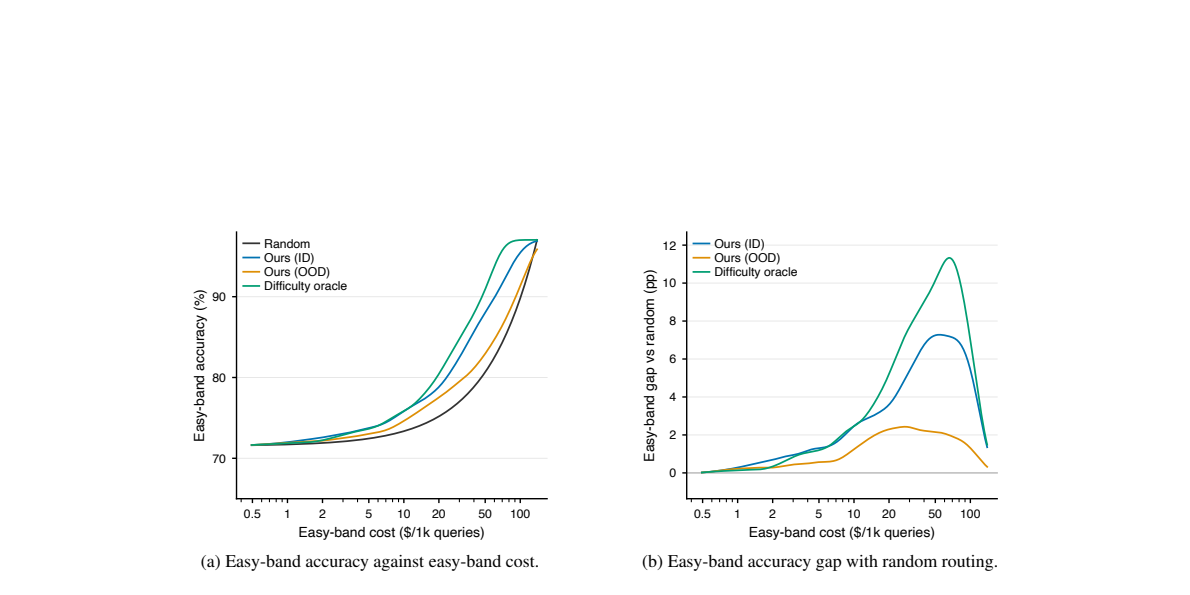
… per-model fitted values labeled s_i (3.89, 3.54, ..., −0.12) suggest this is not an idle concern, and the multidimensional MIRT analysis in §6.2 does not test this two-model slope heterogeneity. The formula also omits per-query cost variation, which is the quantity the Pareto objective trades against. The direct measurement in Figure 2 and its replication in Figure 13 are not at risk, but the abstract's stronger statement that the first three patterns are 'what the standard objective rewards' should be restricted to the measured model pairs or supported by a slope-heterogeneous refit.
The paper says, at §6.1 / Figure 4
The review did not quote this passage.
A classifier read this sentence of the paper as acknowledging the concern (probability 0.71):
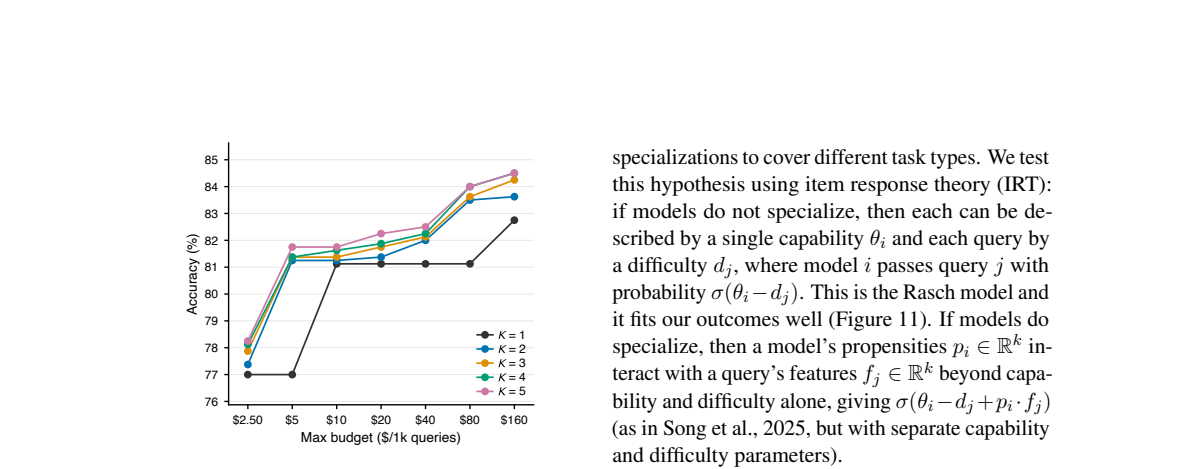
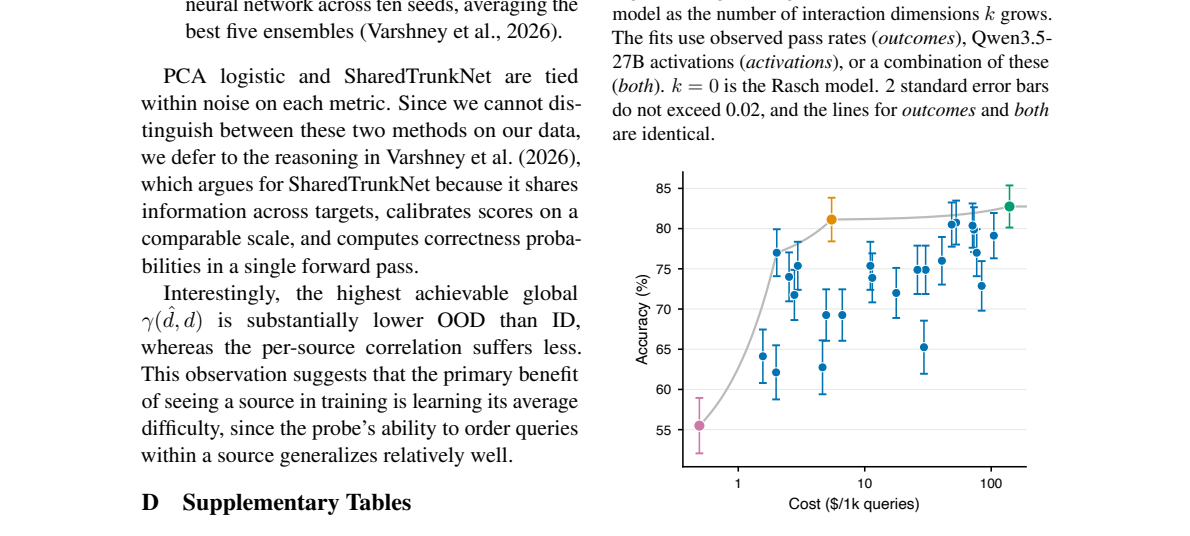
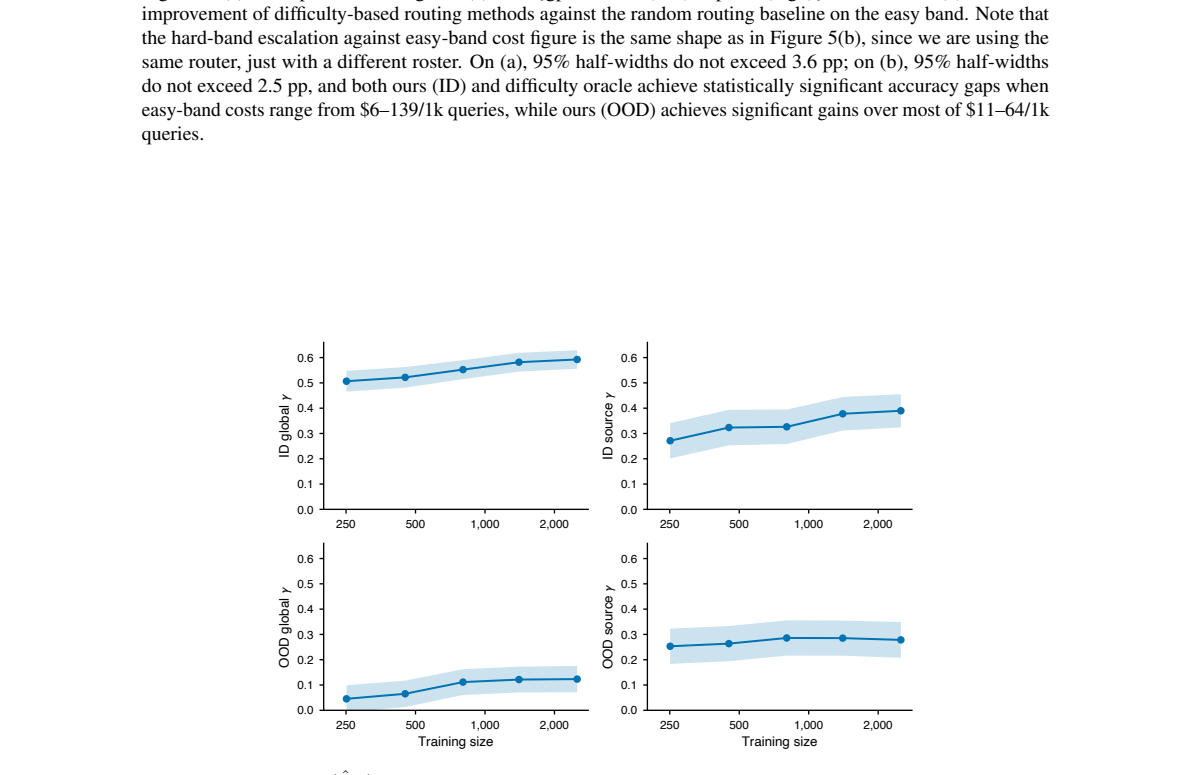
“Larger rosters are also more fragile, with more thresholds to tune from noisy difficulty estimates, so the small gains they show here, measured in-sample, may not generalize out of distribution. 6.2 Model specialization Even if two models have the same overall capabil- ity, they may specialize in different areas.”
Pith says: Objection 2 of 2 · major
The two-models-suffice roster claim is produced by an oracle that selects both the roster and the difficulty thresholds on the evaluation set itself, and the text acknowledges that accuracies above the strongest model reflect overfitting to that set. Because larger rosters have more thresholds, selection on the evaluation set can make a two-model roster look closer to larger rosters than it would out of sample.
more of objection 2
The 'at most 1 pp' gap is therefore an in-sample statement, not an established bound on achievable routing accuracy. Please report a cross-validated or split-half version of Figure 4 (and the corresponding panels of Figure 12), and temper the abstract and §6 accordingly if the gap widens.
5 minor objections
The paper says, at §3
Pith says: minor objection 1 of 5
The notation d_j is used both for the empirical failure fraction and for the fitted Rasch difficulty, and later figures rely on one of the two. Please state explicitly which definition is used in Figures 2, 4, and 13, or use distinct symbols.
The paper says, at Table 1 / Table 6
Pith says: minor objection 2 of 5
The pass rule is 'not significantly below zero,' but the abstract and §4 phrase the result as 'none outperforms' the random baseline. Given that two rows of Table 6 have positive point estimates within noise, the wording should distinguish 'no significant improvement' from 'no point-estimate improvement.'
show 3 more
The paper says, at §A.3
Pith says: minor objection 3 of 5
The routing endpoints receive query text without tool schemas, but the evaluation set includes a 100-query tool-use category. Please state how this constraint affects conclusions for that category, or provide a sensitivity analysis.
The paper says, at Figure 3
Pith says: minor objection 4 of 5
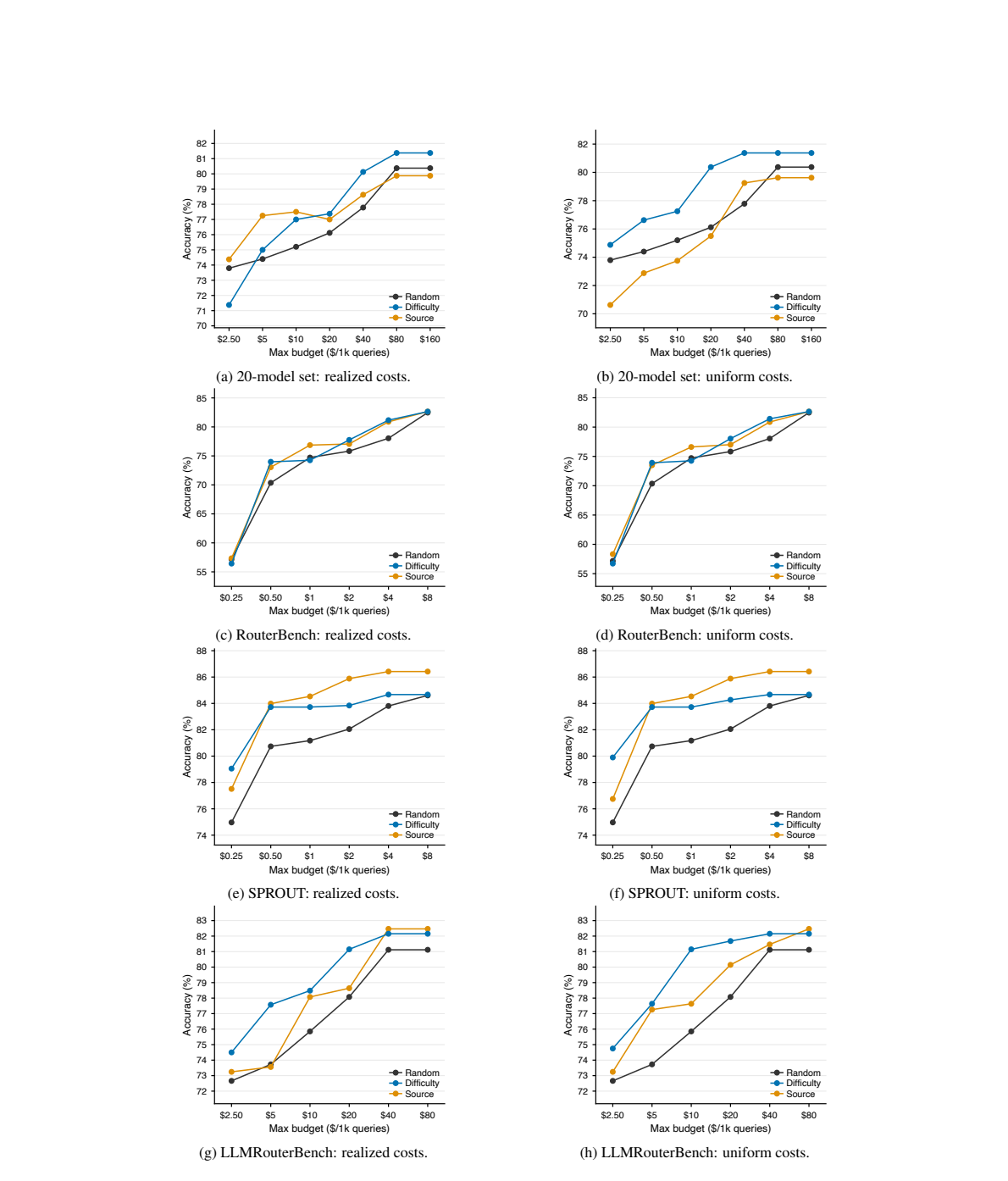
The Difficulty baseline in Figure 3 is an in-sample oracle while the Source baseline is fitted on the training set; the caption explains this, but the main text should state explicitly that the Difficulty curve is an upper bound and not a deployable method when discussing the semantic-matching findings.
The paper says, at General
Pith says: minor objection 5 of 5
The paper does not state plans for releasing the router logs, graded outcomes, or code. For a benchmark-based empirical study, this would materially aid replication.
What would settle it
Refit the evaluation outcomes with a two-parameter (slope-heterogeneous) IRT model, P(pass)=σ(s_i(θ_i−d_j)), and compute the pairwise escalation gain σ(s_1(θ_1−d))−σ(s_2(θ_2−d)) for the {Gemini 3.7 Flash, Opus 5 (high)} pair across the fitted difficulty range. If the fitted slopes are statistically indistinguishable (s_1≈s_2) and the gain remains unimodal near d=(θ_1+θ_2)/2 with the 80–100th decile having the smallest absolute gain, the §5.1 mechanism survives and no revision is needed.
from the skeptic's reading
How the review went
4 readings by deepseek-v4-flash · 5 Oct 2026
- Reader holds up, with conditions
- Skeptic partly agrees
- Editor wrote the verdict above
- Referee major revision: 2 major objections, 5 minor
Not run on this paper: the simulated authors' defence.
Pith did not check this review's objections against the paper.
The review in full
The review in brief, machine-written
The headline is believable: none of six commercial routers beats a random two-model router at matched cost. The statistics back it up—paired Wald and jackknife intervals, cost-matched baselines, roster matching to each router's contemporaneous model set, and replication on three external benchmarks. That's the kind of clean, falsifiable result the routing subfield needs, and the abstract's claim is not overreach.
The genuinely new content is the fourth pattern, length reversal, and the mechanism story for why the standard cost–accuracy Pareto objective produces the other three. Prior work already noted difficulty blindness and semantic matching; this paper explains them. The length-reversal finding is measured and replicated (Figure 13), and the accuracy-hacking explanation—escalating longer-answer queries costs more, so a realized-cost optimizer prefers short ones—is simple and correct.
The soft spot is in §5.1. The claim that the objective inherently rewards difficulty blindness is grounded in the one-parameter Rasch gain σ(θ1−d)−σ(θ2−d) peaking at the midpoint. That's an equal-slope assumption. With slope heterogeneity—the strong model discriminating harder—the peak shifts toward the difficult end, and the "inherent" claim stops being structural. The authors state the Rasch condition but never flag the equal-slope dependence, and they don't fit a 2PL. Important caveat: the empirical Figure 2 finding (escalating the 80–100 band is not Pareto-efficient) is measured directly from pass rates, survives without Rasch, and replicates. So the direct result is solid; only the generalization about what the objective "rewards" is broader than the math supports. Moderate issue, not fatal.
Two smaller items. The two-models-suffice claim rests on a difficulty oracle fit on the evaluation set itself; the authors acknowledge the in-sample overfitting and fragility of larger rosters, but the headline claim should be refit out-of-sample to be settled. And there's no code or data release, which limits independent verification given the AAII matching is approximate.
Who gets value: anyone working on router evaluation or cost-accuracy benchmarks. The revised methodology in §5.4 is a reasonable proposal even if the hard-band judgment is a design choice. This deserves peer review—send it to a strong venue with requests to soften the §5.1 generalization or test slope heterogeneity, and to release the artifacts.
The strongest objection
The central negative finding — no commercial router beats random two-model routing at matched cost (Table 1, replicated in Table 6 against contemporaneous rosters) — is direct, cost-matched, and not seriously at risk; I am not attacking that. The load-bearing concern is the explanatory thesis (b4, §5.1): that the cost-accuracy Pareto objective *inherently* rewards difficulty blindness, grounded in the one-parameter Rasch argument that the escalation gain σ(θ1−d)−σ(θ2−d) peaks at d=(θ1+θ2)/2 and vanishes as d→±∞. This conclusion is an artifact of the equal-slope (one-parameter) assumption. Under a two-parameter model with slope heterogeneity, P(pass)=σ(s_i(θ_i−d_j)), the gain curve is not unimodal at the midpoint: when the strong model has higher discrimination (s1>s2), it retains a non-negligible pass rate at difficulties where the weak model has already collapsed, so the gain peak shifts toward the hard end, and escalating the hardest queries can be what a realized-cost Pareto optimizer rewards. In that regime the mechanism behind 'the objective rewards escalating moderately hard over hardest' stops being a structural property and becomes contingent on the slope structure of the specific pair. The empirical §5.1 finding (80–100th difficulty band not Pareto-efficient, Figure 2, replicated on external sets in Figure 13) is measured directly from pass rates and survives even if Rasch is wrong, because the fitted difficulties induce the same ordering as d_j and §6.2's multidimensional extension mitigates but does not test slope heterogeneity in the pairwise gain. What is threatened is the generalization — the paper's novel claim that difficulty blindness, length reversal, and semantic matching are what the objective itself rewards, which is what the title's 'misguided' asserts. The authors do not flag the equal-slope dependence, so this is an unacknowledged condition, not a stated limitation.
The reader's weakest_assumption targets the same region of the argument I find most load-bearing: the §5.1 mechanism claim that the standard objective rewards the observed patterns. But I push the pin to a sharper and more directly testable form. The reader frames the risk as multidimensionality of difficulty (ordering queries differently across model sets), with §6.2 as mitigation. My reading is that the decisive assumption is equal discrimination/slope within the scalar model: the formula 'peaks at d=(θ1+θ2)/2, vanishes as d→±∞' follows only when both models share the Rasch slope, and with slope heterogeneity the peak moves toward the hard end, where under realized-cost Pareto analysis the hardest queries could become the ones a cost-accuracy optimizer wants to escalate. That is why I make the decisive test a 2PL refit rather than the multidimensional §6.2 extension, which the reader already acknowledges only mitigates. I also give the paper more credit than the reader's framing suggests in one respect: the empirical content of §5.1 (Figure 2, and the replicated Figure 13) is measured directly from pass rates and difficulty deciles, not derived from Rasch, so the specific 'hardest band is not Pareto-efficient' result does not collapse if the model is misspecified; what collapses is the generalization that the objective structurally encodes these patterns. Because the empirical negative claim (routers underperform random baselines) is solid and replicated, and the mechanism concern is real but resolvable by a re-fit that the paper could plausibly pass, the reader's CONDITIONAL verdict is the right one, and I do not move it. The concern is about an unacknowledged equal-slope condition in the explanatory argument, not about any stated limitation, and no ad hominem or theatrical characterization is warranted: the paper is unusually careful about cost-matching, roster contemporaneity, and out-of-sample fits, and it candidly lists its limits. My test would settle whether the mechanism claim generalizes or must be downgraded to a contingent observation, and that settles whether the paper's central explanatory thesis holds.
The referee's report
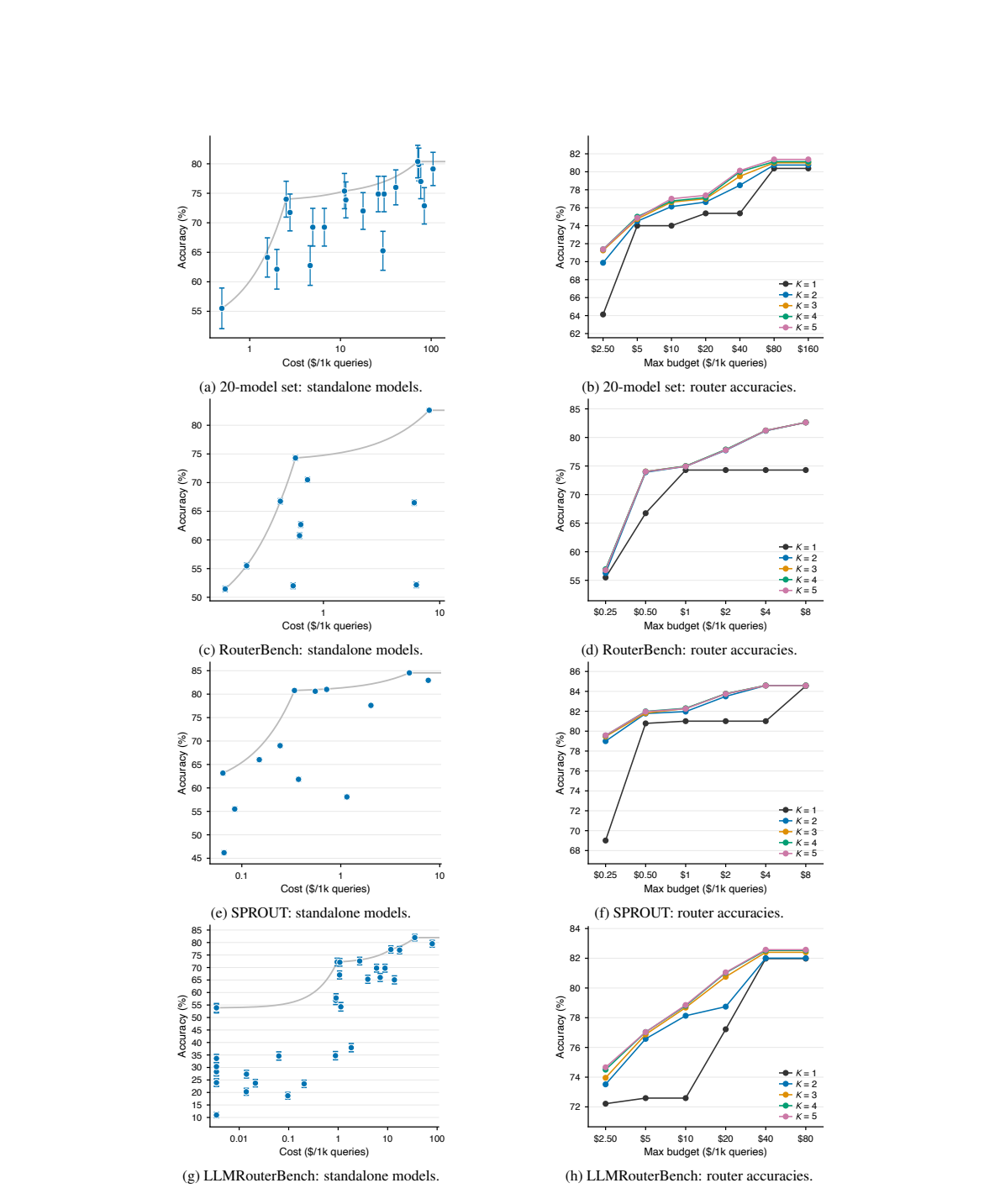
The empirical core of this paper is valuable. The headline comparison is carefully executed: all routers and baselines are evaluated with the same generation protocol, costs are matched by interpolating a random baseline, uncertainties are reported as paired Wald and jackknife intervals, the AAII-based ability ordering is stress-tested by perturbation in Appendix F, and the escalation findings are replicated on RouterBench, SPROUT, and LLMRouterBench. If the findings hold, the paper is a useful empirical counterweight to the assumption that learned routers dominate well-chosen static portfolios, and the proposed evaluation corrections address a real weakness in current cost–accuracy benchmarking. The main weakness is that the explanatory narrative extends beyond the measurements: the Rasch-based mechanism in §5.1 is presented as a structural property of the objective, and the roster-sufficiency claim in §6.1 is estimated by an in-sample oracle. Neither issue endangers the direct measured negative result, but both need revision before the paper's broader claims can be accepted.
Pith's reading of the paper (a machine's summary, not the authors')
This paper argues that commercial dynamic LLM routers are failing their central promise — cheaper inference by sending each query to the cheapest model that can answer it. On an 800-query benchmark spanning eight task categories, none of six commercial routers across 14 settings beats a router that randomly selects between two well-chosen models at matched cost, and some underperform by more than 10 percentage points. The authors' explanation is the paper's core: the conventional cost-accuracy Pareto objective on realized costs itself rewards the three observed pathologies — escalating moderately hard queries over the hardest ones, shorter queries over longer ones, and routing by a query's source over its difficulty. If the explanation is right, the field's evaluation yardstick, not just individual routers, is what is misguided, and much of the reported value of dynamic routing is an artifact of realized-cost accounting.
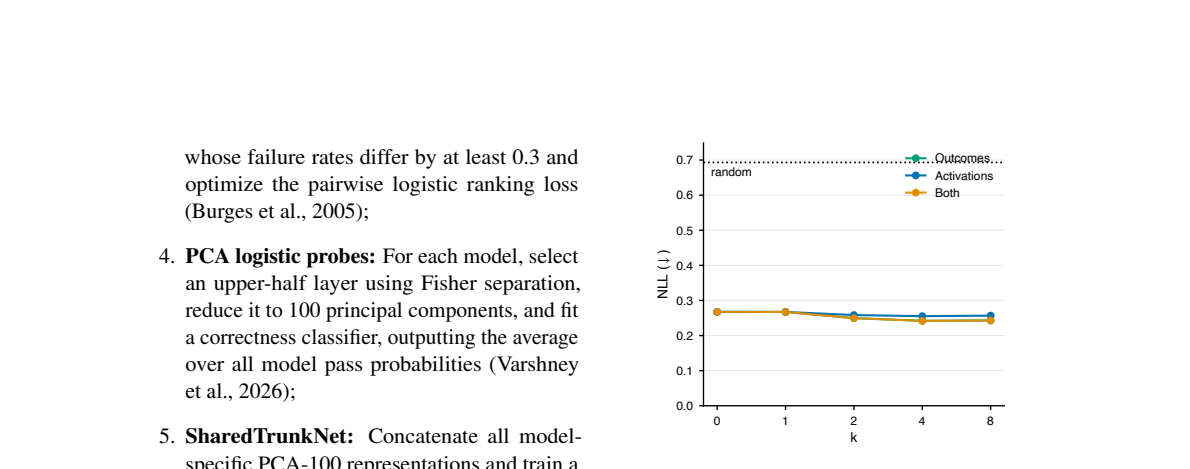
What carries the argument. The engine of the argument is the Rasch one-parameter item response model, which assigns each model a capability $\theta_i$ and each query a difficulty $d_j$ with pass probability $\sigma(\theta_i - d_j)$, and the escalation-gain function $\sigma(\theta_1 - d) - \sigma(\theta_2 - d)$ it generates. Because this gain peaks at $d = (\theta_1 + \theta_2)/2$ and shrinks to zero as $d \to \pm\infty$, a cost-accuracy Pareto-efficient router has little reason to escalate the hardest queries, which the paper identifies as the root of difficulty blindness, and prefers cheaper (shorter) escalations, the root of length reversal. The multidimensional extension, which adds interaction terms $p_i \cdot f_j$ to the Rasch form, serves as the test for model specialization, and the fitted single-capability difficulties feed the in-sample difficulty oracle behind the two-models-suffice roster claim.
Core claim. On the paper's own terms, the discovery is that commercial routers fail their own bargain: none of six commercial routers across 14 settings beats a router that randomly selects between two well-chosen models at matched cost on an 800-query benchmark spanning eight categories, and several underperform by more than 10 percentage points. The explanatory claim is that this failure is systematic, not incidental. Under the standard cost-accuracy Pareto objective on realized costs, a router escalates a query when an expensive model is much more likely than the cheap one to answer it; because that gap $\sigma(\theta_1 - d) - \sigma(\theta_2 - d)$ peaks at the midpoint difficulty $d = (\theta_1 + \theta_2)/2$ and vanishes on the hardest queries, the objective itself rewards difficulty blindness and length reversal. Because answer length and data source are easier to predict than difficulty, the same objective rewards semantic matching. The paper further argues that the two assumptions justifying large rosters, model granularity and model specialization, do not hold empirically, so a roster of two (rarely three) models closely approximates the best achievable accuracy.
The premise it rests on. Everything hinges on query difficulty being a single scalar that orders queries identically for every pair of models — the authors fit a Rasch model and test the multidimensional extension, finding weak specialization, but the escalation-gain peak that drives the accuracy-hacking explanation still depends on that one-dimensional assumption.
If the paper is right (Pith's inferences, not the authors')
A router's roster, not its routing policy, determines nearly all achievable accuracy: on the paper's model set, a difficulty-based two-model router stays within noise of random routing at matched cost.
Evaluation methodology should charge each answer its model's mean cost rather than realized cost, score difficulty predictions within data source rather than globally, and reward escalation on a hard band; these three corrections stop rewarding the identified patterns.
Rosters of two models (rarely three) approximate the best achievable accuracy even with perfect difficulty knowledge, so large rosters buy fragility rather than accuracy, and subpar routers are more likely failing on roster than on policy.
Difficulty is the binding constraint on routing quality, since out-of-distribution within-source difficulty prediction does not improve with a tenfold increase in training data.
If query difficulty cannot be predicted from the query alone even with a tenfold data increase, the cost-reduction premise of routing may hit a fundamental information limit rather than a technique gap; a testable consequence is that router gains over random should stay flat as difficulty predictors improve.
The length-reversal result implies that some reported Pareto gains of routers may reflect cost bookkeeping, choosing which answers are cheapest to escalate, more than genuine selection skill; comparing routers under mean-cost charging would separate the two.
If weak specialization holds across future model generations, it argues against building domain-specialized models for routing and in favor of maintaining a single cheap-strong frontier pair.
The paper's single-turn scope leaves the hardest case open: multi-turn and long-horizon traffic, where KV caching makes switching models expensive, may be exactly where routers earn their keep rather than the regime where they are shown to be superfluous.
Check this review
Pith stored no record of this review's passes and took no fingerprint of it. Reviews made by code from 13 Nov 2026 on carry both.
How often reviews like this one are right
Reviews like this one: written by deepseek-v4-flash, where what was read was not recorded.
How often objections from reviews like this one are right: not yet measured
Reviews by people
This review was written by a machine. No person has reviewed this paper on Pith yet. A scientist listed on Pith can review it for a fee, and their review is published here whatever it concludes.
The paper
Abstract
Dynamic LLM routers promise to cut inference costs by sending each query to the cheapest model that can answer it correctly. We analyze six commercial routers across 14 settings on a diverse benchmark spanning eight task categories, finding that none of them outperforms a router that randomly selects between two well-chosen models at matched cost. Some underperform by more than 10 percentage points. We trace this gap to four patterns prevalent across routers: difficulty blindness, length reversal, semantic matching, and roster suboptimality. We show that the first three are what the standard objective rewards: cost-accuracy Pareto efficiency on realized costs favors escalating moderately hard queries over the hardest ones, shorter queries over longer ones, and routing by a query's source over its difficulty. We also argue that the two assumptions that would justify large rosters, model granularity and model specialization, do not hold empirically. We propose an alternative evaluation methodology that does not reward these patterns, and as a proof of concept, we design a simple two-model router that avoids all four. Nevertheless, its gain over random routing is limited, because a well-chosen roster leaves little to route.
The paper's own sentences, arranged, kept beside the review and separate from it. Each label is drawn from a closed vocabulary; the number beside it is the probability the classifier gave that label. No sentence in this record was written by a model.
abstract compiled · 2026-10-05
The authors' main claim, as the classifier picked it out 1.00
“We analyze six commercial routers across 14 settings on a diverse benchmark spanning eight task categories, finding that none of them outperforms a router that randomly selects between two well-chosen models at matched cost.”
How the main claim is stated: asserted 1.00
What the abstract itself states, as probabilities: claims first 0.05 · states limitation 0.95 · human participants 0.04 · controlled comparison 0.95 · randomized assignment 0.06 · states quantitative result 0.98 · compares with prior results 0.96 · mentions code or data availability 0.04
The abstract, sentence by sentence
This table labels the abstract only (arXiv listing abstract v1). The number is the probability the classifier gave the label.
| Sentence | Role | The authors' own work | States the main conclusion | Strength |
|---|---|---|---|---|
| Dynamic LLM routers promise to cut inference costs by sending each query to the cheapest model that can answer it correctly. | background 1.00 | 0.04 | 0.03 | asserted 0.68 |
| We analyze six commercial routers across 14 settings on a diverse benchmark spanning eight task categories, finding that none of them outperforms a router that randomly selects between two well-chosen models at matched cost. | result 0.99 | 0.97 | 0.80 | asserted 1.00 |
| Some underperform by more than 10 percentage points. | result 1.00 | 0.92 | 0.07 | asserted 0.99 |
| We trace this gap to four patterns prevalent across routers: difficulty blindness, length reversal, semantic matching, and roster suboptimality. | result 0.69 | 0.94 | 0.14 | asserted 1.00 |
| We show that the first three are what the standard objective rewards: cost-accuracy Pareto efficiency on realized costs favors escalating moderately hard queries over the hardest ones, shorter queries over longer ones, and routing by a query's source over its difficulty. | interpretation 0.96 | 0.90 | 0.13 | asserted 1.00 |
| We also argue that the two assumptions that would justify large rosters, model granularity and model specialization, do not hold empirically. | result 0.56 | 0.88 | 0.12 | asserted 0.99 |
| We propose an alternative evaluation methodology that does not reward these patterns, and as a proof of concept, we design a simple two-model router that avoids all four. | contribution 0.89 | 0.94 | 0.16 | asserted 0.96 |
| Nevertheless, its gain over random routing is limited, because a well-chosen roster leaves little to route. | limitation 0.70 | 0.89 | 0.21 | asserted 0.98 |
What kind of paper the classifier reports this is: empirical study 1.00 · evidence from observation or experiment 0.97
What was examined, and what was not
Sources read
- arXiv listing abstract v1
Not examined
- full text
- figures and tables
- references and citing sentences
- relations to other papers
Levels run
- P abstract
Not run
- S sections
- T body sentences
- C citations
- R cross-paper relations
How the labels were made
Compiled by classifier-1.13.0 via TypeSafe API, question bank abstract-p1-20260923, 2026-10-05: 1 request, 6,231 input tokens.
Every quoted sentence on this record is the authors'. Every label is from Pith's closed vocabulary, with the probability shown beside it. This record as JSON
Figures (15)
Figures are the authors', reproduced from the paper.
References (86)
- [1] Wei Song and Zhenya Huang and Cheng Cheng and Weibo Gao and Bihan Xu and GuanHao Zhao and Fei Wang and Runze Wu , year =. 2506.01048 , archivePrefix = on PithPith's reviewarXiv
- [2] Evaluating Large Language Models Trained on Code , author =. 2021 , eprint = on Pith
- [3] Program Synthesis with Large Language Models , author =. 2021 , booktitle =. 2108.07732 , archivePrefix = on PithPith's reviewarXiv
- [4] Terry Yue Zhuo and Vu Minh Chien and Jenny Chim and Han Hu and Wenhao Yu and Ratnadira Widyasari and Imam Nur Bani Yusuf and Haolan Zhan and Junda He and Indraneil Paul and Simon Brunner and Chen Gong and James Hoang and Armel Randy Zebaze and Xiaoheng Hong and Wen-Ding Li and... on Pith
- [5] Instruction-Following Evaluation for Large Language Models , author =. 2023 , eprint = on Pith
- [6] Measuring Massive Multitask Language Understanding , author =. International Conference on Learning Representations , year = on Pith
- [7] Wang, Yubo and Ma, Xueguang and Zhang, Ge and Ni, Yuansheng and Chandra, Abhranil and Guo, Shiguang and Ren, Weiming and Arulraj, Aaran and He, Xuan and Jiang, Ziyan and Li, Tianle and Ku, Max and Wang, Kai and Zhuang, Alex and Fan, Rongqi and Yue, Xiang and Chen, Wenhu , titl... on Pith
- [8] David Rein and Betty Li Hou and Asa Cooper Stickland and Jackson Petty and Richard Yuanzhe Pang and Julien Dirani and Julian Michael and Samuel R. Bowman , booktitle =. 2024 , url = on Pith
- [9] Let's Verify Step by Step , author =. The Twelfth International Conference on Learning Representations , year = on Pith
- [10] Karl Cobbe and Vineet Kosaraju and Mohammad Bavarian and Mark Chen and Heewoo Jun and Lukasz Kaiser and Matthias Plappert and Jerry Tworek and Jacob Hilton and Reiichiro Nakano and Christopher Hesse and John Schulman , title =. CoRR , volume =. 2021 , url =. 2110.14168 , timestamp = on PithPith's reviewarXiv
- [11] Niklas Muennighoff and Qian Liu and Armel Randy Zebaze and Qinkai Zheng and Binyuan Hui and Terry Yue Zhuo and Swayam Singh and Xiangru Tang and Leandro Von Werra and Shayne Longpre , booktitle =. 2024 , url = on Pith
- [12] Kwiatkowski, Tom and Palomaki, Jennimaria and Redfield, Olivia and Collins, Michael and Parikh, Ankur and Alberti, Chris and Epstein, Danielle and Polosukhin, Illia and Devlin, Jacob and Lee, Kenton and Toutanova, Kristina and Jones, Llion and Kelcey, Matthew and Chang, Ming-W... on Pithdoi:10.1162/tacl_a_00276
- [13] Joshi, Mandar and Choi, Eunsol and Weld, Daniel and Zettlemoyer, Luke , editor =. Proceedings of the 55th Annual Meeting of the Association for Computational Linguistics (Volume 1: Long Papers) , month = jul, year =. doi:10.18653/v1/P17-1147 , pages = on Pithdoi:10.18653/v1/p17-1147
- [14] Os. Question Answering over Tabular Data with. Proceedings of the 2024 Joint International Conference on Computational Linguistics, Language Resources and Evaluation (LREC-COLING 2024) , month = may, year = on Pith
- [15] Zeyao Ma and Bohan Zhang and Jing Zhang and Jifan Yu and Xiaokang Zhang and Xiaohan Zhang and Sijia Luo and Xi Wang and Jie Tang , booktitle =. 2024 , url = on Pith
- [16] Tejal Patwardhan and Rachel Dias and Elizabeth Proehl and Grace Kim and Michele Wang and Olivia Watkins and Simon Posada Fishman and Marwan Aljubeh and Phoebe Thacker and Laurance Fauconnet and Natalie S. Kim and Samuel Miserendino and Gildas Chabot and David Li and Patrick Ch... on Pith
- [17] Patil, Shishir G. and Mao, Huanzhi and Yan, Fanjia and Ji, Charlie Cheng-Jie and Suresh, Vishnu and Stoica, Ion and Gonzalez, Joseph E. , title =. Proceedings of the 42nd International Conference on Machine Learning , articleno =. 2025 , publisher = on Pith
- [18] -bench: A Benchmark for Tool-Agent-User Interaction in Real-World Domains , author =. The Thirteenth International Conference on Learning Representations , year = on Pith
- [19] Shitao Xiao and Zheng Liu and Peitian Zhang and Niklas Muennighoff , year =. 2309.07597 , archivePrefix = on PithPith's reviewarXiv
- [20] Qitian Jason Hu and Jacob Bieker and Xiuyu Li and Nan Jiang and Benjamin Keigwin and Gaurav Ranganath and Kurt Keutzer and Shriyash Kaustubh Upadhyay , booktitle =. 2024 , url = on Pith
show 66 more
- [21] Yifan Lu and Rixin Liu and Jiayi Yuan and Xingqi Cui and Shenrun Zhang and Hongyi Liu and Jiarong Xing , booktitle =. RouterArena: An Open Platform for Comprehensive Comparison of. 2026 , url = on Pith
- [22] Zhenghua Bao and Fengya Tian and Chris Zhang and Zhenjun Chen and Xile Ma and Yi Shi , year =. 2605.30736 , archivePrefix = on PithPith's reviewarXiv
- [23] NadirClaw: Open-Source. 2026 , howpublished = on Pith
- [24] A Benchmark of Expert-Level Academic Questions to Assess. Nature , volume =. 2026 , doi =. 2501.14249 , archivePrefix = on PithPith's reviewarXiv
- [25] How Predictable Is Language Model Benchmark Performance? , author =. 2024 , eprint = on Pith
- [26] Aaron Grattafiori and Abhimanyu Dubey and Abhinav Jauhri and Abhinav Pandey and Abhishek Kadian and Ahmad Al-Dahle and Aiesha Letman and Akhil Mathur and Alan Schelten and Alex Vaughan and Amy Yang and Angela Fan and Anirudh Goyal and Anthony Hartshorn and Aobo Yang and Archi ... on Pith
- [27] Establishing Task Scaling Laws via Compute-Efficient Model Ladders , author =. Second Conference on Language Modeling , year = on Pith
- [28] Artificial Analysis Intelligence Index , year = on Pith
- [29] A New Index Measuring Evenness , volume=. Journal of the Marine Biological Association of the United Kingdom , author=. 1974 , pages=. doi:10.1017/S0025315400022736 , number= on Pithdoi:10.1017/s0025315400022736
- [30] CARROT: A Cost Aware Rate Optimal Router , author=. 2025 , eprint= on Pith
- [31] The rising costs of training frontier AI models , author=. 2025 , eprint= on Pith
- [32] LLM inference prices have fallen rapidly but unequally across tasks , author=. 2025 , url= on Pith
- [33] The Price of Progress , author=. NeurIPS 2025 Workshop on Evaluating the Evolving LLM Lifecycle: Benchmarks, Emergent Abilities, and Scaling , year= on Pith
- [34] Open models lag state-of-the-art closed models by 4 months , author=. 2026 , url= on Pith
- [35] On-Policy Distillation of Language Models: Learning from Self-Generated Mistakes , author=. The Twelfth International Conference on Learning Representations , year= on Pith
- [36] Frontier AI performance becomes accessible on consumer hardware within a year , author=. 2025 , url= on Pith
- [37] Song, Wei and Huang, Zhenya and Cheng, Cheng and Gao, Weibo and Xu, Bihan and Zhao, GuanHao and Wang, Fei and Wu, Runze. IRT -Router: Effective and Interpretable Multi- LLM Routing via Item Response Theory. Proceedings of the 63rd Annual Meeting of the Association for Computat... on Pithdoi:10.18653/v1/2025.acl-long.761
- [38] A Rosetta Stone for AI benchmarks , author=. 2025 , url= on Pith
- [39] Observational Scaling Laws and the Predictability of Language Model Performance , author=. The Thirty-eighth Annual Conference on Neural Information Processing Systems , year= on Pith
- [40] David Ilić and Gilles E. Gignac , keywords =. Evidence of interrelated cognitive-like capabilities in large language models: Indications of artificial general intelligence or achievement? , journal =. 2024 , issn =. doi:10.1016/j.intell.2024.101858 , url = on Pithdoi:10.1016/j.intell.2024.101858
- [41] No Answer Needed: Predicting LLM Answer Accuracy from Question-Only Linear Probes , author=. 2025 , eprint= on Pith
- [42] Probing the Difficulty Perception Mechanism of Large Language Models , author=. 2025 , eprint= on Pith
- [43] LLM Router: Rethinking Routing with Prefill Activations , author=. 2026 , eprint= on Pith
- [44] Burges, Chris and Shaked, Tal and Renshaw, Erin and Lazier, Ari and Deeds, Matt and Hamilton, Nicole and Hullender, Greg , title =. Proceedings of the 22nd International Conference on Machine Learning , pages =. 2005 , isbn =. doi:10.1145/1102351.1102363 , abstract = on Pithdoi:10.1145/1102351.1102363
- [45] Gombert, Sebastian and Menzel, Lukas and Di Mitri, Daniele and Drachsler, Hendrik. Predicting Item Difficulty and Item Response Time with Scalar-mixed Transformer Encoder Models and Rational Network Regression Heads. Proceedings of the 19th Workshop on Innovative Use of NLP fo... on Pith
- [46] Distributionally Robust Neural Networks , author=. International Conference on Learning Representations , year= on Pith
- [47] Isaac Ong and Amjad Almahairi and Vincent Wu and Wei-Lin Chiang and Tianhao Wu and Joseph E. Gonzalez and M Waleed Kadous and Ion Stoica , booktitle=. Route. 2025 , url= on Pith
- [48] Dujian Ding and Ankur Mallick and Chi Wang and Robert Sim and Subhabrata Mukherjee and Victor R. Hybrid. The Twelfth International Conference on Learning Representations , year= on Pith
- [49] Lu, Keming and Yuan, Hongyi and Lin, Runji and Lin, Junyang and Yuan, Zheng and Zhou, Chang and Zhou, Jingren. Routing to the Expert: Efficient Reward-guided Ensemble of Large Language Models. Proceedings of the 2024 Conference of the North American Chapter of the Association ... on Pithdoi:10.18653/v1/2024.naacl-long.109
- [50] vLLM Semantic Router: Signal Driven Decision Routing for Mixture-of-Modality Models , author=. 2026 , eprint= on Pith
- [51] The Avengers: A Simple Recipe for Uniting Smaller Language Models to Challenge Proprietary Giants , author=. 2025 , eprint= on Pith
- [52] Zhang, Yiqun and Li, Hao and Chen, Jianhao and Zhang, Hangfan and Ye, Peng and Bai, Lei and Hu, Shuyue , title =. Proceedings of the 2025 7th International Conference on Distributed Artificial Intelligence , pages =. 2025 , isbn =. doi:10.1145/3772429.3772445 , abstract = on Pithdoi:10.1145/3772429.3772445
- [53] Lingjiao Chen and Matei Zaharia and James Zou , journal=. Frugal. 2023 , url= on Pith
- [54] Wittawat Jitkrittum and Harikrishna Narasimhan and Ankit Singh Rawat and Jeevesh Juneja and Congchao Wang and Zifeng Wang and Alec Go and Chen-Yu Lee and Pradeep Shenoy and Rina Panigrahy and Aditya Krishna Menon and Sanjiv Kumar , booktitle=. Universal Model Routing for Effic... on Pith
- [55] AutoMix: Automatically Mixing Language Models , author=. The Thirty-eighth Annual Conference on Neural Information Processing Systems , year= on Pith
- [56] Jasper Dekoninck and Maximilian Baader and Martin Vechev , booktitle=. A Unified Approach to Routing and Cascading for. 2025 , url= on Pith
- [57] Agreement-Based Cascading for Efficient Inference , author=. 2025 , eprint= on Pith
- [58] Shuhao Chen and Weisen Jiang and Baijiong Lin and James Kwok and Yu Zhang , booktitle=. Router. 2024 , url= on Pith
- [59] Tao Feng and Yanzhen Shen and Jiaxuan You , booktitle=. GraphRouter: A Graph-based Router for. 2025 , url= on Pith
- [60] Richard Zhuang and Tianhao Wu and Zhaojin Wen and Andrew Li and Jiantao Jiao and Kannan Ramchandran , booktitle=. Embed. 2025 , url= on Pith
- [61] Jiaqi Xue and Qian Lou and Jiarong Xing and Heng Huang , booktitle=. R2-Router: A New Paradigm for. 2026 , url= on Pith
- [62] Li, Hao and Zhang, Yiqun and Guo, Zhaoyan and Wang, Chenxu and Tang, Shengji and Zhang, Qiaosheng and Chen, Yang and Qi, Biqing and Ye, Peng and Bai, Lei and Wang, Zhen and Hu, Shuyue. LLMR outer B ench: A Massive Benchmark and Unified Framework for LLM Routing. Findings of th... on Pithdoi:10.18653/v1/2026.findings-acl.1881
- [63] Pei Yang and Wanyi Chen and Tongyun Yang and Pengbin Feng and Jiarong Xing and Wentao Guo and Yuhang Yao and Yuhang Han and Hanchen Li and Xu Wang and ZEYU WANG and Jie Xiao and Anjie Yang and Lynn Ai and Eric Yang and TIANYU SHI , booktitle=. TwinRouterBench: Fast Static and ... on Pith
- [64] Learning When to Think: Adaptive Reasoning for Test-Time Compute Allocation , author=. 2026 , eprint= on Pith
- [65] Can LLMs Predict Their Own Failures? Self-Awareness via Internal Circuits , author=. 2025 , eprint= on Pith
- [66] Revealing the structure of language model capabilities , author=. 2023 , eprint= on Pith
- [67] Lord, Frederic M. , title =. Psychometric Monograph , year = on Pith
- [68] Rasch, Georg , title =. 1960 , publisher = on Pith
- [69] Birnbaum, Allan , title =. Statistical Theories of Mental Test Scores , editor =. 1968 , publisher = on Pith
- [70] Reckase, Mark D. , title =. 2009 , publisher = on Pith
- [71] Have AI Capabilities Accelerated? , author=. 2026 , url= on Pith
- [72] Felipe Maia Polo and Lucas Weber and Leshem Choshen and Yuekai Sun and Gongjun Xu and Mikhail Yurochkin , booktitle=. tinyBenchmarks: evaluating. 2024 , url= on Pith
- [73] metabench - A Sparse Benchmark of Reasoning and Knowledge in Large Language Models , author=. The Thirteenth International Conference on Learning Representations , year= on Pith
- [74] Fluid Language Model Benchmarking , author=. Second Conference on Language Modeling , year= on Pith
- [75] Sakana Fugu Technical Report , author=. 2026 , eprint= on Pith
- [76] The Routing Plateau: Understanding and Breaking the Accuracy Limits of LLM Routers , author=. 2026 , eprint= on Pith
- [77] When Routing Collapses: On the Degenerate Convergence of LLM Routers , author=. 2026 , eprint= on Pith
- [78] When Does Confidence-Based Cascade Deferral Suffice? , author=. Thirty-seventh Conference on Neural Information Processing Systems , year= on Pith
- [79] Towards Fair and Comprehensive Evaluation of Routers in Collaborative LLM Systems , author=. 2026 , eprint= on Pith
- [80] William Lugoloobi and Thomas Foster and William Bankes and Chris Russell , booktitle=. 2026 , url= on Pith
- [81] Language models are multilingual chain-of-thought reasoners , author=. The Eleventh International Conference on Learning Representations , year= on Pith
- [82] Kang, Deokhyung and Hwang, Seonjeong and Kim, Daehui and Kim, Hyounghun and Lee, Gary. Why Do Multilingual Reasoning Gaps Emerge in Reasoning Language Models?. Findings of the A ssociation for C omputational L inguistics: ACL 2026. 2026. doi:10.18653/v1/2026.findings-acl.1586 on Pithdoi:10.18653/v1/2026.findings-acl.1586
- [83] Ahuja, Kabir and Diddee, Harshita and Hada, Rishav and Ochieng, Millicent and Ramesh, Krithika and Jain, Prachi and Nambi, Akshay and Ganu, Tanuja and Segal, Sameer and Ahmed, Mohamed and Bali, Kalika and Sitaram, Sunayana. MEGA : Multilingual Evaluation of Generative AI. Proc... on Pithdoi:10.18653/v1/2023.emnlp-main.258
- [84] Singh, Shivalika and Romanou, Angelika and Fourrier, Cl \'e mentine and Adelani, David Ifeoluwa and Ngui, Jian Gang and Vila-Suero, Daniel and Limkonchotiwat, Peerat and Marchisio, Kelly and Leong, Wei Qi and Susanto, Yosephine and Ng, Raymond and Longpre, Shayne and Ruder, Se... on Pith
- [85] Dan Hendrycks and Collin Burns and Saurav Kadavath and Akul Arora and Steven Basart and Eric Tang and Dawn Song and Jacob Steinhardt , booktitle=. Measuring Mathematical Problem Solving With the. 2021 , url= on Pith
- [86] Qwen3.5-Omni Technical Report , author=. 2026 , eprint= on Pith
Cited by 1 Pith paper
Reviewed papers on Pith that cite this one. The full citation record
Challenges and discussion
Disagree with the review, or know something it missed? Leave a comment, or challenge this review formally: a challenge becomes a permanent entry in this paper's record, and its decision is published here.
Come back by email
A short list of the week's newly reviewed papers. Nothing is sent until you confirm from your inbox, and every email has a link that stops it. No account.
No comments yet.
Sign in to comment