Cryptography and Security · arXiv:2610.09981 v1 · submitted 7 Oct 2026 · 42 references
Sensitive-Topic Leakage Through LLM Routing Metadata: Measurement and Mitigation
The paper says
“LLM routers pick a cheap or expensive model per request by its content, and many gateways and some cloud platforms can log that choice with content logging off.”
more of the abstract
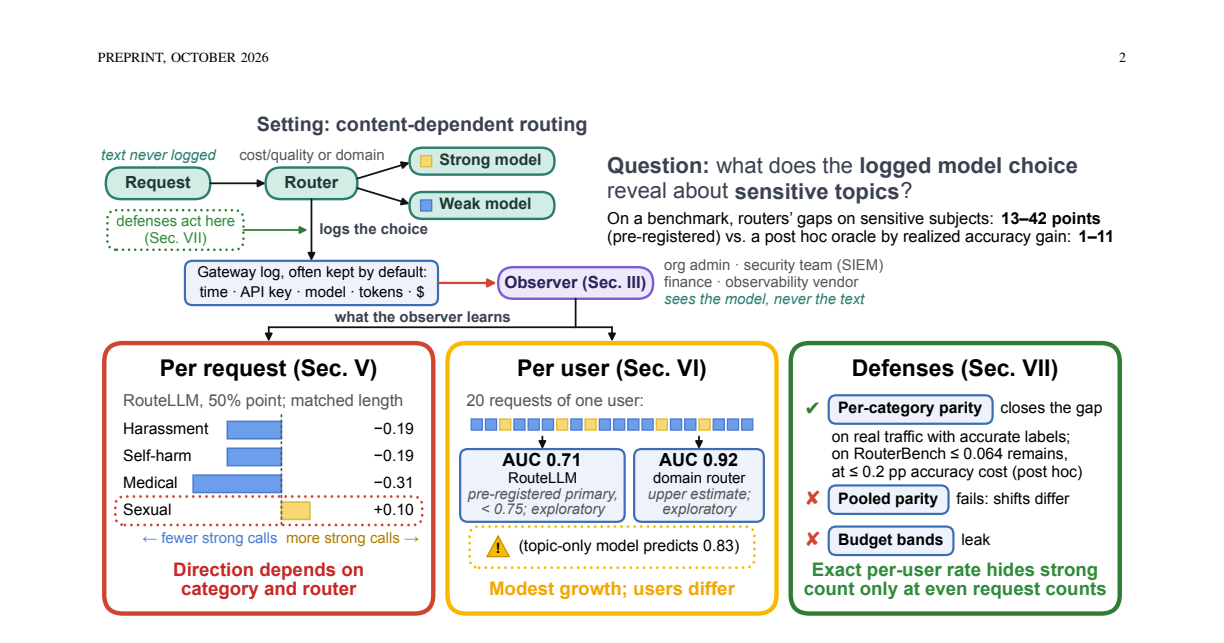
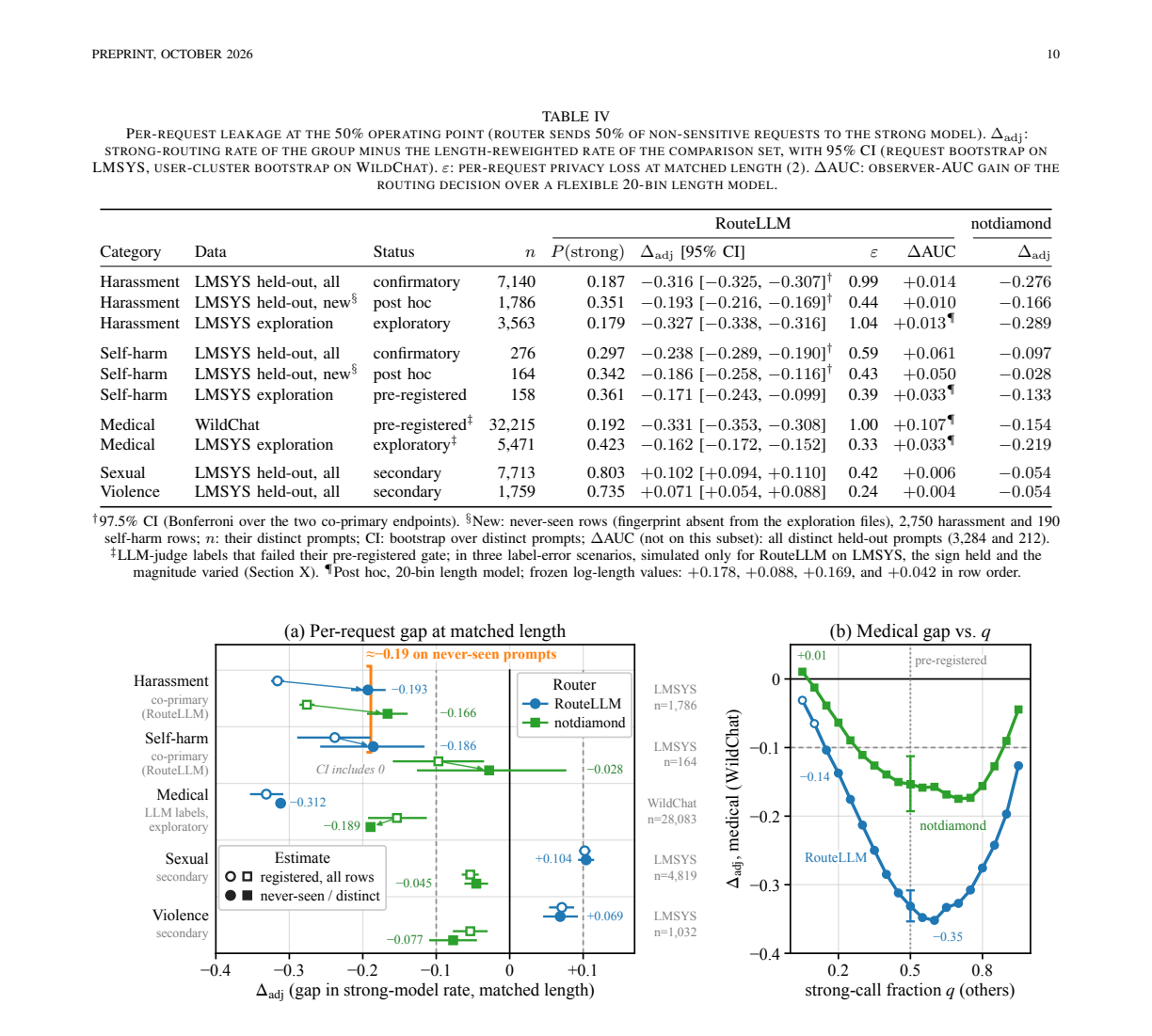
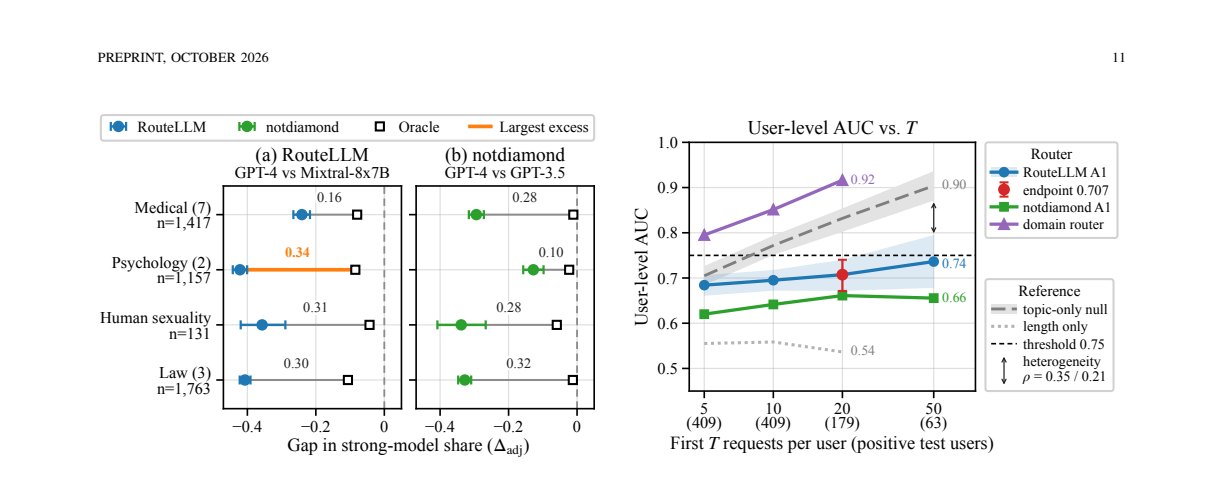
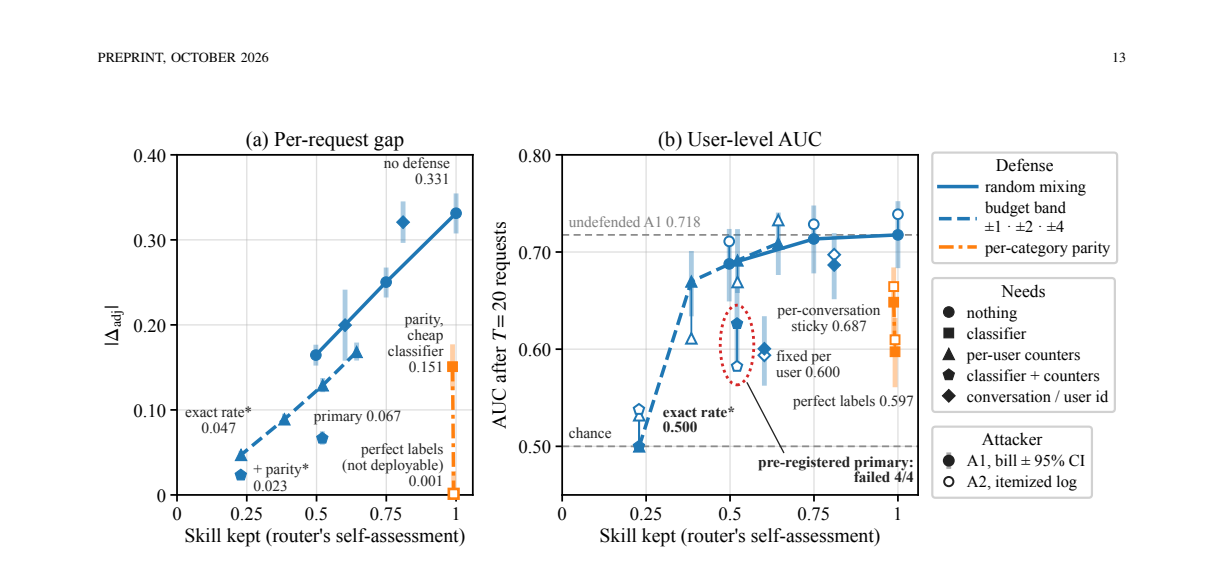
We measure this privacy channel beyond token counts, accounting for noisy labels and repeated prompts. We run pre-registered studies on 1.7 million real requests (WildChat-1M, LMSYS-Chat-1M) with two cost/quality routers and a domain router, survey eleven systems' logging, and test post-processing defenses. At matched length, the shift's direction depends on category and router. For RouteLLM at the 50% operating point, harassment and self-harm requests reach the strong model 19 points less often than comparable ones on prompts unseen in exploration, medical requests (exploratory: LLM labels failed their gate) 31 points less often on distinct prompts (both post hoc), and sexual requests 10 points more often (secondary); the other router's four are negative. Twenty RouteLLM decisions separate frequent medical askers with AUC 0.71, exploratory and below the pre-registered primary endpoint's 0.75 (domain router: 0.92, an upper estimate). Per-category length-matched parity with accurate labels removes the gap on real traffic, costing at most 0.2 accuracy points on RouterBench (post hoc), where routers' gaps on sensitive subjects (13-42 points, pre-registered) exceed those of an oracle routing by realized accuracy gain (1-11, post hoc). Per-conversation stickiness, per-user budget bands, and pooled parity fail, the last as categories' shifts differ in size or sign. A post hoc exact per-user rate hides only even-prefix strong counts and forfeits most self-assessed routing value; it preserves odd-position decisions, from which a post hoc log attack reaches AUC 0.73 after 20 RouteLLM requests (exploratory).
from the abstract
Pith says
Machine review · deepseek-v4-flash · 8 Oct 2026 · what was read was not recorded · not checked by a person
It can be wrong. Challenge this review or reply to it.
Holds up, with conditions. First real-traffic measurement showing content-dependent router logs leak sensitive topics; the qualitative result holds, but the confirmatory magnitudes rest on unvalidated moderation flags. This line is wrong
4 major objections · 4 minor
How often objections from reviews like this one are right: not yet measured
Not checked: figures, code, what the 42 references say.
The paper says, at Section IV-B, Table IV, Section X(1)
The review did not quote this passage.
Pith says: Objection 1 of 4 · major
The confirmatory co-primary endpoints (harassment -0.316, self-harm -0.238, Table IV) rest on the per-message OpenAI moderation flags shipped with LMSYS-Chat-1M, whose generating model/version is unknown and which the paper never validated (Section X(1)). The paper applies a label-validity gate to medical labels (exploratory after failing precision 0.75/0.70 vs. required 0.85, Section IV-B) but not to the confirmatory categories, leaving the headline magnitudes with unquantified label-noise bias.
more of objection 1
The paper's own medical simulation shows the sign is robust but the magnitude ranges from -0.10 to -0.23 against -0.162 observed (Section X(1)); an analogous sensitivity analysis for the moderation flags is needed before the co-primary estimates are treated as pinned.
The paper says, at Section V-B / Section X(2)
The review did not quote this passage.
Pith says: Objection 2 of 4 · major
The never-seen-prompts gaps (-0.193, -0.186; Table IV, Section V-B) are post hoc subsets of the held-out rows, and their intervals resample distinct prompts while holding the roughly 480,000-request comparison set fixed (Section IV-D). The paper labels them post hoc, which is good, but it also calls them 'the robust estimates' (Section VIII-B), which overstates their status given the subset selection is data-driven and the confidence intervals are conditional on a fixed design.
more of objection 2
The reporting is transparent; the interpretation should be softened.
The paper says, at Section X(8), Section VII
The review did not quote this passage.
A classifier read this sentence of the paper as acknowledging the concern (probability 0.65):
“Sensitive requests may also differ in format or phrasing, for example exam-style versus conversational, which we did not control; register is known to shift complexity-based routing, though mainly through input length [ 8], for which our gaps adjust.”
Pith says: Objection 3 of 4 · major
Length matching controls token count but not request format or register; the paper acknowledges this (Section X(8)) and the observer's conclusion does not require a causal topic interpretation. However, for the mitigation claim (Section VII, Proposition 1), the category labels enter the defense directly: if the flags select a style (e.g., quoted speech, personal disclosures), then parity with those labels equalizes decisions on the flag set, not on the topic itself.
more of objection 3
This is a known limitation of the paper's operationalization and should be stated in the defense recommendation (Section VIII-A) as a precondition: parity closes the gap as measured, and the gap's interpretation as topic-specific depends on labels.
The paper says, at Table IX / Remark 6
The review did not quote this passage.
Pith says: Objection 4 of 4 · major
The odd-position attack result (AUC 0.730 vs. original A2 0.532 at T=20, Table IX) is a solid demonstration that the exact-rate defense preserves signal, but it is post hoc, inherits the failed medical-label gate, uses unadjusted intervals with fixed training fits, and assumes the observer knows the complete ordered prefix and its starting phase (Section X(4)).
more of objection 4
All of this is stated. The remaining gap is that the paper does not compare the odd-position attack against any tuned baseline (e.g., a position-aware logistic regression over all positions, including parity with the count) to bound what a generic observer would achieve; the claim is therefore that this attack works, not that other attacks would not, and the text is careful about that.
4 minor objections
The paper says, at Abstract / Section V-A
Pith says: minor objection 1 of 4
The abstract lists RouteLLM gaps as '-0.19 and -0.19' for never-seen prompts while Table IV reports -0.193 and -0.186; the rounding is fine, but the abstract's per-category numbers for 'medical' and 'sexual' should consistently carry the exploratory and secondary qualifiers, which they do in the full text.
The paper says, at Various
Pith says: minor objection 2 of 4
Minor wording and notation issues: 'notdiamond' is used as an abbreviation for 'notdiamond-0001' without a definition at first use in table headers, and the paper would benefit from a notation table for the many symbols such as Delta_adj, epsilon, Delta_AUC, rho, SK, and m.
show 2 more
The paper says, at Section IV-F, Remark 5
Pith says: minor objection 3 of 4
Remark 5's i.i.d. Bernoulli model is presented as a heuristic explanation, and Section VII-B reports the empirical boundary distributions; this is fine, but the numbers are given only in the text, so a table or figure reference for those boundary distributions would make the empirical support easier to verify.
The paper says, at Table IV
Pith says: minor objection 4 of 4
For the Medical WildChat row, the displayed n (32,215) is the number of request rows while the distinct-prompt subset n=28,083 appears only in the figure caption; adding the distinct n to the table would make the post hoc estimate's support clearer.
What would settle it
Draw a stratified random sample of ~1,000 LMSYS-Chat-1M first-turn messages per confirmatory category (harassment, self-harm) plus an equal number of unflagged comparison messages. Have two independent human annotators, blind to routing decisions and to the flag status, label each message under the paper's stated category definitions. Compute the length-matched gap Δadj of (1) on the subset where both annotators agree (or use double-sampling to correct for misclassification), preserving the same held-out/never-seen splits. If the confirmed-positive gaps remain ≤ −0.10 with intervals excluding zero, the co-primary endpoints survive label validation; if not, the headline per-request claim is unverified.
from the skeptic's reading
How the review went
4 readings by deepseek-v4-flash · 8 Oct 2026
- Reader holds up, with conditions
- Skeptic agrees
- Editor wrote the verdict above
- Referee minor revision: 4 major objections, 4 minor
Not run on this paper: the simulated authors' defence.
Pith did not check this review's objections against the paper.
The review in full
The review in brief, machine-written
Worth your time. This is the first real-traffic measurement of a privacy channel routing work has mostly missed: the router's logged decision itself, readable by an org admin or SIEM with content logging off. The author runs pre-registered studies on 1.7 million real requests across two cost/quality routers and a domain router. At matched length, RouteLLM sends harassment and self-harm requests to the weak model 24-32 points less often than comparable requests, the direction depends on the category-router pair, and twenty logged decisions separate frequent medical askers at AUC 0.707. The RouterBench comparison earns its keep: routers differentiate sensitive MMLU subjects 13-42 points, against 1-11 for an accuracy oracle at the same budget, so most of the differentiation is not accuracy-rational. The defense evaluation is useful, especially the failure modes: pooled parity breaks because categories shift in opposite directions, budget bands leak at their edges, and the exact per-user rate still gives a position-aware attacker AUC 0.73.
The reporting discipline is the best part. Table III lists every primary and co-primary endpoint with freeze date and outcome, including the failures: sexual gap +0.102 against a predicted bound below 0.10, harassment gain over a 20-bin length model +0.014 against at least 0.10 predicted, user-level AUC 0.707 against 0.75, both medical label gates missed. Medical numbers stay labeled exploratory throughout. Section IX discloses four data-handling departures, including non-blind reference labels assigned by Claude and a history rewrite. Nothing material is hidden.
Now the soft spot, and it is where the stress-test lands: the confirmatory harassment and self-harm endpoints use OpenAI moderation flags shipped with LMSYS-Chat-1M that the paper never validated and whose generating model version is unknown. The label-error sensitivity analysis covers only the medical labels, not these flags; false positives at an unknown rate can bias the gap in either direction, and length matching does not control request format or register. The sign is consistent across all held-out rows, the never-seen subset, and distinct prompts, so the qualitative claim - logged routing decisions leak sensitive topics beyond token counts - is safe. The magnitudes are not yet pinned to human-verified labels. That is a major-revision issue, not a rejection.
This paper is for privacy and side-channel researchers, gateway operators, and router builders. It deserves a serious referee. I would send it out with a request for a validated subsample of the moderation flags, a label-noise analysis for them, and ideally a format/register robustness check.
The strongest objection
The central claim—that logged routing decisions leak sensitive topics at matched length—rests primarily on the two confirmatory co-primary endpoints (harassment −0.316, self-harm −0.238, Table IV), whose category labels are the per-message OpenAI moderation outputs shipped with LMSYS-Chat-1M. The paper states it never validated these flags and that the generating model/version is unknown (Section X(1); b450), whereas only the medical labels underwent validity gates, and those gates failed. Thus the confirmatory categories have no human-validated labels, and the same label-validity objection the paper applies to medical results (exploratory) applies to the headline confirmatory numbers, yet they are reported as confirmatory. Length matching in (1) controls token count but not request format or register (Section X(8); b492): if the moderation flags select a style—personal disclosures, quoted speech, adversarial phrasing—the router may shift for that style rather than for the topic per se. The paper's own label-error simulation for medical labels on LMSYS shows the sign survives but the magnitude ranges from −0.10 to −0.23 against −0.162 observed (Section X(1)); no equivalent sensitivity analysis exists for the moderation-flag categories. False negatives in the flags dilute the gap conservatively, but false positives at an unknown rate could bias the estimate in either direction. The qualitative direction is likely robust, but the central quantitative claim is not yet pinned to human-verified topic labels.
The reader's weakest assumption identifies the same load-bearing concern: category labels must be accurate enough for measured routing gaps to reflect the topic. The two pre-registered co-primary endpoints, which the paper treats as its confirmatory standard, are defined by OpenAI moderation flags that the paper deliberately never validated against any human or independent labels (Section X(1)). The paper itself demotes all medical results to exploratory solely because their LLM-judge labels failed precision gates; by that same standard, the moderation-flag categories should have been validated, and the absence of such validation leaves the central claim's primary support resting on unmeasured label quality. This is not an external-consensus dispute but an internal evidentiary gap: the labels are classifier outputs, and the paper acknowledges they cannot be reproduced because the model version is unknown (b450). A false-positive rate of even 20–30% in the flags, plausible for 2023 moderation on messy real chats, could change the gap's magnitude substantially (the paper's own medical simulation shows −0.162 observed versus −0.10 to −0.23 corrected), and if false positives skew toward content the router sends to the strong model (as sexual content does, +0.102), even the sign could be affected. Length matching does not resolve format/register confounds, which the paper acknowledges in Section X(8). The defense and user-level results are secondary to the per-request claim; defense findings are already conditional on labels, and the user-level endpoint already failed its pre-registered threshold. The proposed human-label check would settle the concern without re-running routers or re-analyzing the full dataset. If the check confirms the gaps, the paper's qualitative and quantitative per-request claims stand; if not, the headline numbers should be demoted to exploratory alongside the medical ones. Because the reader's CONDITIONAL verdict already reflects this risk, the verdict remains UNCHANGED.
The referee's report
If the results hold, this is a genuinely new privacy measurement: a realistic, field-grounded channel (the logged routing decision as business metadata), measured on organic traffic at scale with pre-registration and duplicate awareness, with an unusually honest accounting of failures. The paper's discipline is a strength: Table III reports every pre-registered primary and co-primary endpoint including misses, and the post hoc status of the headline never-seen estimates is stated in the abstract, text, and figure captions. The practical guidance (treat the model field as content-derived data; per-category parity with validated labels; budget bands and stickiness do not protect) is actionable. The main significance caveat is that the confirmatory per-request endpoints rest on unvalidated moderation flags of unknown provenance, and the medical (user-level) results rest on labels that failed the paper's own gates, so the quantitative magnitudes are more uncertain than the crisp numbers in Tables IV-VIII suggest. The RouterBench comparison between router gaps and an accuracy oracle is informative but post hoc on the oracle side.
Pith's reading of the paper (a machine's summary, not the authors')
The paper tries to establish that the logged choice made by a content-dependent LLM router, on its own and without any text, leaks which sensitive topics users ask about. The author measures this channel on roughly 1.7 million real chat requests from two public datasets, using two cost/quality routers and one domain router, and shows that at matched request length the routing decision still differs for harassment, self-harm, medical, and sexual requests. The paper argues this matters because many gateways and cloud platforms keep the model-choice field by default while content logging is disabled, so an insider with log access can infer topics the user may believe are hidden. It also finds that a simple defense, per-category length-matched parity, closes the per-request gap on real traffic at a small accuracy cost, while simpler defenses like per-conversation stickiness or per-user budget bands do not work.
What carries the argument. The length-matched gap is the central measurement object: for a sensitive category c it compares the category's strong-model routing rate with the rate of non-sensitive comparison requests reweighted to have the same length profile, giving Δadj(c). This quantity, along with the per-request privacy loss ε(c), the maximum absolute log-likelihood ratio between the two routing distributions after controlling for length, carries the per-request argument. The user-level argument is carried by the bill-only attacker A1, which scores a user by the count of strong-model decisions in the first T requests, and the itemized-log attacker A2, which uses each record's decision together with the length decile. The defense that works, per-category length-matched parity, post-processes router scores so that within every global length decile each category receives the same strong-model rate as the comparison set, which Proposition 1 shows removes the gap up to rounding when the category labels are accurate.
Core claim. The central claim is that a router's logged binary decision, observed without any request text, carries information about sensitive topics beyond what can be explained by request length alone. At the 50 percent strong-model operating point, RouteLLM sends harassment requests to the weak model 0.316 less often than length-matched comparison requests on all held-out LMSYS rows, and self-harm requests 0.238 less often; on prompts never seen in exploration, these gaps shrink to 0.193 and 0.186 but remain statistically distinguishable. Medical requests on WildChat show the largest gap at 0.331, although the LLM-judge labels failed the pre-registered validity gate, making that result exploratory. The direction of the shift is not uniform: sexual requests go 10 points more often to the strong model, and the second router, notdiamond-0001, sends all four sensitive categories less often, so the leak is a property of the category-router pair rather than of sensitivity as such. At the user level, the strong-model count across a user's first 20 requests separates frequent medical askers from non-askers with AUC 0.707, below the pre-registered 0.75 threshold, and length-matched parity per category removes the per-request gap on real traffic when labels are accurate, at a RouterBench accuracy cost of at most 0.2 points.
The premise it rests on. The category labels are accurate enough that the measured routing gaps reflect the topic rather than label noise, an assumption that is strained for the medical category, whose judge labels failed both pre-registered precision gates, and untestable for the moderation-flag categories, whose model version is unstated and intentionally unvalidated.
If the paper is right (Pith's inferences, not the authors')
If the paper is right, gateway and cloud administrators who can already see model-choice logs can infer sensitive topics such as harassment, self-harm, and medical questions from real user traffic without reading any content.
Disabling content logging does not by itself protect topic privacy when routing depends on content, so compliance and monitoring policies that rely on content removal need to treat the model field as content-derived data.
Per-category length-matched parity is a practical mitigation that removes the per-request gap on real traffic when validated labels are available, with an accuracy cost of at most 0.2 points on RouterBench.
Pooled parity, per-conversation stickiness, and per-user budget bands should not be deployed as privacy controls, because categories shift by different amounts or in opposite directions and the band defenses leak through their boundaries.
An exact per-user strong-request rate hides the count only at even request counts, and even then the ordered log preserves odd-position decisions from which a position-aware attacker can recover user-level signal.
The reported gaps exceed what an accuracy oracle would produce by 10 to 34 points, indicating that much of the sensitive-topic differentiation is not explained by realized accuracy gains.
One extension the author leaves implicit is that the size of the gap at a given operating point may not be stable across router versions or model pairs; the per-category parity defense, however, is designed to hold whatever the direction of the gap is, so it may generalize better than any particular measured number.
A further inference is that the user-level leakage, though below the pre-registered threshold on medical requests, could be larger for categories with clearer routing signatures, such as harassment or self-harm, if user-linked data were available; the paper explicitly notes this measurement is missing.
The dependence of the leak's direction on the category-router pair suggests that no single blanket rule, such as 'send sensitive content to the strong model,' is a privacy control; the right test is the per-category length-matched gap itself.
A testable extension would be to run the per-category parity defense online with calibrated score cutoffs per category-length cell and measure whether the finite-sample parity guarantee degrades under distribution shift, which the paper notes the batch rule does not automatically inherit.
Check this review
Pith stored no record of this review's passes and took no fingerprint of it. Reviews made by code from 13 Nov 2026 on carry both.
How often reviews like this one are right
Reviews like this one: written by deepseek-v4-flash, where what was read was not recorded.
How often objections from reviews like this one are right: not yet measured
Reviews by people
This review was written by a machine. No person has reviewed this paper on Pith yet. A scientist listed on Pith can review it for a fee, and their review is published here whatever it concludes.
The paper
Abstract
LLM routers pick a cheap or expensive model per request by its content, and many gateways and some cloud platforms can log that choice with content logging off. We measure this privacy channel beyond token counts, accounting for noisy labels and repeated prompts. We run pre-registered studies on 1.7 million real requests (WildChat-1M, LMSYS-Chat-1M) with two cost/quality routers and a domain router, survey eleven systems' logging, and test post-processing defenses. At matched length, the shift's direction depends on category and router. For RouteLLM at the 50% operating point, harassment and self-harm requests reach the strong model 19 points less often than comparable ones on prompts unseen in exploration, medical requests (exploratory: LLM labels failed their gate) 31 points less often on distinct prompts (both post hoc), and sexual requests 10 points more often (secondary); the other router's four are negative. Twenty RouteLLM decisions separate frequent medical askers with AUC 0.71, exploratory and below the pre-registered primary endpoint's 0.75 (domain router: 0.92, an upper estimate). Per-category length-matched parity with accurate labels removes the gap on real traffic, costing at most 0.2 accuracy points on RouterBench (post hoc), where routers' gaps on sensitive subjects (13-42 points, pre-registered) exceed those of an oracle routing by realized accuracy gain (1-11, post hoc). Per-conversation stickiness, per-user budget bands, and pooled parity fail, the last as categories' shifts differ in size or sign. A post hoc exact per-user rate hides only even-prefix strong counts and forfeits most self-assessed routing value; it preserves odd-position decisions, from which a post hoc log attack reaches AUC 0.73 after 20 RouteLLM requests (exploratory).
The paper's own sentences, arranged, kept beside the review and separate from it. Each label is drawn from a closed vocabulary; the number beside it is the probability the classifier gave that label. No sentence in this record was written by a model.
abstract compiled · 2026-10-08
The authors' main claim, as the classifier picked it out 0.97
“Per-category length-matched parity with accurate labels removes the gap on real traffic, costing at most 0.2 accuracy points on RouterBench (post hoc), where routers' gaps on sensitive subjects (13-42 points, pre-registered) exceed those of an oracle routing by realized accuracy gain (1-11, post hoc).”
How the main claim is stated: asserted 1.00
What the abstract itself states, as probabilities: claims first 0.06 · states limitation 0.90 · human participants 0.42 · controlled comparison 0.76 · randomized assignment 0.04 · states quantitative result 0.99 · compares with prior results 0.91 · mentions code or data availability 0.04
The abstract, sentence by sentence
This table labels the abstract only (arXiv listing abstract v1). The number is the probability the classifier gave the label.
| Sentence | Role | The authors' own work | States the main conclusion | Strength |
|---|---|---|---|---|
| LLM routers pick a cheap or expensive model per request by its content, and many gateways and some cloud platforms can log that choice with content logging off. | background 1.00 | 0.06 | 0.05 | asserted 0.94 |
| We measure this privacy channel beyond token counts, accounting for noisy labels and repeated prompts. | contribution 0.76 | 0.94 | 0.04 | asserted 1.00 |
| We run pre-registered studies on 1.7 million real requests (WildChat-1M, LMSYS-Chat-1M) with two cost/quality routers and a domain router, survey eleven systems' logging, and test post-processing defenses. | method 0.87 | 0.96 | 0.04 | asserted 0.99 |
| At matched length, the shift's direction depends on category and router. | result 0.99 | 0.86 | 0.09 | asserted 1.00 |
| For RouteLLM at the 50% operating point, harassment and self-harm requests reach the strong model 19 points less often than comparable ones on prompts unseen in exploration, medical requests (exploratory: LLM labels failed their gate) 31 points less often on distinct prompts (both post hoc), and sexual requests 10 points more often (secondary); the other router's four are negative. | result 1.00 | 0.94 | 0.14 | asserted 1.00 |
| Twenty RouteLLM decisions separate frequent medical askers with AUC 0.71, exploratory and below the pre-registered primary endpoint's 0.75 (domain router: 0.92, an upper estimate). | result 1.00 | 0.95 | 0.11 | asserted 1.00 |
| Per-category length-matched parity with accurate labels removes the gap on real traffic, costing at most 0.2 accuracy points on RouterBench (post hoc), where routers' gaps on sensitive subjects (13-42 points, pre-registered) exceed those of an oracle routing by realized accuracy gain (1-11, post hoc). | result 0.99 | 0.93 | 0.48 | asserted 1.00 |
| Per-conversation stickiness, per-user budget bands, and pooled parity fail, the last as categories' shifts differ in size or sign. | result 1.00 | 0.92 | 0.13 | asserted 1.00 |
| A post hoc exact per-user rate hides only even-prefix strong counts and forfeits most self-assessed routing value; it preserves odd-position decisions, from which a post hoc log attack reaches AUC 0.73 after 20 RouteLLM requests (exploratory). | result 0.98 | 0.90 | 0.09 | asserted 1.00 |
What kind of paper the classifier reports this is: empirical study 1.00 · evidence from observation or experiment 0.83
What was examined, and what was not
Sources read
- arXiv listing abstract v1
Not examined
- full text
- figures and tables
- references and citing sentences
- relations to other papers
Levels run
- P abstract
Not run
- S sections
- T body sentences
- C citations
- R cross-paper relations
How the labels were made
Compiled by classifier-1.13.0 via TypeSafe API, question bank abstract-p1-20260923, 2026-10-08: 1 request, 7,316 input tokens.
Every quoted sentence on this record is the authors'. Every label is from Pith's closed vocabulary, with the probability shown beside it. This record as JSON
Figures (5)
Showing 4 of the paper's 5 figures. Figures are the authors', reproduced from the paper.
References (42)
- [1] L. Chen, M. Zaharia, and J. Zou, “FrugalGPT: How to use large language models while reducing cost and improving performance,”Trans. Machine Learning Research, 2024, arXiv:2305.05176 on PithPith's reviewarXiv
- [2] D. Ding, A. Mallick, C. Wang, R. Sim, S. Mukherjee, V . Rühle, L. V . S. Lakshmanan, and A. H. Awadallah, “Hybrid LLM: Cost-efficient and quality-aware query routing,” inProc. Int. Conf. Learning Representations (ICLR), vol. 2024, 2024, pp. 41 348–41 366, arXiv:2404.14618 on PithPith's reviewarXiv
- [3] P. Aggarwal, A. Madaan, A. Anand, S. P. Potharaju, S. Mishra, P. Zhou, A. Gupta, D. Rajagopal, K. Kappaganthu, Y . Yang, S. Upad- hyay, M. Faruqui, and Mausam, “AutoMix: Automatically mixing language models,” inAdvances in Neural Information Processing Systems (NeurIPS), vol. ... on PithPith's reviewarXiv
- [4] I. Ong, A. Almahairi, V . Wu, W.-L. Chiang, T. Wu, J. E. Gonzalez, M. W. Kadous, and I. Stoica, “RouteLLM: Learning to route LLMs from preference data,” inProc. Int. Conf. Learning Representations (ICLR), vol. 2025, 2025, pp. 34 433–34 448, arXiv:2406.18665 on PithPith's reviewarXiv
- [5] Q. J. Hu, J. Bieker, X. Li, N. Jiang, B. Keigwin, G. Ranganath, K. Keutzer, and S. K. Upadhyay, “RouterBench: A benchmark for multi-LLM routing system,”arXiv preprint, 2024, arXiv:2403.12031 on PithPith's reviewarXiv
- [6] OpenRouter, “Auto Router,” 2026, documentation, https://openrouter.ai/ docs/guides/routing/routers/auto-router, accessed Oct. 1, 2026 on Pith
- [7] A. M. Kassem, B. Schölkopf, and Z. Jin, “How robust are router-LLMs? Analysis of the fragility of LLM routing capabilities,” inProc. Conf. European Chapter of the Association for Computational Linguistics (EACL), 2026, pp. 7496–7507, doi: 10.18653/v1/2026.eacl-long.351 on Pithdoi:10.18653/v1/2026.eacl-long.351
- [8] S. Koul, “Register bias in complexity-based large language model routing,” arXiv preprint, 2026, arXiv:2609.17542 on PithPith's reviewarXiv
- [9] vLLM project, “vLLM Semantic Router,” 2025, software, https://github .com/vllm-project/semantic-router; domain classifier used here, revision f6354f54, accessed Oct. 6, 2026: https://huggingface.co/vllm-sr/Vela-1.0 -Encoder-307M-Domain (formerly underllm-semantic-router) on Pith
- [10] S. Li, V . C. Raghuram, O. Khattab, J. Hirschberg, and Z. Yu, “PAPILLON: Privacy preservation from Internet-based and local language model ensem- bles,” inProc. Conf. Nations of the Americas Chapter of the Association for Computational Linguistics: Human Language Technologies ... on Pithdoi:10.18653/v1/2025.naacl-long.173
- [11] J. Zhan, H. Shen, Z. Lin, and T. He, “PRISM: Privacy-aware routing for adaptive cloud–edge LLM inference via semantic sketch collaboration,” inProc. AAAI Conf. Artificial Intelligence (AAAI), vol. 40, no. 33, 2026, pp. 28 150–28 158, doi: 10.1609/aaai.v40i33.40041 on Pithdoi:10.1609/aaai.v40i33.40041
- [12] X. Wu, Y . Zhang, Y . Ji, R. Shirkavand, Q. Lou, and S. Gao, “Privacy- preserving LLMs routing,”arXiv preprint, 2026, arXiv:2604.15728 on PithPith's reviewarXiv
- [13] R. Wails, Y . Sun, A. Johnson, M. Chiang, and P. Mittal, “Tempest: Temporal dynamics in anonymity systems,”Proceedings on Privacy Enhancing Technologies, vol. 2018, no. 3, pp. 22–42, 2018, doi: 10.1515/popets-2018-0019 on Pithdoi:10.1515/popets-2018-0019
- [14] F. Rochet, R. Wails, A. Johnson, P. Mittal, and O. Pereira, “CLAPS: Client-location-aware path selection in Tor,” inProc. ACM Conf. Computer and Communications Security (CCS), 2020, pp. 17–34, doi: 10.1145/3372297.3417279 on Pithdoi:10.1145/3372297.3417279
- [15] T. Kannan, N. Feamster, and H. Hoffmann, “Prediction privacy in distributed multi-exit neural networks: Vulnerabilities and solutions,” inProc. ACM Conf. Computer and Communications Security (CCS), 2023, pp. 1123–1137, doi: 10.1145/3576915.3623069 on Pithdoi:10.1145/3576915.3623069
- [16] A. Akinsanya and T. Brennan, “Timing channels in adaptive neural networks,” inProc. Network and Distributed System Security Symp. (NDSS), 2024, doi: 10.14722/ndss.2024.24125 on Pithdoi:10.14722/ndss.2024.24125
- [17] G. McDonald and J. Bar Or, “Whisper Leak: A side-channel attack on large language models,”arXiv preprint, 2025, arXiv:2511.03675 on PitharXiv
- [18] S. Pouryousef, J. Lopez, S. R. Nowmi, M. M. Kamol, M. Hossain, M. Tran, and M. S. Rahman, “A large-scale benchmark and risk assessment of traffic analysis attacks on cloud LLM services,”arXiv preprint, 2026, arXiv:2609.31877 on PithPith's reviewarXiv
- [19] B. Dangol, “From privacy to workflow integrity: Communication-graph metadata in autonomous agent interoperability,”arXiv preprint, 2026, arXiv:2606.07150 on PithPith's reviewarXiv
- [20] J. Xu, L. Fan, Z. Wang, X. Li, and H. Liu, “Selection-invariant communication compilers for privacy-aware multi-agent LLM workflows,” arXiv preprint, 2026, arXiv:2609.26076 on PithPith's reviewarXiv
show 22 more
- [21] S. Peng, Y . Jiang, Y . Liu, X. Yu, and L. Zhu, “Privacy-preserving agentic AI in edge networks with content and trace protection,”IEEE Trans. Network Science and Engineering, vol. 13, pp. 10 918–10 932, 2026, doi: 10.1109/TNSE.2026.3720648 on Pithdoi:10.1109/tnse.2026.3720648
- [22] M. Gaikwad, “A VEC: Bootstrapping privacy for local LLMs,”arXiv preprint, 2025, arXiv:2509.10561 on PithPith's reviewarXiv
- [23] D. Kim and J. Yang, “AgentCardLeak: Inferring user intent from AI- agent discovery metadata,” inProc. Int. Conf. Computer Communi- cation and the Internet (ICCCI), 2026, pp. 193–198, doi: 10.1109/ ICCCI70321.2026.11666528 on Pith
- [24] W.-L. Chiang, L. Zheng, Y . Sheng, A. N. Angelopoulos, T. Li, D. Li, B. Zhu, H. Zhang, M. I. Jordan, J. E. Gonzalez, and I. Stoica, “Chatbot Arena: An open platform for evaluating LLMs by human preference,” in Proc. Int. Conf. Machine Learning (ICML), vol. 235, 2024, pp. 8359–... on PithPith's reviewarXiv
- [25] Not Diamond, “notdiamond-0001,” 2023, Hugging Face model, https: //huggingface.co/notdiamond/notdiamond-0001, a binary router between GPT-3.5 and GPT-4; revision d754679a on Pith
- [26] K. N. Kumar and S. K. Saminathan, “Task- and session-level model routing: A common-interface hybrid evaluation of four open-source routers across four benchmarks,”arXiv preprint, 2026, arXiv:2608.14641 on PithPith's reviewarXiv
- [27] S. Wang, J. White, S. Allahyar, D. Atreja, U. Zaratiana, and K. Zhang, “Dynamic LLM routers are often misguided,”arXiv preprint, 2026, arXiv:2610.02762 on PithPith's reviewarXiv
- [28] N. Carlini and M. Nasr, “Remote timing attacks on efficient language model inference,”arXiv preprint, 2024, arXiv:2410.17175 on PithPith's reviewarXiv
- [29] B. Chen, B. Tag, H. Xue, D. Angus, and F. Salim, “When ads become profiles: Uncovering the invisible risk of web advertising at scale with LLMs,” inProc. ACM Web Conf. (WWW), 2026, pp. 9604–9615, doi: 10.1145/3774904.3793060 on Pithdoi:10.1145/3774904.3793060
- [30] R. Ding, T. Xu, X. Shen, A. A. Ding, and Y . Fei, “MoEcho: Exploiting side-channel attacks to compromise user privacy in mixture-of-experts LLMs,” inProc. ACM Conf. Computer and Communications Security (CCS), 2025, pp. 2159–2173, doi: 10.1145/3719027.3765174 on Pithdoi:10.1145/3719027.3765174
- [31] B. Lv, Z. Xu, K. Xiu, R. Ding, T. Zheng, Z. Wang, and K. Ren, “RouteScan: A non-intrusive approach to auditing MoE LLMs safety via expert routing telemetry,”arXiv preprint, 2026, arXiv:2605.24817 on PithPith's reviewarXiv
- [32] S. Wang, T. Zhu, H. Chen, J. Li, M. Yang, and B. Liu, “Hidden risks of Jev: An empirical study of security, privacy, and dual use,”arXiv preprint, 2026, arXiv:2610.04985 on PithPith's reviewarXiv
- [33] M. Hardt, E. Price, and N. Srebro, “Equality of opportunity in supervised learning,” inAdvances in Neural Information Processing Systems (NeurIPS), vol. 29, 2016, arXiv:1610.02413 on PithPith's reviewarXiv
- [34] R. Xian, L. Yin, and H. Zhao, “Fair and optimal classification via post- processing,” inProc. Int. Conf. Machine Learning (ICML), vol. 202, 2023, pp. 37 977–38 012, arXiv:2211.01528 on PithPith's reviewarXiv
- [35] Ú. Erlingsson, V . Pihur, and A. Korolova, “RAPPOR: Randomized aggregatable privacy-preserving ordinal response,” inProc. ACM Conf. Computer and Communications Security (CCS), 2014, pp. 1054–1067, doi: 10.1145/2660267.2660348 on Pithdoi:10.1145/2660267.2660348
- [36] LMSYS, “RouteLLM: A framework for serving and evaluating LLM routers,” 2024, software, https://github.com/lm-sys/RouteLLM; thresh- old calibration via routellm.calibrate_threshold, accessed Oct. 1, 2026 on Pith
- [37] W. Zhao, X. Ren, J. Hessel, C. Cardie, Y . Choi, and Y . Deng, “WildChat: 1M ChatGPT interaction logs in the wild,” inProc. Int. Conf. Learning Representations (ICLR), vol. 2024, 2024, pp. 34 590–34 605, arXiv:2405.01470 on PithPith's reviewarXiv
- [38] L. Zheng, W.-L. Chiang, Y . Sheng, T. Li, S. Zhuang, Z. Wu, Y . Zhuang, Z. Li, Z. Lin, E. P. Xing, J. E. Gonzalez, I. Stoica, and H. Zhang, “LMSYS-Chat-1M: A large-scale real-world LLM conversation dataset,” inProc. Int. Conf. Learning Representations (ICLR), vol. 2024, 2024, ... on PithPith's reviewarXiv
- [39] Large Model Systems Organization (LMSYS), “LMSYS-Chat-1M dataset card and dataset license agreement,” 2024, Hugging Face, https://hugg ingface.co/datasets/lmsys/lmsys-chat-1m, revision 200748d9, accessed Oct. 7, 2026 on Pith
- [40] Allen Institute for Artificial Intelligence (Ai2), “WildChat-1M dataset card,” 2024, Hugging Face, https://huggingface.co/datasets/allenai/Wild Chat-1M, revision 7d6490e4, accessed Oct. 6, 2026 on Pith
- [41] D. Hendrycks, C. Burns, S. Basart, A. Zou, M. Mazeika, D. Song, and J. Steinhardt, “Measuring massive multitask language understand- ing,” inProc. Int. Conf. Learning Representations (ICLR), 2021, arXiv:2009.03300 on PithPith's reviewarXiv
- [42] OpenAI, “Moderation,” 2026, OpenAI API documentation, accessed Oct. 1, 2026: https://developers.openai.com/api/docs/guides/moderation (formerly https://platform.openai.com/docs/guides/moderation) on Pith
Cited by 1 Pith paper
Reviewed papers on Pith that cite this one. The full citation record
- Privacy Preference Controls for Agentic Systems cs.CY · Oct 2026
Challenges and discussion
Disagree with the review, or know something it missed? Leave a comment, or challenge this review formally: a challenge becomes a permanent entry in this paper's record, and its decision is published here.
Come back by email
A short list of the week's newly reviewed papers. Nothing is sent until you confirm from your inbox, and every email has a link that stops it. No account.
No comments yet.
Sign in to comment