Quantum Physics · arXiv:2610.03281 v1 · submitted 2 Oct 2026 · 44 references
Efficiently and Reliably Measuring Information Processing Capacity in Dynamical Systems via Kernels
The paper says
“Information Processing Capacity (IPC) is a powerful system-agnostic metric for quantifying a dynamical system's computational capability and is widely used in quantum reservoir computing. However, standard IPC suffers from severe computational limitations.”
more of the abstract
Computing IPC involves estimating how well the system can reconstruct, via linear regression, an (in principle) infinite family of orthogonal polynomial functions of delayed inputs. In practice, this evaluation must be made finite, so we need only to consider polynomials up to a chosen maximum degree. Moreover, the computational complexity for computing IPC grows combinatorially with the considered maximum degree and delay. Here, we introduce Kernel-IPC (KIPC), a scalable framework that uses kernel methods to compute the total IPC without explicitly enumerating basis functions. This allows us to account for the full (infinite) basis (without degree truncation). We also provide a null-hypothesis test for statistically comparing the KIPC of two dynamical systems. We validate KIPC on an echo state network and demonstrate its utility for quantum reservoir computing on a disordered spin chain.
from the abstract
Pith says
Machine review · deepseek-v4-flash · 5 Oct 2026 · what was read was not recorded · not checked by a person
It can be wrong. Challenge this review or reply to it.
Holds up, with conditions. A sound and genuinely useful method—the kernel trace identity works and the estimator is fast—but 'total IPC' overstates what KIPC is: a ρ-weighted capacity functional whose headline observations get no sensitivity analysis. This line is wrong
3 major objections · 4 minor
How often objections from reviews like this one are right: not yet measured
Not checked: figures, code, what the 44 references say.
The paper says, at §III, Remark 1 and §III B; Eqs. (12), (15)
The review did not quote this passage.
Pith says: Objection 1 of 3 · major
The abstract, Theorem 1, and Conclusions present KIPC as computing 'the total IPC' without degree truncation, but KIPC is a weighted functional with per-factor weights λ_i = ρ^i/(2i+1) and a free parameter ρ=0.95, and this distinction is load-bearing. As the paper itself notes in Remark 1, the weights encode Assumption 1 rather than being derived from it, and Example 1 …
more of objection 1
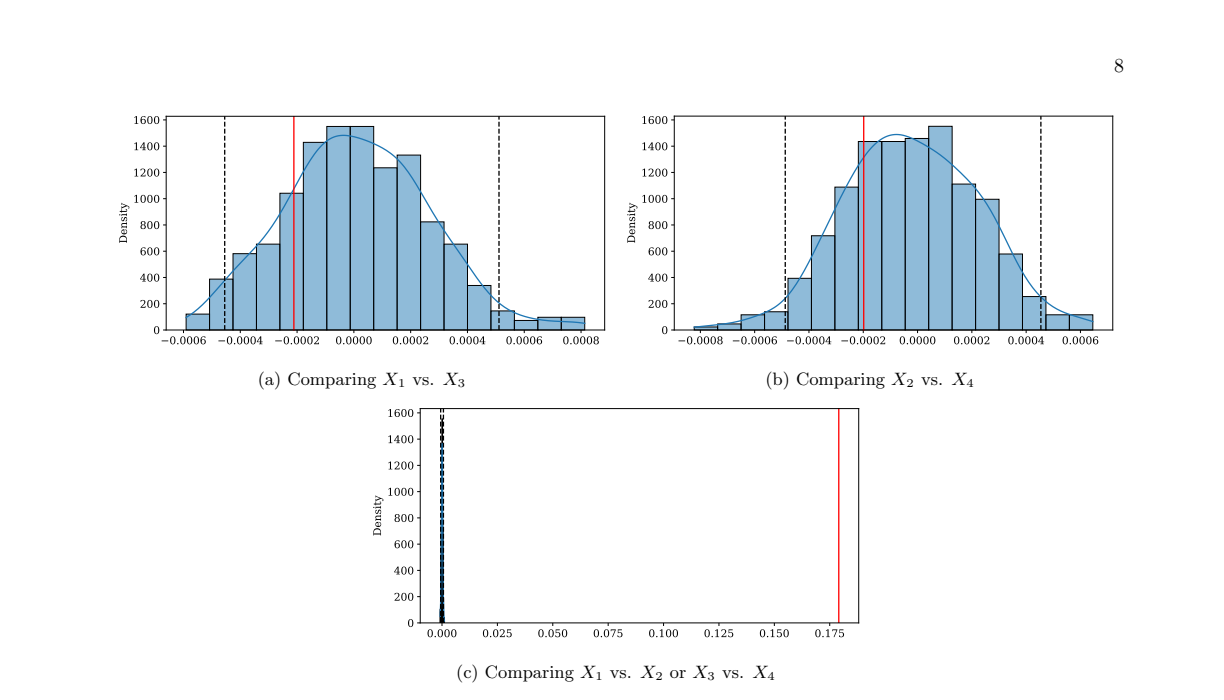
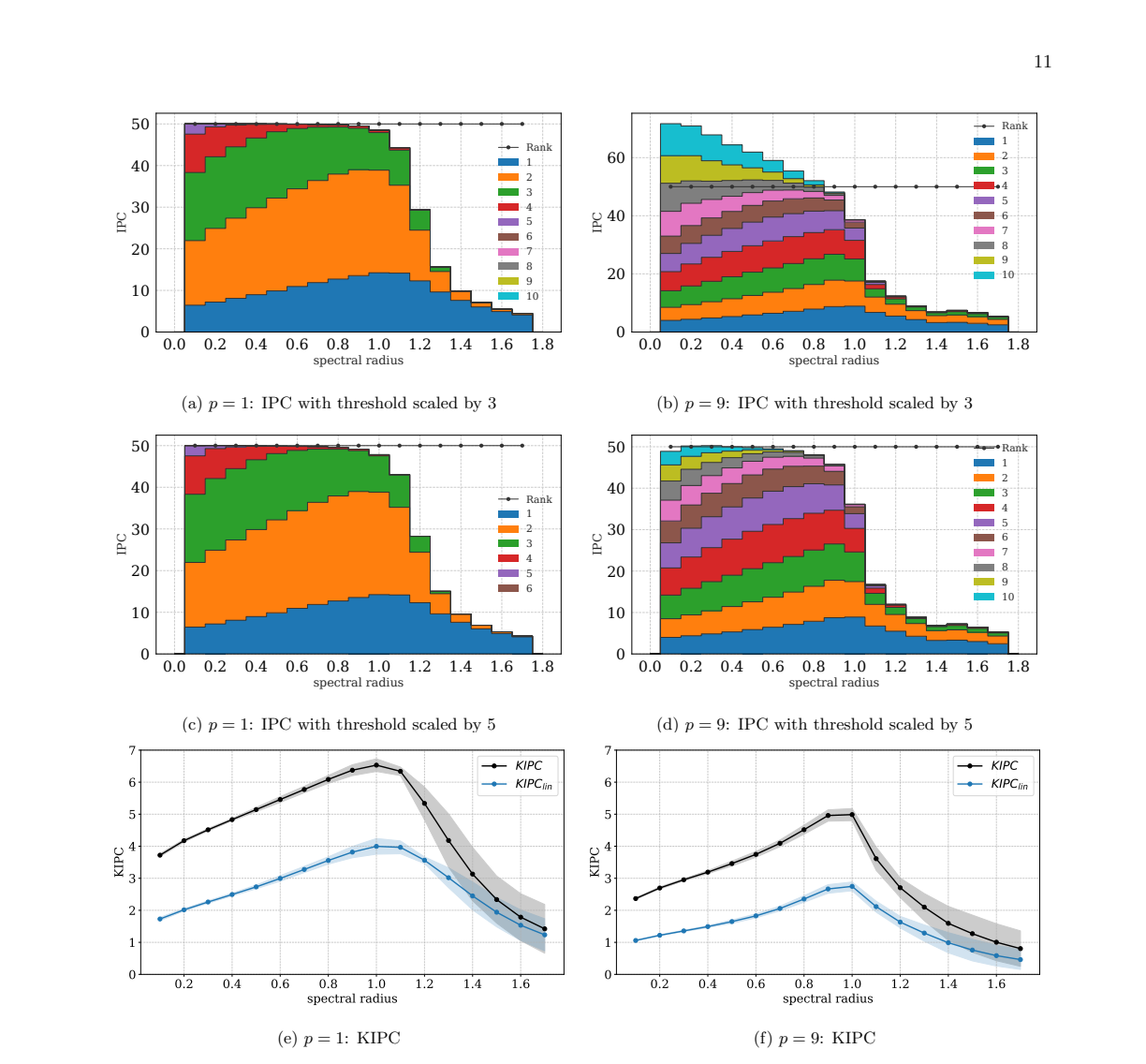
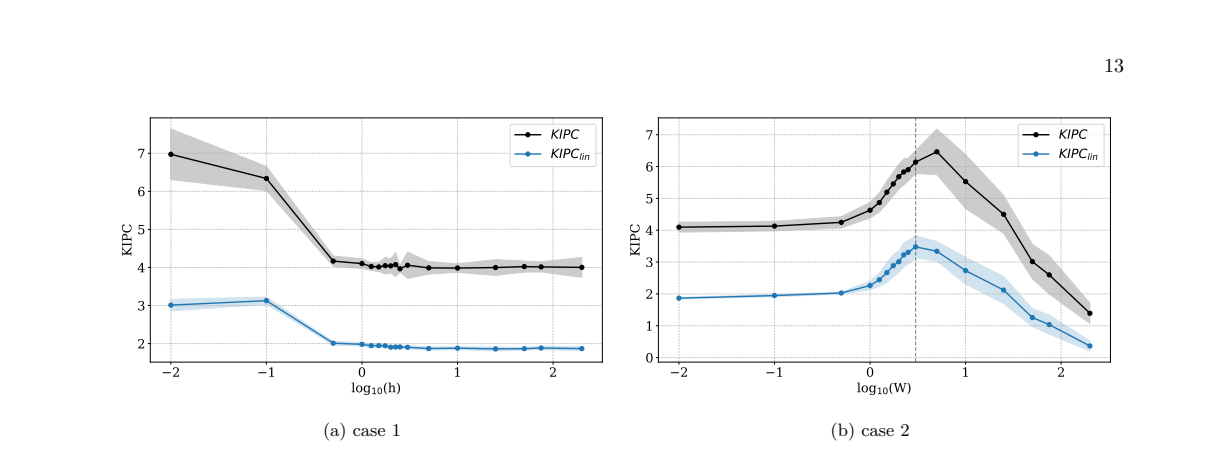
… shows the consequences: the two systems X1 and X2 have identical unweighted total IPC (=3), yet receive KIPC values 0.5543 and 0.3745 solely because the degree-50 term is weighted by ρ^50/101≈0.000762. Since the two headline observations (Fig. 4e/f: ESN maximum KIPC at s=1; Fig. 5b: misalignment of linear and nonlinear KIPC maxima near W∈[3,5]) are computed at a single ρ, and Section III B provides no sensitivity analysis over ρ, the robustness of these conclusions to the weight choice is unestablished; a system whose capacity sits in high-degree terms is underweighted and can be ranked oppositely under different ρ. The authors should either supply a ρ-sensitivity analysis showing the qualitative observations survive, or substantially temper the claim that KIPC measures 'the' total IPC rather than a particular weighted capacity functional.
The paper says, at §III A, Eqs. (21)–(22)
The review did not quote this passage.
Pith says: Objection 2 of 3 · major
The validity of the permutation test rests on an asserted rather than derived property. The text states that under H0 the projections Πa, Πb are 'projecting on the same space' and that therefore Πa−Πb and K⊗(U,U) 'can be assumed to be independent', and that the null distribution is symmetric because 'Πa−Πb can be positive or negative with equal probability'.
more of objection 2
These are not trivial facts: Πa and Πb are projections onto the column spaces of the state matrices X_a, X_b of two distinct reservoirs driven by the same input, so in general they are different matrices whose entries depend on the very input U being permuted, and 'equivalent capacity' does not imply equal column spaces. The correct justification would be an exchangeability argument under an explicit null hypothesis (the two systems are statistically indistinguishable, making the sign-flip symmetry of d_π hold by construction). As written, the p-values and rejection decisions in Figs. 1–2 rely on an unproven assumption, and this should be either proved under explicit hypotheses or clearly stated as an assumption with its domain of validity discussed.
The paper says, at Examples 1–3 and Figs. 4–5
The review did not quote this passage.
Pith says: Objection 3 of 3 · major
The quantitative validation is circular in the sense that every check compares the estimator against an analytic value computed from the same kernel spectral expansion (14) and eigenvalue formula (12) that define KIPC. Examples 1–3 therefore confirm the arithmetic of Theorem 1 and the unbiasedness of Proposition 2, but they do not establish that KIPC, as opposed to the unweighted IPC of Eq.
more of objection 3
(2), tracks a dynamical system's actual computational capability; the ESN and QRC demonstrations likewise compare KIPC only with thresholded or truncated versions of the same IPC concept. An external anchor would materially strengthen the semantic claim: for example, a system whose unweighted capacity is known analytically, with the KIPC ranking checked across several ρ values and against the degree-resolved IPC, would show whether the weighting distorts capacity ordering rather than merely encoding Assumption 1.
This objection may describe the copy Pith gave the reviewer, not the paper.
4 minor objections
The paper says, at §II B (Issue 3), sentence near Eq. (7)
Pith says: minor objection 1 of 4
The sentence 'This means that the total IPC will mostly of the case be inflated due to spurious correlations' is grammatically broken; it should read 'will in most cases be inflated'.
The paper says, at Fig. 5 caption
Pith says: minor objection 2 of 4
The caption of Fig. 5b reads 'In subfigure 5b, we observe that the KIPC (and KIPC lin) increases up to W∈[3,5] ... and then decreases towards 0', but the key observation — the misalignment of linear and nonlinear maxima and the reference to the vertical line at W=3 — is stated only in the main text; pointing the reader to the vertical line directly in the caption would improve readability.
show 2 more
The paper says, at Table I
Pith says: minor objection 3 of 4
The claimed '10-times faster' comparison (2750 s vs 280 s) depends on the specific truncation settings in (26) and on the target accuracy; a sentence stating the configuration and that the comparison is at comparable accuracy would prevent readers from generalizing the factor to other settings.
The paper says, at Example 5 / Remark 3
Pith says: minor objection 4 of 4
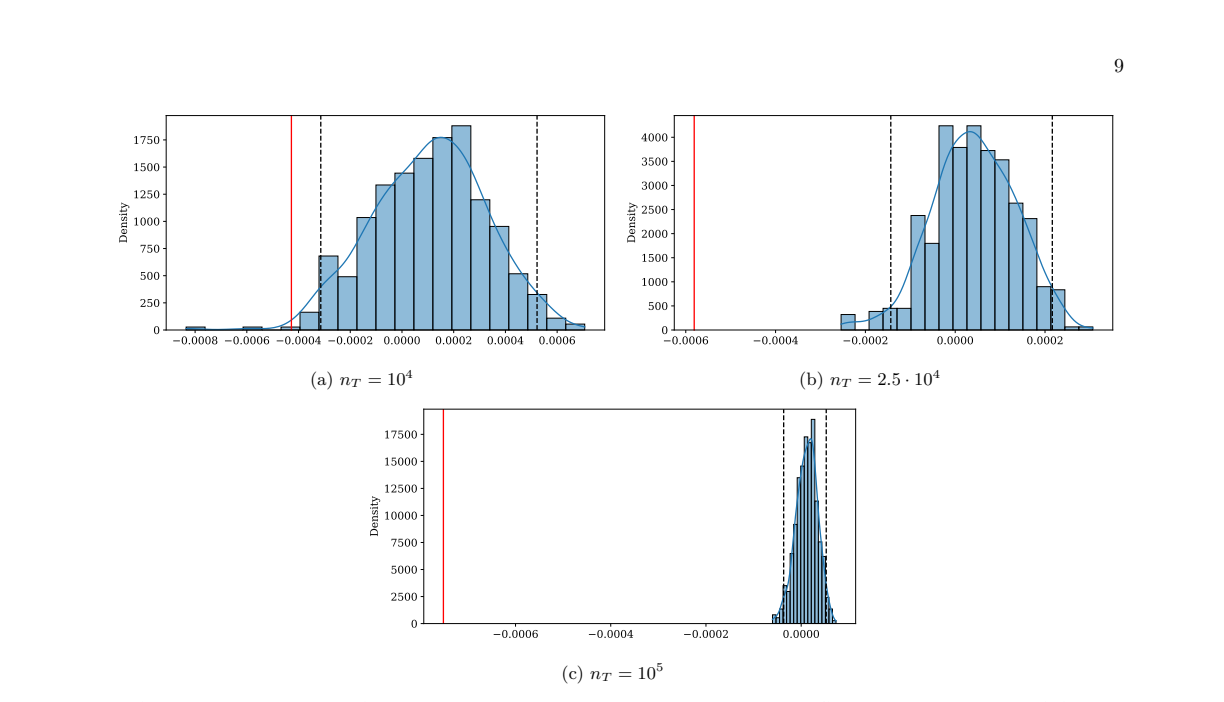
The significance threshold estimated via Remark 3 uses only 30 permutation samples (values 0.00103, 0.00041, 0.00008); given the small sample, reporting the sampling variability of these threshold estimates would make the 'more than enough to detect' conclusion more robust.
What would settle it
Re-run the two headline experiments with ρ ∈ {0.85, 0.90, 0.97, 0.99}: (i) the p=9 ESN sweep (Fig 4f) to check whether KIPC still peaks at s≈1 rather than at a smaller spectral radius; (ii) the QRC case-2 sweep (Fig 5b) to check whether KIPC_lin stops rising and KIPC_nonlin keeps rising at roughly W≈3–5, i.e., whether the linear/nonlinear maxima misalignment persists. For each ρ, set n_T so that, by the significance procedure of Section III B / Remark 3, the smallest claimed KIPC difference in Fig 5b exceeds the detectability threshold (at ρ=0.95, detecting a ρ^50/101 term needs n_T≈10^5, while the QRC run currently uses n_T=20,000). If the peak locations and the qualitative mismatch are unchanged across the ρ range, the conclusions are ρ-robust and the concern is resolved; if they move or vanish, the paper's headline claims are artifacts of the hand-set ρ.
from the skeptic's reading
How the review went
4 readings by deepseek-v4-flash · 5 Oct 2026
- Reader holds up, with conditions
- Skeptic agrees
- Editor wrote the verdict above
- Referee major revision: 3 major objections, 4 minor
Not run on this paper: the simulated authors' defence.
Pith did not check this review's objections against the paper.
The review in full
The review in brief, machine-written
KIPC is a useful method with a sound core identity, but it is not "the total IPC" as advertised, and the referee should push on that before acceptance.
The genuinely new thing is Theorem 1: one kernel-matrix trace computes an infinite weighted sum of polynomial capacities, removing degree truncation and the combinatorial enumeration that makes standard IPC painful. The U-statistic estimator (Eq. 18) is a real improvement—it converges at nT≈104 in their examples—and the 10x speedup is credible. The single permutation test is a sensible answer to the multiple-testing problem. I checked the numbers that matter: 0.5543, 0.3745, 0.555087, and the bound 13.11 all reproduce from their formulas. The kernel closed forms are classical and properly cited; the new part is the IPC framing. They also ship code.
Biggest soft spot: the abstract calls KIPC "the total IPC," but Theorem 1 computes a weighted functional with per-degree weights ρi/(2i+1) and a hand-set ρ=0.95. The weighting is not hidden—Remark 1 and Section III B say exactly what it does—but the semantic claim is too strong. Example 1 makes the point: X1 and X2 have identical standard total IPC of 3, yet KIPC ranks them 0.5543 vs 0.3745 purely through the degree-50 weight. That is a built-in preference, not a side effect of truncation. The ESN peak at s≈1 and the QRC misalignment near W∈[3,5] could shift under a different ρ, and there is no sensitivity analysis. The referee should ask for one, or for a plain statement that KIPC is a ρ-weighted measure with conclusions read accordingly.
Second, the "unbiased for finite nT" label is too clean. The bias-correction argument is standard for V-statistics, but in dynamical data X depends on the input, so Π and K are not independent, and unbiasedness for the asymptotic KIPC does not follow from the proof as written. It works numerically; the label is stronger than the derivation.
Third, the permutation test's null—symmetry of the difference statistic, independence between Πa−Πb and the kernel—is asserted rather than derived. Plausible and probably fine, but ask for a derivation or a softer claim.
Minor: the QRC misalignment observation rests on one numerical dataset (8 spins, 30 runs). Agreement with the NARMA10 phase transition from [12] helps, but I would not market it as a discovery until reproduced. And the reader is right that Tr(ΠK) is classical in kernel methods; the novelty is the IPC framing.
Who this is for: reservoir computing and QRC researchers who have felt the truncation warning from [29, Appendix B]. They will use this. It deserves a serious referee. My recommendation: accept the method, require the ρ-sensitivity analysis and a precise statement of what KIPC measures.
The strongest objection
The abstract and conclusions present KIPC as computing 'the total IPC' without degree truncation (Theorem 1, Eq. 15). The equality itself is algebraically sound: the trace identity follows from the kernel spectral expansion (14) and the projection identity (A6), and the paper's internal checks pass (Example 1's 0.5543/0.3745 converge correctly; the 13.11 bound in Theorem 2 reproduces 30·(ρ/3)+20·(ρ²/5) for ρ=0.95). The load-bearing question is semantic: KIPC is not the unweighted total IPC of Eq. (2) but a weighted functional with per-factor weights λ_i = ρ^i/(2i+1) (Eq. 12) and free parameter ρ=0.95 (Section III B). The paper acknowledges the weighting (Remark 1) and even advertises it as addressing Issue 2, so the assumption is not hidden; what is missing is any evidence that the qualitative conclusions are ρ-robust. Because a degree-d term carries weight roughly ρ^d/(product of (2i+1)), a degree-50 term gets weight ρ^50/101≈0.000762 (Example 5), KIPC can rank two systems oppositely depending on where their capacity sits in the degree spectrum: Example 1's X1 and X2 have identical unweighted total IPC (=3), yet KIPC ranks them 0.5543 vs 0.3745 purely by the degree-50 weight. The claimed new observations — the p=9 ESN retaining maximum KIPC at s=1 (Fig 4f) and the 'misalignment between the maximum of the linear KIPC component and the nonlinear KIPC components' near W∈[3,5] (Fig 5b) — could shift or vanish under a different ρ, since ρ controls how heavily high-degree capacity counts. The paper gives no sensitivity evidence, so the central claim that these are properties of the reservoirs rather than of the chosen ρ is unverified.
The central identity (Theorem 1) is algebraically sound: it follows from the kernel Mercer expansion (14), the empirical-eigenfunction discretization, and the linear-regression projection identity (A6); the paper's internal arithmetic (Example 1's 0.5543/0.3745, the 13.11 bound = 30·ρ/3 + 20·ρ²/5 for ρ=0.95) checks out, and the numerical convergence in Examples 1–3 is self-consistent. This is real independent support for the derivation, and I do not dispute it. The load-bearing weakness is not the algebra but the semantic step: KIPC is a ρ-weighted functional, and the paper's framing of it as 'the total IPC' plus every qualitative conclusion is contingent on ρ=0.95. The paper acknowledges the weighting (Remark 1, Section III B) and explicitly presents it as making Assumption 1 exact, so this is not a hidden assumption — but the paper never shows that the reported conclusions survive ρ variation, and the weights are strong enough (ρ^50/101≈0.000762) to reorder reservoirs with equal unweighted IPC (Example 1, X1 vs X2). The two claimed new observations (ESN capacity peaking at s=1 for p=9, Fig 4f; QRC linear/nonlinear maxima misalignment at W≈3–5, Fig 5b) are exactly the kind of feature that could move with ρ. Secondary, related gaps: the 'unbiased for finite n_T' label on Proposition 2's U-statistic (18) ignores that Π_{ij} depends on all of X through (X^T X)^{-1}, so the pairwise kernel is not a function of the pair alone — its unbiasedness is only numerically demonstrated, not derived; and the permutation null in Section III A asserts rather than derives the independence and symmetry of Π_a−Π_b under H_0. Both are secondary to the ρ question, and the authors already flag the null as future work (Conclusion: parametric null approximation). Because the concern is real but concretely testable, the CONDITIONAL verdict is appropriate; a ρ-sweep on the two headline plots is the concrete gate to ACCEPT. My read therefore does not change the reader's verdict, and I keep it as CONDITIONAL.
The referee's report
If the semantic claims are defensible, KIPC is genuinely useful: it is a scalable, degree-truncation-free capacity functional with O(m n_T^2) complexity, a fast-converging U-statistic (near-accurate at n_T=10^4 in Example 2), a closed-form bound, and a single joint hypothesis test that avoids the multiple-testing problem of term-by-term IPC testing. The paper ships executable code (GitHub), and the proof of Theorem 1 is transparent, with analytic values in Examples 1–3 reproduced correctly by the reported Monte Carlo numbers. The strengths are real. However, three load-bearing issues need work before the conclusions can be accepted: (i) KIPC is a weighted functional with a hand-set free parameter ρ=0.95, not the unweighted total IPC of Eq. (2), and no ρ-sensitivity analysis supports the headline observations; (ii) the permutation test rests on an asserted independence/exchangeability property that is not proven; (iii) the validation is internal-consistency checking of the estimator against the same spectral expansion that defines the metric, rather than external confirmation that KIPC tracks a system's true capacity.
Pith's reading of the paper (a machine's summary, not the authors')
This paper introduces Kernel-IPC (KIPC), a way to compute the information processing capacity (IPC) of a dynamical system—the measure of how well a reservoir can reconstruct, by linear regression, every polynomial function of its delayed inputs—without enumerating basis functions. Standard IPC grows combinatorially with polynomial degree and delay, forcing truncation that can hide real capacity; the paper proves that a single trace of a tensor-product Legendre kernel matrix, projected onto the reservoir states, converges to the full weighted sum over the infinite basis. A U-statistic version estimates this sum with small bias at sequence lengths around $10^{4}$, and a permutation test compares two reservoirs with one hypothesis test instead of one per basis term. The method is validated on an echo state network and a disordered quantum spin chain, where it resolves truncation artifacts that standard IPC cannot.
What carries the argument. The tensor-product Legendre kernel K_⊗(u,u′) = Π_{τ=1}^m $K^{{Leg}}$(u_{t−τ}, u_{t′−τ}), whose closed form comes from Bailey's formula with eigenfunctions the Legendre polynomials L_n and eigenvalues ρ^n/(2n+1). The trace identity of Theorem 1 converts the projection of this kernel onto the reservoir state subspace into the weighted sum of all polynomial capacities, so no basis functions are ever materialized. The U-statistic of Eq. (18) removes the finite-sample bias of the raw trace estimate, and the SVD decomposition Π = VV^T makes the computation run in O(m $n_T^{2}$) time with block-wise kernel evaluation.
Core claim. The central claim is Theorem 1: lim_{n_T→∞} (1/n_T) Tr(Π K_⊗(U,U)) = Σ_{ι∈ℕ^m} λ_ι IPC_ι, where K_⊗ is the tensor product of Legendre kernels over delayed inputs, Π is the projection matrix of the reservoir states, and the sum runs over all multi-indices of the infinite polynomial basis. Because the Legendre kernel has a closed form (derived from Bailey's formula) whose eigenfunctions are the Legendre polynomials with eigenvalues ρ^n/(2n+1), the infinite weighted sum collapses into one matrix trace. This removes degree truncation and combinatorial enumeration of basis terms, and the weighted sum, with weights decaying in polynomial degree, is presented as 'the' total IPC, thereby making Assumption 1 (capacity decreases with degree and delay) explicit in the metric itself.
The premise it rests on. The identification of KIPC with 'the' total capacity rests on the chosen eigenvalue weights λ = ρ^n/(2n+1) — and the value ρ = 0.95 — being the right notion of capacity, so any system whose capacity concentrates in high-degree polynomials is underweighted by this metric.
If the paper is right (Pith's inferences, not the authors')
Total IPC becomes computable for arbitrarily high nonlinearity with a single trace, making capacity comparisons feasible for systems previously beyond reach.
A single permutation test replaces per-term hypothesis testing, eliminating the multiple-comparison inflation that could push standard IPC above the state-rank bound.
For quantum reservoir computing on a disordered spin chain, KIPC reveals that linear and nonlinear capacity components peak at different disorder values, a behavior standard IPC could not expose.
The rank-limited bound of Theorem 2 gives KIPC an absolute ceiling computable from the kernel weights alone, the analogue of the n_s bound for standard IPC.
Because the Gram-matrix eigenbasis is always orthogonal regardless of input distribution, KIPC applies without knowing the input measure that would orthogonalize the original polynomial basis.
If the eigenvalue weighting is read as a modeling choice rather than a neutral measure, KIPC answers a different question than unweighted total IPC: it measures capacity concentrated at low polynomial degree, and systems whose true capacity sits in high-degree terms are systematically undervalued.
The same kernel-trace strategy ports directly to Hermite, Laguerre, and Jacobi families, whose closed forms are already given (Mehler, Hardy–Hille, and Bailey kernels), extending KIPC to Gaussian-distributed or positive inputs.
The Volterra-series connection flagged as future work suggests KIPC could be reinterpreted as a spectral measure of the reservoir's nonlinear input–output map, potentially grounding the ad hoc weights in the system's own dynamics.
A testable extension: the permutation null distribution could be replaced by a parametric approximation (e.g., a Gamma fit to its moments), which would drop the cost of repeated KIPC evaluations during testing.
Check this review
Pith stored no record of this review's passes and took no fingerprint of it. Reviews made by code from 13 Nov 2026 on carry both.
How often reviews like this one are right
Reviews like this one: written by deepseek-v4-flash, where what was read was not recorded.
How often objections from reviews like this one are right: not yet measured
Reviews by people
This review was written by a machine. No person has reviewed this paper on Pith yet. A scientist listed on Pith can review it for a fee, and their review is published here whatever it concludes.
The paper
Abstract
Information Processing Capacity (IPC) is a powerful system-agnostic metric for quantifying a dynamical system's computational capability and is widely used in quantum reservoir computing. However, standard IPC suffers from severe computational limitations. Computing IPC involves estimating how well the system can reconstruct, via linear regression, an (in principle) infinite family of orthogonal polynomial functions of delayed inputs. In practice, this evaluation must be made finite, so we need only to consider polynomials up to a chosen maximum degree. Moreover, the computational complexity for computing IPC grows combinatorially with the considered maximum degree and delay. Here, we introduce Kernel-IPC (KIPC), a scalable framework that uses kernel methods to compute the total IPC without explicitly enumerating basis functions. This allows us to account for the full (infinite) basis (without degree truncation). We also provide a null-hypothesis test for statistically comparing the KIPC of two dynamical systems. We validate KIPC on an echo state network and demonstrate its utility for quantum reservoir computing on a disordered spin chain.
The paper's own sentences, arranged, kept beside the review and separate from it. Each label is drawn from a closed vocabulary; the number beside it is the probability the classifier gave that label. No sentence in this record was written by a model.
abstract compiled · 2026-10-05
The authors' main claim, as the classifier picked it out 0.55
“Here, we introduce Kernel-IPC (KIPC), a scalable framework that uses kernel methods to compute the total IPC without explicitly enumerating basis functions.”
How the main claim is stated: asserted 1.00
What the abstract itself states, as probabilities: claims first 0.06 · states limitation 0.12 · human participants 0.02 · controlled comparison 0.21 · randomized assignment 0.01 · states quantitative result 0.06 · compares with prior results 0.51 · mentions code or data availability 0.03
The abstract, sentence by sentence
This table labels the abstract only (arXiv listing abstract v1). The number is the probability the classifier gave the label.
| Sentence | Role | The authors' own work | States the main conclusion | Strength |
|---|---|---|---|---|
| Information Processing Capacity (IPC) is a powerful system-agnostic metric for quantifying a dynamical system's computational capability and is widely used in quantum reservoir computing. | background 1.00 | 0.05 | 0.04 | asserted 1.00 |
| However, standard IPC suffers from severe computational limitations. | gap 0.63 | 0.09 | 0.03 | asserted 1.00 |
| Computing IPC involves estimating how well the system can reconstruct, via linear regression, an (in principle) infinite family of orthogonal polynomial functions of delayed inputs. | background 0.96 | 0.09 | 0.03 | asserted 1.00 |
| In practice, this evaluation must be made finite, so we need only to consider polynomials up to a chosen maximum degree. | background 0.93 | 0.18 | 0.02 | asserted 0.98 |
| Moreover, the computational complexity for computing IPC grows combinatorially with the considered maximum degree and delay. | background 0.83 | 0.17 | 0.03 | asserted 1.00 |
| Here, we introduce Kernel-IPC (KIPC), a scalable framework that uses kernel methods to compute the total IPC without explicitly enumerating basis functions. | contribution 0.95 | 0.95 | 0.44 | asserted 1.00 |
| This allows us to account for the full (infinite) basis (without degree truncation). | contribution 0.51 | 0.87 | 0.21 | asserted 0.95 |
| We also provide a null-hypothesis test for statistically comparing the KIPC of two dynamical systems. | contribution 0.88 | 0.94 | 0.09 | asserted 1.00 |
| We validate KIPC on an echo state network and demonstrate its utility for quantum reservoir computing on a disordered spin chain. | contribution 0.52 | 0.96 | 0.22 | asserted 1.00 |
What kind of paper the classifier reports this is: method or tool 1.00 · evidence from simulation or computation 0.98
What was examined, and what was not
Sources read
- arXiv listing abstract v1
Not examined
- full text
- figures and tables
- references and citing sentences
- relations to other papers
Levels run
- P abstract
Not run
- S sections
- T body sentences
- C citations
- R cross-paper relations
How the labels were made
Compiled by classifier-1.13.0 via TypeSafe API, question bank abstract-p1-20260923, 2026-10-05: 1 request, 6,781 input tokens.
Every quoted sentence on this record is the authors'. Every label is from Pith's closed vocabulary, with the probability shown beside it. This record as JSON
Figures (5)
Showing 4 of the paper's 5 figures. Figures are the authors', reproduced from the paper.
References (44)
- [12] R. Mart´ ınez-Pe˜ na, G. L. Giorgi, J. Nokkala, M. C. So- riano, and R. Zambrini, Dynamical phase transitions in quantum reservoir computing, Physical Review Letters 127, 100502 (2021) on Pith
- [1] J. Dambre, D. Verstraeten, B. Schrauwen, and S. Massar, Information processing capacity of dynamical systems, Scientific reports2, 514 (2012) on Pith
- [2] S. Boyd and L. Chua, Fading memory and the problem of approximating nonlinear operators with volterra se- ries, IEEE Transactions on circuits and systems32, 1150 (2003) on Pith
- [3] T. Kubota, H. Takahashi, and K. Nakajima, Unifying framework for information processing in stochastically driven dynamical systems, Physical Review Research3, 043135 (2021) on Pith
- [4] T. H¨ ulser, F. K¨ oster, K. L¨ udge, and L. Jaurigue, Deriving task specific performance from the information process- ing capacity of a reservoir computer, Nanophotonics12, 937 (2023) on Pith
- [5] A. M. Polloreno, Innovation capacity of dynamical learn- ing systems, arXiv preprint arXiv:2601.07257 (2026) on PitharXiv
- [6] K. Nakajima, Physical reservoir computing—an intro- ductory perspective, Japanese Journal of Applied Physics 59, 060501 (2020) on Pith
- [7] M. Goldmann, C. R. Mirasso, I. Fischer, and M. C. Sori- ano, Exploiting transient dynamics of a time-multiplexed reservoir to boost the system performance, in2021 Inter- national Joint Conference on Neural Networks (IJCNN) (IEEE, 2021) pp. 1–8 on Pith
- [8] F. K¨ oster, D. Ehlert, and K. L¨ udge, Limitations of the recall capabilities in delay-based reservoir computing sys- tems, Cognitive Computation15, 1419 (2023) on Pith
- [9] Q. Vinckier, F. Duport, A. Smerieri, K. Vandoorne, P. Bienstman, M. Haelterman, and S. Massar, High- performance photonic reservoir computer based on a co- herently driven passive cavity, Optica2, 438 (2015) on Pith
- [10] K. Harkhoe and G. Van der Sande, Task-independent computational abilities of semiconductor lasers with de- 16 layed optical feedback for reservoir computing, inPho- tonics, Vol. 6 (MDPI, 2019) p. 124 on Pith
- [11] S. Ort´ ın and L. Pesquera, Delay-based reservoir comput- ing: tackling performance degradation due to system re- sponse time, Optics Letters45, 905 (2020) on Pith
- [13] S. Ghosh, K. Nakajima, T. Krisnanda, K. Fujii, and T. C. Liew, Quantum neuromorphic computing with reservoir computing networks, Advanced Quantum Technologies 4, 2100053 (2021) on Pith
- [14] P. Mujal, R. Mart´ ınez-Pe˜ na, J. Nokkala, J. Garc´ ıa-Beni, G. L. Giorgi, M. C. Soriano, and R. Zambrini, Oppor- tunities in quantum reservoir computing and extreme learning machines, Advanced Quantum Technologies4, 2100027 (2021) on Pith
- [15] J. Nokkala, R. Mart´ ınez-Pe˜ na, G. L. Giorgi, V. Pa- rigi, M. C. Soriano, and R. Zambrini, Gaussian states of continuous-variable quantum systems provide univer- sal and versatile reservoir computing, Communications Physics4, 53 (2021) on Pith
- [16] D. Nishioka, T. Tsuchiya, W. Namiki, M. Takayanagi, M. Imura, Y. Koide, T. Higuchi, and K. Terabe, Edge- of-chaos learning achieved by ion-electron–coupled dy- namics in an ion-gating reservoir, Science Advances8, eade1156 (2022) on Pith
- [17] W. Xia, J. Zou, X. Qiu, and X. Li, The reservoir learn- ing power across quantum many-body localization tran- sition, Frontiers of Physics17, 33506 (2022) on Pith
- [18] N. G¨ otting, F. Lohof, and C. Gies, Exploring quantum- ness in quantum reservoir computing, Physical Review A 108, 052427 (2023) on Pith
- [19] R. Mart´ ınez-Pe˜ na, J. Nokkala, G. L. Giorgi, R. Zambrini, and M. C. Soriano, Information processing capacity of spin-based quantum reservoir computing systems, Cog- nitive Computation15, 1440 (2023) on Pith
- [20] D. Fry, A. Deshmukh, S. Y.-C. Chen, V. Rastunkov, and V. Markov, Optimizing quantum noise-induced reservoir computing for nonlinear and chaotic time series predic- tion, Scientific Reports13, 19326 (2023) on Pith
show 24 more
- [21] T. Kubota, Y. Suzuki, S. Kobayashi, Q. H. Tran, N. Ya- mamoto, and K. Nakajima, Temporal information pro- cessing induced by quantum noise, Physical Review Re- search5, 023057 (2023) on Pith
- [22] S. Tsunegi, T. Kubota, A. Kamimaki, J. Grollier, V. Cros, K. Yakushiji, A. Fukushima, S. Yuasa, H. Kub- ota, K. Nakajima,et al., Information processing capacity of spintronic oscillator, Advanced Intelligent Systems5, 2300175 (2023) on Pith
- [23] A. Palacios, R. Mart´ ınez-Pe˜ na, M. C. Soriano, G. L. Giorgi, and R. Zambrini, Role of coherence in many-body quantum reservoir computing, Communications Physics 7, 369 (2024) on Pith
- [24] S. ˇCindrak, B. Donvil, K. L¨ udge, and L. Jaurigue, En- hancing the performance of quantum reservoir comput- ing and solving the time-complexity problem by artificial memory restriction, Physical Review Research6, 013051 (2024) on Pith
- [25] A. Sannia, R. Mart´ ınez-Pe˜ na, M. C. Soriano, G. L. Giorgi, and R. Zambrini, Dissipation as a resource for quantum reservoir computing, Quantum8, 1291 (2024) on Pith
- [26] G. Llodr` a, P. Mujal, R. Zambrini, and G. L. Giorgi, Quantum reservoir computing in atomic lattices, Chaos, Solitons & Fractals195, 116289 (2025) on Pith
- [27] Y. Jing, P. Wang, S. Zhang, Z. Zeng, S.-J. Liang, and W. Chen, Quantum transport reservoir computing, Phys- ical Review Applied24, 044036 (2025) on Pith
- [28] S. ˇCindrak, K. L¨ udge, and L. Jaurigue, From krylov com- plexity to observability: Capturing phase space dimen- sion with applications in quantum reservoir computing, Physical Review Research7, L042039 (2025) on Pith
- [29] M. Hahto and J. Nokkala, Smarter usage of measure- ment statistics can greatly improve continuous variable quantum reservoir computing, New Journal of Physics 27, 094510 (2025) on Pith
- [30] N. Keenan and R. Zambrini, Storage, scrambling, and loss of information in the quantum reservoir computing paradigm, arXiv preprint arXiv:2608.07677 (2026) on PithPith's reviewarXiv
- [31] Y. Hou, J. Hua, Z. Wu, W. Xia, Y. Chen, X. Li, Z. Li, X. Peng, and J. Du, High-accuracy temporal prediction via experimental quantum reservoir computing in corre- lated spins, Physical Review Letters136, 120602 (2026) on Pith
- [32] F. G. Mehler, On the expansion of a function of arbitrar- ily many variables in terms of laplace functions of higher order., (1866) on Pith
- [33] C. K. Williams and C. E. Rasmussen,Gaussian processes for machine learning, Vol. 2 (MIT press Cambridge, MA, 2006) on Pith
- [34] G. Hardy, Summation of a series of polynomials of la- guerre, Journal of the London Mathematical Society1, 138 (1932) on Pith
- [35] H. M. Srivastava, A note on certain identities involv- ing series of legendre polynomials, Quarterly of Applied Mathematics44, 691 (1987) on Pith
- [36] D. Hanrahan and D. Kosz, Sharp estimates for jacobi heat kernels in conic domains, Journal of Approximation Theory293, 105921 (2023) on Pith
- [37] Y. V. Boroskikh,U-statistics in Banach Spaces(Walter de Gruyter GmbH & Co KG, 2020) on Pith
- [38] A. Gretton, K. Fukumizu, C. Teo, L. Song, B. Sch¨ olkopf, and A. Smola, A kernel statistical test of independence, Advances in neural information processing systems20 (2007) on Pith
- [39] H. Jaeger and H. Haas, Harnessing nonlinearity: Predict- ing chaotic systems and saving energy in wireless com- munication, science304, 78 (2004) on Pith
- [40] K. Inoue, T. Kubota, Q. Hoan Tran, N. Akashi, R. Ter- ajima, T. Kabayama, J. Guan, and K. Nakajima, Reser- voir computing bootcamp—From Python/NumPy tuto- rial for the complete beginners to cutting-edge research topics of reservoir computing, Chaos: An Interdisci- plinary Jour... on Pith
- [41] D. Yuan, S.-Y. Zhang, Y. Wang, L.-M. Duan, and D.- L. Deng, Quantum information scrambling in quantum many-body scarred systems, Physical Review Research 4, 023095 (2022) on Pith
- [42] A. Benavoli and C. de Campos, Bayesian independence test with mixed-type variables, in2021 IEEE 8th Inter- national Conference on Data Science and Advanced An- alytics (DSAA)(2021) pp. 1–13 on Pith
- [43] A. Benavoli and F. C. Binder, Quantum wiener architec- ture for quantum reservoir computing, Physical Review A114, 012433 (2026) on Pith
- [44] M. J. Schlosser, Multiple hypergeometric series: Appell series and beyond, Computer algebra in quantum field theory: integration, summation and special functions , 17 305 (2013) on Pith
Cited by 2 Pith papers
Reviewed papers on Pith that cite this one. The full citation record
- Emergent Recursive Kernels in Quantum Reservoir Computing quant-ph · Oct 2026
- Augmenting Quantum Neural Networks with Contractive Layers quant-ph · Nov 2026
Challenges and discussion
Disagree with the review, or know something it missed? Leave a comment, or challenge this review formally: a challenge becomes a permanent entry in this paper's record, and its decision is published here.
Come back by email
A short list of the week's newly reviewed papers. Nothing is sent until you confirm from your inbox, and every email has a link that stops it. No account.
No comments yet.
Sign in to comment