Quantum Physics · arXiv:2610.34430 v1 · submitted 25 Oct 2026 · 39 references
Emergent Recursive Kernels in Quantum Reservoir Computing
The paper says
“Learning with a quantum reservoir can be far simpler than simulating its dynamics.”
more of the abstract
We show that a quantum reservoir governed by a fixed evolution, consisting of an input coupling followed by an independently sampled Haar unitary, admits an exact recursive kernel in the large-dimension limit at fixed history length. Memory orthogonality and factorization of propagated overlaps reduce each kernel evaluation to a scalar recurrence, linear in history length and independent of reservoir size. We establish self-averaging around this limit and connect the kernel coefficients to out-of-time-ordered correlators. Our analysis of finite-dimensional effects shows that the computational simplicity of the Haar kernel does not come at the expense of expressive power. Moreover, we demonstrate how the kernel can be tuned for different learning tasks by adjusting properties such as memory retention and temporal interaction order. On the NARMA10 benchmark, the tuned kernel achieves lower prediction error than the tested Ising and Sachdev–Ye–Kitaev reservoirs.
from the abstract
Pith says
Machine review · deepseek-v4-flash · 27 Oct 2026 · what was read was not recorded · not checked by a person
It can be wrong. Challenge this review or reply to it.
Holds up. A mathematically clean paper that derives an exact recursive kernel for a specific class of quantum reservoirs, with honest discussion of limitations. This line is wrong
6 minor
How often objections from reviews like this one are right: not yet measured
Not checked: figures, code, what the 39 references say.
6 minor objections
The paper says, at Eq. (10) and surrounding text
Pith says: minor objection 1 of 6
The recurrence κ_t = b_t + a_t κ_{t-1} with κ_0 = 0 relies on the initialization ρ_0 = I/D. The authors state this condition in Section I (sentence b43). Consider mentioning explicitly that for other initial states the recursive form does not hold and that a warm-up period (as acknowledged) is required.
The paper says, at Fig. 1 caption and panels (c),(d)
Pith says: minor objection 2 of 6
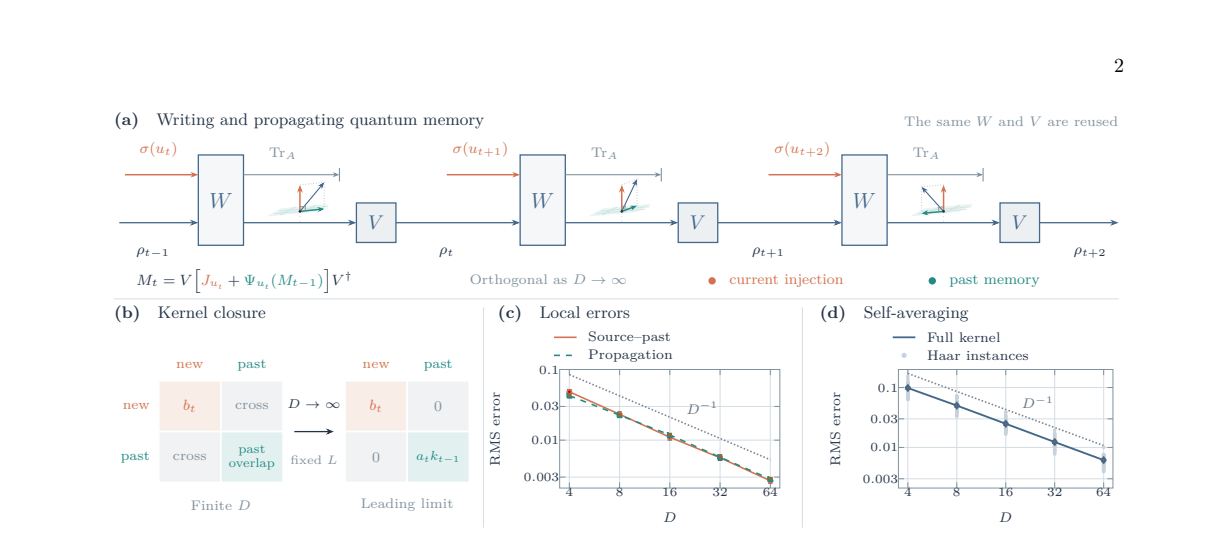
Panel (c) evaluates 'the exact k_{t-1}' while panel (d) compares the full kernel. The caption could clarify that the RMS errors in (c) are for the source–memory overlaps and propagation residuals, not the full kernel difference, to avoid confusion with (d).
show 4 more
The paper says, at S2.E, numerical tests
Pith says: minor objection 3 of 6
The specific writer defined in Eq. (S2.37) is used for the scaling tests. It would be helpful to note whether the qualitative O(D^{-1}) scaling has been verified for other randomly chosen writers, or if this one is representative.
The paper says, at Eq. (13) and surrounding text
Pith says: minor objection 4 of 6
The connection between b(u,v) and OTOCs is an interesting identity. However, the equation involves a sum over four Pauli operators; it may be beneficial to state explicitly that the IA term gives the constant contribution 1/4 for all inputs, which is then subtracted in the definition of Δ_u, so that b(u,v) is indeed an average of OTOC-like quantities.
The paper says, at Fig. 3 caption
Pith says: minor objection 5 of 6
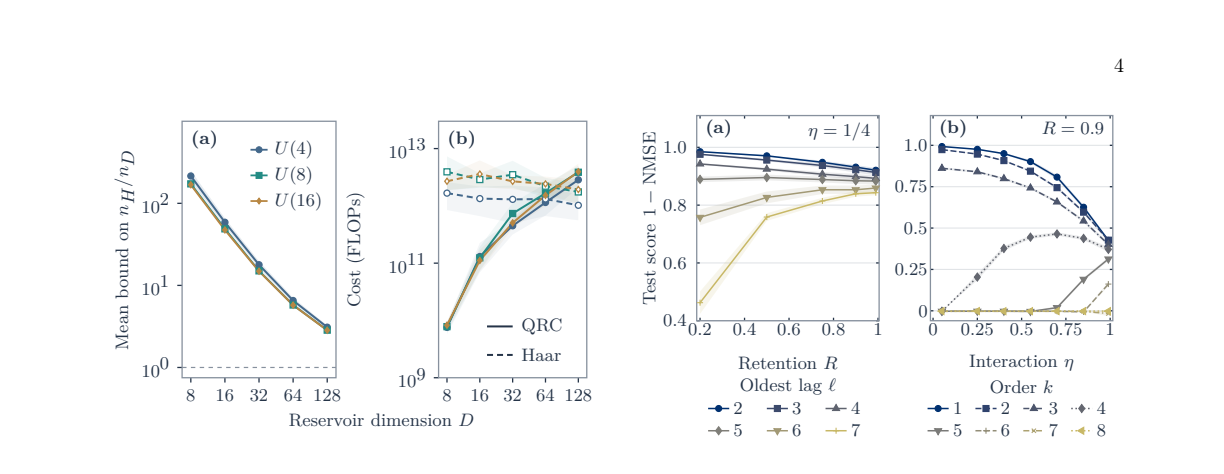
The x-axis labels for panel (a) (ℓ = 2,...,7) and panel (b) (k = 1,...,8) are clear, but the legend entries 'R = 0.20' etc. appear only in the figure itself; the caption could briefly describe the two parameter scans for completeness.
The paper says, at S5.B, Eq. (S5.4)
Pith says: minor objection 6 of 6
The description of how the maximizing target is constructed from the top right singular vector of T_D is concise. A short remark that this target is theoretically optimal for the bound but may not lead to the largest empirical sample demand (as noted in the main text) would reduce potential misinterpretation.
What would settle it
Re-run the error scaling in Fig. 1(d) with a different writer family (e.g., a random local unitary not of the form w⊗I) to confirm the D^{-1} scaling is robust across writer choices, using L=16 histories and D=8,16,32,64.
from the skeptic's reading
How the review went
4 readings by deepseek-v4-flash · 27 Oct 2026
- Reader holds up
- Skeptic agrees
- Editor wrote the verdict above
- Referee minor revision: 6 minor
Not run on this paper: the simulated authors' defence.
Pith did not check this review's objections against the paper.
The review in full
The review in brief, machine-written
The main result is new: for a QRC model with a fixed writer and an independently sampled Haar unitary reused at each step, the temporal kernel reduces to a scalar recurrence in the large-dimension limit at fixed history length. The connection between kernel coefficients and OTOCs is also nice. The derivation uses asymptotic freeness and Weingarten calculus, provides explicit O(D−1) finite-dimensional corrections, and shows self-averaging numerically. The authors state assumptions clearly and discuss the factorization paradox and the conditions under which the result fails. The paper is honest about what it does and does not cover.
The soft spots are proportionate to the stated scope. The model assumption -- U = (IA ⊗ V)W with independent Haar V and fixed W -- is specific. The authors acknowledge it and show it cannot be relaxed to arbitrary dynamics. The NARMA10 comparison to Ising and SYK reservoirs is reasonable but exploratory; the tuning budget is matched, but the comparison is conditional on the chosen candidate banks. The paper's own learning bounds (sample budget ratios) are theoretical and do not directly bound empirical sample counts, which the authors also note.
This is a solid theoretical contribution to QRC. The math is rigorous, the limitations are documented, and the paper gives a practically useful tool for classical simulation of a certain class of reservoirs. It deserves a serious referee.
Reading group: maybe. Would cite: yes (for theoretical QRC work).
The strongest objection
The paper's central claim—an exact recursive temporal kernel in the large-dimension limit for a fixed writer and independently sampled Haar router—is derived rigorously, with explicit finite-dimensional corrections and self-averaging bounds. All assumptions are clearly stated and acknowledged as limitations (e.g., the specific U = (I_A ⊗ V)W structure, fixed history length, initialization at I/D). The derivation uses Weingarten calculus and asymptotic freeness, with concrete O(D^{-1}) RMS error estimates. The numerical experiments in Fig. 1 confirm the predicted scaling. The paper honestly discusses the factorization paradox and the conditions under which the result fails. No gaps, internal inconsistencies, or unsupported leaps were found that would undermine the main conclusion within the stated scope.
The reader's weakest_assumption concerns the specific form U = (I_A ⊗ V)W, which the paper clearly acknowledges and defends. The stress-test identified no additional load-bearing concern: the central derivation is mathematically sound, the finite-dimensional corrections are quantified, and the honest discussion of limitations (e.g., dependence on fixed history length, independence of writer and router, initialization at I/D) means the paper does not overclaim. The numerical evidence supports the theoretical predictions. Therefore the reader's ACCEPT verdict remains fully justified, and no revision to the verdict is needed.
The referee's report
If the result holds, it provides a rare example of a closed-form analytic kernel for a quantum reservoir model, reducing the computational cost of learning from exponential in the dimension to linear in the history length. The recursive structure enables interpretable control over memory retention and interaction order without simulating quantum dynamics. The connection between kernel coefficients and OTOCs is a conceptual bridge between quantum chaos and learning theory. The paper also honestly discusses the limitations of the independence assumption and the factorization paradox. This work may influence both the design of efficient classical surrogates for quantum reservoir computing and the search for analytic kernels in other many-body settings.
Pith's reading of the paper (a machine's summary, not the authors')
This paper shows that a quantum reservoir governed by a fixed writer and an independently sampled Haar-random unitary yields a temporal kernel that can be computed exactly with a scalar recurrence, independent of the reservoir size. The recurrence, κ_t = b_t + a_t κ_{t-1}, reduces each kernel evaluation to O(L) operations per input pair, in contrast to the O(L $D^{3}$) cost of simulating the full quantum dynamics. The result establishes that the complexity of quantum dynamics does not necessarily transfer to the associated learning model, and it opens the door to efficient classical surrogates for certain quantum reservoir computers.
What carries the argument. The key machinery is the scalar recurrence κ_t = b_t + a_t κ_{t-1} (Eq. 10), derived from the Haar-limit dynamics. It relies on asymptotic freeness between the current input channel and the propagated memory: at each step, the current injection is orthogonal to the propagated past memory, and the overlap of two propagated memories factorizes into the scalar a(u, v) times the preceding kernel. The local kernels b(u, v) and a(u, v) are determined solely by the fixed writer W and the input encoding, and they satisfy a memory–injection tradeoff b(u,u) + 2a(u,u) ≤ 2.
Core claim. The central discovery is that for a quantum reservoir with update U = (I_A ⊗ V)W, where W is a fixed input-coupling unitary and V is an independently sampled Haar-random unitary reused at every time step, the temporal kernel in the large-dimension limit at fixed history length obeys a closed scalar recurrence. Memory orthogonality and factorization of propagated overlaps suppress cross terms and reduce the preceding kernel overlap to a multiplication by a scalar a(u, v). The exact recursive kernel κ_t = b_t + a_t κ_{t-1} with κ_0 = 0, where b_t and a_t are local positive-semidefinite kernels, follows directly. This kernel is independent of the reservoir dimension and can be evaluated without simulating quantum states.
The premise it rests on. The reservoir evolution must be of the specific form U = (I_A ⊗ V)W, with a fixed writer W and a Haar-random unitary V that is independently sampled and reused at every time step, and the reservoir must start from the maximally mixed state.
If the paper is right (Pith's inferences, not the authors')
Temporal kernel evaluation for quantum reservoir computing becomes independent of reservoir size, enabling scalable learning without full quantum simulation.
The recursive kernel can be tuned via its parameters R and η to control memory depth and temporal interaction order, providing interpretable knobs for different learning tasks.
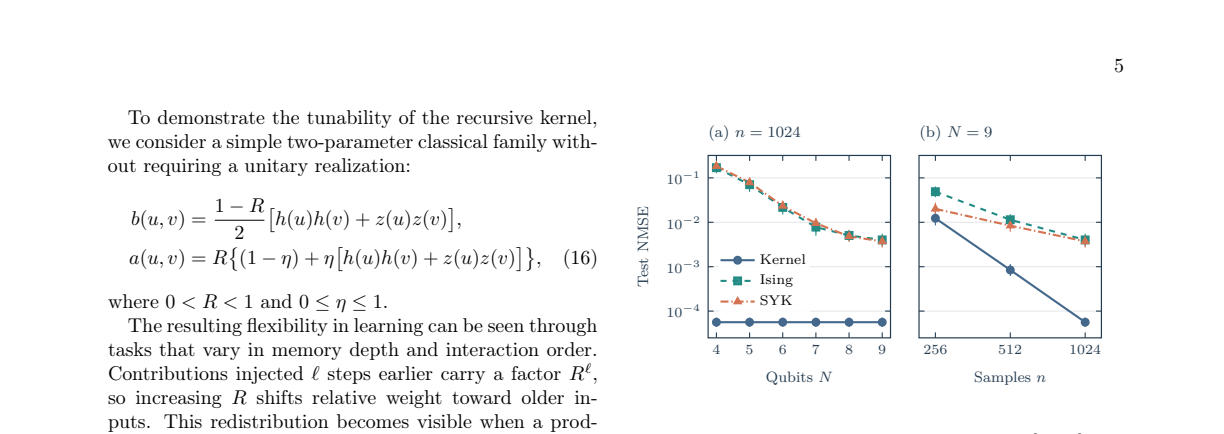
On the NARMA10 benchmark the tuned recursive kernel achieves lower mean prediction error than commonly studied Hamiltonian-driven Ising and SYK reservoirs, despite being dimension-independent.
The connection between the kernel coefficients and out-of-time-ordered correlators links quantum chaos measures directly to machine learning performance.
Finite-dimensional effects do not destroy the recursive structure; they add corrections that vanish as O(D^{-1}), so the Haar kernel remains a good approximation for large reservoirs.
The recursive kernel result suggests that many quantum reservoir architectures, beyond the specific Haar-router design, may admit tractable analytical kernels when the dynamics scramble memory in a way that leads to asymptotic freeness.
Because the recursive kernel is a classical model, it offers a concrete baseline against which any claim of quantum advantage in reservoir computing must be measured: if the Haar kernel matches or outperforms a quantum reservoir, then the quantum device does not provide a learning advantage beyond classical surrogates.
The tradeoff b(u,u) + 2a(u,u) ≤ 2 implies a fundamental bound on the diagonal kernel values, which may translate into universal capacity limits for quantum reservoirs of this form.
The explicit formula for κ_L in terms of products of local kernels (Eq. 11) shows that the temporal kernel is essentially a sum of products of input-dependent scalars; this structure could be exploited to design efficient classical algorithms for time-series prediction that mimic quantum reservoir learning.
Check this review
Pith stored no record of this review's passes and took no fingerprint of it. Reviews made by code from 13 Nov 2026 on carry both.
How often reviews like this one are right
Reviews like this one: written by deepseek-v4-flash, where what was read was not recorded.
How often objections from reviews like this one are right: not yet measured
Reviews by people
This review was written by a machine. No person has reviewed this paper on Pith yet. A scientist listed on Pith can review it for a fee, and their review is published here whatever it concludes.
The paper
Abstract
Learning with a quantum reservoir can be far simpler than simulating its dynamics. We show that a quantum reservoir governed by a fixed evolution, consisting of an input coupling followed by an independently sampled Haar unitary, admits an exact recursive kernel in the large-dimension limit at fixed history length. Memory orthogonality and factorization of propagated overlaps reduce each kernel evaluation to a scalar recurrence, linear in history length and independent of reservoir size. We establish self-averaging around this limit and connect the kernel coefficients to out-of-time-ordered correlators. Our analysis of finite-dimensional effects shows that the computational simplicity of the Haar kernel does not come at the expense of expressive power. Moreover, we demonstrate how the kernel can be tuned for different learning tasks by adjusting properties such as memory retention and temporal interaction order. On the NARMA10 benchmark, the tuned kernel achieves lower prediction error than the tested Ising and Sachdev–Ye–Kitaev reservoirs.
The paper's own sentences, arranged, kept beside the review and separate from it. Each label is drawn from a closed vocabulary; the number beside it is the probability the classifier gave that label. No sentence in this record was written by a model.
abstract compiled · 2026-10-27
The authors' main claim, as the classifier picked it out 0.32
“Our analysis of finite-dimensional effects shows that the computational simplicity of the Haar kernel does not come at the expense of expressive power.”
How the main claim is stated: asserted 1.00
What the abstract itself states, as probabilities: claims first 0.04 · states limitation 0.22 · human participants 0.02 · controlled comparison 0.70 · randomized assignment 0.02 · states quantitative result 0.36 · compares with prior results 0.95 · mentions code or data availability 0.02
The abstract, sentence by sentence
This table labels the abstract only (arXiv listing abstract v1). The number is the probability the classifier gave the label.
| Sentence | Role | The authors' own work | States the main conclusion | Strength |
|---|---|---|---|---|
| Learning with a quantum reservoir can be far simpler than simulating its dynamics. | background 0.95 | 0.11 | 0.12 | hedged possibility 0.60 |
| We show that a quantum reservoir governed by a fixed evolution, consisting of an input coupling followed by an independently sampled Haar unitary, admits an exact recursive kernel in the large-dimension limit at fixed history length. | result 0.55 | 0.94 | 0.53 | asserted 1.00 |
| Memory orthogonality and factorization of propagated overlaps reduce each kernel evaluation to a scalar recurrence, linear in history length and independent of reservoir size. | result 0.74 | 0.89 | 0.21 | asserted 1.00 |
| We establish self-averaging around this limit and connect the kernel coefficients to out-of-time-ordered correlators. | contribution 0.49 | 0.94 | 0.09 | asserted 1.00 |
| Our analysis of finite-dimensional effects shows that the computational simplicity of the Haar kernel does not come at the expense of expressive power. | result 0.70 | 0.94 | 0.22 | asserted 1.00 |
| Moreover, we demonstrate how the kernel can be tuned for different learning tasks by adjusting properties such as memory retention and temporal interaction order. | contribution 0.75 | 0.94 | 0.10 | asserted 1.00 |
| On the NARMA10 benchmark, the tuned kernel achieves lower prediction error than the tested Ising and Sachdev--Ye--Kitaev reservoirs. | result 1.00 | 0.94 | 0.25 | asserted 1.00 |
What kind of paper the classifier reports this is: theoretical result 0.99 · evidence from proof or derivation 0.97
What was examined, and what was not
Sources read
- arXiv listing abstract v1
Not examined
- full text
- figures and tables
- references and citing sentences
- relations to other papers
Levels run
- P abstract
Not run
- S sections
- T body sentences
- C citations
- R cross-paper relations
How the labels were made
Compiled by classifier-1.13.0 via TypeSafe API, question bank abstract-p1-20260923, 2026-10-27: 1 request, 5,548 input tokens.
Every quoted sentence on this record is the authors'. Every label is from Pith's closed vocabulary, with the probability shown beside it. This record as JSON
Figures (4)
Showing 3 of the paper's 4 figures. Figures are the authors', reproduced from the paper.
References (39)
- [1] K. Fujii and K. Nakajima, Phys. Rev. Applied8, 024030 (2017) on Pith
- [2] R. Martínez-Peña, G. L. Giorgi, J. Nokkala, M. C. So- riano, and R. Zambrini, Phys. Rev. Lett.127, 100502 6 (2021), arXiv:2103.05348 on PithPith's reviewarXiv
- [3] K. Kobayashi and Y. Motome, Phys. Rev. Lett.136, 040602 (2026), arXiv:2506.17547 on PitharXiv
- [4] S. Cao, W. Xia, and X. Li, Theory of the edge-of- chaos advantage in quantum reservoir computing (2026), arXiv:2610.05213 [quant-ph] on PithPith's reviewarXiv
- [5] J. Dambre, D. Verstraeten, B. Schrauwen, and S. Massar, Sci. Rep.2, 514 (2012) on Pith
- [6] R. Martínez-Peña, J. Nokkala, G. L. Giorgi, R. Zam- brini,andM.C.Soriano,Cogn.Comput.15,1440(2023), arXiv:2010.06369 on PithPith's reviewarXiv
- [7] A. Benavoli, F. Binder, and C. Chen, Efficiently and reliably measuring information processing capacity in dynamical systems via kernels (2026), arXiv:2610.03281 [quant-ph] on PithPith's reviewarXiv
- [8] Y. Kora, H. Zadeh-Haghighi, T. C. Stewart, K. Heshami, and C. Simon, Physical Review A110, 042416 (2024) on Pith
- [9] W. Xia, S. Cao, X. Qiu, and X. Li, Quantum magic and non-commutativity as computational resources in quantum reservoir computing (2026), arXiv:2607.12035 [quant-ph] on PithPith's reviewarXiv
- [10] M. Negoro, K. Mitarai, K. Fujii, K. Nakajima, and M. Kitagawa, Machine learning with controllable quan- tum dynamics of a nuclear spin ensemble in a solid (2018), arXiv:1806.10910 [quant-ph] on PithPith's reviewarXiv
- [11] Y. Suzuki, Q. Gao, K. C. Pradel, K. Yasuoka, and N. Ya- mamoto, Scientific Reports12, 1353 (2022) on Pith
- [12] T. Yasuda, Y. Suzuki, T. Kubota, K. Nakajima, Q. Gao, W. Zhang, S. Shimono, A. Matsuo, J. Anantha- narayanan, H. I. Nurdin, and N. Yamamoto, Quantum reservoir computing with repeated measurements on su- perconducting devices (2023), arXiv:2310.06706 [quant- ph] on PithPith's reviewarXiv
- [13] I. Paparelle, J. Henaff, J. García-Beni, E. Gillet, D. Mon- tesinos, G. L. Giorgi, M. C. Soriano, R. Zambrini, and V. Parigi, Nature Photonics20, 413 (2026) on Pith
- [14] M. Gross and H.-M. Rieser, Kernel-based optimization of measurement operators for quantum reservoir computers (2026), arXiv:2602.14677 [quant-ph] on PitharXiv
- [15] M. Schuld, Supervised quantum machine learning models are kernel methods (2021), arXiv:2101.11020 [quant-ph] on PithPith's reviewarXiv
- [16] M. Hermans and B. Schrauwen, Neural Comput.24, 104 (2012) on Pith
- [17] J. Dong, R. Ohana, M. Rafayelyan, and F. Krzakala, inAdvances in Neural Information Processing Systems, Vol. 33 (2020) pp. 16785–16796 on Pith
- [18] L. Gonon, L. Grigoryeva, and J.-P. Ortega, IEEE Trans. Neural Netw. Learn. Syst.37, 2181 (2026), arXiv:2212.14641 on PithPith's reviewarXiv
- [19] S. Malacarne, A. Ceni, and C. Gallicchio, Free- probability kernels for zero-rollout hyperparameter selec- tion in reservoir computing (2026), arXiv:2608.20998 on PithPith's reviewarXiv
- [20] A. Aaraba, S. Cherkaoui, O. Ahmad, and S. Wang, QuaRK: A quantum reservoir kernel for time series learn- ing (2026), arXiv:2602.13531 [cs.LG] on PitharXiv
show 19 more
- [21] A. Jacot, F. Gabriel, and C. Hongler, inAdvances in Neural Information Processing Systems, Vol. 31 (2018) pp. 8571–8580, arXiv:1806.07572 on PithPith's reviewarXiv
- [22] W. Xiong, Z. Holmes, A. Angrisani, Y. Suzuki, T. Chotibut, and S. Thanasilp, Role of scrambling and noise in temporal information processing with quantum systems (2025), arXiv:2505.10080 on PithPith's reviewarXiv
- [23] N.-E. Schütte, N. Götting, H. Müntinga, M. List, D. Brunner, and C. Gies, Expressivity of quantum reser- voir computers (2025), arXiv:2501.15528 [quant-ph] on PithPith's reviewarXiv
- [24] O. L. White, D. D. Lee, and H. Sompolinsky, Phys. Rev. Lett.92, 148102 (2004), arXiv:cond-mat/0402452 on PithPith's reviewarXiv
- [25] C. Wang and X. Qiu, Fisher-orthogonal memory in quan- tum reservoir computing (2026), arXiv:2607.29219 on PithPith's reviewarXiv
- [26] (2026), see the Supplemental Material for exact multi- time kernel coefficients, fixed-Haar closure and finite- dimension corrections, writer constructions, shared tem- poral dictionaries and learning bounds, and numerical protocols and results on Pith
- [27] B. Collins and P. Śniady, Commun. Math. Phys.264, 773 (2006) on Pith
- [28] B. Collins and C. Male, Ann. Sci. Éc. Norm. Supér.47, 147 (2014) on Pith
- [29] E. S. Meckes and M. W. Meckes, Electron. Commun. Probab.18, 1 (2013), arXiv:1210.2681 on PithPith's reviewarXiv
- [30] F. Ma and H.-Y. Huang, inProceedings of the 57th An- nual ACM Symposium on Theory of Computing, STOC ’25 (Association for Computing Machinery, 2025) pp. 806–809, arXiv:2410.10116 [quant-ph] on PithPith's reviewarXiv
- [31] T. Schuster, J. Haferkamp, and H.-Y. Huang, Science 389, 92 (2025), arXiv:2407.07754 [quant-ph] on PithPith's reviewarXiv
- [32] A. K. Ekert, C. M. Alves, D. K. L. Oi, M. Horodecki, P. Horodecki, and L. C. Kwek, Physical Review Letters 88, 217901 (2002) on Pith
- [33] A. Kutvonen, K. Fujii, and T. Sagawa, Sci. Rep.10, 14687 (2020) on Pith
- [34] P. L. Bartlett and S. Mendelson, J. Mach. Learn. Res.3, 463 (2002) on Pith
- [35] H.-Y. Huang, M. Broughton, M. Mohseni, R. Babbush, S. Boixo, H. Neven, and J. R. McClean, Nat. Commun. 12, 2631 (2021) on Pith
- [36] M. Kornjača, H.-Y. Hu, C. Zhao, J. Wurtz, P. Wein- berg, M. Hamdan, A. Zhdanov, S. H. Cantu, H. Zhou, R. A. Bravo, K. Bagnall, J. I. Basham, J. Campo, A. Choukri, R. DeAngelo, P. Frederick, D. Haines, J. Hammett, N. Hsu, M.-G. Hu, F. Huber, P. N. Jepsen, N. Jia, T. Karolyshyn,... on PithPith's reviewarXiv
- [37] O. Kar and Aswath Babu H, When does interference help learning? kernel geometry as a pre-experimental test for photonic reservoir computing (2026), arXiv:2610.11360 [quant-ph] on PithPith's reviewarXiv
- [38] Y. Paquot, F. Duport, A. Smerieri, J. Dambre, B. Schrauwen, M. Haelterman, and S. Massar, Sci. Rep. 2, 287 (2012), arXiv:1111.7219 on PithPith's reviewarXiv
- [39] J. Maldacena and D. Stanford, Phys. Rev. D94, 106002 (2016), arXiv:1604.07818. S1 Supplemental Material Emergent Recursive Kernels in Quantum Reservoir Computing We derive the local kernels, establish the recursive Haar limit, and relate kernel coefficients to operator correla... on PithPith's reviewarXiv
Cited by 1 Pith paper
Reviewed papers on Pith that cite this one. The full citation record
- Augmenting Quantum Neural Networks with Contractive Layers quant-ph · Nov 2026
Challenges and discussion
Disagree with the review, or know something it missed? Leave a comment, or challenge this review formally: a challenge becomes a permanent entry in this paper's record, and its decision is published here.
Come back by email
A short list of the week's newly reviewed papers. Nothing is sent until you confirm from your inbox, and every email has a link that stops it. No account.
No comments yet.
Sign in to comment