Quantum Physics · arXiv:2610.11360 v3 · submitted 8 Oct 2026
When Does Interference Help Learning? Kernel Geometry as a Pre-Experimental Test for Photonic Reservoir Computing
The paper says
“Multi-photon interference is the resource most native to photonic quantum machine learning, yet experiments on photonic reservoirs have reported advantages, null results, and train-only effects. These outcomes cannot be compared: each measures task-dependent accuracy on different tasks and platforms.”
more of the abstract
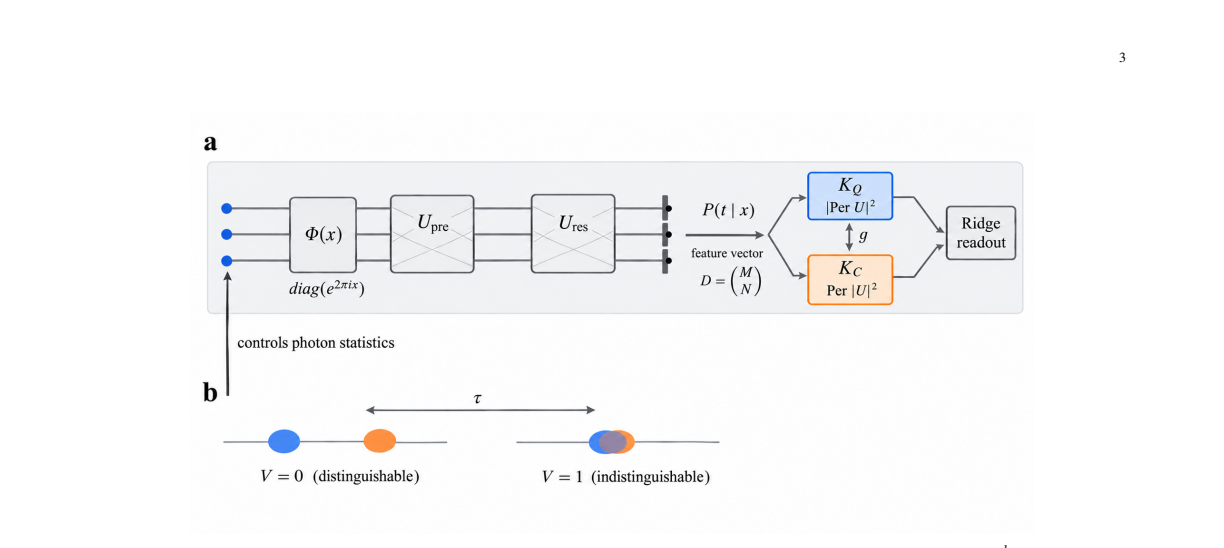
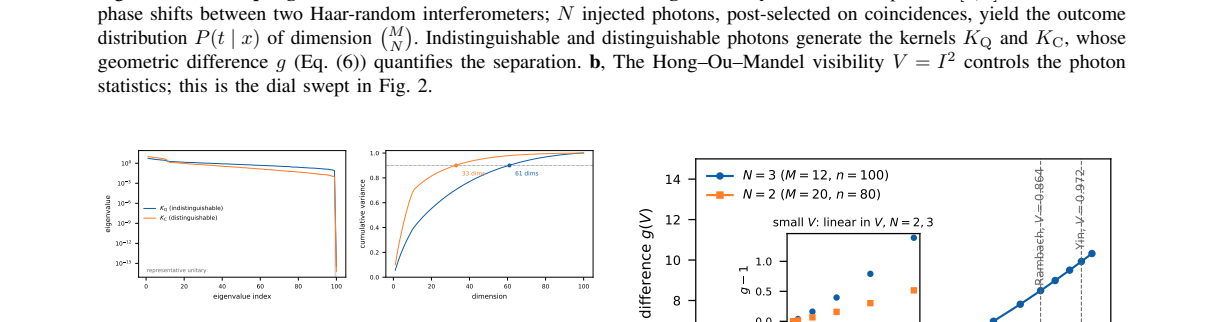
Here we resolve the question task-independently through the kernel geometry of boson-sampling feature maps. Interference redistributes feature variance across roughly twice as many effective dimensions as distinguishable-particle statistics, generating a large geometric separation between the corresponding kernels. The separation grows superlinearly with indistinguishability, is linear in Hong–Ou–Mandel visibility at small visibility for two to four photons, and retains approximately 80% of its magnitude at the source quality of current quantum processors. Under experimental sampling budgets the separation is learnable on adversarially constructed tasks (accuracy advantage +0.22 plus or minus 0.05) and an order of magnitude smaller on natural tasks, gated by kernel–task alignment. The results reconcile the existing experimental record and supply a pre-experimental protocol: kernel geometry establishes that an interference-specific learning resource exists, and task alignment determines whether a given task can access it; both are computable before committing significant hardware resources.
from the abstract
Pith says
Machine review · deepseek-v4-flash · 10 Oct 2026 · of version 1 of the paper; version 3 is newer · what was read was not recorded · not checked by a person
It can be wrong. Challenge this review or reply to it.
Holds up. A clean, well-executed kernel-geometry analysis that resolves when interference helps photonic reservoir computing, with honest limitations and a clear prospective test. This line is wrong
2 major objections · 6 minor
How often objections from reviews like this one are right: not yet measured
Not checked: figures, code, what the references say.
The paper says, at Abstract and Section IV, Fig. 3
The review did not quote this passage.
A classifier read this sentence of the paper as acknowledging the concern (probability 0.90):
“Multiphoton emission noise ( g(2)) is not modelled; because it perturbs the input state itself rather than the channel, it is the imperfection most likely to modify the geometric quantities at fixed V , and its characterization is a priority for hardware follow-up.”
Pith says: Objection 1 of 2 · major
The paper claims that the geometric separation 'retains approximately 80% of its magnitude at the source quality of current quantum processors' (Abstract, also [b19] and Fig. 3 caption). This retention is computed from a model that includes only visibility (V) as a source imperfection.
more of objection 1
The authors acknowledge in Section V.B (sentence b79) that multiphoton emission noise (g^{(2)}) is not modelled and 'is the imperfection most likely to modify the geometric quantities at fixed V.' Since the abstract and the caption of Fig. 3 present the 80% figure without this qualification, a reader may overestimate the model's coverage of hardware imperfections. The retention claim should be explicitly conditioned on the single-photon-per-mode assumption in the abstract and in the caption, or the known limitation should be highlighted there. This is a clarity issue, not a correctness error, because the limitation is clearly stated elsewhere.
The paper says, at Section VI and Supplementary Note 8
The review did not quote this passage.
A classifier read this sentence of the paper as acknowledging the concern (probability 0.72):
“The natural-task families are structured label functions on a single data manifold; the fine-grained alignment ordering among natural tasks is not resolved at current sample sizes (Supplementary Note 8), and the weighted- alignment reading is post-hoc and unsupported by the expanded battery.”
Pith says: Objection 2 of 2 · major
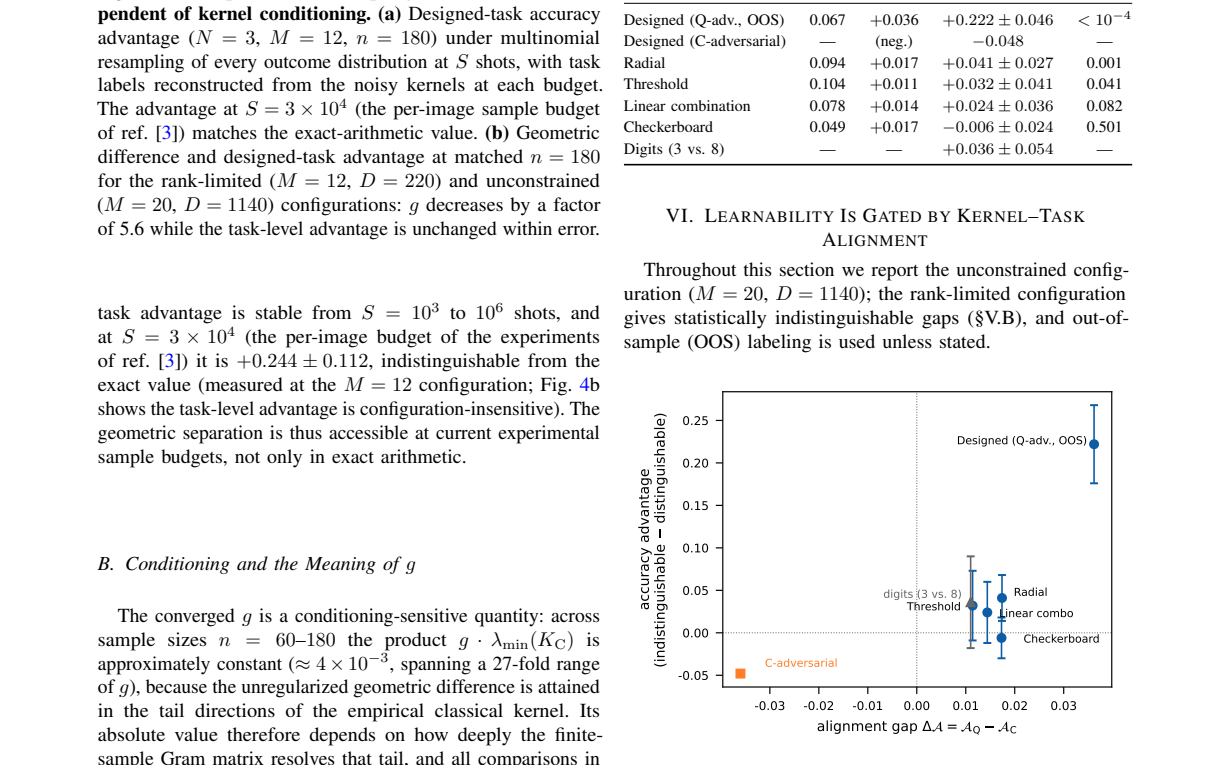
The central gating claim—that geometry without alignment yields no advantage—is supported at the extremes (designed task vs. null controls), but the pre-registered battery (13 natural-task families) failed to confirm the graded ordering predicted by alignment: Spearman ρ=0.027 (p=0.93) and sign agreement in 9 of 13 families (threshold 10 of 14).
more of objection 2
The authors correctly interpret this as a resolution limit (Supplementary Note 8). However, the main text (Section VI, Table I) still ranks the natural tasks by advantage, and the Discussion (Box 1) presents alignment computation without caveat. To avoid overclaiming, the paper should more prominently state that fine-grained ordering among natural tasks is not resolved and that the gating claim is validated only at the extremes. This is a presentational point, not a flaw in the core result.
This review says the paper's mathematics is wrong. Pith did not check that against the paper's source.
6 minor objections
The paper says, at Abstract
Pith says: minor objection 1 of 6
The phrase 'approximately 80% of its magnitude at the source quality of current quantum processors' should include a brief parenthetical remark that this estimate assumes negligible multiphoton emission noise (g^{(2)}), as the authors acknowledge in Section V.B.
The paper says, at Section III, Fig. 2 caption
Pith says: minor objection 2 of 6
The caption states 'KQ reaches 90% of its trace in 61 dimensions against 33 for KC.' Consider adding a brief note that these numbers are for one representative interferometer realization; the shaded regions show the spread over 10 realizations.
show 4 more
The paper says, at Section V.A, sentence b71
Pith says: minor objection 3 of 6
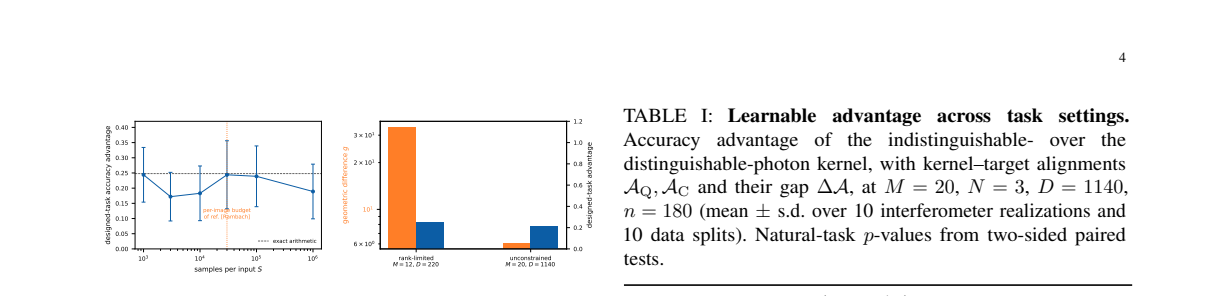
The phrase 'indistinguishable from the exact value' for the accuracy advantage at S=3×10^4 (0.244±0.112 vs. exact) could be clarified by stating the exact value explicitly (e.g., +0.222±0.046 from Section VI).
The paper says, at Section VI, Table I
Pith says: minor objection 4 of 6
The column 'Accuracy gap' would benefit from a footnote stating that the natural-task p-values are from two-sided paired tests and that the fine-grained ordering among natural tasks is not statistically resolved (see Supplementary Note 8).
The paper says, at Supplementary Note 6
Pith says: minor objection 5 of 6
The caveat (iii) states that the predicted transmission-matrix spread is narrower than the published error bars because the latter additionally fold in dataset resampling. Consider noting whether this narrowing affects the comparison of the effect-size prediction (0.015 vs. 0.014), or whether the conclusion of a null effect is robust to the difference.
The paper says, at Section VIII, Limitations
Pith says: minor objection 6 of 6
The sentence 'Our results are numerical, at system sizes that remain classically simulable; they bracket the experimental regime through shot-noise and visibility modeling but do not replace hardware validation' already conveys the limitation well. No change needed—commendable.
What would settle it
Simulate the input state with a small admixture of two-photon emission: replace each ideal single-photon input with a probabilistic mixture (1-ε) single-photon + ε two-photon Fock state, where ε is set by the g^{(2)} value (ε ∝ g^{(2)}). Recompute the Gram matrices and geometric difference g(V) for N=3 at V=0.864 and V=1.0 using the same M=12, n=100 setup. If the retention R(V=0.864) drops below 50% for g^{(2)} ≈ 0.01–0.1, then the hardware survival claim is weakened under realistic noise.
from the skeptic's reading
How the review went
4 readings by deepseek-v4-flash · 10 Oct 2026
- Reader holds up
- Skeptic disagrees
- Editor wrote the verdict above
- Referee minor revision: 2 major objections, 6 minor
Not run on this paper: the simulated authors' defence.
Pith did not check this review's objections against the paper.
The review in full
The review in brief, machine-written
This paper does something useful that the experimental literature has been circling for years: it gives a task-independent answer to when multi-photon interference actually helps learning, as opposed to just making the feature map more nonlinear. The key move is applying geometric difference and kernel-target alignment to the distinguishability dial of a boson-sampling reservoir. The numerical results are carefully done—g(V) scaling, retention at hardware visibilities, the dissociation of g from task-level advantage, and the alignment-gating story all hold up on inspection. The blind prospective prediction for the Joly et al. configuration (Supplementary Note 6) is a nice touch, and the pre-registered battery (Note 8) that didn't resolve fine-grained ordering is reported honestly rather than swept under the rug.
The only substantive unresolved issue is the missing g(2) noise model. The authors flag it themselves (sentence b79) as the imperfection most likely to modify the geometric quantities at fixed V, and leave its characterization to future work. That's a real limitation for hardware-facing claims: the retention numbers at V=0.864 and V=0.972 are conditional on single-photon-per-mode input states, and real SPDC sources with g(2) ~ 0.01-0.1 could redistribute outcome statistics in ways the scalar-visibility model does not capture. The stress-test note is correct that this is the most significant quantitative uncertainty. But the paper already says this, and I don't think it undermines the framework—it just means the protocol's output for a given platform is provisional until g(2) is included. That's an honest limitation that follow-up work can address.
The other soft spots are all stated: the system sizes are classically simulable, the fine-grained natural-task ordering wasn't resolved (pre-registration partly failed), and the weighted-alignment reading is post-hoc. None of these are hidden.
Who should read this? People working in photonic reservoir computing or quantum kernel methods. It reconciles apparent contradictions in the experimental record and provides an actionable pre-experimental protocol for small-to-midscale systems. The paper deserves a serious referee.
I'd bring this to my reading group and would cite it in work on quantum reservoir computing. Recommend peer review.
The strongest objection
The paper's central claim that the geometric separation survives hardware-typical source imperfection (Section IV, retention R≈80% at V=0.864) is based on a model that omits multiphoton emission noise (g^{(2)}). The authors explicitly state in Section V.B (sentence b79) that g^{(2)} is the imperfection 'most likely to modify the geometric quantities at fixed V' and leave its characterization to future work. Because g^{(2)} noise perturbs the input state itself—introducing additional two-photon components that are absent in the ideal single-photon-per-mode assumption—it could redistribute the outcome statistics in a way that the scalar visibility model (uniform overlap, V=I²) does not capture. The retention numbers (Fig. 3, marked for refs. [3] and [4]) are therefore conditional on the absence of g^{(2)} noise; if realistic g^{(2)} levels (∼0.01–0.1 for typical SPDC sources) substantially reduce the effective geometric difference, the pre-experimental protocol might overstate the resource available to a given hardware platform. The authors acknowledge this limitation, but no quantitative estimate of its effect is provided. Because the claim that the resource survives hardware imperfections is load-bearing for the protocol, this missing analysis is the most significant unresolved uncertainty.
The reader identified the uniform-overlap assumption (S_ij = I for i≠j) as the weakest assumption. While that is a valid simplification, the paper's own text flags multiphoton emission noise (g^{(2)}) as the imperfection 'most likely to modify the geometric quantities at fixed V' (sentence b79). This omission directly impacts the core claim that the geometric separation survives hardware-typical source quality, because current photon sources (SPDC, quantum dots) have non-zero g^{(2)} values. The uniform-overlap assumption is acknowledged and partially addressed by the retention numbers at experimental visibilities, but g^{(2)} noise is not modeled at all. A quantitative test of g^{(2)} effects would settle whether the hardware survival claim is robust. Despite this concern, the paper's extensive numerical evidence, honesty about limitations, and successful blind prediction make the overall argument strong. The verdict of ACCEPT remains appropriate, as the missing analysis is identified as future work and does not invalidate the existing numerical results under ideal conditions.
The referee's report
If the conclusions hold, the paper provides a principled, task-independent framework for understanding when multi-photon interference aids learning in photonic reservoir computing—a question that has produced mixed experimental results. By dissociating the geometric resource (separation g) from its task-dependent accessibility (alignment), the authors offer a constructive protocol that can be evaluated before committing hardware resources. The numerical experiments are carefully executed, the shot-noise modeling is thorough, and the code is provided. The prospective blind prediction for the configuration of ref. [2] (Supplementary Note 6) is a particularly strong validation of the framework's predictive power, and the pre-registered battery (Supplementary Note 8) honestly reports the limits of fine-grained resolution.
Pith's reading of the paper (a machine's summary, not the authors')
The paper aims to resolve, task-independently, when multi-photon interference helps learning in photonic reservoir computing. It shows that interference redistributes feature variance across roughly twice as many effective dimensions as distinguishable-particle statistics, creating a large geometric separation (g≈10.3) that grows superlinearly with indistinguishability and survives hardware-typical source imperfection. However, this geometric resource only translates into a learning advantage when the quantum kernel aligns with the task more than the classical kernel does: on adversarially designed tasks the accuracy advantage is +0.222±0.046, an order of magnitude smaller on natural tasks, and zero where neither kernel aligns. These results reconcile four previously contradictory experiments and supply a practical protocol: compute the kernel geometry and task alignment before committing hardware resources.
What carries the argument. The key machinery is the pair of quantities: the geometric difference g(K_Q, K_C) = $\sqrt$(λ_max($K_Q^{{1/2}}$(K_C+εI)^{-1} $K_Q^{{1/2}}$)) and the kernel–target alignment A(K, y) = ⟨K, yy^T⟩_F / (‖K‖_F ‖y‖^2). The geometric difference measures the spectral separation between the two kernels and upper-bounds the ratio of model complexities, establishing that interference adds directions absent from the classical map. The alignment measures how well each kernel predicts the task labels; the gap ΔA = A_Q - A_C gates whether the interference-specific directions improve generalization. Together they provide a pre-experimental test: g large and ΔA positive implies interference will help.
Core claim. The central discovery is that a geometric difference g between the indistinguishable-photon kernel K_Q and the distinguishable-photon kernel K_C, defined as $\sqrt$(λ_max($K_Q^{{1/2}}$(K_C+εI)^{-1} $K_Q^{{1/2}}$)), certifies the existence of an interference-specific learning resource. Whether a given task can exploit that resource is determined not by g but by the kernel–target alignment gap ΔA = A(K_Q, y) - A(K_C, y). At the flagship configuration (M=12, N=3, n=100), g=10.3±1.1; the designed-task advantage is +0.222±0.046, while natural-task advantages are an order of magnitude smaller and vanish when ΔA ≈ 0. The geometric separation is smooth in the Hong–Ou–Mandel visibility V, linear at small V, and retains ~80% at hardware-typical source quality.
The premise it rests on. The model of partial distinguishability assumes uniform pairwise overlaps among all photons, controlled by a single parameter I (HOM visibility V = $I^{2}$), whereas realistic sources may have non-uniform overlaps or frequency correlations that the scalar model does not capture.
If the paper is right (Pith's inferences, not the authors')
Photonic reservoir computing experiments can now be preceded by a simulation-based or small-shot-budget evaluation of g and alignment, determining whether high-visibility sources are worth deploying for a given task family.
The framework reconciles the contradictory experimental record: Di Bartolo et al. found advantage on nonlinear temporal tasks (high alignment), Joly et al. found none on MNIST 0 vs. 1 (low alignment), and Rambach et al. observed a train–test gap consistent with geometry improving trainability while generalization follows alignment.
Partial distinguishability is reframed as a continuous resource rather than an imperfection: at V=0.864 (current quantum processor quality) the geometric separation retains 80.3% of its maximum, so mild decoherence does not eliminate the resource.
The convexity of the model complexity in V is proved (Proposition 2), ruling out interior optima at the kernel-geometry level; any observed interior optimum must arise from readout-level effects, not kernel structure.
The designed-task advantage is insensitive to the conditioning-sensitive absolute value of g (a 5.6-fold change in g leaves the advantage unchanged within error), separating the learnable effect from a conditioning artifact.
The protocol could be adapted to other quantum machine learning settings where kernel geometry is computable classically or via small quantum circuits, extending beyond photonic reservoirs to generic quantum kernel methods.
The convexity proof and the resolution-limited ordering among natural tasks suggest that testing the fine-grained predictions of kernel–task alignment will require either engineering tasks with larger alignment gaps or substantially more interferometer realizations (≈5× more than used here) to beat the noise floor.
The result that random Fourier features cannot reproduce the photonic kernels' separation indicates that the interference-specific structure is not generic high-dimensional randomness; this hints at a qualitative difference between physical feature maps and random projections that may be exploitable beyond the sizes studied.
The paper's computational bottleneck (matrix permanents are #P-hard) limits the protocol to classically simulable system sizes (N≤4); extending the approach to larger N will require new heuristics or approximations for permanent evaluation, which is acknowledged as an open problem.
Check this review
Pith stored no record of this review's passes and took no fingerprint of it. Reviews made by code from 13 Nov 2026 on carry both.
How often reviews like this one are right
Reviews like this one: written by deepseek-v4-flash, where what was read was not recorded.
How often objections from reviews like this one are right: not yet measured
Reviews by people
This review was written by a machine. No person has reviewed this paper on Pith yet. A scientist listed on Pith can review it for a fee, and their review is published here whatever it concludes.
The paper
Abstract
Multi-photon interference is the resource most native to photonic quantum machine learning, yet experiments on photonic reservoirs have reported advantages, null results, and train-only effects. These outcomes cannot be compared: each measures task-dependent accuracy on different tasks and platforms. Here we resolve the question task-independently through the kernel geometry of boson-sampling feature maps. Interference redistributes feature variance across roughly twice as many effective dimensions as distinguishable-particle statistics, generating a large geometric separation between the corresponding kernels. The separation grows superlinearly with indistinguishability, is linear in Hong–Ou–Mandel visibility at small visibility for two to four photons, and retains approximately 80% of its magnitude at the source quality of current quantum processors. Under experimental sampling budgets the separation is learnable on adversarially constructed tasks (accuracy advantage +0.22 plus or minus 0.05) and an order of magnitude smaller on natural tasks, gated by kernel–task alignment. The results reconcile the existing experimental record and supply a pre-experimental protocol: kernel geometry establishes that an interference-specific learning resource exists, and task alignment determines whether a given task can access it; both are computable before committing significant hardware resources.
The paper's own sentences, arranged, kept beside the review and separate from it. Each label is drawn from a closed vocabulary; the number beside it is the probability the classifier gave that label. No sentence in this record was written by a model.
abstract compiled · 2026-10-09
The authors' main claim, as the classifier picked it out 1.00
“The results reconcile the existing experimental record and supply a pre-experimental protocol: kernel geometry establishes that an interference-specific learning resource exists, and task alignment determines whether a given task can access it; both are computable before committing significant hardware resources.”
How the main claim is stated: asserted 1.00
What the abstract itself states, as probabilities: claims first 0.07 · states limitation 0.84 · human participants 0.02 · controlled comparison 0.73 · randomized assignment 0.01 · states quantitative result 0.98 · compares with prior results 0.85 · mentions code or data availability 0.03
The abstract, sentence by sentence
This table labels the abstract only (arXiv listing abstract v1). The number is the probability the classifier gave the label.
| Sentence | Role | The authors' own work | States the main conclusion | Strength |
|---|---|---|---|---|
| Multi-photon interference is the resource most native to photonic quantum machine learning, yet experiments on photonic reservoirs have reported advantages, null results, and train-only effects. | background 0.88 | 0.06 | 0.03 | asserted 1.00 |
| These outcomes cannot be compared: each measures task-dependent accuracy on different tasks and platforms. | gap 0.75 | 0.08 | 0.02 | asserted 1.00 |
| Here we resolve the question task-independently through the kernel geometry of boson-sampling feature maps. | contribution 0.89 | 0.85 | 0.12 | asserted 0.99 |
| Interference redistributes feature variance across roughly twice as many effective dimensions as distinguishable-particle statistics, generating a large geometric separation between the corresponding kernels. | result 1.00 | 0.86 | 0.18 | asserted 1.00 |
| The separation grows superlinearly with indistinguishability, is linear in Hong--Ou--Mandel visibility at small visibility for two to four photons, and retains approximately 80% of its magnitude at the source quality of current quantum processors. | result 1.00 | 0.90 | 0.08 | asserted 1.00 |
| Under experimental sampling budgets the separation is learnable on adversarially constructed tasks (accuracy advantage +0.22 plus or minus 0.05) and an order of magnitude smaller on natural tasks, gated by kernel--task alignment. | result 1.00 | 0.91 | 0.16 | asserted 1.00 |
| The results reconcile the existing experimental record and supply a pre-experimental protocol: kernel geometry establishes that an interference-specific learning resource exists, and task alignment determines whether a given task can access it; both are computable before committing significant hardware resources. | interpretation 0.94 | 0.84 | 0.90 | asserted 1.00 |
What kind of paper the classifier reports this is: theoretical result 0.43 · evidence from simulation or computation 0.84
What was examined, and what was not
Sources read
- arXiv listing abstract v1
Not examined
- full text
- figures and tables
- references and citing sentences
- relations to other papers
Levels run
- P abstract
Not run
- S sections
- T body sentences
- C citations
- R cross-paper relations
How the labels were made
Compiled by classifier-1.13.0 via TypeSafe API, question bank abstract-p1-20260923, 2026-10-09: 1 request, 5,774 input tokens.
Every quoted sentence on this record is the authors'. Every label is from Pith's closed vocabulary, with the probability shown beside it. This record as JSON
Figures (6)

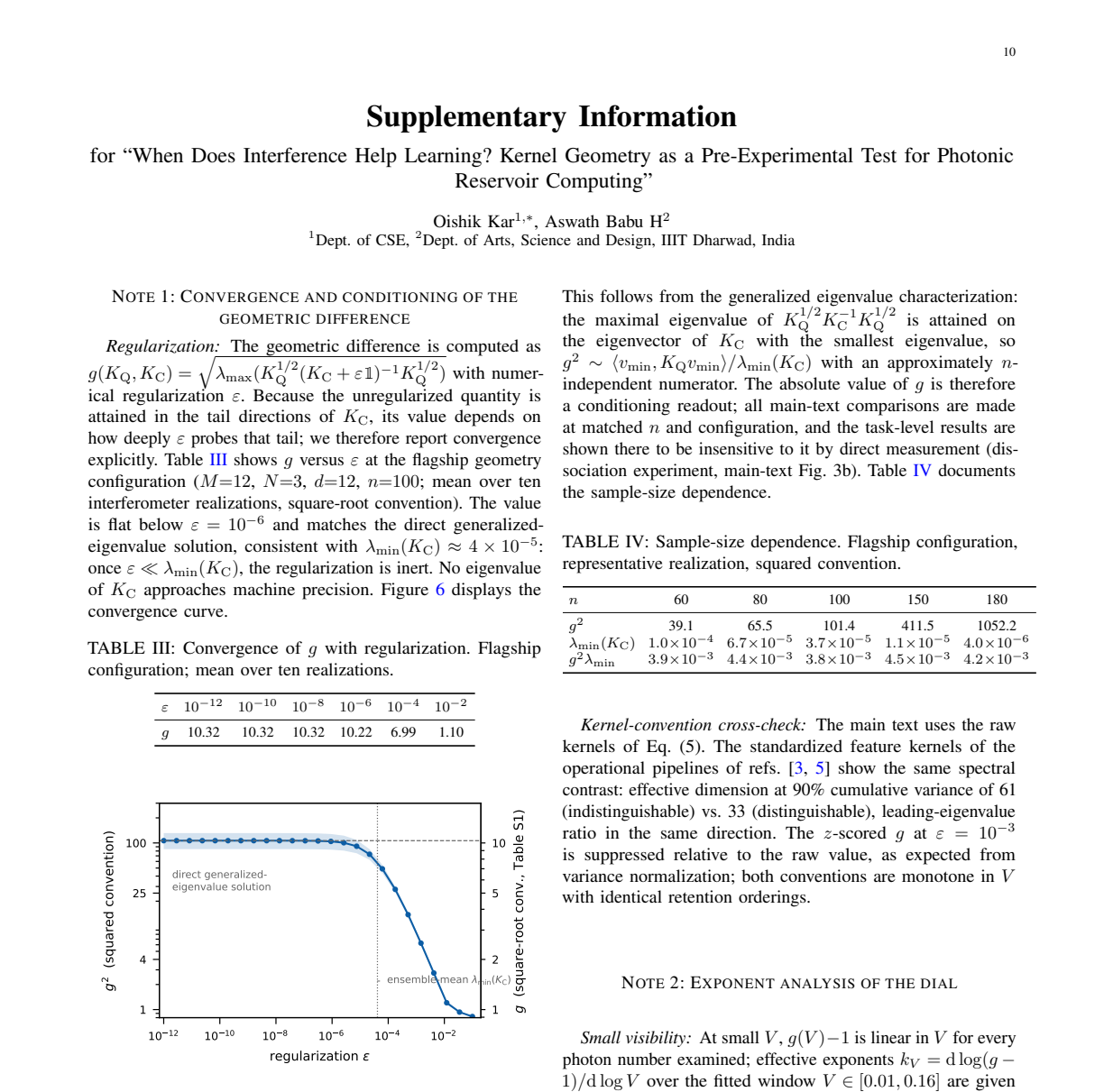
Figures are the authors', reproduced from the paper.
Cited by 1 Pith paper
Reviewed papers on Pith that cite this one. The full citation record
- Emergent Recursive Kernels in Quantum Reservoir Computing quant-ph · Oct 2026
Challenges and discussion
Disagree with the review, or know something it missed? Leave a comment, or challenge this review formally: a challenge becomes a permanent entry in this paper's record, and its decision is published here.
Come back by email
A short list of the week's newly reviewed papers. Nothing is sent until you confirm from your inbox, and every email has a link that stops it. No account.
No comments yet.
Sign in to comment