Quantum Physics · arXiv:2610.03304 v1 · submitted 2 Oct 2026 · 36 references
Free fermionic black holes as polarised mirrors
The paper says
“Understanding the speed with which various classes of quantum systems can scramble information is a key goal of quantum information theory, with relevance to both fundamental physics and the study of the efficiency of quantum algorithms.”
more of the abstract
Famously, such understanding enabled Hayden and Preskill to show that, under the assumption that black hole dynamics may be modelled by a Haar-random unitary, old black holes act as ”mirrors”, reflecting infalling quantum information back out again effectively instantaneously. In this work, we investigate which aspects of this mirror behaviour survive beyond the Haar-random setting by considering a random free fermionic model of black hole dynamics. We find that the rate of information release is governed by the underlying representation-theoretic structure; such a black hole acts as a ”polarised mirror”, retaining information encoded in low fermionic-degree irreps while reflecting information encoded in high fermionic-degree irreps much more rapidly. As a result of the retention of low-degree information, we show that faithful recovery of the infalling quantum information is impossible until all but a vanishing fraction of the black hole has evaporated. However, augmenting the dynamics with a fixed Clifford unitary can restore their reflective behaviour, even though the ensemble's frame potential remains unchanged and far above its Haar value. Remarkably, we find that such black holes can outperform their fully Haar-random counterparts: in the high-fidelity limit, recovering a single-qubit message requires asymptotically approximately 37% fewer emitted qubits.
from the abstract
Pith says
Machine review · deepseek-v4-flash · 5 Oct 2026 · what was read was not recorded · not checked by a person
It can be wrong. Challenge this review or reply to it.
Holds up. Solid, checkable result: matchgate Hayden-Preskill recovery cleanly separates reflection from 2-design scrambling, and the Clifford beat-the-Haar claim is real but needs a one-line joint-limits condition (r = o(nB)). This line is wrong
1 major objection · 5 minor
How often objections from reviews like this one are right: not yet measured
Not checked: figures, code, what the 36 references say.
The paper says, at §IV, Theorem 4 and the paragraph after Eq. (34)
The review did not quote this passage.
Pith says: Objection 1 of 1 · major
The comparison ε_MG = Θ(q_m^{−2r}) versus ε_U = Θ(4^{−r}), and hence the claimed ratio r_MG/r_U → log 4/log 9, requires the O_{m,r}(n_B^{−1}) remainder in Eq. (34) to be uniform in r over the subsequent limit r → ∞, and this uniformity is not established.
more of objection 1
In the proof at the end of Appendix A4, p_{k_j} = ∏_{ℓ=0}^{2r−1} (2n_B − k_j − ℓ)/(2n_B − ℓ); expanding the logarithms shows the dominant finite-n_B correction to ln p_{k_j} is of order r²/n_B in the exponent (with k_j ≈ 4^m n_B/(4^m − 1) for the message labels), so q_m^{−2r}(1+o(1)) holds only along sequences satisfying r = o(n_B) as a joint condition. The phrasing 'first taking n_B → ∞ at each fixed r, before letting r → ∞' does not license this conclusion, because the fixed-r limit may carry an r-dependent error constant that grows in the second limit. I recommend restating Theorem 4 and the Appendix A4 derivation as: for fixed m, along any sequence with n_B → ∞, n_B ≫ m·4^m, and r = o(n_B), d_A d_{Bf} Δ_2 = (4^m − 1) q_m^{−2r}(1+o(1)); equivalently, ε_MG/ε_U = (q_m²/4)^{−r}(1+o(1)) in that coupled limit, from which the ratio log 4/log q_m² follows. This is a one-sentence formal tightening, but it is load-bearing because the 37% advantage is the paper's headline quantitative claim and the regime r = o(n_B) is exactly the early-radiation regime the authors themselves use in Theorem 3.
5 minor objections
The paper says, at §IV, after Eq. (34)
Pith says: minor objection 1 of 5
Please qualify the '37% fewer emitted qubits' claim as holding for m = 1 in the coupled limit r = o(n_B) with ε → 0 (so r = Θ(log 1/ε)); as written, the sentence appears before the regime is fixed, and the reader should be reminded that the advantage is negligible for larger m since q_m → 2 exponentially in m (the paper notes this only later in the paragraph).
The paper says, at Eq. (24), §III
Pith says: minor objection 2 of 5
The relation p_k(n_Bf,n_B) ∼ (n_Bf/n_B)^k stated after Eq. (24) is pointwise in k, whereas the reasoning around Eq. (30) deliberately uses extensive k = Θ(n_B), where the binomial ratio is governed by entropic factors rather than the power law; a sentence bridging the two regimes would help the reader follow the 'k⋆ ≈ n_B' argument.
show 3 more
The paper says, at Appendix A3, proof of Lemma 3
Pith says: minor objection 3 of 5
The identity E_{O∼Haar(SO(2n_B))}[O_{μν}²] = 1/(2n_B), which drives the evaluation E[s_V²] = 1 − r/n_B, is used without being stated; please state it explicitly with a one-line justification so the reader can verify the average over the orthogonal group.
The paper says, at Notation throughout
Pith says: minor objection 4 of 5
Subscript notation is inconsistent across the main text and the appendix (n_B, nB, n_Bf, n_Bi, dBf appear interchangeably, e.g., in the proof of Lemma 3); a uniform convention would improve readability.
The paper says, at Appendix A2, Eq. (A32)
Pith says: minor objection 5 of 5
The transpose notation P_A^T is used without definition; please specify that it is the transpose in the computational basis of A, since the identity tr_M[Φ_MA(P_M⊗1_A)] = P_A^T/d_M is used repeatedly.
What would settle it
One check: for m = 1, evaluate the exact non-asymptotic factor p_k = C(2n_B − 2r, k)/C(2n_B, k) at k = 4t* + 1 with t* = ⌊(n_B − 1)/3⌋, for n_B = 10^6 and r ∈ {10^2, 10^3, 10^4, 10^5} (r/n_B = 10^{-4}, 10^{-3}, 10^{-2}, 10^{-1}). For each, compare −ln p_k/(2r) against ln 3: the deviation should equal r/(n_B ln 3) to first order, i.e. ≈0.00009%, 0.0009%, 0.009%, 0.9%, and 9.1% respectively. If at r = 0.1n_B the effective per-qubit rate differs from ln 3 by more than ~5% (which shifts the claimed ratio log 4/log 9 ≈ 0.63 by several percent), then Theorem 4's rate and the 37% comparison must be restated under the explicit joint condition r = o(n_B) and n_B ≫ m·4^m rather than the two-step 'n_B → ∞ at fixed r, then r → ∞' phrasing, exactly as the reader's requested tightening would require.
from the skeptic's reading
How the review went
4 readings by deepseek-v4-flash · 5 Oct 2026
- Reader holds up
- Skeptic partly agrees
- Editor wrote the verdict above
- Referee minor revision: 1 major objection, 5 minor
Not run on this paper: the simulated authors' defence.
Pith did not check this review's objections against the paper.
The review in full
The review in brief, machine-written
Worth a serious referee. The per-theorem math is internally consistent — I checked the swap-trick twirl in Theorem 2's proof, the degree-one witness in Lemma 3 (tr[YV XV] = sV, E[sV2] = 1 − r/nB, the Jensen step), and the Witt-lifted symplectic construction in Theorem 4. Everything coheres, and there are no fitted parameters; the decoupling rates are derived from the stated ensembles. The reader's and stress-test's checks line up with my own read.
What's actually new: Theorem 2's degree-resolved decoupling formula is a clean tool, and the polarised-mirror picture — low-degree Majorana sectors retained, high-degree sectors reflected — really does separate Hayden-Preskill-style reflection from unitary-2-design scrambling. The Clifford construction that leaves the frame potential unchanged yet restores, and beats, Haar-like recovery is the most interesting part; that is a genuine statement about scrambling diagnostics, not a rehash. The 37% number for a single-qubit message is the headline, and the mechanism (q1 = 3 vs 4−r) is sound at leading order.
The soft spot, and it is a soft spot: the 37% saving is stated through a non-uniform double limit — nB → ∞ at fixed r, then r → ∞ — and that phrasing does not supply the uniformity you need. The dominant finite-n_B correction to ln p_kj is of order (kj/(2nB − kj))·r2/nB, i.e. a relative error r/(nB ln qm) in the exponent. So qm−2r — and with it the ratio log 4/log 9 — holds along sequences with r = o(nB), and at r = 0.1 nB the exponent is already off by roughly nine percent. This is a quantification gap, not an inconsistency: the missing premise is the same early-radiation condition r = o(nB) the paper already uses in Theorem 3. A one-sentence joint-limits statement fixes it. The stress-test is right on this.
The other premise worth remembering is the model itself: exact Page-time maximal entanglement between the old black hole and early radiation. The degree weights Wk and the Clifford advantage rest on that exact form. The authors acknowledge it, and it is the standard HP idealization, so I would not call it a flaw — just do not quote the 37% outside that scope.
Who it is for: quantum information people working on symmetry-restricted decoupling, matchgate/fermionic dynamics, and toy black-hole models. With the joint-limits statement added, it is publishable essentially as is.
The strongest objection
The per-theorem mathematics checks out: Theorem 1's two-sided fidelity bounds, Lemma 3's degree-one witness (tr[Y_V X_V] = s_V, E[s_V²] = 1 − r/n_B, Jensen step), and Theorem 4's W_k/binomial algebra are internally consistent, and the Clifford C_{t*} is a legitimate Witt-lifted symplectic map with the frame potential exactly invariant. The load-bearing soft spot is the regime in which the headline 37% saving is claimed. Theorem 4 is stated for fixed m, r as n_B → ∞; Section IV then 'first tak[es] n_B → ∞ at each fixed r, before letting r → ∞', and from ε_MG = Θ(q_m^{-2r}), ε_U = Θ(4^{-r}) concludes r_MG/r_U → log 4/log 9 ≈ 0.63. That conclusion requires ε to be of the form (4^m−1)q_m^{-2r} along the whole path r → ∞, i.e. uniformity in r of the n_B → ∞ limit. The dominant finite-n_B correction to ln p_{kj} = Σ_{ℓ=0}^{2r−1} ln((2n_B − k_j − ℓ)/(2n_B − ℓ)) is −[k_j/(2n_B − k_j)]·r²/n_B; for m = 1, k_j ≈ 4n_B/3 so ln p_{k_j} = −2r ln 3 − 2r²/n_B(1+o(1)), a relative error r/(n_B ln 3) in the exponent. Hence q_m^{-2r} holds only under r = o(n_B) as a joint condition, and at r = 0.1n_B the correction is already ~9% of the exponent, shifting the ratio 0.63 by several percent. Pointwise-then-second-limit phrasing does not supply this; the required statement is: along any sequence with n_B ≫ m·4^m and r/n_B → 0, ε_MG/ε_U = (q_m²/4)^{-r}(1+o(1)) and r_MG/r_U → log 4/log q_m². This is a quantification gap, not an inconsistency; a one-sentence joint-limits statement (the same tightening the reader requests) resolves it. The early-radiation condition r = o(n_B) already used in Theorem 3 is exactly the missing premise.
I read Sections II–IV and Appendix A closely. Theorem 1's upper bound (pinching, angular triangle inequality, x_j ≤ d_A²) and lower bound (Hölder) are valid; Lemma 1 is the standard Uhlmann purification step. Theorem 2's twirl over MG(n_B) uses the commutant basis Q_{k,0}, Q_{k,1}; the parity-twisted Q_{k,1} contribution cancels (tr Π_n = 0), leaving the degree-resolved sum with p_k and W_k, consistent with Eq. (26). Lemma 2's W_k = C(2m,k)/d_M follows from tr_M[Φ(1⊗P)] = Pᵀ/d_M. Lemma 3's witness Y_V = γ_1^A ⊗ Γ̂_{V,f} gives tr[Y_V X_V] = s_V exactly (the τ_A ⊗ τ_Bf term vanishes since γ_1^A is traceless), with E[s_V²] = 1 − r/n_B; the measurement-channel step and Jensen on the concave square root give Theorem 3's bound E F ≤ (1/2)(1+√(r/n_B)). Theorem 4: C_{t*} is a legitimate symplectic map (|C_t(x)| ≡ |x| and C_t(x)·C_t(y) ≡ x·y mod 2, lifted by Witt's theorem); the images have degree t*4^m + |x|, giving W_{t*4^m+j} = C(2m,j)/d_A and the binomial-ratio sum; the expansion 1 − k_j/2n_B = q_m^{-1} + O(1/n_B) with q_m = 2(4^m−1)/(4^m−2) is algebraically correct. The frame-potential identity F^{(ℓ)}_{GC} = F^{(ℓ)}_G is exact and well-used. So the derivations are sound; my concern is not an error in any single step but the unstated uniformity in the second limit (r → ∞) used for the 37% comparison. The dominant finite-n_B correction to ln p_{kj} is −[k_j/(2n_B − k_j)]r²/n_B ≈ −2r²/n_B for m = 1, making the rate q_m^{-2r} and hence log 4/log q_m² valid only as a joint limit with r = o(n_B) (plus n_B ≫ m·4^m so the degree t*4^m + |x| exceeds n_B). That is precisely the early-radiation regime already used in Theorem 3, but it is never stated for Theorem 4's comparison, and at r = 0.1n_B the correction is ~9% of the exponent, enough to shift the 0.63 ratio materially. A one-sentence joint-limits statement fixes it; I do not change the reader's ACCEPT verdict since the concern is a tightening rather than a rejection. Agreement is partial: the reader's stated weakest assumption (exact maximal entanglement in ω_HP = Φ_MA ⊗ τ_Bi) is the standard published Hayden–Preskill premise and, per review rules, not the best attack; the regime condition, which the reader mentioned only in the rationale, is the more load-bearing point.
The referee's report
The central finding — that Gaussian (matchgate) dynamics with a fixed Clifford pre-processing can beat Haar-random unitaries at the concrete task of Hayden–Preskill recovery, while leaving the second-order frame potential unchanged and far above its Haar value — is a clean separation between scrambling diagnostics (design-ness, frame potential) and the information-theoretic rate of information release. If the results stand, the paper establishes a genuinely new mechanism (degree-resolved 'polarised mirror' obstructions) and a concrete, falsifiable quantitative prediction (the factor log 4/log 9 for m = 1). On the technical side the paper is unusually careful: the matchgate-commutant computation in Theorem 2, the correlation-witness lower bound in Lemma 3, and the Witt-lifted symplectic construction C_{t*} are all derived from the stated ensembles with no fitted free parameters (t* is fixed by n_B and m, not calibrated to force the result), and all proofs are written out in the appendix.
Pith's reading of the paper (a machine's summary, not the authors')
The paper asks how much of the Hayden–Preskill black-hole-mirror effect survives when the interior dynamics are Haar-random matchgate circuits — free-fermionic, Gaussian evolution — instead of Haar-random unitaries. Its central claim is that such a black hole acts as a “polarised mirror”: infalling correlations are released at a rate set by their fermionic degree, with low-degree sectors retained and high-degree sectors reflected rapidly. Because Alice's small message ($m \ll n_B$) occupies only low-degree sectors, the average optimal recovery fidelity is capped at $1/2 + o(1)$ while the black hole is far from fully evaporated, so Bob cannot faithfully recover the message no matter how powerful his decoding. The paper then shows that prepending a fixed Clifford unitary that moves the message into extensive-degree strings restores fast release, and its explicit construction needs asymptotically about 37% fewer emitted qubits than the Haar-random benchmark to reach a given recovery fidelity, even though the ensemble's frame potential stays far above its Haar value. The upshot is that the mirror effect does not require strong scrambling, and that how the message is encoded relative to the dynamics matters as much as how the dynamics scramble.
What carries the argument. The load-bearing object is the grading of the matchgate group $\mathrm{MG}(n_B) \cong \mathrm{Spin}(2n_B)$ by fermionic degree — the number of Majorana operators in an operator string, equivalently the label of the exterior-power irrep $\Lambda^k(\mathbb{C}^{2n_B})$ that the string's subspace carries under conjugation. Because the two-copy commutant of the matchgate group has dimension $4n_B + 2$ and is spanned by the operators $Q_{k,0}, Q_{k,1}$ of Eqs. (19)–(20), the averaged two-copy twirl can be evaluated exactly, producing the polarised-mirror identity of Theorem 2: each degree-$k$ correlation survives with probability $p_k \approx (n_{B_f}/n_B)^k$, so low-degree messages stay trapped while high-degree strings leak into the radiation. The second piece of machinery is the explicit Clifford $C_{t^*}$, a symplectic map whose nonzero inputs are vectors of Hamming weight $4^m t^* + |x| \approx n_B$; it is what relocates the message into the sector the matchgate dynamics decouple fastest, and its existence (for most Cliffords, by a concentration argument) is what decouples recovery from the frame-potential diagnostic.
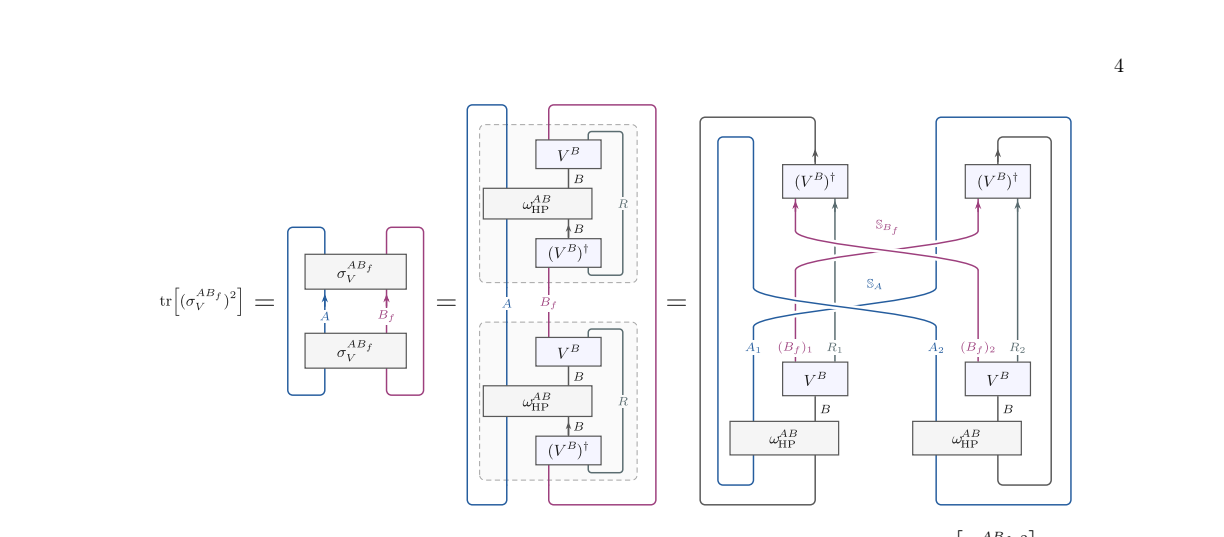
Core claim. The paper proves a degree-resolved decoupling theorem for matchgate (free-fermion) dynamics: for any input state $\omega^{AB}$, the averaged Hilbert–Schmidt decoupling error is $\Delta_2^{MG(n_B),\omega} = \frac{1}{d_{B_f}} \sum_{k=1}^{2n_{B_f}} p_k(n_{B_f}, n_B) W_k(\omega)$, where $p_k = \binom{2n_{B_f}}{k}/\binom{2n_B}{k} \approx (n_{B_f}/n_B)^k$ is the fraction of degree-$k$ Majorana monomials still supported on the remaining black hole and $W_k(\omega)$ is the correlation weight the input state carries in the degree-$k$ sector. For the Hayden–Preskill input $\omega_{HP} = \Phi_{MA}\otimes\tau_{B_i}$, Lemma 2 fixes the weights as $W_k = \frac{1}{d_M}\binom{2m}{k}$ for $k \le 2m$ and zero above, so all retained message correlations sit in the low-degree sectors where the survival factor is largest. Combining this with a general two-sided fidelity bound (Theorem 1) yields Theorem 3: the average optimal recovery fidelity satisfies $\frac{1}{1+R_{MG}} \le \mathbb{E}\,F_{rec} \le \frac{1}{2}(1+\sqrt{r/n_B})$, and in the early-radiation regime $r = o(n_B)$ the ceiling is $1/2 + o(1)$ — free-fermionic black holes fail as Hayden–Preskill mirrors. The reflective behaviour is then restored by an explicit fixed Clifford $C_{t^*}$ built from the evaluation map $x \mapsto (a\cdot x)_{a \neq 0}$, concatenated an even number of times and lifted by Witt's theorem to a symplectic (Clifford) transformation on the whole black hole; its image strings have degree $4^m t^* + |x| \approx n_B$, so the message correlations are shifted into the fast-decoupled high-degree sector. With this Clifford, Theorem 4 gives $d_A d_{B_f} \Delta_2 \sim (4^m - 1) q_m^{-2r}$ with $q_m = \frac{2(4^m-1)}{4^m-2} > 2$, an infidelity that decays faster in $r$ than the Haar factor $4^{-r}$; for a single message qubit $q_1 = 3$, so the radiation needed for a fixed target fidelity is asymptotically reduced by the factor $\log 4/\log 9 \approx 0.63$ — the 37% saving.
The premise it rests on. The quantitative claims rest on the Hayden–Preskill idealisation that the old black hole is past the Page time and exactly maximally entangled with the early radiation, $\omega_{HP} = \Phi_{MA}\otimes\tau_{B_i}$, together with a small message, $m \ll n_B$; the binomial weights $W_k = \frac{1}{d_M}\binom{2m}{k}$ of Lemma 2, the degree-resolved decoupling formula, the $1/2 + o(1)$ ceiling, and the $q_m^{-2r}$ Clifford scaling all inherit this exact form, and each would need to be rederived if the entanglement is only approximate or the message is not small. The authors state this model explicitly, and it remains the premise on which the numbers stand.
If the paper is right (Pith's inferences, not the authors')
In the early-radiation regime $r = o(n_B)$, a free-fermionic black hole cannot act as a Hayden–Preskill mirror: even a computationally unrestricted Bob achieves average optimal recovery fidelity at most $1/2 + o(1)$ for Alice's Bell-state message.
Faithful recovery from a free-fermionic black hole is obtained only as $R_{MG} \to 0$, which requires the black hole to have almost completely evaporated and Bob to collect essentially all of the emitted radiation.
Prepending a fixed Clifford that maps every message Pauli to a Majorana monomial of degree $\approx n_B$ restores Haar-like recovery, and for large $n_B$ most Clifford unitaries have this property (the paper shows a random Clifford fails with probability at most $4^m e^{-t^2/n_B}$, negligible for $t \gg \sqrt{n_B}$).
In the high-fidelity limit, the Clifford-augmented free-fermion black hole needs asymptotically fewer radiation qubits than the Haar-random one: for $m = 1$, $r_{MG}/r_U \to \log 4/\log 9 \approx 0.63$, a 37% saving that shrinks rapidly with message size since $q_m \to 2$ exponentially in $m$.
The augmented ensemble's second frame potential is unchanged and far above its Haar value, so the mirror effect is not diagnosed by this scrambling measure; Haar-like information release does not require the dynamics to form a unitary 2-design.
A general recipe the paper leaves implicit: whenever dynamics have a graded decoupling error, the recovery rate is set by where the message's correlations sit under the encoding, and a fixed pre-encoding that moves them into the fast-decoupled sector should generically reproduce (or beat) Haar-like recovery — a testable extension would be to replace $C_{t^*}$ with a short fixed circuit or a sparse
Because matchgate dynamics are classically simulable, the Clifford-augmented protocol may admit an explicit, efficient decoding algorithm; the paper states only information-theoretic guarantees and does not construct one, so this is a natural open direction rather than a claimed result.
The $1/2 + o(1)$ obstruction is tied to exact maximal entanglement of the old black hole with the early radiation: if real evaporation leaves $\tau_{B_i}$ only approximately maximally mixed, the weights $W_k$ change and the ceiling could loosen, so a perturbative evaluation of recovery fidelity would delimit how robust the polarised-mirror prediction is beyond the idealised Page model.
Check this review
Pith stored no record of this review's passes and took no fingerprint of it. Reviews made by code from 13 Nov 2026 on carry both.
How often reviews like this one are right
Reviews like this one: written by deepseek-v4-flash, where what was read was not recorded.
How often objections from reviews like this one are right: not yet measured
Reviews by people
This review was written by a machine. No person has reviewed this paper on Pith yet. A scientist listed on Pith can review it for a fee, and their review is published here whatever it concludes.
The paper
Abstract
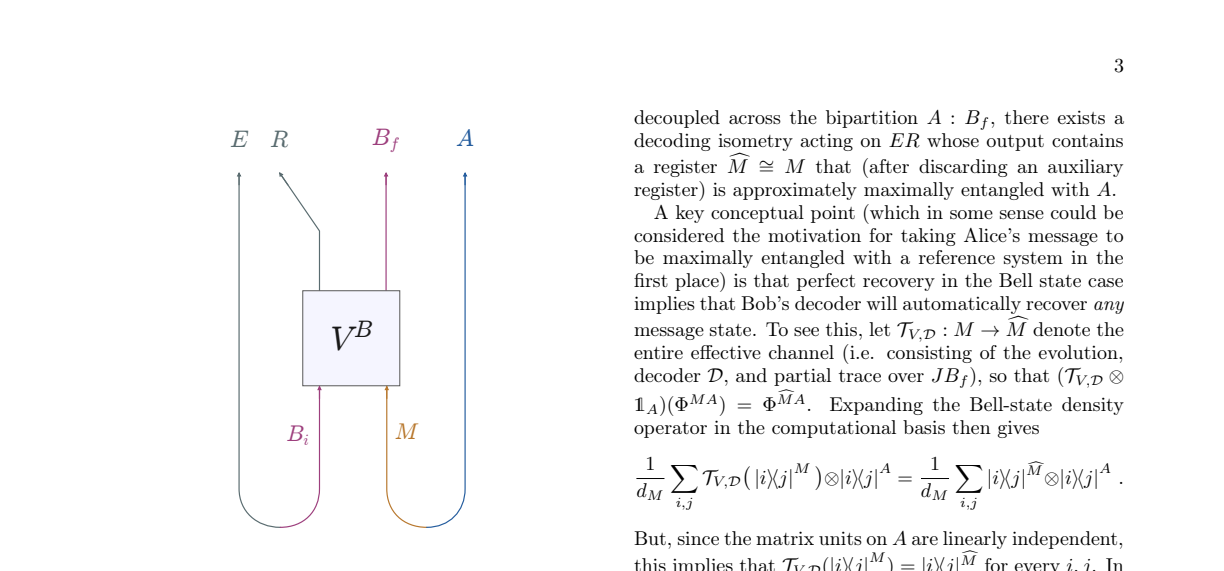
Understanding the speed with which various classes of quantum systems can scramble information is a key goal of quantum information theory, with relevance to both fundamental physics and the study of the efficiency of quantum algorithms. Famously, such understanding enabled Hayden and Preskill to show that, under the assumption that black hole dynamics may be modelled by a Haar-random unitary, old black holes act as ”mirrors”, reflecting infalling quantum information back out again effectively instantaneously. In this work, we investigate which aspects of this mirror behaviour survive beyond the Haar-random setting by considering a random free fermionic model of black hole dynamics. We find that the rate of information release is governed by the underlying representation-theoretic structure; such a black hole acts as a ”polarised mirror”, retaining information encoded in low fermionic-degree irreps while reflecting information encoded in high fermionic-degree irreps much more rapidly. As a result of the retention of low-degree information, we show that faithful recovery of the infalling quantum information is impossible until all but a vanishing fraction of the black hole has evaporated. However, augmenting the dynamics with a fixed Clifford unitary can restore their reflective behaviour, even though the ensemble's frame potential remains unchanged and far above its Haar value. Remarkably, we find that such black holes can outperform their fully Haar-random counterparts: in the high-fidelity limit, recovering a single-qubit message requires asymptotically approximately 37% fewer emitted qubits.
The paper's own sentences, arranged, kept beside the review and separate from it. Each label is drawn from a closed vocabulary; the number beside it is the probability the classifier gave that label. No sentence in this record was written by a model.
abstract compiled · 2026-10-05
The authors' main claim, as the classifier picked it out 0.82
“We find that the rate of information release is governed by the underlying representation-theoretic structure; such a black hole acts as a ''polarised mirror'', retaining information encoded in low fermionic-degree irreps while reflecting information encoded in high fermionic-degree irreps much more rapidly.”
How the main claim is stated: asserted 1.00
What the abstract itself states, as probabilities: claims first 0.05 · states limitation 0.83 · human participants 0.01 · controlled comparison 0.83 · randomized assignment 0.06 · states quantitative result 0.98 · compares with prior results 0.96 · mentions code or data availability 0.02
The abstract, sentence by sentence
This table labels the abstract only (arXiv listing abstract v1). The number is the probability the classifier gave the label.
| Sentence | Role | The authors' own work | States the main conclusion | Strength |
|---|---|---|---|---|
| Understanding the speed with which various classes of quantum systems can scramble information is a key goal of quantum information theory, with relevance to both fundamental physics and the study of the efficiency of quantum algorithms. | background 1.00 | 0.03 | 0.02 | asserted 1.00 |
| Famously, such understanding enabled Hayden and Preskill to show that, under the assumption that black hole dynamics may be modelled by a Haar-random unitary, old black holes act as ''mirrors'', reflecting infalling quantum information back out again effectively instantaneously. | background 1.00 | 0.03 | 0.03 | asserted 0.94 |
| In this work, we investigate which aspects of this mirror behaviour survive beyond the Haar-random setting by considering a random free fermionic model of black hole dynamics. | contribution 0.89 | 0.70 | 0.04 | asserted 0.68 |
| We find that the rate of information release is governed by the underlying representation-theoretic structure; such a black hole acts as a ''polarised mirror'', retaining information encoded in low fermionic-degree irreps while reflecting information encoded in high fermionic-degree irreps much more rapidly. | result 0.98 | 0.96 | 0.74 | asserted 1.00 |
| As a result of the retention of low-degree information, we show that faithful recovery of the infalling quantum information is impossible until all but a vanishing fraction of the black hole has evaporated. | result 0.96 | 0.94 | 0.26 | asserted 1.00 |
| However, augmenting the dynamics with a fixed Clifford unitary can restore their reflective behaviour, even though the ensemble's frame potential remains unchanged and far above its Haar value. | result 0.98 | 0.93 | 0.13 | asserted 0.94 |
| Remarkably, we find that such black holes can outperform their fully Haar-random counterparts: in the high-fidelity limit, recovering a single-qubit message requires asymptotically approximately $37\%$ fewer emitted qubits. | result 1.00 | 0.96 | 0.31 | asserted 0.99 |
What kind of paper the classifier reports this is: theoretical result 1.00 · evidence from proof or derivation 0.97
What was examined, and what was not
Sources read
- arXiv listing abstract v1
Not examined
- full text
- figures and tables
- references and citing sentences
- relations to other papers
Levels run
- P abstract
Not run
- S sections
- T body sentences
- C citations
- R cross-paper relations
How the labels were made
Compiled by classifier-1.13.0 via TypeSafe API, question bank abstract-p1-20260923, 2026-10-05: 1 request, 5,892 input tokens.
Every quoted sentence on this record is the authors'. Every label is from Pith's closed vocabulary, with the probability shown beside it. This record as JSON
Figures (2)
Figures are the authors', reproduced from the paper.
References (36)
- [1] P. Hayden and J. Preskill, Black holes as mirrors: quan- tum information in random subsystems, Journal of High Energy Physics9, 120 (2007) on Pith
- [2] Y. Sekino and L. Susskind, Fast scramblers, Journal of High Energy Physics2008, 065 (2008) on Pith
- [3] T. Schuster, J. Haferkamp, and H.-Y. Huang, Random unitaries in extremely low depth, Science389, 92 (2025) on Pith
- [4] N. LaRacuente and F. Leditzky, Approximate unitaryk- designs from shallow, low-communication circuits, arXiv preprint arXiv:2407.07876 10.48550/arXiv.2407.07876 (2024) on Pithdoi:10.48550/arxiv.2407.07876
- [5] L. Cui, T. Schuster, F. Brandao, and H.-Y. Huang, Uni- tary designs in nearly optimal depth, arXiv preprint arXiv:2507.06216 10.48550/arXiv.2507.06216 (2025) on PithPith's reviewarXivdoi:10.48550/arxiv.2507.06216
- [6] T. Schuster, F. Ma, A. Lombardi, F. Brandao, and H.-Y. Huang, Strong random unitaries and fast scrambling, arXiv preprint arXiv:2509.26310 10.48550/arXiv.2509.26310 (2025) on Pithdoi:10.48550/arxiv.2509.26310
- [7] T. Parella-Dilmé, J. Barberà-Rodríguez, S. F. Oliviero, and A. A. Mele, Strong unitary designs in opti- mal depth and space, arXiv preprint arXiv:2608.13491 10.48550/arXiv.2608.13491 (2026) on PithPith's reviewarXivdoi:10.48550/arxiv.2608.13491
- [8] D. N. Page, Average entropy of a subsystem, Physical Review Letters71, 1291 (1993) on Pith
- [9] B. Yoshida and A. Kitaev, Efficient decoding for the hayden-preskill protocol, arXiv preprint arXiv:1710.03363 10.48550/arXiv.1710.03363 (2017) on PithPith's reviewarXivdoi:10.48550/arxiv.1710.03363
- [10] L. Leone, S. F. Oliviero, S. Piemontese, S. True, and A. Hamma, Retrieving information from a black hole us- ing quantum machine learning, Physical Review A106, 062434 (2022) on Pith
- [11] Y. Nakata and M. Tezuka, Hayden-preskill recovery in hamiltonian systems, Physical Review Research6, L022021 (2024) on Pith
- [12] M. A. Rampp and P. W. Claeys, Hayden-preskill recov- ery in chaotic and integrable unitary circuit dynamics, Quantum8, 1434 (2024) on Pith
- [13] Y. Nakata, E. Wakakuwa, and M. Koashi, Black holes as clouded mirrors: the hayden-preskill protocol with sym- metry, Quantum7, 928 (2023) on Pith
- [14] R. Jozsa and A. Miyake, Matchgates and classical simu- lation of quantum circuits, Proceedings of the Royal Soci- ety A: Mathematical, Physical and Engineering Sciences 464, 3089 (2008) on Pith
- [15] B. C. Dias, M. Haque, P. Ribeiro, and P. McClarty, Diffusive operator spreading for random unitary free fermion circuits, arXiv preprint arXiv:2102.09846 10.48550/arXiv.2102.09846 (2021) on PithPith's reviewarXivdoi:10.48550/arxiv.2102.09846
- [16] A. Nahum, S. Vijay, and J. Haah, Operator spreading in random unitary circuits, Physical Review X8, 021014 (2018) on Pith
- [17] E. Bianchi, L. Hackl, and M. Kieburg, Page curve for fermionic gaussian states, Phys. Rev. B103, L241118 (2021) on Pith
- [18] A. Paviglianiti, L. Lumia, E. Tirrito, A. Silva, M. Col- lura, X. Turkeshi, and G. Lami, Emergence of generic en- tanglement structure in doped matchgate circuits, Phys. Rev. Lett.136, 020403 (2026) on Pith
- [19] M. West, D. García-Martín, N. Diaz, M. Cerezo, and M. Larocca, No-go theorems for sublinear- depth group designs, arXiv preprint arXiv:2506.16005 10.48550/arXiv.2506.16005 (2025) on PithPith's reviewarXivdoi:10.48550/arxiv.2506.16005
- [20] L. Grevink, J. Haferkamp, M. Heinrich, J. Helsen, M. Hinsche, T. Schuster, and Z. Zimboras, Will it glue? on short-depth designs beyond the unitary group, arXiv preprint arXiv:2506.23925 10.48550/arXiv.2506.23925 (2025) on Pithdoi:10.48550/arxiv.2506.23925
show 16 more
- [21] M. West, M. Cerezo, and M. Larocca, Ambient uni- taries don’t enable shallow group designs, arXiv preprint arXiv:2608.13528 10.48550/arXiv.2608.13528 (2026) on PithPith's reviewarXivdoi:10.48550/arxiv.2608.13528
- [22] A. A. Mele, Introduction to haar measure tools in quan- tuminformation: Abeginner’stutorial,Quantum8,1340 (2024) on Pith
- [23] C. A. Fuchs and J. Van De Graaf, Cryptographic dis- tinguishability measures for quantum-mechanical states, IEEE Transactions on Information Theory45, 1216 (1999) on Pith
- [24] P. Hayden, M. Horodecki, A. Winter, and J. Yard, A de- coupling approach to the quantum capacity, Open Sys- tems & Information Dynamics15, 7 (2008) on Pith
- [25] D. Weingarten, Asymptotic behavior of group integrals in the limit of infinite rank, Journal of Mathematical Physics19, 999 (1978) on Pith
- [26] B. Collins and P. Śniady, Integration with respect to the haar measure on unitary, orthogonal and symplectic group, Communications in Mathematical Physics264, 773 (2006) on Pith
- [27] P. Braccia, N. Diaz, M. Larocca, M. Cerezo, and D. García-Martín, The commutant of fermionic gaussian unitaries, arXiv preprint arXiv:2603.19210 10.48550/arXiv.2603.19210 (2026) on Pithdoi:10.48550/arxiv.2603.19210
- [28] P. Sierant, X. Turkeshi, and P. S. Tarabunga, The- 11 ory of the matchgate commutant, arXiv preprint arXiv:2603.12392 10.48550/arXiv.2603.12392 (2026) on Pithdoi:10.48550/arxiv.2603.12392
- [29] W. Fulton and J. Harris,Representation Theory: A First Course(Springer, 1991) on Pith
- [30] N. L. Diaz, D. García-Martín, S. Kazi, M. Larocca, and M. Cerezo, Showcasing a barren plateau the- ory beyond the dynamical lie algebra, arXiv preprint arXiv:2310.11505 10.48550/arXiv.2310.11505 (2023) on PithPith's reviewarXivdoi:10.48550/arxiv.2310.11505
- [31] M. West, N. Dowling, A. Southwell, M. Sevior, M. Us- man, K. Modi, and T. Quella, A graph-theoretic ap- proach to chaos and complexity in quantum systems, Sci- Post Physics Core8, 081 (2025) on Pith
- [32] D. A. Roberts and B. Yoshida, Chaos and complexity by design, Journal of High Energy Physics2017, 121 (2017) on Pith
- [33] S. Bravyi, B. M. Terhal, and B. Leemhuis, Majorana fermion codes, New Journal of Physics12, 083039 (2010) on Pith
- [34] J. A. Wood, Witt’s extension theorem for mod four val- uedquadraticforms,TransactionsoftheAmericanMath- ematical Society336, 445 (1993) on Pith
- [35] G.A.L.White, J.Eisert,andN.Dowling,Exactoperator complexity measures from random matchgate unitaries (2026), arXiv:2609.38300 [quant-ph] on PithPith's reviewarXiv
- [36] A. Winter, Generalised pinching in- equality, arXiv preprint arXiv:2510.19111 doi.org/10.48550/arXiv.2510.19111 (2025). Appendix A: Proofs In this appendix, we give proofs of the results stated in the main text on Pithdoi:10.48550/arxiv.2510.19111
Challenges and discussion
Disagree with the review, or know something it missed? Leave a comment, or challenge this review formally: a challenge becomes a permanent entry in this paper's record, and its decision is published here.
Come back by email
A short list of the week's newly reviewed papers. Nothing is sent until you confirm from your inbox, and every email has a link that stops it. No account.
No comments yet.
Sign in to comment