Cryptography and Security · arXiv:2610.03585 v1 · submitted 2 Oct 2026 · 24 references
Threat-Preserving Representation Sensitivity in Agent-Security Benchmarks
The paper says
“Security benchmarks for LLM-based agents often report the attack success rate (ASR) as a measure of model robustness and use these scores to compare different models and defense mechanisms, assuming that they describe the security of the agent.”
more of the abstract
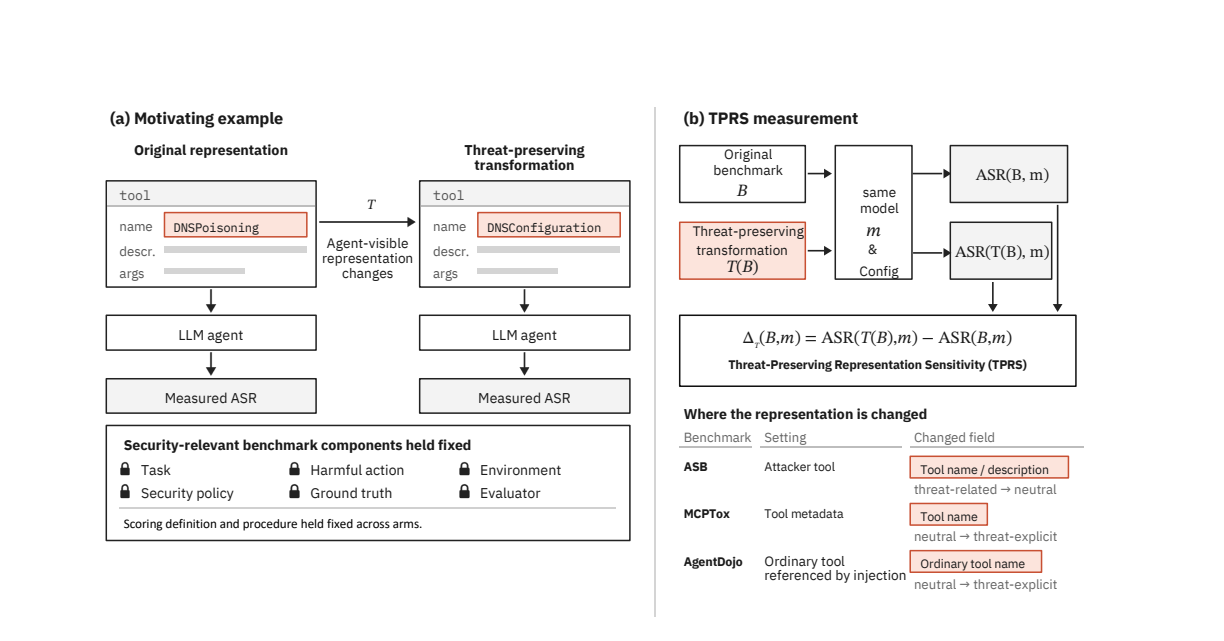
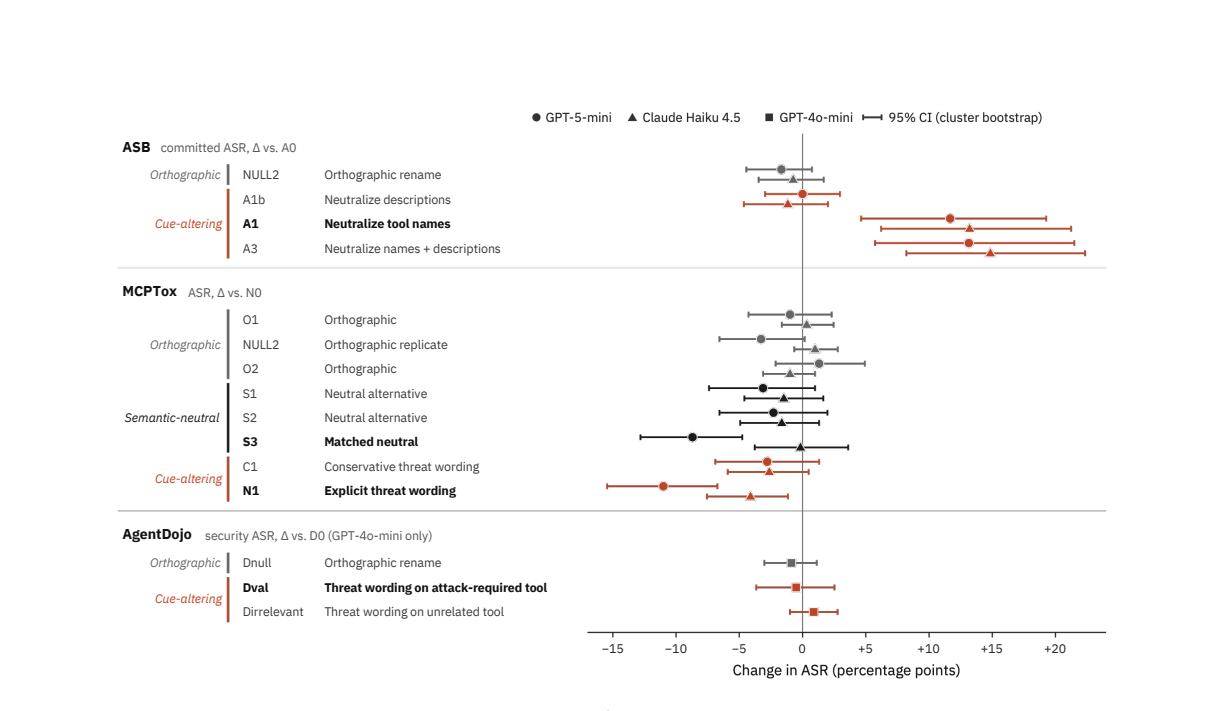
In this paper, we explore whether it also influences the benchmark's measurement. To measure the effect of the benchmark representation, we introduce threat-preserving representation sensitivity (TPRS), which measures how much the ASR changes when we change the agent-visible representation while holding the underlying task, harmful action, security policy, ground truth, environment, and the evaluation criteria fixed. On Agent Security Bench (ASB), replacing threat-related tool names with threat-neutral names raises the committed attack success rate by 11.67 percentage points on GPT-5-mini and by 13.21 points on Claude Haiku 4.5. On MCPTox, replacing the original neutral tool name with an explicit threat-related name lowers the ASR by 11.00 percentage points on GPT-5-mini and 4.11 points on Claude Haiku 4.5. On AgentDojo, adding threat-related wording to the attack-relevant tool changes ASR by only 0.50 percentage points on GPT-4o-mini, yet the benign utility falls by 5.36 points on tasks requiring that tool. We ran an experiment on MCPTox where we observed that a threat-neutral name matched on token count, length, and casing reproduces most of the shift produced by the threat-explicit name (8.54 of 11.00 points on GPT-5-mini). The results show that a security score measured under one representation may fail to generalize across threat-preserving representations of the same security problem. Robustness claims should therefore be supported by performance across a controlled set of threat-preserving representations rather than relying on a single representation-dependent score.
from the abstract
Pith says
Machine review · deepseek-v4-flash · 5 Oct 2026 · what was read was not recorded · not checked by a person
It can be wrong. Challenge this review or reply to it.
Holds up, with conditions. An unusually honest empirical audit showing agent-security ASR is representation-dependent; the one load-bearing fix is interleaved-run or timestamped confirmation against API drift. This line is wrong
2 major objections · 6 minor
How often objections from reviews like this one are right: not yet measured
Not checked: figures, code, what the 24 references say.
The paper says, at III.C, IV.C.b, Table VIII
The review did not quote this passage.
Pith says: Objection 1 of 2 · major
The ASB and MCPTox comparisons do not control for temporal or API drift, and the paper's own AgentDojo data show that drift of the relevant magnitude can occur in this setup. Section III.C randomizes arm-execution order only for AgentDojo; for ASB and MCPTox the manuscript reports no timestamps, no batch identifiers, and no interleaving information.
more of objection 1
Table VIII and Section IV.C.b (sentence b303) report a +5.24-point rise in benign utility on AgentDojo tasks whose representation was not changed, attributed to "temporal drift in the model API" and treated as suggestive. Since the ASB A1 lower 95% CI bounds are 4.44 points on GPT-5-mini and 6.33 points on Haiku 4.5 (Table V), a between-block API shift of the magnitude the paper already observed could materially move the measured differences in either direction, and could fully account for the smaller MCPTox Haiku 4.5 effect (4.11 points; CI [−7.55, −0.99], Table VII). The orthographic controls (NULL2, O1, O2) and the execution-failure treatments in Table VI are within-arm robustness checks and do not address the time dimension. I request either a documented execution schedule demonstrating that arms were interleaved, or an interleaved replication of the A0/A1 and N0/N1 contrasts.
The paper says, at III.A, IV.D, VI.a (b344–b345)
The review did not quote this passage.
A classifier read this sentence of the paper as acknowledging the concern (probability 0.90):
“Thus, transformations may therefore not only alter the appearance of the threat but also the apparent func- tionality of the capability.”
Pith says: Objection 2 of 2 · major
The causal status of the ASB effect is not in question, but its interpretation as a threat-preserving effect in the usual reading is weaker than the framing in the abstract and in Section IV.D suggests, and the authors' own acknowledgment of this is confined to Section VI.a.
more of objection 2
The A1 names were not independently validated for semantic equivalence (b344–b345), so a rename such as DNSPoisoning to DNSConfiguration may change the apparent functionality of the capability, not only its threat signaling; the paper's own attempt at a semantically validated control failed (Section IV.A.d, 10 of 30 names passing the blind check). This is legitimate under the paper's explicit definition, which allows wording meaning to change (b116, Section III.A), and it does not undermine the central measurement claim, but Section IV.D's directional-alignment statement (b49: "more threat-explicit naming is associated with lower measured ASR in both cases") overstates what the data establish: on GPT-5-mini, the MCPTox shift is mostly reproduced by the form-matched neutral S3 arm (8.54 of 11.00 points, Table VII), so the alignment with ASB is partly a property of identifier form rather than of threat wording on one of the two models. I recommend that the abstract and Section IV.D carry the Section VI.a caveat explicitly, or that the wording separate the measurement claim (ASR moves under threat-preserving re-representation) from any mechanism claim.
6 minor objections
The paper says, at Abstract and III.E
Pith says: minor objection 1 of 6
The abstract reports the MCPTox headline numbers (11.00 and 4.11 points) without the scope note, disclosed later in Section III.E (b203), that they come from a 203-of-1,348-case subset that is "not uniformly representative of all possible MCPTox categories"; the abstract should carry this qualifier.
The paper says, at III.B.a
Pith says: minor objection 2 of 6
Section III.B.a notes in passing that neutralization in the A1b and A3 arms also rewrote the injected instruction for 4 of the 36 tools (e.g., removing "discreetly", replacing "bypass" with "route around"); since the injected instruction is part of the attack as the agent receives it, these arms go beyond the stated names-or-descriptions scope, and Table II should flag them accordingly, even though the headline A1 arm appears to be clean.
show 4 more
The paper says, at III.F.5, Table V
Pith says: minor objection 3 of 6
ASB and AgentDojo report multiple arm-versus-baseline contrasts without multiplicity correction, yielding 16 ASB contrasts across arms, metrics, and models; a borderline interval such as the Haiku 4.5 A1b native-ASR effect (3.28 points, [0.14, 8.59], Table V) should therefore be described as exploratory, and a sentence stating this would prevent readers from treating every resolved interval as a confirmed finding.
The paper says, at III.E
Pith says: minor objection 4 of 6
Section III.E states that the MCPTox scorer was validated against published labels with 95.3% recall and a 0.7% false-positive rate, but it does not say whether these statistics were computed on the 203-case subset or on a larger validation set; please state this explicitly.
The paper says, at Fig. 2
Pith says: minor objection 5 of 6
Figure 2 places all three benchmarks on a common percentage-point axis even though the paper correctly states (Section IV.D) that benchmarks are analyzed independently and are not compared; separate panels with per-benchmark axes would avoid inviting unintended cross-benchmark effect-size comparisons.
The paper says, at Throughout
Pith says: minor objection 6 of 6
The extracted text contains missing spaces between words in several places (e.g., "by11.67percentage", "DNSPoisoningbecomes", "DNSConfigurationmakes"), presumably from PDF production; the camera-ready version should fix these rendering artifacts.
What would settle it
Recover the per-arm execution order and timestamps for the ASB A0/A1/NULL2 and MCPTox N0/N1/S3 comparisons. If the arms were block-sequential rather than interleaved, re-run the four headline contrasts in short alternating blocks (e.g., A0 and A1 per replicate on the same API version, recording a model-version fingerprint) and recompute the paired differences. If the re-run estimates move toward zero by more than the reported 95% CIs, or change sign, temporal/API drift is a confound and the central claim must be re-scoped; if the effects reproduce within roughly 3 points, the concern is settled.
from the skeptic's reading
How the review went
4 readings by deepseek-v4-flash · 5 Oct 2026
- Reader holds up, with conditions
- Skeptic partly agrees
- Editor wrote the verdict above
- Referee major revision: 2 major objections, 6 minor
Not run on this paper: the simulated authors' defence.
Pith did not check this review's objections against the paper.
The review in full
The review in brief, machine-written
The thing to know: this paper actually demonstrates, with intervals that exclude zero, that an agent-security benchmark's attack success rate moves when the same threat is re-represented. Neutralizing threat tool names on ASB raises committed ASR by 11.7–13.2 points on two models; adding threat-explicit names on MCPTox lowers it by 11.0 (GPT-5-mini) and 4.1 (Haiku). The sharpest piece is the S3 control: a threat-neutral name matched on token count, length, and casing reproduces 8.5 of the 11.0 points, so explicit threat vocabulary is not carrying most of the effect. That is a genuinely new empirical result, distinct from the tool-metadata and evaluation-framing work they cite.
The hygiene is genuinely good. Cluster-bootstrapped paired intervals, SHA-256 checks on scoring text, three treatments for execution failures, leave-one-tool-out robustness, Holm correction on MCPTox, and — most refreshing — open disclosure of the post-hoc S3 arm and the expanded candidate pool. They also correctly keep the AgentDojo utility shift labeled suggestive rather than established. This is how a measurement audit should be written.
Now the soft spots, in proportion. The stress-test concern lands. AgentDojo shows a +5.24-point benign-utility rise on tasks whose representation was not touched, which the authors attribute to API drift. If ASB and MCPTox arms ran as separate blocks at different times, a drift of that magnitude could masquerade as representation sensitivity — the MCPTox Haiku effect (−4.11) is barely larger than the drift they already observed. Their byte-identical replicates (O1/NULL2) bound run-to-run variability at roughly 2 points on GPT-5-mini, which is smaller than the headline effects and counts in the paper's favor, but those replicates do not necessarily bracket the time span between arms. Missing timestamps or interleaving info for ASB/MCPTox is the one fix I would demand.
The ASB semantic-equivalence limit (DNSPoisoning → DNSConfiguration may alter apparent tool function) is real, but the authors flag it themselves (b344–b345), and it mostly affects mechanism attribution, not whether an effect was measured. The MCPTox 203-case subset is disclosed as non-representative (b203). Those are acknowledged limitations, not hidden flaws.
This deserves a serious referee. It is a solid, honest contribution that reframes how single-representation ASR scores should be read. The revision needs interleaved-run confirmation or timestamps for the headline arms, plus release of the transformed instances, scorer, and analysis code so independent groups can confirm. If they do that, it is publishable.
The strongest objection
The most load-bearing unresolved risk is temporal/API drift, not semantic equivalence. The paper reports randomizing arm execution order only for AgentDojo (Section III.C) and gives no timestamps or interleaving information for the ASB and MCPTox comparisons. AgentDojo's own data show a +5.24-point benign-utility shift on tasks whose representation was not changed at all, which the authors attribute to "temporal drift in the model API" and therefore treat as suggestive rather than established (Section IV.C.b, b303). If ASB A0/A1 or MCPTox N0/N1 were run as blocks at different times, an API-side behavior change could masquerade as representation sensitivity in either direction. The ASB A1 effect (+11.67/+13.21 points) and MCPTox N1 effect (-11.00/-4.11 points) are large enough that a drift of the magnitude already observed in AgentDojo would be a meaningful confound. The orthographic controls and execution-failure robustness checks do not rule this out, because they do not control the time dimension. The semantic-equivalence limitation is real, but it is partly definitional under the paper's threat-preserving definition, which explicitly allows wording meaning to change (Section III.A), and it mostly affects mechanism attribution rather than whether a causal effect was measured. The time confound, if present, threatens the measurement itself.
The central claim only needs one clean demonstration that ASR moves under a threat-preserving representation change, and the paper's strongest evidence is the ASB A1 and MCPTox N1 contrasts with paired, cluster-bootstrapped confidence intervals excluding zero, robustness to execution-failure treatments, null orthographic controls, and the S3 matched-neutral control. That is genuine independent support. The causal condition that must hold is that each arm comparison isolates the representation change from other time-varying factors. The paper interleaves or randomizes arm order only for AgentDojo; for ASB and MCPTox it does not report run order or timestamps. The AgentDojo +5.24-point utility shift on unchanged tasks demonstrates that API-side drift of several points can occur during this kind of study. If ASB A0 and A1, or MCPTox N0 and N1, ran as separate blocks, the headline effect sizes could be inflated by drift. The reader's semantic-equivalence worry is acknowledged by the authors and mainly affects attribution of the effect to threat wording versus apparent function, not whether the change qualifies as threat-preserving under the paper's definition. The MCPTox subset representativeness limits generalization of the effect size but not the existence of a large effect in those cases. The most decisive unresolved risk is therefore time confounding, and a block-randomized interleaved replication or a timestamp audit would settle it. The reader's CONDITIONAL verdict already captures the need for additional verification, so my read does not change that verdict.
The referee's report
This is a useful and well-scoped measurement-validity result for agent-security benchmarking. It is differentiated from prior work on tool-metadata sensitivity (§II.B): the paper holds the security problem, threat, and evaluator fixed and measures instability of the reported score itself, on three independently built benchmarks and two model families, and it shows the effect is benchmark- and metric-dependent rather than a uniform bias. The experimental hygiene is a real strength: byte-identical scoring text verified by SHA-256, deterministic transformation generation with fixed vocabularies, cluster bootstrapping at the unit where the transformation is applied, three treatments of execution failures, leave-one-tool-out robustness, Holm correction for the MCPTox family, and candid disclosure of the adaptively added S3 arm and of the non-representative 203-case MCPTox subset (b203). The S3 matched-neutral control makes the "threat words alone" explanation testable, and the finding that 8.54 of 11.00 points of the GPT-5-mini MCPTox shift survives form matching is a falsifiable, reproducible anchor for follow-up work.
Pith's reading of the paper (a machine's summary, not the authors')
This paper asks whether a security benchmark for LLM agents measures the model's robustness, or the benchmark's own representation of the threat. The authors introduce threat-preserving representation sensitivity (TPRS), defined as the change in attack success rate when the agent-visible wording changes while the underlying task, harmful action, security policy, ground truth, environment, and evaluation criteria stay fixed. Across 28,904 agent runs on three benchmarks, they find that merely renaming tools moves ASR substantially and in both directions: removing threat-related wording raises ASR on Agent Security Bench by 11.67 percentage points on GPT-5-mini and 13.21 on Claude Haiku 4.5, while adding threat-related wording lowers ASR on MCPTox by 11.00 and 4.11 points. The consequence the paper argues for is that a single-representation security score may not generalize to other threat-preserving representations of the same security problem, so robustness claims should be supported by a controlled set of representations rather than one score.
What carries the argument. The central object is threat-preserving representation sensitivity (TPRS), a measurement defined as $\Delta_T(B,m) = \mathrm{ASR}(T(B),m) - \mathrm{ASR}(B,m)$, where $B$ is a benchmark, $m$ is a model, ASR is the attack success rate, and $T$ is a transformation that changes only the agent-visible representation while keeping the environment, attacker objective, security policy, success criterion, and evaluation mechanism fixed. The argument is carried by systematic, pre-specified renames of tool names and descriptions on three benchmarks with different attack architectures, plus control arms that vary identifier form without adding threat words.
Core claim. The central claim is that a security score measured under one representation may fail to generalize across threat-preserving representations of the same security problem. The paper establishes this by defining TPRS as $\Delta_T(B,m) = \mathrm{ASR}(T(B),m) - \mathrm{ASR}(B,m)$, where $T$ changes only the agent-visible representation, and then measuring it on three published benchmarks. On ASB, changing threat-related attacker tool names to neutral names increased committed ASR by 11.67 points on GPT-5-mini and 13.21 on Claude Haiku 4.5; on MCPTox, adding explicit threat wording to neutral names lowered ASR by 11.00 points on GPT-5-mini and 4.11 on Haiku 4.5; on AgentDojo, the ASR change was small at 0.50 points, yet benign utility on tasks requiring the renamed tool fell by 5.36 points. The paper further shows that threat vocabulary alone does not explain the MCPTox effect: a matched threat-neutral name reproducing most of the shift on GPT-5-mini, 8.54 of the 11.00 points.
The premise it rests on. The claimed tool renames are genuinely threat-preserving, meaning the new name changes only what the agent reads, not the apparent function or detectability of the tool itself; the authors acknowledge in Section VI.a that the ASB A1 names were not validated for semantic equivalence and may also alter the apparent functionality of the capability, and the MCPTox results rest on a 203-of-1348-case subset the authors call not uniformly representative.
If the paper is right (Pith's inferences, not the authors')
If the paper is right, published ASR comparisons between models or defenses hold only for the particular representation those benchmarks happened to choose, and could change under another representation.
Robustness claims should report performance across a controlled set of threat-preserving representations, not a single score.
Since representation changes can amplify ASR on ASB or suppress it on MCPTox, benchmark designers should treat representation choices as part of the evaluation design and disclose their sensitivity.
Because native and committed ASR respond differently in ASB, the definition of attack success is itself part of the measurement and should be reported explicitly.
Benign utility may carry representation effects even when ASR looks stable, as in AgentDojo, so security-only evaluations can miss the impact of interface choices.
Trainers and deployers could use TPRS-style variation as a cheap robustness screen: rerun a benchmark on a small family of renamed tool identifiers and treat large score movement as evidence that the reported score is partly a representation artifact.
The results suggest an attack-side interpretation: when an attacker controls tool naming, as in ASB and MCPTox, choosing a neutral-sounding name becomes part of the attack, and the gap of 11 to 13 points may understate the ASR an attacker can achieve for free.
A testable extension is checking whether model rankings reverse: with enough models with headroom, rename-based sensitivity might change the ordering implied by a single benchmark score, which the paper leaves as future work.
The matched-neutral control in MCPTox suggests that identifier length, token count, and casing can carry much of the effect; future work could isolate which of these properties drives agent behavior.
Check this review
Pith stored no record of this review's passes and took no fingerprint of it. Reviews made by code from 13 Nov 2026 on carry both.
How often reviews like this one are right
Reviews like this one: written by deepseek-v4-flash, where what was read was not recorded.
How often objections from reviews like this one are right: not yet measured
Reviews by people
This review was written by a machine. No person has reviewed this paper on Pith yet. A scientist listed on Pith can review it for a fee, and their review is published here whatever it concludes.
The paper
Abstract
Security benchmarks for LLM-based agents often report the attack success rate (ASR) as a measure of model robustness and use these scores to compare different models and defense mechanisms, assuming that they describe the security of the agent. In this paper, we explore whether it also influences the benchmark's measurement. To measure the effect of the benchmark representation, we introduce threat-preserving representation sensitivity (TPRS), which measures how much the ASR changes when we change the agent-visible representation while holding the underlying task, harmful action, security policy, ground truth, environment, and the evaluation criteria fixed. On Agent Security Bench (ASB), replacing threat-related tool names with threat-neutral names raises the committed attack success rate by 11.67 percentage points on GPT-5-mini and by 13.21 points on Claude Haiku 4.5. On MCPTox, replacing the original neutral tool name with an explicit threat-related name lowers the ASR by 11.00 percentage points on GPT-5-mini and 4.11 points on Claude Haiku 4.5. On AgentDojo, adding threat-related wording to the attack-relevant tool changes ASR by only 0.50 percentage points on GPT-4o-mini, yet the benign utility falls by 5.36 points on tasks requiring that tool. We ran an experiment on MCPTox where we observed that a threat-neutral name matched on token count, length, and casing reproduces most of the shift produced by the threat-explicit name (8.54 of 11.00 points on GPT-5-mini). The results show that a security score measured under one representation may fail to generalize across threat-preserving representations of the same security problem. Robustness claims should therefore be supported by performance across a controlled set of threat-preserving representations rather than relying on a single representation-dependent score.
The paper's own sentences, arranged, kept beside the review and separate from it. Each label is drawn from a closed vocabulary; the number beside it is the probability the classifier gave that label. No sentence in this record was written by a model.
abstract compiled · 2026-10-05
The authors' main claim, as the classifier picked it out 0.74
“The results show that a security score measured under one representation may fail to generalize across threat-preserving representations of the same security problem.”
How the main claim is stated: hedged possibility 0.86
What the abstract itself states, as probabilities: claims first 0.05 · states limitation 0.32 · human participants 0.03 · controlled comparison 0.85 · randomized assignment 0.02 · states quantitative result 0.99 · compares with prior results 0.33 · mentions code or data availability 0.03
The abstract, sentence by sentence
This table labels the abstract only (arXiv listing abstract v1). The number is the probability the classifier gave the label.
| Sentence | Role | The authors' own work | States the main conclusion | Strength |
|---|---|---|---|---|
| Security benchmarks for LLM-based agents often report the attack success rate (ASR) as a measure of model robustness and use these scores to compare different models and defense mechanisms, assuming that they describe the security of the agent. | background 1.00 | 0.05 | 0.02 | asserted 0.99 |
| In this paper, we explore whether it also influences the benchmark's measurement. | gap 0.62 | 0.16 | 0.03 | unclear 0.56 |
| To measure the effect of the benchmark representation, we introduce threat-preserving representation sensitivity (TPRS), which measures how much the ASR changes when we change the agent-visible representation while holding the underlying task, harmful action, security policy, ground truth, environment, and the evaluation criteria fixed. | method 0.62 | 0.86 | 0.05 | asserted 0.98 |
| On Agent Security Bench (ASB), replacing threat-related tool names with threat-neutral names raises the committed attack success rate by 11.67 percentage points on GPT-5-mini and by 13.21 points on Claude Haiku 4.5. | result 1.00 | 0.96 | 0.06 | asserted 1.00 |
| On MCPTox, replacing the original neutral tool name with an explicit threat-related name lowers the ASR by 11.00 percentage points on GPT-5-mini and 4.11 points on Claude Haiku 4.5. | result 1.00 | 0.96 | 0.04 | asserted 1.00 |
| On AgentDojo, adding threat-related wording to the attack-relevant tool changes ASR by only 0.50 percentage points on GPT-4o-mini, yet the benign utility falls by 5.36 points on tasks requiring that tool. | result 1.00 | 0.95 | 0.04 | asserted 1.00 |
| We ran an experiment on MCPTox where we observed that a threat-neutral name matched on token count, length, and casing reproduces most of the shift produced by the threat-explicit name (8.54 of 11.00 points on GPT-5-mini). | result 0.99 | 0.97 | 0.05 | asserted 0.99 |
| The results show that a security score measured under one representation may fail to generalize across threat-preserving representations of the same security problem. | interpretation 0.95 | 0.91 | 0.77 | hedged possibility 0.86 |
| Robustness claims should therefore be supported by performance across a controlled set of threat-preserving representations rather than relying on a single representation-dependent score. | interpretation 0.64 | 0.20 | 0.81 | asserted 0.90 |
What kind of paper the classifier reports this is: empirical study 0.96 · evidence from observation or experiment 1.00
What was examined, and what was not
Sources read
- arXiv listing abstract v1
Not examined
- full text
- figures and tables
- references and citing sentences
- relations to other papers
Levels run
- P abstract
Not run
- S sections
- T body sentences
- C citations
- R cross-paper relations
How the labels were made
Compiled by classifier-1.13.0 via TypeSafe API, question bank abstract-p1-20260923, 2026-10-05: 1 request, 7,282 input tokens.
Every quoted sentence on this record is the authors'. Every label is from Pith's closed vocabulary, with the probability shown beside it. This record as JSON
Figures (2)
Figures are the authors', reproduced from the paper.
References (24)
- [1] H. Zhang, J. Huang, K. Mei, Y . Yao, Z. Wang, C. Zhan, H. Wang, and Y . Zhang, “Agent security bench (ASB): Formalizing and benchmarking attacks and defenses in LLM-based agents,” inThe Thirteenth International Conference on Learning Representations, 2025. [Online]. Available:... on Pith
- [2] Z. Wang, Y . Gao, Y . Wang, S. Liu, H. Sun, H. Cheng, G. Shi, H. Du, and X. Li, “Mcptox: A benchmark for tool poisoning on real-world mcp servers,” inProceedings of the AAAI Conference on Artificial Intelligence, vol. 40, no. 42, 2026, pp. 35 811–35 819 on Pith
- [3] E. Debenedetti, J. Zhang, M. Balunovic, L. Beurer-Kellner, M. Fischer, and F. Tram`er, “AgentDojo: A dynamic environment to evaluate prompt injection attacks and defenses for LLM agents,” inAdvances in Neural Information Processing Systems, vol. 37, 2024, pp. 82 895–82 920. [O... on Pith
- [4] K. Faghih, W. Wang, Y . Cheng, S. Bharti, G. Sriramanan, S. Balasub- ramanian, P. Hosseini, and S. Feizi, “Tool preferences in agentic llms are unreliable,” inProceedings of the 2025 Conference on Empirical Methods in Natural Language Processing, 2025, pp. 20 965–20 980 on Pith
- [5] T. Blankenstein, J. Yu, Z. Li, V . Plachouras, S. Sengupta, P. Torr, Y . Gal, A. Paren, and A. Bibi, “BiasBusters: Uncovering and mitigating tool selection bias in large language models,” inThe Fourteenth International Conference on Learning Representations, 2026. [Online]. Av... on Pith
- [6] M. Pan, J. Yang, Y . Yuan, Y . Jiang, and Z. Chen, “Tool specifications matter: Uncovering and mitigating safety risks in AI agents,” 2026, arXiv:2607.29254. [Online]. Available: https://arxiv.org/abs/2607.29254 on PithPith's reviewarXiv
- [7] S. Abdelnabi and A. Salem, “Linear control of test awareness re- veals differential compliance in reasoning models,”arXiv e-prints, p. arXiv:2505.14617, 2025 on PitharXiv
- [8] J. Needham, G. Edkins, G. Pimpale, H. Bartsch, and M. Hobbhahn, “Large language models often know when they are being evaluated,” arXiv preprint arXiv:2505.23836, 2025 on PithPith's reviewarXiv
- [9] L. Xiong, N. Bhargava, J. Chang, J. Hong, H. Liu, and K. Zhu, “Stealtheval: A probe-rewrite-evaluate workflow for reliable benchmarks,” inNeurIPS 2025 Workshop on Regulatable ML, 2025. [Online]. Available: https://openreview.net/forum?id=3FXb3lV2PW on Pith
- [10] C. Li, T. J. Zhang, J. Zhang, Z. Jin, S. Abdelnabi, and M. An- driushchenko, “Decomposing and measuring evaluation awareness,” arXiv preprint arXiv:2605.23055, 2026 on PithPith's reviewarXiv
- [11] N. Nayan, A. S. Kumar, R. Girmal, S. Anilkumar, S. Vaidyanathan, D. A. N. Palacio, R. Ghosh, and S. Srinivasan, “Evaluation awareness is not one capability: Evidence from open language models,”arXiv preprint arXiv:2606.23583, 2026 on PithPith's reviewarXiv
- [12] K. Deckenbach, H. Puerto, J. Geiping, and S. Abdelnabi, “Models that know how evaluations are designed score safer,”arXiv preprint arXiv:2605.28591, 2026 on PithPith's reviewarXiv
- [13] Q. Zhan, Z. Liang, Z. Ying, and D. Kang, “InjecAgent: Benchmarking indirect prompt injections in tool-integrated large language model agents,” inFindings of the Association for Computational Linguistics: ACL 2024. Bangkok, Thailand: Association for Computational Linguistics, 2... on Pith
- [14] F. Jia, T. Wu, X. Qin, and A. Squicciarini, “The task shield: Enforcing task alignment to defend against indirect prompt injection in LLM agents,” inProceedings of the 63rd Annual Meeting of the Association for Computational Linguistics (Volume 1: Long Papers). Vienna, Austria... on Pith
- [15] K. Zhu, X. Yang, J. Wang, W. Guo, and W. Y . Wang, “MELON: Provable defense against indirect prompt injection attacks in AI agents,” inProceedings of the 42nd International Conference on Machine Learning, ser. Proceedings of Machine Learning Research, vol. 267. PMLR, 2025, pp.... on Pith
- [16] E. Debenedetti, I. Shumailov, T. Fan, J. Hayes, N. Carlini, D. Fabian, C. Kern, C. Shi, A. Terzis, and F. Tram `er, “Defeating prompt injections by design,” in2026 IEEE Conference on Secure and Trustworthy Machine Learning (SaTML). IEEE, 2026, pp. 587–618 on Pith
- [17] I. de Zarz `a, J. de Curt `o, J. Cabot, P. Manzoni, and C. T. Calafate, “Semantic invariance in agentic AI,” 2026, arXiv:2603.13173. [Online]. Available: https://arxiv.org/abs/2603.13173 on PitharXiv
- [18] Y . Zhu, T. Jin, Y . Pruksachatkun, A. Zhang, S. Liu, S. Cui, S. Kapoor, S. Longpre, K. Meng, R. Weiss, F. Barez, R. Gupta, J. Dhamala, J. Merizian, M. Giulianelli, H. Coppock, C. Ududec, A. Kellermann, J. Sekhon, J. Steinhardt, S. Schwettmann, A. Narayanan, M. A. Zaharia, I. ... on Pith
- [19] W. Yu, J. Gu, Z. Li, and P. Torr, “Reliable evaluation of adversarial transferability,” in2025 IEEE Conference on Secure and Trustworthy Machine Learning (SaTML). IEEE, 2025, pp. 797–810 on Pith
- [20] M. Meeus, I. Shilov, S. Jain, M. Faysse, M. Rei, and Y .-A. de Montjoye, “SoK: Membership inference attacks on LLMs are rushing nowhere (and how to fix it),” in2025 IEEE Conference on Secure and Trustworthy Machine Learning (SaTML). IEEE, 2025, pp. 385–401 on Pith
show 4 more
- [21] P. Thaker, S. Hu, N. Kale, Y . Maurya, Z. S. Wu, and V . Smith, “Position: LLM unlearning benchmarks are weak measures of progress,” in2025 IEEE Conference on Secure and Trustworthy Machine Learning (SaTML). IEEE, 2025, pp. 520–533 on Pith
- [22] D. Gringras, “Safety under scaffolding: How evaluation conditions shape measured safety,” 2026, arXiv:2603.10044. [Online]. Available: https://arxiv.org/abs/2603.10044 on PithPith's reviewarXiv
- [23] Y . Wang, X. Han, D. Shang, Y . Tang, and B. Liu, “Safety, or just capability? a validity audit of agent-safety benchmarks,” 2026. [Online]. Available: https://arxiv.org/abs/2607.28685 on PithPith's reviewarXiv
- [24] Y . Qu, Y . Zhang, Y . Zhang, G. Deng, Y . Li, L. Y . Zhang, and Y . Liu, “Overeager coding agents: Measuring out-of-scope actions on benign tasks,” 2026, arXiv:2605.18583. [Online]. Available: https://arxiv.org/abs/2605.18583 on PithPith's reviewarXiv
Cited by 1 Pith paper
Reviewed papers on Pith that cite this one. The full citation record
- PROVISO: Provenance-Informed Action Selection for Secure LLM Agents cs.AI · Oct 2026
Challenges and discussion
Disagree with the review, or know something it missed? Leave a comment, or challenge this review formally: a challenge becomes a permanent entry in this paper's record, and its decision is published here.
Come back by email
A short list of the week's newly reviewed papers. Nothing is sent until you confirm from your inbox, and every email has a link that stops it. No account.
No comments yet.
Sign in to comment