Quantum Physics · arXiv:2610.03686 v2 · submitted 2 Oct 2026
Efficient Block Encoding of Structured Hamiltonians by Separating Where and What
The paper says
“In fault-tolerant block encodings of structured Hamiltonians, the support geometry can set how the non-Clifford cost of SELECT scales with the system size, however many operators act on each support.”
more of the abstract
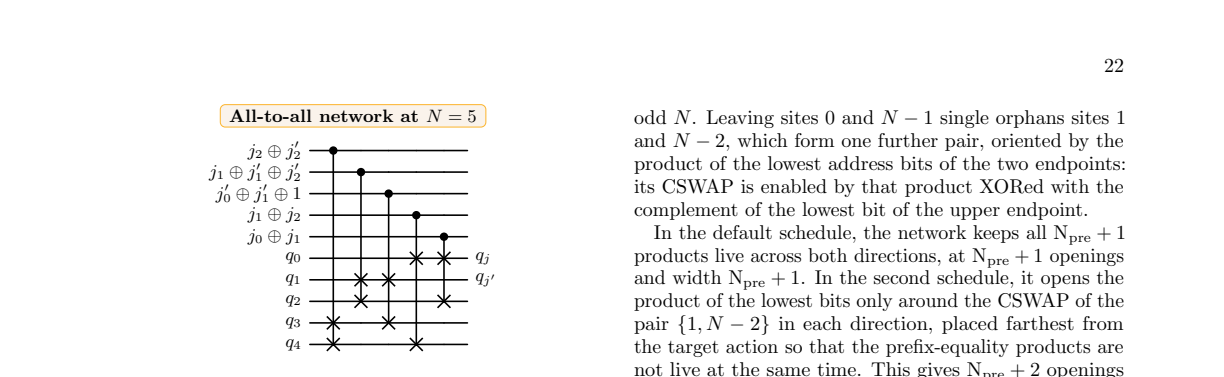
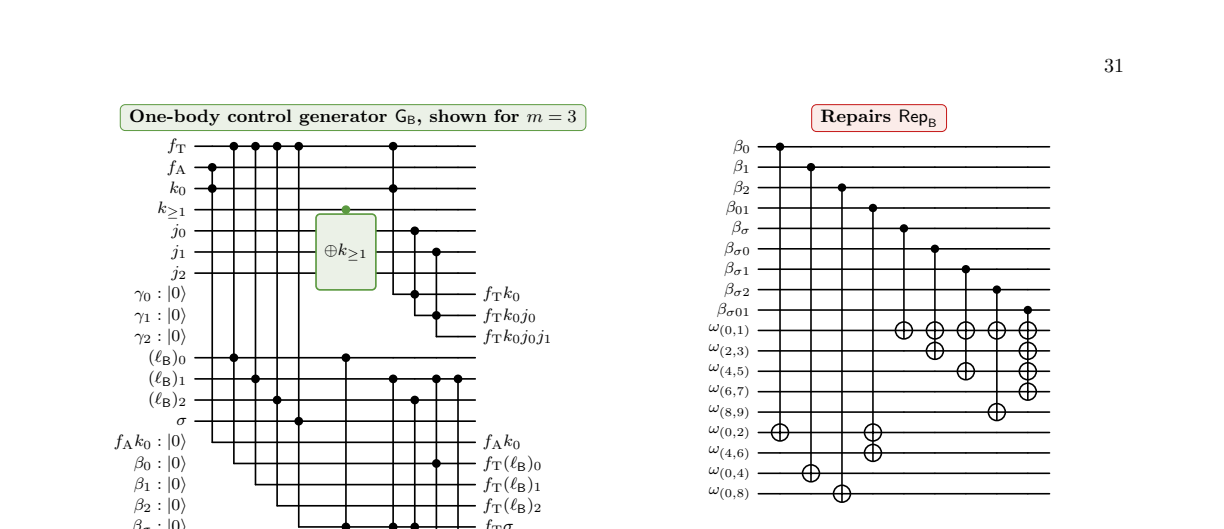
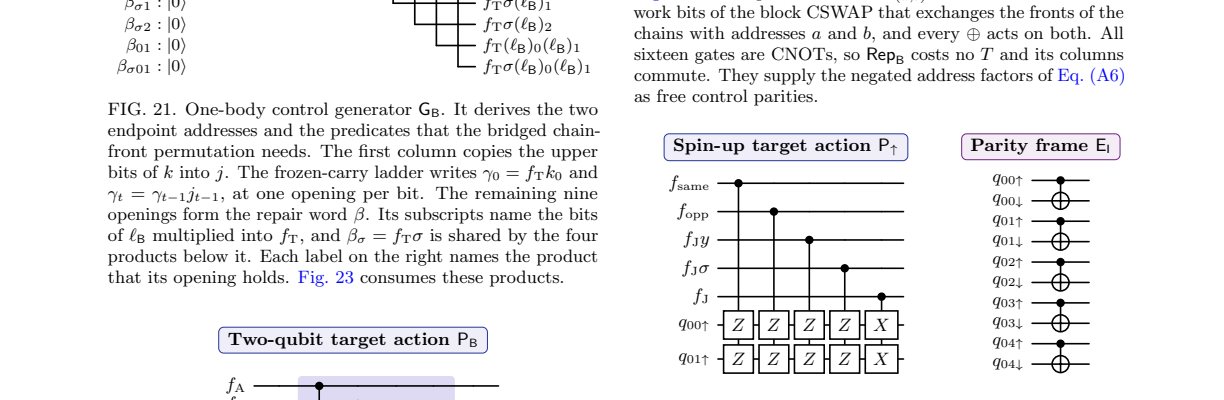
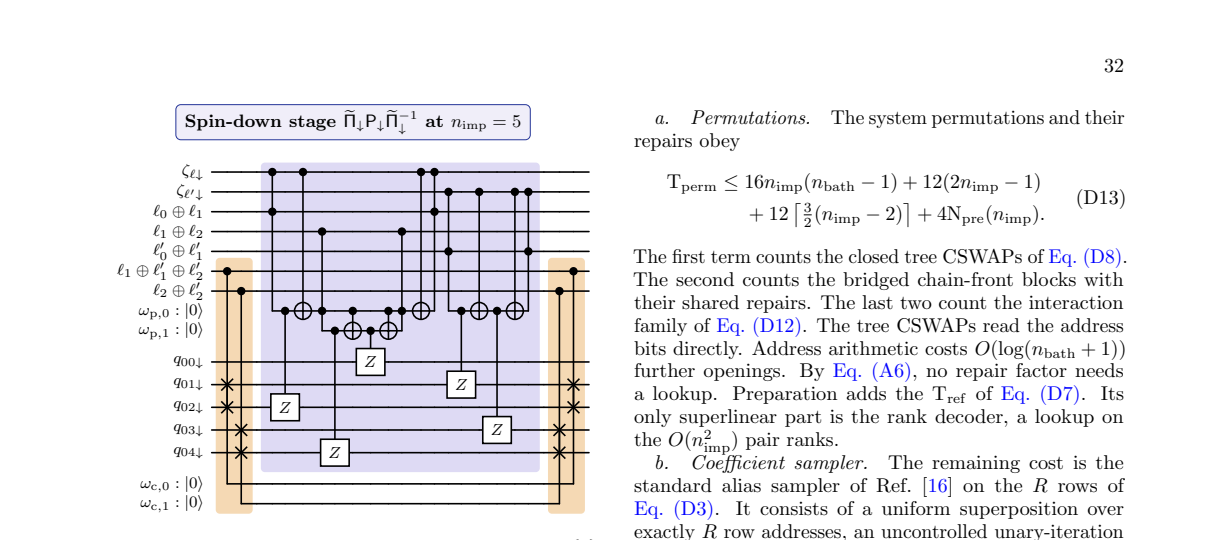
We construct permute-act-unpermute circuits: a CSWAP network fixed by this geometry brings a selected support to a fixed target register, a shared local circuit acts there, and the permutation is undone. The operators add only an XZ mask on this register, at a cost independent of the system size, and one query can mix several support geometries. For two-site supports, we establish and attain the minimum CSWAP count within address-controlled networks of site transpositions. Compiled for Pauli terms, these circuits use 8SN + o(N) T gates with O(logN) permutation work qubits, where N is the number of system qubits and S is determined by the support geometry, with S = 1 for nearest-neighbour interactions and S = 3/2 for all-to-all pairs; in both cases the correction is O(logN). We also introduce a bridged CSWAP, which remembers the logical value of its temporary AND across the target action and repairs it from the prepared labels, so that the inverse CSWAP undoes the exchange without recomputing the value. When the repair is Clifford, it halves the T count of a matched forward-inverse CSWAP pair at the cost of one retained work qubit. For a Heisenberg ring, the complete block-encoding query reduces the T count by a factor approaching 3 as the system size grows, relative to flat and product-wise Pauli walks. For a five-orbital Anderson impurity model, which combines nearest-neighbour and all-to-all support geometries, the reduction is about 1.7 at large bath sizes, relative to the cheapest of three comparators, each built from the methods of the references it follows.
from the abstract
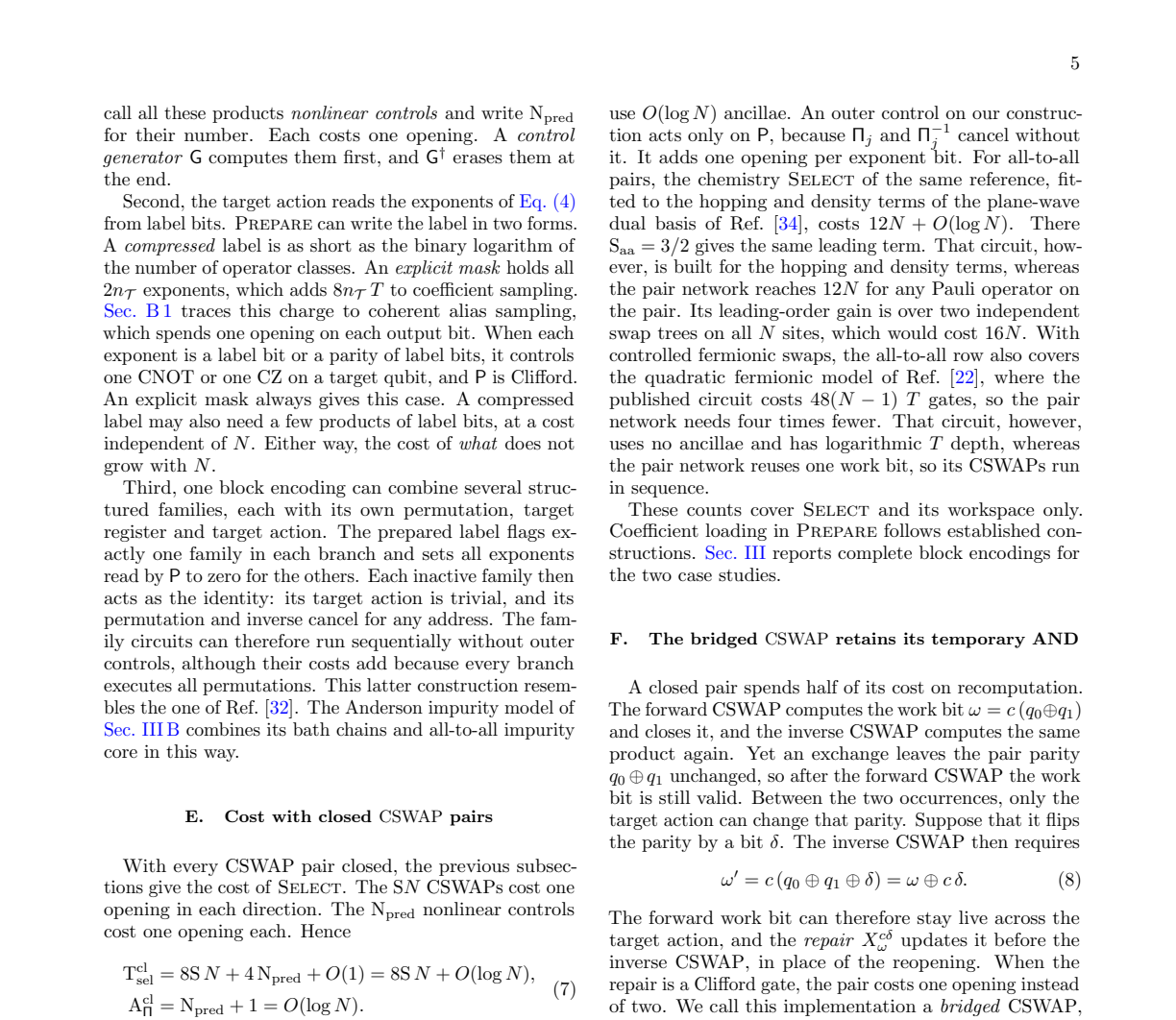
Pith says
Machine review · deepseek-v4-flash · 5 Oct 2026 · of version 1 of the paper; version 2 is newer · what was read was not recorded · not checked by a person
It can be wrong. Challenge this review or reply to it.
Holds up. A clean, well-scoped compilation result: the resource law and the 3x/1.7x reductions hold up; only the 'minimum CSWAP' wording overreaches its stated scope. This line is wrong
5 minor
How often objections from reviews like this one are right: not yet measured
Not checked: figures, code, what the references say.
5 minor objections
The paper says, at Sec. V (Acknowledgements)
Pith says: minor objection 1 of 5
The sentence 'We thank Élie Gouzien, Vivien Londe, Alice Moutenet, and for fruitful discussions' contains a dangling 'and', which suggests a missing name; please fix the grammar or supply the omitted name.
The paper says, at Sec. I, Refs. [25,26]
Pith says: minor objection 2 of 5
Ref. [26] is titled 'A denser planar surface code' yet is cited as an example of a chemistry block encoding that exchanges the two spin sectors of the system register; please verify the citation placement or add a clarifying phrase, since the title does not obviously connect to that claim.
show 3 more
The paper says, at Sec. II C and Sec. A 2 b
Pith says: minor objection 3 of 5
The CSWAP densities S=1 and S=3/2 are the paper's headline structural quantities, but the minimality behind them is proven only within address-controlled networks of site transpositions. The scope is stated correctly in the appendix and the abstract, but consider adding one sentence at the point where S is introduced in Sec.
more of objection 3
II C (not only in Sec. A 2 b) noting that networks using controlled three-cycles or other conditional permutation primitives are excluded, so that S is not read as a universal lower bound on SELECT cost for these geometries.
The paper says, at Sec. III A and Fig. 5
Pith says: minor objection 4 of 5
The text calls the flat walk the 'best comparator' for the ring; please carry the same qualifier used in the abstract ('lowest-cost compiled baselines considered'), since the register-mask and tree rows are evaluated under different preparation trade-offs and the register-mask row uses the open-chain Hamiltonian, so 'best' is only within the considered set.
The paper says, at Table I
Pith says: minor objection 5 of 5
The resource law 8SN+O(log N) is stated for power-of-two sizes, with other sizes incurring borrow-chain openings and ancillae; a footnote near Eq. (7) stating that the O(log N) term absorbs those non-power-of-two corrections would prevent a reader from misapplying the exact 8SN count at arbitrary N.
What would settle it
Exhaustively enumerate address-controlled networks on N <= 8 leaves that gather all two-site supports, over two primitive sets: (i) controlled transpositions only, and (ii) controlled transpositions plus controlled three-cycles (and four-cycles). Confirm the transposition-only minimum equals ceil(N + chi/2 − 3) for the ring (chi=2) and all-to-all (chi=N) geometries, i.e. that Eq. (A3) is tight. Then test whether adding three-cycles lowers the count below ceil(N + chi/2 − 3) for either geometry. If a 3-cycle network gathers all ring bonds in fewer than N−2 operations, the optimality reading of the densities fails within the enlarged primitive class; if not, the stated scope caveat is immaterial in the practically central nearest-neighbour case, and the S=1 density can be reported as unconditional within address-controlled networks.
from the skeptic's reading
How the review went
4 readings by deepseek-v4-flash · 5 Oct 2026
- Reader holds up
- Skeptic agrees
- Editor wrote the verdict above
- Referee minor revision: 5 minor
Not run on this paper: the simulated authors' defence.
Pith did not check this review's objections against the paper.
The review in full
The review in brief, machine-written
This is a good paper and the reader's ACCEPT is right. The where/what separation is genuinely new: writing each term as a conjugated local operator and paying for the permutation once per support, instead of per operator class, turns a Theta(N^nT) flat-walk SELECT into O(N) for fixed support size. The bridged CSWAP — keeping a temporary AND live across the target action and repairing it — is a clean, well-explained trick, and the paired CSWAP lower bound via the complete-multipartite relaxation is a real argument, not decoration.
The counting is honest. The claims are stated as circuit costs, and the comparisons are scoped against the lowest-cost compiled baselines at matched workspace and unchanged normalisation. The verification is real evidence: the ring compiled in Qualtran and checked against the Hamiltonian at every even N from 4 to 1000 with all 64 sign patterns, the AIM checked by tensor contraction. No fitted parameters, no circularity. The open questions (nT >= 3 minimality, simultaneous O(log N) control) are stated plainly in the conclusion.
The one soft spot is the load-bearing wording, not the content. The "minimum CSWAP count" claim is scoped to address-controlled networks of site transpositions, and the authors say so explicitly in Sec. A2b. A controlled three-cycle is a product of two transpositions, and nothing in the relaxation argument excludes a three-cycle-based network gathering every pair support in fewer operations. That is a genuine gap, but it is an acknowledged one, and the practical weight is bounded: the 8SN law and the 3x and 1.7x reductions are costs of the constructed circuits and stand regardless of optimality. The "minimum" reading of S=1 and S=3/2 is what is at risk, not the resource law. The stress-test note is right about this, and I want the referee to push on the relaxation argument in A2b line by line — I could not fully verify it either.
Minor gripe: no code artifact is released despite the compiled checks being central to the verification story. Not fatal, but it would make the checks independently reproducible.
This is for the fault-tolerant simulation and circuit-compilation crowd. It deserves a serious referee and will likely need only minor revision. I would bring it to the reading group and would cite it.
The strongest objection
The applied claims — the 8SN+O(log N) resource law and the factor-3 (ring) and 1.7 (AIM) reductions — are costs of the constructed circuits and rest on the reported compiled checks in Qualtran (ring checked symbolically at every even N from 4 to 1000, all 64 sign patterns; AIM checked by tensor contraction at (2,1) and on basis inputs). Those costs do not depend on optimality, so they stand regardless of the concern below.
The load-bearing structural claim is instead 'we establish and attain the minimum CSWAP count' (abstract; Sec. II C; Sec. A 2 b). It rests on Eq. (A3), obtained by running the network backwards and relaxing it so every CSWAP can be enabled or disabled independently. The relaxation direction is safe for a lower bound, since it only enlarges the reachable pair set, and the graph-evolution counting of Sec. A 2 b (activations vs splits, D = a − p) is internally consistent; I verified it reproduces N−2 at chi=2 and ceil(3(N−2)/2) at chi=N, with the construction attaining both.
What remains unresolved is exactly the scope the paper states: the bound counts conditional transpositions only, and 'other primitives, such as controlled three-cycles, lie outside this model' (Sec. A 2 b). A controlled 3-cycle is a product of two transpositions, and nothing in the proof excludes a 3-cycle-based network gathering every pair support in strictly fewer than ceil(N + chi/2 − 3) operations. This is an acknowledged limitation, not a hidden flaw, and the reader's weakest_assumption correctly identifies it. Its practical weight is bounded: if such a network existed, the S=1 and S=3/2 densities would lose their optimality reading, but the built circuits would still deliver their advertised T counts and reductions. The claim most at risk is the 'minimum' wording, not the resource law.
The paper's central claim splits into two parts. The applied part — that permute-act-unpermute Select costs 8SN + O(log N) T gates and delivers 3x (ring) and about 1.7x (AIM) reductions against the stated compiled baselines at unchanged normalisation — is the cost of the constructed circuits, and it carries independent support: the Qualtran compiled checks at many sizes (ring at all even N to 1000 with all sign patterns; AIM by tensor contraction and basis enumeration), which I count as real evidence under the review rules. That part is not threatened by the minimality question.
The second part — 'we establish and attain the minimum CSWAP count' — rests on the Eq. (A3) lower bound, whose scope is restricted to address-controlled transposition networks. I re-derived the counting: the activation/split charging, the D = a − p invariant, and the reproduction of the chi=2 and chi=N densities all check out, and the constructions attain the bound. The only genuine soft spot is the primitive set: controlled three-cycles and richer primitives are excluded by hypothesis, and the paper says so explicitly in Sec. A 2 b. This is a stated scope condition rather than a hidden assumption, and the reader's weakest_assumption captures it accurately.
I do not see an internal inconsistency, a circular step, or a misquoted precedent: the adjacent-AND merge of Ref. [16] is acknowledged and shown to be a special case of the bridge (Sec. A 1 b), and the bridged CSWAP is conceded to affect only subleading terms in both examples (b599), so it does not carry the headline reductions. The acknowledged open problems (n_T >= 3 minimality, simultaneous O(log N) controls, b605/b606) are consistent with my reading.
The scope caveat does not move the verdict because the applied resource law and the baseline comparisons are compiled-verified and independent of optimality; at most it qualifies the 'minimum' wording in the abstract and Sec. II C. For users applying 8SN as an achievable cost, nothing changes; for users citing 'minimum CSWAP count' as a universal bound, the caveat matters. ACCEPT with MODERATE confidence remains appropriate, and I recommend leaving the verdict unchanged.
The referee's report
This is a solid and well-executed contribution to fault-tolerant Hamiltonian simulation. The where/what separation is clean and yields honest constant-factor gains over flat and structured baselines at unchanged normalisation, and the bridged CSWAP is a genuine new primitive with a correct accounting (Eq. (8) and Sec. A 1 b tie it precisely to the adjacent-AND merge). The compiled verification is unusually strong for this literature: the ring query is checked symbolically at every even N from 4 to 1000 with all 64 sign patterns, and the AIM SELECT by tensor contraction, so the constructed-circuit resource claims are machine-checked rather than heuristic. I verified the internal consistency of the minimality proof in Sec. A 2 b, reproducing N−2 at χ=2 and ⌈3(N−2)/2⌉ at χ=N with the constructions attaining both. The stress-test concern about controlled three-cycles is real but acknowledged by the paper: Sec. A 2 b states that the bound counts conditional transpositions only and that other primitives lie outside the model.
Pith's reading of the paper (a machine's summary, not the authors')
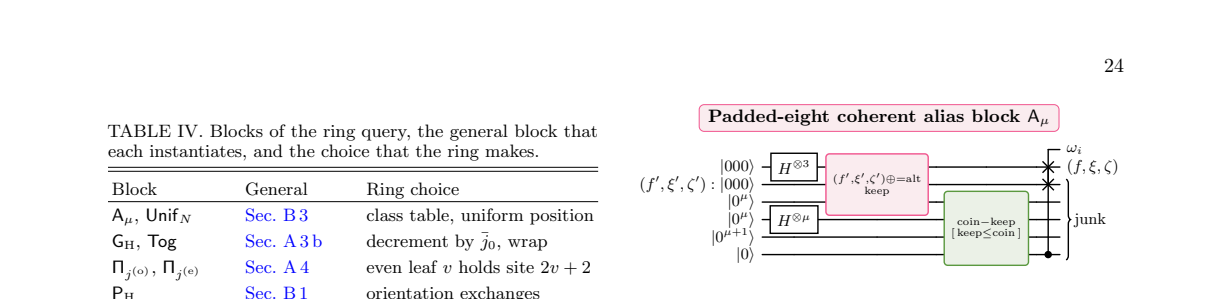
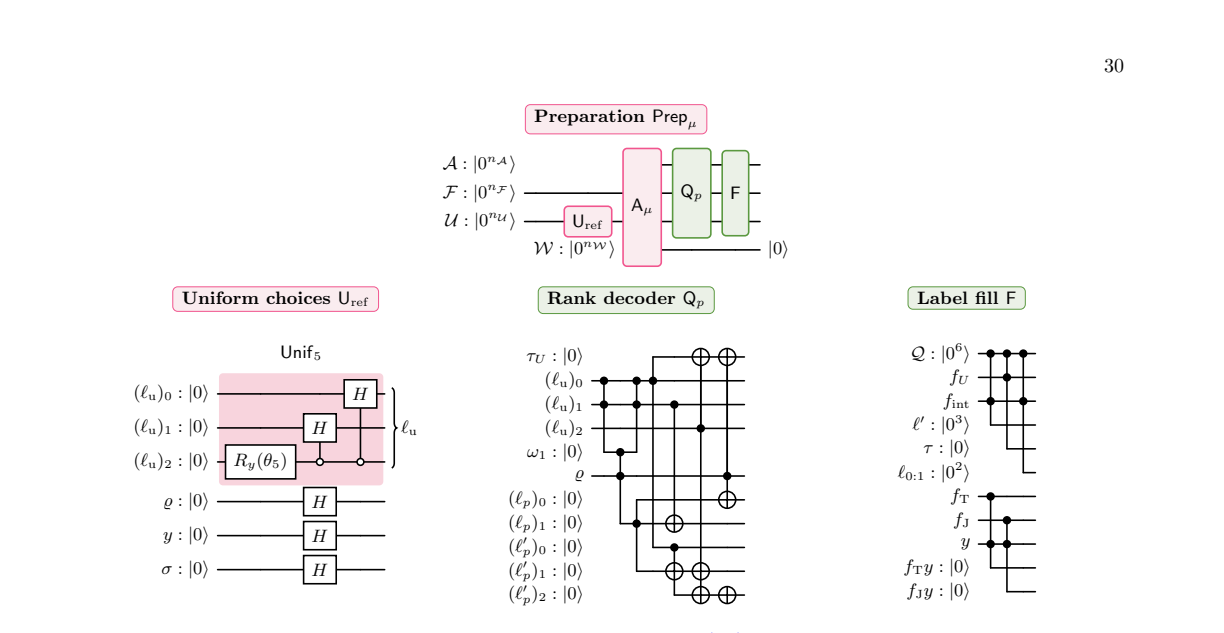
This paper claims that for Hamiltonians with repeated local structure, the SELECT stage of a block encoding can be rebuilt so that its non-Clifford cost is set by the system size, not by the number of terms. The construction writes every term as a support-dependent permutation conjugated around a fixed local operator, H = sum_{j,b} alpha_{j,b} $Pi_j^{{-1}}$ $P_T^{{(b)}}$ Pi_j, so the address j fixes where the term acts, the label b fixes what is applied, and the costs of the two add instead of multiplying. For pair supports the paper proves the resulting CSWAP count is minimal within address-controlled networks of site transpositions, giving 8 S N + O(log N) T gates with O(log N) work qubits, where S = 1 for nearest-neighbour geometry and S = 3/2 for all-to-all pairs. A new bridged CSWAP keeps the forward permutation's temporary AND live across the target action and repairs it, halving the cost of a matched forward-inverse pair when the repair is Clifford. On a Heisenberg ring the complete query needs about three times fewer T gates than the best comparator, and on a five-orbital Anderson impurity model about 1.7 times fewer at large bath size, at unchanged normalisation and comparable peak ancillas.
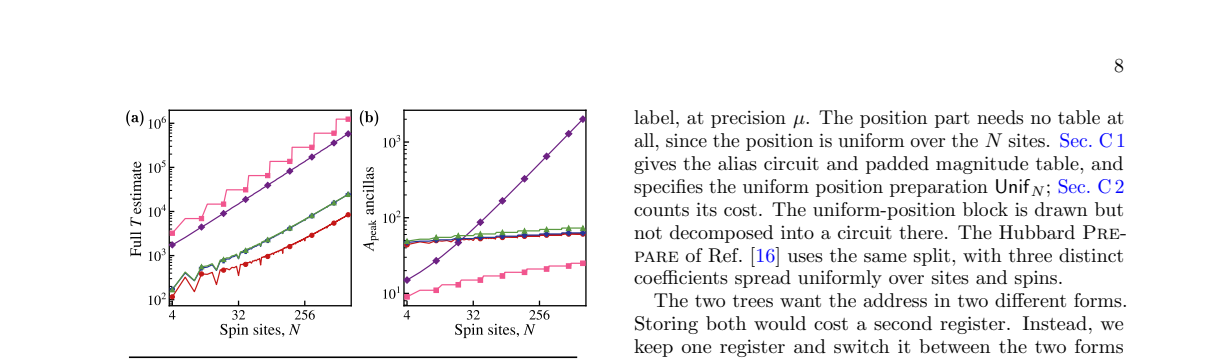
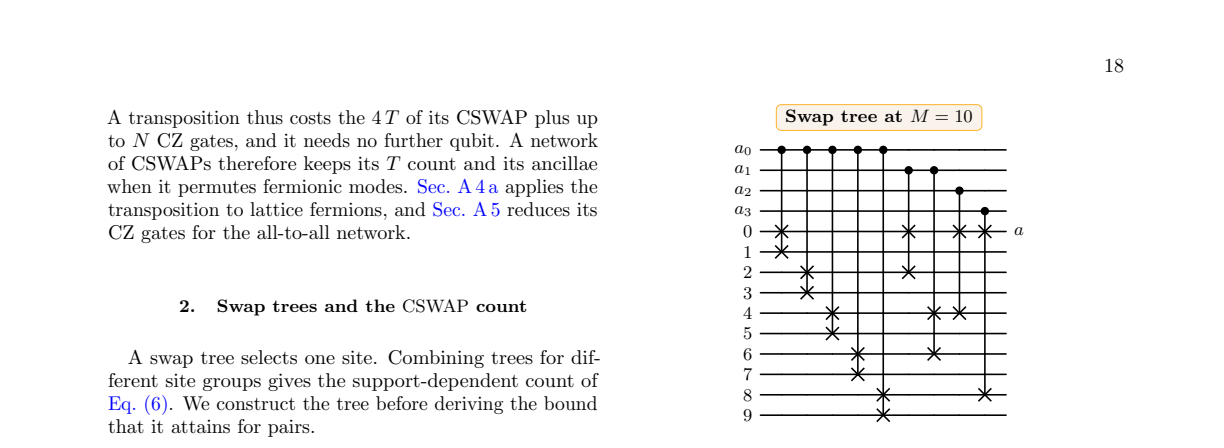
What carries the argument. Three mechanisms carry the argument. First, the swap tree of Ref. [28]: a CSWAP network on M leaves that brings a selected leaf to a root using M-1 CSWAPs, one layer per address bit, with no nonlinear product controls, so a closed tree costs M-1 openings per direction. Second, the support geometry enters through the strong chromatic number chi of the support family, the least number of site groups such that no support holds two sites of one group; for pair supports the total is ceil(N + chi/2 - 3) CSWAPs, which the paper proves optimal within address-controlled site-transposition networks and which yields S = 1 when chi is bounded and S = 3/2 when chi = N. Third, the bridged CSWAP rests on the identity omega' = omega XOR (c delta) of Eq. (8): the forward work bit, kept live across the target action, is repaired by a Clifford gate instead of being erased and recomputed, halving the pair cost when the repair is Clifford and sharing one repair predicate across the two lanes of a block CSWAP.
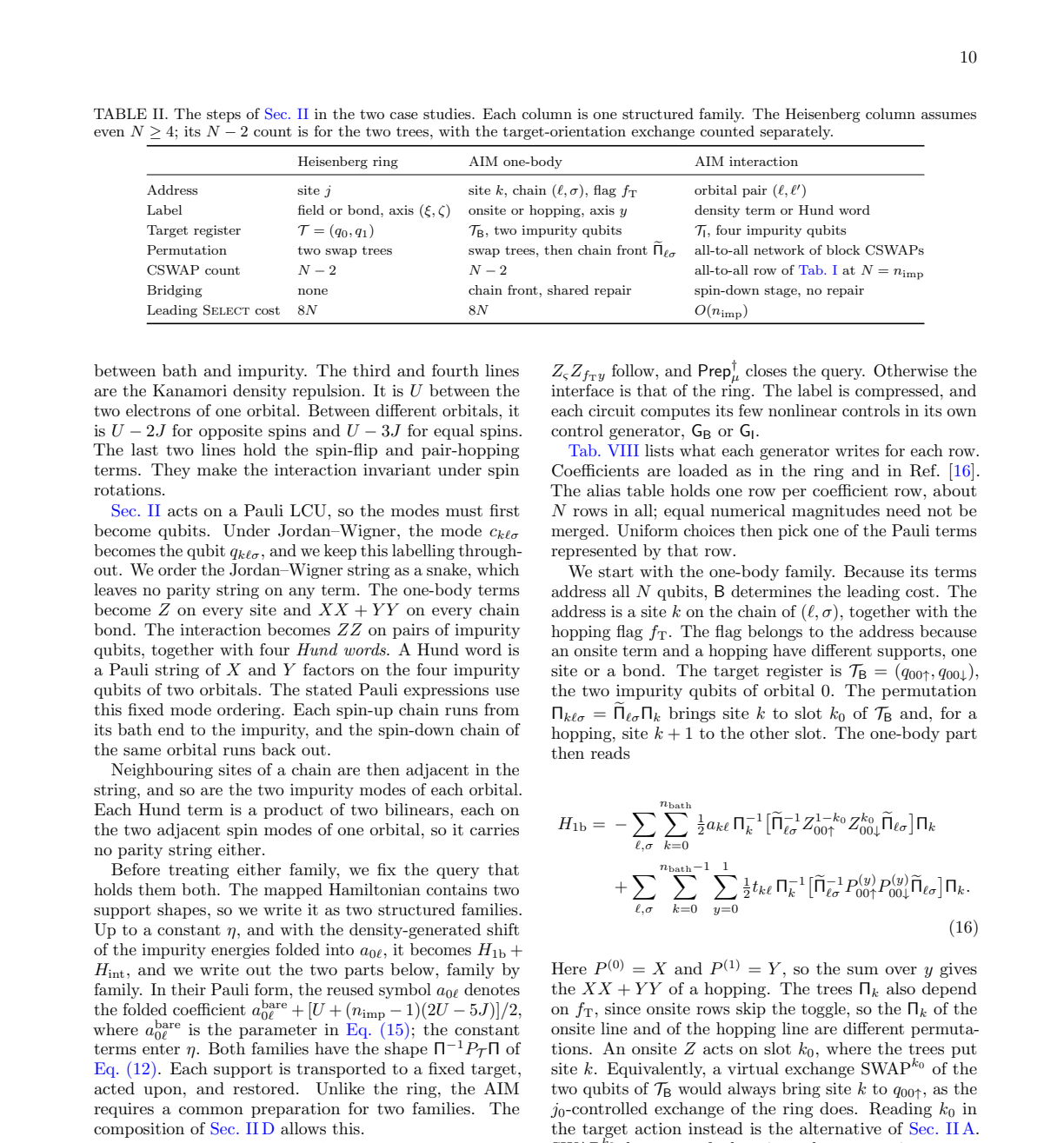
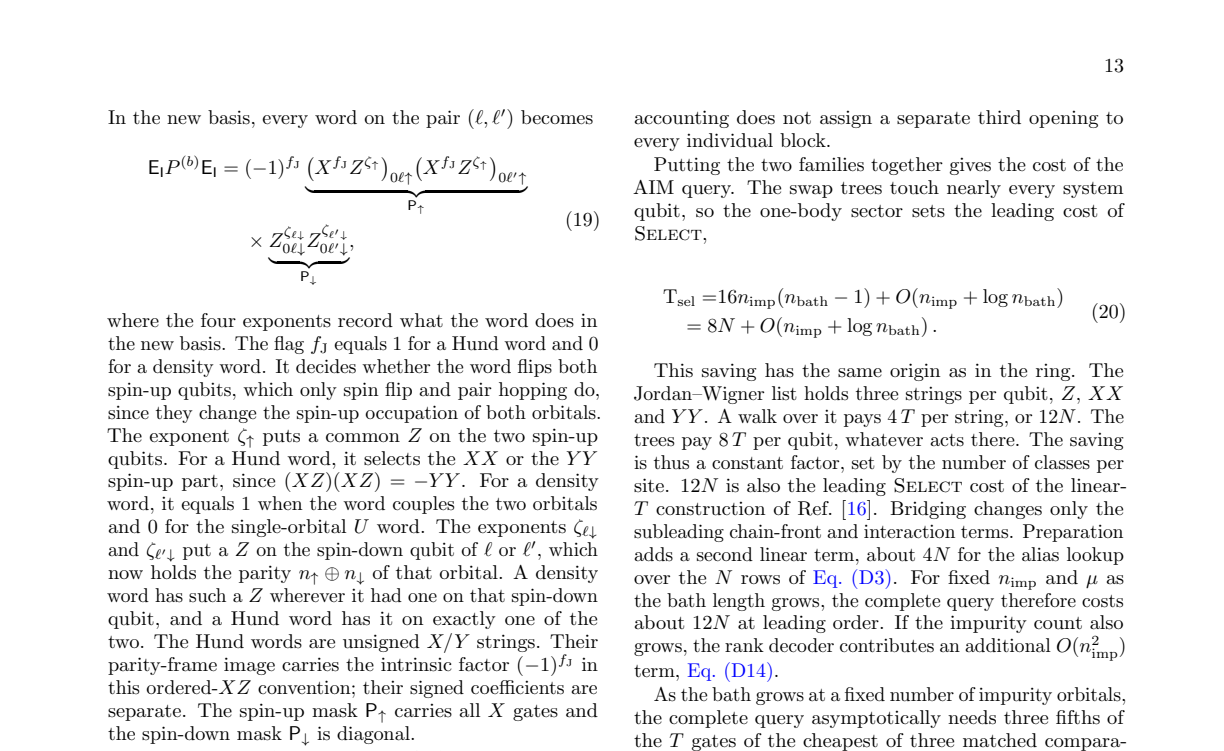
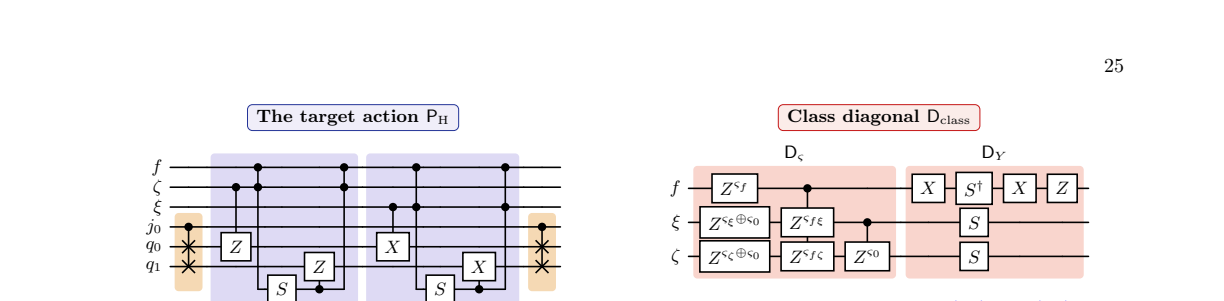
Core claim. The central claim is that a block encoding's SELECT can be made much cheaper by separating the role of the support address from the role of the operator label. Writing each term as $Pi_j^{{-1}}$ $P_T^{{(b)}}$ Pi_j turns SELECT into permute-act-unpermute: an address-controlled CSWAP network brings the selected support to a fixed target register, a shared circuit acts there, and the inverse network restores the system. Because the permutation depends on the address alone, every operator class reuses it, and for fixed support size its CSWAP count stays linear in N; the number of terms enters the query only through the coefficients that Prepare loads. For two-site supports the paper proves this count is the minimum over address-controlled networks of site transpositions, giving S = 1 for any geometry with bounded colouring number (including nearest-neighbour bonds and plaquettes) and S = 3/2 for all-to-all pairs, with an exact touched-at CSWAP count and O(log N) retained products. The matched forward and inverse permutations then admit a second saving: the temporary AND of a forward CSWAP can stay live across the target action and be repaired by the Clifford gate $X^{{c delta}}$, halving the 8T cost of a closed pair to 4T when the repair is Clifford. The complete queries deliver a factor approaching 3 fewer T gates on the Heisenberg ring and about 1.7 fewer on the Anderson impurity model against the lowest-cost matched comparators, at comparable peak workspace.
The premise it rests on. The minimality proof for the CSWAP count, and with it the densities S = 1 and S = 3/2 that feed the headline 8SN T-gate count, holds only within address-controlled networks of site transpositions in which each CSWAP is gated by a single address bit, explicitly excluding richer primitives such as controlled three-cycles.
If the paper is right (Pith's inferences, not the authors')
SELECT cost for supports of fixed size becomes O(N) T gates whatever the number of terms, so power-law couplings and other many-coefficient families cost the same as uniform ones at leading order.
Every operator class sharing a support geometry reuses the same permutation, so adding operator classes changes only the target action's cost, which is independent of N.
The bridged CSWAP identity applies to any action whose parity change is fixed by the prepared registers, not just Pauli targets, so any such operator can halve the cost of its matched permutation pair at the price of one retained work bit.
For all-to-all pairs the construction reaches the same 12N leading term as the plane-wave chemistry SELECT of Ref. [16] but works for any Pauli operator on the pair, and it sits four times below the ancilla-free fermionic quadratic SELECT of Ref. [22].
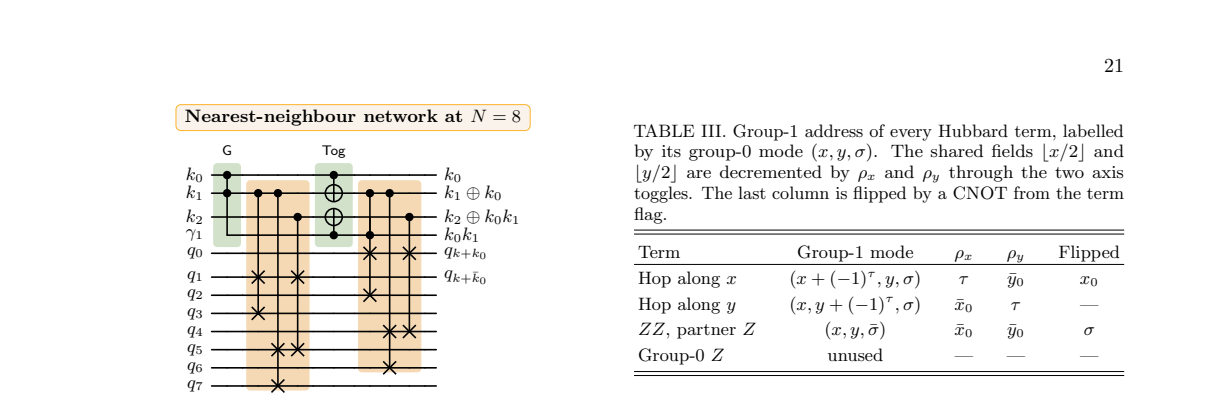
The Heisenberg ring leads with 8N against 24N for a flat Pauli walk, because the permutation is paid once per position rather than once per term-class combination.
The stated scope of the minimality proof invites a concrete test: search for networks whose controlled operations are three-cycles or other multi-target primitives gated by general address functions; if any gathers every two-site support of a ring or all-to-all pair graph with strictly fewer operations than S N, the densities S = 1 and S = 3/2 and the headline 8SN count are not optimal.
The where-what split suggests the same principle may transfer to other selection mechanisms, such as walk-based SELECT, sparse-QROM enumeration reorganized by support family, or Hermitian encodings, since the paper itself closes by noting that block encodings might be designed around geometry rather than flat term lists.
For supports of three or more sites the paper leaves two linked questions open, the exact minimum CSWAP count and whether O(log N) nonlinear controls can always accompany a minimal permutation network, so a natural next result would be to close the bracket between (N - n_T) + ceil((chi - n_T)/2) and N + O(n_T chi) and exhibit a network that achieves both simultaneously.
Check this review
Pith stored no record of this review's passes and took no fingerprint of it. Reviews made by code from 13 Nov 2026 on carry both.
How often reviews like this one are right
Reviews like this one: written by deepseek-v4-flash, where what was read was not recorded.
How often objections from reviews like this one are right: not yet measured
Reviews by people
This review was written by a machine. No person has reviewed this paper on Pith yet. A scientist listed on Pith can review it for a fee, and their review is published here whatever it concludes.
The paper
Abstract
In fault-tolerant block encodings of structured Hamiltonians, the support geometry can set how the non-Clifford cost of SELECT scales with the system size, however many operators act on each support. We construct permute-act-unpermute circuits: a CSWAP network fixed by this geometry brings a selected support to a fixed target register, a shared local circuit acts there, and the permutation is undone. The operators add only an XZ mask on this register, at a cost independent of the system size, and one query can mix several support geometries. For two-site supports, we establish and attain the minimum CSWAP count within address-controlled networks of site transpositions. Compiled for Pauli terms, these circuits use 8SN + o(N) T gates with O(logN) permutation work qubits, where N is the number of system qubits and S is determined by the support geometry, with S = 1 for nearest-neighbour interactions and S = 3/2 for all-to-all pairs; in both cases the correction is O(logN). We also introduce a bridged CSWAP, which remembers the logical value of its temporary AND across the target action and repairs it from the prepared labels, so that the inverse CSWAP undoes the exchange without recomputing the value. When the repair is Clifford, it halves the T count of a matched forward-inverse CSWAP pair at the cost of one retained work qubit. For a Heisenberg ring, the complete block-encoding query reduces the T count by a factor approaching 3 as the system size grows, relative to flat and product-wise Pauli walks. For a five-orbital Anderson impurity model, which combines nearest-neighbour and all-to-all support geometries, the reduction is about 1.7 at large bath sizes, relative to the cheapest of three comparators, each built from the methods of the references it follows.
The paper's own sentences, arranged, kept beside the review and separate from it. Each label is drawn from a closed vocabulary; the number beside it is the probability the classifier gave that label. No sentence in this record was written by a model.
abstract compiled · 2026-10-05
The authors' main claim, as the classifier picked it out 0.86
“Fault-tolerant block encodings of structured Hamiltonians can reduce their non-Clifford cost in SELECT by selecting where an operator acts separately from what is applied.”
How the main claim is stated: hedged possibility 0.63
What the abstract itself states, as probabilities: claims first 0.06 · states limitation 0.27 · human participants 0.01 · controlled comparison 0.87 · randomized assignment 0.01 · states quantitative result 0.98 · compares with prior results 0.95 · mentions code or data availability 0.02
The abstract, sentence by sentence
This table labels the abstract only (arXiv listing abstract v1). The number is the probability the classifier gave the label.
| Sentence | Role | The authors' own work | States the main conclusion | Strength |
|---|---|---|---|---|
| Fault-tolerant block encodings of structured Hamiltonians can reduce their non-Clifford cost in SELECT by selecting where an operator acts separately from what is applied. | background 0.58 | 0.22 | 0.75 | hedged possibility 0.63 |
| We construct permute-act-unpermute circuits whose CSWAP networks exploit the support geometry: a selected support is brought to a fixed target register, a shared local circuit acts there, and the permutation is undone. | method 0.92 | 0.93 | 0.13 | asserted 1.00 |
| For supports of fixed size, the $T$ count of SELECT then grows with the system size rather than with the number of terms, without requiring translational symmetry or factorised coefficients. | result 0.96 | 0.83 | 0.37 | asserted 1.00 |
| For two-site supports, we establish and attain the minimum CSWAP count within address-controlled networks of site transpositions. | result 0.77 | 0.92 | 0.10 | asserted 1.00 |
| Compiled for Pauli terms, these circuits use $8SN+O(\log N)$ $T$ gates with $O(\log N)$ permutation work qubits, where $N$ is the number of system qubits and $S$ is determined by the support geometry, with $S=1$ for nearest-neighbour interactions and $S=3/2$ for all-to-all pairs. | result 0.97 | 0.90 | 0.22 | asserted 1.00 |
| We also introduce a bridged CSWAP that retains and repairs a temporary AND across the target action. | contribution 0.70 | 0.92 | 0.03 | asserted 1.00 |
| When the repair is Clifford, it halves the $T$ count of a matched forward-inverse CSWAP pair at the cost of one retained work qubit. | result 0.52 | 0.84 | 0.06 | asserted 0.99 |
| For a Heisenberg ring, the complete block-encoding query reduces the $T$ count by a factor approaching 3 as the system size grows. | result 1.00 | 0.90 | 0.19 | asserted 1.00 |
| For a five-orbital Anderson impurity model, which combines nearest-neighbour and all-to-all support geometries, the reduction is about 1.7 at large bath sizes. | result 1.00 | 0.91 | 0.07 | asserted 0.99 |
| Both comparisons use the lowest-cost compiled baselines considered, at unchanged block-encoding normalisation and comparable peak ancilla counts. | result 0.44 | 0.82 | 0.05 | asserted 0.99 |
What kind of paper the classifier reports this is: method or tool 1.00 · evidence from proof or derivation 0.95
What was examined, and what was not
Sources read
- arXiv listing abstract v1
Not examined
- full text
- figures and tables
- references and citing sentences
- relations to other papers
Levels run
- P abstract
Not run
- S sections
- T body sentences
- C citations
- R cross-paper relations
How the labels were made
Compiled by classifier-1.13.0 via TypeSafe API, question bank abstract-p1-20260923, 2026-10-05: 1 request, 7,808 input tokens.
Every quoted sentence on this record is the authors'. Every label is from Pith's closed vocabulary, with the probability shown beside it. This record as JSON
Figures (26)

Showing 17 of the paper's 26 figures. Figures are the authors', reproduced from the paper.
Cited by 2 Pith papers
Reviewed papers on Pith that cite this one. The full citation record
- Low-frustration block encodings by patch routing quant-ph · Oct 2026
- Simulating closed- and open-system dynamics of Tavis--Cummings lattices on fault-tolerant quantum computers quant-ph · Nov 2026
Challenges and discussion
Disagree with the review, or know something it missed? Leave a comment, or challenge this review formally: a challenge becomes a permanent entry in this paper's record, and its decision is published here.
Come back by email
A short list of the week's newly reviewed papers. Nothing is sent until you confirm from your inbox, and every email has a link that stops it. No account.
No comments yet.
Sign in to comment