Quantum Physics · arXiv:2611.14398 v1 · submitted 10 Nov 2026 · 97 references
Simulating closed- and open-system dynamics of Tavis–Cummings lattices on fault-tolerant quantum computers
The paper says
“Tavis–Cummings lattices couple cavities containing several emitters and host polaritonic many-body dynamics whose real-time correlations are costly to compute classically in two dimensions, especially when unequal emitter relaxation or dephasing rates break permutation symmetry.”
more of the abstract
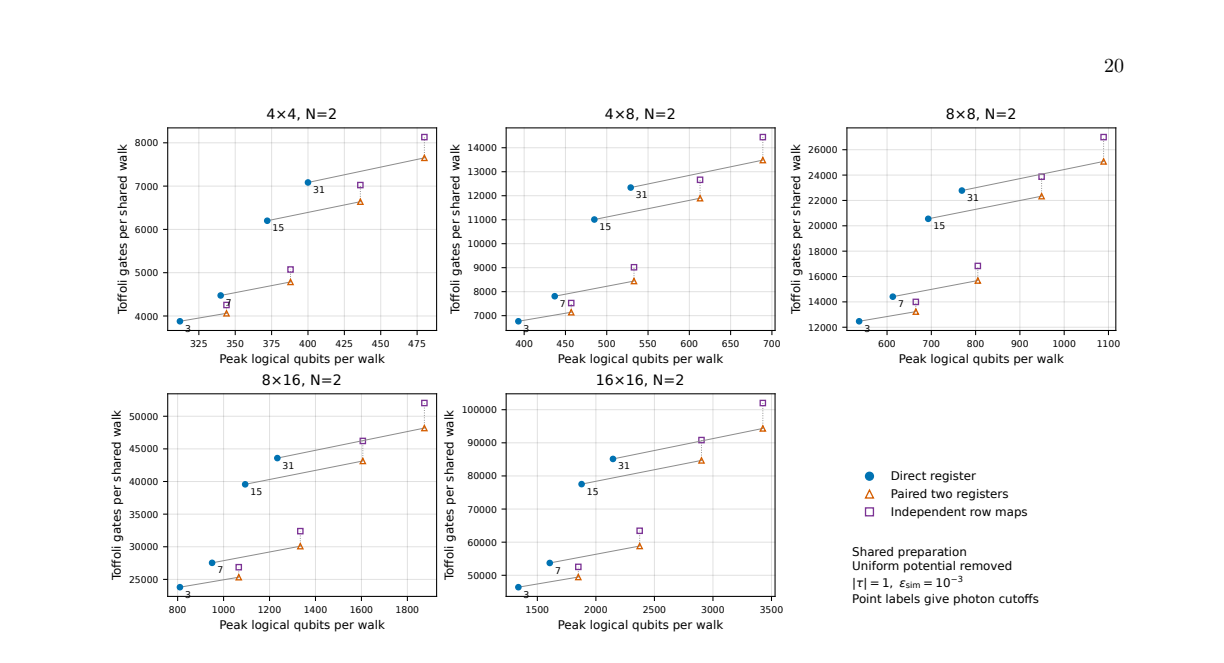
We analyze logical resources for fault-tolerant closed- and open-system simulation of an atom-resolved lattice with L cavities, N emitters per cavity, and photon cutoff n_max, including target observable estimation. Building on ladder-operator block encoding, we construct circuits for photon hopping and local light–matter exchange and combine them to encode the lattice Hamiltonian. By updating source and destination photon occupations in place, the hopping circuit eliminates the auxiliary $L\lceil\log_2(n\_{\max}+1)\rceil$-qubit photon register used by two-register implementations. Across three uniform-coefficient examples with 16 to 256 cavities, the controlled walk uses 4.75–$8.11%$ fewer Toffoli gates than the paired two-register implementation under matched shared preparation, precision, control, and workspace conventions. For closed systems, we implement real-time evolution with generalized quantum signal processing and bound the cost of estimating retarded cavity spectral functions. For open systems with photon loss, emitter relaxation, and dephasing, we use a sampled first-order dilation and bound the runs and timesteps needed to estimate transient photon statistics such as g(2)(0). With state-preparation and measurement costs explicit, these estimates provide a reference for assessing fault-tolerant light–matter lattice simulation costs.
from the abstract
Pith says
Machine review · deepseek-v4-flash · 11 Nov 2026 · what was read was not recorded · not checked by a person
It can be wrong. Challenge this review or reply to it.
2 minor
How often objections from reviews like this one are right: not yet measured
Not checked: figures, code, what the 97 references say.
2 minor objections
The paper says, at Section VII A, Table II, and Eq. (D10)
Pith says: minor objection 1 of 2
The tabulated alias-precision values B in Table II are one bit below the threshold set by Eq. (D10) for the first two example rows. For the (16,1,3) row, Eq. (D10) gives 8|tau|(alpha_hop + alpha_loc)/epsilon approximately 554,502, which is larger than 2^19, so B >= 20 rather than the tabulated B = 19; the (64,2,7) row similarly gives B >= 23 rather than 22.
more of objection 1
The text states that b and B obey Eqs. (D9) and (D10), so the precision formula or the table values should be brought into agreement, and the effect on the reported coherent counts should be checked.
The paper says, at Section VII A and Appendix C
Pith says: minor objection 2 of 2
The main text says that independent Qualtran checks reproduce the coherent Toffoli counts, while Appendix C(b) reports that the arithmetic subtotals in Table III come out below the stated bounds because of a cheaper reversible destination-address circuit and that the audit "supports the ledger bounds but does not establish the cost of a complete Hamiltonian block encoding or controlled walk at those arithmetic subtotals."
more of objection 2
This distinction is reasonable, but it would improve clarity to state in Section VII A that Table III is an upper-bound ledger rather than an exact circuit count, so that readers do not conflate it with the reproduced Table II counts.
What would settle it
Recompile the paired two-register hopping encoding with select-swap lookups under exactly the conventions of Table II (shared preparation, $|\tau|=1$, $\varepsilon_{\mathrm{sim}}=10^{-3}$, matched angle and alias precisions) and count Toffoli gates per controlled walk on the $(L=256, N=4, n_{\max}=15)$ instance: if the alternative two-register count lands at or below the direct-register 83,720, the claimed 7.88% saving reverses. An independent re-derivation of the ledger — a reasonable standard given the paper's disclosure that AI tools helped build and lower the gate counts during revision — should also reproduce the direct walk's 2,399 peak qubits and 1,024-qubit register removal.
from Pith's summary of the paper
How the review went
2 readings by deepseek-v4-flash · 11 Nov 2026
- Reader holds up
- Referee minor revision: 2 minor
Not run on this paper: the skeptic, the editor, the simulated authors' defence.
Pith did not check this review's objections against the paper.
The review in full
The referee's report
The central construction appears sound, and the resource ledger is internally consistent: the quoted savings percentages, sampling step counts, and T-gate tallies in the worked examples follow from the stated formulas, and the analytic spectral benchmark is parameter-free. The paper's strengths are its explicit circuit-level counting conventions, reproducible decompositions, honest allocation of state-preparation, evolution, and measurement costs, and the absence of fitted parameters disguised as predictions. The headline savings figure is relative to the authors' own paired two-register baseline, and the baseline dependence is acknowledged explicitly (Section VII A: "Other structured encodings may have different costs" and "We therefore make no numerical prediction for that ratio without specifying the lookup scheme"), so this concern does not land as a defect. The result is a useful reference estimate for fault-tolerant light-matter simulation, not a claim of asymptotic superiority or quantum advantage.
Pith's reading of the paper (a machine's summary, not the authors')
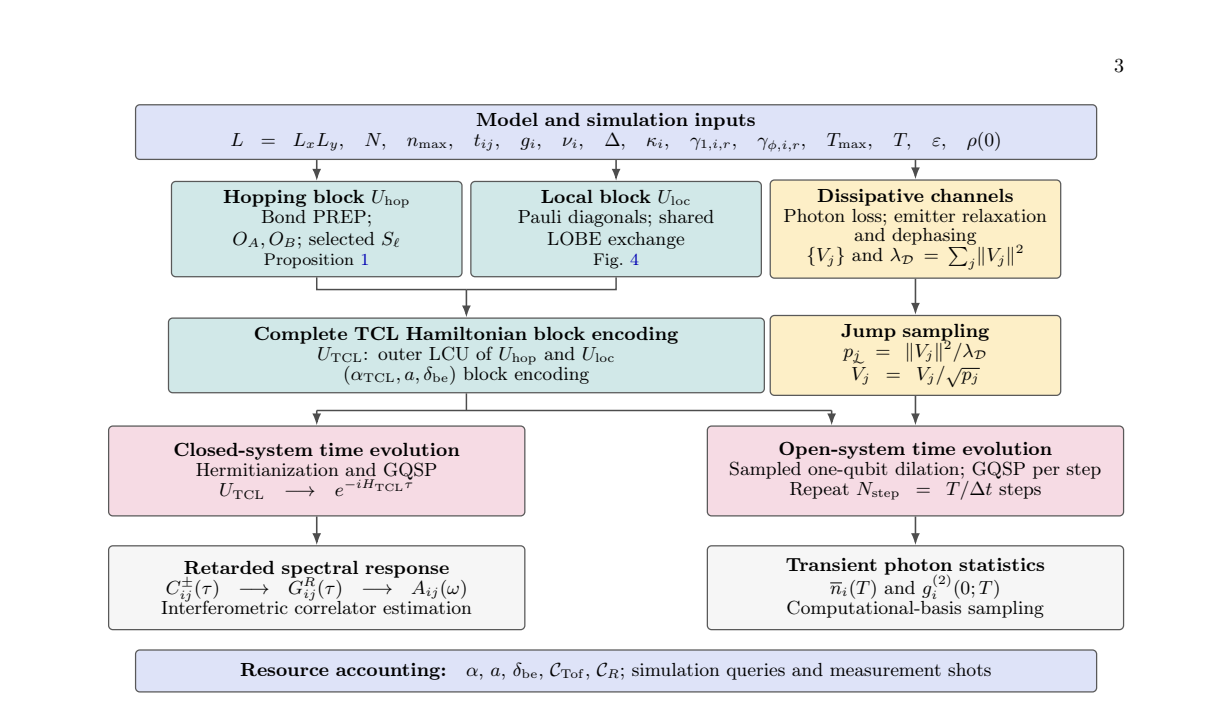
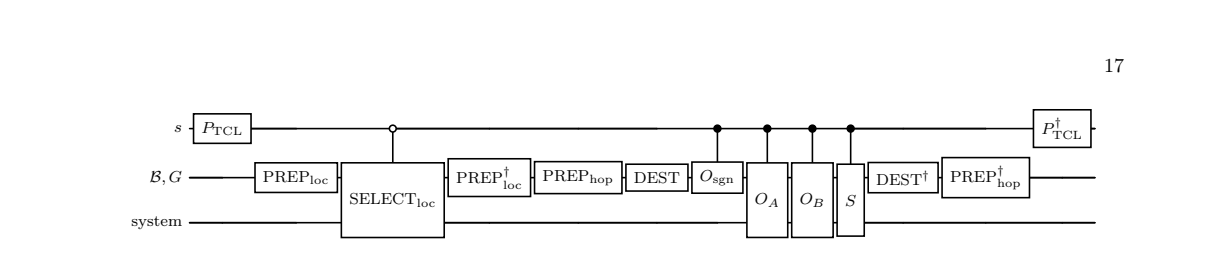
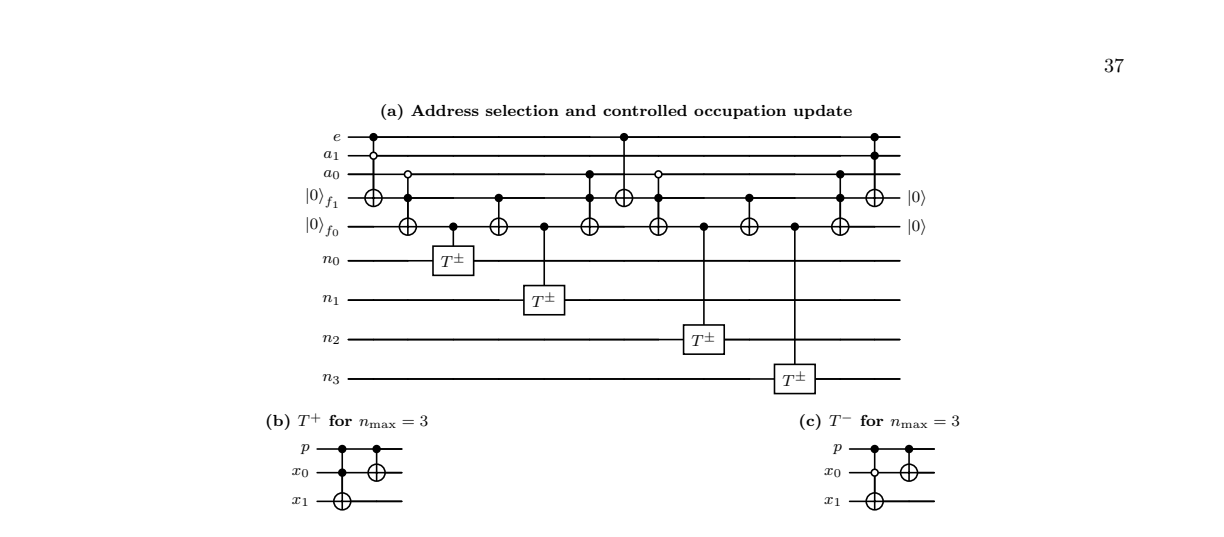
This paper sets out to show that a fault-tolerant quantum computer can simulate a Tavis–Cummings lattice — an array of coupled cavities, each holding several two-level emitters — with explicit, end-to-end logical resource counts: Toffoli gates, rotations, qubits, timesteps, and measurement shots. Its central circuit claim is that a photon hop decomposes into a modular shift of the source and destination occupations times a diagonal coefficient, so the hopping block encoding can update the photon registers in place; this removes the auxiliary $L\lceil\log_2(n_{\max}+1)\rceil$-qubit second photon register that two-register implementations need and uses 4.75–8.11% fewer Toffoli gates per controlled walk step in three examples with 16 to 256 cavities. The same encoding is then carried through real-time evolution by generalized quantum signal processing, through retarded spectral-function estimation, and through Lindblad open dynamics via a sampled first-order dilation, producing cost formulas and worked numbers including a $g^{(2)}(0)$ example. If correct, these estimates turn an asymptotic simulation bound into a concrete reference ledger for light–matter lattice simulation on fault-tolerant hardware.
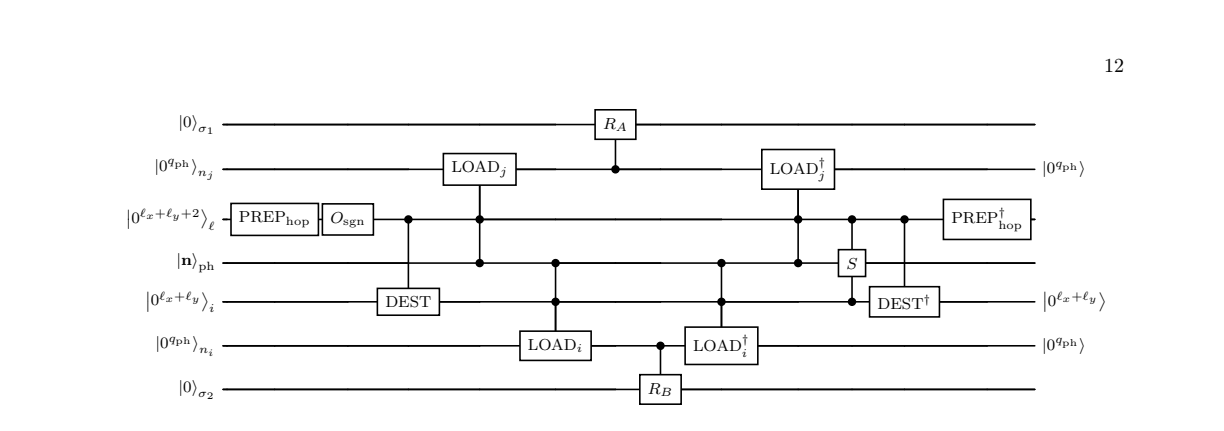
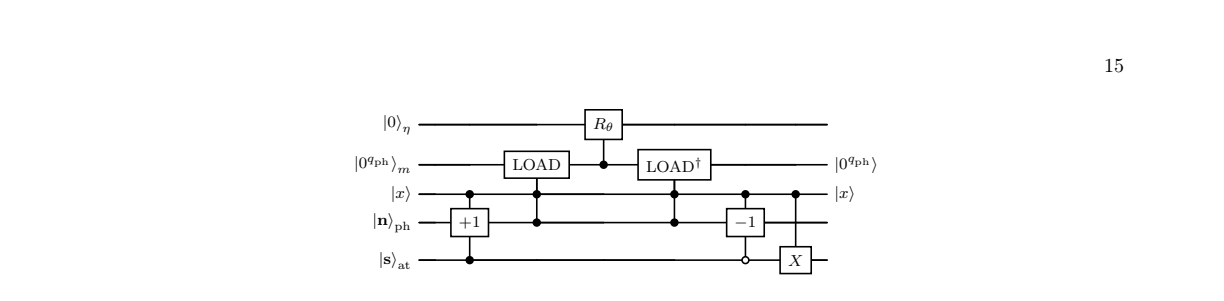
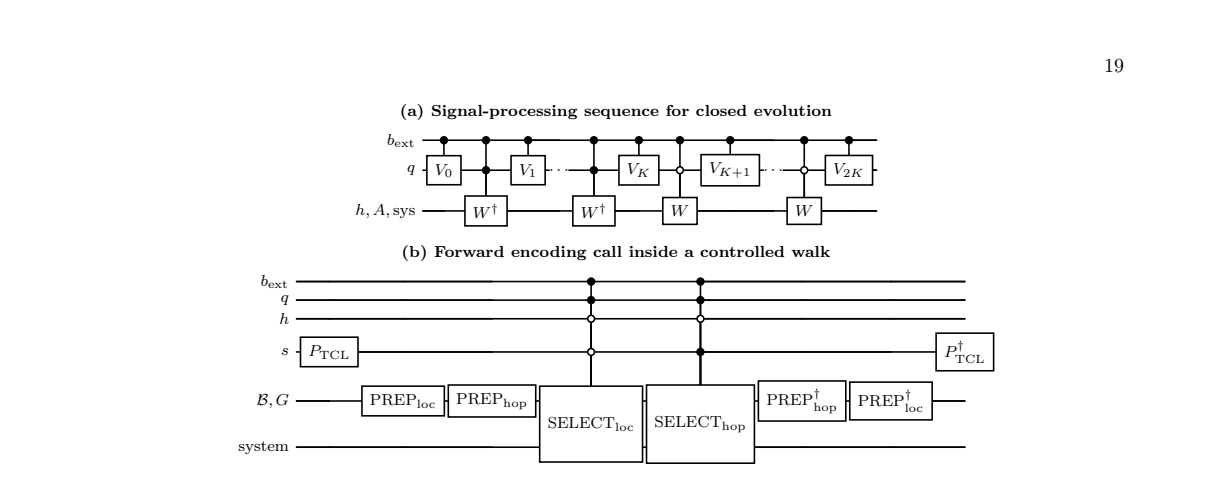
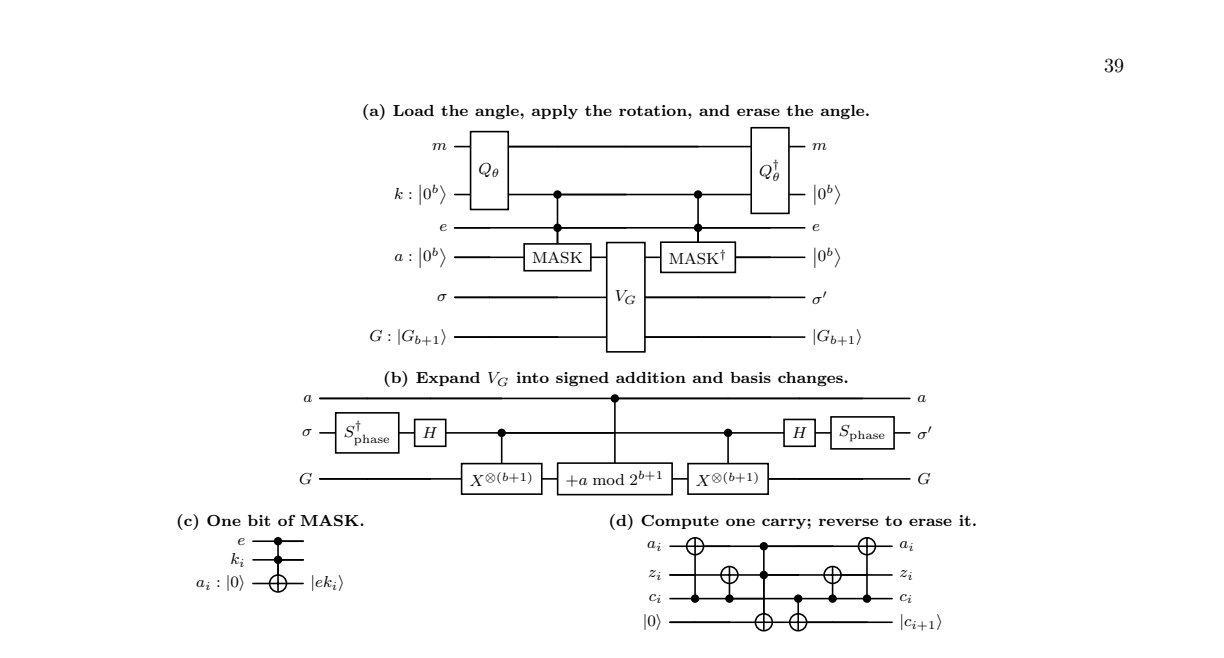
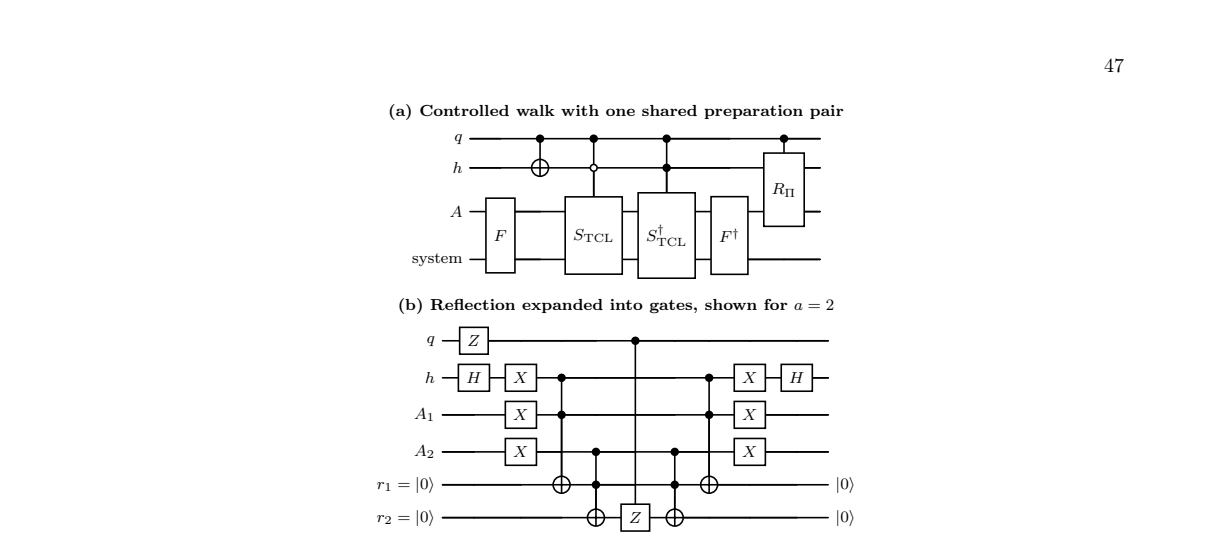
What carries the argument. The carrying mechanism is the shift–diagonal decomposition of a directed photon transfer (Lemma 1): a hop is a unitary modular shift $S_\ell$ that decrements the source and increments the destination occupation, multiplied by a diagonal operator $D_\ell$ that supplies the amplitude $\sqrt{n_j(n_i+1)}$ and returns zero at the boundaries and on unused labels. The companion factorization (Lemma 2) splits that coefficient into $A(n_j)B(n_i)$, two $R$-entry tables independent of the bond label, so one shared angle lookup with a phase-gradient rotation serves every hopping branch, and the same shared lookup serves the local light–matter exchange. Around this core sit the LCU combination of the hopping and local encodings, the Hermitianized qubitized walk with generalized quantum signal processing for evolution, and the sampled one-qubit dilation that turns each sampled Lindblad jump into a block-encoded two-branch Hamiltonian with normalization $\sqrt{\Delta t}\,\alpha_{\mathrm{TCL}} + \sqrt{\lambda_D}$.
Core claim. On the authors' own terms, the discovery is that the truncated hopping operator $a_i^\dagger a_j$ factorizes as $S_\ell D_\ell$, where $S_\ell$ is a unitary modular shift that decrements the source occupation and increments the destination occupation, and $D_\ell$ is diagonal with entries $\sqrt{n_j(n_i+1)}$ and zero on the boundary occupations $n_j=0$, $n_i=n_{\max}$, and on unused binary labels. This coefficient further splits into $A(n_j)B(n_i)$, two one-dimensional tables of $R$ entries each, shared by all $4L$ directed bonds, so the hopping circuit can load two occupations, apply the amplitude factors on two signal qubits, and shift the occupations in place. The paper claims this yields a valid $(\alpha_{\mathrm{TCL}}, a, \delta_{\mathrm{be}})$ block encoding of the atom-resolved Tavis–Cummings Hamiltonian, that the controlled walk built from it uses 4.75–8.11% fewer Toffoli gates than the paired two-register circuit under matched conventions while removing $Lq_{\mathrm{ph}}$ qubits, and that the closed- and open-system resource bounds — including observable shot counts for spectral functions and $g^{(2)}(0)$ — follow from this encoding.
The premise it rests on. The 4.75–8.11% Toffoli saving is measured against the authors' own paired two-register circuit under their chosen counting conventions, so a cheaper two-register compilation — a possibility the paper explicitly acknowledges for select-swap and sign-LCU lookups — would shrink or reverse the headline ratio even though the in-place construction itself would remain a valid block encoding.
If the paper is right (Pith's inferences, not the authors')
A concrete $(\alpha_{\mathrm{TCL}}, a, \delta_{\mathrm{be}})$ block encoding of the atom-resolved Tavis–Cummings lattice exists with per-call Toffoli cost $O(Lq_{\mathrm{ph}} + LN + n_{\max} + b + b_{\mathrm{alias}})$ and at most two arbitrary rotations, so end-to-end cost statements can be made per simulation query rather than only asymptotically.
The in-place update removes $L\lceil\log_2(n_{\max}+1)\rceil$ qubits — 1,024 on the 256-cavity instance, cutting peak walk qubits from 3,423 to 2,399 — and saves 4.75–8.11% of the Toffoli gates per controlled walk relative to the paired two-register circuit under the stated conventions.
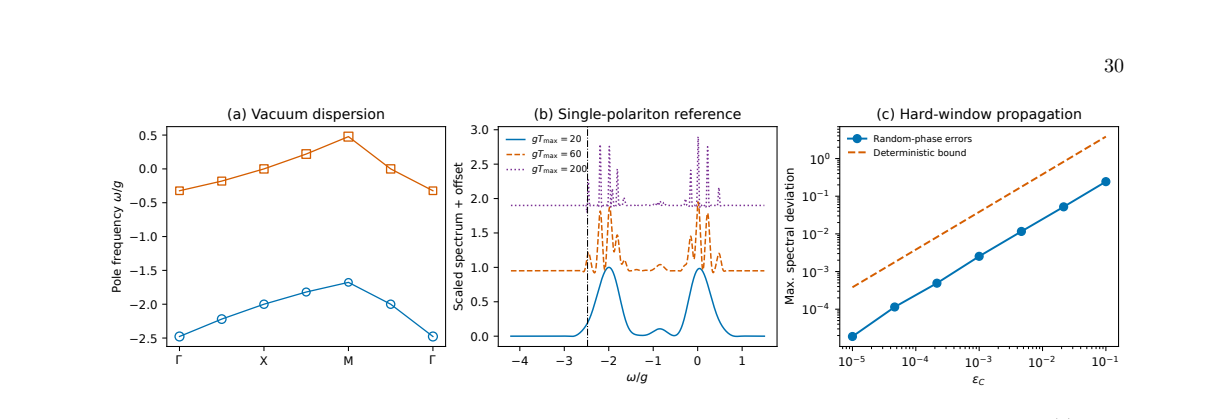
For closed systems, the cost of estimating retarded cavity spectral functions is fixed by the observation window ($\delta\omega \simeq 2\pi/T_{\max}$), a common-evolution interferometer, and shot counts $O(n_{\max}^2/\varepsilon_C^2)$ per quadrature, with an exact-diagonalization check of the correlator definitions and windowing bounds.
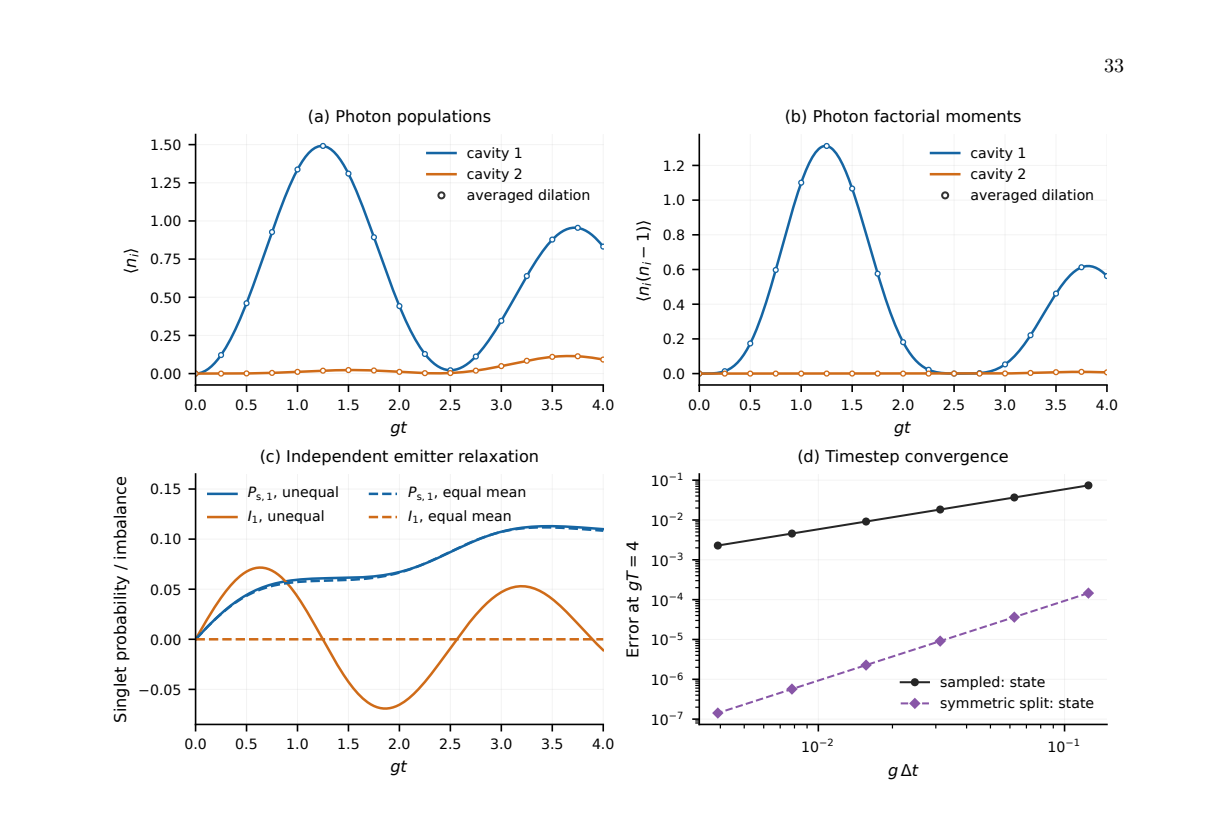
For open systems, the sampled first-order dilation needs $N_{\mathrm{step}} = O(1 + T^2\Lambda^2/\varepsilon)$ timesteps, and the correlated ratio-error bound for $g^{(2)}(0)$ cuts required runs by roughly a factor of 81 relative to separate moment bounds in the worked $(L=16, N=1, n_{\max}=3)$ example.
The authors state that these counts do not establish optimality or quantum advantage and that physical error-correction overhead is not included; the ledger is a reference for fault-tolerant cost, not a lower bound.
The shift–diagonal trick is not specific to Tavis–Cummings couplings: any bosonic hopping term whose amplitude factorizes into source and destination functions could adopt the in-place update, so Jaynes–Cummings–Hubbard and free-boson encodings may inherit the same register and gate savings without changing their normalization.
The 4.75–8.11% ratio is a compiler-dependent statement, as the authors acknowledge; a select-swap lookup or sign-LCU two-register encoding could shrink or reverse it, while the qualitative benefit of dropping $Lq_{\mathrm{ph}}$ qubits would survive.
Because the worked $g^{(2)}(0)$ example lands near $1.9\times10^{20}$ T-gates before state preparation under the conservative first-order bounds, the authors' own pointer to symmetric splitting (roughly 385 times fewer steps with exact local channels) suggests the practical open-system cost will be set by compiling exact photon-loss channels, which the paper leaves as future work.
The observable-estimation stage, not the Hamiltonian walk, dominates the bottom-line counts in both worked examples, so amplitude estimation and variance-aware estimators are likely to be the first place the reported run numbers come down in a physical deployment.
Check this review
Pith stored no record of this review's passes and took no fingerprint of it. Reviews made by code from 13 Nov 2026 on carry both.
How often reviews like this one are right
Reviews like this one: written by deepseek-v4-flash, where what was read was not recorded.
How often objections from reviews like this one are right: not yet measured
Reviews by people
This review was written by a machine. No person has reviewed this paper on Pith yet. A scientist listed on Pith can review it for a fee, and their review is published here whatever it concludes.
The paper
Abstract
Tavis–Cummings lattices couple cavities containing several emitters and host polaritonic many-body dynamics whose real-time correlations are costly to compute classically in two dimensions, especially when unequal emitter relaxation or dephasing rates break permutation symmetry. We analyze logical resources for fault-tolerant closed- and open-system simulation of an atom-resolved lattice with L cavities, N emitters per cavity, and photon cutoff n_max, including target observable estimation. Building on ladder-operator block encoding, we construct circuits for photon hopping and local light–matter exchange and combine them to encode the lattice Hamiltonian. By updating source and destination photon occupations in place, the hopping circuit eliminates the auxiliary $L\lceil\log_2(n\_{\max}+1)\rceil$-qubit photon register used by two-register implementations. Across three uniform-coefficient examples with 16 to 256 cavities, the controlled walk uses 4.75–$8.11%$ fewer Toffoli gates than the paired two-register implementation under matched shared preparation, precision, control, and workspace conventions. For closed systems, we implement real-time evolution with generalized quantum signal processing and bound the cost of estimating retarded cavity spectral functions. For open systems with photon loss, emitter relaxation, and dephasing, we use a sampled first-order dilation and bound the runs and timesteps needed to estimate transient photon statistics such as g(2)(0). With state-preparation and measurement costs explicit, these estimates provide a reference for assessing fault-tolerant light–matter lattice simulation costs.
The paper's own sentences, arranged, kept beside the review and separate from it. Each label is drawn from a closed vocabulary; the number beside it is the probability the classifier gave that label. No sentence in this record was written by a model.
abstract compiled · 2026-11-11
The authors' main claim, as the classifier picked it out 0.86
“With state-preparation and measurement costs explicit, these estimates provide a reference for assessing fault-tolerant light--matter lattice simulation costs.”
How the main claim is stated: asserted 0.75
What the abstract itself states, as probabilities: claims first 0.04 · states limitation 0.32 · human participants 0.01 · controlled comparison 0.63 · randomized assignment 0.01 · states quantitative result 0.98 · compares with prior results 0.92 · mentions code or data availability 0.02
The abstract, sentence by sentence
This table labels the abstract only (arXiv listing abstract v1). The number is the probability the classifier gave the label.
| Sentence | Role | The authors' own work | States the main conclusion | Strength |
|---|---|---|---|---|
| Tavis--Cummings lattices couple cavities containing several emitters and host polaritonic many-body dynamics whose real-time correlations are costly to compute classically in two dimensions, especially when unequal emitter relaxation or dephasing rates break permutation symmetry. | background 0.99 | 0.06 | 0.04 | asserted 1.00 |
| We analyze logical resources for fault-tolerant closed- and open-system simulation of an atom-resolved lattice with $L$ cavities, $N$ emitters per cavity, and photon cutoff $n\_{\max}$, including target observable estimation. | contribution 1.00 | 0.93 | 0.09 | asserted 0.98 |
| Building on ladder-operator block encoding, we construct circuits for photon hopping and local light--matter exchange and combine them to encode the lattice Hamiltonian. | method 0.95 | 0.93 | 0.05 | asserted 1.00 |
| By updating source and destination photon occupations in place, the hopping circuit eliminates the auxiliary $L\lceil\log_2(n\_{\max}+1)\rceil$-qubit photon register used by two-register implementations. | method 0.93 | 0.92 | 0.09 | asserted 1.00 |
| Across three uniform-coefficient examples with $16$ to $256$ cavities, the controlled walk uses $4.75$--$8.11%$ fewer Toffoli gates than the paired two-register implementation under matched shared preparation, precision, control, and workspace conventions. | result 1.00 | 0.93 | 0.17 | asserted 1.00 |
| For closed systems, we implement real-time evolution with generalized quantum signal processing and bound the cost of estimating retarded cavity spectral functions. | method 0.82 | 0.94 | 0.08 | asserted 1.00 |
| For open systems with photon loss, emitter relaxation, and dephasing, we use a sampled first-order dilation and bound the runs and timesteps needed to estimate transient photon statistics such as $g^{(2)}(0)$. | method 0.93 | 0.93 | 0.07 | asserted 1.00 |
| With state-preparation and measurement costs explicit, these estimates provide a reference for assessing fault-tolerant light--matter lattice simulation costs. | interpretation 0.89 | 0.79 | 0.24 | asserted 0.75 |
What kind of paper the classifier reports this is: method or tool 0.96 · evidence from proof or derivation 0.83
What was examined, and what was not
Sources read
- arXiv listing abstract v1
Not examined
- full text
- figures and tables
- references and citing sentences
- relations to other papers
Levels run
- P abstract
Not run
- S sections
- T body sentences
- C citations
- R cross-paper relations
How the labels were made
Compiled by classifier-1.13.0 via TypeSafe API, question bank abstract-p1-20260923, 2026-11-11: 1 request, 6,589 input tokens.
Every quoted sentence on this record is the authors'. Every label is from Pith's closed vocabulary, with the probability shown beside it. This record as JSON
Figures (15)
Figures are the authors', reproduced from the paper.
References (97)
- [1] M. J. Hartmann, F. G. S. L. Brandão, and M. B. Plenio, Quantum many-body phenomena in coupled cavity arrays, Laser Photonics Rev.2, 527 (2008) on Pith
- [2] C. Noh and D. G. Angelakis, Quantum simulations and many-body physics with light, Rep. Prog. Phys.80, 016401 (2017) on Pith
- [3] M. J. Hartmann, F. G. S. L. Brandão, and M. B. Plenio, Strongly interacting polaritons in coupled arrays of cavities, Nat. Phys.2, 849 (2006) on Pith
- [4] E. T. Jaynes and F. W. Cummings, Comparison of quantum and semiclassical radiation theories with application to the beam maser, Proc. IEEE51, 89 (1963) on Pith
- [5] M. Tavis and F. W. Cummings, Exact Solution for anN-Molecule—Radiation-Field Hamiltonian, Phys. Rev.170, 379 (1968) on Pith
- [6] A. D. Greentree, C. Tahan, J. H. Cole, and L. C. L. Hollenberg, Quantum phase transitions of light, Nat. Phys.2, 856 (2006) on Pith
- [7] D. G. Angelakis, M. F. Santos, and S. Bose, Photon-blockade-induced Mott transitions and XY spin models in coupled cavity arrays, Phys. Rev. A76, 031805 (2007) on Pith
- [8] M. Knap, E. Arrigoni, and W. von der Linden, Quantum phase transition and excitations of the Tavis-Cummings lattice model, Phys. Rev. B82, 045126 (2010) on Pith
- [9] M. Aichhorn, M. Hohenadler, C. Tahan, and P. B. Littlewood, Quantum fluctuations, temperature, and detuning effects in solid-light systems, Phys. Rev. Lett.100, 216401 (2008) on Pith
- [10] J. Koch and K. Le Hur, Superfluid–Mott-insulator transition of light in the Jaynes-Cummings lattice, Phys. Rev. A80, 023811 (2009) on Pith
- [11] S. Jandura, V. Srivastava, L. Pecorari, G. K. Brennen, and G. Pupillo, Nonlocal multiqubit quantum gates via a driven cavity, Phys. Rev. A110, 062610 (2024) on Pith
- [12] V. Srivastava, S. Jandura, G. K. Brennen, and G. Pupillo, Cavity polariton blockade for non-local entangling gates with trapped atoms, Quantum Sci. Technol.10, 045038 (2025) on Pith
- [13] P. Pippan, H. G. Evertz, and M. Hohenadler, Excitation spectra of strongly correlated lattice bosons and polaritons, Phys. Rev. A80, 033612 (2009) on Pith
- [14] M. Knap, E. Arrigoni, and W. von der Linden, Polaritonic properties of the Jaynes–Cummings lattice model in two dimensions, Comput. Phys. Commun.182, 2036 (2011). 66 on Pith
- [15] D. Rossini and R. Fazio, Mott-insulating and glassy phases of polaritons in 1D arrays of coupled cavities, Phys. Rev. Lett. 99, 186401 (2007) on Pith
- [16] S. Schütz, J. Schachenmayer, D. Hagenmüller, G. K. Brennen, T. Volz, V. Sandoghdar, T. W. Ebbesen, C. Genes, and G. Pupillo, Ensemble-induced strong light-matter coupling of a single quantum emitter, Phys. Rev. Lett.124, 113602 (2020) on Pith
- [17] M. Hohenadler, M. Aichhorn, S. Schmidt, and L. Pollet, Dynamical critical exponent of the Jaynes-Cummings-Hubbard model, Phys. Rev. A84, 041608 (2011) on Pith
- [18] M. Tudorovskaya and D. Muñoz Ramo, Quantum Computing Simulation of a Mixed Spin-Boson Hamiltonian and Its Performance for a Cavity Quantum Electrodynamics Problem, Phys. Rev. A109, 032612 (2024), arXiv:2310.11342 on PithPith's reviewarXiv
- [19] N. Nguyen, M. Yu, A. Robertson, H. Nishimura, S. J. Elman, and B. Koltenbah, End-to-end complexity analysis for quantum simulation of the extended Jaynes-Cummings models (2025), arXiv:2509.13546 [quant-ph] on PitharXiv
- [20] A. N. Sims, D. Patel, A. Philip, A. H. Rubin, R. Bandyopadhyay, M. Radulaski, and M. M. Wilde, Digital quantum simulations of the nonresonant open Tavis-Cummings model, Phys. Rev. Res.7, 043302 (2025) on Pith
show 77 more
- [21] A. Mezzacapo, U. Las Heras, J. S. Pedernales, L. DiCarlo, E. Solano, and L. Lamata, Digital quantum Rabi and Dicke models in superconducting circuits, Sci. Rep.4, 7482 (2014) on Pith
- [22] N. K. Langford, R. Sagastizabal, M. Kounalakis, C. Dickel, A. Bruno, F. Luthi, D. J. Thoen, A. Endo, and L. DiCarlo, Experimentally simulating the dynamics of quantum light and matter at deep-strong coupling, Nat. Commun.8, 1715 (2017) on Pith
- [23] A. Haukisalmi, D. Paz Ramos, M. Raasakka, A. Marchesin, L. Ylinen, and I. Tittonen, Noisy quantum simulation: Performance and resource considerations for the Tavis-Cummings and Heisenberg models, Phys. Rev. Res.7, 043254 (2025) on Pith
- [24] R. Cleve and C. Wang, Efficient Quantum Algorithms for Simulating Lindblad Evolution, in44th International Colloquium on Automata, Languages, and Programming (ICALP 2017), Leibniz International Proceedings in Informatics, Vol. 80 (Schloss Dagstuhl–Leibniz-Zentrum für Informati... on Pith
- [25] W. A. Simon, C. M. Gustin, K. Serafin, A. Ralli, G. R. Goldstein, and P. J. Love, Ladder operator block-encoding, Quantum9, 1953 (2025) on Pith
- [26] C. F. Kane, S. Hariprakash, N. S. Modi, M. Kreshchuk, and C. W. Bauer, Block encoding bosons by signal processing, Quantum9, 1747 (2025) on Pith
- [27] A. Gilyén, Y. Su, G. H. Low, and N. Wiebe, Quantum singular value transformation and beyond: exponential improvements for quantum matrix arithmetics, inProceedings of the 51st Annual ACM SIGACT Symposium on Theory of Computing (2019) pp. 193–204, arXiv:1806.01838 on PithPith's reviewarXiv
- [28] Y. Dong, L. Lin, and Y. Tong, Ground-state preparation and energy estimation on early fault-tolerant quantum computers via quantum eigenvalue transformation of unitary matrices, PRX Quantum3, 040305 (2022) on Pith
- [29] A. M. Childs, D. Maslov, Y. Nam, N. J. Ross, and Y. Su, Toward the first quantum simulation with quantum speedup, Proc. Natl. Acad. Sci. U.S.A.115, 9456 (2018) on Pith
- [30] R. Babbush, C. Gidney, D. W. Berry, N. Wiebe, J. McClean, A. Paler, A. Fowler, and H. Neven, Encoding Electronic Spectra in Quantum Circuits with LinearTComplexity, Phys. Rev. X8, 041015 (2018) on Pith
- [31] N. Nguyen, T. W. Watts, B. Link, K. S. Williams, Y. R. Sanders, S. J. Elman, M. Kieferova, M. J. Bremner, K. J. Morrell, J. Elenewski, E. B. Isaacs, S. D. Johnson, L. Mathieson, K. M. Obenland, M. Otten, R. Sundareswara, and A. Holmes, Quantum computing for corrosion simulatio... on Pith
- [32] J. A. Mlynek, A. A. Abdumalikov, C. Eichler, and A. Wallraff, Observation of Dicke superradiance for two artificial atoms in a cavity with high decay rate, Nat. Commun.5, 5186 (2014) on Pith
- [33] D. W. Berry, A. M. Childs, and R. Kothari, Hamiltonian simulation with nearly optimal dependence on all parameters, in 2015 IEEE 56th Annual Symposium on Foundations of Computer Science(2015) pp. 792–809 on Pith
- [34] D. Motlagh and N. Wiebe, Generalized quantum signal processing, PRX Quantum5, 020368 (2024) on Pith
- [35] C. Sünderhauf, E. Campbell, and J. Camps, Block-encoding structured matrices for data input in quantum computing, Quantum8, 1226 (2024) on Pith
- [36] C. Hindlycke and J.-Å. Larsson, Single-qubit rotation algorithm with logarithmic Toffoli count and gate depth, Phys. Rev. Res.6, L042027 (2024) on Pith
- [37] P. Selinger, Quantum circuits ofT-depth one, Phys. Rev. A87, 042302 (2013), arXiv:1210.0974 on PithPith's reviewarXiv
- [38] M. Amy, D. Maslov, M. Mosca, and M. Roetteler, A meet-in-the-middle algorithm for fast synthesis of depth-optimal quantum circuits, IEEE Trans. Comput.-Aided Des. Integr. Circuits Syst.32, 818 (2013) on Pith
- [39] A. M. Childs and Y. Su, Nearly optimal lattice simulation by product formulas, Phys. Rev. Lett.123, 050503 (2019) on Pith
- [40] A. M. Childs, Y. Su, M. C. Tran, N. Wiebe, and S. Zhu, Theory of Trotter error with commutator scaling, Phys. Rev. X 11, 011020 (2021) on Pith
- [41] G. H. Low and I. L. Chuang, Hamiltonian Simulation by Qubitization, Quantum3, 163 (2019) on Pith
- [42] G. H. Low and I. L. Chuang, Optimal Hamiltonian simulation by quantum signal processing, Phys. Rev. Lett.118, 010501 (2017) on Pith
- [43] R.D.Somma, G.Ortiz, J.E.Gubernatis, E.Knill,andR.Laflamme,Simulatingphysicalphenomenabyquantumnetworks, Phys. Rev. A65, 042323 (2002) on Pith
- [44] D. Wecker, M. B. Hastings, N. Wiebe, B. K. Clark, C. Nayak, and M. Troyer, Solving strongly correlated electron models on a quantum computer, Phys. Rev. A92, 062318 (2015) on Pith
- [45] Z. Ding, X. Li, and L. Lin, Simulating Open Quantum Systems Using Hamiltonian Simulations, PRX Quantum5, 020332 (2024). 67 on Pith
- [46] M. P. Harrigan, T. Khattar, C. Yuan, A. Peduri, N. Yosri, F. D. Malone, R. Babbush, and N. C. Rubin, Expressing and Analyzing Quantum Algorithms with Qualtran (2024), arXiv:2409.04643 [quant-ph] on PithPith's reviewarXiv
- [47] V. Gorini, A. Kossakowski, and E. C. G. Sudarshan, Completely positive dynamical semigroups ofN-level systems, J. Math. Phys.17, 821 (1976) on Pith
- [48] G. Lindblad, On the generators of quantum dynamical semigroups, Commun. Math. Phys.48, 119 (1976) on Pith
- [49] H.-P. Breuer and F. Petruccione,The Theory of Open Quantum Systems(Oxford University Press, 2002) on Pith
- [50] M. Kliesch, T. Barthel, C. Gogolin, M. Kastoryano, and J. Eisert, Dissipative quantum Church-Turing theorem, Phys. Rev. Lett.107, 120501 (2011) on Pith
- [51] A. M. Childs and T. Li, Efficient simulation of sparse Markovian quantum dynamics, Quantum Inf. Comput.17, 901 (2017) on Pith
- [52] R. Kubo, Statistical-Mechanical Theory of Irreversible Processes. I. General Theory and Simple Applications to Magnetic and Conduction Problems, J. Phys. Soc. Jpn.12, 570 (1957) on Pith
- [53] G. D. Mahan,Many-Particle Physics, 3rd ed. (Springer, 2000) on Pith
- [54] R. J. Glauber, The quantum theory of optical coherence, Phys. Rev.130, 2529 (1963) on Pith
- [55] W. Hoeffding, Probability inequalities for sums of bounded random variables, J. Am. Stat. Assoc.58, 13 (1963) on Pith
- [56] N. P. D. Sawaya, T. Menke, T. H. Kyaw, S. Johri, A. Aspuru-Guzik, and G. G. Guerreschi, Resource-efficient digital quantum simulation ofd-level systems for photonic, vibrational, and spin-sHamiltonians, npj Quantum Inf.6, 49 (2020) on Pith
- [57] J. Dalibard, Y. Castin, and K. Mølmer, Wave-function approach to dissipative processes in quantum optics, Phys. Rev. Lett.68, 580 (1992) on Pith
- [58] P. Kirton and J. Keeling, Suppressing and restoring the Dicke superradiance transition by dephasing and decay, Phys. Rev. Lett.118, 123602 (2017) on Pith
- [59] N. Shammah, S. Ahmed, N. Lambert, S. De Liberato, and F. Nori, Open quantum systems with local and collective incoherent processes: Efficient numerical simulations using permutational invariance, Phys. Rev. A98, 063815 (2018) on Pith
- [60] N. Schuch, M. M. Wolf, F. Verstraete, and J. I. Cirac, Computational complexity of projected entangled pair states, Phys. Rev. Lett.98, 140506 (2007) on Pith
- [61] N. Schuch, M. M. Wolf, K. G. H. Vollbrecht, and J. I. Cirac, On entropy growth and the hardness of simulating time evolution, New J. Phys.10, 033032 (2008) on Pith
- [62] M. Zwolak and G. Vidal, Mixed-state dynamics in one-dimensional quantum lattice systems: A time-dependent superop- erator renormalization algorithm, Phys. Rev. Lett.93, 207205 (2004) on Pith
- [63] A. H. Werner, D. Jaschke, P. Silvi, M. Kliesch, T. Calarco, J. Eisert, and S. Montangero, Positive tensor network approach for simulating open quantum many-body systems, Phys. Rev. Lett.116, 237201 (2016), arXiv:1412.5746 on PithPith's reviewarXiv
- [64] C. Mc Keever and M. H. Szymańska, Stable iPEPO tensor-network algorithm for dynamics of two-dimensional open quantum lattice models, Phys. Rev. X11, 021035 (2021) on Pith
- [65] S. Finazzi, A. Le Boité, F. Storme, A. Baksic, and C. Ciuti, Corner-space renormalization method for driven-dissipative two-dimensional correlated systems, Phys. Rev. Lett.115, 080604 (2015) on Pith
- [66] J. Jin, A. Biella, O. Viyuela, L. Mazza, J. Keeling, R. Fazio, and D. Rossini, Cluster mean-field approach to the steady-state phase diagram of dissipative spin systems, Phys. Rev. X6, 031011 (2016) on Pith
- [67] S. Aaronson and A. Arkhipov, The computational complexity of linear optics, inProceedings of the 43rd Annual ACM Symposium on Theory of Computing (STOC 2011)(2011) pp. 333–342 on Pith
- [68] A. Deshpande, B. Fefferman, M. C. Tran, M. Foss-Feig, and A. V. Gorshkov, Dynamical phase transitions in sampling complexity, Phys. Rev. Lett.121, 030501 (2018) on Pith
- [69] R. Trivedi and J. I. Cirac, Transitions in computational complexity of continuous-time local open quantum dynamics, Phys. Rev. Lett.129, 260405 (2022) on Pith
- [70] A.M.ChildsandN.Wiebe,Hamiltoniansimulationusinglinearcombinationsofunitaryoperations,QuantumInf.Comput. 12, 901 (2012) on Pith
- [71] D. W. Berry, A. M. Childs, R. Cleve, R. Kothari, and R. D. Somma, Simulating Hamiltonian dynamics with a truncated Taylor series, Phys. Rev. Lett.114, 090502 (2015) on Pith
- [72] J.Zylberman, U.Nzongani, A.Simonetto,andF.Debbasch,Efficientquantumcircuitsfornon-unitaryandunitarydiagonal operators with space-time-accuracy trade-offs, ACM Trans. Quantum Comput.6, 1 (2025) on Pith
- [73] B. Peng, Y. Su, D. Claudino, K. Kowalski, G. H. Low, and M. Roetteler, Quantum Simulation of Boson-Related Hamil- tonians: Techniques, Effective Hamiltonian Construction, and Error Analysis, Quantum Sci. Technol.10, 023002 (2025), arXiv:2307.06580 on PithPith's reviewarXiv
- [74] A. Summer and F. Jamet, Efficient Block Encoding of Structured Hamiltonians by Separating Where and What (2026), arXiv:2610.03686 on PithPith's reviewarXiv
- [75] M. Liu, A. Gnanasekaran, A. Kaushik, S. Hariprakash, A. M. Khah, M. Roetteler, and G. Salton, Low-frustration block encodings by patch routing (2026), arXiv:2610.32946 on PithPith's reviewarXiv
- [76] J. Haah, M. B. Hastings, R. Kothari, and G. H. Low, Quantum Algorithm for Simulating Real Time Evolution of Lattice Hamiltonians, in2018 IEEE 59th Annual Symposium on Foundations of Computer Science (FOCS)(IEEE, 2018) pp. 350–360, arXiv:1801.03922 on PithPith's reviewarXiv
- [77] D. W. Berry, D. Motlagh, G. Pantaleoni, and N. Wiebe, Doubling the efficiency of Hamiltonian simulation via generalized quantum signal processing, Phys. Rev. A110, 012612 (2024), arXiv:2401.10321 on PithPith's reviewarXiv
- [78] Z. Ding, C.-F. Chen, and L. Lin, Single-ancilla ground state preparation via Lindbladians, Phys. Rev. Res.6, 033147 (2024), arXiv:2308.15676 on PithPith's reviewarXiv
- [79] X. Li and C. Wang, Simulating Markovian open quantum systems using higher-order series expansion, in50th International 68 Colloquium on Automata, Languages, and Programming (ICALP 2023), Leibniz International Proceedings in Informatics, Vol. 261 (Schloss Dagstuhl – Leibniz-Zen... on PithPith's reviewarXiv
- [80] H. Chen, B. Li, J. Lu, and L. Ying, A Randomized Method for Simulating Lindblad Equations and Thermal State Preparation, Quantum9, 1917 (2025) on Pith
- [81] T. W. Watts, S. Sarkar, D. Collins, N. Nguyen, L. Quezada, M. J. Bremner, and S. J. Elman, Dissipative continuation for ground-state preparation at chemical transition states, Phys. Rev. A114, 022471 (2026) on Pith
- [82] E. Campbell, Random Compiler for Fast Hamiltonian Simulation, Phys. Rev. Lett.123, 070503 (2019) on Pith
- [83] J. Kato, K. Wada, K. Ito, and N. Yamamoto, Exponentially accurate open quantum simulation via randomized dissipation with minimal ancilla, PRX Quantum7, 033046 (2026) on Pith
- [84] E. Borras and M. Marvian, Quantum simulation algorithms based on quantum trajectories, Quantum10, 2063 (2026) on Pith
- [85] B. Chen, M. Gao, X. Wang, and S. Zhou, Query-Optimal and Gate-Efficient Lindbladian Simulation (2026), arXiv:2609.18757 on PithPith's reviewarXiv
- [86] C. Wang and C. Ye, Query-optimal quantum simulation of Lindblad evolution (2026), arXiv:2609.17490 on PithPith's reviewarXiv
- [87] Z. Shen, Y. Wu, X. Yuan, and Y. Zhang, Shallow Quantum Circuits for Geometrically Local Lindblad Dynamics (2026), arXiv:2610.05362 on PithPith's reviewarXiv
- [88] G.Brassard, P.Høyer, M.Mosca,andA.Tapp,Quantumamplitudeamplificationandestimation,inQuantum Computation and Information, Contemporary Mathematics, Vol. 305 (American Mathematical Society, 2002) pp. 53–74 on Pith
- [89] L. Lin and Y. Tong, Near-optimal ground state preparation, Quantum4, 372 (2020) on Pith
- [90] Y. Ge, J. Tura, and J. I. Cirac, Faster ground state preparation and high-precision ground energy estimation with fewer qubits, J. Math. Phys.60, 022202 (2019) on Pith
- [91] L. J. Bond, M. J. Davis, J. Minář, R. Gerritsma, G. K. Brennen, and A. Safavi-Naini, Global variational quantum circuits for arbitrary symmetric state preparation, Phys. Rev. Res.7, L022072 (2025) on Pith
- [92] N. J. Ross and P. Selinger, Optimal ancilla-free Clifford+T approximation of z-rotations, Quantum Inf. Comput.16, 901 (2016) on Pith
- [93] A. Roggero and J. Carlson, Dynamic linear response quantum algorithm, Phys. Rev. C100, 034610 (2019), arXiv:1804.01505 on PithPith's reviewarXiv
- [94] F. J. Harris, On the use of windows for harmonic analysis with the discrete Fourier transform, Proc. IEEE66, 51 (1978) on Pith
- [95] C. Gidney, Halving the cost of quantum addition, Quantum2, 74 (2018) on Pith
- [96] G. H. Low, V. Kliuchnikov, and L. Schaeffer, TradingTgates for dirty qubits in state preparation and unitary synthesis, Quantum8, 1375 (2024), arXiv:1812.00954 on PithPith's reviewarXiv
- [97] T. Khattar and C. Gidney, Rise of conditionally clean ancillae for efficient quantum circuit constructions, Quantum9, 1752 (2025), arXiv:2407.17966 [quant-ph] on PithPith's reviewarXiv
Challenges and discussion
Disagree with the review, or know something it missed? Leave a comment, or challenge this review formally: a challenge becomes a permanent entry in this paper's record, and its decision is published here.
Come back by email
A short list of the week's newly reviewed papers. Nothing is sent until you confirm from your inbox, and every email has a link that stops it. No account.
No comments yet.
Sign in to comment