Quantum Physics · arXiv:2610.03714 v1 · submitted 2 Oct 2026 · 32 references
SpiderCSS: Scalable Fault-Tolerant CSS State Preparation
The paper says
“Fault-tolerant preparation of logical states is a critical primitive for the realization of large-scale fault-tolerant quantum computing. This paper introduces SpiderCSS, a scalable compilation pipeline that generates highly-optimized, fault-tolerant state preparation circuits for arbitrary Calderbank-Shor-Steane (CSS) codes.”
more of the abstract
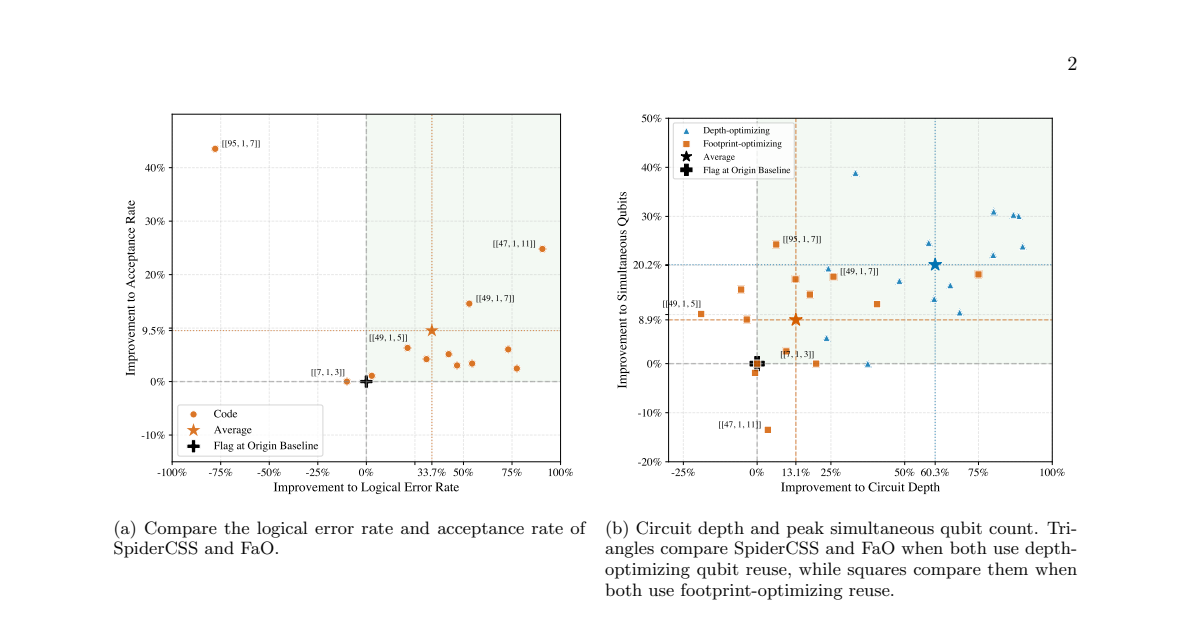
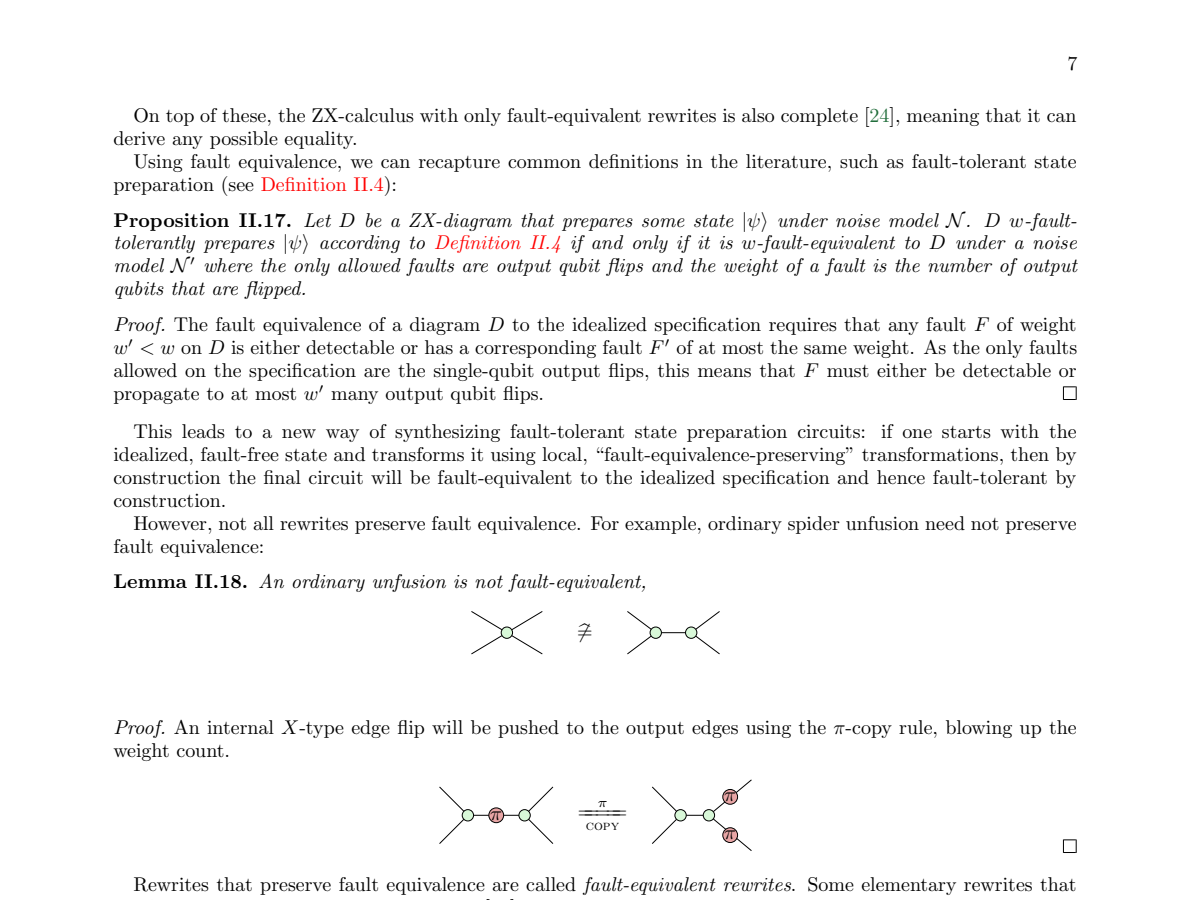
Starting from an idealized specification of a CSS state, we use the ZX-calculus and fault-equivalent rewrites to construct a diagram that prepares the given state while preserving the fault tolerance of the initial ideal ZX-diagram. From this diagram, SpiderCSS constructs a fault-tolerant CSS-state preparation circuit using a modular construction that is CNOT-minimal both within each component and also in the way these components are connected together. By only using fault-equivalent rewrites, the final circuit is provably fault-tolerant without needing expensive verification. Monte Carlo simulations across a variety of CSS codes up to distance 15 show that SpiderCSS scales efficiently and constructs circuits with substantially reduced depth and qubit footprint compared to existing scalable and heuristic methods, while simultaneously achieving an average decrease of 33.7% in logical error rate and an increase of 9.5% in acceptance rate.
from the abstract
Pith says
Machine review · deepseek-v4-flash · 5 Oct 2026 · what was read was not recorded · not checked by a person
It can be wrong. Challenge this review or reply to it.
Holds up, with conditions. A solid, honest engineering paper that beats the scalable baseline with careful benchmarking; the fault-tolerance guarantee is real but only proven under CSS noise, and the abstract drops that qualifier. This line is wrong
5 major objections · 6 minor
How often objections from reviews like this one are right: not yet measured
Not checked: figures, code, what the 32 references say.
The paper says, at Abstract; Sec. II A and III A 2; Remark III.5
The review did not quote this passage.
Pith says: Objection 1 of 5 · major
The abstract's claim that the final circuit is 'provably fault-tolerant' is established only through the CSS-noise submodel (Prop. III.4, Remark III.5, and the correspondence cited from [17, Sec. 7.2.2]), while the benchmarks in Sec. V use depolarizing noise containing Y faults; the authors acknowledge the CSS restriction (b91, b470) and appeal to distance equality, but they never state the argument that actually closes the gap.
more of objection 1
For the circuit class of Prop. II.8, w-fault-tolerance (Def. II.4) is equivalent to d_N(C) >= w, because any non-trivial undetectable fault with N(F) < w would give distance below w, so distance equality transfers the CSS guarantee to full circuit-level noise, and the Remark III.5 weight-2 image of a weight-1 Y fault is then necessarily detected (affecting acceptance rate, not LER, for d >= 3 codes). Please state this bridge explicitly as a proposition, and qualify the abstract's unqualified 'provably fault-tolerant' phrasing to reflect that the proof passes through the CSS submodel and distance preservation.
The paper says, at Prop. III.6; Sec. III B
The review did not quote this passage.
Pith says: Objection 2 of 5 · major
Proposition III.6 claims a global minimum CNOT count of sum_v C(deg(v),t) - |E|, but the proof is a five-sentence sketch: the lower bound (that no modular implementation uses fewer CNOTs) and the 'saving of |E| CNOTs' by merging two fan-out CNOTs are asserted rather than derived, and achievability presupposes that every connected leg satisfies the well-ordered conditions of Lemmas III.9 and III.10.
more of objection 2
Since CNOT-minimality is a headline contribution (abstract and Sec. III B), please provide a rigorous statement of the lower bound argument and of the exact conditions under which it is attained, or downgrade the proposition to an upper bound consistent with Remark III.7.
The paper says, at Lemma IV.2; Sec. IV C vs Appendix A
The review did not quote this passage.
Pith says: Objection 3 of 5 · major
Lemma IV.2 is stated unconditionally ('Algorithm 1 guarantees that D_global remains a DAG at every step' and 'Lemma IV.2 has no restrictions on the ordering of external connections'), but Appendix A states that for partially safe partitions, Lemma IV.2 and Algorithm 1 hold only if the absolute ordering of the external edges respects the order demanded by the partition (b568).
more of objection 3
The main text should fold this condition into the lemma statement, or explain how the pipeline enforces or detects it, otherwise the lemma as stated in Sec. IV C is stronger than what is proved.
The paper says, at Table I; Sec. V; Conclusion
The review did not quote this passage.
Pith says: Objection 4 of 5 · major
Table I shows SpiderCSS with a worse logical error rate than FaO for [[95,1,7]] ([3.0,3.4]x10^-4 versus [1.6,2.0]x10^-4) and overlapping confidence intervals for [[7,1,3]], so the conclusion's 'produces states using ... better logical error rates' (b454) is too strong as a universal claim; it should be qualified to 'on average / for most codes', consistent with the abstract and Figure 1, which already present this correctly as an average.
The paper says, at Conclusion; Sec. IV A-B
The review did not quote this passage.
Pith says: Objection 5 of 5 · major
The conclusion's claim that 'all parts of the pipeline run in polynomial time' is in tension with the simulated-annealing search for minimum-diameter spanning forests (Sec. IV A) and the Monte Carlo basis search (Sec. IV B), whose iteration counts are not bounded; since the Gaussian elimination and the Appendix A safe-hook characterization are the provably polynomial parts, please either state the iteration bounds for the heuristics or qualify the polynomial-time claim to the deterministic components of the pipeline.
6 minor objections
The paper says, at Sec. I A
Pith says: minor objection 1 of 6
The display equations (1)-(4) and (6) appear as empty placeholders ('b= (1)', '(2)', ...) in the manuscript text, making the pipeline description unreadable without the ZX diagrams; these need to render properly or be described in captions.
The paper says, at Abstract
Pith says: minor objection 2 of 6
The abstract contains a typo: 'an increase 9.5% in acceptance rate' should read 'an increase of 9.5% in acceptance rate'.
show 4 more
The paper says, at Remark II.21; Table I
Pith says: minor objection 3 of 6
The t versus t+1 convention shift relative to SpiderCat should be made explicit when reporting the fault-tolerance level of the benchmarked circuits, so readers can map the claimed fault-tolerance parameters across the two papers.
The paper says, at Sec. III B 2
Pith says: minor objection 4 of 6
The statement 'In practice we can always find a suitable DAG for any marked graph supplied from SpiderCat' is an unstated empirical assumption; please report the failure rate if it is known, or explicitly mark this as a heuristic that the pipeline falls back on.
The paper says, at Sec. V
Pith says: minor objection 5 of 6
The logical error rate is decoded with code-capacity lookup tables with a d/2-fault discard, which does not mirror the circuit's flag and syndrome propagation structure; this keeps the FaO comparison fair, but the absolute LER values should carry a caution that they are decoder-dependent.
The paper says, at Reference [25]
Pith says: minor objection 6 of 6
The repository URL text reads 'spiderCSSC' (extra C), and for reproducibility the paper should pin the code to a specific version or commit hash.
What would settle it
Using the released SpiderCSS code [25], run Stim on the [[7,1,3]] Steane and [[47,1,11]] circuits under full depolarizing circuit-level noise (p2 = p1 = pSPAM = 10^-3). Enumerate all single-fault locations; for each single Y fault placed on an internal edge created by a Prop III.4 unidealization, propagate the fault to the output, record the resulting output Pauli weight, and compute the syndrome against the prepared state's stabilizer group. Repeat for all single faults. Decision rule: if every non-detectable output image has Pauli weight exactly 1, then w=2 fault tolerance per Def II.4 holds under full noise and the CSS restriction is benign for these codes. If any single fault yields a non-detectable output error of weight ≥ 2, then the 'provably fault-tolerant' claim requires the CSS submodel, and the abstract should be qualified accordingly.
from the skeptic's reading
How the review went
4 readings by deepseek-v4-flash · 5 Oct 2026
- Reader holds up, with conditions
- Skeptic agrees
- Editor wrote the verdict above
- Referee major revision: 5 major objections, 6 minor
Not run on this paper: the simulated authors' defence.
Pith did not check this review's objections against the paper.
The review in full
The review in brief, machine-written
Read it. SpiderCSS is a well-built result in a practical bottleneck, fault-tolerant logical state preparation. The genuinely new pieces: well-ordered CAT states enabling zero-cost Bell connections (Lemmas III.9, III.10), the O(n3) characterization of strictly safe hook errors in Appendix A, the RREF generator-cost optimization, and the four routing heuristics. The benchmarking is the real strength: large Monte Carlo samples, Wilson confidence intervals, and they re-ran Flag at Origin under the same noise model and decoder rather than quoting the baseline's published numbers. The pipeline code is public. The wins are real: CNOT counts matched or improved in every directly comparable case, up to ~54% down; depth consistently shallower; LER and acceptance mostly better. The table even shows one case ([[7,1,3]] Steane) where SpiderCSS LER is slightly worse than FaO, and the text says "for most codes" rather than "all" — that is honest reporting.
The main caveat is the fault-tolerance claim, and the stress-test note is right about the precision of the abstract. The rewrite chain (Prop III.4, Remark III.5) proves fault equivalence under CSS edge-flip noise. The Y-fault doubling — one internal Y of weight 1 mapping to an X-plus-Z on two boundary edges of weight 2 under ordinary edge-flip — is precisely where the full-noise argument does not follow. Prop II.8 gives only distance equality, and Definition II.4 fault tolerance is a weight-preservation property that distance equality does not imply. So "provably fault-tolerant" as literally stated in the abstract is proven only under CSS noise, while the benchmarks use depolarizing noise that contains Y faults. The authors are transparent about this in the body (b75, b91, b89, b470), but the abstract drops the qualifier. For the d ≥ 3 codes benchmarked, the weight-2 image of that single fault is detected, so the LER numbers should stand; this is a precision-of-claim problem, not a load-bearing flaw. A referee should ask for the abstract to say "under CSS noise," and ideally one sentence on why the Y-fault image is detectable for these codes.
Two lesser items. The CNOT minimality in Proposition III.6 leans on "in practice we can always find a suitable DAG" — empirical, acknowledged as very rare, load-bearing for the minimality claim; a brief worst-case note would sharpen it. And the acceptance rate falls steeply as code size grows; the authors flag it (b463) and leave flag-based decoding to future work. That is an honest limitation that tempers the "scales" headline at large distances.
Who this is for: anyone building state preparation, Steane-EC, or syndrome extraction circuits, and compiler people who want a model of how to benchmark a baseline fairly. It deserves a serious referee. Send it to review; expect tightening of the abstract and perhaps a short worst-case remark, not a rewrite.
The strongest objection
The central claim, quoted in the abstract, is that the final circuit is 'provably fault-tolerant without needing expensive verification.' The proof chain is: idealized spec → fault-equivalent rewrites (Props III.3, III.4) → SpiderCat decompositions → extracted circuit → the [17] circuit-level-to-edge-flip correspondence. The bottleneck is Prop III.4/Remark III.5: edge unidealization is fault-equivalent only under CSS edge-flip noise, because a single internal Y fault (weight 1) maps to an X-fault on one boundary edge plus a Z-fault on another (weight 2 under ordinary edge-flip noise). The paper acknowledges this and then restores full-noise guarantees via Prop II.8, which gives d_N(C) = d_CSS(C). But that is a statement about distance only. Definition II.4 fault tolerance is a weight-preservation property: every undetectable fault with N(F) < w must map to output flips of weight ≤ N(F). Distance equality does not give weight preservation, and the Remark III.5 Y-fault is precisely a weight-non-preserving mapping under the full model. The benchmark simulates physically-relevant depolarizing circuit-level noise (p2 = p1 = pSPAM = 10^-3), which contains Y faults, so the theorem (CSS-contingent) and the empirical validation (full noise) live in different models. For the benchmarked d ≥ 3 codes a weight-2 image of a single fault is detected, so LER may be unaffected; but the 'provably' umbrella as literally stated is not established without an explicit check. The authors also concede (b89) that reuse inside larger protocols with non-CSS gates lowers the non-CSS distance. The honesty of Remark III.5 and b470 brackets the gap but does not close it, so the abstract overstates the proven guarantee.
The reader's weakest_assumption was that fault tolerance is proven only under the CSS noise submodel, with Prop III.4 failing under ordinary edge-flip noise (Remark III.5) and the authors acknowledging the larger-protocol exposure (b89) and the invalidation for arbitrary stabilizer codes (b470). My stress-test confirms this is the most load-bearing concern and sharpens the mechanism: the paper's own Definition II.4 is a weight-preserving mapping property, while the available bridge, Prop II.8, proves only distance equality. The Remark III.5 Y-fault example is exactly a weight-non-preserving mapping under the full model, so the CSS-submodel theorem and the benchmark's depolarizing-noise validation occupy different noise models. This is a theorem-level gap, not an observed empirical failure; the benchmark's depolarizing results are, if anything, reassuring, and for the d ≥ 3 codes a weight-2 image is detected so logical error rate is likely unaffected. I therefore do not change the verdict: CONDITIONAL remains right, with the concrete test above able to either close the gap (all weight-1 images) or force a qualification of the 'provably' wording. I considered the competing concern, the 'always succeeds in practice' claim for the well-ordered DAG construction (Sec III B 2) that underwrites the Prop III.6 CNOT minimum, and agree with the reader that it is real; but it is empirically demonstrated on every benchmarked code, the paper already hedges the bound with Remark III.7, and the fallback only adds 'small overhead' while preserving fault tolerance, so it is secondary to the noise-model restriction for the headline fault-tolerance claim. The upstream guarantees are self-cited preprints ([16], [17], [24]); per the reviewing rules I treat this as an external-verification request rather than a defect, since the citations appear to contain the results they are invoked for. The disclosed [[95,1,7]] logical-error regression and the use of p=0.0001 for the four largest codes are factors a careful reader weights, but they are disclosed and do not change the verdict.
The referee's report
The conditional value is high if the claims hold: SpiderCSS appears to be a modular pipeline that scales CSS state preparation to distance-15 codes with competitive or better resources than Flag at Origin, and the design ideas (well-ordered CAT states, flag-delegation CNOT merges, DAG-based extraction) are reusable beyond state preparation (e.g., Steane and Knill error correction, as the authors note). Concrete strengths: the pipeline is implemented and the code is released (ref. [25]); the benchmarks re-baseline FaO under the same noise model, decoder, and sampling (10^9-5x10^9 shots per code); several statements are parameter-free (Prop. III.6 has no free parameters), and the safe-hook-error characterization in Appendix A is a genuine O(n^3) algorithm. The main risks are that the strongest claims (provable fault tolerance under the benchmarked depolarizing noise, CNOT-minimality, polynomial runtime) are under-justified as written: the fault-tolerance guarantee is proven under the CSS submodel and bridged to full noise only implicitly through distance equality (Prop. II.8); the Prop.
Pith's reading of the paper (a machine's summary, not the authors')
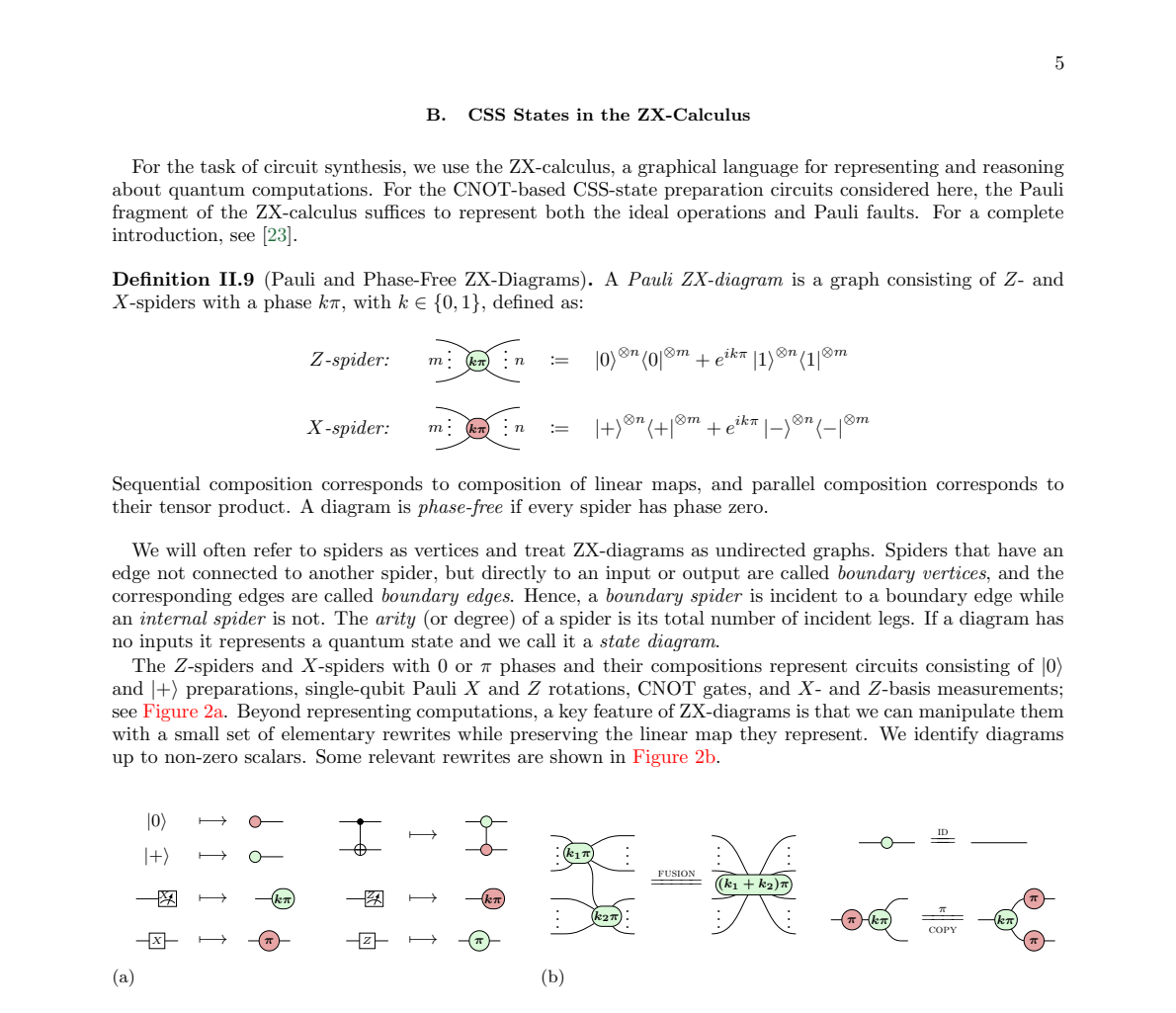
SpiderCSS proposes that fault-tolerant preparation of logical states of any Calderbank–Shor–Steane (CSS) code can be compiled as a chain of fault-equivalent rewrites (transformations that preserve a diagram's behaviour under faults) on an idealized ZX-diagram (a graphical notation for quantum circuits), so the final circuit inherits fault tolerance by construction rather than by expensive verification. The pipeline starts from the stabilizer description of the desired state, unidealizes internal edges (turns idealized fault-free edges into ordinary noisy edges) under the CSS noise submodel (where a fault's weight is the larger of its X and Z parts), splits high-weight spiders into three-legged pieces using CAT-state gadgets (entangled ancillas of the form $(|0\rangle^{\otimes n}+|1\rangle^{\otimes n})/\sqrt{2}$) and strictly safe hook errors (single internal faults that reduce, through the target state's stabilizers, to a weight-one boundary fault), and schedules the pieces with a dependency DAG (a directed acyclic ordering of the pieces) so that connecting the gadgets costs no extra entangling gates. Every stage runs in polynomial time, which is the main scalability claim. On CSS codes up to distance 15, the paper reports matching or improving CNOT counts in all directly comparable cases, with reductions up to 53.8%, a nearly tenfold depth reduction in the best case, and average gains of 33.7% lower logical error rate and 9.5% higher acceptance rate over the previous modular method. These guarantees are for the CSS noise submodel, and the authors state that transferring them to a protocol with non-CSS gates requires care.
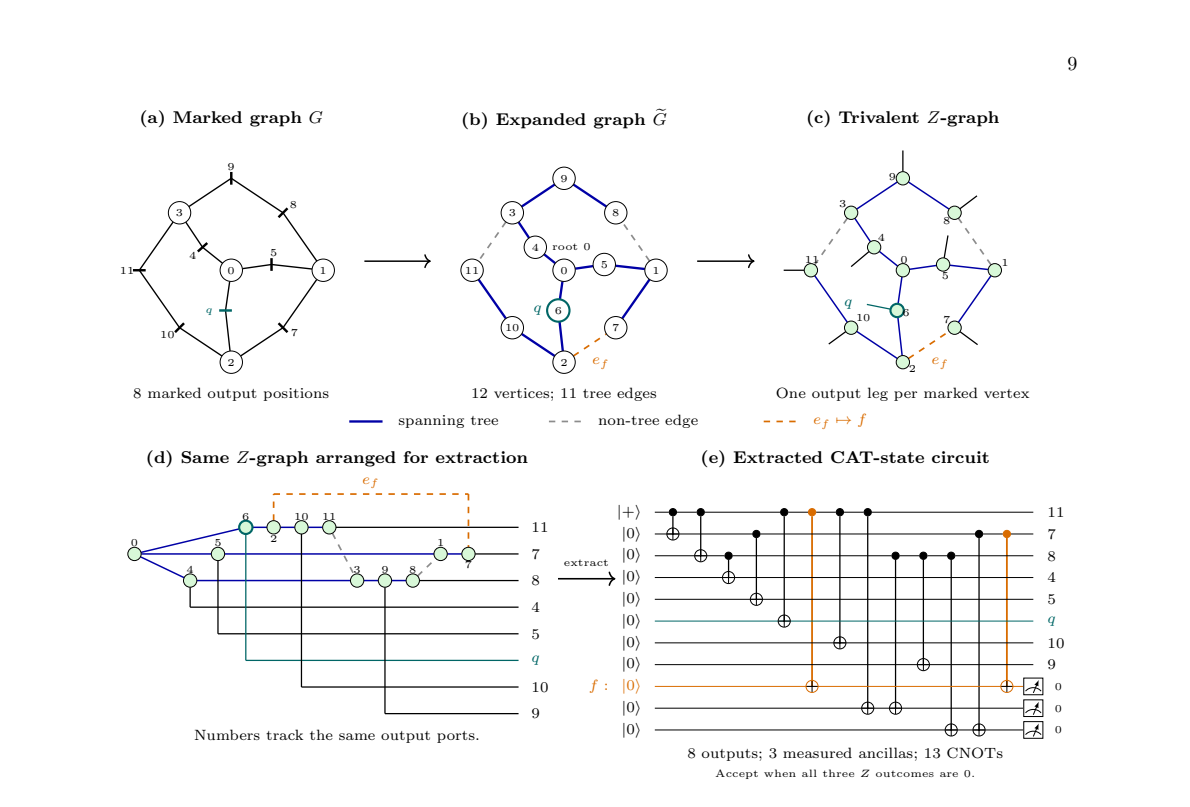
What carries the argument. The carrying object is a phase-free ZX-diagram (a graphical notation for Clifford circuits in which operations are drawn as connected spiders) whose internal edges can be marked idealized (treated as able to experience no faults), together with a family of rewrites that preserve fault equivalence. A CAT state, an $n$-qubit superposition $(|0\rangle^{\otimes n}+|1\rangle^{\otimes n})/\sqrt{2}$, appears as a single high-arity spider, and the pipeline replaces each such spider by a network of three-legged spiders using the optimal construction of [16], modified so that all but one output qubit obey the well-ordered condition: the last CNOT on each such qubit is either its only CNOT or the first CNOT of a flag. That property lets connections between neighboring CAT gadgets be implemented as joint parity measurements at no extra entangling cost, by the two delegation lemmas. A global dependency DAG is built by attaching each external connection to the earliest available leg of each gadget, which provably keeps the graph acyclic and lets the final circuit meet a proven CNOT lower bound for modular extraction. The same DAG also determines the circuit's time ordering, so depth is controlled by the choice of which connections to prioritize.
Core claim. The paper's central claim is that CSS state preparation can be both scalable and provably fault-tolerant without verification. Starting from the generator-form ZX-diagram of a CSS state with all internal edges idealized, the pipeline applies only rewrites that preserve fault equivalence under CSS noise: it row-reduces the stabilizer generators to reduce entanglement cost, unidealizes edges that connect a Z-spider to an X-spider, unfuses high-arity spiders along strictly safe hook errors where available, and finishes with CNOT-minimal decompositions into well-ordered CAT states. Because every rewrite is fault-equivalent, the extracted circuit is fault-equivalent to the idealized specification, which is the paper's definition of fault-tolerant state preparation. The reported Monte Carlo benchmarks on codes from distance 3 to distance 15, up to 144 physical qubits, show the method beats the previous modular baseline on average on logical error rate and acceptance rate while also reducing depth and, depending on the reuse strategy, qubit footprint.
The premise it rests on. The load-bearing premise is that the CSS noise submodel is sufficient for the fault-tolerance guarantee: the edge-unidealization rewrite is fault-equivalent only between a Z- and an X-spider under CSS noise, because a single internal Y fault would otherwise need two boundary faults to reproduce, and the authors state that a larger protocol with non-CSS gates can have lower non-CSS distance.
If the paper is right (Pith's inferences, not the authors')
Larger CSS codes can be targeted without the steep cost of satisfiability or integer-programming searches, because every pipeline stage runs in polynomial time.
The well-ordered CAT-state gadgets and zero-cost connection lemmas transfer to other modular constructions, such as syndrome measurement circuits for error correction.
The prepared logical $|0\rangle$ and $|+\rangle$ states are the standard ancilla inputs used in syndrome-extraction-based error correction, so the resource savings should reduce overhead in a full fault-tolerant protocol.
The $O(n^3)$ classification of strictly safe hook errors identifies which spider splits preserve fault tolerance, and can be reused whenever a CSS-state preparation diagram is being decomposed.
If a full protocol can keep non-CSS faults shielded by syndrome extraction, the reported reductions in depth and logical error rate should translate into lower overall cost for a fault-tolerant computation; the paper motivates this use but does not demonstrate it.
A natural testable extension is flag-aware decoding: because the paper notes rejection rate grows with code size, using flag and measurement outcomes to correct rather than discard shots could improve acceptance further.
The well-ordered CAT-state construction resembles causal-flow scheduling, suggesting it may extend to measurement-based or code-switching contexts where path ordering constraints are explicit; this is an extrapolation beyond the paper's claims.
The main transfer risk is practical: workloads that cannot be confined to the CSS noise submodel, including Y faults that cost double under ordinary edge-flip noise, could erase the reported gains, so an end-to-end logical computation benchmark with full depolarizing noise would be the natural next experiment.
Check this review
Pith stored no record of this review's passes and took no fingerprint of it. Reviews made by code from 13 Nov 2026 on carry both.
How often reviews like this one are right
Reviews like this one: written by deepseek-v4-flash, where what was read was not recorded.
How often objections from reviews like this one are right: not yet measured
Reviews by people
This review was written by a machine. No person has reviewed this paper on Pith yet. A scientist listed on Pith can review it for a fee, and their review is published here whatever it concludes.
The paper
Abstract
Fault-tolerant preparation of logical states is a critical primitive for the realization of large-scale fault-tolerant quantum computing. This paper introduces SpiderCSS, a scalable compilation pipeline that generates highly-optimized, fault-tolerant state preparation circuits for arbitrary Calderbank-Shor-Steane (CSS) codes. Starting from an idealized specification of a CSS state, we use the ZX-calculus and fault-equivalent rewrites to construct a diagram that prepares the given state while preserving the fault tolerance of the initial ideal ZX-diagram. From this diagram, SpiderCSS constructs a fault-tolerant CSS-state preparation circuit using a modular construction that is CNOT-minimal both within each component and also in the way these components are connected together. By only using fault-equivalent rewrites, the final circuit is provably fault-tolerant without needing expensive verification. Monte Carlo simulations across a variety of CSS codes up to distance 15 show that SpiderCSS scales efficiently and constructs circuits with substantially reduced depth and qubit footprint compared to existing scalable and heuristic methods, while simultaneously achieving an average decrease of 33.7% in logical error rate and an increase of 9.5% in acceptance rate.
The paper's own sentences, arranged, kept beside the review and separate from it. Each label is drawn from a closed vocabulary; the number beside it is the probability the classifier gave that label. No sentence in this record was written by a model.
abstract compiled · 2026-10-05
The authors' main claim, as the classifier picked it out 0.99
“Monte Carlo simulations across a variety of CSS codes up to distance 15 show that SpiderCSS scales efficiently and constructs circuits with substantially reduced depth and qubit footprint compared to existing scalable and heuristic methods, while simultaneously achieving an average decrease of 33.7% in logical error rate and an increase of 9.5% in acceptance rate.”
How the main claim is stated: asserted 1.00
What the abstract itself states, as probabilities: claims first 0.07 · states limitation 0.09 · human participants 0.02 · controlled comparison 0.63 · randomized assignment 0.01 · states quantitative result 0.99 · compares with prior results 0.97 · mentions code or data availability 0.03
The abstract, sentence by sentence
This table labels the abstract only (arXiv listing abstract v1). The number is the probability the classifier gave the label.
| Sentence | Role | The authors' own work | States the main conclusion | Strength |
|---|---|---|---|---|
| Fault-tolerant preparation of logical states is a critical primitive for the realization of large-scale fault-tolerant quantum computing. | background 1.00 | 0.04 | 0.03 | asserted 1.00 |
| This paper introduces SpiderCSS, a scalable compilation pipeline that generates highly-optimized, fault-tolerant state preparation circuits for arbitrary Calderbank-Shor-Steane (CSS) codes. | contribution 1.00 | 0.92 | 0.17 | asserted 1.00 |
| Starting from an idealized specification of a CSS state, we use the ZX-calculus and fault-equivalent rewrites to construct a diagram that prepares the given state while preserving the fault tolerance of the initial ideal ZX-diagram. | method 0.99 | 0.93 | 0.06 | asserted 1.00 |
| From this diagram, SpiderCSS constructs a fault-tolerant CSS-state preparation circuit using a modular construction that is CNOT-minimal both within each component and also in the way these components are connected together. | method 0.94 | 0.93 | 0.12 | asserted 1.00 |
| By only using fault-equivalent rewrites, the final circuit is provably fault-tolerant without needing expensive verification. | method 0.68 | 0.86 | 0.11 | asserted 1.00 |
| Monte Carlo simulations across a variety of CSS codes up to distance 15 show that SpiderCSS scales efficiently and constructs circuits with substantially reduced depth and qubit footprint compared to existing scalable and heuristic methods, while simultaneously achieving an average decrease of 33.7% in logical error rate and an increase of 9.5% in acceptance rate. | result 1.00 | 0.95 | 0.70 | asserted 1.00 |
What kind of paper the classifier reports this is: method or tool 1.00 · evidence from simulation or computation 0.98
What was examined, and what was not
Sources read
- arXiv listing abstract v1
Not examined
- full text
- figures and tables
- references and citing sentences
- relations to other papers
Levels run
- P abstract
Not run
- S sections
- T body sentences
- C citations
- R cross-paper relations
How the labels were made
Compiled by classifier-1.13.0 via TypeSafe API, question bank abstract-p1-20260923, 2026-10-05: 1 request, 5,098 input tokens.
Every quoted sentence on this record is the authors'. Every label is from Pith's closed vocabulary, with the probability shown beside it. This record as JSON
Figures (9)
Showing 8 of the paper's 9 figures. Figures are the authors', reproduced from the paper.
References (32)
- [25] B. Po´ or, Implementation and simulation of spiderCSSC: Scalable fault-tolerant CSS state preparation,https:// github.com/boldar99/spidercss(2026) on Pith
- [1] D. Gottesman, Surviving as a quantum computer in a classical world (2026), textbook draft, March 31, 2026 on Pith
- [2] A. R. Calderbank and P. W. Shor, Good quantum error-correcting codes exist, Physical Review A54, 1098 (1996) on Pith
- [3] A. M. Steane, Error correcting codes in quantum theory, Physical Review Letters77, 793 (1996) on Pith
- [4] A. M. Steane, Active stabilization, quantum computation, and quantum state synthesis, Physical Review Letters 78, 2252 (1997) on Pith
- [5] A. M. Steane, Space, time, parallelism and noise requirements for reliable quantum computing, Fortschritte der Physik46, 443 (1998) on Pith
- [6] A. M. Steane, Overhead and noise threshold of fault-tolerant quantum error correction, Physical Review A68, 042322 (2003) on Pith
- [7] A. M. Steane, Fast fault-tolerant filtering of quantum codewords (2002), arXiv:quant-ph/0202036 on PithPith's reviewarXiv
- [8] A. M. Steane and B. Ibinson, Fault-tolerant logical gate networks for Calderbank-Shor-Steane codes, Physical Review A72, 052335 (2005) on Pith
- [9] H. Goto, Minimizing resource overheads for fault-tolerant preparation of encoded states of the Steane code, Scientific Reports6, 19578 (2016) on Pith
- [10] R. Chao and B. W. Reichardt, Quantum error correction with only two extra qubits, Physical Review Letters121, 050502 (2018) on Pith
- [11] F. Butt, S. Heußen, M. Rispler, and M. M¨ uller, Fault-tolerant code-switching protocols for near-term quantum processors, PRX Quantum5, 020345 (2024) on Pith
- [12] T. Peham, L. Schmid, L. Berent, M. M¨ uller, and R. Wille, Automated synthesis of fault-tolerant state preparation circuits for quantum error-correction codes, PRX Quantum6, 020330 (2025) on Pith
- [13] L. Schmid, T. Peham, L. Berent, M. M¨ uller, and R. Wille, Deterministic fault-tolerant state preparation for near- term quantum error correction: Automatic synthesis using Boolean satisfiability, in2025 Design, Automation & Test in Europe Conference (DATE)(IEEE, 2025) pp. 1–7 on Pith
- [14] B. Criger, A. Hankin, J. J. Burau, and A. R. Perry, Automated flag-based fault-tolerant state preparation using integer linear programming (2026), arXiv:2607.22498 [quant-ph] on PithPith's reviewarXiv
- [15] D. Forlivesi and D. Amaro, Flag at origin: a modular fault-tolerant preparation for css codes (2025), arXiv:2508.14200 [quant-ph] on PitharXiv
- [16] A. B. Khesin, S. M. Li, B. Po´ or, B. Rodatz, J. van de Wetering, and R. Yeung, SpiderCat: Optimal fault-tolerant cat state preparation (2026), arXiv:2603.05391 [quant-ph] on PitharXiv
- [17] B. Rodatz, B. Po´ or, and A. Kissinger, Fault tolerance by construction (2025), arXiv:2506.17181 [quant-ph] on PitharXiv
- [18] B. Coecke and R. Duncan, Interacting Quantum Observables, inAutomata, Languages and Programming, Lecture Notes in Computer Science, edited by L. Aceto, I. Damg˚ ard, L. A. Goldberg, M. M. Halld´ orsson, A. Ing´ olfsd´ ottir, and I. Walukiewicz (Springer, 2008) pp. 298–310 on Pith
- [19] A. Kissinger, Phase-free zx diagrams are css codes (...or how to graphically grok the surface code) (2022), arXiv:2204.14038 [quant-ph] on PithPith's reviewarXiv
show 12 more
- [20] A. Strikis, D. E. Browne, and M. E. Beverland, High-performance syndrome extraction circuits for quantum codes (2026), arXiv:2603.05481 [quant-ph] on PithPith's reviewarXiv
- [21] E. Weilandt, T. Peham, and R. Wille, Synthesis of fault-tolerant state preparation circuits using steane-type error detection (2026), arXiv:2601.13313 [quant-ph] on PithPith's reviewarXiv
- [22] B. Po´ or, B. Rodatz, and A. Kissinger, Ultra low overhead syndrome extraction for the Steane code, Quantum Science and Technology11, 045009 (2026) on Pith
- [23] A. Kissinger and J. van de Wetering,Picturing Quantum Software: An Introduction to the ZX-Calculus and Quantum Compilation(Preprint, 2024) on Pith
- [24] M. R¨ usch, B. Rodatz, and A. Kissinger, Completeness for fault equivalence of clifford zx diagrams (2025), arXiv:2510.08477 [quant-ph] on PithPith's reviewarXiv
- [26] B. Rodatz, B. Po´ or, and A. Kissinger, Floquetifying stabiliser codes with distance-preserving rewrites, Quantum 10, 2202 (2026) on Pith
- [27] V. Danos and E. Kashefi, Determinism in the one-way model, Physical Review A74, 052310 (2006), arXiv:quant- ph/0506062 on Pith
- [28] C. Gidney, Stim: a fast stabilizer circuit simulator, Quantum5, 497 (2021) on Pith
- [29] M. DeCross, E. Chertkov, M. Kohagen, and M. Foss-Feig, Qubit-reuse compilation with mid-circuit measurement and reset, Phys. Rev. X13, 041057 (2023) on Pith
- [30] E. Knill, Quantum computing with realistically noisy devices, Nature434, 39 (2005) on Pith
- [31] A. Kissinger, A. Merry, C. Heunen, and K. J. Paulsson, TikZit,https://tikzit.github.io/index.html, accessed: 2024-12-08 on Pith
- [32] E. Dennis, A. Kitaev, A. Landahl, and J. Preskill, Topological quantum memory, Journal of Mathematical Physics 43, 4452 (2002), arXiv:quant-ph/0110143. Appendix A: Safe Hook Errors In fault-tolerant quantum computing, a hook error occurs when a single physical fault during cir... on PithPith's reviewarXiv
Cited by 1 Pith paper
Reviewed papers on Pith that cite this one. The full citation record
Challenges and discussion
Disagree with the review, or know something it missed? Leave a comment, or challenge this review formally: a challenge becomes a permanent entry in this paper's record, and its decision is published here.
Come back by email
A short list of the week's newly reviewed papers. Nothing is sent until you confirm from your inbox, and every email has a link that stops it. No account.
No comments yet.
Sign in to comment