Quantum Physics · arXiv:2611.25107 v1 · submitted 18 Nov 2026 · 40 references
Generalizing and Combining Check Constructions: Design-Space Exploration for Fault-Tolerant Quantum State Preparation
The paper says
“Fault-tolerant quantum computing needs logical states prepared such that single faults cannot spread into uncorrectable errors. Post-selection achieves this with added checks that detect dangerous faults and discard the run.”
more of the abstract
How the checks are measured sets the depth and operation count of the circuit, and the best trade-off depends on the hardware. Existing automated methods, however, each use one check construction and yield fixed trade-offs. We first introduce Block Checks, in which several checks share one fault-tolerantly prepared auxiliary block, which places them and existing constructions in a single design space. Second, to explore that space, we propose a Pareto tree search that adds checks and auxiliary blocks, merges auxiliaries, and edits the circuit. On quantum codes of distance up to seven, the search finds best-known circuits for many new operation–depth trade-offs and surpasses existing methods. The code is open source as part of the Munich Quantum Toolkit (MQT) at https://github.com/munich-quantum-toolkit/qecc, and all circuits are available in the QECirc library at https://qecirc.com.
from the abstract
Pith says
Machine review · deepseek-v4-flash · 20 Nov 2026 · read the full text (55,531 characters) · not checked by a person
It can be wrong. Challenge this review or reply to it.
Holds up. A Pareto tree search over a unified design space of check constructions finds fault-tolerant state preparation circuits for CSS codes up to distance 7 that improve on every published circuit at its depth, with the largest gains against Steane-type checks. This line is wrong
8 minor
How often objections from reviews like this one are right: not yet measured
The paper, first character to last
The reviewer was given the whole text, 55,531 characters. Not checked: figures, code, what the 40 references say.
8 minor objections
The paper says, at §II, Definition 1
Pith says: minor objection 1 of 8
The definition of fault tolerance (Definition 1) uses the condition 'every dangerous set F with |F| ≤ t is detected.' The paper should clarify whether 'detected' means that at least one check fires, or that the syndrome is non-trivial. This is standard but worth stating explicitly.
The paper says, at §IV-A, Eq. (1)
Pith says: minor objection 2 of 8
The reward function in Eq. (1) uses parameters σ, σ', τ, and C. The paper states default values (σ=5%, τ=0.2, σ'=0.2, C=0.5) but does not discuss sensitivity to these choices. A brief comment on how the results depend on these parameters would be helpful.
show 6 more
The paper says, at §V-A, Setup
Pith says: minor objection 3 of 8
The search runtime is reported as 85 core-hours for the [[9,1,3]] code and 1200-2150 core-hours for larger codes. The paper should specify the hardware used (CPU type, clock speed) to make these numbers meaningful.
The paper says, at §V-B, Table 1
Pith says: minor objection 4 of 8
In Table 1, the column headers use abbreviations like 'ops/CNOTs/auxiliaries' and 'acceptance rate / logical error rate.' The table is dense and the font is very small. Consider splitting the table or using a landscape layout for better readability.
The paper says, at §II, Fig. 1
Pith says: minor objection 5 of 8
The paper references Fig. 1 extensively but the figure is not visible in the manuscript text. The caption describes the content, but the actual figure is missing. This is a formatting issue in the supplied text, but the authors should ensure the figure is included in the final version.
The paper says, at §IV-D, Polish
Pith says: minor objection 6 of 8
The polish step includes 'Bell reduction' which is cited as a fault-equivalent rewrite. The paper should briefly explain what Bell reduction does, as it is not a standard term.
The paper says, at §V-B, Results
Pith says: minor objection 7 of 8
The paper states that the search finds circuits with 'fewer operations than every published circuit at its depth.' However, the comparison is only against circuits that were published. The paper should clarify whether the prior methods were run with the same noise model and error rate, or whether the published circuits were designed for different noise models.
The paper says, at §VI, Conclusion
Pith says: minor objection 8 of 8
The conclusion mentions future work on counting undetected sets of t+1 faults. This is a good suggestion, but the paper should also discuss whether the search could be extended to non-CSS codes or to logical states other than |0...0⟩_L.
What would settle it
For a specific code (e.g., the [[17,1,5]] color code), one could attempt to find a fault-tolerant state preparation circuit with, say, depth 7 and fewer than 77 operations (the paper's claimed best) by exhaustive search over a restricted space or by a different method; if such a circuit exists and is not found by the paper's search, it would show the search is not optimal. Conversely, if one can prove a lower bound on operations at a given depth that exceeds the paper's numbers, the paper's circuits would be impossible.
from Pith's summary of the paper
How the review went
5 passes by deepseek-v4-flash · 20 Nov 2026
- Reader holds up
- Skeptic concern withdrawn: the paper already says this
- Referee 8 minor
- Check against the paper kept 0 of 5 objections
- Editor wrote the verdict above
Not run on this paper: the simulated authors' defence.
Pith's passes raised 5 objections. A check against the paper's text kept 0 and withdrew 5 (5 the paper already says).
The review in full
The review in brief, machine-written
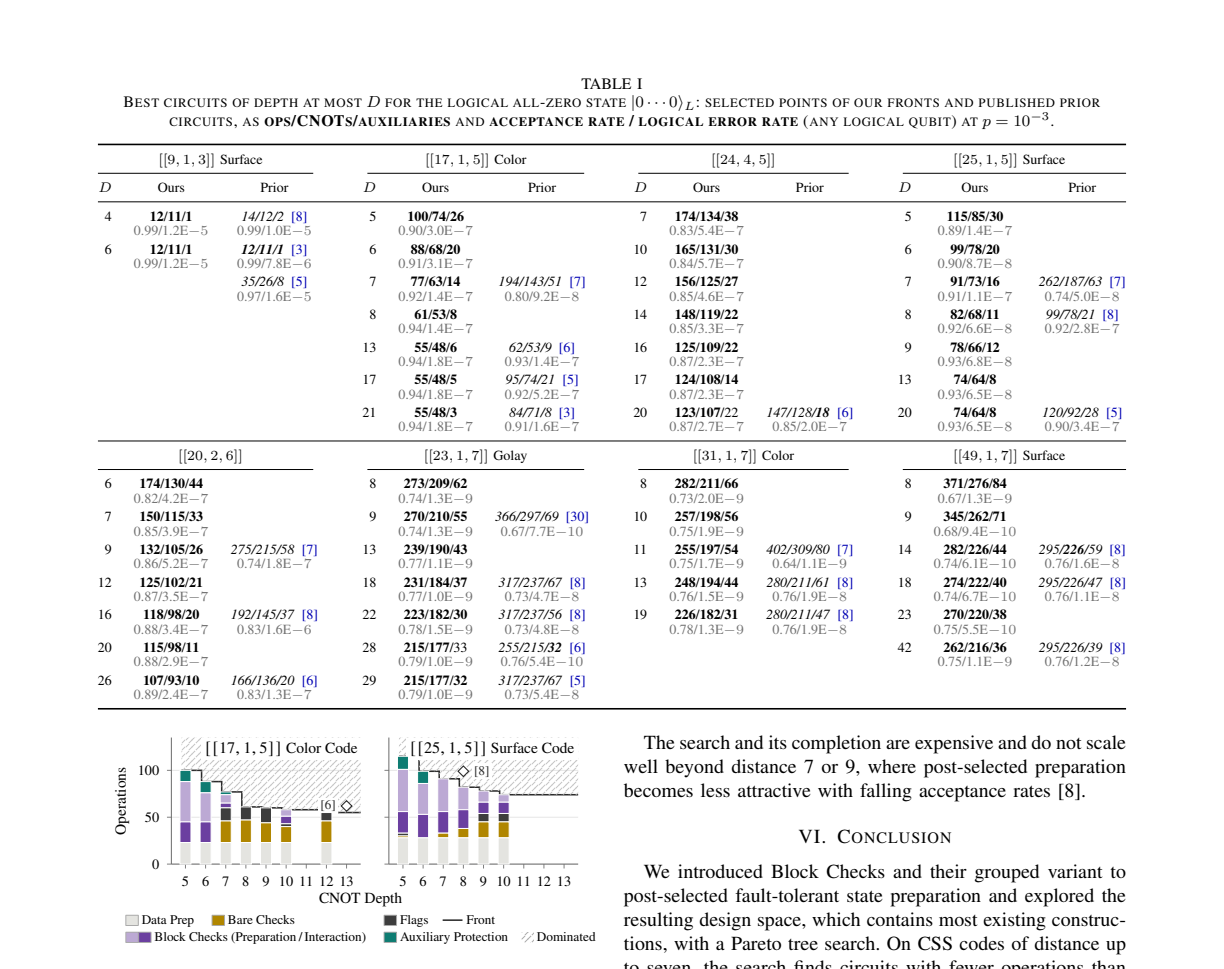
This paper introduces Block Checks, a new construction for post-selected fault-tolerant state preparation that lets several checks share one auxiliary block, and places them together with existing constructions (Bare Checks, Cat Checks, Steane-Type Checks) into a single design space linked by two merge operations. The authors then propose a Pareto tree search that navigates this space by adding checks and blocks, merging auxiliaries, and editing circuits. The central claim—that the search finds circuits with better operation–depth trade-offs than any published method—is well supported by Table 1, which compares against prior work on nine CSS codes of distance up to 7. At the depth of every published circuit, the search finds a circuit with fewer operations (except one tie), and for several codes it reaches depths no prior circuit achieved. The largest savings are against Steane-type checks: for the [[25,1,5]] surface code, 91 operations instead of 262 at depth 7. The code and all circuits are open source, and the evaluation uses the same noise model and simulator (Stim) as the baselines. The paper is clearly written, the design space is well motivated, and the method is a genuine advance for automated synthesis of post-selected state preparation.
The soft spots are acknowledged by the authors. The logical error rates of the new circuits are sometimes higher than those of prior methods (e.g., Steane-type and ILP circuits), because the search optimizes for operation count and depth, not for logical error rate. The search does not scale well beyond distance 7–9, and the design space, while broad, is not formally proven complete. These are real limitations but are stated openly, and the paper suggests future work to address them. The completion step (Section IV-C) uses a greedy ILP and a set of rewrites that are verified to preserve fault tolerance, but there is no proof that the completion always finds a fault-tolerant circuit if one exists. This is a practical limitation of the search, not a flaw in the results it does produce.
This paper is for researchers working on fault-tolerant quantum computing, especially those interested in automated circuit synthesis for near-term error-corrected devices. It deserves a serious referee. The central empirical claim is solid, the method is novel, and the limitations are honestly stated. I would recommend acceptance after the authors address the minor point that the logical error rate comparison could be more thoroughly discussed (they already do this in part). The paper is a clear contribution to the field.
The stress test's concern
Withdrawn: the paper already says this.
The paper says
“The search and its completion are expensive and do not scale well beyond distance~7 or~9, where post-selected preparation becomes less attractive with falling acceptance rates”
The referee's report
Not published. Pith's referee wrote this assessment before its objections were checked against the paper, and 4 of its 4 major objections did not survive that check.
Pith's reading of the paper (a machine's summary, not the authors')
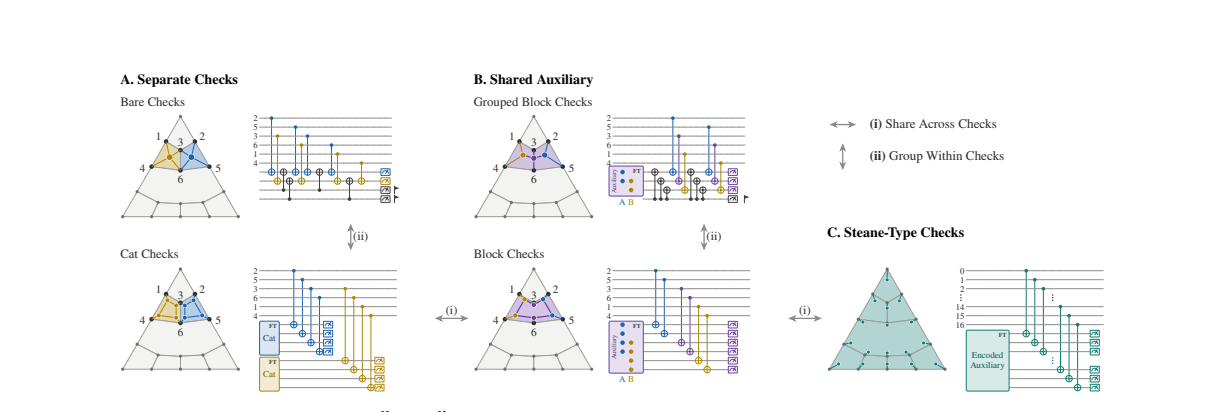
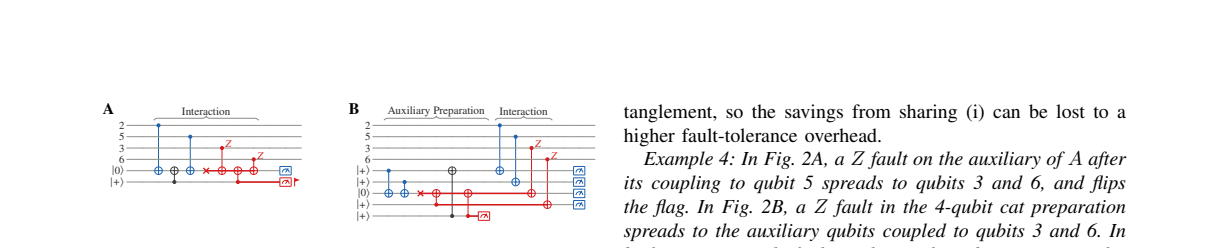
The paper introduces Block Checks, a way to measure several stabilizer checks through one fault-tolerantly prepared auxiliary block, and places them alongside existing constructions (Bare Checks, Cat Checks, Steane-Type Checks) in a unified design space for post-selected fault-tolerant state preparation. To explore this space, the authors propose a Pareto tree search that adds checks, merges auxiliaries, and edits circuits, aiming to find circuits that minimize both operations and depth. On CSS codes of distance up to seven, the search finds circuits that, at the depth of every published circuit, have fewer operations (except one tie), and that reach lower depths than any published circuit for several codes. If the approach is correct, it would give hardware designers a way to systematically trade off depth and operation count, potentially finding better circuits for specific hardware constraints than any single construction can provide.
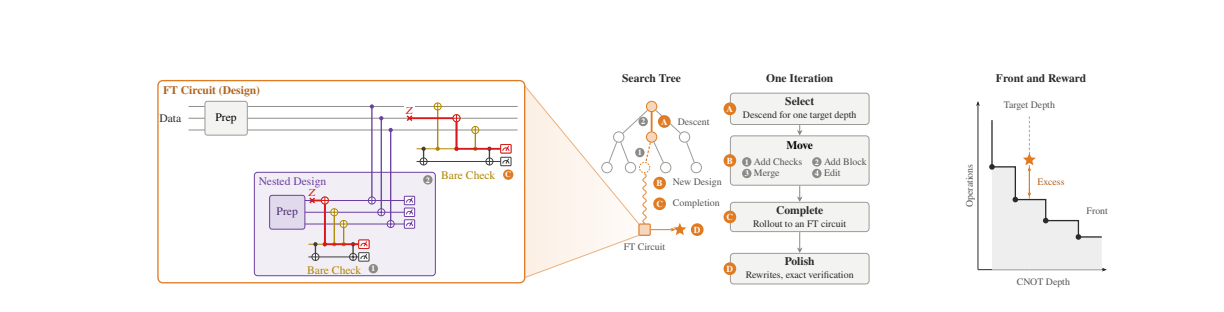
What carries the argument. The key machinery is the Pareto tree search operating on a design space defined by four move families (Add Checks, Add Block, Merge, Edit) and a completion step that turns partial designs into fault-tolerant circuits. The design space itself is built on the insight (from Huang and Brown) that auxiliary qubits can be merged in two ways: sharing across checks and grouping within checks, which connects all constructions. The search uses a multi-objective Monte Carlo tree search variant that keeps a front of circuits and rates designs by how close they come to the front at a target depth.
Core claim. The paper claims that by introducing Block Checks (and their grouped variant) into the design space for post-selected fault-tolerant state preparation, and by searching that space with a Pareto tree search, one can automatically find circuits that dominate published circuits in the operation–depth trade-off. Specifically, for CSS codes of distance up to seven, the search finds circuits with fewer operations at every published depth (except one tie) and reaches lower depths than any published circuit for several codes. The central claim is that the design space, which includes Bare Checks, Cat Checks, Block Checks, Grouped Block Checks, and Steane-Type Checks as points connected by merge operations, can be effectively explored to yield Pareto-optimal circuits that mix constructions in ways not previously automated.
The premise it rests on. The completion and polish steps rely on a greedy ILP-based step and a set of rewrites that are verified to preserve fault tolerance, but the paper does not prove that the completion always produces a fault-tolerant circuit if one exists, nor does it characterize the completeness of the rewrites; the search may miss circuits that require a different combination of moves not captured by the four move families.
If the paper is right (Pith's inferences, not the authors')
If the search is correct, hardware designers can automatically find circuits that are better suited to their specific constraints (e.g., neutral-atom processors that benefit from low depth) than any single construction provides.
The approach could be extended to other fault-tolerant primitives beyond state preparation, such as logical gate implementations or syndrome extraction, where similar trade-offs between operations and depth exist.
The design space unification suggests that the known constructions are not separate methods but points on a continuum, potentially leading to further constructions that interpolate between them.
The search could be combined with hardware-specific noise models to directly optimize for logical error rate rather than just operation count and depth.
The paper's design space does not include all possible fault-tolerant circuits (e.g., those from ZX-calculus derivations or reinforcement learning over raw circuits), so the claim of optimality is relative to the space defined by the four move families and the completion heuristics.
The search's reliance on a greedy ILP-based completion and a set of rewrites that are verified but not proven complete means that the search may miss circuits that require a different combination of moves not captured by the four families.
The logical error rates of the found circuits are sometimes higher than those of prior circuits (e.g., Steane-Type checks), suggesting that optimizing for operation count and depth alone may sacrifice fault-tolerance margins; a multi-objective approach that includes logical error rate as a third objective could yield more balanced circuits.
The approach could be applied to the nested preparation of auxiliary states themselves, which the paper already does recursively, but the search does not explore the space of auxiliary preparations as thoroughly as the data preparation, potentially leaving better circuits undiscovered.
Check this review
What was read
The passes were given all 55,531 characters of the paper's LaTeX source.
Fingerprint of that text (SHA-256): 27e0d0573d7447f331b4182fd5f947fb113993ee1df364708524883221706334
Pith does not keep that text. Rebuilt from the paper's source or PDF by the same code, it has this fingerprint if it is the same text. From a copy of Pith's code:
PYTHONPATH=. python scripts/review_input_check.py 2611.25107
The passes, in the order they ran
- Reader deepseek-v4-flash · medium effort · $0.0028 · instructions of the Reader, fingerprint f9ead7300382…
- Skeptic deepseek-v4-flash · medium effort · $0.0019 · instructions of the Skeptic, fingerprint 8f88c0f61488…
- Referee deepseek-v4-flash · medium effort · $0.0023 · instructions of the Referee, fingerprint a852d99aea0d…
- Check against the paper deepseek-v4-flash · medium effort · $0.0025 · instructions of the Check against the paper, fingerprint 6c7a6883d551…
- Editor deepseek-v4-flash · medium effort · $0.0020 · instructions of the Editor, fingerprint e7211f6a3d27…
- Circularity check deepseek-v4-flash · medium effort · $0.0019 · instructions of the Circularity check, fingerprint e9946e39d67b…
- Summary for the page deepseek-v4-flash · medium effort · temperature 0.2 · $0.0023 · instructions of the Summary for the page, fingerprint e4f56bf568e7…
The passes cost $0.016 in model calls together.
Version stamped on this review: pith-pipeline@v1.4.1-daily-deepseek-or-medium+deepseek/deepseek-v4-flash+p.d60f54226f00
Each link opens a pass's instructions as plain text, the exact bytes its fingerprint was taken over. Every stored set of instructions.
curl -s https://pith.science/methodology/prompts/f9ead730038216984cfb56d7cb34332bdf691828296a1de4245f3d6667d4bf56 | sha256sum
prints the fingerprint of the reader's instructions. The same works for every pass.
The receipt
The review's fingerprint was taken on 20 Nov 2026. The review you are reading still matches it.
Fingerprint of the review (SHA-256): 2cd0a6d11a71c9510b958fb5fc1526b72a1283d6d7430e10afa6e87c5b6e3d88
curl -s 'https://pith.science/api/v1/verdicts/2611.25107?form=canonical' | sha256sum
prints the fingerprint of the review as it stands now. The rule, in four steps.
A matching fingerprint shows the review has not changed since that date. It does not show that the review is right.
How often reviews like this one are right
Reviews like this one: written by deepseek-v4-flash, from the paper's LaTeX source.
How often objections from reviews like this one are right: not yet measured
Reviews by people
This review was written by a machine. No person has reviewed this paper on Pith yet. A scientist listed on Pith can review it for a fee, and their review is published here whatever it concludes.
The paper
Abstract
Fault-tolerant quantum computing needs logical states prepared such that single faults cannot spread into uncorrectable errors. Post-selection achieves this with added checks that detect dangerous faults and discard the run. How the checks are measured sets the depth and operation count of the circuit, and the best trade-off depends on the hardware. Existing automated methods, however, each use one check construction and yield fixed trade-offs. We first introduce Block Checks, in which several checks share one fault-tolerantly prepared auxiliary block, which places them and existing constructions in a single design space. Second, to explore that space, we propose a Pareto tree search that adds checks and auxiliary blocks, merges auxiliaries, and edits the circuit. On quantum codes of distance up to seven, the search finds best-known circuits for many new operation–depth trade-offs and surpasses existing methods. The code is open source as part of the Munich Quantum Toolkit (MQT) at https://github.com/munich-quantum-toolkit/qecc, and all circuits are available in the QECirc library at https://qecirc.com.
The paper's own sentences, arranged, kept beside the review and separate from it. Each label is drawn from a closed vocabulary; the number beside it is the probability the classifier gave that label. No sentence in this record was written by a model.
abstract compiled · 2026-11-20
The authors' main claim, as the classifier picked it out 1.00
“On quantum codes of distance up to seven, the search finds best-known circuits for many new operation--depth trade-offs and surpasses existing methods.”
How the main claim is stated: asserted 1.00
What the abstract itself states, as probabilities: claims first 0.25 · states limitation 0.23 · human participants 0.02 · controlled comparison 0.42 · randomized assignment 0.01 · states quantitative result 0.59 · compares with prior results 0.96 · mentions code or data availability 0.99
The abstract, sentence by sentence
This table labels the abstract only (arXiv listing abstract v1). The number is the probability the classifier gave the label.
| Sentence | Role | The authors' own work | States the main conclusion | Strength |
|---|---|---|---|---|
| Fault-tolerant quantum computing needs logical states prepared such that single faults cannot spread into uncorrectable errors. | background 1.00 | 0.04 | 0.03 | asserted 1.00 |
| Post-selection achieves this with added checks that detect dangerous faults and discard the run. | background 0.98 | 0.05 | 0.03 | asserted 1.00 |
| How the checks are measured sets the depth and operation count of the circuit, and the best trade-off depends on the hardware. | background 0.99 | 0.07 | 0.03 | asserted 0.99 |
| Existing automated methods, however, each use one check construction and yield fixed trade-offs. | gap 0.98 | 0.04 | 0.03 | asserted 1.00 |
| We first introduce Block Checks, in which several checks share one fault-tolerantly prepared auxiliary block, which places them and existing constructions in a single design space. | contribution 0.88 | 0.94 | 0.07 | asserted 1.00 |
| Second, to explore that space, we propose a Pareto tree search that adds checks and auxiliary blocks, merges auxiliaries, and edits the circuit. | method 0.80 | 0.92 | 0.06 | asserted 0.99 |
| On quantum codes of distance up to seven, the search finds best-known circuits for many new operation--depth trade-offs and surpasses existing methods. | result 1.00 | 0.96 | 0.74 | asserted 1.00 |
| The code is open source as part of the Munich Quantum Toolkit (MQT) at https://github.com/munich-quantum-toolkit/qecc, and all circuits are available in the QECirc library at https://qecirc.com. | contribution 0.85 | 0.52 | 0.03 | asserted 0.99 |
What kind of paper the classifier reports this is: method or tool 1.00 · evidence from simulation or computation 1.00
What was examined, and what was not
Sources read
- arXiv listing abstract v1
Not examined
- full text
- figures and tables
- references and citing sentences
- relations to other papers
Levels run
- P abstract
Not run
- S sections
- T body sentences
- C citations
- R cross-paper relations
How the labels were made
Compiled by classifier-1.13.0 via TypeSafe API, question bank abstract-p1-20260923, 2026-11-20: 1 request, 6,210 input tokens.
Every quoted sentence on this record is the authors'. Every label is from Pith's closed vocabulary, with the probability shown beside it. This record as JSON
Figures (5)
Showing 4 of the paper's 5 figures. Figures are the authors', reproduced from the paper.
References (40)
- [1] E. Knill, “Quantum computing with realistically noisy devices,”Nature, vol. 434, no. 7029, pp. 39–44, Mar. 2005 on Pith
- [2] H. Goto, “Minimizing resource overheads for fault-tolerant preparation of encoded states of the Steane code,”Sci. Rep., vol. 6, no. 1, p. 19578, Jan. 2016 on Pith
- [3] T. Pehamet al., “Automated synthesis of fault-tolerant state preparation circuits for quantum error-correction codes,”PRX Quantum, vol. 6, no. 2, p. 020330, May 2025 on Pith
- [4] R. Zenet al., “Quantum circuit discovery for fault-tolerant logical state preparation with reinforcement learning,”Phys. Rev. X, vol. 15, no. 4, p. 041012, Oct. 2025 on Pith
- [5] D. Forlivesi and D. Amaro, “Flag at origin: A modular fault-tolerant preparation for CSS codes,” Aug. 2025, arXiv:2508.14200 on PitharXiv
- [6] B. Crigeret al., “Automated flag-based fault-tolerant state preparation using integer linear programming,” Jul. 2026, arXiv:2607.22498 on PithPith's reviewarXiv
- [7] E. Weilandt, T. Peham, and R. Wille, “Synthesis of fault-tolerant state preparation circuits using Steane-type error detection,”Phys. Rev. A, vol. 114, no. 5, p. 052429, Nov. 2026 on Pith
- [8] B. Po ´oret al., “SpiderCSS: Scalable fault-tolerant CSS state prepara- tion,” Oct. 2026, arXiv:2610.03714 on PithPith's reviewarXiv
- [9] L. Schmidet al., “Deterministic fault-tolerant state preparation for near-term quantum error correction: Automatic synthesis using boolean satisfiability,” inProc. Design, Automation & Test in Europe Conf. (DATE). IEEE, Mar. 2025, pp. 1–7 on Pith
- [10] T. Peham, E. Weilandt, and R. Wille, “Optimizing fault-tolerant cat state preparation,”Phys. Rev. A, vol. 113, no. 6, p. 062426, Jun. 2026 on Pith
- [11] C. Ryan-Andersonet al., “Realization of real-time fault-tolerant quan- tum error correction,”Phys. Rev. X, vol. 11, no. 4, p. 041058, Dec. 2021 on Pith
- [12] L. Postleret al., “Demonstration of fault-tolerant universal quantum gate operations,”Nature, vol. 605, no. 7911, pp. 675–680, May 2022 on Pith
- [13] D. Bluvsteinet al., “Logical quantum processor based on reconfigurable atom arrays,”Nature, vol. 626, no. 7997, pp. 58–65, Feb. 2024 on Pith
- [14] A. Paetznicket al., “Demonstration of logical qubits and repeated error correction with better-than-physical error rates,” Apr. 2024, arXiv:2404.02280 on PithPith's reviewarXiv
- [15] M. A. Perlinet al., “Fault-tolerant execution of error-corrected quantum algorithms,”Phys. Rev. X, Oct. 2026, doi:10.1103/gnq3-c2df on Pithdoi:10.1103/gnq3-c2df
- [16] L. Postleret al., “Demonstration of fault-tolerant Steane quantum error correction,”PRX Quantum, vol. 5, no. 3, p. 030326, Aug. 2024 on Pith
- [17] S. J. Everedet al., “High-fidelity parallel entangling gates on a neutral- atom quantum computer,”Nature, vol. 622, no. 7982, pp. 268–272, Oct. 2023 on Pith
- [18] S. Huang and K. R. Brown, “Between Shor and steane: A unifying construction for measuring error syndromes,”Phys. Rev. Lett., vol. 127, no. 9, p. 090505, Aug. 2021 on Pith
- [19] R. Willeet al., “The MQT handbook: A summary of design automation tools and software for quantum computing,” inProc. IEEE Int. Conf. Quantum Software (QSW), Jul. 2024, pp. 1–8 on Pith
- [20] L. Schmid, T. Peham, and R. Wille, “QECirc: A community- driven, FAIR library of quantum error correction circuits,” Jul. 2026, arXiv:2609.20182 on PithPith's reviewarXiv
show 20 more
- [21] A. R. Calderbank and P. W. Shor, “Good quantum error-correcting codes exist,”Phys. Rev. A, vol. 54, no. 2, pp. 1098–1105, Aug. 1996 on Pith
- [22] A. Steane, “Multiple-particle interference and quantum error correction,” Proc. R. Soc. Lond. A, vol. 452, no. 1954, pp. 2551–2577, Nov. 1996 on Pith
- [23] R. Chao and B. W. Reichardt, “Quantum error correction with only two extra qubits,”Phys. Rev. Lett., vol. 121, no. 5, p. 050502, Aug. 2018 on Pith
- [24] C. Chamberland and M. E. Beverland, “Flag fault-tolerant error correc- tion with arbitrary distance codes,”Quantum, vol. 2, p. 53, Feb. 2018 on Pith
- [25] P. W. Shor, “Fault-tolerant quantum computation,” inProc. 37th Annu. Symp. Found. Comput. Sci. (FOCS). IEEE Computer Society Press, 1996, pp. 56–65 on Pith
- [26] P. Prabhu and B. W. Reichardt, “Fault-tolerant syndrome extraction and cat state preparation with fewer qubits,”Quantum, vol. 7, p. 1154, Oct. 2023 on Pith
- [27] A. B. Khesinet al., “SpiderCat: Optimal fault-tolerant cat state prepa- ration,” Mar. 2026, arXiv:2603.05391 on PitharXiv
- [28] M. D. Gorman, “Transversal syndrome extraction: A unifying construc- tion for measuring the error syndromes of any stabilizer code,” Oct. 2026, arXiv:2610.30279 on PithPith's reviewarXiv
- [29] A. M. Steane, “Active stabilization, quantum computation, and quantum state synthesis,”Phys. Rev. Lett., vol. 78, no. 11, pp. 2252–2255, Mar. 1997 on Pith
- [30] A. Paetznick and B. W. Reichardt, “Fault-tolerant ancilla preparation and noise threshold lower bounds for the 23-qubit Golay code,”Quantum Inf. Comput., vol. 12, no. 11&12, pp. 1034–1080, Nov. 2012 on Pith
- [31] A. M. Steane, “Fast fault-tolerant filtering of quantum codewords,” Feb. 2002, arXiv:quant-ph/0202036 on PithPith's reviewarXiv
- [32] B. W. Reichardt, “Improved ancilla preparation scheme increases fault- tolerant threshold,” Jun. 2004, arXiv:quant-ph/0406025 on PithPith's reviewarXiv
- [33] A. W. Cross, D. P. DiVincenzo, and B. M. Terhal, “A comparative code study for quantum fault tolerance,”Quantum Inf. Comput., vol. 9, no. 7&8, pp. 541–572, Jul. 2009 on Pith
- [34] A. Lahiri and F. Marquardt, “Agentic AI for discovering fault-tolerant quantum circuits,” Nov. 2026, arXiv:2611.18504 on PithPith's reviewarXiv
- [35] W. Wang and M. Sebag, “Multi-objective Monte-Carlo tree search,” inProc. Asian Conf. Machine Learning (ACML), ser. PMLR, vol. 25. PMLR, Nov. 2012, pp. 507–522 on Pith
- [36] L. Kocsis and C. Szepesv ´ari, “Bandit based Monte-Carlo planning,” in Proc. European Conf. Machine Learning (ECML), ser. LNCS, vol. 4212. Springer, 2006, pp. 282–293 on Pith
- [37] C. B. Browneet al., “A survey of Monte Carlo tree search methods,” IEEE Trans. Comput. Intell. AI Games, vol. 4, no. 1, pp. 1–43, Mar. 2012 on Pith
- [38] A. Cou ¨etouxet al., “Continuous upper confidence trees,” inProc. Learning and Intelligent Optimization (LION), ser. LNCS, vol. 6683. Springer, 2011, pp. 433–445 on Pith
- [39] H. Jeon, J. Lee, and T. Kim, “Automated reduction of fault-tolerant circuits,” Oct. 2026, arXiv:2610.09749 on PithPith's reviewarXiv
- [40] C. Gidney, “Stim: A fast stabilizer circuit simulator,”Quantum, vol. 5, p. 497, Jul. 2021 on Pith
Challenges and discussion
Disagree with the review, or know something it missed? Leave a comment, or challenge this review formally: a challenge becomes a permanent entry in this paper's record, and its decision is published here.
Come back by email
A short list of the week's newly reviewed papers. Nothing is sent until you confirm from your inbox, and every email has a link that stops it. No account.
No comments yet.
Sign in to comment