Quantum Physics · arXiv:2611.18504 v1 · submitted 13 Nov 2026 · 68 references
Agentic AI for Discovering Fault-Tolerant Quantum Circuits
The paper says
“Scaling quantum computing toward practical quantum advantage is currently limited by the efficiency of circuits that operate on information encoded by quantum error-correcting codes.”
more of the abstract
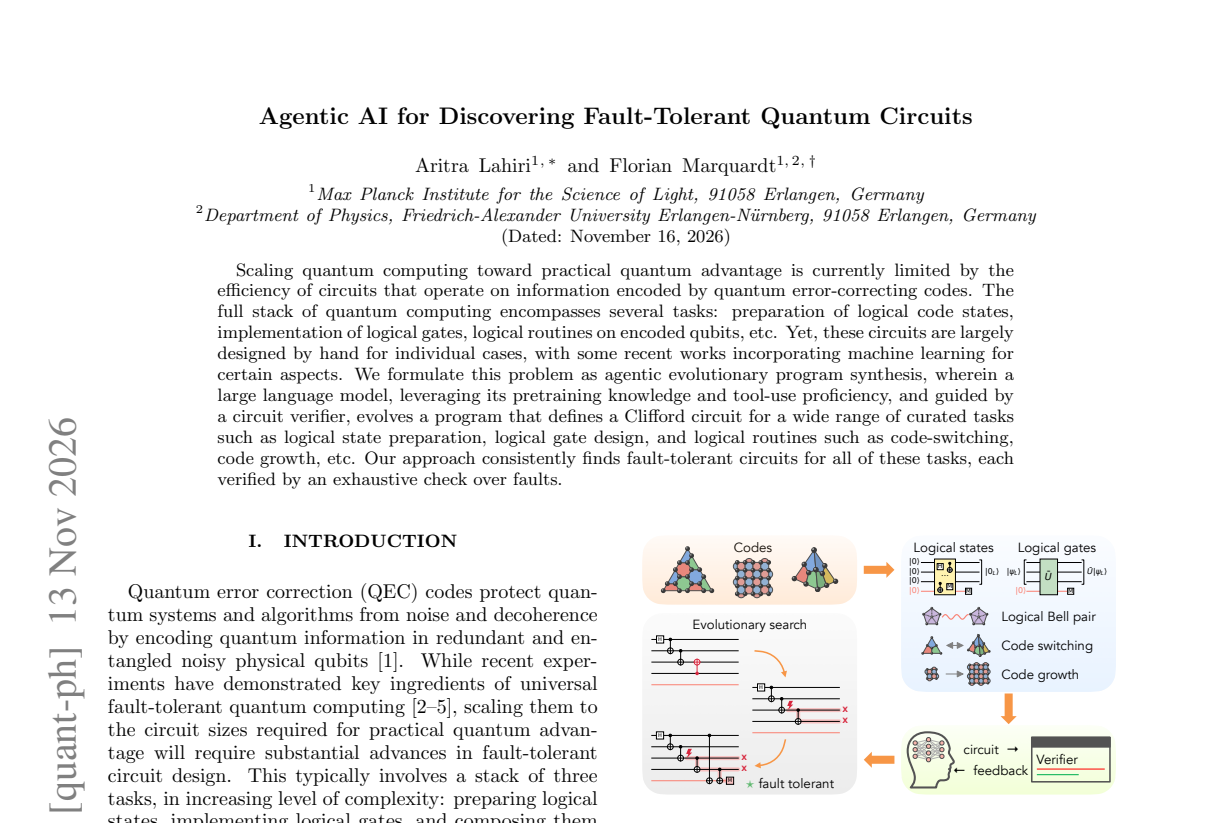
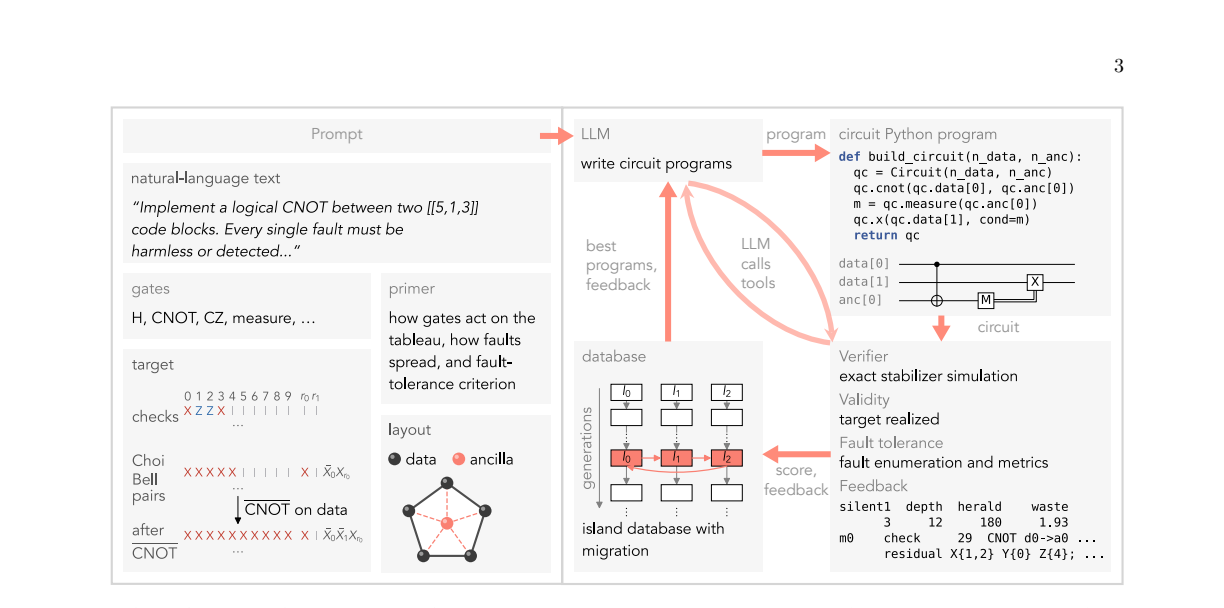
The full stack of quantum computing encompasses several tasks: preparation of logical code states, implementation of logical gates, logical routines on encoded qubits, etc. Yet, these circuits are largely designed by hand for individual cases, with some recent works incorporating machine learning for certain aspects. We formulate this problem as agentic evolutionary program synthesis, wherein a large language model, leveraging its pretraining knowledge and tool-use proficiency, and guided by a circuit verifier, evolves a program that defines a Clifford circuit for a wide range of curated tasks such as logical state preparation, logical gate design, and logical routines such as code-switching, code growth, etc. Our approach consistently finds fault-tolerant circuits for all of these tasks, each verified by an exhaustive check over faults.
from the abstract
Pith says
Machine review · deepseek-v4-flash · 16 Nov 2026 · read the full text (130,696 characters) · not checked by a person
It can be wrong. Challenge this review or reply to it.
Holds up. A hybrid agentic evolutionary search using a frontier LLM with tool use and a circuit verifier discovers fault-tolerant Clifford circuits for a range of quantum error correction tasks, matching or improving on prior benchmarks. This line is wrong
10 minor · 2 open questions
How often objections from reviews like this one are right: not yet measured
The paper, first character to last
The reviewer was given the whole text, 130,696 characters. Not checked: figures, code, what the 68 references say.
10 minor objections
The paper says, at §2
Pith says: minor objection 1 of 10
The paper uses the term 'flag fault tolerance' but does not cite the original flag fault tolerance papers (ChaoReichardt2018, ChamberlandBeverland2018) in this sentence; they are cited later. Consider adding the citation here for clarity.
The paper says, at §2, Eq. (2)
Pith says: minor objection 2 of 10
The variable N is defined as n_data + n_anc, the total number of qubits. However, the number of possible events of order i scales as (number of fault locations choose i), which is not simply N^i. The factor (cN)^{i-1} is a heuristic normalization. The paper should discuss the rationale for this choice and its limitations.
show 8 more
The paper says, at §3.1, Table I
Pith says: minor objection 3 of 10
The notation 'multi-size$^\dagger$' is used but not explained in the caption. It appears to refer to a separate multi-size search that produced a different circuit for the Steane code. Clarify in the caption or main text.
The paper says, at §3.2, Table II
Pith says: minor objection 4 of 10
The paper states that the multi-size program 'branches on distance' for the surface code S gate. This means the program is not truly size-general (it uses if-else on distance). This is a limitation that should be noted in the main text, not just in the table caption.
The paper says, at §3.3, Table III
Pith says: minor objection 5 of 10
The Bell pair task is listed under 'Further Applications' but is a state preparation task. It might be better placed in the logical states section, or the paper should explain why it is considered a separate application.
The paper says, at §4, Fig. 4
Pith says: minor objection 6 of 10
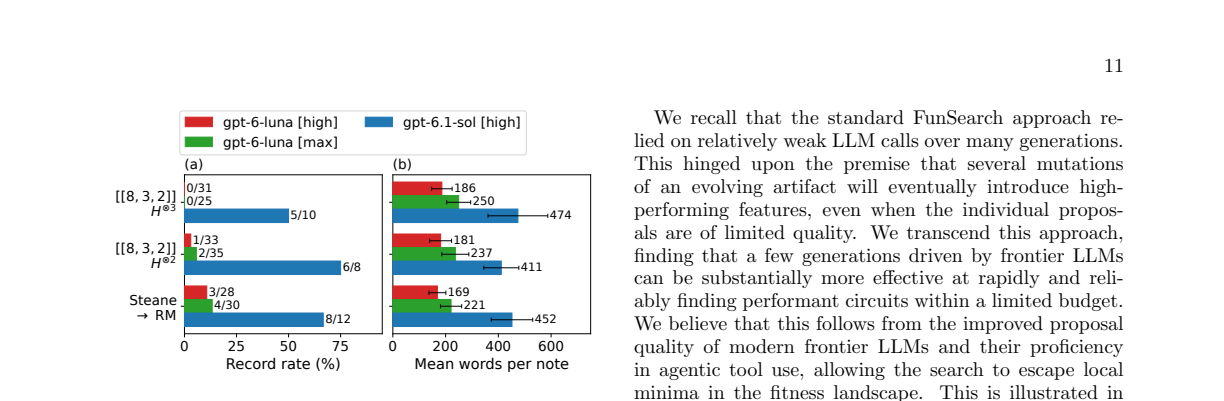
Figure 4 shows record rates and word counts for different LLM tiers. The paper should clarify whether the record rates are computed over all generations or only after the seeding phase. Also, the word count analysis is interesting but the paper does not discuss whether longer scratchpad notes correlate with better performance.
The paper says, at Appendix B
Pith says: minor objection 7 of 10
The Choi state construction is described, but the paper does not discuss how the reference qubits are handled in the verifier. Are they included in the fault enumeration? The paper should clarify that reference qubits are not subject to faults (since they are isolated), or explain how they are treated.
The paper says, at Appendix C
Pith says: minor objection 8 of 10
The paper states that the residual and pattern of a higher-order event are the XOR of those of its constituent faults. This is true because the propagation is linear. However, the paper should also note that this relies on the assumption that faults are Pauli errors and that the circuit is Clifford. This is fine, but it should be explicitly stated.
The paper says, at Appendix D
Pith says: minor objection 9 of 10
The verification method of Ref. [Kliuchnikov2023] is used to check validity. The paper should mention that this method works for Clifford circuits with Pauli feedforward, which is exactly the class considered. This is a strength, but the paper should also note any limitations (e.g., non-Clifford gates are not considered).
The paper says, at Appendix E
Pith says: minor objection 10 of 10
The pseudocode in Appendix E is helpful. However, the description of the island database and clustering is somewhat vague. The paper could provide more detail on how clusters are formed and how diversity is maintained.
Open questions (2)
Pith raised these and could not confirm them against the text of the paper it read. They are questions for the authors, not findings.
- §2, Eq. (2) and surrounding text What value of the constant c was used in the experiments, and how sensitive are the results to this choice?
- §3.3, Table III How do the reported undecodable costs for the growth circuits compare to theoretical lower bounds or practical requirements, and what are the resulting logical error rates or success probabilities?
What would settle it
If the same agentic FunSearch setup were run on a new, comparably complex task (e.g., logical T gate on a distance-5 code) and failed to find any fault-tolerant circuit within a reasonable number of generations (e.g., 100), that would cast doubt on the generality of the claim.
from Pith's summary of the paper
How the review went
5 passes by deepseek-v4-flash · 16 Nov 2026
- Reader holds up
- Skeptic concern withdrawn: Pith's reviewer misread the paper
- Referee 10 minor
- Check against the paper kept 0 of 6 objections
- Editor wrote the verdict above
Not run on this paper: the simulated authors' defence.
Pith's passes raised 6 objections. A check against the paper's text kept 0, withdrew 4 (2 the paper already says; 2 Pith's reviewer misread the paper) and left 2 as questions.
The review in full
The review in brief, machine-written
This paper presents a method that combines an LLM (GPT-6.1-sol) with an evolutionary search to design fault-tolerant Clifford circuits for quantum error correction. The key novelty is the agentic loop: the LLM can call a verifier as a tool, test its own proposals, and keep scratchpad notes that persist across generations. The verifier performs an exhaustive enumeration of fault events up to order t, which is a rigorous check. The method is demonstrated on a wide range of tasks: logical state preparation (surface codes, colour codes, the perfect code), logical gates (CNOT, Hadamard, S, on several codes), code switching, code growth, and Bell pair preparation. In several cases the discovered circuits are shallower or have better fault-tolerance metrics than prior work. The paper is clearly written and the method is described in enough detail to be reproducible.
The main soft spot is that the entire search depends on a proprietary frontier LLM (GPT-6.1-sol) whose capabilities are not under the authors' control and may not persist. The paper acknowledges this reliance. A second concern is that some searches were not fully converged within the allocated budget (e.g., the d=3→5 growth). The paper states this. The fault-tolerance criterion is exact for the Clifford case, but the method is limited to Clifford circuits; non-Clifford gates are left for future work. The constant c in the silent-cost formula is not specified, but the results are not sensitive to it because the lexicographic ordering means silent events dominate. The paper's central claim—that the method consistently finds fault-tolerant circuits—is supported by the evidence presented.
This paper is for researchers working on automated quantum circuit design and fault-tolerant quantum computing. It deserves a serious referee. The method is sound, the results are concrete, and the limitations are stated. I recommend engaging with the work.
The stress test's concern
Withdrawn: Pith's reviewer misread the paper.
The paper says
“a conditional Pauli $P_c$ fires on the XOR of some outcomes, making it linear in the faults. If a fault flips an odd number of them, whether $P_c$ is applied or not changes relative to the fault-free circuit. This multiplies the propagated fault by $P_c$. Since every step is $\GF$-linear, the residual and pattern of a higher-order event composed of several faults are simply the XOR of those of its constituent faults.”
The referee's report
Not published. Pith's referee wrote this assessment before its objections were checked against the paper, and 5 of its 5 major objections did not survive that check.
Pith's reading of the paper (a machine's summary, not the authors')
The paper claims that a frontier large language model (GPT-6.1-sol), used as a mutation operator in an evolutionary search with tool use and a circuit verifier, can autonomously design fault-tolerant Clifford circuits for a wide variety of quantum error correction tasks. The approach is tested on logical state preparation, logical gate design, code switching, and code growth for several codes (perfect code, rotated surface code, colour codes, Reed-Muller code, etc.). The circuits are verified by exhaustive enumeration of faults up to the code's error-correction capability. The authors report that the method consistently finds circuits that satisfy their fault tolerance criterion, often matching or improving upon existing benchmarks in depth, two-qubit gate count, or fault tolerance metrics.
What carries the argument. The key machinery is the agentic FunSearch loop: an LLM (GPT-6.1-sol) acts as a mutation operator, proposing Python programs that define dynamic Clifford circuits. The LLM can call a verifier tool to test its proposals before submission. The verifier checks circuit validity and fault tolerance by enumerating all fault events up to order t (the code's error-correction capability) and scoring circuits by a lexicographic metric (silent events, depth, herald/waste or undecodable/forfeit costs). The search runs on multiple islands with periodic migration, and the LLM also writes scratchpad notes that persist across generations.
Core claim. The central claim is that an agentic evolutionary search, using a frontier LLM with tool use and guided by a circuit verifier, consistently finds fault-tolerant Clifford circuits for a wide range of quantum error correction tasks, including logical state preparation, logical gate design, code switching, and code growth, with each circuit verified by an exhaustive check over faults.
The premise it rests on. The approach assumes that a frontier LLM (GPT-6.1-sol), without any domain-specific fine-tuning, can propose meaningful circuit mutations and improvements when guided by a verifier and evolutionary search.
If the paper is right (Pith's inferences, not the authors')
If the approach scales, it could automate the design of fault-tolerant circuits for larger codes and more complex logical operations, reducing human effort.
The method could be extended to non-Clifford gates (e.g., T gates) by incorporating magic state injection or other techniques, potentially enabling full universal fault-tolerant circuit design.
The agentic FunSearch paradigm may be applicable to other domains of quantum computing, such as compiling, error correction decoding, or even experimental design.
The results suggest that frontier LLMs, without domain-specific fine-tuning, can already propose meaningful circuit mutations, which may accelerate discovery in quantum error correction.
The paper's reliance on a specific frontier LLM (GPT-6.1-sol) raises the question of whether the approach would work with weaker or open-source models, or whether it depends on proprietary capabilities.
The exhaustive fault enumeration limits the method to circuits of modest size; scaling to larger codes (e.g., distance-13 surface code) may require approximate or sampling-based fault tolerance checks.
The paper does not compare the resource overhead (e.g., number of LLM calls, total compute time) against reinforcement learning or SAT-based methods, so it is unclear whether the approach is more efficient in practice.
The code switching and growth circuits are demonstrated only for specific code pairs; generalizing to arbitrary code transitions would require further work.
Check this review
What was read
The passes were given all 130,696 characters of the paper's LaTeX source.
Fingerprint of that text (SHA-256): b76773ec05f234358b5c461edef0cc6ad8c8c39f1ab40dbf35e4d0322e45e0ee
Pith does not keep that text. Rebuilt from the paper's source or PDF by the same code, it has this fingerprint if it is the same text. From a copy of Pith's code:
PYTHONPATH=. python scripts/review_input_check.py 2611.18504
The passes, in the order they ran
- Reader deepseek-v4-flash · medium effort · $0.0048 · instructions of the Reader, fingerprint f9ead7300382…
- Skeptic deepseek-v4-flash · medium effort · $0.0038 · instructions of the Skeptic, fingerprint 8f88c0f61488…
- Referee deepseek-v4-flash · medium effort · $0.0042 · instructions of the Referee, fingerprint a852d99aea0d…
- Check against the paper deepseek-v4-flash · medium effort · $0.013 · instructions of the Check against the paper, fingerprint 6c7a6883d551…
- Editor deepseek-v4-flash · medium effort · $0.0038 · instructions of the Editor, fingerprint e7211f6a3d27…
- Summary for the page deepseek-v4-flash · medium effort · temperature 0.2 · $0.0041 · instructions of the Summary for the page, fingerprint e4f56bf568e7…
The passes cost $0.033 in model calls together.
Version stamped on this review: pith-pipeline@v1.4.1-daily-deepseek-or-medium+deepseek/deepseek-v4-flash+p.0ef1a750a3e3
Each link opens a pass's instructions as plain text, the exact bytes its fingerprint was taken over. Every stored set of instructions.
curl -s https://pith.science/methodology/prompts/f9ead730038216984cfb56d7cb34332bdf691828296a1de4245f3d6667d4bf56 | sha256sum
prints the fingerprint of the reader's instructions. The same works for every pass.
The receipt
The review's fingerprint was taken on 16 Nov 2026. The review you are reading still matches it.
Fingerprint of the review (SHA-256): 7a881718786bdd006d086c1e24893a36fd17b797ed018256d853b17d9b4f8011
curl -s 'https://pith.science/api/v1/verdicts/2611.18504?form=canonical' | sha256sum
prints the fingerprint of the review as it stands now. The rule, in four steps.
A matching fingerprint shows the review has not changed since that date. It does not show that the review is right.
How often reviews like this one are right
Reviews like this one: written by deepseek-v4-flash, from the paper's LaTeX source.
How often objections from reviews like this one are right: not yet measured
Reviews by people
This review was written by a machine. No person has reviewed this paper on Pith yet. A scientist listed on Pith can review it for a fee, and their review is published here whatever it concludes.
The paper
Abstract
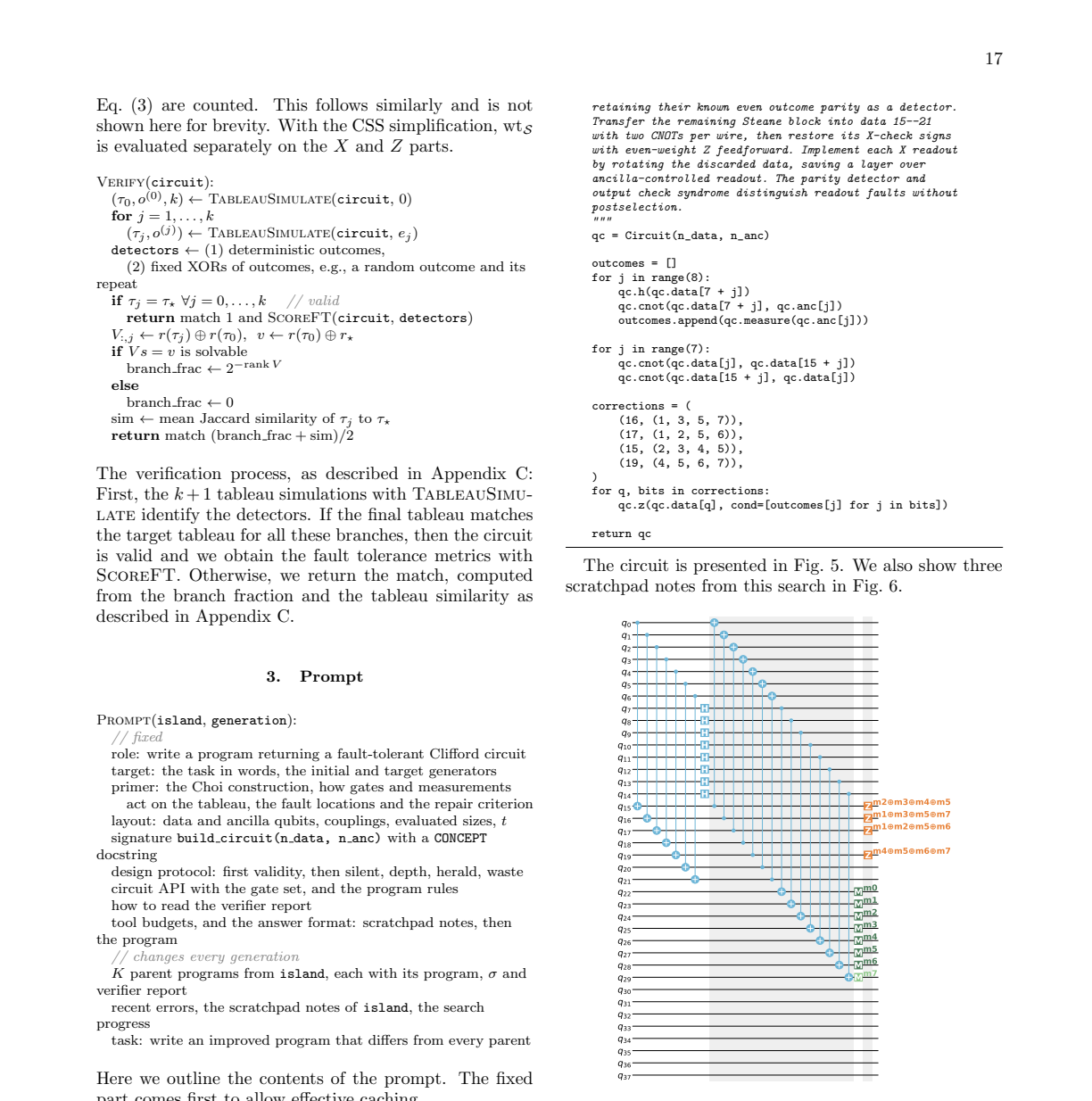
Scaling quantum computing toward practical quantum advantage is currently limited by the efficiency of circuits that operate on information encoded by quantum error-correcting codes. The full stack of quantum computing encompasses several tasks: preparation of logical code states, implementation of logical gates, logical routines on encoded qubits, etc. Yet, these circuits are largely designed by hand for individual cases, with some recent works incorporating machine learning for certain aspects. We formulate this problem as agentic evolutionary program synthesis, wherein a large language model, leveraging its pretraining knowledge and tool-use proficiency, and guided by a circuit verifier, evolves a program that defines a Clifford circuit for a wide range of curated tasks such as logical state preparation, logical gate design, and logical routines such as code-switching, code growth, etc. Our approach consistently finds fault-tolerant circuits for all of these tasks, each verified by an exhaustive check over faults.
The paper's own sentences, arranged, kept beside the review and separate from it. Each label is drawn from a closed vocabulary; the number beside it is the probability the classifier gave that label. No sentence in this record was written by a model.
abstract compiled · 2026-11-16
The authors' main claim, as the classifier picked it out 1.00
“Our approach consistently finds fault-tolerant circuits for all of these tasks, each verified by an exhaustive check over faults.”
How the main claim is stated: asserted 1.00
What the abstract itself states, as probabilities: claims first 0.08 · states limitation 0.11 · human participants 0.03 · controlled comparison 0.05 · randomized assignment 0.01 · states quantitative result 0.08 · compares with prior results 0.17 · mentions code or data availability 0.04
The abstract, sentence by sentence
This table labels the abstract only (arXiv listing abstract v1). The number is the probability the classifier gave the label.
| Sentence | Role | The authors' own work | States the main conclusion | Strength |
|---|---|---|---|---|
| Scaling quantum computing toward practical quantum advantage is currently limited by the efficiency of circuits that operate on information encoded by quantum error-correcting codes. | background 0.99 | 0.04 | 0.04 | asserted 1.00 |
| The full stack of quantum computing encompasses several tasks: preparation of logical code states, implementation of logical gates, logical routines on encoded qubits, etc. | background 1.00 | 0.05 | 0.02 | asserted 1.00 |
| Yet, these circuits are largely designed by hand for individual cases, with some recent works incorporating machine learning for certain aspects. | gap 0.84 | 0.05 | 0.03 | asserted 0.99 |
| We formulate this problem as agentic evolutionary program synthesis, wherein a large language model, leveraging its pretraining knowledge and tool-use proficiency, and guided by a circuit verifier, evolves a program that defines a Clifford circuit for a wide range of curated tasks such as logical state preparation, logical gate design, and logical routines such as code-switching, code growth, etc. | method 0.90 | 0.90 | 0.10 | asserted 0.98 |
| Our approach consistently finds fault-tolerant circuits for all of these tasks, each verified by an exhaustive check over faults. | result 1.00 | 0.96 | 0.83 | asserted 1.00 |
What kind of paper the classifier reports this is: method or tool 1.00 · evidence from simulation or computation 0.98
What was examined, and what was not
Sources read
- arXiv listing abstract v1
Not examined
- full text
- figures and tables
- references and citing sentences
- relations to other papers
Levels run
- P abstract
Not run
- S sections
- T body sentences
- C citations
- R cross-paper relations
How the labels were made
Compiled by classifier-1.13.0 via TypeSafe API, question bank abstract-p1-20260923, 2026-11-16: 1 request, 4,308 input tokens.
Every quoted sentence on this record is the authors'. Every label is from Pith's closed vocabulary, with the probability shown beside it. This record as JSON
Figures (6)
Figures are the authors', reproduced from the paper.
References (68)
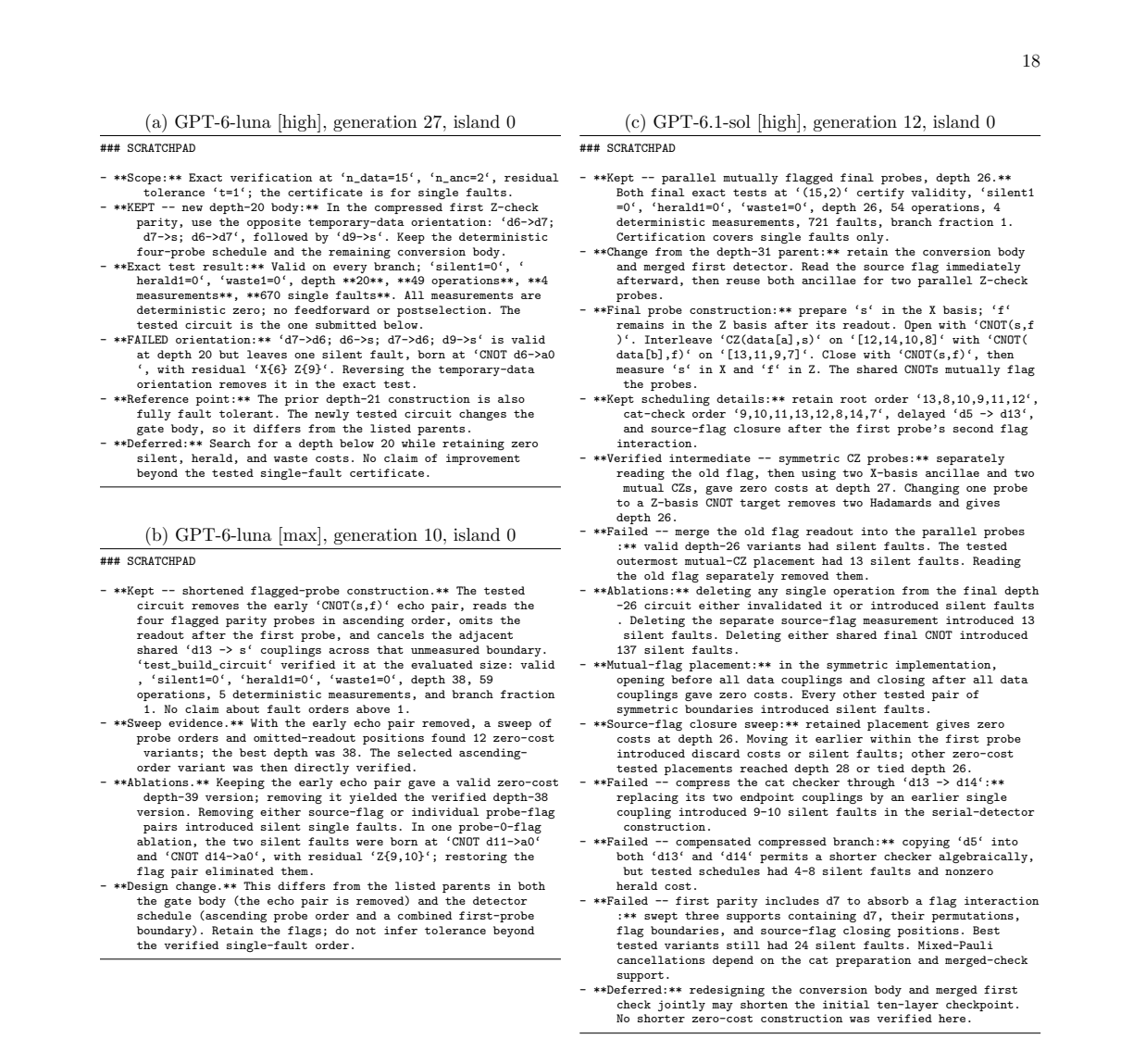
- [1] No claim about fault orders above 1. - **Sweep evidence.** With the early echo pair removed, a sweep of probe orders and omitted-readout positions found 12 zero-cost variants; the best depth was 38. The selected ascending- order variant was then directly verified. - **Ablation... on Pith
- [2] D. Gottesman, An introduction to quantum error correc- tion and fault-tolerant quantum computation, inQuan- tum Information Science and Its Contributions to Mathe- matics, Proceedings of Symposia in Applied Mathematics Vol. 68, edited by S. J. Lomonaco, Jr. (American Math- ema... on Pith
- [3] R. Acharyaet al.(Google Quantum AI and Collabora- tors), Quantum error correction below the surface code threshold, Nature638, 920 (2025) on Pith
- [4] D. Bluvstein, S. J. Evered, A. A. Geim, S. H. Li, H. Zhou, T. Manovitz, S. Ebadi, M. Cain, M. Kalinowski, D. Hangleiteret al., Logical quantum processor based on reconfigurable atom arrays, Nature626, 58 (2024) on Pith
- [5] D. Bluvstein, A. A. Geim, S. H. Li, S. J. Evered, J. P. Bonilla Ataides, G. Baranes, A. Gu, T. Manovitz, M. Xu, M. Kalinowskiet al., A fault-tolerant neutral-atom architecture for universal quantum computation, Nature 649, 39 (2026) on Pith
- [6] E. Rosenfeldet al., Magic state cultivation on a superconducting quantum processor, Science (2026), 10.1126/science.aee7961 on Pithdoi:10.1126/science.aee7961
- [7] T. Peham, L. Schmid, L. Berent, M. M¨ uller, and R. Wille, Automated synthesis of fault-tolerant state preparation circuits for quantum error-correction codes, PRX Quan- tum6, 020330 (2025) on Pith
- [8] D. Kremer, V. Villar, H. Paik, I. Duran, I. Faro, and J. Cruz-Benito, Practical and efficient quantum circuit synthesis and transpiling with reinforcement learning, arXiv:2405.13196 on PithPith's reviewarXiv
- [9] S. Rietsch, A. Y. Dubey, C. Ufrecht, M. Periyasamy, A. Plinge, C. Mutschler, and D. D. Scherer, Unitary synthe- sis of Clifford+T circuits with reinforcement learning, in 2024 IEEE International Conference on Quantum Com- puting and Engineering (QCE)(IEEE, Piscataway, NJ, 2024... on Pith
- [10] M. Doherty, M. Puviani, J. Brewer, G. Matos, D. Amaro, B. Criger, and D. T. Stephen, Fast stabilizer state preparation via AI-optimized graph decimation, arXiv:2603.17743 on PitharXiv
- [11] J. Olle, R. Zen, M. Puviani, and F. Marquardt, Si- multaneous discovery of quantum error correction codes and encoders with a noise-aware reinforcement learning agent, npj Quantum Inf.10, 126 (2024) on Pith
- [12] T. F¨ osel, P. Tighineanu, T. Weiss, and F. Marquardt, Re- inforcement learning with neural networks for quantum feedback, Phys. Rev. X8, 031084 (2018) on Pith
- [13] T. F¨ osel, M. Y. Niu, F. Marquardt, and L. Li, Quan- tum circuit optimization with deep reinforcement learn- ing, arXiv:2103.07585 on PithPith's reviewarXiv
- [14] R. Zen, J. Olle, L. Colmenarez, M. Puviani, M. M¨ uller, and F. Marquardt, Quantum circuit discovery for fault- tolerant logical state preparation with reinforcement learning, Phys. Rev. X15, 041012 (2025) on Pith
- [15] N. Rengaswamy, R. Calderbank, S. Kadhe, and H. D. Pfister, Logical Clifford synthesis for stabilizer codes, IEEE Trans. Quantum Eng.1, 1 (2020) on Pith
- [16] E. J. Kuehnke, K. Levi, J. Roffe, J. Eisert, and D. Miller, Hardware-tailored logical Clifford circuits for stabilizer codes, arXiv:2505.20261 on PithPith's reviewarXiv
- [17] H. Chen, M. Vasmer, N. P. Breuckmann, and E. Grant, Automated discovery of logical gates for quantum error correction, Quantum Inf. Comput.22, 947 (2022) on Pith
- [18] N. Meyer, C. Mutschler, D. Seuß, A. Maier, and D. D. Scherer, Learning logical operations for arbitrary quan- tum error correction codes, Phys. Rev. A114, 032424 (2026) on Pith
- [19] H. Sayginel, S. Koutsioumpas, M. Webster, A. Rajput, and D. E. Browne, Fault-tolerant logical Clifford gates from code automorphisms, PRX Quantum6, 030343 (2025) on Pith
- [20] A. Benhemou and N. Berthusen, Automated logical Clif- ford gadgets for heterogeneous architectures via chain maps, arXiv:2607.02482 on PithPith's reviewarXiv
show 48 more
- [21] N. Shutty and C. Chamberland, Decoding merged color- surface codes and finding fault-tolerant Clifford circuits using solvers for satisfiability modulo theories, Phys. Rev. Appl.18, 014072 (2022) on Pith
- [22] N. Dupuis, L. Buratti, S. Vishwakarma, A. Viudes For- rat, D. Kremer, I. Faro, R. Puri, and J. Cruz-Benito, Qiskit Code Assistant: Training LLMs for generating quantum computing code, in2024 IEEE LLM Aided De- sign Workshop (LAD)(IEEE, Piscataway, NJ, 2024), pp. 1–4 on Pith
- [23] N. Dupuis, A. Tiwari, Y. Mroueh, D. Kremer, I. Faro, and J. Cruz-Benito, Quantum verifiable rewards for post- training Qiskit Code Assistant, arXiv:2508.20907 on PithPith's reviewarXiv
- [24] X. Guo, M. Wang, and J. Zhao, QuanBench: Bench- marking quantum code generation with large language models, in2025 40th IEEE/ACM International Confer- ence on Automated Software Engineering (ASE)(IEEE, Piscataway, NJ, 2025), pp. 2657–2669 on Pith
- [25] J. Cruz-Benito and I. Faro, Qiskit QuantumKatas: Adapting Microsoft’s quantum computing exercises for LLM evaluation, arXiv:2605.27210 on PithPith's reviewarXiv
- [26] A. Paz, C. Tarta, C. Y. Li, M. Sun, S. Patel, and S. Lausier, StabilizerBench: A benchmark for AI-assisted quantum error correction circuit synthesis, arXiv:2604.21287 on PithPith's reviewarXiv
- [27] B. Romera-Paredes, M. Barekatain, A. Novikov, M. Ba- log, M. P. Kumar, E. Dupont, F. J. R. Ruiz, J. S. El- lenberg, P. Wang, O. Fawzi, P. Kohli, and A. Fawzi, Mathematical discoveries from program search with large language models, Nature625, 468 (2024) on Pith
- [28] A. Novikov, N. V˜ u, M. Eisenberger, E. Dupont, P.-S. Huang, A. Z. Wagner, S. Shirobokov, B. Kozlovskii, F. J. R. Ruiz, A. Mehrabian, M. P. Kumar, A. See, S. Chaud- huri, G. Holland, A. Davies, S. Nowozin, P. Kohli, and M. Balog, AlphaEvolve: A coding agent for scientific and ... on PithPith's reviewarXiv
- [29] Z. Liu and F. Marquardt, Large-language-model discov- ery of quantum LDPC codes through structured concept evolution, arXiv:2606.24808 on PithPith's reviewarXiv
- [30] J. Cruz-Benito, A. W. Cross, D. Kremer, and I. Faro, Evolutionary discovery of bivariate bicycle codes with LLM-guided search, arXiv:2606.02418 on PithPith's reviewarXiv
- [31] M. N¨ agele and F. Marquardt, Agentic exploration of physics models, Phys. Rev. X16, 031002 (2026) on Pith
- [32] S. Aaronson and D. Gottesman, Improved simulation of stabilizer circuits, Phys. Rev. A70, 052328 (2004) on Pith
- [33] A. Jamio lkowski, Linear transformations which preserve trace and positive semidefiniteness of operators, Rep. Math. Phys.3, 275 (1972) on Pith
- [34] M.-D. Choi, Completely positive linear maps on complex matrices, Linear Algebra Appl.10, 285 (1975) on Pith
- [35] M. A. Nielsen and I. L. Chuang, Programmable quantum gate arrays, Phys. Rev. Lett.79, 321 (1997) on Pith
- [36] D. Gottesman and I. L. Chuang, Demonstrating the via- bility of universal quantum computation using teleporta- tion and single-qubit operations, Nature402, 390 (1999) on Pith
- [37] T. Peham, N. Brandl, R. Kueng, R. Wille, and L. Burgholzer, Depth-optimal synthesis of Clifford circuits with SAT solvers, in2023 IEEE International Conference on Quantum Computing and Engineering (QCE)(IEEE, Piscataway, NJ, 2023), pp. 802–813. 20 on Pith
- [38] V. Kliuchnikov, M. Beverland, and A. Paetznick, Stabi- lizer circuit verification, arXiv:2309.08676 on PithPith's reviewarXiv
- [39] R. Chao and B. W. Reichardt, Quantum error correction with only two extra qubits, Phys. Rev. Lett.121, 050502 (2018) on Pith
- [40] C. Chamberland and M. E. Beverland, Flag fault-tolerant error correction with arbitrary distance codes, Quantum 2, 53 (2018) on Pith
- [41] E. Knill, Quantum computing with realistically noisy de- vices, Nature434, 39 (2005) on Pith
- [42] P. Aliferis, D. Gottesman, and J. Preskill, Quantum accu- racy threshold for concatenated distance-3 codes, Quan- tum Inf. Comput.6, 97 (2006) on Pith
- [43] B. W. Reichardt, D. Aasen, and R. Chao, Fire and ice: Partially fault-tolerant quantum computing with selec- tive state filtering, arXiv:2605.15344 on PithPith's reviewarXiv
- [44] E. Knill, Fault-tolerant postselected quantum computa- tion: Schemes, arXiv:quant-ph/0402171 on PithPith's reviewarXiv
- [45] L. Colmenarez, R. Zen, J. Olle, F. Marquardt, and M. M¨ uller, Unitary fault-tolerant encoding of Pauli states in surface codes, npj Quantum Inf.12, 159 (2026) on Pith
- [46] H. Goto, Minimizing resource overheads for fault-tolerant preparation of encoded states of the Steane code, Sci. Rep.6, 19578 (2016) on Pith
- [47] R. Zen, rlftqc: Reinforcement learning for fault-tolerant quantum circuit discovery, 2023,https://github.com/ remmyzen/rlftqc on Pith
- [48] M. McEwen, D. Bacon, and C. Gidney, Relaxing hard- ware requirements for surface code circuits using time- dynamics, Quantum7, 1172 (2023) on Pith
- [49] R. Laflamme, C. Miquel, J. P. Paz, and W. H. Zurek, Perfect quantum error correcting code, Phys. Rev. Lett. 77, 198 (1996) on Pith
- [50] H. Bomb ´ ın and M. A. Martin-Delgado, Optimal resources for topological two-dimensional stabilizer codes: Com- parative study, Phys. Rev. A76, 012305 (2007) on Pith
- [51] A. G. Fowler, M. Mariantoni, J. M. Martinis, and A. N. Cleland, Surface codes: Towards practical large-scale quantum computation, Phys. Rev. A86, 032324 (2012) on Pith
- [52] C. Ryan-Andersonet al., Implementing fault-tolerant en- tangling gates on the five-qubit code and the color code, arXiv:2208.01863 on PithPith's reviewarXiv
- [53] H. Bomb ´ ın and M. A. Martin-Delgado, Topological quan- tum distillation, Phys. Rev. Lett.97, 180501 (2006) on Pith
- [54] B. Eastin and E. Knill, Restrictions on transversal en- coded quantum gate sets, Phys. Rev. Lett.102, 110502 (2009) on Pith
- [55] T. J. Yoder, R. Takagi, and I. L. Chuang, Universal fault- tolerant gates on concatenated stabilizer codes, Phys. Rev. X6, 031039 (2016) on Pith
- [56] F. Butt, S. Heussen, M. Rispler, and M. M¨ uller, Fault- tolerant code-switching protocols for near-term quantum processors, PRX Quantum5, 020345 (2024) on Pith
- [57] C. Gidney, Inplace access to the surface code Y basis, Quantum8, 1310 (2024) on Pith
- [58] Y. Hirai, S. Ikari, Y. Ueno, and Y. Suzuki, A 2d×d×d spacetime volume implementation of a logical S gate in the surface code, arXiv:2604.13632 on PithPith's reviewarXiv
- [59] C. Ryan-Andersonet al., High-fidelity teleportation of a logical qubit using transversal gates and lattice surgery, Science385, 1327 (2024) on Pith
- [60] L. Daguerre, R. Blume-Kohout, N. C. Brown, D. Hayes, and I. H. Kim, Experimental demonstration of high- fidelity logical magic states from code switching, Phys. Rev. X15, 041008 (2025) on Pith
- [61] L. Daguerre and I. H. Kim, Code switching revisited: Low-overhead magic state preparation using color codes, Phys. Rev. Res.7, 023080 (2025) on Pith
- [62] C. Gidney, N. Shutty, and C. Jones, Magic state cul- tivation: Growing T states as cheap as CNOT gates, arXiv:2409.17595 on PithPith's reviewarXiv
- [63] K. Sahay, P.-K. Tsai, K. Chang, Q. Su, T. B. Smith, S. Singh, and S. Puri, Fold-transversal surface code cultiva- tion, PRX Quantum7, 033006 (2026) on Pith
- [64] F. K. Marqversen, G. Baranes, M. Sirotin, and J. Bor- regaard, Fault-tolerant interfaces for modular quantum computing on diverse qubit platforms, Phys. Rev. Res. 8, 023097 (2026) on Pith
- [65] A. Gu, A. H. Kemeny, S. F. Yelin, and M. D. Lukin, Discovering state-of-the-art quantum circuits with large language models, arXiv:2610.22367 on PithPith's reviewarXiv
- [66] T. Khattar, N. C. Rubin, C. Gidney, M. Broughton, G. H. Low, and R. Babbush, Leveraging verifiable structure in quantum circuits to find more efficient compilations with agentic AI, arXiv:2610.23832 on PithPith's reviewarXiv
- [67] Y.-C. Zheng, C.-Y. Lai, and T. A. Brun, Efficient prepa- ration of large-block-code ancilla states for fault-tolerant quantum computation, Phys. Rev. A97, 032331 (2018) on Pith
- [68] D. Gottesman,Surviving as a Quantum Computer in a Classical World(unpublished textbook draft, 2024) on Pith
Cited by 1 Pith paper
Reviewed papers on Pith that cite this one. The full citation record
Challenges and discussion
Disagree with the review, or know something it missed? Leave a comment, or challenge this review formally: a challenge becomes a permanent entry in this paper's record, and its decision is published here.
Come back by email
A short list of the week's newly reviewed papers. Nothing is sent until you confirm from your inbox, and every email has a link that stops it. No account.
No comments yet.
Sign in to comment