Quantum Physics · arXiv:2610.30279 v1 · submitted 21 Oct 2026 · 38 references
Transversal syndrome extraction: A unifying construction for measuring the error syndromes of any stabilizer code
The paper says
“Fault-tolerant syndrome extraction is fundamental to stabilizer-code-based quantum error correction, yet existing general protocols incur substantial costs in either circuit depth or width.”
more of the abstract
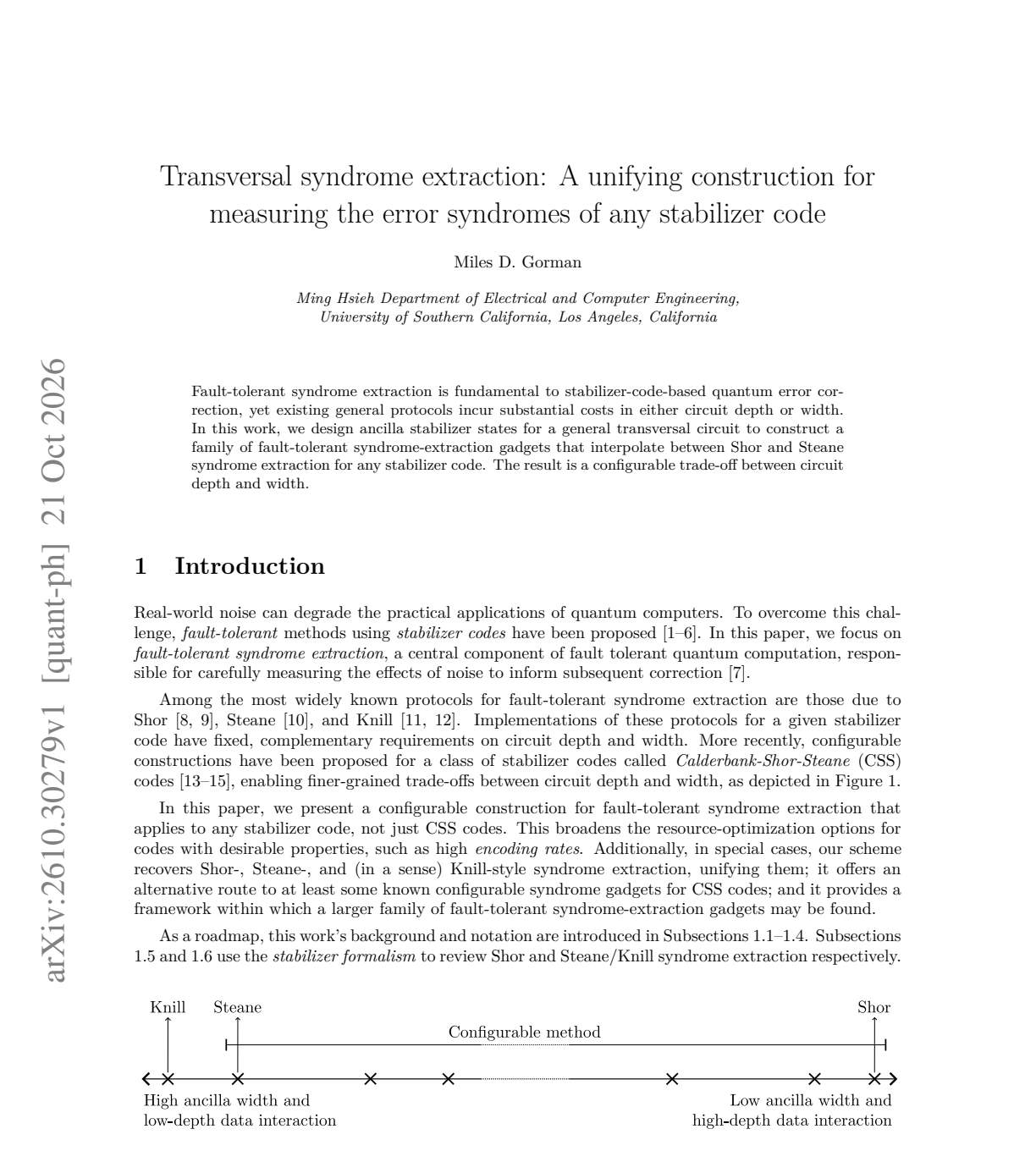
In this work, we design ancilla stabilizer states for a general transversal circuit to construct a family of fault-tolerant syndrome-extraction gadgets that interpolate between Shor and Steane syndrome extraction for any stabilizer code. The result is a configurable trade-off between circuit depth and width.
from the abstract
Pith says
Machine review · deepseek-v4-flash · 23 Oct 2026 · what was read was not recorded · not checked by a person
It can be wrong. Challenge this review or reply to it.
Holds up, with conditions. The construction is real and the provable core checks out; the abstract's 'fault-tolerant' qualifier is inherited from Shor by assertion and is the one load-bearing gap. This line is wrong
2 major objections · 4 minor
How often objections from reviews like this one are right: not yet measured
Not checked: figures, code, what the 38 references say.
The paper says, at Section 2.4 (fault tolerance)
The review did not quote this passage.
Pith says: Objection 1 of 2 · major
Sentences [b151] and [b158], against conditions [b48]-[b49]: the fault-tolerance claim is asserted rather than proved for gadgets that measure several stabilizers simultaneously. The text says that "the same fault-tolerance argument used in Shor syndrome extraction also applies to our scheme" and gives as sufficient conditions that "the prepared ancilla contains sufficiently few errors" and that the syndrome used for correction is accurate.
more of objection 1
However, conditions [b48] and [b49] require a bound on the weight of data errors accumulated before correction, and the t+1-consecutive-syndrome repetition protocol only guarantees that the final syndrome is accurate; it does not by itself bound the weight of data errors already present. A single fault during ancilla preparation can in principle produce errors on several ancilla qubits, and because the extraction layer is transversal, each such error can propagate to a different data qubit. The paper honestly acknowledges that ancilla preparation is a standalone problem [b221] and that the (t+1)^2 bound is crude [b160], but an acknowledgment does not supply the missing transfer, so the "fault-tolerant" qualifier of the abstract is not yet established.
The paper says, at Section 2.5 and Appendix H
The review did not quote this passage.
A classifier read this sentence of the paper as acknowledging the concern (probability 0.62):
“Also, new preparation methods should be explored, particularly those that suppress correlated X and Y errors; suppression of correlated Z errors may be less critical, since the redundant syndrome measurements for syndrome verification can offset their effects. 12 Acknowledgments I am grateful to Todd Brun and Terry Farrelly for their helpful comments and suggestions on this work.”
Pith says: Objection 2 of 2 · major
Table 1: the overhead factor R'(t) is defined as the number of redundant syndrome measurements needed "to guarantee fault tolerance", so the table inherits the unproved claim from Section 2.4. In addition, the table explicitly excludes ancilla preparation, and the simulations in Appendix H use ideal preparation followed by independent single-qubit depolarizing noise on each prepared qubit; this setup cannot detect correlated multi-qubit ancilla errors of the kind that the missing fault-tolerance analysis must control.
more of objection 2
The resource comparison should therefore be presented as conditional on a bounded-error ancilla-preparation protocol, and Table 1's R'(t) should be labeled as an upper bound whose validity for the intermediate gadgets is not yet demonstrated.
4 minor objections
The paper says, at Section 1.1
Pith says: minor objection 1 of 4
The opening sentence says "Then-qubit Pauli group"; this should read "The n-qubit Pauli group".
The paper says, at Figure 3
Pith says: minor objection 2 of 4
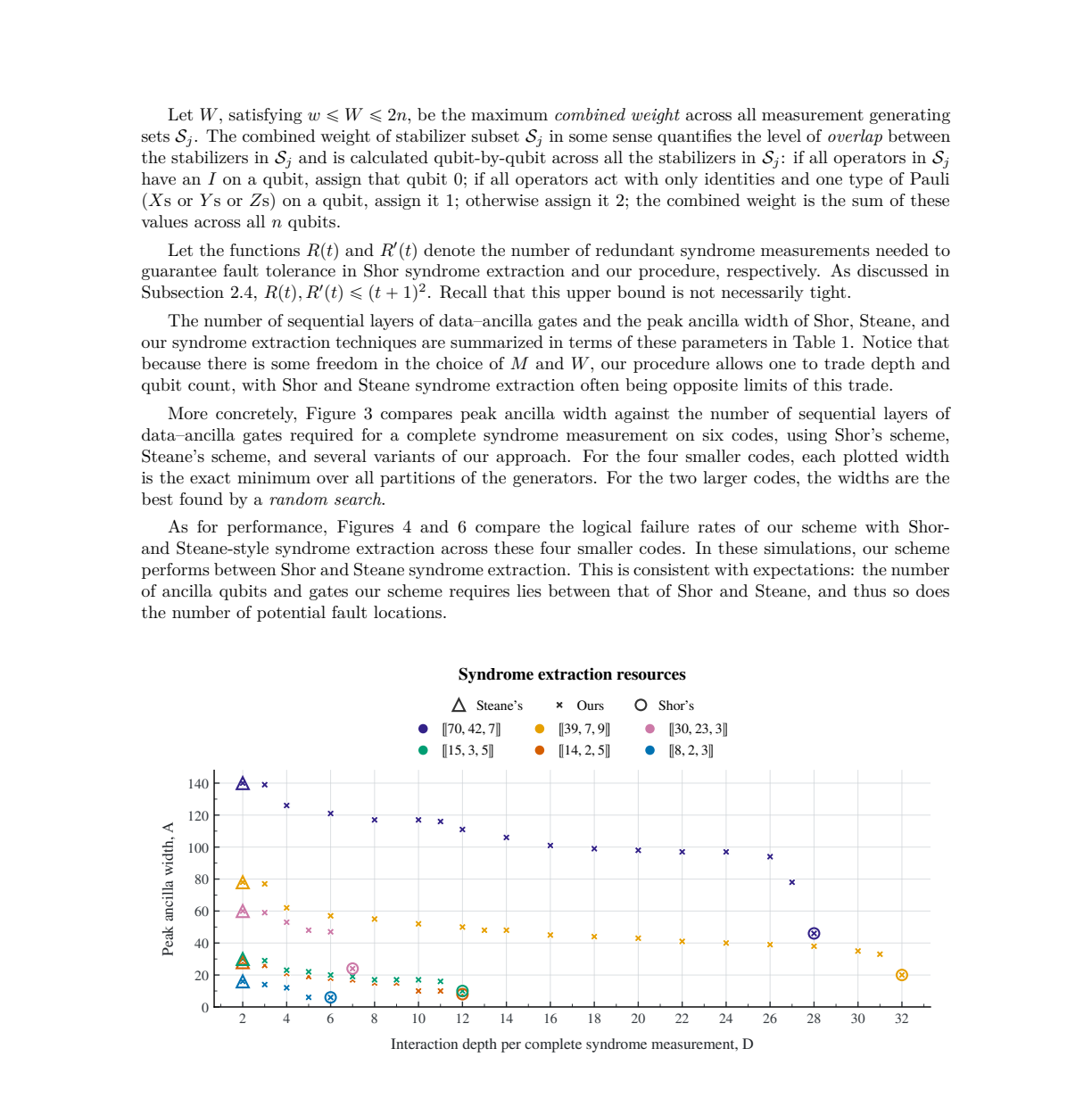
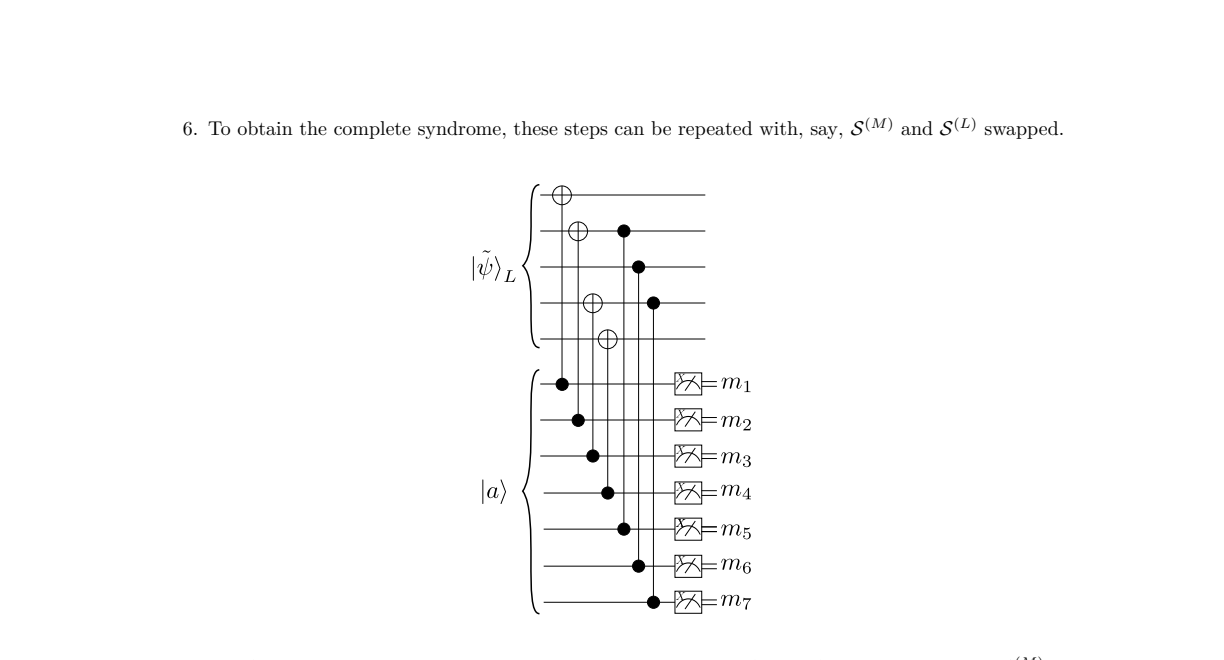
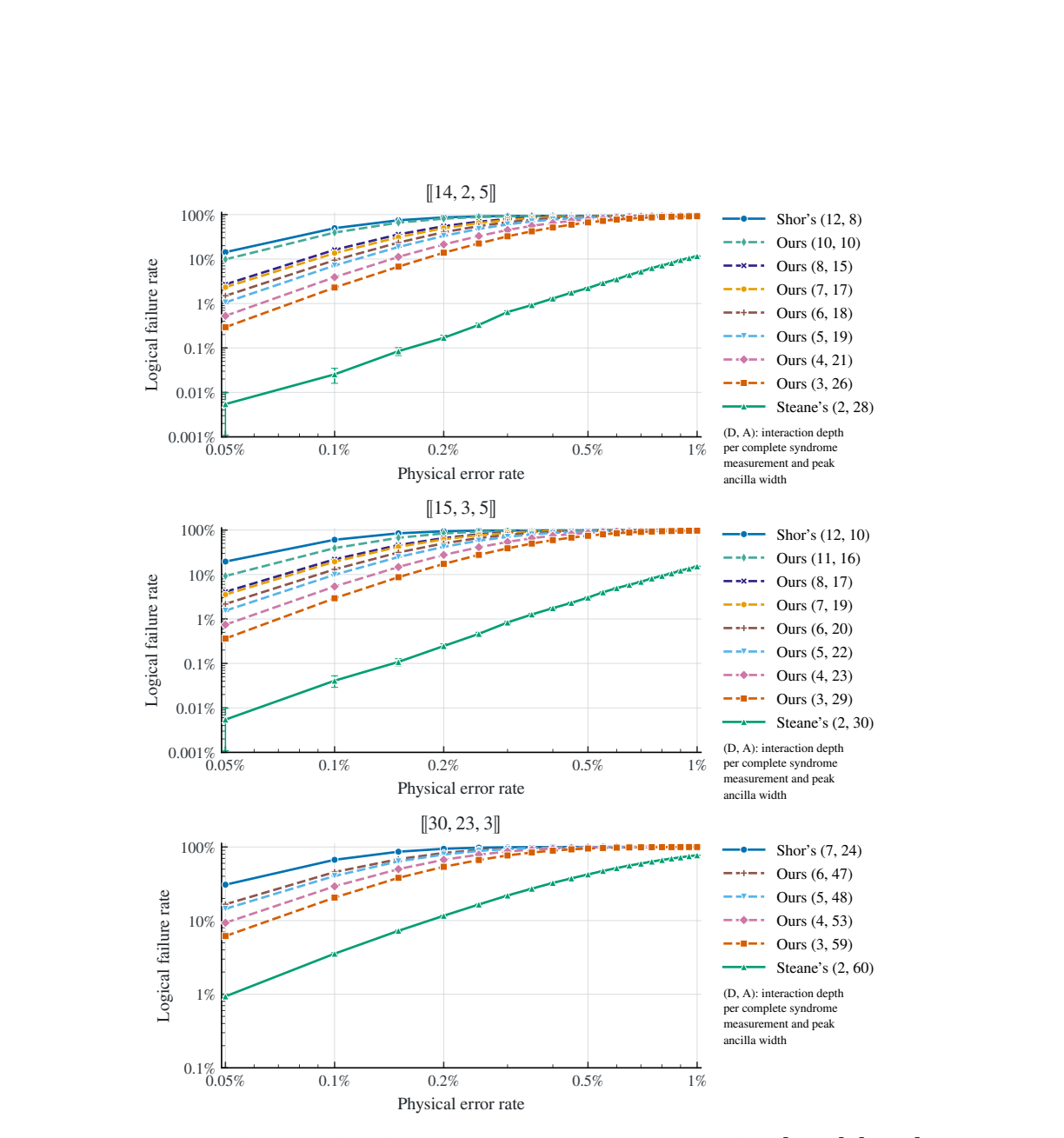
For the two larger codes, the text says the widths are "the best found by a random search"; please specify the search procedure, the number of partitions sampled, and the tie-breaking or seed rule so the displayed numbers are reproducible.
show 2 more
The paper says, at Section 2.4
Pith says: minor objection 3 of 4
Reference [7] is listed as a manuscript in preparation; the Shor fault-tolerance argument should be attributed to the published sources [9, 23], or [7] should be explicitly marked as unpublished.
The paper says, at Abstract and Section 2.3
Pith says: minor objection 4 of 4
Since Shor syndrome extraction cannot always be recovered, as acknowledged in [b143], the phrase "interpolate between Shor and Steane" should be qualified, for example by saying that the family approaches the Shor endpoint in the (depth, width) resource space rather than recovering the Shor gadget exactly for every code.
What would settle it
Take the [[5,1,3]] intermediate gadget of Appendix B (ancilla stabilizers of Eq. 23, circuit of Figure 5) and implement in Stim, under the Appendix H circuit-level depolarizing model, a complete protocol that includes a concrete verified preparation circuit for that ancilla, the Figure 5 extraction, and the t+1=2 consecutive-syndrome stop rule. Exhaustively enumerate all single-fault locations spanning preparation, extraction, and measurement, and check both fault-tolerance conditions of Section 1.2 for inputs with u <= 1 errors. If any single fault leaves an uncorrectable data error or violates condition 1, the Section 2.4 transfer claim is false for this code; if no violation is found, run the same check on the J8,2,3K intermediate points of Figure 4 to test whether the claimed R'(t) overhead survives in a full circuit-level setting.
from the skeptic's reading
How the review went
4 readings by deepseek-v4-flash · 23 Oct 2026
- Reader holds up, with conditions
- Skeptic agrees
- Editor wrote the verdict above
- Referee major revision: 2 major objections, 4 minor
Not run on this paper: the simulated authors' defence.
Pith did not check this review's objections against the paper.
The review in full
The review in brief, machine-written
The construction is real and the proofs I checked hold up; the problem is that the abstract's "fault-tolerant" qualifier is inherited from Shor by assertion, not proven, and Table 1's R'(t) rides on it.
What's new: Gorman builds, for any stabilizer code, a transversal syndrome-extraction gadget that measures any chosen subset S(M) of generators (plus a rewritten remainder S(LM)), interpolating between Shor and Steane/Knill by choosing how many stabilizers to measure at once. Huang-Brown only cover CSS codes; Takagi-Yoder-Chuang give the single Steane point. The ancilla-manipulation trick — delete the S(LL) rows from the generalized Steane ancilla, delete qubits where S(M) has zero columns, insert single-qubit Z generators — is new, and the controlled-Y variant handles Pauli-Y stabilizers. Theorems 1 and 2 are the core. I checked what the reader checked: Eq. 24 is S(M) with the deleted columns removed, the Appendix A elimination preserves its stated invariants, and the five-qubit example is consistent. The proof that Shor's cat state is recovered as a special case is a genuine check, not a triviality.
Where it's soft: Section 2.4 asserts that "the same fault-tolerance argument used in Shor syndrome extraction also applies to our scheme" and imports the (t+1)2 repetition bound without proving the transfer. That matters because one fault can corrupt several syndrome bits of a simultaneous gadget at once, and an ancilla-preparation fault can land on multiple ancilla qubits, each propagating to a different data qubit through the transversal gates. The paper states the sufficient condition — the prepared ancilla must contain "sufficiently few errors" — then declares preparation a standalone problem and excludes its cost from Table 1. Conditions [b48]/[b49] of Section 1.2 are not verified for the gadget's intermediate rounds. The author is upfront about the crude bound and the excluded cost, which counts for something, but acknowledgement doesn't close the gap: the abstract's headline claim is exactly the part that isn't proven. I'd call this a real, addressable gap, not a demonstrated error — nothing suggests the transfer fails, just that it isn't supplied.
Smaller items: the simulations are described well but ship no code or data, and they use fault-free preparation, so they don't test the missing piece. And the fault-tolerance conditions lean partly on [7], a manuscript in preparation by the same author; that should be replaced or de-emphasized.
Who it's for: anyone optimizing syndrome-extraction resources for non-CSS or high-rate codes. The construction is the contribution and deserves a serious referee. I'd send it out with a request that the author either prove the fault-tolerance transfer or scale the abstract back to "conditional on ancilla preparation."
The strongest objection
The provable core—Theorems 1, 2, 5, 6 and the Appendix A partitioning algorithm—appears internally consistent, and the reader's spot-checks of the five-qubit example and the Appendix C validity argument are borne out by the text. The load-bearing step is the fault-tolerance claim in Section 2.4. There the paper asserts [b158] that 'the same fault-tolerance argument used in Shor syndrome extraction also applies to our scheme', then imports the (t+1)^2 repetition bound. This transfer is not proved for gadgets that measure several stabilizers simultaneously. The only stated sufficient condition, [b151], is that the prepared ancilla 'contains sufficiently few errors'; ancilla preparation is then called a standalone problem and excluded from Table 1. What remains unresolved is that a single preparation fault could in principle produce errors on several ancilla qubits, and because the extraction layer is transversal, each such error can propagate to a different data qubit. The t+1-consecutive-syndrome repetition protocol controls the accuracy of the final syndrome, but it does not by itself bound the weight of data errors accumulated before that final accurate syndrome. Consequently, conditions [b48] and [b49] of Section 1.2 are not shown to hold for the intermediate gadgets, and the R'(t) factor in Table 1 is not justified as a fault-tolerance overhead. The author honestly acknowledges the preparation-cost exclusion and the crudeness of the bound [b160, b221], but acknowledgement does not supply the missing preparation protocol or the missing argument that one fault cannot undo the fault-tolerance conditions.
The reader's CONDITIONAL verdict is the right one. My independent read of the appendices did not reveal an internal inconsistency in the provable core: the Appendix A algorithm satisfies its stated invariants, Theorem 1's stabilizer-validity argument is coherent, Appendix D's propagation calculation has the right structure, and the five-qubit example matches the claimed syndrome matrix. The concern is therefore not mathematical correctness of the construction but the strength of the abstract's claim that the gadgets are fault-tolerant. Section 2.4's transfer of Shor's fault-tolerance argument is the single load-bearing unproven step: it is asserted, not derived, and it is conditional on an ancilla-preparation guarantee for states that are new in the intermediate regime. Table 1's R'(t) factor inherits this unproven status, and the preparation cost is explicitly excluded, so the advertised depth-width trade-off is demonstrated only for interaction layers. The author acknowledges the exclusion and the crudeness of the repetition bound, but those acknowledgements do not close the gap. A single counterexample in a small code would settle the concern negatively; a clean exhaustive fault-path analysis together with a written Shor-style lemma for these gadgets would settle it positively. I do not escalate to REJECT because the construction itself appears sound and the missing fault-tolerance proof and preparation protocol are conditions on the central claim rather than demonstrated failures of it.
The referee's report
If the algebraic claims hold, this is a useful unifying framework: any stabilizer code receives a family of transversal syndrome-extraction gadgets trading depth against width, with Steane/Knill extraction at one extreme and a near-Shor regime at the other. The paper's strengths are explicit and checkable stabilizer-propagation proofs for the ancilla-validity and syndrome-extraction claims, an explicit partitioning algorithm, a worked five-qubit example, and Monte Carlo resource and performance comparisons under circuit-level noise with ideal ancilla preparation. I found the Appendix A invariants, Eq. (24), and the five-qubit construction consistent with the stated result. The main weakness is that the fault-tolerance claim and the R'(t) overhead in Table 1 rest on an asserted transfer of Shor's argument, not on a proof for simultaneous multi-stabilizer gadgets; this gap is load-bearing because "fault-tolerant" appears in the abstract and in the central resource comparison.
Pith's reading of the paper (a machine's summary, not the authors')
The paper aims to show that a single family of circuits can measure the error syndrome of any stabilizer code, with Shor syndrome extraction at one end and Steane (equivalently Knill) syndrome extraction at the other, and every point in between available as a tunable depth–width trade-off. The construction is explicit: group the stabilizer generators as $S = S(M) \cup S(LM) \cup S(LL)$ subject to two column conditions, build an ancilla by trimming the generalized Steane ancilla, and run a transversal controlled-Pauli circuit; Theorems 1 and 2 prove the ancilla is a valid stabilizer state and that the circuit reads off exactly the syndrome bits of $S(M) \cup S(LM)$ while leaving the data untouched. If correct, the result extends to every stabilizer code—not just CSS codes—the configurable syndrome-extraction flexibility previously available only for CSS codes, and it recovers Shor, Steane, and Knill protocols as special cases. The cost of preparing the constructed ancilla states is set aside, and fault tolerance is argued by transferring Shor's repetition argument rather than by a new proof.
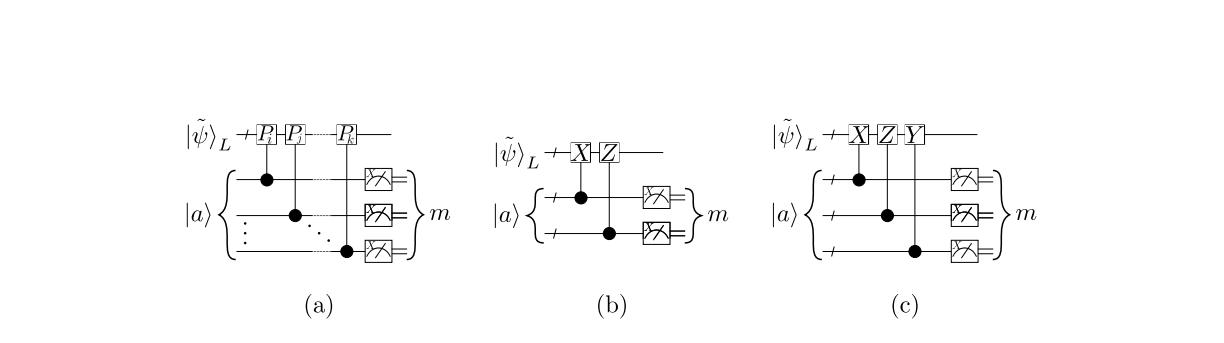
What carries the argument. The load-bearing object is the partition of the stabilizer generators $S = S(M) \cup S(LM) \cup S(LL)$ together with two column conditions: every zero column of $S(M)$ is also a zero column of $S(LM)$, and every row of $S(LL)$ has a $1$ in a column that no other row of $S(M) \cup S(LL)$ touches. The algorithm in Appendix A shows this form is reachable for any stabilizer code through row operations on the generator matrix. The partition dictates the ancilla: start from the generalized Steane ancilla of Eq. 19, drop the $S(LL)$ rows, delete the qubits on which $S(M)$ is identically identity, and add single-qubit $Z$ generators at the deleted sites; the column conditions guarantee the ancilla is a valid stabilizer state (Theorem 1) and that the transversal controlled-Pauli circuit transfers precisely the syndrome bits of $S(M) \cup S(LM)$ onto the ancilla's $X$-type stabilizers, where $X$-basis measurement reads them off (Theorem 2). The number $M$ of measuring sets needed to cover the full stabilizer group is the dial that moves the gadget between the Shor limit (one stabilizer per round, deep and narrow) and the Steane limit (all stabilizers at once, shallow and wide), with peak ancilla width $W$ between $w$ and $2n$ and interaction depth $2M R'(t)$. In the controlled-$Y$ variant, pairs of $C(X)$ and $C(Z)$ gates collapse into single $C(Y)$ gates when the measured stabilizers act only as $Y$ or identity on a qubit, preserving the validity and syndrome-extraction theorems while saving ancilla qubits.
Core claim. The central claim is that a single procedure, transversal syndrome extraction, works for any stabilizer code. Given a code and a chosen subset $S(M)$ of stabilizers to measure in the current round, the remaining generators are rewritten as $S(LM) \cup S(LL)$ using an algorithm that works for every code, so that $S(LM)$ vanishes on every column where $S(M)$ is zero and every row of $S(LL)$ has a unique $1$ in some column. Step 3 of the procedure deletes the $S(LL)$ rows from the generalized Steane ancilla and deletes the qubits on which $S(M)$ acts trivially, restoring a full set of generators with single-qubit $Z$ terms; Step 4 runs the transversal circuit of Figure 2b. Theorem 1 establishes that the resulting ancilla is a valid stabilizer state, and Theorem 2 that the $X$-basis measurement outcomes yield exactly the syndrome bits of $S(M) \cup S(LM)$ while leaving the data state unchanged; Theorems 5 and 6 extend both statements to a controlled-$Y$ variant that merges the $X$- and $Z$-controlled gates. Fault tolerance is claimed by transferring Shor's argument: $t$ faults can misdiagnose a syndrome in at most $t$ complete measurements, so repeating until $t+1$ consecutive identical syndromes, at most $(t+1)^2$ rounds, guarantees an accurate syndrome.
The premise it rests on. The load-bearing premise is that Shor's fault-tolerance argument transfers unchanged to the new gadgets, namely that $t$ faults can misdiagnose the syndrome at most $t$ times, and that each constructed ancilla state can be prepared with few enough errors—a preparation cost the paper's overhead comparison does not include.
If the paper is right (Pith's inferences, not the authors')
Every stabilizer code, including non-CSS codes such as the five-qubit code, gains a continuous depth–width dial for syndrome extraction instead of being restricted to Shor's deep circuit or Steane's wide one.
The construction reduces to Shor syndrome extraction when one stabilizer is measured per round and $S(LM)$ is empty, to generalized Steane (equivalently Knill) syndrome extraction when all generators are measured at once, and to a known configurable scheme for CSS codes when applied to the Steane $[\![7,1,3]\!]$ code.
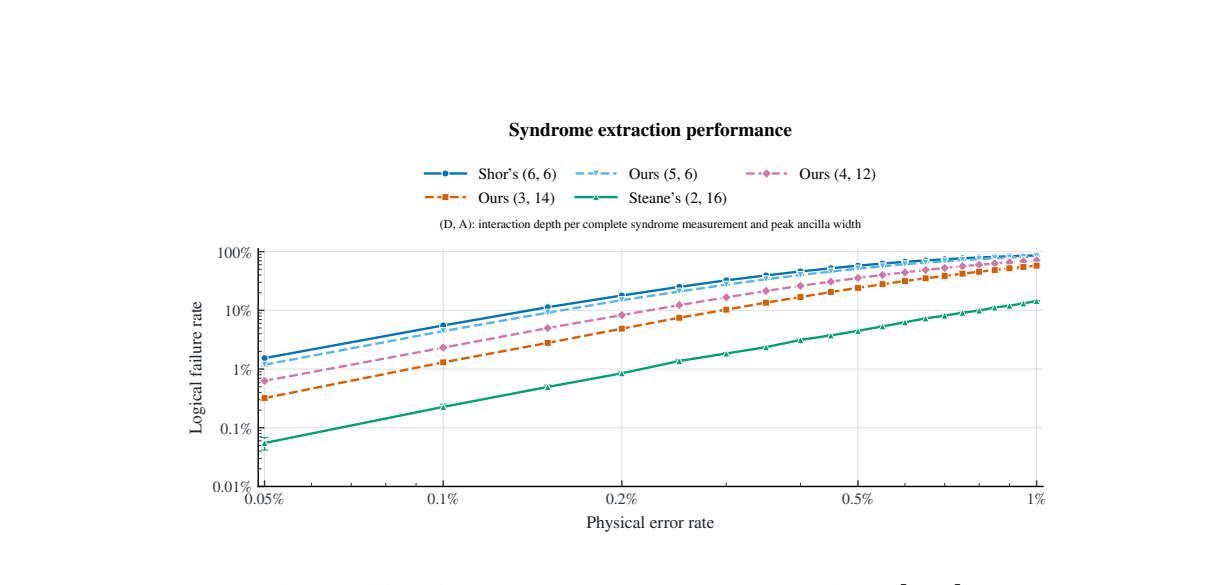
For a code with $m$ generators each of weight at most $w$, the worst-case interaction depth is $2M R'(t)$ with peak ancilla width $W$ satisfying $w \le W \le 2n$, so choosing how to cover the stabilizer group by $M$ measuring sets moves the gadget along the trade-off; Monte Carlo simulations on four non-CSS codes place the logical failure rate between Shor's and Steane's.
The repetition factor $R'(t) \le (t+1)^2$ is inherited from Shor's scheme, but because several stabilizers are measured simultaneously, the paper argues the redundancy could be reduced below Shor's $R(t)$, with the Steane limit needing only a single complete measurement.
Because the data–ancilla interactions are transversal and the data state is left unchanged, the gadget composes safely with a standard measure-and-correct loop, and the paper notes the same framework can measure products of stabilizers to encode the syndrome in a checkable form.
Because the overhead comparison excludes ancilla preparation, the practical trade-off is only fully established once those circuits are counted; a direct test would be to rerun the paper's Monte Carlo protocol with realistic, verified ancilla preparation folded into the width, depth, and failure-rate numbers.
The construction recasts gadget design as a covering problem over the stabilizer group, so an algorithmic treatment—finding covers of a given code whose combined weight and number of sets are near-optimal—is the natural next step, one the paper only sketches by exhaustive or random search.
The verification bound is inherited from Shor's scheme, and the author's expectation that simultaneous measurement reduces the number of redundant rounds is testable: counting how often a wrong syndrome survives the $(t+1)$-agreement rule, for each point on the depth–width curve, would settle whether $R'(t) < R(t)$ holds.
If the construction is right, the interpolation points matter most for high-rate non-CSS codes, where Shor depth and Steane width are both prohibitive; identifying code families whose stabilizers admit low-combined-weight covers is the condition that would make the dial practically valuable.
Check this review
Pith stored no record of this review's passes and took no fingerprint of it. Reviews made by code from 13 Nov 2026 on carry both.
How often reviews like this one are right
Reviews like this one: written by deepseek-v4-flash, where what was read was not recorded.
How often objections from reviews like this one are right: not yet measured
Reviews by people
This review was written by a machine. No person has reviewed this paper on Pith yet. A scientist listed on Pith can review it for a fee, and their review is published here whatever it concludes.
The paper
Abstract
Fault-tolerant syndrome extraction is fundamental to stabilizer-code-based quantum error correction, yet existing general protocols incur substantial costs in either circuit depth or width. In this work, we design ancilla stabilizer states for a general transversal circuit to construct a family of fault-tolerant syndrome-extraction gadgets that interpolate between Shor and Steane syndrome extraction for any stabilizer code. The result is a configurable trade-off between circuit depth and width.
The paper's own sentences, arranged, kept beside the review and separate from it. Each label is drawn from a closed vocabulary; the number beside it is the probability the classifier gave that label. No sentence in this record was written by a model.
abstract compiled · 2026-10-23
The authors' main claim, as the classifier picked it out 0.76
“The result is a configurable trade-off between circuit depth and width.”
How the main claim is stated: asserted 1.00
What the abstract itself states, as probabilities: claims first 0.08 · states limitation 0.24 · human participants 0.01 · controlled comparison 0.16 · randomized assignment 0.01 · states quantitative result 0.05 · compares with prior results 0.89 · mentions code or data availability 0.03
The abstract, sentence by sentence
This table labels the abstract only (arXiv listing abstract v1). The number is the probability the classifier gave the label.
| Sentence | Role | The authors' own work | States the main conclusion | Strength |
|---|---|---|---|---|
| Fault-tolerant syndrome extraction is fundamental to stabilizer-code-based quantum error correction, yet existing general protocols incur substantial costs in either circuit depth or width. | background 0.83 | 0.05 | 0.04 | asserted 1.00 |
| In this work, we design ancilla stabilizer states for a general transversal circuit to construct a family of fault-tolerant syndrome-extraction gadgets that interpolate between Shor and Steane syndrome extraction for any stabilizer code. | contribution 0.69 | 0.96 | 0.34 | asserted 1.00 |
| The result is a configurable trade-off between circuit depth and width. | result 0.82 | 0.86 | 0.50 | asserted 1.00 |
What kind of paper the classifier reports this is: method or tool 0.99 · evidence from proof or derivation 0.91
What was examined, and what was not
Sources read
- arXiv listing abstract v1
Not examined
- full text
- figures and tables
- references and citing sentences
- relations to other papers
Levels run
- P abstract
Not run
- S sections
- T body sentences
- C citations
- R cross-paper relations
How the labels were made
Compiled by classifier-1.13.0 via TypeSafe API, question bank abstract-p1-20260923, 2026-10-23: 1 request, 2,955 input tokens.
Every quoted sentence on this record is the authors'. Every label is from Pith's closed vocabulary, with the probability shown beside it. This record as JSON
Figures (6)
Figures are the authors', reproduced from the paper.
References (38)
- [7] M. D. Gorman and T. Farrelly, “Syndromes and stabilizers: a review of fault-tolerant syndrome extraction in quantum error correction”, (Manuscript in preparation) on Pith
- [1] D. Aharonov and M. Ben-Or, “Fault-tolerant quantum computation with constant error”, in Proceedings of the twenty-ninth annual acm symposium on theory of computing, STOC ’97 (1997), pages 176–188 on Pith
- [2] E. Knill, R. Laflamme, and W. Zurek, “Resilient quantum computation”, Science 279, 342–345 (1998) on Pith
- [3] P. Aliferis, D. Gottesman, and J. Preskill, “Quantum accuracy threshold for concatenated distance-3 codes”, Quantum Information and Computation 6, 97–165 (2006) on Pith
- [4] D. Gottesman, “Fault-tolerant quantum computation with constant overhead”, Quantum Informa- tion and Computation 14, 1338–1372 (2014) on Pith
- [5] O. Fawzi, A. Grospellier, and A. Leverrier, “Constant overhead quantum fault tolerance with quantum expander codes”, Communications of the ACM 64, 106–114 (2020) on Pith
- [6] O. Fawzi, A. M¨ uller-Hermes, and A. Shayeghi, “A Lower Bound on the Space Overhead of Fault- Tolerant Quantum Computation”, in 13th innovations in theoretical computer science conference (itcs 2022), Vol. 215, edited by M. Braverman, Leibniz International Proceedings in Infor... on Pith
- [8] P. Shor, “Fault-Tolerant Quantum Computation”, in Proceedings of 37th conference on foundations of computer science (1996), pages 56–65 on Pith
- [9] D. P. DiVincenzo and P. W. Shor, “Fault-Tolerant Error Correction with Efficient Quantum Codes”, Physical Review Letters 77, 3260–3263 (1996) on Pith
- [10] A. M. Steane, “Active Stabilization, Quantum Computation, and Quantum State Synthesis”, Phys. Rev. Lett. 78, 2252–2255 (1997) on Pith
- [11] E. Knill, “Scalable quantum computing in the presence of large detected-error rates”, Phys. Rev. A 71, 042322 (2005) on Pith
- [12] E. Knill, “Quantum computing with realistically noisy devices”, Nature 434, 39–44 (2005) on Pith
- [13] S. Huang and K. R. Brown, “Between shor and steane: a unifying construction for measuring error syndromes”, Phys. Rev. Lett. 127, 090505 (2021) on Pith
- [14] S. Huang and K. R. Brown, “Constructions for measuring error syndromes in calderbank-shor- steane codes between shor and steane methods”, Phys. Rev. A 104, 022429 (2021) on Pith
- [15] S. Huang, T. Jochym-O’Connor, and T. J. Yoder, “Homomorphic logical measurements”, PRX Quantum 4, 030301 (2023) on Pith
- [16] D. Gottesman, Surviving as a quantum computer in a classical world, Lecture notes / draft textbook available at https://www.cs.umd.edu/˜dgottesm/ (University of Maryland, 2024) on Pith
- [17] J. Roffe, “Quantum error correction: an introductory guide”, Contemporary Physics 60, 226–245 (2019) on Pith
- [18] M. A. Nielsen and I. L. Chuang, Quantum Computation and Quantum Information (Cambridge University Press, 2000) on Pith
- [19] D. Gottesman, The heisenberg representation of quantum computers , 1998. 13 on Pith
- [20] D. Gottesman, “Stabilizer codes and quantum error correction”, Caltech (PhD Thesis) (1997) on Pith
show 18 more
- [21] D. Gottesman, An introduction to quantum error correction and fault-tolerant quantum computa- tion, 2009 on Pith
- [22] R. Takagi, T. J. Yoder, and I. L. Chuang, “Error rates and resource overheads of encoded three- qubit gates”, Phys. Rev. A 96, 042302 (2017) on Pith
- [23] T. Tansuwannont, B. Pato, and K. R. Brown, “Adaptive syndrome measurements for shor-style error correction”, Quantum 7, 1075 (2023) on Pith
- [24] A. B. Khesin, S. M. Li, B. Po´ or, B. Rodatz, J. van de Wetering, and R. Yeung, Spidercat: optimal fault-tolerant cat state preparation, 2026 on Pith
- [25] C.-Y. Lai, Y.-C. Zheng, and T. A. Brun, “Fault-tolerant preparation of stabilizer states for quantum calderbank-shor-steane codes by classical error-correcting codes”, Phys. Rev. A 95, 032339 (2017) on Pith
- [26] Y.-C. Zheng, C.-Y. Lai, and T. A. Brun, “Efficient preparation of large-block-code ancilla states for fault-tolerant quantum computation”, Phys. Rev. A 97, 032331 (2018) on Pith
- [27] P. Prabhu and B. W. Reichardt, “Fault-tolerant syndrome extraction and cat state preparation with fewer qubits”, Quantum 7, 1154 (2023) on Pith
- [28] T. Peham, L. Schmid, L. Berent, M. M¨ uller, and R. Wille, “Automated synthesis of fault-tolerant state preparation circuits for quantum error-correction codes”, PRX Quantum 6, 020330 (2025) on Pith
- [29] N. Delfosse, B. W. Reichardt, and K. M. Svore, “Beyond single-shot fault-tolerant quantum error correction”, IEEE Transactions on Information Theory 68, 287–301 (2022) on Pith
- [30] A. Ashikhmin, C. Y. Lai, and T. A. Brun, “Quantum data-syndrome codes”, IEEE Journal on Selected Areas in Communications 38, 449–462 (2020) on Pith
- [31] N. Delfosse and B. W. Reichardt, Short shor-style syndrome sequences , 2020 on Pith
- [32] D. Gottesman, “Opportunities and challenges in fault-tolerant quantum computation”, (2022) on Pith
- [33] S. Bravyi, D. Poulin, and B. Terhal, “Tradeoffs for reliable quantum information storage in 2d systems”, Phys. Rev. Lett. 104, 050503 (2010) on Pith
- [34] N. Baspin and A. Krishna, “Quantifying nonlocality: how outperforming local quantum codes is expensive”, Phys. Rev. Lett. 129, 050505 (2022) on Pith
- [35] D. A. Lidar and T. A. Brun, editors, Quantum error correction (Cambridge University Press, 2013) on Pith
- [36] C. Gidney, “Stim: a fast stabilizer circuit simulator”, Quantum 5, 497 (2021) on Pith
- [37] M. D. Gorman and T. Farrelly, Ancilla-free-preparation-of-stabilizer-states, https://github.com/ MilesGorman/Ancilla-Free-Preparation-of-Stabilizer-States , 2025 on Pith
- [38] M. Grassl, Bounds on the minimum distance of linear codes and quantum codes , Online available at http://www.codetables.de, 2007. 14 Appendix A Algorithm for partitioning xSpLqy Given a set of stabilizer generators SpMq to be measured in the current round, and a set of stabili... on Pith
Cited by 1 Pith paper
Reviewed papers on Pith that cite this one. The full citation record
Challenges and discussion
Disagree with the review, or know something it missed? Leave a comment, or challenge this review formally: a challenge becomes a permanent entry in this paper's record, and its decision is published here.
Come back by email
A short list of the week's newly reviewed papers. Nothing is sent until you confirm from your inbox, and every email has a link that stops it. No account.
No comments yet.
Sign in to comment