Computation and Language · arXiv:2610.06625 v1 · submitted 5 Oct 2026 · 28 references
JEV versus LLMs: Accuracy, Cost and Calibration on Seven Political Science Replications
The paper says
“Large language models (LLMs) annotate and scale political text or constructs by generating text tokens. A new class of models, which TypeSafe markets as "System One" models, instead returns decisions and probability distributions across a user-supplied fixed answer set.”
more of the abstract
A commercial model, JEV, is advertised as having a dramatic cost and speed advantage over traditional LLMs along with better calibrated decisions. As such, it might be useful for social scientists looking to quickly and cost-effectively annotate or scale large corpora of text and have a reliable indicator of a classifier's uncertainty. Yet, the accuracy of these claims and the broader model accuracy in social science text-based tasks are not yet established. In this paper, we do just that and hope to establish the suitability of JEV for social science tasks. We compare JEV with LLMs and human coders from published research, and with a current mid-tier commercial LLM (GPT-6 Luna) and an open-weight alternative (Qwen3.8-27B). We find that JEV matches, or comes close to, the capabilities of both LLMs in a variety of tasks. However, we find no cost advantage over GPT-6 Luna at OpenAI's batch prices. Further, we find that, when each question is asked once, JEV's probabilities are better calibrated than GPT-6 Luna's token probabilities, but not consistently better than Qwen3.8-27B's. We conclude that unless researchers have a need for speed, JEV's only obvious advantage is ease of parsing the underlying choice probabilities.
from the abstract
Pith says
Machine review · deepseek-v4-flash · 6 Oct 2026 · what was read was not recorded · not checked by a person
It can be wrong. Challenge this review or reply to it.
The passes disagreed. Reader: holds up. Skeptic: holds up only with conditions. Referee: major revision.
A careful, honest evaluation of a new constrained-output model; the accuracy and cost findings hold, but the calibration advantage over GPT-6 Luna needs a label-noise adjustment before it is load-bearing. This line is wrong
2 major objections · 4 minor
How often objections from reviews like this one are right: not yet measured
Not checked: figures, code, what the 28 references say.
The paper says, at §'JEV's advantage?' and Figure 2; Appendix G, Table 8 note
The review did not quote this passage.
Pith says: Objection 1 of 2 · major
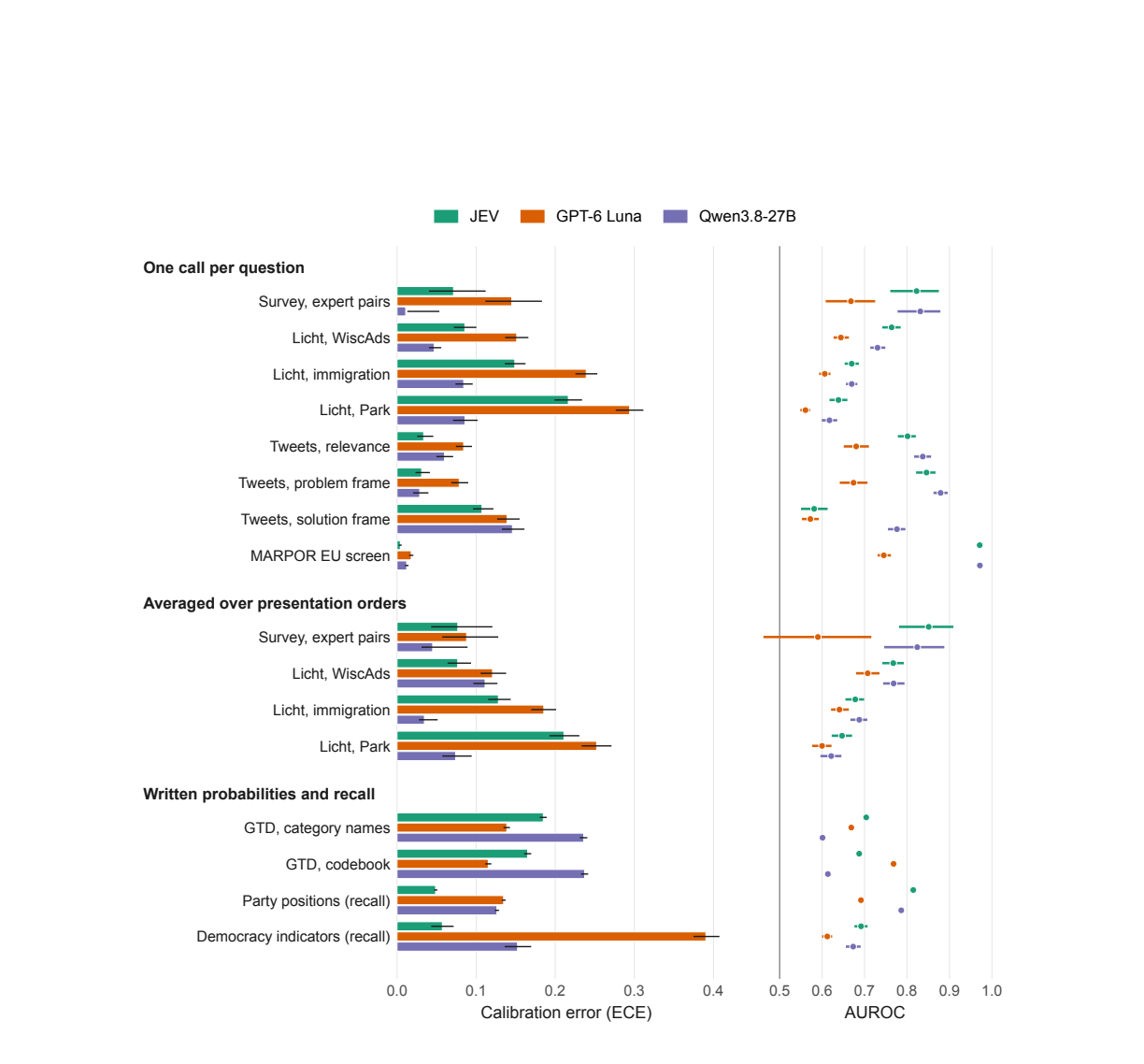
The single-call calibration advantage over GPT-6 Luna on the eight labeled tasks is computed against observed human labels, which are noisy: Appendix G reports two expert judgments of the same survey pair agree only 75.2% of the time, an effective per-judgment error of roughly 0.13.
more of objection 1
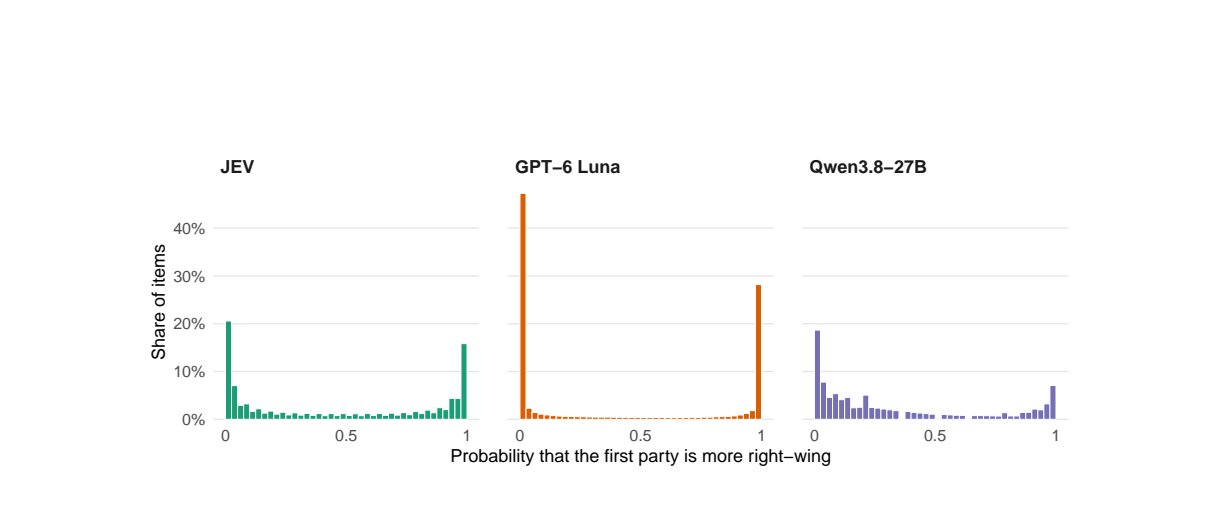
Under the standard flip model (observed label equals latent truth with probability 1-e), ECE against observed labels is e|1-2p| for a model whose stated probability p equals the latent truth probability. A model whose probabilities concentrate near 0/1 -- GPT-6 Luna has 74% of party-comparison probabilities below 0.01 or above 0.99 (Figure 1) -- pays an ECE penalty near e even when perfectly calibrated, while JEV's mid-range probabilities pay much less. The reported JEV-versus-Luna gap may therefore reflect the difference in the models' marginal probability distributions under a noisy gold standard rather than a difference in latent calibration. The authors acknowledge rater disagreement and its ceiling on any scorer (Table 8 note), but they do not model the asymmetric effect on ECE across models with different probability distributions. Because 'better calibrated than GPT-6 Luna' is one of the paper's two positive findings, this needs a label-noise-adjusted check before it is load-bearing: for example, a debiased ECE estimator, or restricting the comparison to tasks (or subsets) where labels are adjudicated or measured with high agreement, with the survey-pair row as the priority case (rater noise is documented there, and the gap is 0.145 vs 0.071 in single calls).
The paper says, at Appendix H, additional calibration tasks; Figure 2
The review did not quote this passage.
Pith says: Objection 2 of 2 · major
For the Licht (WiscAds, Immigration, Park) and MARPOR EU-screen rows of Figure 2, the correctness target is not a directly observed human label but the winner determined by a Bradley-Terry scale estimated from coders' comparisons (Appendix H: 'the answer counted as correct is the text with the higher score on the Bradley-Terry scale estimated from the human coders' comparisons').
more of objection 2
ECE and AUROC against this derived target inherit estimation noise in the scale itself, and that noise interacts with each model's probability distribution in the same way as the survey-pair noise described above. A sensitivity analysis that computes ECE only on pairs whose BT-scale winner is estimated from multiple or highly concordant judgments (or that reports the noise floor for this target) would strengthen the claim that the calibration advantage over Luna is not an artifact of the target construction.
4 minor objections
The paper says, at Table 1 and §'Open-ended survey responses'
Pith says: minor objection 1 of 4
One of the replicated applications, DiGiuseppe and Flynn (2026), is co-authored by a paper author; this should be disclosed where the application is introduced, even though the human benchmark and published prompts are used and one of the tasks also uses a GPT-4o-derived scale for some comparisons.
The paper says, at §'Terrorist attack type'
Pith says: minor objection 2 of 4
The sentence 'First they classify the attack type of 37,709 Global Terrorism Database ... incidents ... Second ...' contains a stray word: 'are meant to demonstrate test the utility of LLMs' should read 'demonstrate the utility.'
show 2 more
The paper says, at Introduction, RLCD paragraph
Pith says: minor objection 3 of 4
The sentence 'As such, it is no obvious that the RLCD would translate to honest calibration across all uses cases' should read 'it is not obvious,' and 'uses cases' should be 'use cases.'
The paper says, at §'JEV's advantage?'
Pith says: minor objection 4 of 4
The sentence 'Yet, Where JEV does show better calibration than Qwen, the differences are not dramatic' has an internal capitalization error after the comma; 'Where' should be lowercase.
What would settle it
Use each model's stored per-item probabilities from the replication archive and estimate the label-noise rate e from duplicate judgments: Appendix G's 75.2% pairwise rater agreement implies e roughly 0.13, and Gilardi's two-annotator agreement gives comparable values. Simulate, say, 1,000 draws of latent labels y_i* ~ Bernoulli(p_i), then observed labels y_i = y_i* with probability 1-e and flipped with probability e; compute ECE and AUROC against both latent and observed labels, preserving the paired JEV-minus-Luna comparisons. If the JEV-Luna ECE gap shrinks materially or reverses under latent-label scoring while persisting under observed-label scoring, the advertised calibration advantage is partly or wholly an artifact of label noise.
from the skeptic's reading
How the review went
4 readings by deepseek-v4-flash · 6 Oct 2026
- Reader holds up
- Skeptic partly agrees: says it holds up only with conditions Noisy human labels can asymmetrically inflate GPT-6 Luna's ECE relative to JEV because Luna's token probabilities concentrate near 0/1; the calibration advantage needs a label-noise-adjusted check before it is load-bearing.
- Editor wrote the verdict above
- Referee major revision: 2 major objections, 4 minor
Not run on this paper: the simulated authors' defence.
Pith did not check this review's objections against the paper.
The review in full
The review in brief, machine-written
Two things to know up front. This is the most careful evaluation so far of a commercial constrained-output model on political science text benchmarks, and its main conclusions hold up: JEV is roughly on par with GPT-6 Luna and Qwen3.8-27B, faster, and no cheaper at OpenAI batch prices. The paper's other positive finding — JEV's probabilities are better calibrated than Luna's token probabilities — is shakier, because the ECE target is noisy human labels that penalize Luna's extreme probabilities more than JEV's mid-range ones.
The craft is genuinely good. They reproduce published figures exactly (all 71 cells of the Brandt tables, Gilardi et al.'s 93.9% intercoder agreement), use paired bootstrap intervals throughout, print the exact prompts, and probe benchmark contamination in the recall tasks with a clever split on CHES coverage. They also stay honest about what cannot be known: TypeSafe publishes no architecture, training data or reward function, and the authors say so rather than overreading outputs. The speed, cost, transitivity and test-retest sections are a useful template for benchmarking closed models.
The calibration finding is the load-bearing soft spot. Appendix G reports two expert judgments of the same survey pair agreeing only 75.2% of the time — per-judgment error rate around e ≈ 0.14. Against such labels, a perfectly calibrated model with probability p has observed ECE ≈ e·|1−2p|. Luna, with 74% of its party-comparison probabilities below 0.01 or above 0.99, pays nearly e in measured ECE even if its latent calibration is perfect; JEV's mid-range probabilities pay much less. The reported gap could largely be label noise plus distributional differences (truncated, rounded token probabilities versus full choice distributions), not latent calibration. The authors acknowledge the rater disagreement and even state the ceiling it sets, but never adjust the ECE computation for it. The AUROC comparisons are more robust — noise attenuates ranking metrics fairly evenly across models, and Luna is still lower on seven of eight tasks — so the ranking argument partially survives, but "better calibrated" as stated is not established.
Minor items: no link or commit hash for the replication archive; one benchmark is the authors' own prior study (DiGiuseppe and Flynn), though independent expert-pair judgments keep it grounded; the framing-task instructions are reconstructed, as they disclose.
This is a paper for text-as-data practitioners who need a benchmarked comparison point for a newly marketed model class. It deserves a serious referee. The fix is narrow: add a label-noise-adjusted ECE — they have the disagreement data to do it — or reduce the claim to "Luna's token probabilities are more dispersed," and the rest stands.
The strongest objection
The central calibration claim is that, when each question is asked once, JEV's probabilities have lower ECE than GPT-6 Luna's token probabilities on all eight categorical tasks. The ECE target is the observed human label, but those labels are noisy: Appendix G reports two expert judgments of the same survey pair agree only 75.2% of the time, implying a per-judgment error rate of roughly e = 0.13. Label noise does not add the same ECE to every model. If latent correctness Y* relates to a model's stated probability p by P(Y*=1|p)=p, and the observed label Y equals Y* with probability 1-e and flips otherwise, then ECE against observed labels is |e+(1-2e)p - p| = e|1-2p|. A model whose probabilities are concentrated near 0 or 1 — Luna has 74% of party-comparison probabilities below 0.01 or above 0.99 in Figure 1 — pays an ECE penalty of roughly e even when perfectly calibrated to the latent truth, while JEV's mid-range probabilities can score low ECE against noisy labels. The reported JEV-versus-Luna calibration gap may therefore reflect the difference in marginal probability distributions under a noisy gold standard rather than a difference in latent calibration. The authors acknowledge rater disagreement and even note the ceiling it places on any scorer, but they do not model label noise in the ECE computation. Because 'better calibrated than GPT-6 Luna' is one of the paper's two positive findings, this assumption is load-bearing.
The reader's ACCEPT is largely defensible: the accuracy comparisons rest on published replications, paired bootstraps, reproduced figures, and explicit discussion of benchmark-contamination risks in the recall tasks. The cost finding is supported by run totals and posted batch prices, and the speed measurements are transparently scoped. My concern targets the calibration half of the strongest claim. The paper itself supplies the key statistic — 75.2% agreement between two expert judgments of the same survey pairs in Appendix G — but does not propagate that label noise into the ECE comparisons. The mechanism is not a generic 'labels are imperfect' caveat: under a symmetric noise model, ECE against observed labels equals e|1-2p| for a latently perfectly calibrated model, so a model with extreme stated probabilities is systematically penalized relative to a model with mid-range probabilities. Since GPT-6 Luna's token probabilities are famously concentrated near 0 and 1 while JEV's are not, the reported ECE advantage could be a comparison of marginal distributions under noise rather than of latent calibration. The suggested test is feasible from the replication archive and requires no new model calls. If the gap survives latent-label scoring, the paper's calibration conclusion stands and ACCEPT is appropriate; if it does not, the conclusion should be narrowed from 'better calibrated' to 'better calibrated to the observed noisy labels,' which is a materially weaker claim. That is why I move the verdict to CONDITIONAL rather than REJECT: the finding is plausible, but one central component should be re-verified with label noise modeled explicitly.
The referee's report
If its results hold, this is a valuable independent evaluation: a careful, parameter-free head-to-head of a new model class against current LLM comparators on pre-registered-style published benchmarks, with exact-figure reproduction, paired bootstrap inference, and honest accounting for contamination and prompt changes. The calibration finding is the one positive result that goes beyond 'no worse, but no cheaper,' and it is the load-bearing claim at risk: the ECE gap against GPT-6 Luna is computed against noisy observed human labels, and the direction of the concern is precise because Luna's probabilities are concentrated near 0/1 while JEV's are mid-range. The paper's own Appendix G documents 75.2% rater agreement on the survey pairs, so the correct base rate for noise is in the manuscript itself. The reported gap may partly reflect label noise plus differing marginal probability distributions rather than latent calibration; this requires a noise-adjusted check before the claim is credited. The negative findings (no cost edge, Qwen convergence) are robust to this concern.
Pith's reading of the paper (a machine's summary, not the authors')
The paper asks whether JEV, a commercial 'System One' model that returns decisions and probability distributions over a fixed user-supplied answer set instead of generating text, can replace token-generating LLMs for social-science annotation and scaling. Replicating seven published political-science studies — tweet relevance, tweet sentiment, terrorist attack type, party positioning, democracy indicators, open-ended survey pairwise comparisons, and manifesto-speech scaling — the authors find JEV's accuracy is on par with a mid-tier commercial LLM, GPT-6 Luna, and an open-weight alternative, Qwen3.8-27B. The advertised cost advantage does not survive comparison at OpenAI's batch prices: Luna costs less on six of the seven tasks, though JEV is far faster. When each question is asked once, JEV's probabilities are better calibrated than Luna's token probabilities on all eight compared tasks, but not consistently better than Qwen's. The authors conclude that unless a researcher needs speed, JEV's only obvious advantage is the ease of parsing its choice probabilities.
What carries the argument. The central object is JEV's typed output: it reads the 'state' once and answers every user-supplied question in parallel, returning a probability for each option in a fixed answer set via three output types (Choice, Score, Noul), with probabilities rounded to two decimals and renormalised to sum to one. Because the probability arrives with every judgment, defined over the named options and at no extra cost, it can be read directly for calibration (expected calibration error over ten bins) and ranking (AUROC) without extracting or renormalising token probabilities, which closed APIs truncate and often refuse to return when a model reasons. The comparison machinery is the published human labels acting as gold standards, with paired bootstrap intervals for model differences.
Core claim. JEV matches, or comes close to, the accuracy of contemporary LLMs across all seven replicated applications, so the constrained-output design does not cost accuracy on these tasks. Against human-coded benchmarks, JEV ties GPT-6 Luna and Qwen3.8-27B on most headline measures, trails on some (tweet sentiment, 2021 tweet relevance) and leads on others (terrorism attack type, party positions, democracy indicators). The marketing claims that survive scrutiny are speed and a calibration result: when each question is asked once, JEV's probabilities have lower expected calibration error than GPT-6 Luna's token probabilities on all eight tasks, because Luna's post-training produces overconfident probabilities concentrated near 0 or 1, whereas JEV returns more mid-range probabilities; the same advantage does not hold consistently against Qwen3.8-27B, which is better calibrated than JEV on the pairwise tasks. The cost advantage does not survive batch pricing, so the paper's bottom line is that JEV's only unambiguous advantage over a batch-priced LLM is ease of parsing the attached probabilities.
The premise it rests on. Every accuracy and calibration comparison scores the models against published human labels treated as a gold standard, yet those labels are themselves noisy: in the survey replication two expert judges agree only 75.2% of the time, which caps any model at about 87.1% agreement with an individual judgment and means the reported ECE gaps could partly reflect label noise rather than genuine differences in calibration.
If the paper is right (Pith's inferences, not the authors')
For researchers who annotate or scale political text and can wait up to a day for answers, JEV offers no accuracy edge and no batch-price cost edge over a mid-tier commercial LLM; a modest cost advantage appears only at OpenAI's standard (non-batch) pricing.
When latency matters, JEV's roughly 0.1 second per decision with high self-consistency (98.6% replay agreement) is a genuine operational gain over both comparators.
JEV's per-option probabilities are usable without token parsing, so screening corpora for a rare category (AUROC) or building probability-weighted scales is simpler with JEV than with LLM token probabilities.
The token probabilities of chat-tuned LLMs like GPT-6 Luna are overconfident by default (74% of its probabilities fall below 0.01 or above 0.99 on the party comparisons), so a researcher relying on them as confidence measures should expect bias; JEV's outputs avoid that pattern on these tasks.
Calibration differences are task-dependent: JEV is better calibrated on labelling and recall tasks, while Qwen3.8-27B is better calibrated on pairwise tasks, so the choice of model depends on the form of the measurement task.
Because JEV's architecture, training data, and reward function are undisclosed, the calibration edge is a property of this specific closed model (version 1.13), not of the 'System One' class; one cannot extrapolate it to other TypeSafe models or future versions.
The fine-grained calibration comparisons (JEV versus Qwen, differences of a few hundredths in ECE) sit within the plausible magnitude of human-label noise, so only the larger gaps (JEV versus Luna, roughly 0.33 on the democracy indicators) are clearly robust.
The two recall tasks embed a leakage the authors acknowledge: party placements and V-Dem codes were public before JEV's training cut-off, so part of its lead there may reflect memorisation rather than knowledge; a post-version-date benchmark is the clean test.
Because JEV's accuracy parity held on five reading tasks where no benchmark recall is possible, the parity conclusion is the most defensible part of the paper, while the calibration story is the most version- and data-dependent.
Check this review
Pith stored no record of this review's passes and took no fingerprint of it. Reviews made by code from 13 Nov 2026 on carry both.
How often reviews like this one are right
Reviews like this one: written by deepseek-v4-flash, where what was read was not recorded.
How often objections from reviews like this one are right: not yet measured
Reviews by people
This review was written by a machine. No person has reviewed this paper on Pith yet. A scientist listed on Pith can review it for a fee, and their review is published here whatever it concludes.
The paper
Abstract
Large language models (LLMs) annotate and scale political text or constructs by generating text tokens. A new class of models, which TypeSafe markets as "System One" models, instead returns decisions and probability distributions across a user-supplied fixed answer set. A commercial model, JEV, is advertised as having a dramatic cost and speed advantage over traditional LLMs along with better calibrated decisions. As such, it might be useful for social scientists looking to quickly and cost-effectively annotate or scale large corpora of text and have a reliable indicator of a classifier's uncertainty. Yet, the accuracy of these claims and the broader model accuracy in social science text-based tasks are not yet established. In this paper, we do just that and hope to establish the suitability of JEV for social science tasks. We compare JEV with LLMs and human coders from published research, and with a current mid-tier commercial LLM (GPT-6 Luna) and an open-weight alternative (Qwen3.8-27B). We find that JEV matches, or comes close to, the capabilities of both LLMs in a variety of tasks. However, we find no cost advantage over GPT-6 Luna at OpenAI's batch prices. Further, we find that, when each question is asked once, JEV's probabilities are better calibrated than GPT-6 Luna's token probabilities, but not consistently better than Qwen3.8-27B's. We conclude that unless researchers have a need for speed, JEV's only obvious advantage is ease of parsing the underlying choice probabilities.
The paper's own sentences, arranged, kept beside the review and separate from it. Each label is drawn from a closed vocabulary; the number beside it is the probability the classifier gave that label. No sentence in this record was written by a model.
abstract compiled · 2026-10-06
The authors' main claim, as the classifier picked it out 1.00
“We conclude that unless researchers have a need for speed, JEV's only obvious advantage is ease of parsing the underlying choice probabilities.”
How the main claim is stated: asserted 0.95
What the abstract itself states, as probabilities: claims first 0.06 · states limitation 0.70 · human participants 0.17 · controlled comparison 0.81 · randomized assignment 0.02 · states quantitative result 0.08 · compares with prior results 0.97 · mentions code or data availability 0.03
The abstract, sentence by sentence
This table labels the abstract only (arXiv listing abstract v1). The number is the probability the classifier gave the label.
| Sentence | Role | The authors' own work | States the main conclusion | Strength |
|---|---|---|---|---|
| Large language models (LLMs) annotate and scale political text or constructs by generating text tokens. | background 1.00 | 0.04 | 0.01 | asserted 1.00 |
| A new class of models, which TypeSafe markets as "System One" models, instead returns decisions and probability distributions across a user-supplied fixed answer set. | background 0.99 | 0.05 | 0.02 | asserted 0.99 |
| A commercial model, JEV, is advertised as having a dramatic cost and speed advantage over traditional LLMs along with better calibrated decisions. | background 0.99 | 0.04 | 0.02 | asserted 0.93 |
| As such, it might be useful for social scientists looking to quickly and cost-effectively annotate or scale large corpora of text and have a reliable indicator of a classifier's uncertainty. | background 0.89 | 0.05 | 0.02 | speculative 0.94 |
| Yet, the accuracy of these claims and the broader model accuracy in social science text-based tasks are not yet established. | gap 1.00 | 0.05 | 0.02 | asserted 0.94 |
| In this paper, we do just that and hope to establish the suitability of JEV for social science tasks. | contribution 1.00 | 0.37 | 0.03 | asserted 0.74 |
| We compare JEV with LLMs and human coders from published research, and with a current mid-tier commercial LLM (GPT-6 Luna) and an open-weight alternative (Qwen3.8-27B). | method 0.91 | 0.79 | 0.02 | asserted 0.97 |
| We find that JEV matches, or comes close to, the capabilities of both LLMs in a variety of tasks. | result 1.00 | 0.95 | 0.18 | asserted 1.00 |
| However, we find no cost advantage over GPT-6 Luna at OpenAI's batch prices. | result 1.00 | 0.95 | 0.08 | asserted 1.00 |
| Further, we find that, when each question is asked once, JEV's probabilities are better calibrated than GPT-6 Luna's token probabilities, but not consistently better than Qwen3.8-27B's. | result 1.00 | 0.96 | 0.08 | asserted 1.00 |
| We conclude that unless researchers have a need for speed, JEV's only obvious advantage is ease of parsing the underlying choice probabilities. | interpretation 0.98 | 0.83 | 0.93 | asserted 0.95 |
What kind of paper the classifier reports this is: empirical study 1.00 · evidence from observation or experiment 0.70
What was examined, and what was not
Sources read
- arXiv listing abstract v1
Not examined
- full text
- figures and tables
- references and citing sentences
- relations to other papers
Levels run
- P abstract
Not run
- S sections
- T body sentences
- C citations
- R cross-paper relations
How the labels were made
Compiled by classifier-1.13.0 via TypeSafe API, question bank abstract-p1-20260923, 2026-10-06: 1 request, 8,238 input tokens.
Every quoted sentence on this record is the authors'. Every label is from Pith's closed vocabulary, with the probability shown beside it. This record as JSON
Figures (2)
Figures are the authors', reproduced from the paper.
References (28)
- [2] Almost entirely wrong, with at most a stray relevant word on Pith
- [4] Largely uninformed, but gestures at something relevant on Pith
- [6] Roughly correct in outline, but vague or incomplete. 25 on Pith
- [8] Accurate and reasonably complete on Pith
- [9] Accurate, complete, and clearly explained on Pith
- [10] Highly knowledgeable and accurate. Score, five levels (Score).Instructions.You are an expert in US economic policy. Your task is to rate the given statement based on how knowledgeable it is in response to the following question: In a few sentences and without looking it up, ca... on Pith
- [11] Completely incorrect or irrelevant on Pith
- [12] Mostly wrong, with a trace of relevant knowledge on Pith
- [13] Partly correct, with significant errors or omissions on Pith
- [14] Correct on the main point, with minor gaps on Pith
- [15] Highly knowledgeable and accurate. Noul for a single answer (Noul).Instructions.You are an expert in US economic policy. Is the statement a knowledgeable and accurate response to the following question: In a few sentences and without looking it up, can you explain how interest... on Pith
- [17] Almost entirely uncertain, naming nothing concrete on Pith
- [19] Largely hedged, though some direction is suggested. 27 on Pith
- [20] Mixed, with uncertainty outweighing any stated expectation on Pith
- [21] Mixed, with a stated expectation outweighing the hedging on Pith
- [23] Certain about the main consequence, with minor hedging on Pith
- [24] Confident and specific about what will happen on Pith
- [25] Highly certain about what will happen. Score, five levels (Score).Instructions.Right before the 2023 Debt Ceiling Crisis in the United States we asked US citizens the following question: In one or two sentences, what do you think will happen if the government DOES NOT increase... on Pith
- [26] Completely uncertain about what might happen on Pith
- [27] Mostly uncertain, with one vague possibility raised on Pith
show 8 more
- [28] Mixed between uncertainty and a stated expectation on Pith
- [29] Fairly certain, with some hedging remaining on Pith
- [30] Highly certain about what will happen. Noul for a single answer (Noul).Instructions.Right before the 2023 Debt Ceiling Crisis in the United States we asked US citizens the following question: In one or two sentences, what do you think will happen if the government DOES NOT inc... on Pith
- [31] Not respected by public authorities. Censorship and intimidation are frequent. Academic activities and cultural expressions are severely restricted or controlled by the government on Pith
- [32] Weakly respected by public authorities. Academic freedom and freedom of cultural expression are practiced occasionally, but direct criticism of the government is mostly met with repression on Pith
- [33] Somewhat respected by public authorities. Academic freedom and freedom of cultural expression are practiced routinely, but strong criticism of the government is sometimes met with repression on Pith
- [34] Mostly respected by public authorities. There are few limitations on academic freedom and freedom of cultural expression, and resulting sanctions tend to be infrequent and soft on Pith
- [35] Fully respected by public authorities. There are no restrictions on academic freedom or cultural expression. The published closing line, “Please only return the score as a number, without any explanation.”, is dropped for JEV and kept for GPT-6 Luna, whose single user message ... on Pith
Cited by 1 Pith paper
Reviewed papers on Pith that cite this one. OpenAlex reports about 2 citations worldwide. The full citation record
Challenges and discussion
Disagree with the review, or know something it missed? Leave a comment, or challenge this review formally: a challenge becomes a permanent entry in this paper's record, and its decision is published here.
Come back by email
A short list of the week's newly reviewed papers. Nothing is sent until you confirm from your inbox, and every email has a link that stops it. No account.
No comments yet.
Sign in to comment