Machine Learning · arXiv:2610.34329 v1 · submitted 25 Oct 2026 · 91 references
SHIFT-JEV: Certified Abstention and Gain-Gated Continual Adaptation for LLM-Based Decision Models under Distribution Shift
The paper says
“Large language models (LLMs) can act as decision models that return a probability distribution over a fixed set of options, but deployed decision models face domain, label-prior, emerging-class and candidate-set shift.”
more of the abstract
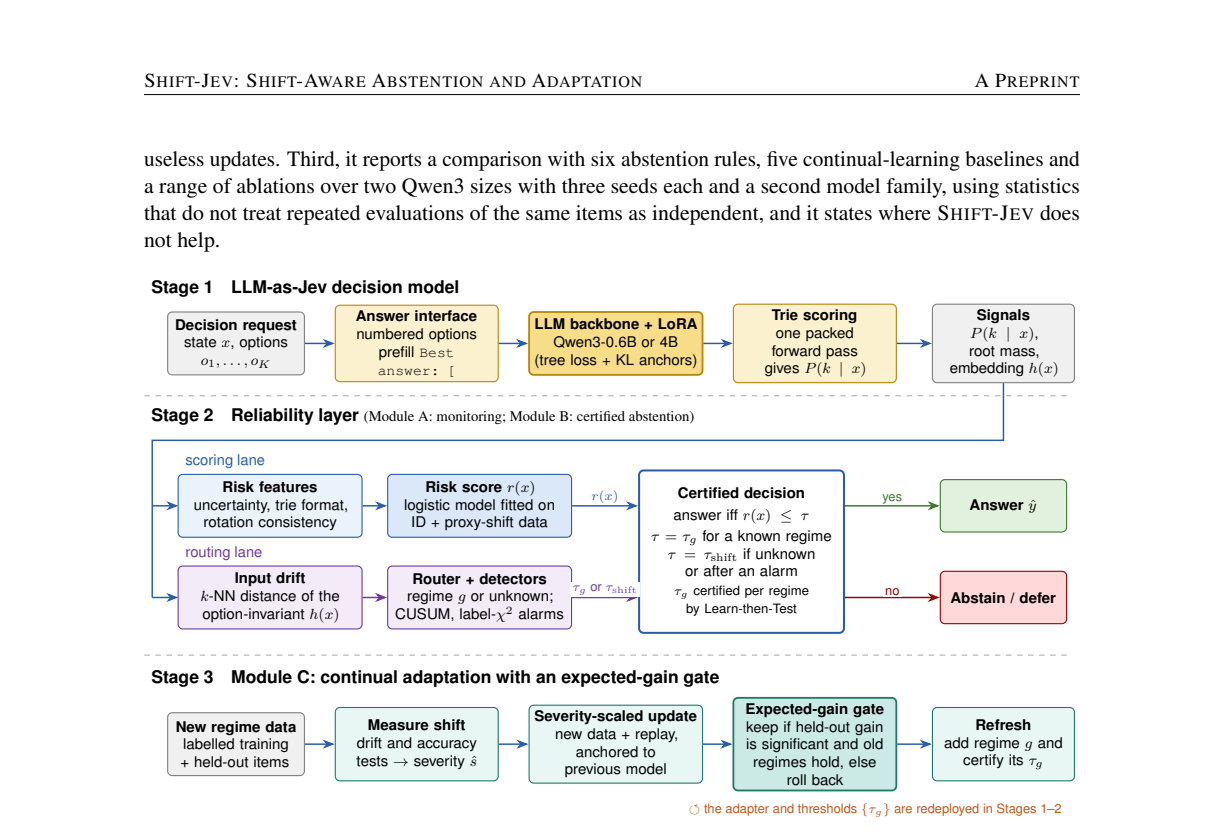
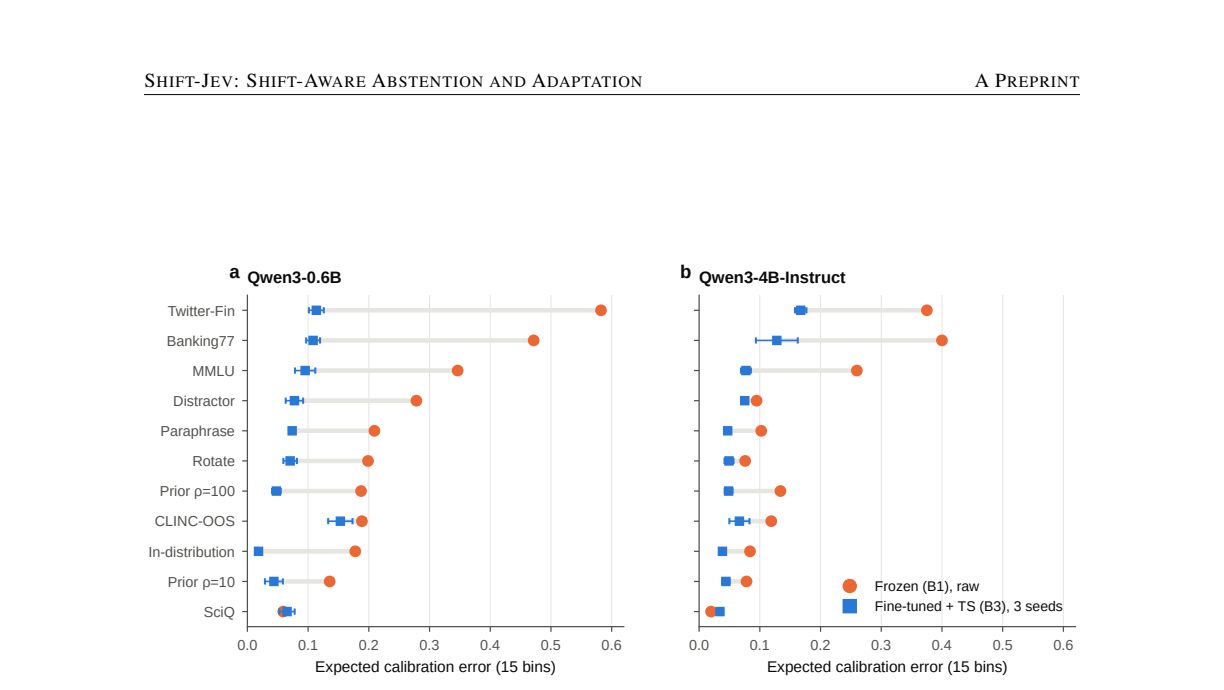
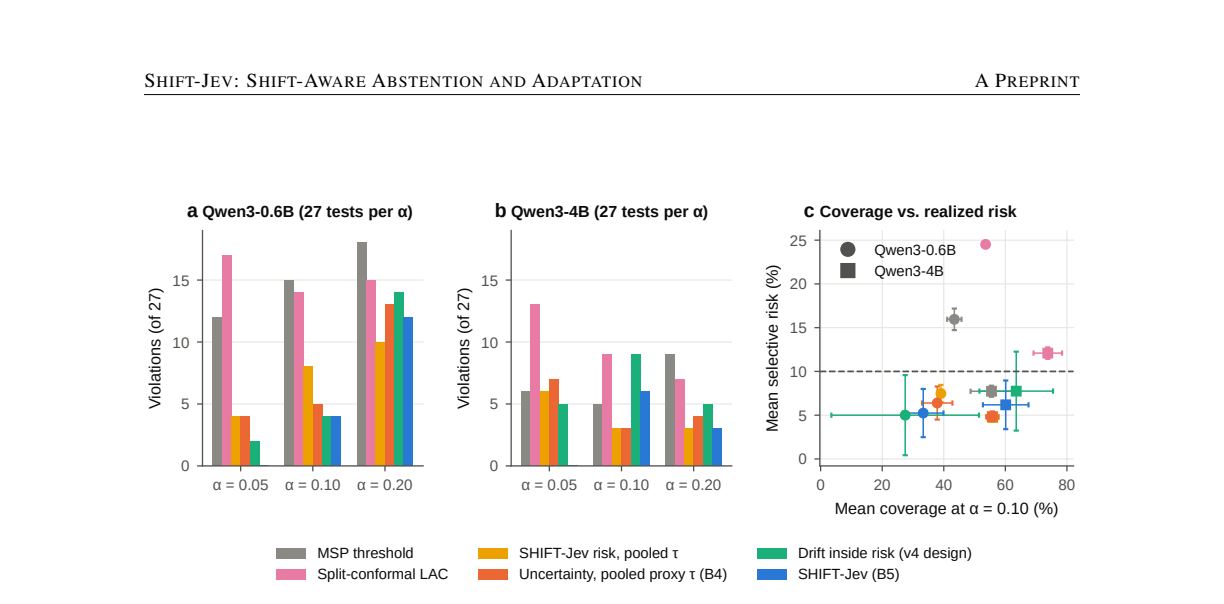
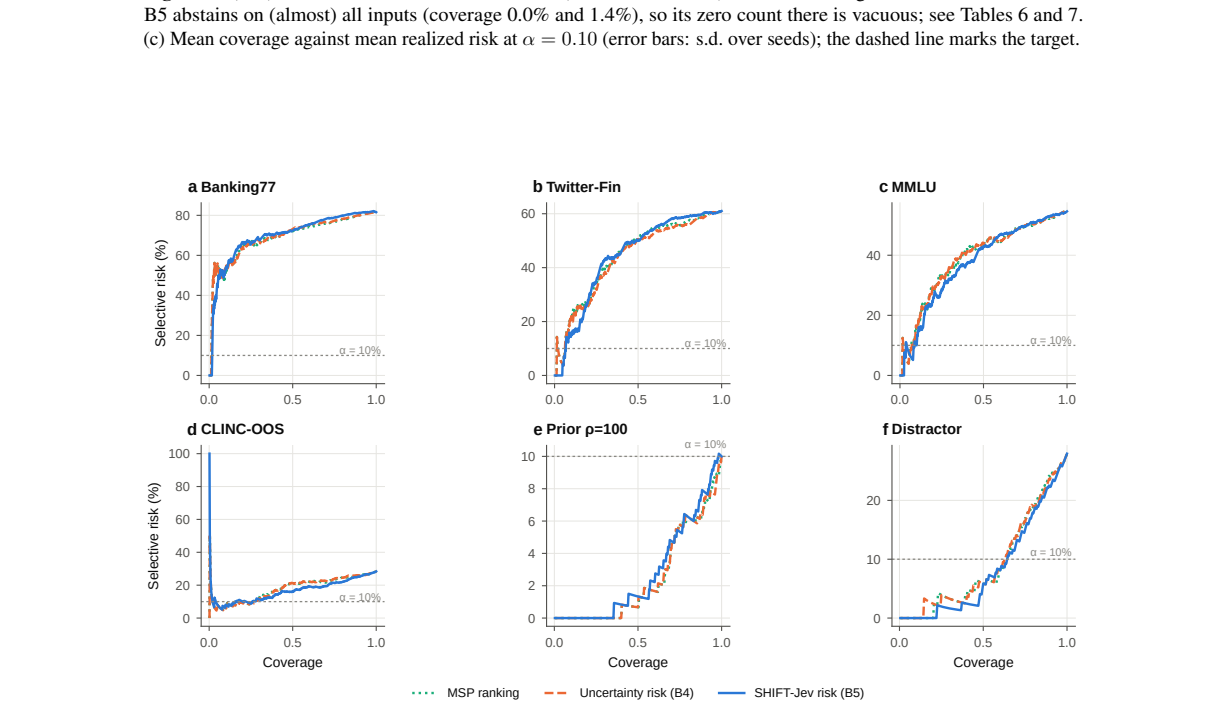
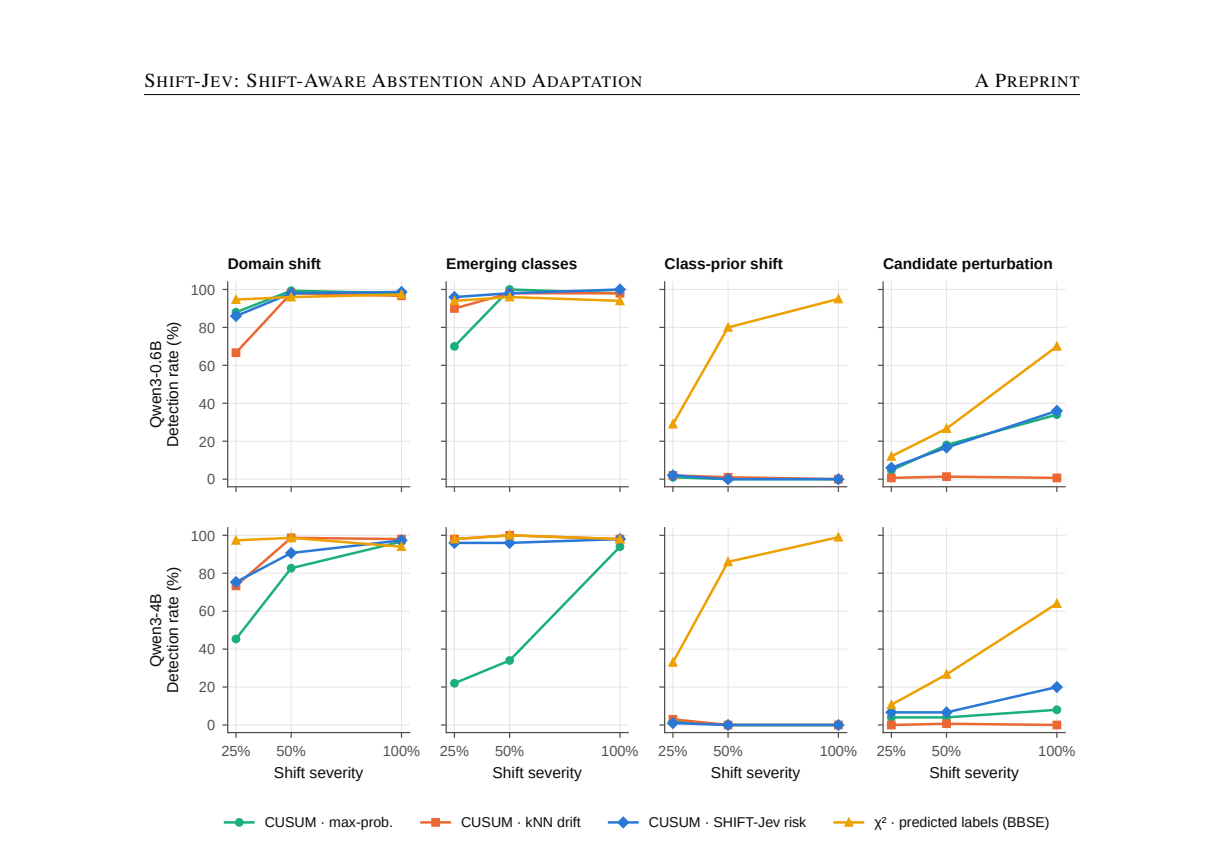
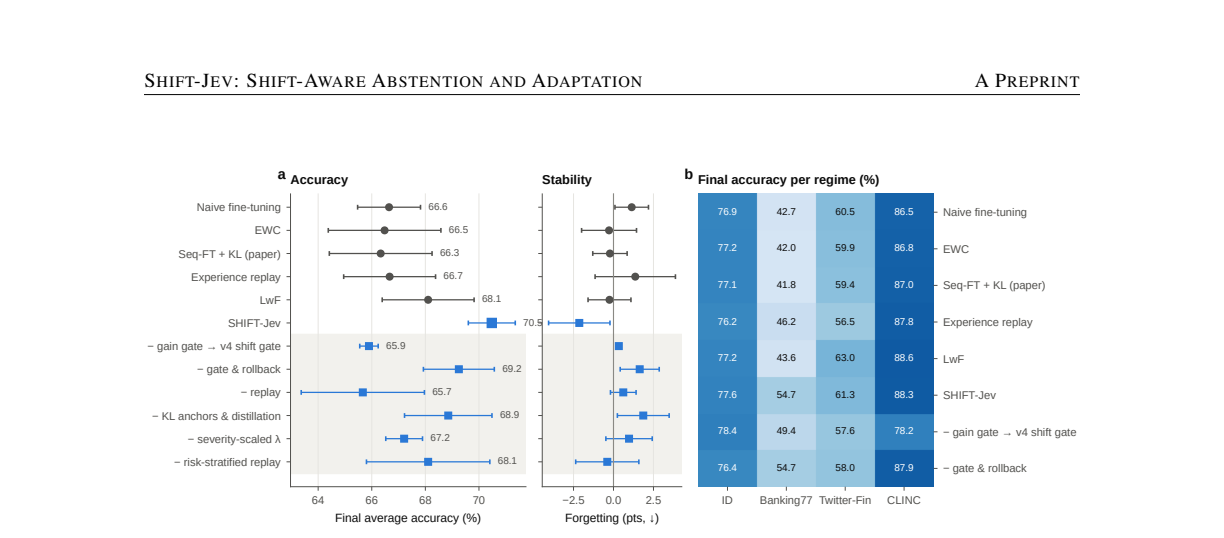
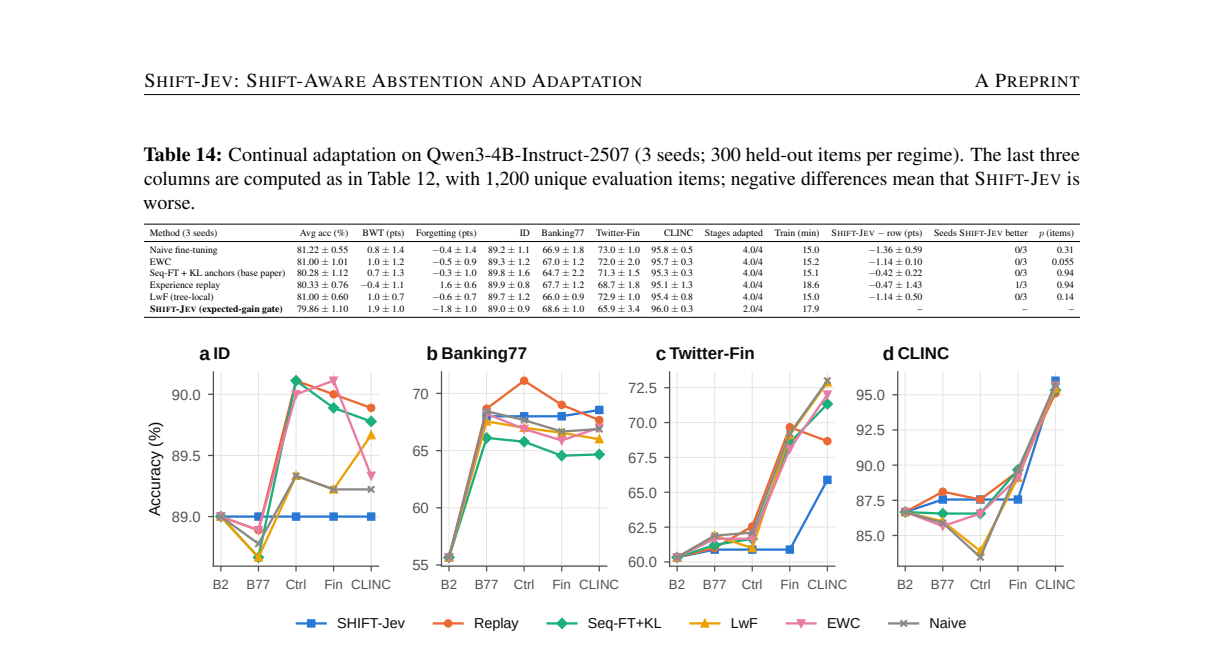
We study how such models fail under shift and propose SHIFT-Jev, a monitoring, abstention and continual-adaptation procedure for them. It scores the risk of each decision from uncertainty, format and option-consistency signals, certifies abstention thresholds with Learn-then-Test, monitors the decision stream with drift and label-shift detectors, and accepts a model update only when an expected-gain gate finds a significant held-out improvement without loss on earlier regimes. On a benchmark of ten shifted test environments with Qwen3-0.6B and Qwen3-4B (three seeds each) and Phi-4-mini, fine-tuning with KL anchors and temperature scaling lowers calibration error under shift from 0.289 to 0.087. At a target risk of 10%, a learned uncertainty score with a certified threshold exceeds the target in 3 to 5 of 27 environment-seed tests, against 5 to 15 for a max-probability score with the same certification and 9 to 14 for conformal prediction sets; drift-based routing changes little. A chi-squared test on predicted labels detects 95 to 99% of class-prior shifts that confidence- and embedding-based detectors miss. In continual adaptation, SHIFT-Jev reaches 70.5% accuracy on Qwen3-0.6B, above replay, LwF, EWC and fine-tuning baselines in every seed, whereas on Qwen3-4B its conservative gate leaves it 0.4 to 1.4 points behind them.
from the abstract
Pith says
Machine review · deepseek-v4-flash · 27 Oct 2026 · what was read was not recorded · not checked by a person
It can be wrong. Challenge this review or reply to it.
Holds up, with conditions. Solid empirical study of certified abstention and adaptation for LLM decision models under shift, but the central violation count comparison lacks statistical rigor. This line is wrong
2 major objections · 7 minor
How often objections from reviews like this one are right: not yet measured
Not checked: figures, code, what the 91 references say.
The paper says, at Abstract and Section 5.3
The review did not quote this passage.
A classifier read this sentence of the paper as acknowledging the concern (probability 0.86):
“We therefore avoided pooling seeds as independent pairs, but seed-level tests have little power, and violation counts over (environment, seed) tests are descriptive.”
Pith says: Objection 1 of 2 · major
The headline comparison of violation counts (3–5 vs. 5–15 vs. 9–14) is used in the abstract and conclusions to support the claim that the learned uncertainty score outperforms MSP and split-conformal LAC. However, the authors state in Section 5.3 that ‘because these tests share items, we treat the counts as descriptive’ and in Section 6.2 that ‘seed-level tests have little power.’
more of objection 1
No statistical test (e.g., a paired permutation test across the 27 environment–seed pairs) is performed to assess whether the observed differences could arise by chance. The abstract does not carry this qualification, giving an inflated impression of certainty. To support the central claim, the authors should either (a) add a valid non-parametric test for paired violation indicators, or (b) modify the abstract and conclusions to state explicitly that the violation counts are descriptive and that no significance test was performed, and discuss the implications for interpreting the comparison.
The paper says, at Abstract and Section 6.2
The review did not quote this passage.
A classifier read this sentence of the paper as acknowledging the concern (probability 0.69):
“We therefore avoided pooling seeds as independent pairs, but seed-level tests have little power, and violation counts over (environment, seed) tests are descriptive.”
Pith says: Objection 2 of 2 · major
The abstract and conclusion present the violation count results as a central contribution without referencing the acknowledged limitation that the counts are descriptive and that seed-level tests have little power. This disconnect between the strong claim in the abstract and the careful hedging in the limitations section needs to be resolved.
more of objection 2
I recommend adding a sentence to the abstract such as ‘Because tests share items across seeds, violation counts are reported as descriptive and should be interpreted with caution; see Section 6.2 for discussion.’
7 minor objections
The paper says, at Abstract
Pith says: minor objection 1 of 7
Inconsistency: the abstract uses ‘SHIFT-Jev’ (twice) but the rest of the paper uses ‘SHIFT-JEV’. Please standardize.
The paper says, at Section 3.4
Pith says: minor objection 2 of 7
The description of LTT certification could be clarified: the fixed sequence is over candidate thresholds ordered from strict to permissive, but it would help to state explicitly that the sequence is determined from the first calibration half and that the second half is used only for testing, ensuring exchangeability.
show 5 more
The paper says, at Section 4 / Table 2
Pith says: minor objection 3 of 7
The caption of Table 2 states that SciQ and Emotion serve only as proxy shifts for calibration, but the table labels their role as ‘Cal only’. That is clear, but it would be helpful to note in the text that these datasets are chosen because they differ from ID tasks in content, not because they cover all possible shifts.
The paper says, at Section 5.3, Tables 6 and 7
Pith says: minor objection 4 of 7
The columns ‘Viol.@.10 per seed’ report per-seed counts (e.g., ‘2 / 2 / 1’). It would be more informative to report the total over seeds (27 tests) followed by the per-seed breakdown in parentheses, to avoid confusion. Also, ensure that each count corresponds to a specific seed consistently across tables.
The paper says, at Section 5.5, Table 12
Pith says: minor objection 5 of 7
The p-values from item-level sign tests are reported with precision (e.g., 8.5×10⁻⁴). However, the evaluation items are shared across seeds, so the item-level test treats the three correctness values per item as independent, which is not strictly true. This should be noted as a caveat, perhaps by adding a brief sentence to the caption.
The paper says, at Section 6.2
Pith says: minor objection 6 of 7
The paragraph on limitations is commendably thorough. However, the risk score is trained on only two proxy shifts (SciQ and Emotion). While this is mentioned, the potential impact on generalizability (e.g., to shifts unlike these two) could be discussed more explicitly. A brief sentence noting that the choice of proxy shifts may affect the risk score's effectiveness for unseen shift types would strengthen the limitations section.
The paper says, at Section 3.2 / Appendix A
Pith says: minor objection 7 of 7
The packed trie scoring procedure is described clearly, but the condition for falling back to unpacked scoring (probability difference > 0.03 in fp16) is mentioned only in the appendix. Consider moving a brief note to the main text, as this affects reproducibility.
What would settle it
Perform a permutation test on the 27 paired (environment, seed) blocks. For each block, record the binary indicator of whether each method's realized selective risk exceeds alpha. Shuffle method labels within each block independently, recompute the total violation counts for the compared methods (e.g., B5 vs. MSP), and compute the difference in violation counts. Repeat 10,000 times. If the observed difference lies inside the 95% interval of the permutation distribution, the violation advantage is not statistically significant at the 0.05 level. This test accounts for shared items and three-seed structure without assuming independence across blocks.
from the skeptic's reading
How the review went
4 readings by deepseek-v4-flash · 27 Oct 2026
- Reader holds up, with conditions
- Skeptic partly agrees
- Editor wrote the verdict above
- Referee major revision: 2 major objections, 7 minor
Not run on this paper: the simulated authors' defence.
Pith did not check this review's objections against the paper.
The review in full
The review in brief, machine-written
SHIFT-JEV is a well-executed piece of work that tackles a real problem: safe deployment of LLM decision models under distribution shift. The paper's main contributions are a benchmark of ten shifted environments and the SHIFT-JEV pipeline combining risk scoring, LTT-based certification, stream monitoring, and gain-gated adaptation. The empirical evaluation is thorough: two backbone sizes, three seeds, multiple shift types, honest ablations, and the authors explicitly state their limitations. The finding that a learned uncertainty score with LTT certification yields fewer violations than MSP or conformal prediction at α=0.10 is interesting, and the predicted-label χ² test for class-prior shift is a practical result. The continual learning experiments on the 0.6B model show consistent gains over baselines.
The main soft spot concerns the central violation count comparison (3–5 vs 5–15 vs 9–14 out of 27 tests). The authors call these counts 'descriptive' and acknowledge that seed-level tests lack power, yet the abstract and conclusions present the numbers as evidence of superiority. No statistical test (e.g., a paired permutation test on violation indicators) is performed across the 27 environment-seed pairs. Given that the best MSP run has 5 violations—within the 3–5 range—the headline claim would be stronger with a proper significance test. The authors should either add the test or soften the claim accordingly. This doesn't invalidate the paper, but it means the central result is less definitive than it reads.
Other soft spots: routing adds little value, certification fails at α=0.05 (vacuous coverage), and the gate on the 4B model is too conservative. All are acknowledged. The calibration set size limits the strictness of guarantees in practice.
Overall, this is serious, honest work that deserves peer review. The authors are transparent about limitations. I recommend sending to review with a note to address the statistical rigor of the violation comparison and to clarify the narrative around which components actually matter (routing vs. threshold selection vs. risk score). Those are minor revisions, not rejections.
The strongest objection
The paper's strongest empirical support for SHIFT-JEV's certified abstention is the violation count: 3–5 of 27 tests exceed alpha=0.10 for the learned score vs. 5–15 for MSP and 9–14 for split-conformal LAC (Tables 6, 7). The authors explicitly state that 'because these tests share items, we treat the counts as descriptive' (Section 5.3) and acknowledge that seed-level tests have little power (Section 6.2). However, the abstract and conclusions present these counts as evidence that the learned score 'exceeds the target in 3 to 5 of 27 environment-seed tests, against 5 to 15 for a max-probability score.' No statistical test is performed to assess whether the observed differences in violation rates could arise by chance under the null hypothesis of equal violation probability per method. Since the 27 tests per method are pairwise-blocked by environment and seed, a valid non-parametric test (e.g., permutation test on paired violation indicators) is feasible and would quantify the reliability of the claimed improvement. Without it, the reader cannot determine whether the lower violation count of B4/B5 is a real advantage or a chance fluctuation across three seeds. This is the single most load-bearing concern because the central claim that SHIFT-JEV 'keeps selective risk below a target alpha' relative to alternatives rests on this comparison.
The reader's weakest assumption was the representativeness of the two proxy shifts for training the risk score. While that is a valid concern and is acknowledged by the authors, the most load-bearing vulnerability in the empirical argument is the lack of a proper significance test for the headline violation-count comparisons. The paper states that violation counts are descriptive but then uses them as evidence for the central claim. The concrete test I propose would settle this without requiring new data. The verdict should remain CONDITIONAL because this concern adds to the conditions already identified by the reader (clarify routing contribution, address alpha=0.05 fragility, add statistical support); the condition can be expanded to include this statistical check. Agreement with reader is partial because I identify a different weakest assumption than the reader did; both are valid, but the statistical one is more directly testable and less acknowledged.
The referee's report
If its claims hold, SHIFT-JEV provides a principled, empirically grounded procedure for deploying LLM decision models under shift with formal risk guarantees per regime, a detection mechanism for class-prior shift that operates solely from predicted labels, and a continual-adaptation method that avoids harmful updates via an expected-gain gate. The benchmark is carefully constructed, covering four shift types at two model scales and three seeds, with honest reporting of limitations and negative results. The paper’s practical recommendations (e.g., a single conservative threshold, running a label-χ² test, and using replay plus severity-scaled anchors) are actionable.
Pith's reading of the paper (a machine's summary, not the authors')
Large language models used as decision models (LLM-as-Jev) return calibrated probabilities over fixed answer options, but their errors rise sharply under distribution shift. The paper proposes SHIFT-JEV, a system that scores each decision's risk from uncertainty, format, and consistency signals, certifies an abstention threshold per regime using Learn-then-Test, monitors the decision stream with drift and label-shift detectors, and adapts the model only when a held-out gain is significant. The central result is that a learned risk score with a certified threshold keeps the selective risk (error rate among answered inputs) below a 10% target in 22 of 27 environment-seed tests, far outperforming max-probability and conformal prediction baselines. A predicted-label chi-squared test detects 95–99% of class-prior shifts that confidence- and embedding-based detectors miss. Gain-gated continual adaptation improves accuracy on a small model but proves too conservative for a stronger backbone.
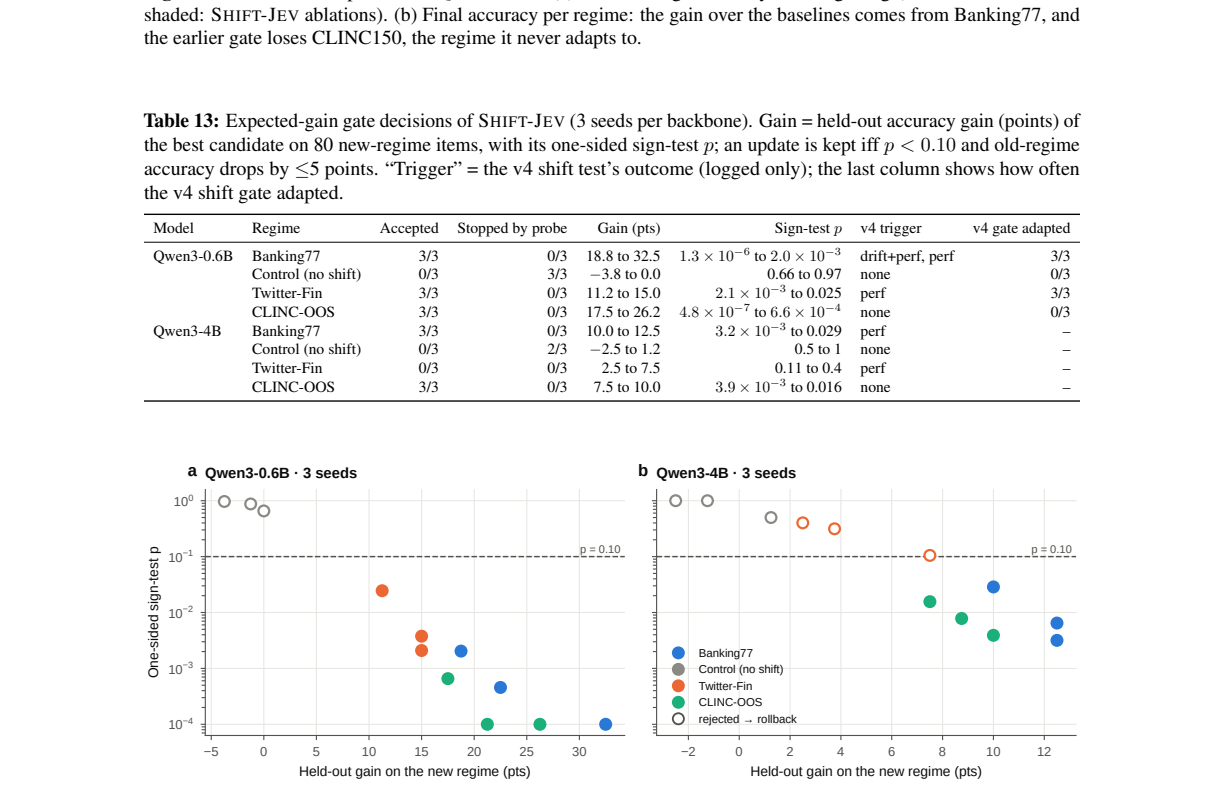
What carries the argument. The central machinery has three parts. (1) A risk score that combines normalized entropy, maximum probability, margin, number of options, the log of the legal-token probability mass, and rotation-consistency distances—all computed from the LLM's single forward pass. (2) Per-regime thresholds certified by fixed-sequence Learn-then-Test (LTT), which guarantees that selective risk stays below the target α with probability at least 1−δ under exchangeability. (3) An expected-gain gate that accepts an adapter update only if a one-sided sign test on 80 held-out items shows a significant gain (p<0.10) without more than a 5-point drop on earlier regimes; the update is otherwise rolled back. Together these modules provide certified abstention, stream monitoring, and controlled adaptation.
Core claim. The paper's main discovery is that a simple logistic regression risk score trained on uncertainty, format, and consistency features, when paired with a threshold certified by fixed-sequence Learn-then-Test on separate calibration data from the in-distribution and two proxy-shift datasets, can control selective risk under distribution shift much more reliably than the standard maximum-softmax-probability score with the same certification or conformal prediction sets. At a target risk of 10%, the learned score violates the budget in 3–5 of 27 (environment, seed) tests, compared to 5–15 for MSP and 9–14 for conformal LAC sets. A key enabler is the separation of risk scoring from drift-based routing: drift distances are excluded from the risk model and instead used to assign inputs to regime-specific thresholds, which rarely changes the threshold but prevents false confidence. The paper also finds that a chi-squared test on predicted labels, which requires no extra computation, is the only detector that catches class-prior shifts. For continual adaptation, the gain-gated procedure rejects no-shift updates and yields negative forgetting on the small model, but on the larger model it misses modest gains due to insufficient statistical power.
The premise it rests on. The risk model's ability to generalize to unseen shifts rests on being trained on just two proxy-shift datasets (SciQ and Emotion); if these are not representative of the actual deployment shifts, the certified guarantee does not hold and violation counts become untrustworthy.
If the paper is right (Pith's inferences, not the authors')
LLM decision models can be deployed with a certified risk budget under distribution shift if calibration data from the target regime or representative proxy shifts are available.
A simple predicted-label chi-squared test is sufficient to detect class-prior shifts and should be included in any monitoring suite.
The gain-gated adaptation protocol prevents useless or harmful updates, as shown by the rejection of the no-shift control stage and the avoidance of forgetting on the small model.
The post-hoc finding that a single conservative threshold (the stricter of ID and proxy-shift thresholds) yielded the fewest violations suggests a simpler deployment strategy for future work to confirm.
The method's failure to certify any threshold at α=0.05 on small calibration sets reveals a practical limit: strict risk budgets require larger calibration pools.
The reliance on only two proxy shifts (SciQ and Emotion) for risk model training is a notable limitation; a broader set of proxy shifts or a data-adaptive selection mechanism would strengthen the claim that the risk model generalizes to unseen shifts.
The post-hoc finding that applying the stricter of the ID and proxy thresholds to all inputs (without routing) gave the fewest violations is a testable hypothesis: future work should pre-register this rule and evaluate it on fresh benchmarks to see if it holds.
On larger models with small remaining gains, the 80-item heldout set is underpowered; a sequential test or Bayesian approach could allow the gate to accept beneficial updates without inflating false positives.
The large variance in abstention on removed-answer items across seeds on Qwen3-4B (14-72%) suggests that the risk score's consistency and format features are not robust to such perturbations, and a dedicated out-of-scope mechanism may be needed.
Check this review
Pith stored no record of this review's passes and took no fingerprint of it. Reviews made by code from 13 Nov 2026 on carry both.
How often reviews like this one are right
Reviews like this one: written by deepseek-v4-flash, where what was read was not recorded.
How often objections from reviews like this one are right: not yet measured
Reviews by people
This review was written by a machine. No person has reviewed this paper on Pith yet. A scientist listed on Pith can review it for a fee, and their review is published here whatever it concludes.
The paper
Abstract
Large language models (LLMs) can act as decision models that return a probability distribution over a fixed set of options, but deployed decision models face domain, label-prior, emerging-class and candidate-set shift. We study how such models fail under shift and propose SHIFT-Jev, a monitoring, abstention and continual-adaptation procedure for them. It scores the risk of each decision from uncertainty, format and option-consistency signals, certifies abstention thresholds with Learn-then-Test, monitors the decision stream with drift and label-shift detectors, and accepts a model update only when an expected-gain gate finds a significant held-out improvement without loss on earlier regimes. On a benchmark of ten shifted test environments with Qwen3-0.6B and Qwen3-4B (three seeds each) and Phi-4-mini, fine-tuning with KL anchors and temperature scaling lowers calibration error under shift from 0.289 to 0.087. At a target risk of 10%, a learned uncertainty score with a certified threshold exceeds the target in 3 to 5 of 27 environment-seed tests, against 5 to 15 for a max-probability score with the same certification and 9 to 14 for conformal prediction sets; drift-based routing changes little. A chi-squared test on predicted labels detects 95 to 99% of class-prior shifts that confidence- and embedding-based detectors miss. In continual adaptation, SHIFT-Jev reaches 70.5% accuracy on Qwen3-0.6B, above replay, LwF, EWC and fine-tuning baselines in every seed, whereas on Qwen3-4B its conservative gate leaves it 0.4 to 1.4 points behind them.
The paper's own sentences, arranged, kept beside the review and separate from it. Each label is drawn from a closed vocabulary; the number beside it is the probability the classifier gave that label. No sentence in this record was written by a model.
abstract compiled · 2026-10-27
The authors' main claim, as the classifier picked it out 0.63
“In continual adaptation, SHIFT-the classifier reaches 70.5% accuracy on Qwen3-0.6B, above replay, LwF, EWC and fine-tuning baselines in every seed, whereas on Qwen3-4B its conservative gate leaves it 0.4 to 1.4 points behind them.”
How the main claim is stated: asserted 1.00
What the abstract itself states, as probabilities: claims first 0.04 · states limitation 0.91 · human participants 0.03 · controlled comparison 0.97 · randomized assignment 0.04 · states quantitative result 0.99 · compares with prior results 0.98 · mentions code or data availability 0.03
The abstract, sentence by sentence
This table labels the abstract only (arXiv listing abstract v1). The number is the probability the classifier gave the label.
| Sentence | Role | The authors' own work | States the main conclusion | Strength |
|---|---|---|---|---|
| Large language models (LLMs) can act as decision models that return a probability distribution over a fixed set of options, but deployed decision models face domain, label-prior, emerging-class and candidate-set shift. | background 1.00 | 0.06 | 0.02 | asserted 0.77 |
| We study how such models fail under shift and propose SHIFT-Jev, a monitoring, abstention and continual-adaptation procedure for them. | contribution 1.00 | 0.85 | 0.13 | asserted 0.96 |
| It scores the risk of each decision from uncertainty, format and option-consistency signals, certifies abstention thresholds with Learn-then-Test, monitors the decision stream with drift and label-shift detectors, and accepts a model update only when an expected-gain gate finds a significant held-out improvement without loss on earlier regimes. | method 0.99 | 0.81 | 0.18 | asserted 1.00 |
| On a benchmark of ten shifted test environments with Qwen3-0.6B and Qwen3-4B (three seeds each) and Phi-4-mini, fine-tuning with KL anchors and temperature scaling lowers calibration error under shift from 0.289 to 0.087. | result 0.99 | 0.91 | 0.08 | asserted 1.00 |
| At a target risk of 10%, a learned uncertainty score with a certified threshold exceeds the target in 3 to 5 of 27 environment-seed tests, against 5 to 15 for a max-probability score with the same certification and 9 to 14 for conformal prediction sets; drift-based routing changes little. | result 1.00 | 0.95 | 0.20 | asserted 1.00 |
| A chi-squared test on predicted labels detects 95 to 99% of class-prior shifts that confidence- and embedding-based detectors miss. | result 1.00 | 0.91 | 0.06 | asserted 1.00 |
| In continual adaptation, SHIFT-Jev reaches 70.5% accuracy on Qwen3-0.6B, above replay, LwF, EWC and fine-tuning baselines in every seed, whereas on Qwen3-4B its conservative gate leaves it 0.4 to 1.4 points behind them. | result 1.00 | 0.95 | 0.23 | asserted 1.00 |
What kind of paper the classifier reports this is: method or tool 1.00 · evidence from observation or experiment 0.96
What was examined, and what was not
Sources read
- arXiv listing abstract v1
Not examined
- full text
- figures and tables
- references and citing sentences
- relations to other papers
Levels run
- P abstract
Not run
- S sections
- T body sentences
- C citations
- R cross-paper relations
How the labels were made
Compiled by classifier-1.13.0 via TypeSafe API, question bank abstract-p1-20260923, 2026-10-27: 1 request, 6,085 input tokens.
Every quoted sentence on this record is the authors'. Every label is from Pith's closed vocabulary, with the probability shown beside it. This record as JSON
Figures (11)
Showing 10 of the paper's 11 figures. Figures are the authors', reproduced from the paper.
References (91)
- [1] Diogo Almeida. Introducing system one models & Jev. TypeSafe AI blog, https://typesafe. ai/blog/introducing-system-one-models-and-jev, 2026 on Pith
- [2] Yubo Li, Yidi Miao, Ramayya Krishnan, and Rema Padman. JEV-as-a-judge: Accept when confident, escalate when unsure.arXiv preprint arXiv:2609.26550, 2026. doi:10.48550/arXiv.2609.26550 on PithPith's reviewarXivdoi:10.48550/arxiv.2609.26550
- [3] Delip Rao and Chris Callison-Burch. JEV vs. LLMs as rubric judges: Cheaper, faster, and wrong in the same places.arXiv preprint arXiv:2609.29769, 2026. doi:10.48550/arXiv.2609.29769 on PithPith's reviewarXivdoi:10.48550/arxiv.2609.29769
- [4] Ruoqi Guo, Yi Liu, Gelei Deng, Yuekang Li, Lida Zhao, Yutao Wu, Simin Chen, Ying Zhang, and Leo Yu Zhang. Just ask Jev: Reinforcement learning for calibrated decisions as a zero-shot detector of AI alignment failures.arXiv preprint arXiv:2609.29429, 2026. doi:10.48550/arXiv.2609.29429 on PithPith's reviewarXivdoi:10.48550/arxiv.2609.29429
- [5] Steven Denney and Matthew DiGiuseppe. JEV versus LLMs: Accuracy, cost and calibration on seven political science replications.arXiv preprint arXiv:2610.06625, 2026. doi:10.48550/arXiv.2610.06625 on PithPith's reviewarXivdoi:10.48550/arxiv.2610.06625
- [6] Amir Rafe and Subasish Das. Calibrated decisions at scale: Converting police crash narratives into probabilistic crash variables with a system one model (Jev).arXiv preprint arXiv:2609.24052, 2026. doi:10.48550/arXiv.2609.24052 on PithPith's reviewarXivdoi:10.48550/arxiv.2609.24052
- [7] Yinheng Li and Justin Wagle. LLM-as-Jev: LLMs are already Jev-style decision models—when and how to fine-tune them.arXiv preprint arXiv:2610.02076, 2026. doi:10.48550/arXiv.2610.02076 on PithPith's reviewarXivdoi:10.48550/arxiv.2610.02076
- [8] Zailong Tian, Zhuoheng Han, Yanzhe Chen, Haozhe Xu, Xi Yang, Richeng Xuan, Houfeng Wang, and Lizi Liao. Overconfidence in LLM-as-a-judge: Diagnosis and confidence-driven solution.arXiv preprint arXiv:2508.06225, 2025. doi:10.48550/arXiv.2508.06225. 22 SHIFT-JEV: SHIFT-AWAREABS... on PithPith's reviewarXivdoi:10.48550/arxiv.2508.06225
- [9] Varun Kotte. When can conformal risk control certify LLM outputs? bounds, impossibility, and adapta- tion for structured generation.arXiv preprint arXiv:2606.29054, 2026. doi:10.48550/arXiv.2606.29054 on PithPith's reviewarXivdoi:10.48550/arxiv.2606.29054
- [10] Zhexiao Lin, Yuanyuan Li, Neeraj Sarna, Yuanyuan Gao, and Michael von Gablenz. Domain-shift- aware conformal prediction for large language models.arXiv preprint arXiv:2510.05566, 2025. doi:10.48550/arXiv.2510.05566 on PithPith's reviewarXivdoi:10.48550/arxiv.2510.05566
- [11] Murilo Salem, Luísa Böhm, Daniel Pontes, and Anderson Ferrugem. Hierarchical group-conditional conformal risk control for selective prediction in language models.arXiv preprint arXiv:2607.24562, on PithPith's reviewarXiv
- [12] Md Ashikur Rahman, Md Arifur Rahman, Niamul Hassan Samin, Khandaker Rifah Tasnia, Md Ha- sibul Amin, Sifat Rahman Ahona, and Juena Ahmed Noshin. Beyond aggregate risk: Role- stratified conformal risk control for LLM tool calls.arXiv preprint arXiv:2607.24343, 2026. doi:10.4855... on PithPith's reviewarXivdoi:10.48550/arxiv.2607.24343
- [13] Ibne Farabi Shihab, Sanjeda Akter, and Anuj Sharma. Continual calibration: Coverage can collapse before accuracy in lifelong LLM fine-tuning.arXiv preprint arXiv:2604.23987, 2026. doi:10.48550/arXiv.2604.23987 on PithPith's reviewarXivdoi:10.48550/arxiv.2604.23987
- [14] Benchmark Heaven. JevBench: Jev-class model benchmark (v1.4.2.2). https:// benchmarkheaven.com/jev-models/v1.4.2.2, 2026 on Pith
- [15] Lianmin Zheng, Wei-Lin Chiang, Ying Sheng, Siyuan Zhuang, Zhanghao Wu, Yonghao Zhuang, Zi Lin, Zhuohan Li, Dacheng Li, Eric P. Xing, Hao Zhang, Joseph E. Gonzalez, and Ion Stoica. Judging LLM-as-a-judge with MT-Bench and Chatbot Arena.Advances in Neural Information Processing ... on PithPith's reviewarXivdoi:10.48550/arxiv.2306.05685
- [16] Victor Wang, Michael J. Q. Zhang, and Eunsol Choi. Improving LLM-as-a-judge inference with the judgment distribution. InFindings of the Association for Computational Linguistics: EMNLP 2025, on Pith
- [17] Jiaxin Gao, Chen Chen, Yanwen Jia, Xueluan Gong, Kwok-Yan Lam, and Qian Wang. Evaluating and mitigating LLM-as-a-judge bias in communication systems.arXiv preprint arXiv:2510.12462, 2025. doi:10.48550/arXiv.2510.12462 on Pithdoi:10.48550/arxiv.2510.12462
- [18] Zhuohang Li, Xiaowei Li, Chengyu Huang, Guowang Li, Katayoon Goshvadi, Bo Dai, Dale Schuur- mans, Paul Zhou, Hamid Palangi, Yiwen Song, Palash Goyal, Murat Kantarcioglu, Bradley A. Malin, and Yuan Xue. Judging with confidence: Calibrating autoraters to preference distributions... on Pithdoi:10.48550/arxiv.2510.00263
- [19] Nuo Chen, Zhiyuan Hu, Qingyun Zou, Jiaying Wu, Qian Wang, Bryan Hooi, and Bingsheng He. JudgeLRM: Large reasoning models as a judge.arXiv preprint arXiv:2504.00050, 2025. doi:10.48550/arXiv.2504.00050 on Pithdoi:10.48550/arxiv.2504.00050
- [20] Chungpa Lee, Thomas Zeng, Jongwon Jeong, Jy-yong Sohn, and Kangwook Lee. How to correctly report LLM-as-a-judge evaluations.arXiv preprint arXiv:2511.21140, 2026. doi:10.48550/arXiv.2511.21140 on PithPith's reviewarXivdoi:10.48550/arxiv.2511.21140
show 71 more
- [21] Erlis Lushtaku, Bora Kargi, Alejandro R. Salamanca, Julia Kreutzer, Ali Elganzory, Fabio Ferreira, and David Salinas. JudgeArena: A unified framework for reproducible LLM-judge evaluation.arXiv preprint arXiv:2608.02620, 2026. doi:10.48550/arXiv.2608.02620. 23 SHIFT-JEV: SHIFT... on PithPith's reviewarXivdoi:10.48550/arxiv.2608.02620
- [22] Zhilong Zhao and Yindi Liu. A confidence–diversity framework for calibrating AI judgement in acces- sible qualitative coding tasks.arXiv preprint arXiv:2508.02029, 2025. doi:10.48550/arXiv.2508.02029 on PithPith's reviewarXivdoi:10.48550/arxiv.2508.02029
- [23] Joshua Robinson and David Wingate. Leveraging large language models for multiple choice question answering. InInternational Conference on Learning Representations, 2023. doi:10.48550/arXiv.2210.12353 on PithPith's reviewarXivdoi:10.48550/arxiv.2210.12353
- [24] Chujie Zheng, Hao Zhou, Fandong Meng, Jie Zhou, and Minlie Huang. Large language models are not robust multiple choice selectors. InInternational Conference on Learning Representations, 2024. doi:10.48550/arXiv.2309.03882 on PithPith's reviewarXivdoi:10.48550/arxiv.2309.03882
- [25] Pouya Pezeshkpour and Estevam Hruschka. Large language models sensitivity to the order of options in multiple-choice questions. InFindings of the Association for Computational Linguistics: NAACL 2024, pages 2006–2017, 2024. doi:10.48550/arXiv.2308.11483 on PithPith's reviewarXivdoi:10.48550/arxiv.2308.11483
- [26] Chuan Guo, Geoff Pleiss, Yu Sun, and Kilian Q. Weinberger. On calibration of modern neural networks. InProceedings of the 34th International Conference on Machine Learning, pages 1321–1330, 2017. doi:10.48550/arXiv.1706.04599 on PithPith's reviewarXivdoi:10.48550/arxiv.1706.04599
- [27] Shrey Desai and Greg Durrett. Calibration of pre-trained transformers. InProceedings of the 2020 Conference on Empirical Methods in Natural Language Processing, pages 295–302, 2020. doi:10.18653/v1/2020.emnlp-main.21 on Pithdoi:10.18653/v1/2020.emnlp-main.21
- [28] Saurav Kadavath, Tom Conerly, Amanda Askell, Tom Henighan, Dawn Drain, Ethan Perez, Nicholas Schiefer, Zac Hatfield-Dodds, Nova DasSarma, Eli Tran-Johnson, et al. Language models (mostly) know what they know.arXiv preprint arXiv:2207.05221, 2022. doi:10.48550/arXiv.2207.05221 on PithPith's reviewarXivdoi:10.48550/arxiv.2207.05221
- [29] Miao Xiong, Zhiyuan Hu, Xinyang Lu, Yifei Li, Jie Fu, Junxian He, and Bryan Hooi. Can LLMs express their uncertainty? an empirical evaluation of confidence elicitation in LLMs. InInternational Conference on Learning Representations, 2024. doi:10.48550/arXiv.2306.13063 on PithPith's reviewarXivdoi:10.48550/arxiv.2306.13063
- [30] Sebastian Farquhar, Jannik Kossen, Lorenz Kuhn, and Yarin Gal. Detecting hallucinations in large language models using semantic entropy.Nature, 630(8017):625–630, 2024. doi:10.1038/s41586-024- 07421-0 on Pithdoi:10.1038/s41586-024-
- [31] Markus Oehri, Giulia Conti, Kaviraj Pather, Alexandre Rossi, Laia Serra, Adrian Parody, Rogvi Johan- nesen, Aviaja Petersen, and Arben Krasniqi. Trusted uncertainty in large language models: A unified framework for confidence calibration and risk-controlled refusal.arXiv prepr... on PitharXiv
- [32] Ahmet Faruk Cetinkaya, Enes A˘gırman, and Cem Tekin. Good enough is better: Uncertainty-aware aggregation for multi-LLM systems. Preprint, Bilkent University, 2026 on Pith
- [33] Yaniv Ovadia, Emily Fertig, Jie Ren, Zachary Nado, D. Sculley, Sebastian Nowozin, Joshua Dillon, Balaji Lakshminarayanan, and Jasper Snoek. Can you trust your model’s uncertainty? evaluating predictive uncertainty under dataset shift. InAdvances in Neural Information Processin... on PithPith's reviewarXivdoi:10.48550/arxiv.1906.02530
- [34] doi:10.48550/arXiv.2509.01455 on Pithdoi:10.48550/arxiv.2509.01455
- [35] Yonatan Geifman and Ran El-Yaniv. Selective classification for deep neural networks. InAdvances in Neural Information Processing Systems, volume 30, 2017. doi:10.48550/arXiv.1705.08500. 24 SHIFT-JEV: SHIFT-AWAREABSTENTION ANDADAPTATIONA PREPRINT on PithPith's reviewarXivdoi:10.48550/arxiv.1705.08500
- [36] Dan Hendrycks and Kevin Gimpel. A baseline for detecting misclassified and out-of-distribution examples in neural networks. InInternational Conference on Learning Representations, 2017. doi:10.48550/arXiv.1610.02136 on PithPith's reviewarXivdoi:10.48550/arxiv.1610.02136
- [37] Ran El-Yaniv and Yair Wiener. On the foundations of noise-free selective classification.Journal of Machine Learning Research, 11:1605–1641, 2010 on Pith
- [38] Anastasios N. Angelopoulos and Stephen Bates. Conformal prediction: A gentle introduction.Founda- tions and Trends in Machine Learning, 16(4):494–591, 2023. doi:10.1561/2200000101 on Pithdoi:10.1561/2200000101
- [39] Stephen Bates, Anastasios Angelopoulos, Lihua Lei, Jitendra Malik, and Michael Jordan. Distribution- free, risk-controlling prediction sets.Journal of the ACM, 68(6):1–34, 2021. doi:10.1145/3478535 on Pithdoi:10.1145/3478535
- [40] Vladimir V ovk, Alexander Gammerman, and Glenn Shafer.Algorithmic Learning in a Random World. Springer, 2005. doi:10.1007/b106715 on Pithdoi:10.1007/b106715
- [41] Anastasios N. Angelopoulos, Stephen Bates, Emmanuel J. Candès, Michael I. Jordan, and Lihua Lei. Learn then test: Calibrating predictive algorithms to achieve risk control.arXiv preprint arXiv:2110.01052, 2021. doi:10.48550/arXiv.2110.01052 on PithPith's reviewarXivdoi:10.48550/arxiv.2110.01052
- [42] Bhawesh Kumar, Charlie Lu, Gauri Gupta, Anil Palepu, David Bellamy, Ramesh Raskar, and Andrew Beam. Conformal prediction with large language models for multi-choice question answering. InICML 2023 Workshop on Neural Conversational AI, 2023. doi:10.48550/arXiv.2305.18404 on PithPith's reviewarXivdoi:10.48550/arxiv.2305.18404
- [43] Anastasios N. Angelopoulos, Stephen Bates, Adam Fisch, Lihua Lei, and Tal Schuster. Conformal risk control. InInternational Conference on Learning Representations, 2024. doi:10.48550/arXiv.2208.02814 on PithPith's reviewarXivdoi:10.48550/arxiv.2208.02814
- [44] Christopher Mohri and Tatsunori Hashimoto. Language models with conformal factuality guar- antees. InProceedings of the 41st International Conference on Machine Learning, 2024. doi:10.48550/arXiv.2402.10978 on PithPith's reviewarXivdoi:10.48550/arxiv.2402.10978
- [45] Rina Foygel Barber, Emmanuel J. Candès, Aaditya Ramdas, and Ryan J. Tibshirani. Conformal prediction beyond exchangeability.The Annals of Statistics, 51(2):816–845, 2023. doi:10.1214/23- AOS2276 on Pithdoi:10.1214/23-
- [46] Victor Quach, Adam Fisch, Tal Schuster, Adam Yala, Jae Ho Sohn, Tommi S. Jaakkola, and Regina Barzilay. Conformal language modeling. InInternational Conference on Learning Representations, on Pith
- [47] Aleksandr Podkopaev and Aaditya Ramdas. Distribution-free uncertainty quantification for classification under label shift. InProceedings of the 37th Conference on Uncertainty in Artificial Intelligence, pages 844–853, 2021. doi:10.48550/arXiv.2103.03323 on PithPith's reviewarXivdoi:10.48550/arxiv.2103.03323
- [48] Chenfeng Huang, Zixuan Ma, and George Michailidis. Model-agnostic online certificate-driven calibration for time series forecasting under distribution shift.arXiv preprint arXiv:2609.31960, 2026. doi:10.48550/arXiv.2609.31960 on PithPith's reviewarXivdoi:10.48550/arxiv.2609.31960
- [49] Stephan Rabanser, Stephan Günnemann, and Zachary Lipton. Failing loudly: An empirical study of methods for detecting dataset shift. InAdvances in Neural Information Processing Systems, volume 32, on Pith
- [50] Isaac Gibbs and Emmanuel Candès. Adaptive conformal inference under distribution shift. InAdvances in Neural Information Processing Systems, volume 34, pages 1660–1672, 2021. doi:10.48550/arXiv.2106.00170 on PithPith's reviewarXivdoi:10.48550/arxiv.2106.00170
- [51] Kimin Lee, Kibok Lee, Honglak Lee, and Jinwoo Shin. A simple unified framework for detecting out-of-distribution samples and adversarial attacks. InAdvances in Neural Information Processing Systems, volume 31, 2018. doi:10.48550/arXiv.1807.03888 on PithPith's reviewarXivdoi:10.48550/arxiv.1807.03888
- [52] Jie Ren, Stanislav Fort, Jeremiah Liu, Abhijit Guha Roy, Shreyas Padhy, and Balaji Lakshmi- narayanan. A simple fix to Mahalanobis distance for improving near-OOD detection.arXiv preprint arXiv:2106.09022, 2021. doi:10.48550/arXiv.2106.09022 on PithPith's reviewarXivdoi:10.48550/arxiv.2106.09022
- [53] Yiyou Sun, Yifei Ming, Xiaojin Zhu, and Yixuan Li. Out-of-distribution detection with deep nearest neighbors. InProceedings of the 39th International Conference on Machine Learning, pages 20827– 20840, 2022. doi:10.48550/arXiv.2204.06507 on PithPith's reviewarXivdoi:10.48550/arxiv.2204.06507
- [54] Weitang Liu, Xiaoyun Wang, John Owens, and Yixuan Li. Energy-based out-of-distribution detec- tion. InAdvances in Neural Information Processing Systems, volume 33, pages 21464–21475, 2020. doi:10.48550/arXiv.2010.03759 on PithPith's reviewarXivdoi:10.48550/arxiv.2010.03759
- [55] Zachary Lipton, Yu-Xiang Wang, and Alexander Smola. Detecting and correcting for label shift with black box predictors. InProceedings of the 35th International Conference on Machine Learning, pages 3122–3130, 2018. doi:10.48550/arXiv.1802.03916 on PithPith's reviewarXivdoi:10.48550/arxiv.1802.03916
- [56] João Gama, Indr˙e Žliobait˙e, Albert Bifet, Mykola Pechenizkiy, and Abdelhamid Bouchachia. A survey on concept drift adaptation.ACM Computing Surveys, 46(4):1–37, 2014. doi:10.1145/2523813 on Pithdoi:10.1145/2523813
- [57] Abdullah Al Siam, Nuruzzaman Faruqui, Akm Azad, and Mohammad Ali Moni. Securing the unseen: A comprehensive exploration review of AI-powered models for zero-day attack detection.Expert Systems, 43:e70217, 2026. doi:10.1111/exsy.70217 on Pithdoi:10.1111/exsy.70217
- [58] Ashok Devireddy and Shunping Huang. CALM: A framework for continuous, adaptive, and LLM-mediated anomaly detection in time-series streams.arXiv preprint arXiv:2508.21273, 2025. doi:10.48550/arXiv.2508.21273 on PithPith's reviewarXivdoi:10.48550/arxiv.2508.21273
- [59] Pang Wei Koh, Shiori Sagawa, Henrik Marklund, Sang Michael Xie, Marvin Zhang, Akshay Balsubra- mani, Weihua Hu, Michihiro Yasunaga, Richard Lanas Phillips, Irena Gao, et al. WILDS: A benchmark of in-the-wild distribution shifts. InProceedings of the 38th International Conferen... on PithPith's reviewarXivdoi:10.48550/arxiv.2012.07421
- [60] E. S. Page. Continuous inspection schemes.Biometrika, 41(1/2):100–115, 1954. doi:10.1093/biomet/41.1-2.100 on Pithdoi:10.1093/biomet/41.1-2.100
- [61] Zhizhong Li and Derek Hoiem. Learning without forgetting.IEEE Transactions on Pattern Analysis and Machine Intelligence, 40(12):2935–2947, 2018. doi:10.1109/TPAMI.2017.2773081 on Pithdoi:10.1109/tpami.2017.2773081
- [62] David Rolnick, Arun Ahuja, Jonathan Schwarz, Timothy Lillicrap, and Gregory Wayne. Experience replay for continual learning. InAdvances in Neural Information Processing Systems, volume 32, 2019. doi:10.48550/arXiv.1811.11682. 26 SHIFT-JEV: SHIFT-AWAREABSTENTION ANDADAPTATIONA PREPRINT on PithPith's reviewarXivdoi:10.48550/arxiv.1811.11682
- [63] Arslan Chaudhry, Marcus Rohrbach, Mohamed Elhoseiny, Thalaiyasingam Ajanthan, Puneet K. Doka- nia, Philip H. S. Torr, and Marc’Aurelio Ranzato. On tiny episodic memories in continual learning. arXiv preprint arXiv:1902.10486, 2019. doi:10.48550/arXiv.1902.10486 on PithPith's reviewarXivdoi:10.48550/arxiv.1902.10486
- [64] David Lopez-Paz and Marc’Aurelio Ranzato. Gradient episodic memory for continual learning. In Advances in Neural Information Processing Systems, volume 30, 2017. doi:10.48550/arXiv.1706.08840 on PithPith's reviewarXivdoi:10.48550/arxiv.1706.08840
- [65] James Kirkpatrick, Razvan Pascanu, Neil Rabinowitz, Joel Veness, Guillaume Desjardins, Andrei A. Rusu, Kieran Milan, John Quan, Tiago Ramalho, Agnieszka Grabska-Barwinska, et al. Overcoming catastrophic forgetting in neural networks.Proceedings of the National Academy of Scien... on Pithdoi:10.1073/pnas.1611835114
- [66] Haizhou Shi, Zihao Xu, Hengyi Wang, Weiyi Qin, Wenyuan Wang, Yibin Wang, Zifeng Wang, Sayna Ebrahimi, and Hao Wang. Continual learning of large language models: A comprehensive survey.ACM Computing Surveys, 2025. doi:10.1145/3735633 on Pithdoi:10.1145/3735633
- [67] Yun Luo, Zhen Yang, Fandong Meng, Yafu Li, Jie Zhou, and Yue Zhang. An empirical study of catastrophic forgetting in large language models during continual fine-tuning.arXiv preprint arXiv:2308.08747, 2023. doi:10.48550/arXiv.2308.08747 on PithPith's reviewarXivdoi:10.48550/arxiv.2308.08747
- [68] Dan Biderman, Jacob Portes, Jose Javier Gonzalez Ortiz, Mansheej Paul, Philip Greengard, Connor Jennings, Daniel King, Sam Havens, Vitaliy Chiley, Jonathan Frankle, Cody Blakeney, and John P. Cunningham. LoRA learns less and forgets less.Transactions on Machine Learning Resear... on PithPith's reviewarXivdoi:10.48550/arxiv.2405.09673
- [69] Yujie Feng, Hao Wang, Jian Li, Xu Chu, Zhaolu Kang, Yiran Liu, Yasha Wang, Philip S. Yu, and Xiao-Ming Wu. FOREVER: Forgetting curve-inspired memory replay for language model continual learning.arXiv preprint arXiv:2601.03938, 2026. doi:10.48550/arXiv.2601.03938 on PithPith's reviewarXivdoi:10.48550/arxiv.2601.03938
- [70] Liyuan Wang, Xingxing Zhang, Hang Su, and Jun Zhu. A comprehensive survey of continual learning: Theory, method and application.IEEE Transactions on Pattern Analysis and Machine Intelligence, 46 (8):5362–5383, 2024. doi:10.1109/TPAMI.2024.3367329 on Pithdoi:10.1109/tpami.2024.3367329
- [71] C. J. Clopper and E. S. Pearson. The use of confidence or fiducial limits illustrated in the case of the binomial.Biometrika, 26(4):404–413, 1934. doi:10.1093/biomet/26.4.404 on Pithdoi:10.1093/biomet/26.4.404
- [72] Geoffrey Hinton, Oriol Vinyals, and Jeff Dean. Distilling the knowledge in a neural network.arXiv preprint arXiv:1503.02531, 2015. doi:10.48550/arXiv.1503.02531 on PithPith's reviewarXivdoi:10.48550/arxiv.1503.02531
- [73] Xiang Zhang, Junbo Zhao, and Yann LeCun. Character-level convolutional networks for text classification. InAdvances in Neural Information Processing Systems, volume 28, 2015. doi:10.48550/arXiv.1509.01626 on PithPith's reviewarXivdoi:10.48550/arxiv.1509.01626
- [74] Richard Socher, Alex Perelygin, Jean Wu, Jason Chuang, Christopher D. Manning, Andrew Ng, and Christopher Potts. Recursive deep models for semantic compositionality over a sentiment treebank. In Proceedings of the 2013 Conference on Empirical Methods in Natural Language Proces... on Pith
- [75] Edward J. Hu, Yelong Shen, Phillip Wallis, Zeyuan Allen-Zhu, Yuanzhi Li, Shean Wang, Lu Wang, and Weizhu Chen. LoRA: Low-rank adaptation of large language models. InInternational Conference on Learning Representations, 2022. doi:10.48550/arXiv.2106.09685 on PithPith's reviewarXivdoi:10.48550/arxiv.2106.09685
- [76] Peter Clark, Isaac Cowhey, Oren Etzioni, Tushar Khot, Ashish Sabharwal, Carissa Schoenick, and Oyvind Tafjord. Think you have solved question answering? try ARC, the AI2 reasoning challenge. arXiv preprint arXiv:1803.05457, 2018. doi:10.48550/arXiv.1803.05457 on PithPith's reviewarXivdoi:10.48550/arxiv.1803.05457
- [77] Johannes Welbl, Nelson F. Liu, and Matt Gardner. Crowdsourcing multiple choice science ques- tions. InProceedings of the 3rd Workshop on Noisy User-generated Text, pages 94–106, 2017. doi:10.18653/v1/W17-4413 on Pithdoi:10.18653/v1/w17-4413
- [78] Elvis Saravia, Hsien-Chi Toby Liu, Yen-Hao Huang, Junlin Wu, and Yi-Shin Chen. CARER: Contextual- ized affect representations for emotion recognition. InProceedings of the 2018 Conference on Empirical Methods in Natural Language Processing, pages 3687–3697, 2018. doi:10.18653/... on Pithdoi:10.18653/v1/d18-1404
- [79] Iñigo Casanueva, Tadas Temˇcinas, Daniela Gerz, Matthew Henderson, and Ivan Vuli´c. Efficient intent detection with dual sentence encoders. InProceedings of the 2nd Workshop on Natural Language Processing for Conversational AI, pages 38–45, 2020. doi:10.18653/v1/2020.nlp4convai-1.5 on Pithdoi:10.18653/v1/2020.nlp4convai-1.5
- [80] Christopher Clark, Kenton Lee, Ming-Wei Chang, Tom Kwiatkowski, Michael Collins, and Kristina Toutanova. BoolQ: Exploring the surprising difficulty of natural yes/no questions. InProceedings of NAACL-HLT 2019, pages 2924–2936, 2019. doi:10.18653/v1/N19-1300. 27 SHIFT-JEV: SHIF... on Pithdoi:10.18653/v1/n19-1300
- [81] Dan Hendrycks, Collin Burns, Steven Basart, Andy Zou, Mantas Mazeika, Dawn Song, and Jacob Steinhardt. Measuring massive multitask language understanding. InInternational Conference on Learning Representations, 2021. doi:10.48550/arXiv.2009.03300 on PithPith's reviewarXivdoi:10.48550/arxiv.2009.03300
- [82] Stefan Larson, Anish Mahendran, Joseph J. Peper, Christopher Clarke, Andrew Lee, Parker Hill, Jonathan K. Kummerfeld, Kevin Leach, Michael A. Laurenzano, Lingjia Tang, and Jason Mars. An evaluation dataset for intent classification and out-of-scope prediction. InProceedings of... on Pithdoi:10.18653/v1/d19-1131
- [83] Yubo Wang, Xueguang Ma, Ge Zhang, Yuansheng Ni, Abhranil Chandra, Shiguang Guo, Weiming Ren, Aaran Arulraj, Xuan He, Ziyan Jiang, et al. MMLU-Pro: A more robust and challenging multi-task language understanding benchmark. InAdvances in Neural Information Processing Systems (Da... on PithPith's reviewarXivdoi:10.48550/arxiv.2406.01574
- [84] Keisuke Sakaguchi, Ronan Le Bras, Chandra Bhagavatula, and Yejin Choi. WinoGrande: An ad- versarial Winograd schema challenge at scale.Communications of the ACM, 64(9):99–106, 2021. doi:10.1145/3474381 on Pithdoi:10.1145/3474381
- [85] Zeroshot. Twitter financial news topic dataset. https://huggingface.co/datasets/ zeroshot/twitter-financial-news-topic, 2022 on Pith
- [86] Abdelrahman Abouelenin, Atabak Ashfaq, Adam Atkinson, Hany Awadalla, Nguyen Bach, Jianmin Bao, Alon Benhaim, Martin Cai, Vishrav Chaudhary, Congcong Chen, et al. Phi-4-Mini technical report: Compact yet powerful multimodal language models via mixture-of-LoRAs.arXiv preprint ar... on PithPith's reviewarXivdoi:10.48550/arxiv.2503.01743
- [90] An Yang, Anfeng Li, Baosong Yang, Beichen Zhang, Binyuan Hui, Bo Zheng, Bowen Yu, Chang Gao, Chengen Huang, Chenxu Lv, et al. Qwen3 technical report.arXiv preprint arXiv:2505.09388, 2025. doi:10.48550/arXiv.2505.09388 on PithPith's reviewarXivdoi:10.48550/arxiv.2505.09388
- [2019] doi:10.48550/arXiv.1810.11953. 25 SHIFT-JEV: SHIFT-AWAREABSTENTION ANDADAPTATIONA PREPRINT on PithPith's reviewarXivdoi:10.48550/arxiv.1810.11953
- [2024] doi:10.48550/arXiv.2306.10193 on PithPith's reviewarXivdoi:10.48550/arxiv.2306.10193
- [2025] doi:10.48550/arXiv.2503.03064 on Pithdoi:10.48550/arxiv.2503.03064
- [2026] doi:10.48550/arXiv.2607.24562 on PithPith's reviewarXivdoi:10.48550/arxiv.2607.24562
Cited by 1 Pith paper
Reviewed papers on Pith that cite this one. The full citation record
Challenges and discussion
Disagree with the review, or know something it missed? Leave a comment, or challenge this review formally: a challenge becomes a permanent entry in this paper's record, and its decision is published here.
Come back by email
A short list of the week's newly reviewed papers. Nothing is sent until you confirm from your inbox, and every email has a link that stops it. No account.
No comments yet.
Sign in to comment