Computer Vision and Pattern Recognition · arXiv:2611.30096 v1 · submitted 23 Nov 2026 · 43 references
When "A or B" Is Less Likely than A: Coherent Probabilities for Vision Decision Models
The paper says
“Vision decision models answer a multiple-choice question about an image with one probability per option, and software uses them directly.”
more of the abstract
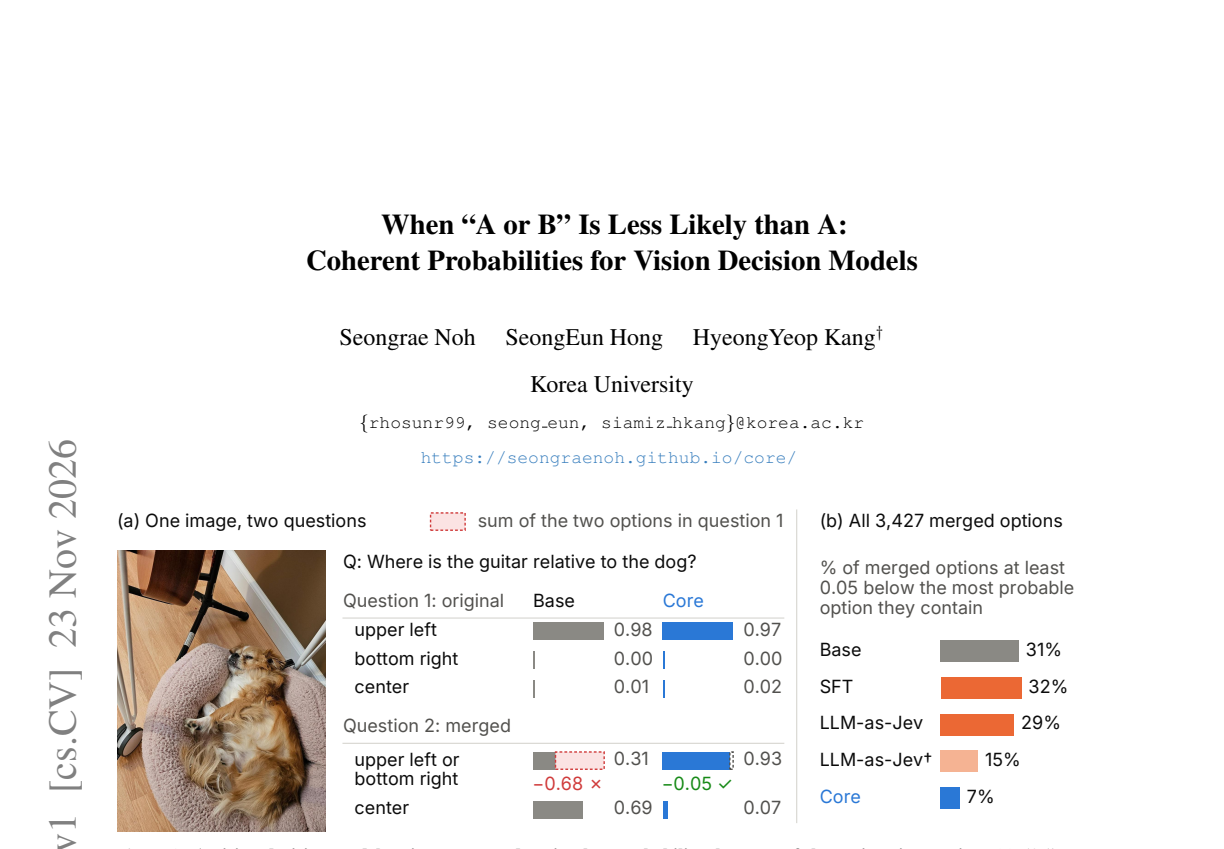
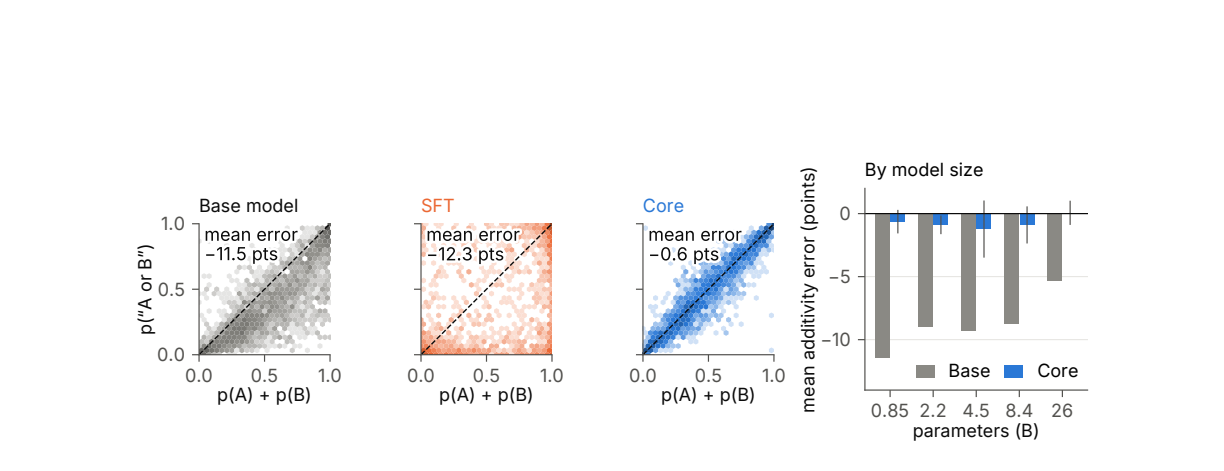
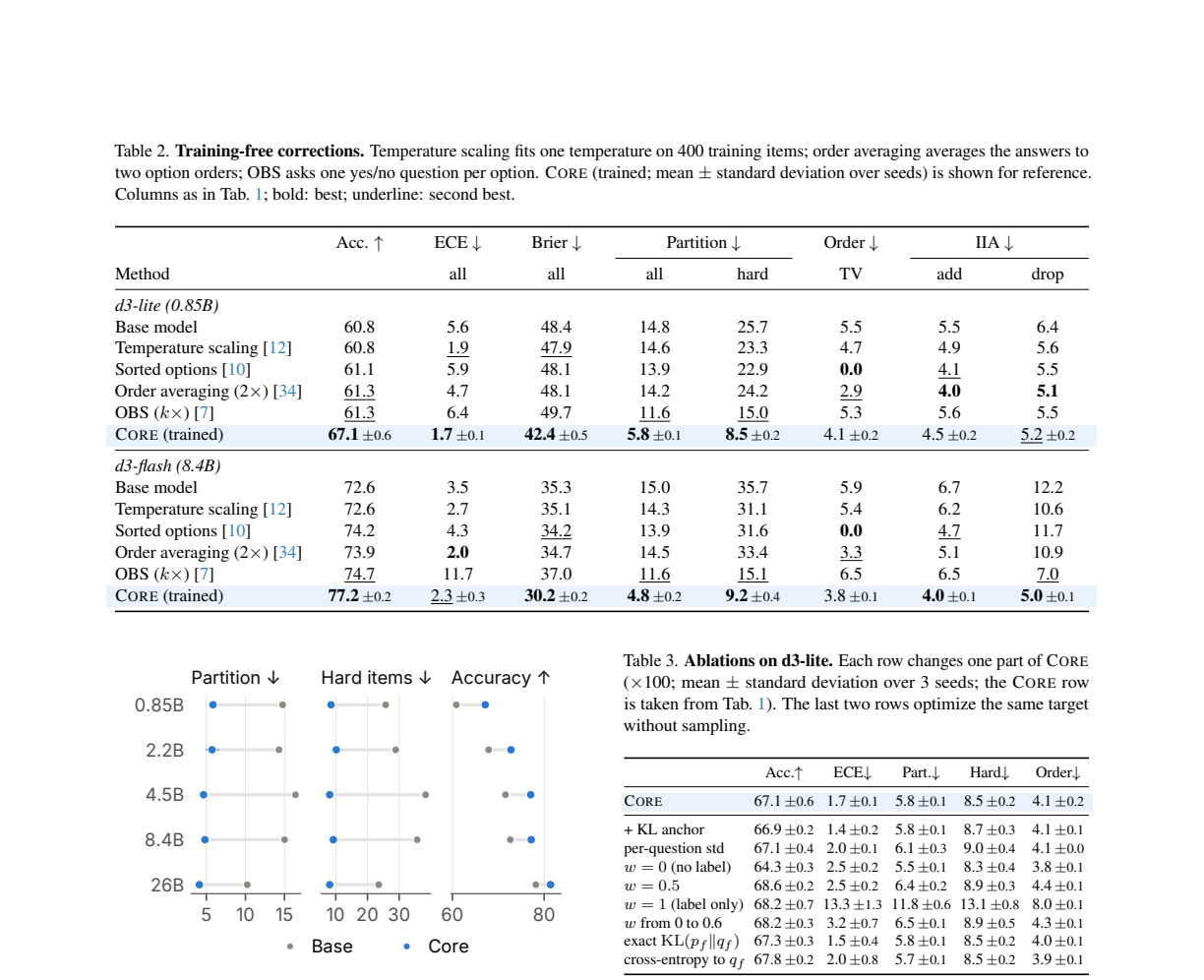
We show that the probabilities depend on how the options are grouped: a merged option "A or B" receives on average 11.5 points less probability than the sum of A and B. This under-additivity appears at every model size from 0.85B to 26B and remains after fine-tuning on labels. We propose CORE, which asks each training question with its options regrouped and trains the answers to all these questions toward one target distribution over the original options, summed into each question's groups. On 1,050 items from seven benchmarks, CORE reduces the total variation distance between the answer to a regrouped question and the original answer summed into the same groups from 14.8 to 5.8 points on the 0.85B model, against 9.4 for the best baseline trained on the same questions. At all five model sizes, CORE reduces this distance without lowering accuracy.
from the abstract
Pith says
Machine review · deepseek-v4-flash · 24 Nov 2026 · read the full text (181,733 characters) · not checked by a person
It can be wrong. Challenge this review or reply to it.
Holds up. Vision decision models systematically assign less probability to a merged option than the sum of its members; CORE, a training method that shares one target across regrouped questions, reduces this under-additivity at every model size without lowering accuracy. This line is wrong
4 minor
How often objections from reviews like this one are right: not yet measured
The paper, first character to last
The reviewer was given the whole text, 181,733 characters. Not checked: figures, code, what the 43 references say.
4 minor objections
The paper says, at Abstract
Pith says: minor objection 1 of 4
The paper uses many LaTeX macros for numerical values (e.g., `NBasePart`, `NOursPart`). While this ensures consistency, it makes the source hard to read for anyone not familiar with the macro definitions. A reader of the PDF sees the numbers, but the source is not the primary medium. No change needed.
The paper says, at 3
Pith says: minor objection 2 of 4
Section 3, paragraph on evaluation data: The number of training items (2,310) is given, but the distribution across benchmarks is only in the supplementary material. A brief summary in the main text would help the reader gauge dataset balance without flipping pages.
show 2 more
The paper says, at 5
Pith says: minor objection 3 of 4
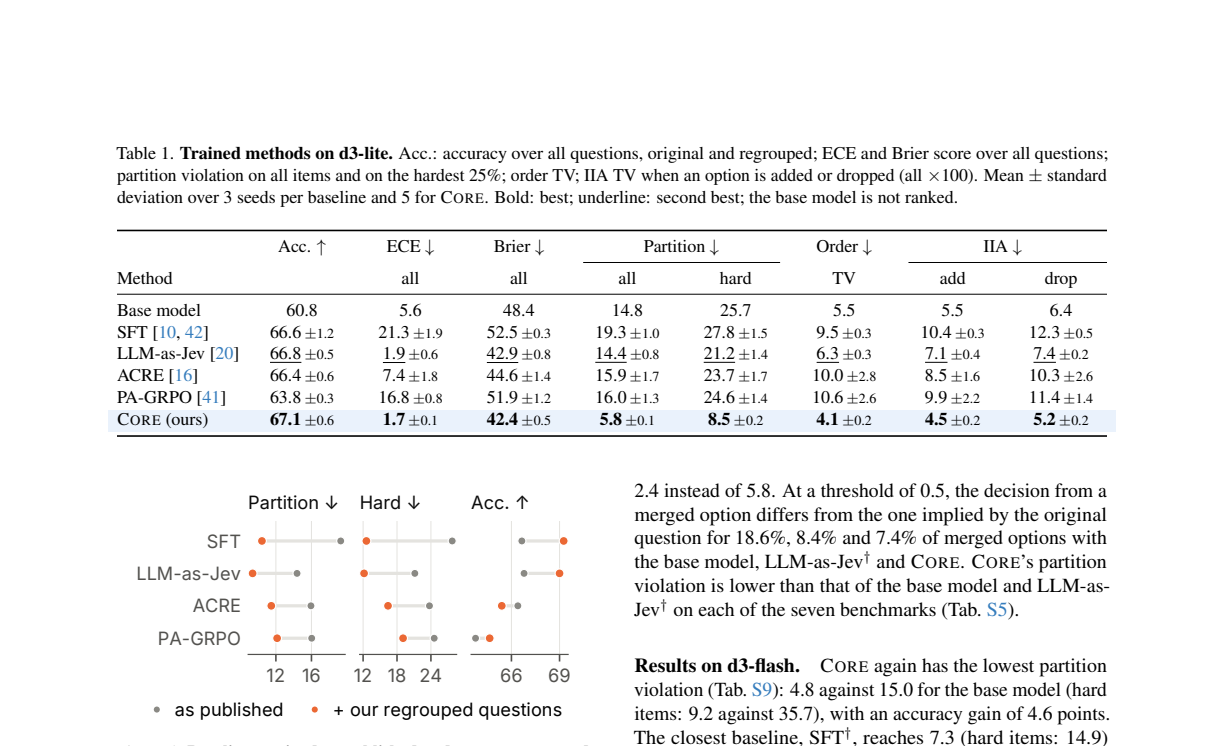
Table 1 caption: The note about ACRE$^dagger$ and PA-GRPO$^dagger$ not being trained on d3-flash is in the supplementary material but not in the main table caption. Adding a footnote to Table 1 would avoid confusion.
The paper says, at 1
Pith says: minor objection 4 of 4
Figure 3 (additivity scatter plots) is described in the caption but the actual figure is not visible in the supplied text. The caption is clear, but the paper would benefit from a brief description of the hexagon binning in the text for readers who cannot see the figure.
What would settle it
A concrete falsifier would be a dataset where CORE fails to reduce the partition violation below the baseline, or where the reduction comes at the cost of accuracy, or where the method does not generalize to a new merge wording not seen in training.
from Pith's summary of the paper
How the review went
5 passes by deepseek-v4-flash · 24 Nov 2026
- Reader holds up
- Skeptic concern withdrawn: the paper already says this
- Referee 4 minor
- Check against the paper kept 0 of 1 objection
- Editor wrote the verdict above
Not run on this paper: the simulated authors' defence.
Pith's passes raised 1 objection. A check against the paper's text kept 0 and withdrew 1 (1 the paper already says).
The review in full
The review in brief, machine-written
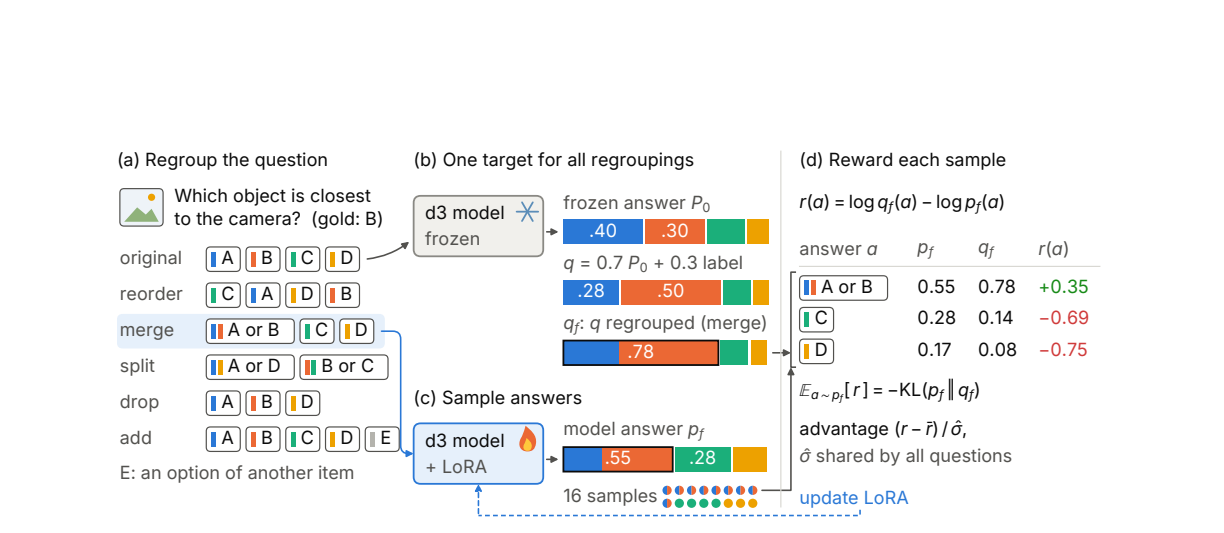
This paper identifies a clear and practically important flaw in vision decision models: when options are merged (e.g., “A or B”), the model’s probability for the merged option is on average 11.5 points lower than the sum of the probabilities of A and B. This under-additivity appears at every model size from 0.85B to 26B and persists after standard fine-tuning. The authors propose CORE, which trains the model on regrouped versions of each question (merges, splits, drops, adds) toward a single target distribution over the original options, summed into each group. The target is a mixture of the frozen model’s answer and the smoothed label, and the reward is the log-ratio of target to model probability, whose expectation is the negative KL divergence. The method is tested on 1,050 items from seven benchmarks across five d3 model sizes. CORE reduces the partition violation (TV distance between the answer to a regrouped question and the original answer summed into the same groups) from 14.8 to 5.8 on the 0.85B model, compared to 9.4 for the best baseline trained on the same regrouped questions. Accuracy improves at every size, and ECE improves on smaller models. The reduction transfers to unseen merge wordings and to cross-dataset training. The experiments are extensive, with multiple baselines, ablations, and statistical intervals. The authors acknowledge limitations: the method is tested only on merged options that list their members (not broader events like “left half”), and part of the improvement on hard items is regression to the mean. The central claim is well-supported. This paper is for anyone building or using decision models whose probabilities are consumed by downstream software. It deserves a serious referee and would benefit from discussion of how the method scales to larger answer sets and to merged options that do not list members. I recommend engaging with the work.
The stress test's concern
Withdrawn: the paper already says this.
The paper says
“These settings were chosen in earlier experiments on our evaluation items, without a separate validation split, and kept fixed for every experiment.”
The referee's report
The paper identifies a clear and practically important failure of vision decision models: under-additivity of probabilities when options are merged. The proposed method, CORE, is simple, principled, and effective across five model sizes, multiple benchmarks, and unseen merge wordings. The experiments are extensive, with proper statistical intervals, ablations, and controls for confounding factors (confidence, order sensitivity). The paper also demonstrates that the violation cannot be fixed by standard calibration or order-averaging techniques, and that fine-tuning on labels alone makes it worse. This work has immediate relevance for any system that uses decision-model probabilities in downstream decisions, and it opens a new evaluation dimension (partition violation) that should become standard alongside accuracy and calibration.
Pith's reading of the paper (a machine's summary, not the authors')
The paper shows that vision decision models (such as the d3 family) are under-additive: when options are merged into 'A or B', the model assigns less probability to the merged option than the sum of the probabilities of A and B. This happens at every model size from 0.85B to 26B and persists after fine-tuning on labels. The authors propose CORE, a training method that asks each training question with its options regrouped and trains the answers toward a single target distribution over the original options, summed into each question's groups. On 1,050 items from seven benchmarks, CORE reduces the total variation distance between the answer to a regrouped question and the original answer summed into the same groups from 14.8 to 5.8 points on the 0.85B model, without lowering accuracy. The reduction generalizes to unseen merge wordings and cross-dataset training.
What carries the argument. The key machinery is the regrouping-consistent target (Equation 2 in the paper): for each training item, a single distribution q over the original options is defined as a weighted mixture of the frozen base model's answer and the smoothed label. For any regrouped question f (e.g., a merge, split, drop, or add), the target q_f is the same regrouping of q. The model is trained to minimize the KL divergence between its answer p_f and q_f, using a log-ratio reward whose expectation is -KL(p_f || q_f). This ensures that if the model matches all targets, it satisfies additivity on the training items.
Core claim. The central discovery is that vision decision models systematically violate probabilistic coherence: a merged option 'A or B' receives on average 11.5 points less probability than the sum of the probabilities of A and B. This under-additivity is present at every model size tested (0.85B to 26B) and is not removed by standard fine-tuning on labels. The authors propose CORE, which trains the model to assign the same probability to an event regardless of how the options are grouped, by defining a target distribution over the original options (a mixture of the frozen model's answer and the smoothed label) and training the model to match the regrouping of this target for each regrouped question. CORE reduces the partition violation (a measure of incoherence) from 14.8 to 5.8 points on the 0.85B model, and from 15.0 to 4.8 on the 8.4B model, without lowering accuracy.
The premise it rests on. The method assumes that training the model to match the regrouping-consistent target on training items will generalize to unseen items and regroupings; this is tested on unseen merge wordings and cross-dataset, but the assumption that the frozen model's answer provides a useful starting point for the target is not independently verified.
If the paper is right (Pith's inferences, not the authors')
If CORE generalizes as shown, decision models can be made coherent without sacrificing accuracy, making their probabilities reliable for downstream uses like thresholding and combining across questions.
The finding that under-additivity persists after standard fine-tuning suggests that current training practices do not enforce probabilistic coherence, and that coherence should be a separate evaluation metric.
CORE's reduction of partition violation on unseen merge wordings and cross-dataset indicates that the method learns a general principle rather than memorizing specific regroupings.
The method's success on generative VLMs (Qwen3-VL) suggests it applies beyond the d3 architecture, though with a smaller accuracy gain.
The paper's diagnosis of under-additivity mirrors human subadditivity (Tversky and Koehler 1994), suggesting that decision models inherit a cognitive bias from their training data or architecture.
CORE's target construction uses the frozen model's answer as an anchor; this implies that the method's effectiveness depends on the base model's initial probabilities being a reasonable starting point, which may not hold for poorly calibrated models.
The residual partition violation after CORE is partly due to order sensitivity; combining CORE with order-invariant architectures (like Jeva) could further reduce incoherence.
The paper tests only merged options that list their members; extending to broader events (e.g., 'left half') would require a different approach, possibly using hierarchical labels.
Check this review
What was read
The passes were given all 181,733 characters of the paper's LaTeX source.
Fingerprint of that text (SHA-256): 1b09f7d72b248f3d7f0fe4e31cbf7ed054967ae7ba49688c98fa86e20ea386f0
Pith does not keep that text. Rebuilt from the paper's source or PDF by the same code, it has this fingerprint if it is the same text. From a copy of Pith's code:
PYTHONPATH=. python scripts/review_input_check.py 2611.30096
The passes, in the order they ran
- Reader deepseek-v4-flash · medium effort · $0.0067 · instructions of the Reader, fingerprint f9ead7300382…
- Skeptic deepseek-v4-flash · medium effort · $0.0062 · instructions of the Skeptic, fingerprint 8f88c0f61488…
- Referee deepseek-v4-flash · medium effort · $0.0059 · instructions of the Referee, fingerprint a852d99aea0d…
- Check against the paper deepseek-v4-flash · medium effort · $0.0058 · instructions of the Check against the paper, fingerprint 6c7a6883d551…
- Editor deepseek-v4-flash · medium effort · $0.0058 · instructions of the Editor, fingerprint e7211f6a3d27…
- Circularity check deepseek-v4-flash · medium effort · $0.0058 · instructions of the Circularity check, fingerprint e9946e39d67b…
- Summary for the page deepseek-v4-flash · medium effort · temperature 0.2 · $0.0063 · instructions of the Summary for the page, fingerprint e4f56bf568e7…
The passes cost $0.042 in model calls together.
Version stamped on this review: pith-pipeline@v1.4.1-daily-deepseek-or-medium+deepseek/deepseek-v4-flash+p.d60f54226f00
Each link opens a pass's instructions as plain text, the exact bytes its fingerprint was taken over. Every stored set of instructions.
curl -s https://pith.science/methodology/prompts/f9ead730038216984cfb56d7cb34332bdf691828296a1de4245f3d6667d4bf56 | sha256sum
prints the fingerprint of the reader's instructions. The same works for every pass.
The receipt
The review's fingerprint was taken on 24 Nov 2026. The review you are reading still matches it.
Fingerprint of the review (SHA-256): 405931e275660d0045d76ffff56b1d862ec00126663f7b778ef5742a5287559b
curl -s 'https://pith.science/api/v1/verdicts/2611.30096?form=canonical' | sha256sum
prints the fingerprint of the review as it stands now. The rule, in four steps.
A matching fingerprint shows the review has not changed since that date. It does not show that the review is right.
How often reviews like this one are right
Reviews like this one: written by deepseek-v4-flash, from the paper's LaTeX source.
How often objections from reviews like this one are right: not yet measured
Reviews by people
This review was written by a machine. No person has reviewed this paper on Pith yet. A scientist listed on Pith can review it for a fee, and their review is published here whatever it concludes.
The paper
Abstract
Vision decision models answer a multiple-choice question about an image with one probability per option, and software uses them directly. We show that the probabilities depend on how the options are grouped: a merged option "A or B" receives on average 11.5 points less probability than the sum of A and B. This under-additivity appears at every model size from 0.85B to 26B and remains after fine-tuning on labels. We propose CORE, which asks each training question with its options regrouped and trains the answers to all these questions toward one target distribution over the original options, summed into each question's groups. On 1,050 items from seven benchmarks, CORE reduces the total variation distance between the answer to a regrouped question and the original answer summed into the same groups from 14.8 to 5.8 points on the 0.85B model, against 9.4 for the best baseline trained on the same questions. At all five model sizes, CORE reduces this distance without lowering accuracy.
The paper's own sentences, arranged, kept beside the review and separate from it. Each label is drawn from a closed vocabulary; the number beside it is the probability the classifier gave that label. No sentence in this record was written by a model.
abstract compiled · 2026-11-24
The authors' main claim, as the classifier picked it out 0.67
“We show that the probabilities depend on how the options are grouped: a merged option "A or B" receives on average 11.5 points less probability than the sum of A and B.”
How the main claim is stated: asserted 1.00
What the abstract itself states, as probabilities: claims first 0.05 · states limitation 0.16 · human participants 0.04 · controlled comparison 0.96 · randomized assignment 0.03 · states quantitative result 0.99 · compares with prior results 0.96 · mentions code or data availability 0.03
The abstract, sentence by sentence
This table labels the abstract only (arXiv listing abstract v1). The number is the probability the classifier gave the label.
| Sentence | Role | The authors' own work | States the main conclusion | Strength |
|---|---|---|---|---|
| Vision decision models answer a multiple-choice question about an image with one probability per option, and software uses them directly. | background 1.00 | 0.05 | 0.02 | asserted 1.00 |
| We show that the probabilities depend on how the options are grouped: a merged option "A or B" receives on average 11.5 points less probability than the sum of A and B. | result 1.00 | 0.94 | 0.67 | asserted 1.00 |
| This under-additivity appears at every model size from 0.85B to 26B and remains after fine-tuning on labels. | result 1.00 | 0.92 | 0.16 | asserted 1.00 |
| We propose CORE, which asks each training question with its options regrouped and trains the answers to all these questions toward one target distribution over the original options, summed into each question's groups. | method 0.96 | 0.88 | 0.09 | asserted 0.98 |
| On 1,050 items from seven benchmarks, CORE reduces the total variation distance between the answer to a regrouped question and the original answer summed into the same groups from 14.8 to 5.8 points on the 0.85B model, against 9.4 for the best baseline trained on the same questions. | result 1.00 | 0.96 | 0.23 | asserted 1.00 |
| At all five model sizes, CORE reduces this distance without lowering accuracy. | result 1.00 | 0.95 | 0.31 | asserted 1.00 |
What kind of paper the classifier reports this is: method or tool 0.98 · evidence from observation or experiment 0.95
What was examined, and what was not
Sources read
- arXiv listing abstract v1
Not examined
- full text
- figures and tables
- references and citing sentences
- relations to other papers
Levels run
- P abstract
Not run
- S sections
- T body sentences
- C citations
- R cross-paper relations
How the labels were made
Compiled by classifier-1.13.0 via TypeSafe API, question bank abstract-p1-20260923, 2026-11-24: 1 request, 5,048 input tokens.
Every quoted sentence on this record is the authors'. Every label is from Pith's closed vocabulary, with the probability shown beside it. This record as JSON
Figures (5)
Figures are the authors', reproduced from the paper.
References (43)
- [1] Mehul Damani, Isha Puri, Stewart Slocum, Idan Shenfeld, Leshem Choshen, Yoon Kim, and Jacob Andreas. Beyond 8 binary rewards: Training lms to reason about their uncer- tainty. InInternational conference on learning representa- tions, pages 59456–59493, 2026. 3, 11 on Pith
- [2] Bruno De Finetti. La pr ´evision: ses lois logiques, ses sources subjectives. InAnnales de l’institut Henri Poincar ´e, pages 1–68, 1937. 3, 11 on Pith
- [3] Decision Index maintainers. Jev Decision Index. Leader- board: https : / / huggingface . co / spaces / multimodalart/jev-decision-index . Reproduc- tion kit: https : / / github . com / apolinario / decision-index, 2026. Accessed November 15, 2026. 3, 11 on Pith
- [4] Julien Delaunay. Can the confidence and decisions of system 1 models be trusted? an explainability and perturbation audit of jev-style decision models.arXiv preprint arXiv:2611.12521, on PithPith's reviewarXiv
- [5] Xiang Deng, Yu Gu, Boyuan Zheng, Shijie Chen, Sam Stevens, Boshi Wang, Huan Sun, and Yu Su. Mind2web: Towards a generalist agent for the web.Advances in Neural Information Processing Systems, 36:28091–28114, 2023. 3 on Pith
- [6] Yuetian Du, Yucheng Wang, Rongyu Zhang, Zhijie Xu, Boyu Yang, Ming Kong, Jie Liu, and Qiang Zhu. Linking per- ception, confidence and accuracy in mllms.arXiv preprint arXiv:2603.12149, 2026. 3, 11 on PitharXiv
- [7] Yanrui Du, Danyang Zhao, Sendong Zhao, Wenhao Li, Yibo Gao, Haochun Wang, Zhuoer Xu, Shiwen Cui, and Bing Qin. How reliable are system-one decisions in medicine? a comparative study of jev, jev-like models, and llms.arXiv preprint arXiv:2610.18529, 2026. 3, 5, 7, 11, 13 on PithPith's reviewarXiv
- [8] Xingyu Fu, Yushi Hu, Bangzheng Li, Yu Feng, Haoyu Wang, Xudong Lin, Dan Roth, Noah A Smith, Wei-Chiu Ma, and Ranjay Krishna. Blink: Multimodal large language mod- els can see but not perceive. InEuropean Conference on Computer Vision, pages 148–166. Springer, 2024. 3 on Pith
- [9] Tommaso Furlanello, Zachary Lipton, Michael Tschannen, Laurent Itti, and Anima Anandkumar. Born again neural networks. InInternational conference on machine learning, pages 1607–1616. PMLR, 2018. 3, 12 on Pith
- [10] Jonathan Geuter, Andrew Cheng, and David Alvarez-Melis. Releasing the inner jev: A simple recipe for open decision models.arXiv preprint arXiv:2610.17205, 2026. 1, 2, 3, 5, 6, 7, 11, 13 on PithPith's reviewarXiv
- [11] W Brier Glenn et al. Verification of forecasts expressed in terms of probability.Monthly weather review, 78(1):1–3, on Pith
- [12] Chuan Guo, Geoff Pleiss, Yu Sun, and Kilian Q Weinberger. On calibration of modern neural networks. InInternational conference on machine learning, pages 1321–1330. PMLR, on Pith
- [13] Meng-Hao Guo, Jiajun Xu, Yi Zhang, Jiaxi Song, Haoyang Peng, Yi-Xuan Deng, Xinzhi Dong, Kiyohiro Nakayama, Zhengyang Geng, Chen Wang, et al. R-bench: Graduate- level multi-disciplinary benchmarks for llm & mllm complex reasoning evaluation.arXiv preprint arXiv:2505.02018, 2025. 3 on PithPith's reviewarXiv
- [14] Geoffrey Hinton, Oriol Vinyals, and Jeff Dean. Distill- ing the knowledge in a neural network.arXiv preprint arXiv:1503.02531, 2015. 3, 12 on PithPith's reviewarXiv
- [15] Edward J Hu, Yelong Shen, Phillip Wallis, Zeyuan Allen-Zhu, Yuanzhi Li, Shean Wang, Lu Wang, and Weizhu Chen. Lora: Low-rank adaptation of large language models.arXiv preprint arXiv:2106.09685, 2021. 5, 11 on PithPith's reviewarXiv
- [16] Minbin Huang, Runhui Huang, Chuanyang Zheng, Jingyao Li, Guoxuan Chen, Han Shi, and Hong Cheng. Answer- consistent chain-of-thought reinforcement learning for multi-modal large langauge models.arXiv preprint arXiv:2510.10104, 2025. 2, 3, 5, 6, 11 on PitharXiv
- [17] Saman Sarker Joy. Do system one decisions add up? a study of probabilistic coherence.arXiv preprint arXiv:2609.33971, on PithPith's reviewarXiv
- [18] Keyi Li, Yihao He, and Quanyi Li. Beyond calibration: Do a typed-decision model’s probabilities obey the probability axioms?arXiv preprint arXiv:2609.33209, 2026. 1, 3, 8, 11 on PithPith's reviewarXiv
- [19] Qi Li and Xinchao Wang. Jeva: System one models from first principles.arXiv preprint arXiv:2610.18773, 2026. 3, 11 on PithPith's reviewarXiv
- [20] Yinheng Li and Justin Wagle. Llm2jev: Llms are already jev-style decision models–when and how to fine-tune them. arXiv preprint arXiv:2610.02076, 2026. 1, 3, 5, 6, 11 on PithPith's reviewarXiv
show 23 more
- [21] Yesheng Liu, Hao Li, Haiyu Xu, Baoqi Pei, Jiahao Wang, Mingxuan Zhao, Jing-Shu Zheng, Zheqi He, JG Yao, Xi Yang, et al. Beyond multiple choice: Verifiable openqa for robust vision-language rft. InProceedings of the IEEE/CVF Conference on Computer Vision and Pattern Recognition... on Pith
- [22] Minesh Mathew, Viraj Bagal, Rub `en Tito, Dimosthenis Karatzas, Ernest Valveny, and CV Jawahar. Infographicvqa. In2022 IEEE/CVF Winter Conference on Applications of Computer Vision (WACV), pages 2582–2591. IEEE, 2022. 3 on Pith
- [23] Mahdi Pakdaman Naeini, Gregory Cooper, and Milos Hauskrecht. Obtaining well calibrated probabilities using bayesian binning. InProceedings of the AAAI conference on artificial intelligence, 2015. 3, 11 on Pith
- [24] Jeremy Nixon, Mike Dusenberry, Ghassen Jerfel, Timo- thy Nguyen, Jeremiah Liu, Linchuan Zhang, and Dustin Tran. Measuring calibration in deep learning.arXiv preprint arXiv:1904.01685, 2019. 25 on PithPith's reviewarXiv
- [25] Pouya Pezeshkpour and Estevam Hruschka. Large language models sensitivity to the order of options in multiple-choice questions. InFindings of the Association for Computational Linguistics: NAACL 2024, pages 2006–2017, 2024. 3, 11 on Pith
- [26] Muhammad Atif Saeed, Azka Atiq, Adarsh Kumar, Akhtar Jamil, Uzair Iqbal, and Roland Aydin. Shift-jev: Certified abstention and gain-gated continual adaptation for llm-based decision models under distribution shift.arXiv preprint arXiv:2610.34329, 2026. 11 on PithPith's reviewarXiv
- [27] Dustin Schwenk, Apoorv Khandelwal, Christopher Clark, Kenneth Marino, and Roozbeh Mottaghi. A-okvqa: A bench- mark for visual question answering using world knowledge. InEuropean conference on computer vision, pages 146–162. Springer, 2022. 8 on Pith
- [28] Zhihong Shao, Peiyi Wang, Qihao Zhu, Runxin Xu, Junxiao Song, Xiao Bi, Haowei Zhang, Mingchuan Zhang, YK Li, Yang Wu, et al. Deepseekmath: Pushing the limits of mathe- matical reasoning in open language models.arXiv preprint arXiv:2402.03300, 2024. 3, 5, 11 9 on PithPith's reviewarXiv
- [29] Kihyuk Sohn, David Berthelot, Nicholas Carlini, Zizhao Zhang, Han Zhang, Colin Raffel, Ekin Dogus Cubuk, Alexey Kurakin, and Chun-Liang Li. Fixmatch: Simplifying semi- supervised learning with consistency and confidence.Ad- vances in neural information processing systems, 33:596–608, on Pith
- [30] Shengbang Tong, Ellis Brown, Penghao Wu, Sanghyun Woo, Manoj Middepogu, Sai C Akula, Jihan Yang, Shusheng Yang, Adithya Iyer, Xichen Pan, et al. Cambrian-1: A fully open, vision-centric exploration of multimodal llms.Advances in Neural Information Processing Systems, 37:87310–87356, on Pith
- [31] Amos Tversky and Daniel Kahneman. Rational choice and the framing of decisions. InMultiple criteria decision making and risk analysis using microcomputers, pages 81–126. Springer, on Pith
- [32] Amos Tversky and Derek J Koehler. Support theory: A nonextensional representation of subjective probability.Psy- chological review, 101(4):547, 1994. 2, 3, 11 on Pith
- [33] TypeSafe AI. Introducing System One models & Jev. TypeSafe AI blog, https://typesafe.ai/blog/ introducing - system - one - models - and - jev, on Pith
- [34] vLLM Semantic Router Team. d3: A multimodal founda- tion decision model. Hugging Face model card, https: //huggingface.co/vllm-sr/d3, 2026. Model fam- ily vllm-sr/d3-lite, d3-nano, d3-mini, d3-flash and d3. Ac- cessed November 15, 2026. 1, 5, 7, 13 on Pith
- [35] Zirui Wang, Mengzhou Xia, Luxi He, Howard Chen, Yi- tao Liu, Richard Zhu, Kaiqu Liang, Xindi Wu, Haotian Liu, Sadhika Malladi, et al. Charxiv: Charting gaps in realistic chart understanding in multimodal llms.Advances in Neural Information Processing Systems, 37:113569–113697, 2024. 3 on Pith
- [36] xAI. Grok-1.5 Vision Preview. https://x.ai/news/ grok-1.5v , 2024. Release of the RealWorldQA bench- mark, April 12, 2024. 3 on Pith
- [37] Qizhe Xie, Zihang Dai, Eduard Hovy, Thang Luong, and Quoc Le. Unsupervised data augmentation for consistency training.Advances in neural information processing systems, 33:6256–6268, 2020. 3, 12 on Pith
- [38] Hee Suk Yoon, Eunseop Yoon, Ji Woo Hong, SooHwan Eom, Gwanhyeong Koo, Mark Hasegawa-Johnson, Qi Dai, Chong Luo, and Chang D Yoo. Pdcr: Perception-decomposed confi- dence reward for vision-language reasoning.arXiv preprint arXiv:2605.13467, 2026. 3, 11 on PithPith's reviewarXiv
- [39] Zirui Zhang, Haoyu Dong, Kexin Pei, and Chengzhi Mao. R-c2: Cycle-consistent reinforcement learning improves mul- timodal reasoning.arXiv preprint arXiv:2603.25720, 2026. 3, 11 on PitharXiv
- [40] Chujie Zheng, Hao Zhou, Fandong Meng, Jie Zhou, and Minlie Huang. Large language models are not robust multiple choice selectors. InInternational Conference on Learning Representations, pages 19426–19454, 2024. 2, 3, 11 on Pith
- [41] Jinquan Zheng, Jia Yuan, Jiacheng Yao, Chenyang Gu, Pujun Zheng, and Guoxiu He. Mitigating selection bias in large lan- guage models via permutation-aware grpo. InProceedings of the 64th Annual Meeting of the Association for Computational Linguistics (Volume 1: Long Papers), p... on Pith
- [42] Xunlan Zhou, Xianliang Yang, and Li Zhao. From text de- cisions to pixels: An study of jev-style visual choice model. arXiv preprint arXiv:2609.29283, 2026. 1, 3, 5, 6, 11, 13 10 When “A or B” Is Less Likely than A: Coherent Probabilities for Vision Decision Models Supplementa... on PithPith's reviewarXiv
- [2026] Published September 15, 2026. Accessed November 15, 2026. 1, 3, 11 on Pith
Challenges and discussion
Disagree with the review, or know something it missed? Leave a comment, or challenge this review formally: a challenge becomes a permanent entry in this paper's record, and its decision is published here.
Come back by email
A short list of the week's newly reviewed papers. Nothing is sent until you confirm from your inbox, and every email has a link that stops it. No account.
No comments yet.
Sign in to comment