Machine Learning · arXiv:2611.12521 v1 · submitted 9 Nov 2026 · 104 references
Can the Confidence and Decisions of System 1 Models Be Trusted? An Explainability and Perturbation Audit of Jev-Style Decision Models
The paper says
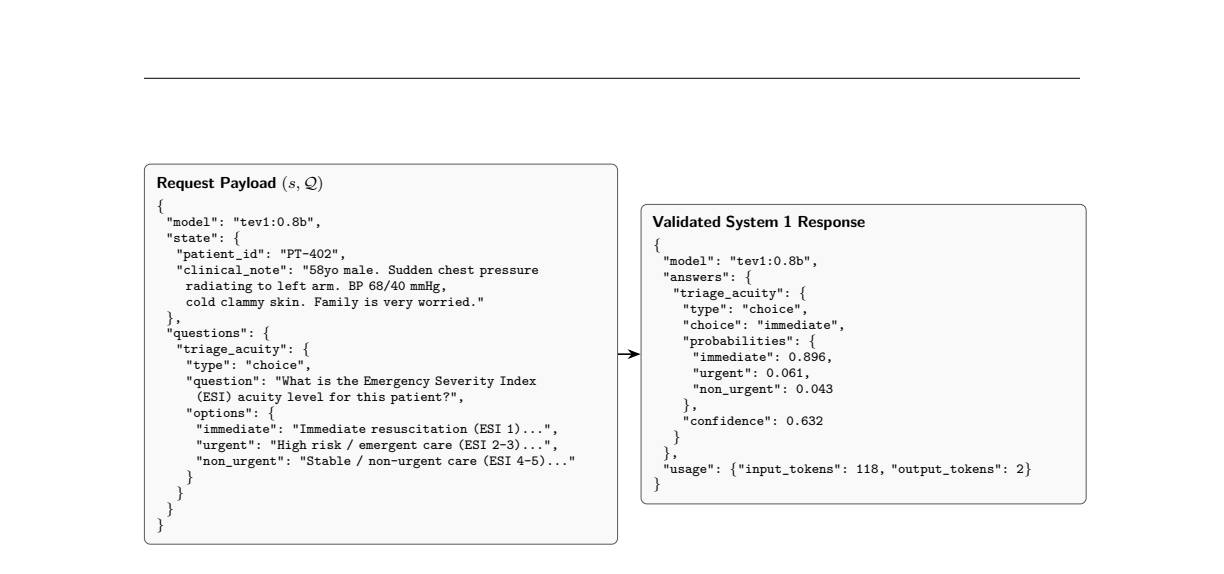
“"System 1" decision models (pioneered by TypeSafe AI's Jev) replace autoregressive text generation with a single forward pass returning typed probability distributions over declared schemas (Choice, Score, Noul).”
more of the abstract
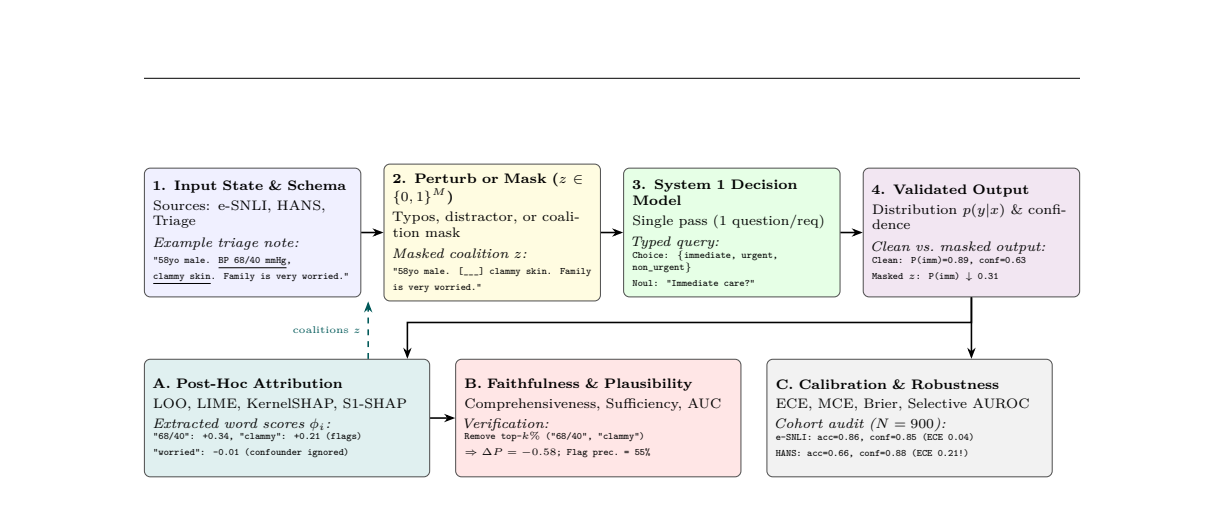
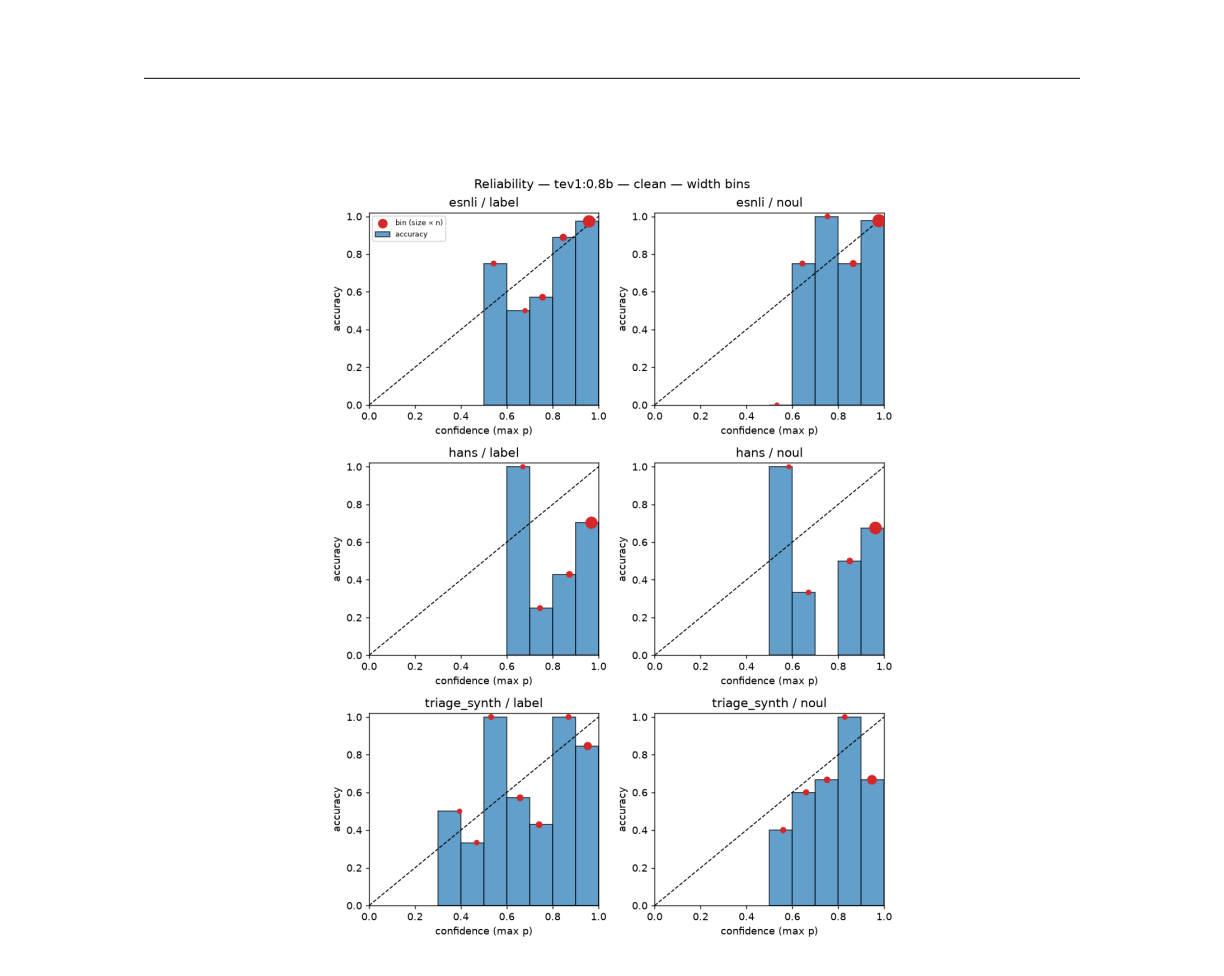
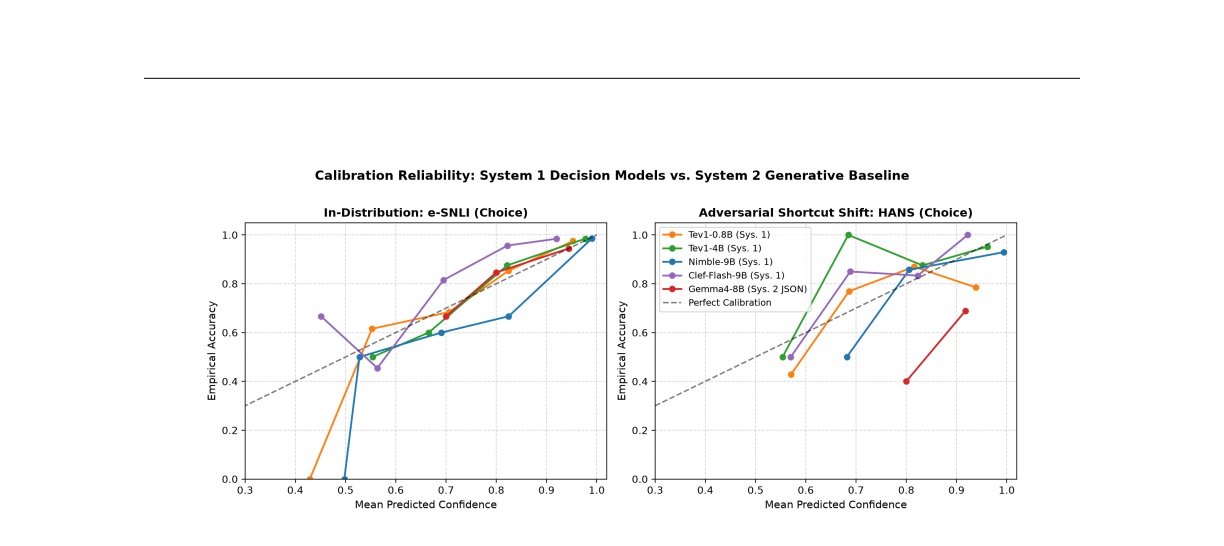
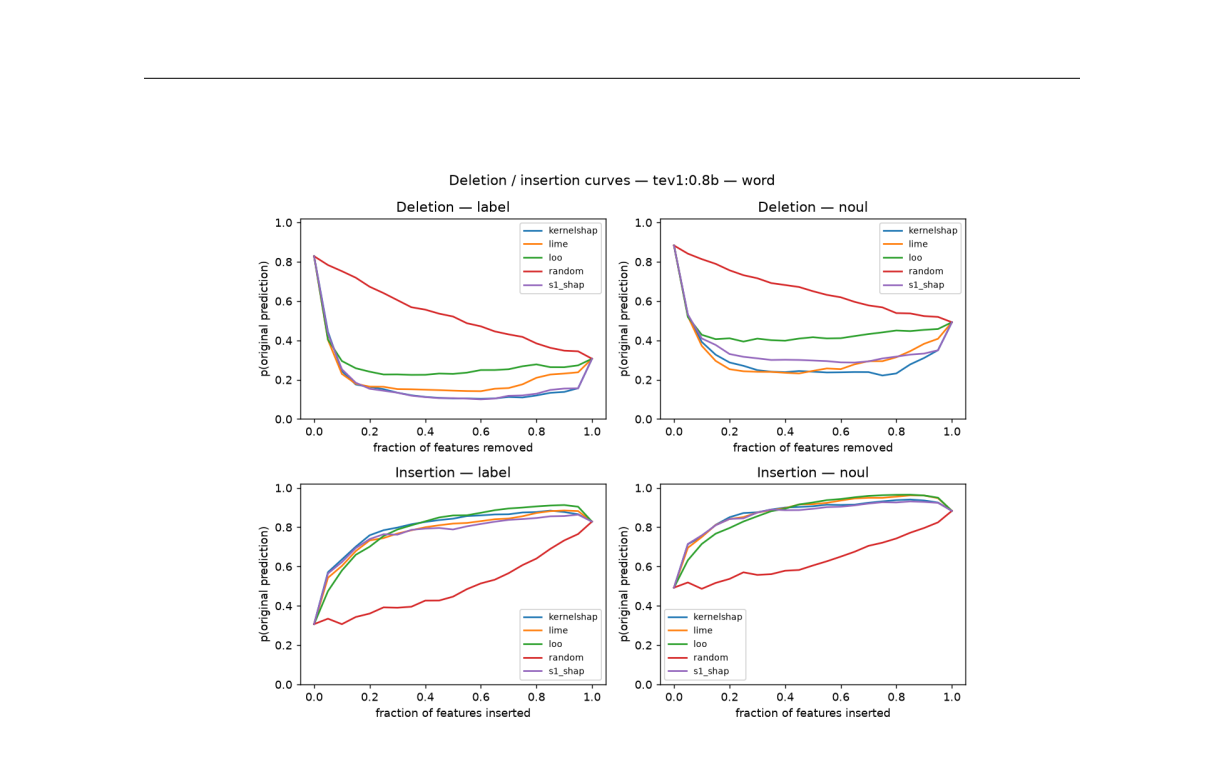
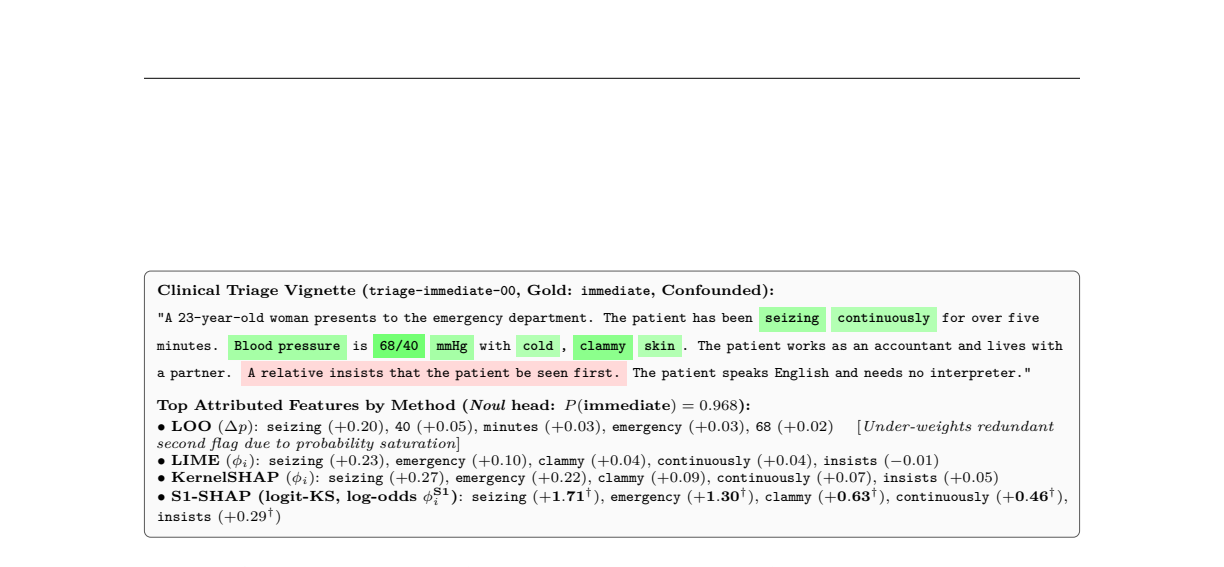
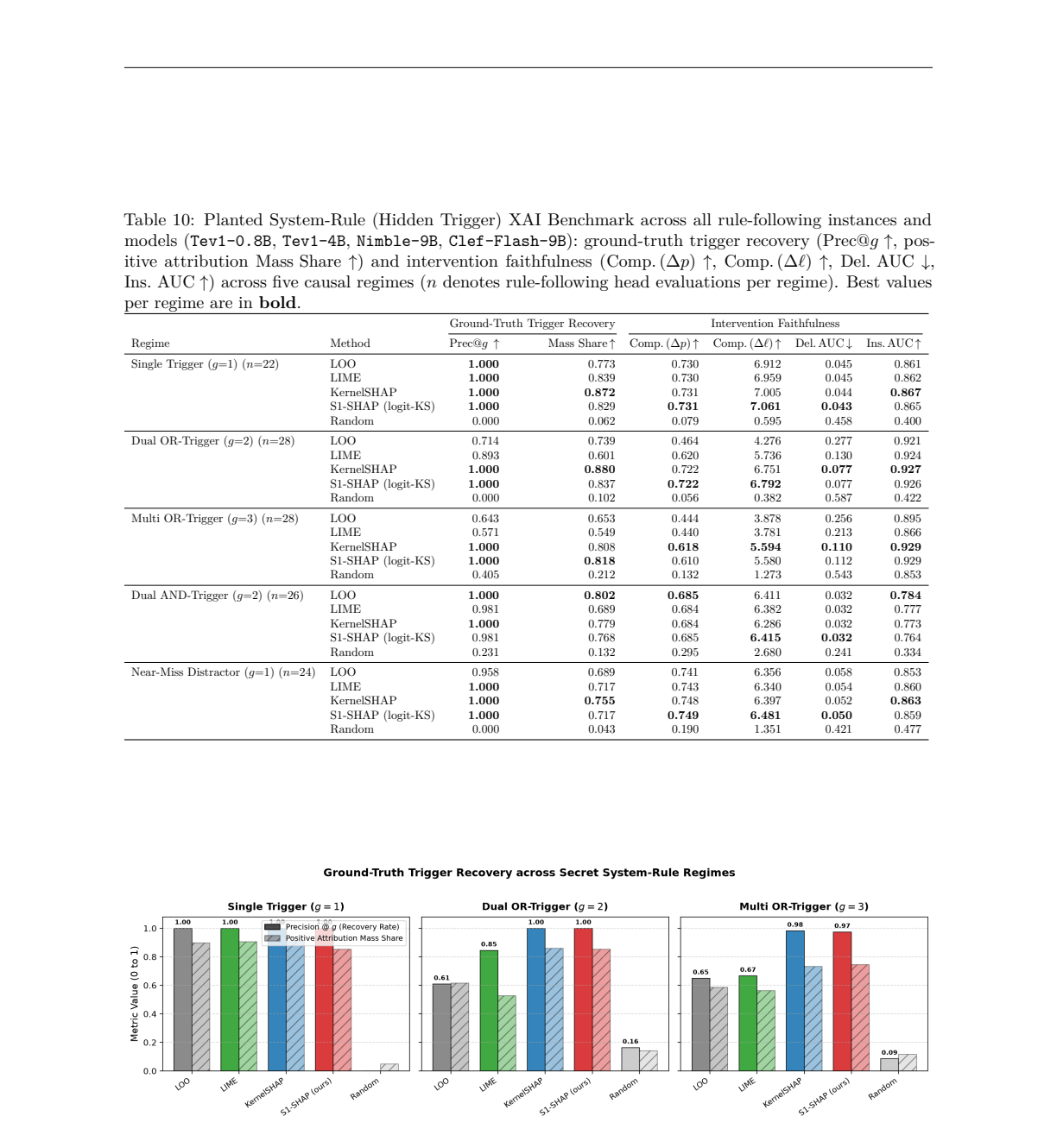
While deployed for low-latency routing and automated triage, their statistical calibration and post-hoc explainability remain uncharacterized. We introduce an open, deterministic audit benchmark evaluating System 1 decision models across calibration under label-preserving perturbations, cross-question interference, and post-hoc attribution faithfulness. Evaluating five open-weight models (0.8B to 27B) alongside generative System 2 baselines – both single-token logprob scoring and structured JSON/CoT decoding – across NLI (e-SNLI), adversarial syntactic shortcuts (HANS), synthetic clinical triage (N=900), prompt injection defense (Tensor Trust, N=250), and an 86-case logic-gate trigger suite yields five findings: (1) provider confidence is an exact closed-form dispersion transform (1 - H(p)/ln K on sub-10B models; normalized margin on Clef-27B) rather than empirical accuracy; (2) bundling multiple questions in one request induces directional cross-question interference (11.7% to 22.4% binary flips on Tev1-0.8B, vs. 0.1% to 0.2% on Tev1-4B); (3) System 1 models with >= 4B parameters are faster and better calibrated under syntactic shifts (ECE_w = 0.030 to 0.087) than logprob (0.144) and JSON (0.378) baselines; (4) for prompt-injection defense (N=250), >= 4B models achieve 0.988 to 0.998 AUROC with up to 95.2% recall and 0.0% false alarms at 48 to 60 ms; and (5) single-pass inference makes 512-coalition XAI interactive (1.3 to 3.2 s/input), while KernelSHAP with a logit link (S1-SHAP) mitigates softmax saturation on disjunctive OR gates (89.3% to 100.0% gate recovery vs. 57.1% to 82.1% in prob space; p_adj = 0.004).
from the abstract
Pith says
Machine review · deepseek-v4-flash · 10 Nov 2026 · what was read was not recorded · not checked by a person
It can be wrong. Challenge this review or reply to it.
Holds up. Rigorous empirical audit of System 1 decision models with a clean structural discovery about confidence scores, but limited generative baselines and synthetic clinical data. This line is wrong
2 major objections · 5 minor
How often objections from reviews like this one are right: not yet measured
Not checked: figures, code, what the 104 references say.
The paper says, at Section 5.1 and Equation (5)
The review did not quote this passage.
Pith says: Objection 1 of 2 · major
The claim that the confidence field equals 1−H(p)/lnK is verified 'across all 600 clean choice predictions on these four models (150 per model)' to floating-point precision. This verification is limited to Choice heads. The paper should state explicitly whether the same formula holds for binary Noul distributions (K=2) on sub-10B models, or whether Noul uses a different computation.
more of objection 1
If it has not been verified for Noul, that should be noted, because several experiments (e.g., AUROC_c in Table 6) treat the confidence field as a general ranking signal for Noul decisions by marking the metric with a dash rather than reporting a number—clarifying the scope would help readers avoid overextending the claim.
The paper says, at Section 4.2 (Table 2) and Tables 7/13
The review did not quote this passage.
Pith says: Objection 2 of 2 · major
The comparison between System 1 models and the System 2 baseline (Gemma4-8B) conflates two differences: decision paradigm (System 1 vs. generative) and base model architecture (Qwen3.5 vs. Gemma-4). The paper acknowledges that all System 1 models are fine-tuned from Qwen3.5, but the calibration advantage claimed in Finding (3) could partly stem from the Qwen backbone rather than the decision paradigm per se.
more of objection 2
A controlled comparison would require a Qwen-based generative baseline. The authors should either add such a baseline (even at a smaller scale) or clearly discuss this confound in the limitations so that readers do not attribute all the observed advantage to the System 1 interface alone.
5 minor objections
The paper says, at Table 8 (caption and column headers)
Pith says: minor objection 1 of 5
The column header 'Comp.(∆p)↑' is used consistently, but the term 'Comprehensiveness' is spelled correctly. However, the abbreviation 'Suff.↓' is not defined in the caption; it appears in Section 4.3 as sufficiency but the table would benefit from a footnote or a brief inline reminder.
The paper says, at Section 5.2, Table 7 caption
Pith says: minor objection 2 of 5
The caption states '‡N = 450, n = 150 per dataset for Clef-27B and Gemma4-8B JSON'. This is inconsistent with the abstract which says N=900 for the main cohort. Clarify that Clef-27B and Gemma4-8B JSON were evaluated on a smaller subset due to resource constraints, and state how this affects the comparability of cross-model results, especially for selective risk metrics.
show 3 more
The paper says, at Section 5.9, last paragraph
Pith says: minor objection 3 of 5
The Holm-Bonferroni adjusted Wilcoxon p-values are reported as 'p_adj = 0.0040' for S1-SHAP vs. KernelSHAP on log-odds comprehensiveness. The test is described as pooled across four models and 24 instances per model. The paper should report the exact test statistic (W) and sample size for reproducibility, or confirm that these are included in the public repository.
The paper says, at Various tables (e.g., Tables 6, 13)
Pith says: minor objection 4 of 5
Several tables report ECE_w with 95% bootstrap confidence intervals for some cells (e.g., Table 6) but not all (e.g., Table 13 does not show intervals for cross-model comparisons). For consistency and to avoid giving a false sense of precision, the authors should either provide CIs for all reported ECE values or state which comparisons are based on full population enumeration and thus need no intervals.
The paper says, at Section 5.10, Table 14 caption
Pith says: minor objection 5 of 5
The column 'Flip (C/N)↓' reports cross-question flip rates for Choice and Noul. For Gemma4-8B (Logprob) the value is '–', which is appropriate because it uses a single-token protocol. For Gemma4-8B (JSON), the value '0.01 / 0.06' is given. The paper should briefly explain how the JSON baseline was queried in bundled vs. isolated mode, since the JSON protocol is inherently single-question per request. If the bundled protocol was not used for JSON, the flip rate should be '–' as well.
What would settle it
Verify the confidence formula (Eq. 5) holds on a held‑out sub‑10B System 1 model not included in the original evaluation (e.g., an unreleased variant or a fine‑tune on a different base architecture), using at least 100 clean multi‑way choices, and confirm maximum absolute deviation remains below 1e‑15.
from the skeptic's reading
How the review went
4 readings by deepseek-v4-flash · 10 Nov 2026
- Reader holds up
- Skeptic agrees
- Editor wrote the verdict above
- Referee minor revision: 2 major objections, 5 minor
Not run on this paper: the simulated authors' defence.
Pith did not check this review's objections against the paper.
The review in full
The review in brief, machine-written
You should know this paper is the first systematic audit of Jev-style System 1 decision models (like TypeSafe AI's Jev). The headline finding is that the provider's confidence score is not empirical accuracy but an exact closed-form dispersion transform: 1 - H(p)/ln K on sub-10B models, and normalized margin on the 27B model. This is verified to floating-point precision across all models. The paper also shows that bundling multiple questions in one request causes substantial cross-question interference (up to 22.4% flips on the 0.8B model) that depends on causal ordering and training recipe rather than just scale. The XAI evaluation is thorough: they adapt KernelSHAP with a logit link (S1-SHAP) and demonstrate on a planted-rule benchmark that it recovers disjunctive OR gates perfectly while probability-space methods fail. The prompt injection guardrail results are impressive: ≥4B models hit 0.988-0.998 AUROC with 0% false alarms on hard benign queries. The authors release all code and data. The work is honest; they state limitations (synthetic clinical notes, balanced classes, single GPU).
Soft spots: The generative System 2 baselines use only Gemma4-8B. If the model or its interface (1-token logprob vs JSON) were different, the calibration comparisons might shift. The clinical triage vignettes are programmatic, so transfer to real EHR notes is unvalidated. The paper relies on two non-archival web references for the System 1 protocol definition, but the core findings about confidence and interference are dataset-independent and proven by exact computation. These are minor concerns. The central claims hold up well. This is a strong, reproducible empirical paper. I'd bring it to reading group. It deserves peer review and publication.
The strongest objection
The paper is a rigorous, multi-faceted empirical audit with several methodological strengths: (1) the confidence formula claim is verified to floating-point precision across all sub-10B models, making it a structural, dataset-independent finding; (2) cross-question interference is thoroughly characterized with ordering, permutation, and dummy‑query controls; (3) calibration and robustness are evaluated across multiple datasets and model scales with bootstrap confidence intervals; (4) the planted‑rule benchmark provides an unambiguous, prior‑free causal ground truth for XAI evaluation, which directly supports the central XAI claim about logit‑link SHAP; and (5) all limitations—programmatic clinical notes, balanced classes, single‑GPU quantization—are explicitly acknowledged by the authors. I find no internal inconsistency, no suppressed contradiction, and no assumption that is simultaneously unverified and load‑bearing. The reader’s weakest assumption (noise in ground‑truth annotations) is partly mitigated by the planted‑rule benchmark, which does not rely on human annotations or synthetic clinical flags, and the paper honestly states that the clinical triage results may not directly transfer to real notes. Therefore, the central claims about confidence composition, cross‑question interference, ≥4B model calibration, and logit‑link SHAP advantage are well supported within the stated scope.
The paper's empirical design is thorough and transparent. The structural finding about the confidence formula is mathematically closed‑form and verified to machine precision across all tested inputs; it does not depend on any data quality assumption. Cross‑question interference is probed with multiple controls (ordering, permutation, dummy queries) that convincingly attribute the effect to causal attention cross‑talk rather than prompt length. The calibration evaluation uses proper scoring rules, bootstrap intervals, and post‑hoc scaling, and the advantage of ≥4B System 1 models over the generative baseline is consistent across datasets. The planted‑rule XAI benchmark provides a gold‑standard ground truth that does not rely on human or synthetic annotations, and the logit‑link SHAP improvement there is statistically significant (padj = 0.004) and replicated across multiple models and regimes. The authors honestly disclose the limitations (programmatic clinical notes, balanced classes, single GPU). The reader's concern about annotation noise is partially addressed by the planted‑rule results and is explicitly acknowledged in the paper's limitations section. No unacknowledged assumption threatens the central claims. Hence the verdict should remain ACCEPT.
The referee's report
If the findings hold, this paper makes several important contributions: it provides the first systematic characterization of the confidence field in System 1 decision models (showing it is an entropy measure rather than calibrated accuracy), it documents the severity of cross-question interference in multi-query requests, and it demonstrates that single-pass architectures make game-theoretic XAI computationally tractable at interactive speeds. The planted-system-rule benchmark offers a prior-free causal ground truth for evaluating attribution methods, and the S1-SHAP logit-link adaptation addresses a real softmax-saturation problem that has been largely ignored in the NLP XAI literature. The paper is methodologically thorough—using bootstrap confidence intervals, multiple comparison corrections, ablation studies (deletion vs. mask, word vs. subword, ordering controls), and open code/data—and the limitations (programmatic clinical notes, balanced classes, single-GPU quantization) are honestly stated.
Pith's reading of the paper (a machine's summary, not the authors')
This paper audits Jev-style 'System 1' decision models—fast, single-pass classifiers that output explicit probability distributions. The central finding is that the confidence field these models return is not a probability of being correct: it is exactly one minus the normalized Shannon entropy of the predicted distribution, or a normalized margin on the largest model. This means a model can be highly confident (max probability 0.90) while the confidence score is much lower (0.63), and vice versa. The paper also shows that asking multiple questions in one request causes systematic decision interference—on a 0.8B model, the answer to a binary question flips 22% of the time compared to asking it alone. However, models with 4 billion parameters or more are fast, well-calibrated even under adversarial syntactic shifts, and their decisions can be faithfully explained with a logit-link version of Shapley values that avoids probability saturation artifacts.
What carries the argument. The central object is the returned `confidence` scalar, which the paper proves to satisfy $c(p)=1-H(p)/\ln K$ on all four sub-10B models evaluated (verified to machine epsilon). The key identity is the Shannon entropy $H(p)=-\sum p_k\ln p_k$ normalized by $\ln K$, showing that confidence measures distributional spread, not accuracy. The cross-question interference is isolated using a causal ordering control experiment that swaps question serialization order. For post-hoc explanation, the paper introduces S1-SHAP, which replaces the probability value function with the log-odds $v_{\rm S1}(z)=\ln(\tilde{p}/(1-\tilde{p}))$ in the Shapley kernel regression, effectively linearizing the output of saturated softmax heads.
Core claim. The paper establishes two structural properties of System 1 decision models (Jev-style): (1) the provider `confidence` value is a deterministic dispersion transform—$1 - H(p)/\ln K$ on sub-10B models and $(\max p - 1/K)/(1 - 1/K)$ on the 27B Clef model—rather than an empirical probability of correctness; and (2) bundling multiple question schemas into a single HTTP request induces directional cross-question interference driven by causal attention ordering in the decoder, with binary flips reaching 22% on the 0.8B model but falling to $\leq 0.2\%$ on the 4B Tev1 model. On models with $\geq 4$B parameters, calibration under adversarial syntactic shifts (HANS) is competitive with single-token logprob baselines and superior to JSON or CoT generation, while single-pass inference makes 512-coalition post-hoc explanations (LIME, KernelSHAP, logit-link S1-SHAP) practical at 1.3–3.2 seconds per input. The logit-link KernelSHAP (S1-SHAP) significantly improves log-odds comprehensiveness ($p_{\rm adj}=0.004$) and is decisive for recovering disjunctive (OR-gate) boolean interactions that probability-space SHAP misses under softmax saturation.
The premise it rests on. The ground-truth causal word spans in the synthetic clinical triage vignettes and e-SNLI rationale highlights accurately represent the features a correct and trustworthy model should rely on; if these annotations are noisy or incomplete, the plausibility and confounder-isolation results in Table 9 may not transfer to real clinical notes or other domains.
If the paper is right (Pith's inferences, not the authors')
Users must treat confidence scores as dispersion measures, not calibrated probabilities; calibration evaluation should use the max probability instead.
Bundling multiple questions in one request can flip binary decisions up to 22% on small models, but large models (≥4B) reduce interference below 1%, with Tev1-4B achieving 0.2% flips.
System 1 models with ≥4B parameters outperform generative baselines in speed and out-of-distribution calibration on HANS (ECE_w 0.030–0.087 vs. 0.144 for logprob and 0.378 for JSON).
Single-pass inference makes 512-coalition Shapley explanations practical (1.3–3.2 s/input), enabling real-time post-hoc attribution in production.
Logit-link KernelSHAP (S1-SHAP) is strictly necessary for recovering disjunctive (OR-gate) feature interactions under output saturation; probability-space SHAP recovers only 57–82% of such gates.
If the confidence-entropy identity extends to all Jev-style models, then any deployment using 'confidence' as a risk signal must be audited for this artifact before being used in clinical, legal, or financial decision pipelines.
The cross-question interference mechanism (causal attention cross-talk) suggests that future System 1 model training could benefit from block-diagonal attention masks between separate question slots, guaranteeing prediction independence without latency overhead.
The programmatic Planted System-Rule benchmark methodology (86 cases with exact boolean ground truth) could be adopted across domains to evaluate feature attribution faithfulness without costly human annotation.
Check this review
Pith stored no record of this review's passes and took no fingerprint of it. Reviews made by code from 13 Nov 2026 on carry both.
How often reviews like this one are right
Reviews like this one: written by deepseek-v4-flash, where what was read was not recorded.
How often objections from reviews like this one are right: not yet measured
Reviews by people
This review was written by a machine. No person has reviewed this paper on Pith yet. A scientist listed on Pith can review it for a fee, and their review is published here whatever it concludes.
The paper
Abstract
"System 1" decision models (pioneered by TypeSafe AI's Jev) replace autoregressive text generation with a single forward pass returning typed probability distributions over declared schemas (Choice, Score, Noul). While deployed for low-latency routing and automated triage, their statistical calibration and post-hoc explainability remain uncharacterized. We introduce an open, deterministic audit benchmark evaluating System 1 decision models across calibration under label-preserving perturbations, cross-question interference, and post-hoc attribution faithfulness. Evaluating five open-weight models (0.8B to 27B) alongside generative System 2 baselines – both single-token logprob scoring and structured JSON/CoT decoding – across NLI (e-SNLI), adversarial syntactic shortcuts (HANS), synthetic clinical triage (N=900), prompt injection defense (Tensor Trust, N=250), and an 86-case logic-gate trigger suite yields five findings: (1) provider confidence is an exact closed-form dispersion transform (1 - H(p)/ln K on sub-10B models; normalized margin on Clef-27B) rather than empirical accuracy; (2) bundling multiple questions in one request induces directional cross-question interference (11.7% to 22.4% binary flips on Tev1-0.8B, vs. 0.1% to 0.2% on Tev1-4B); (3) System 1 models with >= 4B parameters are faster and better calibrated under syntactic shifts (ECE_w = 0.030 to 0.087) than logprob (0.144) and JSON (0.378) baselines; (4) for prompt-injection defense (N=250), >= 4B models achieve 0.988 to 0.998 AUROC with up to 95.2% recall and 0.0% false alarms at 48 to 60 ms; and (5) single-pass inference makes 512-coalition XAI interactive (1.3 to 3.2 s/input), while KernelSHAP with a logit link (S1-SHAP) mitigates softmax saturation on disjunctive OR gates (89.3% to 100.0% gate recovery vs. 57.1% to 82.1% in prob space; p_adj = 0.004).
The paper's own sentences, arranged, kept beside the review and separate from it. Each label is drawn from a closed vocabulary; the number beside it is the probability the classifier gave that label. No sentence in this record was written by a model.
abstract compiled · 2026-11-11
The authors' main claim, as the classifier picked it out 1.00
“Evaluating five open-weight models (0.8B to 27B) alongside generative System 2 baselines -- both single-token logprob scoring and structured JSON/CoT decoding -- across NLI (e-SNLI), adversarial syntactic shortcuts (HANS), synthetic clinical triage (N=900), prompt injection defense (Tensor Trust, N=250), and an 86-case logic-gate trigger suite yields five findings: (1) provider confidence is an exact closed-form dispersion transform (1 - H(p)/ln K on sub-10B models; normalized margin on Clef-27B) rather than empirical accuracy; (2) bundling multiple questions in one request induces directional cross-question interference (11.7% to 22.4% binary flips on Tev1-0.8B, vs. 0.1% to 0.2% on Tev1-4B); (3) System 1 models with >= 4B parameters are faster and better calibrated under syntactic shifts (ECE_w = 0.030 to 0.087) than logprob (0.144) and JSON (0.378) baselines; (4) for prompt-injection defense (N=250), >= 4B models achieve 0.988 to 0.998 AUROC with up to 95.2% recall and 0.0% false alarms at 48 to 60 ms; and (5) single-pass inference makes 512-coalition XAI interactive (1.3 to 3.2 s/input), while KernelSHAP with a logit link (S1-SHAP) mitigates softmax saturation on disjunctive OR gates (89.3% to 100.0% gate recovery vs. 57.1% to 82.1% in prob space; p_adj = 0.004).”
How the main claim is stated: asserted 1.00
What the abstract itself states, as probabilities: claims first 0.13 · states limitation 0.23 · human participants 0.13 · controlled comparison 0.94 · randomized assignment 0.02 · states quantitative result 0.99 · compares with prior results 0.96 · mentions code or data availability 0.64
The abstract, sentence by sentence
This table labels the abstract only (arXiv listing abstract v1). The number is the probability the classifier gave the label.
| Sentence | Role | The authors' own work | States the main conclusion | Strength |
|---|---|---|---|---|
| "System 1" decision models (pioneered by TypeSafe AI's Jev) replace autoregressive text generation with a single forward pass returning typed probability distributions over declared schemas (Choice, Score, Noul). | background 1.00 | 0.05 | 0.02 | asserted 1.00 |
| While deployed for low-latency routing and automated triage, their statistical calibration and post-hoc explainability remain uncharacterized. | gap 0.99 | 0.05 | 0.02 | asserted 1.00 |
| We introduce an open, deterministic audit benchmark evaluating System 1 decision models across calibration under label-preserving perturbations, cross-question interference, and post-hoc attribution faithfulness. | contribution 0.95 | 0.90 | 0.05 | asserted 0.99 |
| Evaluating five open-weight models (0.8B to 27B) alongside generative System 2 baselines -- both single-token logprob scoring and structured JSON/CoT decoding -- across NLI (e-SNLI), adversarial syntactic shortcuts (HANS), synthetic clinical triage (N=900), prompt injection defense (Tensor Trust, N=250), and an 86-case logic-gate trigger suite yields five findings: (1) provider confidence is an exact closed-form dispersion transform (1 - H(p)/ln K on sub-10B models; normalized margin on Clef-27B) rather than empirical accuracy; (2) bundling multiple questions in one request induces directional cross-question interference (11.7% to 22.4% binary flips on Tev1-0.8B, vs. 0.1% to 0.2% on Tev1-4B); (3) System 1 models with >= 4B parameters are faster and better calibrated under syntactic shifts (ECE_w = 0.030 to 0.087) than logprob (0.144) and JSON (0.378) baselines; (4) for prompt-injection defense (N=250), >= 4B models achieve 0.988 to 0.998 AUROC with up to 95.2% recall and 0.0% false alarms at 48 to 60 ms; and (5) single-pass inference makes 512-coalition XAI interactive (1.3 to 3.2 s/input), while KernelSHAP with a logit link (S1-SHAP) mitigates softmax saturation on disjunctive OR gates (89.3% to 100.0% gate recovery vs. 57.1% to 82.1% in prob space; p_adj = 0.004). | result 0.91 | 0.96 | 0.72 | asserted 1.00 |
What kind of paper the classifier reports this is: empirical study 0.66 · evidence from observation or experiment 0.97
What was examined, and what was not
Sources read
- arXiv listing abstract v1
Not examined
- full text
- figures and tables
- references and citing sentences
- relations to other papers
Levels run
- P abstract
Not run
- S sections
- T body sentences
- C citations
- R cross-paper relations
How the labels were made
Compiled by classifier-1.13.0 via TypeSafe API, question bank abstract-p1-20260923, 2026-11-11: 1 request, 4,194 input tokens.
Every quoted sentence on this record is the authors'. Every label is from Pith's closed vocabulary, with the probability shown beside it. This record as JSON
Figures (7)
Figures are the authors', reproduced from the paper.
References (104)
- [1] Geirhos, Robert and Jacobsen, J. Shortcut learning in deep neural networks , journal = on Pith
- [2] Lundberg, Scott M. and Lee, Su-In , title =. Advances in Neural Information Processing Systems , year = on Pith
- [3] Ribeiro, Marco Tulio and Singh, Sameer and Guestrin, Carlos , title =. Proceedings of KDD , pages = on Pith
- [4] Slack, Dylan and Hilgard, Sophie and Jia, Emily and Singh, Sameer and Lakkaraju, Himabindu , title =. Proceedings of AIES , year = on Pith
- [5] Sundararajan, Mukund and Taly, Ankur and Yan, Qiqi , title =. Proceedings of ICML , pages = on Pith
- [6] Jacovi, Alon and Goldberg, Yoav , title =. Proceedings of ACL , pages = on Pith
- [7] DeYoung, Jay and Jain, Sarthak and Rajani, Nazneen Fatema and Lehman, Eric and Xiong, Caiming and Socher, Richard and Wallace, Byron C. , title =. Proceedings of ACL , pages = on Pith
- [8] Petsiuk, Vitali and Das, Abir and Saenko, Kate , title =. Proceedings of BMVC , year = on Pith
- [9] Hooker, Sara and Erhan, Dumitru and Kindermans, Pieter-Jan and Kim, Been , title =. Advances in Neural Information Processing Systems , year = on Pith
- [10] Hase, Peter and Bansal, Mohit , title =. Proceedings of ACL , pages = on Pith
- [12] Wiegreffe, Sarah and Marasovi. Measuring association between labels and free-text rationales , booktitle = on Pith
- [13] Guo, Chuan and Pleiss, Geoff and Sun, Yu and Weinberger, Kilian Q. , title =. Proceedings of ICML , pages = on Pith
- [14] Naeini, Mahdi Pakdaman and Cooper, Gregory F. and Hauskrecht, Milos , title =. Proceedings of AAAI , year = on Pith
- [15] Nixon, Jeremy and Dusenberry, Michael W. and Zhang, Linchuan and Jerfel, Ghassen and Tran, Dustin , title =. CVPR Workshops , year = on Pith
- [16] Brier, Glenn W. , title =. Monthly Weather Review , volume = on Pith
- [17] Efron, Bradley , title =. The Annals of Statistics , volume = on Pith
- [18] Breiman, Leo , title =. Statistical Science , volume = on Pith
- [19] Bowman, Samuel R. and Angeli, Gabor and Potts, Christopher and Manning, Christopher D. , title =. Proceedings of EMNLP , year = on Pith
- [20] Camburu, Oana-Maria and Rockt. e-. Advances in Neural Information Processing Systems , year = on Pith
- [21] McCoy, R. Thomas and Pavlick, Ellie and Linzen, Tal , title =. Proceedings of ACL , pages = on Pith
show 80 more
- [22] At. Non-Determinism of ``Deterministic''. Proceedings of the 5th Workshop on Evaluation and Comparison of NLP Systems (Eval4NLP) , pages =. 2025 , publisher = on Pith
- [23] Ollama now supports. 2026 , note = on Pith
- [24] tev1 model card , howpublished =. 2026 , note = on Pith
- [25] Introducing. 2026 , note = on Pith
- [26] Nimble: Open-weight. 2026 , note = on Pith
- [31] Kahneman, Daniel , title = on Pith
- [32] Wei, Jason and Wang, Xuezhi and Schuurmans, Dale and Bosma, Maarten and Ichter, Brian and Xia, Fei and Chi, Ed and Le, Quoc V. and Zhou, Denny , title =. Advances in Neural Information Processing Systems , year = on Pith
- [33] Turpin, Miles and Michael, Julian and Perez, Ethan and Bowman, Samuel R. , title =. Advances in Neural Information Processing Systems , year = on Pith
- [35] Grabisch, Michel and Roubens, Marc , title =. International Journal of Game Theory , volume = on Pith
- [36] Tsang, Michael and Rambhatla, Sirisha and Liu, Yan , title =. Advances in Neural Information Processing Systems , year = on Pith
- [37] Geifman, Yonatan and El-Yaniv, Ran , title =. Advances in Neural Information Processing Systems , year = on Pith
- [38] Platt, John , title =. Advances in Large Margin Classifiers , pages = on Pith
- [39] Delaunay, Julien and Gal. When Should We Use Linear Explanations? , booktitle = on Pith
- [40] Delaunay, Julien and Gal. Improving Anchor-Based Explanations , booktitle = on Pith
- [41] Delaunay, Julien and Gal. Does It Make Sense to Explain a Black Box With Another Black Box? , journal = on Pith
- [42] Gaudel, Romaric and Gal. s-. International Symposium on Intelligent Data Analysis (IDA) , pages = on Pith
- [43] Slack, Dylan and Hilgard, Sophie and Singh, Sameer and Lakkaraju, Himabindu , title =. Advances in Neural Information Processing Systems (NeurIPS) , volume = on Pith
- [44] Visani, Giorgio and Bagli, Enrico and Chesani, Federico , title =. Journal of Machine Learning Research (JMLR) , volume = on Pith
- [45] Jethani, Neil and Sudarshan, Mukund and Covert, Ian C. and Lee, Su-In and Ranganath, Rajesh , title =. International Conference on Learning Representations (ICLR) , year = on Pith
- [46] Covert, Ian and Lundberg, Scott M. and Lee, Su-In , title =. Journal of Machine Learning Research (JMLR) , volume = on Pith
- [47] Gilboy, Nicki and Tanabe, Paula and Travers, Debbie and Rosenau, Alexander M. , title = on Pith
- [48] Toyer, Sam and Watkins, Olivia and Mendes, Ethan Adrian and Svegliato, Justin and Bailey, Luke and Wang, Tiffany and Ong, Isaac and Elmaaroufi, Karim and Abbeel, Pieter and Darrell, Trevor and Ritter, Alan and Russell, Stuart , title =. International Conference on Learning Rep... on Pith
- [50] Desai, Shrey and Durrett, Greg , title =. Proceedings of the 2020 Conference on Empirical Methods in Natural Language Processing (EMNLP) , pages = on Pith
- [51] Zheng, Chujie and Zhou, Hao and Meng, Fandong and Zhou, Jie and Huang, Minlie , title =. International Conference on Learning Representations (ICLR) , year = on Pith
- [52] Pezeshkpour, Pouya and Hruschka, Estevam , title =. Findings of the Association for Computational Linguistics: NAACL 2024 , pages = on Pith
- [53] Sundararajan, Mukund and Dhamdhere, Kedar and Agarwal, Ashish , title =. Proceedings of the 37th International Conference on Machine Learning (ICML) , pages = on Pith
- [54] Janizek, Joseph D. and Sturmfels, Pascal and Lee, Su-In , title =. Journal of Machine Learning Research (JMLR) , volume = on Pith
- [55] Geifman, Yonatan and El-Yaniv, Ran , title =. Proceedings of the 36th International Conference on Machine Learning (ICML) , pages = on Pith
- [56] Josh Achiam, Steven Adler, Sandhini Agarwal, Lama Ahmad, Ilge Akkaya, Florencia Leoni Aleman, Diogo Almeida, Janko Altenschmidt, Sam Altman, Shyamal Anadkat, et al. GPT-4 technical report. arXiv preprint arXiv:2303.08774, 2023 on PithPith's reviewarXiv
- [57] Berk At l, Sarp Aykent, Alexa Chittams, Lisheng Fu, Rebecca J. Passonneau, Evan Radcliffe, Guru Rajan Rajagopal, Adam Sloan, Tomasz Tudrej, Ferhan Ture, Zhe Wu, Lixinyu Xu, and Breck Baldwin. Non-determinism of ``deterministic'' LLM system settings in hosted environments. In P... on Pith
- [58] Bespoke Labs . Nimble: Open-weight Jev -compatible decision models. https://ollama.com/library/nimble, 2026. Accessed 2026-10-04 on Pith
- [59] Samuel R. Bowman, Gabor Angeli, Christopher Potts, and Christopher D. Manning. A large annotated corpus for learning natural language inference. In Proceedings of EMNLP, 2015 on Pith
- [60] Glenn W. Brier. Verification of forecasts expressed in terms of probability. Monthly Weather Review, 78 0 (1): 0 1--3, 1950 on Pith
- [61] Oana-Maria Camburu, Tim Rockt \"a schel, Thomas Lukasiewicz, and Phil Blunsom. e- SNLI : Natural language inference with natural language explanations. In Advances in Neural Information Processing Systems, 2018 on Pith
- [62] Cloudflare . Introducing Clef and Clef-flash : Open-weight multimodal decision models on Workers AI . https://blog.cloudflare.com, 2026. Accessed 2026-10-04 on Pith
- [63] Ian Covert, Scott M. Lundberg, and Su-In Lee. Explaining by removing: A unified framework for model explanation. In Journal of Machine Learning Research (JMLR), volume 22, pp.\ 1--90, 2021 on Pith
- [64] Julien Delaunay, Luis Gal \'a rraga, and Christine Largou \"e t. Improving anchor-based explanations. In Proceedings of the 29th ACM International Conference on Information and Knowledge Management (CIKM), pp.\ 3269--3272, 2020 on Pith
- [65] Julien Delaunay, Luis Gal \'a rraga, and Christine Largou \"e t. When should we use linear explanations? In Proceedings of the 31st ACM International Conference on Information and Knowledge Management (CIKM), pp.\ 355--364, 2022 on Pith
- [66] Julien Delaunay, Luis Gal \'a rraga, and Christine Largou \"e t. Does it make sense to explain a black box with another black box? Traitement Automatique des Langues (TAL), 64 0 (3): 0 93--117, 2024 on Pith
- [67] Shrey Desai and Greg Durrett. Calibration of pre-trained transformers. In Proceedings of the 2020 Conference on Empirical Methods in Natural Language Processing (EMNLP), pp.\ 295--302, 2020 on Pith
- [68] Jay DeYoung, Sarthak Jain, Nazneen Fatema Rajani, Eric Lehman, Caiming Xiong, Richard Socher, and Byron C. Wallace. ERASER : A benchmark to evaluate rationalized NLP models. In Proceedings of ACL, pp.\ 4443--4458, 2020 on Pith
- [69] Abhimanyu Dubey, Abhinav Jauhri, Abhinav Pandey, Abhishek Kadian, Ahmad Al-Dahle, Aiesha Letman, Akhil Mathur, Alan Schelten, Amy Yang, Angela Fan, et al. The Llama 3 herd of models. arXiv preprint arXiv:2407.21783, 2024 on PithPith's reviewarXiv
- [70] Bradley Efron. Bootstrap methods: Another look at the jackknife. The Annals of Statistics, 7 0 (1): 0 1--26, 1979 on Pith
- [71] Romaric Gaudel, Luis Gal \'a rraga, Julien Delaunay, Laurence Roz \'e , and Vaishnavi Bhargava. s- LIME : Reconciling locality and fidelity in linear explanations. In International Symposium on Intelligent Data Analysis (IDA), pp.\ 120--132, 2022 on Pith
- [72] Yonatan Geifman and Ran El-Yaniv. Selective classification for deep neural networks. In Advances in Neural Information Processing Systems, 2017 on Pith
- [73] Yonatan Geifman and Ran El-Yaniv. SelectiveNet : A deep neural network with an integrated reject option. In Proceedings of the 36th International Conference on Machine Learning (ICML), pp.\ 2151--2159, 2019 on Pith
- [74] Robert Geirhos, J \"o rn-Henrik Jacobsen, Claudio Michaelis, Richard Zemel, Wieland Brendel, Matthias Bethge, and Felix A. Wichmann. Shortcut learning in deep neural networks. Nature Machine Intelligence, 2 0 (11): 0 665--673, 2020 on Pith
- [75] Nicki Gilboy, Paula Tanabe, Debbie Travers, and Alexander M. Rosenau. Emergency severity index ( ESI ): A triage tool for emergency department care, version 4. Technical Report AHRQ Publication No. 12-0014, Agency for Healthcare Research and Quality (AHRQ), 2011 on Pith
- [76] Roni Goldshmidt and Miriam Horovicz. TokenSHAP : Interpreting large language models with Monte Carlo Shapley value estimation. arXiv preprint arXiv:2407.10114, 2024 on PithPith's reviewarXiv
- [77] Michel Grabisch and Marc Roubens. An axiomatic approach to the concept of interaction among players in cooperative games. International Journal of Game Theory, 28 0 (4): 0 547--565, 1999 on Pith
- [78] Chuan Guo, Geoff Pleiss, Yu Sun, and Kilian Q. Weinberger. On calibration of modern neural networks. In Proceedings of ICML, pp.\ 1321--1330, 2017 on Pith
- [79] Sara Hooker, Dumitru Erhan, Pieter-Jan Kindermans, and Been Kim. A benchmark for interpretability methods in deep neural networks. In Advances in Neural Information Processing Systems, 2019 on Pith
- [80] Alon Jacovi and Yoav Goldberg. Towards faithfully interpretable NLP systems: How should we define and evaluate faithfulness? In Proceedings of ACL, pp.\ 4198--4205, 2020 on Pith
- [81] Joseph D. Janizek, Pascal Sturmfels, and Su-In Lee. Explaining explanations: Axiomatic feature interactions for deep networks. Journal of Machine Learning Research (JMLR), 22 0 (104): 0 1--54, 2021 on Pith
- [82] Neil Jethani, Mukund Sudarshan, Ian C. Covert, Su-In Lee, and Rajesh Ranganath. Fast SHAP : Real-time shapley value estimation. In International Conference on Learning Representations (ICLR), 2022 on Pith
- [83] Albert Q. Jiang, Alexandre Sablayrolles, Arthur Mensch, Chris Bamford, Devendra Singh Chaplot, Diego de las Casas, Florian Bressand, Gianna Lengyel, Guillaume Lample, Lucile Saulnier, et al. Mistral 7 B . arXiv preprint arXiv:2310.06825, 2023 on PithPith's reviewarXiv
- [84] Saurav Kadavath, Tom Conerly, Amanda Askell, Tom Henighan, Dawn Drain, Ethan Perez, Nicholas Schiefer, Zac Hatfield-Dodds, Nova DasSarma, Eli Tran-Johnson, et al. Language models (mostly) know what they know. arXiv preprint arXiv:2207.05221, 2022 on PithPith's reviewarXiv
- [85] Daniel Kahneman. Thinking, Fast and Slow. Farrar, Straus and Giroux, 2011 on Pith
- [86] Tamera Lanham et al. Measuring faithfulness in chain-of-thought reasoning. arXiv preprint arXiv:2307.13702, 2023 on PithPith's reviewarXiv
- [87] Scott M. Lundberg and Su-In Lee. A unified approach to interpreting model predictions. In Advances in Neural Information Processing Systems, 2017 on Pith
- [88] R. Thomas McCoy, Ellie Pavlick, and Tal Linzen. Right for the wrong reasons: Diagnosing syntactic heuristics in natural language inference. In Proceedings of ACL, pp.\ 3428--3448, 2019 on Pith
- [89] Mahdi Pakdaman Naeini, Gregory F. Cooper, and Milos Hauskrecht. Obtaining well calibrated probabilities using Bayesian binning. In Proceedings of AAAI, 2015 on Pith
- [90] Jeremy Nixon, Michael W. Dusenberry, Linchuan Zhang, Ghassen Jerfel, and Dustin Tran. Measuring calibration in deep learning. In CVPR Workshops, 2019 on Pith
- [91] Ollama . Ollama now supports Jev -style decision models. https://ollama.com/blog/ollama-now-supports-jev-style-decision-models, 2026 a . Accessed 2026-10-04 on Pith
- [92] Ollama . tev1 model card. https://ollama.com/library/tev1, 2026 b . Accessed 2026-10-04 on Pith
- [93] Perplexity AI . pplx-decider : High-throughput decision models for routing and classification. https://docs.perplexity.ai, 2026. Accessed 2026-10-04 on Pith
- [94] Vitali Petsiuk, Abir Das, and Kate Saenko. RISE : Randomized input sampling for explanation of black-box models. In Proceedings of BMVC, 2018 on Pith
- [95] Pouya Pezeshkpour and Estevam Hruschka. Large language models sensitivity to the order of options in multiple-choice questions. In Findings of the Association for Computational Linguistics: NAACL 2024, pp.\ 2006--2017, 2024 on Pith
- [96] John Platt. Probabilistic outputs for support vector machines and comparisons to regularized likelihood methods. In Advances in Large Margin Classifiers, pp.\ 61--74. 1999 on Pith
- [97] Marco Tulio Ribeiro, Sameer Singh, and Carlos Guestrin. `` Why should I trust you?'': Explaining the predictions of any classifier. In Proceedings of KDD, pp.\ 1135--1144, 2016 on Pith
- [98] Dylan Slack, Sophie Hilgard, Emily Jia, Sameer Singh, and Himabindu Lakkaraju. Fooling LIME and SHAP : Adversarial attacks on post hoc explanation methods. In Proceedings of AIES, 2020 on Pith
- [99] Dylan Slack, Sophie Hilgard, Sameer Singh, and Himabindu Lakkaraju. Reliable post hoc explanations: Modeling uncertainty in explainability. In Advances in Neural Information Processing Systems (NeurIPS), volume 34, pp.\ 9391--9404, 2021 on Pith
- [100] Mukund Sundararajan, Ankur Taly, and Qiqi Yan. Axiomatic attribution for deep networks. In Proceedings of ICML, pp.\ 3319--3328, 2017 on Pith
- [101] Mukund Sundararajan, Kedar Dhamdhere, and Ashish Agarwal. The Shapley Taylor interaction index. In Proceedings of the 37th International Conference on Machine Learning (ICML), pp.\ 9259--9268, 2020 on Pith
- [102] System One . API reference and decision primitives. https://docs.system-one.dev/en/docs/api, 2026. Accessed 2026-10-04 on Pith
- [103] Sam Toyer, Olivia Watkins, Ethan Adrian Mendes, Justin Svegliato, Luke Bailey, Tiffany Wang, Isaac Ong, Karim Elmaaroufi, Pieter Abbeel, Trevor Darrell, Alan Ritter, and Stuart Russell. Tensor trust: Interpretable prompt injection attacks from an online game. In International ... on Pith
- [104] Michael Tsang, Sirisha Rambhatla, and Yan Liu. How does this interaction affect that prediction? A general framework for feature interaction explanation. In Advances in Neural Information Processing Systems, 2020 on Pith
- [105] Miles Turpin, Julian Michael, Ethan Perez, and Samuel R. Bowman. Language models don't always say what they think: Unfaithful explanations in chain-of-thought prompting. In Advances in Neural Information Processing Systems, 2023 on Pith
- [106] TypeSafe AI . Introducing Jev : System 1 decision models for structured inference. https://system-one.dev, 2026. Accessed 2026-10-04 on Pith
- [107] Giorgio Visani, Enrico Bagli, and Federico Chesani. Statistical stability indices for LIME : Obtaining reliable explanations for machine learning models. Journal of Machine Learning Research (JMLR), 23 0 (91): 0 1--51, 2022 on Pith
The first 100 of 104 references are listed here. All of them are in this paper's citation record.
Cited by 1 Pith paper
Reviewed papers on Pith that cite this one. The full citation record
Challenges and discussion
Disagree with the review, or know something it missed? Leave a comment, or challenge this review formally: a challenge becomes a permanent entry in this paper's record, and its decision is published here.
Come back by email
A short list of the week's newly reviewed papers. Nothing is sent until you confirm from your inbox, and every email has a link that stops it. No account.
No comments yet.
Sign in to comment