Machine Learning · arXiv:2610.07898 v1 · submitted 6 Oct 2026 · 19 references
FC-SWE: Failure-Conditioned RL for Long-Horizon Software Engineering Agents
The paper says
“Repository-level software engineering (SWE) is a challenging long-horizon setting: agents must reason over extended interactions, use tools, and adapt to stateful environments.”
more of the abstract
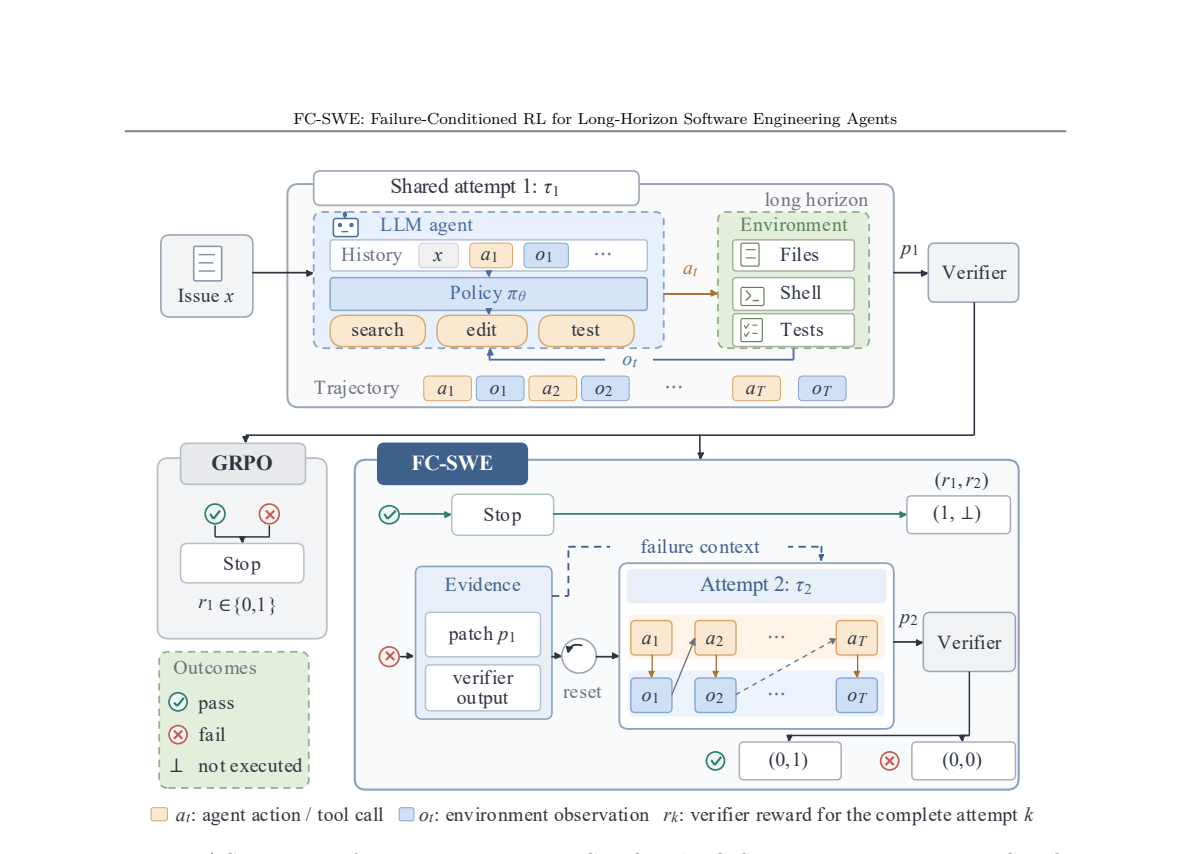
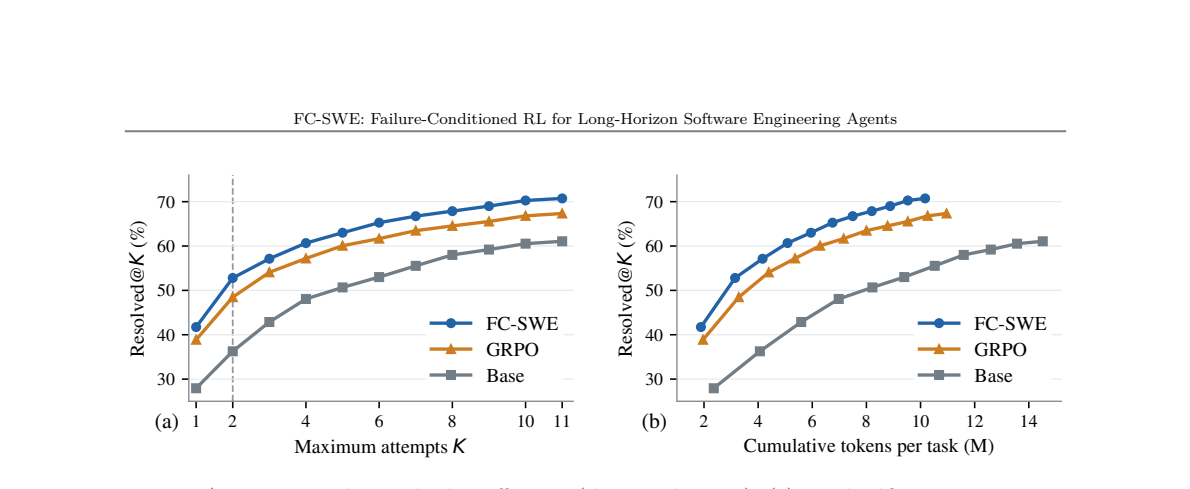
Recent work trains SWE agents with reinforcement learning methods such as Group Relative Policy Optimization (GRPO), which independently sample multiple trajectories per issue, test the resulting patches, and compare terminal rewards within a fixed group. However, this training setup does not reuse verifier feedback from failed patches as context for subsequent attempts, even though this feedback contains valuable diagnostic information about what went wrong. Training on recovery trajectories is challenging because the preceding outcome determines whether the next trajectory is generated, while the failed execution determines its conditioning context. We introduce FC-SWE, a failure-conditioned RL framework that incorporates recovery attempts into policy training. After a patch fails verification, FC-SWE restores the repository to its original task state and uses the failed patch and verifier feedback as context for a recovery trajectory. FC-SWE adapts GRPO to these chains of complete, multi-turn tool-use trajectories through two mechanisms. Trajectory-local rewards preserve each attempt's verifier outcome, preventing recovery success from rewarding an earlier failed patch. Active-set advantage estimation forms a comparison group from all initial and recovery trajectories actually executed for the same issue, so failed attempts remain in the group while unexecuted attempts are excluded. On all 500 SWE-bench Verified tasks under a verifier-assisted protocol, FC-SWE with Qwen3.5-4B and SWE-agent achieves 41.7% Resolved@1 and 52.8% Resolved@2, compared with 38.9% and 48.5% for GRPO. Although trained with at most two attempts per chain, FC-SWE reaches 70.7% Resolved@11 under an eleven-attempt test-time budget.
from the abstract
Pith says
Machine review · deepseek-v4-flash · 7 Oct 2026 · what was read was not recorded · not checked by a person
It can be wrong. Challenge this review or reply to it.
Holds up, with conditions. A well-run recovery-RL study whose main risk—asymmetric checkpoint selection on the eval benchmark—is a reporting fix, not a fatal flaw. This line is wrong
2 major objections · 4 minor
How often objections from reviews like this one are right: not yet measured
Not checked: figures, code, what the 19 references say.
The paper says, at Appendix B.1 / Table 1
The review did not quote this passage.
Pith says: Objection 1 of 2 · major
The headline comparison in Table 1 rests on a checkpoint-selection procedure that is disclosed for only one side. Appendix B.1 states that the reported FC-SWE checkpoint (step 67) "was selected based on performance across multiple validation sets, including a fixed 100-task subset of SWE-bench Verified," but no selection rule is documented for the GRPO row, which is reported as a single number.
more of objection 1
Since the 100-task subset is drawn from the same 500-task benchmark used for Table 1, FC-SWE's numbers reflect selection on part of the evaluation set while GRPO's do not, so the reported 2.9 and 4.3 percentage-point advantages can be inflated by this asymmetry. I ask that the paper either document the GRPO checkpoint-selection rule and apply the identical protocol (same 100-task subset, same criterion) to both methods, or report both policies' benchmark results at matched training steps (e.g., step 67 and the final step for each). I note that the disclosure of the FC-SWE selection rule is commendable; the issue is the missing counterpart.
The paper says, at Table 1 / Table 5
The review did not quote this passage.
A classifier read this sentence of the paper as acknowledging the concern (probability 0.66):
“We do not infer statistical superiority between verifier-only and combined context from these percentages alone.”
Pith says: Objection 2 of 2 · major
The paper reports only point estimates for the central comparison, and the per-seed counts in Table 5 show substantial overlap between the two policies: FC-SWE Resolved@1 is 216/207/203 (43.2/41.4/40.6%) versus 206/179/198 (41.2/35.8/39.6%) for GRPO, and Resolved@2 is 274/261/257 (54.8/52.2/51.4%) versus 257/228/242 (51.4/45.6/48.4%).
more of objection 2
Because the same 500 tasks are evaluated under every seed, a paired task-level analysis (e.g., a McNemar-style comparison per seed, or pooled across seeds) is the natural way to quantify the 2.9 and 4.3 percentage-point gaps, and I ask that it be added or that the absence of a significant difference be stated. As Appendix B.5 acknowledges, the three seeds are decoding seeds rather than independent training runs, so between-training-run variance is not captured by the current numbers; this makes the requested paired analysis more important, not less.
4 minor objections
The paper says, at Section 3.4 / Appendix D.1
Pith says: minor objection 1 of 4
The active-set advantage estimator is acknowledged in Section 3.4 to lack the unbiasedness guarantee of an action-independent baseline, and Appendix D.1 concedes that alternative advantage-group constructions are not ablated; since trajectory-local rewards are ablated but the comparison-group construction is not, an ablation of the grouping (active-set versus per-attempt-index) would complete the attribution of the gains to the second mechanism.
The paper says, at Title page
Pith says: minor objection 2 of 4
The author names "Terry Kong", "Yuki Huang", "Ashwath Aithal", "Wenming Yang", and "Jun Yang" contain spurious internal spaces in the compiled text; these formatting artifacts should be fixed in the camera-ready version.
show 2 more
The paper says, at Section 4.5
Pith says: minor objection 3 of 4
The token-efficiency comparison reports the token budgets at the 50% and 60% resolution targets (3.15M, 4.39M, 8.22M and 5.08M, 6.29M, 13.57M) but not the attained resolutions at those budgets in the main text; stating them (e.g., 52.8%, 54.1%, and 50.7% at the 50% target, per Appendix E.3) would allow readers to judge the matched-resolution claim without consulting the appendix.
The paper says, at Appendix G
Pith says: minor objection 4 of 4
The training-compute asymmetry (FC-SWE generates up to twice as many trajectories per step as GRPO) is properly disclosed in Appendix G, and the w/o-failure-context ablation partially addresses it; a GRPO variant matched in total number of trained trajectories per task would further quantify how much of the gain comes from recovery conditioning rather than additional data.
What would settle it
Evaluate every saved GRPO checkpoint at the canonical steps (36, 50, 67, 84, and any other baseline checkpoints) on the same fixed 100-task SWE-bench Verified subset used for FC-SWE selection; choose the best GRPO checkpoint by the same stated selection rule and tie-break. Then evaluate that checkpoint on all 500 tasks with the three decoding seeds and recompute Resolved@1 and Resolved@2. If the symmetrically selected GRPO checkpoint yields 38.9/48.5 and FC-SWE still leads by roughly 2.9/4.3 percentage points, checkpoint selection is exonerated. If it yields higher numbers or shrinks the gap below about one percentage point, the headline advantage is not robust. This test requires only saved checkpoints and the existing evaluation harness.
from the skeptic's reading
How the review went
4 readings by deepseek-v4-flash · 7 Oct 2026
- Reader holds up, with conditions
- Skeptic agrees
- Editor wrote the verdict above
- Referee major revision: 2 major objections, 4 minor
Not run on this paper: the simulated authors' defence.
Pith did not check this review's objections against the paper.
The review in full
The review in brief, machine-written
Read this one if you work on RL for coding agents. The core is a clean recipe: after a patch fails verification, reset the repo and generate a recovery trajectory conditioned on the failed patch and verifier output, then train with trajectory-local rewards (each attempt keeps its own binary verifier outcome) and active-set advantages (comparison group is only the trajectories actually executed for that issue). LaMer, PivoARL, MulFeRL, and ContextRL are in the neighborhood, but the reward-assignment and grouping choices are concretely different, and the paper argues those differences matter. The strongest evidence is the inference-time ablation: feedback-conditioned retries hurt Base and GRPO relative to resampling but help FC-SWE, which is what you would expect if the training really teaches the policy to use failure evidence rather than just adding attempts. Training and evaluation data are cleanly separated (R2E-Gym vs SWE-bench Verified), so there is no leakage concern there.
The paper is honestly run and honestly written: same Qwen3.5-4B initialization for the controlled comparison, same controller and attempt budgets, three decoding seeds with per-seed counts in the appendix, ablations for failure context, reward broadcasting, and runtime penalties, plus a candid limitations section covering deployment verifiers, compute matching, single training config, and the fact that the three seeds are inference seeds, not training seeds.
The soft spot is the one the reader flagged, and it is real. Appendix B.1 says the reported FC-SWE checkpoint (step 67) was selected using a fixed 100-task subset of SWE-bench Verified, drawn from the same 500 tasks used for the headline numbers. No equivalent selection rule is stated for the GRPO checkpoint. That asymmetry is exactly the kind of thing that can inflate a 2.9-point gap. The disclosure rules out hidden intent, but the GRPO side needs the same treatment. This is a reporting fix, not a redesign: state the GRPO selection rule, or report both methods' best checkpoints under an identical procedure. Also keep in mind the numbers are verifier-assisted recovery numbers, not Pass@K; the paper says this clearly, so it is a comparability warning rather than a flaw.
Who it is for: people building retry and recovery loops for SWE agents, and anyone thinking about how to define advantage groups in outcome-dependent trajectory chains. It deserves a serious referee. My recommendation: send it to review, and require the symmetric checkpoint-selection reporting and artifacts before acceptance.
The strongest objection
Appendix B.1 says the final FC-SWE checkpoint (step 67) "was selected based on performance across multiple validation sets, including a fixed 100-task subset of SWE-bench Verified"; no equivalent selection rule is reported for the GRPO checkpoint in Table 1. The central numerical claim (41.7 vs 38.9 Resolved@1; 52.8 vs 48.5 Resolved@2) therefore rests on an asymmetric checkpoint-selection premise. Because the 100-task subset is drawn from the same 500-task evaluation benchmark, selecting FC-SWE's step on it and reporting a single, unspecified GRPO checkpoint can inflate both components of the headline advantage. This is not an internal inconsistency in the algorithm: the method sections are clearly specified. It is a fairness condition on the headline numbers, and the paper discloses the FC-SWE side while leaving the GRPO side unstated.
The paper is transparent about the FC-SWE selection procedure in Appendix B.1 but silent about the GRPO checkpoint selection. Table 1's central comparison depends on a single FC-SWE step chosen using a 100-task slice of the benchmark. Table 4 shows the selected step is not interchangeability: local-reward checkpoints at steps 67 and 84 differ by 1.8 percentage points in conditional recovery and 2.2 percentage points in Resolved@2 on one seed. Thus, the missing symmetric selection rule is a concrete fairness risk for the numerical claim, not a theoretical complaint about the method. I do not see an equally compelling internal flaw in the algorithm itself: trajectory-local rewards (Eq. 5), active-set advantage estimation (Eqs. 6-7), and the disclosed outcome-dependence bias are coherent, and ablations support the role of failure context. Compute-matching and benchmark-feedback access concerns are acknowledged by the authors and apply to both policies under the stated protocol. The checkpoint-selection issue is exactly the reader's weakest assumption, so my read does not move the verdict; it keeps the existing CONDITIONAL posture pending the symmetric checkpoint-selection check.
The referee's report
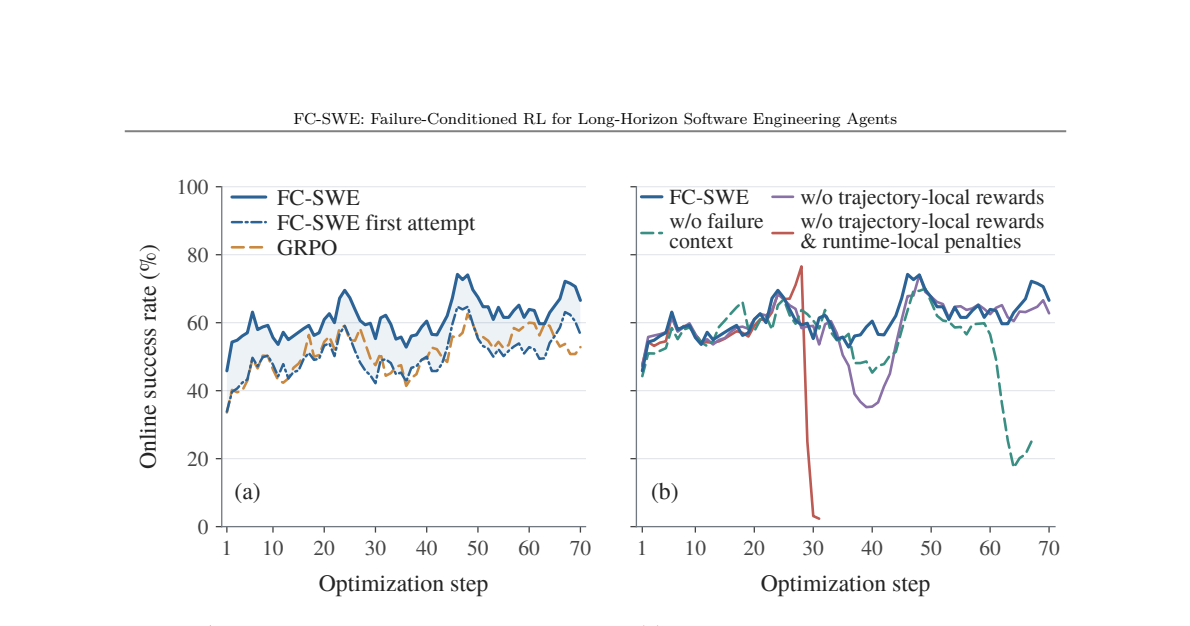
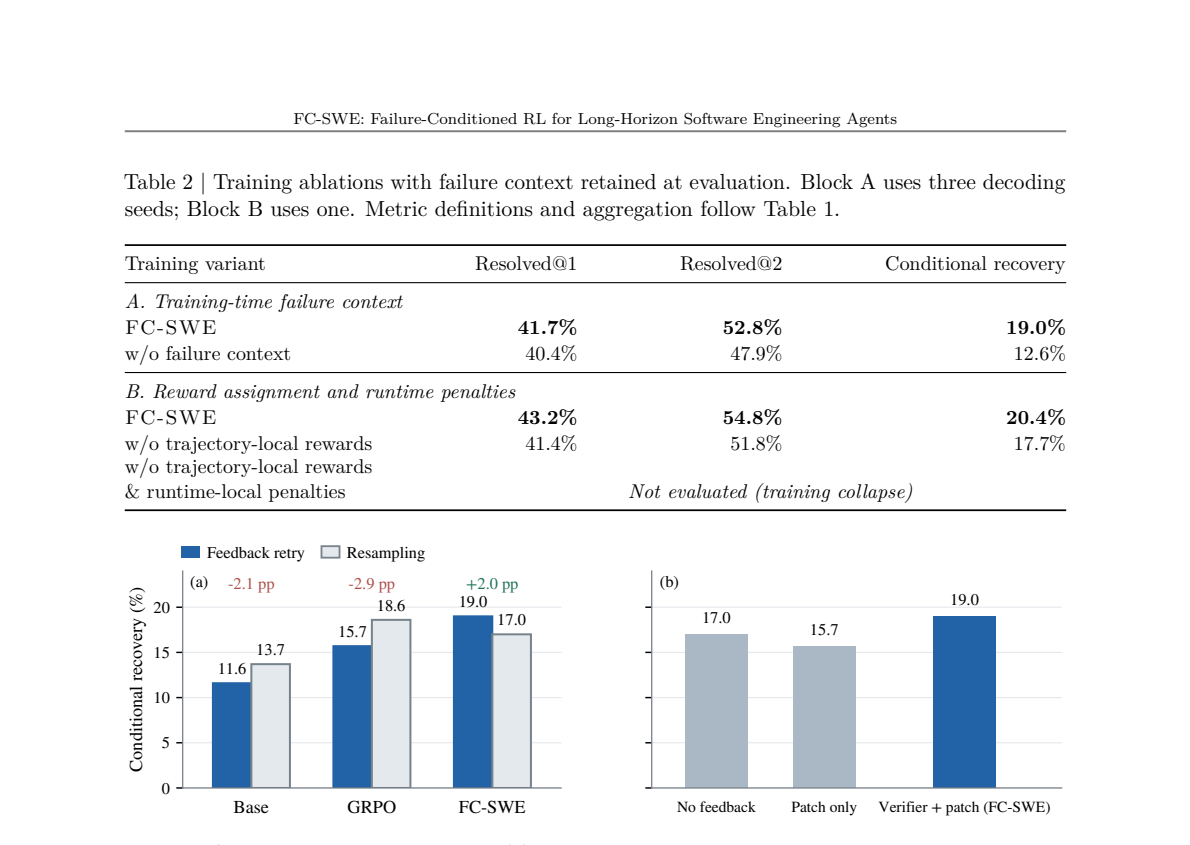
If the headline comparison holds, the paper makes a solid methodological contribution: a clean, well-specified recipe for training multi-turn SWE agents to reuse verifier diagnostics after failure, with the two mechanisms clearly formalized in Section 3. The strengths are real and worth naming: the controlled same-initialization comparison, full per-seed counts in Table 5, clean separation of training (R2E-Gym) from evaluation (SWE-bench Verified), and unusually honest limitation statements (verifier-assisted protocol in Appendix A, training-compute asymmetry in Appendix G, and the acknowledged lack of baseline unbiasedness in Section 3.4). The training-context ablation in Table 2A is especially informative: extra recovery trajectories without failure conditioning do not reproduce the Resolved@2 gain (47.9% vs. 48.5% for GRPO and 52.8% for FC-SWE), which supports attributing the gain to failure-conditioned training rather than to the additional trajectories alone.
Pith's reading of the paper (a machine's summary, not the authors')
The paper claims that an RL-trained coding agent becomes better at both first attempts and follow-up recovery if its training loop includes recovery trajectories: when a patch fails verification, the repository resets and the agent tries again with the failed patch and the verifier's diagnostic output as context. Standard GRPO training samples independent attempts and discards that feedback, so the agent never learns to exploit what a rejection tells it. FC-SWE is that training recipe, built on two adjustments to GRPO: each attempt keeps its own verifier outcome as its reward, and advantages are computed over exactly the attempts executed for the issue. On all 500 SWE-bench Verified tasks, a 4B-parameter model trained this way reaches 41.7% first-attempt and 52.8% two-attempt resolution, versus 38.9% and 48.5% for GRPO. The training also transfers beyond its two-attempt horizon, reaching 70.7% resolution with eleven attempts at test time.
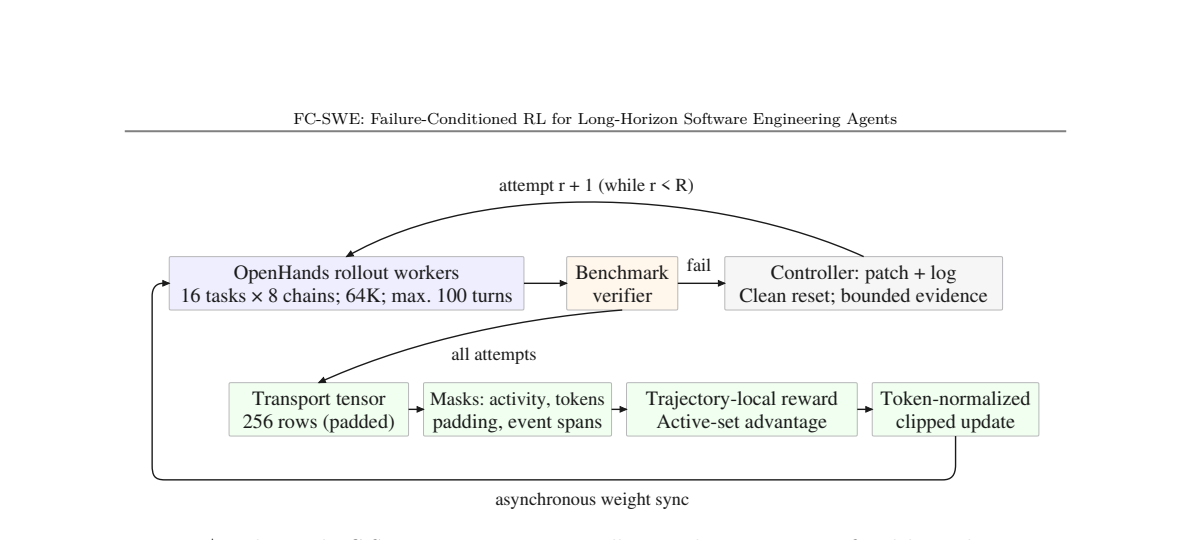
What carries the argument. The central object is the failure-conditioned recovery chain with two GRPO adaptations. After a patch fails, the system restores the repository to its original state and builds the next attempt's context as $h_{c,r+1} = C(x, patch(\tau_{c,r}), verify(\tau_{c,r}))$: the original issue, the failed patch, and the verifier's diagnostic output, truncated to a fixed budget. Trajectory-local rewards assign each attempt its own binary verifier outcome, so a successful recovery raises the advantage of the recovery trajectory without relabeling the earlier failure. Active-set advantage estimation then computes leave-one-out mean baselines over the set of trajectories actually executed for the issue, normalizing by the sample standard deviation with the zero-variance fallback of the paper's GRPO implementation. Together these convert verifier failure from a terminal scalar into structured context and contrastive signal for the policy, which is what the paper argues standard GRPO cannot do.
Core claim. FC-SWE claims that post-failure recovery can be trained directly, rather than left to chance at inference. The framework turns each issue into outcome-dependent recovery chains: the initial trajectory is always generated; if its patch fails the verifier, the repository is restored to the original task state and a new trajectory is generated from the issue plus the failed patch and diagnostic verifier output as context. Two mechanisms adapt GRPO to these chains. Trajectory-local reward assignment gives every trajectory the verifier outcome of its own patch, so a chain with outcomes [0, 1] is trained with rewards [0, 1], never [1, 1]; the later success does not retroactively reward the earlier failure. Active-set advantage estimation forms each trajectory's comparison group from all initial and recovery trajectories actually executed for the same issue, keeping failed attempts in the group while excluding unexecuted recovery slots. The paper's central empirical claim is that on all 500 SWE-bench Verified tasks, with Qwen3.5-4B and SWE-agent, FC-SWE achieves 41.7% Resolved@1 and 52.8% Resolved@2 versus 38.9% and 48.5% for GRPO, and that the gap comes from learning to use failure evidence: feedback-conditioned retries beat independent resampling only for the FC-SWE-trained policy (19.0% versus 17.0% conditional recovery), and removing verifier evidence from the context drops conditional recovery by 3.3 points.
The premise it rests on. The reported 2.9-point and 4.3-point advantages rest on checkpoint-selection fairness: the FC-SWE checkpoint (step 67) was chosen using validation performance that included a fixed 100-task slice of SWE-bench Verified, and the paper reports no analogous selection procedure for the GRPO checkpoint it is compared against.
If the paper is right (Pith's inferences, not the authors')
Failure-conditioned RL raises both first-attempt solving and recovery: 41.7% vs 38.9% Resolved@1 and 52.8% vs 48.5% Resolved@2 over GRPO on all 500 SWE-bench Verified tasks.
The benefit is specifically learning from failure evidence: removing failure context during training drops two-attempt resolution by 4.9 points and conditional recovery from 19.0% to 12.6%, and at inference verifier evidence adds 3.3 points over patch-only context.
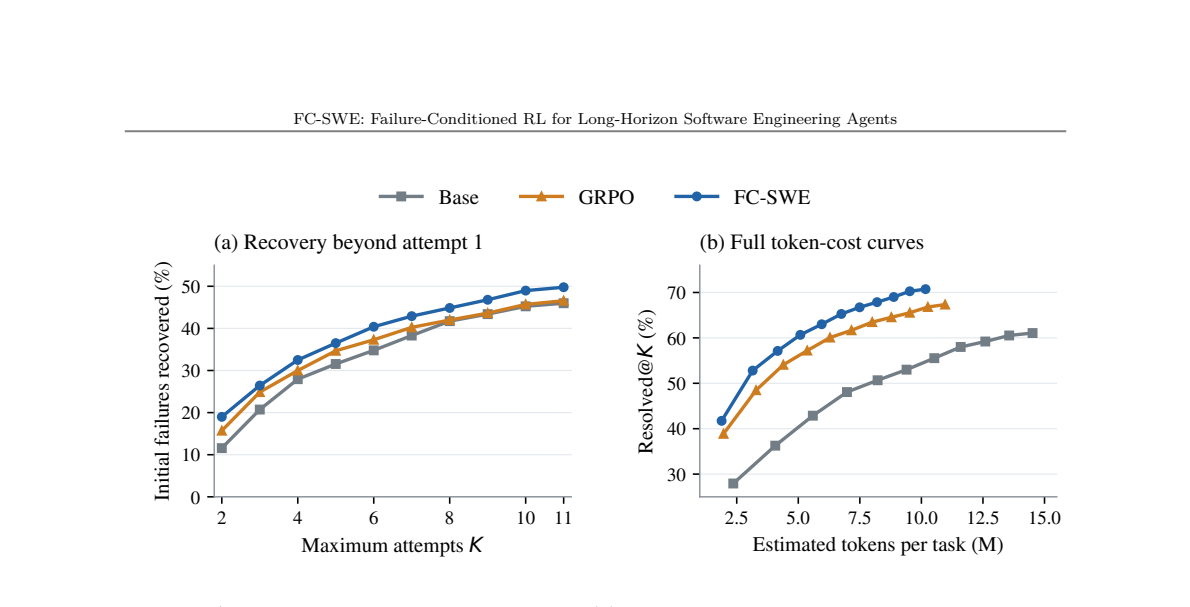
Only the failure-trained policy benefits from feedback at a matched budget: FC-SWE recovers 19.0% of first-attempt failures with feedback versus 17.0% by independent resampling, while Base and GRPO both do better with resampling than with feedback.
Recovery training transfers beyond its two-attempt training horizon: the same policy reaches 70.7% resolution with eleven verifier-guided attempts at test time, versus 67.3% for GRPO.
FC-SWE is also inference-token-efficient: at roughly 50% resolution it uses about 3.15M tokens per task versus 4.39M for GRPO and 8.22M for Base.
The size of the headline margin is the number to stress-test: if a GRPO checkpoint selected on the same 100-task SWE-bench Verified validation slice closed most of the 2.9/4.3-point gap, the mechanism could still be real but the headline advantage would be weaker than reported.
The paper itself notes that the active-set comparison is outcome-dependent and does not inherit the unbiasedness guarantee of an action-independent baseline; a natural follow-up is to test whether a selection-bias-corrected or doubly-robust advantage changes training dynamics, which would separate conditioning effects from group-composition effects.
The recipe generalizes: any verifier-gated agent domain (theorem proving, web automation, scientific code) with diagnostic failure output could treat recovery trajectories as first-class training data instead of inference-time repair.
Since Resolved@K gains shrink after K=8, the policy's recovery skill, not the attempt budget, appears to be the binding constraint at test time; training with more than two attempts per chain or a curriculum over attempt number is the natural next experiment to test whether that ceiling moves.
Check this review
Pith stored no record of this review's passes and took no fingerprint of it. Reviews made by code from 13 Nov 2026 on carry both.
How often reviews like this one are right
Reviews like this one: written by deepseek-v4-flash, where what was read was not recorded.
How often objections from reviews like this one are right: not yet measured
Reviews by people
This review was written by a machine. No person has reviewed this paper on Pith yet. A scientist listed on Pith can review it for a fee, and their review is published here whatever it concludes.
The paper
Abstract
Repository-level software engineering (SWE) is a challenging long-horizon setting: agents must reason over extended interactions, use tools, and adapt to stateful environments. Recent work trains SWE agents with reinforcement learning methods such as Group Relative Policy Optimization (GRPO), which independently sample multiple trajectories per issue, test the resulting patches, and compare terminal rewards within a fixed group. However, this training setup does not reuse verifier feedback from failed patches as context for subsequent attempts, even though this feedback contains valuable diagnostic information about what went wrong. Training on recovery trajectories is challenging because the preceding outcome determines whether the next trajectory is generated, while the failed execution determines its conditioning context. We introduce FC-SWE, a failure-conditioned RL framework that incorporates recovery attempts into policy training. After a patch fails verification, FC-SWE restores the repository to its original task state and uses the failed patch and verifier feedback as context for a recovery trajectory. FC-SWE adapts GRPO to these chains of complete, multi-turn tool-use trajectories through two mechanisms. Trajectory-local rewards preserve each attempt's verifier outcome, preventing recovery success from rewarding an earlier failed patch. Active-set advantage estimation forms a comparison group from all initial and recovery trajectories actually executed for the same issue, so failed attempts remain in the group while unexecuted attempts are excluded. On all 500 SWE-bench Verified tasks under a verifier-assisted protocol, FC-SWE with Qwen3.5-4B and SWE-agent achieves 41.7% Resolved@1 and 52.8% Resolved@2, compared with 38.9% and 48.5% for GRPO. Although trained with at most two attempts per chain, FC-SWE reaches 70.7% Resolved@11 under an eleven-attempt test-time budget.
The paper's own sentences, arranged, kept beside the review and separate from it. Each label is drawn from a closed vocabulary; the number beside it is the probability the classifier gave that label. No sentence in this record was written by a model.
abstract compiled · 2026-10-07
The authors' main claim, as the classifier picked it out 0.85
“On all 500 SWE-bench Verified tasks under a verifier-assisted protocol, FC-SWE with Qwen3.5-4B and SWE-agent achieves 41.7% Resolved@1 and 52.8% Resolved@2, compared with 38.9% and 48.5% for GRPO.”
How the main claim is stated: asserted 1.00
What the abstract itself states, as probabilities: claims first 0.08 · states limitation 0.42 · human participants 0.03 · controlled comparison 0.95 · randomized assignment 0.03 · states quantitative result 0.99 · compares with prior results 0.98 · mentions code or data availability 0.03
The abstract, sentence by sentence
This table labels the abstract only (arXiv listing abstract v1). The number is the probability the classifier gave the label.
| Sentence | Role | The authors' own work | States the main conclusion | Strength |
|---|---|---|---|---|
| Repository-level software engineering (SWE) is a challenging long-horizon setting: agents must reason over extended interactions, use tools, and adapt to stateful environments. | background 1.00 | 0.05 | 0.02 | asserted 1.00 |
| Recent work trains SWE agents with reinforcement learning methods such as Group Relative Policy Optimization (GRPO), which independently sample multiple trajectories per issue, test the resulting patches, and compare terminal rewards within a fixed group. | background 1.00 | 0.04 | 0.02 | asserted 1.00 |
| However, this training setup does not reuse verifier feedback from failed patches as context for subsequent attempts, even though this feedback contains valuable diagnostic information about what went wrong. | gap 0.99 | 0.07 | 0.05 | asserted 1.00 |
| Training on recovery trajectories is challenging because the preceding outcome determines whether the next trajectory is generated, while the failed execution determines its conditioning context. | background 0.60 | 0.09 | 0.03 | asserted 1.00 |
| We introduce FC-SWE, a failure-conditioned RL framework that incorporates recovery attempts into policy training. | contribution 1.00 | 0.91 | 0.16 | asserted 1.00 |
| After a patch fails verification, FC-SWE restores the repository to its original task state and uses the failed patch and verifier feedback as context for a recovery trajectory. | method 0.99 | 0.88 | 0.08 | asserted 1.00 |
| FC-SWE adapts GRPO to these chains of complete, multi-turn tool-use trajectories through two mechanisms. | method 0.89 | 0.84 | 0.04 | asserted 0.99 |
| Trajectory-local rewards preserve each attempt's verifier outcome, preventing recovery success from rewarding an earlier failed patch. | method 0.97 | 0.86 | 0.05 | asserted 1.00 |
| Active-set advantage estimation forms a comparison group from all initial and recovery trajectories actually executed for the same issue, so failed attempts remain in the group while unexecuted attempts are excluded. | method 0.98 | 0.89 | 0.05 | asserted 1.00 |
| On all 500 SWE-bench Verified tasks under a verifier-assisted protocol, FC-SWE with Qwen3.5-4B and SWE-agent achieves 41.7% Resolved@1 and 52.8% Resolved@2, compared with 38.9% and 48.5% for GRPO. | result 1.00 | 0.96 | 0.42 | asserted 1.00 |
| Although trained with at most two attempts per chain, FC-SWE reaches 70.7% Resolved@11 under an eleven-attempt test-time budget. | result 1.00 | 0.94 | 0.30 | asserted 1.00 |
What kind of paper the classifier reports this is: method or tool 1.00 · evidence from observation or experiment 0.98
What was examined, and what was not
Sources read
- arXiv listing abstract v1
Not examined
- full text
- figures and tables
- references and citing sentences
- relations to other papers
Levels run
- P abstract
Not run
- S sections
- T body sentences
- C citations
- R cross-paper relations
How the labels were made
Compiled by classifier-1.13.0 via TypeSafe API, question bank abstract-p1-20260923, 2026-10-07: 1 request, 8,392 input tokens.
Every quoted sentence on this record is the authors'. Every label is from Pith's closed vocabulary, with the probability shown beside it. This record as JSON
Figures (8)
Figures are the authors', reproduced from the paper.
References (19)
- [1] Arash Ahmadian, Chris Cremer, Matthias Galle, Marzieh Fadaee, Julia Kreutzer, Olivier Pietquin, Ahmet Ustun, and Sara Hooker. Back to basics: Revisiting REINFORCE style optimization for learning from human feedback in LLMs.arXiv preprint arXiv:2402.14740, on PithPith's reviewarXiv
- [5] Alexander Golubev, Maria Trofimova, Sergei Polezhaev, Ibragim Badertdinov, Maksim Nekrashevich, Anton Shevtsov, Simon Karasik, Sergey Abramov, Andrei Andriushchenko, Filipp Fisin, Sergei Skvortsov, and Boris Yangel. Training long-context, multi-turn software engineering agents... on PitharXiv
- [7] URL https://arxiv.org/abs/2607.03702. Naman Jain, Jaskirat Singh, Manish Shetty, Liang Zheng, Koushik Sen, and Ion Stoica. R2E-Gym: Procedural environments and hybrid verifiers for scaling open-weights SWE agents.arXiv preprint arXiv:2504.07164, on PithPith's reviewarXiv
- [8] URLhttps://arxiv.org/abs/2512.16848v2. Carlos E. Jimenez, John Yang, Alexander Wettig, Shunyu Yao, Kexin Pei, Ofir Press, and Karthik Narasimhan. SWE-bench: Can language models resolve real-world GitHub issues?arXiv preprint arXiv:2310.06770, on PitharXiv
- [9] Xuancheng Li, Haitao Li, Yujia Zhou, Yiqun Liu, and Qingyao Ai. MulFeRL:Enhancingreinforcement learning with verbal feedback in a multi-turn loop.arXiv preprint arXiv:2601.22900, 2026a. URL https://arxiv.org/abs/2601.22900v2. Yujiang Li, Zhenyu Hou, Yi Jing, Jie Tang, and Yuxi... on PithPith's reviewarXiv
- [10] URLhttps://arxiv.org/abs/2602.22623. Michael Luo, Naman Jain, Jaskirat Singh, Sijun Tan, Ameen Patel, Qingyang Wu, Alpay Ariyak, Colin Cai, Tarun Venkat, Shang Zhu, Ben Athiwaratkun, Manan Roongta, Ce Zhang, Li Erran Li, Raluca Ada Popa, Koushik Sen, and Ion Stoica. DeepSWE: T... on PitharXiv
- [11] Jiayi Pan, Xingyao Wang, Graham Neubig, Navdeep Jaitly, Heng Ji, Alane Suhr, and Yizhe Zhang. Training software engineering agents and verifiers with SWE-Gym.arXiv preprint arXiv:2412.21139, on PithPith's reviewarXiv
- [12] URLhttps://proceedings.neurips.cc/paper_files/paper/2024/hash/6 39d992f819c2b40387d4d5170b8ffd7-Abstract-Conference.html. Qwen Team. Qwen3.5-4B.https://huggingface.co/Qwen/Qwen3.5-4B, 2026a. Model card. Qwen Team. Qwen3.5-9B.https://huggingface.co/Qwen/Qwen3.5-9B, 2026b. Model... on PithPith's reviewarXiv
- [15] Yuxiang Wei, Olivier Duchenne, Jade Copet, Quentin Carbonneaux, Lingming Zhang, Daniel Fried, Gabriel Synnaeve, Rishabh Singh, and Sida I. Wang. SWE-RL: Advancing LLM reasoning via reinforcement learning on open software evolution.arXiv preprint arXiv:2502.18449, on PithPith's reviewarXiv
- [16] John Yang, Carlos E. Jimenez, Alexander Wettig, Kilian Lieret, Shunyu Yao, Karthik Narasimhan, and Ofir Press. SWE-agent: Agent-computer interfaces enable automated software engineering. arXiv preprint arXiv:2405.15793, on PithPith's reviewarXiv
- [17] doi: 10.48550/arXiv.2210.03629. URLhttps://arxiv.org/abs/ 2210.03629. Qiying Yu, Zheng Zhang, Ruofei Zhu, Yufeng Yuan, Xiaochen Zuo, et al. DAPO: An open-source LLM reinforcement learning system at scale.arXiv preprint arXiv:2503.14476, on PithPith's reviewarXivdoi:10.48550/arxiv.2210.03629
- [19] URL https://arxiv.org/abs/2505.23604. 13 FC-SWE: Failure-Conditioned RL for Long-Horizon Software Engineering Agents A. Verifier Choice and Evaluation Protocol A common verification procedure.Our study concerns learning to recover from failed attempts, rather than designing a ... on PithPith's reviewarXiv
- [21] The target-resolution comparisons in the text select the lowest-cost evaluated budget reachingat leastthe target. For 50%, the selected budgets are𝐾 = 5, 3, 2for Base, GRPO, and FC-SWE, at 8.22M, 4.39M, and 3.15M tokens per task. For 60%, they are𝐾 = 10, 5, 4, at 13.57M, 6.29M... on Pith
- [67] was selected based on performance across multiple validation sets, including a fixed 100-task subset of SWE-bench Verified. RL parameter updates used the R2E-Gym training data. Training was resumed across scheduler allocations. Curves are stitched by global optimization step, ... on Pith
- [2017] Zhihong Shao, Peiyi Wang, Qihao Zhu, Runxin Xu, Junxiao Song, Xiao Bi, Haowei Zhang, Mingchuan Zhang, Y. K. Li, Y. Wu, and Daya Guo. DeepSeekMath: Pushing the limits of mathematical reasoning in open language models.arXiv preprint arXiv:2402.03300, on PithPith's reviewarXiv
- [2023] URLhttps://proceedings.neurips.cc/paper_files/paper/202 3/hash/1b44b878bb782e6954cd888628510e90-Abstract-Conference.html. Xingyao Wang, Boxuan Li, Yufan Song, Frank F. Xu, Xiangru Tang, Mingchen Zhuge, Jiayi Pan, Yueqi Song, Bowen Li, Jaskirat Singh, et al. OpenHands: An open ... on PithPith's reviewarXiv
- [2024] Lang Feng, Zhenghai Xue, Tingcong Liu, and Bo An. Group-in-group policy optimization for LLM agent training.arXiv preprint arXiv:2505.10978, on PithPith's reviewarXiv
- [2025] Shaopeng Fu, Xingxing Zhang, Li Dong, Di Wang, and Furu Wei. RefineRL: Advancing competitive programming with self-refinement reinforcement learning.arXiv preprint arXiv:2604.00790, on PithPith's reviewarXiv
- [2026] Jonas Gehring, Kunhao Zheng, Jade Copet, Vegard Mella, Quentin Carbonneaux, Taco Cohen, and Gabriel Synnaeve. RLEF: Grounding code LLMs in execution feedback with reinforcement learning.arXiv preprint arXiv:2410.02089, on PithPith's reviewarXiv
Cited by 1 Pith paper
Reviewed papers on Pith that cite this one. The full citation record
- PROVISO: Provenance-Informed Action Selection for Secure LLM Agents cs.AI · Oct 2026
Challenges and discussion
Disagree with the review, or know something it missed? Leave a comment, or challenge this review formally: a challenge becomes a permanent entry in this paper's record, and its decision is published here.
Come back by email
A short list of the week's newly reviewed papers. Nothing is sent until you confirm from your inbox, and every email has a link that stops it. No account.
No comments yet.
Sign in to comment