Computer Vision and Pattern Recognition · arXiv:2610.12402 v2 · submitted 8 Oct 2026
SpaceCast-Bench: Evaluating Predictive Spatial Reasoning in Vision-Language Models
The paper says
“Existing spatial reasoning benchmarks mainly test spatial perception: reading off relations already visible in the input.”
more of the abstract
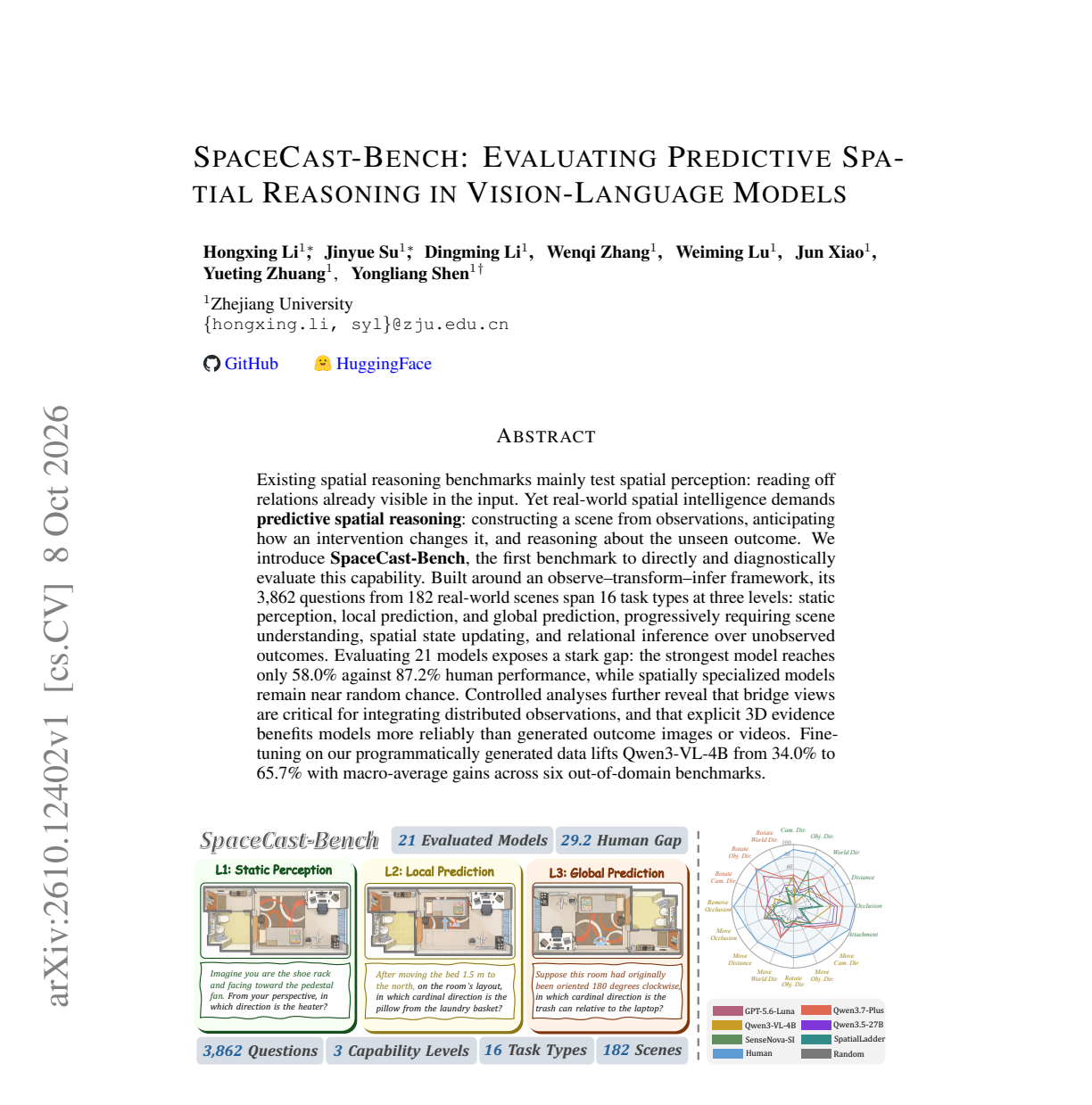
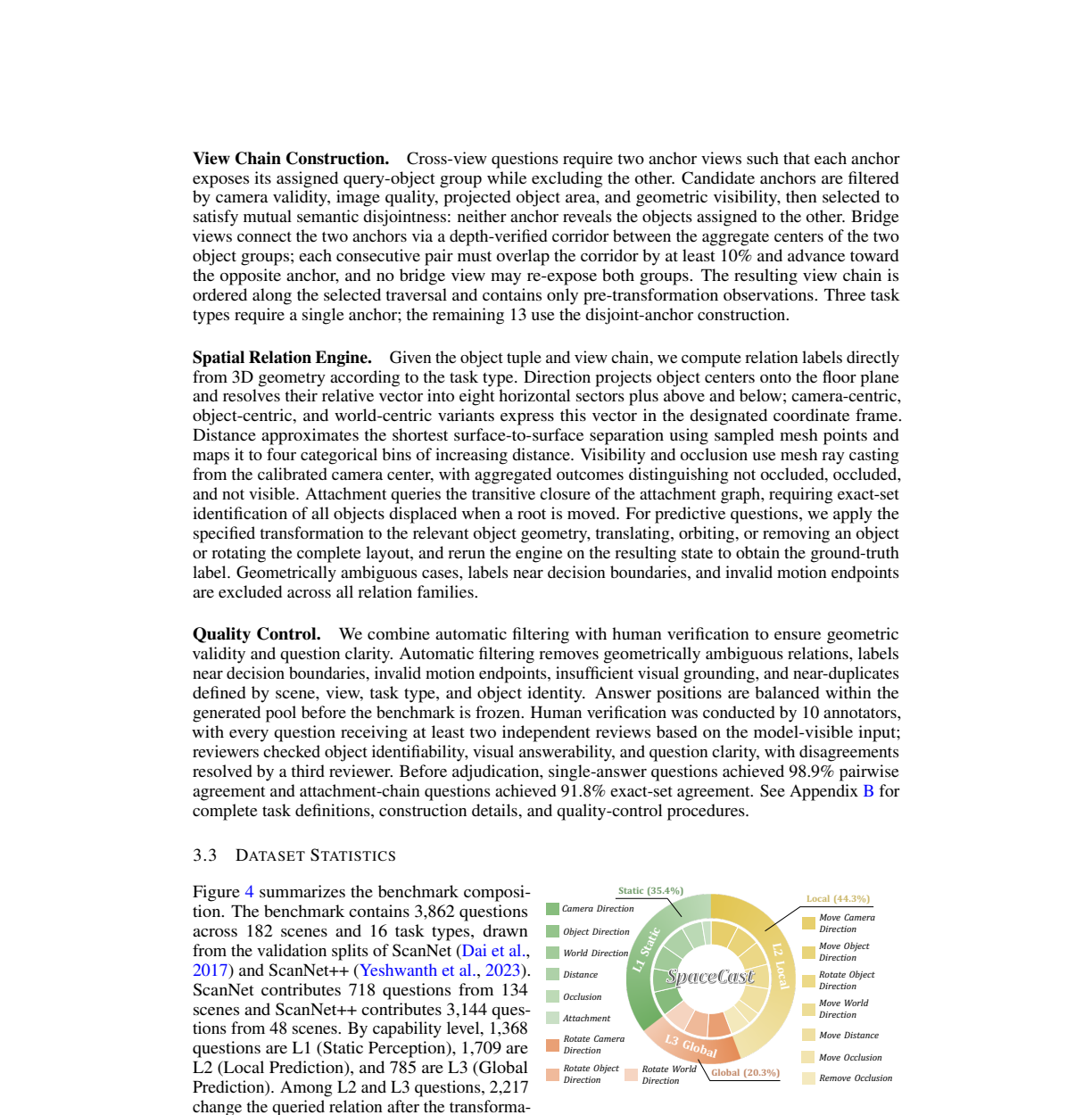
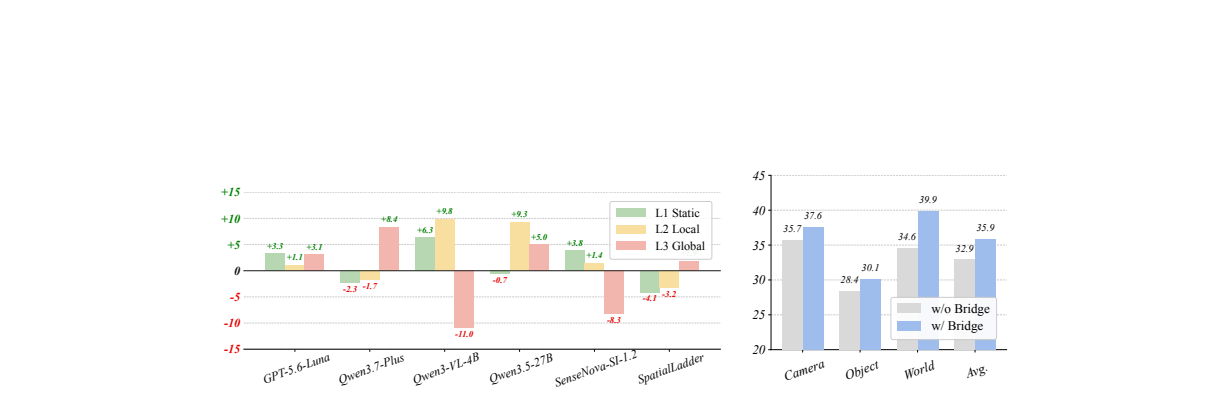
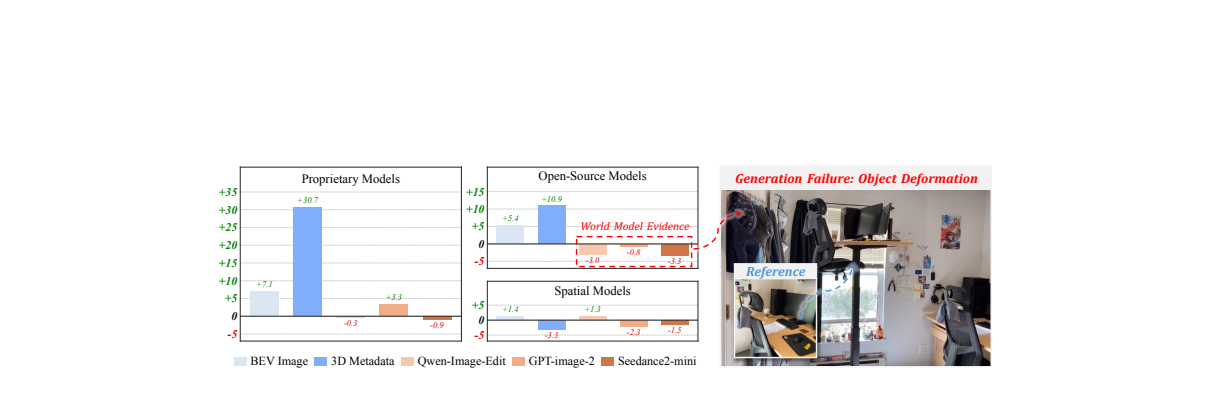
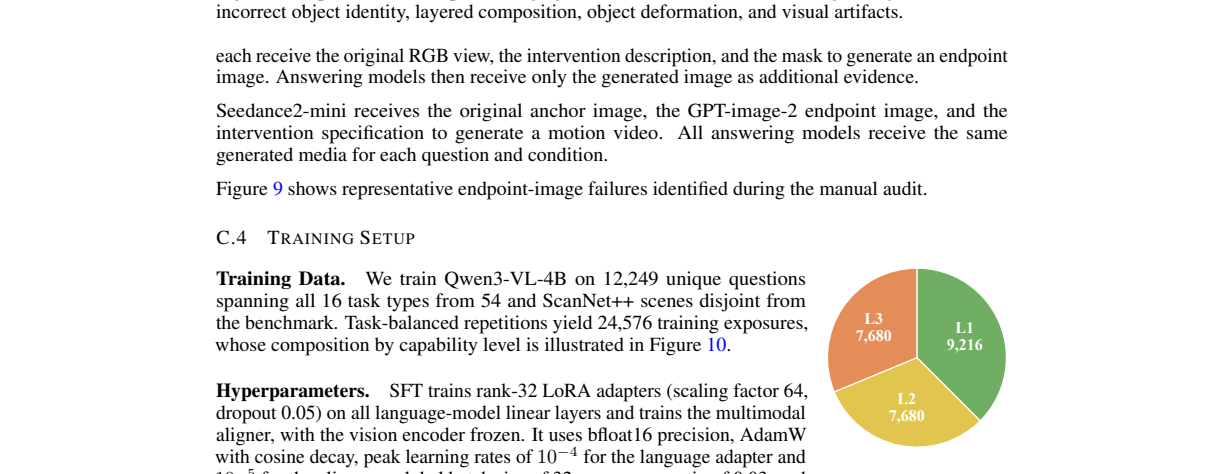
Yet real-world spatial intelligence demands predictive spatial reasoning: constructing a scene from observations, anticipating how an intervention changes it, and reasoning about the unseen outcome. We introduce SpaceCast-Bench, the first benchmark to directly and diagnostically evaluate this capability. Built around an observe-transform-infer framework, its 3,862 questions from 182 real-world scenes span 16 task types at three levels: static perception, local prediction, and global prediction, progressively requiring scene understanding, spatial state updating, and relational inference over unobserved outcomes. Evaluating 21 models exposes a stark gap: the strongest model reaches only 58.0% against 87.2% human performance, while spatially specialized models remain near random chance. Controlled analyses further reveal that bridge views are critical for integrating distributed observations, and that explicit 3D evidence benefits models more reliably than generated outcome images or videos. Fine-tuning on our programmatically generated data lifts Qwen3-VL-4B from 34.0% to 65.7% with macro-average gains across six out-of-domain benchmarks.
from the abstract
Pith says
Machine review · deepseek-v4-flash · 9 Oct 2026 · of version 1 of the paper; version 2 is newer · what was read was not recorded · not checked by a person
It can be wrong. Challenge this review or reply to it.
Holds up, with conditions. A genuinely new predictive-spatial-reasoning benchmark with a likely real human-model gap, held back mainly by unquantified attachment-graph labels and release details; deserves peer review. This line is wrong
2 major objections · 5 minor
How often objections from reviews like this one are right: not yet measured
Not checked: figures, code, what the references say.
The paper says, at Section 3.2, Appendix B.4, Appendix A
The review did not quote this passage.
Pith says: Objection 1 of 2 · major
The attachment graph is the least-quantified component of the label pipeline, yet its transitive closure determines the displaced object set for all 1,709 L2 translation/orbit/removal questions and the exact answer sets of the 97 attachment questions. The graph is built from surface-contact, support-overlap, and semantic-compatibility heuristics over reconstructed meshes; Appendix A (b264-b265) explicitly acknowledges that reconstruction uncertainty can affect apparent …
more of objection 1
… surface contact or support relationships, but no edge-error estimate, edge count, or exposure count (how many L2 labels depend on at least one attachment edge) is reported. The QC figures do not close this gap: attachment exact-set agreement is the lowest of all families (91.8%, Appendix B.6), and because the post-move state is unobserved by design, annotators cannot directly verify co-movement. Since Table 2's attachment column and Section D's diagnosis that models leave rigidly attached objects behind (b455) depend on these edges, I ask for a sensitivity analysis that recomputes L2 labels under plausible edge perturbations, such as dropping low-confidence edges, and for explicit exposure counts, to show that the main rankings and failure diagnoses are robust to attachment-graph errors.
The paper says, at Section 3.1, Section 4.2
The review did not quote this passage.
Pith says: Objection 2 of 2 · major
The claim that the L1-L3 comparisons are diagnostic of the transform and infer stages is not yet controlled for item difficulty. The static and transformed variants of each relation family are generated from different object tuples, scenes, and view-chain structures, so the reported level-wise drops (for example, Gemini 3.5 Flash from 67.1% L1 to 45.3% L2) could partly reflect content differences rather than the added transformation.
more of objection 2
A matched-subset analysis using the same queried object tuple and scene with and without the intervention, where such pairs exist, or an item-level difficulty covariate, would make the diagnostic interpretation load-bearing as claimed.
5 minor objections
The paper says, at Abstract and Section 2.2
Pith says: minor objection 1 of 5
The claim to be the first comprehensive benchmark for direct diagnostic evaluation of predictive spatial reasoning should be supported or softened; the cited SpaMEM, MindCube, and SAT works already involve belief revision and what-if motion, and the paper does not give a systematic comparison showing exactly which control dimensions they lack.
The paper says, at Table 1
Pith says: minor objection 2 of 5
Several entries appear typeset without visible separators in the submitted text (for example, the Qwen3.5-27B row as 139.3, and 27.755.3 and 61.286.7 in other rows); these should be fixed so every column value is unambiguous.
show 3 more
The paper says, at Tables 2 and 3
Pith says: minor objection 3 of 5
The direction row in Table 2 is a weighted average over the three reference frames, with 3, 4, and 3 direction tasks respectively, not the unweighted average of the three values in Table 3; stating this in the caption would prevent apparent inconsistency.
The paper says, at Appendix B.6
Pith says: minor objection 4 of 5
The sentence reporting 3,801 single-answer questions and 97 attachment questions refers to the pre-removal pool, since 3,801 + 97 = 3,898 and the final benchmark has 3,862 questions after 36 removals; this should be stated explicitly.
The paper says, at Section 4.4 and Table 10
Pith says: minor objection 5 of 5
The out-of-domain results are reported on curated subsets of the six benchmarks; the main text should state this more prominently, since gains across six out-of-domain benchmarks could otherwise be read as full-benchmark transfer.
What would settle it
Run the label generator with each attachment edge toggled off in turn and with the graph entirely emptied; record how many of the 1,709 L2 questions and 97 attachment questions change label, and re-score the L2 and attachment columns of Tables 1-2 under both perturbations. For the exposed subset (any question whose label changed under a single-edge removal), have two independent annotators, given the model-visible views plus the reconstructed mesh, state the displaced set of each moved root and recompute the queried relation under their displaced sets. If more than 5% of exposed labels flip, re-derive the L2 scores and the Section D 'attached objects left behind' failure mode; if fewer than 1% flip, the diagnosis stands as written.
from the skeptic's reading
How the review went
4 readings by deepseek-v4-flash · 9 Oct 2026
- Reader holds up, with conditions
- Skeptic agrees
- Editor wrote the verdict above
- Referee major revision: 2 major objections, 5 minor
Not run on this paper: the simulated authors' defence.
Pith did not check this review's objections against the paper.
The review in full
The review in brief, machine-written
SpaceCast-Bench is a genuine new artifact: the observe-transform-infer decomposition, 3,862 questions from 182 real ScanNet/ScanNet++ scenes, and programmatic labels computed from 3D geometry with strong human verification. The headline finding - 58.0% for the best model against 87.2% for humans, with spatial specialists near chance - is likely real and useful. It survives my reading of the paper. What is new: it separates static perception from spatial state updating, and its three-level structure makes failure diagnosis possible. The construction pipeline is documented in enough detail to rebuild, Table 1 arithmetic checks out, and the failure analysis in Appendix D is candid rather than cherry-picked. The bridge-view and explicit-3D-evidence controls are good ideas, and the training experiment showing Qwen3-VL-4B going from 34.0% to 65.7% is interesting even if not conclusive. The soft spots, in order of importance. First, the attachment graph. Edges are proposed from surface contact, support overlap, and semantic compatibility over reconstructed meshes, and its transitive closure fixes the displaced set in all 1,709 L2 questions plus the exact sets of the 97 attachment questions. There is no edge-error estimate and no exposure count saying how many labels actually depend on an attachment edge. The authors acknowledge reconstruction uncertainty in Appendix A, but they do not quantify its effect on co-movement labels. That matters most for the Section D diagnosis that models leave rigidly attached objects behind: if some edges are wrong, part of that failure pattern could be a label artifact. It would not overturn the headline gap, but it is the load-bearing premise that needs quantification. Second, there are no error bars or seed variance; evaluations are single-run deterministic. For a 97-question family, ranking claims are fragile. Third, the training result needs a template-memorization control - same templates with corrupted or permuted labels, or held-out template variants. The out-of-domain gains mitigate this, but a direct control would settle it. Fourth, the GitHub and HuggingFace links are bare placeholders; a commit-hashed release is needed. Fifth, ScanNet contamination in proprietary pretraining is not addressed; likely minor for predictive tasks, but it should be stated. Who this is for: anyone building or evaluating spatial VLMs, and the benchmark community more broadly. It deserves a serious referee. I would send it to review with requested revisions on attachment exposure/error analysis, variance reporting, the memorization control, and a verifiable release.
The strongest objection
The central claim, that SpaceCast-Bench measures, and models fail, predictive spatial state updating, rests on two premises: the labels are physically correct, and low model scores reflect missing capability rather than label artifact. The weakest premise is co-movement label correctness, and it is the least quantified. Appendix B.4 builds the attachment graph from 'surface contact, support overlap, and semantic compatibility' over reconstructed ScanNet/ScanNet++ meshes; its transitive closure fixes the displaced set in every L2 translation, orbit, or removal (1,709 questions) and the exact answer sets of the 97 attachment questions. A spurious edge from reconstruction noise, or a missing edge from incomplete geometry, flips any label whose queried object or occluder lies in the graph's closure. The paper reports no edge-error estimate and no exposure count: how many L2 labels actually depend on at least one attachment edge is never stated. The mitigations are real but partial. Single-answer questions reached 98.9% annotator agreement and the QC produced 157 ground-truth corrections, so the process demonstrably caught errors. But annotators judged from the model-visible input only, the very premise under test ('the mouse is on the table'), and the one observation that could verify a displaced set, the post-move scene, is by design absent. Agreement therefore measures shared acceptance of the premise, not its physical truth; Appendix A (b264-b265) concedes reconstruction uncertainty cannot be fully eliminated for attachment and occlusion labels. The consequence strikes the diagnosis, not the headline gap.
SpaceCast-Bench's central contribution has three load-bearing pillars: programmatic geometry-grounded labels with human verification, the observe-transform-infer decomposition that makes the measurement diagnostic, and the training/transfer experiment. The reader's weakest-assumption pick, attachment-graph label fidelity, is the right one, and the manuscript's own Appendix A points at the same residual risk; this is an acknowledged limitation whose magnitude is unmeasured rather than a newly invented flaw. I considered alternatives and found each weaker. Template memorization in the 34.0% to 65.7% training result would attack the abstract's third claim, but the out-of-domain macro-average gains (+3.7 to +4.6 pp across six benchmarks with disjoint formats) show the improvement is not purely format-specific, and the benchmark's central measurement claim does not depend on the training experiment. ScanNet contamination in proprietary pretraining corpora would inflate model scores and thus makes the headline gap conservative. Run-to-run variance is largely moot under deterministic decoding; the finite-question-sample uncertainty affects only the fine-grained ranking between 58.0 and 56.7, not the 29.2 pp gap. The 'first comprehensive benchmark' framing is a positioning claim that cannot be adjudicated without reading MindCube and SpaMEM closely, and it is not a correctness risk in this pass. The attachment concern is distinct because it sits where the benchmark's ground truth and its conclusion cross: every L2 intervention moves a root plus its attachment descendants, so the graph's closure is silently present in single-answer questions whose 98.9% annotator agreement cannot be distinguished from shared premise acceptance, since no post-move observation exists anywhere in the construction. Countervailing evidence bounds the concern: single-answer agreement of 98.9%, 157 ground-truth corrections, a 87.2% human baseline from the same views, and top models scoring 80.4% on attachment, which is why the verdict remains CONDITIONAL rather than a rejection. What is missing is the quantification proposed in the concrete test: the exposure count and edge-error rate. If label flips under edge perturbation are rare, the diagnosis and rankings stand; if common, Section D's central failure mode needs re-derivation. I therefore keep the reader's verdict unchanged: the benchmark contribution stands, pending the reader's four conditions, with the attachment exposure and error-rate quantification promoted as the decisive item.
The referee's report
The benchmark addresses a real gap: most spatial benchmarks test perception of relations already visible in the input, whereas SpaceCast-Bench asks models to update a scene representation under an intervention and answer about an unobserved outcome. The label pipeline is a genuine strength: ground truth is derived from external ScanNet/ScanNet++ geometry rather than from the evaluated models, question counts and Table 1 macro-averages reproduce, the human QC process is documented in detail, and the task decomposition permits a plausible and useful failure analysis. The training-transfer results are concrete, and the controlled analyses of bridge views and external 3D evidence are informative. The main risk is concentrated in the attachment graph, whose edge correctness controls most L2 labels but is not quantified; the diagnostic conclusions depend on resolving this risk.
Pith's reading of the paper (a machine's summary, not the authors')
SpaceCast-Bench is presented as the first benchmark that directly and diagnostically measures predictive spatial reasoning: whether a vision-language model can take observed views of a real room, apply an intervention it never sees (a move, rotation, or removal), and answer a spatial question about the resulting state. The 3,862 questions from 182 real indoor scenes are built on an observe–transform–infer structure so that perception, spatial state updating, and relational inference can be scored separately. The central result is a wide gap: the strongest of 21 evaluated models reaches 58.0% accuracy while humans reach 87.2%, and models explicitly fine-tuned for spatial tasks cluster near the 25.9% random baseline, which the authors take as evidence that existing spatial training does not transfer to state updating. The paper further shows that supervised fine-tuning on its programmatically generated data lifts one small open-weight model (Qwen3-VL-4B) from 34.0% to 65.7% and improves six out-of-domain spatial benchmarks. If the measurements are sound, the benchmark gives the field a way to track a capability that embodied agents and spatial world models will need.
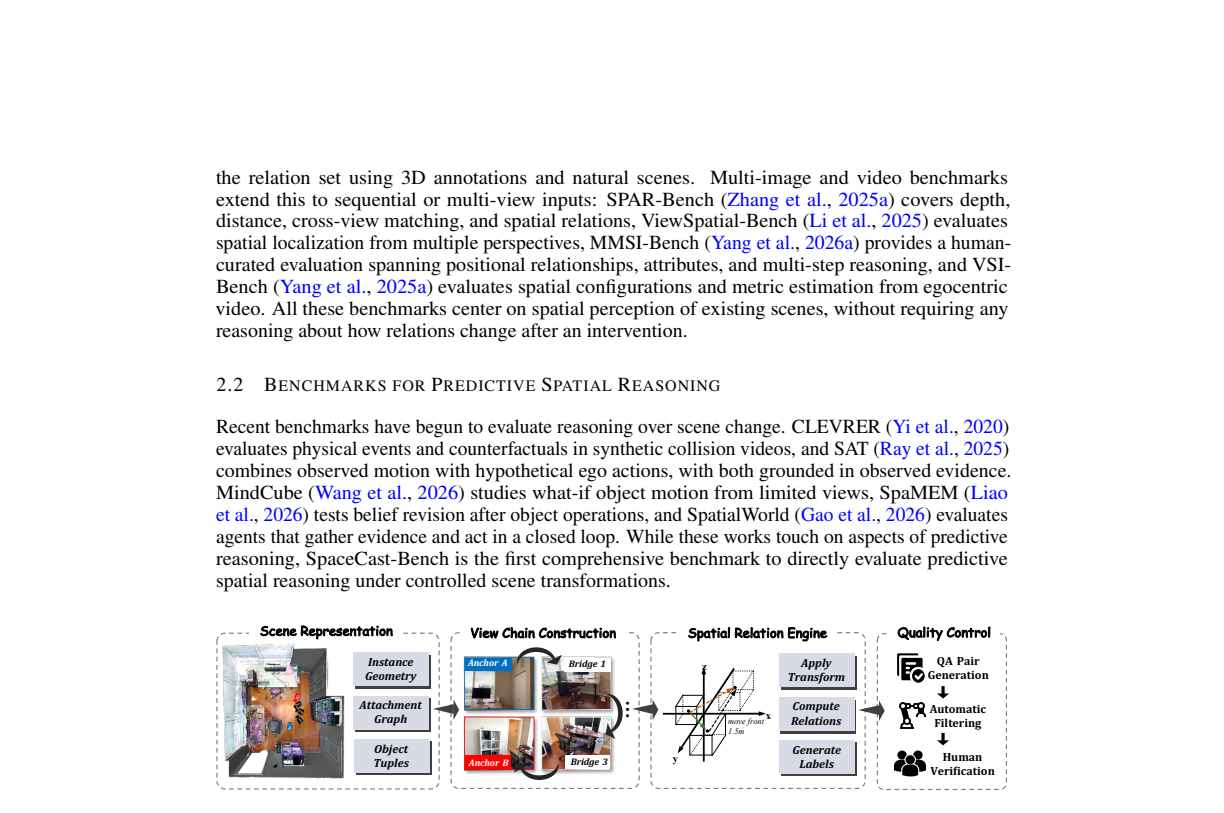
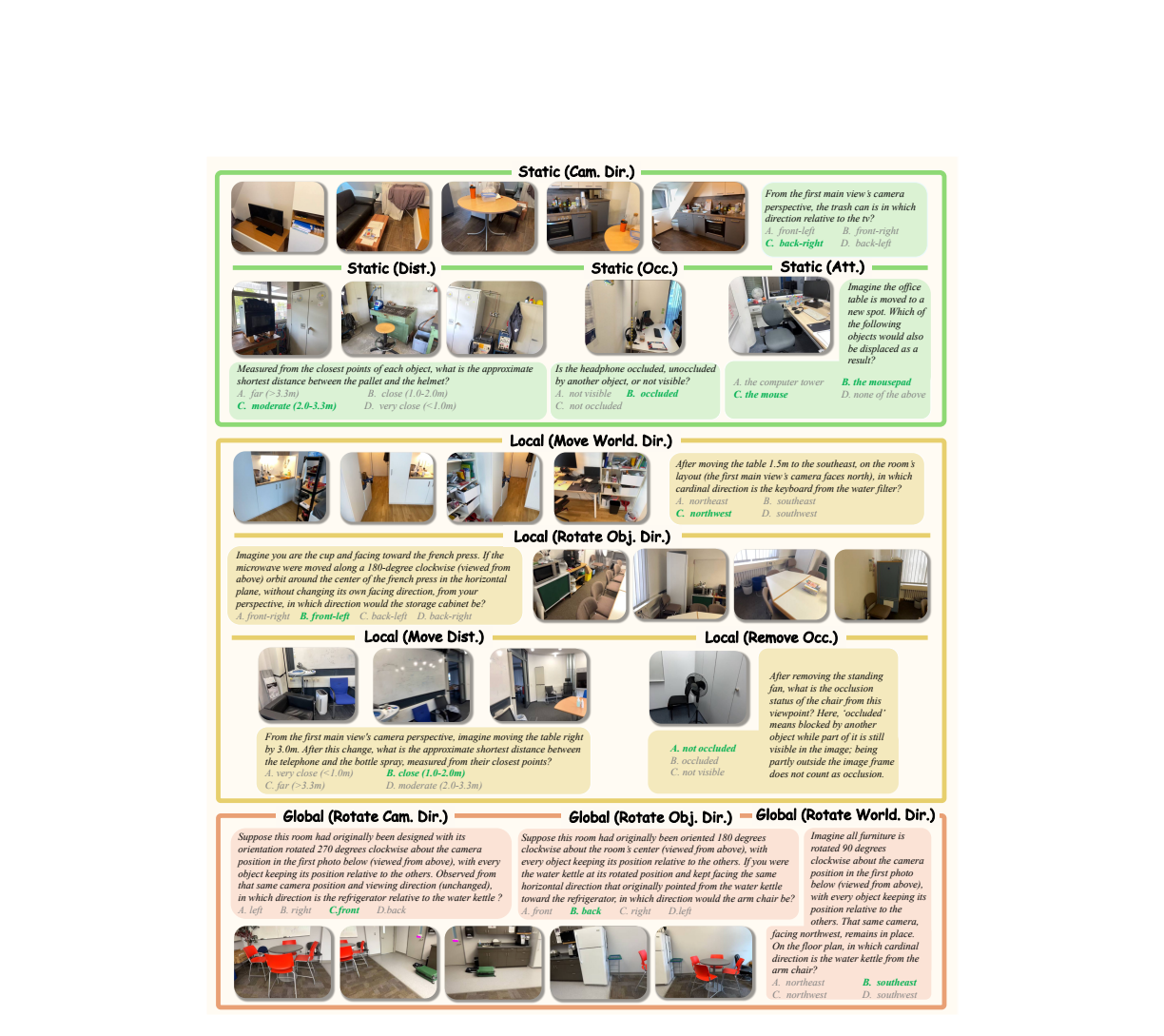
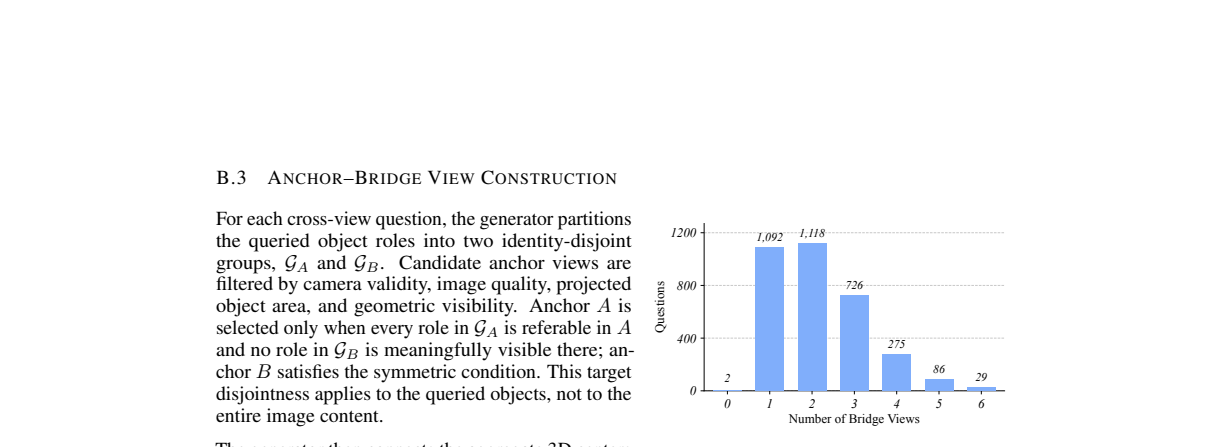
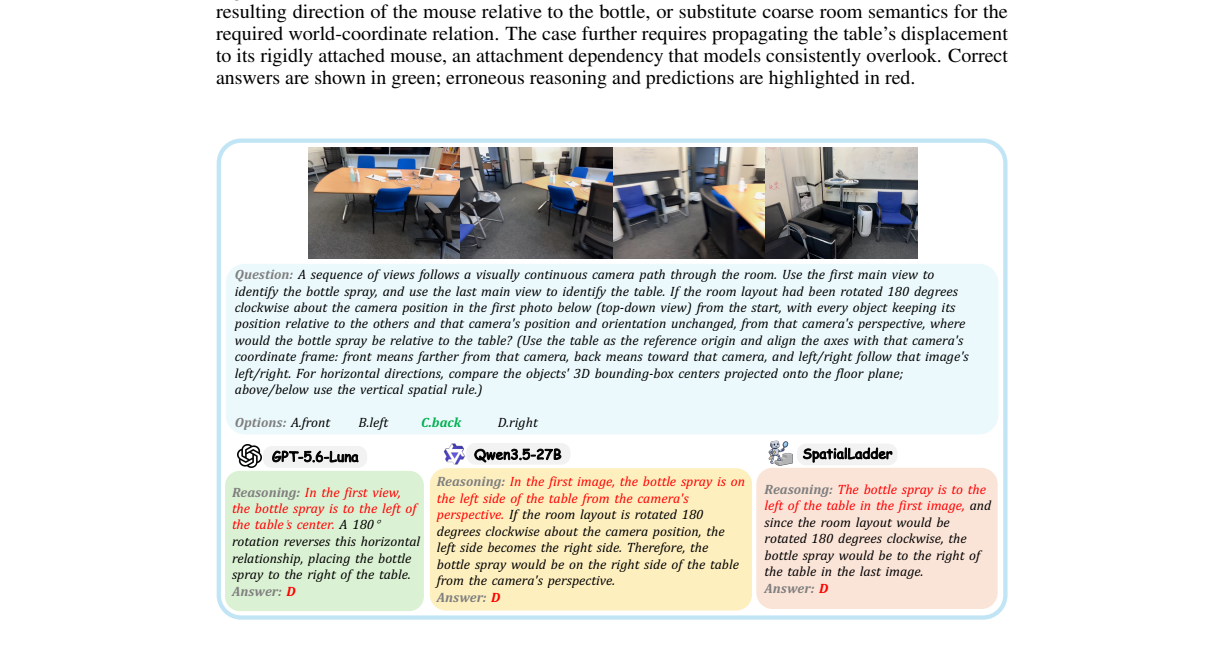
What carries the argument. The load-bearing machinery is a geometry-grounded pipeline that turns posed RGB-D scans into questions with programmatic ground truth. Each cross-view question selects two anchor views that expose disjoint queried object groups, connected by depth-verified bridge views along a corridor $p(t)=c_A+t(c_B-c_A)$, so the model sees only the pre-intervention scene. A spatial relation engine computes labels from reconstructed meshes: direction projects object centers onto the floor plane and quantizes them into eight horizontal sectors plus above and below; distance samples mesh points to approximate surface-to-surface separation and bins it into four categories; occlusion ray casts mesh points from the calibrated camera; and attachment takes the transitive closure of a directed attachment graph whose edges encode surface contact, support overlap, and semantic compatibility. For predictive questions the engine is rerun after translating, orbiting, removing, or globally rotating the relevant geometry, yielding the ground-truth label for the unobserved outcome state. The attachment graph decides which objects co-move under local interventions, and the L1/L2/L3 level structure is what lets failures be attributed to perception versus state updating versus global transformation.
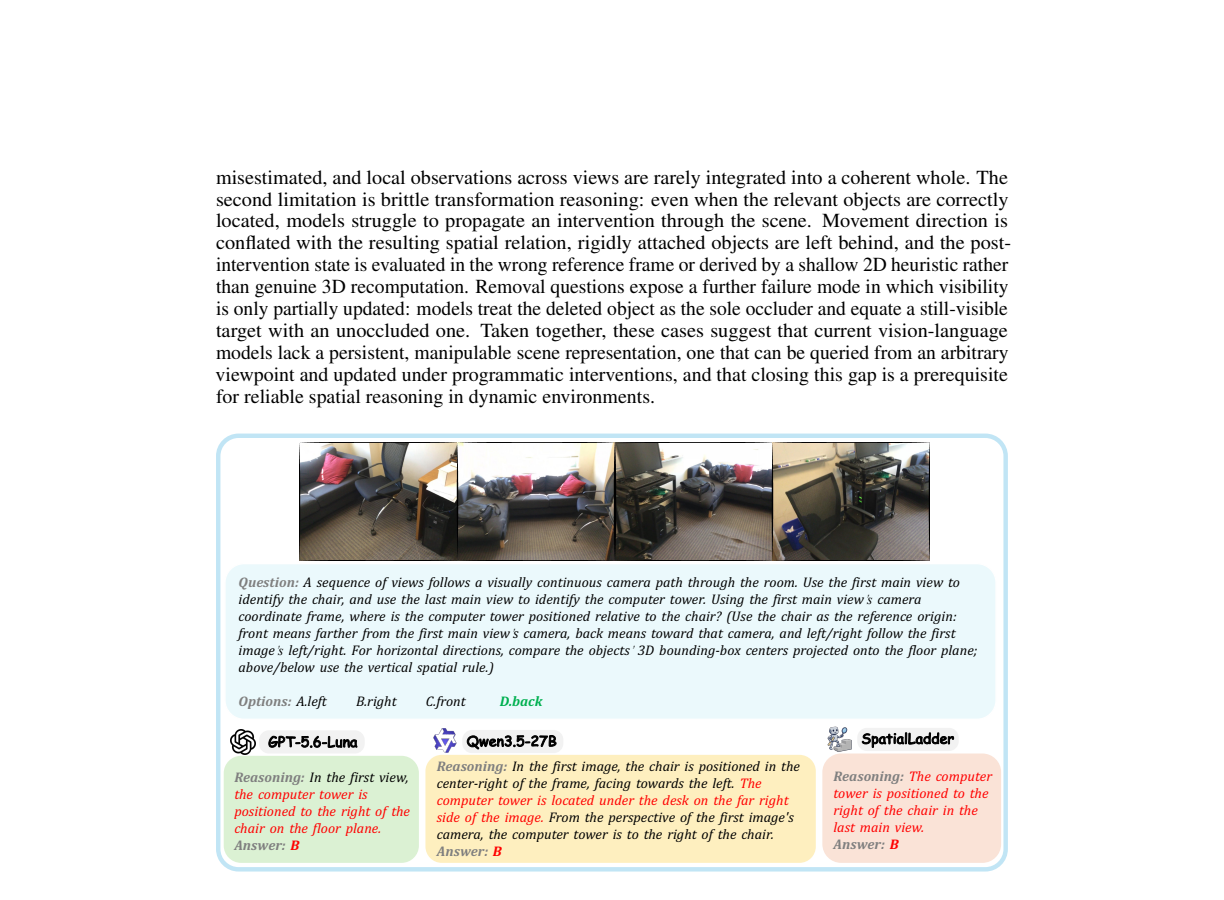
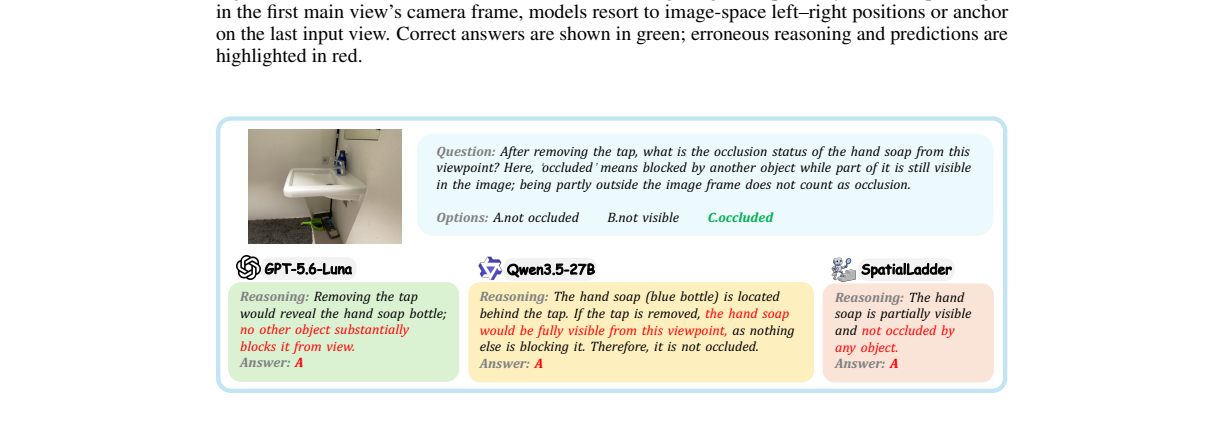
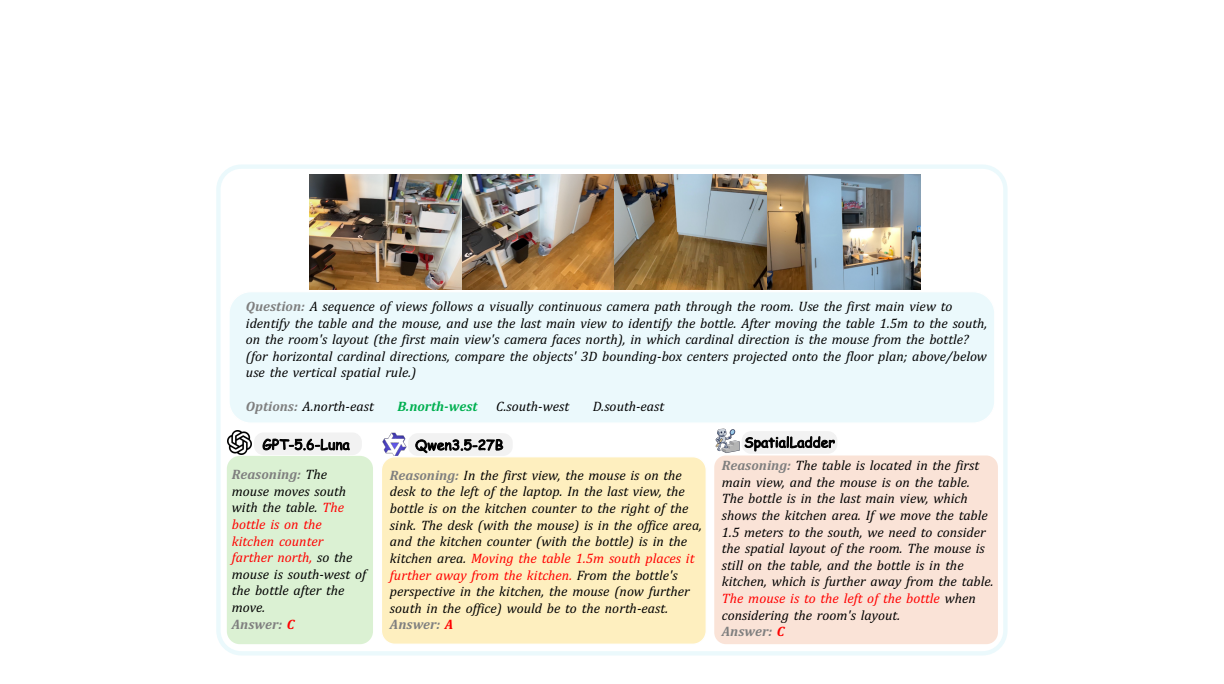
Core claim. The paper's claim, stated sympathetically, is that predictive spatial reasoning is a genuine, separable capability that current vision-language models largely lack, and that this can be shown with controlled questions whose outcome states are never shown to the model. Each task hands the model ordered RGB views of the pre-intervention scene, a natural-language transformation, and a query; the correct label is computed programmatically by applying the transformation in 3D to reconstructed scene geometry and rerunning the spatial relation engine on the result. Across 21 models the top performer, Gemini 3.5 Flash, reaches 58.0% overall against 87.2% human performance, spatially specialized models stay between 25.7% and 29.1%, and general-purpose models drop sharply from static perception to local prediction before partially recovering on global-rotation tasks. Controlled analyses attribute the failures to shallow scene representations and brittle transformation reasoning: models anchor on image-space cues instead of recovering 3D structure, leave rigidly attached objects behind when a parent moves, and treat a removed object as the only occluder. The strongest proprietary models recover on L3 global rotation, which the paper reads as evidence that a holistic grasp of layout suffices there, whereas spatially specialized models do not recover.
The premise it rests on. The load-bearing premise is label fidelity: every ground-truth answer comes from reconstructed meshes, poses, and depth, and crucially from the attachment graph's heuristic edges, which decide which objects co-move whenever an object is moved; the paper acknowledges reconstruction uncertainty but does not quantify how many attachment edges are wrong.
If the paper is right (Pith's inferences, not the authors')
If the benchmark is sound, current vision-language models cannot perform controlled spatial state updating on real scenes, and spatial fine-tuning that improves perception does not transfer to prediction.
Benchmark-aligned supervised fine-tuning on programmatic data can roughly double one small model's predictive accuracy (Qwen3-VL-4B from 34.0% to 65.7%) and lift its macro-average on six out-of-domain spatial benchmarks.
Bridge views are needed to integrate distributed observations: removing them lowers directional accuracy in every reference frame, most for world-centric questions.
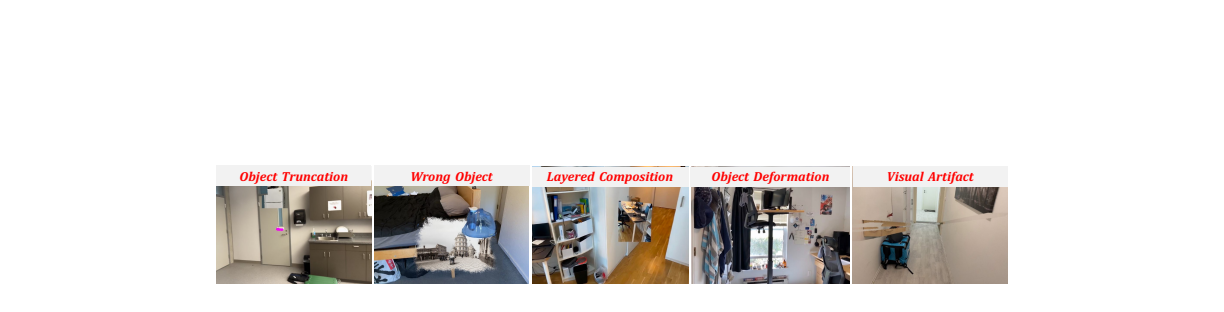
Generated outcome images and videos are unreliable external evidence for prediction, so progress on world-model-style assistance requires both better generation fidelity and better alignment of synthesized endpoints with the original views.
Object-centric reference frames and attachment relations are the clearest weak spots across model families, pointing to concrete deficits in existing spatial training data.
A testable extension the authors do not run: regress L2 and L3 accuracy on L1 accuracy per model to separate how much of the predictive gap is perception failure versus state-updating failure, since the reported L2-minus-L1 drops vary from a few points to over twenty across families.
The attachment graph's heuristic edges (surface contact, support overlap, semantic compatibility) are the most likely source of wrong ground truth; a re-derivation of co-movement from physical support rules would test whether the benchmark's ranking of spatially specialized models is stable.
The result that explicit 3D evidence helps general models far more than generated outcome images suggests a concrete recipe the paper leaves implicit: give models depth-aware or point-cloud input at inference time rather than more natural images, and measure the marginal gain.
Because all interventions are kinematic (no deformation, friction, or collision dynamics), the benchmark bounds only state updating under rigid motion; a synthetic-dynamics cousin would show whether the same models can propagate forces, a boundary the paper itself states.
Check this review
Pith stored no record of this review's passes and took no fingerprint of it. Reviews made by code from 13 Nov 2026 on carry both.
How often reviews like this one are right
Reviews like this one: written by deepseek-v4-flash, where what was read was not recorded.
How often objections from reviews like this one are right: not yet measured
Reviews by people
This review was written by a machine. No person has reviewed this paper on Pith yet. A scientist listed on Pith can review it for a fee, and their review is published here whatever it concludes.
The paper
Abstract
Existing spatial reasoning benchmarks mainly test spatial perception: reading off relations already visible in the input. Yet real-world spatial intelligence demands predictive spatial reasoning: constructing a scene from observations, anticipating how an intervention changes it, and reasoning about the unseen outcome. We introduce SpaceCast-Bench, the first benchmark to directly and diagnostically evaluate this capability. Built around an observe-transform-infer framework, its 3,862 questions from 182 real-world scenes span 16 task types at three levels: static perception, local prediction, and global prediction, progressively requiring scene understanding, spatial state updating, and relational inference over unobserved outcomes. Evaluating 21 models exposes a stark gap: the strongest model reaches only 58.0% against 87.2% human performance, while spatially specialized models remain near random chance. Controlled analyses further reveal that bridge views are critical for integrating distributed observations, and that explicit 3D evidence benefits models more reliably than generated outcome images or videos. Fine-tuning on our programmatically generated data lifts Qwen3-VL-4B from 34.0% to 65.7% with macro-average gains across six out-of-domain benchmarks.
The paper's own sentences, arranged, kept beside the review and separate from it. Each label is drawn from a closed vocabulary; the number beside it is the probability the classifier gave that label. No sentence in this record was written by a model.
abstract compiled · 2026-10-09
The authors' main claim, as the classifier picked it out 0.99
“Evaluating 21 models exposes a stark gap: the strongest model reaches only 58.0% against 87.2% human performance, while spatially specialized models remain near random chance.”
How the main claim is stated: asserted 1.00
What the abstract itself states, as probabilities: claims first 0.97 · states limitation 0.59 · human participants 0.18 · controlled comparison 0.58 · randomized assignment 0.02 · states quantitative result 0.99 · compares with prior results 0.88 · mentions code or data availability 0.09
The abstract, sentence by sentence
This table labels the abstract only (arXiv listing abstract v1). The number is the probability the classifier gave the label.
| Sentence | Role | The authors' own work | States the main conclusion | Strength |
|---|---|---|---|---|
| Existing spatial reasoning benchmarks mainly test spatial perception: reading off relations already visible in the input. | background 0.88 | 0.07 | 0.03 | asserted 1.00 |
| Yet real-world spatial intelligence demands predictive spatial reasoning: constructing a scene from observations, anticipating how an intervention changes it, and reasoning about the unseen outcome. | gap 0.64 | 0.06 | 0.07 | asserted 1.00 |
| We introduce SpaceCast-Bench, the first benchmark to directly and diagnostically evaluate this capability. | contribution 1.00 | 0.92 | 0.10 | asserted 1.00 |
| Built around an observe-transform-infer framework, its 3,862 questions from 182 real-world scenes span 16 task types at three levels: static perception, local prediction, and global prediction, progressively requiring scene understanding, spatial state updating, and relational inference over unobserved outcomes. | method 0.87 | 0.93 | 0.07 | asserted 1.00 |
| Evaluating 21 models exposes a stark gap: the strongest model reaches only 58.0% against 87.2% human performance, while spatially specialized models remain near random chance. | result 1.00 | 0.96 | 0.50 | asserted 1.00 |
| Controlled analyses further reveal that bridge views are critical for integrating distributed observations, and that explicit 3D evidence benefits models more reliably than generated outcome images or videos. | result 0.78 | 0.94 | 0.14 | asserted 0.99 |
| Fine-tuning on our programmatically generated data lifts Qwen3-VL-4B from 34.0% to 65.7% with macro-average gains across six out-of-domain benchmarks. | result 0.98 | 0.95 | 0.15 | asserted 1.00 |
What kind of paper the classifier reports this is: dataset or benchmark 1.00 · evidence from observation or experiment 0.97
What was examined, and what was not
Sources read
- arXiv listing abstract v1
Not examined
- full text
- figures and tables
- references and citing sentences
- relations to other papers
Levels run
- P abstract
Not run
- S sections
- T body sentences
- C citations
- R cross-paper relations
How the labels were made
Compiled by classifier-1.13.0 via TypeSafe API, question bank abstract-p1-20260923, 2026-10-09: 1 request, 5,728 input tokens.
Every quoted sentence on this record is the authors'. Every label is from Pith's closed vocabulary, with the probability shown beside it. This record as JSON
Figures (14)
Showing 13 of the paper's 14 figures. Figures are the authors', reproduced from the paper.
Cited by 1 Pith paper
Reviewed papers on Pith that cite this one. The full citation record
Challenges and discussion
Disagree with the review, or know something it missed? Leave a comment, or challenge this review formally: a challenge becomes a permanent entry in this paper's record, and its decision is published here.
Come back by email
A short list of the week's newly reviewed papers. Nothing is sent until you confirm from your inbox, and every email has a link that stops it. No account.
No comments yet.
Sign in to comment