Machine Learning · arXiv:2611.25387 v1 · submitted 19 Nov 2026 · 106 references
TuringSpace: Grounding Spatial Intelligence in Action with Interactive CAPTCHAs
The paper says
“Humans act in the visual world by inferring the 3D layout behind a 2D view, predicting how an action changes it, and correcting themselves after seeing the result. Can multimodal large language models (MLLMs) do the same?”
more of the abstract
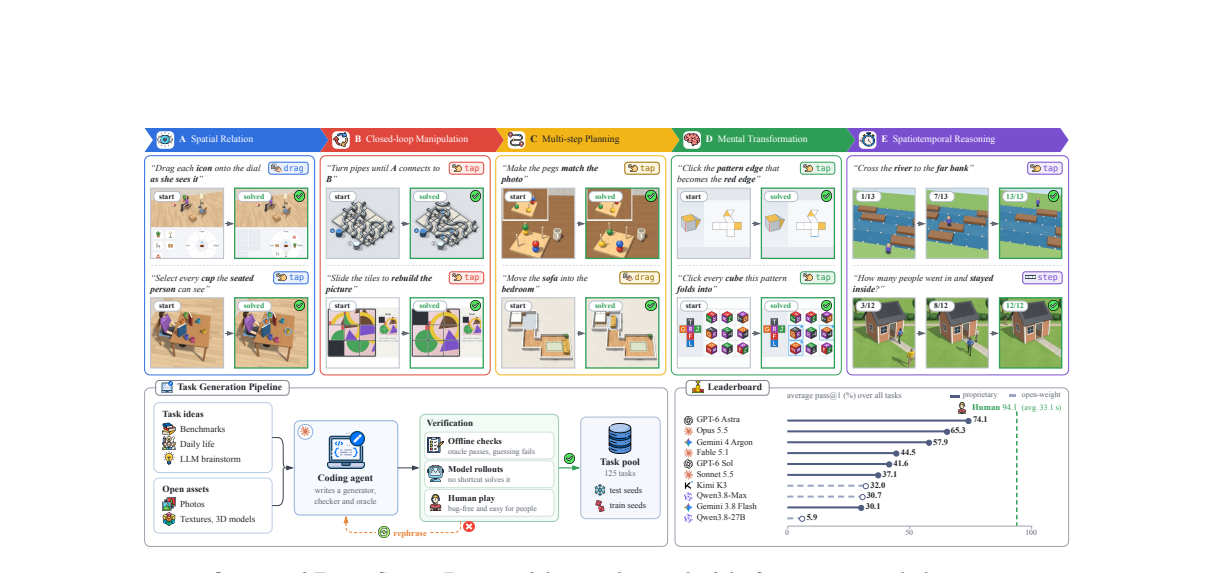
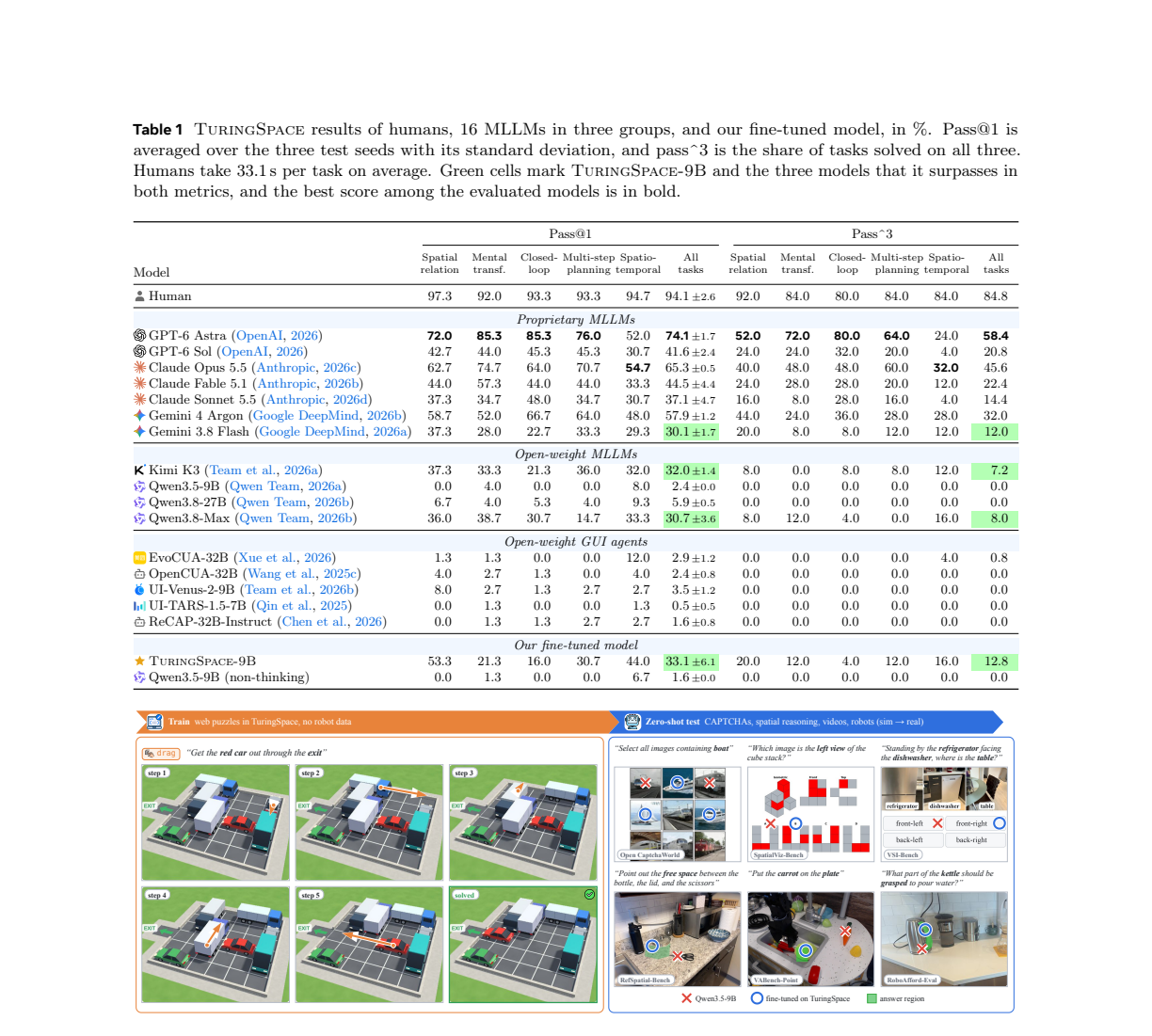
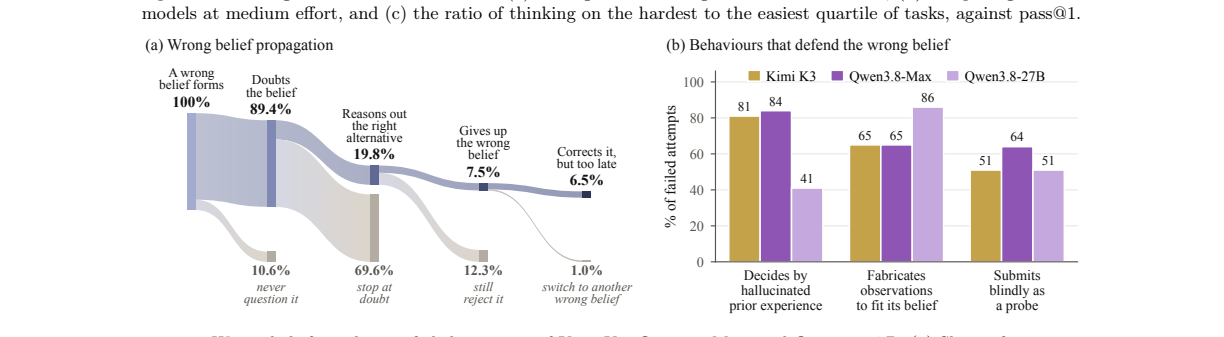
CAPTCHAs offer a natural test, since humans solve them through this very loop, clicking and dragging on the screen and adjusting after each result. Yet existing CAPTCHA benchmarks are largely solved and rarely spatial, while spatial benchmarks rarely require action. We therefore present TuringSpace, a synthetic web environment of 125 interactive CAPTCHAs that span five spatial abilities and must be solved through clicks and drags on the screen. Every task is a program that generates new instances with a checker and an oracle, so the tasks also form a scalable training gym. Humans solve 94.1% of the tasks, whereas the best model, GPT-6 Astra, still fails 25.9% of them, and the best open-weight model, Kimi K3, fails 68.0%. Our further analysis shows that most failures come from misreading the screenshot, and that model reasoning rarely corrects a wrong belief but hallucinates evidence to defend it. To test whether such spatial abilities can be learned, we fine-tune Qwen3.5-9B on this gym. Its success rate rises from 1.6% to 33.1%, above Kimi K3, and it improves on all seven out-of-distribution benchmarks, including a 9.9-point gain on the real-world indoor videos of VSI-Bench. These results show that grounding spatial intelligence in screen actions exposes what MLLMs lack and offers a scalable way to teach it, with gains that transfer to real-world scenes. We will release TuringSpace to support further study.
from the abstract
Pith says
Machine review · deepseek-v4-flash · 20 Nov 2026 · read the full text (149,143 characters) · not checked by a person
It can be wrong. Challenge this review or reply to it.
Holds up, with conditions. TuringSpace turns interactive CAPTCHAs into a training gym for spatial reasoning and shows that synthetic web puzzles can transfer to real-world benchmarks, though the oracle solutions used for training come from the same pipeline that created the tasks. This line is wrong
8 minor · 1 open question
How often objections from reviews like this one are right: not yet measured
The paper, first character to last
The reviewer was given the whole text, 149,143 characters. Not checked: figures, code, what the 106 references say.
8 minor objections
The paper says, at §1, Figure 1
Pith says: minor objection 1 of 8
Figure 1(a) shows failure rates on TuringSpace-Bench and two other CAPTCHA benchmarks, but the caption says 'every model fails more often on TuringSpace-Bench than on both.' This is not visible in the text-only version; the figure is absent. Please ensure the figure clearly supports this claim.
The paper says, at §3.3, Equation (2)
Pith says: minor objection 2 of 8
The notation D_test uses seeds {36, 43, 50} but the text says 'the three test seeds were chosen at random.' It would be helpful to state how these specific seeds were selected (e.g., random draw from which range) and whether any seeds were excluded because they produced degenerate instances.
show 6 more
The paper says, at §4.1
Pith says: minor objection 3 of 8
The human baseline is measured by three authors who 'took no part in building or reviewing the tasks.' However, the authors are still familiar with the paper's goals and may have above-average spatial reasoning or motivation. A more representative human baseline would include participants who are not co-authors. This is a minor concern given the large gap (94.1% vs 74.1%), but it should be noted.
The paper says, at §5.1, Figure 4
Pith says: minor objection 4 of 8
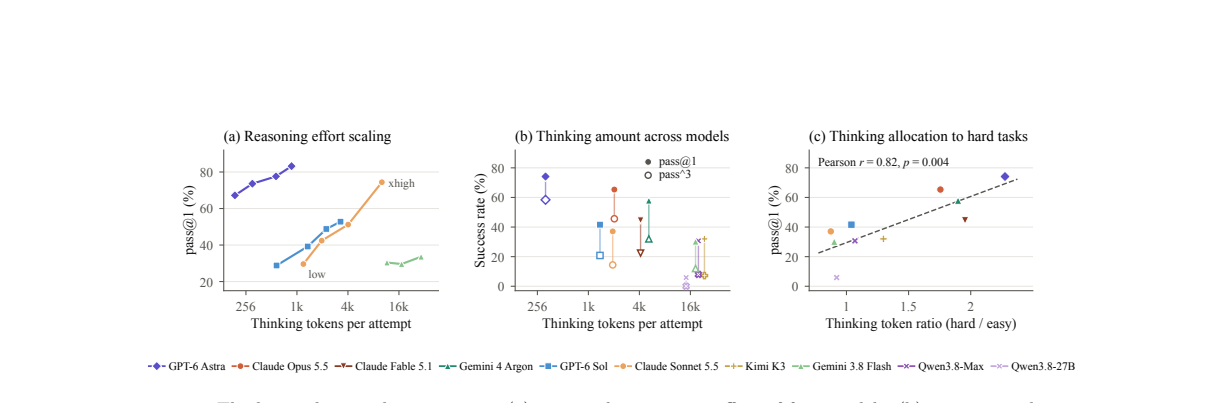
Figure 4(b) shows a negative correlation between mean thinking tokens and pass@1 (r = -0.75, p = 0.01). However, this correlation may be driven by the fact that weaker models (like Kimi K3) are forced to think more because they struggle, while stronger models (like GPT-6 Astra) solve tasks quickly. The causal direction is unclear. The authors should discuss this alternative interpretation.
The paper says, at §5.3, Table 6
Pith says: minor objection 5 of 8
The error analysis in Table 6 is based on 380 failed attempts of the three strongest models. The annotation uses Claude Opus 5.5 as a judge, with one author independently labeling all 380 failures, achieving 90.3% agreement (Cohen's κ = 0.88).
more of objection 5
This is a reasonable methodology, but the paper should clarify whether the author labels or the judge labels are reported as final. The caption says 'Table 6 reports the human labels as final,' which is good, but the text in §D.1 says 'the two sets of labels match on 90.3%' without specifying which set is used.
The paper says, at §A, Table 3
Pith says: minor objection 6 of 8
The training configuration (Table 3) shows that the model is trained for 1,000 steps (about 2.3 epochs) on 55,000 trajectories. The paper does not report whether the model converged or whether longer training would improve results. A validation curve or early stopping criterion would strengthen the training section.
The paper says, at §C.4, Case 6
Pith says: minor objection 7 of 8
The case studies in Appendix C are very helpful for understanding the failure modes. However, the formatting of the cases (with red/green markings) is described but cannot be rendered in the text-only version. Consider adding a brief textual description of what the markings indicate in each case.
The paper says, at §H
Pith says: minor objection 8 of 8
The ethics statement appropriately discusses dual-use concerns. However, the request that 'TuringSpace-Bench not be used to train models' is stated without enforcement mechanism. Given that the benchmark will be publicly released, this is a request rather than a restriction. The authors may want to clarify whether there are any technical measures (e.g., license terms) to prevent unintended use.
Open questions (1)
Pith raised these and could not confirm them against the text of the paper it read. They are questions for the authors, not findings.
- §3.2, §3.3 Pith raised a concern here that it could not check against the text of the paper it was given, so it is not published as an objection.
What would settle it
If a replication attempted to generate a new set of 125 interactive spatial CAPTCHAs using the same pipeline but with different seed ideas and a different coding agent, and found that fine-tuning on those trajectories produced no transfer to real-world benchmarks (e.g., no improvement on VSI-Bench or robotic pointing tasks), the claim that such training transfers to real-world scenes would be undermined.
from Pith's summary of the paper
How the review went
5 passes by deepseek-v4-flash · 20 Nov 2026
- Reader holds up, with conditions
- Skeptic concern not confirmed: listed as an open question
- Referee 8 minor
- Check against the paper kept 0 of 4 objections
- Editor wrote the verdict above
Not run on this paper: the simulated authors' defence.
Pith's passes raised 4 objections. A check against the paper's text kept 0, withdrew 2 (2 Pith's reviewer misread the paper) and left 2 as questions.
The review in full
The review in brief, machine-written
This paper introduces TuringSpace, a set of 125 interactive spatial CAPTCHAs that double as a training environment. The core idea is clean: instead of testing spatial reasoning with multiple-choice questions, make the model click and drag on a real browser page, see the result, and adjust. The tasks are programs, not fixed puzzles, so they generate unlimited fresh instances with verified oracle solutions. The authors evaluate 16 models and find a large gap between humans (94.1%) and the best model (GPT-6 Astra at 74.1%). Fine-tuning Qwen3.5-9B on 55,000 oracle trajectories raises its success rate from 1.6% to 33.1%, and the gains transfer to seven out-of-distribution benchmarks including real-world indoor videos. The failure analysis is thoughtful: most errors come from misreading screenshots, and model reasoning rarely corrects a wrong belief but instead hallucinates evidence to defend it.
The main soft spot is that the oracle solutions used for training are generated by the same coding agent (Claude Code with Opus 5.5) that created the tasks. The paper describes a review loop with programmatic checks, model rollouts, and human play, but there is no independent verification that the oracle trajectories are correct or optimal. If they contain errors, the training data would be flawed. A second concern is the human baseline: three authors who took no part in building the tasks. That is a small sample, though the gap is large enough that a bigger baseline would likely still show a clear human advantage. The OOD transfer results also lack error bars, which would strengthen the claims.
These issues are addressable. The paper is well-designed, the evaluation is thorough, and the central finding—that training on synthetic web puzzles transfers to real-world spatial tasks—is interesting and supported by the evidence. The work deserves a serious referee. I would recommend acceptance conditional on addressing the oracle verification and providing confidence intervals for the transfer results.
The stress test's concern
Not confirmed. Pith could not check this concern against the text of the paper it was given; it is listed as an open question, not a finding.
The referee's report
Not published. Pith's referee wrote this assessment before its objections were checked against the paper, and 3 of its 3 major objections did not survive that check.
Pith's reading of the paper (a machine's summary, not the authors')
The paper argues that the best way to test and teach spatial intelligence in multimodal large language models (MLLMs) is through interactive CAPTCHAs that require clicking and dragging on a screen, not through multiple-choice questions. The authors introduce TuringSpace, a suite of 125 synthetic web puzzles that generate unlimited instances, and show that humans solve 94.1% of them while the strongest model, GPT-6 Astra, reaches only 74.1%. Fine-tuning a 9-billion-parameter model on 55,000 oracle trajectories from these puzzles raises its success rate from 1.6% to 33.1% and improves its performance on all seven out-of-distribution benchmarks tested, including real-world indoor videos and robotic pointing tasks. The central finding is that most failures stem from misreading the screenshot—especially depth and 3D layout—and that model reasoning rarely corrects a wrong belief but instead hallucinates evidence to defend it. If correct, the work suggests that interactive GUI environments offer a scalable way to train spatial abilities that transfer to physical scenes.
What carries the argument. The central object is TuringSpace, a synthetic web environment of 125 interactive CAPTCHAs that are programs rather than fixed puzzles. Each task program generates unlimited fresh instances from random seeds, provides an automatic checker for the final state, and computes an oracle solution that can be replayed to produce verified training trajectories. The five task categories—spatial relation understanding, mental transformation, closed-loop manipulation, multi-step planning and simulation, and spatiotemporal reasoning—progress from reading 3D structure in one view to acting on it over time. The key mechanism is the action loop: the agent reads a screenshot, predicts the outcome of an action, acts (click or drag), sees the result in the next screenshot, and adjusts. This loop grounds spatial understanding in action and generates the training signal.
Core claim. The paper claims that grounding spatial intelligence in screen actions through interactive CAPTCHAs exposes what MLLMs lack and offers a scalable way to teach it, with gains that transfer to real-world scenes. Specifically: (1) TuringSpace-Bench reveals a large gap between humans (94.1%) and the best model GPT-6 Astra (74.1%) on interactive spatial tasks. (2) Fine-tuning Qwen3.5-9B on 55,000 trajectories from TuringSpace-Gym raises its success rate from 1.6% to 33.1%, surpassing Kimi K3 and Qwen3.8-Max. (3) The resulting TuringSpace-9B improves on all seven out-of-distribution benchmarks, including a 9.9-point gain on VSI-Bench real-world indoor videos. (4) Most failures come from misreading screenshots, and model reasoning rarely corrects wrong beliefs but hallucinates evidence to defend them.
The premise it rests on. The 125 seed tasks, generated by a coding agent from ideas adapted from spatial benchmarks, cognitive tests, and LLM brainstorming, adequately sample the full space of spatial abilities that matter for real-world interaction, and the oracle solutions generated by the same coding agent are correct and optimal.
If the paper is right (Pith's inferences, not the authors')
If the paper is correct, training on synthetic interactive puzzles can transfer to real-world spatial tasks, suggesting that GUI environments may serve as a scalable proxy for embodied spatial training.
The finding that most failures come from misreading screenshots—especially depth and 3D layout—implies that improving visual perception of 3D structure from 2D images is the primary bottleneck for MLLMs on spatial tasks.
The observation that model reasoning rarely corrects wrong beliefs but instead hallucinates evidence to defend them suggests that current reasoning mechanisms in MLLMs may actively reinforce errors rather than fix them.
The result that a 9B model fine-tuned on TuringSpace outperforms open-weight models over 250 times its size suggests that targeted interactive training can dramatically improve spatial abilities without scaling model parameters.
The paper's finding that perception errors dominate failures even on tasks designed to test reasoning (e.g., mental transformation) suggests that current MLLM benchmarks that use multiple-choice questions may overestimate spatial reasoning abilities by bypassing the perception bottleneck.
The result that training on synthetic web puzzles transfers to robotic pointing and affordance benchmarks implies that the action loop—observe, act, observe result—may be a general mechanism for learning spatial understanding that does not require embodiment.
The paper's analysis of wrong-belief propagation suggests a testable hypothesis: if models were trained to explicitly verify their perceptual beliefs against the screenshot before reasoning from them, failure rates might drop significantly.
Check this review
What was read
The passes were given all 149,143 characters of the text of the paper's PDF.
Fingerprint of that text (SHA-256): 0337ae4cdfd8e5fbab37c93d52d82119dc4569f3bbaea72aa72205787d9c396a
Pith does not keep that text. Rebuilt from the paper's source or PDF by the same code, it has this fingerprint if it is the same text. From a copy of Pith's code:
PYTHONPATH=. python scripts/review_input_check.py 2611.25387
The passes, in the order they ran
- Reader deepseek-v4-flash · medium effort · $0.0048 · instructions of the Reader, fingerprint f9ead7300382…
- Skeptic deepseek-v4-flash · medium effort · $0.0042 · instructions of the Skeptic, fingerprint 8f88c0f61488…
- Referee deepseek-v4-flash · medium effort · $0.0044 · instructions of the Referee, fingerprint a852d99aea0d…
- Check against the paper deepseek-v4-flash · medium effort · $0.0060 · instructions of the Check against the paper, fingerprint 6c7a6883d551…
- Editor deepseek-v4-flash · medium effort · $0.011 · instructions of the Editor, fingerprint e7211f6a3d27…
- Circularity check deepseek-v4-flash · medium effort · $0.0068 · instructions of the Circularity check, fingerprint e9946e39d67b…
- Summary for the page deepseek-v4-flash · medium effort · temperature 0.2 · $0.0045 · instructions of the Summary for the page, fingerprint e4f56bf568e7…
The passes cost $0.042 in model calls together.
Version stamped on this review: pith-pipeline@v1.4.1-daily-deepseek-or-medium+deepseek/deepseek-v4-flash+p.d60f54226f00
Each link opens a pass's instructions as plain text, the exact bytes its fingerprint was taken over. Every stored set of instructions.
curl -s https://pith.science/methodology/prompts/f9ead730038216984cfb56d7cb34332bdf691828296a1de4245f3d6667d4bf56 | sha256sum
prints the fingerprint of the reader's instructions. The same works for every pass.
The receipt
The review's fingerprint was taken on 20 Nov 2026. The review you are reading still matches it.
Fingerprint of the review (SHA-256): bf2d40c3af33f5f3c0364cd777ac407641bac740b0dc7b1b20cad92b6d1fed43
curl -s 'https://pith.science/api/v1/verdicts/2611.25387?form=canonical' | sha256sum
prints the fingerprint of the review as it stands now. The rule, in four steps.
A matching fingerprint shows the review has not changed since that date. It does not show that the review is right.
How often reviews like this one are right
Reviews like this one: written by deepseek-v4-flash, from the text of the paper's PDF.
How often objections from reviews like this one are right: not yet measured
Reviews by people
This review was written by a machine. No person has reviewed this paper on Pith yet. A scientist listed on Pith can review it for a fee, and their review is published here whatever it concludes.
The paper
Abstract
Humans act in the visual world by inferring the 3D layout behind a 2D view, predicting how an action changes it, and correcting themselves after seeing the result. Can multimodal large language models (MLLMs) do the same? CAPTCHAs offer a natural test, since humans solve them through this very loop, clicking and dragging on the screen and adjusting after each result. Yet existing CAPTCHA benchmarks are largely solved and rarely spatial, while spatial benchmarks rarely require action. We therefore present TuringSpace, a synthetic web environment of 125 interactive CAPTCHAs that span five spatial abilities and must be solved through clicks and drags on the screen. Every task is a program that generates new instances with a checker and an oracle, so the tasks also form a scalable training gym. Humans solve 94.1% of the tasks, whereas the best model, GPT-6 Astra, still fails 25.9% of them, and the best open-weight model, Kimi K3, fails 68.0%. Our further analysis shows that most failures come from misreading the screenshot, and that model reasoning rarely corrects a wrong belief but hallucinates evidence to defend it. To test whether such spatial abilities can be learned, we fine-tune Qwen3.5-9B on this gym. Its success rate rises from 1.6% to 33.1%, above Kimi K3, and it improves on all seven out-of-distribution benchmarks, including a 9.9-point gain on the real-world indoor videos of VSI-Bench. These results show that grounding spatial intelligence in screen actions exposes what MLLMs lack and offers a scalable way to teach it, with gains that transfer to real-world scenes. We will release TuringSpace to support further study.
The paper's own sentences, arranged, kept beside the review and separate from it. Each label is drawn from a closed vocabulary; the number beside it is the probability the classifier gave that label. No sentence in this record was written by a model.
abstract compiled · 2026-11-20
The authors' main claim, as the classifier picked it out 1.00
“These results show that grounding spatial intelligence in screen actions exposes what MLLMs lack and offers a scalable way to teach it, with gains that transfer to real-world scenes.”
How the main claim is stated: asserted 1.00
What the abstract itself states, as probabilities: claims first 0.15 · states limitation 0.45 · human participants 0.60 · controlled comparison 0.51 · randomized assignment 0.02 · states quantitative result 0.99 · compares with prior results 0.97 · mentions code or data availability 0.85
The abstract, sentence by sentence
This table labels the abstract only (arXiv listing abstract v1). The number is the probability the classifier gave the label.
| Sentence | Role | The authors' own work | States the main conclusion | Strength |
|---|---|---|---|---|
| Humans act in the visual world by inferring the 3D layout behind a 2D view, predicting how an action changes it, and correcting themselves after seeing the result. | background 1.00 | 0.06 | 0.03 | asserted 1.00 |
| Can multimodal large language models (MLLMs) do the same? | background 0.67 | 0.05 | 0.02 | unclear 0.77 |
| CAPTCHAs offer a natural test, since humans solve them through this very loop, clicking and dragging on the screen and adjusting after each result. | background 0.87 | 0.10 | 0.03 | asserted 0.97 |
| Yet existing CAPTCHA benchmarks are largely solved and rarely spatial, while spatial benchmarks rarely require action. | gap 1.00 | 0.08 | 0.02 | asserted 1.00 |
| We therefore present TuringSpace, a synthetic web environment of 125 interactive CAPTCHAs that span five spatial abilities and must be solved through clicks and drags on the screen. | contribution 0.86 | 0.94 | 0.05 | asserted 1.00 |
| Every task is a program that generates new instances with a checker and an oracle, so the tasks also form a scalable training gym. | method 0.77 | 0.89 | 0.03 | asserted 1.00 |
| Humans solve 94.1% of the tasks, whereas the best model, GPT-6 Astra, still fails 25.9% of them, and the best open-weight model, Kimi K3, fails 68.0%. | result 1.00 | 0.93 | 0.07 | asserted 1.00 |
| Our further analysis shows that most failures come from misreading the screenshot, and that model reasoning rarely corrects a wrong belief but hallucinates evidence to defend it. | result 0.76 | 0.95 | 0.06 | asserted 1.00 |
| To test whether such spatial abilities can be learned, we fine-tune Qwen3.5-9B on this gym. | method 0.92 | 0.94 | 0.03 | asserted 0.55 |
| Its success rate rises from 1.6% to 33.1%, above Kimi K3, and it improves on all seven out-of-distribution benchmarks, including a 9.9-point gain on the real-world indoor videos of VSI-Bench. | result 1.00 | 0.96 | 0.12 | asserted 1.00 |
| These results show that grounding spatial intelligence in screen actions exposes what MLLMs lack and offers a scalable way to teach it, with gains that transfer to real-world scenes. | interpretation 1.00 | 0.91 | 0.94 | asserted 1.00 |
| We will release TuringSpace to support further study. | future work 0.94 | 0.43 | 0.03 | asserted 0.91 |
What kind of paper the classifier reports this is: dataset or benchmark 0.99 · evidence from observation or experiment 0.98
What was examined, and what was not
Sources read
- arXiv listing abstract v1
Not examined
- full text
- figures and tables
- references and citing sentences
- relations to other papers
Levels run
- P abstract
Not run
- S sections
- T body sentences
- C citations
- R cross-paper relations
How the labels were made
Compiled by classifier-1.13.0 via TypeSafe API, question bank abstract-p1-20260923, 2026-11-20: 1 request, 8,989 input tokens.
Every quoted sentence on this record is the authors'. Every label is from Pith's closed vocabulary, with the probability shown beside it. This record as JSON
Figures (24)




Figures are the authors', reproduced from the paper.
References (106)
- [2] CAPTCHA Solving for Native GUI Agents: Automated Reasoning-Action Data Generation and Self-Corrective Training , author=. 2026 , eprint= on Pith
- [3] CaptchaArena: A Large-Scale, Fine-Grained Dataset for Training Computer-Use Agents on Interactive CAPTCHAs , author=. 2026 , eprint= on Pith
- [4] Kharlamova, Arina and He, Bowei and Ma, Chen and Liu, Xue , booktitle =. Spatial CAPTCHA: Generatively Benchmarking Spatial Reasoning for Human-Machine Differentiation , url = on Pith
- [6] Next-Gen CAPTCHAs: Leveraging the Cognitive Gap for Scalable and Diverse GUI-Agent Defense , author=. 2026 , eprint= on Pith
- [7] CaptchaMind: Training CAPTCHA Solvers via Reinforcement Learning with Explicit Reasoning Supervision , author=. 2026 , eprint= on Pith
- [8] Wang, Qineng and Yin, Baiqiao and Zhang, Pingyue and Zhang, Jianshu and Wang, Kangrui and Wang, Zihan and Zhang, Jieyu and Chandrasegaran, Keshigeyan and Liu, Han and Krishna, Ranjay and Xie, Saining and Wu, Jiajun and Fei-Fei, Li and Li, Manling , booktitle =. Spatial Mental ... on Pith
- [9] Wang, Siting and Pei, Minnan and Sun, Luoyang and Deng, Cheng and Li, Yuchen and Shao, Kun and Tian, Zheng and Zhang, Haifeng and Wang, Jun , booktitle =. SpatialViz-Bench: A Cognitively-Grounded Benchmark for Diagnosing Spatial Visualization in MLLMs , url = on Pith
- [10] Jia, Mengdi and Qi, Zekun and Zhang, Shaochen and Zhang, Wenyao and Yu, XinQiang and He, Jiawei and Wang, He and Yi, Li , booktitle =. OmniSpatial: Towards Comprehensive Spatial Reasoning Benchmark for Vision Language Models , url = on Pith
- [11] ViewSpatial-Bench: Evaluating Multi-perspective Spatial Localization in Vision-Language Models , author=. 2025 , eprint= on Pith
- [12] Ma, Wufei and Chen, Haoyu and Zhang, Guofeng and Chou, Yu-Cheng and Chen, Jieneng and de Melo, Celso and Yuille, Alan , title =. Proceedings of the IEEE/CVF International Conference on Computer Vision (ICCV) , month =. 2025 , pages = on Pith
- [13] Spatial457: A Diagnostic Benchmark for 6D Spatial Reasoning of Large Multimodal Models , author=. 2025 , eprint= on Pith
- [14] Li, Linjie and Bigverdi, Mahtab and Gu, Jiawei and Ma, Zixian and Yang, Yinuo and Li, Ziang and Choi, Yejin and Krishna, Ranjay , booktitle =. Unfolding Spatial Cognition: Evaluating Multimodal Models on Visual Simulations , url = on Pith
- [15] Yang, Jihan and Yang, Shusheng and Gupta, Anjali W. and Han, Rilyn and Fei-Fei, Li and Xie, Saining , title =. Proceedings of the IEEE/CVF Conference on Computer Vision and Pattern Recognition (CVPR) , month =. 2025 , pages = on Pith
- [16] SpaceCast-Bench: Evaluating Predictive Spatial Reasoning in Vision-Language Models , author=. 2026 , eprint= on Pith
- [17] SpatialWorld: Benchmarking Interactive Spatial Reasoning of Multimodal Agents in Real-World Tasks , author=. 2026 , eprint= on Pith
- [18] VisGym: Diverse, Customizable, Scalable Environments for Multimodal Agents , author=. 2026 , eprint= on Pith
- [20] Ramakrishnan, Santhosh Kumar and Wijmans, Erik and Kr\". Does Spatial Cognition Emerge in Frontier Models? , url =. International Conference on Learning Representations , editor = on Pith
- [21] Xie, Tianbao and Zhang, Danyang and Chen, Jixuan and Li, Xiaochuan and Zhao, Siheng and Cao, Ruisheng and Hua, Toh Jing and Cheng, Zhoujun and Shin, Dongchan and Lei, Fangyu and Liu, Yitao and Xu, Yiheng and Zhou, Shuyan and Savarese, Silvio and Xiong, Caiming and Zhong, Victo... on Pithdoi:10.52202/079017-1650
- [23] UI-TARS: Pioneering Automated GUI Interaction with Native Agents , author=. 2025 , eprint= on Pith
- [24] UI-TARS-2 Technical Report: Advancing GUI Agent with Multi-Turn Reinforcement Learning , author=. 2025 , eprint= on Pith
show 80 more
- [25] UI-Venus-2 Technical Report , author=. 2026 , eprint= on Pith
- [26] EvoCUA: Evolving Computer Use Agents via Learning from Scalable Synthetic Experience , author=. 2026 , eprint= on Pith
- [27] Wang, Xinyuan and Wang, Bowen and Lu, Dunjie and Yang, Junlin and Xie, Tianbao and Wang, Junli and Deng, Jiaqi and Guo, Xiaole and Xu, Yiheng and Wu, Chen and Shen, Zhennan and Li, Zhuokai and Li, Ryan and Li, Xiaochuan and Chen, Junda and Zheng, Boyuan and PEIHANG, LI and Lei... on Pith
- [28] Kimi K3: Open Frontier Intelligence , author=. 2026 , eprint= on Pith
- [31] Xiwen Teoh and Yun Lin and Siqi Li and Ruofan Liu and Avi Sollomoni and Yaniv Harel and Jin Song Dong , title =. 34th USENIX Security Symposium (USENIX Security 25) , year = on Pith
- [32] The Blind Spot of Agent Safety: How Benign User Instructions Expose Critical Vulnerabilities in Computer-Use Agents , author=. 2026 , eprint= on Pith
- [33] OSWorld 2.0: Benchmarking Computer Use Agents on Long-Horizon Real-World Tasks , author=. 2026 , eprint= on Pith
- [34] An Illusion of Progress? Assessing the Current State of Web Agents , author=. 2025 , eprint= on Pith
- [35] WebArena: A Realistic Web Environment for Building Autonomous Agents , author=. 2024 , eprint= on Pith
- [36] AndroidWorld: A Dynamic Benchmarking Environment for Autonomous Agents , author=. 2025 , eprint= on Pith
- [37] Windows Agent Arena: Evaluating Multi-Modal OS Agents at Scale , author=. 2024 , eprint= on Pith
- [38] Qwen-UI-Agent Technical Report: Toward Next-Generation Real-World Centric Foundation GUI Agents , author=. 2026 , eprint= on Pith
- [39] System Card:. 2026 , month = sep, howpublished = on Pith
- [40] Using. 2026 , howpublished = on Pith
- [41] 2026 , month = oct, howpublished = on Pith
- [42] 2026 , month = jun, howpublished = on Pith
- [43] Yang, Sihan and Xu, Runsen and Xie, Yiman and Yang, Sizhe and Li, Mo and Lin, Jingli and Zhu, Chenming and Chen, Xiaochen and Duan, Haodong and Yue, Xiangyu and Lin, Dahua and Wang, Tai and Pang, Jiangmiao , booktitle =. MMSI-Bench: A Benchmark for Multi-Image Spatial Intellig... on Pith
- [44] Holistic Evaluation of Multimodal LLMs on Spatial Intelligence , author=. 2025 , eprint= on Pith
- [46] Yuan, Yifu and Cui, Haiqin and Chen, Yibin and Dong, Zibin and Ni, Fei and Kou, Longxin and Liu, Jinyi and Li, Pengyi and ZHENG, YAN and Hao, Jianye , booktitle =. From Seeing to Doing: Bridging Reasoning and Decision for Robotic Manipulation , url = on Pith
- [47] RoboAfford++: A Generative AI-Enhanced Dataset for Multimodal Affordance Learning in Robotic Manipulation and Navigation , author=. 2025 , eprint= on Pith
- [50] Poly Haven: The Public 3D Asset Library , year = on Pith
- [51] 2026 , howpublished = on Pith
- [52] Claude Code , year = on Pith
- [53] Introducing. 2026 , month = sep, howpublished = on Pith
- [54] ESI-Bench: Towards Embodied Spatial Intelligence that Closes the Perception-Action Loop , author=. 2026 , eprint= on Pith
- [55] 2026 , month = sep, howpublished = on Pith
- [56] Computer-Use Agents Are Embodied Generalists , author=. 2026 , eprint= on Pith
- [57] Pranjal Aggarwal and Sean Welleck. Computer-use agents are embodied generalists, 2026. https://arxiv.org/abs/2611.09847 on PithPith's reviewarXiv
- [58] ambientCG . ambientCG - free textures, HDRIs and models. https://ambientcg.com, 2026 on Pith
- [59] Anthropic . Claude code. https://code.claude.com/docs/en/overview, 2026 a on Pith
- [60] Anthropic . System card: Claude Fable 5.1 & Claude Mythos 5.1 . https://www.anthropic.com/claude-fable-5-1-mythos-5-1-system-card, September 2026 b on Pith
- [61] Anthropic . System card: Claude Opus 5.5 . https://www-cdn.anthropic.com/fc1b44717c85dc068bc6ba5024219938094694bd/Claude\ on Pith
- [62] Anthropic . Introducing Claude Sonnet 5.5 . https://www.anthropic.com/news/claude-sonnet-5-5, September 2026 d on Pith
- [63] Rogerio Bonatti, Dan Zhao, Francesco Bonacci, Dillon Dupont, Sara Abdali, Yinheng Li, Yadong Lu, Justin Wagle, Kazuhito Koishida, Arthur Bucker, Lawrence Jang, and Zack Hui. Windows agent arena: Evaluating multi-modal os agents at scale, 2024. https://arxiv.org/abs/2409.08264 on PithPith's reviewarXiv
- [64] Zhongang Cai, Yubo Wang, Qingping Sun, Ruisi Wang, Chenyang Gu, Wanqi Yin, Zhiqian Lin, Zhitao Yang, Chen Wei, Oscar Qian, Hui En Pang, Xuanke Shi, Kewang Deng, Xiaoyang Han, Zukai Chen, Jiaqi Li, Xiangyu Fan, Hanming Deng, Lewei Lu, Bo Li, Ziwei Liu, Quan Wang, Dahua Lin, and... on PitharXiv
- [65] Yuxi Chen, Haoyu Zhai, Chenkai Wang, Rui Yang, Lingming Zhang, Gang Wang, and Huan Zhang. Captcha solving for native gui agents: Automated reasoning-action data generation and self-corrective training, 2026. https://arxiv.org/abs/2603.23559 on PithPith's reviewarXiv
- [66] Xuwei Ding, Skylar Zhai, Linxin Song, Jiate Li, Taiwei Shi, Nicholas Meade, Siva Reddy, Jian Kang, and Jieyu Zhao. The blind spot of agent safety: How benign user instructions expose critical vulnerabilities in computer-use agents, 2026. https://arxiv.org/abs/2604.10577 on PithPith's reviewarXiv
- [67] Hongcheng Gao, Hailong Qu, Jingyi Tang, Jiahao Wang, Zihao Huang, Hengkang Qiao, Shihong Huang, Junming Yang, Yi Li, Hongyixuan Yuan, Wenjie Li, Bohan Zeng, Wenbo Li, Bo Wang, Jianhui Liu, Olive Huang, Haoyang Huang, Wentao Zhang, Guoqing Huang, Nan Duan, and Yinpeng Dong. Spa... on PithPith's reviewarXiv
- [68] Google DeepMind . Gemini 3.8 Flash model card. https://deepmind.google/models/model-cards/gemini-3-8-flash/, September 2026 a on Pith
- [69] Google DeepMind . Gemini 4 Argon model card. https://deepmind.google/models/model-cards/gemini-4-argon/, October 2026 b on Pith
- [70] Xiaoshuai Hao, Yingbo Tang, Lingfeng Zhang, Yanbiao Ma, Yunfeng Diao, Ziyu Jia, Wenbo Ding, Hangjun Ye, and Long Chen. Roboafford++: A generative ai-enhanced dataset for multimodal affordance learning in robotic manipulation and navigation, 2025. https://arxiv.org/abs/2511.12436 on PitharXiv
- [71] Yining Hong, Jiageng Liu, Han Yin, Manling Li, Leonidas Guibas, Li Fei-Fei, Jiajun Wu, and Yejin Choi. Esi-bench: Towards embodied spatial intelligence that closes the perception-action loop, 2026. https://arxiv.org/abs/2605.18746 on PithPith's reviewarXiv
- [72] Mengdi Jia, Zekun Qi, Shaochen Zhang, Wenyao Zhang, XinQiang Yu, Jiawei He, He Wang, and Li Yi. Omnispatial: Towards comprehensive spatial reasoning benchmark for vision language models. In C. Vondrick, B. Hariharan, C. Raffel, L. Pinto, D. Yang, and A. Faust, editors, Interna... on Pith
- [73] Arina Kharlamova, Bowei He, Chen Ma, and Xue Liu. Spatial captcha: Generatively benchmarking spatial reasoning for human-machine differentiation. In C. Vondrick, B. Hariharan, C. Raffel, L. Pinto, D. Yang, and A. Faust, editors, International Conference on Learning Representat... on Pith
- [74] Alina Kuznetsova, Hassan Rom, Neil Alldrin, Jasper Uijlings, Ivan Krasin, Jordi Pont-Tuset, Shahab Kamali, Stefan Popov, Matteo Malloci, Alexander Kolesnikov, Tom Duerig, and Vittorio Ferrari. The open images dataset v4: Unified image classification, object detection, and visu... on Pithdoi:10.1007/s11263-020-01316-z
- [75] Dingming Li, Hongxing Li, Zixuan Wang, Yuchen Yan, Hang Zhang, Siqi Chen, Guiyang Hou, Shengpei Jiang, Wenqi Zhang, Yongliang Shen, Weiming Lu, and Yueting Zhuang. Viewspatial-bench: Evaluating multi-perspective spatial localization in vision-language models, 2025 a . https://... on PitharXiv
- [76] Hongxing Li, Jinyue Su, Dingming Li, Wenqi Zhang, Weiming Lu, Jun Xiao, Yueting Zhuang, and Yongliang Shen. Spacecast-bench: Evaluating predictive spatial reasoning in vision-language models, 2026 a . https://arxiv.org/abs/2610.12402 on PithPith's reviewarXiv
- [77] Kaixin Li, Ziyang Meng, Hongzhan Lin, Ziyang Luo, Yuchen Tian, Jing Ma, Zhiyong Huang, and Tat-Seng Chua. Screenspot-pro: Gui grounding for professional high-resolution computer use. In Proceedings of the 33rd ACM International Conference on Multimedia, MM ’25, page 8778–8786.... on Pithdoi:10.1145/3746027.3755688
- [78] Linjie Li, Mahtab Bigverdi, Jiawei Gu, Zixian Ma, Yinuo Yang, Ziang Li, Yejin Choi, and Ranjay Krishna. Unfolding spatial cognition: Evaluating multimodal models on visual simulations. In C. Vondrick, B. Hariharan, C. Raffel, L. Pinto, D. Yang, and A. Faust, editors, Internati... on Pith
- [79] Tsung-Yi Lin, Michael Maire, Serge Belongie, James Hays, Pietro Perona, Deva Ramanan, Piotr Dollár, and C. Lawrence Zitnick. Microsoft COCO: Common Objects in Context, page 740–755. Springer International Publishing, 2014. ISBN 9783319106021. doi:10.1007/978-3-319-10602-1_48. ... on Pithdoi:10.1007/978-3-319-10602-1_48
- [80] Jiacheng Liu, Yaxin Luo, Jiacheng Cui, Xinyi Shang, Xiaohan Zhao, and Zhiqiang Shen. Next-gen captchas: Leveraging the cognitive gap for scalable and diverse gui-agent defense, 2026. https://arxiv.org/abs/2602.09012 on PithPith's reviewarXiv
- [81] Yaxin Luo, Zhaoyi Li, Jiacheng Liu, Jiacheng Cui, Xiaohan Zhao, and Zhiqiang Shen. Open captchaworld: A comprehensive web-based platform for testing and benchmarking multimodal llm agents. In D. Belgrave, C. Zhang, H. Lin, R. Pascanu, P. Koniusz, M. Ghassemi, and N. Chen, edit... on Pithdoi:10.52202/085713-3006
- [82] Wufei Ma, Haoyu Chen, Guofeng Zhang, Yu-Cheng Chou, Jieneng Chen, Celso de Melo, and Alan Yuille. 3dsrbench: A comprehensive 3d spatial reasoning benchmark. In Proceedings of the IEEE/CVF International Conference on Computer Vision (ICCV), pages 6924--6934, October 2025 on Pith
- [83] Julius Mayer, Mohamad Ballout, Serwan Jassim, Farbod Nosrat Nezami, and Elia Bruni. i VISPAR --- an interactive visual-spatial reasoning benchmark for VLM s. In Christos Christodoulopoulos, Tanmoy Chakraborty, Carolyn Rose, and Violet Peng, editors, Proceedings of the 2025 Con... on Pithdoi:10.18653/v1/2025.emnlp-main.1359
- [84] MiniMax . MiniMax M3 : Frontier coding, 1m context, native multimodality --- all in one model. https://www.minimax.io/blog/minimax-m3, June 2026 on Pith
- [85] OpenAI . Using GPT-6 . https://developers.openai.com/api/docs/guides/latest-model, 2026 on Pith
- [86] Poly Haven . Poly haven: The public 3d asset library. https://polyhaven.com, 2026 on Pith
- [87] Yujia Qin, Yining Ye, Junjie Fang, Haoming Wang, Shihao Liang, Shizuo Tian, Junda Zhang, Jiahao Li, Yunxin Li, Shijue Huang, Wanjun Zhong, Kuanye Li, Jiale Yang, Yu Miao, Woyu Lin, Longxiang Liu, Xu Jiang, Qianli Ma, Jingyu Li, Xiaojun Xiao, Kai Cai, Chuang Li, Yaowei Zheng, C... on PithPith's reviewarXiv
- [88] Qwen Team . Qwen3.5 : Towards native multimodal agents, February 2026 a . https://qwen.ai/blog?id=qwen3.5 on Pith
- [89] Qwen Team . Qwen3.8-Max : A new bar for coding and cowork, August 2026 b . https://qwen.ai/blog?id=qwen3.8 on Pith
- [90] Santhosh Kumar Ramakrishnan, Erik Wijmans, Philipp Kr\" a henb\" u hl, and Vladlen Koltun. Does spatial cognition emerge in frontier models? In Y. Yue, A. Garg, N. Peng, F. Sha, and R. Yu, editors, International Conference on Learning Representations, volume 2025, pages 101439... on Pith
- [91] Christopher Rawles, Sarah Clinckemaillie, Yifan Chang, Jonathan Waltz, Gabrielle Lau, Marybeth Fair, Alice Li, William Bishop, Wei Li, Folawiyo Campbell-Ajala, Daniel Toyama, Robert Berry, Divya Tyamagundlu, Timothy Lillicrap, and Oriana Riva. Androidworld: A dynamic benchmark... on PithPith's reviewarXiv
- [92] Kimi Team, Tongtong Bai, Yifan Bai, Yiping Bao, M. C., Jianfeng Cai, Xinyuan Cai, Peizhou Cao, Yuxuan Cao, Ziwei Chai, Y. Charles, H. S. Che, Guanduo Chen, Guangyu Chen, Guanzheng Chen, Huarong Chen, Jia Chen, Jianlong Chen, Jun Chen, Kexin Chen, Peng Chen, Ruijue Chen, Wentao... on PitharXiv
- [93] Venus Team, Zhuohan Cai, Haoxing Chen, Jiaxuan Chen, Weizhi Chen, Changlong Gao, Zhangxuan Gu, Yuan Guo, Yusong Hu, Jianrong Jiang, Jianguo Li, Runze Li, Jinzhen Lin, Zhenyu Ma, Changhua Meng, Han Peng, Xinyu Qiu, Shuheng Shen, Zhongyi Shui, Weiqiang Wang, Ming Wen, Zhuoer Xu,... on PithPith's reviewarXiv
- [94] Xiwen Teoh, Yun Lin, Siqi Li, Ruofan Liu, Avi Sollomoni, Yaniv Harel, and Jin Song Dong. Are CAPTCHAs still bot-hard? generalized visual CAPTCHA solving with agentic vision language model. In 34th USENIX Security Symposium (USENIX Security 25), pages 3747--3766, Seattle, WA, A... on Pith
- [95] Luis von Ahn, Manuel Blum, Nicholas J. Hopper, and John Langford. CAPTCHA: Using Hard AI Problems for Security, page 294–311. Springer Berlin Heidelberg, 2003. ISBN 9783540392002. doi:10.1007/3-540-39200-9_18. http://dx.doi.org/10.1007/3-540-39200-9_18 on Pithdoi:10.1007/3-540-39200-9_18
- [96] Luis von Ahn, Benjamin Maurer, Colin McMillen, David Abraham, and Manuel Blum. recaptcha: Human-based character recognition via web security measures. Science, 321 0 (5895): 0 1465–1468, September 2008. ISSN 1095-9203. doi:10.1126/science.1160379. http://dx.doi.org/10.1126/sci... on Pithdoi:10.1126/science.1160379
- [97] Haoming Wang, Haoyang Zou, Huatong Song, Jiazhan Feng, Junjie Fang, Junting Lu, Longxiang Liu, Qinyu Luo, Shihao Liang, Shijue Huang, Wanjun Zhong, Yining Ye, Yujia Qin, Yuwen Xiong, Yuxin Song, Zhiyong Wu, Aoyan Li, Bo Li, Chen Dun, Chong Liu, Daoguang Zan, Fuxing Leng, Hanbi... on PithPith's reviewarXiv
- [98] Pengcheng Wang, Haoxiang Liu, Yang Dai, Xiangxiang Zeng, Guanhua Chen, Baotian Hu, Longyue Wang, and Weihua Luo. Captchamind: Training captcha solvers via reinforcement learning with explicit reasoning supervision, 2026 a . https://arxiv.org/abs/2605.19538 on PithPith's reviewarXiv
- [99] Qineng Wang, Baiqiao Yin, Pingyue Zhang, Jianshu Zhang, Kangrui Wang, Zihan Wang, Jieyu Zhang, Keshigeyan Chandrasegaran, Han Liu, Ranjay Krishna, Saining Xie, Jiajun Wu, Li Fei-Fei, and Manling Li. Spatial mental modeling from limited views. In C. Vondrick, B. Hariharan, C. R... on Pith
- [100] Siting Wang, Minnan Pei, Luoyang Sun, Cheng Deng, Yuchen Li, Kun Shao, Zheng Tian, Haifeng Zhang, and Jun Wang. Spatialviz-bench: A cognitively-grounded benchmark for diagnosing spatial visualization in mllms. In C. Vondrick, B. Hariharan, C. Raffel, L. Pinto, D. Yang, and A. ... on Pith
- [101] Xingrui Wang, Wufei Ma, Tiezheng Zhang, Celso M de Melo, Jieneng Chen, and Alan Yuille. Spatial457: A diagnostic benchmark for 6d spatial reasoning of large multimodal models, 2025 b . https://arxiv.org/abs/2502.08636 on PitharXiv
- [102] Xinyuan Wang, Bowen Wang, Dunjie Lu, Junlin Yang, Tianbao Xie, Junli Wang, Jiaqi Deng, Xiaole Guo, Yiheng Xu, Chen Wu, Zhennan Shen, Zhuokai Li, Ryan Li, Xiaochuan Li, Junda Chen, Boyuan Zheng, LI PEIHANG, Fangyu Lei, Ruisheng Cao, Yeqiao Fu, Dongchan Shin, Martin Shin, Hu Jia... on Pith
- [103] Zirui Wang, Junyi Zhang, Jiaxin Ge, Long Lian, Letian Fu, Lisa Dunlap, Ken Goldberg, XuDong Wang, Ion Stoica, David M. Chan, Sewon Min, and Joseph E. Gonzalez. Visgym: Diverse, customizable, scalable environments for multimodal agents, 2026 d . https://arxiv.org/abs/2601.16973 on PitharXiv
- [104] Zonglin Wu, Yule Xue, Yaoyao Feng, Xiaolong Wang, and Yiren Song. Mca-bench: A multimodal benchmark for evaluating captcha robustness against vlm-based attacks. Proceedings of the AAAI Conference on Artificial Intelligence, 40 0 (44): 0 38039–38047, Mar. 2026. doi:10.1609/aaai... on Pithdoi:10.1609/aaai.v40i44.41141
- [105] Tianbao Xie, Danyang Zhang, Jixuan Chen, Xiaochuan Li, Siheng Zhao, Ruisheng Cao, Toh Jing Hua, Zhoujun Cheng, Dongchan Shin, Fangyu Lei, Yitao Liu, Yiheng Xu, Shuyan Zhou, Silvio Savarese, Caiming Xiong, Victor Zhong, and Tao Yu. Osworld: Benchmarking multimodal agents for op... on Pith
- [106] Taofeng Xue, Chong Peng, Mianqiu Huang, Linsen Guo, Tiancheng Han, Haozhe Wang, Jianing Wang, Xiaocheng Zhang, Xin Yang, Dengchang Zhao, Jinrui Ding, Xiandi Ma, Yuchen Xie, Peng Pei, Xunliang Cai, and Xipeng Qiu. Evocua: Evolving computer use agents via learning from scalable ... on PitharXiv
- [107] Tianci Xue, Weijian Qi, Tianneng Shi, Chan Hee Song, Boyu Gou, Dawn Song, Huan Sun, and Yu Su. An illusion of progress? assessing the current state of web agents, 2025. https://arxiv.org/abs/2504.01382 on PitharXiv
- [108] Jihan Yang, Shusheng Yang, Anjali W. Gupta, Rilyn Han, Li Fei-Fei, and Saining Xie. Thinking in space: How multimodal large language models see, remember, and recall spaces. In Proceedings of the IEEE/CVF Conference on Computer Vision and Pattern Recognition (CVPR), pages 1063... on Pith
- [109] Sihan Yang, Runsen Xu, Yiman Xie, Sizhe Yang, Mo Li, Jingli Lin, Chenming Zhu, Xiaochen Chen, Haodong Duan, Xiangyu Yue, Dahua Lin, Tai Wang, and Jiangmiao Pang. Mmsi-bench: A benchmark for multi-image spatial intelligence. In C. Vondrick, B. Hariharan, C. Raffel, L. Pinto, D.... on Pith
The first 100 of 106 references are listed here. All of them are in this paper's citation record.
Challenges and discussion
Disagree with the review, or know something it missed? Leave a comment, or challenge this review formally: a challenge becomes a permanent entry in this paper's record, and its decision is published here.
Come back by email
A short list of the week's newly reviewed papers. Nothing is sent until you confirm from your inbox, and every email has a link that stops it. No account.
No comments yet.
Sign in to comment