Machine Learning · arXiv:2611.09847 v1 · submitted 6 Nov 2026 · 27 references
Computer-Use Agents Are Embodied Generalists
The paper says
“In many areas of AI, general-purpose models have increasingly replaced handcrafted methods and specialized architectures. We argue that embodied AI is poised for a similar shift.”
more of the abstract
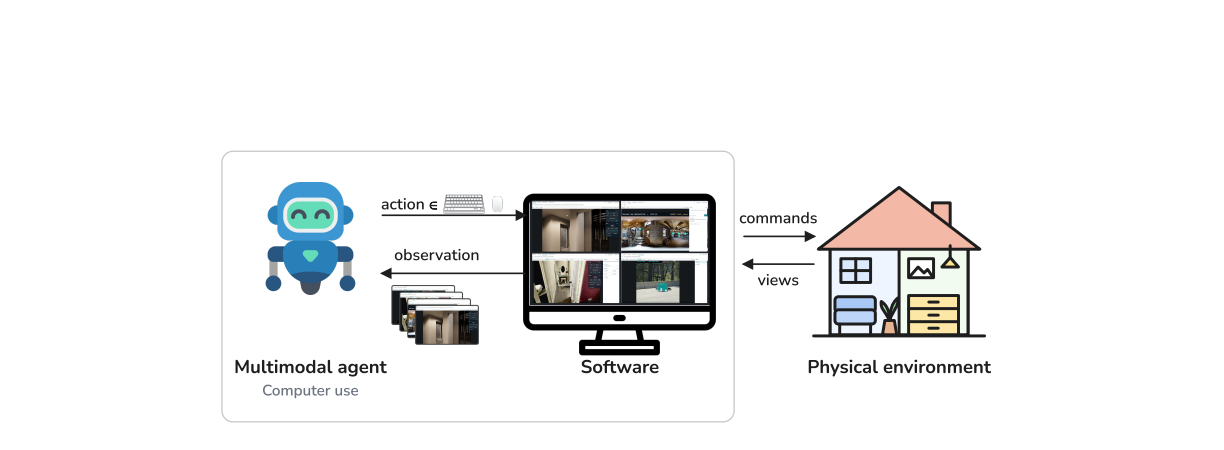
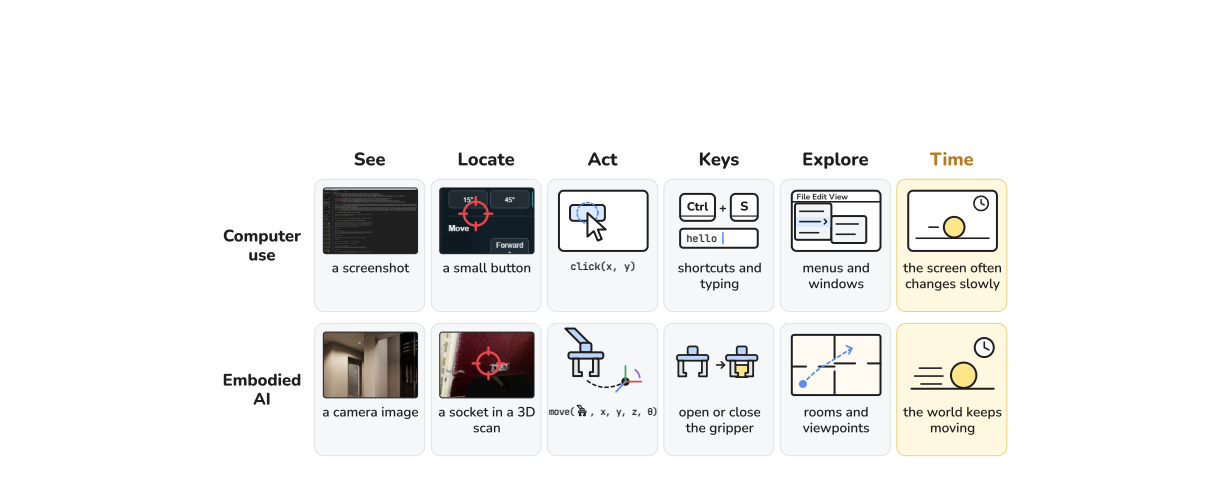
Our key claim is that embodied tasks can be formulated as interaction with digital software. Specifically, we build software that renders an agent's view of a physical environment on a screen and provides controls for acting in it. A computer-use agent (CUA) can then perform embodied tasks through the same screenshots and keyboard and mouse actions that it uses to operate ordinary software. Using a single CUA design and changing only the software, our entries win first-, second-, third-, and sixth-place prizes across four ECCV workshop competitions, without any competition-specific agent tuning. These results suggest that the skills CUAs learn on software, such as visual grounding, precise clicking, and exploration, already carry over to embodied tasks, giving CUAs a far broader scope in embodied AI than previously realized. We therefore advocate that computer-use agents can be embodied generalists. Further, we advocate that, by following the training strategy that made computer-use agents general, embodied AI can converge on a single general model as well, ushering in a new era of general embodied AI. Website: https://pranjal2041.github.io/cua-embodied
from the abstract
Pith says
Machine review · deepseek-v4-flash · 9 Nov 2026 · what was read was not recorded · not checked by a person
It can be wrong. Challenge this review or reply to it.
Holds up, with conditions. The four-competition result is a real, independently scored contribution; the title and abstract claim that this makes CUAs embodied generalists is not supported by the evidence. This line is wrong
4 major objections · 3 minor
How often objections from reviews like this one are right: not yet measured
Not checked: figures, code, what the 27 references say.
The paper says, at Abstract, §1, §2, Table 1
The review did not quote this passage.
Pith says: Objection 1 of 4 · major
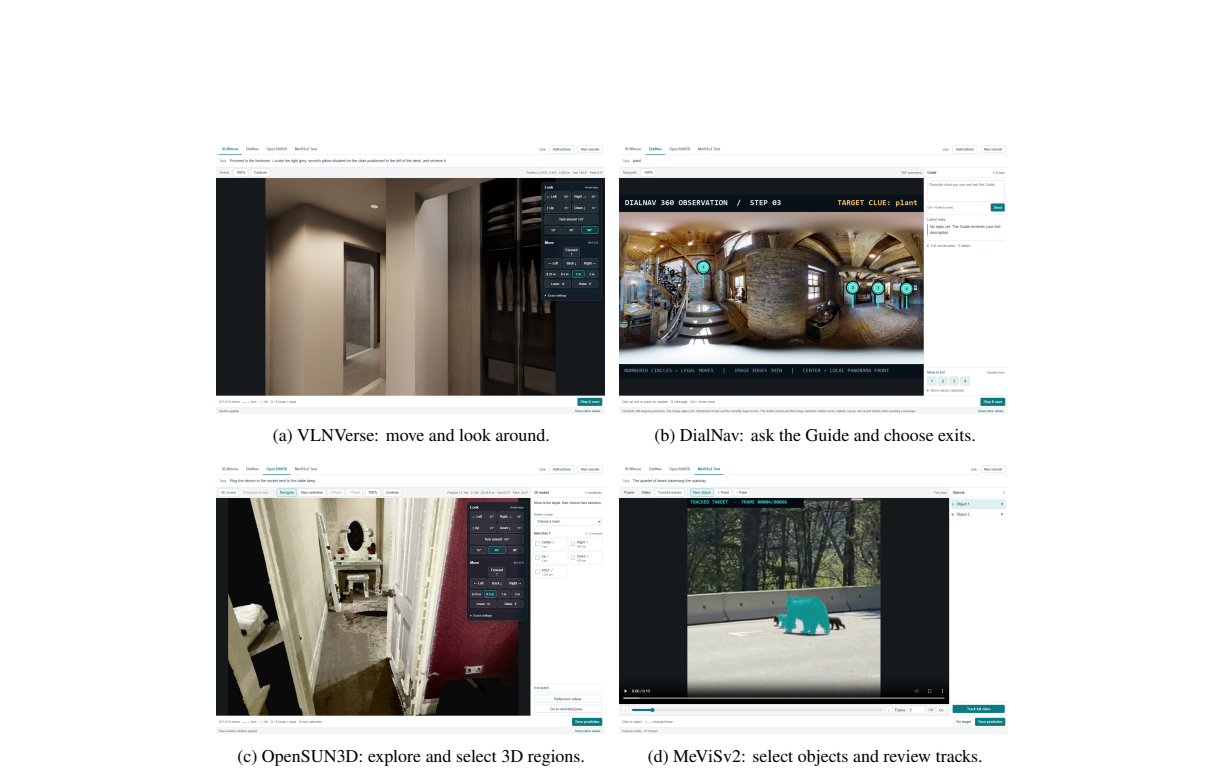
The central inference, stated in the abstract and conclusion, is that the competition results show CUA skills 'already carry over to embodied tasks.' The four wrappers do not test that transfer. VLNVerse (§2.2) and DialNav (§2.3) restrict action to discrete translation/rotation or clicking numbered exits in rendered panoramas; OpenSUN3D (§2.4) is a point-click segmentation task in which PinPoint3D and VOLT produce the masks; MeViSv2 (§2.5) is video segmentation via SAM3.
more of objection 1
None of the evaluations involves continuous motor commands, contact dynamics, or real-time physical feedback, and no robot is controlled. Table 1 therefore demonstrates that a capable multimodal model plus task-specific software can operate these benchmarks, but it does not establish transfer from software use to physical embodiment. The acknowledgments in §4 (b122–b124) concern humanoid action-format efficiency, not this screen-surrogacy gap. The revision should either add a direct transfer test, such as the same agent controlling a simulated or real manipulator through the software interface, or reframe the title, abstract, and conclusion as claims about software-mediated embodied benchmarks.
The paper says, at §2.1
The review did not quote this passage.
Pith says: Objection 2 of 4 · major
The paper says it uses Gemini 3.5 Flash and Gemini 3.6 Flash but never states which model produced each competition entry. Since the headline claim is that the agent design is held fixed and 'only the software' changes, using two model versions is a potential change in the agent. The paper should report the model assignment per competition and confirm that no competition-specific changes were made to prompts, context-management parameters, or the action space.
The paper says, at §3.2, Table 2
The review did not quote this passage.
Pith says: Objection 3 of 4 · major
The GUI-vs-API comparison is under-specified. The 'subset of tasks' used for each competition is not defined, episode counts are absent, and no confidence intervals or per-episode breakdowns are reported. With differences of −4.0 to +1.4 across four competitions, the claim that the interfaces perform 'within four points' is compatible with sampling noise, particularly for DialNav. Please provide the evaluation sizes, uncertainty estimates, and a per-task breakdown, or soften the §3.2 claim to a qualitative observation about this limited subset.
The paper says, at §4, Claim 2
The review did not quote this passage.
Pith says: Objection 4 of 4 · major
The preliminary Gym-Anything experiment is the only direct evidence for the claim that specialized action heads are unnecessary, but the description is too thin to support it. The two gift-box tasks are not named; training details such as base checkpoint, full fine-tuning versus adapters, context length, action text format, and number of seeds are not given; and the 56% versus 59% difference over 1,000 unseen instances is reported without variance.
more of objection 4
Please add these details, including repeated-seed results, or clearly mark the claim as a conjecture rather than a supported result.
3 minor objections
The paper says, at Table 1
Pith says: minor objection 1 of 3
The 'Best other' cells are blank for DialNav; include the best official score and the number of entries for each competition so the four placements can be assessed uniformly.
The paper says, at §3.1
Pith says: minor objection 2 of 3
The metric definitions would be easier to follow as a small table, and the DialNav results should cite the specific official challenge report rather than only the general EAD workshop page.
show 1 more
The paper says, at §2, Reproducibility
Pith says: minor objection 3 of 3
The manuscript does not describe a code or data release; releasing the four software applications and the agent prompts would substantially aid reproducibility of the wrappers and the GUI/API comparison.
What would settle it
Run the same CUA harness on a contact-rich physical manipulation benchmark exposed only through screenshots and keyboard/mouse commands—for example, a Franka arm opening a drawer or performing a pick-and-place sequence, with no ground-truth point selection, no SAM-style segmentation, and no privileged state access in the software—and compare success rate over at least 100 episodes against a specialized VLA baseline. If the CUA succeeds comparably, the surrogate premise survives; if it fails on contact, real-time, or continuous-control aspects, the central claim must be narrowed to perception-and-navigation tasks rather than embodied generalism.
from the skeptic's reading
How the review went
4 readings by deepseek-v4-flash · 9 Nov 2026
- Reader holds up, with conditions
- Skeptic agrees
- Editor wrote the verdict above
- Referee major revision: 4 major objections, 3 minor
Not run on this paper: the simulated authors' defence.
Pith did not check this review's objections against the paper.
The review in full
The review in brief, machine-written
Short version: ignore the title, keep the empirical core. The paper's real contribution is concrete: one computer-use harness, with only per-task software wrappers changed, placed first, second, third, and sixth in four ECCV workshop competitions on external official test sets. That is new and independently judged, and it is genuinely useful evidence that screen-and-keyboard interaction can operate software-rendered versions of embodied benchmarks. I also give credit for the GUI-vs-API validation comparison in Table 2, where the two interfaces landed within four points on all four tasks, and for the small no-action-head pilot in which a plain 9B vision-language model matched pi0.5 at 56% versus 59% on two simulated two-arm tasks. That pilot is not a headline result, but it is a real measurement rather than hand-waving. The soft spot is the gap between that evidence and the title. All four competitions are screen-mediated or perception tasks: VLNVerse is discrete first-person navigation, DialNav is choosing numbered exits from a panorama, OpenSUN3D is point-click 3D segmentation, and MeViSv2 is video segmentation. None of them involves physical actuation, contact dynamics, or real-time motor feedback. The results demonstrate that a strong multimodal model can operate software versions of embodied benchmarks; they do not demonstrate that the skills carry over to embodied tasks as the abstract asserts. The authors call the results sparks in Section 2 and acknowledge the humanoid action-format limitation, but they do not address this screen-surrogacy gap. The inference from four competition placements to 'CUAs are embodied generalists' is a hypothesis, not a result. Other quibbles are minor. Table 2 has no error bars and uses validation subsets, but the authors only draw a modest conclusion from it. Claim 2's convergence argument is analogy plus the 9B pilot; fine as a position, not established. There is heavy self-citation, but the main evidence is independent official scores, so I do not see a circularity problem. The absence of released code is a practical limitation, not a defect in what is reported. Bottom line: this deserves a serious referee. The harness and the independent competition results are worth engaging, and the paper raises a question the field should discuss: what does success on screen-mediated surrogates actually license? Send it to peer review, but expect substantial revision to the title and abstract, with a clearer separation between evidence and advocacy.
The strongest objection
The abstract's central claim requires that performing a task through a software-rendered view and discrete keyboard/mouse inputs transfers to embodied performance, and that bridge is never tested. In Section 2, each wrapper removes exactly the part of embodiment that is hardest: VLNVerse (§2.2) is first-person navigation with discrete translation and rotation; DialNav (§2.3) chooses numbered exits from a panorama; OpenSUN3D (§2.4) is a 3D segmentation task where clicking a point yields a mask via PinPoint3D and VOLT; MeViSv2 (§2.5) is video segmentation via SAM3. Two of the four are perception tasks that change no environment state, and the other two involve no contact dynamics, continuous motor commands, or real-time physical feedback. Table 1 therefore demonstrates that a strong multimodal model with task-specific software and a GUI harness can operate these benchmarks, not that the learned skills carry over to physical embodiment. The paper does acknowledge format limitations for humanoids [b122–b124] and frames the results as 'sparks' in §2, but those acknowledgments do not cover the screen-surrogacy gap: even the two-arm simulated setting leaves contact-rich, high-frequency physical interaction untested. If the software-rendered version omits the physical difficulty, then success on the surrogate cannot license the title claim.
The reader identified the same load-bearing weakness: all four competition tasks are screen-mediated, and no physical robot is controlled. I agree that this is the central inferential gap. The competition placements themselves are credible and useful, and the paper is explicit that it is providing 'sparks of evidence' rather than a complete embodied-evaluation suite. It also acknowledges the humanoid action-format limitation, which is why the result is not reject-level. However, the title-level claim that computer-use agents 'are embodied generalists' goes beyond the evidence: the tasks are navigation, dialogue, and segmentation, with software wrappers supplying affordance, mask, and guide models, and no test of contact dynamics, motor control, or real-time physical interaction. A single check on a contact-rich physical task would settle whether the screen-surrogacy premise actually transfers. Since the reader already assigned CONDITIONAL on exactly this basis, my read does not change the verdict.
The referee's report
The main empirical strength is the use of official competition scores on external test sets: the four placements are not produced by the authors' own evaluation protocol, and the claim of a shared agent design with only the software changed is a concrete, falsifiable engineering claim. If the screen-surrogacy premise were established, the paper would be a notable demonstration that one agent interface can span navigation, dialogue, and segmentation-style embodied benchmarks, and the GUI/API parity check and action-head-free VLM result would be valuable data points. As it stands, the significance is conditional: every task is mediated by a rendered display and discrete keyboard/mouse input, two tasks are perception/segmentation tasks that do not change environment state, and no physical robot or contact-rich control loop is involved. The empirical evidence therefore supports the claim that a computer-use agent can operate software wrappers for embodied-style benchmarks, but it does not, by itself, establish that the agent is already an embodied generalist in the title's sense.
Pith's reading of the paper (a machine's summary, not the authors')
The paper argues that embodied tasks—navigating a room, following a guide's directions, segmenting a 3D scene, tracking objects in video—do not require specialized embodied models: if each task is wrapped in software that renders the environment on a screen and maps keyboard and mouse actions to movement and selection, a general computer-use agent can handle it with the same skills it uses on ordinary applications. As evidence, the authors keep one agent design fixed across four ECCV workshop competitions and change only the software, placing first in OpenSUN3D (language-guided 3D segmentation), second in MeViSv2-Text (referring video segmentation), third in DialNav (dialogue navigation), and sixth in VLNVerse (vision-language navigation). They also report that a plain vision-language model with no robot-specific action head matches the π0.5 vision-language-action model on a two-arm manipulation simulation (56% versus 59% success), and that operating through a GUI costs little compared to a text API. If the claim holds, embodied AI could follow the computer-use trajectory toward a single general model rather than a zoo of task-specific architectures.
What carries the argument. The load-bearing mechanism is the screen-surrogacy wrapper: for each embodied task, the authors build software that renders the agent's observation on a screen—a first-person view, a panorama, a point cloud, or a video player—and exposes the task's operations as keyboard and mouse commands. Around these wrappers sits a fixed interaction loop: the agent receives the task description, the software's instructions, and any reference media; it chooses actions from a shared action space; the software executes them and returns a fresh screenshot; and the loop repeats until the agent presses submit. Task-specific expertise lives in the software rather than the model—a Guide model answers dialogue, PinPoint3D converts clicks into point-prompted 3D masks, and SAM3 segments and propagates video masks—so one agent design can span all four tasks. The same loop, with the action format changed from screen coordinates to plain text tokens, powers the no-action-head experiment in which a 9-billion-parameter vision-language model is trained on 1,000 demonstrations and matches a leading vision-language-action model on a two-arm simulation.
Core claim. The central claim is that a computer-use agent—a model that operates software through screenshots and keyboard and mouse actions—is already an embodied generalist, because any embodied task can be formulated as interaction with digital software. The authors build four software applications, one per task: a first-person 3D viewer for vision-language navigation, a 360-degree panorama with a Guide model for dialogue-driven navigation, a free-camera point-cloud renderer with point clicking for language-guided 3D segmentation, and a video player with mask propagation for referring video segmentation. With the agent's implementation, system prompt, and action space held fixed and only the software changed, the same agent won first place in OpenSUN3D, second in MeViSv2-Text, third in DialNav, and sixth in VLNVerse, without competition-specific tuning. The authors interpret these placements as evidence that abilities computer-use agents already learn on software—visual grounding, precise clicking, exploration, and recognizing when no target is present—transfer to embodied tasks. They extend this into a broader thesis: embodied AI will converge on one general model, just as computer use did, and the path runs through grounding data from simulators, reinforcement-learning environments exposed as software, and optimized real-time interaction.
The premise it rests on. The load-bearing premise is that performing a task through a screen surrogate—a rendered view plus keyboard and mouse inputs, with no physical robot in the loop—is equivalent to performing it in the physical world, so that placements in four screen-mediated competitions count as evidence of embodied capability.
If the paper is right (Pith's inferences, not the authors')
If the claim holds, anyone with a capable computer-use agent gains a working embodied agent for any task that can be wrapped in software, with no new model training required.
The four placements suggest that computer-use skills such as precise clicking, visual grounding, exploration, and negative-target detection transfer to embodied benchmarks without additional adaptation.
The no-action-head result suggests continuous robot control can be expressed as ordinary text tokens; the paper itself restricts this to the two-arm setting and notes that many-degree-of-freedom robots may need a more efficient state and action format.
The near-parity of GUI and API interaction—within four points, with the GUI higher in two of four competitions—implies the screen interface is not the bottleneck for sufficiently capable agents.
The paper's three-phase playbook, grounding from simulators, reinforcement-learning environments, and real-time speed, gives embodied AI a concrete agenda: expose simulators and robots through software and train general agents on them.
My inference: the paper's evidence is entirely screen-mediated—all four competitions present observations through a display and accept discrete inputs, and two are segmentation tasks rather than physical interaction—so the leap from these placements to physical motor control, contact dynamics, and real-time bodily feedback remains untested in this work.
My inference: if the screen-surrogacy claim is right, a direct extension is to train a computer-use agent on software-wrapped simulators at scale and then deploy it on a real robot unchanged; the paper's own playbook predicts immediate or near-immediate transfer, which is a strong, checkable prediction.
My inference: standardizing embodied benchmarks as software interfaces would turn any computer-use benchmark suite into an embodied evaluation, letting embodied AI reuse the measurement infrastructure that already exists for GUI agents.
Check this review
Pith stored no record of this review's passes and took no fingerprint of it. Reviews made by code from 13 Nov 2026 on carry both.
How often reviews like this one are right
Reviews like this one: written by deepseek-v4-flash, where what was read was not recorded.
How often objections from reviews like this one are right: not yet measured
Reviews by people
This review was written by a machine. No person has reviewed this paper on Pith yet. A scientist listed on Pith can review it for a fee, and their review is published here whatever it concludes.
The paper
Abstract
In many areas of AI, general-purpose models have increasingly replaced handcrafted methods and specialized architectures. We argue that embodied AI is poised for a similar shift. Our key claim is that embodied tasks can be formulated as interaction with digital software. Specifically, we build software that renders an agent's view of a physical environment on a screen and provides controls for acting in it. A computer-use agent (CUA) can then perform embodied tasks through the same screenshots and keyboard and mouse actions that it uses to operate ordinary software. Using a single CUA design and changing only the software, our entries win first-, second-, third-, and sixth-place prizes across four ECCV workshop competitions, without any competition-specific agent tuning. These results suggest that the skills CUAs learn on software, such as visual grounding, precise clicking, and exploration, already carry over to embodied tasks, giving CUAs a far broader scope in embodied AI than previously realized. We therefore advocate that computer-use agents can be embodied generalists. Further, we advocate that, by following the training strategy that made computer-use agents general, embodied AI can converge on a single general model as well, ushering in a new era of general embodied AI. Website: https://pranjal2041.github.io/cua-embodied
The paper's own sentences, arranged, kept beside the review and separate from it. Each label is drawn from a closed vocabulary; the number beside it is the probability the classifier gave that label. No sentence in this record was written by a model.
abstract compiled · 2026-11-09
The authors' main claim, as the classifier picked it out 1.00
“We therefore advocate that computer-use agents can be embodied generalists.”
How the main claim is stated: asserted 0.52
What the abstract itself states, as probabilities: claims first 0.07 · states limitation 0.08 · human participants 0.06 · controlled comparison 0.08 · randomized assignment 0.02 · states quantitative result 0.88 · compares with prior results 0.35 · mentions code or data availability 0.41
The abstract, sentence by sentence
This table labels the abstract only (arXiv listing abstract v1). The number is the probability the classifier gave the label.
| Sentence | Role | The authors' own work | States the main conclusion | Strength |
|---|---|---|---|---|
| In many areas of AI, general-purpose models have increasingly replaced handcrafted methods and specialized architectures. | background 1.00 | 0.04 | 0.02 | asserted 0.99 |
| We argue that embodied AI is poised for a similar shift. | background 0.72 | 0.08 | 0.06 | hedged possibility 0.89 |
| Our key claim is that embodied tasks can be formulated as interaction with digital software. | contribution 0.92 | 0.21 | 0.13 | asserted 0.98 |
| Specifically, we build software that renders an agent's view of a physical environment on a screen and provides controls for acting in it. | method 0.94 | 0.91 | 0.03 | asserted 0.99 |
| A computer-use agent (CUA) can then perform embodied tasks through the same screenshots and keyboard and mouse actions that it uses to operate ordinary software. | method 0.87 | 0.33 | 0.06 | asserted 0.70 |
| Using a single CUA design and changing only the software, our entries win first-, second-, third-, and sixth-place prizes across four ECCV workshop competitions, without any competition-specific agent tuning. | result 0.99 | 0.96 | 0.08 | asserted 1.00 |
| These results suggest that the skills CUAs learn on software, such as visual grounding, precise clicking, and exploration, already carry over to embodied tasks, giving CUAs a far broader scope in embodied AI than previously realized. | interpretation 1.00 | 0.79 | 0.19 | hedged possibility 0.99 |
| We therefore advocate that computer-use agents can be embodied generalists. | interpretation 0.88 | 0.17 | 0.89 | asserted 0.52 |
| Further, we advocate that, by following the training strategy that made computer-use agents general, embodied AI can converge on a single general model as well, ushering in a new era of general embodied AI. | future work 0.97 | 0.07 | 0.16 | hedged possibility 0.54 |
| Website: https://pranjal2041.github.io/cua-embodied | future work 0.63 | 0.08 | 0.02 | unclear 1.00 |
What kind of paper the classifier reports this is: position or commentary 0.57 · evidence from observation or experiment 0.93
What was examined, and what was not
Sources read
- arXiv listing abstract v1
Not examined
- full text
- figures and tables
- references and citing sentences
- relations to other papers
Levels run
- P abstract
Not run
- S sections
- T body sentences
- C citations
- R cross-paper relations
How the labels were made
Compiled by classifier-1.13.0 via TypeSafe API, question bank abstract-p1-20260923, 2026-11-09: 1 request, 7,459 input tokens.
Every quoted sentence on this record is the authors'. Every label is from Pith's closed vocabulary, with the probability shown beside it. This record as JSON
Figures (3)
Figures are the authors', reproduced from the paper.
References (27)
- [2] URLhttps://arxiv.org/abs/2610.37567. PranjalAggarwalandSeanWelleck. ProgrammingwithPixels: Cancomputer-useagentsdosoftware engineering? InInternational Conference on Learning Representations (ICLR), on PithPith's reviewarXiv
- [3] URLhttps://arxiv.org/abs/2611.06854. Pranjal Aggarwal, Lawrence Keunho Jang, Sean Welleck, Daniel Fried, Ruslan Salakhutdinov, and Jing Yu Koh. cua-speedrun: Standardized benchmarking of the speed of computer-use agents, 2026a. URLhttps://arxiv.org/abs/2609.40284. Pranjal Agga... on PithPith's reviewarXiv
- [5] URLhttps://arxiv.org/ abs/2511.04668. Nicolas Carion, Laura Gustafson, Yuan-Ting Hu, Shoubhik Debnath, Ronghang Hu, Didac Suris, Chaitanya Ryali, Kalyan Vasudev Alwala, Haitham Khedr, Andrew Huang, Jie Lei, Tengyu Ma, Baishan Guo, Arpit Kalla, Markus Marks, Joseph Greer, Meng ... on PitharXiv
- [6] URL https://arxiv.org/abs/2511.16719. Kanzhi Cheng, Qiushi Sun, Yougang Chu, Fangzhi Xu, Yantao Li, Jianbing Zhang, and Zhiyong Wu. SeeClick: Harnessing GUI grounding for advanced visual GUI agents. InAnnual Meeting of the Association for Computational Linguistics (ACL), pp. 9... on PithPith's reviewarXiv
- [7] EAD. Embodied Agent and Dialog Workshop, in conjunction with ECCV 2026, on Pith
- [8] URL https://ead-workshop.github.io/. EMR. Workshop on Embodied Multimodal Reasoning in Physical Environments, in conjunction with ECCV 2026, on Pith
- [9] URL https://arxiv.org/abs/2503.20020. Boyu Gou, Ruohan Wang, Boyuan Zheng, Yanan Xie, Cheng Chang, Yiheng Shu, Huan Sun, and Yu Su. Navigating the digital world as humans do: Universal visual grounding for GUI agents. In International Conference on Learning Representations (ICLR), on PithPith's reviewarXiv
- [10] URLhttps://arxiv.org/abs/2510.13054. Leekyeung Han, Hyunji Min, Gyeom Hwangbo, Jonghyun Choi, and Paul Hongsuck Seo. DialNav: Multi-turn dialog navigation with a remote guide. InProceedings of the IEEE/CVF International Conference on Computer Vision (ICCV), pp. 8514–8523, on PitharXiv
- [11] URL https://arxiv.org/abs/2606.01533. 10 Jason Lee, Jiafei Duan, Haoquan Fang, Yuquan Deng, Shuo Liu, Boyang Li, Bohan Fang, Jieyu Zhang, Yi Ru Wang, Sangho Lee, Winson Han, Wilbert Pumacay, Angelica Wu, Rose Hendrix, Karen Farley, Eli VanderBilt, Ali Farhadi, Dieter Fox, and ... on PithPith's reviewarXiv
- [13] URLhttps://arxiv.org/abs/2512.19021. Chang Liu, Henghui Ding, Lingyi Hong, Ning Xu, Linjie Yang, Yuchen Fan, Canyang Wu, Jinrong Zhang, Xusheng He, Ce Bian, Xianjing Han, Jianlong Wu, Mingqi Gao, Sijie Li, Jungong Han, JeongRae Kim, Chaehyun Kim, Changwon Lim, Jungyoon Lee, Gy... on PitharXiv
- [14] URLhttps://arxiv.org/abs/2609.06078. Thang Luong and Edward Lockhart. Advanced version of Gemini with Deep Think officially achieves gold-medal standard at the International Mathemat- ical Olympiad, on PithPith's reviewarXiv
- [15] URL https://arxiv.org/abs/2503.14734. Open X-Embodiment Collaboration, Abby O’Neill, Abdul Rehman, Abhiram Maddukuri, Abhishek Gupta, Abhishek Padalkar, Abraham Lee, Acorn Pooley, Agrim Gupta, Ajay Mandlekar, Ajinkya Jain, Albert Tung, Alex Bewley, Alex Herzog, Alex Irpan, Ale... on PithPith's reviewarXiv
- [16] URLhttps://arxiv.org/abs/2502.06807. OpenSUN3D. 7th Workshop on Open-World 3D Scene Understanding and Representations, in conjunction with ECCV 2026, on PithPith's reviewarXiv
- [17] URLhttps://arxiv.org/abs/2501.09747. 12 Nicholas Pfaff, Thomas Cohn, Sergey Zakharov, Rick Cory, and Russ Tedrake. SceneSmith: Agentic generation of simulation-ready indoor scenes. InInternational Conference on Machine Learning (ICML), on PithPith's reviewarXiv
- [18] URL https://arxiv.org/abs/2504.16054. Yujia Qin, Yining Ye, Junjie Fang, Haoming Wang, Shihao Liang, Shizuo Tian, Junda Zhang, Jiahao Li, Yunxin Li, Shijue Huang, Wanjun Zhong, Kuanye Li, Jiale Yang, Yu Miao, Woyu Lin, Longxiang Liu, Xu Jiang, Qianli Ma, Jingyu Li, Xiaojun Xia... on PithPith's reviewarXiv
- [19] URLhttps://arxiv.org/abs/2501.12326. Mateo Quiros. Introducing computer use in Gemini 3.5 Flash, on PithPith's reviewarXiv
- [20] Yueqi Song, Frank F. Xu, Shuyan Zhou, and Graham Neubig. Beyond browsing: API-based web agents. InFindings of the Association for Computational Linguistics: ACL 2025,pp.11066–11085, on Pith
- [21] URLhttps: //arxiv.org/abs/2602.08683. Jingyu Tang, Xu Yang, Zhehao Zhang, Zheng Wang, Qi Cheng, Haozhe Zhao, Manling Li, Wenxuan Li, Xide Xia, and Jiaxin Pei. Realtime-Bench: Can frontier models solve real-time interactive problems?, on PitharXiv
- [22] URLhttps://arxiv.org/abs/2610.22155. Yufei Wang, Zhou Xian, Feng Chen, Tsun-Hsuan Wang, Yian Wang, Katerina Fragkiadaki, Zackory Erickson, David Held, and Chuang Gan. RoboGen: Towards unleashing infinite data for automated robotlearningviagenerativesimulation. InInternational ... on PithPith's reviewarXiv
- [23] URL https://arxiv.org/abs/2605.25624. Tianbao Xie, Danyang Zhang, Jixuan Chen, Xiaochuan Li, Siheng Zhao, Ruisheng Cao, Toh Jing Hua, Zhoujun Cheng, Dongchan Shin, Fangyu Lei, Yitao Liu, Yiheng Xu, Shuyan Zhou, Silvio Savarese, Caiming Xiong, Victor Zhong, and Tao Yu. OSWorld:... on PithPith's reviewarXiv
show 7 more
- [25] URLhttps://arxiv.org/abs/2504.21798. Wentao Yuan, Jiafei Duan, Valts Blukis, Wilbert Pumacay, Ranjay Krishna, Adithyavairavan Murali, Arsalan Mousavian, and Dieter Fox. RoboPoint: A vision-language model for spatial affordance prediction for robotics, on PithPith's reviewarXiv
- [26] URLhttps://arxiv.org/abs/2406.10721. Chi Zhang, Zhao Yang, Jiaxuan Liu, Yanda Li, Yucheng Han, Xin Chen, Zebiao Huang, Bin Fu, and Gang Yu. AppAgent: Multimodal agents as smartphone users. InProceedings of the CHI Conference on Human Factors in Computing Systems (CHI), on PithPith's reviewarXiv
- [27] URL https://arxiv.org/abs/2509.25970. Boyuan Zheng, Boyu Gou, Jihyung Kil, Huan Sun, and Yu Su. GPT-4V(ision) is a generalist web agent, if grounded. InInternational Conference on Machine Learning (ICML), on PitharXiv
- [2023] URLhttps://arxiv. org/abs/2310.11441. JianweiYang,ReubenTan,QianhuiWu,RuijieZheng,BaolinPeng,YongyuanLiang,YuGu,MuCai, Seonghyeon Ye, Joel Jang, Yuquan Deng, and Jianfeng Gao. Magma: A foundation model for multimodal AI agents. InProceedings of the IEEE/CVF Conference on Compu... on PithPith's reviewarXiv
- [2024] URLhttps: //arxiv.org/abs/2411.19650. Haozhan Li, Yuxin Zuo, Jiale Yu, Yuhao Zhang, Zhaohui Yang, Kaiyan Zhang, Xuekai Zhu, Yuchen Zhang, Tianxing Chen, Ganqu Cui, Dehui Wang, Dingxiang Luo, Yuchen Fan, Youbang Sun, Jia Zeng, Jiangmiao Pang, Shanghang Zhang, Yu Wang, Yao Mu, B... on PithPith's reviewarXiv
- [2025] URLhttps://arxiv.org/abs/2502.13923. Kevin Black, Noah Brown, Danny Driess, Adnan Esmail, Michael Equi, Chelsea Finn, Niccolo Fusai, Lachy Groom, Karol Hausman, Brian Ichter, Szymon Jakubczak, Tim Jones, Liyiming Ke, Sergey Levine, Adrian Li-Bell, Mohith Mothukuri, Suraj Nair,... on PithPith's reviewarXiv
- [2026] URLhttps://arxiv.org/abs/2610.40565. Pranjal Aggarwal and Sean Welleck. Gym-Anything-RT: Scaling real-time environments for vision- language agents, on PithPith's reviewarXiv
Cited by 1 Pith paper
Reviewed papers on Pith that cite this one. The full citation record
Challenges and discussion
Disagree with the review, or know something it missed? Leave a comment, or challenge this review formally: a challenge becomes a permanent entry in this paper's record, and its decision is published here.
Come back by email
A short list of the week's newly reviewed papers. Nothing is sent until you confirm from your inbox, and every email has a link that stops it. No account.
No comments yet.
Sign in to comment