Machine Learning · arXiv:2610.37567 v1 · submitted 27 Oct 2026 · 20 references
Gym-Anything-RT: Scaling Real-Time Environments for Vision-Language Agents
The paper says
“AI agents have made substantial progress in domains where they have a non-trivial amount of time to deliberate between actions, such as mathematics, software engineering, and performing tasks on desktop applications.”
more of the abstract
It is less clear how such models fare in settings that demand real-time interaction, such as playing a video game or operating a physical device. In these settings, the environment state may evolve as the agent is reasoning, or even as the underlying model is performing a forward pass. To gain insight into the real-time interaction capabilities of vision-language agents, we introduce Gym-Anything-RT. Our key idea is to construct visual minigames that demand a portfolio of capabilities required for interactive real-time settings. Gym-Anything-RT uses an agentic pipeline to automatically generate such environments based on a taxonomy of six capabilities required for real-time interaction, including the ability to perceive the environment and act under an evolving environment state. A key feature of Gym-Anything-RT is that it allows for controlled comparison of real-time interaction capabilities: we can run the same minigame in real time, or pause or slow down the environment to relax the requirement for real-time actions. We use Gym-Anything-RT to construct 100 real-time minigames and evaluate AI agents on them. We find large capability gaps in real-time interaction. For example, GPT-6 Astra (xHigh) achieves a pass rate of only 9.0% on the real-time minigames, which rises to 75.0% when the environment is paused. We also identify intriguing behaviors by the most powerful frontier agents: for instance, when given the ability to write code, these agents write code that bypasses the need to perceive and act in real time. We publicly release Gym-Anything-RT and the generated minigames to spur further research on AI agents in real-time interactive settings.
from the abstract
Pith says
Machine review · deepseek-v4-flash · 28 Oct 2026 · what was read was not recorded · not checked by a person
It can be wrong. Challenge this review or reply to it.
Holds up, with conditions. The clock-control slowdown curve is a genuine, robust measurement that speed is the bottleneck; the headline live-versus-counterpart gap is the part that depends on an unverified LLM audit chain. This line is wrong
3 major objections · 6 minor
How often objections from reviews like this one are right: not yet measured
Not checked: figures, code, what the 20 references say.
The paper says, at §2.2–2.3, Appendix B.4, Appendix H.1
The review did not quote this passage.
Pith says: Objection 1 of 3 · major
The independent variable of the headline comparison (9.0% real-time vs 66.0% counterpart, §4.2) is the real-time label and the counterpart-parity guarantee, and both are produced and verified exclusively by GPT-6 Astra agents. The only human involvement reported is the manual review of the first 15 minigames (§2.1) and the author baseline on 20 tasks (Appendix F.7).
more of objection 1
Appendix B.4 shows that the audit loop materially reshapes the corpus (64 minigames revised for genuine real-time behavior, 35 to restore exploration, 23 to remove brakes or repeating motion), so the final set is determined by the same model family that is then evaluated, and no inter-reviewer agreement statistics, unresolved counts, or pre-run-threshold determinations are reported even though the pre-run exception in Appendix H.1 is a designed 50% parameter that can flip a positive classification. The risk is systematic permissiveness in the auditor, which would mix the real-time requirement with unannounced task-difficulty changes. The concrete fix is a stratified human or machine verification of the real-time labels and counterpart pairs, with agreement and unresolved rates reported; without this, the causal reading in §4.2 (that acting in real time, rather than the underlying task, accounts for most failures) is conditional on an unverified audit. The capability annotations used in §4.6–4.8 inherit the same verification gap and should be covered by the same check.
The paper says, at Appendix E; Figures 5–7; §4.3, §4.6
The review did not quote this passage.
Pith says: Objection 2 of 3 · major
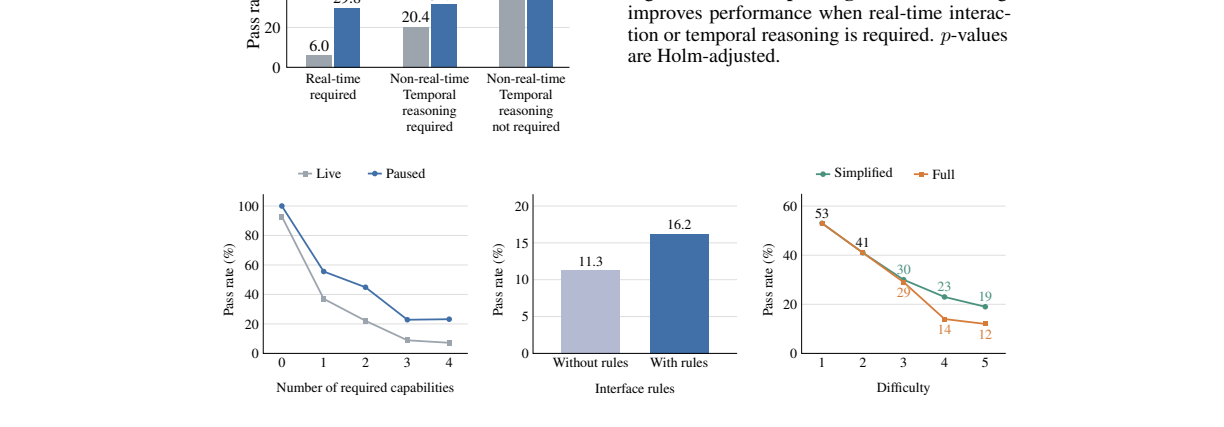
Paused execution returns three to six chronological frames per observation window, while live execution returns one instantaneous screenshot, as stated in Appendix E and in the prompts in Figures 10 and 11. The live-versus-paused comparisons that anchor the abstract and conclusion (9.0% live vs 75.0% paused), the paused points in Figure 5, Figure 7, and the §4.6 claim that pausing specifically helps tasks requiring temporal reasoning therefore bundle the removal of time pressure with an increase in observation information.
more of objection 2
Because extra frames directly supply temporal evidence, the §4.6 contrast is not a clean control: the no-temporal-reasoning subset, where p = 0.443, is small, and a null there cannot establish that the temporal-reasoning gain comes from pausing rather than from additional frames. The slowdown curve in Figure 5 avoids this confound because the observation protocol is identical across slowdowns, and I regard the speed-bottleneck claim of §4.3 as supported by that curve. The paper should either add a paused condition with a single matched frame or explicitly qualify all live-versus-paused statements as including an observation-information difference; the same caveat applies to the interpretation that the 18-point gap between 64x and paused performance at §4.3 shows that some tasks remain difficult as long as the environment keeps changing.
The paper says, at Appendix F.3; §4.2, Table 3, Figure 5
The review did not quote this passage.
Pith says: Objection 3 of 3 · major
The per-attempt time limits differ across the conditions being compared: GPT-6 Astra (xHigh) receives a 6-hour limit on the non-real-time counterparts but a 1-hour limit on the real-time tasks at 1x, 4x, and 16x slowdown and in the paused setting, and the 64x condition is not listed in the exception at all.
more of objection 3
The headline 9.0% (real-time, 1-hour cap) versus 66.0% (non-real-time, 6-hour cap) comparison is therefore not a matched-budget comparison, and even with a uniform wall-clock cap, a fixed cap gives different game-time budgets at different slowdowns (for example 3.75 game-minutes at 16x under a 1-hour cap versus 60 game-minutes at 1x). The paper should disclose this asymmetry where the numbers are used (Figure 4, Table 2, Table 3), report how many attempts per condition reached the time limit, and analyze whether the monotone slowdown trend and the real-time versus non-real-time gap survive matched budgets; equality of the 100-step budget is not sufficient unless that budget is shown to be the binding constraint.
6 minor objections
The paper says, at Figures 4–9, Tables 2–4
Pith says: minor objection 1 of 6
Pass rates are reported without confidence intervals or per-configuration attempt and seed counts; for binary outcomes on 100 tasks, the 1.0% and 5.0% figures sit on one or five successes, so reporting seeds and attempt counts would let readers assess stability.
The paper says, at Figure 1
Pith says: minor objection 2 of 6
The compiled figure text has duplicated example panels (for instance the LIDAR Blacksite and Rotating On-Screen Keyboard blocks repeat), which makes the figure hard to read; the layout should be repaired in the final version.
show 4 more
The paper says, at Appendix F.7
Pith says: minor objection 3 of 6
The human baseline is a single author on 20 tasks, and that author was also involved in setting the pipeline's quality standards (§2.1); the 45.0% figure should be flagged as likely an upper bound, and the sampled task list should be included for transparency.
The paper says, at Appendix H.1, Appendix E
Pith says: minor objection 4 of 6
The designed parameters of the real-time definition (the 50% pre-run threshold and the 80–800 ms observation windows with three to six frames) are introduced without justification or sensitivity analysis; a sentence motivating each choice, plus the distribution of pre-run rates across configurations, would strengthen the definition as a measurement instrument.
The paper says, at §2.5, §4.3
Pith says: minor objection 5 of 6
Section 2.5 states that action delivery and screenshot capture run in real time under slowdown, but Figure 5 and the §4.3 prose would benefit from an explicit statement that the agent's screenshot cadence and per-action wall-clock latency are unchanged across 1x, 4x, 16x, and 64x, so readers can see that the slowdown isolates game-clock speed.
The paper says, at §2.6, Table 7
Pith says: minor objection 6 of 6
Section 3.1 reports that all real-time minigames require temporal reasoning while only 82% of counterparts do; since these capability labels come from the same GPT-6 Astra review agents, the paper should note that the annotations inherit the same verification gap as the real-time labels and are used for the secondary claims in §4.6–4.8.
What would settle it
Independently audit a random sample of 30 of the 100 minigames: have two fresh reviewers (human experts or a different model with a distinct prompt) re-derive the Appendix H real-time label from the frozen source code and recorded evidence, and have one engineer verify non-real-time counterpart parity by program diff plus running both versions under identical action schedules and comparing state trajectories. Report per-configuration agreement, unresolved cases, and any counterpart differences in information, difficulty, or controls. If the error rate is low (<10%), the construct-validity concern is resolved; if higher, recompute the headline pass rates on the corrected subset and re-estimate the live-versus-paused and live-versus-counterpart gaps.
from the skeptic's reading
How the review went
4 readings by deepseek-v4-flash · 28 Oct 2026
- Reader holds up, with conditions
- Skeptic agrees
- Editor wrote the verdict above
- Referee major revision: 3 major objections, 6 minor
Not run on this paper: the simulated authors' defence.
Pith did not check this review's objections against the paper.
The review in full
The review in brief, machine-written
Two things to know. First, the clock-control design is the real contribution: the same 100 minigames, same seed, same verifier, run live, at 4x/16x/64x slowdown, and paused, with Astra's pass rate rising monotonically from 9% to 57% as the clock slows. The observation protocol stays fixed across the slowdown conditions, so this is a controlled measurement, not a fitted story, and it is hard to see how you get that curve on tasks with no genuine time pressure. Second, the headline 9% versus 66% live-versus-counterpart gap is real but softer than the curve: it depends on a pipeline in which every creator, auditor, difficulty reviewer, capability reviewer, and real-time reviewer is an instance of GPT-6 Astra, and no human or independent machine spot-check of the 100 labels or counterpart parity is reported. The stress-test note lands on this and I agree with it. What is new: paired real-time and non-real-time counterparts for every game, continuous clock control, and a serious formal real-time definition in Appendix H that explicitly excludes brakes and repeating motion. Appendix B.4 is reassuring in a specific way: 64 minigames were revised, 35 to restore exploration, 23 to remove shortcuts. That shows the audits catch real problems, though it does not prove the final labels are correct. Credit is also due for disclosure: the paper states the overlapping capability labels, reports the non-significant pause gain with p=0.443, flags that transfer to full games and physical devices is open, and shows coding still leaves Astra 44 points below paused. Soft spots, in proportion. The construct-validity concern is legitimate but conditional, not a demonstrated flaw: the slowdown curve survives it, and the claim that all 100 games satisfy the Appendix H definition is the part that needs verification. A human spot-check of a sample of games, plus reporting unresolved counts and agreement from the Appendix H review, would settle it. Minor secondary issue: paused execution returns 3-6 chronological frames per step while live returns one, so the 75% paused figure bundles time relief with richer observation; the paper describes this openly, and the slowdown curve is unaffected. The human baseline is one author on 20 tasks, which is a sanity check rather than a population estimate. Who this is for: anyone evaluating vision-language agents in moving environments, and benchmark builders who want a reusable protocol. It deserves a serious referee. Send it out, with the independent label spot-check as the main requested revision.
The strongest objection
The paper's most convincing evidence is the slowdown curve (Section 4.3, Figure 5), which holds the observation protocol fixed and shows Astra's pass rate rising monotonically from 9% at 1x to 57% at 64x. That directly supports "speed matters" within the benchmark. The central claim about real-time interaction, however, additionally requires that all 100 minigames satisfy the Appendix H real-time definition and that each non-real-time counterpart differs from its real-time version only in timing. Every creator, auditor, difficulty reviewer, capability reviewer, and real-time reviewer is an instance of GPT-6 Astra (Section 2, Appendix B), and the paper reports no independent human or machine verification of these labels or of counterpart parity. This is not a merely formal worry: Appendix B.4 documents that 64 initial minigames had to be revised because they were not genuinely real-time or allowed shortcuts, 35 of them needed a second revision to restore exploration, and 23 had brakes or repeating motion removed. The final set therefore depends on the very audit whose correctness is unverified, while the paper reports no unresolved counts, agreement statistics, or pre-run-threshold determinations from the Appendix H review. A secondary confound is that paused execution returns 3-6 chronological frames while live returns one (Appendix E), but the slowdown curve avoids this; the primary unresolved risk is systematic permissiveness in labels and counterparts contaminating the denominator of the 9% vs 66% gap.
The reader's conditional verdict is appropriate. The benchmark has genuine strengths that I do not want to discount: the clock-control design with paired counterparts, the formal real-time definition in Appendix H, the measured 39-47 ms action-to-screenshot latency, the oracle solvers, the human baseline of 45% on 20 live tasks (Appendix F.7), and the disclosed limitations in Appendix A. The slowdown curve is internally strong evidence that the environment clock is a major factor for frontier models, because it varies only the clock while keeping the observation protocol and task fixed. The load-bearing weakness is construct validity: the 9%-vs-66% gap and the 'real-time interaction' interpretation depend on labels and counterparts produced and audited entirely by GPT-6 Astra, with no independent verification reported. Appendix B.4's frequent audit interventions make this concrete rather than hypothetical. The observation-protocol difference between live and paused (one frame vs 3-6 frames, Appendix E) is a real but secondary confound, as the 64x slowdown curve keeps the protocol fixed; it affects the abstract's 75% paused figure but not the qualitative speed conclusion. Because the concern is about verification rather than a demonstrated error, it warrants a conditional accept rather than a rejection. My read therefore does not change the reader's verdict.
The referee's report
If its construct validity is confirmed, Gym-Anything-RT is a genuinely useful instrument. The within-task clock control is a methodological advance over existing game benchmarks, which compare paused versus live play on only a few games; the monotone slowdown curve (9%, 17%, 48%, 57% at 1x, 4x, 16x, 64x, with the observation protocol held fixed) is the strongest evidence in the paper and directly supports the speed-bottleneck claim. The authors also ship code and data, verify solvability with oracle runs, and engineer the action/screenshot path to sub-50 ms median latency, which is careful and reproducible. The same property that makes the pipeline scalable also creates its main risk: the real-time labels, counterpart parity, difficulty calibration, and capability annotations are produced and verified exclusively by GPT-6 Astra agents, with no independent verification, and several headline quantities (9% live vs 75% paused; pausing-specific gains in temporal reasoning) bundle time pressure with an observation-information difference (one frame live vs three to six frames paused).
Pith's reading of the paper (a machine's summary, not the authors')
The paper claims that current vision-language agents fail at real-time interaction primarily because they are too slow, not because the underlying tasks are too hard. Its evidence is a controlled experiment: 100 automatically generated visual minigames run live, slowed, and paused, together with 100 non-real-time counterparts that differ only in timing. The strongest evaluated model solves 9% of the live tasks and 75% of the paused ones, while the same model solves 66% of the non-real-time counterparts. This matters because real-world deployment in games, devices, and robots requires acting while the world keeps changing, and existing benchmarks either wait for the agent or bundle many capabilities into one game without isolating the effect of time pressure.
What carries the argument. The load-bearing mechanism is the controllable clock. Each minigame is a program exposing a common interface of screenshot observations and mouse/keyboard actions, and the evaluation stack scales every timer, animation, and server-side clock so the same task can run live at natural speed, slowed by a factor s, or paused (frozen until the agent acts). Each real-time minigame is paired with a non-real-time counterpart created by a minimal timing change, with an audit agent checking that the two versions differ only in timing. Around this core, a creator-auditor pipeline generates the minigames with oracle solvers, five difficulty levels, simplified versus full interaction modes, and a formal real-time definition (Appendix H) requiring three clauses: no policy using only the agent's action history can choose a delayed-optimal action, a policy using a bounded recent visual window can, and the environment's autonomous evolution during the delay strictly degrades the value of a chosen action.
Core claim. The central discovery is that the live-versus-paused gap measures real-time interaction ability, because the game, seed, difficulty, and verifier are held fixed and only the clock changes. On 100 real-time minigames at the hardest difficulty, the strongest model passes 9.0%, rising to 17% at 4x slowdown, 48% at 16x, 57% at 64x, and 75% when paused, against 66.0% on the non-real-time counterparts. The paper also shows that speed is the dominant bottleneck specifically for frontier models: higher reasoning effort adds 8 points on waiting tasks but only 1 point live, and allowing the strongest model to write code lifts its live pass rate to 31% by moving perception and action into fast scripts. Pausing helps weaker models far less, and controlled variations identify temporal reasoning and exploration of unfamiliar interfaces as additional, separable sources of difficulty.
The premise it rests on. The whole measurement rests on the assumption that the 100 generated minigames are exactly what the pipeline says they are: genuinely solvable, correctly labelled as real-time under the formal definition, and paired with counterparts that differ only in timing, even though every creator, auditor, and reviewer is an instance of GPT-6 Astra with no independent human or machine verification reported.
If the paper is right (Pith's inferences, not the authors')
If speed is the primary bottleneck for frontier models, then reducing inference latency alone, without adding new perception or reasoning capabilities, should translate directly into higher real-time pass rates up to the ceiling implied by the slowdown curve (57% at 64x).
Higher reasoning effort pays off only when the environment waits, so real-time agents need a different compute-allocation strategy than the deliberation-heavy models that dominate waiting benchmarks.
Allowing a model to write code moves the time-critical loop out of the model: the strongest agent's live pass rate rises from 9% to 31% when it can run perception-and-action scripts, but the gain stays well short of the 75% paused ceiling.
Benchmarks that let the environment wait, or that bundle many capabilities into one full game, cannot reveal whether a failure is a speed problem; twin tasks with controllable clocks are needed to separate the two.
For weaker models speed is only one bottleneck: pausing raises GPT-6 Luna's pass rate only to 29.8%, with temporal reasoning and interface exploration identified as further independent sources of difficulty.
The slowdown curve (9% to 57% between 1x and 64x) is a de facto latency-budget table: it quantifies how much response time a frontier agent needs per task, which could serve as an engineering target for faster models or for speculative-execution schemes.
Because live execution returns one instantaneous screenshot per step while paused execution returns 3 to 6 chronological frames, part of the measured live-versus-paused gap may be an observation-information effect rather than pure speed; the slowdown sweep is the cleaner speed estimate, and a variant that equalizes frame count across conditions would isolate the remaining gap.
The coding result points toward a modular architecture for real-time agents, a slow deliberative model that writes fast reactive controllers, with a testable prediction: giving models stronger low-level perception primitives such as template matching and motion tracking should close much of the remaining gap toward the paused ceiling.
Because the pipeline uses coding agents and automatic verifiers, the 100-task suite is a renewable resource: the same creator-auditor loop can generate new minigames and capability combinations on demand, and the seed-controlled twin-task design resists memorization in a way static question-answer benchmarks cannot.
Check this review
Pith stored no record of this review's passes and took no fingerprint of it. Reviews made by code from 13 Nov 2026 on carry both.
How often reviews like this one are right
Reviews like this one: written by deepseek-v4-flash, where what was read was not recorded.
How often objections from reviews like this one are right: not yet measured
Reviews by people
This review was written by a machine. No person has reviewed this paper on Pith yet. A scientist listed on Pith can review it for a fee, and their review is published here whatever it concludes.
The paper
Abstract
AI agents have made substantial progress in domains where they have a non-trivial amount of time to deliberate between actions, such as mathematics, software engineering, and performing tasks on desktop applications. It is less clear how such models fare in settings that demand real-time interaction, such as playing a video game or operating a physical device. In these settings, the environment state may evolve as the agent is reasoning, or even as the underlying model is performing a forward pass. To gain insight into the real-time interaction capabilities of vision-language agents, we introduce Gym-Anything-RT. Our key idea is to construct visual minigames that demand a portfolio of capabilities required for interactive real-time settings. Gym-Anything-RT uses an agentic pipeline to automatically generate such environments based on a taxonomy of six capabilities required for real-time interaction, including the ability to perceive the environment and act under an evolving environment state. A key feature of Gym-Anything-RT is that it allows for controlled comparison of real-time interaction capabilities: we can run the same minigame in real time, or pause or slow down the environment to relax the requirement for real-time actions. We use Gym-Anything-RT to construct 100 real-time minigames and evaluate AI agents on them. We find large capability gaps in real-time interaction. For example, GPT-6 Astra (xHigh) achieves a pass rate of only 9.0% on the real-time minigames, which rises to 75.0% when the environment is paused. We also identify intriguing behaviors by the most powerful frontier agents: for instance, when given the ability to write code, these agents write code that bypasses the need to perceive and act in real time. We publicly release Gym-Anything-RT and the generated minigames to spur further research on AI agents in real-time interactive settings.
The paper's own sentences, arranged, kept beside the review and separate from it. Each label is drawn from a closed vocabulary; the number beside it is the probability the classifier gave that label. No sentence in this record was written by a model.
abstract compiled · 2026-10-28
The authors' main claim, as the classifier picked it out 1.00
“We find large capability gaps in real-time interaction.”
How the main claim is stated: asserted 1.00
What the abstract itself states, as probabilities: claims first 0.07 · states limitation 0.29 · human participants 0.04 · controlled comparison 0.76 · randomized assignment 0.02 · states quantitative result 0.99 · compares with prior results 0.30 · mentions code or data availability 0.97
The abstract, sentence by sentence
This table labels the abstract only (arXiv listing abstract v1). The number is the probability the classifier gave the label.
| Sentence | Role | The authors' own work | States the main conclusion | Strength |
|---|---|---|---|---|
| AI agents have made substantial progress in domains where they have a non-trivial amount of time to deliberate between actions, such as mathematics, software engineering, and performing tasks on desktop applications. | background 1.00 | 0.06 | 0.02 | asserted 1.00 |
| It is less clear how such models fare in settings that demand real-time interaction, such as playing a video game or operating a physical device. | gap 0.90 | 0.07 | 0.03 | asserted 0.62 |
| In these settings, the environment state may evolve as the agent is reasoning, or even as the underlying model is performing a forward pass. | background 0.94 | 0.07 | 0.02 | hedged possibility 0.99 |
| To gain insight into the real-time interaction capabilities of vision-language agents, we introduce Gym-Anything-RT. | contribution 1.00 | 0.89 | 0.03 | asserted 0.89 |
| Our key idea is to construct visual minigames that demand a portfolio of capabilities required for interactive real-time settings. | method 0.52 | 0.80 | 0.03 | asserted 0.99 |
| Gym-Anything-RT uses an agentic pipeline to automatically generate such environments based on a taxonomy of six capabilities required for real-time interaction, including the ability to perceive the environment and act under an evolving environment state. | method 0.96 | 0.91 | 0.03 | asserted 1.00 |
| A key feature of Gym-Anything-RT is that it allows for controlled comparison of real-time interaction capabilities: we can run the same minigame in real time, or pause or slow down the environment to relax the requirement for real-time actions. | method 0.80 | 0.82 | 0.04 | asserted 0.99 |
| We use Gym-Anything-RT to construct 100 real-time minigames and evaluate AI agents on them. | method 0.72 | 0.97 | 0.05 | asserted 1.00 |
| We find large capability gaps in real-time interaction. | result 0.99 | 0.97 | 0.66 | asserted 1.00 |
| For example, GPT-6 Astra (xHigh) achieves a pass rate of only 9.0% on the real-time minigames, which rises to 75.0% when the environment is paused. | result 1.00 | 0.95 | 0.32 | asserted 1.00 |
| We also identify intriguing behaviors by the most powerful frontier agents: for instance, when given the ability to write code, these agents write code that bypasses the need to perceive and act in real time. | result 0.93 | 0.90 | 0.06 | asserted 1.00 |
| We publicly release Gym-Anything-RT and the generated minigames to spur further research on AI agents in real-time interactive settings. | contribution 0.66 | 0.89 | 0.04 | asserted 0.98 |
What kind of paper the classifier reports this is: dataset or benchmark 0.78 · evidence from observation or experiment 0.98
What was examined, and what was not
Sources read
- arXiv listing abstract v1
Not examined
- full text
- figures and tables
- references and citing sentences
- relations to other papers
Levels run
- P abstract
Not run
- S sections
- T body sentences
- C citations
- R cross-paper relations
How the labels were made
Compiled by classifier-1.13.0 via TypeSafe API, question bank abstract-p1-20260923, 2026-10-28: 1 request, 8,992 input tokens.
Every quoted sentence on this record is the authors'. Every label is from Pith's closed vocabulary, with the probability shown beside it. This record as JSON
Figures (11)




Showing 9 of the paper's 11 figures. Figures are the authors', reproduced from the paper.
References (20)
- [4] URLhttps://arxiv.org/abs/2511.19304. Henry Hengyuan Zhao, Kaiming Yang, Wendi Yu, Difei Gao, and Mike Zheng Shou. WorldGUI: An Interactive Benchmark for Desktop GUI Automation from Any Starting Point, 2025. Xiangxi Zheng, Linjie Li, Zhengyuan Yang, Ping Yu, Alex Jinpeng Wang, ... on PitharXiv
- [5] the solver, when present. Study a normal screenshot-only solution using visible task controls. Private state and scripted solvers are implementation evidence, not information available to the policy. ## Frozen mathematical definition ```text H_t visible interaction history thr... on Pith
- [10] Return`unresolved`instead of guessing when the complete source does not determine the answer. Return exactly one JSON object: ```json { "case_index": "{case_index}", "public_environment_name": "{public_environment_name}", "environment_id": "{environment_id}", "difficulty": "{d... on Pith
- [19] the exact difficulty and interaction profile in`controls.json` on Pith
- [20] the visible browser implementation and relevant CSS on Pith
- [21] the grader and verifier; and on Pith
- [22] the solver, when present. Study a normal screenshot-only solution using visible task controls. Private state and scripted solvers are implementation evidence, not information available to the policy. ## Frozen mathematical definition ```text H_t visible interaction history thr... on Pith
- [23] State the controls available in this exact difficulty and interaction mode on Pith
- [24] Describe every period in which the task changes without a new agent action on Pith
- [25] State whether an outcome-affecting control remains available during each such period on Pith
- [26] Enumerate the legitimate grouped control modes`D` on Pith
- [27] Try to construct an observation-free policy`q`using only`I_t` on Pith
- [28] Try to construct a bounded-window policy`g`using only`I_t`and`W_tˆw` on Pith
- [29] Check whether the same visible autonomous process causes an available action to become unavailable or strictly less effective within some`Delta` on Pith
- [30] For`yes`, give one concrete common witness:`D`,`Delta`,`w`, the visible process, why`q` fails, why`g`succeeds, and the expiring or degrading action on Pith
- [31] For`no`, identify the failed clause and explain why no legitimate choice of`D`,`Delta`, and`w`repairs it, or establish that the pre-run threshold overrides a mathematical Yes on Pith
- [32] Return`unresolved`instead of guessing when the complete source does not determine the answer. Return exactly one game-level JSON object with numeric game case_index, environment_id, public_environment_name, and configuration_reports. configuration_reports is an array containin... on Pith
- [2024] arXiv:2410.07166. Enqi Liu, Liyuan Pan, Zhi Gao, Yan Yang, Chenrui Shi, Yang Liu, Jingrong Wu, and Qing Li. Benchmarking and Improving GUI Agents in High-Dynamic Environments, 2026. 13 Preprint Yuanxin Liu, Shicheng Li, Yi Liu, Yuxiang Wang, Shuhuai Ren, Lei Li, Sishuo Chen, X... on PithPith's reviewarXiv
- [2025] URLhttps://arxiv.org/abs/2504.07981. Manling Li, Shiyu Zhao, Qineng Wang, Kangrui Wang, Yu Zhou, Sanjana Srivastava, Cem Gokmen, Tony Lee, Li Erran Li, Ruohan Zhang, Weiyu Liu, Percy Liang, Li Fei-Fei, Jiayuan Mao, and Jiajun Wu. Embodied Agent Interface: Benchmarking LLMs for... on PithPith's reviewarXiv
- [2026] arXiv:2506.02387. Jihan Yang, Shusheng Yang, Anjali W. Gupta, Rilyn Han, Li Fei-Fei, and Saining Xie. Thinking in Space: How Multimodal Large Language Models See, Remember, and Recall Spaces. In Proceedings of the IEEE/CVF Conference on Computer Vision and Pattern Recognition ... on PithPith's reviewarXiv
Cited by 5 Pith papers
Reviewed papers on Pith that cite this one. The full citation record
- PlayCraft: Designing Engaging Games from Agent Play Experience cs.AI · Nov 2026
- Think Offline, Act in Real Time: Self-Improving Visual Game Agents through Code cs.AI · Nov 2026
- From Game Generation to Game Playing: Fully Automated Ability Training for Vision-Language-Action Models cs.CV · Nov 2026
- Visual Token Routing: Learning to keep tokens that matter cs.CV · Nov 2026
- Computer-Use Agents Are Embodied Generalists cs.LG · Nov 2026
Challenges and discussion
Disagree with the review, or know something it missed? Leave a comment, or challenge this review formally: a challenge becomes a permanent entry in this paper's record, and its decision is published here.
Come back by email
A short list of the week's newly reviewed papers. Nothing is sent until you confirm from your inbox, and every email has a link that stops it. No account.
No comments yet.
Sign in to comment