Computation and Language · arXiv:2610.18248 v1 · submitted 13 Oct 2026 · 16 references
Are We Testing Too Much? A Survey of Benchmark Compression for Efficient Evaluation of Large Language Models
The paper says
“Benchmarks are essential for evaluating and improving large language models (LLMs). Yet many widely used benchmarks are redundant, making evaluation unnecessarily expensive. Benchmark compression lowers this cost by estimating full-benchmark scores and rankings from a partial evaluation.”
more of the abstract
Research in this area has grown rapidly since 2024, but to our knowledge no survey has systematically organized its methods and findings. We review 119 papers to explain how methods choose what to evaluate, recover full-benchmark results, and verify their reliability. From this analysis, we develop a taxonomy covering compression within individual benchmarks, across benchmark suites, and during adaptive evaluation, together with work on redundancy and reliability. We compare their information needs, total costs, reliability checks, and limitations. Methods reduce evaluation costs by selecting representative subsets, using cheaper or reusable information, and testing adaptively, but risk poor coverage, inaccurate estimates, and sequential delays. The resulting taxonomy and practical guide help researchers choose, validate, and deploy methods for more efficient and reliable LLM evaluation.
from the abstract
Pith says
Machine review · deepseek-v4-flash · 14 Oct 2026 · what was read was not recorded · not checked by a person
It can be wrong. Challenge this review or reply to it.
Holds up. A timely, well-organized survey that gives the field a clear taxonomy and a practical roadmap, but it is a synthesis of existing work, not a source of new empirical findings. This line is wrong
7 minor
How often objections from reviews like this one are right: not yet measured
Not checked: figures, code, what the 16 references say.
7 minor objections
The paper says, at Section 2.2
Pith says: minor objection 1 of 7
The taxonomy decision path is described textually but a flowchart summarizing the three-question hierarchy would increase clarity for readers skimming the paper. Consider adding a small decision tree figure in the main text (Appendix C.3 already describes the path in prose).
The paper says, at Table 1 caption
Pith says: minor objection 2 of 7
The abbreviation 'Pred.' is used but not expanded in the caption. Define it as 'Prediction' for completeness, as done for 'Corr.'.
show 5 more
The paper says, at Appendix A, Table 3 caption
Pith says: minor objection 3 of 7
The column 'Saved unit' uses values like 'Item', 'Human', 'Judge', etc., which are intuitive but not all defined. A brief list of possible values and their meanings (e.g., 'Item' = model-item run, 'Human' = human review) would help readers.
The paper says, at Figure 1
Pith says: minor objection 4 of 7
The stacked bar chart is clear, but the individual category contributions within the stacked bars are hard to read because of the color density. Consider using a grouped bar chart or a cumulative area plot to make category trends more distinguishable.
The paper says, at Section 6.3
Pith says: minor objection 5 of 7
The lifecycle cost breakdown is qualitative. The authors acknowledge that different cost types (human time, accelerator time, latency) are not combined without a stated conversion. Adding a sentence that explicitly advises authors to report these components separately (as done in Appendix D.4) would strengthen the practical guidance already given.
The paper says, at Appendix C.1, line about 'Scope'
Pith says: minor objection 6 of 7
The definition of 'saved unit' could be more precise: e.g., 'a unit of costly evaluation work such as a model-item inference, a human judgment, or an agent rollout' instead of 'costly units' to avoid ambiguity.
The paper says, at References
Pith says: minor objection 7 of 7
Several 2026 references are listed as 'arXiv' or 'submitted' without venue confirmation for some (e.g., Anonymous, 2026). This is acceptable for a survey with an August 2026 cutoff, but it should be noted that some works may not be formally peer-reviewed at the time of publication.
What would settle it
Have two independent annotators apply the taxonomy decision path (Appendix C.3) to a random sample of 20 papers from the corpus and measure inter-annotator agreement (Cohen's κ) on the primary label. κ ≥ 0.80 would confirm the taxonomy's reproducibility; if lower, the paper's own boundary examples and rules may need refinement.
from the skeptic's reading
How the review went
4 readings by deepseek-v4-flash · 14 Oct 2026
- Reader holds up
- Skeptic agrees
- Editor wrote the verdict above
- Referee minor revision: 7 minor
Not run on this paper: the simulated authors' defence.
Pith did not check this review's objections against the paper.
The review in full
The review in brief, machine-written
Here's the one-line take: this is a solid, well-executed survey that delivers exactly what it promises—a principled taxonomy and cross-family comparison for LLM benchmark compression. It's the first to unify methods that compress single benchmarks, cross-benchmark suites, and adaptive evaluation, plus foundational analysis. The authors are honest about scope (119 papers through August 2026) and they discuss boundary cases transparently. The decision tree for classification is clear, and the lifecycle-cost analysis (Table 16) is genuinely useful for a practitioner choosing among methods. If you work on efficient evaluation or want to understand the landscape quickly, this paper saves you a lot of reading. The main contribution is organizational, not empirical, and the paper knows it. Weaknesses are proportionate and mostly admitted by the authors: the taxonomy is subjective (they flag it), the corpus may miss later work (they say so), and there is no quantitative meta-analysis across methods (because evaluation settings are too heterogeneous). The weakest assumption is that the literature search is comprehensive; I think it is good enough for a survey of this pace, but it will age quickly. The paper does not claim to resolve debates—it maps them. It deserves a serious referee because the field is growing fast and a clean organizing framework is valuable, even if provisional. I would cite it for background in future work. Recommend sending to peer review; it will need careful checking of the classification consistency (the appendix helps), but the core is solid.
The strongest objection
The survey is well-executed: it provides a clear, principled taxonomy, covers 119 papers with explicit scope and boundary rules, and acknowledges its limitations (cutoff date, space constraints, heterogeneous evaluation settings). The central claim—that this is the first systematic survey synthesizing LLM benchmark compression under a unified definition—is supported by the comparison with prior surveys in Appendix B and by the coherence of the taxonomy. The weakest assumption (comprehensiveness of the literature search) is identified by the reader and acknowledged by the authors. No internal inconsistency, missing critical category, or unsupported inference undermines the main contribution. The paper's value as a survey stands on its careful organization and cross-family comparisons, which are thorough and transparent.
The reader identified comprehensiveness of the literature search as the weakest assumption, which the authors already acknowledge as a limitation. My review found no additional load-bearing concern: the taxonomy is well-defined with explicit rules and boundary cases, the comparisons across families are detailed and transparent, and the scope is clearly delimited. The survey delivers on its stated contributions. Therefore the reader's ACCEPT verdict stands without adjustment.
The referee's report
If the taxonomy and comparisons hold, this survey fills a clear gap in the efficient LLM evaluation literature. Its principled classification rules, explicit boundary cases, and lifecycle cost analysis offer a valuable organizational framework for researchers and practitioners. The paper's emphasis on reliability, cost transparency, and method validation distinguishes it from broader evaluation surveys. Its utility as a reference for method selection and benchmarking could positively influence reporting practices and reduce redundant evaluation, with potential environmental and financial benefits. The survey is timely given the rapid growth of the field since 2024.
Pith's reading of the paper (a machine's summary, not the authors')
This survey is the first to systematically organize the rapidly growing field of LLM benchmark compression. It synthesizes 119 papers under a unified definition and taxonomy, dividing methods into four families: single-benchmark compression, cross-benchmark compression, adaptive evaluation, and benchmark analysis and foundations. The paper provides a practical guide for choosing, validating, and deploying compression methods, comparing their information needs, lifecycle costs, reliability checks, and limitations. If this taxonomy and comparison are adopted, researchers will have a clearer roadmap for reducing evaluation costs without sacrificing reliability.
What carries the argument. The core machinery is a hierarchical taxonomy with seven leaf categories (Content-Based, Historical-Response, Target-Conditioned, Cross-Benchmark, Adaptive Item Selection, Sequential Decision and Stopping, and Benchmark Analysis and Foundations) defined by a decision path that orders contribution type, adaptivity, scope, and information source. This taxonomy allows consistent classification and comparison of methods and is supported by a formal problem formulation involving a full evaluation set U, a compressed subset S, auxiliary information Z, and a recovery rule R that estimates the full result.
Core claim. The paper establishes that LLM benchmark compression can be systematically classified by three questions: whether the subset is fixed or adaptive, whether it spans one benchmark or several, and what information guides selection (content, historical responses, or target-specific cheap signals). It provides the first unified taxonomy and cross-family comparison, showing that all methods save cost by evaluating representative items, using cheaper or reusable information, or testing adaptively, but each family has distinct risks such as poor coverage, inaccurate estimates, or sequential delays.
The premise it rests on. The taxonomy and comparisons rely on the comprehensiveness of the literature search through August 2026; important missed methods or developments after the cutoff could make the framework incomplete.
If the paper is right (Pith's inferences, not the authors')
Researchers can use the taxonomy to quickly identify which compression family matches their available information (e.g., only item data vs. historical responses vs. cheap target signals).
The lifecycle cost analysis shows that historical-response methods have high construction cost but low per-target cost, making them suitable for repeated evaluation of many models on the same benchmark.
Adaptive methods trade parallel execution for more focused testing, so they are best when serial rounds are acceptable and the primary goal is a decision rather than precise scores.
The survey's comparison of recovery mechanisms (sample mean, coreset aggregation, probability weighting, model prediction, prediction+correction) clarifies what reliability checks each requires.
The identification of random sampling as a competitive baseline suggests that complex selectors should always be compared against it.
The taxonomy implicitly prioritizes adaptivity and scope over information source, which could be refined if future methods combine multiple information sources in novel ways not covered by the current hierarchy.
The survey's emphasis on lifecycle cost suggests that the most impactful compression methods may be those that balance construction cost with transferability across model generations, a direction the paper flags as future work.
While the survey covers 119 papers, the rapid growth since 2024 means that new methods may soon challenge the current categories, requiring periodic updates to the taxonomy.
Check this review
Pith stored no record of this review's passes and took no fingerprint of it. Reviews made by code from 13 Nov 2026 on carry both.
How often reviews like this one are right
Reviews like this one: written by deepseek-v4-flash, where what was read was not recorded.
How often objections from reviews like this one are right: not yet measured
Reviews by people
This review was written by a machine. No person has reviewed this paper on Pith yet. A scientist listed on Pith can review it for a fee, and their review is published here whatever it concludes.
The paper
Abstract
Benchmarks are essential for evaluating and improving large language models (LLMs). Yet many widely used benchmarks are redundant, making evaluation unnecessarily expensive. Benchmark compression lowers this cost by estimating full-benchmark scores and rankings from a partial evaluation. Research in this area has grown rapidly since 2024, but to our knowledge no survey has systematically organized its methods and findings. We review 119 papers to explain how methods choose what to evaluate, recover full-benchmark results, and verify their reliability. From this analysis, we develop a taxonomy covering compression within individual benchmarks, across benchmark suites, and during adaptive evaluation, together with work on redundancy and reliability. We compare their information needs, total costs, reliability checks, and limitations. Methods reduce evaluation costs by selecting representative subsets, using cheaper or reusable information, and testing adaptively, but risk poor coverage, inaccurate estimates, and sequential delays. The resulting taxonomy and practical guide help researchers choose, validate, and deploy methods for more efficient and reliable LLM evaluation.
The paper's own sentences, arranged, kept beside the review and separate from it. Each label is drawn from a closed vocabulary; the number beside it is the probability the classifier gave that label. No sentence in this record was written by a model.
abstract compiled · 2026-10-14
The authors' main claim, as the classifier picked it out 0.76
“The resulting taxonomy and practical guide help researchers choose, validate, and deploy methods for more efficient and reliable LLM evaluation.”
How the main claim is stated: asserted 0.99
What the abstract itself states, as probabilities: claims first 0.77 · states limitation 0.17 · human participants 0.04 · controlled comparison 0.09 · randomized assignment 0.01 · states quantitative result 0.84 · compares with prior results 0.33 · mentions code or data availability 0.03
The abstract, sentence by sentence
This table labels the abstract only (arXiv listing abstract v1). The number is the probability the classifier gave the label.
| Sentence | Role | The authors' own work | States the main conclusion | Strength |
|---|---|---|---|---|
| Benchmarks are essential for evaluating and improving large language models (LLMs). | background 1.00 | 0.05 | 0.02 | asserted 1.00 |
| Yet many widely used benchmarks are redundant, making evaluation unnecessarily expensive. | background 0.99 | 0.11 | 0.04 | asserted 0.98 |
| Benchmark compression lowers this cost by estimating full-benchmark scores and rankings from a partial evaluation. | background 0.90 | 0.05 | 0.06 | asserted 1.00 |
| Research in this area has grown rapidly since 2024, but to our knowledge no survey has systematically organized its methods and findings. | gap 1.00 | 0.29 | 0.03 | asserted 0.94 |
| We review 119 papers to explain how methods choose what to evaluate, recover full-benchmark results, and verify their reliability. | contribution 0.84 | 0.95 | 0.06 | asserted 0.99 |
| From this analysis, we develop a taxonomy covering compression within individual benchmarks, across benchmark suites, and during adaptive evaluation, together with work on redundancy and reliability. | contribution 0.99 | 0.95 | 0.17 | asserted 1.00 |
| We compare their information needs, total costs, reliability checks, and limitations. | contribution 0.62 | 0.82 | 0.06 | asserted 0.96 |
| Methods reduce evaluation costs by selecting representative subsets, using cheaper or reusable information, and testing adaptively, but risk poor coverage, inaccurate estimates, and sequential delays. | result 0.76 | 0.28 | 0.37 | asserted 0.97 |
| The resulting taxonomy and practical guide help researchers choose, validate, and deploy methods for more efficient and reliable LLM evaluation. | contribution 0.64 | 0.80 | 0.61 | asserted 0.99 |
What kind of paper the classifier reports this is: review 1.00 · evidence from literature 0.99
What was examined, and what was not
Sources read
- arXiv listing abstract v1
Not examined
- full text
- figures and tables
- references and citing sentences
- relations to other papers
Levels run
- P abstract
Not run
- S sections
- T body sentences
- C citations
- R cross-paper relations
How the labels were made
Compiled by classifier-1.13.0 via TypeSafe API, question bank abstract-p1-20260923, 2026-10-14: 1 request, 6,720 input tokens.
Every quoted sentence on this record is the authors'. Every label is from Pith's closed vocabulary, with the probability shown beside it. This record as JSON
Figures (4)
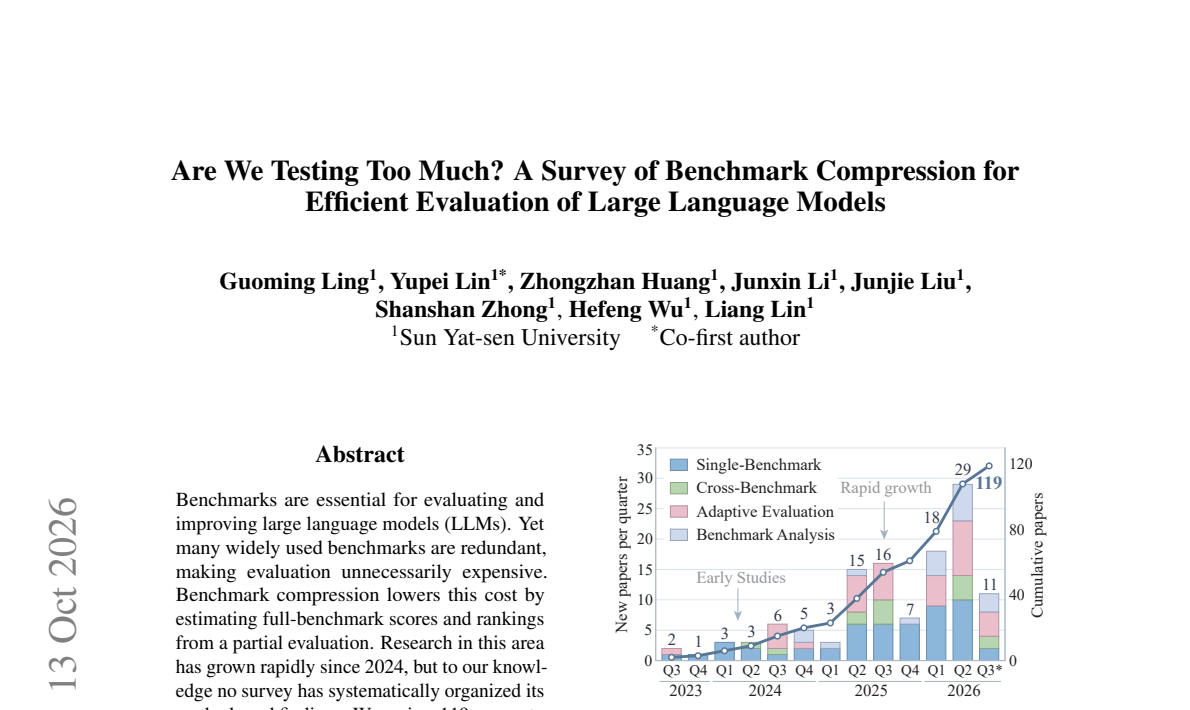


Figures are the authors', reproduced from the paper.
References (16)
- [6] Toward a unified framework for data-efficient evaluation of large language models.arXiv preprint arXiv:2510.04051. Guoming Ling, Zhongzhan Huang, Yupei Lin, Junxin Li, Shanshan Zhong, Hefeng Wu, and Liang Lin on PitharXiv
- [7] Neural chain-of-thought search: Searching the optimal reasoning path to enhance large language models.Preprint, arXiv:2601.11340. Gili Lior, Tzviel Frostig, Gabriel Stanovsky, and Matan Eyal. 2026. Extending item response theory for effi- cient and meaningful multilingual eval... on PithPith's reviewarXiv
- [8] Adaptive prediction-powered autoeval with reliability and efficiency guarantees. InAdvances in Neural Information Processing Systems, volume 38, Main Conference, pages 158758–158784. Curran Associates, Inc. Yotam Perlitz, Elron Bandel, Ariel Gera, Ofir Arviv, Liat Ein Dor, Eya... on PithPith's reviewarXiv
- [9] An interpretable and scalable framework for evaluating large language models.arXiv preprint arXiv:2605.07046. Aashish Anantha Ramakrishnan, Ardavan Saeedi, Hamid Reza Hassanzadeh, Fazlolah Mohaghegh, and Dongwon Lee. 2026. Generative active testing: Effi- cient llm evaluation ... on PithPith's reviewarXiv
- [10] Llm-as-judge on a budget.arXiv preprint arXiv:2602.15481. Gayathri Saranathan, Cong Xu, Mahammad Parwez Alam, Tarun Kumar, Martin Foltin, Soon Yee Wong, and Suparna Bhattacharya. 2025. Sublime: Sub- set selection via rank correlation prediction for data- efficient llm evaluati... on PithPith's reviewarXiv
- [11] Evaluating multiple models using labeled and unlabeled data. InAdvances in Neural Information Processing Systems, volume 38, Main Conference, pages 30612–30648. Curran Associates, Inc. Saeid Sheikhi, Lauri Loven, and Panos Kostakos. 2026. Beyond the leaderboard: A survey of th... on PithPith's reviewarXiv
- [12] Pace: A proxy for agentic capability evalua- tion.arXiv preprint arXiv:2607.02032. Fabio Spagliardi, Mírian Silva, Ayan Datta, Aiden Zhou, Vamshi Bonagiri, and Diogo Cruz. 2026. Efficient safety benchmarking via item response theory.arXiv preprint arXiv:2606.20626. Nishant Sub... on PithPith's reviewarXiv
- [13] Simba: Simplifying benchmark analysis using performance matrices alone. InEMNLP (Findings), pages 13220–13233. Teppei Suzuki and Keisuke Ozawa. 2025. Resampling benchmark for efficient comprehensive evaluation of large vision-language models.arXiv preprint arXiv:2504.09979. Sh... on PithPith's reviewarXiv
- [14] Label-efficient model selection for text gener- ation. InProceedings of the 62nd Annual Meeting of the Association for Computational Linguistics (Vol- ume 1: Long Papers), pages 8384–8402. Elad Tolochinsky, Yaniv Tenzer, and Yaniv Romano on Pith
- [15] Valid best-model identification for llm eval- uation via low-rank factorization.arXiv preprint arXiv:2605.10405. Sang Truong, Yuheng Tu, Percy Liang, Bo Li, and Sanmi Koyejo. 2025. Reliable and efficient amor- tized model-based evaluation.arXiv preprint arXiv:2503.13335. Sang ... on PithPith's reviewarXiv
- [16] To the best of our knowledge, no prior sur- vey has organized it as a unified field. We bring to- gether methods for compressing individual bench- marks and benchmark suites, adapting evaluation as results arrive, and analyzing redundancy and re- liability. Within a unified fr... on Pith
- [113] IEEE. Esma Balkır, Alice Pernthaller, Marco Basaldella, José Hernández-Orallo, and Nigel Collier. 2026. Con- fident rankings with fewer items: Adaptive llm evaluation with continuous scores.arXiv preprint arXiv:2601.13885. Andrew M Bean, Nabeel Seedat, Shengzhuang Chen, and Jo... on PithPith's reviewarXiv
- [2021] Measuring massive multitask language under- standing. InInternational Conference on Learning Representations. Valentin Hofmann, David Heineman, Ian Magnusson, Kyle Lo, Jesse Dodge, Maarten Sap, Pang Wei Koh, Chun Wang, Hannaneh Hajishirzi, and Noah A Smith on Pith
- [2024] A systematic survey and critical review on evaluating large language models: Challenges, lim- itations, and recommendations. InProceedings of the 2024 Conference on empirical methods in natural language processing, pages 13785–13816. Chungpa Lee, Thomas Zeng, Jongwon Jeong, Jy... on PithPith's reviewarXiv
- [2025] Fluid language model benchmarking.arXiv preprint arXiv:2509.11106. Chia-Yu Hsu and Shubhanshu Shekhar. 2026. Effi- cient sequential evaluation of large language models. arXiv preprint arXiv:2607.17409. Wei-Jung Huang. 2026. How many tasks are enough for agent benchmark decisio... on PithPith's reviewarXiv
- [2026] Discovering hidden gems in model reposito- ries.arXiv preprint arXiv:2601.22157. Bora Kargi and David Salinas. 2026. From uncer- tain judgments to calibrated rankings: Conformal elo estimation for llm evaluation.arXiv preprint arXiv:2606.13221. Eungyeup Kim, Chenchen Gu, Vashi... on PitharXiv
Cited by 1 Pith paper
Reviewed papers on Pith that cite this one. The full citation record
Challenges and discussion
Disagree with the review, or know something it missed? Leave a comment, or challenge this review formally: a challenge becomes a permanent entry in this paper's record, and its decision is published here.
Come back by email
A short list of the week's newly reviewed papers. Nothing is sent until you confirm from your inbox, and every email has a link that stops it. No account.
No comments yet.
Sign in to comment