Computation and Language · arXiv:2611.28833 v1 · submitted 21 Nov 2026 · 74 references
Self-WSP: Can Language Models Improve Themselves Through Weight-Space Programming?
The paper says
“Frontier language models can now read and edit the weights of a neural network much like code and thereby improve a small model, an approach known as Weight-Space Programming (WSP).”
more of the abstract
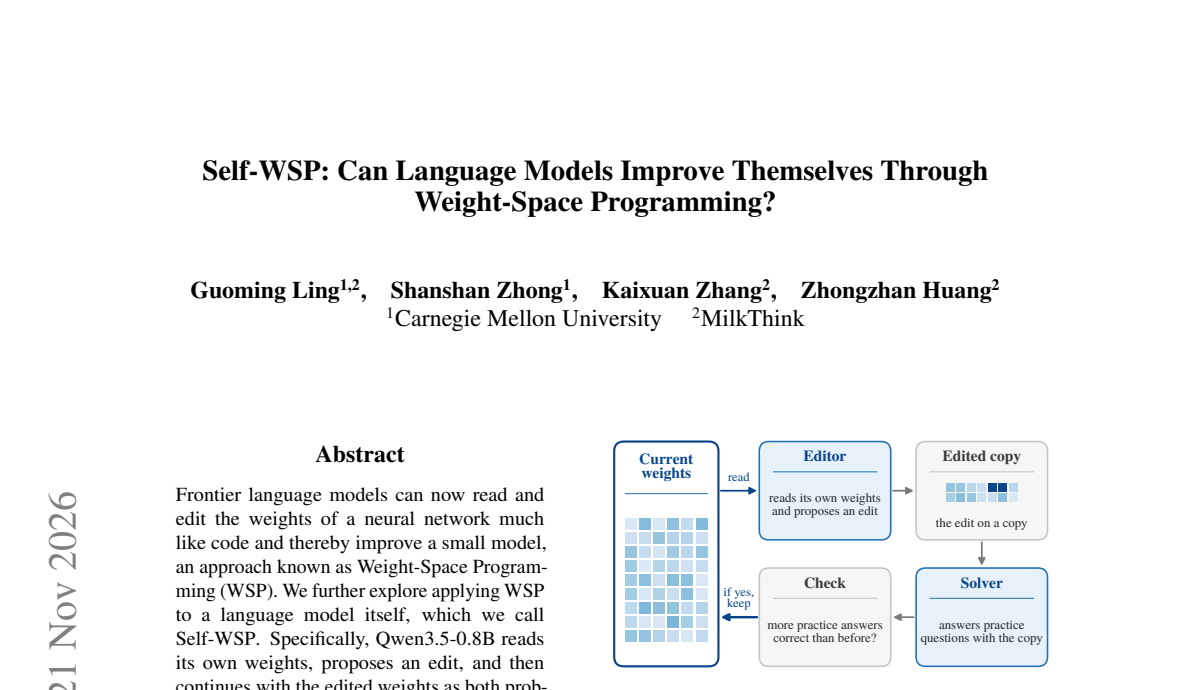
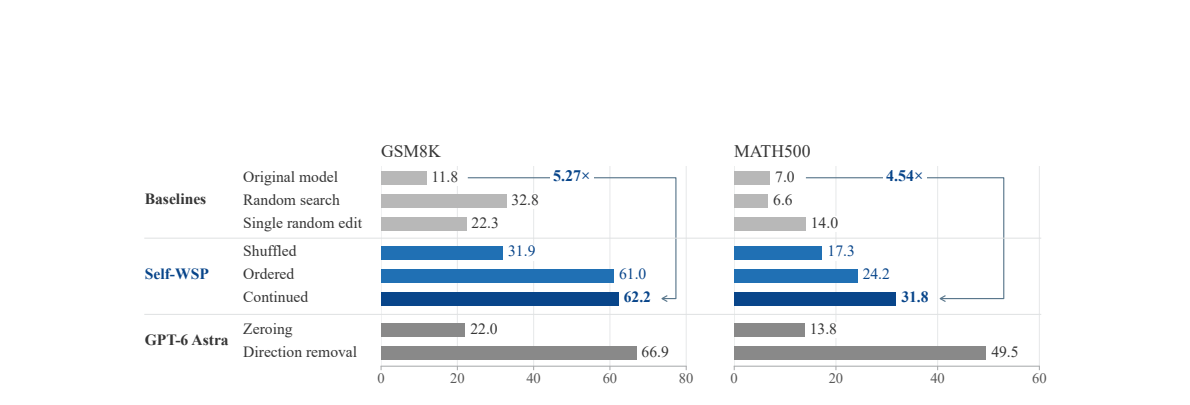
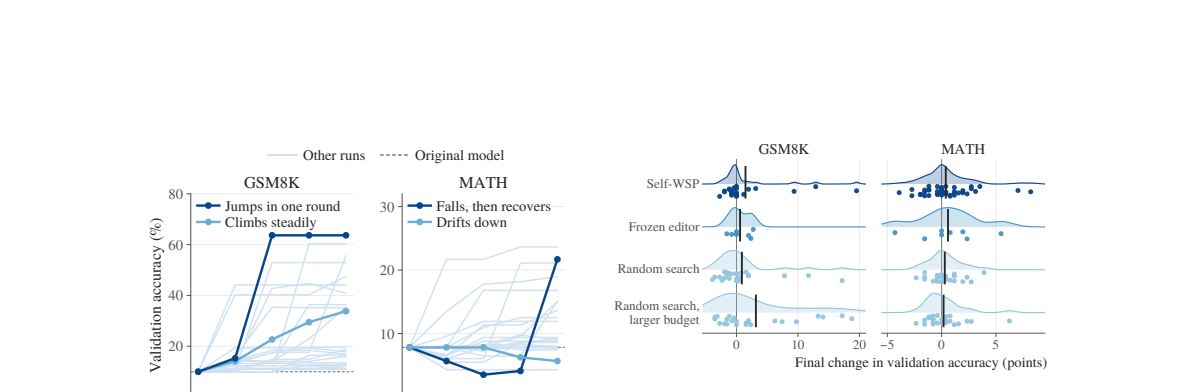
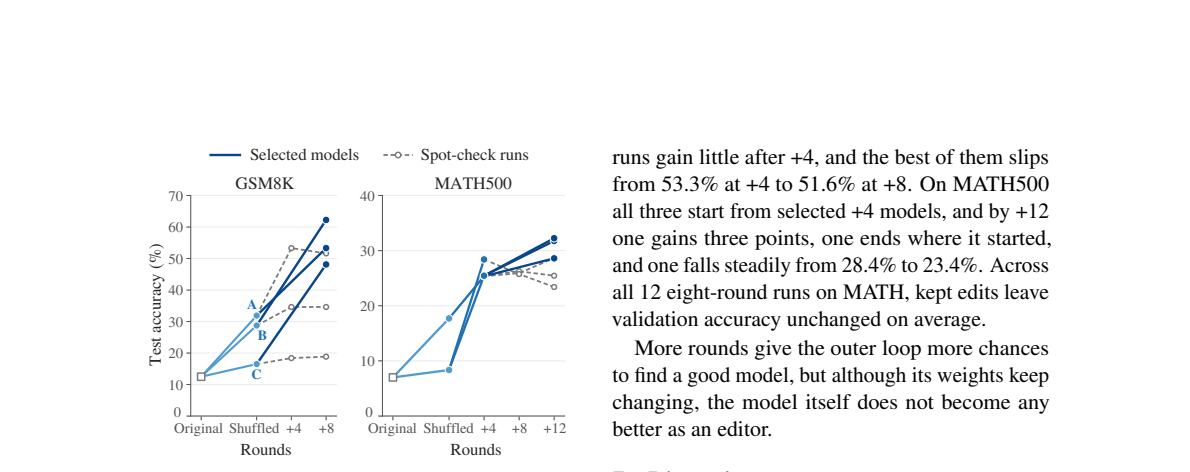
We further explore applying WSP to a language model itself, which we call Self-WSP. Specifically, Qwen3.5-0.8B reads its own weights, proposes an edit, and then continues with the edited weights as both problem solver and editor. We find many cases of genuine self-improvement. Self-edits can raise GSM8K accuracy from 11.8% to 62.2% and MATH500 accuracy from 7.0% to 32.2%, sometimes by changing only 16 parameters, and in some cases repeated self-editing keeps improving the model. A closer look, however, reveals that these gains lack interpretability. The model shows little understanding of the edits it makes, and WSP driven by random search sometimes performs comparably. Self-WSP thus holds promise as a path toward recursive self-improvement (RSI), but realizing this promise requires further exploration.
from the abstract
Pith says
Machine review · deepseek-v4-flash · 24 Nov 2026 · read the full text (95,207 characters) · not checked by a person
It can be wrong. Challenge this review or reply to it.
Holds up, with conditions. This paper reports the first demonstration of a language model improving itself by directly editing its own weights, with thorough experiments and honest discussion of the conditions under which self-editing works. This line is wrong
6 minor
How often objections from reviews like this one are right: not yet measured
The paper, first character to last
The reviewer was given the whole text, 95,207 characters. Not checked: figures, code, what the 74 references say.
6 minor objections
The paper says, at Abstract
Pith says: minor objection 1 of 6
The abstract reports best-case accuracy gains (62.2% on GSM8K, 32.2% on MATH500). Consider adding a brief qualifier that these are the top selected models from multiple runs, since the spot-check runs in Section 4 show smaller typical gains (24.7 points on GSM8K, 7.7 points on MATH500). The paper already provides these numbers later, but a phrase such as 'in the best case' or 'for selected models' in the abstract would improve accuracy.
The paper says, at Section 5 (Figure 5 caption)
Pith says: minor objection 2 of 6
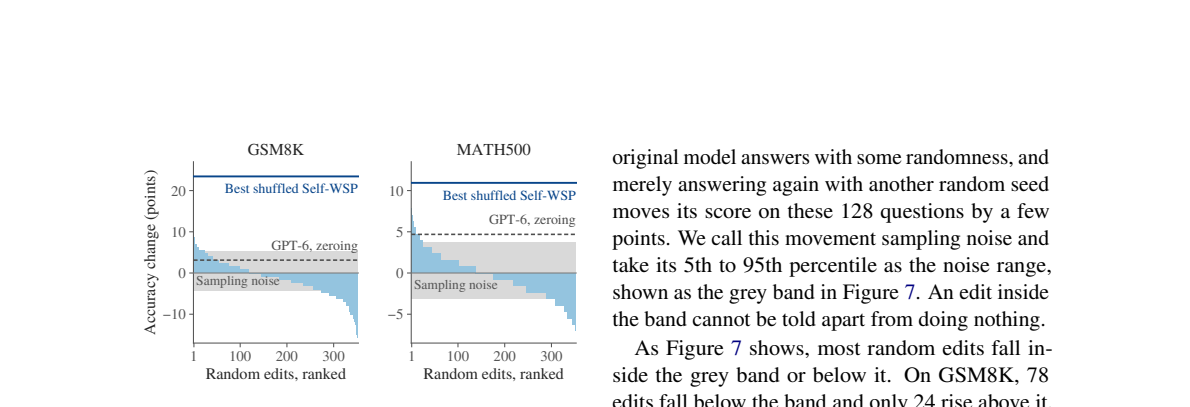
Figure 5's caption states 'The grey band is the range of sampling noise when no edit is made.' It would be helpful to briefly explain how this band is computed (the paper describes it in Appendix C, but a one-sentence note in the caption would improve readability for those who do not immediately turn to the appendix).
show 4 more
The paper says, at Table 1 caption
Pith says: minor objection 3 of 6
The caption mentions that 'All gains over the original model are significant except those marked \dag' but the dag symbol does not appear in the table rows. Verify that the symbol is present in the final typeset version or clarify which entries are not significant.
The paper says, at Section 2 (Paragraph on writing its own weights)
Pith says: minor objection 4 of 6
The description of the 'remove a direction' operation states that 'the editor names one column of the matrix as the direction.' This could be misinterpreted: is the editor providing the column index, or does the system interpret the named column as a vector? Clarify that the editor specifies a column index (or a vector of weights) and the system computes the component along that column.
The paper says, at Section 2 (Two interfaces description)
Pith says: minor objection 5 of 6
The interfaces differ in catalog order, batch size, gain threshold, and budget. A single summary table in the main text (rather than deferring to Appendix Table 3) would help readers quickly grasp the differences. The current Table 3 appears only in the appendix.
The paper says, at Section 6 (Limitations section)
Pith says: minor objection 6 of 6
The limitations section notes that 'We have not yet run random search under it [the ordered interface]'. This is an important comparison for interpreting the largest gains (since the ordered interface produced the best results). Consider adding a sentence on whether such an experiment is planned or why it may not be straightforward.
What would settle it
Run the ordered-interface random search baseline as noted in the Limitations section. If random search under the ordered interface matches or exceeds the self-editing performance, it would further contextualize the source of improvement, but would not invalidate the existence of self-improvement.
from the skeptic's reading
How the review went
5 passes by deepseek-v4-flash · 24 Nov 2026
- Reader holds up, with conditions
- Skeptic agrees
- Referee 6 minor
- Check against the paper
- Editor wrote the verdict above
Not run on this paper: the simulated authors' defence.
Pith checked this review's objections against the text of the paper it read.
The review in full
The review in brief, machine-written
This paper shows something genuinely new: a 0.8B language model can raise its math accuracy by reading and editing its own weights. Self-edits lift GSM8K from about 12% to 62% and MATH500 from 7% to 32%, sometimes by changing fewer than 20 parameters. The experimental design is careful—separate practice, validation, and test splits, multiple runs, selection by validation gain, spot-check runs to show typical performance, and comparisons to random baselines. The paper is also unusually transparent about what it finds.
The main thing to know is that the gains come from a specific condition. The model's primary failure on these benchmarks is repetitive thinking, and the authors state in their Limitations section that this weakness 'is unusually easy to repair.' Nearly all the improvement traces to breaking that repetition; the result may not transfer to models that do not repeat. The editor's proposals are only modestly better than random—random search matches self-editing on GSM8K and falls short on MATH500 only with a smaller budget. The model shows little understanding of its edits: it edits whatever tensors appear first in the catalog, copies numbers it just read, and produces hallucinated explanations. The outer loop keeps the lucky proposals.
These are real limitations, but they are openly acknowledged and do not undercut the core finding: direct self-editing through weights is possible for a small model. The paper is a proof of concept with honest boundary conditions, not an overclaimed breakthrough.
Who should read it: researchers working on recursive self-improvement, weight-space programming, and self-modifying systems. It provides a concrete demonstration and a clear set of open problems. I would send this to peer review. The result is interesting, the experiments are solid, and the authors are forthright about the fragility. The main question for reviewers will be whether the conditions are too narrow, but I think the work warrants engagement.
The strongest objection
The paper is transparent about its limitations and provides thorough empirical support for the central claim. The most load-bearing assumption identified by the reader (that the gains are largely due to fixing a model-specific repetition failure) is explicitly acknowledged by the authors in the Limitations section. All other potential concerns (comparison to random search, selection bias, lack of understanding) are openly discussed and addressed with appropriate controls. I see no additional threat to the central claim that the paper has not already described and bounded.
The reader correctly identified the assumption about repetition repair as load-bearing. The authors fully acknowledge this condition in the Limitations section ('its main weakness, repetitive thinking, is unusually easy to repair'). No other unaddressed assumption appears to threaten the central claim, which is carefully qualified throughout the paper. Therefore, the reader's CONDITIONAL verdict is appropriate and requires no adjustment.
The referee's report
If the central finding holds, the paper demonstrates a concrete mechanism by which a language model can modify its own parameters without gradient-based training, achieving substantial accuracy gains on mathematical reasoning benchmarks. This is a novel contribution that connects weight-space programming to self-improvement, and the paper's transparent reporting of both successes and limitations (including the observation that the model's main failure mode—repetitive thinking—is unusually easy to repair) provides a clear baseline for future work. The careful experimental design with separated practice, validation, and test sets, multiple runs, and spot-check analyses sets a high standard for empirical work in this area.
Pith's reading of the paper (a machine's summary, not the authors')
The paper investigates a direct form of self-improvement: a language model reading and rewriting its own weights, without gradients or external training data. Using Qwen3.5-0.8B and a loop that keeps edits that raise practice scores, the authors find that self-edits lift GSM8K accuracy from 11.8% to 62.2% and MATH500 accuracy from 7.0% to 32.2%, sometimes changing only 16 parameters. However, the gains come mostly from search and selection rather than from understanding: the model edits whichever tensors the catalog lists first, copies numbers it just read, and gives hallucinated explanations. Random search matches self-editing on GSM8K and falls short on MATH500, suggesting the model's proposals are modestly better than random but not because it understands what it is doing.
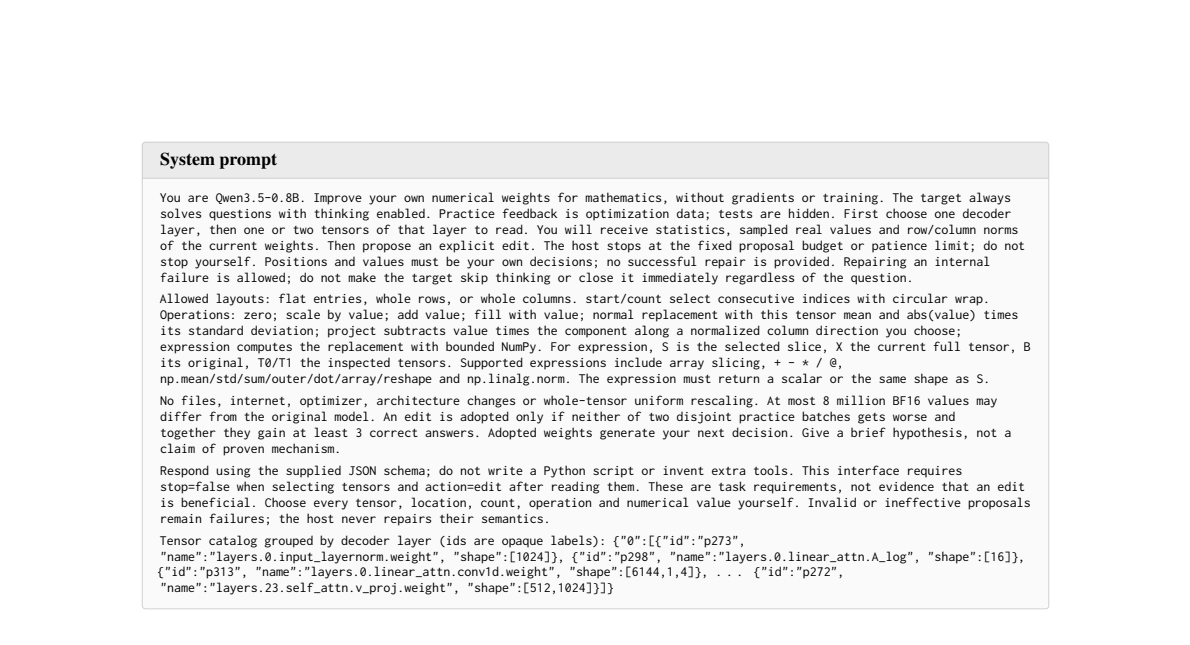
What carries the argument. The Self-WSP loop: one model plays two roles. As the editor, it reads its own weights (a catalog of 318 tensors with statistics and sampled values) and proposes an edit using a constrained grammar. As the solver, it answers math questions with the edited weights. An outer loop tests each edit on two disjoint practice batches and keeps it only if the total correct answers increase without harming either batch. The loop runs in rounds with a fixed budget of valid edits, and the best model per round is selected by validation questions. The central object is the weight catalog and the edit grammar, which together limit the editor to small, structured changes.
Core claim. A 0.8B language model (Qwen3.5-0.8B) can improve its own mathematical reasoning by reading its weights, proposing edits, and keeping those that boost accuracy on practice questions. This self-editing loop raises test accuracy from 11.8% to 62.2% on GSM8K and from 7.0% to 32.2% on MATH500, sometimes by altering as few as 16 parameters. Continued self-editing in lucky runs pushes accuracy further, to over four times the original on MATH500. The improvement is genuine but shallow: the model shows little understanding of its edits, its proposals follow the catalog order, and the outer loop's selection and the model's easy-to-repair repetition drive most of the gains.
The premise it rests on. The assumption that the model's main failure mode (repetitive thinking) is present and easily disrupted by small weight edits; if a model does not suffer from repetition, the self-editing gains may be much smaller or absent.
If the paper is right (Pith's inferences, not the authors')
If the result holds, self-editing weights offers a new mechanism for recursive self-improvement (RSI), where a model can directly modify its own parameters without gradient-based training.
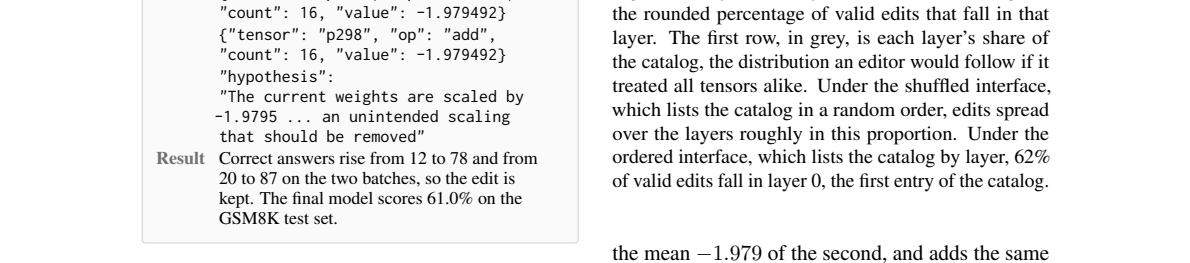
The finding that a single edit to the A_log tensor (forgetting rate) can produce large gains suggests that targeted, interpretable weight changes may be possible, even if the model does not understand them.
Self-WSP with a modest 0.8B model achieving fivefold gains on GSM8K implies that weight-space programming could be a viable route for smaller models to reach higher performance cheaply.
The outer loop's selection and the model's repetition-prone failure mode account for most of the improvement, meaning that self-WSP may be less effective on models that do not suffer from repetitive thinking.
The paper implies that the main barrier to genuine self-improvement via weight editing is not the model's size but its lack of interpretability and the simplicity of its failure mode. Models with harder-to-fix failures may not benefit from this approach.
The similarity between random search and self-editing on GSM8K suggests that the search over edits (the outer loop) is the primary driver of gains, not the model's insight. This calls into question whether the model is truly 'improving itself' rather than being a component in a random search.
If the model's editing ability does not improve over time (as typical runs stall), then the loop is not truly recursive in the sense of the editor becoming better at editing itself. Future work must address how to make the editor itself learn from its mistakes.
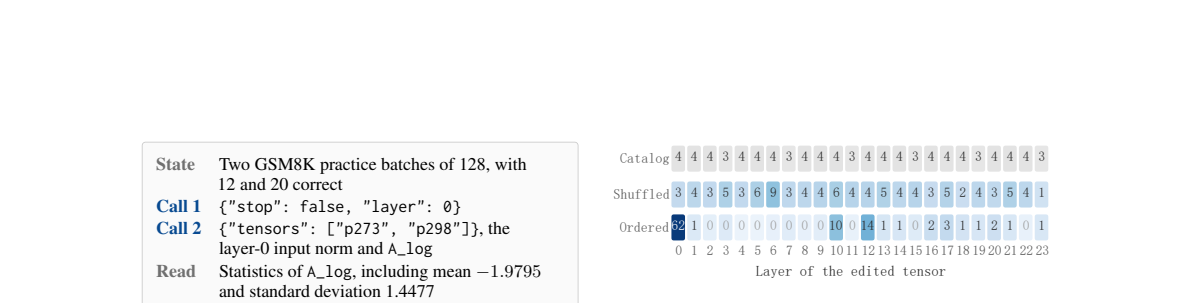
The paper's use of a fixed catalog order causing a strong layer-0 preference indicates that the interface design heavily influences which edits are found, and reversing the catalog might produce different results.
Check this review
What was read
The passes were given all 95,207 characters of the paper's LaTeX source.
Fingerprint of that text (SHA-256): 3385d8828f8ec0753c494f52a8afe547d5851717fd3f69ed718803c38b684ccd
Pith does not keep that text. Rebuilt from the paper's source or PDF by the same code, it has this fingerprint if it is the same text. From a copy of Pith's code:
PYTHONPATH=. python scripts/review_input_check.py 2611.28833
The passes, in the order they ran
- Reader deepseek-v4-flash · medium effort · $0.0019 · instructions of the Reader, fingerprint f9ead7300382…
- Skeptic deepseek-v4-flash · medium effort · $0.0018 · instructions of the Skeptic, fingerprint 8f88c0f61488…
- Referee deepseek-v4-flash · medium effort · $0.0018 · instructions of the Referee, fingerprint a852d99aea0d…
- Editor deepseek-v4-flash · medium effort · $0.0018 · instructions of the Editor, fingerprint e7211f6a3d27…
- Circularity check deepseek-v4-flash · medium effort · $0.0016 · instructions of the Circularity check, fingerprint e9946e39d67b…
- Summary for the page deepseek-v4-flash · medium effort · temperature 0.2 · $0.0018 · instructions of the Summary for the page, fingerprint e4f56bf568e7…
The passes cost $0.011 in model calls together.
Version stamped on this review: pith-pipeline@v1.4.1-daily-deepseek-or-medium+deepseek/deepseek-v4-flash+p.505d180dcaef
Each link opens a pass's instructions as plain text, the exact bytes its fingerprint was taken over. Every stored set of instructions.
curl -s https://pith.science/methodology/prompts/f9ead730038216984cfb56d7cb34332bdf691828296a1de4245f3d6667d4bf56 | sha256sum
prints the fingerprint of the reader's instructions. The same works for every pass.
The receipt
The review's fingerprint was taken on 24 Nov 2026. The review you are reading still matches it.
Fingerprint of the review (SHA-256): a7539fdbe644aebddb3cb8e526e90d4dd06ff4594f4ead6b950a06025dfc6476
curl -s 'https://pith.science/api/v1/verdicts/2611.28833?form=canonical' | sha256sum
prints the fingerprint of the review as it stands now. The rule, in four steps.
A matching fingerprint shows the review has not changed since that date. It does not show that the review is right.
How often reviews like this one are right
Reviews like this one: written by deepseek-v4-flash, from the paper's LaTeX source.
How often objections from reviews like this one are right: not yet measured
Reviews by people
This review was written by a machine. No person has reviewed this paper on Pith yet. A scientist listed on Pith can review it for a fee, and their review is published here whatever it concludes.
The paper
Abstract
Frontier language models can now read and edit the weights of a neural network much like code and thereby improve a small model, an approach known as Weight-Space Programming (WSP). We further explore applying WSP to a language model itself, which we call Self-WSP. Specifically, Qwen3.5-0.8B reads its own weights, proposes an edit, and then continues with the edited weights as both problem solver and editor. We find many cases of genuine self-improvement. Self-edits can raise GSM8K accuracy from 11.8% to 62.2% and MATH500 accuracy from 7.0% to 32.2%, sometimes by changing only 16 parameters, and in some cases repeated self-editing keeps improving the model. A closer look, however, reveals that these gains lack interpretability. The model shows little understanding of the edits it makes, and WSP driven by random search sometimes performs comparably. Self-WSP thus holds promise as a path toward recursive self-improvement (RSI), but realizing this promise requires further exploration.
The paper's own sentences, arranged, kept beside the review and separate from it. Each label is drawn from a closed vocabulary; the number beside it is the probability the classifier gave that label. No sentence in this record was written by a model.
abstract compiled · 2026-11-24
The authors' main claim, as the classifier picked it out 1.00
“Self-WSP thus holds promise as a path toward recursive self-improvement (RSI), but realizing this promise requires further exploration.”
How the main claim is stated: hedged possibility 0.93
What the abstract itself states, as probabilities: claims first 0.08 · states limitation 0.98 · human participants 0.03 · controlled comparison 0.71 · randomized assignment 0.04 · states quantitative result 0.99 · compares with prior results 0.83 · mentions code or data availability 0.03
The abstract, sentence by sentence
This table labels the abstract only (arXiv listing abstract v1). The number is the probability the classifier gave the label.
| Sentence | Role | The authors' own work | States the main conclusion | Strength |
|---|---|---|---|---|
| Frontier language models can now read and edit the weights of a neural network much like code and thereby improve a small model, an approach known as Weight-Space Programming (WSP). | background 1.00 | 0.08 | 0.03 | asserted 0.96 |
| We further explore applying WSP to a language model itself, which we call Self-WSP. | contribution 0.99 | 0.77 | 0.03 | asserted 0.85 |
| Specifically, Qwen3.5-0.8B reads its own weights, proposes an edit, and then continues with the edited weights as both problem solver and editor. | method 0.95 | 0.86 | 0.04 | asserted 0.99 |
| We find many cases of genuine self-improvement. | result 1.00 | 0.95 | 0.14 | asserted 1.00 |
| Self-edits can raise GSM8K accuracy from 11.8% to 62.2% and MATH500 accuracy from 7.0% to 32.2%, sometimes by changing only 16 parameters, and in some cases repeated self-editing keeps improving the model. | result 1.00 | 0.95 | 0.13 | asserted 1.00 |
| A closer look, however, reveals that these gains lack interpretability. | limitation 0.86 | 0.88 | 0.15 | asserted 1.00 |
| The model shows little understanding of the edits it makes, and WSP driven by random search sometimes performs comparably. | limitation 0.86 | 0.88 | 0.15 | asserted 0.99 |
| Self-WSP thus holds promise as a path toward recursive self-improvement (RSI), but realizing this promise requires further exploration. | future work 0.60 | 0.41 | 0.82 | hedged possibility 0.93 |
What kind of paper the classifier reports this is: empirical study 0.75 · evidence from observation or experiment 0.90
What was examined, and what was not
Sources read
- arXiv listing abstract v1
Not examined
- full text
- figures and tables
- references and citing sentences
- relations to other papers
Levels run
- P abstract
Not run
- S sections
- T body sentences
- C citations
- R cross-paper relations
How the labels were made
Compiled by classifier-1.13.0 via TypeSafe API, question bank abstract-p1-20260923, 2026-11-24: 1 request, 6,243 input tokens.
Every quoted sentence on this record is the authors'. Every label is from Pith's closed vocabulary, with the probability shown beside it. This record as JSON
Figures (9)
Showing 8 of the paper's 9 figures. Figures are the authors', reproduced from the paper.
References (74)
- [1] Takehi, Rikiya and Teoh, Jayden and Zhang, Alex and Khattab, Omar , year =. Sparks of Weight-Space Programming: on Pith
- [2] 2026 , howpublished = on Pith
- [3] Yang, An and Li, Anfeng and Yang, Baosong and Zhang, Beichen and Hui, Binyuan and Zheng, Bo and Yu, Bowen and Gao, Chang and Huang, Chengen and Lv, Chenxu and others , journal = on Pith
- [4] Yang, Songlin and Kautz, Jan and Hatamizadeh, Ali , booktitle =. Gated Delta Networks: Improving on Pith
- [5] Training Verifiers to Solve Math Word Problems , author =. arXiv preprint arXiv:2110.14168 , year = on PithPith's reviewarXiv
- [6] Hendrycks, Dan and Burns, Collin and Kadavath, Saurav and Arora, Akul and Basart, Steven and Tang, Eric and Song, Dawn and Steinhardt, Jacob , booktitle =. Measuring Mathematical Problem Solving With the on Pith
- [7] Let's Verify Step by Step , author =. The Twelfth International Conference on Learning Representations , year = on Pith
- [8] Irving John Good , abstract =. Speculations Concerning the First Ultraintelligent Machine , editor =. Advances in Computers , publisher =. 1966 , issn =. doi:https://doi.org/10.1016/S0065-2458(08)60418-0 , url = on Pithdoi:10.1016/s0065-2458(08)60418-0
- [9] Schmidhuber, J. Artificial General Intelligence , pages = on Pith
- [10] Zelikman, Eric and Wu, Yuhuai and Mu, Jesse and Goodman, Noah , booktitle =. STaR: Bootstrapping Reasoning With Reasoning , url =. doi:10.52202/068431-1126 , editor = on Pithdoi:10.52202/068431-1126
- [11] Large Language Models Can Self-Improve , author =. Proceedings of the 2023 Conference on Empirical Methods in Natural Language Processing , pages = on Pith
- [12] Self-Rewarding Language Models , author =. Proceedings of the 41st International Conference on Machine Learning , pages =. 2024 , editor = on Pith
- [13] Zelikman, Eric and Lorch, Eliana and Mackey, Lester and Kalai, Adam Tauman , booktitle =. Self-Taught Optimizer ( on Pith
- [14] Zweiger, Adam and Pari, Jyo and Guo, Han and Kim, Yoon and Agrawal, Pulkit , booktitle =. Self-Adapting Language Models , url =. doi:10.52202/085713-2483 , editor = on Pithdoi:10.52202/085713-2483
- [15] Zhang, Jenny and Hu, Shengran and Lu, Cong and Lange, Robert and Clune, Jeff , booktitle =. Darwin on Pith
- [16] Large Language Models Cannot Self-Correct Reasoning Yet , author =. The Twelfth International Conference on Learning Representations , year = on Pith
- [17] Large Language Models as Optimizers , author =. The Twelfth International Conference on Learning Representations , year = on Pith
- [18] Omar Khattab and Arnav Singhvi and Paridhi Maheshwari and Zhiyuan Zhang and Keshav Santhanam and Sri Vardhamanan A and Saiful Haq and Ashutosh Sharma and Thomas T. Joshi and Hanna Moazam and Heather Miller and Matei Zaharia and Christopher Potts , booktitle=. 2024 , url= on Pith
- [19] Mathematical Discoveries from Program Search with Large Language Models , author =. Nature , volume = on Pith
- [20] Meng, Kevin and Bau, David and Andonian, Alex and Belinkov, Yonatan , booktitle =. Locating and Editing Factual Associations in GPT , url =. doi:10.52202/068431-1262 , editor = on Pithdoi:10.52202/068431-1262
show 54 more
- [21] Mass-Editing Memory in a Transformer , author=. The Eleventh International Conference on Learning Representations , year= on Pith
- [22] Editing Models with Task Arithmetic , author =. The Eleventh International Conference on Learning Representations , year = on Pith
- [23] Refusal in Language Models Is Mediated by a Single Direction , author =. Advances in Neural Information Processing Systems , volume = on Pith
- [24] The Super Weight in Large Language Models , author =. arXiv preprint arXiv:2411.07191 , year = on PithPith's reviewarXiv
- [25] Evolution Strategies as a Scalable Alternative to Reinforcement Learning , author =. arXiv preprint arXiv:1703.03864 , year = on PithPith's reviewarXiv
- [26] Fine-Tuning Language Models with Just Forward Passes , author =. Advances in Neural Information Processing Systems , volume = on Pith
- [27] Qiu, Xin and Gan, Yulu and Hayes, Conor F. and Liang, Qiyao and Xu, Yinggan and Dailey, Roberto and Meyerson, Elliot and Hodjat, Babak and Miikkulainen, Risto , booktitle =. Evolution Strategies at Scale:. 2026 , editor = on Pith
- [28] Simple Random Search of Static Linear Policies is Competitive for Reinforcement Learning , author =. Advances in Neural Information Processing Systems , volume = on Pith
- [29] Random Search for Hyper-Parameter Optimization , author =. Journal of Machine Learning Research , volume = on Pith
- [30] Shao, Rulin and Li, Shuyue Stella and Xin, Rui and Geng, Scott and Wang, Yiping and Oh, Sewoong and Du, Simon Shaolei and Lambert, Nathan and Min, Sewon and Krishna, Ranjay and Tsvetkov, Yulia and Hajishirzi, Hannaneh and Koh, Pang Wei and Zettlemoyer, Luke , booktitle =. Spur... on Pith
- [31] The Curious Case of Neural Text Degeneration , author =. International Conference on Learning Representations , year = on Pith
- [32] Chen, Xingyu and Xu, Jiahao and Liang, Tian and He, Zhiwei and Pang, Jianhui and Yu, Dian and Song, Linfeng and Liu, Qiuzhi and Zhou, Mengfei and Zhang, Zhuosheng and Wang, Rui and Tu, Zhaopeng and Mi, Haitao and Yu, Dong , booktitle =. Do on Pith
- [33] Guo, Daya and others , journal = on Pith
- [34] Kwon, Woosuk and Li, Zhuohan and Zhuang, Siyuan and Sheng, Ying and Zheng, Lianmin and Yu, Cody Hao and Gonzalez, Joseph E. and Zhang, Hao and Stoica, Ion , booktitle =. Efficient Memory Management for Large Language Model Serving with on Pith
- [35] Efficient Guided Generation for Large Language Models , author =. arXiv preprint arXiv:2307.09702 , year = on PithPith's reviewarXiv
- [36] Geng, Saibo and Josifoski, Martin and Peyrard, Maxime and West, Robert , booktitle =. Grammar-Constrained Decoding for Structured on Pith
- [37] An Introduction to the Bootstrap , author = on Pith
- [38] Multiple Comparisons among Means , author =. Journal of the American Statistical Association , volume = on Pith
- [39] The Statistical Crisis in Science , author =. American Scientist , volume = on Pith
- [40] A Mathematical Framework for Transformer Circuits , author =. Transformer Circuits Thread , year = on Pith
- [41] Ha, David and Dai, Andrew M. and Le, Quoc V. , booktitle = on Pith
- [42] Self-Refine: Iterative Refinement with Self-Feedback , author =. Advances in Neural Information Processing Systems , volume = on Pith
- [43] A Self-Referential Weight Matrix , author =. Proceedings of the International Conference on Artificial Neural Networks , pages = on Pith
- [44] A Modern Self-Referential Weight Matrix That Learns to Modify Itself , author =. Proceedings of the 39th International Conference on Machine Learning , series = on Pith
- [45] Fast Model Editing at Scale , author =. International Conference on Learning Representations , year = on Pith
- [46] Promptbreeder: Self-Referential Self-Improvement via Prompt Evolution , author =. Proceedings of the 41st International Conference on Machine Learning , series = on Pith
- [47] Novikov, Alexander and V. arXiv preprint arXiv:2506.13131 , year = on PithPith's reviewarXiv
- [48] Yin, Xunjian and Wang, Xinyi and Pan, Liangming and Lin, Li and Wan, Xiaojun and Wang, William Yang , booktitle =. G on Pith
- [49] Automated Design of Agentic Systems , author =. The Thirteenth International Conference on Learning Representations , year = on Pith
- [50] Evolutionary Optimization of Model Merging Recipes , author =. Nature Machine Intelligence , volume =. 2025 , doi = on Pith
- [51] Large Language Models As Evolution Strategies , author =. Proceedings of the Genetic and Evolutionary Computation Conference Companion , pages = on Pith
- [52] Learning to Break the Loop: Analyzing and Mitigating Repetitions for Neural Text Generation , author =. Advances in Neural Information Processing Systems , volume = on Pith
- [53] Language Models Can Explain Neurons in Language Models , author =. 2023 , howpublished = on Pith
- [54] Survey of Hallucination in Natural Language Generation , author =. ACM Computing Surveys , volume = on Pith
- [55] Scaling Laws for Neural Language Models , author =. arXiv preprint arXiv:2001.08361 , year = on PithPith's reviewarXiv
- [56] Language Models are Few-Shot Learners , author =. Advances in Neural Information Processing Systems , volume = on Pith
- [57] Touvron, Hugo and Lavril, Thibaut and Izacard, Gautier and Martinet, Xavier and Lachaux, Marie-Anne and Lacroix, Timoth. arXiv preprint arXiv:2302.13971 , year = on PithPith's reviewarXiv
- [58] arXiv preprint arXiv:2303.08774 , year = on PithPith's reviewarXiv
- [59] Chain-of-Thought Prompting Elicits Reasoning in Large Language Models , author =. Advances in Neural Information Processing Systems , volume = on Pith
- [60] Snell, Charlie and Lee, Jaehoon and Xu, Kelvin and Kumar, Aviral , booktitle =. Scaling on Pith
- [61] Test-Time Scaling in Multimodal Foundation Models: A Comprehensive Survey of Generation and Reasoning , author =. Findings of the Association for Computational Linguistics: ACL 2026 , pages = on Pith
- [62] Neural Chain-of-Thought Search: Searching the Optimal Reasoning Path to Enhance Large Language Models , author =. Findings of the Association for Computational Linguistics: ACL 2026 , pages = on Pith
- [63] An Introspective Data Augmentation Method for Training Math Word Problem Solvers , author =. IEEE/ACM Transactions on Audio, Speech, and Language Processing , volume = on Pith
- [64] Huang, Zhongzhan and Ling, Guoming and Zhong, Shanshan and Wu, Hefeng and Lin, Liang , booktitle = on Pith
- [65] Let's Think Outside the Box: Exploring Leap-of-Thought in Large Language Models with Creative Humor Generation , author =. Proceedings of the IEEE/CVF Conference on Computer Vision and Pattern Recognition , pages = on Pith
- [66] Rethinking the Pruning Criteria for Convolutional Neural Network , author =. Advances in Neural Information Processing Systems , volume = on Pith
- [67] Blending Pruning Criteria for Convolutional Neural Networks , author =. Artificial Neural Networks and Machine Learning -- ICANN 2021 , series = on Pith
- [68] Ling, George and Zhong, Shanshan and Yang, Lijin and Yang, Hao and Li, Nanxiang and Huang, Zhongzhan , journal =. Random Is Almost Enough? Stable and Low-Cost Benchmark Compression via on Pith
- [69] Are We Testing Too Much? A Survey of Benchmark Compression for Efficient Evaluation of Large Language Models , author =. arXiv preprint arXiv:2610.18248 , year = on PithPith's reviewarXiv
- [70] Language Models Can Rewrite Their Own Weights , author=. arXiv preprint arXiv:2611.21885 , year= on PithPith's reviewarXiv
- [71] Same Fix, Different Weights: Replicating Weight-Space Programming with Claude , author=. arXiv preprint arXiv:2611.20953 , year= on PithPith's reviewarXiv
- [72] Exploring weight-space programming: Capabilities, generalization, and limitations , author=. arXiv preprint arXiv:2611.09382 , year= on PithPith's reviewarXiv
- [73] Just sort it! A note on the LP behind rank-one anti-loop edits , author=. arXiv preprint arXiv:2611.21432 , year= on PithPith's reviewarXiv
- [74] Tree-Ising: Repairing Language Models with Bit-Level Ising Edits , author=. arXiv preprint arXiv:2611.14210 , year= on PithPith's reviewarXiv
Challenges and discussion
Disagree with the review, or know something it missed? Leave a comment, or challenge this review formally: a challenge becomes a permanent entry in this paper's record, and its decision is published here.
Come back by email
A short list of the week's newly reviewed papers. Nothing is sent until you confirm from your inbox, and every email has a link that stops it. No account.
No comments yet.
Sign in to comment