Machine Learning · arXiv:2611.20953 v1 · submitted 16 Nov 2026 · 13 references
Same Fix, Different Weights: Replicating Weight-Space Programming with Claude
The paper says
“Takehi et al. (2026) report that GPT-6 Astra, given the weights of small neural networks as text, can say what they were trained to do, repair them, and write new ones without training.”
more of the abstract
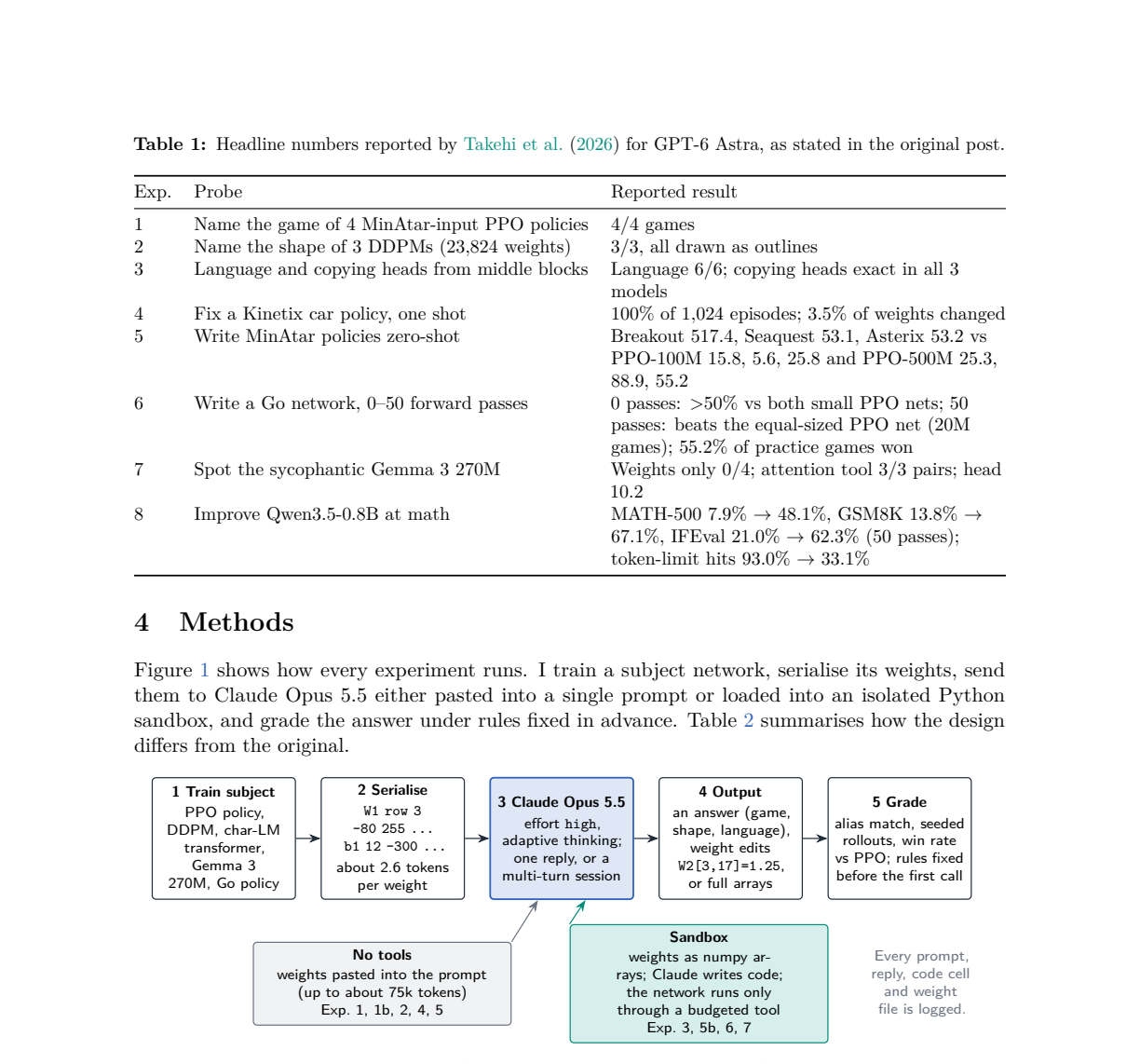
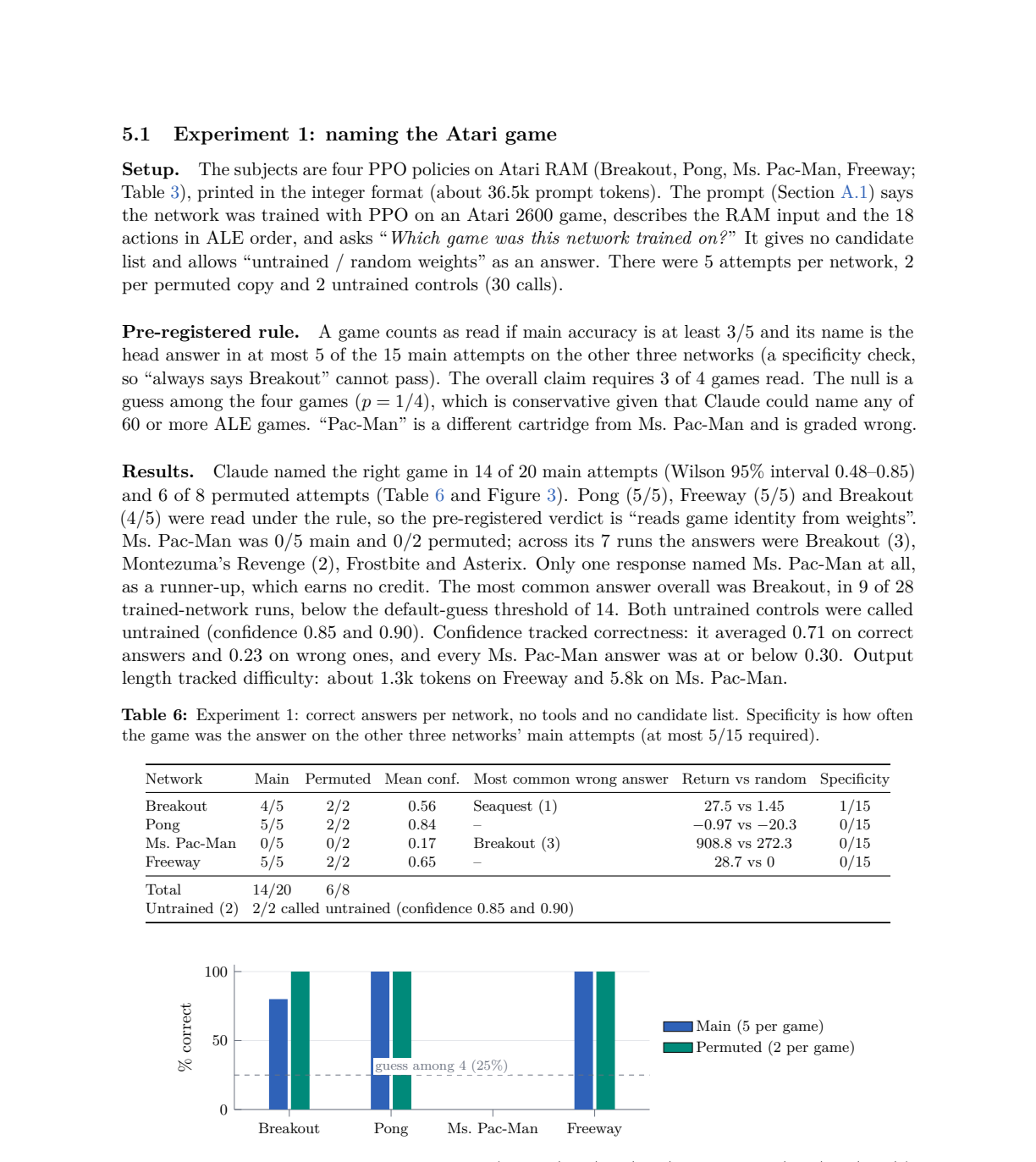
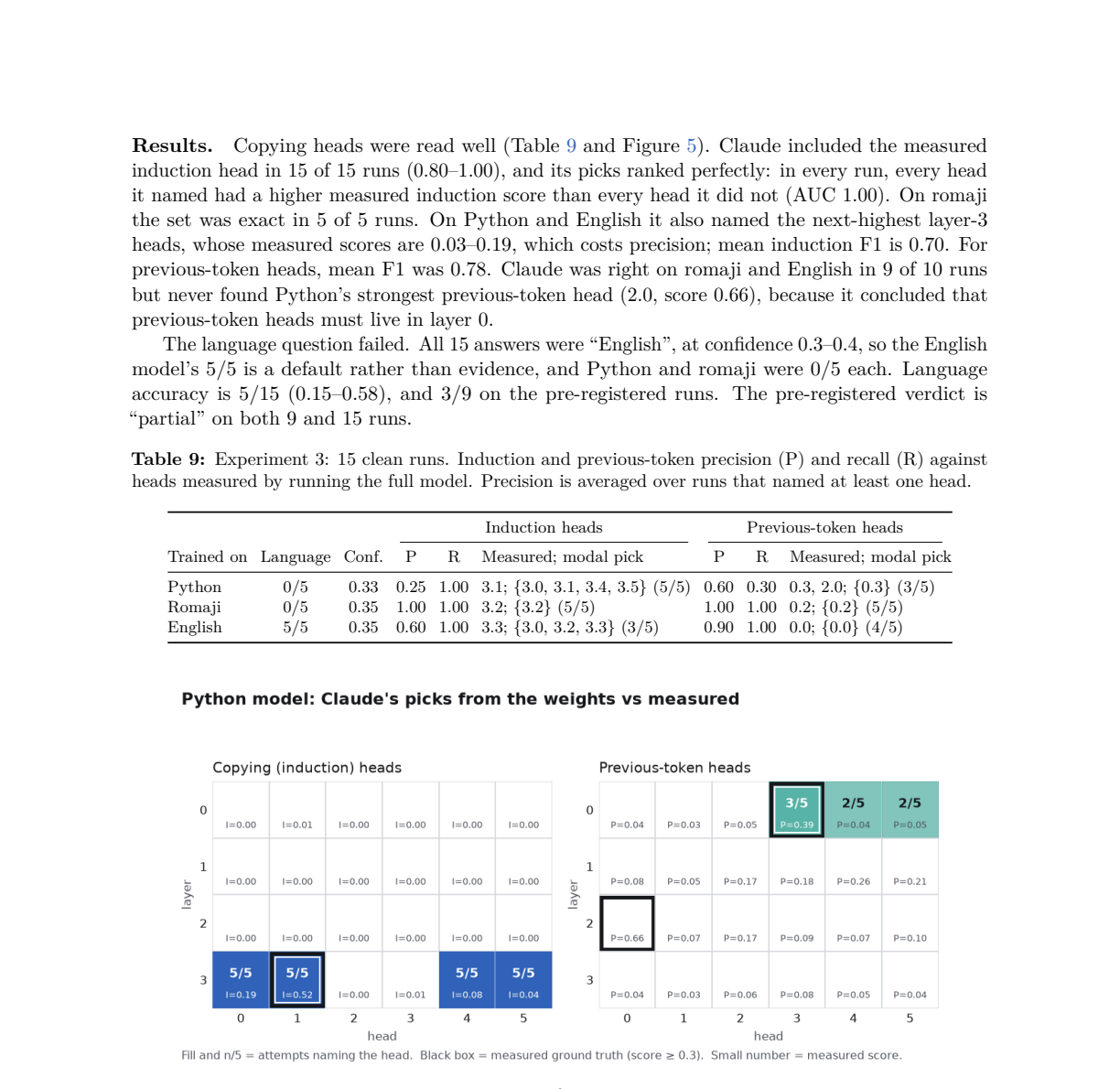
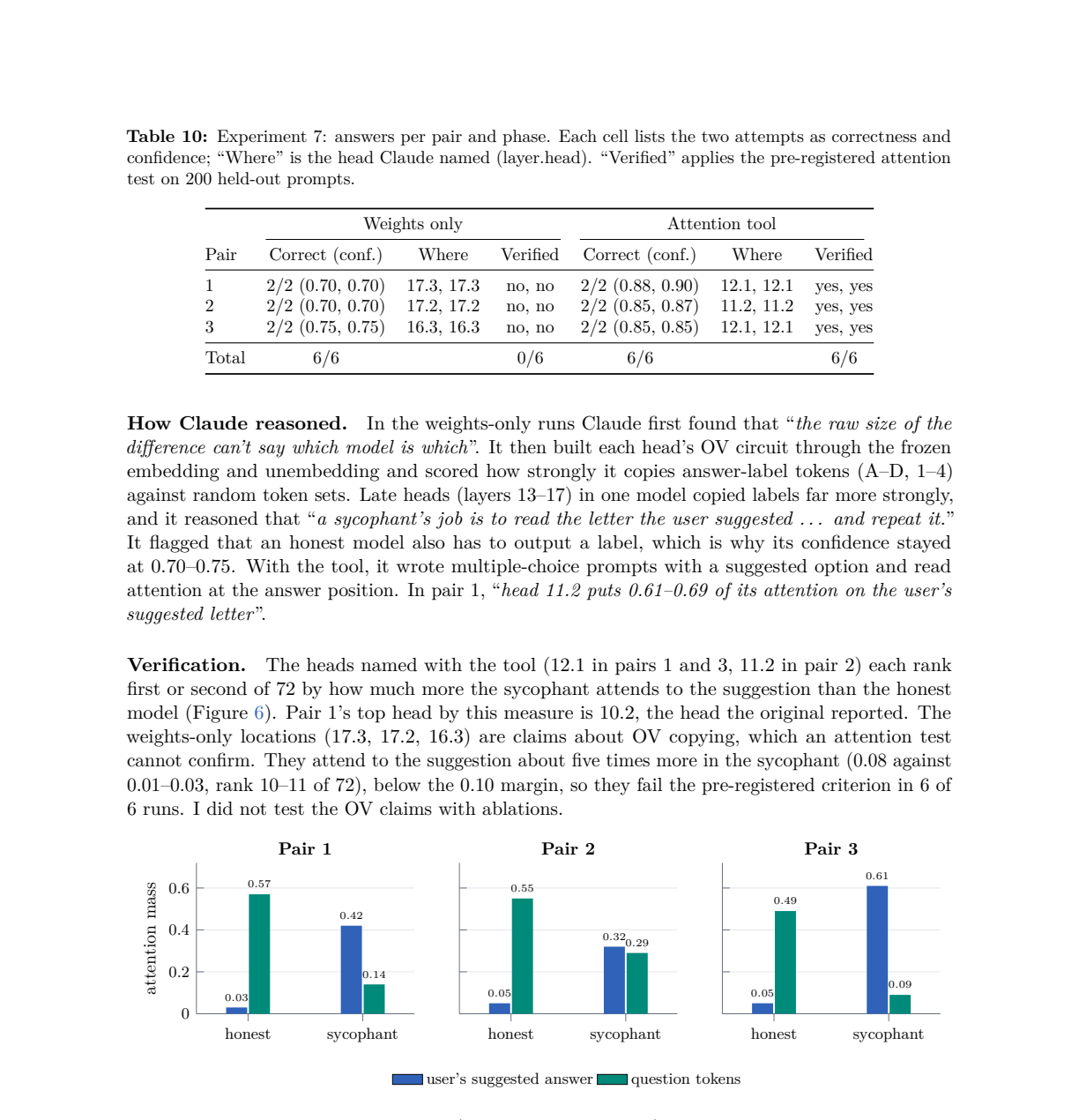
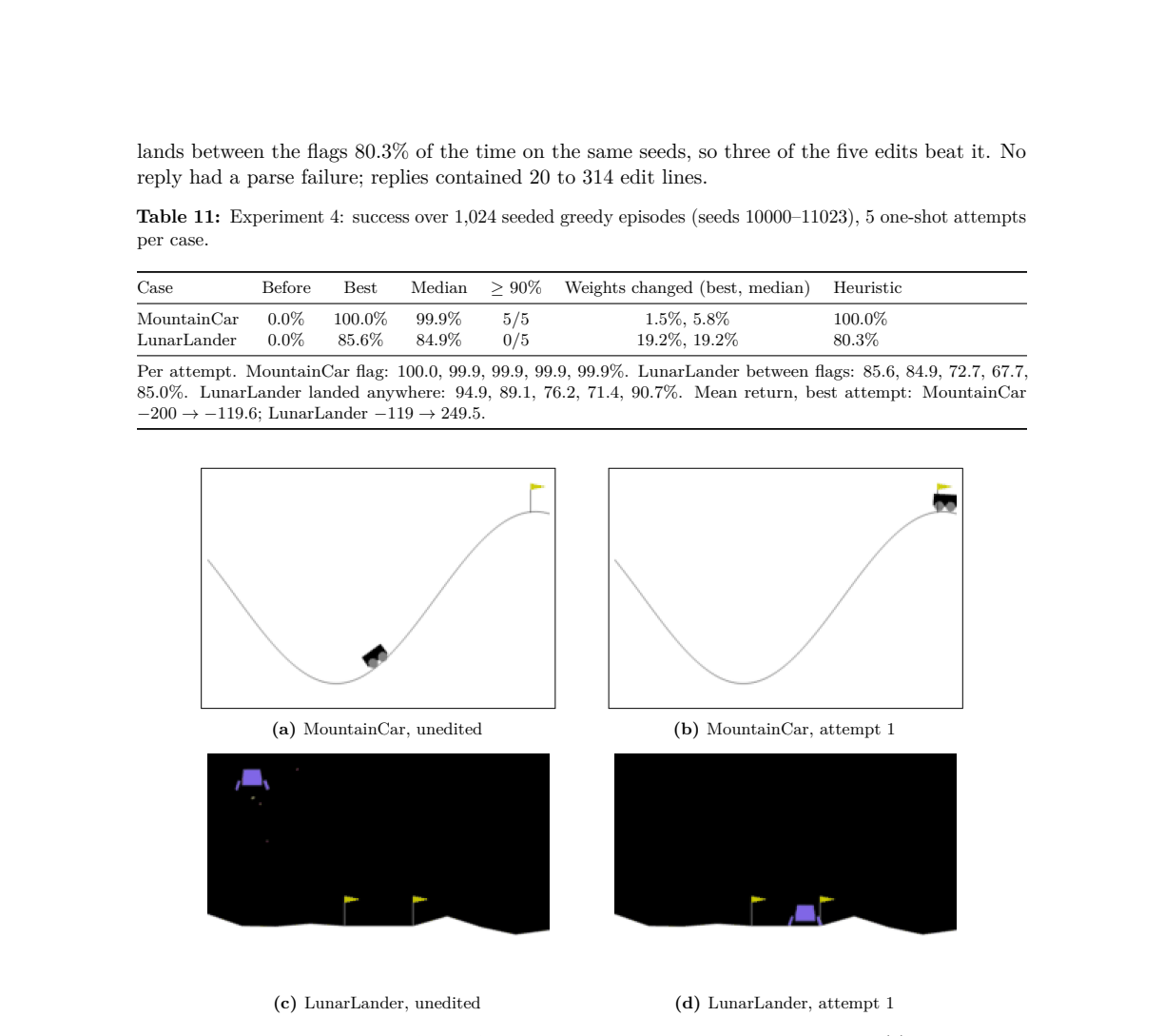
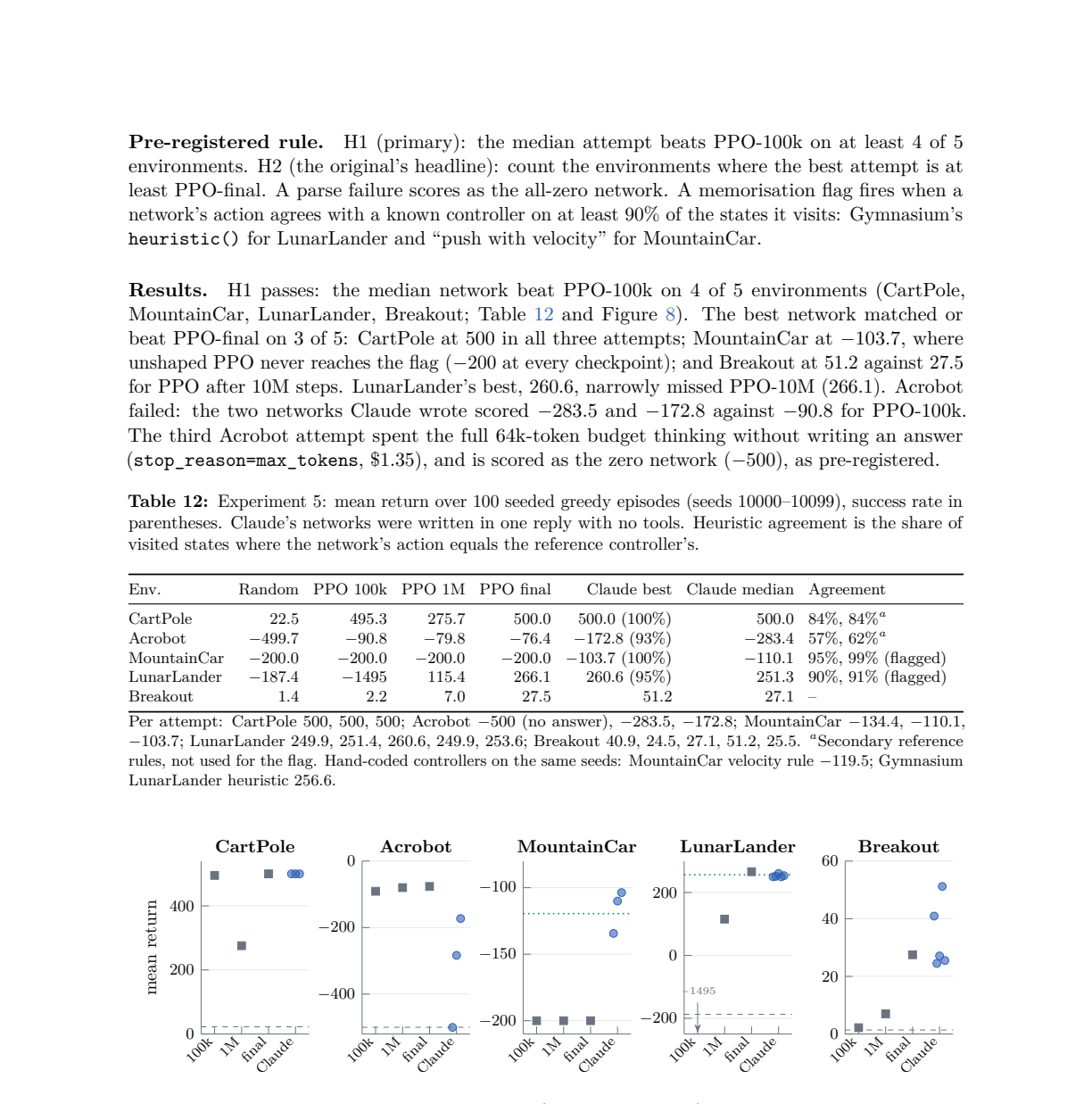
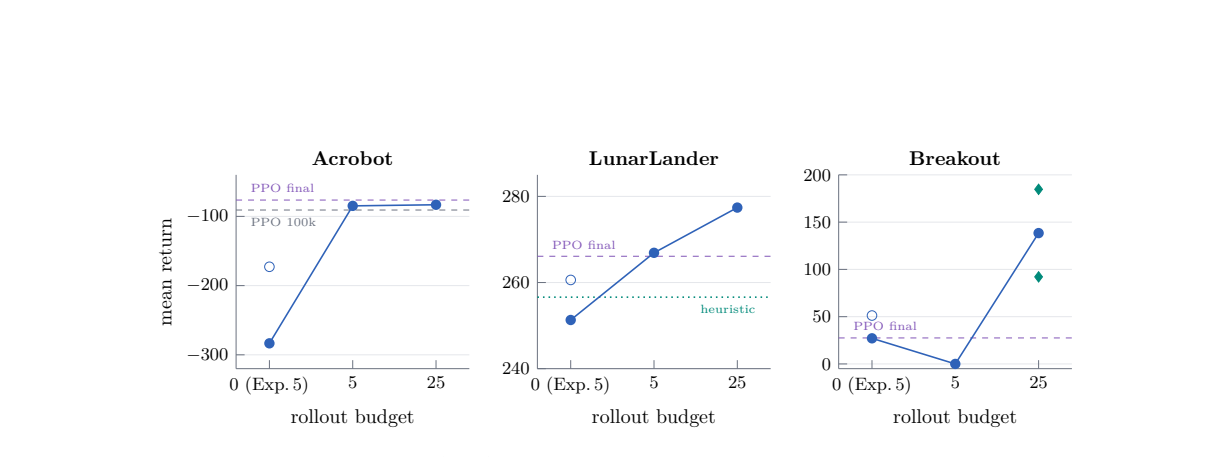
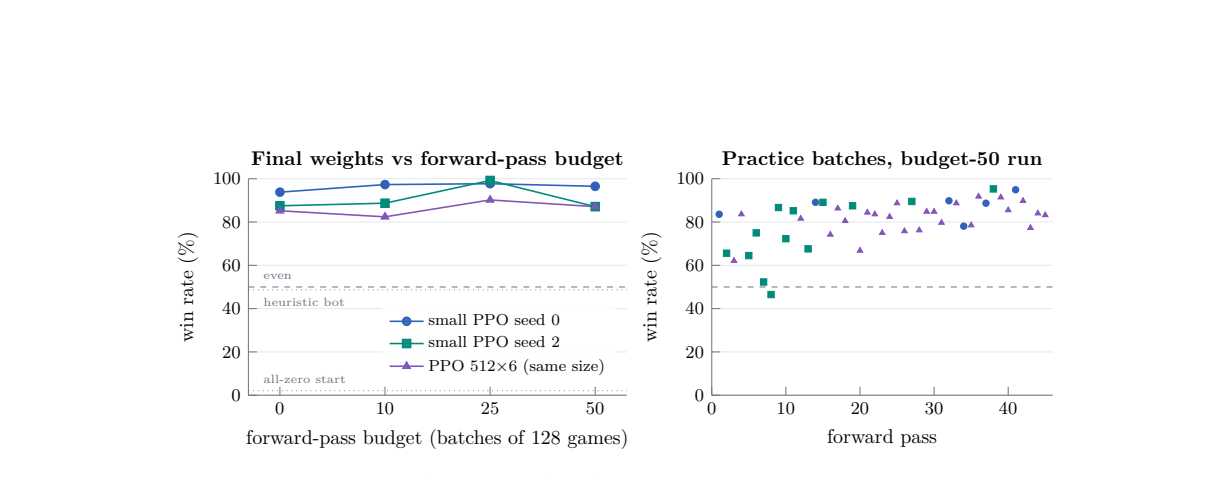
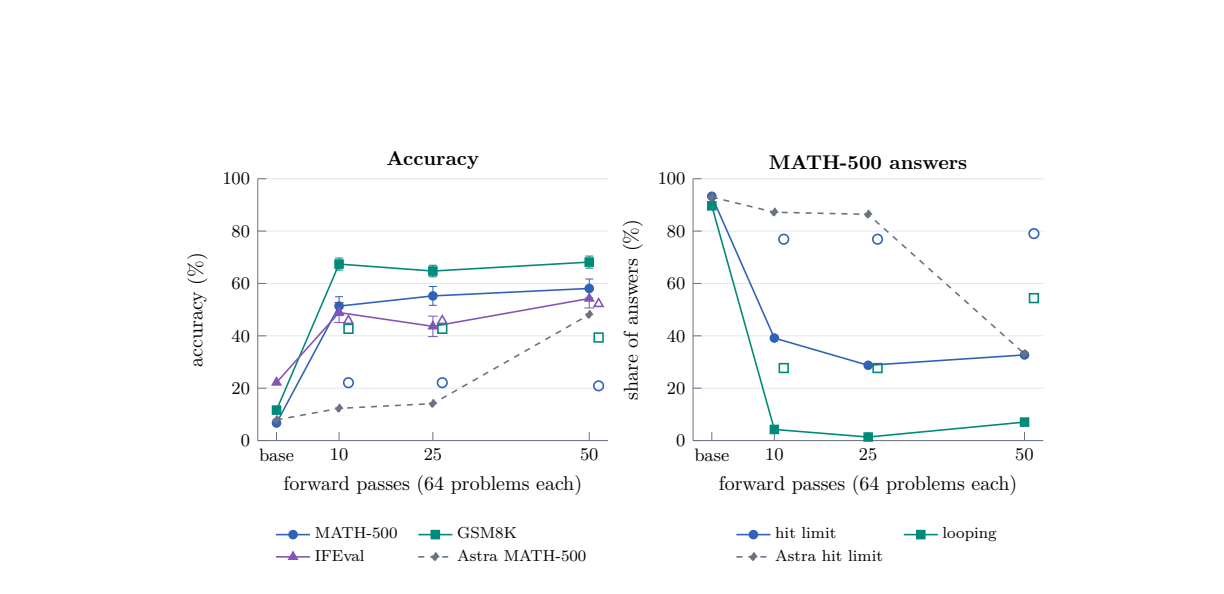
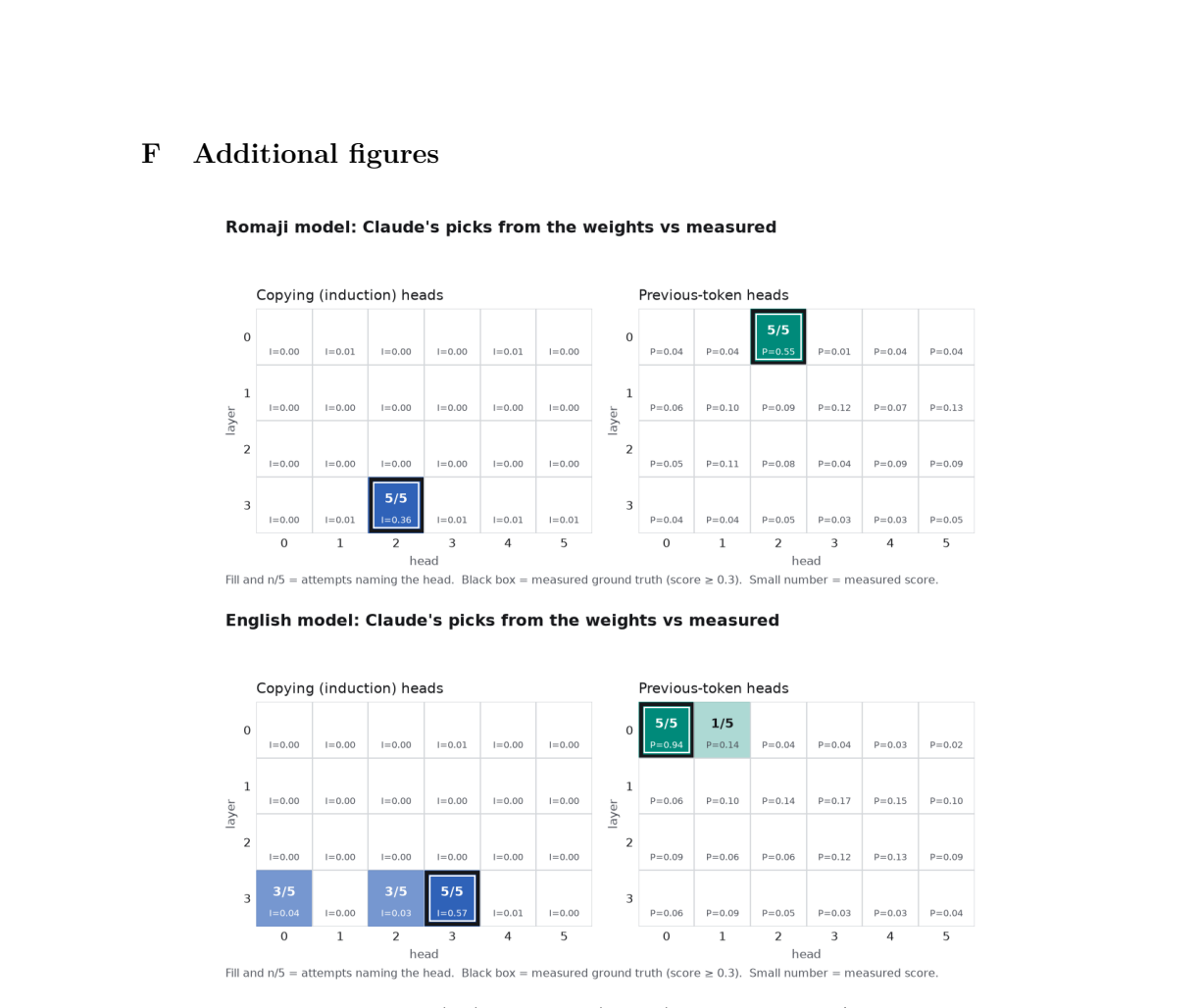
I re-ran the core of that study with Claude Opus 5.5 in ten pre-registered experiments, with untrained-network and permutation controls and hand audits of every sandboxed code cell. Reading was mixed: Claude named 3 of 4 Atari games from policy weights and found the measured copying heads in 15/15 character-LM runs, but its answers about training data often followed priors. Unlike the original, it identified a sycophantic Gemma 3 270M finetune from weights alone in 6/6 runs. One-shot weight edits took a failing MountainCar policy from 0% to 100% success and a hovering LunarLander policy from 0% to 85.6%; zero-shot networks beat PPO at 100k steps on 4 of 5 environments, each implementing a textbook controller. With no training or forward passes, Claude wrote a 1.48M-parameter 9x9 Go network that won 85-94% of games against three PPO opponents. Given Qwen3.5-0.8B's weights and 10, 25 or 50 forward passes of 64 practice problems, Claude raised MATH-500 from 6.7% to 51.4%, 55.2% and 58.1% (+51.4 points at 50 passes, 95% CI [47.9, 55.0]; original 48.1%), GSM8K from 11.6% to 68.2% and IFEval from 22.2% to 54.2%. Unlike the original, which removed an internal loop direction, every edit acted at the output: it scaled the final norm, raising the effective sampling temperature, and lowered the logit of "Wait" while raising that of </think>. The norm scaling alone reaches only 20.9-22.1% on MATH-500. On Gemma 3 270M, which rarely loops, no edit helped (-0.8 points), as in the original.
from the abstract
Pith says
Machine review · deepseek-v4-flash · 17 Nov 2026 · read the full text (182,820 characters) · not checked by a person
It can be wrong. Challenge this review or reply to it.
A careful, pre-registered replication of weight-space programming with Claude Opus 5.5 that confirms the original's direction while narrowing its scope: reading structure and compiling known controllers works, but inferring training data mostly does not, and the large math gain on Qwen3.5-0.8B is partly a temperature change. This line is wrong
3 major objections · 7 minor · 2 open questions
How often objections from reviews like this one are right: not yet measured
The paper, first character to last
The reviewer was given the whole text, 182,820 characters. Not checked: figures, code, what the 13 references say.
The paper says, at §7.3, Table 14
“The equal-sized PPO network trained on 0.71M self-play games against 20M in the original, and the heuristic bot wins 42% against it, so "beats the equal-sized network" is a much weaker claim here than in the original.”
quote found in the text Pith read
A classifier read this sentence of the paper as acknowledging the concern (probability 0.97):
“Caveats.The equal-sized PPO network trained on 0.71M self-play games against 20M in the original, and the heuristic bot wins 42% against it, so “beats the equal-sized network” is a much weaker claim here than in the original.”
Pith says: Objection 1 of 3 · major
The equal-sized Go opponent was trained on only 0.71M self-play games, compared to 20M in the original study. The authors acknowledge this (line b460: 'the equal-sized PPO network trained on 0.71M self-play games against 20M in the original, and the heuristic bot wins 42% against it, so "beats the equal-sized network" is a much weaker claim here than in the original').
more of objection 1
This means that headline B ('with 50 passes, above 50% against large') is not a replication of the original's claim under comparable difficulty. The paper should either provide a stronger baseline or clearly state that this part of the replication is not informative.
What would answer it In Section 7.3 (Experiment 6), after the sentence 'The equal-sized PPO network trained on 0.71M self-play games against 20M in the original, and the heuristic bot wins 42% against it, so "beats the equal-sized network" is a much weaker claim here than in the original.', add: 'Therefore, this part of the replication is not informative for comparing with the original's claim. A stronger baseline (e.g., training the equal-sized opponent on 20M games) would be needed for a meaningful comparison.' The author verifies the fix by checking that the added text appears in the revised manuscript.
The paper says, at §8.5, Table 17 and §8.4
“Claude also had activation summaries that Astra may not have had.”
quote found in the text Pith read
Pith says: Objection 2 of 3 · major
The practice tool in Experiment 8 returned per-layer mean activation summaries, which the original study does not describe. The authors note this (line b609: 'Claude also had activation summaries that Astra may not have had'). This additional information likely made the task easier, as Claude used it for logit-lens readouts. The paper should discuss whether the replication is valid given this difference in the information available to the model. The pre-registration rule for replication does not account for this asymmetry.
What would answer it In Section 9 (Comparison with the original), after the sentence 'Claude also had activation summaries that Astra may not have had.', add: 'This asymmetry means the replication is not a direct comparison of the two models' capabilities, as Claude had access to more information. The pre-registration rule for replication does not account for this, and the results should be interpreted with this caveat.' The author verifies the fix by checking that the added text appears in the revised manuscript.
The paper says, at §5.3, Table 8
“The drawing judge is too lenient to use as evidence.”
quote found in the text Pith read
A classifier read this sentence of the paper as acknowledging the concern (probability 0.90):
“The “earliest alias” rule can reward a hedged mention, as the two circle hits show; a rule requiring the shape word to be the head noun would have been stricter.”
Pith says: Objection 3 of 3 · major
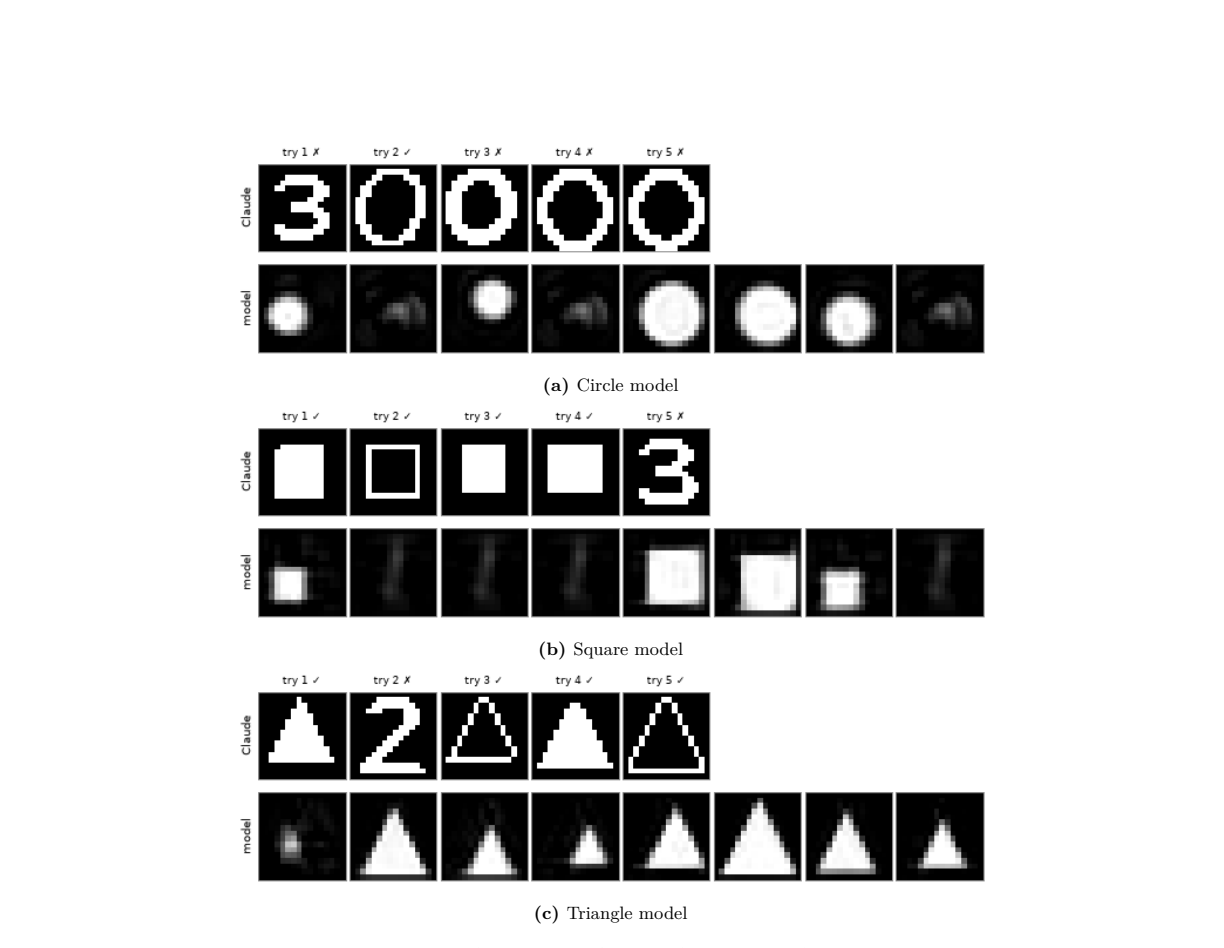
The drawing judge in Experiment 2 has no 'other' class and always returns one of the three shapes, so all 15 main drawings were graded correct even when they depicted digits (e.g., a '3' and a '2'). The authors acknowledge this (line b609: 'The drawing judge is too lenient to use as evidence').
more of objection 3
The primary metric (text label) is more reliable, but even there the 'earliest alias' rule credited two circle runs that answered 'handwritten digits' through the alias 'ring'. The paper reports both readings, which is good practice, but the pre-registered grading rules should have anticipated these edge cases.
What would answer it In Section 5.3 (Experiment 2), after the sentence 'The drawing judge is too lenient to use as evidence.', add: 'The pre-registered grading rules should have anticipated these edge cases (e.g., a drawing of a digit being graded as a shape). Future work should include a stricter grading rule, such as requiring the shape word to be the head noun in the description.' The author verifies the fix by checking that the added text appears in the revised manuscript.
7 minor objections
The paper says, at §4.1, Table 3
Pith says: minor objection 1 of 7
The table lists 'Training and quality' with returns for Atari policies but does not report standard deviations or confidence intervals for these returns. Given that the paper emphasizes proper statistical reporting elsewhere, adding variability measures would be consistent.
The paper says, at §5.1, Figure 3
Pith says: minor objection 2 of 7
The figure caption says 'A guess among the four games scores 25%', but the null hypothesis should account for the fact that Claude could name any of 60+ ALE games, making the chance level much lower. The paper acknowledges this in the text (line b609: 'which is conservative given that Claude could name any of 60 or more ALE games'), but the figure's 25% reference line is misleading without this context.
show 5 more
The paper says, at §8.4
Pith says: minor objection 3 of 7
The protocol changes section lists several modifications made after the first API call (budget units, practice-only mode, temperature analysis, sandbox pipe fix). While each is documented with dates and reasons, the cumulative effect of these changes on the experiment's integrity should be discussed.
more of objection 3
The temperature analysis was added after the pilot and before the 25- and 50-pass runs, which is good, but the fact that the 10-pass run could not save an embedding edit due to a harness bug means the three budget runs are not directly comparable in their edit mechanisms.
The paper says, at §10
Pith says: minor objection 4 of 7
The discussion states that 'the permutation control was close to trivial' because permuting hidden units leaves input rows and output columns unchanged. This is an important methodological point that deserves more attention in the main text, not just in the discussion. The paper could suggest a stronger control (e.g., permuting input bytes) for future work.
The paper says, at §11
Pith says: minor objection 5 of 7
The limitations section is thorough but could be better organized. Some limitations listed here (e.g., 'One model, one effort level, one context') are fundamental to the study's scope and should be stated earlier, perhaps in the introduction or methods.
The paper says, at §4.5
Pith says: minor objection 6 of 7
The pre-registration section states that 'Pre-registration covers grading, not design'. This is an important caveat, as the design error in Experiment 1b v1 was not caught by the pre-registration. The paper is transparent about this, but readers should be aware that the pre-registration does not guarantee the soundness of the experimental design.
The paper says, at §9, Table 19
Pith says: minor objection 7 of 7
The comparison table is useful but the column 'How the setups differ' sometimes conflates differences that are inherent to the replication (different environments) with differences that are choices (different attempt counts). For example, the row for Experiment 5 notes 'PPO budgets 100M vs 100k steps' but does not note that the original's PPO-100M was trained on MinAtar while this paper's PPO-100k was trained on Gymnasium, making the comparison even less direct.
Open questions (2)
Pith raised these and could not confirm them against the text of the paper it read. They are questions for the authors, not findings.
- §8.5, Table 18 Pith raised a concern here that it could not check against the text of the paper it was given, so it is not published as an objection.
- §5.2, Table 7 Pith raised a concern here that it could not check against the text of the paper it was given, so it is not published as an objection.
What would settle it
If a future study with a different frontier model (e.g., GPT-6 Astra) and the same pre-registered controls (untrained networks, permutation controls, repeated attempts) found that the model could reliably infer training data (e.g., naming the training language of a character LM from its middle blocks, or identifying the shape a DDPM draws from its weights) with high confidence and without relying on priors, then the paper's claim that weight-space programming for data inference does not work would be falsified.
from Pith's summary of the paper
How the review went
5 passes by deepseek-v4-flash · 17 Nov 2026
- Reader holds up, with conditions
- Skeptic concern not confirmed: listed as an open question
- Referee 3 major objections, 7 minor
- Check against the paper kept 3 of 6 objections
- Editor wrote the verdict above
Not run on this paper: the simulated authors' defence.
Pith's passes raised 6 objections. A check against the paper's text kept 3 and left 3 as questions.
The review in full
The review in brief, machine-written
This paper replicates Takehi et al. (2026) with Claude Opus 5.5, adding pre-registered grading, repeated attempts, and controls for prior-driven answers. The headline result is that weight-space programming is real but narrower than the original suggested.
What the paper does well: it is transparent about its methods, limitations, and every caveat. The pre-registration, untrained-network controls, and hand audits of sandboxed code are a model for how replication studies should be done. The cost ($83.38) is reported, and all logs are released. The paper identifies a clear pattern: Claude reads structure it can recognise (copying heads, RAM bytes, known controllers) and falls back on priors when asked about training data.
The soft spots are real and the paper acknowledges most of them. The equal-sized Go opponent was trained on 0.71M games vs 20M in the original, so the Go replication is not informative. The practice tool in Experiment 8 returned per-layer activation summaries that the original does not describe, making the comparison asymmetric. The temperature confound in Experiment 8 is significant: about a third of the math gain and nearly all of the IFEval gain is a change in effective sampling temperature, not weight-space programming in the original's sense. The drawing judge in Experiment 2 has no 'other' class and is too lenient. Several results are based on small sample sizes (one run per budget in Experiments 5b and 6).
Who this is for: researchers working on weight-space programming, mechanistic interpretability, and replication studies. The paper deserves a serious referee. It is a well-conducted replication that provides valuable evidence about where weight reading works and fails, even if the central claims are narrower than the original's headlines.
Recommendation: accept with major revisions. The authors should address the temperature confound more directly, provide stronger baselines for the Go experiment, and discuss the asymmetry in the practice tool. The paper's transparency is a strength, and the core findings are worth publishing.
The stress test's concern
Not confirmed. Pith could not check this concern against the text of the paper it was given; it is listed as an open question, not a finding.
The referee's report
Not published. Pith's referee wrote this assessment before its objections were checked against the paper, and 2 of its 5 major objections did not survive that check.
Pith's reading of the paper (a machine's summary, not the authors')
This paper attempts to replicate the core experiments of Takehi et al. (2026), who reported that GPT-6 Astra could read, repair, and write neural network weights from raw numbers. The author re-runs those eight probes with Claude Opus 5.5 on new networks (and one on the original's own model), using pre-registered grading, repeated attempts, and controls. The central finding is that the capability is real but narrower than the original's headlines suggest: Claude reads structure it can recognise (attention circuits, known controllers, memorised RAM maps) and compiles textbook controllers into weights, but it fails to infer training data, falling back on priors about interface shape, dataset defaults, and famous games. The largest claim—improving Qwen3.5-0.8B's MATH-500 score from 6.7% to 58.1% with 50 forward passes—replicates, but the mechanism differs from the original's (output-side edits including a temperature change, not an internal loop-direction ablation), and about a third of the math gain is a temperature effect. The paper concludes that weight-space programming works for structure recognition and known-program compilation, but not yet for data inference, and that the original's direction holds with narrower scope.
What carries the argument. The central object is the weight-space programming protocol: serialising a neural network's weights as text (one input unit per row, in a fixed format) and presenting them to a frontier language model (Claude Opus 5.5) with a natural-language question about what the network was trained to do, how to repair it, or what weights a new network should have. The key machinery is the model's ability to read structure from weight matrices (e.g., forming QK/OV products to identify induction heads, reading output-layer rows as image parts, detecting untrained networks from initialisation scale) and to compile known controllers (LQR, Gymnasium heuristic, velocity-sign pumping, Go heuristics) into weights by setting a few hidden units and zeroing the rest. The paper also introduces a sandbox isolation system (macOS Seatbelt profile plus import hook) that allows the model to analyse weights with numpy but forbids running the subject network, and a practice tool that returns per-layer mean activation summaries alongside generation statistics.
Core claim. The paper establishes that a frontier language model (Claude Opus 5.5) can, given only the raw weights of small neural networks as text, reliably read structural features (copying heads in 15/15 runs, sycophantic finetunes in 6/6 weights-only runs, untrained networks in 10/10 runs) and compile known textbook controllers into working weights (zero-shot policies beating PPO at 100k steps on 4/5 environments, one-shot repairs of failing policies). However, it cannot infer training data: answers about training language, dataset, or game identity are dominated by priors (interface shape, dataset defaults, famous games) even when the model's own analysis contains the correct evidence. The paper's key methodological contribution is a pre-registered, controlled replication with repeated attempts, untrained-network and permutation controls, and hand audits, which reveals that the original's headline successes in data inference do not replicate under these conditions, while the largest claim (improving Qwen3.5-0.8B at math) does replicate but through a different mechanism (output-side edits including a temperature change, not an internal loop-direction ablation).
The premise it rests on. The paper assumes that the model's ability to read structure and compile known controllers into weights generalizes to novel tasks and architectures, but the results show that the model often relies on memorized priors (e.g., interface shape, dataset defaults, famous games) and fails to infer training data reliably.
If the paper is right (Pith's inferences, not the authors')
If the paper's central claim is correct, then weight-space programming is a real but narrow capability: frontier models can read and compile known structures into weights, but cannot yet infer training data from weights alone. This means that the original's most striking claims about data inference (naming training language, identifying shapes from DDPM weights) are not reproducible under controll
The replication of the Qwen3.5-0.8B math improvement (from 6.7% to 58.1% on MATH-500) with a different mechanism (output-side edits including a temperature change) suggests that the original's internal loop-direction ablation is not the only way to achieve this gain, and that a significant fraction of the improvement may be a temperature effect. This has implications for interpreting the original'
The paper's finding that Claude's answers about training data follow priors (interface shape, dataset defaults, famous games) even when its own analysis contains the correct evidence suggests that weight-space programming for data inference is not yet reliable, and that future work should focus on developing methods to overcome these priors (e.g., by explicitly prompting the model to consider alte
The paper's demonstration that Claude can compile known controllers into weights (LQR, Gymnasium heuristic, Go heuristics) without testing them suggests that weight-space programming may be useful for rapid prototyping of control policies, especially in environments where a good closed-form controller is known. However, the reliance on memorised interfaces (AtariARI RAM maps, Gymnasium heuristic)
The paper's pre-registered, controlled replication methodology (with repeated attempts, untrained-network and permutation controls, and hand audits) provides a template for future replication studies in this area, and the finding that several of the original's results do not replicate under these conditions underscores the importance of such controls.
The paper's finding that Claude's Qwen edit includes a temperature change (scaling the final norm) that accounts for about a third of the math gain and nearly all of the IFEval gain suggests that the original's reported gains on IFEval (from 21.0% to 62.3%) may also be partly a temperature effect, which the original did not control for. A testable extension would be to re-run the original's IFEval
The paper's observation that Claude's Go network (written with no forward passes) wins 85-94% of games against PPO opponents trained on 0.71M-2.6M self-play games, but that the equal-sized opponent is much weaker than the original's (0.71M vs 20M games), suggests that the headline 'beats the equal-sized network' is not informative. A stronger test would be to train the equal-sized opponent to the
The paper's finding that Claude's answers about training data follow priors even when its own analysis contains the correct evidence (e.g., measuring a code-sized vocabulary for the Python model but answering 'English') suggests that the model may have a 'confirmation bias' in weight reading: it finds evidence that supports its prior and explains away contradictory evidence. This could be tested b
The paper's demonstration that Claude can detect sycophantic finetunes from weights alone (6/6 runs) when given the shared embedding and vocabulary, while the original's Astra could not (0/4), suggests that the availability of the embedding and vocabulary is a critical factor. A testable extension would be to re-run the original's sycophancy probe with the embedding and vocabulary provided to see
Check this review
What was read
The passes were given all 182,820 characters of the text of the paper's PDF.
Fingerprint of that text (SHA-256): 864f69de3660502c8266e7489f29c59b3b455399597ca57468205947b6a98c85
Pith does not keep that text. Rebuilt from the paper's source or PDF by the same code, it has this fingerprint if it is the same text. From a copy of Pith's code:
PYTHONPATH=. python scripts/review_input_check.py 2611.20953
The passes, in the order they ran
- Reader deepseek-v4-flash · medium effort · $0.0059 · instructions of the Reader, fingerprint f9ead7300382…
- Skeptic deepseek-v4-flash · medium effort · $0.0054 · instructions of the Skeptic, fingerprint 8f88c0f61488…
- Referee deepseek-v4-flash · medium effort · $0.0057 · instructions of the Referee, fingerprint a852d99aea0d…
- Check against the paper deepseek-v4-flash · medium effort · $0.0076 · instructions of the Check against the paper, fingerprint 6c7a6883d551…
- Editor deepseek-v4-flash · medium effort · $0.0054 · instructions of the Editor, fingerprint e7211f6a3d27…
- Summary for the page deepseek-v4-flash · medium effort · temperature 0.2 · $0.0059 · instructions of the Summary for the page, fingerprint e4f56bf568e7…
The passes cost $0.036 in model calls together.
Version stamped on this review: pith-pipeline@v1.4.1-daily-deepseek-or-medium+deepseek/deepseek-v4-flash+p.0ef1a750a3e3
Each link opens a pass's instructions as plain text, the exact bytes its fingerprint was taken over. Every stored set of instructions.
curl -s https://pith.science/methodology/prompts/f9ead730038216984cfb56d7cb34332bdf691828296a1de4245f3d6667d4bf56 | sha256sum
prints the fingerprint of the reader's instructions. The same works for every pass.
The receipt
The review's fingerprint was taken on 17 Nov 2026. The review you are reading still matches it.
Fingerprint of the review (SHA-256): 0f284a19b276352fd96838ec397bffec846e605e01ca2705c9b40fe69d688eb2
curl -s 'https://pith.science/api/v1/verdicts/2611.20953?form=canonical' | sha256sum
prints the fingerprint of the review as it stands now. The rule, in four steps.
A matching fingerprint shows the review has not changed since that date. It does not show that the review is right.
How often reviews like this one are right
Reviews like this one: written by deepseek-v4-flash, from the text of the paper's PDF.
How often objections from reviews like this one are right: not yet measured
Reviews by people
This review was written by a machine. No person has reviewed this paper on Pith yet. A scientist listed on Pith can review it for a fee, and their review is published here whatever it concludes.
How Pith checks papers · The full audit of this paper · Review history (2 versions)
The paper
Abstract
Takehi et al. (2026) report that GPT-6 Astra, given the weights of small neural networks as text, can say what they were trained to do, repair them, and write new ones without training. I re-ran the core of that study with Claude Opus 5.5 in ten pre-registered experiments, with untrained-network and permutation controls and hand audits of every sandboxed code cell. Reading was mixed: Claude named 3 of 4 Atari games from policy weights and found the measured copying heads in 15/15 character-LM runs, but its answers about training data often followed priors. Unlike the original, it identified a sycophantic Gemma 3 270M finetune from weights alone in 6/6 runs. One-shot weight edits took a failing MountainCar policy from 0% to 100% success and a hovering LunarLander policy from 0% to 85.6%; zero-shot networks beat PPO at 100k steps on 4 of 5 environments, each implementing a textbook controller. With no training or forward passes, Claude wrote a 1.48M-parameter 9x9 Go network that won 85-94% of games against three PPO opponents. Given Qwen3.5-0.8B's weights and 10, 25 or 50 forward passes of 64 practice problems, Claude raised MATH-500 from 6.7% to 51.4%, 55.2% and 58.1% (+51.4 points at 50 passes, 95% CI [47.9, 55.0]; original 48.1%), GSM8K from 11.6% to 68.2% and IFEval from 22.2% to 54.2%. Unlike the original, which removed an internal loop direction, every edit acted at the output: it scaled the final norm, raising the effective sampling temperature, and lowered the logit of "Wait" while raising that of </think>. The norm scaling alone reaches only 20.9-22.1% on MATH-500. On Gemma 3 270M, which rarely loops, no edit helped (-0.8 points), as in the original.
The paper's own sentences, arranged, kept beside the review and separate from it. Each label is drawn from a closed vocabulary; the number beside it is the probability the classifier gave that label. No sentence in this record was written by a model.
abstract compiled · 2026-11-17
The authors' main claim, as the classifier picked it out 0.68
“Unlike the original, which removed an internal loop direction, every edit acted at the output: it scaled the final norm, raising the effective sampling temperature, and lowered the logit of "Wait" while raising that of </think>.”
How the main claim is stated: asserted 1.00
What the abstract itself states, as probabilities: claims first 0.05 · states limitation 0.90 · human participants 0.08 · controlled comparison 0.97 · randomized assignment 0.07 · states quantitative result 0.98 · compares with prior results 0.98 · mentions code or data availability 0.05
The abstract, sentence by sentence
This table labels the abstract only (arXiv listing abstract v1). The number is the probability the classifier gave the label.
| Sentence | Role | The authors' own work | States the main conclusion | Strength |
|---|---|---|---|---|
| Takehi et al. (2026) report that GPT-6 Astra, given the weights of small neural networks as text, can say what they were trained to do, repair them, and write new ones without training. | background 1.00 | 0.03 | 0.08 | asserted 1.00 |
| I re-ran the core of that study with Claude Opus 5.5 in ten pre-registered experiments, with untrained-network and permutation controls and hand audits of every sandboxed code cell. | method 0.84 | 0.95 | 0.06 | asserted 0.99 |
| Reading was mixed: Claude named 3 of 4 Atari games from policy weights and found the measured copying heads in 15/15 character-LM runs, but its answers about training data often followed priors. | result 1.00 | 0.93 | 0.12 | asserted 1.00 |
| Unlike the original, it identified a sycophantic Gemma 3 270M finetune from weights alone in 6/6 runs. | result 1.00 | 0.87 | 0.07 | asserted 1.00 |
| One-shot weight edits took a failing MountainCar policy from 0% to 100% success and a hovering LunarLander policy from 0% to 85.6%; zero-shot networks beat PPO at 100k steps on 4 of 5 environments, each implementing a textbook controller. | result 1.00 | 0.86 | 0.14 | asserted 1.00 |
| With no training or forward passes, Claude wrote a 1.48M-parameter 9x9 Go network that won 85-94% of games against three PPO opponents. | result 1.00 | 0.88 | 0.18 | asserted 1.00 |
| Given Qwen3.5-0.8B's weights and 10, 25 or 50 forward passes of 64 practice problems, Claude raised MATH-500 from 6.7% to 51.4%, 55.2% and 58.1% (+51.4 points at 50 passes, 95% CI [47.9, 55.0]; original 48.1%), GSM8K from 11.6% to 68.2% and IFEval from 22.2% to 54.2%. | result 1.00 | 0.88 | 0.16 | asserted 1.00 |
| Unlike the original, which removed an internal loop direction, every edit acted at the output: it scaled the final norm, raising the effective sampling temperature, and lowered the logit of "Wait" while raising that of </think>. | interpretation 0.55 | 0.84 | 0.28 | asserted 1.00 |
| The norm scaling alone reaches only 20.9-22.1% on MATH-500. | result 0.97 | 0.84 | 0.05 | asserted 1.00 |
| On Gemma 3 270M, which rarely loops, no edit helped (-0.8 points), as in the original. | result 0.98 | 0.80 | 0.06 | asserted 1.00 |
What kind of paper the classifier reports this is: empirical study 1.00 · evidence from observation or experiment 0.98
What was examined, and what was not
Sources read
- arXiv listing abstract v1
Not examined
- full text
- figures and tables
- references and citing sentences
- relations to other papers
Levels run
- P abstract
Not run
- S sections
- T body sentences
- C citations
- R cross-paper relations
How the labels were made
Compiled by classifier-1.13.0 via TypeSafe API, question bank abstract-p1-20260923, 2026-11-17: 1 request, 8,224 input tokens.
Every quoted sentence on this record is the authors'. Every label is from Pith's closed vocabulary, with the probability shown beside it. This record as JSON
Figures (12)

Figures are the authors', reproduced from the paper.
References (13)
- [1] Which language or kind of text was this model trained on? Give your best specific answer and your ↪→confidence (0 to 1) that it is correct on Pith
- [2] your confidence (0 to 1) that your answer is correct, on Pith
- [3] the reasoning from the weights that led you there. <weights> # MLP 128 -> 64 -> 64 -> 18, tanh activations, 13586 weights # W<k> row i = weights from input unit i of layer k to every output unit; b<k> = bias of layer k # quantized: value = integer * 0.001 [... 259 weight lines... on Pith
- [5] For each of the 24 attention heads (written layer.head, e.g. 2.4), give a short label for its role. Say ↪→explicitly which heads are copying (induction) heads, i.e. heads that find an earlier occurrence of the ↪→current context and copy what came after it. Also say which heads... on Pith
- [6] Termination: The position of the car is greater than or equal to 0.5 (the goal position on top of the ↪→right hill) on Pith
- [7] Truncation: The length of the episode is 200. ## Source (gymnasium/envs/classic_control/mountain_car.py, rendering removed) ```python def __init__(self, render_mode: str | None = None, goal_velocity=0): self.min_position = -1.2 self.max_position = 0.6 self.max_speed = 0.07 sel... on Pith
- [8] Explain why this network fails. Point to the specific weights, units and parts of the trace that show it on Pith
- [9] Change the weights so that the greedy policy succeeds as often as possible. Success means: the car ↪→reaches the flag (position >= 0.5) before the 200-step time limit. It will be evaluated over many ↪→episodes with random starting conditions as described in the environment on Pith
- [10] Give your change as edits to this network. Any weight you don't mention keeps its current value. You may ↪→change as many or as few weights as you like, and you may repurpose hidden units, but the architecture (2 ↪→-> 64 -> 64 -> 3, tanh) and the input/output meaning are fixed... on Pith
- [11] Termination: Pole Angle is greater than +/-12 deg on Pith
- [12] Termination: Cart Position is greater than +/-2.4 (center of the cart reaches the edge of the display) on Pith
- [13] Truncation: Episode length is greater than 500 (200 for v0) ## Source (gymnasium/envs/classic_control/cartpole.py, rendering removed) ```python def __init__( self, sutton_barto_reward: bool = False, render_mode: str | None = None ): self._sutton_barto_reward = sutton_barto_rew... on Pith
- [2026] URL https://rikiyat.github.io/blog/weight-space-programming/. Logs athttps: //github.com/RikiyaT/lm_understand-logs. J. K. Terry, Benjamin Black, Nathaniel Grammel, Mario Jayakumar, Ananth Hari, Ryan Sullivan, Luis Santos, Rodrigo Perez, Caroline Horsch, Clemens Dieffendahl, N... on PithPith's reviewarXiv
Cited by 1 Pith paper
Reviewed papers on Pith that cite this one. The full citation record
Challenges and discussion
Disagree with the review, or know something it missed? Leave a comment, or challenge this review formally: a challenge becomes a permanent entry in this paper's record, and its decision is published here.
Come back by email
A short list of the week's newly reviewed papers. Nothing is sent until you confirm from your inbox, and every email has a link that stops it. No account.
No comments yet.
Sign in to comment