Statistical Mechanics · arXiv:2610.18320 v1 · submitted 13 Oct 2026 · 49 references
Charge-selective topological locking and ultraslow coarsening in magnetoelastic media
The paper says
“We demonstrate that the symmetry of magnetoelastic coupling governs the topological organization of composite defects and can qualitatively alter phase-ordering kinetics.”
more of the abstract
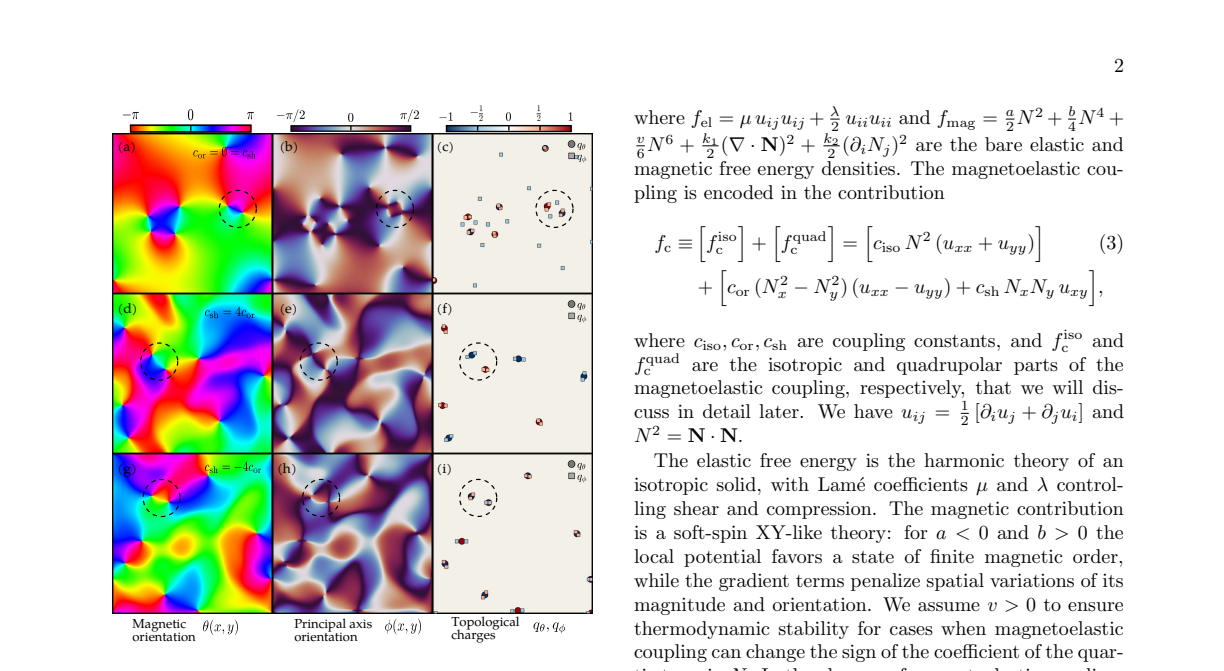
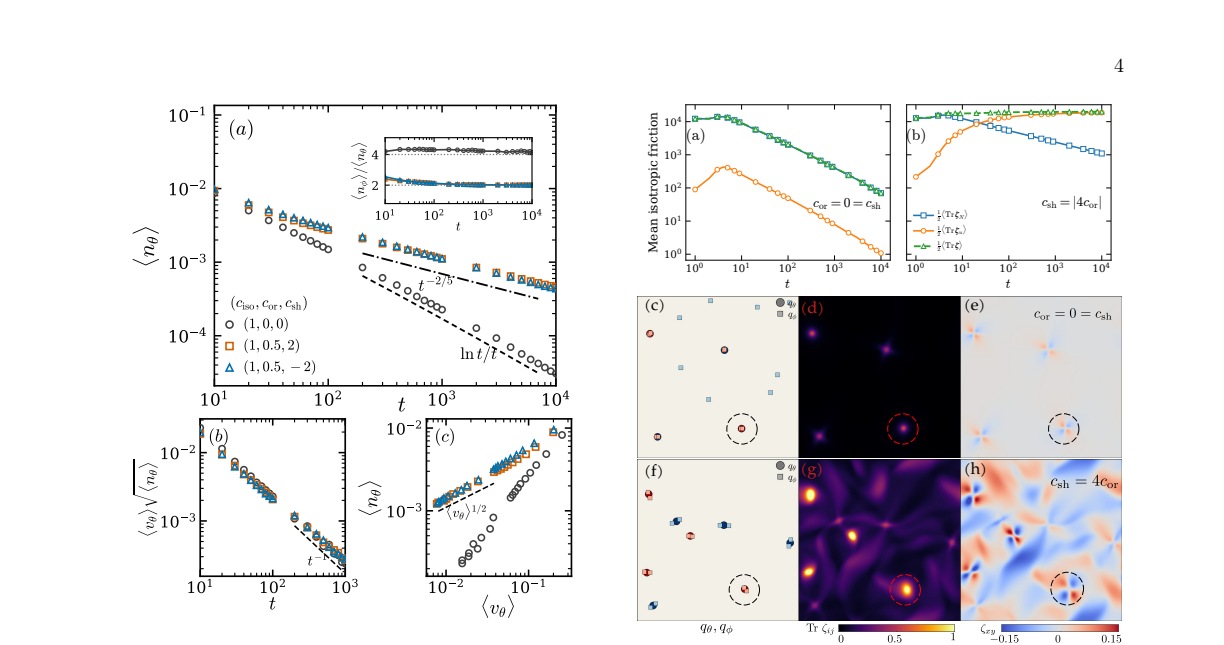
In a two-dimensional theory of an in-plane magnetic vector coupled to elastic strain, we find that integer magnetic vortices bind pairs of elementary elastic half-defects. Isotropic magnetostriction produces a core-induced elastic winding independent of the magnetic charge, giving defect binding without charge locking and leaving the magnetic sector with essentially XY-like coarsening. In contrast, quadrupolar magnetoelastic coupling locks magnetic and elastic defect charges: continuous rotational symmetry favors qφ = qθ, whereas crystalline anisotropy can reverse the locking to qφ = −qθ. We reveal that both locking sectors display anomalously slow vortex annihilation: defect density shows a power-law decay t−2/5, while the average defect-velocity scales as t−4/5. These results are consistent with a dynamic exponent z ≃ 5. We show that this coarsening slowdown is associated with large anisotropic elastic friction. An adiabatic elimination of the elastic field reveals that isotropic magnetostriction merely renormalizes local magnetic interactions, whereas orientational coupling induces effective nonlocal interactions between magnetic spins. Our experimentally testable results thus establish magnetoelastic coupling symmetry as a means of controlling defect topology and ordering kinetics.
from the abstract
Pith says
Machine review · deepseek-v4-flash · 14 Oct 2026 · what was read was not recorded · not checked by a person
It can be wrong. Challenge this review or reply to it.
Holds up, with conditions. The topological locking rule is clean, parameter-free, and citable now; the z≈5 exponent is a plausible numerical candidate that needs error bars, fit ranges, and finite-size checks before it can carry the paper's headline. This line is wrong
3 major objections · 5 minor
How often objections from reviews like this one are right: not yet measured
Not checked: figures, code, what the 49 references say.
The paper says, at Ultraslow coarsening (Fig. 2, Eqs. (9)-(11))
The review did not quote this passage.
Pith says: Objection 1 of 3 · major
The central quantitative claim z ≈ 5 is supported only by log-log slopes inferred from Fig. 2: 40 realizations at L = 512 for panel (a) and 128 realizations at L = 256 for panels (b,c), with no error bars, no stated fitting range or fitting procedure, no finite-size comparison, and no sensitivity analysis of the defect-core threshold ρ_cut = 0.08 used in Eq.
more of objection 1
(S11). Over the displayed window t ≈ 10^2–10^4 the inferred length ℓ ~ n^(−1/2) grows only by a factor of about 2.5, so the asymptotic slope can be strongly contaminated by subleading corrections and by the choice of window boundaries. Since the abstract and Discussion advertise t^(−2/5), t^(−4/5) and z ≈ 5, and since the authors themselves note in the Discussion that the analytic derivation of z = 5 'remains nontrivial', this numerical evidence is effectively the only support for the headline result. The manuscript should report realization-based error bars, explicit fit intervals and alternative functional forms (e.g., (ln t)/t or stretched-power fits), a comparison of at least two system sizes, and a check of the ρ_cut dependence, or else the abstract should be reworded to present the exponent as preliminary.
The paper says, at Ultraslow coarsening, Eq. (11)
The review did not quote this passage.
Pith says: Objection 2 of 3 · major
The velocity rescaling in Fig. 2(b) is not an independent confirmation of z = 5. Under the single-length assumption, ⟨v_theta⟩ ~ ℓ/t with ℓ ~ n^(−1/2) gives ⟨v_theta⟩ sqrt(⟨n_theta⟩) ~ 1/t for any value of z, and conversely once n_theta ~ t^(−2/5) is imposed the same relation algebraically yields v ~ t^(−4/5).
more of objection 2
The authors do state the single-length assumption when introducing Eq. (11), but the subsequent text describing 'independently measured defect numbers and velocities' as bearing signatures of a common length scale overstates the logical status: the collapse in Fig. 2(b) tests consistency with the single-length hypothesis, not the specific exponent. Consequently the evidence for z ≈ 5 reduces to the slopes of n_theta(t) and v_theta(t) themselves, which are subject to the fitting concerns raised above; the paper should state this explicitly.
The paper says, at Fig. 2(a) inset and elastic defect density
The review did not quote this passage.
Pith says: Objection 3 of 3 · major
The claim that the elastic defect density shares the t^(−2/5) decay, and hence that both locking sectors coarsen with the same exponent, rests entirely on the inset of Fig. 2(a), which shows only the ratio ⟨n_phi⟩/⟨n_theta⟩ versus t. The treatment of this inset is not described: no error bars are shown, no fit to the ratio or to ⟨n_phi(t)⟩ is …
more of objection 3
… reported, and the assertion that the ultraslow regime 'coincides with' ⟨n_phi⟩ ≃ 2⟨n_theta⟩ is made without a quantitative definition of the onset. A direct log-log plot of ⟨n_phi(t)⟩ for both c_sh = ±4c_or, documented with the same fitting care as the magnetic density, is needed to support the abstract's statement that both sectors display the ultraslow decay.
5 minor objections
The paper says, at Sec. S3, Eq. (S70)
Pith says: minor objection 1 of 5
The symbol q_phi denotes the integer total composite winding in Eq. (S70) (q_phi = ±q_theta), whereas elsewhere (Sec. S1 and the main text) q_phi denotes the elementary half-integer defect charge; a distinct symbol such as q_phi^tot for the composite winding would remove this ambiguity.
The paper says, at Main text around Eqs. (9)-(11)
Pith says: minor objection 2 of 5
The sentence 'both defect densities decay as t^(−2/5), while the mean defect velocities decay as t^(−4/5)' can be read as claiming that the elastic-sector velocity also scales as t^(−4/5), whereas Fig. 2(b,c) report only ⟨v_theta⟩; either state explicitly that the reported velocity exponents refer to the magnetic sector or show the elastic-sector velocity data.
show 3 more
The paper says, at Dissipative mechanics section, closing paragraph
Pith says: minor objection 3 of 5
The sentence 'the ultraslow coarsening is, therefore, a signature of the anisotropic redistribution of dissipation into an extended elastic sector' states a causal mechanism, but Fig. 3 establishes a correlation between charge locking and large elastic friction; recommend softening 'therefore' to 'is accompanied by'.
The paper says, at Main text near Fig. 2(a)
Pith says: minor objection 4 of 5
The statement that the appearance of the ultraslow regime 'coincides with' ⟨n_phi⟩ ≃ 2⟨n_theta⟩ needs a testable definition of the onset (e.g., a threshold density or a crossover time), since otherwise the coincidence cannot be checked by readers.
The paper says, at Fig. 2(a) caption
Pith says: minor objection 5 of 5
The comparison of the isotropic-coupling data (black circles) with the XY prediction (ln t)/t from Ref. [3] is displayed without a stated fitting or alignment procedure; a brief description of how the reference curve was matched would help the reader judge the quality of the claimed XY-like coarsening.
What would settle it
Re-analyze the existing simulation data (or rerun the dynamics) and report: (i) log-log slopes for n_θ, n_ϕ, and ⟨v_θ⟩ over a stated late-time window with bootstrap 95% confidence intervals across realizations; (ii) the same fits at L=1024 and at dx=0.5 and 1.0, and with ρ_cut = 0.04, 0.08, and 0.16; (iii) a direct measurement of the magnetic correlation length ℓ(t) from ⟨cos(θ(r)−θ(0))⟩, tested against ℓ(t)∼t^(1/z) for z=5 over the same window. If the direct correlation-length exponent deviates from z=5 by more than the bootstrap uncertainty, or if the density/velocity exponents shift by more than the stated error bars under the finite-size or threshold changes, the universal z=5 claim should be downgraded.
from the skeptic's reading
How the review went
4 readings by deepseek-v4-flash · 14 Oct 2026
- Reader holds up, with conditions
- Skeptic agrees
- Editor wrote the verdict above
- Referee major revision: 3 major objections, 5 minor
Not run on this paper: the simulated authors' defence.
Pith did not check this review's objections against the paper.
The review in full
The review in brief, machine-written
Two things to know. The topological analysis is genuinely good and new: the locking rule q_phi = sgn(c_or c_sh) q_theta comes out of a parameter-free minimization of the stated quadrupolar coupling (Sec. S3), and the isotropic case is organized clearly — core-induced elastic winding of charge +1 that fractionalizes into two +1/2 defects regardless of the magnetic charge sign (Sec. S2). The adiabatic elimination in Appendix A is a nice bonus: isotropic coupling only renormalizes local magnetic terms, while orientational coupling produces nonlocal interactions. The paper also reproduces the known 2D XY lnt/t coarsening as a control, which says the numerics are sound in the regime where the answer is already known.
Now the soft spot, and it is the advertised headline. z ≈ 5 is extracted from log-log slopes over a late-time window in which the inferred length grows by only a factor of about 2.5. No error bars, no stated fitting ranges, no finite-size check (density runs are all 512x512, velocity runs 256x256), and no sensitivity analysis for the velocity threshold rho_cut = 0.08. The velocity collapse in Fig. 2(b) is not independent confirmation: under the single-length assumption v ~ l/t, so once n ~ t−2/5 is put in, the t−1 product follows automatically. The parametric v–n plot in Fig. 2(c) carries the most weight, but it shares the same window and the same assumption. Minor by comparison: the claim that the elastic density shares the decay rests on an inset whose data treatment is not described. To the authors' credit, they state that an analytical derivation 'remains nontrivial' and label the single-length hypothesis as an assumption; the gap is the fitting evidence, not the framing.
If the z=5 story survives added analysis — bootstrap errors, fit-range stability, one larger system, rho_cut sensitivity — the claim that both locking sectors share the same exponent is the most striking result in the paper. Right now it is plausible, not established. The qualitative narrative around it is well supported: charge-locked defects coarsen much more slowly, and the elastic friction becomes extended, anisotropic, and dominant. The friction argument is suggestive rather than mechanistic, and the general c_or/c_sh case is deferred to an unpublished sequel, but those are acknowledged scope limits, not flaws.
Bottom line. This deserves a serious referee. The topological results are citable on their own, and a referee can fairly ask that the scaling analysis catch up with the abstract — or that the abstract catch up with the scaling analysis. I'd take the locking rule now and wait on the exponent.
The strongest objection
The central quantitative claim—z≈5 with both magnetic and elastic defect densities decaying as t^(−2/5) and velocities as t^(−4/5) in both locking sectors, Eqs. (9)–(11) and Fig. 2—is a numerical inference whose supporting evidence is not yet strong enough to carry the paper's headline. Fig. 2(a) uses 40 realizations on a 512×512 lattice; Fig. 2(b,c) use 128 realizations on 256×256, with no error bars, no stated fitting interval, no bootstrap or alternative-fit comparison, and no sensitivity analysis of the defect-core threshold ρ_cut = 0.08 used in Sec. S1. Over the displayed range t≈10^2–10^4 the inferred length ℓ(t) grows only by roughly a factor of 2.5, so log-log slopes in this window can be strongly affected by subleading corrections and by the choice of window boundaries. The equality of the magnetic and elastic exponents rests on the inset of Fig. 2(a), whose data treatment is not described. Moreover, Eq. (11) is not an independent check: under the single-length assumption it defines ⟨v⟩∼ℓ/t, so once n∼t^(−2/5) is inserted, v∼t^(−4/5) follows automatically; plotting ⟨v⟩√n against t therefore does not by itself confirm z=5. The authors explicitly acknowledge both that the analytical derivation of z=5 'remains nontrivial' and that Eq. (11) assumes a single growing length, so this is a strengthening issue rather than an internal contradiction; nevertheless, the universal ultraslow exponent is exactly what the abstract and discussion advertise, making this the most load-bearing unsecured part of the argument.
I read the paper in good faith. The topological analysis in Sec. S3—the mapping from the quadrupolar coupling to the winding rule q_ϕ = sgn(c_or c_sh) q_θ—is coherent, parameter-free up to the sign of the coupling product, and agrees with the special cases c_sh = ±4c_or. The isotropic-core argument in Sec. S2 is a plausible radial approximation and supports the qualitative binding-without-charge-locking picture. The adiabatic elimination in Appendix A correctly identifies a distinction between purely local renormalization for isotropic magnetostriction and nonlocal effective interactions for orientational coupling. The proposed mechanism of extended elastic friction is qualitatively consistent with the simulation snapshots. The weak point is therefore not the topology or the qualitative slowdown but the quantitative claim of a common z=5 exponent. The paper itself flags the missing analytical derivation and the single-length assumption; what remains unresolved is that the extracted exponent has no statistical or systematic-error characterization. This is exactly the reader's weakest assumption, so my agreement is full. Because the concern is strengthening evidence rather than a demonstrated contradiction, the existing CONDITIONAL verdict should stand; I therefore report UNCHANGED while emphasizing that the numerical basis for z=5 should be made explicit before the quantitative claim is treated as established.
The referee's report
The analytic part of the paper is strong and deserves explicit credit: the locking rule q_phi = sgn(c_or c_sh) q_theta (Sec. S3, Eq. S70), the core-induced elastic fractionalization for isotropic coupling (Sec. S2), and the exact integration of elastic modes leading to the effective nonlocal interactions (Sec. S5, Eq. S139) are parameter-free derivations from the stated model, and the singular-boundary structure of the locking map is handled carefully. If the kinetic claim survives scrutiny, the paper establishes a striking and experimentally testable principle: the symmetry of magnetoelastic coupling controls both the topology of composite defects and the phase-ordering exponent, with a nontrivial z ≈ 5 and a physically suggestive dissipation mechanism. The authors are commendably explicit about the scope (|c_sh| = 4|c_or|, zero temperature, single-length scaling) and about the absence of an analytic derivation of the exponent.
Pith's reading of the paper (a machine's summary, not the authors')
This paper establishes that the symmetry of magnetoelastic coupling governs both the topological organization of composite defects and the rate at which they coarsen. In a two-dimensional model of a magnetic vector coupled to elastic strain, isotropic magnetostriction binds magnetic vortices to elastic half-defects without locking their charges, leaving magnetic coarsening essentially XY-like. Quadrupolar (orientational) coupling, by contrast, locks the topological charges of magnetic and elastic defects: under continuous rotational symmetry the elastic charge matches the magnetic charge, while crystalline anisotropy can reverse the sign. In both locking sectors the annihilation of composite defects becomes anomalously slow, with defect density decaying as $t^{{-2/5}}$ and defect speed as $t^{{-4/5}}$, implying a dynamic exponent z ≈ 5. If correct, this identifies magnetoelastic coupling symmetry as a tunable control over defect topology and ordering kinetics, with direct experimental signatures in strain-sensitive magnetic materials.
What carries the argument. The key mechanism is the quadrupolar magnetoelastic coupling density f_c^quad = c_or ($N_x^{2}$ - $N_y^{2}$)(u_xx - u_yy) + c_sh N_x N_y u_xy, which couples the magnetic quadrupole to the elastic deviatoric strain. Minimization of this term yields the locking relation tan 2ϕ = (c_sh/(4c_or)) tan 2θ, forcing the elastic director to wind in lockstep with the magnetic orientation and thereby binding the topological charges of composite defects. The resulting anisotropic elastic friction, quantified by the trace of the friction tensor Tr ζ, becomes the dominant dissipative channel and, together with the nonlocal magnetic interactions generated by adiabatic elimination of the displacement field, produces the slow dynamic exponent z ≈ 5.
Core claim. The central discovery is that the symmetry of the magnetoelastic coupling determines whether magnetic and elastic defects bind with locked topological charges. For isotropic coupling (c_iso), the coupling responds only to the magnitude of magnetic order, so both vortices and antivortices bind pairs of +1/2 elastic defects, leaving magnetic coarsening unchanged. For quadrupolar coupling (c_or, c_sh), the relative orientation of magnetization and strain is locked via the minimum condition tan 2ϕ = (c_sh/(4c_or)) tan 2θ. When 4c_or = c_sh, the winding of the elastic director equals that of the magnetic angle (q_ϕ = q_θ); when 4c_or = -c_sh, they lock with opposite sign (q_ϕ = -q_θ). In both cases, numerical simulations show that defect densities decay as $t^{{-2/5}}$, mean defect speeds as $t^{{-4/5}}$, and the dynamic exponent is z ≈ 5. This ultraslow coarsening originates from large anisotropic elastic friction and, after adiabatic elimination of the elastic field, from effective long-range interactions between magnetic spins that are absent under isotropic coupling.
The premise it rests on. The central claim of ultraslow coarsening with z ≈ 5 relies on the assumption that the numerically observed $t^{{-2/5}}$ defect density decay and $t^{{-4/5}}$ velocity decay over the simulated time window (up to $10^{4}$ units on 512×512 and 256×256 lattices) represent the true asymptotic power-law behavior, and that the single-length-scaling hypothesis [Eq. (11)] holds for these coupled fields.
If the paper is right (Pith's inferences, not the authors')
Magnetic domain growth in quadrupolar magnetoelastic media follows L(t) ~ t^{1/5}, dramatically slower than the XY-model behavior L(t) ~ (t/ln t)^{1/2}.
Composite defects with locked topological charges can be directly observed by simultaneous high-resolution imaging of strain and magnetization, as demonstrated in recent electron microscopy studies.
The same ultraslow coarsening exponent z ≈ 5 appears regardless of whether the elastic charges lock with the same sign or opposite sign as the magnetic charge, showing that the charge-locking type does not alter the kinetics.
The large anisotropic elastic friction provides a measurable signature of the coupling symmetry: in the locked regime the elastic contribution to the total friction tensor overtakes the magnetic contribution and remains large throughout coarsening.
The charge-locking mechanism likely generalizes to other coupled orientational fields (e.g., ferroelectric order coupled to strain, or nematic order coupled to flow), where the symmetry of the coupling would similarly determine whether defects bind with or without charge selectivity.
The numerical evidence for z ≈ 5, while consistent, relies on a limited late-time window and on the single-length-scaling hypothesis; an analytical derivation (which the authors flag as nontrivial) and experiments with coverage beyond 10^4 time units would strengthen the case that this is the true asymptotic exponent.
The strong elastic friction in the locked regime suggests that introducing additional dissipation mechanisms, such as viscoelasticity or phonon drag, could further modify the coarsening kinetics, potentially yielding exponents other than 5.
Because the same exponent appears in both charge-locking sectors, the ultraslow coarsening may be a generic property of quadrupolar coupling rather than of the specific sign of the locking, implying that a broad class of magnetoelastic materials should exhibit this behavior.
Check this review
Pith stored no record of this review's passes and took no fingerprint of it. Reviews made by code from 13 Nov 2026 on carry both.
How often reviews like this one are right
Reviews like this one: written by deepseek-v4-flash, where what was read was not recorded.
How often objections from reviews like this one are right: not yet measured
Reviews by people
This review was written by a machine. No person has reviewed this paper on Pith yet. A scientist listed on Pith can review it for a fee, and their review is published here whatever it concludes.
The paper
Abstract
We demonstrate that the symmetry of magnetoelastic coupling governs the topological organization of composite defects and can qualitatively alter phase-ordering kinetics. In a two-dimensional theory of an in-plane magnetic vector coupled to elastic strain, we find that integer magnetic vortices bind pairs of elementary elastic half-defects. Isotropic magnetostriction produces a core-induced elastic winding independent of the magnetic charge, giving defect binding without charge locking and leaving the magnetic sector with essentially XY-like coarsening. In contrast, quadrupolar magnetoelastic coupling locks magnetic and elastic defect charges: continuous rotational symmetry favors qφ = qθ, whereas crystalline anisotropy can reverse the locking to qφ = −qθ. We reveal that both locking sectors display anomalously slow vortex annihilation: defect density shows a power-law decay t−2/5, while the average defect-velocity scales as t−4/5. These results are consistent with a dynamic exponent z ≃ 5. We show that this coarsening slowdown is associated with large anisotropic elastic friction. An adiabatic elimination of the elastic field reveals that isotropic magnetostriction merely renormalizes local magnetic interactions, whereas orientational coupling induces effective nonlocal interactions between magnetic spins. Our experimentally testable results thus establish magnetoelastic coupling symmetry as a means of controlling defect topology and ordering kinetics.
The paper's own sentences, arranged, kept beside the review and separate from it. Each label is drawn from a closed vocabulary; the number beside it is the probability the classifier gave that label. No sentence in this record was written by a model.
abstract compiled · 2026-10-14
The authors' main claim, as the classifier picked it out 0.53
“Our experimentally testable results thus establish magnetoelastic coupling symmetry as a means of controlling defect topology and ordering kinetics.”
How the main claim is stated: asserted 1.00
What the abstract itself states, as probabilities: claims first 0.04 · states limitation 0.11 · human participants 0.01 · controlled comparison 0.22 · randomized assignment 0.01 · states quantitative result 0.97 · compares with prior results 0.47 · mentions code or data availability 0.01
The abstract, sentence by sentence
This table labels the abstract only (arXiv listing abstract v1). The number is the probability the classifier gave the label.
| Sentence | Role | The authors' own work | States the main conclusion | Strength |
|---|---|---|---|---|
| We demonstrate that the symmetry of magnetoelastic coupling governs the topological organization of composite defects and can qualitatively alter phase-ordering kinetics. | result 0.65 | 0.94 | 0.76 | asserted 1.00 |
| In a two-dimensional theory of an in-plane magnetic vector coupled to elastic strain, we find that integer magnetic vortices bind pairs of elementary elastic half-defects. | result 0.79 | 0.94 | 0.07 | asserted 1.00 |
| Isotropic magnetostriction produces a core-induced elastic winding independent of the magnetic charge, giving defect binding without charge locking and leaving the magnetic sector with essentially XY-like coarsening. | result 0.98 | 0.88 | 0.09 | asserted 1.00 |
| In contrast, quadrupolar magnetoelastic coupling locks magnetic and elastic defect charges: continuous rotational symmetry favors $q_\phi=q_\theta$, whereas crystalline anisotropy can reverse the locking to $q_\phi=-q_\theta$. | result 1.00 | 0.89 | 0.23 | asserted 1.00 |
| We reveal that both locking sectors display anomalously slow vortex annihilation: defect density shows a power-law decay $t^{-2/5}$, while the average defect-velocity scales as $t^{-4/5}$. | result 1.00 | 0.93 | 0.18 | asserted 1.00 |
| These results are consistent with a dynamic exponent $z\simeq 5$. | interpretation 0.60 | 0.76 | 0.07 | hedged possibility 0.99 |
| We show that this coarsening slowdown is associated with large anisotropic elastic friction. | interpretation 0.80 | 0.90 | 0.10 | asserted 1.00 |
| An adiabatic elimination of the elastic field reveals that isotropic magnetostriction merely renormalizes local magnetic interactions, whereas orientational coupling induces effective nonlocal interactions between magnetic spins. | interpretation 0.45 | 0.91 | 0.11 | asserted 1.00 |
| Our experimentally testable results thus establish magnetoelastic coupling symmetry as a means of controlling defect topology and ordering kinetics. | interpretation 0.89 | 0.87 | 0.87 | asserted 1.00 |
What kind of paper the classifier reports this is: theoretical result 0.99 · evidence from proof or derivation 0.81
What was examined, and what was not
Sources read
- arXiv listing abstract v1
Not examined
- full text
- figures and tables
- references and citing sentences
- relations to other papers
Levels run
- P abstract
Not run
- S sections
- T body sentences
- C citations
- R cross-paper relations
How the labels were made
Compiled by classifier-1.13.0 via TypeSafe API, question bank abstract-p1-20260923, 2026-10-14: 1 request, 7,063 input tokens.
Every quoted sentence on this record is the authors'. Every label is from Pith's closed vocabulary, with the probability shown beside it. This record as JSON
Figures (2)
Figures are the authors', reproduced from the paper.
References (49)
- [1] A. Bray, Adv. Phys.43, 357 (1994) on Pith
- [2] G. F. Mazenko, Phys. Rev. Lett.78, 401 (1997) on Pith
- [3] B. Yurke, A. N. Pargellis, T. Kovacs, and D. A. Huse, Phys. Rev. E47, 1525 (1993) on Pith
- [4] M. Mondello and N. Goldenfeld, Phys. Rev. A42, 5865 (1990) on Pith
- [5] R. Becker and W. D¨ oring,Ferromagnetismus(Verlag Julius Springer, Berlin, 1939) pp. 132, 145 on Pith
- [6] C. Kittel, Rev. Mod. Phys.21, 541 (1949) on Pith
- [7] E. R. Callen and H. B. Callen, Phys. Rev.129, 578–593 (1963) on Pith
- [8] E. Callen and H. B. Callen, Phys. Rev.139, A455 (1965) on Pith
- [9] J. M. Silveyra, E. Ferrara, D. L. Huber, and T. C. Mon- son, Science362, eaao0195 (2018) on Pith
- [10] Z. Xiao, T. Huang, and C. Zeng, Phys. Rev. B110, 024312 (2024). 7 on Pith
- [11] F. Zhou, K. Hwangbo, Q. Zhang, C. Wang, L. Shen, J. Zhang, Q. Jiang, A. Zong, Y. Su, M. Zajac, Y. Ahn, D. A. Walko, R. D. Schaller, J.-H. Chu, N. Gedik, X. Xu, D. Xiao, and H. Wen, Nat. Commun.13, 6598 (2022) on Pith
- [12] Y. Fridman, D. Spirin, C. Alexeyev, and D. Matiunin, Eur. Phys. J. B26, 185 (2002) on Pith
- [13] V. Iurchuk, J. Lindner, J. Fassbender, and A. K´ akay, Phys. Rev. Lett.133, 146701 (2024) on Pith
- [14] H. Jani, J. Harrison, S. Hooda, S. Prakash, P. Nandi, J. Hu, Z. Zeng, J.-C. Lin, C. Godfrey, G. j. Omar, T. A. Butcher, J. Raabe, S. Finizio, A. V.-Y. Thean, A. Ar- iando, and P. G. Radaelli, Nature Materials23, 619 (2024) on Pith
- [15] T.-H. Kim, H. Zhao, B. A. Jensen, L. Ke, and L. Zhou, Phys. Rev. Lett.134, 136704 (2025) on Pith
- [16] S. Kang, M. T¨ ollner, D. Wang, C. Minnert, K. Durst, A. Caron, R. E. Dunin-Borkowski, J. McCord, C. K¨ ubel, and X. Mu, Nat. Commun.16, 1305 (2025) on Pith
- [17] D. Kong, A. Kov´ acs, M. Charilaou, M. Altthaler, L. Pro- dan, V. Tsurkan, D. Meier, X. Han, I. K´ ezsm´ arki, and R. E. Dunin-Borkowski, ACS Nano19, 8142 (2025) on Pith
- [18] Z. Tang, Q. Gong, and M. Yi, Mat. Sci. Eng. R Rep. 162, 100878 (2025) on Pith
- [19] C. Cai, Y. Wen, S. Liang, L. Yin, R. Cheng, H. Wang, X. Feng, L. Liu, and J. He, Nat. Commun.16, 10664 (2025) on Pith
- [20] Z. Ma, B. Lv, X. Li, and B. Liu, J. Phys. Condens. Matter.37, 463001 (2025) on Pith
show 29 more
- [21] C. A. Marques, L. C. Rhodes, W. Osmolska, H. Lane, I. Benediˇ ciˇ c, M. Naritsuka, S. A. Berge, R. Fittipaldi, M. Lettieri, A. Vecchione, and P. Wahl, Nat. Phys.21, 1243 (2025) on Pith
- [22] D. Kriegner, K. V´ yborn´ y, K. Olejn ´ ık, H. Reichlov´ a, V. Nov´ ak, X. Marti, J. Gazquez, V. Saidl, P. Nˇ emec, V. V. Volobuev, G. Springholz, V. Hol´ y, and T. Jung- wirth, Nat. Commun.7, 11623 (2016) on Pith
- [23] S. Reimers, Y. Lytvynenko, Y. R. Niu, E. Golias, B. Sarpi, L. S. I. Veiga, T. Denneulin, A. Kov´ acs, R. E. Dunin-Borkowski, J. Bl¨ aßer, M. Kl¨ aui, and M. Jourdan, Nat. Commun.14, 1861 (2023) on Pith
- [24] R. Backofen and A. Voigt, Phys. Rev. Mater.4, 023404 (2020). [25]See movie Fig1.mp4 in Supplemental Material on Pith
- [26] L. Angheluta, P. Jeraldo, and N. Goldenfeld, Phys. Rev. E85, 011153 (2012) on Pith
- [27] V. Skogvoll, J. Rønning, M. Salvalaglio, and L. Anghe- luta, npj Comput. Mater.9, 122 (2023) on Pith
- [28] T. Banerjee, L. Cocconi, T. Desaleux, J. Ranft, and E. Fodor, “Defect statistics in pulsating active liquids: From contraction waves to aster dynamics,” (2026), arXiv:2509.19024 [cond-mat.stat-mech]. [29]See Supplemental Material on PithPith's reviewarXiv
- [30] T. Banerjee and A. Jaiswal,Article in preparation(2026). [31]See movie Fig3.mp4 in Supplemental Material on Pith
- [32] A. A. Thiele, Phys. Rev. Lett.30, 230 (1973) on Pith
- [33] C. Long and J. V. Selinger, Soft Matter17, 10437 (2021) on Pith
- [34] M. C. Cross and D. I. Meiron, Phys. Rev. Lett.75, 2152 (1995) on Pith
- [35] M. Karl and T. Gasenzer, New J. Phys.19, 093014 (2017) on Pith
- [36] T. Nattermann and S. Scheidl, Adv. Phys.49, 607 (2000) on Pith
- [37] J. Gliozzi, F. Balducci, and G. De Tomasi, Phys. Rev. E113, 044112 (2026) on Pith
- [38] N. Uchida, Phys. Rev. E66, 040902(R) (2002) on Pith
- [39] A. Vats, V. Banerjee, and S. Puri, Europhys. Lett.128, 66001 (2020) on Pith
- [40] S. Dutta, J. Dalby, A. Majumdar, and A. Schl¨ omerkemper, “A study of ferronematic thin films including a stray field energy,” (2025), arXiv:2509.10442 [math.AP] on PithPith's reviewarXiv
- [41] F. Brauns, M. O’Leary, A. Hernandez, M. J. Bowick, and M. C. Marchetti, Phys. Rev. Lett.136, 058302 (2026) on Pith
- [42] F. L. Memarian, D. Hammar, M. M. H. Sabbir, M. Elias, K. A. Mitchell, and L. S. Hirst, Phys. Rev. Lett.132, 228301 (2024) on Pith
- [43] Y. Hirota and N. Uchida, Phys. Rev. E113, 055412 (2026) on Pith
- [44] S. Shankar, L. V. D. Scharrer, M. J. Bowick, and M. C. Marchetti, Proc. Natl. Acad. Sci. U. S. A.121, e2400933121 (2024) on Pith
- [45] T. Halder, A. K. Nandy, and A. Mukherjee, “Entropy- driven altermagnetism from thermal magnons,” (2026), arXiv:2609.40002 [cond-mat.str-el] on PithPith's reviewarXiv
- [46] A. Mertelj, D. Lisjak, M. Drofenik, and M. ˇCopiˇ c, Nature 504, 237 (2013) on Pith
- [47] X. Liu, N. Kent, A. Ceballos, R. Streubel, Y. Jiang, Y. Chai, P. Y. Kim, J. Forth, F. Hellman, S. Shi, D. Wang, B. A. Helms, P. D. Ashby, P. Fischer, and T. P. Russell, Science365, 264 (2019) on Pith
- [48] T. Banerjee, N. Sarkar, and A. Basu, Phys. Rev. E92, 062133 (2015) on Pith
- [49] W. Florkowski, B. Friman, A. Jaiswal, and E. Speranza, Phys. Rev. C97, 041901 (2018), arXiv:1705.00587 [nucl- th] on PithPith's reviewarXiv
- [50] S. Bhadury, W. Florkowski, A. Jaiswal, A. Kumar, and R. Ryblewski, Phys. Rev. Lett.129, 192301 (2022), arXiv:2204.01357 [nucl-th] on PithPith's reviewarXiv
- [51] T. Banerjee, N. Sarkar, J. Toner, and A. Basu, Phys. Rev. Lett.122, 218002 (2019) on Pith
- [52] T. Banerjee, N. Sarkar, J. Toner, and A. Basu, Phys. Rev. E99, 053004 (2019). 1 Supplemental Material Charge-selective topological locking and ultraslow coarsening in magnetoelastic media Tirthankar Banerjee and Amaresh Jaiswal School of Physical Sciences, National Institute o... on Pith
Challenges and discussion
Disagree with the review, or know something it missed? Leave a comment, or challenge this review formally: a challenge becomes a permanent entry in this paper's record, and its decision is published here.
Come back by email
A short list of the week's newly reviewed papers. Nothing is sent until you confirm from your inbox, and every email has a link that stops it. No account.
No comments yet.
Sign in to comment