Analysis of PDEs · arXiv:2509.10442 v1 · submitted 12 Sep 2025 · 40 references
A study of ferronematic thin films including a stray field energy
The paper says
“Ferronematic materials are colloidal suspensions of magnetic particles in liquid crystals. They are complex materials with potential applications in display technologies, sensors, microfluidics devices, etc. We consider a model for ferronematics in a 2D domain with a variational approach.”
more of the abstract
The proposed free energy of the ferronematic system depends on the Landau-de Gennes (LdG) order parameter Q and the magnetization M, and incorporates the complex interaction between the liquid crystal molecules and the magnetic particles in the presence of an external magnetic field Hext. The energy functional combines the Landau-de Gennes nematic energy density and energy densities from the theory of micromagnetics including (an approximation of) the stray field energy and energetic contributions from an external magnetic field. For the proposed ferronematic energy, we first prove the existence of an energy minimizer and then the uniqueness of the minimizer in certain parameter regimes. Secondly, we numerically compute stable ferronematic equilibria by solving the gradient flow equations associated with the proposed ferronematic energy. The numerical results show that the stray field influences the localization of the interior nematic defects and magnetic vortices.
from the abstract
Pith says
Machine review · deepseek-v4-flash · 15 Aug 2026 · what was read was not recorded · not checked by a person
It can be wrong. Challenge this review or reply to it.
Holds up, with conditions. Useful model study with a solid existence proof and suggestive numerics, but the claimed uniqueness theorem has a real gap that should be fixed before publication. This line is wrong
2 major objections · 5 minor
How often objections from reviews like this one are right: not yet measured
Not checked: figures, code, what the 40 references say.
The paper says, at §4, Theorem 4.5, equation (38)
The review did not quote this passage.
Pith says: Objection 1 of 2 · major
The uniqueness proof assumes that Q - Qbar and M - Mbar lie in C_c^∞(Ω) and therefore vanish outside a compact set K ⊂ Ω. Since both admissible pairs have the same Dirichlet trace, the differences are in H_0^1(Ω), not in C_c^∞(Ω), and H_0^1 functions need not vanish in any neighbourhood of the boundary.
more of objection 1
Consequently, the estimates leading to (44) and the strict convexity inequality (46) are not justified, because Lemma 4.4 supplies only interior local L∞ bounds on compact subsets of Ω. The theorem is therefore not established as written. The authors need to supply boundary or global L∞ estimates for weak solutions, add a hypothesis forcing the minimizers to agree near the boundary, or replace the argument by a different convexity analysis.
The paper says, at §4, Lemma 4.4 and the proof of Theorem 4.5
The review did not quote this passage.
Pith says: Objection 2 of 2 · major
Even if the support issue in equation (38) were resolved, the proof uses the Lipschitz constant λ = max_{(Q,M)} |f'(Q,M)| and the second-derivative bounds from Lemma 4.4, which are stated only for compact subsets of the interior of Ω. The midpoint (Q+Qbar)/2 is evaluated along the linear segment joining two admissible H^1 functions; without information on the behaviour of the order parameters in a boundary layer, the pointwise bounds in (40)-(43) do not control the f-midpoint term near ∂Ω.
more of objection 2
Thus equation (44) is not a consequence of the stated lemmas, and the uniqueness claim requires an additional boundary analysis.
5 minor objections
The paper says, at Abstract, MSC codes
Pith says: minor objection 1 of 5
The MSC codes 68Q25, 68R10, and 68U05 are computer science classifications and do not reflect the mathematical content of the paper; appropriate codes such as 35J20, 35J47, 49J40, or 65M06 should be used.
The paper says, at §4, Proposition 4.1
Pith says: minor objection 2 of 5
The proof refers to a trace operator on W^{1,3/2}(Ω); this appears to be a typo, since the admissible space is H^1 = W^{1,2}. The intended statement should be that the trace map from H^1(Ω) to L^2(∂Ω) is compact.
show 3 more
The paper says, at Equations (37) and (45)
Pith says: minor objection 3 of 5
The Poincaré inequality is written with a constant c_p as if ||u||_{L2} ≤ c_p ||∇u||_{L2} implied ||u||^2 ≤ c_p ||∇u||^2; the correct inequality has c_p^2. The constants in (37) and (45) are therefore formally incorrect, though this does not change the overall strategy.
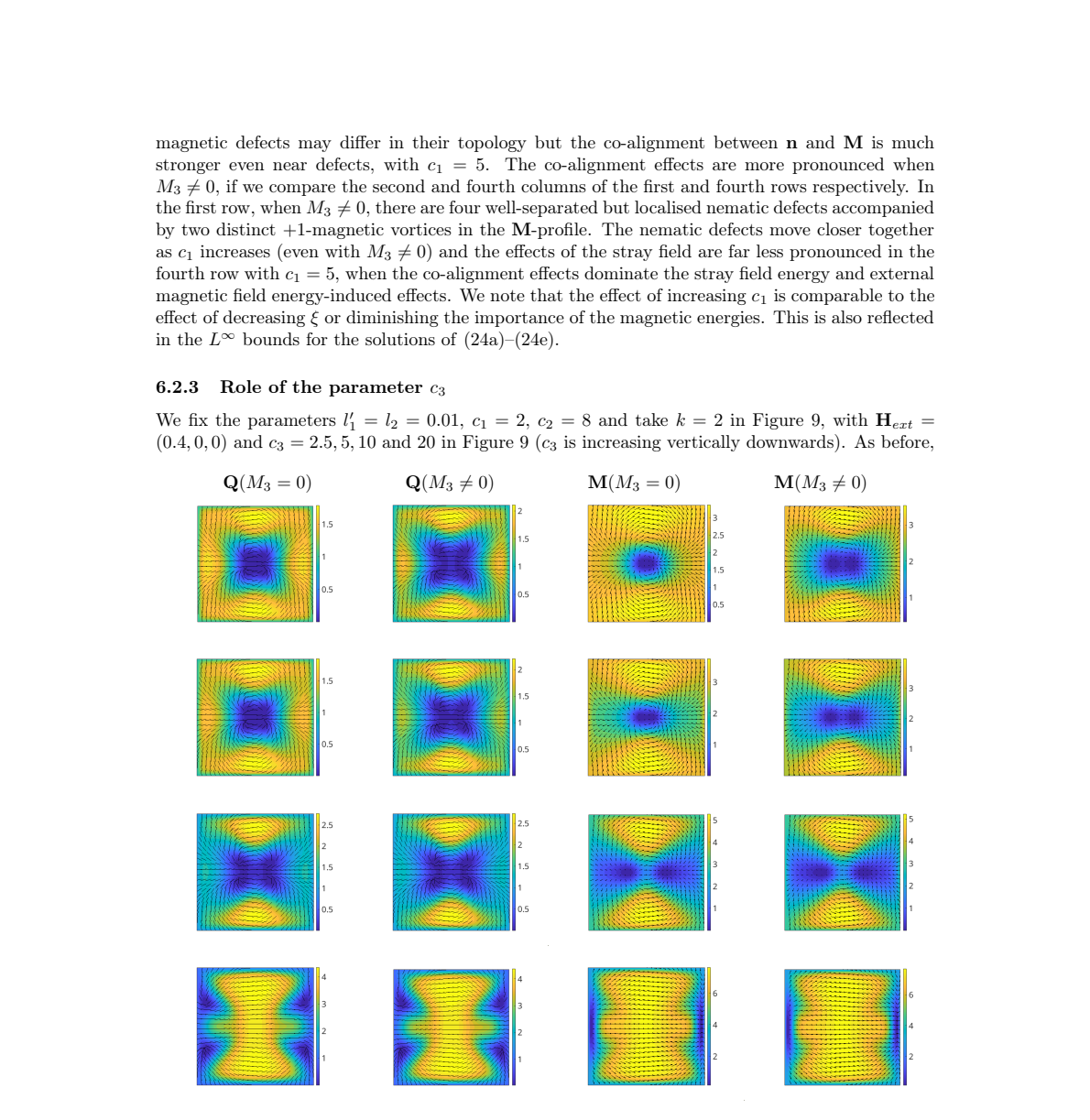
The paper says, at §6, Figures 3–9
Pith says: minor objection 4 of 5
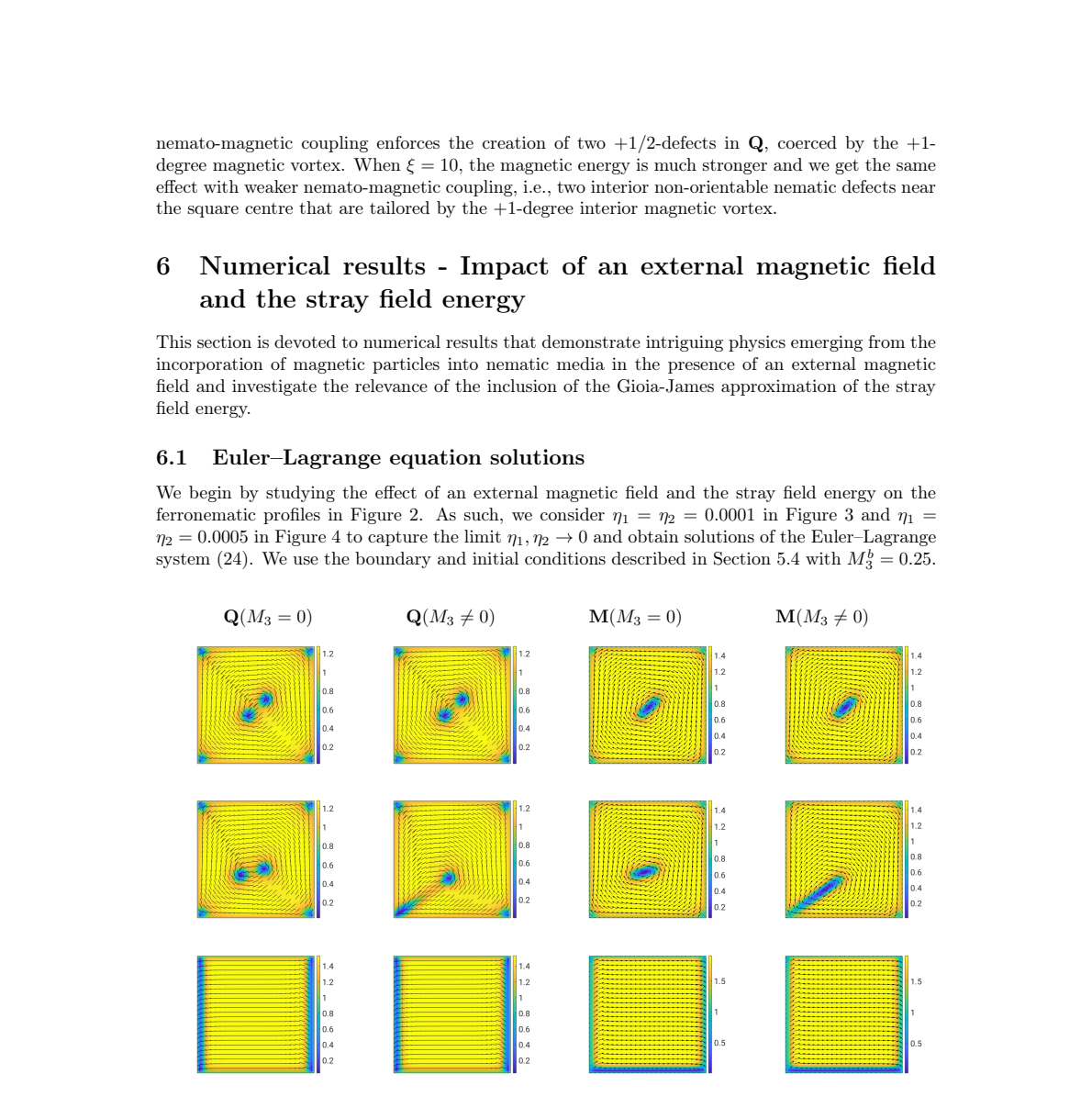
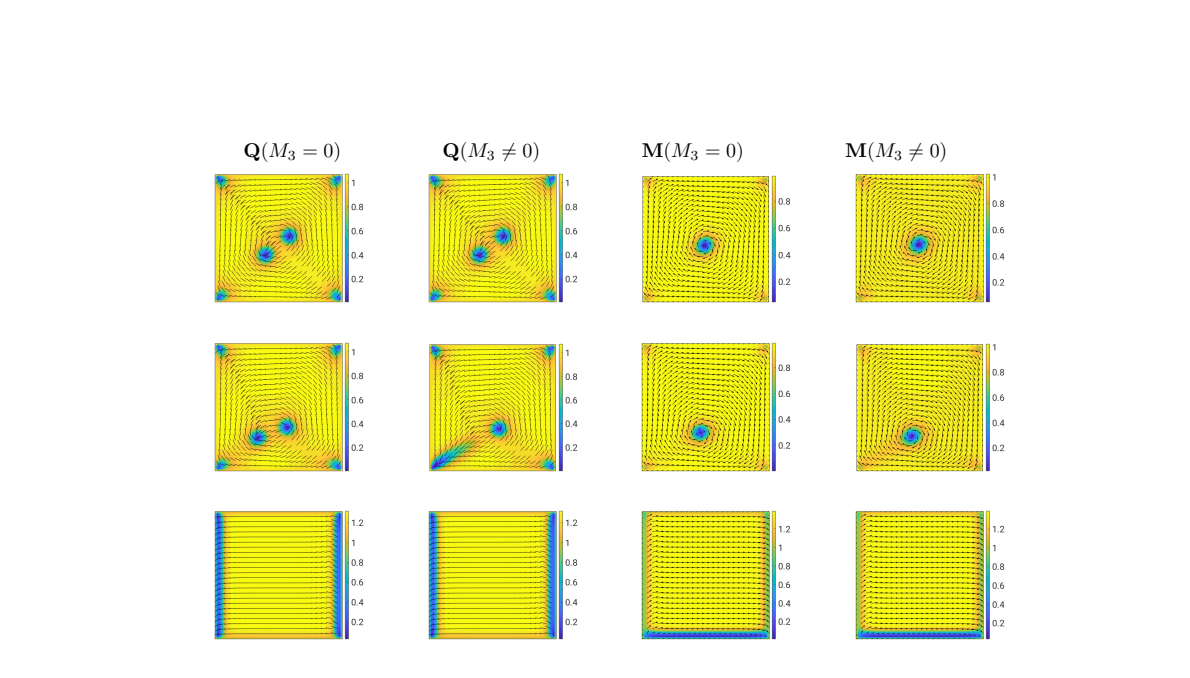
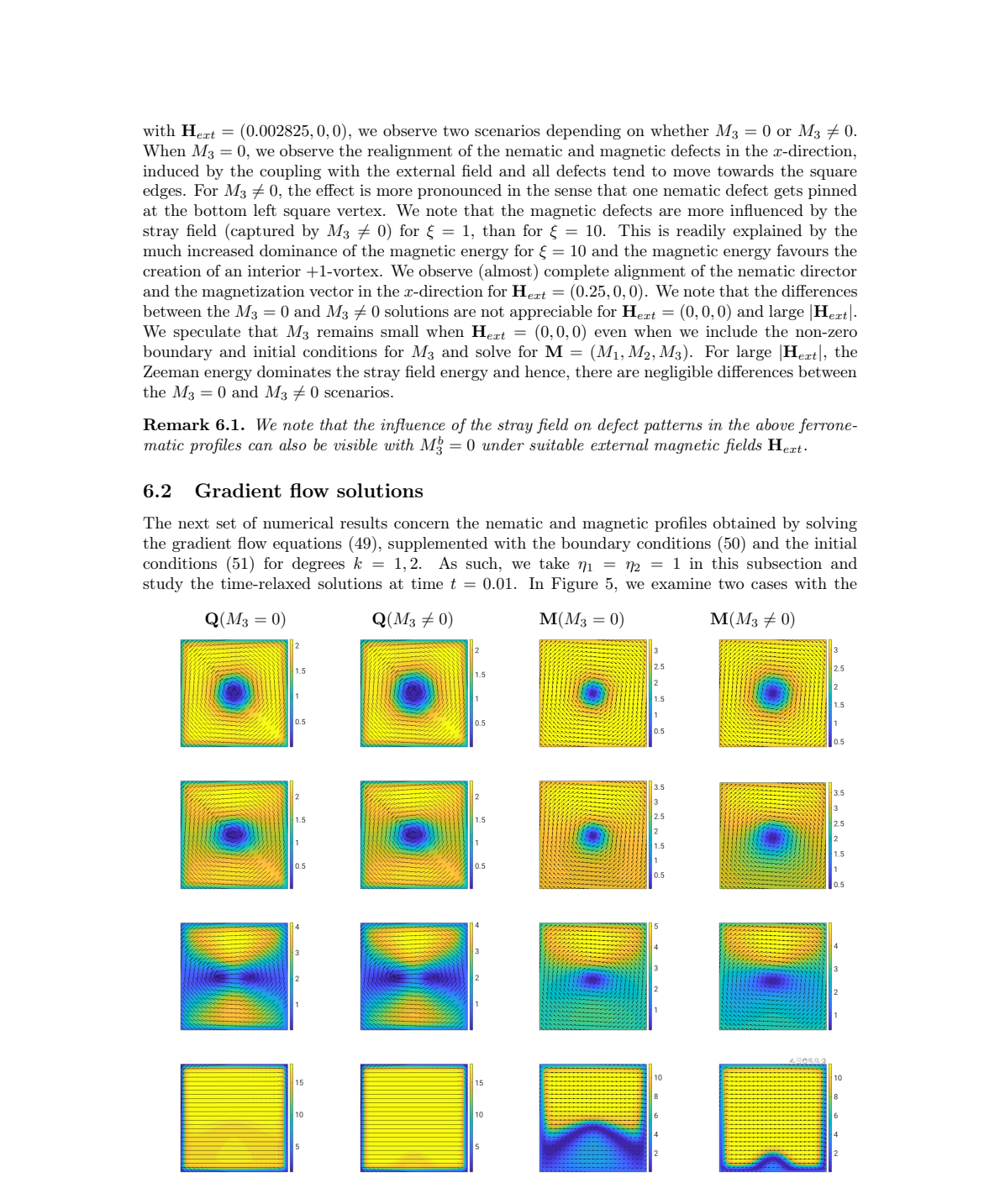
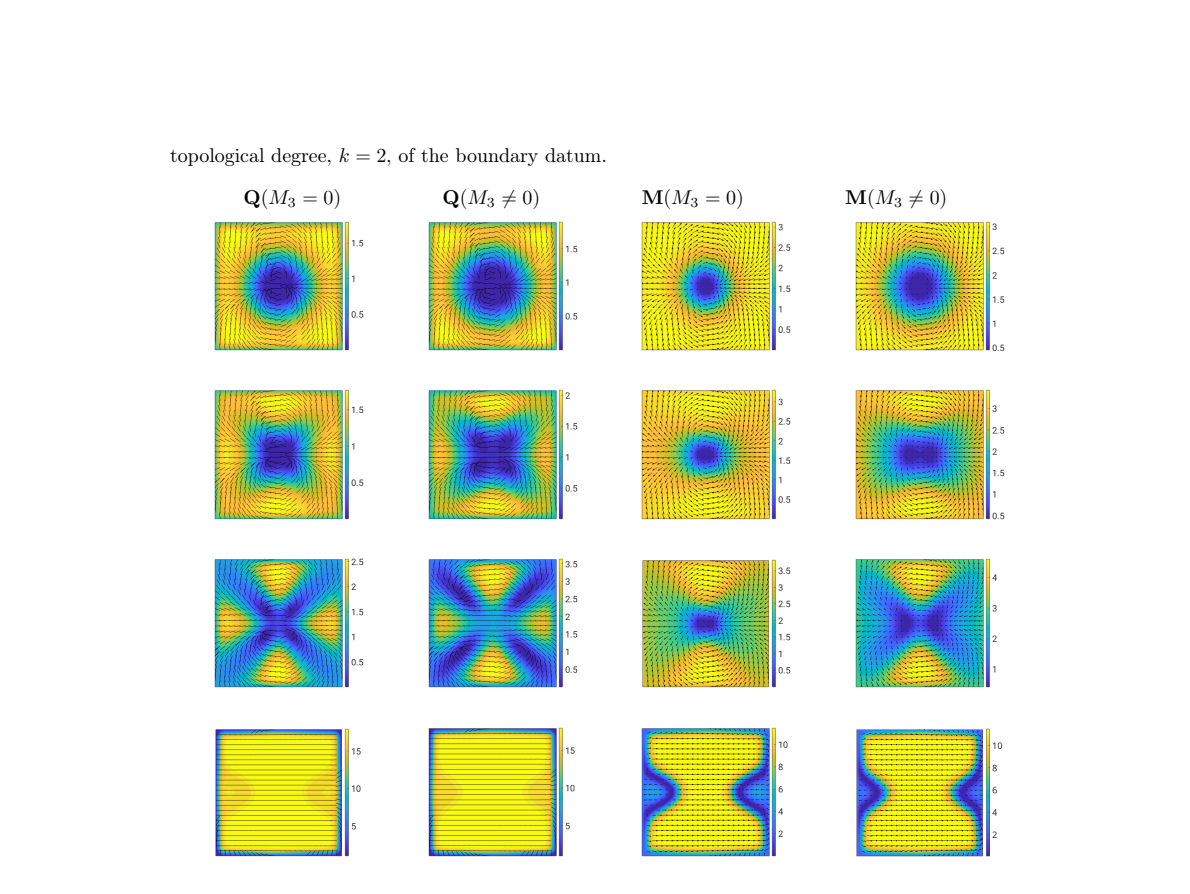
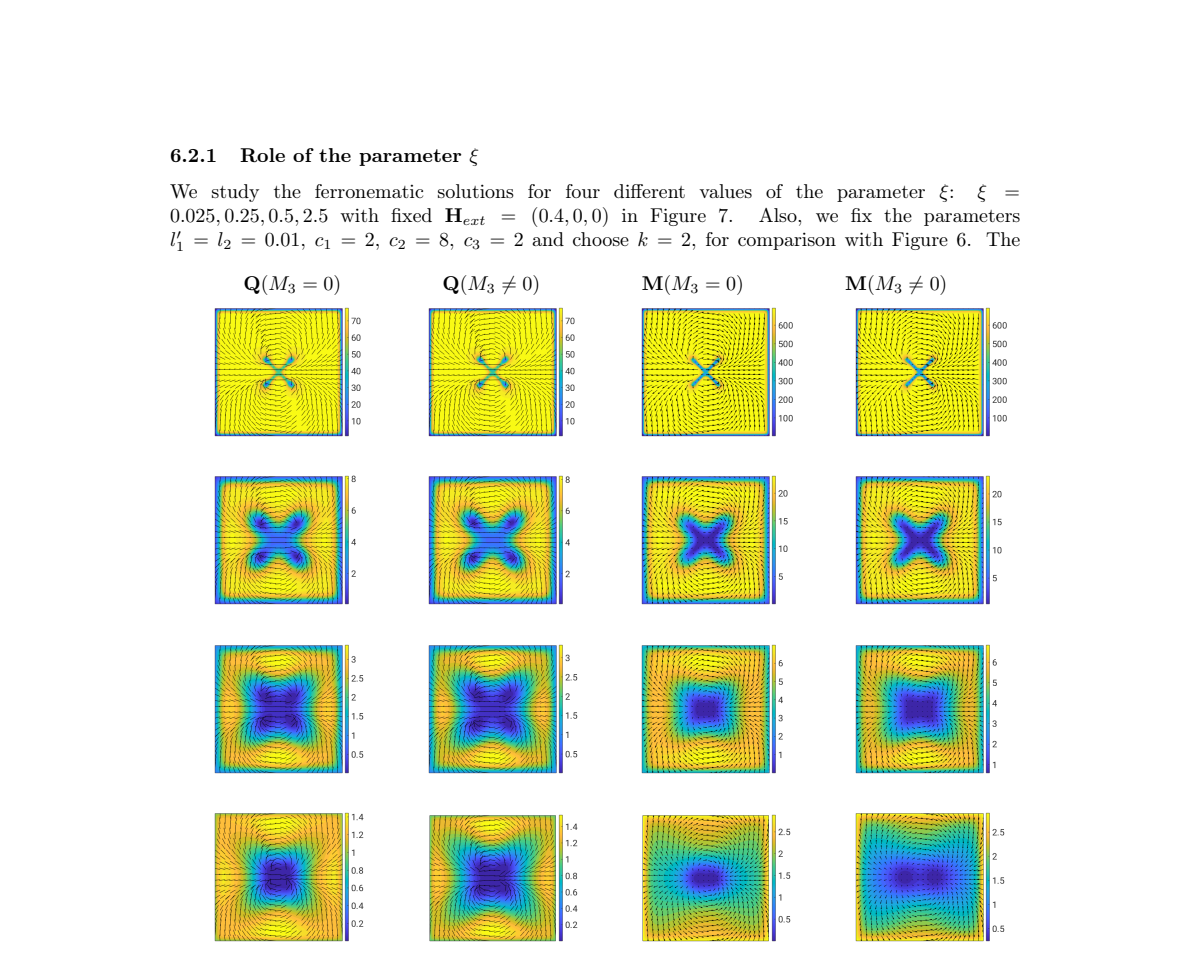
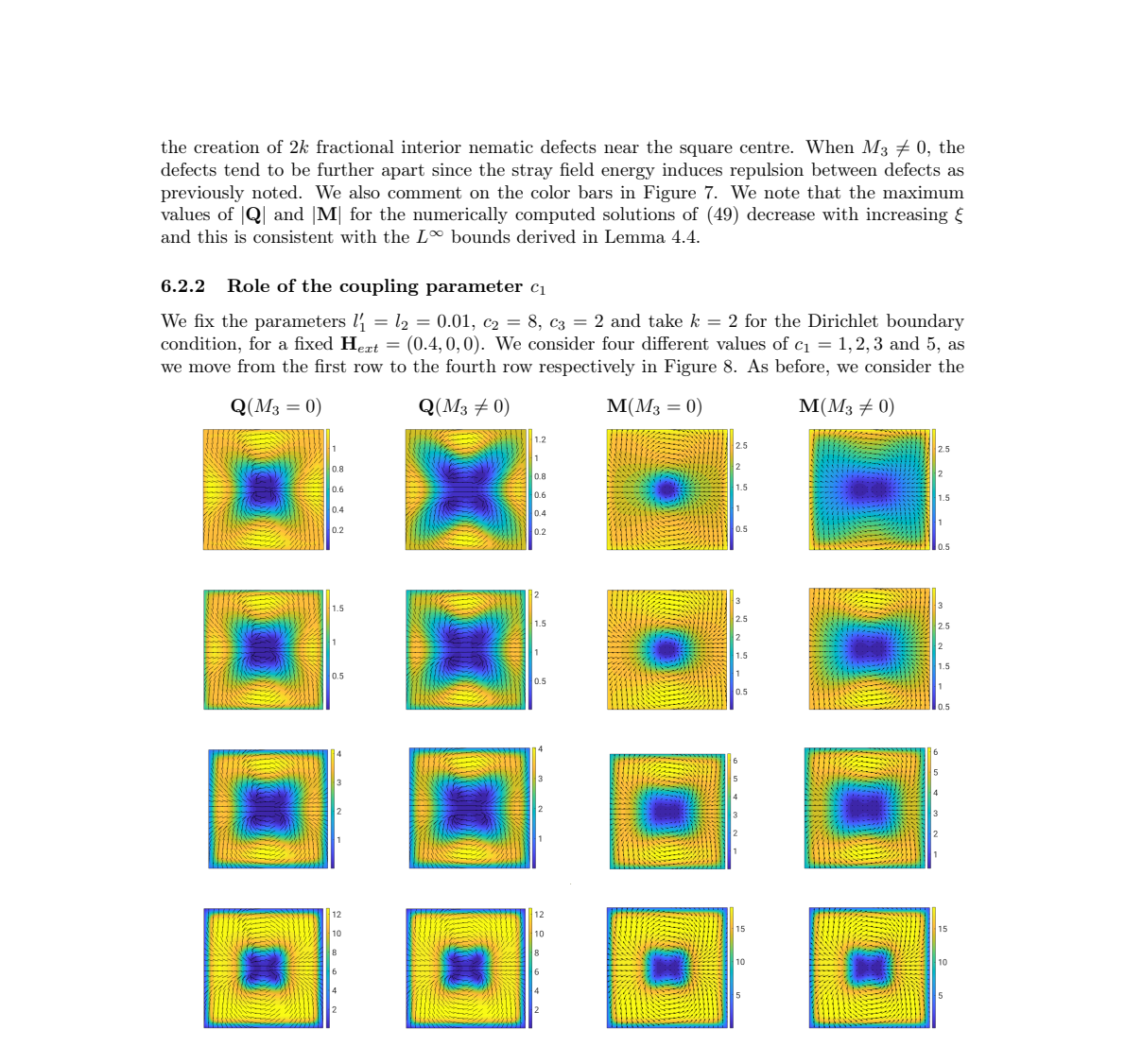
The color bars in the figures are not described consistently; the text should state explicitly whether the plotted quantity is |Q|, 1/2|Q|^2, |M|, or a component, and a common scale should be used for direct comparison across columns.
The paper says, at Reference [18]
Pith says: minor objection 5 of 5
The name is spelled 'Carlos García-Cevera' in the bibliography, but the standard spelling is 'García-Cervera'; please correct.
What would settle it
Re-derive Theorem 4.5 with the false compact-support assumption removed: take (Q,M), (Q̄,M̄) with Q−Q̄, M−M̄ ∈ H^1_0 and introduce a cut-off χ_ε equal to 1 on a compact interior set and 0 in a boundary layer of width ε. Write the exact version of (37)–(45) including the boundary-layer contribution ∫_Ω f((Q+Q̄)/2,(M+M̄)/2) − 1/2 f(Q,M) − 1/2 f(Q̄,M̄) dx over the layer. Show whether this contribution is controlled by (l1+c_p l2ξ)||∇(Q−Q̄)||^2 as ε→0; if it is not, no threshold l′ in (46) follows. As a numerical cross-check, set l1=l2 just above the claimed threshold and compute the smallest eigenvalue of the second variation of the discretized energy at the computed minimizer; a negative eigenvalue would directly disprove uniqueness in that regime.
from the skeptic's reading
How the review went
4 readings by deepseek-v4-flash · 15 Aug 2026
- Reader holds up, with conditions
- Skeptic partly agrees
- Editor wrote the verdict above
- Referee major revision: 2 major objections, 5 minor
Not run on this paper: the simulated authors' defence.
Pith did not check this review's objections against the paper.
The review in full
The review in brief, machine-written
Short version: the numerical study is useful, the existence proof is solid, and the uniqueness theorem is not proved as written. The specific problem is in the proof of Theorem 4.5: it asserts Q−Q̄, M−M̄ are compactly supported smooth functions, but admissible variations are H1_0, which need not vanish near the boundary. Since Lemma 4.4's L∞ bounds are interior only, the negative elastic terms in (37) don't control the f-midpoint term at the boundary, so the strict convexity inequality (46) is unjustified. This is a real gap. It may be repairable, but the claim as stated doesn't follow.
What's genuinely new: the model energy (1) is a natural extension of the Bisht et al. ferronematic energy, adding a Gioia-James stray field term and Zeeman/Q-field couplings. The existence proof via direct method is standard and, as far as I can tell, correct. The numerics are systematic: they reproduce a known test case, sweep ξ, c1, c3, and report qualitative defect behavior. The observation that the stray field enlarges, splits, and pushes interior defects toward the boundary is plausible and likely to be of interest to the soft-matter modeling community. The authors are also honest that the parameters are not physically calibrated and that the boundary conditions for M are a modeling choice.
The soft spots, in proportion: the Gioia-James approximation is derived for pure magnetic thin films; its validity for ferronematics is plausible but not justified here. The numerical results are never compared to a full stray-field solver, and at t=0.01 the gradient flow may not be fully converged to equilibria. No code is shipped. These are addressable weaknesses, not fatal flaws. But the uniqueness proof is a load-bearing flaw in the abstract's claims, and it needs to be fixed, or the claim weakened.
Who is this for: researchers working on ferronematic and soft-matter models, especially the analysis-numerics interface. It deserves refereeing; a serious referee should ask for a corrected uniqueness argument or a modified statement, and for at least one sanity check on the Gioia-James approximation. Conditional acceptance is the right call, not rejection.
The strongest objection
The central claim includes Theorem 4.5: uniqueness of the ferronematic energy minimizer for sufficiently large l1 and l2. The proof fails at a specific, identifiable step. After equation (37), the text states: “Since Q−Q̄, M−M̄ ∈ C_c^∞(Ω), there exists a compact set K⊂Ω such that Q−Q̄=0 a.e. in Ω\K.” This is false: two H^1 admissible maps with the same Dirichlet trace have a difference in H^1_0(Ω), not in C_c^∞(Ω), and H^1_0 functions need not vanish in any neighborhood of the boundary. The subsequent estimates (39)–(44) use the local L^∞ bounds from Lemma 4.4 only on the compact set K, and the negative elastic terms −l1/(8c_p)||Q−Q̄||^2 − l2ξ/(8c_p)||M−M̄||^2 control only those same compactly supported differences. If the difference has support reaching ∂Ω, the f-midpoint term near the boundary is uncontrolled because Lemma 4.4 gives only interior bounds and no boundary L^∞ estimate is supplied. Thus the strict convexity inequality (46), which is the contradiction used to prove uniqueness, is not justified for admissible variations in H^1_0. In short, Theorem 4.5's proof has a missing boundary argument, and the theorem cannot be considered proved on the basis of the manuscript as written. This is a genuine internal gap, not merely a disagreement with standard assumptions. The existence theorem (4.3) is unaffected, and the numerical defect-migration study is independent of the uniqueness proof, but the uniqueness claim in the abstract and introduction rests on this step.
The reader's verdict is CONDITIONAL, with the weakest assumption identified as the physical validity of the Gioia–James stray-field approximation and the resulting numerical conclusions. That concern is real but is about the model's applicability to ferronematics, not about the internal correctness of the analytic theorems. Reading the manuscript in good faith, the existence proof is standard and essentially sound, and the numerical sections are explicitly framed as qualitative explorations of a proposed model. The least secure load-bearing step in the paper's own mathematical claims is Theorem 4.5: the proof relies on the assertion that differences of two minimizers are compactly supported smooth functions, which is false for H^1 admissible maps with fixed Dirichlet data. This matters because uniqueness for large l1,l2 is stated in the abstract, introduction, and Theorem 4.5, and the proof's strict-convexity estimate (46) is only derived on a compact set away from the boundary. Without a global or boundary L^∞ estimate, the midpoint-energy comparison cannot be closed. The gap is probably repairable — e.g., by proving L^∞ bounds up to the boundary under suitable smooth boundary data or by a more careful limiting argument — so it does not warrant rejecting the paper outright. The reader's rationale does mention uncertainty about the uniqueness proof's constants, which is related, but the specific compact-support error is not identified there. Hence agreement is partial. On balance, the verdict remains CONDITIONAL: the paper should be published only after the uniqueness proof is repaired or the theorem downgraded to an existence-plus-numerics claim. This is not a no-objection pass, but it is also not a rejection of the paper's overall contribution.
The referee's report
The existence theorem (Theorem 4.3) is a standard direct-method argument and appears correct. The main mathematical novelty is the claimed uniqueness theorem, which attempts to combine local L-infinity estimates with a strict-convexity argument for large elastic constants; if rigorously established, it would be a valuable contribution to the analytical theory of ferronematics. The numerical study is extensive, systematically explores the parameter dependence, and is validated against previously published results [8], which are reproduced by the code. The numerical observations about defect splitting and migration are falsifiable within the proposed model and could guide further theoretical work. However, the uniqueness proof contains a load-bearing gap that must be fixed before the paper's central claims can be accepted.
Pith's reading of the paper (a machine's summary, not the authors')
This paper studies a two-dimensional ferronematic model—magnetic nanoparticles suspended in a nematic liquid crystal—through a coupled energy for the Landau-de Gennes order parameter $\mathbf{Q}$ and the magnetization $\mathbf{M}$. It establishes that the energy admits a global minimizer under Dirichlet boundary conditions, and that the minimizer is unique when the elastic constants $l_1$ and $l_2$ are large enough. The numerical part solves the associated gradient flow and finds that the approximated stray field energy enlarges defect cores, splits interior nematic defects and magnetic vortices, and repels them toward the square edges; this cooperates with an external magnetic field to align the director and magnetization with $\mathbf{H}_{\mathrm{ext}}$. A careful reader should care because the results add rigorous variational foundations and concrete predictions for defect and vortex placement in a material class with display, sensor, and microfluidics applications.
What carries the argument. The central object is the coupled ferronematic energy combining the Landau-de Gennes $\mathbf{Q}$-tensor energy, an exchange and Ginzburg-Landau energy for $\mathbf{M}$, a nematic-magnetic coupling term, a local penalty on $M_3^2$ that approximates the nonlocal stray field, and Zeeman and field-nematic interaction terms. The existence proof uses coercivity estimates via Young-type inequalities on the coupling terms, Poincaré's inequality, weak compactness, and lower semicontinuity through the direct method. The uniqueness proof derives local $L^{\infty}$ bounds for weak solutions of the Euler-Lagrange equations by a maximum-principle argument, then shows strict convexity of the energy once $l_1$ and $l_2$ exceed an explicit threshold. The numerics are driven by the $L^2$ gradient flow system, discretized with the Crank-Nicolson finite-difference method and Newton linearization, and validated by reproducing the [8] profiles in a test case.
Core claim. The paper's central claim is that the ferronematic energy is a well-posed variational model: for any bounded Lipschitz domain with Lipschitz Dirichlet data and a continuous external field, it has a global minimizer in the admissible space $\mathcal{A}\times\mathcal{S}$ (Theorem 4.3), and for sufficiently large elastic constants $l_1$ and $l_2$ there is exactly one minimizer (Theorem 4.5). The numerical claim, based on solving the $L^2$ gradient flow with a Crank-Nicolson finite-difference scheme, is that the local thin-film approximation of the stray field energy—a penalty on the out-of-plane component $M_3$—enlarges and splits interior nematic defects and magnetic vortices and repels them toward the square edges, acting in concert with the Zeeman coupling to align $\mathbf{Q}$ and $\mathbf{M}$ with $\mathbf{H}_{\mathrm{ext}}$. The authors present this as an extension of the ferronematic model of [8], which previously omitted both the stray field and external magnetic fields.
The premise it rests on. The numerical conclusions assume that replacing the true long-range magnetic stray field by a local penalty on the out-of-plane magnetization is physically accurate for ferronematic films; the existence and uniqueness proofs do not depend on that physical accuracy.
If the paper is right (Pith's inferences, not the authors')
For any bounded Lipschitz domain with compatible Dirichlet data and a continuous external field, the variational problem is well posed: a global minimizer exists.
When the elastic constants are large enough, the equilibrium is unique, so bistable or multistable ferronematic textures cannot occur in that parameter regime.
Including the stray field energy enlarges and splits interior defect cores and drives them toward the boundary, even before an external field is applied.
An external magnetic field aligns the director and magnetization, and the stray field reinforces this alignment; at strong external fields the stray field's influence becomes negligible.
Increasing the parameter $c_3$ promotes full co-alignment of $\mathbf{n}$, $\mathbf{M}$, and $\mathbf{H}_{\mathrm{ext}}$ at smaller external fields, which could matter for low-field switching applications.
If the full nonlocal stray field from Maxwell's equations replaced the local $M_3^2$ penalty, the defect-repulsion effect would likely depend on film thickness; the paper does not test this, so it is a testable prediction of the approximation rather than of the full model.
The observation that the vector-valued magnetization splits into integer-degree vortices while the nematic order parameter splits into half-degree defects suggests a topological selection rule: fractional defects are allowed in $\mathbf{Q}$ but not in $\mathbf{M}$, so splitting for $\mathbf{M}$ must occur in integer units.
The paper conjectures that Neumann boundary conditions for $\mathbf{M}$ would remove geometric frustration; running the same gradient-flow scheme under Neumann conditions could show whether the stray-field-driven edge migration persists without Dirichlet constraints.
Check this review
Pith stored no record of this review's passes and took no fingerprint of it. Reviews made by code from 13 Nov 2026 on carry both.
How often reviews like this one are right
Reviews like this one: written by deepseek-v4-flash, where what was read was not recorded.
How often objections from reviews like this one are right: not yet measured
Reviews by people
This review was written by a machine. No person has reviewed this paper on Pith yet. A scientist listed on Pith can review it for a fee, and their review is published here whatever it concludes.
How Pith checks papers · The full audit of this paper · Review history (2 versions)
The paper
Abstract
Ferronematic materials are colloidal suspensions of magnetic particles in liquid crystals. They are complex materials with potential applications in display technologies, sensors, microfluidics devices, etc. We consider a model for ferronematics in a 2D domain with a variational approach. The proposed free energy of the ferronematic system depends on the Landau-de Gennes (LdG) order parameter Q and the magnetization M, and incorporates the complex interaction between the liquid crystal molecules and the magnetic particles in the presence of an external magnetic field Hext. The energy functional combines the Landau-de Gennes nematic energy density and energy densities from the theory of micromagnetics including (an approximation of) the stray field energy and energetic contributions from an external magnetic field. For the proposed ferronematic energy, we first prove the existence of an energy minimizer and then the uniqueness of the minimizer in certain parameter regimes. Secondly, we numerically compute stable ferronematic equilibria by solving the gradient flow equations associated with the proposed ferronematic energy. The numerical results show that the stray field influences the localization of the interior nematic defects and magnetic vortices.
The paper's own sentences, arranged, kept beside the review and separate from it. Each label is drawn from a closed vocabulary; the number beside it is the probability the classifier gave that label. No sentence in this record was written by a model.
abstract compiled · 2026-09-23
The authors' main claim, as the classifier picked it out 1.00
“The numerical results show that the stray field influences the localization of the interior nematic defects and magnetic vortices.”
How the main claim is stated: asserted 1.00
What the abstract itself states, as probabilities: claims first 0.03 · states limitation 0.29 · human participants 0.01 · controlled comparison 0.03 · randomized assignment 0.01 · states quantitative result 0.05 · compares with prior results 0.06 · mentions code or data availability 0.02
The abstract, sentence by sentence
This table labels the abstract only (arXiv listing abstract v1). The number is the probability the classifier gave the label.
| Sentence | Role | The authors' own work | States the main conclusion | Strength |
|---|---|---|---|---|
| Ferronematic materials are colloidal suspensions of magnetic particles in liquid crystals. | background 1.00 | 0.04 | 0.01 | asserted 1.00 |
| They are complex materials with potential applications in display technologies, sensors, microfluidics devices, etc. | background 1.00 | 0.04 | 0.02 | hedged possibility 0.60 |
| We consider a model for ferronematics in a 2D domain with a variational approach. | method 0.74 | 0.91 | 0.03 | asserted 0.96 |
| The proposed free energy of the ferronematic system depends on the Landau-de Gennes (LdG) order parameter $\mathbf{Q}$ and the magnetization $\mathbf{M}$, and incorporates the complex interaction between the liquid crystal molecules and the magnetic particles in the presence of an external magnetic field $\mathbf{H}_{ext}$. | method 0.64 | 0.80 | 0.05 | asserted 1.00 |
| The energy functional combines the Landau-de Gennes nematic energy density and energy densities from the theory of micromagnetics including (an approximation of) the stray field energy and energetic contributions from an external magnetic field. | method 0.69 | 0.75 | 0.06 | asserted 1.00 |
| For the proposed ferronematic energy, we first prove the existence of an energy minimizer and then the uniqueness of the minimizer in certain parameter regimes. | result 0.55 | 0.97 | 0.16 | asserted 1.00 |
| Secondly, we numerically compute stable ferronematic equilibria by solving the gradient flow equations associated with the proposed ferronematic energy. | method 0.97 | 0.97 | 0.07 | asserted 1.00 |
| The numerical results show that the stray field influences the localization of the interior nematic defects and magnetic vortices. | result 0.97 | 0.95 | 0.60 | asserted 1.00 |
What kind of paper the classifier reports this is: theoretical result 0.93 · evidence from simulation or computation 0.58
What was examined, and what was not
Sources read
- arXiv listing abstract v1
Not examined
- full text
- figures and tables
- references and citing sentences
- relations to other papers
Levels run
- P abstract
Not run
- S sections
- T body sentences
- C citations
- R cross-paper relations
How the labels were made
Compiled by classifier-1.13.0 via TypeSafe API, question bank abstract-p1-20260923, 2026-09-23: 1 request, 6,323 input tokens.
Every quoted sentence on this record is the authors'. Every label is from Pith's closed vocabulary, with the probability shown beside it. This record as JSON
Figures (9)
Figures are the authors', reproduced from the paper.
References (40)
- [8] Konark Bisht, Yiwei Wang, Varsha Banerjee, and Apala Majumdar. Tailored morphologies in two-dimensional ferronematic wells.Physical Review E, 101(2):022706, 2020 on Pith
- [1] Pierre Gilles de Gennes and Jacques Prost. The physics of liquid crystals.International series of monographs on physics, 2, 1995 on Pith
- [2] William Fuller Brown.Magnetoelastic interactions, volume 9. Springer, 1966 on Pith
- [3] Jan PF Lagerwall and Giusy Scalia. A new era for liquid crystal research: Applications of liquid crystals in soft matter nano-, bio-and microtechnology.Current Applied Physics, 12(6): 1387–1412, 2012 on Pith
- [4] Min Shuai, Arthur Klittnick, Yongqiang Shen, Gregory P Smith, Michael R Tuchband, Chen- hui Zhu, Rolfe G Petschek, A. Mertelj, Darja Lisjak, Martin Čopič, J. E Maclennan, M. A. Glaser, and N. A. Clark. Spontaneous liquid crystal and ferromagnetic ordering of colloidal magnetic... on Pith
- [5] F Brochard and PG De Gennes. Theory of magnetic suspensions in liquid crystals.Journal de Physique, 31(7):691–708, 1970 on Pith
- [6] Shu-Hsia Chen and Nabil M Amer. Observation of macroscopic collective behavior and new texture in magnetically doped liquid crystals.Physical Review Letters, 51(25):2298, 1983 on Pith
- [7] Alenka Mertelj, Darja Lisjak, Miha Drofenik, and Martin Čopič. Ferromagnetism in suspen- sions of magnetic platelets in liquid crystal.Nature, 504(7479):237–241, 2013 on Pith
- [9] Giacomo Canevari, Federico Luigi Dipasquale, and Bianca Stroffolini. The formation of gradient-driven singular structures of codimension one and two in two-dimensions: The case study of ferronematics.arXiv:2505.07506, 2025 on PithPith's reviewarXiv
- [10] Giacomo Canevari, Apala Majumdar, Bianca Stroffolini, and Yiwei Wang. Two-dimensional ferronematics, canonical harmonic maps and minimal connections.Archive for Rational Me- chanics and Analysis, 247(6):110, 2023 on Pith
- [11] James Dalby, Patrick E Farrell, Apala Majumdar, and Jingmin Xia. One-dimensional ferrone- matics in a channel: Order reconstruction, bifurcations, and multistability.SIAM Journal on Applied Mathematics, 82(2):694–719, 2022 on Pith
- [12] Ruma Rani Maity, Apala Majumdar, and Neela Nataraj. Parameter dependent finite element analysis for ferronematics solutions.Computers & Mathematics with Applications, 103:127– 155, 2021 on Pith
- [13] Yucen Han, Apala Majumdar, and Lei Zhang. A reduced study for nematic equilibria on two-dimensional polygons.SIAM Journal on Applied Mathematics, 80(4):1678–1703, 2020 on Pith
- [14] Alex Hubert and Rudolf Schäfer.Magnetic domains: the analysis of magnetic microstructures. Springer Science & Business Media, 2008 on Pith
- [15] Martin Kružík and Andreas Prohl. Recent developments in the modeling, analysis, and nu- merics of ferromagnetism.SIAM Review, 48(3):439—-483, 2006 on Pith
- [16] Antonio DeSimone, Robert V Kohn, Stefan Müller, and Felix Otto. Recent analytical devel- opments in micromagnetics.Preprint by MPI, Leipzig, 2004. 26 on Pith
- [17] Gustavo Gioia and Richard D James. Micromagnetics of very thin films.Proceedings of the Royal Society of London. Series A: Mathematical, Physical and Engineering Sciences, 453 (1956):213–223, 1997 on Pith
- [18] Carlos García-Cevera. One-dimensional magnetic domain walls.Euro. Jnl of Applied Mathe- matics, 15:451–486, 2004 on Pith
- [19] Harald Pleiner, E Jarkova, HW Müller, and HR Brand. Landau description of ferrofluid to ferronematic phase transition.Magnetohydrodynamics, 37(254):146, 2001 on Pith
- [20] Maria-Carme Calderer, Antonio DeSimone, Dmitry Golovaty, and Alexander Panchenko. An effective model for nematic liquid crystal composites with ferromagnetic inclusions.SIAM Journal on Applied Mathematics, 74(2):237–262, 2014 on Pith
show 20 more
- [21] RL Burden and DJ Faires.Numerical analysis. 3rd edn Boston. MA: PWS Publishing Com- pany, 1985 on Pith
- [22] Yucen Han, Joseph Harris, Joshua Walton, and Apala Majumdar. Tailored nematic and magnetization profiles on two-dimensional polygons.Physical Review E, 103(5):052702, 2021 on Pith
- [23] Martin Kalousek, Joshua Kortum, and Anja Schlömerkemper. Mathematical analysis of weak and strong solutions to an evolutionary model for magnetoviscoelasticity.Discrete & Contin- uous Dynamical Systems-Series S, 14(1), 2021 on Pith
- [24] Antonio DeSimone, Robert V Kohn, Stefan Müller, and Felix Otto. A reduced theory for thin-film micromagnetics, 2002 on Pith
- [25] Giovanni Di Fratta, Cyrill B Muratov, and Valeriy V Slastikov. Reduced energies for thin ferromagnetic films with perpendicular anisotropy.arXiv preprint arXiv:2306.07634, 2023 on PithPith's reviewarXiv
- [26] Robert V Kohn and Valeriy V Slastikov. Another thin-film limit of micromagnetics.Archive for Rational Mechanics and Analysis, 178:227–245, 2005 on Pith
- [27] Dmitry Golovaty, José Alberto Montero, and Peter Sternberg. Dimension reduction for the Landau-de Gennes model in planar nematic thin films.Journal of Nonlinear Science, 25(6): 1431–1451, 2015 on Pith
- [28] Nigel J. Mottram and Chris J. P. Newton. Introduction to q-tensor theory.arXiv:1409.3542, 2014 on PithPith's reviewarXiv
- [29] Philippe G Ciarlet.Mathematical elasticity: Three-dimensional elasticity. SIAM, 2021 on Pith
- [30] Filip Rindler.Calculus of variations, volume 5. Springer, 2018 on Pith
- [31] Lawrence C Evans.Partial differential equations, volume 19. American Mathematical Society, 2022 on Pith
- [32] Lars Onsager. Reciprocal relations in irreversible processes. II.Physical Review, 38(12):2265, 1931 on Pith
- [33] GordonDSmith.Numerical solution of partial differential equations: finite difference methods. Oxford university press, 1985 on Pith
- [34] C. Luo, A. Majumdar, and R. Erban. Multistability in planar liquid crystal wells.Phys. Rev. E, 85(6):061702, 2012 on Pith
- [35] C. Tsakonas, A. J. Davidson, C. V. Brown, and N. J. Mottram. Multistable alignment states in nematic liquid crystal filled wells.Applied Physics Letters, 90(11):111913, 2007 on Pith
- [36] J. M. Ball. Liquid crystals and their defects.arXiv:1706.06861v3 [cond-mat.soft], 2017 on PithPith's reviewarXiv
- [37] A Wachowiak, J Wiebe, M Bode, O Pietzsch, M Morgenstern, and R Wiesendanger. Direct observation of internal spin structure of magnetic vortex cores.Science, 298(5593):577–580, 2002. 27 on Pith
- [38] Fabrice Bethuel, Haïm Brezis, and Frédéric Hélein.Ginzburg-landau vortices, volume 13. Springer, 1994 on Pith
- [39] M. Ravnik and S Žumer. Landau–de Gennes modelling of nematic liquid crystal colloids. Liquid Crystals, 36(10-11):1201–1214, 2009 on Pith
- [40] J. Y. Yin, Y. W. Wang, J. Z. Y. Chen, P. W. Zhang, and L. Zhang. Construction of a pathway map on a complicated energy landscape.Physical Review Letters, 124:090601, 2020. 28 on Pith
Cited by 2 Pith papers
Reviewed papers on Pith that cite this one. The full citation record
- Charge-selective topological locking and ultraslow coarsening in magnetoelastic media cond-mat.stat-mech · Oct 2026
- Existence of homeomorphic minimizers via mappings of finite distortion in compressible magnetoelasticity math.AP · Aug 2026
How the literature uses it
1 arXiv paper cite this in 7 sentences
Papers citing it · 6 sentences without a confident label
Uses its method or tool 1 paper
-
For the particular solution scheme, we refer to [ref] , and for more details, see [ref] .
A variational approach to ferronematics with a dimension reduction · Numerical observations · 0.88
Challenges and discussion
Disagree with the review, or know something it missed? Leave a comment, or challenge this review formally: a challenge becomes a permanent entry in this paper's record, and its decision is published here.
Come back by email
A short list of the week's newly reviewed papers. Nothing is sent until you confirm from your inbox, and every email has a link that stops it. No account.
No comments yet.
Sign in to comment