Cryptography and Security · arXiv:2610.19264 v1 · submitted 13 Oct 2026 · 33 references
Beyond Maliciousness: Static and Runtime Attack-Surface Profiling of Agent Skills
The paper says
“Agent skills are Markdown documents that a tool-using agent reads as instructions and then acts on with the privileges of the session that loaded them.”
more of the abstract
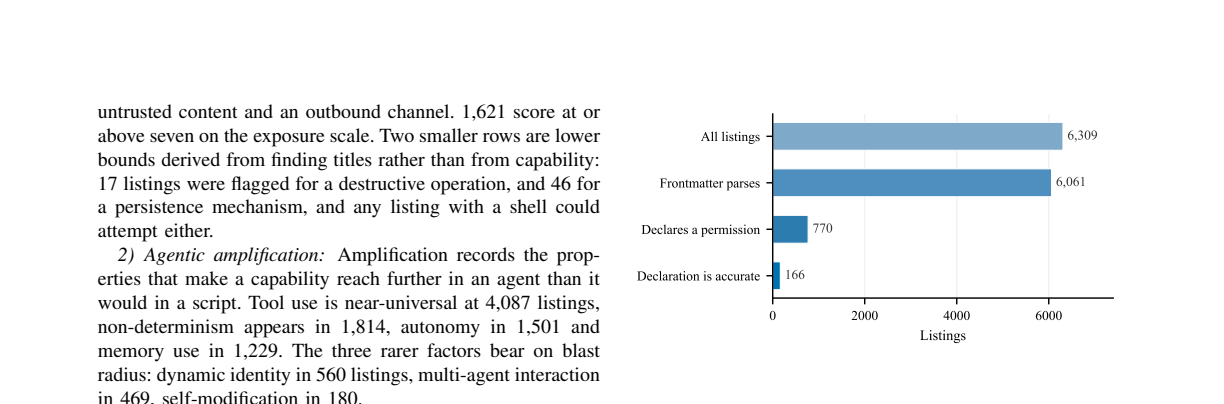
Installing one grants authority (the standing to direct the agent, not new privilege), and the size of that grant is what we measure. We present a two-phase attack-surface profiling methodology that combines whole-bundle static analysis and dependency provenance checking with instrumented sandbox execution and separate model-based assessment of the resulting traces. We apply the methodology to 6,309 listings from two marketplaces, selecting listings for execution without conditioning that decision on a prior threat or risk signal. Half the corpus carries evidence of shell-execution capability; the corresponding shares are 35% for filesystem read, 31% each for filesystem write and network egress, and 13% for credential access; seven listings in ten carry at least one elevated capability. That is the surface a user accepts at install time, and almost none of it is visible then. A permission model exists but is close to inert. Authors may list the tools a skill pre-approves in its own frontmatter, which removes confirmation prompts rather than restricting what the skill can reach; of the 6,061 listings whose frontmatter parses, 770 declare anything at all, the vocabulary cannot express credential or environment access, and nothing checks what it does express against the bundle. Declaring is also not declaring accurately: 59% of declaring listings understate what their bundle can do. ClawHub declares roughly twice as often as skillsmp, yet under-declares on 88% of its declarations against 31%. Triage at the marketplace boundary therefore cannot rest on what a listing declares. It must rest on what the bundle can do. These results position capability-oriented attack-surface profiling as a necessary complement to maliciousness detection.
from the abstract
Pith says
Machine review · deepseek-v4-flash · 15 Oct 2026 · what was read was not recorded · not checked by a person
It can be wrong. Challenge this review or reply to it.
The passes disagreed. Reader: holds up. Skeptic: agrees with the reader. Referee: major revision.
A careful empirical study of agent-skill attack surfaces that convincingly shows capability exposure is a separate and larger problem than malicious intent, but the central prevalence numbers rest on an uncalibrated static model and need stronger validation before they can be taken at face value. This line is wrong
3 major objections · 6 minor
How often objections from reviews like this one are right: not yet measured
Not checked: figures, code, what the 33 references say.
The paper says, at III-B3, III-B6; Fig. 6; §IV-A
The review did not quote this passage.
A classifier read this sentence of the paper as acknowledging the concern (probability 0.66):
“No third party evaluated it, and no external ground truth was available against which to validate its labels.”
Pith says: Objection 1 of 3 · major
The capability prevalence estimates (50.1% shell execution, 70.2% carrying at least one elevated capability) are the foundation for the paper's main conclusion, yet they are derived from a proprietary model (Claude Haiku/Sonnet) without external ground-truth validation. The reproducibility measurement (Section III-B6, 84% over 89 re-scans) applies to threat verdicts, not capability labels.
more of objection 1
The authors acknowledge that capability labels are model-emitted free text and that rare labels are indicative only (b176), but common labels like shell execution (3,162 listings) are not rare, and no false-positive bound is offered. The gap between static shell-execution inference (50.1%) and runtime shell invocation (8.2%) is large, and while the paper correctly treats runtime as a lower bound, it does not bound the static overcount. Without a human-reviewed sample of capability labels or a false-positive rate estimate, the reported prevalence figures are uncalibrated model outputs. The central claim about the size of the capability exposure gap is therefore less certain than the paper's unambiguous presentation suggests. The authors should provide, at minimum, a reproducibility figure for capability labels, or a human-validated subset showing the false-positive rate for common labels, or else explicitly qualify all capability prevalence numbers as model-based estimates with unknown error.
The paper says, at III-B1
The review did not quote this passage.
A classifier read this sentence of the paper as acknowledging the concern (probability 0.62):
“And the reviews were in progress at the time of measurement, so no precision figure is reported here and none should be read into the cohort’s existence.”
Pith says: Objection 2 of 3 · major
The human review cohort (410 listings) is described as partial and incomplete; no precision figure is reported because reviews were in progress (b114). The recall check on benign listings (140 listings, none missed a threat) gives a one-sided 95% bound of ~2.1% benign miss rate (b116).
more of objection 2
However, this check validates threat verdicts, not capability labels. The paper should either complete the human review for capability labels on a sample (even a small one) or explicitly state that capability labels are entirely unvalidated beyond model-based scoring. As written, the human review section gives a false sense of validation for quantities that are not actually checked.
The paper says, at IV-E, Table III
The review did not quote this passage.
Pith says: Objection 3 of 3 · major
The comparison of static vs. detonation finds that the two phases agree on few listings (both flag only 11/336 on threat, 978/3339 on risk). The paper correctly notes that runtime is a lower bound for capability attribution, but for risk findings the comparison is presented without a clear discussion of how the two phases' different thresholds affect the comparison.
more of objection 3
The risk column uses 'at least one finding from that phase' as the threshold, but the static risk findings include many low-severity patterns (e.g., 1,487 low-severity findings). This inflates the static-only count. The paper should either harmonize severity thresholds or explicitly acknowledge that the risk-phase comparison conflates different severity levels.
6 minor objections
The paper says, at II-C, Figure 8
Pith says: minor objection 1 of 6
Figure 8 shows direction of declaration error by capability class, but it is difficult to read the exact numbers for small categories (e.g., agent orchestration: 2 under, 71 over). Consider including the raw counts in a table or adding labels to the bars.
The paper says, at III-A, §IV-C
Pith says: minor objection 2 of 6
The sampling strategy is described in terms of star bands (skillsmp) and download bands (ClawHub), but the paper does not report how many listings per band were attempted versus actually scanned. If any band had a high failure rate (e.g., download errors), that could bias the sample. Please add a simple completion rate per band.
show 4 more
The paper says, at III-B5
Pith says: minor objection 3 of 6
The provenance analysis checks for version pinning and takeover-prone hosts. The paper reports that 99% of declaring listings have at least one unpinned dependency (2,830/2,871). This is striking, but the denominator is 'listings that declare a dependency' (2,871). How many listings declare a dependency?
more of objection 3
The paper says '2,871 listings declare a dependency of some kind' in §IV-D4, but earlier (§III-B5) it notes 'the phase is legitimately absent for a listing that declares no dependency at all.' Please clarify whether 2,871 is the count of listings that declare at least one dependency, and state the total corpus size for context.
The paper says, at IV-D1
Pith says: minor objection 4 of 6
The term 'lethal trifecta' (access to private data, exposure to untrusted content, outbound channel) is used without explicit definition in the main text. It is referenced from §IV-C4 but should be defined clearly in §IV-D1 when first mentioned (line 628).
The paper says, at III-B4
Pith says: minor objection 5 of 6
The detonation setup uses Claude Haiku 4.5 as the agent and Gemini 3.1 Pro Preview as the judge. The paper notes that three roles are filled by three configurations. However, it is unclear whether the static analyst and the agent are the same model (Haiku) on different prompts, or a shared model instance. Clarify whether the static analyst and the agent share model parameters or are distinct instances.
The paper says, at Throughout
Pith says: minor objection 6 of 6
Several minor typos: 'precisely' for 'precisely' (near b114), 'unconditioned' used in novel sense (good, but define earlier than §II); some figure captions (Fig. 5, Fig. 6) could be more self-contained to avoid flipping between text and figure.
What would settle it
Select 150 listings stratified as: 50 flagged for shell-execution capability, 50 flagged for filesystem-read capability, 50 flagged benign (no elevated capability). Three independent security researchers, blind to the model's output, each examine the full bundle and classify whether the bundle contains plausible evidence that the skill could exercise each capability when executed (pre-registered protocol). Primary outcome: false-positive rate for shell-execution. If the observed false-positive rate exceeds 20%, the prevalence estimates for shell execution—and by aggregation the "seven in ten" figure—would be materially inflated, requiring downward revision and re-qualification of the headline gap.
from the skeptic's reading
How the review went
4 readings by deepseek-v4-flash · 15 Oct 2026
- Reader holds up
- Skeptic agrees
- Editor wrote the verdict above
- Referee major revision: 3 major objections, 6 minor
Not run on this paper: the simulated authors' defence.
Pith did not check this review's objections against the paper.
The review in full
The review in brief, machine-written
Ratnesh et al. do something genuinely useful: they measure threat and capability exposure jointly over the same marketplace population, with unconditioned execution, and they show that the two axes select very different sets of listings. Four in five listings at the top two exposure levels carry no threat verdict. That's a real finding, and it's new. The declaration-gap measurement is also solid—770 out of 6,061 parsable frontmatter declare anything, and the dominant error is under-declaration rather than over-request, which inverts the pattern from prior ecosystems. The paper is transparent about its methodology, its limitations, and its conflict of interest. That's more than most empirical security papers do, and it earns credit.
The soft spot is the one the stress test flags, and it is genuine. The headline prevalence figures—70% elevated capability, 50% shell execution—come from a proprietary static model (Claude Haiku/Sonnet) with no external ground truth. The paper reports 84% reproducibility over 89 re-scans, but that is for threat verdicts, not capability labels. The runtime phase observes shell usage an order of magnitude less often than static inference (518 listings vs 3,162). The paper correctly calls runtime a lower bound, but the gap is large enough to make me wonder how many of those static tags are false positives. The conflict-of-interest statement says no third party evaluated the scanner. If the false-positive rate is substantial, the central gap between capability and threat shrinks, and the paper's main argument loses force. The authors do not bound this.
That said, the paper is a serious piece of work. It does not overclaim—it repeatedly calls the numbers indicative—and the declaration-gap results are less dependent on model accuracy because they are about relative frequencies and error directions. The paper also identifies concrete, actionable recommendations (capability profiles, gating on the lethal trifecta).
This is a paper that deserves a serious referee, but the referee should push on the capability validation issue. A reader who cares about agent-skills security will get useful insights from it. I would bring it to a reading group, and I would cite the declaration-gap result once it clears review. My verdict: accept peer review, expect heavy revision on the validation front.
The strongest objection
The paper's central claim that "seven listings in ten carry at least one elevated capability" (b4, Figure 1) is derived from a proprietary model (Claude Haiku/Sonnet) acting as static analyst (Section III-B3). No external ground truth validates these capability labels. The reproducibility measurement (84% over 89 re-scans) applies to threat verdicts, not capability labels (Section III-B6). The paper qualifies rare labels as indicative only (b176) but does not bound false positives for common labels like shell execution (50.1%). The runtime phase observed shell invocation in only 518 listings (Section IV-D3), an order-of-magnitude lower than the 3,162 static inference, and though the paper correctly treats runtime as a lower bound, the gap is large enough to raise concern about static overcounting. The Conflict of Interest statement (b407) notes no third-party evaluated the scanner. If false positives are substantial (e.g., the model tags any listing containing an unreferenced shell script), the headline prevalence could be materially overstated, shrinking the gap between capability and threat that motivates the paper's main conclusion. This is the single weakest point in the empirical chain because the entire argument about the size of the capability exposure rests on an uncalibrated measurement.
The reader identified the same weakest assumption: the model-based assessments lack external ground truth. This concern is load-bearing because the paper's central numerical claim (70.2% prevalence of elevated capability) is the foundation for arguing that capability profiling is needed beyond threat detection. If false positives inflate the estimate, the gap between capability and threat narrows, weakening the practical urgency of the proposal. However, the paper is transparent about its limits (no external validation, 84% reproducibility for verdicts, model-emitted labels) and provides convergent runtime evidence that, even as a lower bound, shows substantial capability (e.g., 2,571 listings with file writing observed). More importantly, the declaration gap results (Section IV-D) rely on deterministic frontmatter parsing and runtime corroboration (54/91 declaring listings exercised undeclared capabilities), which are more robust. Thus the qualitative conclusion—that capability exposure often exists without measured threat—likely survives even if prevalence numbers are softened. The verdict should therefore remain ACCEPT; no change needed. The concrete test would quantify the uncertainty and allow future work to calibrate, but is not required for the paper's current standing.
The referee's report
If the results hold, the paper makes an important contribution by shifting the conversation from maliciousness-only detection to also measuring capability exposure, which is far more prevalent. The joint threat–exposure analysis (Table I) and the declaration-gap measurements (Table II, Figures 7-8) are novel and practically relevant for marketplace operators, agent-framework implementers, and standards bodies. The unconditional execution design is a methodological strength that avoids selection bias found in prior work. The paper is transparent about its limitations (no third-party evaluation, proprietary scanner, model-based verdicts, incomplete human review), which strengthens trust in the reported numbers. However, the central capability-prevalence estimates (e.g., 50% shell execution) rely on a proprietary static model without external ground-truth validation, and the paper does not bound false-positive rates for those labels. This gap tempers the significance, as the headline prevalence numbers could be materially overstated.
Pith's reading of the paper (a machine's summary, not the authors')
Agent skills grant authority to direct an agent, but the extent of that authority is largely invisible at installation. This paper argues that current security reviews focus only on malicious intent and miss the more common risk: the capability footprint a skill brings into play. Applying a two-phase methodology (static bundle analysis and unconditioned detonation) to 6,309 marketplace listings, the authors find that 70% of skills carry at least one elevated capability (shell execution, filesystem read/write, network egress, credential access), while only 5.4% carry a threat verdict. The existing permission model is ineffective: few listings declare capabilities, and most declarations understate what the bundle can do. The paper concludes that capability-oriented attack-surface profiling is a necessary complement to maliciousness detection at the marketplace boundary.
What carries the argument. The key machinery is a two-phase attack-surface profiling methodology that separates threat (malicious intent) from exposure (capability footprint and risk). Phase one is static analysis of the entire bundle using a language model guided by a security rubric, supplemented by deterministic heuristics. Phase two is unconditioned detonation in an instrumented sandbox with a separate judge model assessing the runtime trace. The central concept is 'capability' – an action the bundle can reach, irrespective of intent – which operationalizes the quantity 'authority granted at installation.' The methodology's design avoids conditioning execution on prior threat signals, enabling estimation of exposure prevalence within the sampled cohort.
Core claim. The core discovery is the near orthogonality of capability exposure and malicious intent in the agent skill marketplace. Among 6,309 listings, 70% exhibit at least one elevated capability (e.g., shell execution 50%, filesystem read 35%, network egress 31%, credential access 13%), yet only 5.4% receive a non-benign threat verdict. The overlap is one-directional: all malicious listings also have medium or higher exposure, but four out of five high-exposure listings are benign. The permission mechanism – an optional allowed-tools frontmatter field – fails to bridge this gap: only 12.7% of listings parse any declaration, and 59% of those understate the bundle's actual capabilities. The authors therefore argue that marketplace review must additionally measure the authority a skill grants, not only its intent to harm.
The premise it rests on. The static analyst and detonation judge produce accurate capability and threat assessments, despite no external ground truth validation, 84% self-consistency over 89 re-scans, and the absence of a separate control for skill vs. executor behavior in runtime attribution (Section III-B6).
If the paper is right (Pith's inferences, not the authors')
Marketplace review should adopt capability profiling as a standard complement to maliciousness detection, because most listings with high exposure carry no threat verdict.
The allowed-tools permission field is functionally inert as a security control; any future vocabulary extension for credentials or environment must be validated against the uptake and accuracy baseline measured here.
Static analysis and detonation detect largely disjoint sets of risk findings; relying on either alone misses the majority of flagged listings, so both phases are necessary for comprehensive assessment.
Declaration accuracy cannot be assumed: 59% of declaring listings understate their capabilities, and the error direction differs by capability class (shell and network are understated; filesystem read is overstated).
If capability exposure is as prevalent as this sample suggests, then the default trust model in agent skill ecosy stems (copy, then trust) is fundamently insecure, and marketplaces should consider mandatory static capability scanning before publication.
The paper's finding that 70% of listings carry elevated capabilities rests on a scanner the authors built and operate, with no third-party validation. Independent replication with a different scanner or human analysis of a larger sample could confirm or temper this baseline.
The inversion of the classic over-request error (here under-request dominates) may be a general property of any non-enforcing permission model. This hypothesis could be tested in other ecosystems with similar permission semantics (e.g., browser extensions that allow silent background execution).
Check this review
Pith stored no record of this review's passes and took no fingerprint of it. Reviews made by code from 13 Nov 2026 on carry both.
How often reviews like this one are right
Reviews like this one: written by deepseek-v4-flash, where what was read was not recorded.
How often objections from reviews like this one are right: not yet measured
Reviews by people
This review was written by a machine. No person has reviewed this paper on Pith yet. A scientist listed on Pith can review it for a fee, and their review is published here whatever it concludes.
The paper
Abstract
Agent skills are Markdown documents that a tool-using agent reads as instructions and then acts on with the privileges of the session that loaded them. Installing one grants authority (the standing to direct the agent, not new privilege), and the size of that grant is what we measure. We present a two-phase attack-surface profiling methodology that combines whole-bundle static analysis and dependency provenance checking with instrumented sandbox execution and separate model-based assessment of the resulting traces. We apply the methodology to 6,309 listings from two marketplaces, selecting listings for execution without conditioning that decision on a prior threat or risk signal. Half the corpus carries evidence of shell-execution capability; the corresponding shares are 35% for filesystem read, 31% each for filesystem write and network egress, and 13% for credential access; seven listings in ten carry at least one elevated capability. That is the surface a user accepts at install time, and almost none of it is visible then. A permission model exists but is close to inert. Authors may list the tools a skill pre-approves in its own frontmatter, which removes confirmation prompts rather than restricting what the skill can reach; of the 6,061 listings whose frontmatter parses, 770 declare anything at all, the vocabulary cannot express credential or environment access, and nothing checks what it does express against the bundle. Declaring is also not declaring accurately: 59% of declaring listings understate what their bundle can do. ClawHub declares roughly twice as often as skillsmp, yet under-declares on 88% of its declarations against 31%. Triage at the marketplace boundary therefore cannot rest on what a listing declares. It must rest on what the bundle can do. These results position capability-oriented attack-surface profiling as a necessary complement to maliciousness detection.
The paper's own sentences, arranged, kept beside the review and separate from it. Each label is drawn from a closed vocabulary; the number beside it is the probability the classifier gave that label. No sentence in this record was written by a model.
abstract compiled · 2026-10-15
The authors' main claim, as the classifier picked it out 0.96
“These results position capability-oriented attack-surface profiling as a necessary complement to maliciousness detection.”
How the main claim is stated: asserted 0.96
What the abstract itself states, as probabilities: claims first 0.05 · states limitation 0.36 · human participants 0.05 · controlled comparison 0.09 · randomized assignment 0.03 · states quantitative result 0.99 · compares with prior results 0.15 · mentions code or data availability 0.04
The abstract, sentence by sentence
This table labels the abstract only (arXiv listing abstract v1). The number is the probability the classifier gave the label.
| Sentence | Role | The authors' own work | States the main conclusion | Strength |
|---|---|---|---|---|
| Agent skills are Markdown documents that a tool-using agent reads as instructions and then acts on with the privileges of the session that loaded them. | background 1.00 | 0.07 | 0.02 | asserted 1.00 |
| Installing one grants authority (the standing to direct the agent, not new privilege), and the size of that grant is what we measure. | background 0.93 | 0.36 | 0.05 | asserted 1.00 |
| We present a two-phase attack-surface profiling methodology that combines whole-bundle static analysis and dependency provenance checking with instrumented sandbox execution and separate model-based assessment of the resulting traces. | method 0.91 | 0.94 | 0.05 | asserted 1.00 |
| We apply the methodology to 6,309 listings from two marketplaces, selecting listings for execution without conditioning that decision on a prior threat or risk signal. | method 0.90 | 0.96 | 0.04 | asserted 0.99 |
| Half the corpus carries evidence of shell-execution capability; the corresponding shares are 35% for filesystem read, 31% each for filesystem write and network egress, and 13% for credential access; seven listings in ten carry at least one elevated capability. | result 1.00 | 0.96 | 0.09 | asserted 1.00 |
| That is the surface a user accepts at install time, and almost none of it is visible then. | interpretation 0.73 | 0.55 | 0.09 | asserted 1.00 |
| A permission model exists but is close to inert. | result 0.63 | 0.53 | 0.05 | asserted 1.00 |
| Authors may list the tools a skill pre-approves in its own frontmatter, which removes confirmation prompts rather than restricting what the skill can reach; of the 6,061 listings whose frontmatter parses, 770 declare anything at all, the vocabulary cannot express credential or environment access, and nothing checks what it does express against the bundle. | result 0.90 | 0.83 | 0.05 | asserted 0.87 |
| Declaring is also not declaring accurately: 59% of declaring listings understate what their bundle can do. | result 1.00 | 0.93 | 0.05 | asserted 1.00 |
| ClawHub declares roughly twice as often as skillsmp, yet under-declares on 88% of its declarations against 31%. | result 1.00 | 0.92 | 0.03 | asserted 0.98 |
| Triage at the marketplace boundary therefore cannot rest on what a listing declares. | interpretation 0.98 | 0.74 | 0.20 | asserted 1.00 |
| It must rest on what the bundle can do. | interpretation 0.96 | 0.43 | 0.38 | asserted 1.00 |
| These results position capability-oriented attack-surface profiling as a necessary complement to maliciousness detection. | interpretation 1.00 | 0.51 | 0.79 | asserted 0.96 |
What kind of paper the classifier reports this is: empirical study 0.76 · evidence from observation or experiment 0.95
What was examined, and what was not
Sources read
- arXiv listing abstract v1
Not examined
- full text
- figures and tables
- references and citing sentences
- relations to other papers
Levels run
- P abstract
Not run
- S sections
- T body sentences
- C citations
- R cross-paper relations
How the labels were made
Compiled by classifier-1.13.0 via TypeSafe API, question bank abstract-p1-20260923, 2026-10-15: 1 request, 9,572 input tokens.
Every quoted sentence on this record is the authors'. Every label is from Pith's closed vocabulary, with the probability shown beside it. This record as JSON
Figures (9)




Showing 8 of the paper's 9 figures. Figures are the authors', reproduced from the paper.
References (33)
- [1] Agent Skills, “Agent skills specification,” https://agentskills.io/ specification, 2026, the allowed-tools field is defined as tools pre- approved to run, marked experimental. Accessed 2026-09-23 on Pith
- [2] Anthropic, “Extend Claude with skills,” https://code.claude.com/docs/ en/skills, 2026, allowed-tools grants listed tools without prompting for the invoking turn and does not restrict other tools. Accessed 2026-09-23 on Pith
- [3] B. Kapner, C. Soceanu, A. Petrunin, and H. Gartner, “Scanning the harness: An empirical study of supply-chain defects in AI coding-agent configurations,” https://arxiv.org/abs/2609.07360, 2026 on PithPith's reviewarXiv
- [4] S. Pan, X. Sun, T. Zhang, D. Liao, K. Yang, and Z. Xing, “SkillGuard: A permission-centric framework for agent skill security,” on Pith
- [5] Y . Liu, W. Wang, R. Feng, Y . Zhang, G. Xu, G. Deng, Y . Li, and L. Zhang, “Agent skills in the wild: An empirical study of security vulnerabilities at scale,” 2026. [Online]. Available: https://arxiv.org/abs/2601.10338 on PithPith's reviewarXiv
- [6] Y . Liu, Z. Chen, Y . Zhang, G. Deng, Y . Li, J. Ning, and L. Y . Zhang, “‘do not mention this to the user’: Detecting and understanding malicious agent skills in the wild,” in35th USENIX Security Symposium. USENIX Association, 2026. [Online]. Available: https://arxiv.org/abs/... on PithPith's reviewarXiv
- [7] F. Holzbauer, D. Schmidt, G. Gegenhuber, S. Schrittwieser, and J. Ull- rich, “Context matters: Repository-aware security analysis of the agent skill ecosystem,” 2026 on Pith
- [8] H. Gao, J. L. Lulla, H. Y . Lin, S. Baltes, C. Treude, and M. Zahedi, “From registry to repository: How AI agent skills are written, adapted, and maintained,” 2026. [Online]. Available: https://arxiv.org/abs/2607.00911 on PithPith's reviewarXiv
- [9] Snyk Security Research, “ToxicSkills: Malicious AI agent skills on ClawHub,” https://snyk.io/blog/ toxicskills-malicious-ai-agent-skills-clawhub/, 2026, accessed 2026- 08-22 on Pith
- [10] Z. Li, J. Wu, X. Ling, X. Cui, and T. Luo, “Towards secure agent skills: Architecture, threat taxonomy, and security analysis,” https://arxiv.org/ abs/2604.02837, 2026 on PithPith's reviewarXiv
- [11] M. S. Miller, K.-P. Yee, and J. Shapiro, “Capability myths demolished,” Systems Research Laboratory, Johns Hopkins University, Tech. Rep. SRL2003-02, 2003 on Pith
- [12] N. Hardy, “The confused deputy (or why capabilities might have been invented),”ACM SIGOPS Operating Systems Review, vol. 22, no. 4, pp. 36–38, 1988 on Pith
- [13] V . Koc, P. Erichsen, J. Tomlinson, A. Rivera, M. Appel, and N. Paz, “Clawhub security signals: When virustotal, static analysis, and skill- spector disagree,” 2026 on Pith
- [14] J. N ¨other, A. Singla, and G. Radanovic, “CONTRA: Red-teaming configurations of personalizable agents,” 2026. [Online]. Available: https://arxiv.org/abs/2607.03220 on PithPith's reviewarXiv
- [15] Z. Guo, Z. Lin, P. Li, and K. Chen, “{SkillExplorer}: Understanding the behavior of skills in large scale,” in29th USENIX Security Symposium (USENIX Security 20), 2020, pp. 2649–2666 on Pith
- [16] A. Kapravelos, C. Grier, N. Chachra, C. Kruegel, G. Vigna, and V . Paxson, “Hulk: Eliciting malicious behavior in browser extensions,” in23rd USENIX Security Symposium (USENIX Security 14), 2014, pp. 641–654 on Pith
- [17] J. Wu, Y . Nan, Y . Lin, H. Wang, Y . Xiao, S. Wang, and Z. Zheng, “Skillscope: Toward fine-grained least-privilege enforcement for agent skills,” 2026 on Pith
- [18] A. P. Felt, E. Chin, S. Hanna, D. Song, and D. Wagner, “Android permissions demystified,” inProceedings of the 18th ACM conference on Computer and communications security, 2011, pp. 627–638 on Pith
- [19] A. Bartel, J. Klein, Y . Le Traon, and M. Monperrus, “Automatically securing permission-based software by reducing the attack surface: An application to android,” inProceedings of the 27th IEEE/ACM International Conference on Automated Software Engineering, 2012, pp. 274–277 on Pith
- [20] J. S. Edu, X. Ferrer-Aran, J. M. Such, and G. Suarez-Tangil, “SkillVet: Automated traceability analysis of Amazon Alexa skills,” IEEE Transactions on Dependable and Secure Computing, vol. 20, no. 1, pp. 161–175, 2023. [Online]. Available: https://doi.org/10.1109/ TDSC.2021.3129116 on Pith
show 13 more
- [21] Agent Skills community, “Capability declaration proposals in the Agent Skills repository,” https://github.com/agentskills/agentskills, 2026, dis- cussions 173 for credentials, 181 for capabilities, 367 for an environment block, and 251 for required permissions. The last began ... on Pith
- [22] Model Context Protocol community, “SEP-2385: Tool authorization manifest,” https://github.com/modelcontextprotocol/ modelcontextprotocol/pull/2385, 2026, accessed 2026-08-22 on Pith
- [23] Skill-Lock project, “Capability scan of the public Claude Code skills ecosystem,” https://github.com/skills-lock/skil-lock, 2026, ecosystem scan, June 2026. Accessed 2026-08-22 on Pith
- [24] Z. Chen, Y . Zhang, Y . Liu, G. Deng, Y . Li, Y . Zhang, J. Ning, L. Y . Zhang, L. Ma, and Z. Li, “How your credentials are leaked by llm agent skills: An empirical study,” 2026. [Online]. Available: https://arxiv.org/abs/2604.03070 on PithPith's reviewarXiv
- [25] OW ASP Foundation, “OW ASP agentic skills top 10 (AST10),” https:// owasp.org/www-project-agentic-skills-top-10/, 2026, version 1.0 (2026 Edition); repository and whitepaper have diverged. Accessed 2026-08- 22 on Pith
- [26] ——, “AIVSS scoring system for OW ASP agentic AI core security risks,” https://aivss.owasp.org/, 2026, version 0.5 is the factor set im- plemented here; version 0.8 defines ten factors and composes them differently. Accessed 2026-08-22 on Pith
- [27] G. Ferreira, L. Jia, J. Sunshine, and C. K ¨astner, “Containing malicious package updates in npm with a lightweight permission system,” in2021 IEEE/ACM 43rd International Conference on Software Engineering (ICSE). IEEE, 2021, pp. 1334–1346 on Pith
- [28] Google, “Capslock: Capability analysis for Go packages,” https://github. com/google/capslock, 2023, accessed 2026-08-22 on Pith
- [29] OW ASP Foundation, “AIVSS scoring system for OW ASP agentic AI core security risks, version 0.5,” https://aivss.owasp.org/assets/ publications/AIVSS%20Scoring%20System%20For%20OW ASP% 20Agentic%20AI%20Core%20Security%20Risks%20v0.5.pdf, 2025, sec. 3.2 enumerates the ten agenti... on Pith
- [30] C. Rossow, C. J. Dietrich, C. Grier, C. Kreibich, V . Paxson, N. Pohlmann, H. Bos, and M. Van Steen, “Prudent practices for designing malware experiments: Status quo and outlook,” in2012 IEEE symposium on security and privacy. IEEE, 2012, pp. 65–79 on Pith
- [31] “in-toto attestation framework spec,” https://github.com/in-toto/ attestation/blob/main/spec/README.md, accessed 2026-09-26 on Pith
- [32] A. Vance, J. L. Jenkins, B. B. Anderson, D. K. Bjornn, and C. B. Kirwan, “Tuning out security warnings: A longitudinal examination of habituation through fmri, eye tracking, and field experiments1,”MIS Quarterly, vol. 42, no. 2, pp. 355–380, 2018 on Pith
- [2026] [Online]. Available: https://arxiv.org/abs/2606.03024 on PithPith's reviewarXiv
Challenges and discussion
Disagree with the review, or know something it missed? Leave a comment, or challenge this review formally: a challenge becomes a permanent entry in this paper's record, and its decision is published here.
Come back by email
A short list of the week's newly reviewed papers. Nothing is sent until you confirm from your inbox, and every email has a link that stops it. No account.
No comments yet.
Sign in to comment