Materials Science · arXiv:2610.19846 v1 · submitted 14 Oct 2026 · 69 references
A practical route to amorphous solid-state electrolyte structures by hybrid reverse Monte Carlo with foundation potentials
The paper says
“Amorphous alkali oxychlorides are fast ion conductors, but their atomic structure remains unresolved. Total scattering sums all partial pair correlations into one curve that has no unique inversion, so the structure must be modeled.”
more of the abstract
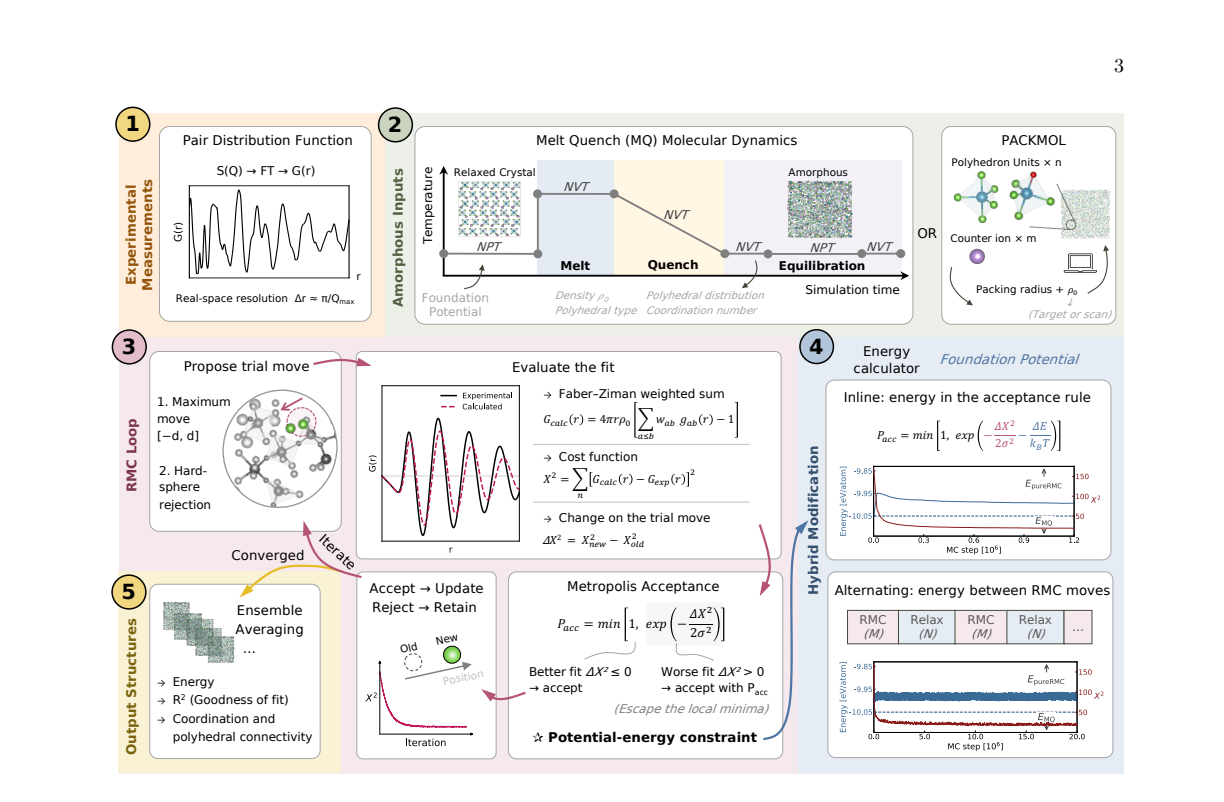
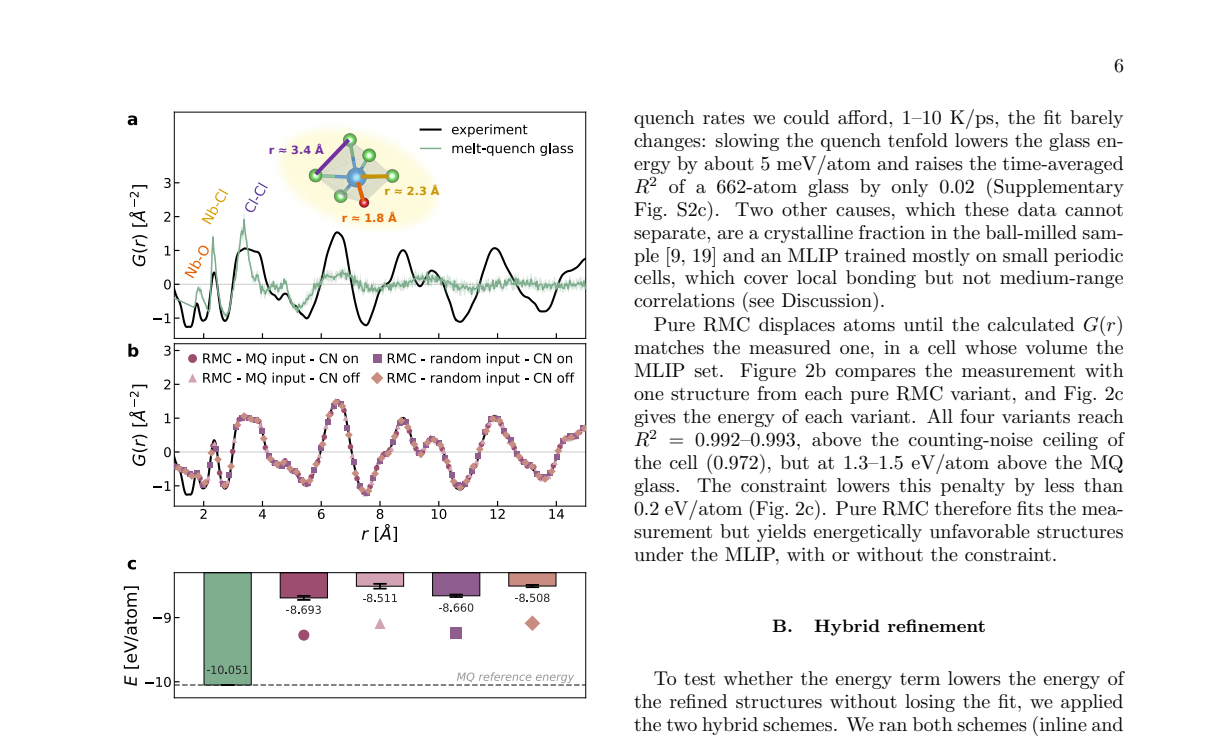
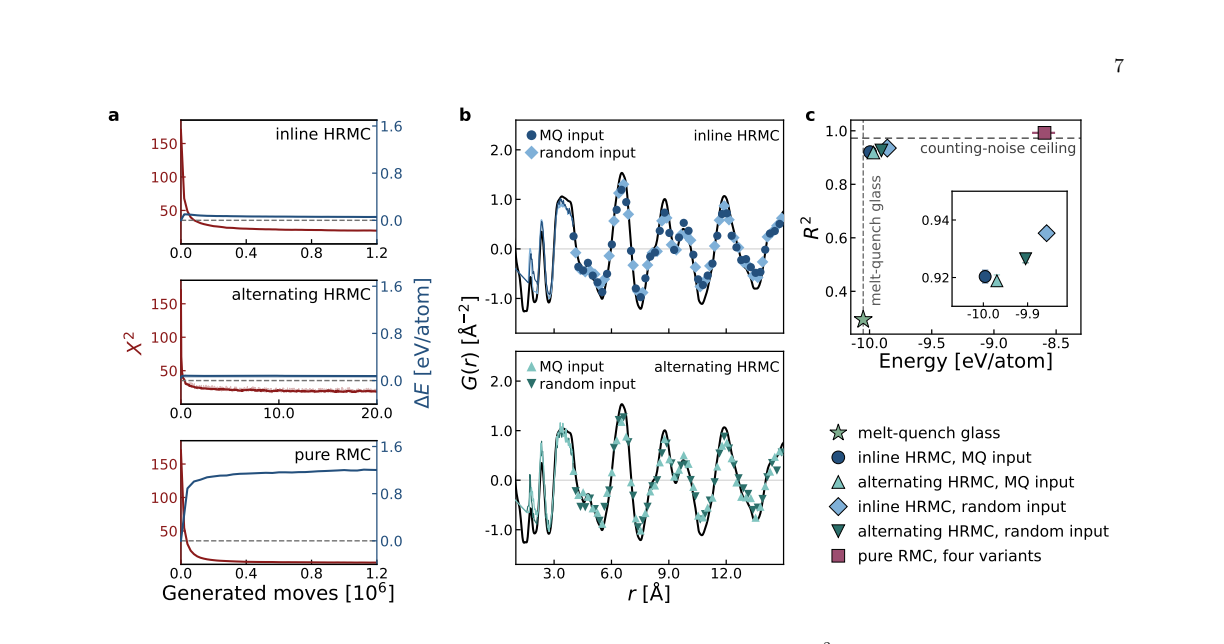
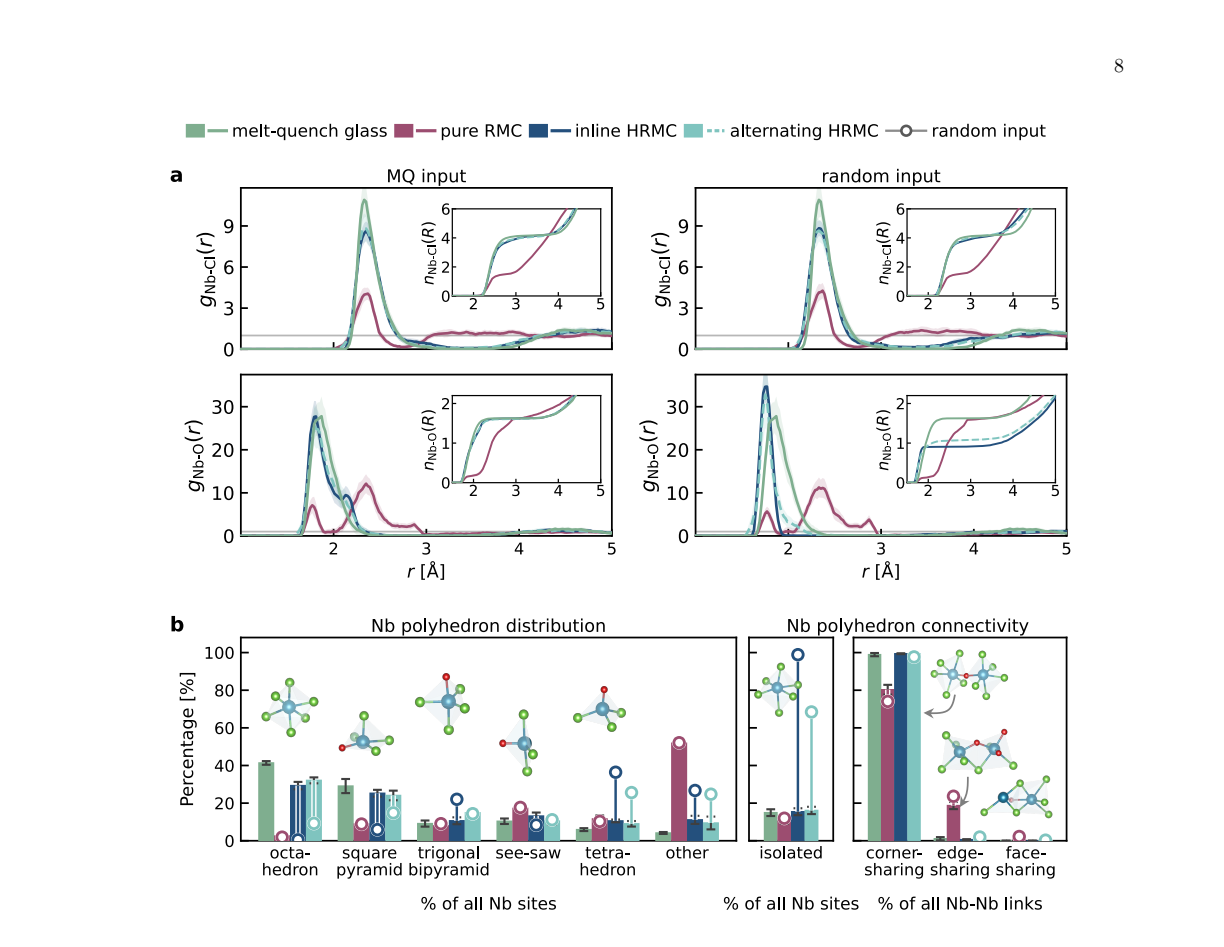
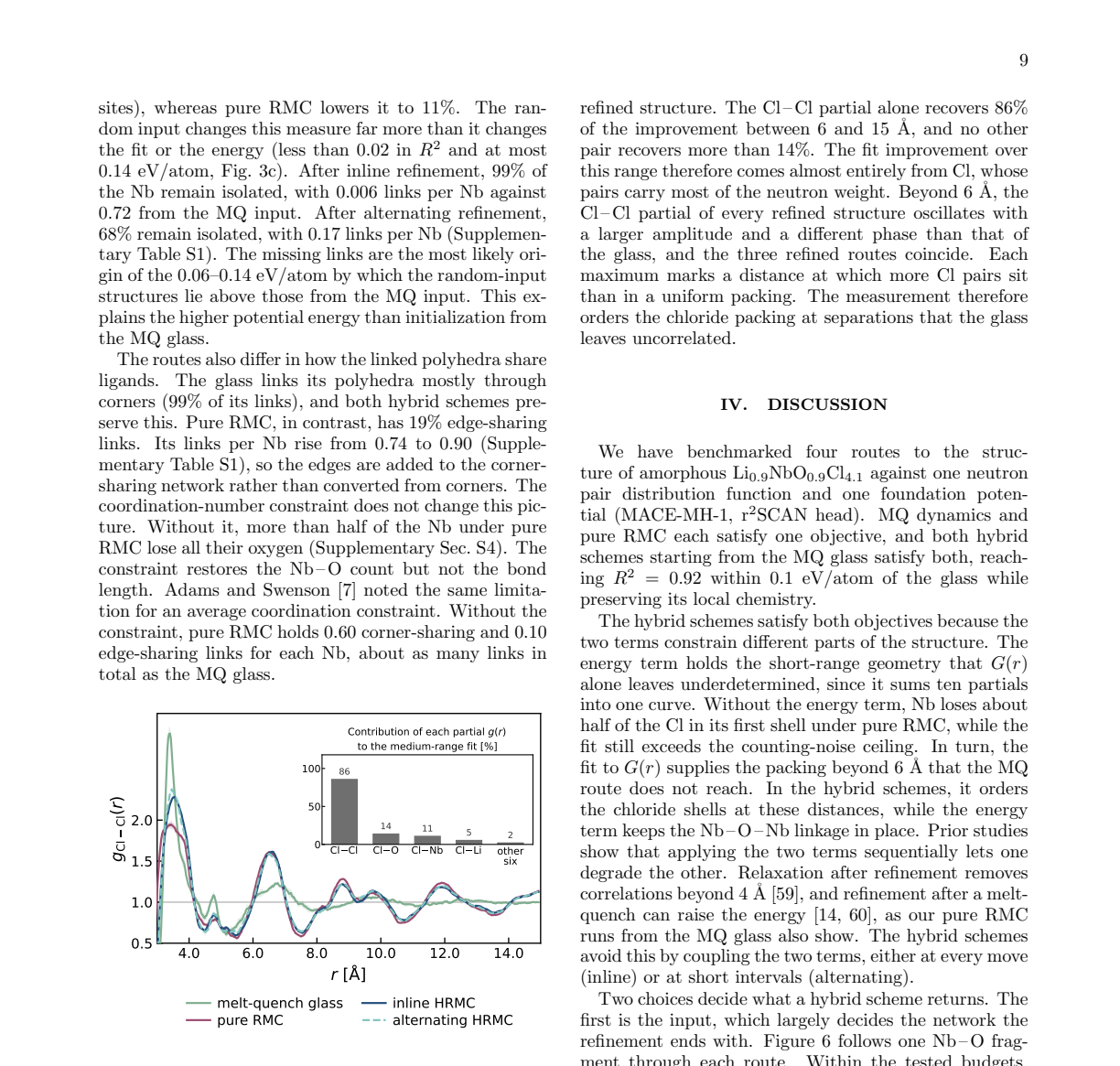
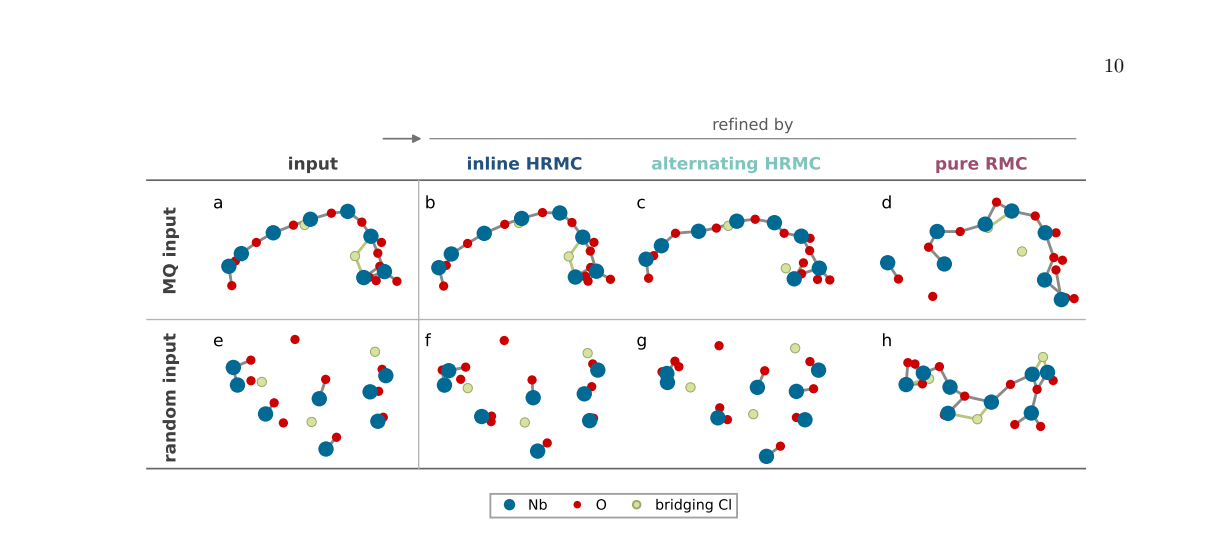
Melt-quench molecular dynamics builds a model from the interatomic potential alone, and reverse Monte Carlo (RMC) builds one from the measurement alone. The two have rarely been compared with all else held fixed. We benchmark both routes and two hybrid schemes on amorphous ȩ{Li_0.9NbO_0.9Cl_4.1} against one neutron pair distribution function with one foundation potential. The hybrid schemes put the energy either in the acceptance rule (inline) or in short relaxations between blocks of refinement (alternating). Each refinement starts from a melt-quench glass or from a random packing of isolated units. The glass has the lowest energy and places the first-shell peaks correctly, but carries almost none of the oscillation beyond 6 Å (goodness of fit R2 = 0.29). Pure RMC fits the measurement to within its counting noise (R2 = 0.99), but at more than 1.3 eV/atom above the glass, and niobium loses about half of its first-shell chlorine. Started from the glass, both hybrid schemes reach R2 = 0.92 within 0.1 eV/atom of its energy and keep its coordination chemistry. Structures from the two inputs fit almost equally well and differ in energy by a tenth of the RMC penalty, yet they differ in whether their polyhedra are connected. The input is therefore part of the method. We recommend quenching a glass with a foundation potential and refining it against the measurement with a hybrid scheme. The resulting structure carries both the local chemistry and the medium-range order, and it is the starting point for modeling ion transport in these conductors.
from the abstract
Pith says
Machine review · deepseek-v4-flash · 15 Oct 2026 · what was read was not recorded · not checked by a person
It can be wrong. Challenge this review or reply to it.
Holds up, with conditions. A clean, honest benchmark of amorphous structure modeling routes on an oxychloride electrolyte; the limitations are stated clearly and the central practical recommendation is well-supported. This line is wrong
3 major objections · 5 minor
How often objections from reviews like this one are right: not yet measured
Not checked: figures, code, what the 69 references say.
The paper says, at Section II.B and Supplementary Sec. S1
The review did not quote this passage.
Pith says: Objection 1 of 3 · major
The foundation potential (MACE-MH-1 r2SCAN head) is validated only on 55-atom disordered configurations (MAE 3.1 meV/atom). The potential is used to generate the MQ glass, to score every structure in all routes, and to perform relaxations in the alternating scheme.
more of objection 1
The 55-atom cell cannot capture correlations beyond ~6 Å, which is precisely where the hybrid schemes claim to recover packing information (Fig. 5, inset). The paper acknowledges this risk (sentence b179, Discussion), but does not provide evidence that the potential's energy ranking between the MQ glass, pure RMC, and hybrid structures is physically meaningful for the 2236-atom cell. A test against DFT (r2SCAN) on a subset of configurations (e.g., one from each route, or on larger representative cells) would substantially strengthen the central claim. If such calculations are too expensive, the limitation should be stated more prominently as a caveat on the quantitative energy comparisons.
The paper says, at Section II.D.e and Section III.C
The review did not quote this passage.
Pith says: Objection 2 of 3 · major
The coordination-number (CN) constraint on Nb–O uses the distribution from the MQ glass as the target. All hybrid schemes appear to include this constraint (Methods describe it as part of the RMC loop, and it is active for pure RMC in Fig. 2 and for hybrid schemes in Figs. 3–4; please confirm explicitly).
more of objection 2
If the CN constraint is applied to the hybrid routes, then the claim that they 'keep the coordination chemistry of the glass' is partly enforced by the objective function, not solely a consequence of the energy term. The paper should state unambiguously which schemes use the CN constraint, and should report hybrid runs without it (or explain why they are omitted) to separate the effect of the constraint from that of the energy term.
The paper says, at Section II.E.a and Supplementary Sec. S5
The review did not quote this passage.
A classifier read this sentence of the paper as acknowledging the concern (probability 0.73):
“It costs an MLIP call for every move that passes the hard- sphere filter, and its energy still decreases slightly at the end of the budget, so the inline energies reported here are upper bounds (Supplementary Sec. S5).”
Pith says: Objection 3 of 3 · major
The inline scheme's energy is still decreasing at the end of the fixed budget (b305: 'its energy still decreases slightly at the end of the budget, so the inline energies reported here are upper bounds'). This raises the question of whether the energy-R² trade-off (Fig. 3c) has converged.
more of objection 3
The authors should either extend the inline runs until the energy trace is stationary (or nearly so) or explicitly quantify the remaining drift and its likely impact on the reported energy relative to the glass.
5 minor objections
The paper says, at Figure 3c
Pith says: minor objection 1 of 5
The marker for pure RMC spans four variants at 1.3–1.5 eV/atom. It would be helpful to label which of the four (with/without constraint, from MQ/random) gives which energy, or to use separate markers.
The paper says, at Section II.D.c
Pith says: minor objection 2 of 5
The hard-sphere table is derived from the MQ glass (0.95 times the shortest observed distance). This ties even the pure RMC runs to the glass's closest approaches. The effect of this choice on the energy and coordination of pure RMC should be mentioned in the discussion.
show 3 more
The paper says, at Section III.A, Fig. 2a
Pith says: minor objection 3 of 5
The green band in Fig. 2a is stated as one sample standard deviation over five glasses. However, the glasses are generated from the same melt at different seeds; the band may underestimate the true variance of the MQ ensemble. A brief comment on this would be appropriate.
The paper says, at Section IV, last paragraph
Pith says: minor objection 4 of 5
The sentence 'The barrier a mobile ion encounters is set by the size and connectivity of the sites' cites Ref. [7]. It would be helpful to note that this bond-valence analysis is relevant for the Li positions, which the paper acknowledges are poorly constrained (b318).
The paper says, at General
Pith says: minor objection 5 of 5
Several references to 'Discussion' (e.g., line after b179, b314) are forward references to the section that follows Results. This is acceptable, but the Discussion section is not labeled in the provided text; please ensure the final manuscript has clear section headings.
What would settle it
Run r2SCAN DFT calculations (or another consistent level) on 2–3 representative configurations from each route: (1) a melt-quench glass, (2) the best hybrid structure from the MQ input (inline and alternating), (3) a pure RMC final structure. Compute total energies and compare with MACE-MH-1 predictions. Additionally, compute forces on a subset of atoms (e.g., 200 atoms) to check if the potential accurately captures local relaxations. If the relative energy ordering between routes changes by more than 0.05 eV/atom or the force MAE exceeds 50 meV/Å, then the energy-based comparisons in Fig. 3c are unreliable and the central argument weakens.
from the skeptic's reading
How the review went
4 readings by deepseek-v4-flash · 15 Oct 2026
- Reader holds up, with conditions
- Skeptic agrees
- Editor wrote the verdict above
- Referee minor revision: 3 major objections, 5 minor
Not run on this paper: the simulated authors' defence.
Pith did not check this review's objections against the paper.
The review in full
The review in brief, machine-written
This paper does what it says: compare melt-quench MD, pure RMC, inline HRMC, and alternating HRMC on one oxychloride (Li0.9NbO0.9Cl4.1) with one cell, one MLIP, and one neutron PDF. The main result—that the input structure largely determines the polyhedral network even when fit and energy are nearly equal—is new and directly useful for practitioners. The benchmarking is thorough: five independent chains per condition, uncertainties reported, and the hybrid schemes are described clearly enough to reproduce.
The authors are unusually transparent about caveats. They note the sample is only ~55% amorphous, that the MLIP validation is limited to small disordered cells (MAE 3.1 meV/atom on 55 atoms), that Li contrast is poor, and that inline energies are upper bounds. This honesty strengthens the paper.
The stress-test concern about foundation-potential accuracy is real but not fatal. All structures are scored with the same potential, so relative rankings between routes are meaningful even if absolute energies carry systematic error. The authors acknowledge this risk (Section IV) and recommend user-side validation. For comparing modeling routes—the stated purpose—the potential is adequate.
Weaknesses: the absolute structures (especially Li positions) are model-dependent; the study covers only one material and one measurement, so generalizability to other systems is untested. But the paper does not overclaim generality—it offers a practical workflow.
Who this is for: materials modellers working on amorphous solid electrolytes. It deserves a serious referee and publication after minor revision (e.g., add a sentence on how one might extend the MLIP validation). I would cite it for the head-to-head comparison and the honest discussion.
Yes to peer review.
The strongest objection
The central claim—that hybrid refinement of a melt-quench glass is the best practical route—rests on the foundation potential (MACE-MH-1 with r2SCAN head) being accurate for the specific amorphous oxychloride composition Li0.9NbO0.9Cl4.1. This potential is used to (i) generate the melt-quench glass reference, (ii) score every structure in pure and hybrid refinement (energy term in inline scheme, relaxations in alternating scheme), and (iii) compare energies across routes. The paper's own validation (Section II.B and Supplementary Sec. S1) reports a mean absolute error of only 3.1 meV/atom against plane-wave r2SCAN for a set of disordered 55-atom configurations. However, 55-atom cells cannot capture medium-range order beyond ~6 Å, which is precisely the range where the hybrid refinement claims to recover packing information from the fit (Fig. 5, inset). The potential's accuracy for correlations at 6–15 Å and for the 2236-atom cell used throughout is untested. The paper acknowledges this risk (Section IV caveats, and sentence [b179]: "an MLIP trained mostly on small periodic cells, which cover local bonding but not medium-range correlations"), but does not provide evidence that the potential's energy ranking between different structural families (glass, pure RMC, hybrid) is physically meaningful. If the potential systematically overstabilizes or understabilizes certain medium-range arrangements—a plausible failure mode for a potential trained on small crystalline and sparse disordered snapshots—then the relative energies in Fig. 3c (the central quantitative evidence) could be misleading. For instance, the 0.1 eV/atom gap between hybrid structures and the glass might not reflect true physical preference, and the claimed superiority of the MQ-input hybrid could be an artifact of a potential that penalizes connectivity differences incorrectly.
The reader's weakest_assumption correctly identifies the foundation potential's accuracy as the load-bearing concern. The paper acknowledges the limited validation (only 55-atom test sets) and states in caveats that the potential may not capture medium-range correlations. However, the conclusion explicitly recommends the same type of potential for practical use. This makes the potential's reliability the single most important unresolved issue. The concrete test (DFT validation of relative energies and forces) would directly resolve whether the energy differences between routes are physically meaningful. I agree with the reader that the manuscript is a sound contribution—methodologically transparent, with multiple replicates and honest caveats—so the conditional acceptance is appropriate. No adjustment to the verdict is needed.
The referee's report
If the result holds, the paper provides the first systematic, cell-size- and potential-constant comparison of MQ, pure RMC, and two hybrid schemes for an amorphous solid electrolyte. The demonstration that hybrid refinement recovers medium-range order that MQ misses while maintaining an energy penalty two orders of magnitude smaller than pure RMC is practically valuable. The finding that the input structure largely determines the polyhedral connectivity, even when the fit and energy are nearly identical, is an important caution for the field. The paper is transparent about its caveats (crystalline fraction, uneven neutron contrast, potential validation) and makes the code and data available, which supports reproducibility.
Pith's reading of the paper (a machine's summary, not the authors')
Amorphous alkali oxychlorides are promising fast-ion conductors, but their atomic structures cannot be read directly from scattering data. The authors compare four modeling routes—melt-quench molecular dynamics, pure reverse Monte Carlo, and two hybrid reverse Monte Carlo schemes—on a single neutron pair distribution function for Li₀.₉NbO₀.₉Cl₄.₁. Melt-quench glass has the lowest energy but fits the data poorly (R²=0.29). Pure RMC fits the data extremely well (R²=0.99) but at an energy penalty of over 1.3 eV/atom and destroys the niobium coordination chemistry. Both hybrid schemes, starting from the melt-quench glass, reach R²=0.92 within 0.1 eV/atom of the glass energy while preserving the local chemistry. The paper recommends quenching a glass with a foundation potential and refining it against the measurement with a hybrid scheme, and shows that the input structure largely determines the final network connectivity.
What carries the argument. The key machinery is the hybrid reverse Monte Carlo (HRMC) method, which adds a potential-energy term from the MACE-MH-1 foundation potential (r²SCAN head) to the standard RMC acceptance criterion (inline) or through periodic relaxations (alternating). The MLIP provides an energy score that prevents the structural degradation seen in pure RMC, while the fit to the scattering data supplies medium-range order missing from the melt-quench glass. The melt-quench glass, generated by the same foundation potential, provides a low-energy starting point with correct short-range bonding that the refinement preserves.
Core claim. The core discovery is that hybrid reverse Monte Carlo (inline or alternating) combined with a melt-quench glass input achieves a fit to the neutron pair distribution function (R²=0.92) that is far better than the glass alone (R²=0.29) and an energy (within 0.1 eV/atom of the glass) that is far lower than pure RMC (1.3–1.5 eV/atom above), while keeping the niobium coordination chemistry intact—pure RMC strips about half of the chlorine from the first shell. The two hybrid schemes differ in computational cost and final energy, but both converge to similar fit and energy from the glass input. Structures refined from a random packing of isolated units fit slightly better (R²≈0.93) but lie 0.06–0.14 eV/atom higher in energy and exhibit far fewer polyhedral connections, showing that the input determines the network topology even when the overall fit and energy are close.
The premise it rests on. The entire comparison depends on the accuracy of the MACE-MH-1 foundation potential (r²SCAN head) for this disordered oxychloride composition: if the MLIP gives unreliable energies or forces for this system, the energy comparisons and the melt-quench glass itself may be misleading.
If the paper is right (Pith's inferences, not the authors')
This hybrid route can be applied to other amorphous solid electrolytes where total scattering data and a foundation potential are available, enabling atomistic models for ion-transport simulations.
The method separates the roles of energy and diffraction data in structure determination: the former fixes local chemistry, the latter fixes medium-range packing.
The input structure is part of the method; a melt-quench glass is recommended because it provides a physically plausible network that the refinement does not erase.
For compositions without a known crystal structure, crystal structure prediction or generative models can supply the starting point for melt-quench dynamics.
The resulting structures let future studies analyze site geometry, polyhedron connectivity, and free volume to understand ionic transport barriers.
The reliance on a single MLIP (MACE-MH-1 r²SCAN) means that the results should be tested with other foundation potentials (e.g., MACE-MH-1 PBE or OMat24) to confirm robustness against potential biases in the energy surface.
Because lithium positions are weakly constrained by the neutron data (only 6.3% of the neutron weight), the resulting models are not directly reliable for lithium transport paths without further validation via ab initio molecular dynamics or NMR.
The 55% amorphous fraction in the sample introduces a potential bias from the crystalline component; repeating the study on a fully amorphous sample would clarify the true medium-range order of the glassy phase and test whether the hybrid refinement recovers it completely.
Check this review
Pith stored no record of this review's passes and took no fingerprint of it. Reviews made by code from 13 Nov 2026 on carry both.
How often reviews like this one are right
Reviews like this one: written by deepseek-v4-flash, where what was read was not recorded.
How often objections from reviews like this one are right: not yet measured
Reviews by people
This review was written by a machine. No person has reviewed this paper on Pith yet. A scientist listed on Pith can review it for a fee, and their review is published here whatever it concludes.
The paper
Abstract
Amorphous alkali oxychlorides are fast ion conductors, but their atomic structure remains unresolved. Total scattering sums all partial pair correlations into one curve that has no unique inversion, so the structure must be modeled. Melt-quench molecular dynamics builds a model from the interatomic potential alone, and reverse Monte Carlo (RMC) builds one from the measurement alone. The two have rarely been compared with all else held fixed. We benchmark both routes and two hybrid schemes on amorphous ȩ{Li_0.9NbO_0.9Cl_4.1} against one neutron pair distribution function with one foundation potential. The hybrid schemes put the energy either in the acceptance rule (inline) or in short relaxations between blocks of refinement (alternating). Each refinement starts from a melt-quench glass or from a random packing of isolated units. The glass has the lowest energy and places the first-shell peaks correctly, but carries almost none of the oscillation beyond 6 Å (goodness of fit R2 = 0.29). Pure RMC fits the measurement to within its counting noise (R2 = 0.99), but at more than 1.3 eV/atom above the glass, and niobium loses about half of its first-shell chlorine. Started from the glass, both hybrid schemes reach R2 = 0.92 within 0.1 eV/atom of its energy and keep its coordination chemistry. Structures from the two inputs fit almost equally well and differ in energy by a tenth of the RMC penalty, yet they differ in whether their polyhedra are connected. The input is therefore part of the method. We recommend quenching a glass with a foundation potential and refining it against the measurement with a hybrid scheme. The resulting structure carries both the local chemistry and the medium-range order, and it is the starting point for modeling ion transport in these conductors.
The paper's own sentences, arranged, kept beside the review and separate from it. Each label is drawn from a closed vocabulary; the number beside it is the probability the classifier gave that label. No sentence in this record was written by a model.
abstract compiled · 2026-10-15
The authors' main claim, as the classifier picked it out 0.89
“We recommend quenching a glass with a foundation potential and refining it against the measurement with a hybrid scheme.”
How the main claim is stated: asserted 0.83
What the abstract itself states, as probabilities: claims first 0.08 · states limitation 0.85 · human participants 0.01 · controlled comparison 0.79 · randomized assignment 0.02 · states quantitative result 0.98 · compares with prior results 0.94 · mentions code or data availability 0.02
The abstract, sentence by sentence
This table labels the abstract only (arXiv listing abstract v1). The number is the probability the classifier gave the label.
| Sentence | Role | The authors' own work | States the main conclusion | Strength |
|---|---|---|---|---|
| Amorphous alkali oxychlorides are fast ion conductors, but their atomic structure remains unresolved. | gap 0.59 | 0.07 | 0.02 | asserted 1.00 |
| Total scattering sums all partial pair correlations into one curve that has no unique inversion, so the structure must be modeled. | background 0.99 | 0.07 | 0.02 | asserted 1.00 |
| Melt-quench molecular dynamics builds a model from the interatomic potential alone, and reverse Monte Carlo (RMC) builds one from the measurement alone. | background 0.93 | 0.05 | 0.02 | asserted 1.00 |
| The two have rarely been compared with all else held fixed. | gap 0.98 | 0.07 | 0.02 | asserted 0.97 |
| We benchmark both routes and two hybrid schemes on amorphous \ce{Li_{0.9}NbO_{0.9}Cl_{4.1}} against one neutron pair distribution function with one foundation potential. | contribution 0.50 | 0.95 | 0.04 | asserted 0.98 |
| The hybrid schemes put the energy either in the acceptance rule (inline) or in short relaxations between blocks of refinement (alternating). | method 0.99 | 0.71 | 0.02 | asserted 0.99 |
| Each refinement starts from a melt-quench glass or from a random packing of isolated units. | method 1.00 | 0.76 | 0.02 | asserted 0.99 |
| The glass has the lowest energy and places the first-shell peaks correctly, but carries almost none of the oscillation beyond 6~\AA{} (goodness of fit $R^{2} = 0.29$). | result 1.00 | 0.94 | 0.04 | asserted 1.00 |
| Pure RMC fits the measurement to within its counting noise ($R^{2} = 0.99$), but at more than $1.3$~eV/atom above the glass, and niobium loses about half of its first-shell chlorine. | result 1.00 | 0.94 | 0.05 | asserted 1.00 |
| Started from the glass, both hybrid schemes reach $R^{2} = 0.92$ within $0.1$~eV/atom of its energy and keep its coordination chemistry. | result 1.00 | 0.97 | 0.18 | asserted 1.00 |
| Structures from the two inputs fit almost equally well and differ in energy by a tenth of the RMC penalty, yet they differ in whether their polyhedra are connected. | result 0.98 | 0.95 | 0.11 | asserted 1.00 |
| The input is therefore part of the method. | interpretation 0.99 | 0.67 | 0.19 | asserted 1.00 |
| We recommend quenching a glass with a foundation potential and refining it against the measurement with a hybrid scheme. | future work 0.59 | 0.44 | 0.79 | asserted 0.83 |
| The resulting structure carries both the local chemistry and the medium-range order, and it is the starting point for modeling ion transport in these conductors. | interpretation 0.63 | 0.80 | 0.37 | asserted 1.00 |
What kind of paper the classifier reports this is: simulation study 0.61 · evidence from simulation or computation 0.98
What was examined, and what was not
Sources read
- arXiv listing abstract v1
Not examined
- full text
- figures and tables
- references and citing sentences
- relations to other papers
Levels run
- P abstract
Not run
- S sections
- T body sentences
- C citations
- R cross-paper relations
How the labels were made
Compiled by classifier-1.13.0 via TypeSafe API, question bank abstract-p1-20260923, 2026-10-15: 1 request, 10,269 input tokens.
Every quoted sentence on this record is the authors'. Every label is from Pith's closed vocabulary, with the probability shown beside it. This record as JSON
Figures (6)
Figures are the authors', reproduced from the paper.
References (69)
- [1] K. Motohashi, H. Tsukasaki, S. Mori, A. Sakuda, and A. Hayashi, Fast Sodium-Ion Conducting Amorphous Oxychloride Embedding Nanoparticles, Chemistry of Materials36, 9914 (2024) on Pith
- [2] Z. Huang, N. Yadav, S. Itakura, P. Song, H. Akamatsu, K. Hayashi, P. Gorai, and S. Ohno, Oxygen-Mediated Structural Modulation and Ion Transport inxNa 2O- TaCl5 Glass Electrolytes, Journal of the American Chem- ical Society147, 43391 (2025) on Pith
- [3] S. Zhang, F. Zhao, J. Chen, J. Fu, J. Luo, S. H. Ala- hakoon, L.-Y. Chang, R. Feng, M. Shakouri, J. Liang, Y. Zhao, X. Li, L. He, Y. Huang, T.-K. Sham, and X. Sun, A family of oxychloride amorphous solid elec- trolytes for long-cycling all-solid-state lithium batteries, Nature... on Pith
- [4] Y. Tanaka, K. Ueno, K. Mizuno, K. Takeuchi, T. Asano, and A. Sakai, New oxyhalide solid electrolytes with high lithium ionic conductivity>10 mS cm −1 for all-solid- state batteries, Angewandte Chemie International Edi- tion62, e202217581 (2023) on Pith
- [5] L. Binci, K. Jun, B. Deng, and G. Ceder, Mechanisms of alkali ionic transport in amorphous oxyhalides solid state conductors, Advanced Energy Materials16, e71124 (2026) on Pith
- [6] J. Leifeld, A. C. Parsons, A. Morscher, X. M. De Irujo- Labalde, M. A. Kraft, O. G. Soulas, B. Samanta, W. Zielasko, N. Yadav, K. Strotmann, N. Jalarvo, B. V. M. Rodrigues, A. Slabon, P. Adelhelm, M. R. Hansen, D. O. Scanlon, W. G. Zeier, and A. G. Squires, Disorder-Driven Fas... on Pith
- [7] S. Adams and J. Swenson, Bond valence analysis of re- verse Monte Carlo produced structural models; a way to understand ion conduction in glasses, Journal of Physics: Condensed Matter17, S87 (2005). 12 on Pith
- [8] B. Singh, Y. Wang, J. Liu, J. D. Bazak, A. Shyamsun- der, and L. F. Nazar, Critical Role of Framework Flex- ibility and Disorder in Driving High Ionic Conductivity in LiNbOCl4, Journal of the American Chemical Society 146, 17158 (2024) on Pith
- [9] J. A. Newnham, J. Kondek, J. Hartel, C. Rosenbach, C. Li, V. Faka, L. Gronych, D. Glikman, F. Schreiner, D. D. Wind, B. Braunschweig, M. R. Hansen, and W. G. Zeier, Correlation between the Coherence Length and Ionic Conductivity in LiNbOCl 4 via the Anion Stoi- chiometry, Chem... on Pith
- [10] F. Hussain, J. Zhu, Y. Zhao, and W. Xia, Exploring supe- rionic conduction in lithium oxyhalide solid electrolytes considering composition and structural factors, npj Com- putational Materials10, 148 (2024) on Pith
- [11] A. Le Bail, Combining the reverse Monte Carlo and the Rietveld glass structure modelling methods, ChemWeb preprint (2000) on Pith
- [12] C. R. M¨ uller, V. Kathriarachchi, M. Schuch, P. Maass, and V. G. Petkov, Reverse Monte Carlo modeling of ion conducting network glasses: An evaluation based on molecular dynamics simulations, Physical Chemistry Chemical Physics12, 10444 (2010) on Pith
- [13] X. Li, W. Song, K. Yang, N. M. A. Krishnan, B. Wang, M. M. Smedskjaer, J. C. Mauro, G. Sant, M. Balonis, and M. Bauchy, Cooling rate effects in sodium silicate glasses: Bridging the gap between molecular dynamics simulations and experiments, The Journal of Chemical Physics147,... on Pith
- [14] K. Matsutani, S. Kasamatsu, and T. Usuki, Comparison of intermediate-range order in GeO2 glass: Molecular dy- namics using machine-learning interatomic potential vs reverse Monte Carlo fitting to experimental data, The Journal of Chemical Physics161, 204103 (2024) on Pith
- [15] A. D. Kaplan, R. Liu, J. Qi, T. W. Ko, B. Deng, J. Riebe- sell, G. Ceder, K. A. Persson, and S. P. Ong, A foun- dational potential energy surface dataset for materials (2025), arXiv:2503.04070 on PitharXiv
- [16] L. Barroso-Luque, M. Shuaibi, X. Fu, B. M. Wood, M. Dzamba, M. Gao, A. Rizvi, M. Uyttendaele, C. L. Zitnick, and Z. W. Ulissi, The Open Materials 2024 (OMat24) inorganic materials dataset and models, Na- ture Computational Science6, 642 (2026) on Pith
- [17] I. Batatia, C. Lin, J. Hart, E. Kasoar, A. M. Elena, S. W. Norwood, T. Wolf, and G. Cs´ anyi, Cross Learning be- tween Electronic Structure Theories for Unifying Molec- ular, Surface, and Inorganic Crystal Foundation Force Fields (2025), arXiv:2510.25380 on PitharXiv
- [18] M. Bertani and A. Pedone, Atomic Structure of Na 4 P2 S7 Glass Solid Electrolyte: Fine-Tuning Machine Learn- ing Potentials for Enhanced Accuracy, The Journal of Physical Chemistry C129, 12697 (2025) on Pith
- [19] D. Butenko, J.-c. Tseng, X. Zhang, P. Yu, W. Tang, J. Lei, S. Zhang, P. Wang, Y. Li, M. Liu, W. Yin, L. Wang, S. Han, W. Xia, Y. Zhao, and J. Zhu, Rapid mechanochemical synthesis of oxyhalide superionic con- ductor: Time-resolved structural evolution, Small Meth- ods10, e00947 (2026) on Pith
- [20] R. L. McGreevy and L. Pusztai, Reverse Monte Carlo simulation: A new technique for the determination of dis- ordered structures, Molecular Simulation1, 359 (1988) on Pith
show 49 more
- [21] D. A. Keen, Total scattering and the pair distribution function in crystallography, Crystallography Reviews26, 143 (2020) on Pith
- [22] M. G. Tucker, D. A. Keen, M. T. Dove, A. L. Good- win, and Q. Hui, RMCProfile: Reverse Monte Carlo for polycrystalline materials, Journal of Physics: Condensed Matter19, 335218 (2007) on Pith
- [23] H. E. Fischer, A. C. Barnes, and P. S. Salmon, Neutron and x-ray diffraction studies of liquids and glasses, Re- ports on Progress in Physics69, 233 (2006) on Pith
- [24] M. I. Mendelev, S. N. Ishmaev, F. Hajdu, G. M´ esz´ aros, and E. Sv´ ab, Partial structure correlations in amor- phous Ni 83La17, Journal of Non-Crystalline Solids240, 35 (1998) on Pith
- [25] G. Opletal, T. Petersen, B. O’Malley, I. Snook, D. G. Mc- Culloch, N. A. Marks, and I. Yarovsky, Hybrid approach for generating realistic amorphous carbon structure using Metropolis and reverse Monte Carlo, Molecular Simula- tion28, 927 (2002) on Pith
- [26] G. Opletal, T. C. Petersen, B. O’Malley, I. K. Snook, D. G. McCulloch, and I. Yarovsky, HRMC: Hybrid re- verse Monte Carlo method with silicon and carbon po- tentials, Computer Physics Communications178, 777 (2008) on Pith
- [27] M. Habchi, S. M. Mesli, M. Kotbi, and H. Xu, Structural modelling of the LiCl aqueous solution by the hybrid re- verse Monte Carlo (HRMC) simulation, The European Physical Journal B85, 255 (2012) on Pith
- [28] A. Pandey, P. Biswas, and D. A. Drabold, Force- enhanced atomic refinement: Structural modeling with interatomic forces in a reverse Monte Carlo approach ap- plied to amorphous Si and SiO 2, Physical Review B92, 155205 (2015) on Pith
- [29] A. Pandey, P. Biswas, B. Bhattarai, and D. A. Drabold, Realistic inversion of diffraction data for an amorphous solid: The case of amorphous silicon, Physical Review B 94, 235208 (2016) on Pith
- [30] P. Biswas, D. N. Tafen, and D. A. Drabold, Experimen- tally constrained molecular relaxation: The case of glassy GeSe2, Physical Review B71, 054204 (2005) on Pith
- [31] P. Cuillier, M. G. Tucker, and Y. Zhang, Integrating ma- chine learning interatomic potentials with hybrid reverse Monte Carlo structure refinements in RMCProfile, Jour- nal of Applied Crystallography57, 1780 (2024) on Pith
- [32] K. M. Ehrhardt, J. D. Sundberg, and S. C. Warren, pyHRMC: Hybrid reverse Monte Carlo for electron to- tal scattering, Journal of Computational Chemistry47, e70306 (2026) on Pith
- [33] T. C. Nicholas, D. F. Thomas du Toit, L. A. M. Rosset, D. M. Proserpio, A. L. Goodwin, and V. L. Deringer, The structure and topology of an amorphous metal-organic framework (2025), arXiv:2503.24367 [cond-mat] on PithPith's reviewarXiv
- [34] H. Kwon, T. Hsu, W. Sun, W. Jeong, F. Aydin, J. Chap- man, X. Chen, V. Lordi, M. R. Carbone, D. Lu, F. Zhou, and T. A. Pham, Spectroscopy-guided discovery of three- dimensional structures of disordered materials with diffu- sion models, Machine Learning: Science and Technology... on Pith
- [35] J. Guo and D. Schwalbe-Koda, Generative Inversion of Spectroscopic Data for Amorphous Structure Elucidation (2026), arXiv:2603.23210 on PitharXiv
- [36] S. Zhang, F. Zhao, L.-Y. Chang, Y.-C. Chuang, Z. Zhang, Y. Zhu, X. Hao, J. Fu, J. Chen, J. Luo, M. Li, Y. Gao, Y. Huang, T.-K. Sham, M. D. Gu, Y. Zhang, G. King, and X. Sun, Amorphous oxyhalide matters for achieving lithium superionic conduction, Journal of the American Chemic... on Pith
- [37] D. Butenko, X. Zhang, M. T. Dove, J.-c. Tseng, Y. Zhang, P. Yu, J. Chen, C. Gu, S. Zhang, J. Lei, Y. Ren, Y. Chen, J. Zhu, and W. Xia, Investigating the structural evolution of lithium zirconium nitrochlo- ride solid electrolytes for all-solid-state batteries, Nature Communica... on Pith
- [38] M. T. Dove and G. Li, Review: Pair distribution func- tions from neutron total scattering for the study of lo- cal structure in disordered materials, Nuclear Analysis 1, 100037 (2022) on Pith
- [39] J. Xu, Y. Xia, Z. Li, H. Chen, X. Wang, Z. Sun, and W. Yin, Multi-physics instrument: Total scattering neu- tron time-of-flight diffractometer at china spallation neu- tron source, Nuclear Instruments and Methods in Physics Research Section A: Accelerators, Spectrometers, Dete... on Pith
- [40] I. Batatia, D. P. Kov´ acs, G. N. C. Simm, C. Ortner, and G. Cs´ anyi, MACE: Higher order equivariant message passing neural networks for fast and accurate force fields, inAdvances in Neural Information Processing Systems, Vol. 35 (2022) pp. 11423–11436 on Pith
- [41] J. H. Yang, D. A. Kitchaev, and G. Ceder, Rationalizing accurate structure prediction in the meta-GGA SCAN functional, Physical Review B100, 035132 (2019) on Pith
- [42] M. Kothakonda, A. D. Kaplan, E. B. Isaacs, C. J. Bar- tel, J. W. Furness, J. Ning, C. Wolverton, J. P. Perdew, and J. Sun, Testing the r 2 SCAN Density Functional for the Thermodynamic Stability of Solids with and without a van der Waals Correction, ACS Materials Au3, 102 (2023) on Pith
- [43] A. P. Thompson, H. M. Aktulga, R. Berger, D. S. Bolin- tineanu, W. M. Brown, P. S. Crozier, P. J. In ’T Veld, A. Kohlmeyer, S. G. Moore, T. D. Nguyen, R. Shan, M. J. Stevens, J. Tranchida, C. Trott, and S. J. Plimpton, LAMMPS - a flexible simulation tool for particle-based mat... on Pith
- [44] R. D. Shannon, Revised effective ionic radii and sys- tematic studies of interatomic distances in halides and chalcogenides, Acta Crystallographica Section A32, 751 (1976) on Pith
- [45] L. Mart ´ ınez, R. Andrade, E. G. Birgin, and J. M. Mart ´ ınez, PACKMOL: A package for building initial con- figurations for molecular dynamics simulations, Journal of Computational Chemistry30, 2157 (2009) on Pith
- [46] V. F. Sears, Neutron scattering lengths and cross sec- tions, Neutron News3, 26 (1992) on Pith
- [47] H. Tian, G. Cai, L. Tan, H. Lin, A. E. Phillips, I. Abra- hams, D. A. Keen, D. S. Keeble, A. Fiedler, J. Zhang, X. Y. Kong, and M. T. Dove, Local structure and lithium- ion diffusion pathway of cubic Li 7La3Zr2O12 studied by total scattering and the reverse Monte Carlo method,... on Pith
- [48] D. A. Keen and R. L. McGreevy, Structural modelling of glasses using reverse Monte Carlo simulation, Nature 344, 423 (1990) on Pith
- [49] L. Karlsson and R. L. McGreevy, Mechanisms of ionic conduction in Li 2SO4 and LiNaSO 4: Paddle wheel or percolation?, Solid State Ionics76, 301 (1995) on Pith
- [50] A. Hirata, S. Kohara, T. Asada, M. Arao, C. Yogi, H. Imai, Y. Tan, T. Fujita, and M. Chen, Atomic-scale disproportionation in amorphous silicon monoxide, Na- ture Communications7, 11591 (2016) on Pith
- [51] Y. Onodera, K. Mori, T. Otomo, A. C. Hannon, M. Sugiyama, and T. Fukunaga, Reverse Monte Carlo modeling of atomic configuration for Li 2S–P2S5 superi- onic glasses, IOP Conference Series: Materials Science and Engineering18, 022012 (2011) on Pith
- [52] D. A. Drabold, Topics in the theory of amorphous mate- rials, The European Physical Journal B68, 1 (2009) on Pith
- [53] A. H. Farmahini and S. K. Bhatia, Hybrid reverse Monte Carlo simulation of amorphous carbon: Distinguishing between competing structures obtained using different modeling protocols, Carbon83, 53 (2015) on Pith
- [54] E. Bitzek, P. Koskinen, F. G¨ ahler, M. Moseler, and P. Gumbsch, Structural relaxation made simple, Phys- ical Review Letters97, 170201 (2006) on Pith
- [55] D. Waroquiers, J. George, M. Horton, S. Schenk, K. A. Persson, G.-M. Rignanese, X. Gonze, and G. Hautier, ChemEnv: a fast and robust coordination environment identification tool, Acta Crystallographica Section B76, 683 (2020) on Pith
- [56] S. P. Ong, W. D. Richards, A. Jain, G. Hautier, M. Kocher, S. Cholia, D. Gunter, V. L. Chevrier, K. A. Persson, and G. Ceder, Python Materials Genomics (py- matgen): A Robust, Open-Source Python Library for Materials Analysis, Computational Materials Science68, 314 (2013) on Pith
- [57] N. P. Funnell, M. T. Dove, A. L. Goodwin, S. Parsons, and M. G. Tucker, Local structure correlations in plastic cyclohexane – a reverse Monte Carlo study, Journal of Physics: Condensed Matter25, 454204 (2013) on Pith
- [58] J. Timoshenko and A. Kuzmin, Reverse Monte Carlo and molecular-dynamics approaches to EXAFS analysis, in International Tables for Crystallography, Volume I: X- ray Absorption Spectroscopy and Related Techniques(In- ternational Union of Crystallography, 2024) Chap. 5.14, pp. 695–701 on Pith
- [59] C. Bousige, A. Bot ¸an, F.-J. Ulm, R. J.-M. Pellenq, and B. Coasne, Optimized molecular reconstruction proce- dure combining hybrid reverse Monte Carlo and molec- ular dynamics, The Journal of Chemical Physics142, 114112 (2015) on Pith
- [60] Y. Zhao, R. Sato, and S. Tsuneyuki, Accelerating sim- ulated annealing of glassy materials with data assim- ilation, Journal of Non-Crystalline Solids600, 122028 (2023) on Pith
- [61] C. J. Pickard and R. Needs, Ab initio random structure searching, J. Phys.: Condens. Matter23, 053201 (2011) on Pith
- [62] A. R. Oganov and C. W. Glass, Crystal structure predic- tion using ab initio evolutionary techniques: Principles and applications, J. Chem. Phys.124, 244704 (2006) on Pith
- [63] Y. Wang, J. Lv, L. Zhu, and Y. Ma, Crystal structure prediction via particle-swarm optimization, Phys. Rev. B82, 094116 (2010) on Pith
- [64] C. Zeni, R. Pinsler, D. Z¨ ugner, A. Fowler, M. Horton, X. Fu, Z. Wang, A. Shysheya, J. Crabb´ e, S. Ueda, R. Sor- dillo, L. Sun, J. Smith, B. Nguyen, H. Schulz, S. Lewis, C.-W. Huang, Z. Lu, Y. Zhou, H. Yang, H. Hao, J. Li, C. Yang, W. Li, R. Tomioka, and T. Xie, A generative... on Pith
- [65] X. Luo, Z. Wang, Q. Wang, X. Shao, J. Lv, L. Wang, Y. Wang, and Y. Ma, CrystalFlow: a flow-based gener- ative model for crystalline materials, Nat. Commun.16, 9267 (2025). 14 on Pith
- [66] P. Zhong, X. Dai, B. Deng, G. Ceder, and K. A. Persson, Crystal structure prediction with host-guided inpainting generation and foundation potentials, Materials Horizons 12, 9669 (2025) on Pith
- [67] H. Park, A. Onwuli, and A. Walsh, Exploration of crys- tal chemical space using text-guided generative artificial intelligence, Nature Communications16, 4379 (2025) on Pith
- [68] P. Zhong and K. A. Persson, Machine-Learning-Guided Insights into Solid-Electrolyte Interphase Conductivity: Are Amorphous Lithium Fluorophosphates the Key?, ACS Energy Letters11, 806 (2026) on Pith
- [69] J. D. Wicks and R. L. McGreevy, RMC: Modelling neu- tron diffraction, X-ray diffraction and EXAFS data si- multaneously for amorphous materials, Journal of Non- Crystalline Solids192–193, 23 (1995) on Pith
Cited by 1 Pith paper
Reviewed papers on Pith that cite this one. The full citation record
- Scalable long-range machine learning interatomic potentials with electrical response for atomistic material modeling cond-mat.mtrl-sci · Oct 2026
Challenges and discussion
Disagree with the review, or know something it missed? Leave a comment, or challenge this review formally: a challenge becomes a permanent entry in this paper's record, and its decision is published here.
Come back by email
A short list of the week's newly reviewed papers. Nothing is sent until you confirm from your inbox, and every email has a link that stops it. No account.
No comments yet.
Sign in to comment