Materials Science · arXiv:2610.23643 v1 · submitted 16 Oct 2026 · 75 references
Scalable long-range machine learning interatomic potentials with electrical response for atomistic material modeling
The paper says
“Accurate atomistic simulations of materials under electric fields require long-range electrostatics and electrical-response modeling at length scales beyond the reach of conventional first-principles methods. Yet these capabilities remain difficult to reconcile with the scalability of machine-learning interatomic potentials (MLIPs).”
more of the abstract
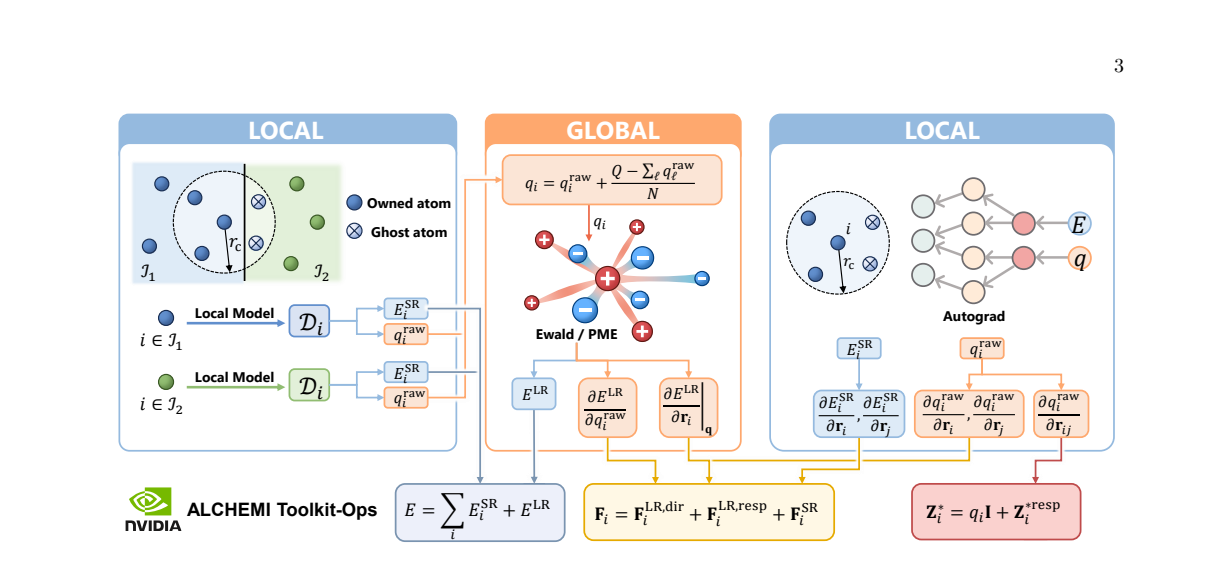
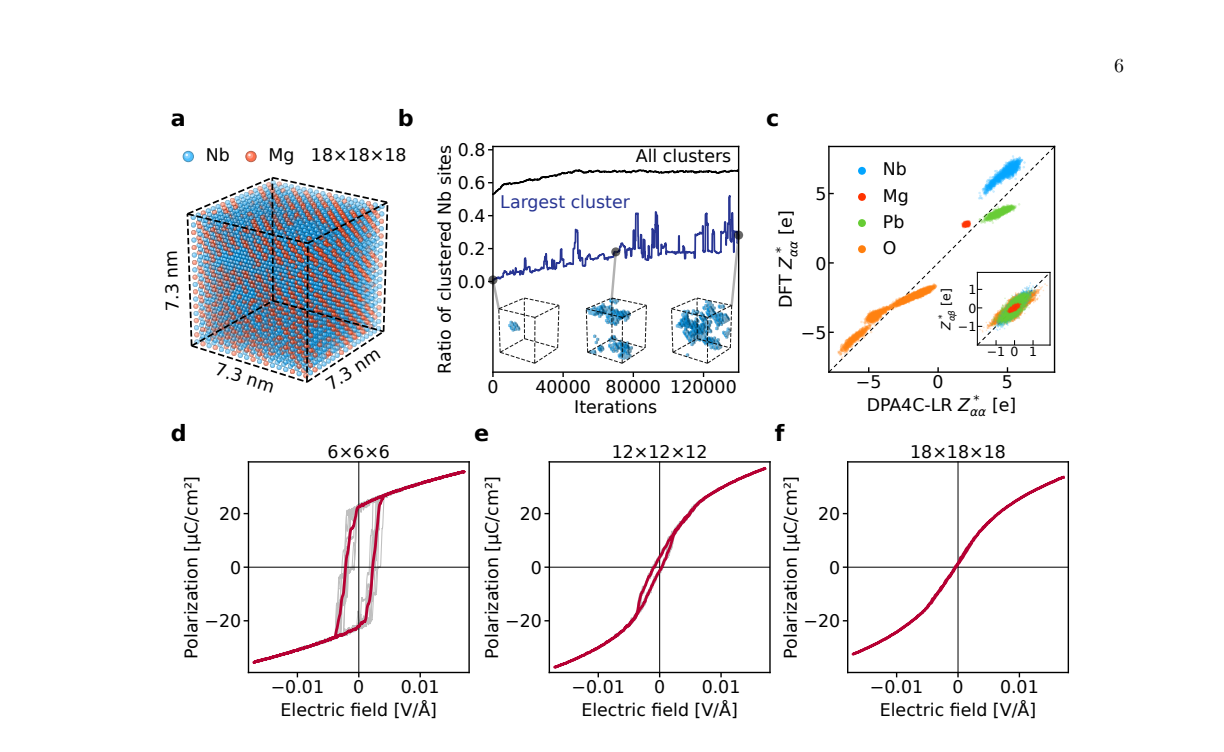
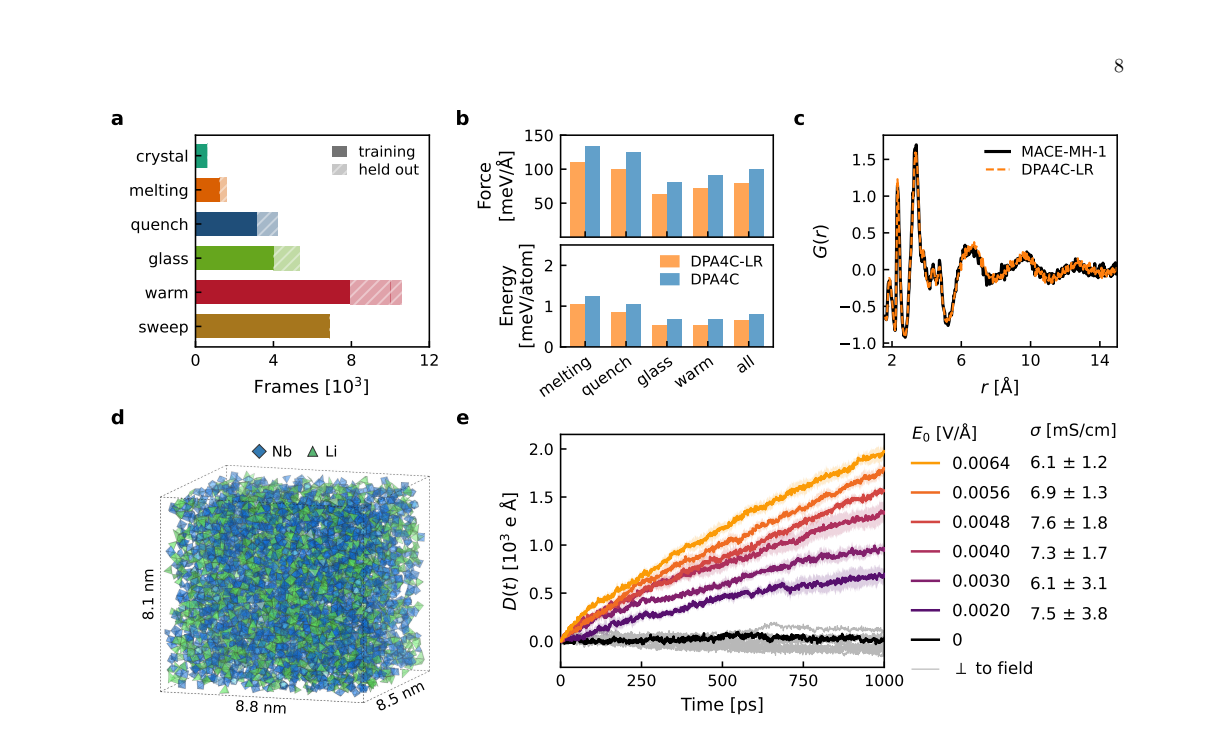
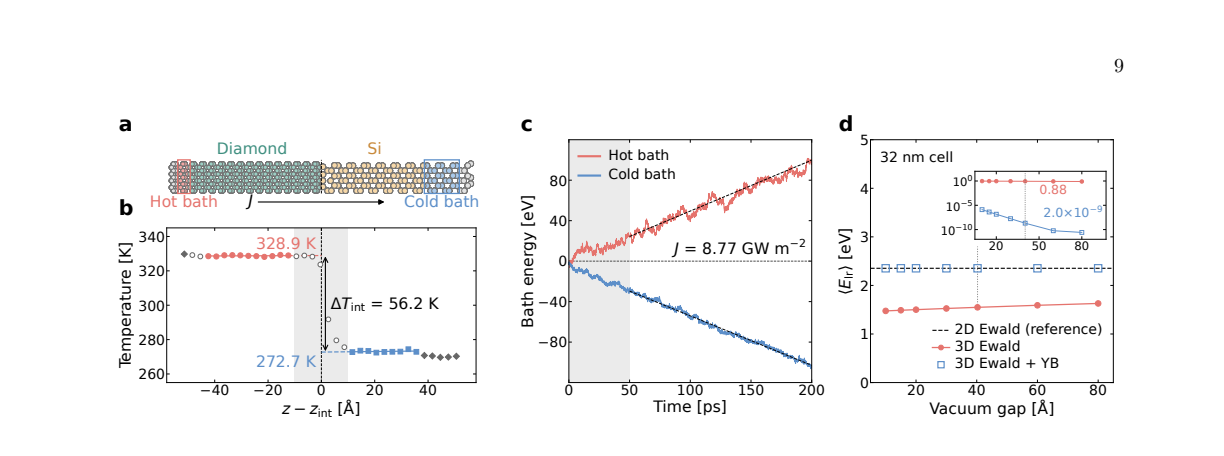
Strictly local models enable efficient spatial parallelization but neglect long-range interactions, whereas existing electrostatic extensions introduce global dependencies that hinder distributed computation. Here, we overcome this limitation by analytically separating the long-range electrostatic forces and Born effective charges (BECs) into a global electrostatics calculation and strictly local derivatives of learned latent charges. This formulation preserves the spatial decomposability of equivariant MLIPs while enabling distributed evaluation of energies, forces, stresses, and BECs across different boundary conditions. Implemented as DPA4C-LR on the \textttnvalchemi platform, the framework scales to 5.2 million atoms on four GPUs at approximately twice the computational cost of its short-range backbone. Trained on energies and forces, DPA4C-LR accurately infers BECs and reproduces the field-dependent infrared spectra of water. We further demonstrate its capabilities by recovering the characteristic slim polarization hysteresis of relaxor ȩ{Pb(Mg_1/3Nb_2/3)O3}, which is obscured by finite-size effects in smaller simulations; predicting a room-temperature field-driven ionic conductivity of 6.8 ± 0.7 mS/cm in amorphous ȩ{Li_0.9NbO_0.9Cl_4.1}; and modeling interfacial thermal transport across Si/diamond interfaces with slab-corrected electrostatics. By combining long-range physics, electrical-response inference, and distributed computation, this framework extends predictive atomistic modeling toward device-relevant length scales.
from the abstract
Pith says
Machine review · deepseek-v4-flash · 19 Oct 2026 · what was read was not recorded · not checked by a person
It can be wrong. Challenge this review or reply to it.
Holds up. Analytic factorization of global electrostatics and local backpropagation enables distributed long-range MLIPs with BEC inference; well-validated, with honest limitations. This line is wrong
3 major objections · 5 minor
How often objections from reviews like this one are right: not yet measured
Not checked: figures, code, what the 75 references say.
The paper says, at §III.A and §III.B, Eq. (9)
The review did not quote this passage.
Pith says: Objection 1 of 3 · major
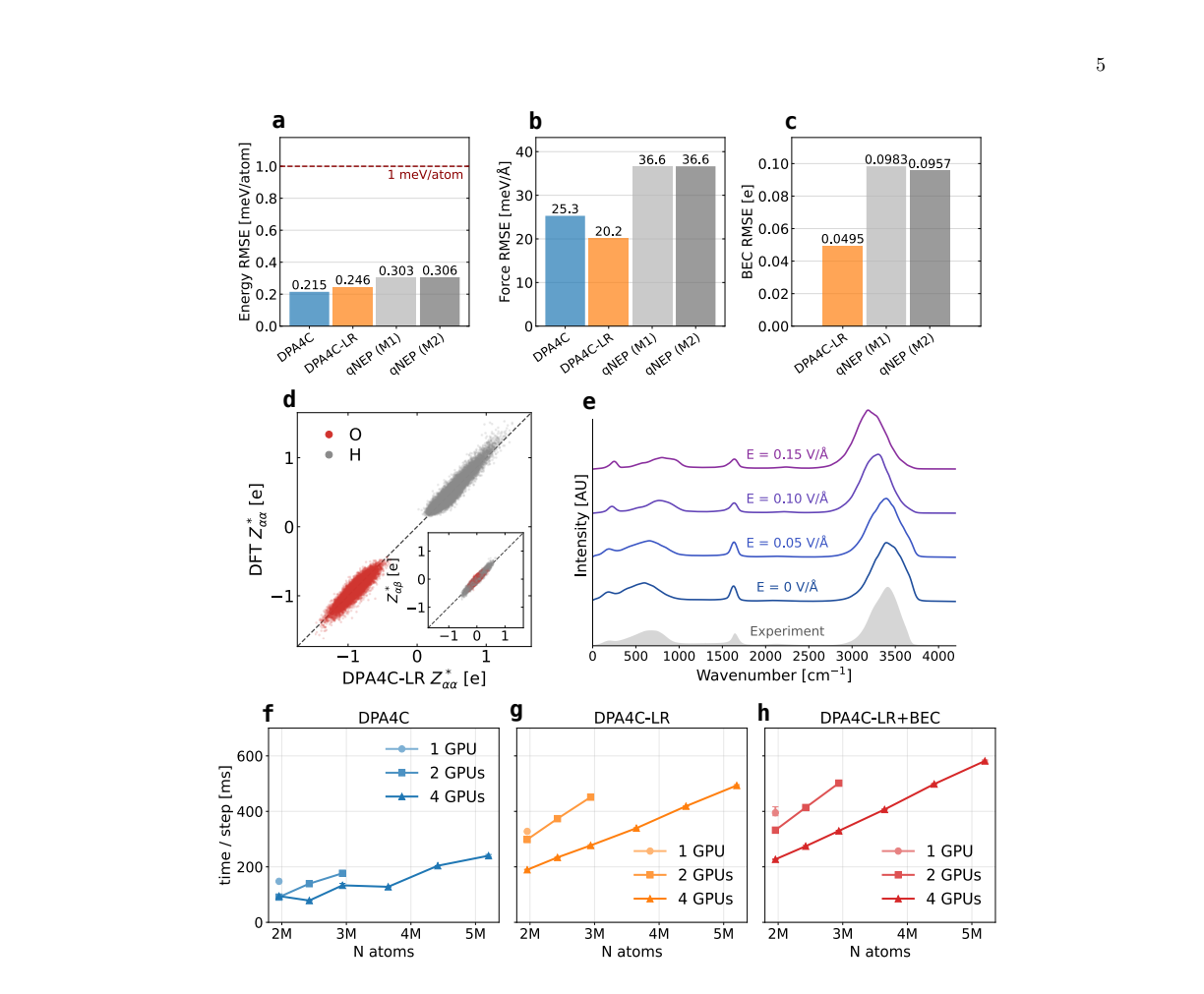
The high-frequency permittivity ε∞ for water (3.07) and for PMN (√ε∞ = 3.80) is obtained by a least-squares fit of predicted charges against DFPT BECs (Fig. 2d). This introduces a parameter fitted to the same kind of reference data that is later used for BEC validation.
more of objection 1
While the independent IR spectra (Fig. 2e) provide corroboration, the BEC RMSE values (0.05 e for water, 0.22 e off-diagonal for PMN) are not fully independent. The authors should clarify whether the reported RMSE is computed after the ε∞ fit, and discuss the sensitivity of the BEC predictions to the fitted ε∞. For the LNOC application, no DFPT reference is available; is ε∞ estimated from literature, a different fit, or treated as a free parameter? The text (line 156) says '√ε∞ = 2.49 (Fig. S2)', but this figure is not included in the manuscript I reviewed. Please provide the determination procedure for ε∞ in LNOC.
The paper says, at §III.A, Fig. 2f–h and §IV
The review did not quote this passage.
Pith says: Objection 2 of 3 · major
The strong scaling efficiency from 1 to 4 GPUs is 43% (speedup 1.73× on 4 GPUs). This is modest and the paper does not discuss how performance would degrade on larger GPU counts (e.g., 64 or 256 GPUs) where communication overhead becomes dominant.
more of objection 2
The weak scaling data are only shown up to 4 GPUs. For the claim 'scalable to multi-million-atom systems across GPUs', the reader needs a clearer discussion of the scaling bottlenecks (global PME FFT, ghost-zone communication) and how the architecture would fare on the 1000+ GPU setups that short-range DPA4C achieves (Ref. 24). The authors should either provide scaling data for more GPUs or explicitly qualify the scalability statement to the 2–4 GPU regime.
The paper says, at §III.C, §IV
The review did not quote this passage.
Pith says: Objection 3 of 3 · major
The LNOC training and validation use MACE-MH-1 labels rather than DFT. The authors cite Wang et al. to argue that MACE-MH-1 dynamics reproduce experimental local structure, but the force RMSE (79 meV/Å) is evaluated against MACE-MH-1, not DFT. The paper should explicitly state that all LNOC results are contingent on the accuracy of the foundation potential, and the conductivity prediction (6.8±0.7 mS/cm) is a zero-shot prediction of the combined DPA4C-LR + MACE-MH-1 pipeline, not a DFT-validated result.
more of objection 3
This is not a fatal flaw—the method itself is validated on DFT for water and PMN—but the text at lines 157–159 currently states the LNOC model was 'trained on the energies and forces of the remaining frames, without supervision of charges or BECs', which may give the impression of a DFT-level validation. A clear caveat should be added.
5 minor objections
The paper says, at §II.C, Eq. (10)
Pith says: minor objection 1 of 5
The decomposition of Z* into a direct charge contribution and a response contribution is clear. However, the derivation that the global charge-projection term cancels from the pairwise response expression (Eq. 11) would benefit from a short justification in the main text or a cross-reference to the SI section where the full derivation is given. Currently the text simply states the result.
The paper says, at §III.D, Fig. 5d
Pith says: minor objection 2 of 5
The validation of the Yeh–Berkowitz correction shows that the uncorrected 3D Ewald energy deviates by 0.88 eV at the production vacuum gap. It would be helpful to state in the caption what the total long-range energy of the 32 nm cell is, so the reader can judge the fractional error. Also, the text says 'the maximum absolute deviation from the 2D reference' but the inset shows values up to ~10^-9 eV; please confirm the y-axis label.
show 3 more
The paper says, at §IV, Fig. 6
Pith says: minor objection 3 of 5
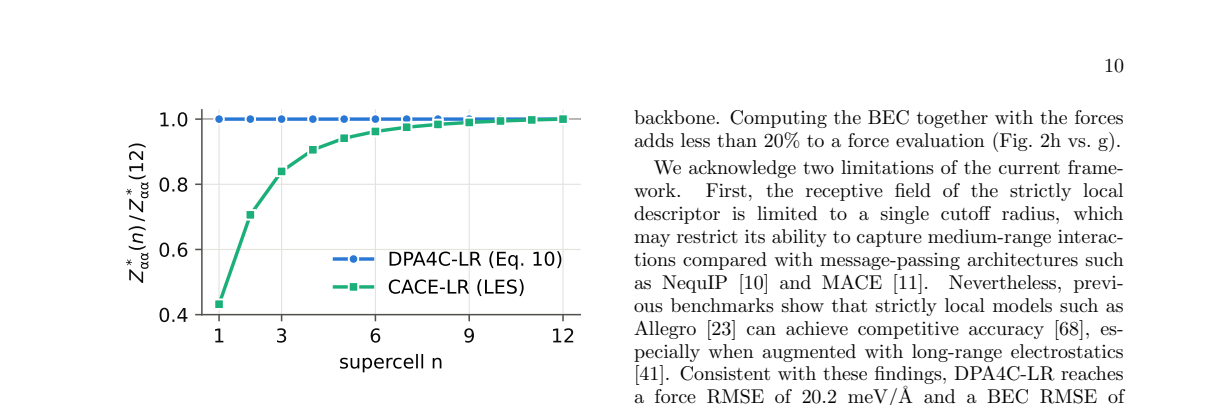
The comparison with LES (Eq. 15) and the cell-size independence of the real-space expression (Eq. 10) is compelling. However, the figure caption and the text should specify that the BEC shown is for Nb in a 15-atom Pb3(Mg1Nb2)O9 cell. Is this the only element tested? The claim that Eq. (10) gives a cell-size-independent BEC is central; a sentence stating that the same behavior holds for all atom types in the test would strengthen the point.
The paper says, at General
Pith says: minor objection 4 of 5
The notation for the high-frequency permittivity changes between √ε∞ (Eq. 9, line 156) and ε∞ (line 82 and Fig. 2d caption). This is not inconsistent but could be confusing. Please unify the notation in the text, using ε∞ consistently and stating explicitly when the square root is used.
The paper says, at §III.A, Fig. 2 caption
Pith says: minor objection 5 of 5
The caption for Fig. 2 says 'DPA4C-LR for bulk water. (a)–(c) Test-set RMSEs ... (d) Diagonal BECs ... (e) Simulated IR spectra ...' but panels (f)–(h) are not described. Please add a description of the scaling panels, including the number of GPUs and the system sizes shown.
What would settle it
Reproduce the DPA4C-LR scaling benchmark on 8 or 16 GPUs for the same water system (1.96 million atoms) to verify that the parallel efficiency does not drop by more than 10 percentage points relative to the 4-GPU measurement (43%), thereby confirming that the PME communication overhead does not degrade scalability at larger GPU counts.
from the skeptic's reading
How the review went
4 readings by deepseek-v4-flash · 19 Oct 2026
- Reader holds up
- Skeptic agrees
- Editor wrote the verdict above
- Referee minor revision: 3 major objections, 5 minor
Not run on this paper: the simulated authors' defence.
Pith did not check this review's objections against the paper.
The review in full
The review in brief, machine-written
Here's my read on arXiv:2610.23643. The core idea—decoupling the global Ewald solve from local automatic differentiation so that long-range electrostatics and Born effective charges stay spatially decomposable—is a genuine technical advance. It solves a real bottleneck for scaling MLIPs with field response. The implementation on DPA4C plus PME shows strong-scaling efficiency around 40% on four GPUs, reaching 5.2M atoms. The water benchmark is the cleanest: trained only on energies and forces, it reproduces BECs with RMSE 0.05 e and field-dependent IR spectra. That part is solid.
The three applications demonstrate reach. The PMN relaxor shows a finite-size effect that disappears at 29k atoms, exactly the sort of problem this method is built for. The LNOC conductivity estimate (6.8 ± 0.7 mS/cm) is plausible but rests on MACE-MH-1 labels, not DFT; the authors note the comparison is qualitative, which is fair. The Si/diamond interface validates the Yeh–Berkowitz correction under 2D PBCs and yields consistent thermal conductances.
Now soft spots. The epsilon_infinity fitting uses a least-squares fit against DFPT BECs, which introduces a mild circularity—the same BECs used for scaling are also used to assess accuracy. This is minor and acknowledged in practice. More substantively, the LNOC claim of a seven-fold narrower confidence interval from field-driven MD is real, but the underlying dynamics depend on the quality of the MACE-MH-1 training data; any systematic error there propagates. The scalability results are limited to four GPUs; beyond that, communication overhead may matter, though the method is architecturally ready.
The authors state two honest limitations: the single-cutoff receptive field and inability to handle nonlocal charge redistribution. These bound the method's applicability to systems without metal–electrolyte interfaces or strong medium-range correlations.
Who should read this? Anyone building long-range MLIPs for device-relevant simulations, especially if they care about field coupling. The paper is technically sound and deserves a serious referee. The code and data are public, which strengthens the case.
My read: accept with moderate confidence.
The strongest objection
The paper presents a technically sound and clearly argued method for incorporating long-range electrostatics and electrical response into strictly local equivariant MLIPs while preserving spatial decomposability. The central innovation—analytical differentiation to decouple the global electrostatic solve from local backpropagation—is well-motivated and validated. The benchmarks for bulk water, PMN, LNOC, and Si/diamond are thorough, and the limitations (nonlocal charge redistribution, medium-range coupling, reliance on a fitted ε∞) are explicitly acknowledged. No internal inconsistency or unsupported leap undermines the central claim. The framework’s accuracy relative to DFPT for water and PMN is convincing, the IR spectra provide independent validation, and the scalability results, though limited to four GPUs, are consistent with the backbone’s known behavior. The LNOC conductivity is a qualitative demonstration, but the paper does not overclaim its certainty. Overall, the argument holds up under scrutiny.
The reader's weakest assumption—that locally predicted latent charges are insufficient for nonlocal charge redistribution—is precisely stated and acknowledged by the authors. I agree this is the principal limitation, but it does not undermine the central claim for the systems tested (insulators and dielectrics). The paper provides adequate evidence (BEC RMSE, IR spectra, P–E loops) that the method works where its assumptions hold. The technical derivations appear correct, and the code/data release supports reproducibility. Therefore, the reader's verdict of ACCEPT remains appropriate; no adjustment is warranted.
The referee's report
If the claims hold, this work removes a key obstacle to using equivariant MLIPs for device-scale simulations: it shows that long-range electrostatic interactions and electrical response can be added without sacrificing the domain decomposition that makes short-range models scalable. The explicit BEC expression (Eq. 10) is cell-size independent and distributable, which avoids finite-size artifacts of prior latent Ewald approaches. The applications (relaxor hysteresis, ionic conductivity, interfacial thermal transport) are at scales relevant to device design and are enabled by the method. The code and data are publicly available. The paper is a strong candidate for publication in a high-impact journal.
Pith's reading of the paper (a machine's summary, not the authors')
The paper develops a method to incorporate long-range electrostatics and electrical response into strictly local equivariant machine learning interatomic potentials (MLIPs) while preserving the domain decomposition that enables efficient parallel computation. By analytically separating the long-range forces and Born effective charges (BECs) into a global electrostatics calculation and strictly local derivatives of learned latent charges, the approach avoids the global computational graph that plagues prior methods. The resulting model, DPA4C-LR, reaches 5.2 million atoms on four GPUs with 43% parallel efficiency and infers BECs accurately from training on only energies and forces. The work demonstrates three large-scale applications—recovering the slim polarization hysteresis of relaxor PMN, predicting ionic conductivity in amorphous solid electrolytes, and modeling interfacial thermal transport—that were previously inaccessible to short-range MLIPs or limited by finite-size effects.
What carries the argument. The central mechanism is the analytic separation of the long-range electrostatic contribution into a global classical electrostatics solve (using particle mesh Ewald or Yeh–Berkowitz correction) and strictly local derivatives of learned latent charges. The Born effective charge (BEC) is computed using a real-space expression (Eq. 10) that depends only on pairwise distance vectors and local charge gradients, making it cell-size-independent and distributable. This factorization, combined with the strictly local equivariant DPA4C backbone, allows the long-range augmentation to inherit the domain decomposition and communication pattern of the short-range model. The local latent charges are read from a descriptor within a single cutoff radius and projected to conserve total charge.
Core claim. The central claim is that long-range electrostatics and electrical response can be added to strictly local MLIPs without sacrificing the domain decomposition that makes them scalable, by analytically separating the long-range forces and Born effective charges (BECs) into a global electrostatics calculation and strictly local derivatives of learned latent charges. This formulation preserves spatial decomposability for energies, forces, stresses, and BECs, enabling distributed evaluation across multiple GPUs. The method outperforms prior long-range approaches: it avoids the finite-size effects of latent Ewald summation's BEC expression and removes the need for a whole-cell computational graph that hinders parallelization. Training on only energies and forces, the model infers BECs accurately and reproduces field-dependent infrared spectra. The authors demonstrate the framework on three systems—relaxor ferroelectric PMN, amorphous solid electrolyte LNOC, and Si/diamond interface—showing that multi-million-atom simulations with field coupling are now routine.
The premise it rests on. The model assumes that latent charges read from a strictly local descriptor (within a single cutoff radius) are sufficient to represent the electrostatic response, which may fail for systems with nonlocal charge redistribution such as metals or metal–electrolyte interfaces.
If the paper is right (Pith's inferences, not the authors')
Electrical-response inference from only energy and force labels becomes practical at device-relevant scales, enabling field-driven molecular dynamics for ferroelectric switching, ion transport, and dielectric response in billion-atom systems with further hardware scaling.
The real-space BEC expression eliminates finite-size errors present in latent Ewald summation, so BEC accuracy no longer depends on supercell size.
The factorization is general and can be applied to any strictly local backbone (e.g., Atomic Cluster Expansion), not just DPA4C.
The approach enables routine simulation of relaxor ferroelectrics, amorphous solid electrolytes, and interfacial thermal transport with ab initio accuracy at tens-of-nanometer scales.
By preserving spatial decomposability, the method naturally extends to distributed and GPU-accelerated environments, promising billion-atom simulations with long-range physics.
If the analytic separation is as general as claimed, it may allow other physically motivated long-range corrections (e.g., van der Waals, multipolar electrostatics) to be added to local MLIPs without breaking domain decomposition, opening the door to multi-physics models at scale.
The limitation to local charge readout suggests a natural next challenge: incorporating nonlocal charge equilibration (e.g., via a short-range neural network predictor of chemical hardness) while retaining decomposability through iterative local updates.
The demonstration on three distinct problems with different boundary conditions (3D periodic, slab, nonperiodic) suggests the method is robust, but the true test of transferability will be its performance on systems with strong charge flow, such as metal surfaces under bias, where the authors acknowledge the local charge approximation may fail.
Check this review
Pith stored no record of this review's passes and took no fingerprint of it. Reviews made by code from 13 Nov 2026 on carry both.
How often reviews like this one are right
Reviews like this one: written by deepseek-v4-flash, where what was read was not recorded.
How often objections from reviews like this one are right: not yet measured
Reviews by people
This review was written by a machine. No person has reviewed this paper on Pith yet. A scientist listed on Pith can review it for a fee, and their review is published here whatever it concludes.
The paper
Abstract
Accurate atomistic simulations of materials under electric fields require long-range electrostatics and electrical-response modeling at length scales beyond the reach of conventional first-principles methods. Yet these capabilities remain difficult to reconcile with the scalability of machine-learning interatomic potentials (MLIPs). Strictly local models enable efficient spatial parallelization but neglect long-range interactions, whereas existing electrostatic extensions introduce global dependencies that hinder distributed computation. Here, we overcome this limitation by analytically separating the long-range electrostatic forces and Born effective charges (BECs) into a global electrostatics calculation and strictly local derivatives of learned latent charges. This formulation preserves the spatial decomposability of equivariant MLIPs while enabling distributed evaluation of energies, forces, stresses, and BECs across different boundary conditions. Implemented as DPA4C-LR on the \textttnvalchemi platform, the framework scales to 5.2 million atoms on four GPUs at approximately twice the computational cost of its short-range backbone. Trained on energies and forces, DPA4C-LR accurately infers BECs and reproduces the field-dependent infrared spectra of water. We further demonstrate its capabilities by recovering the characteristic slim polarization hysteresis of relaxor ȩ{Pb(Mg_1/3Nb_2/3)O3}, which is obscured by finite-size effects in smaller simulations; predicting a room-temperature field-driven ionic conductivity of 6.8 ± 0.7 mS/cm in amorphous ȩ{Li_0.9NbO_0.9Cl_4.1}; and modeling interfacial thermal transport across Si/diamond interfaces with slab-corrected electrostatics. By combining long-range physics, electrical-response inference, and distributed computation, this framework extends predictive atomistic modeling toward device-relevant length scales.
The paper's own sentences, arranged, kept beside the review and separate from it. Each label is drawn from a closed vocabulary; the number beside it is the probability the classifier gave that label. No sentence in this record was written by a model.
abstract compiled · 2026-10-20
The authors' main claim, as the classifier picked it out 1.00
“By combining long-range physics, electrical-response inference, and distributed computation, this framework extends predictive atomistic modeling toward device-relevant length scales.”
How the main claim is stated: asserted 0.92
What the abstract itself states, as probabilities: claims first 0.08 · states limitation 0.37 · human participants 0.01 · controlled comparison 0.16 · randomized assignment 0.01 · states quantitative result 0.99 · compares with prior results 0.66 · mentions code or data availability 0.13
The abstract, sentence by sentence
This table labels the abstract only (arXiv listing abstract v1). The number is the probability the classifier gave the label.
| Sentence | Role | The authors' own work | States the main conclusion | Strength |
|---|---|---|---|---|
| Accurate atomistic simulations of materials under electric fields require long-range electrostatics and electrical-response modeling at length scales beyond the reach of conventional first-principles methods. | background 1.00 | 0.05 | 0.04 | asserted 1.00 |
| Yet these capabilities remain difficult to reconcile with the scalability of machine-learning interatomic potentials (MLIPs). | gap 0.85 | 0.05 | 0.03 | asserted 0.98 |
| Strictly local models enable efficient spatial parallelization but neglect long-range interactions, whereas existing electrostatic extensions introduce global dependencies that hinder distributed computation. | background 0.53 | 0.06 | 0.03 | asserted 1.00 |
| Here, we overcome this limitation by analytically separating the long-range electrostatic forces and Born effective charges (BECs) into a global electrostatics calculation and strictly local derivatives of learned latent charges. | method 0.59 | 0.95 | 0.25 | asserted 1.00 |
| This formulation preserves the spatial decomposability of equivariant MLIPs while enabling distributed evaluation of energies, forces, stresses, and BECs across different boundary conditions. | method 0.63 | 0.87 | 0.14 | asserted 1.00 |
| Implemented as DPA4C-LR on the \texttt{nvalchemi} platform, the framework scales to 5.2 million atoms on four GPUs at approximately twice the computational cost of its short-range backbone. | result 0.76 | 0.95 | 0.08 | asserted 1.00 |
| Trained on energies and forces, DPA4C-LR accurately infers BECs and reproduces the field-dependent infrared spectra of water. | result 0.98 | 0.96 | 0.08 | asserted 1.00 |
| We further demonstrate its capabilities by recovering the characteristic slim polarization hysteresis of relaxor \ce{Pb(Mg_{1/3}Nb_{2/3})O3}, which is obscured by finite-size effects in smaller simulations; predicting a room-temperature field-driven ionic conductivity of $6.8 \pm 0.7$~mS/cm in amorphous \ce{Li_{0.9}NbO_{0.9}Cl_{4.1}}; and modeling interfacial thermal transport across Si/diamond interfaces with slab-corrected electrostatics. | result 0.99 | 0.96 | 0.10 | asserted 1.00 |
| By combining long-range physics, electrical-response inference, and distributed computation, this framework extends predictive atomistic modeling toward device-relevant length scales. | interpretation 0.94 | 0.69 | 0.87 | asserted 0.92 |
What kind of paper the classifier reports this is: method or tool 1.00 · evidence from simulation or computation 1.00
What was examined, and what was not
Sources read
- arXiv listing abstract v1
Not examined
- full text
- figures and tables
- references and citing sentences
- relations to other papers
Levels run
- P abstract
Not run
- S sections
- T body sentences
- C citations
- R cross-paper relations
How the labels were made
Compiled by classifier-1.13.0 via TypeSafe API, question bank abstract-p1-20260923, 2026-10-20: 1 request, 7,209 input tokens.
Every quoted sentence on this record is the authors'. Every label is from Pith's closed vocabulary, with the probability shown beside it. This record as JSON
Figures (6)
Figures are the authors', reproduced from the paper.
References (75)
- [1] J. Maier, Nanoionics: ion transport and electrochemical storage in confined systems, Nat. Mater.4, 805 (2005) on Pith
- [2] A. Giri and P. E. Hopkins, A review of experimental and computational advances in thermal boundary con- ductance and nanoscale thermal transport across solid interfaces, Adv. Funct. Mater.30, 1903857 (2020) on Pith
- [3] M. Dawber, K. M. Rabe, and J. F. Scott, Physics of thin-film ferroelectric oxides, Rev. Mod. Phys.77, 1083 (2005) on Pith
- [4] P. Hohenberg and W. Kohn, Inhomogeneous electron gas, Phys. Rev.136, B864 (1964) on Pith
- [5] W. Kohn and L. J. Sham, Self-consistent equations in- cluding exchange and correlation effects, Phys. Rev.140, A1133 (1965) on Pith
- [6] J. Behler and M. Parrinello, Generalized neural-network representation of high-dimensional potential-energy sur- faces, Phys. Rev. Lett.98, 146401 (2007) on Pith
- [7] A. P. Bart´ ok, M. C. Payne, R. Kondor, and G. Cs´ anyi, Gaussian approximation potentials: The accuracy of quantum mechanics, without the electrons, Phys. Rev. Lett.104, 136403 (2010) on Pith
- [8] L. Zhang, J. Han, H. Wang, R. Car, and E. Weinan, Deep potential molecular dynamics: A scalable model with the accuracy of quantum mechanics, Phys. Rev. Lett.120, 143001 (2018) on Pith
- [9] K. T. Sch¨ utt, H. E. Sauceda, P.-J. Kindermans, A. Tkatchenko, and K.-R. M¨ uller, SchNet – a deep learn- ing architecture for molecules and materials, J. Chem. Phys.148, 241722 (2018) on Pith
- [10] S. Batzner, A. Musaelian, L. Sun, M. Geiger, J. P. Mailoa, M. Kornbluth, N. Molinari, T. E. Smidt, and B. Kozinsky, E(3)-equivariant graph neural networks for data-efficient and accurate interatomic potentials, Nat. Commun.13, 2453 (2022) on Pith
- [11] I. Batatia, D. P. Kovacs, G. Simm, C. Ortner, and G. Csanyi, MACE: Higher order equivariant message passing neural networks for fast and accurate force fields, inAdvances in Neural Information Processing Systems, Vol. 35 (Curran Associates, Inc., 2022) pp. 11423–11436 on Pith
- [12] S. Passaro and C. L. Zitnick, Reducing SO(3) convolu- tions to SO(2) for efficient equivariant GNNs, inProceed- ings of the 40th International Conference on Machine Learning, Proceedings of Machine Learning Research, Vol. 202 (PMLR, 2023) pp. 27420–27438 on Pith
- [13] B. Deng, P. Zhong, K. Jun, J. Riebesell, K. Han, C. J. Bartel, and G. Ceder, CHGNet as a pretrained universal neural network potential for charge-informed atomistic modelling, Nat. Mach. Intell.5, 1031 (2023) on Pith
- [14] L. Barros-Luque, M. Shuaibi, X. Fu, B. M. Wood, M. Dzamba, M. Gao, A. Rizvi, M. Uyttendaele, C. L. Zitnick, and Z. W. Ulissi, The Open Materials 2024 (OMat24) inorganic materials dataset and models (2026) on Pith
- [15] D. S. Levine, M. Shuaibi, E. W. C. Spotte-Smith, M. G. Taylor, M. R. Hasyim, K. Michel, I. Batatia, G. Cs´ anyi, M. Dzamba, P. Eastman, N. C. Frey, X. Fu, V. Gharakhanyan, A. S. Krishnapriyan, J. A. Rackers, S. Raja, A. Rizvi, A. S. Rosen, Z. Ulissi, S. Vargas, C. L. Zitnick, ... on PitharXiv
- [16] A. D. Kaplan, R. Liu, J. Qi, T. W. Ko, B. Deng, J. Riebe- sell, G. Ceder, K. A. Persson, and S. P. Ong, A foun- dational potential energy surface dataset for materials (2025), arXiv:2503.04070 [cond-mat.mtrl-sci] on PitharXiv
- [17] C. Chen and S. P. Ong, A universal graph deep learning interatomic potential for the periodic table, Nat. Com- put. Sci.2, 718 (2022) on Pith
- [18] I. Batatia, P. Benner, Y. Chiang, A. M. Elena, D. P. Kov´ acs, J. Riebesell, X. R. Advincula, M. Asta, M. Avaylon, W. J. Baldwin, F. Berger, N. Bernstein, A. Bhowmik, F. Bigi, S. M. Blau, V. C˘ arare, M. Ceriotti, S. Chong, J. P. Darby, S. De, F. Della Pia, V. L. Deringer, R. ... on Pith
- [19] B. M. Wood, M. Dzamba, X. Fu, M. Gao, M. Shuaibi, L. Barroso-Luque, K. Abdelmaqsoud, V. Gharakhanyan, J. R. Kitchin, D. S. Levine, K. Michel, A. Sriram, T. Co- hen, A. Das, A. Rizvi, S. J. Sahoo, Z. W. Ulissi, and C. L. Zitnick, UMA: A family of universal models for atoms (202... on PitharXiv
- [20] E. C.-Y. Yuan, Y. Liu, J. Chen, P. Zhong, S. Raja, T. Kreiman, S. Vargas, W. Xu, M. Head-Gordon, C. Yang, S. M. Blau, B. Cheng, A. Krishnapriyan, and T. Head-Gordon, Foundation models for atomistic simu- lation of chemistry and materials, Nat. Rev. Chem.10, 212 (2026) on Pith
show 55 more
- [21] I. Amin, S. Raja, and A. Krishnapriyan, Towards fast, specialized machine learning force fields: Dis- tilling foundation models via energy Hessians (2025), arXiv:2501.09009 [physics.chem-ph] on PithPith's reviewarXiv
- [22] R. Wang, Y. Gao, H. Wu, and Z. Zhong, Pre-training, fine-tuning, and distillation (PFD): Automatically gener- ating machine learning force fields from universal models, Phys. Rev. Mater.9, 113802 (2025) on Pith
- [23] A. Musaelian, S. Batzner, A. Johansson, L. Sun, C. J. Owen, M. Kornbluth, and B. Kozinsky, Learning local equivariant representations for large-scale atomistic dy- namics, Nat. Commun.14, 579 (2023) on Pith
- [24] T. Li, J. Xue, L. Zhang, D. Zhang, and H. Wang, Universal machine-learning molecular dynamics at the speed of empirical potentials (2026), arXiv:2608.19041 [physics.chem-ph] on PithPith's reviewarXiv
- [25] D. S. King, D. Kim, P. Zhong, and B. Cheng, Machine learning of charges and long-range interactions from en- ergies and forces, Nat. Commun.16, 8763 (2025) on Pith
- [26] D. Broberg, K. Bystrom, S. Srivastava, D. Dahliah, B. A. Williamson, L. Weston, D. O. Scanlon, G.-M. Rignanese, S. Dwaraknath, J. Varley,et al., High-throughput calcu- lations of charged point defect properties with semi-local density functional theory—performance benchmarks f... on Pith
- [27] T. W. Ko, R. Liu, A. R. Mishra, Z. Yu, J. Qi, and S. P. Ong, A fast, accurate, and reactive equivariant founda- tion potential (2025), arXiv:2511.07249 [cond-mat] on PithPith's reviewarXiv
- [28] I. Batatia, W. J. Baldwin, D. Kuryla, J. Hart, E. Ka- soar, A. M. Elena, H. Moore, M. J. Gawkowski, B. X. Shi, V. Kapil, P. Kourtis, I.-B. Magd˘ au, and G. Cs´ anyi, MACE-POLAR-1: A polarisable electrostatic foundation model for molecular chemistry (2026), arXiv:2602.19411 [ph... on PitharXiv
- [29] Z. Fan, B. Tang, E. Berger, E. Berger, E. Fransson, K. Xu, Z. Yan, Z. Liu, Z. Song, H. Dong, S. Chen, L. Li, Z. Wang, Y. Zhu, J. Wiktor, and P. Erhart, qNEP: A highly efficient neuroevolution potential with dynamic charges for large-scale atomistic simulations, J. Chem. Theory... on Pith
- [30] T. W. Ko, J. A. Finkler, S. Goedecker, and J. Behler, A fourth-generation high-dimensional neural network po- tential with accurate electrostatics including non-local charge transfer, Nat. Commun.12, 398 (2021) on Pith
- [31] L. Zhang, H. Wang, M. C. Muniz, A. Z. Panagiotopou- los, R. Car, and W. E, A deep potential model with long-range electrostatic interactions, J. Chem. Phys.156, 124107 (2022) on Pith
- [32] P. Zhong, D. Kim, D. S. King, and B. Cheng, Ma- chine learning interatomic potential can infer electrical response, npj Comput. Mater.11, 384 (2025) on Pith
- [33] H. Yu, S. Deng, H. Zhu, M. Xie, Y. Zhang, X. Shi, J. Zhong, C. He, and H. Xiang, Prediction of room tem- perature ferroelectricity in subnano silicon thin films with an antiferroelectric ground state, Phys. Rev. Lett.135, 156801 (2025) on Pith
- [34] B. Cheng, Latent Ewald summation for machine learning of long-range interactions, npj Comput. Mater.11, 80 (2025) on Pith
- [35] P. Ying, C. Qian, R. Zhao, Y. Wang, K. Xu, F. Ding, S. Chen, and Z. Fan, Advances in modeling complex materials: The rise of neuroevolution potentials, Chem. Phys. Rev.6, 011310 (2025) on Pith
- [36] T. Liang, K. Xu, E. Lindgren, Z. Chen, R. Zhao, J. Liu, E. Berger, B. Tang, B. Zhang, Y. Wang,et al., NEP89: Universal neuroevolution potential for inorganic and or- ganic materials across 89 elements, Nat. Comput. Sci. , 1 (2026) on Pith
- [37] T. Darden, D. York, and L. Pedersen, Particle mesh Ewald: AnN·log(N) method for Ewald sums in large systems, J. Chem. Phys.98, 10089 (1993) on Pith
- [38] U. Essmann, L. Perera, M. L. Berkowitz, T. Darden, H. Lee, and L. G. Pedersen, A smooth particle mesh Ewald method, J. Chem. Phys.103, 8577 (1995) on Pith
- [39] P. Loche, K. K. Huguenin-Dumittan, M. Honarmand, Q. Xu, E. Rumiantsev, W. B. How, M. F. Langer, and M. Ceriotti, Fast and flexible long-range models for atomistic machine learning, J. Chem. Phys.162, 142501 (2025) on Pith
- [40] NVIDIA, NVIDIA ALCHEMI Toolkit-Ops: High- performance NVIDIA Warp primitives for computational chemistry and atomistic simulation (2026) on Pith
- [41] D. Kim, X. Wang, S. Vargas, P. Zhong, D. S. King, T. J. Inizan, and B. Cheng, A universal augmentation framework for long-range electrostatics in machine learn- ing interatomic potentials, J. Chem. Theory Comput.21, 12709 (2025) on Pith
- [42] I.-C. Yeh and M. L. Berkowitz, Ewald summation for systems with slab geometry, J. Chem. Phys.111, 3155 (1999) on Pith
- [43] J. E. Bertie and Z. Lan, Infrared intensities of liquids XX: The intensity of the oh stretching band of liquid water revisited, and the best current values of the optical constants of H2O(l) at 25◦C between 15,000 and 1 cm−1, Appl. Spectrosc.50, 1047 (1996) on Pith
- [44] S. Baroni, S. de Gironcoli, A. Dal Corso, and P. Gi- annozzi, Phonons and related crystal properties from density-functional perturbation theory, Rev. Mod. Phys. 73, 515 (2001) on Pith
- [45] S. Nos´ e, A molecular dynamics method for simulations in the canonical ensemble, Mol. Phys.52, 255 (1984). 13 on Pith
- [46] W. G. Hoover, Canonical dynamics: Equilibrium phase- space distributions, Phys. Rev. A31, 1695 (1985) on Pith
- [47] G. J. Martyna, M. L. Klein, and M. Tuckerman, Nos´ e–Hoover chains: The canonical ensemble via con- tinuous dynamics, J. Chem. Phys.97, 2635 (1992) on Pith
- [48] X. Xu, K. Cai, Y. Shi, P. Zhong, and P. Xie, Intrin- sic structure of relaxor ferroelectrics from first principles, Phys. Rev. B114, 024204 (2026) on Pith
- [49] A. Kumar, J. N. Baker, P. C. Bowes, M. J. Cabral, S. Zhang, E. C. Dickey, D. L. Irving, and J. M. LeBeau, Atomic-resolution electron microscopy of nanoscale local structure in lead-based relaxor ferroelectrics, Nat. Mater. 20, 62 (2021) on Pith
- [50] J. P. Perdew, A. Ruzsinszky, G. I. Csonka, O. A. Vydrov, G. E. Scuseria, L. A. Constantin, X. Zhou, and K. Burke, Restoring the density-gradient expansion for exchange in solids and surfaces, Phys. Rev. Lett.100, 136406 (2008) on Pith
- [51] A. H. Pandey, S. M. Gupta, V. G. Sathe, and N. P. Lalla, Microstructural, vibrational, dielectric and ferroelectric properties correlation in hot-pressed PbMg 1/3Nb2/3O3 ceramics (2018), arXiv:1810.01132 [cond-mat.mtrl-sci] on PithPith's reviewarXiv
- [52] J. A. Newnham, J. Kondek, J. Hartel, C. Rosenbach, C. Li, V. Faka, L. Gronych, D. Glikman, F. Schreiner, D. D. Wind, B. Braunschweig, M. R. Hansen, and W. G. Zeier, Correlation between the coherence length and ionic conductivity in LiNbOCl 4 via the anion stoichiometry, Chem. ... on Pith
- [53] F. Hussain, J. Zhu, Y. Zhao, and W. Xia, Exploring supe- rionic conduction in lithium oxyhalide solid electrolytes considering composition and structural factors, npj Com- put. Mater.10, 148 (2024) on Pith
- [54] I. Batatia, C. Lin, J. Hart, E. Kasoar, A. M. Elena, S. W. Norwood, T. Wolf, and G. Cs´ anyi, Cross learning be- tween electronic structure theories for unifying molecu- lar, surface, and inorganic crystal foundation force fields (2025), arXiv:2510.25380 [physics.chem-ph] on PitharXiv
- [55] B. Singh, Y. Wang, J. Liu, J. D. Bazak, A. Shyamsunder, and L. F. Nazar, Critical role of framework flexibility and disorder in driving high ionic conductivity in LiNbOCl 4, J. Am. Chem. Soc.146, 17158 (2024) on Pith
- [56] X. Wang, X. Zhang, D. Butenko, B. Hong, J. Zhu, and P. Zhong, A practical route to amorphous solid-state elec- trolyte structures by hybrid reverse Monte Carlo with foundation potentials (2026), arXiv:2610.19846 [cond- mat.mtrl-sci] on PithPith's reviewarXiv
- [57] E. Helfand, Transport coefficients from dissipation in a canonical ensemble, Phys. Rev.119, 1 (1960) on Pith
- [58] A. Rajabpour, B. Mortazavi, P. Mirchi, J. El Hajj, Y. Guo, X. Zhuang, and S. Merabia, Accurate estima- tion of interfacial thermal conductance between silicon and diamond enabled by a machine learning interatomic potential, Int. J. Therm. Sci.214, 109876 (2025) on Pith
- [59] J. W. Furness, A. D. Kaplan, J. Ning, J. P. Perdew, and J. Sun, Accurate and numerically efficient r2SCAN meta- generalized gradient approximation, J. Phys. Chem. Lett. 11, 8208 (2020) on Pith
- [60] F. M¨ uller-Plathe, A simple nonequilibrium molecular dy- namics method for calculating the thermal conductivity, J. Chem. Phys.106, 6082 (1997) on Pith
- [61] G. Bussi and M. Parrinello, Accurate sampling using Langevin dynamics, Phys. Rev. E75, 056707 (2007) on Pith
- [62] D. Parry, The electrostatic potential in the surface region of an ionic crystal, Surf. Sci.49, 433 (1975) on Pith
- [63] Z. Cheng, T. Bai, J. Shi, T. Feng, Y. Wang, M. Meck- lenburg, C. Li, K. D. Hobart, T. I. Feygelson, M. J. Tad- jer, B. B. Pate, B. M. Foley, L. Yates, S. T. Pantelides, B. A. Cola, M. Goorsky, and S. Graham, Tunable ther- mal energy transport across diamond membranes and diamo... on Pith
- [64] K. Woo, M. Malakoutian, Y. Jo, X. Zheng, T. Pfeifer, R. Mandia, T. Hwang, H. Aller, D. Field, A. Kasper- ovich, D. Saraswat, D. Smith, P. Hopkins, S. Graham, M. Kuball, K. Cho, and S. Chowdhury, Interlayer engi- neering to achieve<1 m 2K/GW thermal boundary re- sistances to di... on Pith
- [65] J. Kim, J. Kim, J. Kim, J. Lee, Y. Park, Y. Kang, and S. Han, Data-efficient multifidelity training for high- fidelity machine learning interatomic potentials, J. Am. Chem. Soc.147, 1042 (2025) on Pith
- [66] K. Han, B. Deng, A. B. Farimani, and G. Ceder, DistMLIP: A distributed inference platform for machine learning interatomic potentials (2025), arXiv:2506.02023 [cs.DC] on PitharXiv
- [67] R. Drautz, Atomic cluster expansion for accurate and transferable interatomic potentials, Phys. Rev. B99, 014104 (2019) on Pith
- [68] B. Kozinsky, A. Musaelian, A. Johansson, and S. Batzner, Scaling the leading accuracy of deep equivari- ant models to biomolecular simulations of realistic size, inProceedings of the International Conference for High Performance Computing, Networking, Storage and Anal- ysis, S... on Pith
- [69] R. Gao, C. Yam, J. Mao, S. Chen, G. Chen, and Z. Hu, A foundation machine learning potential with polariz- able long-range interactions for materials modelling, Nat. Commun.16, 10484 (2025) on Pith
- [70] X. Wang, J. Chen, Z. Zeng, F. Stein, J. Lim, and B. Cheng, Ion-modulated structure, proton transfer, and capacitance in the Pt-water electric double layer, npj Comput. Mater. 10.1038/s41524-026-02230-7 (2026) on Pithdoi:10.1038/s41524-026-02230-7
- [71] D. Kim, D. S. King, Y. Park, R. Savoj, S. Hamel, X. Wang, and B. Cheng, Polarizable atomic mul- tipoles for learning long-range electrostatics (2026), arXiv:2605.05746 [cond-mat.mtrl-sci] on PithPith's reviewarXiv
- [72] E. Qu, B. M. Wood, A. S. Krishnapriyan, and Z. W. Ulissi, A recipe for scalable attention-based MLIPs: un- locking long-range accuracy with all-to-all node attention (2026), arXiv:2603.06567 [cs] on PitharXiv
- [73] A. Vaswani, N. Shazeer, N. Parmar, J. Uszkoreit, L. Jones, A. N. Gomez, L. Kaiser, and I. Polosukhin, Attention is All you Need, inAdvances in Neural Infor- mation Processing Systems, Vol. 30 (Curran Associates, Inc., 2017) on Pith
- [74] L. Fu, Z. Feng, Y. Li, H. Du, X. He, J. Wu, K. Bao, Y. Zhang, Z. Deng, Z. Lu, and B. Zhu, Train for ac- curacy, execute at scale: Architecture-preserving infer- ence for equivariant atomistic foundation models (2026), arXiv:2610.01036 [cond-mat.mtrl-sci] on PithPith's reviewarXiv
- [75] X. Yu, G. Yang, Z. Zhao, J. Li, X. Xiao, X. Zhang, J. Liu, and P. Mo, NVNMD-v2: Scalable and accurate deep learning molecular dynamics model based on non- Von Neumann architectures, J. Chem. Theory Comput. 21, 8918 (2025) on Pith
Challenges and discussion
Disagree with the review, or know something it missed? Leave a comment, or challenge this review formally: a challenge becomes a permanent entry in this paper's record, and its decision is published here.
Come back by email
A short list of the week's newly reviewed papers. Nothing is sent until you confirm from your inbox, and every email has a link that stops it. No account.
No comments yet.
Sign in to comment