Materials Science · arXiv:2610.01036 v1 · submitted 1 Oct 2026 · 68 references
Train for Accuracy, Execute at Scale: Architecture-Preserving Inference for Equivariant Atomistic Foundation Models
The paper says
“Equivariant atomistic foundation models provide broadly transferable interatomic potentials trained against quantum-mechanical reference data, but their repeated execution at simulation scale remains computationally and memory intensive.”
more of the abstract
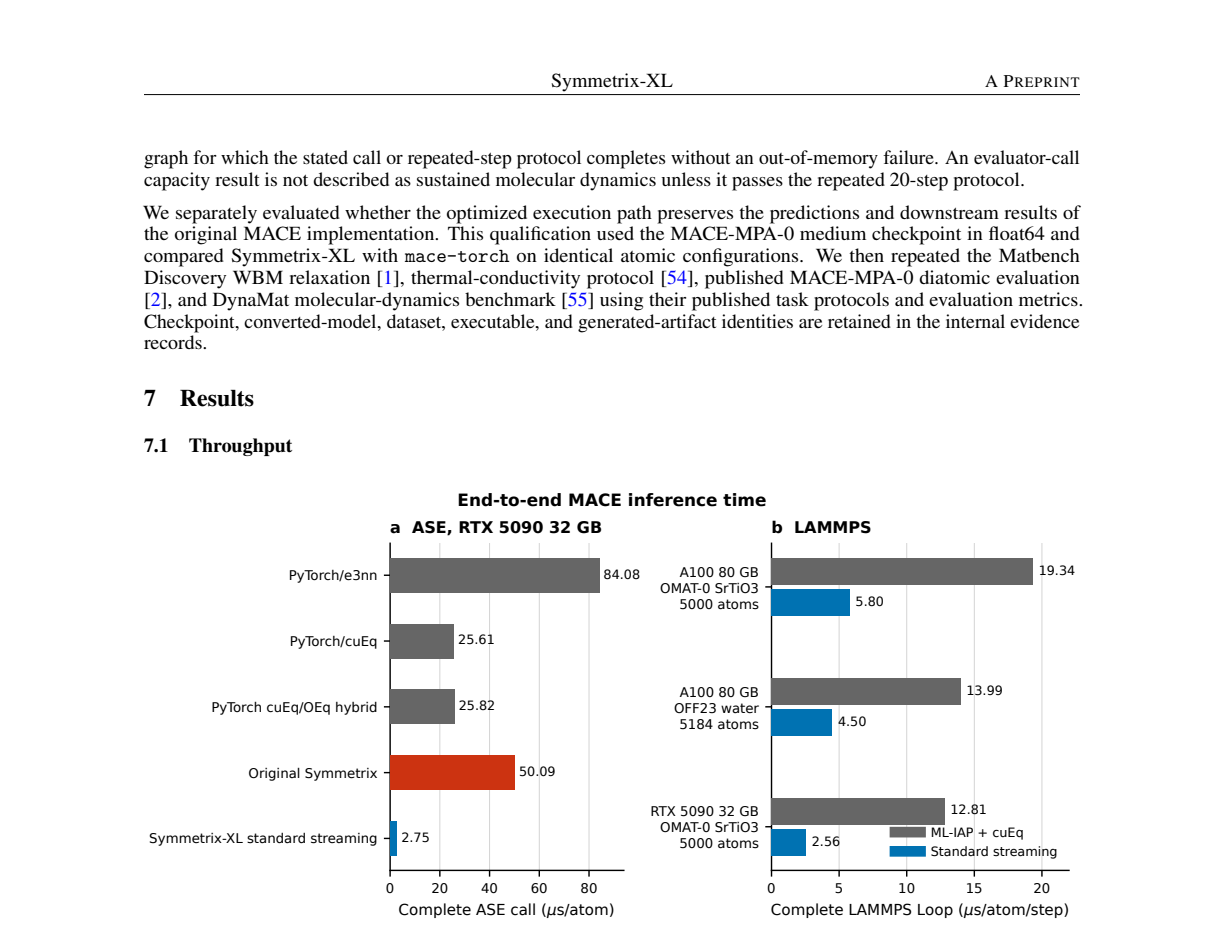
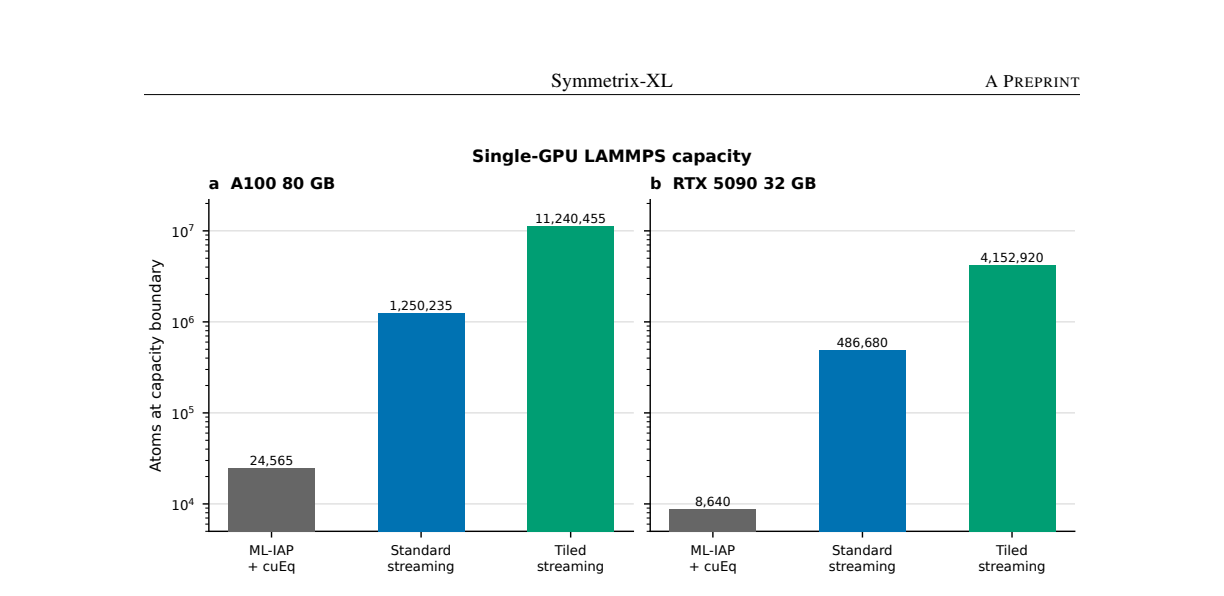
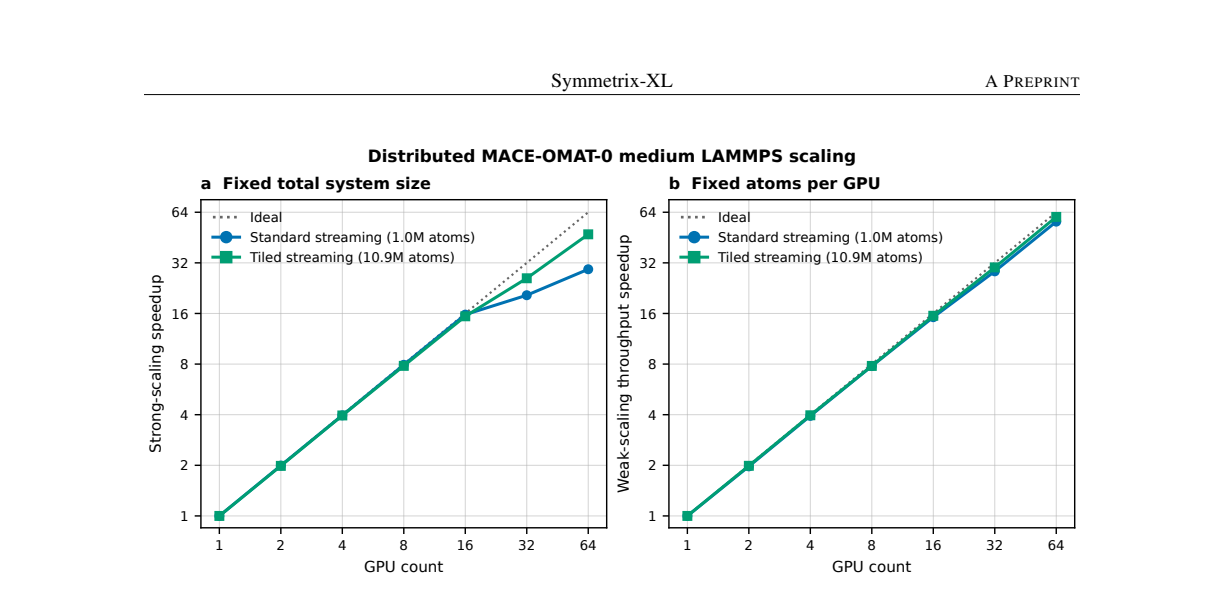
We present Symmetrix-XL, an inference engine that scales pretrained MACE checkpoints without retraining, distillation, or modification of their learned weights. It combines streamed-edge execution to avoid graph-wide materialization of expanded edge intermediates, model-specialized code generation to compile checkpoint-specific operators, and tiled execution to reuse a bounded device-memory workspace. On complete LAMMPS-step benchmarks, Symmetrix-XL reduces inference time by 3.1-5.0 times relative to ML-IAP + cuEquivariance across tested A100 and RTX 5090 workloads. On a single A100 80 GB GPU, the tested MACE-OMAT-0 capacity boundary increases from 24,565 atoms to 11.24 million atoms. This substantially lowers the hardware threshold for simulations that would otherwise require spatial decomposition across many GPUs and compute nodes. The same backend weak-scales to 703 million atoms on 64 A800 GPUs at 93.8 percent efficiency. Energy, force, stress, molecular-dynamics stability, and Matbench Discovery evaluations reproduce reference MACE behavior within measured tolerances. Case studies spanning solid-state, interfacial, and reactive systems demonstrate the increased capacity in realistic workflows. These results establish post-training execution as a scaling axis complementary to model redesign, compression, and distributed scale-out, and show that the practical accuracy-cost frontier depends on both model architecture and inference execution.
from the abstract
Pith says
Machine review · deepseek-v4-flash · 2 Oct 2026 · what was read was not recorded · not checked by a person
It can be wrong. Challenge this review or reply to it.
Holds up. A genuinely solid systems paper: the integration and the measured results are new, honestly reported, and the one real soft spot—thin OMAT-0 float32 fidelity coverage at the scale the headline numbers actually claim—is acknowledged and does not break the central thesis. This line is wrong
2 major objections · 6 minor
How often objections from reviews like this one are right: not yet measured
Not checked: figures, code, what the 68 references say.
The paper says, at Abstract and §7.5
The review did not quote this passage.
Pith says: Objection 1 of 2 · major
The sentence "Energy, force, stress, molecular-dynamics stability, and Matbench Discovery evaluations reproduce reference MACE behavior within measured tolerances" (b6) is not scoped to the configurations actually verified. The end-to-end fidelity battery in §7.5, Table 2, and Appendix A is almost entirely MACE-MPA-0 medium in float64; for the checkpoint and precision used in the headline throughput and capacity numbers (MACE-OMAT-0 medium, …
more of objection 1
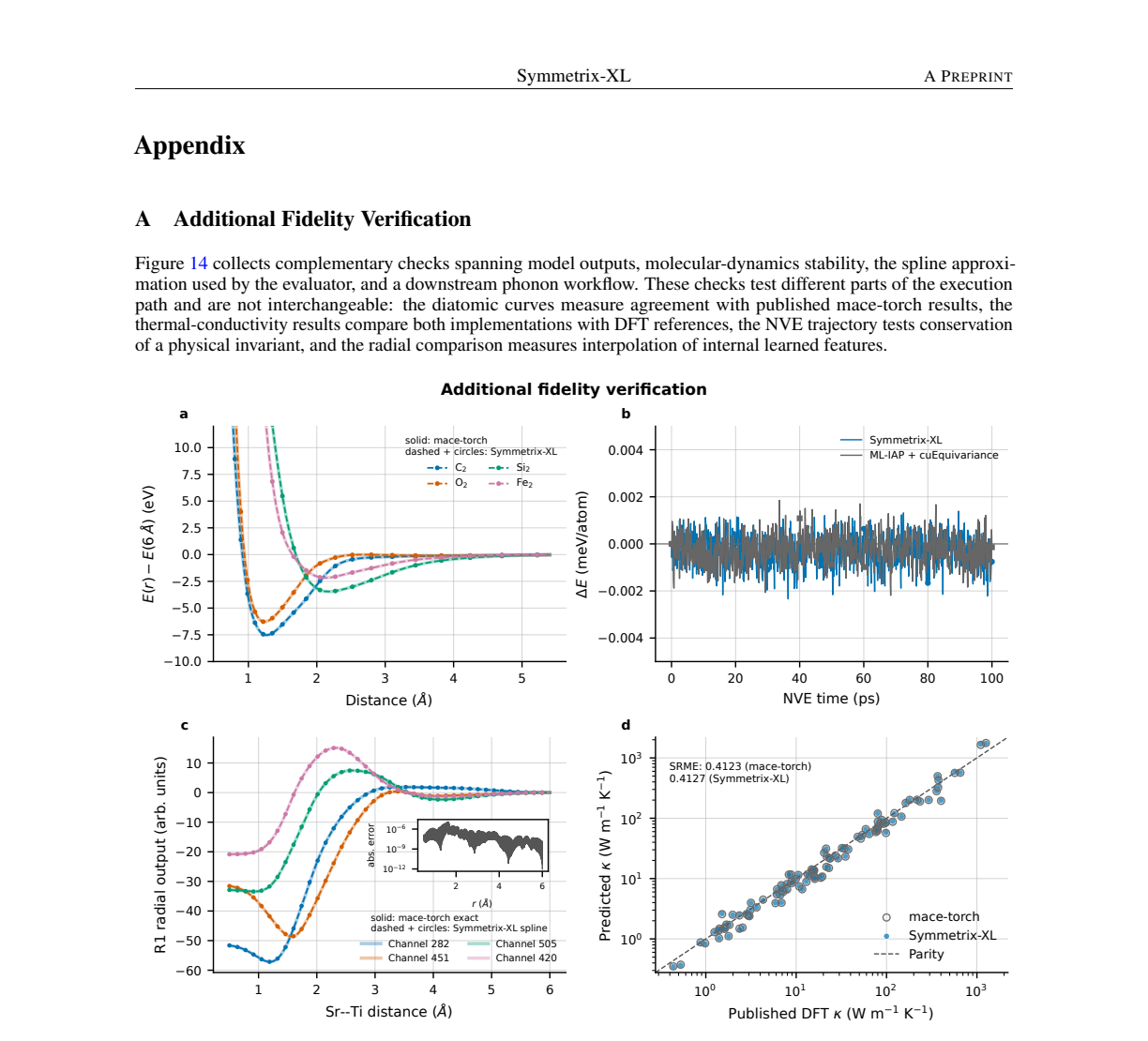
… float32), the reference comparison is a single 5,000-atom SrTiO3 task (energy 1.2e-5 eV/atom, max |F| 6.53e-5 eV/A, stress 8.82e-8 eV/A^3) plus an NVE drift comparison on the same structure. Because the radial-spline gate in Appendix B is explicitly checkpoint-specific (worst internal derivative error 7.23e-3 in internal learned units, with physical fidelity assessed only by end-to-end tests), the preservation guarantee as advertised at 1.25–11.24 million atoms is an extrapolation from one chemistry and one structure. This is not an internal inconsistency, and the paper is transparent about the per-checkpoint nature of the gate, but the unqualified abstract phrasing overstates the coverage. I recommend either adding float32 OMAT-0 parity checks on one or two additional chemistries (the Li–Al, Li6PS5Cl, or OFF23 systems already used in case studies would be cheap) or explicitly restricting the fidelity sentence to the tested configurations.
The paper says, at §7.2 / Table 1
The review did not quote this passage.
Pith says: Objection 2 of 2 · major
The capacity-boundary timings in Table 1 each correspond to a different system size, and the paper states this clearly, but the headline comparison of tiled versus standard streaming at their respective capacity boundaries ("increases the per-atom Loop time by approximately 4% ... while accommodating approximately nine times as many atoms") conflates a tiling-effectiveness claim with a capacity claim.
more of objection 2
A reader could take the 4% overhead as a same-size tiling cost; it is not, since the tiled run operates at ~9× the atom count. The authors disclose this in the caption, but the §7.2 text should state equally prominently that a matched-size comparison of the two streaming modes is not reported anywhere in the paper.
6 minor objections
The paper says, at References
Pith says: minor objection 1 of 6
Several references are listed twice under different numbers: [10] duplicates [2], [12] duplicates [39], [28] duplicates [23], and [34] duplicates [24]. These should be consolidated to avoid citation clutter.
The paper says, at Figure 9 caption
Pith says: minor objection 2 of 6
The caption labels two panels as "(e)" (panels labelled e in the figure legend and in the sentence about DPn/DPw); one of the panel identifiers should be re-lettered for consistency with the in-text references.
show 4 more
The paper says, at §8.1
Pith says: minor objection 3 of 6
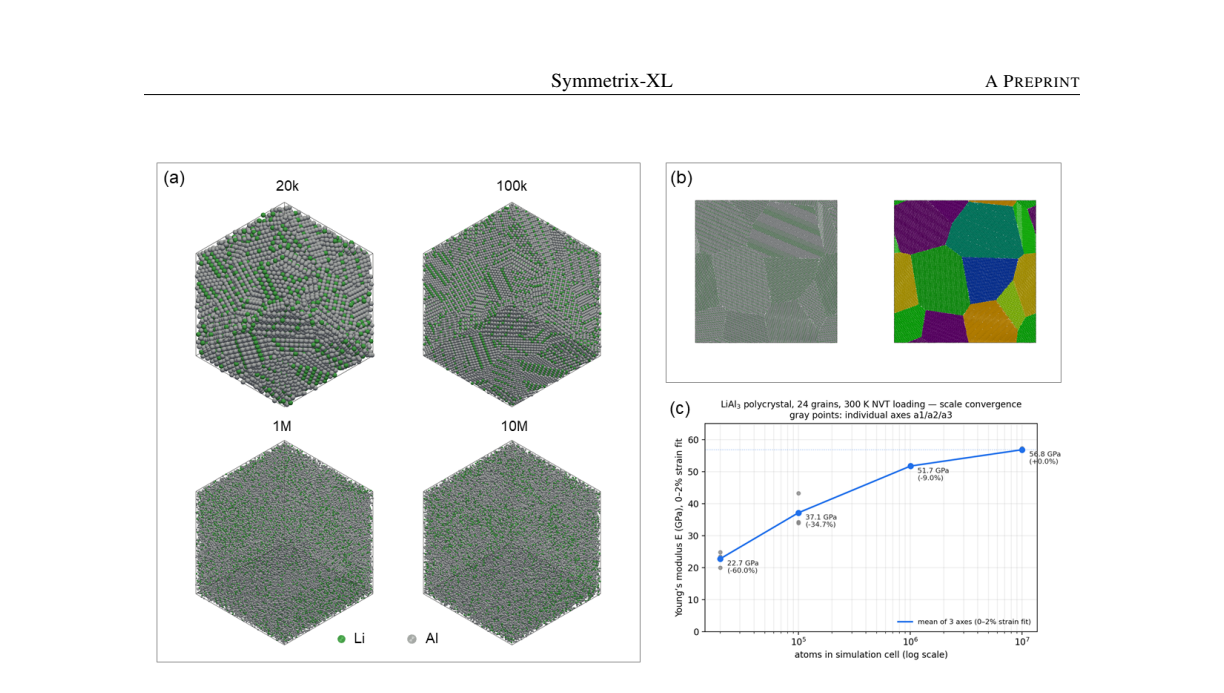
The sentence "Fig. 6 shows the four sample cells; Fig. 6 resolves the 10M grain-boundary network at true atomic scale" cites the same figure twice; the second reference should point to the specific panel (Fig. 6b) to avoid ambiguity.
The paper says, at §7.1 / Figure 2a
Pith says: minor objection 4 of 6
The ASE comparison uses an exact 6.0 A graph for PyTorch and a retained 6.5 A effective-cutoff graph for Symmetrix-XL. This asymmetry is disclosed in the caption and is conservative (it loads more edges onto Symmetrix-XL), but the main text should state the conservatism explicitly so readers do not treat the matched-LAMMPS claim as applying unchanged to the ASE boundary.
The paper says, at §7.2
Pith says: minor objection 5 of 6
Tiled streaming uses a fixed 8,192-workspace-receiver parameter, which appears to be a free design choice. A sentence reporting the sensitivity of capacity and per-atom Loop time to this parameter (or stating that results were insensitive over a tested range) would strengthen the claim that tiling is robust.
The paper says, at Throughout
Pith says: minor objection 6 of 6
Subscripts and superscripts are rendered inconsistently in running text (SrTiO3, Å3, cm2/s, eV/Å3, 10^4). This is likely a typesetting issue, but the camera-ready version should enforce uniform formatting of chemical formulae and units.
What would settle it
Run a fidelity sweep for MACE-OMAT-0 medium in float32: compare Symmetrix-XL against mace-torch on ~200 randomly sampled MP/WBM structures spanning >25 elements and varied coordination (including stretched and near-transition-state geometries), reporting max energy-per-atom, max force-component, and max stress-component differences. Separately re-run the Appendix B spline gate for this checkpoint and precision at 256 nodes and report the worst internal derivative error in force units via an end-to-end atomic-force comparison. Pass criterion: max |ΔF| consistent with the 6.53e-5 eV/A SrTiO3 result (within ~1e-3 eV/A) and spline gate acceptance. If deviations degrade on any chemistry, the abstract's blanket fidelity claim needs a precision/checkpoint qualifier.
from the skeptic's reading
How the review went
4 readings by deepseek-v4-flash · 2 Oct 2026
- Reader holds up
- Skeptic partly agrees
- Editor wrote the verdict above
- Referee minor revision: 2 major objections, 6 minor
Not run on this paper: the simulated authors' defence.
Pith did not check this review's objections against the paper.
The review in full
The review in brief, machine-written
Worth your time. This is a well-executed systems contribution, not a modeling paper, and it does not pretend otherwise. The three mechanisms are individually grounded in cited prior work—streamed-edge execution is the Sobek formulation [49], the specialization program extends Tan/Witt [33,34], tiling is a bounded-memory extension—so the novelty is the integration on top of Symmetrix plus the measured results: 11.24M atoms on one A100 versus the 24.5k baseline, 3.1–5.0x LAMMPS speedup, 703M atoms weak-scaling at 93.8%. Those numbers are mutually consistent between abstract and body, which is more than you usually get.
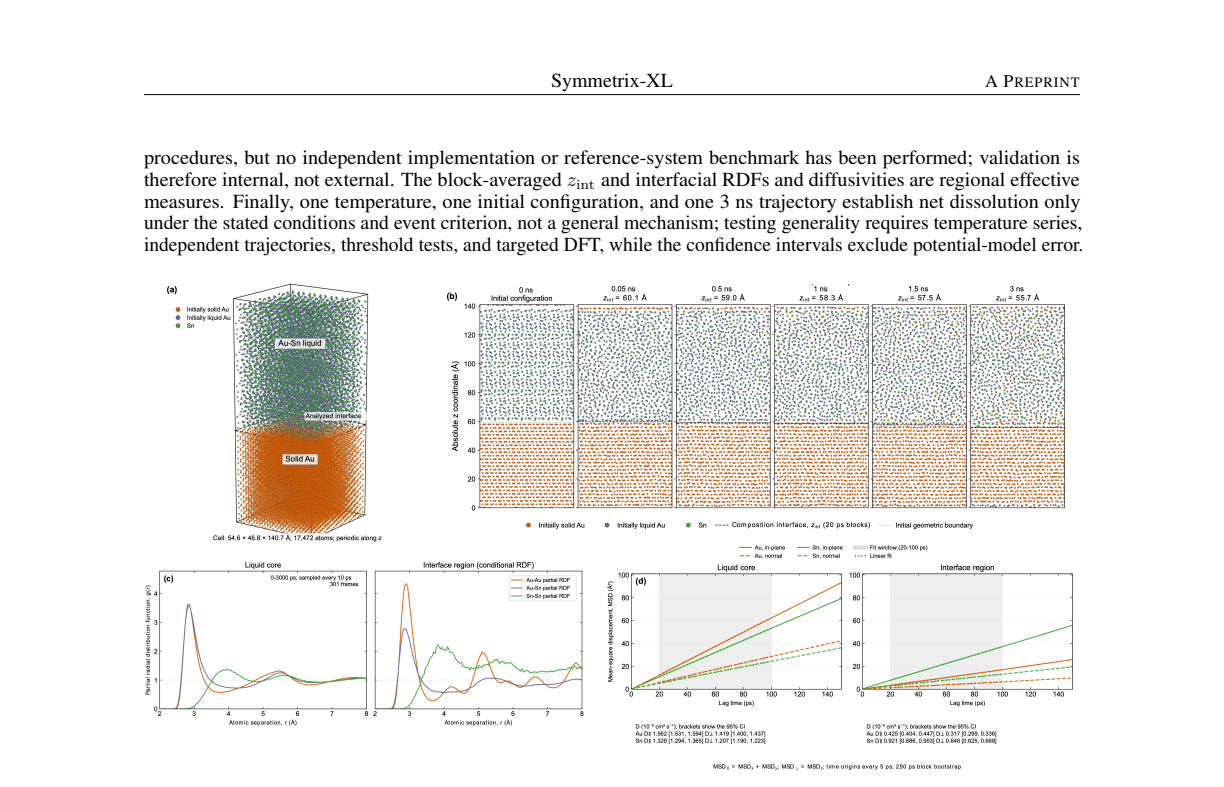
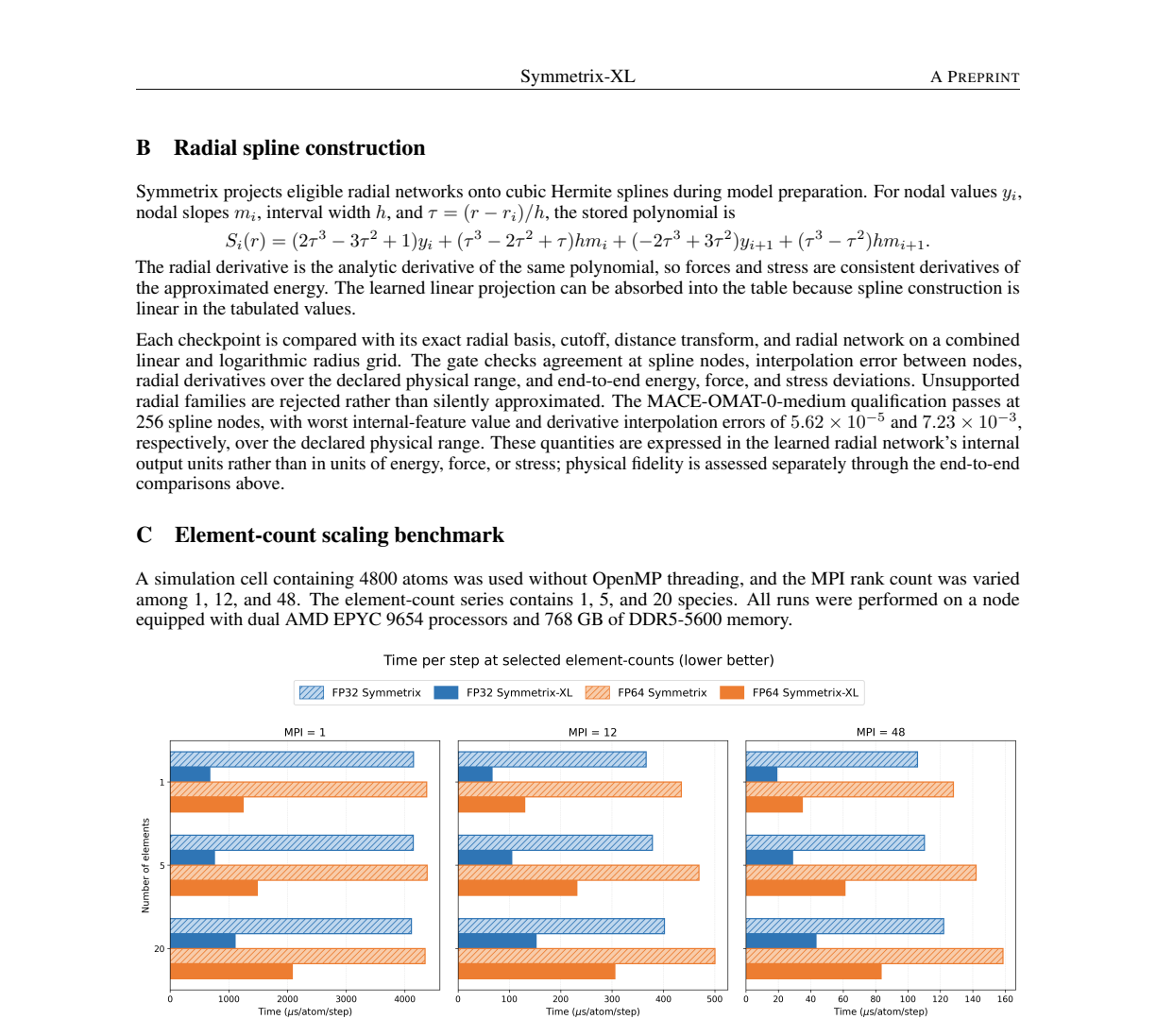
What it does well: the benchmark protocol is careful. Five warm-up, 20 measured steps, medians over fresh processes, zero neighbor-rebuild requirement enforced, capacity boundaries reproduced twice. The graph-construction asymmetry in the ASE comparison (6.0 Å exact for PyTorch, 6.5 Å retained skin for Symmetrix-XL) is disclosed, and it cuts against Symmetrix-XL by adding edges, so it is conservative. Fidelity is checked against genuinely external published results—Matbench Discovery, published MACE-MPA-0 workflows—not against quantities the paper defines, so the circularity burden is low. And the limitations section is unusually honest: capacity probes explicitly flagged as not sustained MD [b410], platform dependence, single-trajectory case studies.
The stress-test note is right about the one real soft spot: the fidelity battery is almost all MACE-MPA-0 float64, while the checkpoint and precision behind the headline capacity numbers is MACE-OMAT-0 float32. For that regime the end-to-end evidence is one 5,000-atom SrTiO3 task plus an NVE comparison. The spline gate is per-checkpoint and per-precision, and the reported worst derivative error (7.23e-3) is in internal learned units, so physical force impact is pointwise, not assumed. That means the preservation guarantee at 1.25–11.24M atoms across the varied chemistries in the case studies rests on extrapolation from a thin base. But it is not a fatal gap: the SrTiO3 spot check shows errors orders below physically meaningful thresholds, the spline qualification is per-checkpoint by design, and the case studies themselves concede internal-only validation where it applies. I would ask for one more OMAT-0 float32 fidelity point at genuinely large scale—say a million-atom energy/force comparison against the reference, or matched sustained MD—before banking on the blanket claim. I would not block the paper on it.
Who it is for: anyone deploying equivariant atomistic foundation models and anyone working on the accuracy-cost frontier of MLIP inference. It deserves a serious referee; accept with the fidelity-coverage refinement in mind.
The strongest objection
The architecture-preserving claim has two parts: an algebraic reassociation (streamed edges, §3) that is exact, and a radial-spline projection (Appendix B) that is a genuine approximation whose gate tolerances are checkpoint- and precision-specific. The measured worst derivative error of 7.23e-3 (Appendix B) is in internal learned units, so its physical force impact must be verified pointwise, not assumed. The fidelity battery in §7.5 and Appendix A is nearly all MACE-MPA-0 medium in float64: WBM relaxation/discovery, thermal conductivity, 87 diatomic pairs, DynaMat, all MPA-0. For the checkpoint and precision actually used in the headline throughput and capacity numbers — MACE-OMAT-0 medium, float32 — the end-to-end evidence is one SrTiO3 5,000-atom task (energy 1.200e-5 eV/atom, max |F| 6.53e-5 eV/A, §7.5) plus an NVE drift comparison on the same structure. The abstract's claim that 'Energy, force, stress ... reproduce reference MACE behavior within measured tolerances' is therefore asserted over a coverage region (OMAT-0 float32 at 1.25–11.24 M atoms, varied chemistries such as the Li–Al, SEI, and Au–Sn case studies) where no reference comparison exists. This is not an internal inconsistency: the spline gate is per-checkpoint and the SrTiO3 spot check shows errors orders below physically meaningful thresholds. But the preservation guarantee at the advertised scale rests on extrapolation from that thin base, and the paper's own case studies concede internal-only validation (b391). The recent optimized-deployment literature (refs 33–34) also means the magnitude of the 3.1–5.0x speedup is baseline-dependent; that is disclosed (§7, Fig. 2 caption) and conservative in direction, so it does not threaten the central thesis.
The reader identified fidelity generalization from the finite test battery to untested downstream observables as the weakest assumption. My stress-test sharpens that to a more concrete and checkable gap: the fidelity battery is essentially MPA-0 float64, while the headline throughput, capacity, and scaling claims are OMAT-0 medium float32; only one SrTiO3 config in float32 is checked end-to-end, and the flagship 11.24M-atom scale and the case-study chemistries have no reference comparison. This is load-bearing for the abstract's blanket fidelity sentence specifically, and it is testable with a bounded computational sweep. I nevertheless recommend UNCHANGED because (i) the §3 streamed reassociation is algebraically exact and the spline is a per-checkpoint, gated approximation with documented error bounds; (ii) the one float32 OMAT-0 check shows errors ~1e-5–1e-4 in physical units, orders below physically meaningful thresholds; (iii) the 6.0 vs 6.5 A graph asymmetry disclosed in Fig. 2 penalizes, not favors, Symmetrix-XL, so the speedup claim is conservative; and (iv) the paper is unusually explicit about capacity-probe, single-trajectory, internal-validation, and platform-dependence limits (b79, b214, b391, b410). No internal inconsistency or algebraic error was found. The suggested sweep is a verification step, not evidence of a defect.
The referee's report
If the results hold, the paper establishes post-training execution as a genuine third scaling axis for atomistic foundation models, complementary to architecture redesign and distillation, requiring no retraining or weight changes. The engineering claims are well evidenced: the benchmark protocol (§6) is unusually careful (five warm-up steps, 20 measured steps, three fresh-process trials, medians, zero neighbor-list-rebuild requirement, twice-reproduced capacity boundaries), the comparisons use matched checkpoints, coordinates, precision, and properties, and the distributed-scaling numbers are internally consistent with the reported atom-per-GPU counts. The fidelity checks validate against external published workflows and the reference mace-torch implementation rather than against paper-defined quantities, and the numerical agreement in Table 2 is quantitatively close (e.g., WBM discovery F1 0.835664 vs 0.835569; diatomic MAE 5.67e-6 eV/dimer). The paper is also unusually honest about its own limitations, repeatedly scoping case-study conclusions as single-trajectory or internally validated.
Pith's reading of the paper (a machine's summary, not the authors')
This paper tries to establish that post-training execution is a third scaling axis for atomistic foundation models, alongside designing cheaper architectures and distilling to smaller models. Its claim is that a fixed, pretrained MACE checkpoint runs dramatically faster and on far more atoms per GPU when only the inference engine changes—streamed edge processing, compiled checkpoint-specific operators, and bounded tiled workspaces—with the learned weights untouched. If the claim holds, the hardware threshold for million-atom simulations drops sharply, and dedicated inference backends become a practical lever that can be combined with model redesign and compression. The novelty is not a new architecture but evidence about how much of the accuracy–cost frontier is determined by execution rather than by the model itself.
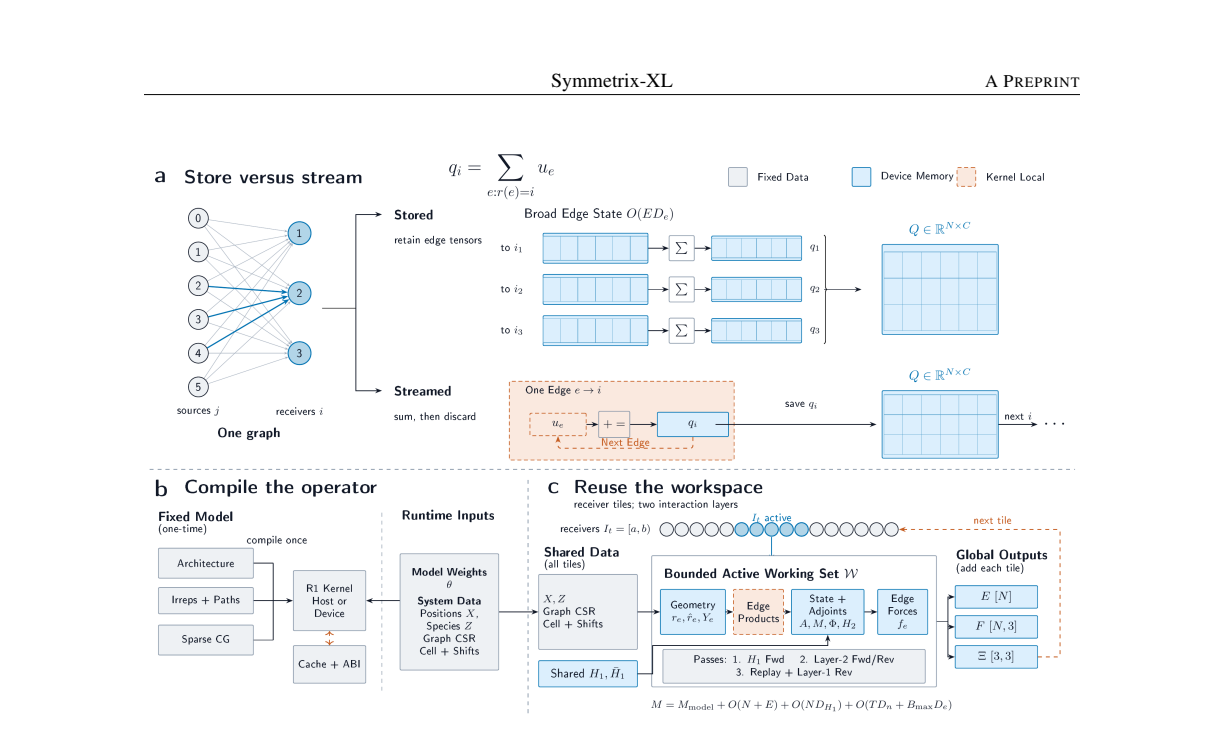
What carries the argument. The central object is a reassociation of the equivariant message-passing contraction. Each expanded edge weight is written as a projection of a compact radial embedding, $W_{e,\pi a} = \sum_q \varphi_{eq} B_{q,\pi a}$, and the receiver message $m_i = \sum_{e:r(e)=i} \sum_{\pi,a} W_{e,\pi a} T_{\pi a}(h_{s(e)}, Y_e)$ is formed by generating each contribution near its point of use, accumulating it into the receiver, and discarding it. This cuts persistent graph-dependent storage from $\mathcal{O}(E C P) + \mathcal{O}(E W_R) + \mathcal{O}(N C G)$ to $\mathcal{O}(E K_{\mathrm{geom}}) + \mathcal{O}(N C K_{\mathrm{node}}) + \mathcal{O}(K_{\mathrm{work}})$, i.e. graph-plus-node state with a bounded kernel-local workspace, with the reverse pass recomputing radial and angular factors under a chosen schedule. The same streamed schedule is combined with code generation that bakes the checkpoint's fixed sparse coupling structure into compiled CPU or GPU kernels, and with tiled execution that partitions receivers and incident edges into bounded tiles so the large temporary workspaces are tile-sized rather than graph-sized.
Core claim. The paper's central claim is that an already-trained equivariant atomistic foundation model can be scaled at execution time instead of at training or architecture time. Symmetrix-XL keeps the MACE checkpoint's learned weights and architectural contract unchanged and replaces how the fixed inference program executes: expanded edge contributions are formed, accumulated into their receiver, and discarded rather than materialized graph-wide; the checkpoint's fixed sparse Clebsch–Gordan paths, coefficients, and layouts are compiled into model-specific kernels; and receivers can be partitioned into bounded tiles that reuse a fixed device-memory workspace. On complete LAMMPS steps the backend is 3.1 to 5.0 times faster than the ML-IAP with cuEquivariance baseline, lifts the single-A100 capacity for MACE-OMAT-0 from 24,565 to 11,240,455 atoms, and weak-scales to 703 million atoms on 64 A800 GPUs at 93.8 percent efficiency. Energy, force, stress, NVE conservation, thermal conductivity, and Matbench Discovery results all reproduce the reference mace-torch behavior within the stated tolerances, although the implementations are not bitwise identical.
The premise it rests on. The claim that unchanged weights give reference behavior rests on the fidelity of streamed, reordered contractions and radial-spline interpolation to genuine MACE outputs, verified only on the finite battery of tested systems and checkpoints; an untested observable or checkpoint more sensitive than the aggregate metrics could deviate beyond tolerance.
If the paper is right (Pith's inferences, not the authors')
Million-atom molecular dynamics becomes feasible on a single consumer GPU: tiled streaming reaches 4.15 million atoms on one RTX 5090 and an estimated 1.7–2.9 million on 16 and 24 GB devices, respectively, for the tested workload.
Distributed LAMMPS runs gain larger local domains per rank, since tiled streaming weak-scales to 703 million atoms on 64 A800 GPUs, lowering the minimum GPU count for a given system.
Dedicated inference backends join architecture redesign and distillation as a third lever on the accuracy–cost frontier, and the three can be combined since each leaves the deployed model untouched in different ways.
The streaming, specialization, and tiling principles are claimed to extend to other equivariant graph neural networks whose operators admit compatible schedules, subject to per-architecture implementation and numerical qualification.
The disclosed graph-construction asymmetry—6.0 Å exact for PyTorch versus a 6.5 Å effective cutoff with a retained 0.5 Å skin for Symmetrix-XL—means part of the end-to-end speedup may come from trading a slightly larger effective cutoff against fewer neighbor-list rebuilds; a matched-cutoff benchmark would isolate the pure model-evaluation gain.
A natural extension is distributing tiled execution across devices within a node, since tiling already partitions receivers; whether tiles can map across GPUs without the graph-wide $H_1$ state would determine if tiled capacity composes with scale-out.
The spline approach that holds at 256 nodes with worst internal derivative error $7.23\times10^{-3}$ suggests the same project-onto-spline trick could be pushed to fewer nodes for other models, trading measurable accuracy for further memory and speed.
Check this review
Pith stored no record of this review's passes and took no fingerprint of it. Reviews made by code from 13 Nov 2026 on carry both.
How often reviews like this one are right
Reviews like this one: written by deepseek-v4-flash, where what was read was not recorded.
How often objections from reviews like this one are right: not yet measured
Reviews by people
This review was written by a machine. No person has reviewed this paper on Pith yet. A scientist listed on Pith can review it for a fee, and their review is published here whatever it concludes.
The paper
Abstract
Equivariant atomistic foundation models provide broadly transferable interatomic potentials trained against quantum-mechanical reference data, but their repeated execution at simulation scale remains computationally and memory intensive. We present Symmetrix-XL, an inference engine that scales pretrained MACE checkpoints without retraining, distillation, or modification of their learned weights. It combines streamed-edge execution to avoid graph-wide materialization of expanded edge intermediates, model-specialized code generation to compile checkpoint-specific operators, and tiled execution to reuse a bounded device-memory workspace. On complete LAMMPS-step benchmarks, Symmetrix-XL reduces inference time by 3.1-5.0 times relative to ML-IAP + cuEquivariance across tested A100 and RTX 5090 workloads. On a single A100 80 GB GPU, the tested MACE-OMAT-0 capacity boundary increases from 24,565 atoms to 11.24 million atoms. This substantially lowers the hardware threshold for simulations that would otherwise require spatial decomposition across many GPUs and compute nodes. The same backend weak-scales to 703 million atoms on 64 A800 GPUs at 93.8 percent efficiency. Energy, force, stress, molecular-dynamics stability, and Matbench Discovery evaluations reproduce reference MACE behavior within measured tolerances. Case studies spanning solid-state, interfacial, and reactive systems demonstrate the increased capacity in realistic workflows. These results establish post-training execution as a scaling axis complementary to model redesign, compression, and distributed scale-out, and show that the practical accuracy-cost frontier depends on both model architecture and inference execution.
The paper's own sentences, arranged, kept beside the review and separate from it. Each label is drawn from a closed vocabulary; the number beside it is the probability the classifier gave that label. No sentence in this record was written by a model.
abstract compiled · 2026-10-02
The authors' main claim, as the classifier picked it out 1.00
“These results establish post-training execution as a scaling axis complementary to model redesign, compression, and distributed scale-out, and show that the practical accuracy-cost frontier depends on both model architecture and inference execution.”
How the main claim is stated: asserted 1.00
What the abstract itself states, as probabilities: claims first 0.06 · states limitation 0.18 · human participants 0.01 · controlled comparison 0.90 · randomized assignment 0.01 · states quantitative result 0.99 · compares with prior results 0.97 · mentions code or data availability 0.04
The abstract, sentence by sentence
This table labels the abstract only (arXiv listing abstract v1). The number is the probability the classifier gave the label.
| Sentence | Role | The authors' own work | States the main conclusion | Strength |
|---|---|---|---|---|
| Equivariant atomistic foundation models provide broadly transferable interatomic potentials trained against quantum-mechanical reference data, but their repeated execution at simulation scale remains computationally and memory intensive. | background 0.96 | 0.07 | 0.03 | asserted 1.00 |
| We present Symmetrix-XL, an inference engine that scales pretrained MACE checkpoints without retraining, distillation, or modification of their learned weights. | contribution 0.99 | 0.94 | 0.12 | asserted 1.00 |
| It combines streamed-edge execution to avoid graph-wide materialization of expanded edge intermediates, model-specialized code generation to compile checkpoint-specific operators, and tiled execution to reuse a bounded device-memory workspace. | method 0.99 | 0.85 | 0.05 | asserted 1.00 |
| On complete LAMMPS-step benchmarks, Symmetrix-XL reduces inference time by 3.1-5.0 times relative to ML-IAP + cuEquivariance across tested A100 and RTX 5090 workloads. | result 1.00 | 0.95 | 0.14 | asserted 1.00 |
| On a single A100 80 GB GPU, the tested MACE-OMAT-0 capacity boundary increases from 24,565 atoms to 11.24 million atoms. | result 1.00 | 0.94 | 0.09 | asserted 1.00 |
| This substantially lowers the hardware threshold for simulations that would otherwise require spatial decomposition across many GPUs and compute nodes. | interpretation 0.99 | 0.70 | 0.08 | asserted 0.99 |
| The same backend weak-scales to 703 million atoms on 64 A800 GPUs at 93.8 percent efficiency. | result 1.00 | 0.94 | 0.07 | asserted 1.00 |
| Energy, force, stress, molecular-dynamics stability, and Matbench Discovery evaluations reproduce reference MACE behavior within measured tolerances. | result 1.00 | 0.93 | 0.07 | asserted 1.00 |
| Case studies spanning solid-state, interfacial, and reactive systems demonstrate the increased capacity in realistic workflows. | result 0.75 | 0.92 | 0.04 | asserted 1.00 |
| These results establish post-training execution as a scaling axis complementary to model redesign, compression, and distributed scale-out, and show that the practical accuracy-cost frontier depends on both model architecture and inference execution. | interpretation 1.00 | 0.81 | 0.87 | asserted 1.00 |
What kind of paper the classifier reports this is: method or tool 1.00 · evidence from simulation or computation 0.82
What was examined, and what was not
Sources read
- arXiv listing abstract v1
Not examined
- full text
- figures and tables
- references and citing sentences
- relations to other papers
Levels run
- P abstract
Not run
- S sections
- T body sentences
- C citations
- R cross-paper relations
How the labels were made
Compiled by classifier-1.13.0 via TypeSafe API, question bank abstract-p1-20260923, 2026-10-02: 1 request, 7,747 input tokens.
Every quoted sentence on this record is the authors'. Every label is from Pith's closed vocabulary, with the probability shown beside it. This record as JSON
Figures (15)
Figures are the authors', reproduced from the paper.
References (68)
- [49] Vsevolod Chorošajev and Cédric Bény. Sobek: Streaming equivariant tensor product convolutions.arXiv preprint arXiv:2607.18074, 2026 on PithPith's reviewarXiv
- [1] Janosh Riebesell, Rhys E. A. Goodall, Philipp Benner, Yuan Chiang, Bowen Deng, Gerbrand Ceder, Mark Asta, Alpha A. Lee, Anubhav Jain, and Kristin A. Persson. Matbench discovery: A framework to evaluate machine learning crystal stability predictions.Nature Machine Intelligence,... on Pith
- [3] Luis Barroso-Luque, Muhammed Shuaibi, Xiang Fu, Brandon M. Wood, Misko Dzamba, Meng Gao, Ammar Rizvi, Matt Uyttendaele, C. Lawrence Zitnick, and Zachary W. Ulissi. Open materials 2024 (OMat24) inorganic materials dataset and models.arXiv preprint arXiv:2410.12771, 2024 on PithPith's reviewarXiv
- [4] Brandon M. Wood, Misko Dzamba, Xiang Fu, Meng Gao, Muhammed Shuaibi, Luis Barroso-Luque, et al. UMA: A family of universal models for atoms.arXiv preprint arXiv:2506.23971, 2026 on PitharXiv
- [5] Kairos Materials. Prophet: Scaling atomistic foundation models across composition, configuration, and spin, 2026. Technical report on Pith
- [6] So Takamoto, Chikashi Shinagawa, Daisuke Motoki, Kosuke Nakago, Wenwen Li, Iori Kurata, Taku Watanabe, Yoshihiro Yayama, Hiroki Iriguchi, Yusuke Asano, Tasuku Onodera, Takafumi Ishii, Takao Kudo, Hideki Ono, Ryohto Sawada, Ryuichiro Ishitani, Marc Ong, Taiki Yamaguchi, Toshiki... on Pith
- [7] Chi Chen and Shyue Ping Ong. A universal graph deep learning interatomic potential for the periodic table. Nature Computational Science, 2:718–728, 2022. doi: 10.1038/s43588-022-00349-3 on Pithdoi:10.1038/s43588-022-00349-3
- [8] Bowen Deng, Peichen Zhong, KyuJung Jun, Janosh Riebesell, Kevin Han, Christopher J. Bartel, and Gerbrand Ceder. CHGNet as a pretrained universal neural network potential for charge-informed atomistic modelling. Nature Machine Intelligence, 5:1031–1041, 2023. doi: 10.1038/s4225... on Pithdoi:10.1038/s42256-023-00716-3
- [9] Kamal Choudhary, Brian DeCost, Lily Major, Keith Butler, Jeyan Thiyagalingam, and Francesca Tavazza. Unified graph neural network force-field for the periodic table: solid state applications.Digital Discovery, 2:346–355, on Pith
- [10] Ilyes Batatia, Philipp Benner, Yuan Chiang, Alin M. Elena, Dávid P. Kovács, Janosh Riebesell, et al. A foundation model for atomistic materials chemistry.The Journal of Chemical Physics, 163(18):184110, 2025. doi: 10.1063/5.0297006 on Pithdoi:10.1063/5.0297006
- [11] Han Yang, Chenxi Hu, Yichi Zhou, Xixian Liu, Yu Shi, Jielan Li, Guanzhi Li, Zekun Chen, Shuizhou Chen, Claudio Zeni, Matthew Horton, Robert Pinsler, Andrew Fowler, Daniel Zügner, Tian Xie, Jake Smith, Lixin Sun, Qian Wang, Lingyu Kong, Chang Liu, Hongxia Hao, and Ziheng Lu. Ma... on PithPith's reviewarXiv
- [13] Jaesun Kim, Jisu Kim, Jaehoon Kim, Jiho Lee, Yutack Park, Youngho Kang, and Seungwu Han. Data-efficient multifidelity training for high-fidelity machine learning interatomic potentials.Journal of the American Chemical Society, 147(1):1042–1054, 2025. doi: 10.1021/jacs.4c14455 on Pithdoi:10.1021/jacs.4c14455
- [14] Luis Barros-Luque, Muhammed Shuaibi, Xiang Fu, Brandon M. Wood, Misko Dzamba, Meng Gao, Ammar Rizvi, Matt Uyttendaele, C. Lawrence Zitnick, and Zachary W. Ulissi. The Open Materials 2024 (OMat24) inorganic materials dataset and models.Nature Computational Science, 6:642–652, 2... on Pith
- [15] Mark Neumann, James Gin, Benjamin Rhodes, Steven Bennett, Zhiyi Li, Hitarth Choubisa, Arthur Hussey, and Jonathan Godwin. Orb: A fast, scalable neural network potential. arXiv preprint arXiv:2410.22570, 2024. URL https://arxiv.org/abs/2410.22570 on PithPith's reviewarXiv
- [16] Benjamin Rhodes, Sander Vandenhaute, Vaidotas Šimkus, James Gin, Jonathan Godwin, Tim Duignan, and Mark Neumann. Orb-v3: atomistic simulation at scale. arXiv preprint arXiv:2504.06231, 2025. URL https: //arxiv.org/abs/2504.06231 on PithPith's reviewarXiv
- [17] Duo Zhang, Xinzijian Liu, Xiangyu Zhang, Chengqian Zhang, Chun Cai, Hangrui Bi, et al. DPA-2: a large atomic model as a multi-task learner.npj Computational Materials, 10:293, 2024. doi: 10.1038/s41524-024-01493-2 on Pithdoi:10.1038/s41524-024-01493-2
- [18] Duo Zhang, Anyang Peng, Chun Cai, Wentao Li, Yuanchang Zhou, Jinzhe Zeng, Mingyu Guo, Chengqian Zhang, Bowen Li, Hong Jiang, Tong Zhu, Weile Jia, Linfeng Zhang, and Han Wang. A graph neural network for the era of large atomistic models. arXiv preprint arXiv:2506.01686, 2025. U... on PitharXiv
- [19] Yury Lysogorskiy, Anton Bochkarev, and Ralf Drautz. Graph atomic cluster expansion for foundational machine learning interatomic potentials.npj Computational Materials, 12:114, 2026. doi: 10.1038/s41524-026-01979-1 on Pithdoi:10.1038/s41524-026-01979-1
- [20] Xiang Fu, Brandon M. Wood, Luis Barroso-Luque, Daniel S. Levine, Meng Gao, Misko Dzamba, and C. Lawrence Zitnick. Learning smooth and expressive interatomic potentials for physical property prediction. InProceedings of the 42nd International Conference on Machine Learning, vol... on Pith
- [21] Brandon M. Wood, Misko Dzamba, Xiang Fu, Meng Gao, Muhammed Shuaibi, Luis Barroso-Luque, Ka- reem Abdelmaqsoud, Vahe Gharakhanyan, John Kitchin, Daniel S. Levine, Kyle Michel, Anuroop Sriram, Taco S. Cohen, Abhishek Das, Sushree Sahoo, Ammar Rizvi, Zachary Ulissi, and Larry Zi... on Pith
show 48 more
- [22] Arslan Mazitov, Filippo Bigi, Matthias Kellner, Paolo Pegolo, Davide Tisi, Guillaume Fraux, Sergey Pozdnyakov, Philip Loche, and Michele Ceriotti. PET-MAD as a lightweight universal interatomic potential for advanced materials modeling.Nature Communications, 16:10653, 2025. do... on Pithdoi:10.1038/s41467-025-65662-7
- [25] Ting Liang, Ke Xu, Eric Lindgren, Zherui Chen, Rui Zhao, Jiahui Liu, Esmée Berger, Benrui Tang, Bohan Zhang, Yanzhou Wang, Keke Song, Penghua Ying, Nan Xu, Haikuan Dong, Shunda Chen, Paul Erhart, Zheyong Fan, Tapio Ala-Nissila, and Jianbin Xu. NEP89: Universal neuroevolution p... on PithPith's reviewarXiv
- [26] Zheyong Fan, Zezhu Zeng, Cunzhi Zhang, Yanzhou Wang, Keke Song, Haikuan Dong, Yue Chen, and Tapio Ala-Nissila. Neuroevolution machine learning potentials: Combining high accuracy and low cost in atomistic simulations and application to heat transport.Physical Review B, 104:104... on Pithdoi:10.1103/physrevb.104
- [27] Zheyong Fan, Yanzhou Wang, Penghua Ying, Keke Song, Junjie Wang, Yong Wang, Zezhu Zeng, Ke Xu, Eric Lindgren, J. Magnus Rahm, Alexander J. Gabourie, Jiahui Liu, Haikuan Dong, Jianyang Wu, Yue Chen, Zheng Zhong, Jian Sun, Paul Erhart, Yanjing Su, and Tapio Ala-Nissila. GPUMD: A... on Pithdoi:10.1063/5.0106617
- [28] Teddy Koker, Mit Kotak, and Tess Smidt. Training a foundation model for materials on a budget.arXiv preprint arXiv:2508.16067, 2025 on PitharXiv
- [29] Yunyang Li, Lin Huang, Zhihao Ding, Chu Wang, Xinran Wei, Han Yang, Zun Wang, Chang Liu, Yu Shi, Peiran Jin, Tao Qin, Mark Gerstein, and Jia Zhang. E2Former: An efficient and equivariant transformer with linear-scaling tensor products.arXiv preprint arXiv:2501.19216, 2025. doi... on Pithdoi:10.48550/arxiv.2501.19216
- [30] Tiancheng Li, Jianming Xue, Linfeng Zhang, Duo Zhang, and Han Wang. Universal machine-learning molecular dynamics at the speed of empirical potentials.arXiv preprint arXiv:2608.19041, 2026. doi: 10.48550/arXiv.2608. 19041 on PithPith's reviewarXivdoi:10.48550/arxiv.2608.19041
- [31] Albert Musaelian, Simon Batzner, Anders Johansson, Lixin Sun, Cameron J. Owen, Mordechai Kornbluth, and Boris Kozinsky. Learning local equivariant representations for large-scale atomistic dynamics.Nature Communications, 14:579, 2023. doi: 10.1038/s41467-023-36329-y on Pithdoi:10.1038/s41467-023-36329-y
- [32] Sangmin Oh, Jinmu You, Jaesun Kim, Jiho Lee, Hyungmin An, Seungwu Han, and Youngho Kang. A lightweight universal machine-learning interatomic potential via knowledge distillation for scalable atomistic simulations. arXiv preprint arXiv:2604.10887, 2026 on PithPith's reviewarXiv
- [33] Chuin Wei Tan, Marc L. Descoteaux, Mit Kotak, Gabriel de Miranda Nascimento, Seán R. Kavanagh, Laura Zichi, Menghang Wang, Aadit Saluja, Yizhong R. Hu, Tess Smidt, Anders Johansson, William C. Witt, Boris Kozinsky, and Albert Musaelian. High-performance training and inference ... on Pithdoi:10.1039/d5dd00423c
- [34] Seán R. Kavanagh, Chuin Wei Tan, Menghang Wang, Marc L. Descoteaux, Gabriel de Miranda Nascimento, Ulrik Unneberg, Laura Zichi, Francesco Libbi, Norma Rivano, Austin Glover, Vivek Bharadwaj, Anders Johansson, William C. Witt, Albert Musaelian, and Boris Kozinsky. Fast and accu... on PithPith's reviewarXiv
- [35] Vivek Bharadwaj, Austin Glover, Aydın Buluç, and James Demmel. An efficient sparse kernel generator for O(3)-equivariant deep networks. InProceedings of the Platform for Advanced Scientific Computing Conference, on Pith
- [36] Seung Yul Lee, Hojoon Kim, Yutack Park, Dawoon Jeong, Seungwu Han, Yeonhong Park, and Jae W. Lee. FlashTP: Fused, sparsity-aware tensor product for machine learning interatomic potentials. InProceedings of the 42nd International Conference on Machine Learning, volume 267 ofPro... on Pith
- [37] Paul Fuchs, Weilong Chen, Stephan Thaler, and Julija Zavadlav. chemtrain-deploy: A parallel and scalable framework for machine learning potentials in million-atom MD simulations.arXiv preprint arXiv:2506.04055, 2025 on PithPith's reviewarXiv
- [38] doi: 10.1137/1.9781611979084.3 on Pithdoi:10.1137/1.9781611979084.3
- [39] Yutack Park, Jaesun Kim, Seungwoo Hwang, and Seungwu Han. Scalable parallel algorithm for graph neural network interatomic potentials in molecular dynamics simulations.Journal of Chemical Theory and Computation, 20:4857–4868, 2024. doi: 10.1021/acs.jctc.4c00190. 25 Symmetrix-X... on Pithdoi:10.1021/acs.jctc.4c00190
- [40] Ilyes Batatia, Dávid Péter Kovács, Gregor N. C. Simm, Christoph Ortner, and Gábor Csányi. MACE: Higher order equivariant message passing neural networks for fast and accurate force fields. InAdvances in Neural Information Processing Systems, volume 35, pages 11423–11436, 2022 on Pith
- [41] William C. Witt. Symmetrix. GitHub repository, n.d. URL https://github.com/wcwitt/symmetrix. Accessed 29 September 2026 on Pith
- [42] Mario Geiger and Tess Smidt. e3nn: Euclidean neural networks.arXiv preprint arXiv:2207.09453, 2022 on PithPith's reviewarXiv
- [43] MACE developers. mace-torch. https://github.com/ACEsuit/mace, 2026. Reference PyTorch implementa- tion; accessed 11 September 2026 on Pith
- [44] Adam Paszke et al. PyTorch: An imperative style, high-performance deep learning library.Advances in Neural Information Processing Systems, 32:8024–8035, 2019 on Pith
- [45] Ask Hjorth Larsen et al. The atomic simulation environment—a python library for working with atoms.Journal of Physics: Condensed Matter, 29:273002, 2017. doi: 10.1088/1361-648X/aa680e on Pithdoi:10.1088/1361-648x/aa680e
- [46] Aidan P. Thompson, H. Metin Aktulga, Richard Berger, Dan S. Bolintineanu, W. Michael Brown, et al. LAMMPS – a flexible simulation tool for particle-based materials modeling at the atomic, meso, and continuum scales. Computer Physics Communications, 271:108171, 2022. doi: 10.10... on Pithdoi:10.1016/j.cpc.2021.108171
- [47] NVIDIA. cuequivariance. https://github.com/NVIDIA/cuEquivariance, 2026. Software repository; accessed 11 September 2026 on Pith
- [48] Justin S. Smith. Enabling scalable AI-driven molecular dynamics simu- lations. NVIDIA Technical Blog, https://developer.nvidia.com/blog/ enabling-scalable-ai-driven-molecular-dynamics-simulations/ , 2025. Published 20 Octo- ber 2025; accessed 20 September 2026 on Pith
- [50] Anders Johansson, Evan Weinberg, Christian R. Trott, Megan J. McCarthy, and Stan G. Moore. LAMMPS- KOKKOS: Performance portable molecular dynamics across exascale architectures. InProceedings of the SC ’25 Workshops of the International Conference for High Performance Computin... on Pithdoi:10.1145/3731599.3767498
- [51] AMD. HIP runtime compilation. https://rocm.docs.amd.com/projects/HIP/en/latest/reference/ hip_runtime_api/modules/runtime_compilation.html, 2026. Documentation; accessed 11 September 2026 on Pith
- [52] Christian R. Trott et al. Kokkos 3: Programming model extensions for the exascale era.IEEE Transactions on Parallel and Distributed Systems, 33(4):805–817, 2022. doi: 10.1109/TPDS.2021.3097283 on Pithdoi:10.1109/tpds.2021.3097283
- [53] NVIDIA. CUDA runtime compilation API. https://docs.nvidia.com/cuda/nvrtc/, 2026. Documentation; accessed 11 September 2026 on Pith
- [54] Balázs Póta, Paramvir Ahlawat, Gábor Csányi, and Michele Simoncelli. Thermal conductivity predictions with foundation atomistic models.Nature Communications, 2026. doi: 10.1038/s41467-026-76391-w on Pithdoi:10.1038/s41467-026-76391-w
- [55] Xiang Fu, Zhenghao Wu, Wujie Wang, Tian Xie, Sinan Keten, Rafael Gomez-Bombarelli, and Tommi Jaakkola. Forces are not enough: Benchmark and critical evaluation for machine learning force fields with molecular simulations.Transactions on Machine Learning Research, 2023 on Pith
- [56] Filippo Bigi, Guillaume Fraux, Nicholas J. Browning, and Michele Ceriotti. Fast evaluation of spherical harmonics with sphericart.The Journal of Chemical Physics, 159:064802, 2023. doi: 10.1063/5.0156307 on Pithdoi:10.1063/5.0156307
- [57] W. C. Witt et al. symmetrix: A cross-platform evaluator for MACE models; Symmetrix-XL v0.1.1. https:// github.com/wcwitt/symmetrix and https://github.com/bonan-group/symmetrix-xl, 2026. Source commit e99fea0. The limgal checkpoint is distributed unchanged with the v0.1.1 relea... on Pith
- [58] J. Schiøtz, F. D. Di Tolla, and K. W. Jacobsen. Softening of nanocrystalline metals at very small grain sizes. Nature, 391:561–562, 1998 on Pith
- [59] P. Virtanen et al. SciPy 1.0: Fundamental algorithms for scientific computing in python.Nature Methods, 17: 261–272, 2020 on Pith
- [60] H. Van Swygenhoven, P. M. Derlet, and A. G. Frøseth. Stacking faults and microtwinning in nanocrystalline fcc metals.Nature Materials, 3:399–403, 2004. 26 Symmetrix-XLA PREPRINT on Pith
- [61] Dávid P. Kovács, J. Harry Moore, Nicholas J. Browning, Ilyes Batatia, John T. Horton, et al. MACE-OFF: Short-range transferable machine learning force fields for organic molecules.Journal of the American Chemical Society, 147(21):17598–17611, 2025. doi: 10.1021/jacs.4c07099 on Pithdoi:10.1021/jacs.4c07099
- [62] M. A. Meyers, A. Mishra, and D. J. Benson. Mechanical properties of nanocrystalline materials.Progress in Materials Science, 51:427–556, 2006 on Pith
- [63] Alejandro Strachan, Edward M. Kober, Adri C. T. van Duin, Jonas Oxgaard, and William A. III Goddard. Thermal decomposition of RDX from reactive molecular dynamics.The Journal of Chemical Physics, 122(5):054502, on Pith
- [64] Pierre Sigwalt. Stereoelection and stereoselection in the ring-opening polymerization of epoxides and episulfides. Pure and Applied Chemistry, 48(3):257–266, 1976. doi: 10.1351/pac197648030257 on Pithdoi:10.1351/pac197648030257
- [65] Giovanni Bussi, Davide Donadio, and Michele Parrinello. Canonical sampling through velocity rescaling.The Journal of Chemical Physics, 126(1):014101, 2007. doi: 10.1063/1.2408420. URL https://doi.org/10. 1063/1.2408420 on Pithdoi:10.1063/1.2408420
- [66] L. Martínez, R. Andrade, E. G. Birgin, and J. M. Martínez. PACKMOL: A package for building initial configura- tions for molecular dynamics simulations.Journal of Computational Chemistry, 30:2157–2164, 2009 on Pith
- [67] Yongliang Ou, Lena Scholz, Sanath Keshav, Yuji Ikeda, Marvin Kraft, Sergiy Divinski, Rafael Gómez-Bombarelli, Wolfgang G. Zeier, Felix Fritzen, and Blazej Grabowski. Microstructural insights into fast ion transport in solid electrolytes via multiscale modeling.Nature Communica... on Pithdoi:10.1038/s41467-026-76216-w
- [68] Luis Barros-Luque, Muhammed Shuaibi, Xiang Fu, Brandon M. Wood, Misko Dzamba, Meng Gao, Ammar Rizvi, Matt Uyttendaele, C. Lawrence Zitnick, and Zachary W. Ulissi. The open materials 2024 (OMat24) inorganic materials dataset and models.Nature Computational Science, 6:642–652, 2... on Pith
- [69] Roderic P. Quirk, Marissa Ocampo, Michael J. Polce, and Chrys Wesdemiotis. Functionalization of poly(styryl)lithium with thiiranes: Sulfur extrusion vs ring-opening mechanisms.Macromolecules, 40(7): 2352–2360, 2007. doi: 10.1021/ma0628026 on Pithdoi:10.1021/ma0628026
- [2005] doi: 10.1063/1.1831277 on Pithdoi:10.1063/1.1831277
- [2023] doi: 10.1039/D2DD00096B on Pithdoi:10.1039/d2dd00096b
- [2025] doi: 10.52202/085713-4310. URL https://papers.nips.cc/paper_files/paper/2025/hash/ bbf23e81b0ad7637fe9a731d0b676ca6-Abstract-Conference.html on Pithdoi:10.52202/085713-4310
Cited by 4 Pith papers
Reviewed papers on Pith that cite this one. The full citation record
- SO3LR Tauri: Generally Applicable Force Fields for Reactive (Bio)Molecular Simulations Covering the Periodic Table physics.chem-ph · Nov 2026
- Foundation-Model Supervision of Distilled Potentials for Million-Atom Molecular Dynamics physics.comp-ph · Oct 2026
- Unconstrained learning of equivariant atomistic properties physics.chem-ph · Oct 2026
- Scalable long-range machine learning interatomic potentials with electrical response for atomistic material modeling cond-mat.mtrl-sci · Oct 2026
Challenges and discussion
Disagree with the review, or know something it missed? Leave a comment, or challenge this review formally: a challenge becomes a permanent entry in this paper's record, and its decision is published here.
Come back by email
A short list of the week's newly reviewed papers. Nothing is sent until you confirm from your inbox, and every email has a link that stops it. No account.
No comments yet.
Sign in to comment