Chemical Physics · arXiv:2610.31183 v1 · submitted 22 Oct 2026 · 66 references
Unconstrained learning of equivariant atomistic properties
The paper says
“Machine-learned interatomic potentials based on graph neural networks (GNNs) have made first-principles accuracy routine for the potential energy surface (PES). Their backbones, often O(3)-equivariant by design, are increasingly used to learn other atomistic properties.”
more of the abstract
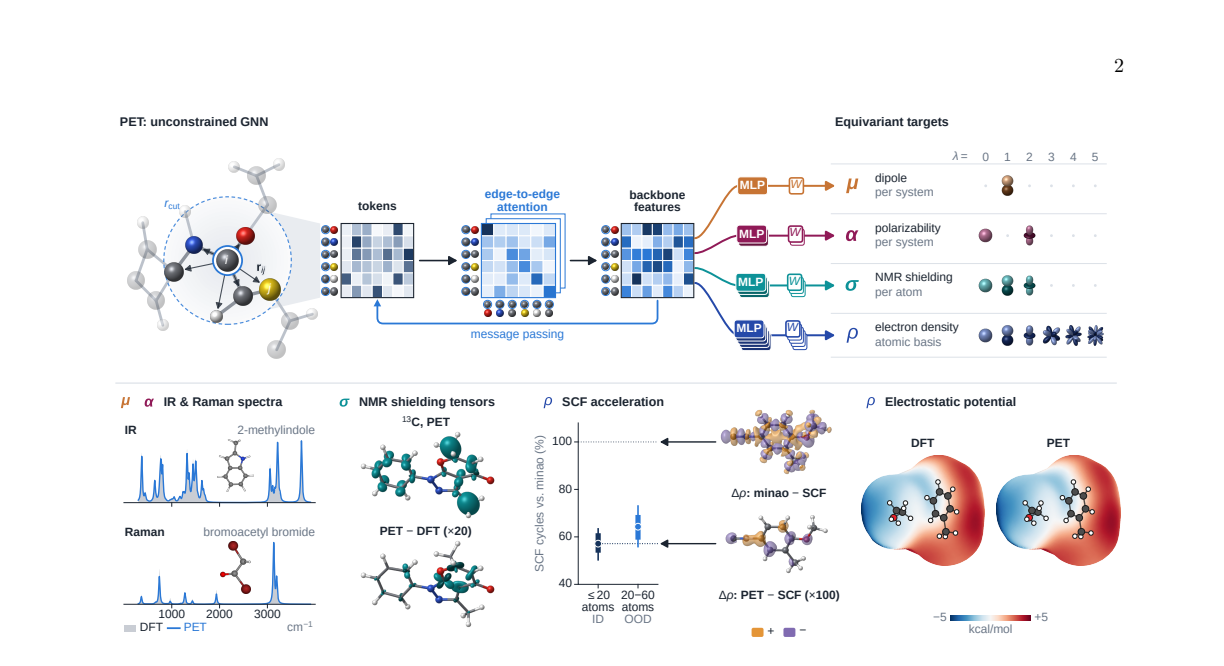
Many of these are of high angular order or pseudotensorial character, defined per atom, or expanded on large atom-centered basis sets. Such targets strain equivariant GNNs, whose tensor products grow steeply in cost with angular order and can fail to represent the target if truncated, forcing difficult trade-offs between hyperparameters. Unconstrained models like the Point-Edge Transformer (PET) instead replace explicit O(3) algebra with edge-to-edge attention and learn equivariance from data, so that the same backbone can in principle learn any equivariant property. We demonstrate how to use PET to learn molecular dipoles and polarizabilities, NMR chemical shielding tensors, and auxiliary-basis expansions of the electron density. Increasing the backbone size systematically improves both accuracy and equivariance error, and targeted architectural and training choices reduce the symmetry breaking further. PET matches or improves on the released reference models at lower inference cost and, compared with equivariant models, a smaller memory footprint. The predictions give accurate IR and Raman spectra and isotropic shieldings; the predicted densities accelerate self-consistent field calculations and give one-shot ground-state properties, and pretrained density models transfer to higher levels of theory by fine-tuning on little data. The impact of approximate equivariance is small for most observables, further validating this approach to train fast, accurate, and useful surrogate models for properties beyond the PES.
from the abstract
Pith says
Machine review · deepseek-v4-flash · 23 Oct 2026 · what was read was not recorded · not checked by a person
It can be wrong. Challenge this review or reply to it.
Holds up, with conditions. A thorough, honest case that unconstrained GNNs can learn practical equivariant targets, with one genuine unresolved problem at high angular order. This line is wrong
3 major objections · 4 minor
How often objections from reviews like this one are right: not yet measured
Not checked: figures, code, what the 66 references say.
The paper says, at Sec. III.A, Fig. S3, Sec. V
The review did not quote this passage.
Pith says: Objection 1 of 3 · major
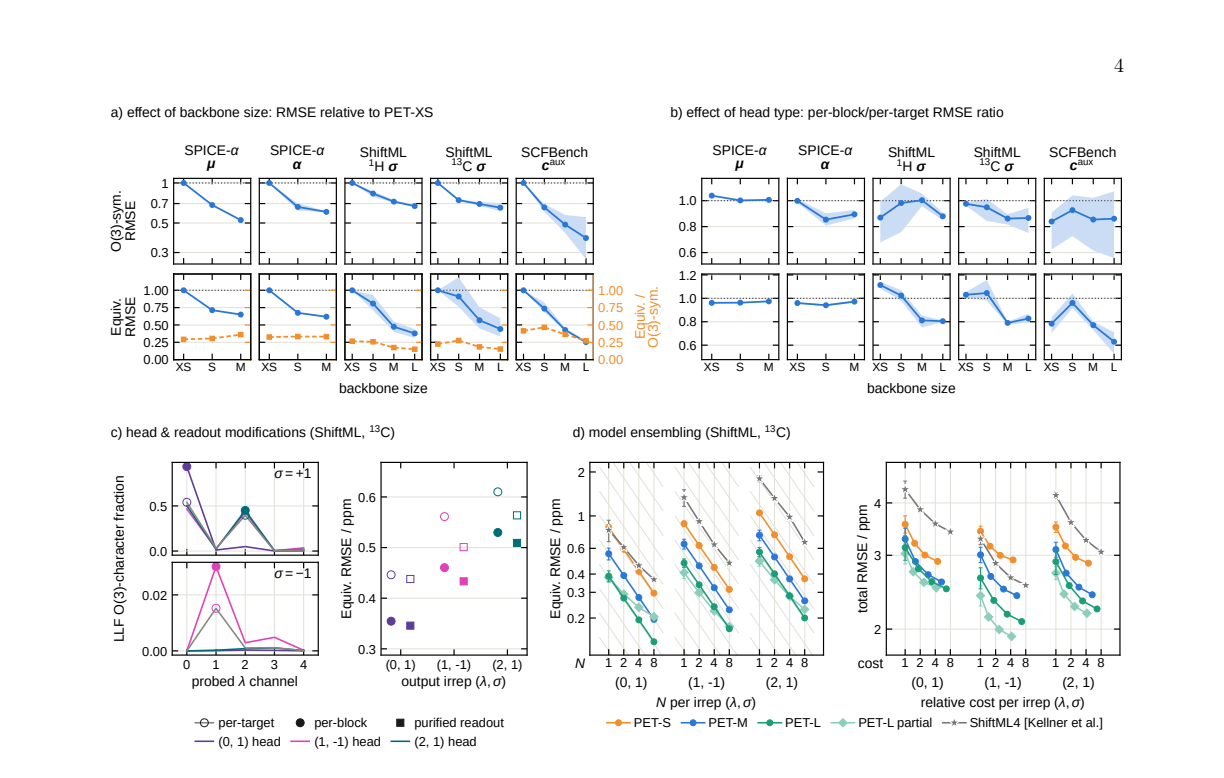
For the SCFBench density, the equivariance RMSE of the λ=3 and 4 blocks remains half or more of the O(3)-symmetrized RMSE at every backbone size, and from PET-XS to PET-L it falls only about as fast as the symmetrized error.
more of objection 1
The paper acknowledges this in Sec. V, but it is load-bearing for the central claim that unconstrained models can learn high-angular-order equivariant targets: the present data show no saturation or downturn of the ratio, leaving open the possibility that augmentation-driven training alone cannot close the gap at any feasible scale. Please either provide evidence that the relative share decreases with further scaling/training, or explicitly restrict the claim to representability plus practically useful but approximate equivariance.
The paper says, at Sec. IV.C, Sec. S6 ("Orientation dependence")
The review did not quote this passage.
A classifier read this sentence of the paper as acknowledging the concern (probability 0.85):
“With a single in-plane angle per direction and no quadrature weights, these are spreads over a sample of orientations, not the weighted orbit variance of Sec. S3 C, and may underestimate it.”
Pith says: Objection 2 of 3 · major
The bound on the one-shot dipole spread uses 52 orientations, a single in-plane angle, and no quadrature weights; Sec. S6 states that this set "may underestimate" the true orbit variance. Since the dipole is linear in the density and directly inherits coefficient equivariance error, the statement in Sec.
more of objection 2
IV.C that the spread reaches about half the model error "in distribution" is not a rigorous quantitative bound. This matters because the abstract and Discussion assert that the impact of approximate equivariance is small for most observables. The authors already have the machinery for weighted O(3) quadrature used elsewhere in the paper; please report a converged weighted orbit variance for the one-shot energy and dipole, or qualify the claim explicitly as a lower-bound estimate.
The paper says, at Sec. II.B, Fig. 2, Sec. V
The review did not quote this passage.
Pith says: Objection 3 of 3 · major
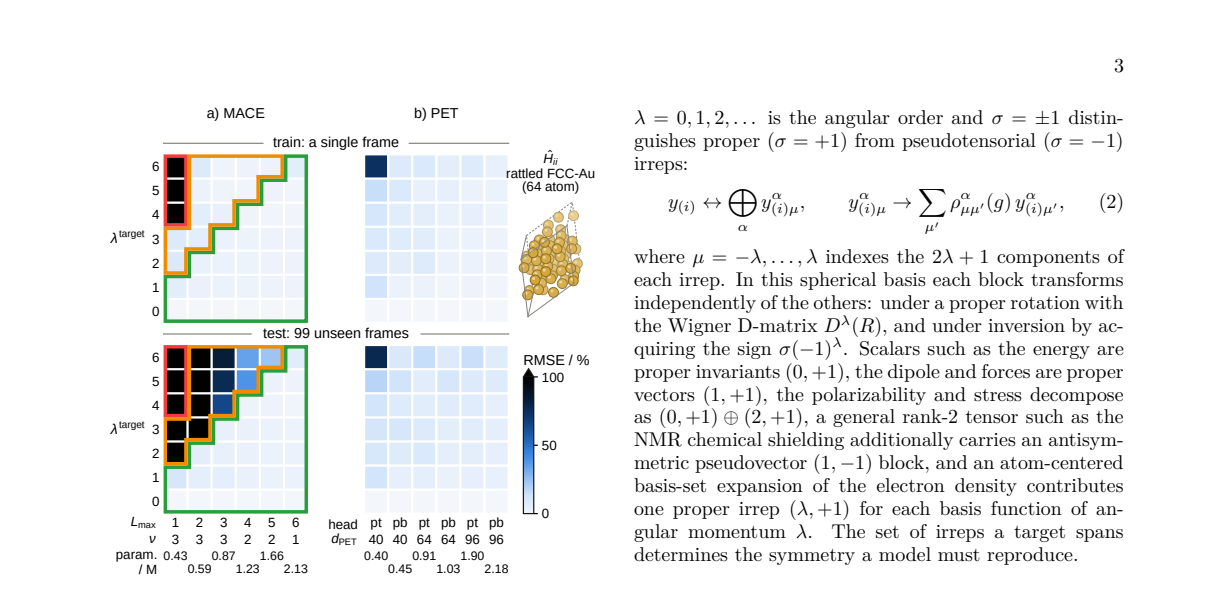
The FCC-Au experiment reports relative RMSE per angular block but not equivariance errors, so the statement that "a small PET model generalizes up to λ=6" from a single training structure supports representability, not learned equivariance at λ=5,6. Since no equivariance error is reported anywhere for λ=5 and 6, the abstract's phrase "the same backbone can in principle learn any equivariant property" should not be read as evidence of learned equivariance at the highest orders.
more of objection 3
Please either add equivariance-error measurements for the FCC-Au benchmark or rephrase the conclusion to separate expressivity from learned symmetry.
4 minor objections
The paper says, at Fig. 7, Sec. IV.D
Pith says: minor objection 1 of 4
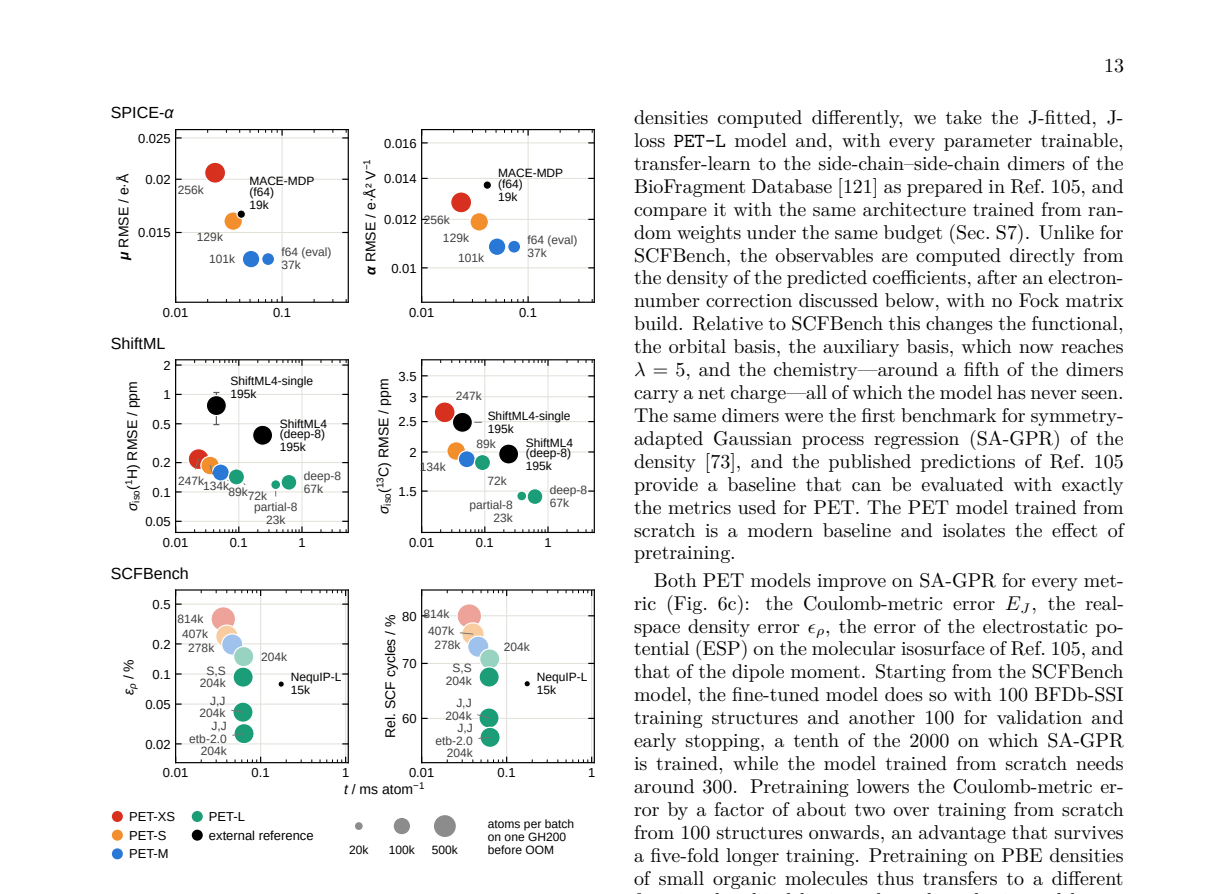
The caption and text state that MACE-MDP is timed in float64 as released while PET-S is in float32, and the text notes this; the phrase "Pareto-optimal front" in Sec. IV.D is still stronger than the controlled evidence, which compares PET with at most one or two external baselines per target. Suggest "a favorable accuracy/cost front" or an explicit statement of the precision caveat in the caption.
The paper says, at Sec. IV.D, Fig. 7
Pith says: minor objection 2 of 4
The comparison with NequIP-L mixes the effect of architecture with the effect of J- versus S-fitted targets; the text acknowledges this, but the reader would benefit from a sentence in the SCFBench panel caption stating that no J-fitted NequIP-L model exists, so the gain reflects the target as much as the model.
show 2 more
The paper says, at Data and code availability
Pith says: minor objection 3 of 4
The data availability statement ends with "(DOI to be confirmed)"; for a reproducibility-oriented journal, please provide a permanent repository link or a specific expected release date.
The paper says, at General
Pith says: minor objection 4 of 4
The abbreviation "LLPR" is used heavily in Sec. IV.A and Fig. 4; it is defined in the text, but a one-sentence reminder of what the last-layer prediction rigidity measures would make the figure caption self-contained.
What would settle it
Evaluate the one-shot dipole (and total-energy) orientation spread of the best density model (PET-L, J,J, etb-2.0, Sec. IV.C) on the same 50 in-distribution and 50 out-of-distribution molecules as Sec. S6, but over a converged O(3) quadrature of degree 13 — Lebedev axes with all equispaced in-plane rotations and inversion, as used for the spectra in Sec. S3 C — instead of the 52-element unweighted sample with a single in-plane angle. If the fully orbit-averaged dipole spread exceeds the per-molecule one-shot dipole model error on the in-distribution set, where the current estimate already reaches about half of the model error, the abstract's claim that approximate equivariance has a small impact on density-derived observables requires qualification. If the spread stays below the model error, the concern is bounded and the CONDITIONAL verdict stands without revision.
from the skeptic's reading
How the review went
4 readings by deepseek-v4-flash · 23 Oct 2026
- Reader holds up, with conditions
- Skeptic partly agrees
- Editor wrote the verdict above
- Referee major revision: 3 major objections, 4 minor
Not run on this paper: the simulated authors' defence.
Pith did not check this review's objections against the paper.
The review in full
The review in brief, machine-written
Short version: this is the most complete systematic test yet of PET as a general target model. The same backbone is trained on dipoles and polarizabilities, NMR shielding tensors, and density coefficients. The genuine additions are the per-block heads, density-loss fine-tuning with overlap and Coulomb metrics, the O(3)-character analysis of the last-layer features, the equivariance scaling of ensembles, and the transfer experiments to BFDb and CCSD densities. The MACE-versus-PET single-frame FCC-Au experiment cleanly isolates basis incompleteness from model capacity. The downstream validation is real work: IR/Raman spectra on 7184 molecules, isotropic shieldings against a released ShiftML4 ensemble, and one-shot SCF properties. The accuracy/cost and memory claims are supported, within the caveats below.
Where I part company with the strongest reading of the abstract: the claim that learned equivariance is good enough at high angular order is not established. In the paper's own numbers, the SCFBench lambda=3 and 4 equivariance RMSE stays at half or more of the symmetrized RMSE at every backbone size, and the relative share does not shrink with scale. The authors call this 'the clearest limit', so it is not hidden; they also do not show a plateau or a path past it. The dipole impact estimate over 52 orientations is explicitly a sample rather than a quadrature, and the SI says it may underestimate the true orbit variance. For the most accurate density models the dipole spread reaches about half the one-shot dipole model error in distribution. That is a load-bearing caveat, not a footnote.
The benchmark comparisons have loose ends. MACE-MDP runs in float64 against PET in float32; ShiftML4's single global scaling convention de-weights 1H; and there is no J-fitted NequIP-L, so the density comparison reflects the better-posed target as much as the architecture. The FCC-Au PET models are not converged after 50k steps, so Figure 2 demonstrates representability more than final error. The exclusions of 32 ShiftML test structures are post hoc but documented. Code, data, and checkpoints are promised, not yet delivered. None of this sinks the paper; it conditions how the comparisons should be read.
Who gets value: people choosing backbones for property models, and equivariant-GNN researchers who believe truncation and parity costs are unavoidable. The dataset-agnostic backbone heuristic alone is useful. I would send it to peer review, and I would require the artifacts, a quadrature-based dipole estimate, and at least one float64 PET comparison point before accepting. My own verdict is conditional rather than accept.
The strongest objection
The central claim has two load-bearing legs: that learned (approximate) equivariance is good enough at high angular order, and that residual symmetry breaking is benign for observables. The paper's own numbers leave the first leg unproven in its strongest form. For the SCFBench density, the equivariance RMSE of the λ=3 and 4 blocks is half or more of the O(3)-symmetrized RMSE at every backbone size, and from PET-XS to PET-L it falls only about as fast as the symmetrized error (Sec. III.A, Fig. S3; Sec. V), so the relative share does not decrease with scale. No saturation or downturn of that ratio is shown, leaving open a plateau at which augmentation-driven training alone cannot close the gap. The second leg is defended by downstream validation: the one-shot energy spread sits at the integration-grid noise floor, but the dipole — linear in the density, so directly inheriting coefficient equivariance error — shows a median spread reaching about half of the one-shot dipole model error in distribution, and the paper states the relative share grows as models improve (Sec. IV.C, Fig. S8). That quantitative bound itself rests on a 52-element orientation set with a single in-plane angle and no quadrature weights, which Sec. S6 explicitly says 'may underestimate' the true orbit variance (b673). The FCC-Au experiment (Fig. 2) also reports no equivariance errors for λ=5,6, so 'generalizes up to λ=6' demonstrates representability, not learned equivariance at high order. The paper acknowledges the density as 'the clearest limit' (Sec. V, b314) and the growing relative share (Sec. IV.C), so this is not a hidden flaw; what remains unresolved is whether the limit shrinks relative to accuracy with capacity, and whether the impact estimate survives a proper quadrature.
The paper is a systematic and unusually candid empirical study: one PET backbone learns dipoles, polarizabilities, NMR shielding tensors (including the (1,−1) pseudovector block), and auxiliary-basis density coefficients up to λ=4–5, with held-out validation against external DFT references and released reference models, and downstream checks running from IR/Raman spectra and isotropic chemical shifts to one-shot SCF properties and fine-tuning to CCSD densities. The comparison-protocol caveats the reader flags — MACE-MDP timed in float64 without cuEquivariance, NequIP-L compared only against S-fitted targets while PET is also trained on J-fitted ones, untuned SCFBench hyperparameters, post hoc test-set exclusions (Sec. S5, b193), and unconverged FCC-Au PET models — are all disclosed by the authors and mostly bounded, and the unconverged PET runs actually cut in PET's favor. I therefore do not see the accuracy/cost leg as the weakest point. The weakest point is the high-order learnability leg: for the hardest density blocks the equivariance error does not shrink relative to the achievable (symmetrized) error with backbone size, and the observable impact is quantified with a method the authors admit may understate it (Sec. S6, b673). This is load-bearing because the abstract's final sentence ('the impact of approximate equivariance is small for most observables') and the 'high angular order' component of the claim both rest on it. The authors already name the density as the clearest limit (Sec. V, b314) and note the growing relative share (Sec. IV.C), so the concern is about what remains unestablished rather than about a concealed flaw: whether the equivariance/symmetrized ratio for λ=3,4 declines with further scaling, and whether the dipole spread is below model error under an exact quadrature. The proposed check settles the second point directly; a secondary probe would be whether a larger backbone (or extended fine-tuning) moves the λ=3,4 ratio below 0.5. Neither check overturns the demonstrated results, so the reader's CONDITIONAL verdict remains appropriate; the condition should include the quadrature-level evaluation (or release of checkpoints enabling reviewers to run it), alongside the artifacts and tightened protocol the reader already requested.
The referee's report
If the central claims hold, the paper provides a substantial demonstration that explicit O(3) symmetry is not a prerequisite for practically useful property prediction, decoupling inference cost from angular order and side-stepping basis-incompleteness problems that affect exactly equivariant models. The study is unusually thorough on the empirical side: it separates symmetrized accuracy from equivariance error, uses held-out external test sets and released third-party models, validates on physically meaningful downstream tasks, and reports inference cost and memory footprint under a consistent protocol. The careful treatment of target scaling, J- versus S-fitted density coefficients, and transfer to CCSD densities are particular strengths. The residual weakness is that the load-bearing claim for high angular order and pseudotensorial blocks is empirical and is only partially supported: the high-order density equivariance error does not shrink relative to model error with scale, and the one-shot dipole bound rests on an orientation sample that the authors themselves state may underestimate the true orbit variance.
Pith's reading of the paper (a machine's summary, not the authors')
This paper sets out to show that a graph neural network with no rotation symmetry written into its architecture can learn molecular properties that must transform correctly under rotations and inversions, and that it can do so as accurately as, and more cheaply than, networks that enforce the symmetry by construction. The test cases span molecular dipoles and polarizabilities, NMR chemical-shielding tensors (whose antisymmetric block is a pseudovector), and atom-centered expansions of the electron density up to angular order $\lambda=5$. Against exactly equivariant models, the paper argues, such targets carry a hidden cost: Clebsch–Gordan product bases truncated at low angular order become incomplete or ill-conditioned for near-symmetric environments, and their cost climbs steeply with angular order. The authors report that the unconstrained Point-Edge Transformer learns all four target classes from rotationally augmented data, that larger backbones improve accuracy and equivariance error together, and that for the downstream observables they test the residual symmetry breaking is not what limits accuracy.
What carries the argument. The load-bearing mechanism is the replacement of explicit $O(3)$ algebra with learned symmetry in the Point-Edge Transformer (PET): the backbone computes edge-to-edge attention among the edges of each atomic neighborhood, with no Clebsch–Gordan couplings and no angular-order cutoff, so the cost and expressivity do not depend on the target's irreps. Around that backbone sit three further pieces of machinery. First, per-block heads: a separate nonlinear head and linear readout for each $O(3)$ irrep block $(\lambda,\sigma)$ of the target, letting each last-layer feature specialize to one angular character (pseudotensorial characters develop latest and benefit most). Second, random rotation-and-inversion augmentation of every structure in each batch, which is what teaches the symmetry; the paper analyzes the $O(3)$-character content of the last-layer features to show that the linear readout filters the character it needs from a mixed spectrum. Third, for the electron density the learning problem is re-posed in the metric of the target field: losses on auxiliary-basis coefficients weighted by the overlap or Coulomb metric, and reference coefficients produced by S- or J-fitting, which together account for most of the density-model gains. The motivation is pinned down in the rattled FCC-Au benchmark: a truncated product basis fails to fit or generalize Hamiltonian blocks with $\lambda$ above its reach, while a matched-size PET fits all blocks up to $\lambda=6$ from a single training frame.
Core claim. The paper's central claim is that equivariance for atomistic properties can be learned rather than engineered. The Point-Edge Transformer (PET) replaces the Clebsch–Gordan tensor products of equivariant GNNs with edge-to-edge attention, so its cost is independent of the target's angular order and no irrep block is excluded by truncation; the symmetry is acquired from random rotation-and-inversion augmentation during training. On that backbone the authors demonstrate dipoles and polarizabilities from SPICE-α, NMR shielding tensors including the $(1,-1)$ pseudovector block from ShiftML-molecules, and electron-density coefficients on auxiliary atom-centered bases up to $\lambda=4$ ($\lambda=5$ in transfer) from SCFBench. They show that scaling the backbone under simple heuristics improves symmetrized accuracy and equivariance error together, that per-block heads and deep ensembling (equivariance error dropping as $N^{-1/2}$) reduce symmetry breaking further, and that PET matches or improves on the released MACE-MDP, ShiftML4, and NequIP-L references at lower inference cost and larger batch capacity on a GPU. They also record the clearest limit of the approach: for the $\lambda=3$ and $\lambda=4$ density blocks the equivariance error falls with backbone size only about as fast as the physical error and remains at half or more of it, propagating into one-shot observables such as the dipole.
The premise it rests on. The approach stands or falls on one empirical premise: that random rotation-and-inversion augmentation during training teaches the network near-exact target equivariance on every structure it will face; the paper itself reports that the $\lambda=3$ and $\lambda=4$ electron-density blocks still carry equivariance error at half or more of their physical error even at the largest backbone, so the premise is not fully satisfied there.
If the paper is right (Pith's inferences, not the authors')
Angular-order truncation is not a safe shortcut for equivariant architectures: near-octahedral environments defeat any product basis cut below the target's $\lambda$, while a matched-size unconstrained model fits and generalizes every block up to $\lambda=6$ from a single training frame.
A single backbone, sized by width and read out per irrep block, spans scalars, vectors, rank-2 tensors with a pseudovector part, and $\lambda\le5$ density expansions, so the $L_{\max}$ and correlation-order hyperparameters of equivariant design drop out of model selection.
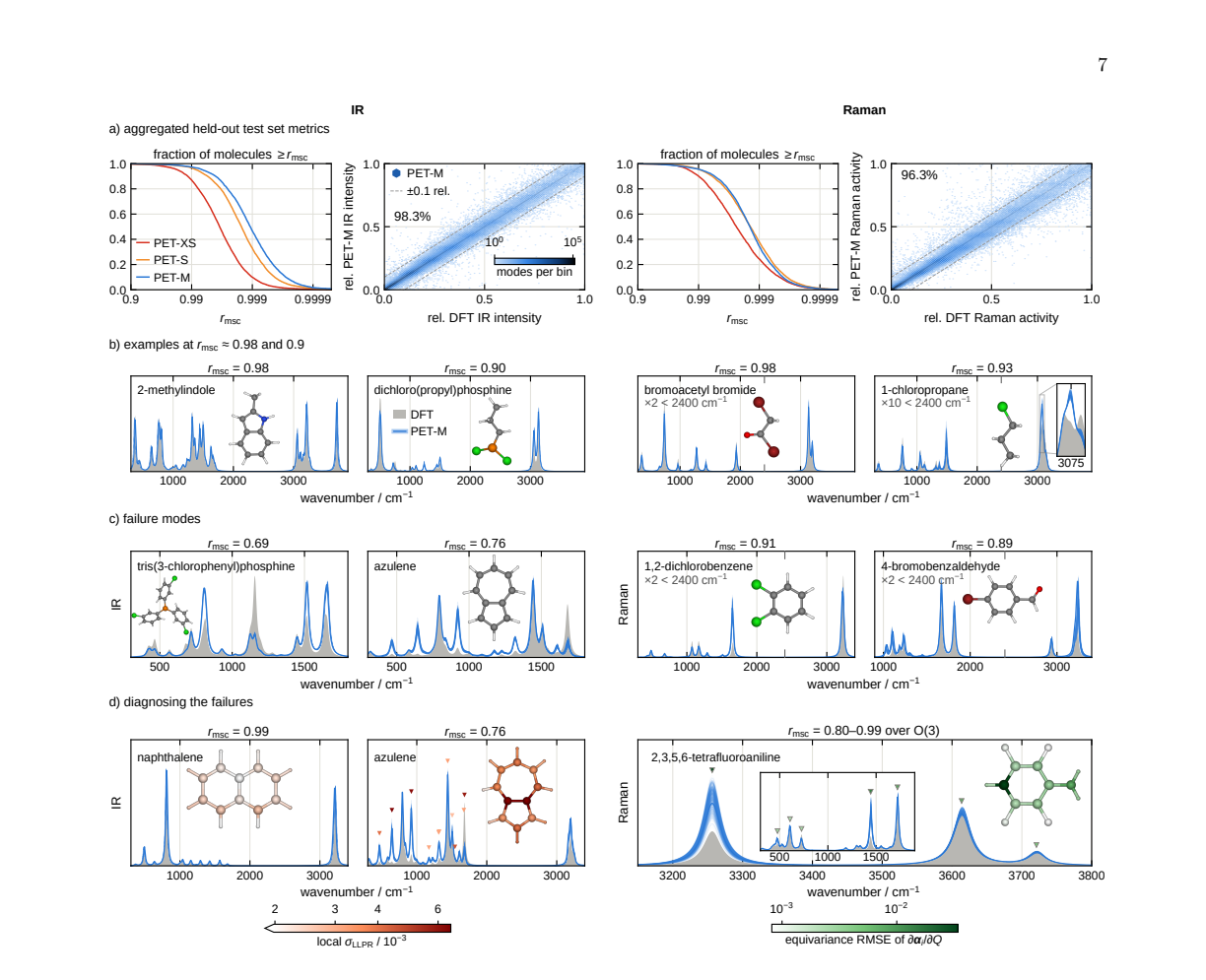
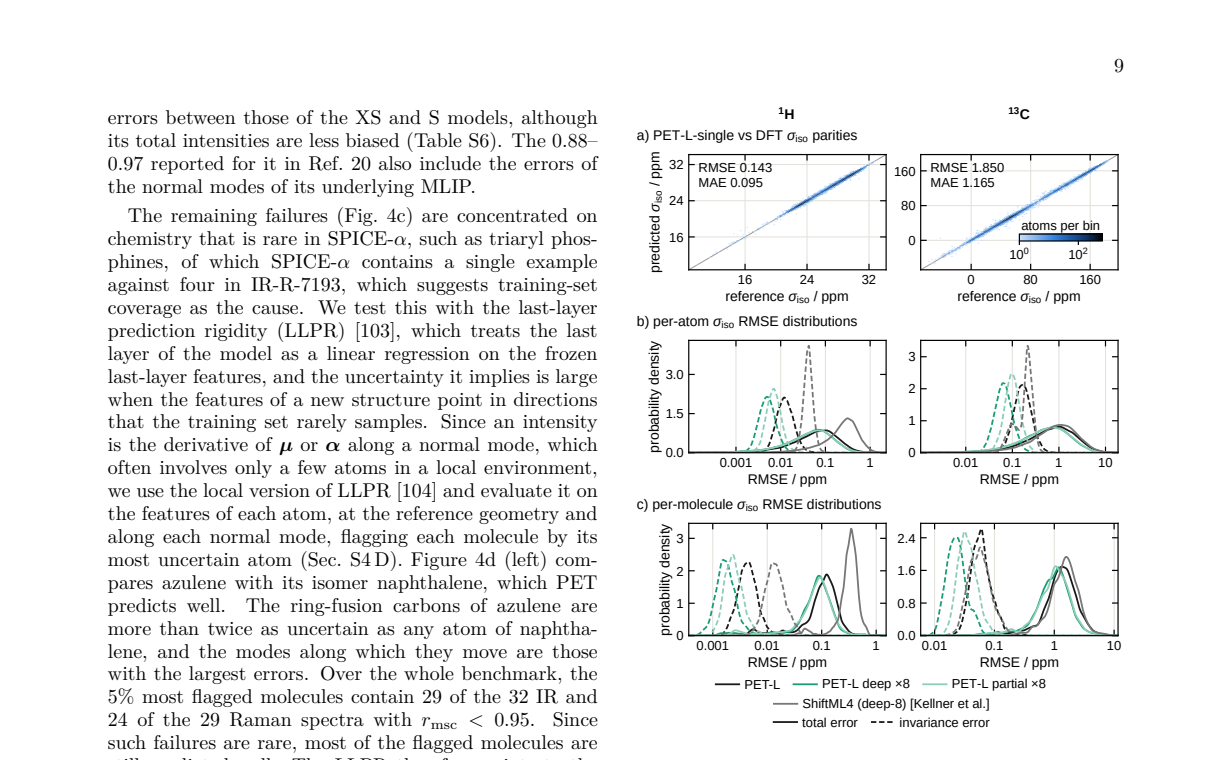
Downstream observables inherit little harm from approximate symmetry: IR and Raman spectra reach mean match scores of 0.994–0.997 at DFT normal modes, a single PET-L model matches the 8-member ShiftML4 ensemble on isotropic shieldings, and predicted densities save about 40% of SCF cycles.
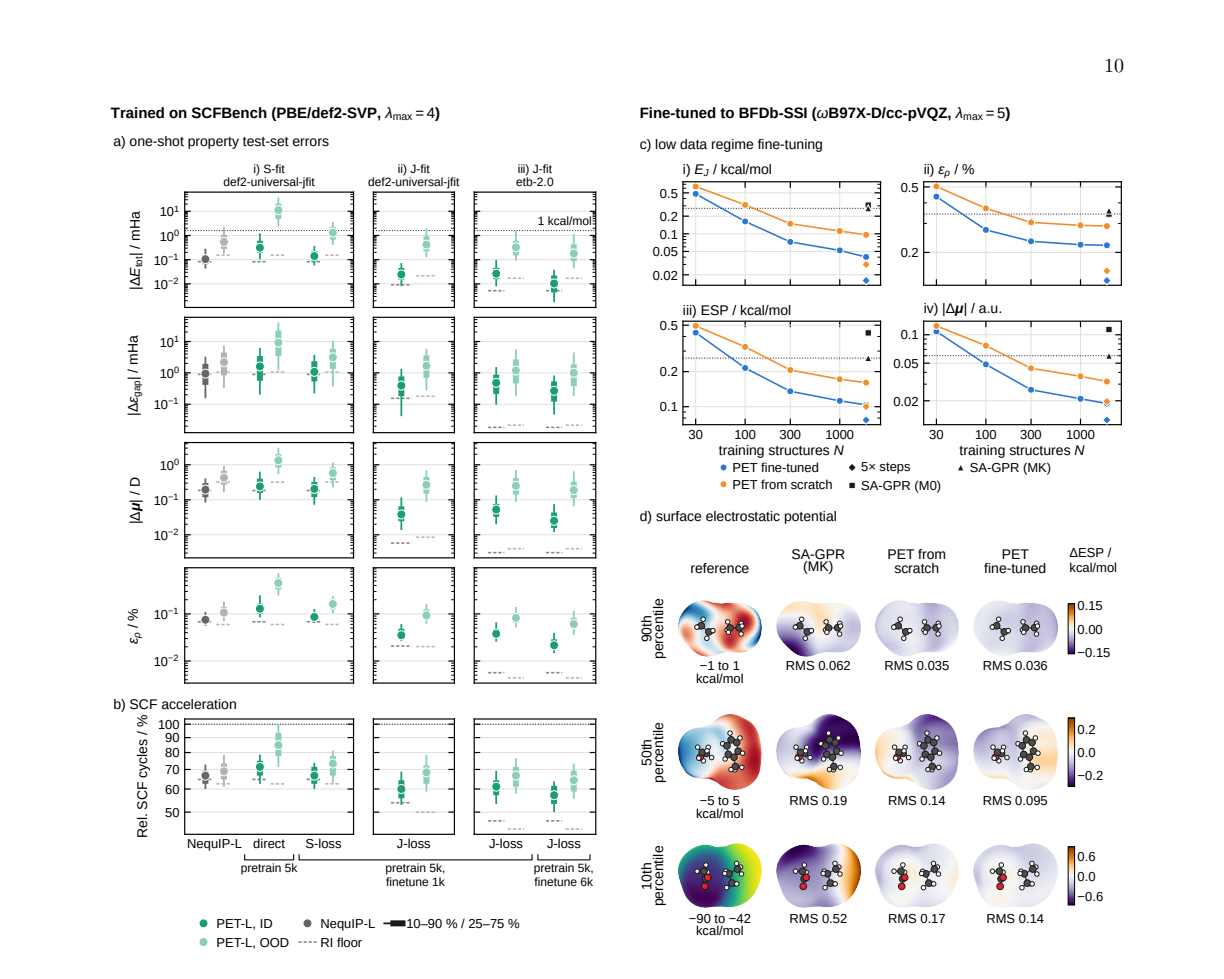
For the electron density, the reference data and loss metric matter more than the architecture: J-fitted coefficients, a Coulomb-metric loss, and a larger auxiliary basis cut median one-shot energy errors by more than an order of magnitude with the backbone untouched, and ten CCSD geometries suffice to fine-tune a PBE-pretrained model below B3LYP accuracy in the Coulomb metric.
Residual equivariance error correlates with model error, so the orientation spread of a prediction flags under-trained environments, and ensembling reduces it systematically as $N^{-1/2}$.
If learned equivariance keeps improving with size and data, the angular-order ceiling that shapes equivariant GNN design stops being a fundamental constraint, and capacity can be spent on width, coverage, and training protocol instead of higher-$\lambda$ tensor-product channels — a shift the paper's roadmap implies but does not fully state.
For the $\lambda=3/4$ density blocks, where equivariance error persists at half the symmetrized error, exact $O(3)$-quadrature averaging of predictions (cited by the paper but not used in production) would remove the residual breaking at a known multiplicative cost, and whether that is cheaper than ensembling is a testable question the paper leaves open.
The same per-block-head and metric-loss recipe transfers, by construction, to any atom-centered scalar field — spin densities, electrostatic potentials, local densities of states — and to electric-field-gradient tensors, which are pure $(2,+1)$ targets; the paper names these successors but does not run them.
Because equivariance error behaves like an out-of-distribution detector, it could be calibrated against the paper's LLPR (last-layer prediction rigidity) uncertainty flag on the spectral benchmark to give one cheap reliability score for unconstrained atomistic models — a diagnostic the paper gestures at without formalizing.
Check this review
Pith stored no record of this review's passes and took no fingerprint of it. Reviews made by code from 13 Nov 2026 on carry both.
How often reviews like this one are right
Reviews like this one: written by deepseek-v4-flash, where what was read was not recorded.
How often objections from reviews like this one are right: not yet measured
Reviews by people
This review was written by a machine. No person has reviewed this paper on Pith yet. A scientist listed on Pith can review it for a fee, and their review is published here whatever it concludes.
The paper
Abstract
Machine-learned interatomic potentials based on graph neural networks (GNNs) have made first-principles accuracy routine for the potential energy surface (PES). Their backbones, often O(3)-equivariant by design, are increasingly used to learn other atomistic properties. Many of these are of high angular order or pseudotensorial character, defined per atom, or expanded on large atom-centered basis sets. Such targets strain equivariant GNNs, whose tensor products grow steeply in cost with angular order and can fail to represent the target if truncated, forcing difficult trade-offs between hyperparameters. Unconstrained models like the Point-Edge Transformer (PET) instead replace explicit O(3) algebra with edge-to-edge attention and learn equivariance from data, so that the same backbone can in principle learn any equivariant property. We demonstrate how to use PET to learn molecular dipoles and polarizabilities, NMR chemical shielding tensors, and auxiliary-basis expansions of the electron density. Increasing the backbone size systematically improves both accuracy and equivariance error, and targeted architectural and training choices reduce the symmetry breaking further. PET matches or improves on the released reference models at lower inference cost and, compared with equivariant models, a smaller memory footprint. The predictions give accurate IR and Raman spectra and isotropic shieldings; the predicted densities accelerate self-consistent field calculations and give one-shot ground-state properties, and pretrained density models transfer to higher levels of theory by fine-tuning on little data. The impact of approximate equivariance is small for most observables, further validating this approach to train fast, accurate, and useful surrogate models for properties beyond the PES.
The paper's own sentences, arranged, kept beside the review and separate from it. Each label is drawn from a closed vocabulary; the number beside it is the probability the classifier gave that label. No sentence in this record was written by a model.
abstract compiled · 2026-10-23
The authors' main claim, as the classifier picked it out 0.99
“The impact of approximate equivariance is small for most observables, further validating this approach to train fast, accurate, and useful surrogate models for properties beyond the PES.”
How the main claim is stated: asserted 0.99
What the abstract itself states, as probabilities: claims first 0.06 · states limitation 0.72 · human participants 0.02 · controlled comparison 0.69 · randomized assignment 0.01 · states quantitative result 0.08 · compares with prior results 0.95 · mentions code or data availability 0.07
The abstract, sentence by sentence
This table labels the abstract only (arXiv listing abstract v1). The number is the probability the classifier gave the label.
| Sentence | Role | The authors' own work | States the main conclusion | Strength |
|---|---|---|---|---|
| Machine-learned interatomic potentials based on graph neural networks (GNNs) have made first-principles accuracy routine for the potential energy surface (PES). | background 1.00 | 0.05 | 0.03 | asserted 1.00 |
| Their backbones, often O(3)-equivariant by design, are increasingly used to learn other atomistic properties. | background 1.00 | 0.06 | 0.03 | asserted 0.98 |
| Many of these are of high angular order or pseudotensorial character, defined per atom, or expanded on large atom-centered basis sets. | background 0.98 | 0.09 | 0.02 | asserted 0.98 |
| Such targets strain equivariant GNNs, whose tensor products grow steeply in cost with angular order and can fail to represent the target if truncated, forcing difficult trade-offs between hyperparameters. | background 0.73 | 0.09 | 0.04 | asserted 0.97 |
| Unconstrained models like the Point-Edge Transformer (PET) instead replace explicit O(3) algebra with edge-to-edge attention and learn equivariance from data, so that the same backbone can in principle learn any equivariant property. | method 0.65 | 0.13 | 0.23 | hedged possibility 0.65 |
| We demonstrate how to use PET to learn molecular dipoles and polarizabilities, NMR chemical shielding tensors, and auxiliary-basis expansions of the electron density. | contribution 0.94 | 0.94 | 0.11 | asserted 1.00 |
| Increasing the backbone size systematically improves both accuracy and equivariance error, and targeted architectural and training choices reduce the symmetry breaking further. | result 1.00 | 0.93 | 0.16 | asserted 1.00 |
| PET matches or improves on the released reference models at lower inference cost and, compared with equivariant models, a smaller memory footprint. | result 1.00 | 0.90 | 0.13 | asserted 1.00 |
| The predictions give accurate IR and Raman spectra and isotropic shieldings; the predicted densities accelerate self-consistent field calculations and give one-shot ground-state properties, and pretrained density models transfer to higher levels of theory by fine-tuning on little data. | result 0.99 | 0.90 | 0.21 | asserted 1.00 |
| The impact of approximate equivariance is small for most observables, further validating this approach to train fast, accurate, and useful surrogate models for properties beyond the PES. | interpretation 0.92 | 0.84 | 0.64 | asserted 0.99 |
What kind of paper the classifier reports this is: method or tool 0.99 · evidence from simulation or computation 0.99
What was examined, and what was not
Sources read
- arXiv listing abstract v1
Not examined
- full text
- figures and tables
- references and citing sentences
- relations to other papers
Levels run
- P abstract
Not run
- S sections
- T body sentences
- C citations
- R cross-paper relations
How the labels were made
Compiled by classifier-1.13.0 via TypeSafe API, question bank abstract-p1-20260923, 2026-10-23: 1 request, 7,737 input tokens.
Every quoted sentence on this record is the authors'. Every label is from Pith's closed vocabulary, with the probability shown beside it. This record as JSON
Figures (7)
Figures are the authors', reproduced from the paper.
References (66)
- [60] W. B. How, P. Febrer, S. Chong, A. Mazitov, F. Bigi, M. Kellner, S. Pozdnyakov, and M. Ceriotti, A univer- sal machine learning model for the electronic density of states, Digital Discovery5, 1635 (2026) on Pith
- [61] F. Bigi, S. Chong, A. Kristiadi, and M. Ceriotti, FlashMD: long-stride, universal prediction of molecu- lar dynamics, inAdvances in Neural Information Pro- cessing Systems 38, NeurIPS 2025 (Neural Information Processing Systems Foundation, Inc. (NeurIPS), 2025) pp. 98379–98416 on Pith
- [62] C. Malosso, W. B. How, G. D. Mir´ on, A. Hassanali, and M. Ceriotti, Transferable machine learning of excited- state dynamics with extremal pooling, arXiv:2606.16859 (2026) on PithPith's reviewarXiv
- [63] F. Musil, A. Grisafi, A. P. Bart´ ok, C. Ortner, G. Cs´ anyi, and M. Ceriotti, Physics-inspired structural represen- tations for molecules and materials, Chemical Reviews 121, 9759 (2021) on Pith
- [64] N. Thomas, T. Smidt, S. Kearnes, L. Yang, L. Li, K. Kohlhoff, and P. Riley, Tensor field networks: Rotation- and translation-equivariant neural networks for 3D point clouds, arXiv:1802.08219 (2018) on PithPith's reviewarXiv
- [65] Y.-L. Liao and T. Smidt, Equiformer: Equivariant graph attention transformer for 3D atomistic graphs, inThe Eleventh International Conference on Learning Representations(2023) on Pith
- [66] A. Musaelian, S. Batzner, A. Johansson, L. Sun, C. J. Owen, M. Kornbluth, and B. Kozinsky, Learning local equivariant representations for large-scale atomistic dy- namics, Nature Communications14, 579 (2023) on Pith
- [67] A. Bochkarev, Y. Lysogorskiy, and R. Drautz, Graph atomic cluster expansion for semilocal interactions be- yond equivariant message passing, Physical Review X 14, 021036 (2024) on Pith
- [68] M. Domina, F. Bigi, P. Pegolo, and M. Ceriotti, Rep- resenting spherical tensors with scalar-based machine- learning models, The Journal of Chemical Physics163, 164114 (2025) on Pith
- [69] R. Drautz, Atomic cluster expansion for accurate and transferable interatomic potentials, Physical Review B 99, 014104 (2019) on Pith
- [70] R. Drautz, Atomic cluster expansion of scalar, vecto- rial, and tensorial properties including magnetism and charge transfer, Physical Review B102, 024104 (2020) on Pith
- [71] J. Nigam, S. Pozdnyakov, and M. Ceriotti, Recursive evaluation and iterative contraction ofN-body equiv- ariant features, The Journal of Chemical Physics153, 121101 (2020) on Pith
- [72] J. Nigam, S. Pozdnyakov, G. Fraux, and M. Ceriotti, Unified theory of atom-centered representations and message-passing machine-learning schemes, The Jour- nal of Chemical Physics156, 204115 (2022) on Pith
- [73] A. Fabrizio, A. Grisafi, B. Meyer, M. Ceriotti, and C. Corminboeuf, Electron density learning of non- covalent systems, Chemical Science10, 9424 (2019) on Pith
- [74] A. M. Lewis, A. Grisafi, M. Ceriotti, and M. Rossi, Learning electron densities in the condensed phase, Journal of Chemical Theory and Computation17, 7203 (2021) on Pith
- [75] J. A. Rackers, L. Tecot, M. Geiger, and T. E. Smidt, A recipe for cracking the quantum scaling limit with machine learned electron densities, Machine Learning: Science and Technology4, 015027 (2023) on Pith
- [76] X. Fu, A. Rosen, K. Bystrom, R. Wang, A. Musaelian, B. Kozinsky, T. Smidt, and T. Jaakkola, A recipe for charge density prediction, inAdvances in Neural In- formation Processing Systems 37, NeurIPS 2024 (Neu- ral Information Processing Systems Foundation, Inc. (NeurIPS), 2024)... on Pith
- [77] Z. Qiao, A. S. Christensen, M. Welborn, F. R. Manby, A. Anandkumar, and T. F. Miller, Informing geomet- ric deep learning with electronic interactions to accel- erate quantum chemistry, Proceedings of the National Academy of Sciences119, e2205221119 (2022) on Pith
- [78] Z. Lou, A. M. Lewis, and M. Rossi, Long-range machine learning of electron density for twisted bilayer Moir´ e materials, PRX Intelligence1, 013015 (2026) on Pith
- [79] O. Unke, M. Bogojeski, M. Gastegger, M. Geiger, T. Smidt, and K.-R. M¨ uller, SE(3)-equivariant predic- tion of molecular wavefunctions and electronic densi- ties, inAdvances in Neural Information Processing Sys- tems, Vol. 34, edited by M. Ranzato, A. Beygelzimer, Y. Dauphin,... on Pith
show 46 more
- [80] H. Li, Z. Wang, N. Zou, M. Ye, R. Xu, X. Gong, W. Duan, and Y. Xu, Deep-learning density functional theory Hamiltonian for efficient ab initio electronic- structure calculation, Nature Computational Science2, 367 (2022) on Pith
- [81] D. Suman, J. Nigam, S. Saade, P. Pegolo, H. T¨ urk, X. Zhang, G. K.-L. Chan, and M. Ceriotti, Exploring the design space of machine learning models for quan- tum chemistry with a fully differentiable framework, Journal of Chemical Theory and Computation21, 6505 (2025) on Pith
- [82] P. Febrer, P. B. Jørgensen, M. Pruneda, A. Garc´ ıa, P. Ordej´ on, and A. Bhowmik, Graph2Mat: universal graph to matrix conversion for electron density pre- diction, Machine Learning: Science and Technology6, 025013 (2025) on Pith
- [83] T. Koker, K. Quigley, E. Taw, K. Tibbetts, and L. Li, Higher-order equivariant neural networks for charge density prediction in materials, npj Computational Ma- terials10, 161 (2024) on Pith
- [84] H. Maennel, O. T. Unke, and K.-R. M¨ uller, Complete and efficient covariants for three-dimensional point con- figurations with application to learning molecular quan- tum properties, The Journal of Physical Chemistry Let- ters15, 12513 (2024) on Pith
- [85] F. Bigi, M. Domina, M. L. Ach, S. N. Pozdnyakov, P. Pegolo, J. W. Abbott, K. K. Huguenin-Dumittan, and M. Ceriotti, Overcoming the limitations of body- ordered potentials for atomistic machine learning, arXiv:2610.10830 (2026) on PithPith's reviewarXiv
- [86] F. Ærtebjerg, J. Elsborg, and A. Bhowmik, Com- plete neural electronic initialization accelerates mate- rials DFT, arXiv:2609.21759 (2026) on PithPith's reviewarXiv
- [87] J. Nigam, T. Smidt, and G. Dusson, Machine learn- ing of electronic structure and atomistic properties from the external potential, The Journal of Chemical Physics 165, 034119 (2026) on Pith
- [88] I. Batatia, P. Benner, Y. Chiang, A. M. Elena, D. P. Kov´ acs, J. Riebesell, X. R. Advincula, M. Asta, M. Avaylon, W. J. Baldwin, F. Berger, N. Bernstein, A. Bhowmik, F. Bigi, S. M. Blau, V. C˘ arare, M. Ce- 19 riotti, S. Chong, J. P. Darby, S. De, F. Della Pia, V. L. Deringer... on Pith
- [89] C. Ben Mahmoud, L. A. M. Rosset, J. R. Yates, and V. L. Deringer, Graph-neural-network predictions of solid-state NMR parameters in silica from spherical ten- sor decomposition, The Journal of Chemical Physics 163, 024118 (2025) on Pith
- [90] J. T. Frank, O. T. Unke, and K.-R. M¨ uller, So3krates: Equivariant attention for interactions on arbitrary length-scales in molecular systems, inAdvances in Neu- ral Information Processing Systems 35, NeurIPS 2022 (Neural Information Processing Systems Foundation, Inc. (NeurI... on Pith
- [91] X. Fu, B. M. Wood, L. Barroso-Luque, D. S. Levine, M. Gao, M. Dzamba, and C. L. Zitnick, Learning smooth and expressive interatomic potentials for phys- ical property prediction, inProceedings of the 42nd In- ternational Conference on Machine Learning, Proceed- ings of Machine... on Pith
- [92] F. Bigi, J. W. Abbott, P. Loche, A. Mazitov, D. Tisi, M. F. Langer, A. Goscinski, P. Pegolo, S. Chong, R. Goswami, P. Febrer, S. Chorna, M. Kellner, M. Ceri- otti, and G. Fraux,metatensorandmetatomic: Foun- dational libraries for interoperable atomistic machine learning, The J... on Pith
- [93] O. T. Unke and M. Meuwly, PhysNet: A neural net- work for predicting energies, forces, dipole moments, and partial charges, Journal of Chemical Theory and Computation15, 3678 (2019) on Pith
- [94] P. St¨ ark, H. Stooß, M. F. Langer, E. Rumiantsev, A. Schlaich, M. Ceriotti, and P. Loche, Simultaneous learning of static and dynamic charges, Physical Chem- istry Chemical Physics28, 16249 (2026) on Pith
- [95] R. Ditchfield, Self-consistent perturbation theory of dia- magnetism, Molecular Physics27, 789 (1974) on Pith
- [96] K. Wolinski, J. F. Hinton, and P. Pulay, Efficient im- plementation of the gauge-independent atomic orbital method for NMR chemical shift calculations, Journal of the American Chemical Society112, 8251 (1990) on Pith
- [97] M. Cordova, E. A. Engel, A. Stefaniuk, F. Paruzzo, A. Hofstetter, M. Ceriotti, and L. Emsley, A machine learning model of chemical shifts for chemically and structurally diverse molecular solids, The Journal of Physical Chemistry C126, 16710 (2022) on Pith
- [98] J. E. Gerken and P. Kessel, Emergent equivariance in deep ensembles, inProceedings of the 41st Inter- national Conference on Machine Learning, Proceed- ings of Machine Learning Research, Vol. 235, edited by R. Salakhutdinov, Z. Kolter, K. Heller, A. Weller, N. Oliver, J. Scarl... on Pith
- [99] B. Lakshminarayanan, A. Pritzel, and C. Blundell, Sim- ple and scalable predictive uncertainty estimation us- ing deep ensembles, inAdvances in Neural Information Processing Systems, Vol. 30, edited by I. Guyon, U. V. Luxburg, S. Bengio, H. Wallach, R. Fergus, S. Vish- wanatha... on Pith
- [100] M. Sch¨ afer, M. Kellner, J. K¨ astner, and M. Ceriotti, How to train a shallow ensemble, Journal of Chemical Theory and Computation22, 4939 (2026) on Pith
- [101] M. Kellner and M. Ceriotti, Uncertainty quantification by direct propagation of shallow ensembles, Machine Learning: Science and Technology5, 035006 (2024) on Pith
- [102] N. G¨ onnheimer, K. Reuter, V. Kapil, and J. T. Margraf, SPICE-alpha – MACE-MDP, https://doi.org/10.5281/zenodo.19205036 (2026) on Pithdoi:10.5281/zenodo.19205036
- [103] F. Bigi, S. Chong, M. Ceriotti, and F. Grasselli, A pre- diction rigidity formalism for low-cost uncertainties in trained neural networks, Machine Learning: Science and Technology5, 045018 (2024) on Pith
- [104] S. Chong, F. Grasselli, C. Ben Mahmoud, J. D. Morrow, V. L. Deringer, and M. Ceriotti, Robustness of local pre- dictions in atomistic machine learning models, Journal of Chemical Theory and Computation19, 8020 (2023) on Pith
- [105] K. R. Briling, A. Fabrizio, and C. Corminboeuf, Impact of quantum-chemical metrics on the machine learning prediction of electron density, The Journal of Chemical Physics155, 024107 (2021) on Pith
- [106] E. Salager, G. M. Day, R. S. Stein, C. J. Pickard, B. Elena, and L. Emsley, Powder crystallography by combined crystal structure prediction and high- resolution 1H solid-state NMR spectroscopy, Journal of the American Chemical Society132, 2564 (2010) on Pith
- [107] P. Hodgkinson, NMR crystallography of molecular or- ganics, Progress in Nuclear Magnetic Resonance Spec- troscopy118–119, 10 (2020) on Pith
- [108] C. J. Pickard and F. Mauri, All-electron magnetic re- sponse with pseudopotentials: NMR chemical shifts, Physical Review B63, 245101 (2001) on Pith
- [109] J. R. Yates, C. J. Pickard, and F. Mauri, Calculation of NMR chemical shifts for extended systems using ul- trasoft pseudopotentials, Physical Review B76, 024401 (2007) on Pith
- [110] P. B. Jørgensen and A. Bhowmik, Equivariant graph neural networks for fast electron density estimation of molecules, liquids, and solids, npj Computational Ma- terials8, 183 (2022) on Pith
- [111] B. Focassio, M. Domina, U. Patil, A. Fazzio, and S. Sanvito, Linear Jacobi-Legendre expansion of the charge density for machine learning-accelerated elec- tronic structure calculations, npj Computational Ma- terials9, 87 (2023) on Pith
- [112] J. Elsborg, L. Thiede, A. Aspuru-Guzik, T. Vegge, and A. Bhowmik, ELECTRA: A Cartesian network for 3D charge density prediction with floating orbitals, inAd- 20 vances in Neural Information Processing Systems 38, NeurIPS 2025 (Neural Information Processing Systems Foundation, ... on Pith
- [113] J. Elsborg, F. Aertebjerg, L. Thiede, A. Aspuru-Guzik, T. Vegge, and A. Bhowmik, Global plane waves from local Gaussians: Periodic charge densities in a blink, inProceedings of the 43rd International Conference on Machine Learning, Proceedings of Machine Learning Research, Vol... on Pith
- [114] P. Stishenko, C. Qian, J. Westermayr, R. J. Maurer, and A. J. Logsdail, Practical integration of machine learning intoab initiocalculations and workflows: Accelerating the SCF cycle via density matrix predictions, The Jour- nal of Chemical Physics164, 064123 (2026) on Pith
- [115] Q. Sun, X. Zhang, S. Banerjee, P. Bao, M. Barbry, N. S. Blunt, N. A. Bogdanov, G. H. Booth, J. Chen, Z.-H. Cui, J. J. Eriksen, Y. Gao, S. Guo, J. Hermann, M. R. Hermes, K. Koh, P. Koval, S. Lehtola, Z. Li, J. Liu, N. Mardirossian, J. D. McClain, M. Motta, B. Mussard, H. Q. Pha... on Pith
- [116] S. Lehtola, Assessment of initial guesses for self- consistent field calculations. Superposition of atomic po- tentials: Simple yet efficient, Journal of Chemical The- ory and Computation15, 1593 (2019) on Pith
- [117] F. Song and J. Feng, Neural network self-consistent fields for density functional theory, npj Computational Materials12, 289 (2026) on Pith
- [118] J. L. Whitten, Coulombic potential energy integrals and approximations, The Journal of Chemical Physics58, 4496 (1973) on Pith
- [119] B. I. Dunlap, Robust and variational fitting, Physical Chemistry Chemical Physics2, 2113 (2000) on Pith
- [120] X. Ren, P. Rinke, V. Blum, J. Wieferink, A. Tkatchenko, A. Sanfilippo, K. Reuter, and M. Schef- fler, Resolution-of-identity approach to Hartree–Fock, hybrid density functionals, RPA, MP2 and GW with numeric atom-centered orbital basis functions, New Journal of Physics14, 0530... on Pith
- [121] L. A. Burns, J. C. Faver, Z. Zheng, M. S. Marshall, D. G. A. Smith, K. Vanommeslaeghe, A. D. MacK- erell, K. M. Merz, and C. D. Sherrill, The BioFragment database (BFDb): An open-data platform for compu- tational chemistry analysis of noncovalent interactions, The Journal of C... on Pith
- [122] T. Li and C. Sun, Automated many-body simulations of strongly correlated systems using a correlation-aware agentic framework, arXiv:2610.00943 (2026) on PithPith's reviewarXiv
- [123] M. Bogojeski, L. Vogt-Maranto, M. E. Tuckerman, K.- R. M¨ uller, and K. Burke, Quantum chemical accuracy from density functional approximations via machine learning, Nature Communications11, 5223 (2020) on Pith
- [124] O. T. Unke, S. Chmiela, M. Gastegger, K. T. Sch¨ utt, H. E. Sauceda, and K.-R. M¨ uller, SpookyNet: Learning force fields with electronic degrees of freedom and non- local effects, Nature Communications12, 7273 (2021) on Pith
- [125] L. Fu, Z. Feng, Y. Li, H. Du, X. He, J. Wu, K. Bao, Y. Zhang, Z. Deng, Z. Lu, and B. Zhu, Train for ac- curacy, execute at scale: Architecture-preserving in- ference for equivariant atomistic foundation models, arXiv:2610.01036 (2026). 21 Supplementary Information Unconstraine... on PithPith's reviewarXiv
Challenges and discussion
Disagree with the review, or know something it missed? Leave a comment, or challenge this review formally: a challenge becomes a permanent entry in this paper's record, and its decision is published here.
Come back by email
A short list of the week's newly reviewed papers. Nothing is sent until you confirm from your inbox, and every email has a link that stops it. No account.
No comments yet.
Sign in to comment