Computational Physics · arXiv:2610.00943 v1 · submitted 1 Oct 2026 · 64 references
Automated Many-Body Simulations of Strongly Correlated Systems Using a Correlation-Aware Agentic Framework
The paper says
“We present CAFES, a correlation-aware agentic framework for electronic-structure simulations of strongly correlated systems. CAFES addresses two challenges: the fragmented software landscape for many-body calculations and the difficulty of selecting appropriate methods across diverse correlation regimes.”
more of the abstract
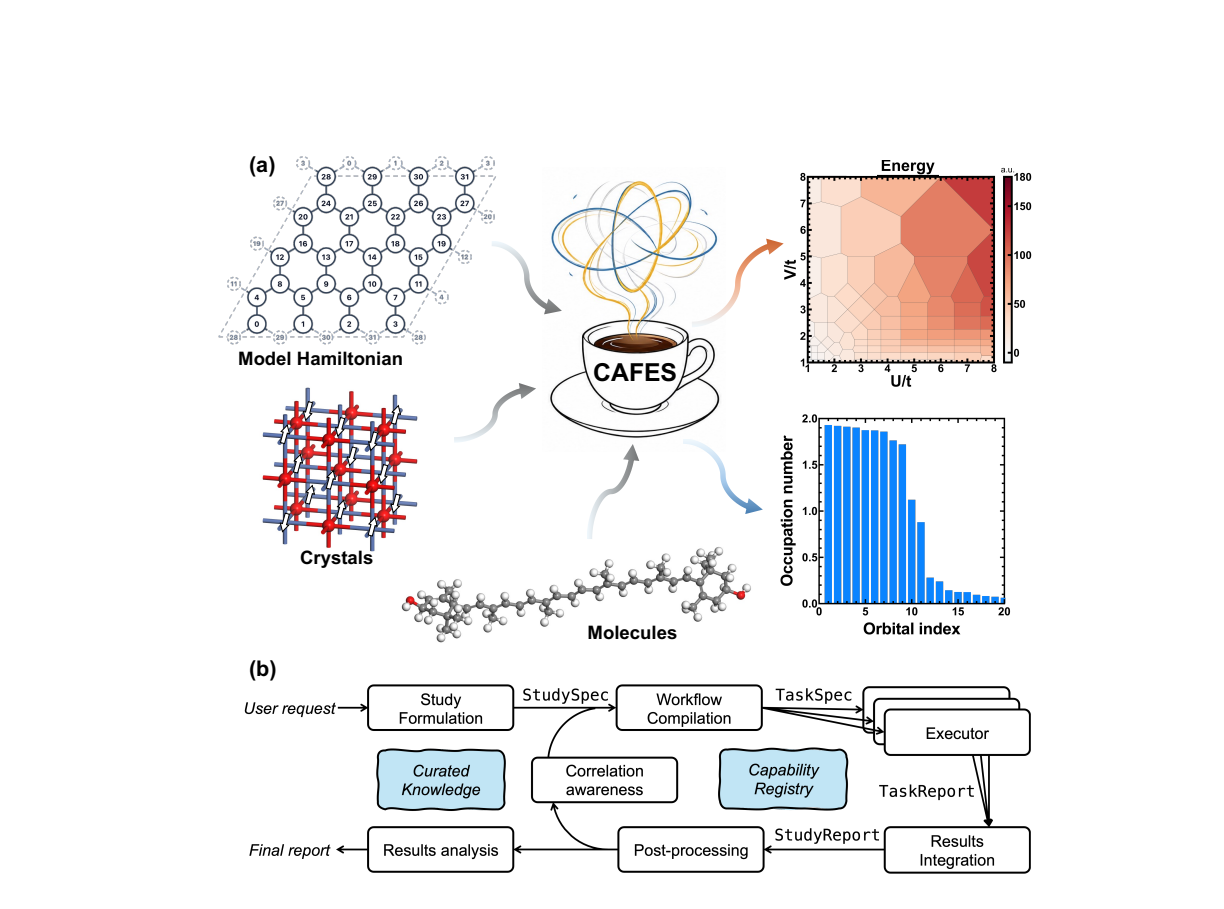
It combines correlation diagnostics, adaptive method selection, and large language model (LLM) assistance for molecular, crystalline, and model-Hamiltonian systems. A study-task architecture separates study-level planning from task-level execution, while a curated scientific knowledge layer provides reusable guidance for method selection, workflow design, and result interpretation. We demonstrate CAFES through three research-level studies: calculating the low-lying electronic states of lutein using DMRG-CASSCF, probing phase competition in the extended honeycomb Hubbard model using DMET, and generating a quantum-chemical dataset with CCSD labels. These calculations demonstrate the potential of agentic workflows for strongly correlated electronic-structure problems, a regime that has received limited attention in existing agentic computational frameworks.
from the abstract
Pith says
Machine review · deepseek-v4-flash · 2 Oct 2026 · what was read was not recorded · not checked by a person
It can be wrong. Challenge this review or reply to it.
Holds up, with conditions. A solid, honest agentic-framework paper whose headline feature — correlation-aware adaptive method selection — is demonstrated by construction rather than by evidence; it deserves a referee. This line is wrong
2 major objections · 5 minor
How often objections from reviews like this one are right: not yet measured
Not checked: figures, code, what the 64 references say.
The paper says, at Sec. 3.3; Eq. S1, Table S2
The review did not quote this passage.
A classifier read this sentence of the paper as acknowledging the concern (probability 0.63):
“These weights could in future be learned and updated as computational evidence and scientific experience accumulate, allowing CAFES to identify which indicators are most informative for a given system or method and to apply that knowledge in later studies.”
Pith says: Objection 1 of 2 · major
The diagnostic score that drives the claimed 'correlation-aware' method selection uses hand-set, unvalidated weights (the authors state at b198 that the weights 'could in future be learned and updated'). More importantly, none of the three demonstrations actually uses the score to select a solver.
more of objection 1
The lutein study (Sec. 4.1) relies on curated AVAS projections combined with natural-orbital occupations; the DMET scan (Sec. 4.2) refines sampling based on interpolation discrepancies in the energy per site and double occupancy, not on the diagnostic score; and Sec. 4.3 computes T1 and D1 post hoc without using them to choose a treatment. The sentence in Sec. 3.3 that the advisor defines 'a practical policy for adaptive method selection rather than a general ranking of method accuracy' mitigates but does not close the gap between that admission and the framework-level claims in the abstract and introduction. I recommend either adding a benchmark in which the diagnostic ranking is checked against a known-correct treatment (e.g., a dissociation-coordinate or model-Hamiltonian series, measuring whether the advisor selects a method whose error is acceptable), or explicitly scoping the central claim so that the diagnostic-ranking component is described as unvalidated rather than demonstrated.
The paper says, at Sec. 4.2 / Sec. 2.4
The review did not quote this passage.
Pith says: Objection 2 of 2 · major
The only adaptive demonstration, the DMET scan, exercises 'adaptive refinement' in the sense of sampling-point insertion driven by interpolation tolerances; it does not exercise the mechanism of switching treatment or active space on the basis of correlation diagnostics, which is the mechanism that distinguishes CAFES from a conventional workflow engine.
more of objection 2
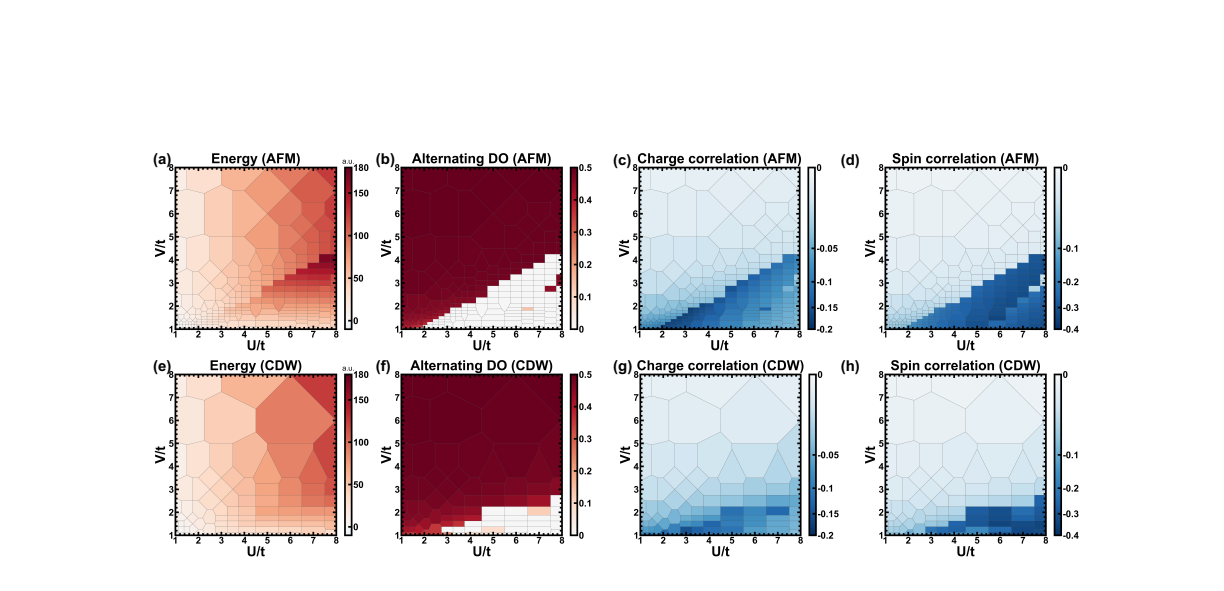
The phase-competition result is also explicitly tentative (b288), with the two seeds disagreeing near the boundary and finite-size and convergence analyses deferred. As an exploratory demonstration this is acceptable, but the paper should state plainly that the DMET study validates adaptive sampling and self-consistency handling, not diagnostic-driven method selection, so that readers do not conflate the two meanings of 'adaptive'.
5 minor objections
The paper says, at Eq. (2), Sec. 4.3
Pith says: minor objection 1 of 5
The notation 'σ max(t1)' should be typeset as σmax(t1), and the definition of the Frobenius norm in T1 should be specified explicitly for readers not familiar with the CCSD diagnostic literature.
The paper says, at Fig. 5(d), Sec. 4.3
Pith says: minor objection 2 of 5
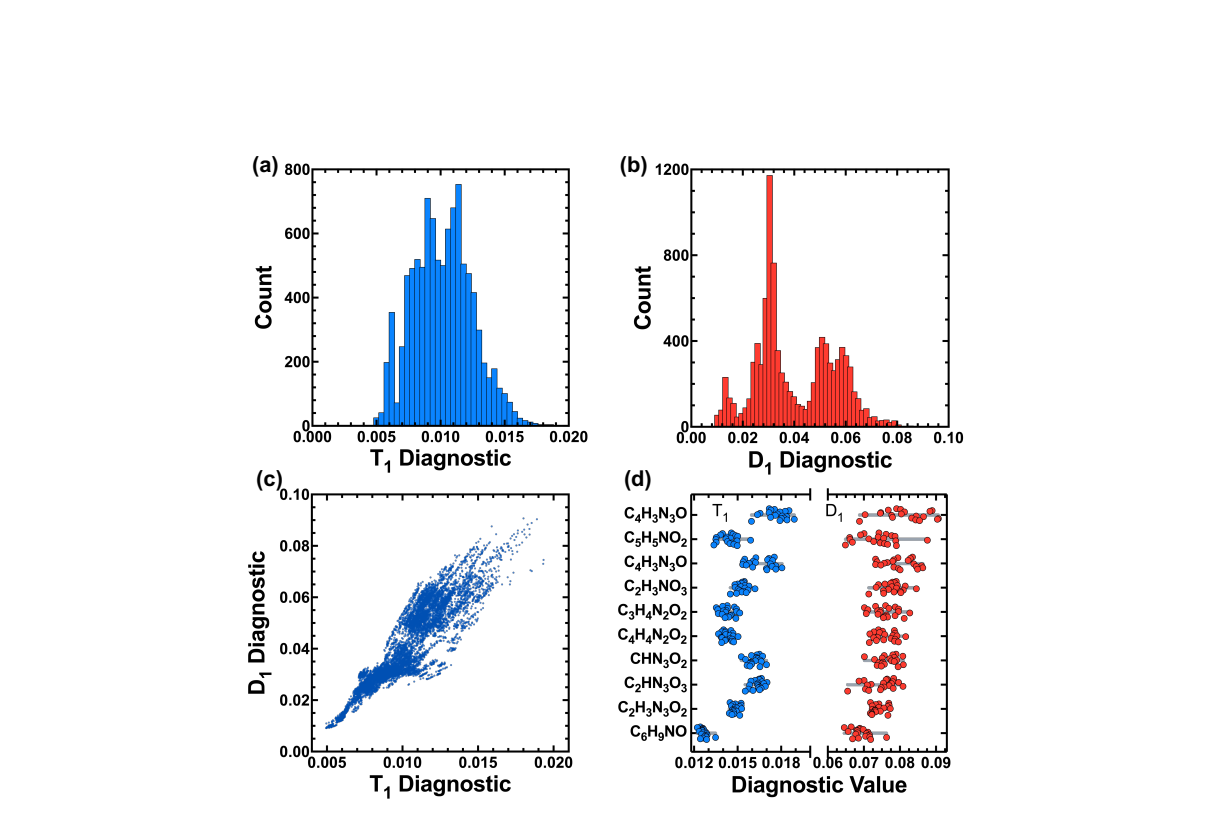
The criterion for selecting the 'ten molecules with the strongest diagnostic indications' is not stated; please specify whether the ranking uses T1, D1, a combination, or the diagnostic score of Eq. S1.
show 3 more
The paper says, at Sec. 4.3
Pith says: minor objection 3 of 5
The snapshot-selection scheme (sorting frames by potential energy into 20 groups and retaining the lower-median frame of each) is described but not justified; a sentence on why this scheme was chosen, and what coverage of the potential-energy range it is intended to preserve, would strengthen the dataset-generation claim.
The paper says, at Sec. 4.1, Fig. 3
Pith says: minor objection 4 of 5
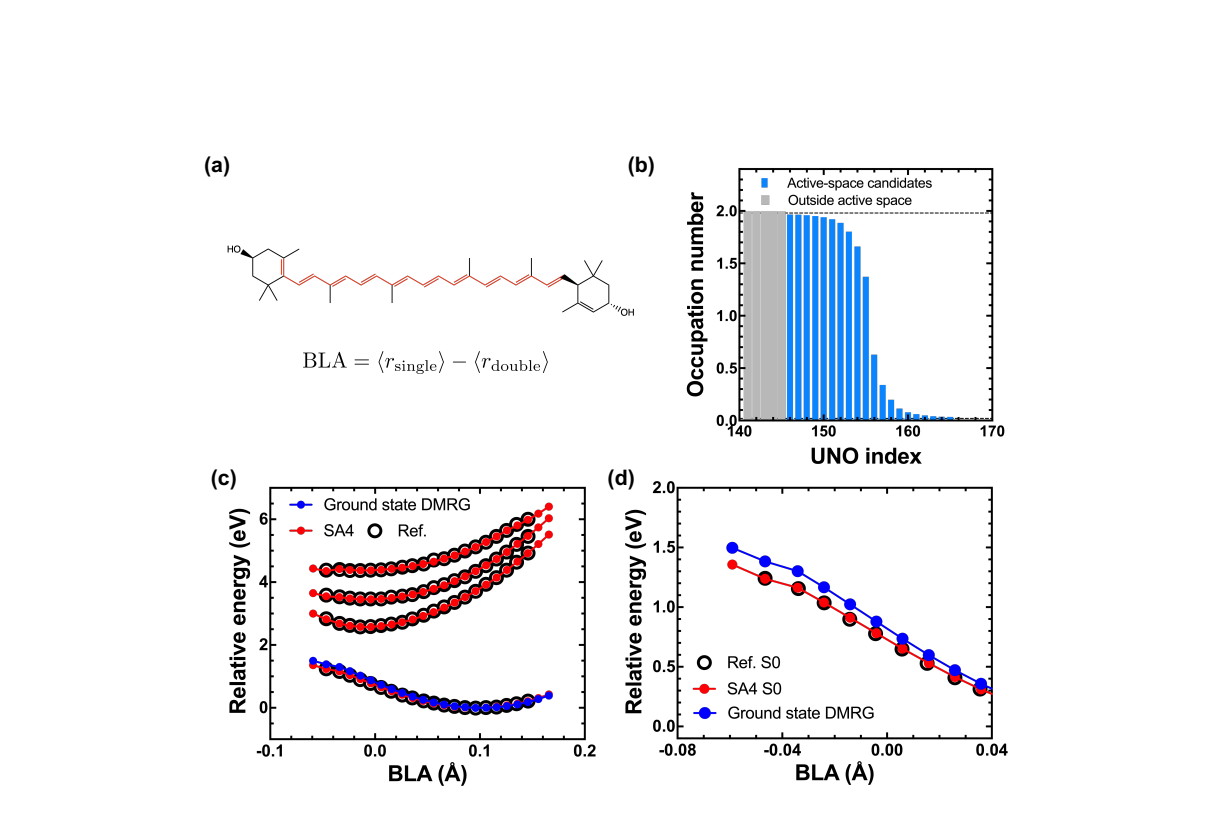
The comparison to Ref. 53 uses SA4-DMRG-CASSCF with M = 2000; please state whether convergence of the excited-state energies with respect to M was checked, so that any small deviations from the reference profiles can be attributed to method settings rather than to truncation.
The paper says, at Abstract and Sec. 1
Pith says: minor objection 5 of 5
Given that diagnostic-driven method selection is not yet demonstrated end-to-end, a sentence in the abstract noting that the three studies validate the workflow, backends, and adaptive sampling, while the diagnostic-ranking component remains to be benchmarked, would better align the claims with the evidence in the paper.
What would settle it
On a subsample of the 10,000-configuration CCSD dataset, compute the Eq. S1 diagnostic score for each configuration, then compare the score ordering to the actual error of CCSD relative to a multireference treatment (e.g., DMRG-CASSCF or NEVPT2) on the ~50 highest-scoring configurations. If the highest-scoring configurations do not show systematically larger reference errors than lower-scoring ones, the ranking fails to predict method accuracy and adaptive selection based on it is unjustified.
from the skeptic's reading
How the review went
4 readings by deepseek-v4-flash · 2 Oct 2026
- Reader holds up, with conditions
- Skeptic agrees
- Editor wrote the verdict above
- Referee major revision: 2 major objections, 5 minor
Not run on this paper: the simulated authors' defence.
Pith did not check this review's objections against the paper.
The review in full
The review in brief, machine-written
This is a real systems paper, not a hype piece, and it deserves a referee. The strongest evidence is the lutein study: DMRG-CASSCF profiles that reproduce the published reference data of Giannì et al. (Ref 53) across both ground and excited states. External validation against an independent published source is more than most agentic-framework papers offer, and it is the right kind of evidence for this kind of claim.
What is genuinely new: the study–task orchestration layer over the PySCF ecosystem (Block2, libDMET, fcDMFT) that cleanly separates LLM planning from deterministic, registry-qualified execution, so the workflow is model-agnostic and execution never depends on the language model. The capability registry and curated knowledge wiki are thoughtful engineering choices. The 10,000-configuration CCSD dataset is a real new artifact, released with a Zenodo DOI, and the code is on GitHub. The paper is also unusually honest: it calls the DMET phase competition ambiguous (b288), states the diagnostics do not quantify errors (b317), and admits method suitability resists automation (b337).
The stress-test concern holds up, but with an important qualification. The diagnostic-score weights (Eq S1, Table S2) are hand-set and deferred to future learning (b198), and — the sharper point — none of the three demonstrations actually exercises that score to pick a solver. The lutein study used curated AVAS-based active-space selection; the DMET adaptive refinement used interpolation discrepancies in energy and double occupancy, not the correlation diagnostic. So the central value claim, correlation-aware adaptive method selection, is shown to run, not shown to work. The paper mitigates this by explicitly framing the method advisor as "a practical policy for adaptive method selection rather than a general ranking of method accuracy," so nobody is misled — but the core benefit remains unverified. Also missing is any benchmark against the existing agentic platforms (Refs 23-31) or against manual workflows, and the SI containing Eq S1, Table S2, and the convergence analyses is not in the preprint, so the quantitative underpinnings cannot be checked from this submission.
These are proportionate soft spots for a framework paper. The validation gap is the expected next step, not a load-bearing flaw. The authors know exactly what is missing and said so. A single benchmark — letting CAFES's adaptive choice run against a fixed protocol on the same systems — would settle the open question.
This is a paper for people building agentic chemistry tools and for the strongly correlated quantum chemistry community. Send it to peer review. A serious referee should push the diagnostic-selection validation, but the paper is honest enough, well-built enough, and sufficiently grounded in external evidence to merit that engagement.
The strongest objection
The framework's central value proposition is that CAFES adaptively selects methods based on correlation diagnostics. That selection is driven by the diagnostic score of Eq. S1 and Table S2, which combines electronic-structure indicators and reliability checks with predefined weights. The paper explicitly defers learning these weights to future work (b198: 'These weights could in future be learned and updated'), and no quantitative evidence is given that the resulting ranking corresponds to method accuracy. This is load-bearing because the methodological contribution is correlation-aware selection; the lutein demonstration relied on curated AVAS-based active-space choices and the DMET scan on seeded broken-symmetry initializations, neither of which exercised the diagnostic score to pick the solver. The DMET phase-competition result is left ambiguous (b286-b288), with the two seeds disagreeing near the boundary, so it cannot validate the diagnostic ranking. Because the score combines several indicators with hand-set weights, a mis-ranking would select suboptimal methods and undermine the adaptive-refinement benefit claimed as the framework's core advantage. The concern is not that the weights are wrong; it is that their correctness is asserted without a test. This is distinct from the claim that the workflow and backends run correctly, which the released code supports. Since the weights are configurable and the paper acknowledges the need for learning, the framework could be correct in principle while the current demonstration under-delivers on the central value claim.
The reader identified the same load-bearing concern: the diagnostic-score weights are hand-set and unvalidated, so correlation-aware selection lacks quantitative support. My independent reading agrees and adds that the paper's own demonstrations do not exercise the score's method-selection role: lutein used curated AVAS-based active-space choices, DMET used seeded initializations, and the DMET phase-competition result near the boundary is left ambiguous (b286-b288). The paper explicitly acknowledges that learning the weights is future work (b198), so the issue is missing evidence rather than internal inconsistency. A conditional verdict is appropriate: the workflow and backends demonstrably run correctly, but the central value claim, that diagnostics guide method selection with accuracy-correlated ranking, remains unvalidated. The concrete test, comparing the Eq. S1 score ordering against reference errors on a subsample of the generated dataset, would settle whether the ranking is accuracy-ordered. No stronger objection than the reader's is warranted; this is precisely a missing quantitative validation, not a defect in execution integrity.
The referee's report
If the adaptive-selection claim holds, CAFES fills a real gap: agentic frameworks for the strongly correlated regime that combine correlation diagnostics, method feedback, and traceable multi-method coordination. The paper has genuine strengths: the lutein study is externally validated against an independent published reference (Ref. 53); the CCSD dataset is newly generated and released with a DOI; the source code is public; and the separation of LLM reasoning from deterministic qualification and compilation is a sensible design choice that supports reproducibility. The paper is also honest about its limits, explicitly qualifying the DMET phase-boundary ambiguity (b288) and the unlearned diagnostic weights (b198). The central gap is that the framework's distinguishing feature—correlation-aware method selection driven by the diagnostic score—is never exercised or validated in any of the three studies; the demonstrations validate the workflow machinery but not the diagnostic ranking on which the core value proposition rests.
Pith's reading of the paper (a machine's summary, not the authors')
CAFES is a software framework for running many-body simulations of strongly correlated systems — molecules, crystals, and model Hamiltonians — with a large language model in the loop. The paper's claim is that a study–task architecture, in which an LLM handles planning and interpretation while deterministic registry checks and numerical backends handle execution, lets the framework coordinate adaptive calculations that would normally require a specialist's repeated judgment. The correlation-dependent part of the claim is that on-the-fly diagnostics — electronic-structure indicators combined with reliability checks — drive method refinement, so that each calculation receives a treatment matched to the correlation strength it exhibits rather than a uniform protocol. Three demonstrations carry the argument: DMRG-CASSCF on lutein reproducing the reference profiles of Ref. [53], an adaptive DMET scan of the extended honeycomb Hubbard model whose refinement adds sample points where observables change rapidly, and a 10,000-configuration CCSD-labeled dataset with $T_1$ and $D_1$ diagnostics. If CAFES works as claimed, advanced many-body methods become easier to apply and research more reproducible, because every method choice, diagnostic, and approval is recorded in a structured report.
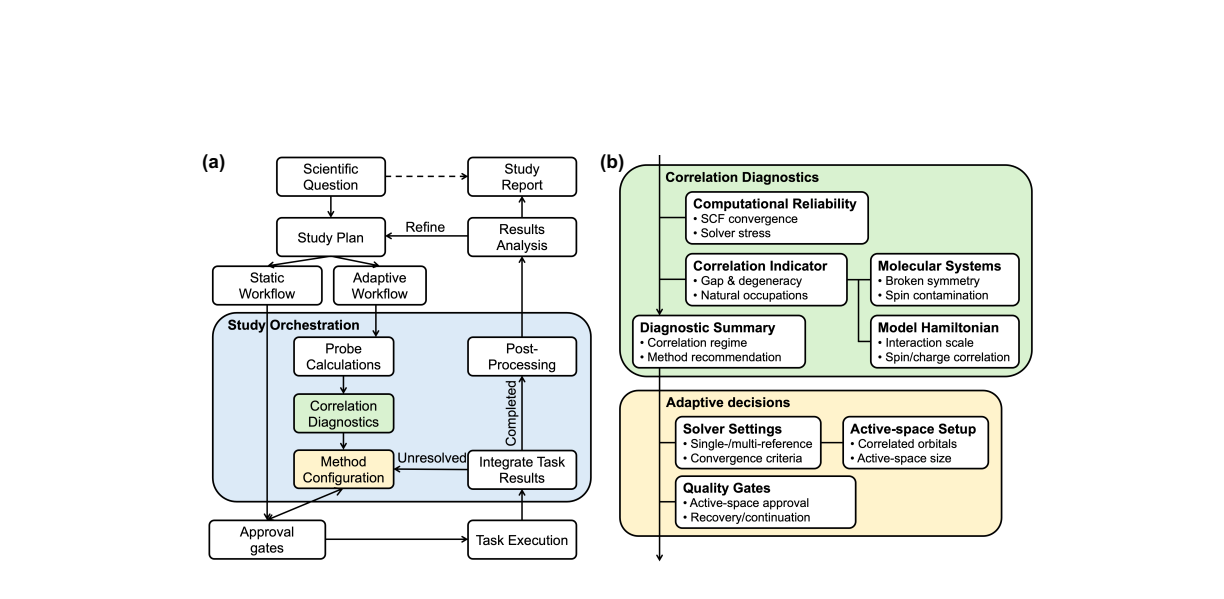
What carries the argument. The carrying mechanism is the study–task architecture plus registry-governed qualification. A StudySpec describes a multi-task objective, which CAFES expands into explicit TaskSpecs; execution yields TaskReports, collected into a StudyReport that records adaptive decisions and links each result to its parent study. Four data structures (StudySpec, TaskSpec, TaskReport, StudyReport) connect natural-language goals to numerical backends. The capability registry is a set of registered modules with typed parameters, compatibility conditions, and quality gates, used uniformly by planner and executor; the workflow compiler runs as a LangGraph state graph, while qualification checks — requirement-driven, not LLM-judged — verify each task satisfies registry constraints. The correlation-diagnostic module scores electronic-structure indicators (small orbital gaps, near-degeneracies, fractional occupations, spin contamination, symmetry breaking) and reliability checks separately, then combines them with predefined weights into an overall diagnostic score that drives the method advisor's recommendations and active-space construction via AVAS projections.
Core claim. The central claim is that a single agentic workflow can coordinate adaptive many-body calculations of strongly correlated systems across three system classes — molecules, crystals, and model Hamiltonians — by separating study-level scientific planning from task-level numerical execution. CAFES puts the division at a specific point: large language models propose and interpret studies, but capability-registry qualification, workflow compilation, and numerical backends run on deterministic program logic, so the framework is model-agnostic. Within that shell, correlation diagnostics (electronic-structure indicators such as small orbital gaps and fractional natural-orbital occupations, combined with reliability checks) produce a diagnostic score (Eq. S1, Table S2) that the method advisor uses to propose refinement: single-reference coupled cluster when correlation is weak, CAS-based treatments when multireference character is substantial. The three demonstrations — DMRG-CASSCF on lutein reproducing the reference profiles of Ref. [53], an adaptive DMET scan of the extended honeycomb Hubbard model in which refinement concentrates new points near rapid observable changes, and a 10,000-configuration CCSD-labeled dataset with $T_1$/$D_1$ diagnostics — show the workflow in each regime. The paper argues that by retaining method choices, diagnostics, and approvals in structured reports, CAFES makes advanced many-body methods easier to apply and supports reproducible, inspectable computational research.
The premise it rests on. The load-bearing premise is that the diagnostic score's hand-set combination weights (Eq. S1, Table S2) actually rank correlation severity in a way that tracks method accuracy: the paper defers learning these weights to future work (sentence b198), so there is no quantitative evidence that the advisor's method recommendations correspond to the best treatment.
If the paper is right (Pith's inferences, not the authors')
If CAFES works as claimed, a researcher can describe a many-body study in natural language and have the framework generate, validate, execute, and refine the constituent calculations under explicit registry constraints.
The adaptive DMET scan shows refinement concentrating new sample points where observables change rapidly, so parameter scans of correlated models can become denser where physical behavior demands it rather than on a uniform grid.
Cross-method comparison becomes routine: the same study context can express single-reference, CAS-based, and embedding treatments, each recorded with its diagnostic evidence and approval record.
Because execution is deterministic and model-agnostic, swapping the LLM component does not change the workflow or backends, decoupling numerical behavior from the reasoning component.
For machine-learning data generation, the workflow can produce correlated-label datasets (like the 10,000-configuration CCSD set) and could later expand them on demand during reinforcement-learning training.
The same structure that separates planning from execution also decouples scientific generality from numerical validity: the framework's scope is only as strong as its registry and wiki entries, so the limiting resource for adding a new method is documentation, not code.
The adaptive-refinement idea generalizes: steering parameter sampling by interpolation discrepancies could apply to phase-diagram mapping with other solvers, and the $T_1$/$D_1$-rich dataset could train a learned diagnostic score to replace the hand-set weights the paper leaves to future work.
The three demonstrations stop short of a controlled accuracy benchmark; a natural next test is comparing the framework's automatically selected methods against expert-chosen treatments on the same systems to quantify how often the advisor matches expert judgment.
Gating expensive or scientifically consequential decisions behind human approval means the framework's automated reach scales with the granularity of its approval gates, so a future version that lets diagnostic evidence modulate review requirements would be the real test of scalability.
Check this review
Pith stored no record of this review's passes and took no fingerprint of it. Reviews made by code from 13 Nov 2026 on carry both.
How often reviews like this one are right
Reviews like this one: written by deepseek-v4-flash, where what was read was not recorded.
How often objections from reviews like this one are right: not yet measured
Reviews by people
This review was written by a machine. No person has reviewed this paper on Pith yet. A scientist listed on Pith can review it for a fee, and their review is published here whatever it concludes.
The paper
Abstract
We present CAFES, a correlation-aware agentic framework for electronic-structure simulations of strongly correlated systems. CAFES addresses two challenges: the fragmented software landscape for many-body calculations and the difficulty of selecting appropriate methods across diverse correlation regimes. It combines correlation diagnostics, adaptive method selection, and large language model (LLM) assistance for molecular, crystalline, and model-Hamiltonian systems. A study-task architecture separates study-level planning from task-level execution, while a curated scientific knowledge layer provides reusable guidance for method selection, workflow design, and result interpretation. We demonstrate CAFES through three research-level studies: calculating the low-lying electronic states of lutein using DMRG-CASSCF, probing phase competition in the extended honeycomb Hubbard model using DMET, and generating a quantum-chemical dataset with CCSD labels. These calculations demonstrate the potential of agentic workflows for strongly correlated electronic-structure problems, a regime that has received limited attention in existing agentic computational frameworks.
The paper's own sentences, arranged, kept beside the review and separate from it. Each label is drawn from a closed vocabulary; the number beside it is the probability the classifier gave that label. No sentence in this record was written by a model.
abstract compiled · 2026-10-02
The authors' main claim, as the classifier picked it out 1.00
“These calculations demonstrate the potential of agentic workflows for strongly correlated electronic-structure problems, a regime that has received limited attention in existing agentic computational frameworks.”
How the main claim is stated: hedged possibility 0.63
What the abstract itself states, as probabilities: claims first 0.11 · states limitation 0.23 · human participants 0.03 · controlled comparison 0.03 · randomized assignment 0.01 · states quantitative result 0.04 · compares with prior results 0.09 · mentions code or data availability 0.04
The abstract, sentence by sentence
This table labels the abstract only (arXiv listing abstract v1). The number is the probability the classifier gave the label.
| Sentence | Role | The authors' own work | States the main conclusion | Strength |
|---|---|---|---|---|
| We present CAFES, a correlation-aware agentic framework for electronic-structure simulations of strongly correlated systems. | contribution 0.99 | 0.90 | 0.07 | asserted 1.00 |
| CAFES addresses two challenges: the fragmented software landscape for many-body calculations and the difficulty of selecting appropriate methods across diverse correlation regimes. | gap 0.55 | 0.28 | 0.04 | asserted 1.00 |
| It combines correlation diagnostics, adaptive method selection, and large language model (LLM) assistance for molecular, crystalline, and model-Hamiltonian systems. | method 0.92 | 0.62 | 0.05 | asserted 1.00 |
| A study-task architecture separates study-level planning from task-level execution, while a curated scientific knowledge layer provides reusable guidance for method selection, workflow design, and result interpretation. | method 0.96 | 0.73 | 0.05 | asserted 1.00 |
| We demonstrate CAFES through three research-level studies: calculating the low-lying electronic states of lutein using DMRG-CASSCF, probing phase competition in the extended honeycomb Hubbard model using DMET, and generating a quantum-chemical dataset with CCSD labels. | contribution 0.85 | 0.96 | 0.09 | asserted 0.99 |
| These calculations demonstrate the potential of agentic workflows for strongly correlated electronic-structure problems, a regime that has received limited attention in existing agentic computational frameworks. | interpretation 1.00 | 0.53 | 0.78 | hedged possibility 0.63 |
What kind of paper the classifier reports this is: method or tool 1.00 · evidence from simulation or computation 1.00
What was examined, and what was not
Sources read
- arXiv listing abstract v1
Not examined
- full text
- figures and tables
- references and citing sentences
- relations to other papers
Levels run
- P abstract
Not run
- S sections
- T body sentences
- C citations
- R cross-paper relations
How the labels were made
Compiled by classifier-1.13.0 via TypeSafe API, question bank abstract-p1-20260923, 2026-10-02: 1 request, 4,997 input tokens.
Every quoted sentence on this record is the authors'. Every label is from Pith's closed vocabulary, with the probability shown beside it. This record as JSON
Figures (5)
Figures are the authors', reproduced from the paper.
References (64)
- [1] Vladimir Anisimov and Yuri Izyumov.Electronic Structure of Strongly Correlated Materi- als. Springer Series in Solid-State Sciences. Springer, Berlin, Heidelberg, 1 edition, 2010. ISBN 978-3-642-04826-5. doi: 10.1007/978-3-642-04826-5. URL https://doi.org/10.1007/ 978-3-642-04826-5 on Pithdoi:10.1007/978-3-642-04826-5
- [2] Adolfo Avella, Ferdinando Mancini, et al.Strongly correlated systems. Springer, 2012. ISBN 978-3-642-35105-1. doi: https://doi.org/10.1007/978-3-642-35106-8. 26 on Pithdoi:10.1007/978-3-642-35106-8
- [3] Björn O. Roos, Peter R. Taylor, and Per E.M. Sigbahn. A complete active space scf method (casscf) using a density matrix formulated super-ci approach.Chemical Physics, 48(2):157– 173, 1980. ISSN 0301-0104. doi: https://doi.org/10.1016/0301-0104(80)80045-0. URLhttps: //www.scie... on Pithdoi:10.1016/0301-0104(80)80045-0
- [4] Steven R. White. Density matrix formulation for quantum renormalization groups.Phys. Rev. Lett., 69:2863–2866, Nov 1992. doi: 10.1103/PhysRevLett.69.2863. URLhttps://link.aps. org/doi/10.1103/PhysRevLett.69.2863 on Pithdoi:10.1103/physrevlett.69.2863
- [5] U. Schollwöck. The density-matrix renormalization group.Rev. Mod. Phys., 77:259–315, Apr 2005. doi: 10.1103/RevModPhys.77.259. URL https://link.aps.org/doi/10.1103/ RevModPhys.77.259 on Pithdoi:10.1103/revmodphys.77.259
- [6] Garnet Kin-Lic Chan and Sandeep Sharma. The density matrix renormalization group in quantum chemistry.Annual review of physical chemistry, 62(1):465–481, 2011. doi: https: //doi.org/10.1146/annurev-physchem-032210-103338 on Pithdoi:10.1146/annurev-physchem-032210-103338
- [8] Federico Becca and Sandro Sorella.Quantum Monte Carlo approaches for correlated sys- tems. Cambridge University Press, 2017. ISBN 9781316417041. doi: https://doi.org/10.1017/ 9781316417041 on Pith
- [9] Martin C Gutzwiller. Correlation of electrons in a narrow s band.Physical Review, 137(6A): A1726, 1965. doi: https://doi.org/10.1103/PhysRev.137.A1726 on Pithdoi:10.1103/physrev.137.a1726
- [10] Antoine Georges, Gabriel Kotliar, Werner Krauth, and Marcelo J. Rozenberg. Dynamical mean-field theory of strongly correlated fermion systems and the limit of infinite dimensions. Rev. Mod. Phys., 68:13–125, Jan 1996. doi: 10.1103/RevModPhys.68.13. URLhttps://link. aps.org/doi... on Pithdoi:10.1103/revmodphys.68.13
- [11] G. Kotliar, S. Y. Savrasov, K. Haule, V. S. Oudovenko, O. Parcollet, and C. A. Marianetti. Electronic structure calculations with dynamical mean-field theory.Rev. Mod. Phys., 78:865– 27 951, Aug 2006. doi: 10.1103/RevModPhys.78.865. URLhttps://link.aps.org/doi/10.1103/ RevModP... on Pithdoi:10.1103/revmodphys.78.865
- [12] Gerald Knizia and Garnet Kin-Lic Chan. Density matrix embedding: A simple alternative to dynamical mean-field theory.Phys. Rev. Lett., 109:186404, Nov 2012. doi: 10.1103/PhysRevLett. 109.186404. URLhttps://link.aps.org/doi/10.1103/PhysRevLett.109.186404 on Pithdoi:10.1103/physrevlett
- [13] Sebastian Wouters, Carlos A. Jiménez-Hoyos, Qiming Sun, and Garnet K.-L. Chan. A practical guide to density matrix embedding theory in quantum chemistry.Journal of Chemical Theory and Computation, 12(6):2706–2719, 06 2016. ISSN 1549-9618. doi: 10.1021/acs.jctc.6b00316. URLhttp... on Pithdoi:10.1021/acs.jctc.6b00316
- [14] Zhi-Hao Cui, Tianyu Zhu, and Garnet Kin-Lic Chan. Efficient implementation of ab initio quantum embedding in periodic systems: Density matrix embedding theory.Journal of Chemical Theory and Computation, 16(1):119–129, 2020. doi: https://doi.org/10.1021/acs.jctc.9b00933 on Pithdoi:10.1021/acs.jctc.9b00933
- [15] Laurence W Giordano, Y Stanley Tan, Zhi-Hao Cui, and Chong Sun. Ab initio quantum embedding at finite temperature with density matrix embedding theory.The Journal of Chemical Physics, 164(15), 2026. doi: https://doi.org/10.1063/5.0320965 on Pithdoi:10.1063/5.0320965
- [16] J. P. F. LeBlanc, Andrey E. Antipov, Federico Becca, Ireneusz W. Bulik, Garnet Kin-Lic Chan, Chia-Min Chung, Youjin Deng, Michel Ferrero, Thomas M. Henderson, Carlos A. Jiménez-Hoyos, E. Kozik, Xuan-Wen Liu, Andrew J. Millis, N. V. Prokof’ev, Mingpu Qin, Gustavo E. Scuseria, H... on Pith
- [17] Mario Motta, David M. Ceperley, Garnet Kin-Lic Chan, John A. Gomez, Emanuel Gull, Sheng Guo, Carlos A. Jiménez-Hoyos, Tran Nguyen Lan, Jia Li, Fengjie Ma, Andrew J. Millis, Nikolay V. Prokof’ev, Ushnish Ray, Gustavo E. Scuseria, Sandro Sorella, Edwin M. Stoudenmire, Qiming Sun... on Pith
- [18] Bo-Xiao Zheng, Chia-Min Chung, Philippe Corboz, Georg Ehlers, Ming-Pu Qin, Reinhard M Noack, Hao Shi, Steven R White, Shiwei Zhang, and Garnet Kin-Lic Chan. Stripe order in the underdoped region of the two-dimensional hubbard model.Science, 358(6367):1155–1160, 2017. doi: 10.1... on Pithdoi:10.1126/science.aam7127
- [19] Timothy J. Lee and Peter R. Taylor. A diagnostic for determining the quality of single-reference electron correlation methods.International Journal of Quantum Chemistry, 36(S23):199–207, on Pith
- [20] Curtis L. Janssen and Ida M.B. Nielsen. New diagnostics for coupled-cluster and møller–plesset perturbation theory.Chemical Physics Letters, 290(4):423–430, 1998. ISSN 0009-2614. doi: https: //doi.org/10.1016/S0009-2614(98)00504-1. URLhttps://www.sciencedirect.com/science/ art... on Pithdoi:10.1016/s0009-2614(98)00504-1
- [21] Mark S Gordon, Michael W Schmidt, Galina M Chaban, Kurt R Glaesemann, Walter J Stevens, and Carlos Gonzalez. A natural orbital diagnostic for multiconfigurational character in correlated wave functions.The Journal of chemical physics, 110(9):4199–4207, 1999. doi: https://doi.o... on Pithdoi:10.1063/1.478301
show 44 more
- [22] Xiang Xu, Luis Soriano-Agueda, Xabier López, Eloy Ramos-Cordoba, and Eduard Matito. All-purpose measure of electron correlation for multireference diagnostics.Journal of Chemical Theory and Computation, 20(2):721–727, 2024. doi: https://doi.org/10.1021/acs.jctc.3c01073 on Pithdoi:10.1021/acs.jctc.3c01073
- [23] Yunheng Zou, Austin H Cheng, Abdulrahman Aldossary, Jiaru Bai, Shi Xuan Leong, Jorge Ar- turo Campos-Gonzalez-Angulo, Changhyeok Choi, Cher Tian Ser, Gary Tom, Andrew Wang, et al. El agente: An autonomous agent for quantum chemistry.Matter, 8(7), 2025. doi: 10.1016/j.matt.2025.102263 on Pithdoi:10.1016/j.matt.2025.102263
- [24] Juan B Pérez-Sánchez, Yunheng Zou, Jorge A Campos-Gonzalez-Angulo, Marcel Müller, Ignacio 29 Gustin, Andrew Wang, Han Hao, Tsz Wai Ko, Changhyeok Choi, Eric S Isbrandt, et al. El agente quntur: A research collaborator agent for quantum chemistry.arXiv preprint arXiv:2602.04850, 2026 on PithPith's reviewarXiv
- [25] Mingwei Ding, Chen Huang, Yibo Hu, Yifan Li, Zitian Lu, Xingtai Yu, Duo Zhang, Wenxi Zhai, Tong Zhu, Qiangqiang Gu, et al. Automating computational chemistry workflows via openclaw and domain-specific skills.Journal of Chemical Theory and Computation, 2026. doi: https://doi.or... on Pithdoi:10.1021/acs.jctc.6c00591
- [26] Martina Kieninger, Marc Segovia, Mauricio Vega-Teijido, Aline Katz, Anabela Martinez, Elena Vuan, Kenneth Irving, and Oscar N Ventura. Virtuallab_cc: An llm-augmented virtual laboratory for automated computational chemistry research.Artificial Intelligence Chemistry, page 1001... on Pithdoi:10.1016/j.aichem.2026.100129
- [27] Ruiqi Zhang, Wenhao Gao, and Yuki Kurashige. Q-planner: a harness system for quantum chemistry agents.ChemRxiv, 2026(0427), 2026. doi: 10.26434/chemrxiv.15002405/v1. URL https://chemrxiv.org/doi/abs/10.26434/chemrxiv.15002405/v1 on Pithdoi:10.26434/chemrxiv.15002405/v1
- [28] Jinming Hu, Hassan Nawaz, Yi-Fan Hou, Yuting Rui, Lijie Chi, Yuxinxin Chen, Arif Ullah, and Pavlo O Dral. Aitomia: Your intelligent assistant for ai-driven atomistic and quantum chemical simulations.arXiv preprint arXiv:2505.08195, 2025 on PithPith's reviewarXiv
- [29] Guangsheng Liu, Leshen Zhang, Xiao Ma, I-Shan Tsai, Jinyi Zhang, and Wan-Lu Li. Chemmate: an autonomous research mate for the full computational chemistry research lifecycle, from ideation to manuscript.ChemRxiv, 2026(0714), 2026. doi: 10.26434/chemrxiv.15006055/v1. URLhttps:/... on Pithdoi:10.26434/chemrxiv.15006055/v1
- [30] Guangchen Liu, Songge Yang, and Yu Zhong. Masgent: an ai-assisted materials simulation agent.Digital Discovery, 5(5):2151–2171, 05 2026. ISSN 2635-098X. doi: 10.1039/d6dd00043f. URLhttps://doi.org/10.1039/d6dd00043f on Pithdoi:10.1039/d6dd00043f
- [31] Jaewoong Lee, Taeun Bae, and Jihan Kim. Simmof: Ai agent for automated mof simulations. arXiv preprint arXiv:2603.29152, 2026. 30 on PithPith's reviewarXiv
- [32] Victor Chang Lee and James M Rondinelli. Can autonomous llm agents execute multireference quantum chemistry calculations?arXiv preprint arXiv:2609.13357, 2026 on PithPith's reviewarXiv
- [33] Jacob J Wardzala, Matthew R Hennefarth, Valay Agarawal, Bhavnesh Jangid, Aniruddha Seal, Matthew R Hermes, Daniel S King, and Laura Gagliardi. Multireference methods for chemistry and materials science: automated active spaces, efficient dynamic correlation, and extended syste... on Pithdoi:10.1021/acs.chemrev
- [34] Qiming Sun, Timothy C Berkelbach, Nick S Blunt, George H Booth, Sheng Guo, Zhendong Li, Junzi Liu, James D McClain, Elvira R Sayfutyarova, Sandeep Sharma, et al. Pyscf: the python- based simulations of chemistry framework.Wiley Interdisciplinary Reviews: Computational Molecula... on Pith
- [35] Qiming Sun, Xing Zhang, Samragni Banerjee, Peng Bao, Marc Barbry, Nick S Blunt, Nikolay A Bogdanov, George H Booth, Jia Chen, Zhi-Hao Cui, et al. Recent developments in the pyscf program package.The Journal of chemical physics, 153(2), 2020 on Pith
- [36] Qiming Sun, Matthew R. Hermes, Xiaojie Wu, Huanchen Zhai, Xing Zhang, Abdelrahman M. Ahmed, Juan José Aucar, Oliver J. Backhouse, Samragni Banerjee, Peng Bao, Nikolay A. Bogdanov, Kyle Bystrom, Frédéric Chapoton, Ning-Yuan Chen, Ivan Yu. Chernyshov, Helen S. Clifford, Sander C... on Pith
- [37] Huanchen Zhai, Henrik R Larsson, Seunghoon Lee, Zhi-Hao Cui, Tianyu Zhu, Chong Sun, Linqing Peng, Ruojing Peng, Ke Liao, Johannes Tölle, et al. Block2: A comprehensive open source framework to develop and apply state-of-the-art dmrg algorithms in electronic structure and beyon... on Pithdoi:10.1063/5
- [38] Bo-Xiao Zheng and Garnet Kin-Lic Chan. Ground-state phase diagram of the square lattice hubbard model from density matrix embedding theory.Phys. Rev. B, 93:035126, Jan 2016. doi: 10.1103/PhysRevB.93.035126. URL https://link.aps.org/doi/10.1103/PhysRevB.93. 035126 on Pithdoi:10.1103/physrevb.93.035126
- [39] Chong Sun, Ushnish Ray, Zhi-Hao Cui, Miles Stoudenmire, Michel Ferrero, and Garnet Kin- Lic Chan. Finite-temperature density matrix embedding theory.Phys. Rev. B, 101:075131, Feb 2020. doi: 10.1103/PhysRevB.101.075131. URL https://link.aps.org/doi/10.1103/ PhysRevB.101.075131 on Pithdoi:10.1103/physrevb.101.075131
- [40] Tianyu Zhu, Carlos A. Jiménez-Hoyos, James McClain, Timothy C. Berkelbach, and Garnet Kin-Lic Chan. Coupled-cluster impurity solvers for dynamical mean-field theory.Phys. Rev. B, 100:115154, Sep 2019. doi: 10.1103/PhysRevB.100.115154. URLhttps://link.aps.org/doi/ 10.1103/PhysR... on Pithdoi:10.1103/physrevb.100.115154
- [41] Tianyu Zhu, Zhi-Hao Cui, and Garnet Kin-Lic Chan. Efficient formulation of ab initio quantum embedding in periodic systems: Dynamical mean-field theory.Journal of Chemical Theory and Computation, 16(1):141–153, 2020. doi: https://doi.org/10.1021/acs.jctc.9b00934. 32 on Pithdoi:10.1021/acs.jctc.9b00934
- [42] Tianyu Zhu and Garnet Kin-Lic Chan. Ab initio full cellgw + DMFT for correlated materials. Phys. Rev. X, 11:021006, Apr 2021. doi: 10.1103/PhysRevX.11.021006. URLhttps://link. aps.org/doi/10.1103/PhysRevX.11.021006 on Pithdoi:10.1103/physrevx.11.021006
- [43] LangChain. Langgraph, 2024. URLhttps://github.com/langchain-ai/langgraph. Version 0.4.32.dev0 on Pith
- [44] J. Hubbard. Electron correlations in narrow energy bands.Proceedings of the Royal Society of London. A. Mathematical and Physical Sciences, 276(1365):238–257, 11 1963. ISSN 0080-4630. doi: 10.1098/rspa.1963.0204. URLhttps://doi.org/10.1098/rspa.1963.0204 on Pithdoi:10.1098/rspa.1963.0204
- [45] T Holstein. Studies of polaron motion: Part i. the molecular-crystal model.Annals of Physics, 8(3):325–342, 1959. ISSN 0003-4916. doi: https://doi.org/10.1016/0003-4916(59)90002-8. URL https://www.sciencedirect.com/science/article/pii/0003491659900028 on Pithdoi:10.1016/0003-4916(59)90002-8
- [46] W. P. Su, J. R. Schrieffer, and A. J. Heeger. Solitons in polyacetylene.Phys. Rev. Lett., 42: 1698–1701, Jun 1979. doi: 10.1103/PhysRevLett.42.1698. URLhttps://link.aps.org/doi/ 10.1103/PhysRevLett.42.1698 on Pithdoi:10.1103/physrevlett.42.1698
- [47] Chr Møller and Milton S Plesset. Note on an approximation treatment for many-electron systems.Physical review, 46(7):618, 1934. doi: https://doi.org/10.1103/PhysRev.46.618 on Pithdoi:10.1103/physrev.46.618
- [48] III Purvis, George D. and Rodney J. Bartlett. A full coupled-cluster singles and doubles model: The inclusion of disconnected triples.The Journal of Chemical Physics, 76(4):1910–1918, 02 on Pith
- [49] Rodney J. Bartlett and Monika Musiał. Coupled-cluster theory in quantum chemistry.Rev. Mod. Phys., 79:291–352, Feb 2007. doi: 10.1103/RevModPhys.79.291. URLhttps://link.aps. org/doi/10.1103/RevModPhys.79.291 on Pithdoi:10.1103/revmodphys.79.291
- [50] Celestino Angeli, Renzo Cimiraglia, Stefano Evangelisti, Thierry Leininger, and J-P Malrieu. Introduction of n-electron valence states for multireference perturbation theory.The Journal of Chemical Physics, 114(23):10252–10264, 2001. doi: https://doi.org/10.1063/1.1361246 on Pithdoi:10.1063/1.1361246
- [51] CelestinoAngeli, RenzoCimiraglia, andJean-PaulMalrieu. N-electronvalencestateperturbation theory: a fast implementation of the strongly contracted variant.Chemical Physics Letters, 350 33 (3):297–305, 2001. ISSN 0009-2614. doi: https://doi.org/10.1016/S0009-2614(01)01303-3. UR... on Pithdoi:10.1016/s0009-2614(01)01303-3
- [52] Elvira R Sayfutyarova, Qiming Sun, Garnet Kin-Lic Chan, and Gerald Knizia. Automated construction of molecular active spaces from atomic valence orbitals.Journal of chemical theory and computation, 13(9):4063–4078, 2017. doi: https://doi.org/10.1021/acs.jctc.7b00128 on Pithdoi:10.1021/acs.jctc.7b00128
- [53] Ivan Giannì, Claudio Amovilli, Filippo Lipparini, and Laura Pedraza-González. Can casscf model the excited states of xanthophyll lutein? a density matrix renormalization group journey. Physical Chemistry Chemical Physics, 28(35):21495–21510, 2026. doi: https://doi.org/10.1039/... on Pith
- [54] János Pipek and Paul G Mezey. A fast intrinsic localization procedure applicable for ab initio and semiempirical linear combination of atomic orbital wave functions.The Journal of Chemical Physics, 90(9):4916–4926, 1989. doi: https://doi.org/10.1063/1.456588 on Pithdoi:10.1063/1.456588
- [55] Sebastian Wouters, Ward Poelmans, Stijn De Baerdemacker, Paul W Ayers, and Dimitri Van Neck. Chemps2: Improved dmrg-scf routine and correlation functions.Computer Physics Communications, 191:235–237, 2015. doi: 10.1016/j.cpc.2015.01.007 on Pithdoi:10.1016/j.cpc.2015.01.007
- [56] ZY Meng, TC Lang, S Wessel, FF Assaad, and A Muramatsu. Quantum spin liquid emerging in two-dimensional correlated dirac fermions.Nature, 464(7290):847–851, 2010. doi: https: //doi.org/10.1038/nature08942 on Pithdoi:10.1038/nature08942
- [57] Sandro Sorella, Yuichi Otsuka, and Seiji Yunoki. Absence of a spin liquid phase in the hubbard model on the honeycomb lattice.Scientific reports, 2(1):992, 2012. doi: https: //doi.org/10.1038/srep00992 on Pithdoi:10.1038/srep00992
- [58] Qiaoni Chen, George H. Booth, Sandeep Sharma, Gerald Knizia, and Garnet Kin-Lic Chan. Intermediate and spin-liquid phase of the half-filled honeycomb hubbard model.Phys. Rev. B, 89:165134, Apr 2014. doi: 10.1103/PhysRevB.89.165134. URLhttps://link.aps.org/doi/ 10.1103/PhysRevB... on Pithdoi:10.1103/physrevb.89.165134
- [59] Ryan Jacobs, Dane Morgan, Siamak Attarian, Jun Meng, Chen Shen, Zhenghao Wu, Clare Yijia Xie, Julia H Yang, Nongnuch Artrith, Ben Blaiszik, et al. A practical guide to machine learning 34 interatomic potentials–status and future.Current Opinion in Solid State and Materials Sci... on Pithdoi:10.1016/j.cossms.2025.101214
- [60] Haiyang Yu, Meng Liu, Youzhi Luo, Alex Strasser, Xiaofeng Qian, Xiaoning Qian, and Shuiwang Ji. Qh9: A quantum hamiltonian prediction benchmark for qm9 molecules.Advances in Neural Information Processing Systems, 36:40487–40503, 2023. doi: https://doi.org/10.52202/ 075280-1761 on Pith
- [61] Raghunathan Ramakrishnan, Pavlo O Dral, Matthias Rupp, and O Anatole Von Lilienfeld. Quantum chemistry structures and properties of 134 kilo molecules.Scientific data, 1(1):140022, on Pith
- [62] Axel D Becke. Density-functional thermochemistry. iii. the role of exact exchange.The Journal of chemical physics, 98(7):5648–5652, 1993. doi: https://doi.org/10.1063/1.464913. 35 on Pithdoi:10.1063/1.464913
- [1982] ISSN 0021-9606. doi: 10.1063/1.443164. URLhttps://doi.org/10.1063/1.443164 on Pithdoi:10.1063/1.443164
- [1989] doi: https://doi.org/10.1002/qua.560360824. URL https://onlinelibrary.wiley.com/ doi/abs/10.1002/qua.560360824 on Pithdoi:10.1002/qua.560360824
- [2014] doi: https://doi.org/10.1038/sdata.2014.22 on Pithdoi:10.1038/sdata.2014.22
Cited by 2 Pith papers
Reviewed papers on Pith that cite this one. The full citation record
- El Agente Quntur: Agentic Active-Space Selection for CASSCF physics.chem-ph · Oct 2026
- Unconstrained learning of equivariant atomistic properties physics.chem-ph · Oct 2026
Challenges and discussion
Disagree with the review, or know something it missed? Leave a comment, or challenge this review formally: a challenge becomes a permanent entry in this paper's record, and its decision is published here.
Come back by email
A short list of the week's newly reviewed papers. Nothing is sent until you confirm from your inbox, and every email has a link that stops it. No account.
No comments yet.
Sign in to comment