Computational Physics · arXiv:2610.23371 v1 · submitted 16 Oct 2026 · 39 references
Foundation-Model Supervision of Distilled Potentials for Million-Atom Molecular Dynamics
The paper says
“Machine-learned interatomic potentials distilled from foundation models enable fast large-scale molecular dynamics (MD), but they can fail locally in chemical environments that their training data did not sample.”
more of the abstract
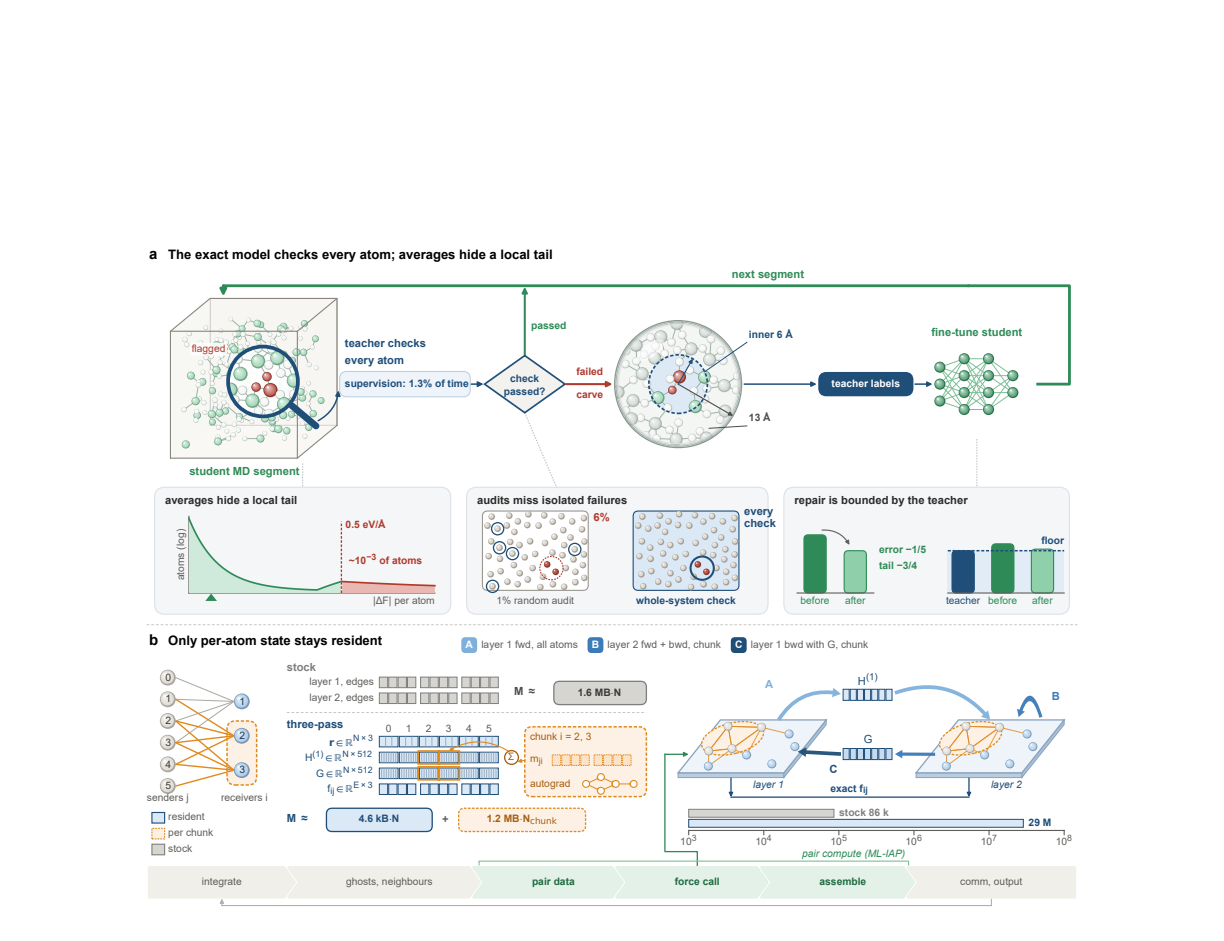
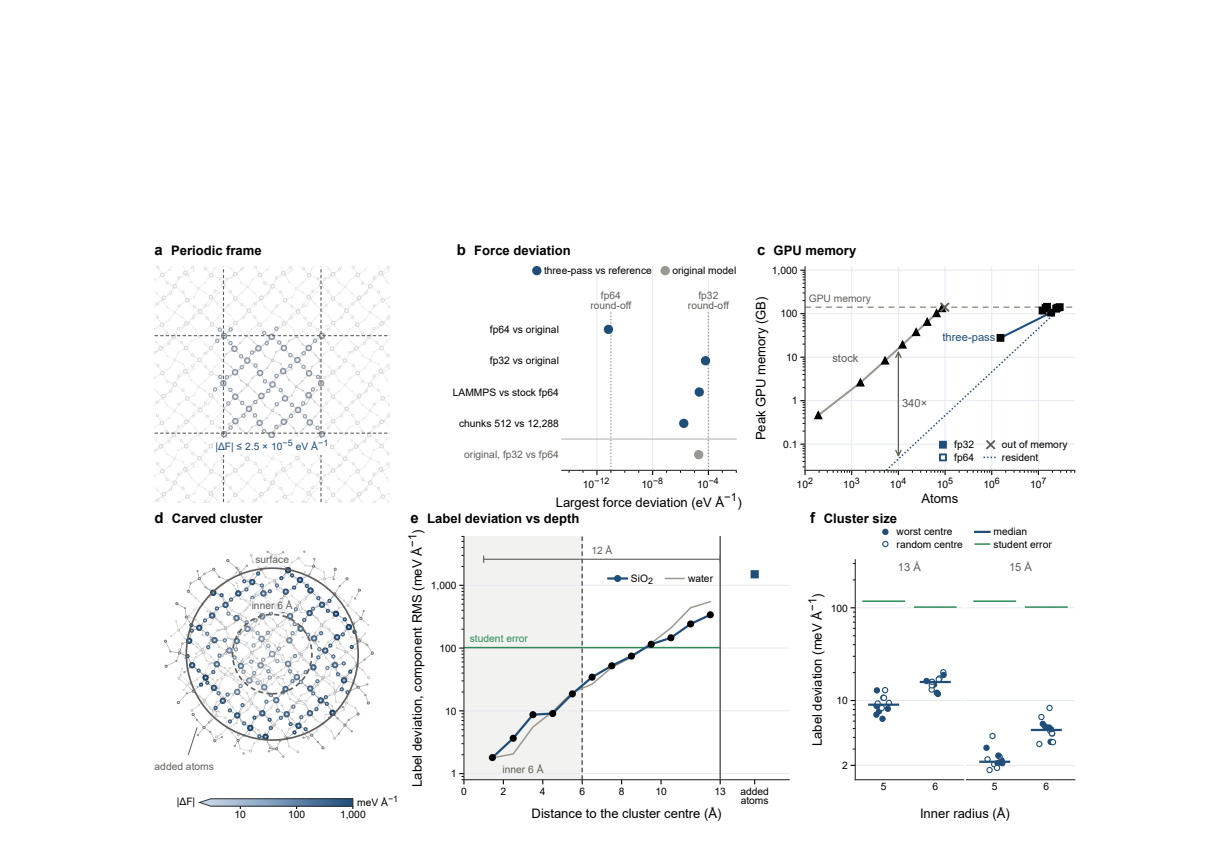
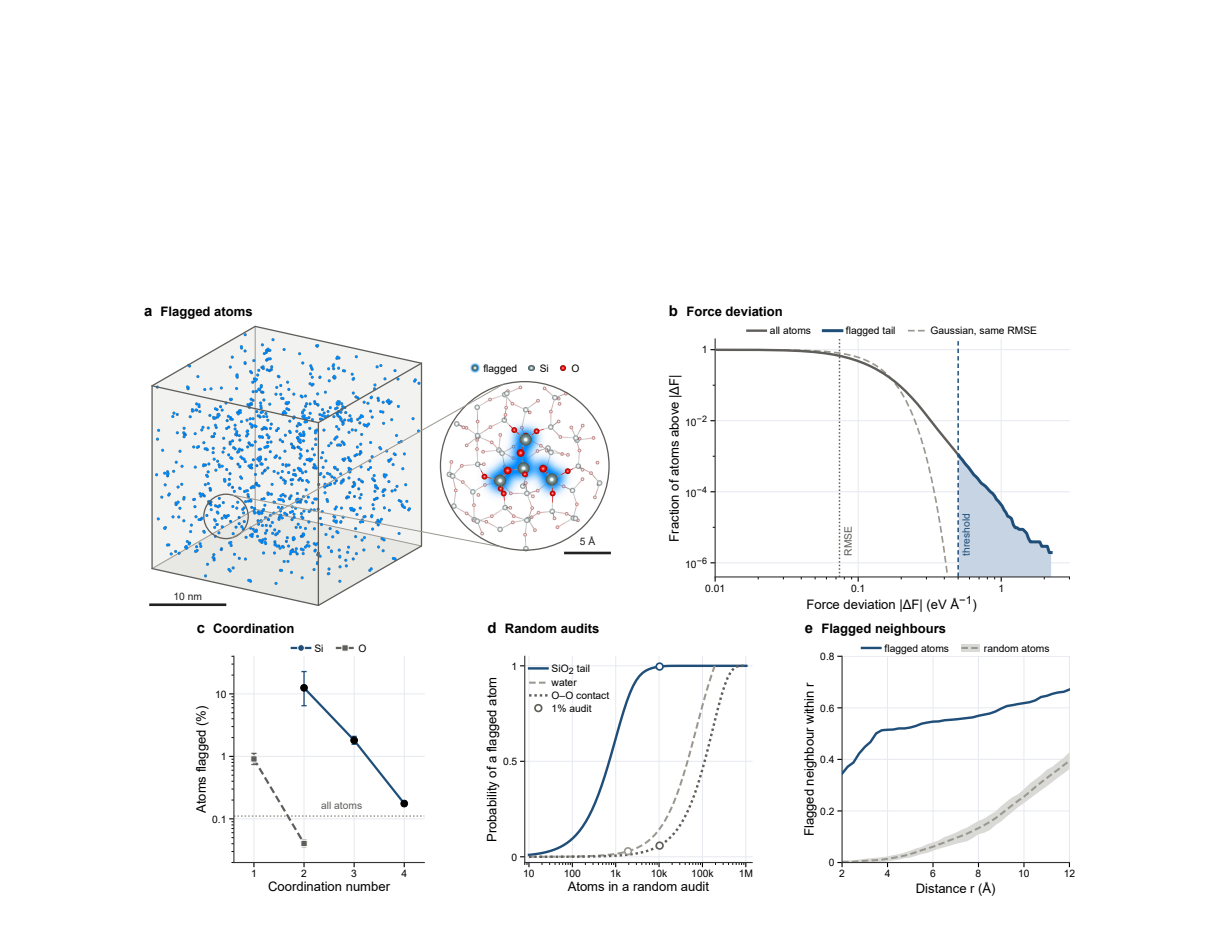
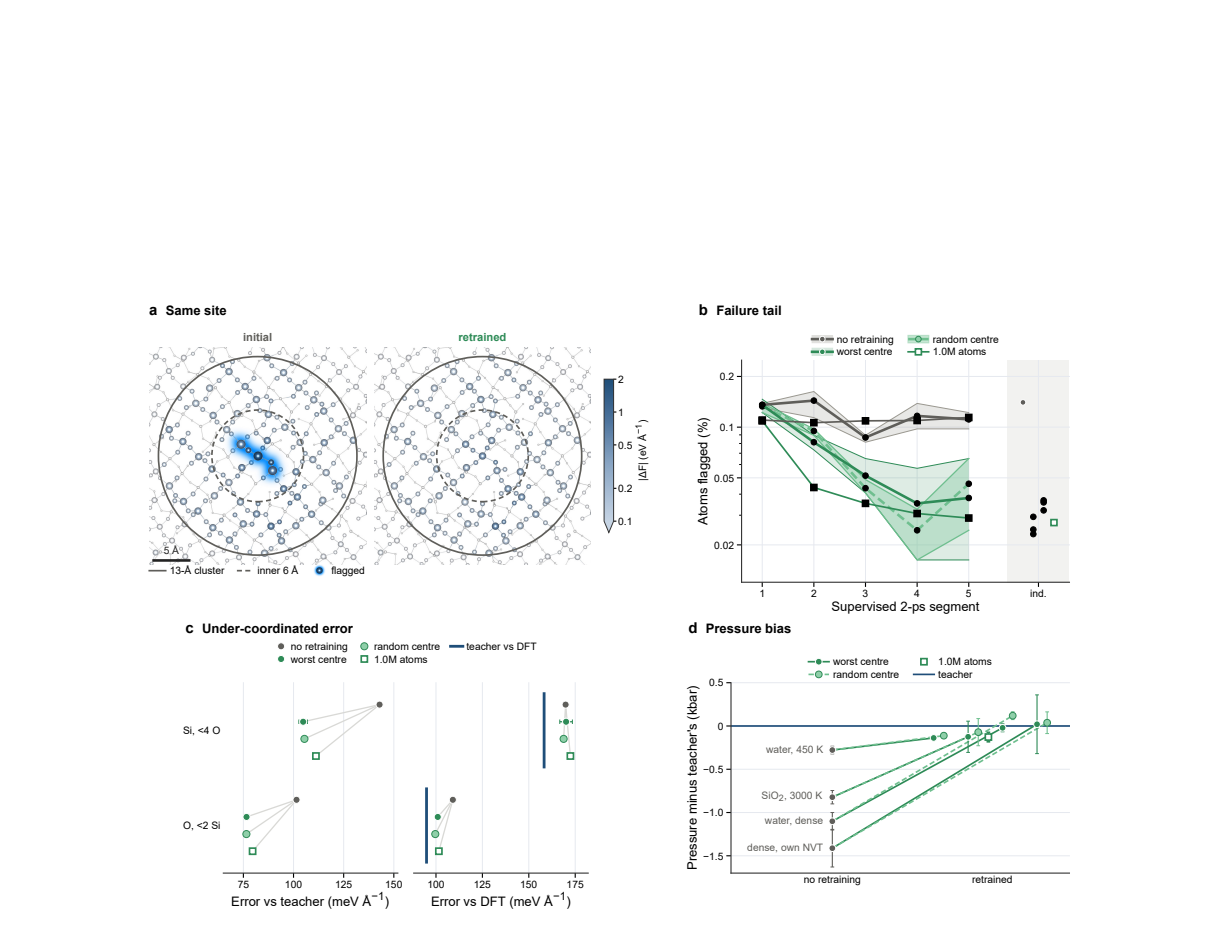
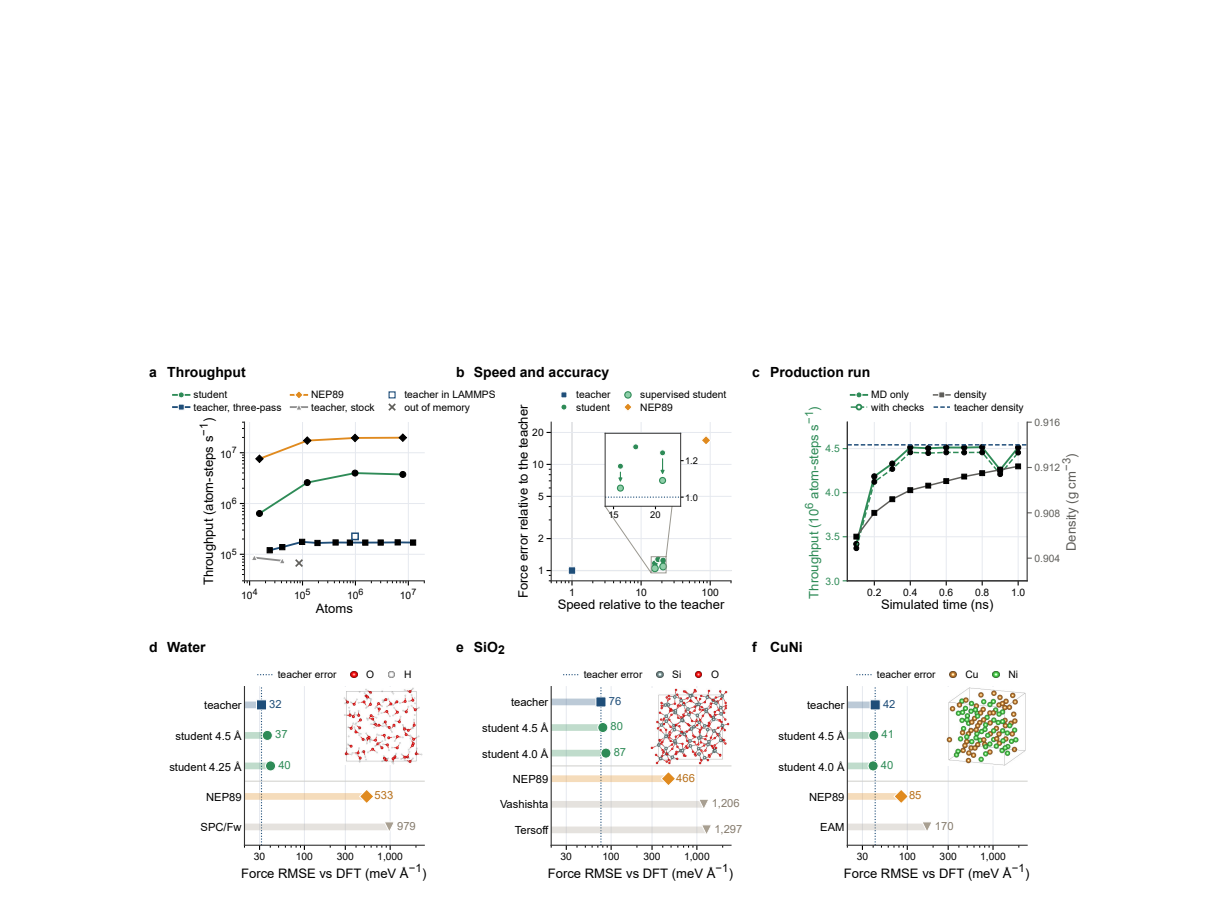
System-averaged error metrics and small random audits often miss such sparse or isolated failures. Here we use an exact equivariant foundation model, MACE-MPA-0, to check every atom of million-atom production simulations. Reorganizing two-layer MACE inference into a receiver-chunked three-pass schedule that keeps no per-edge intermediates resident reduces the marginal memory per atom 340-fold, evaluates up to 2.86 × 10⁷ atoms on a single H200 GPU, and supervises 106-atom trajectories in LAMMPS at 1.3% of the run time. Distilled MACE students run four to nine times slower than NEP89 with 0.95-1.28 times the teacher's force error against density functional theory (DFT). In molten SiO2, whole-system checks uncover a persistent tail of under-coordinated atoms hidden by the system-averaged error and an isolated, unphysical O-O contact that a 1% random audit misses 94% of the time. On-the-fly retraining on teacher-labelled 13-Å clusters, with the force loss restricted to their inner 6 Å, removes three quarters of the failure tail and the kilobar-level pressure biases in SiO2 and compressed water; the repair converges to the teacher, not to DFT.
from the abstract
Pith says
Machine review · deepseek-v4-flash · 19 Oct 2026 · what was read was not recorded · not checked by a person
It can be wrong. Challenge this review or reply to it.
Holds up. Solid engineering: the three-pass schedule is algebraically exact and verified, the failure-detection experiments are well-controlled, and the limitations are stated honestly. Worth a serious referee. This line is wrong
5 minor
How often objections from reviews like this one are right: not yet measured
Not checked: figures, code, what the 39 references say.
5 minor objections
The paper says, at Section 3.3, Figure 4 and Table S14
Pith says: minor objection 1 of 5
The million-atom repair run (1.03×10^6 atoms) uses only one seed. The authors acknowledge this in Section 4 as a limitation. While the three seeds at 12,288 atoms provide statistical replication for the smaller system, adding a second seed for the million-atom case (or stating a resource constraint more clearly) would strengthen confidence in the scalability of the repair.
The paper says, at Section 3.4, Figure 5a-c
Pith says: minor objection 2 of 5
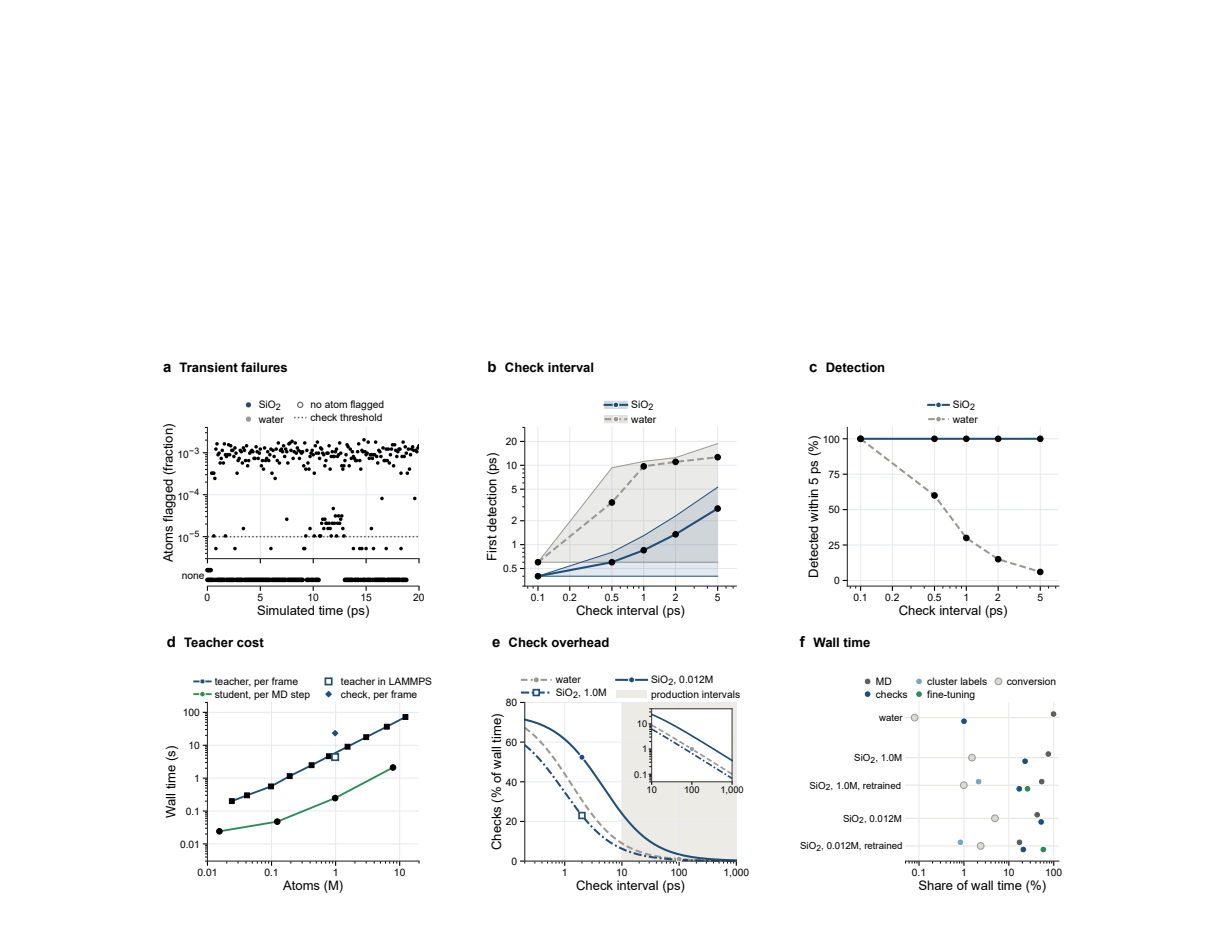
The analysis of transient vs. persistent tails is valuable, but the suggestion that 'criteria based on the persistence of flagged atoms over consecutive checks or on their absolute number would separate the two cases' is not implemented. Adding a simple demonstration (e.g., applying a persistence criterion to the water data) would make the recommendation more concrete.
show 3 more
The paper says, at Section 2.1, Algorithm 1
Pith says: minor objection 3 of 5
The notation G[C ∪ S] += ∂e2/∂H^(1) could be clarified: is the gradient accumulated on both the receiver chunk and its senders? The text says 'back-propagates the first term of eq 2 into the pair forces and ∂e_2/∂H^(1) into G' and that G has size N×512. A short comment in the algorithm caption would help readers unfamiliar with adjoint accumulation.
The paper says, at Supplementary Note 4, Table S7
Pith says: minor objection 4 of 5
The cluster radius study (Table S7) shows that 13 Å clusters are sufficient for label fidelity. However, the text mentions that 15 Å clusters reduce the label deviation further but give the same retrained student accuracy. This result is important and could be moved to the main text, perhaps as a sentence in Section 3.1 or 3.3, to support the claim that the 13 Å choice is justified.
The paper says, at Section 3.6, Table 2
Pith says: minor objection 5 of 5
The throughput for SevenNet-0 in LAMMPS is given as 8.5×10^4 atom-steps s^-1 with a 23 GB peak. It would be helpful to state the number of atoms for this measurement (presumably 983,040 as for the other entries) and the chunk size used, for reproducibility.
What would settle it
Re-run the million-atom SiO2 repair experiment (Section 3.3) with two additional random seeds of the initial velocities and random-number generator, while keeping the student initialization and training data fixed; report the spread of the final student force RMSE and flagged fraction on the independent teacher frames. This would quantify the reproducibility of the repair at scale, addressing the acknowledged limitation.
from the skeptic's reading
How the review went
4 readings by deepseek-v4-flash · 19 Oct 2026
- Reader holds up
- Skeptic agrees
- Editor wrote the verdict above
- Referee minor revision: 5 minor
Not run on this paper: the simulated authors' defence.
Pith did not check this review's objections against the paper.
The review in full
The review in brief, machine-written
This paper delivers what it promises: a way to run an exact equivariant foundation model on million-atom frames with one GPU, by reorganising two-layer MACE inference into three receiver-chunked passes that keep no per-edge intermediates resident. The schedule is proved partition-invariant in the SI, verified numerically to machine precision, and the memory reduction (340-fold, to 4.57 kB per atom) is cleanly measured. That alone is a useful piece of work.
What is actually new: the combination of whole-system supervision of a distilled student with on-the-fly cluster retraining. The empirical finding that a 1 % random audit misses an isolated six-atom O–O contact 94 % of the time is striking, and the controlled repair experiments (three seeds at 12 k atoms, one run at 1 M) show the method works. The paper also honestly measures where it does not work: the teacher’s own error on under-coordinated Si bounds the student, repair converges to the teacher not to DFT, and the 1 M-atom repair demonstration lacks seed replication. Code, data and models are public.
Soft spots in proportion: (i) The million-atom repair run has no seed replication, which the authors acknowledge. Fine. (ii) The check-interval analysis shows that transient failures in water can be missed by sparse checks, but the paper does not propose a criterion to separate persistent from transient tails. That is a development question, not a flaw. (iii) The students’ short-range cutoff costs 1–2 % of the water density, and the pressure-bias in ambient water after cluster retraining is a side effect of missing stress labels. Both are stated. (iv) The throughput comparison with NEP89 is honest about what it compares (GPUMD on the same GPU), but the ratio will change as implementations improve. Not a weakness of the paper. Overall the central claims hold up, and the limitations are explicitly scoped.
Who benefits: anyone building or using distilled potentials who wants to audit whole trajectories, and anyone developing memory-efficient inference for graph-based potentials. This paper is not a breakthrough in accuracy—the repair ceiling is the teacher’s DFT error—but it is a clear methodological advance with rigorous validation.
Recommendation: send to a serious referee. The paper is well-argued, reproducible, and its claims are supported by the evidence presented. Minor revisions could tighten the discussion of transient vs persistent failures, but the work is ready for peer review as is.
The strongest objection
The paper's central claim that whole-system supervision with an exact foundation model detects and repairs local failures of distilled potentials is supported by extensive verification: the three-pass schedule is algebraically exact and verified numerically, cluster labels are tested for fidelity, and retraining is shown to reduce failure tails and pressure biases across multiple seeds and scales. The most significant limitation—that the teacher's own errors bound achievable student accuracy and that the million-atom repair run lacks seed replication—is explicitly acknowledged in the manuscript (Sections 3.3 and 4). No hidden assumption or internal inconsistency undermines the argument.
The paper delivers a clean methodological advance with careful numerical verification and honest reporting of limitations. The three-pass schedule is exact, the memory reduction is real, and the detection/repair experiments are well-designed with multiple seeds at 12k atoms and a single demonstration at 1M atoms. The reader's verdict captures the strengths accurately. I find no additional load-bearing concern that would warrant changing the verdict. The million-atom seed replication is the obvious remaining check, but the authors already note this as a limitation.
The referee's report
If the results hold, this work provides a practical and principled framework for validating and repairing distilled potentials in production MD. The three-pass schedule is algebraically exact and numerically verified, and the memory reduction is dramatic, making exact foundation-model supervision feasible on a single GPU. The controlled experiments clearly separate what random audits miss, what cluster retraining fixes, and where the teacher's own DFT errors limit the repair. The paper is explicit about its limitations (single seed at 10^6 atoms, teacher-bounded accuracy, no stress in clusters, short-range students). This is a significant advance for large-scale MD with equivariant models.
Pith's reading of the paper (a machine's summary, not the authors')
The paper establishes that whole-system supervision with an exact foundation model is feasible for million-atom molecular dynamics at just 1.3% overhead. A receiver-chunked three-pass evaluation schedule reduces the marginal memory of MACE-MPA-0 by 340-fold, fitting up to 28.6 million atoms on a single H200 GPU. This makes it possible to check every atom of a production simulation. In molten SiO₂, such checks uncover a persistent tail of under-coordinated atoms and an isolated unphysical O–O contact that a 1% random audit misses 94% of the time. On-the-fly cluster retraining on teacher-labelled 13-Å clusters removes three quarters of the failure tail and fixes kilobar-level pressure biases, though the repair converges to the teacher, not to DFT.
What carries the argument. Receiver-chunked three-pass schedule. The total energy of a two-layer MACE model is computed in three sweeps over disjoint chunks of receiver atoms: Pass A evaluates layer-1 features for each chunk without autograd; Pass B evaluates the layer-2 energy and back-propagates it, accumulating the upstream gradient G and the first term of the force derivative; Pass C recomputes layer-1 with autograd and back-propagates a surrogate that includes G, yielding the second term. Per-edge intermediates exist only inside the active chunk, reducing the resident state from 1.55 MB per atom to 4.57 kB per atom (340-fold). On-the-fly cluster retraining: when a segment fails, up to four 13-Å clusters are carved around the atoms with the largest per-atom force deviation, labelled by the teacher in vacuum, and the student is fine-tuned for 40–60 epochs with the force loss restricted to the inner 6 Å to avoid surface label error.
Core claim. The paper demonstrates that whole-system checks with an exact equivariant foundation model (MACE-MPA-0) detect sparse, clustered local failures in million-atom MD simulations that system-averaged error metrics and small random audits systematically miss. In molten SiO₂ at 3000 K, a distilled MACE student shows a force RMSE of 66–74 meV/Å—below the 90 meV/Å threshold—yet 1,140 atoms (1.1×10⁻³ of the system) exceed a per-atom force deviation of 0.5 eV/Å, with under-coordinated Si and O enriched 8- and 17-fold. An isolated O–O contact involving six atoms is detected only by checking every atom; a 1% random audit has a 6% probability of containing it. Fine-tuning the student on 13-Å clusters carved around the worst-performing atoms and labelled by the teacher in vacuum (force loss restricted to the inner 6 Å) removes three quarters of the flagged tail, reduces under-coordinated Si error from 143 to 105 meV/Å, and eliminates kilobar-level pressure biases in SiO₂ and compressed water. The repair converges the student toward the teacher, not toward DFT; where the teacher itself errs (e.g. under-coordinated Si at 3000 K, 158 meV/Å against DFT), the student inherits that error.
The premise it rests on. The MACE-MPA-0 foundation model provides sufficiently accurate force and energy labels for all chemical environments encountered in the simulations, including the under-coordinated defect sites that the distilled student fails on—an assumption the paper shows is violated for under-coordinated Si at 3000 K, where the teacher's own error against DFT is 158 meV/Å.
If the paper is right (Pith's inferences, not the authors')
Whole-system supervision can be applied as a routine quality-control step in large-scale MD driven by any distilled potential, with a cost that is negligible at production check intervals (1.3% at one check per 100 ps).
The three-pass schedule generalises layer by layer to deeper NequIP-type networks (e.g. SevenNet-0), enabling exact evaluation of multi-layer equivariant models on millions of atoms on a single GPU.
On-the-fly cluster retraining corrects diffuse coordination-defect tails and isolated catastrophic failures without requiring new DFT data, because the teacher labels are the foundation model; the approach is bounded by the teacher’s own accuracy against DFT.
Random placement of clusters suffices for distributed tails, whereas isolated extreme failures (e.g. the O–O contact) require clusters centred on the worst atoms; the checks should keep running during retraining.
The approach identifies that system-averaged RMSE is an unreliable metric for detecting sparse failures in large systems, and that small random audits have vanishing probability of capturing isolated extreme events.
The three-pass schedule removes the memory bottleneck of equivariant message-passing potentials without altering the model or requiring multiple GPUs, so any existing MACE (or NequIP-type) foundation model can immediately be used for whole-system supervision at scale.
The finding that random placement of clusters works as well as worst-atom placement for diffuse tails suggests a two-tier strategy: a cheap global check triggers retraining on a modest number of random clusters, and worst-atom targeting is reserved for rare, isolated events.
Because the repair converges to the teacher and not to DFT, the practical limit of this supervision pipeline is the accuracy of the foundation model itself. Systems or conditions where the teacher is known to be inaccurate (e.g. under-coordinated Si at high T) would require a DFT fine-tuning stage on the teacher, not just the student.
The transient failure tails observed in ambient water (present in only 44 of 189 frames) imply that check-interval design must distinguish between persistent and transient failures—a simple persistence criterion over consecutive checks could avoid unnecessary retraining on noise.
Check this review
Pith stored no record of this review's passes and took no fingerprint of it. Reviews made by code from 13 Nov 2026 on carry both.
How often reviews like this one are right
Reviews like this one: written by deepseek-v4-flash, where what was read was not recorded.
How often objections from reviews like this one are right: not yet measured
Reviews by people
This review was written by a machine. No person has reviewed this paper on Pith yet. A scientist listed on Pith can review it for a fee, and their review is published here whatever it concludes.
The paper
Abstract
Machine-learned interatomic potentials distilled from foundation models enable fast large-scale molecular dynamics (MD), but they can fail locally in chemical environments that their training data did not sample. System-averaged error metrics and small random audits often miss such sparse or isolated failures. Here we use an exact equivariant foundation model, MACE-MPA-0, to check every atom of million-atom production simulations. Reorganizing two-layer MACE inference into a receiver-chunked three-pass schedule that keeps no per-edge intermediates resident reduces the marginal memory per atom 340-fold, evaluates up to 2.86 × 10⁷ atoms on a single H200 GPU, and supervises 106-atom trajectories in LAMMPS at 1.3% of the run time. Distilled MACE students run four to nine times slower than NEP89 with 0.95-1.28 times the teacher's force error against density functional theory (DFT). In molten SiO2, whole-system checks uncover a persistent tail of under-coordinated atoms hidden by the system-averaged error and an isolated, unphysical O-O contact that a 1% random audit misses 94% of the time. On-the-fly retraining on teacher-labelled 13-Å clusters, with the force loss restricted to their inner 6 Å, removes three quarters of the failure tail and the kilobar-level pressure biases in SiO2 and compressed water; the repair converges to the teacher, not to DFT.
The paper's own sentences, arranged, kept beside the review and separate from it. Each label is drawn from a closed vocabulary; the number beside it is the probability the classifier gave that label. No sentence in this record was written by a model.
abstract compiled · 2026-10-20
The authors' main claim, as the classifier picked it out 0.83
“On-the-fly retraining on teacher-labelled 13-{\AA} clusters, with the force loss restricted to their inner 6 {\AA}, removes three quarters of the failure tail and the kilobar-level pressure biases in SiO$_2$ and compressed water; the repair converges to the teacher, not to DFT.”
How the main claim is stated: asserted 1.00
What the abstract itself states, as probabilities: claims first 0.07 · states limitation 0.89 · human participants 0.01 · controlled comparison 0.76 · randomized assignment 0.03 · states quantitative result 0.99 · compares with prior results 0.96 · mentions code or data availability 0.04
The abstract, sentence by sentence
This table labels the abstract only (arXiv listing abstract v1). The number is the probability the classifier gave the label.
| Sentence | Role | The authors' own work | States the main conclusion | Strength |
|---|---|---|---|---|
| Machine-learned interatomic potentials distilled from foundation models enable fast large-scale molecular dynamics (MD), but they can fail locally in chemical environments that their training data did not sample. | background 0.96 | 0.08 | 0.07 | hedged possibility 0.61 |
| System-averaged error metrics and small random audits often miss such sparse or isolated failures. | gap 0.58 | 0.21 | 0.04 | asserted 0.87 |
| Here we use an exact equivariant foundation model, MACE-MPA-0, to check every atom of million-atom production simulations. | contribution 0.60 | 0.92 | 0.11 | asserted 1.00 |
| Reorganizing two-layer MACE inference into a receiver-chunked three-pass schedule that keeps no per-edge intermediates resident reduces the marginal memory per atom 340-fold, evaluates up to $2.86\times10^{7}$ atoms on a single H200 GPU, and supervises $10^{6}$-atom trajectories in LAMMPS at 1.3% of the run time. | method 0.86 | 0.95 | 0.11 | asserted 1.00 |
| Distilled MACE students run four to nine times slower than NEP89 with 0.95-1.28 times the teacher's force error against density functional theory (DFT). | result 0.92 | 0.81 | 0.07 | asserted 1.00 |
| In molten SiO$_2$, whole-system checks uncover a persistent tail of under-coordinated atoms hidden by the system-averaged error and an isolated, unphysical O-O contact that a 1% random audit misses 94% of the time. | result 1.00 | 0.95 | 0.25 | asserted 1.00 |
| On-the-fly retraining on teacher-labelled 13-{\AA} clusters, with the force loss restricted to their inner 6 {\AA}, removes three quarters of the failure tail and the kilobar-level pressure biases in SiO$_2$ and compressed water; the repair converges to the teacher, not to DFT. | result 0.77 | 0.94 | 0.44 | asserted 1.00 |
What kind of paper the classifier reports this is: method or tool 1.00 · evidence from simulation or computation 1.00
What was examined, and what was not
Sources read
- arXiv listing abstract v1
Not examined
- full text
- figures and tables
- references and citing sentences
- relations to other papers
Levels run
- P abstract
Not run
- S sections
- T body sentences
- C citations
- R cross-paper relations
How the labels were made
Compiled by classifier-1.13.0 via TypeSafe API, question bank abstract-p1-20260923, 2026-10-20: 1 request, 5,982 input tokens.
Every quoted sentence on this record is the authors'. Every label is from Pith's closed vocabulary, with the probability shown beside it. This record as JSON
Figures (6)
Figures are the authors', reproduced from the paper.
References (39)
- [1] Batzner, S.; Musaelian, A.; Sun, L.; Geiger, M.; Mailoa, J. P.; Kornbluth, M.; Molinari, N.; Smidt, T. E.; Kozinsky, B. E(3) -equivariant graph neural networks for data-efficient and accurate interatomic potentials. Nature Communications 2022, 13, 2453 on Pith
- [2] Musaelian, A.; Batzner, S.; Johansson, A.; Sun, L.; Owen, C. J.; Kornbluth, M.; Kozinsky, B. Learning local equivariant representations for large-scale atomistic dynamics. Nature Communications 2023, 14, 579 on Pith
- [3] Batatia, I.; Kov \'a cs, D. P.; Simm, G. N. C.; Ortner, C.; Cs \'a nyi, G. MACE : Higher Order Equivariant Message Passing Neural Networks for Fast and Accurate Force Fields. Advances in Neural Information Processing Systems. 2022; pp 11423--11436 on Pith
- [4] Zeng, J.; Zhang, D.; Lu, D.; Mo, P.; Li, Z.; Chen, Y.; Rynik, M.; Huang, L.; Li, Z.; Shi, S.; Wang, Y.; Ye, H.; Tuo, P.; Yang, J.; Ding, Y.; Li, Y.; Tisi, D.; Zeng, Q.; Bao, H.; Xia, Y.; Huang, J.; Muraoka, K.; Wang, Y.; Chang, J.; Yuan, F.; Bore, S. L.; Cai, C.; Lin, Y.; Wang... on Pith
- [5] Fan, Z.; Zeng, Z.; Zhang, C.; Wang, Y.; Song, K.; Dong, H.; Chen, Y.; Ala-Nissila, T. Neuroevolution machine learning potentials: Combining high accuracy and low cost in atomistic simulations and application to heat transport. Physical Review B 2021, 104, 104309 on Pith
- [6] Fan, Z.; Wang, Y.; Ying, P.; Song, K.; Wang, J.; Wang, Y.; Zeng, Z.; Xu, K.; Lindgren, E.; Rahm, J. M.; Gabourie, A. J.; Liu, J.; Dong, H.; Wu, J.; Chen, Y.; Zhong, Z.; Sun, J.; Erhart, P.; Su, Y.; Ala-Nissila, T. GPUMD : A package for constructing accurate machine-learned pot... on Pith
- [7] Drautz, R. Atomic cluster expansion for accurate and transferable interatomic potentials. Physical Review B 2019, 99, 014104 on Pith
- [8] Lysogorskiy, Y.; van der Oord, C.; Bochkarev, A.; Menon, S.; Rinaldi, M.; Hammerschmidt, T.; Mrovec, M.; Thompson, A.; Cs \'a nyi, G.; Ortner, C.; Drautz, R. Performant implementation of the atomic cluster expansion ( PACE ) and application to copper and silicon. npj Computati... on Pith
- [9] Liang, T.; Xu, K.; Lindgren, E.; Chen, Z.; Zhao, R.; Liu, J.; Berger, E.; Tang, B.; Zhang, B.; Wang, Y.; Song, K.; Ying, P.; Xu, N.; Dong, H.; Chen, S.; Erhart, P.; Fan, Z.; Ala-Nissila, T.; Xu, J. NEP89 : universal neuroevolution potential for inorganic and organic materials ... on Pith
- [10] Batatia, I.; Batzner, S.; Kov \'a cs, D. P.; Musaelian, A.; Simm, G. N. C.; Drautz, R.; Ortner, C.; Kozinsky, B.; Cs \'a nyi, G. The design space of E(3) -equivariant atom-centred interatomic potentials. Nature Machine Intelligence 2025, 7, 56--67 on Pith
- [11] Deng, B.; Zhong, P.; Jun, K.; Riebesell, J.; Han, K.; Bartel, C. J.; Ceder, G. CHGNet as a pretrained universal neural network potential for charge-informed atomistic modelling. Nature Machine Intelligence 2023, 5, 1031--1041 on Pith
- [12] Schmidt, J.; Hoffmann, N.; Wang, H.-C.; Borlido, P.; Carri c o, P. J. M. A.; Cerqueira, T. F. T.; Botti, S.; Marques, M. A. L. Machine-Learning-Assisted Determination of the Global Zero-Temperature Phase Diagram of Materials. Advanced Materials 2023, 35, 2210788 on Pith
- [13] Schmidt, J.; Cerqueira, T. F. T.; Romero, A. H.; Loew, A.; J \"a ger, F.; Wang, H.-C.; Botti, S.; Marques, M. A. L. Improving machine-learning models in materials science through large datasets. Materials Today Physics 2024, 48, 101560 on Pith
- [14] Barroso-Luque, L.; Shuaibi, M.; Fu, X.; Wood, B. M.; Dzamba, M.; Gao, M.; Rizvi, A.; Uyttendaele, M.; Zitnick, C. L.; Ulissi, Z. W. The Open Materials 2024 ( OMat24 ) inorganic materials dataset and models. Nature Computational Science 2026, 6, 642--652 on Pith
- [15] Batatia, I.; Benner, P.; Chiang, Y.; Elena, A. M.; Kov \'a cs, D. P.; Riebesell, J.; Advincula, X. R.; Asta, M.; Avaylon, M.; Baldwin, W. J.; Berger, F.; Bernstein, N.; Bhowmik, A.; Bigi, F.; Blau, S. M.; C a rare, V.; Ceriotti, M.; Chong, S.; Darby, J. P.; De, S.; Della Pia, ... on Pith
- [16] Gardner, J. L. A.; Baker, K. T.; Deringer, V. L. Synthetic pre-training for neural-network interatomic potentials. Machine Learning: Science and Technology 2024, 5, 015003 on Pith
- [17] Gardner, J. L. A.; Thomas du Toit , D. F.; Ben Mahmoud, C.; Faure Beaulieu, Z.; Juraskova, V.; Pa s ca, L.-B.; Rosset, L. A. M.; Duarte, F.; Martelli, F.; Pickard, C. J.; Deringer, V. L. Distillation of atomistic foundation models across architectures and chemical domains. 202... on PithPith's reviewarXiv
- [18] Lian, X.; Pasquarello, A. Data-Efficient and Fast Machine Learning Molecular Dynamics through Integrated Active Learning and Knowledge Distillation. Journal of Chemical Theory and Computation 2026, 22, 8730--8739 on Pith
- [19] Sudhama, A.; Zhang, Z.-Y.; Zhang, C. Foundation model distillation with PiNNAcLe : Application to the ZnCl _2 aqueous electrolyte solution. Electrochimica Acta 2026, 572, 149136 on Pith
- [20] Zhang, W.; Wu, X.; Wang, C.; Hu, S.; Liu, Y.; Wang, L.-W. Constructing machine learning interatomic potentials with minimum amount of ab initio data. npj Computational Materials 2026, 12, 174 on Pith
show 19 more
- [21] Jinnouchi, R.; Karsai, F.; Kresse, G. On-the-fly machine learning force field generation: Application to melting points. Physical Review B 2019, 100, 014105 on Pith
- [22] Jinnouchi, R.; Lahnsteiner, J.; Karsai, F.; Kresse, G.; Bokdam, M. Phase Transitions of Hybrid Perovskites Simulated by Machine-Learning Force Fields Trained on the Fly with Bayesian Inference. Physical Review Letters 2019, 122, 225701 on Pith
- [23] Vandermause, J.; Torrisi, S. B.; Batzner, S.; Xie, Y.; Sun, L.; Kolpak, A. M.; Kozinsky, B. On-the-fly active learning of interpretable Bayesian force fields for atomistic rare events. npj Computational Materials 2020, 6, 20 on Pith
- [24] Zhang, Y.; Wang, H.; Chen, W.; Zeng, J.; Zhang, L.; Wang, H.; E, W. DP-GEN : A concurrent learning platform for the generation of reliable deep learning based potential energy models. Computer Physics Communications 2020, 253, 107206 on Pith
- [25] NVIDIA cuEquivariance : CUDA -accelerated primitives for equivariant neural networks. GitHub repository, 2024; https://github.com/NVIDIA/cuEquivariance, First release v0.1.0, November 2024. Accessed 2026-09-26 on Pith
- [26] Ansel, J.; Yang, E.; He, H.; Gimelshein, N.; Jain, A.; Voznesensky, M.; Bao, B.; Bell, P.; Berard, D.; Burovski, E.; Chauhan, G.; Chourdia, A.; Constable, W.; Desmaison, A.; DeVito, Z.; Ellison, E.; Feng, W.; Gong, J.; Gschwind, M.; Hirsh, B.; Huang, S.; Kalambarkar, K.; Kirsc... on Pith
- [27] Thompson, A. P.; Aktulga, H. M.; Berger, R.; Bolintineanu, D. S.; Brown, W. M.; Crozier, P. S.; in 't Veld , P. J.; Kohlmeyer, A.; Moore, S. G.; Nguyen, T. D.; Shan, R.; Stevens, M. J.; Tranchida, J.; Trott, C.; Plimpton, S. J. LAMMPS -- a flexible simulation tool for particle... on Pith
- [28] Smith, J. S.; Bettencourt, M.; Pellegrini, F.; Glines, F.; Kucukbenli, E. Enabling Scalable AI -Driven Molecular Dynamics Simulations. NVIDIA Technical Blog, 2025; https://developer.nvidia.com/blog/enabling-scalable-ai-driven-molecular-dynamics-simulations/, Describes the LAMM... on Pith
- [29] Johansson, A.; Weinberg, E.; Trott, C. R.; McCarthy, M. J.; Moore, S. G. LAMMPS-KOKKOS : Performance Portable Molecular Dynamics Across Exascale Architectures. Proceedings of the SC '25 Workshops of the International Conference for High Performance Computing, Networking, Stora... on Pith
- [30] Kozinsky, B.; Musaelian, A.; Johansson, A.; Batzner, S. Scaling the Leading Accuracy of Deep Equivariant Models to Biomolecular Simulations of Realistic Size. Proceedings of the International Conference for High Performance Computing, Networking, Storage and Analysis (SC '23).... on Pith
- [31] Park, Y.; Kim, J.; Hwang, S.; Han, S. Scalable Parallel Algorithm for Graph Neural Network Interatomic Potentials in Molecular Dynamics Simulations. Journal of Chemical Theory and Computation 2024, 20, 4857--4868 on Pith
- [32] Kong, L.; Shim, J.; Hu, G.; Fung, V. Scalable foundation interatomic potentials via message-passing pruning and graph partitioning. npj Computational Materials 2026, 12, 180 on Pith
- [33] Choro s ajev, V.; B \'e ny, C. Sobek: Streaming Equivariant Tensor Product Convolutions. 2026; arXiv:2607.18074 on PithPith's reviewarXiv
- [34] Fu, L.; Feng, Z.; Li, Y.; Du, H.; He, X.; Wu, J.; Bao, K.; Zhang, Y.; Deng, Z.; Lu, Z.; Zhu, B. Train for Accuracy, Execute at Scale: Architecture-Preserving Inference for Equivariant Atomistic Foundation Models. 2026; arXiv:2610.01036 on PithPith's reviewarXiv
- [35] Li, T.; Li, W.; Peng, A.; Xue, J.; Zhang, L.; Zhang, D.; Wang, H. DPA4 : Pushing the Accuracy-Cost Frontier of Interatomic Potentials with EMFA SO(2) Convolution. 2026; arXiv:2606.02419 on PithPith's reviewarXiv
- [36] Li, T.; Xue, J.; Zhang, L.; Zhang, D.; Wang, H. Universal Machine-learning Molecular Dynamics at the Speed of Empirical Potentials. 2026; arXiv:2608.19041 on PithPith's reviewarXiv
- [37] Tuckerman, M.; Berne, B. J.; Martyna, G. J. Reversible multiple time scale molecular dynamics. The Journal of Chemical Physics 1992, 97, 1990--2001 on Pith
- [38] Kaplan, A. D.; Liu, R.; Qi, J.; Ko, T. W.; Deng, B.; Riebesell, J.; Ceder, G.; Persson, K. A.; Ong, S. P. A Foundational Potential Energy Surface Dataset for Materials. 2025; arXiv:2503.04070 on PitharXiv
- [39] Batatia, I.; Lin, C.; Hart, J.; Kasoar, E.; Elena, A. M.; Norwood, S. W.; Wolf, T.; Cs \'a nyi, G. Cross Learning between Electronic Structure Theories for Unifying Molecular, Surface, and Inorganic Crystal Foundation Force Fields. 2025; arXiv:2510.25380 mcitethebibliography on PitharXiv
Challenges and discussion
Disagree with the review, or know something it missed? Leave a comment, or challenge this review formally: a challenge becomes a permanent entry in this paper's record, and its decision is published here.
Come back by email
A short list of the week's newly reviewed papers. Nothing is sent until you confirm from your inbox, and every email has a link that stops it. No account.
No comments yet.
Sign in to comment