Machine Learning · arXiv:2610.20136 v1 · submitted 14 Oct 2026 · 26 references
Seeing at the Edge: Energy Characterization of Vision-Language Model Inference on Edge Platforms
The paper says
“Vision-language models (VLMs) are moving onto edge devices, but little is known about how much energy they draw on single-board computers with NPU or GPU accelerators, or where that energy goes.”
more of the abstract
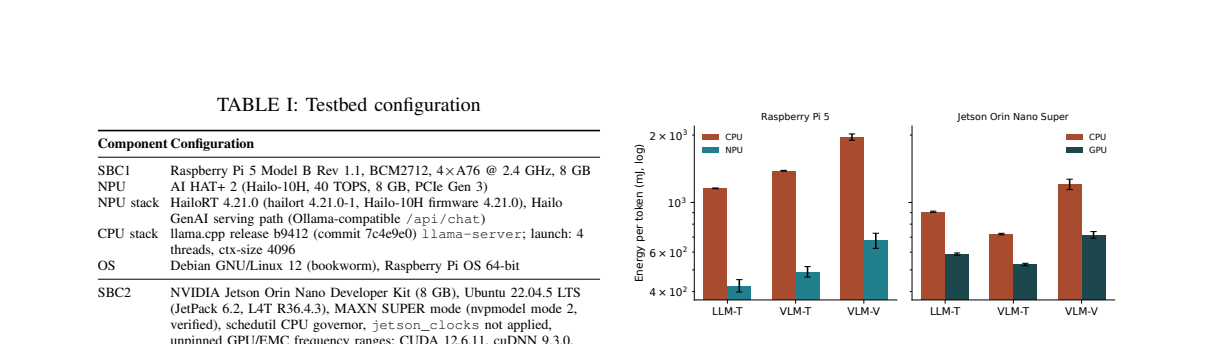
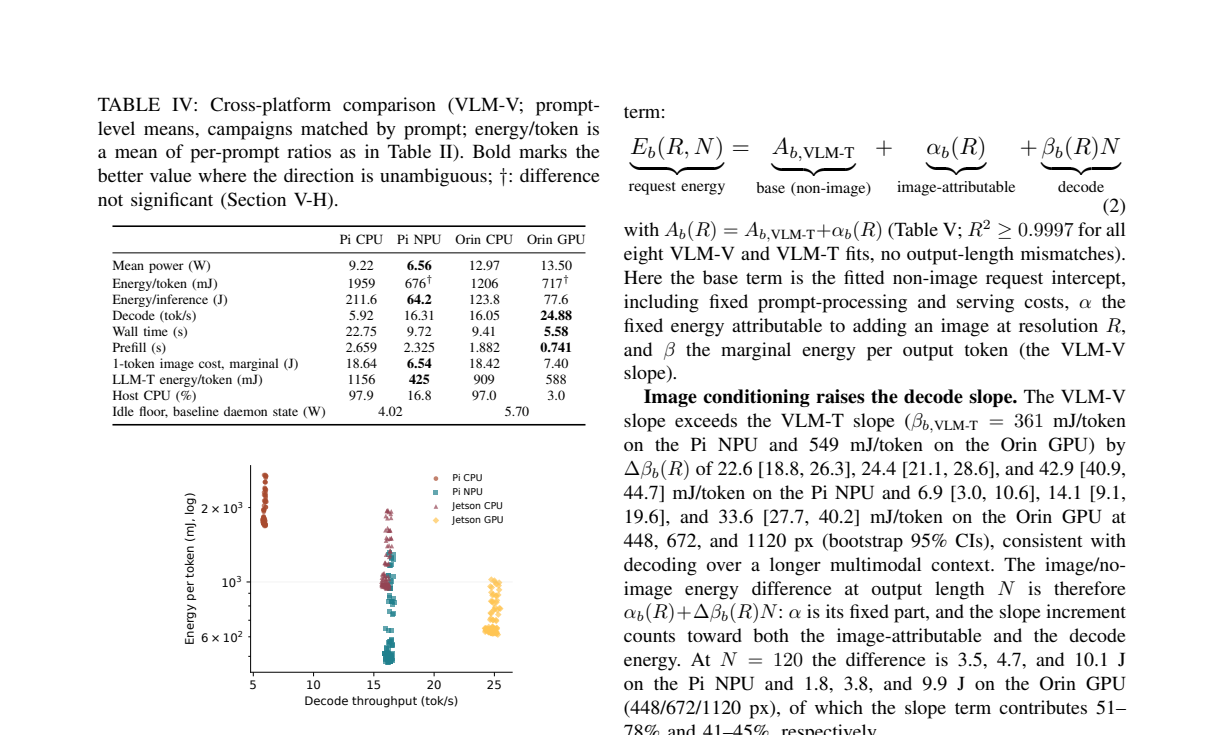
We measure total-system energy, latency, and thermal behavior of Qwen2-VL-2B-Instruct and its text-only sibling on a Raspberry Pi 5 with a Hailo-10H NPU and on a Jetson Orin Nano Super, on both CPU and accelerator, and separate the fixed energy of each request from the energy that grows with output length. Because the accelerators use different quantization and serving software, we compare deployment stacks rather than silicon. Three findings stand out. First, NPU offloading makes the Pi a much more efficient VLM platform: it cuts energy per generated token by about two-thirds, leaves the host CPU largely free, and avoids the thermal throttling that the CPU backend reaches in sustained use. Second, an image adds both fixed and per-token energy, but at typical response lengths generating the answer costs far more than processing the image. Third, the Jetson GPU favors short responses through its lower fixed cost per request, whereas the Pi NPU favors longer ones through its lower cost per output token; their energy curves cross near 40 output tokens.
from the abstract
Pith says
Machine review · deepseek-v4-flash · 15 Oct 2026 · what was read was not recorded · not checked by a person
It can be wrong. Challenge this review or reply to it.
Holds up, with conditions. Careful VLM energy measurements on Pi/Hailo and Orin; NPU-offload and thermal findings solid, but the ~40-token crossover is testbed-specific. This line is wrong
2 major objections · 5 minor
How often objections from reviews like this one are right: not yet measured
Not checked: figures, code, what the 26 references say.
The paper says, at Section V-I, Table V, Abstract, Conclusion
The review did not quote this passage.
A classifier read this sentence of the paper as acknowledging the concern (probability 0.74):
“Absolute Joules are uncalibrated, and the crossover rests on one prompt/image probe plus the natural-suite consistency check.”
Pith says: Objection 1 of 2 · major
The paper's central quantitative claim is the 38–44-token crossover, but its precision is overstated at the claim-summary level. The bootstrap 95% CIs in Table V (e.g., [43.1, 44.3] at 448 px, [37.6, 38.7] at 1120 px) resample trials within the single probe prompt only, as the fit-diagnostics paragraph concedes.
more of objection 1
Two additional uncertainties are quantified in the paper itself: the Orin-GPU one-token residual (+0.22 to +0.26 J in all three fits) would shift the crossover by roughly 1.4 tokens, more than the ~0.6-token bootstrap half-widths, and the natural-suite per-prompt estimates span 33–55 tokens (IQR 36–46). Since the abstract and conclusion quote "near 40" and "38–44 output tokens" without this band, I recommend presenting the crossover as approximately 40 tokens with the natural-suite IQR (36–46) as the principal uncertainty in those summary statements, and adding a Table V caption note that the bracketed intervals reflect trial-resampling only.
The paper says, at Section IV-E / V-I
The review did not quote this passage.
Pith says: Objection 2 of 2 · major
It is not stated whether the two platforms in the fixed-length probe were interleaved or run as sequential blocks during the Aug. 9 follow-up session. The crossover is a ratio of small cross-stack differences (A_gap ≈ 7.5 J and β_gap ≈ 0.18 J/token at 672 px), and the paper's own sensitivity estimate (≈5.6 tokens per joule of intercept-gap error) means even a sub-joule drift between block-sequential platform runs would matter at the quoted precision.
more of objection 2
The sequential-block limitation in Section VI is stated for the main campaign; please state the run order of the probe paths, report any drift diagnostics across the 210-trial session, or explicitly extend the limitation to the probe.
5 minor objections
The paper says, at Section V-I
Pith says: minor objection 1 of 5
One sentence clarifying that the two-point per-prompt lines in the natural-suite check share the linearity assumption of Eq. (2) — so the check quantifies prompt-to-prompt variability rather than testing linearity — would help readers weigh the hedge correctly; the probe's R² ≥ 0.9997 supplies the linearity evidence, making the two estimates complementary rather than independent.
The paper says, at Table V
Pith says: minor objection 2 of 5
The 51–81% lower fixed-intercept claim is reported without a CI, unlike the slope and crossover quantities; a bootstrap CI for the intercept gap would make the uncertainty reporting uniform across all load-bearing parameters.
show 3 more
The paper says, at Section VI
Pith says: minor objection 3 of 5
The sentence reporting the Pi throttle flag should read "throttle_status 0x80008" (a separating space is missing from the current text).
The paper says, at Fig. 6
Pith says: minor objection 4 of 5
The one-token residuals on the Orin-GPU panels are central to the crossover sensitivity discussion; annotating their values on the figure would make that connection visible without requiring readers to reconstruct them from the text.
The paper says, at General
Pith says: minor objection 5 of 5
No data/code availability statement is provided; since much of the paper's value rests on the measurement methodology, releasing the harness, prompt suite, and grading scripts would materially aid reproducibility and is worth adding.
What would settle it
Rerun the fixed-length probe (lengths 1, 8, 16, 32, 64, 128, 256; three trials per length) on the Pi-NPU and Orin-GPU stacks in one session with 5–10 prompts spanning the short/medium/long categories and at least two image resolutions, fitting Eq. 2 per prompt and stack. If the per-prompt crossover distribution remains centered near 38–44 with a narrow IQR and every crossover is positive, the concern fails. If the median shifts by more than ~10 tokens or crossovers go non-positive, report the crossover as a prompt-dependent range and soften the near-40 headline.
from the skeptic's reading
How the review went
4 readings by deepseek-v4-flash · 15 Oct 2026
- Reader holds up, with conditions
- Skeptic agrees
- Editor wrote the verdict above
- Referee minor revision: 2 major objections, 5 minor
Not run on this paper: the simulated authors' defence.
Pith did not check this review's objections against the paper.
The review in full
The review in brief, machine-written
Two things to know. First, this is the most careful VLM energy characterization on NPU-equipped single-board computers I have seen: INA228 hardware-accumulated energy, validity gates, prompt-level paired statistics with Holm correction, byte-identical GGUF files, and residual plots that show where the linear fit is weakest. Second, the headline crossover number (NPU vs GPU near 38-44 output tokens) is softer than the bootstrap CIs suggest, and the authors themselves say as much (b229). The qualitative claim survives; the exact number should not travel. What is actually new: Edge-LLM-Bench covered text-only LLMs on the same Pi/Hailo platform, and Zhan et al. profiled VLM energy on GPU-class hardware. This paper is the first total-system multimodal energy decomposition on an NPU-equipped SBC, adding a three-condition ablation (LLM, VLM without image, VLM with image) and a fixed-length probe that separates fixed request cost from marginal decode cost. That decomposition is the right framing, and it produces a non-obvious answer: the Orin-GPU stack wins on fixed cost, the Pi-NPU stack wins on marginal decode, so the better stack depends on response length. The NPU offloading result on the Pi - 65.5% gross / 80.4% idle-subtracted energy reduction, no throttle flag across three 30-minute sessions while the CPU backend throttles in every session - is robust and practically valuable. The discussion of the conflicting CPU-vs-NPU speed orderings in the literature is handled honestly. Soft spots, in proportion. The crossover is computed from one prompt/image pair per resolution, and the natural-suite consistency check uses a two-point per-prompt approximation that shares the linearity assumption and inherits any bias from the separate one-token campaign. The bootstrap intervals resample trials only, so they understate systematic error; the paper's own residual analysis flags ~1.4 tokens of shift, and a 1 J intercept-gap error would move the crossover roughly 5.6 tokens. But the length-dependent reversal is not fragile: all 30 natural-suite prompts give positive crossovers (median 40, IQR 36-46), and the short/medium/long category means fall clearly on either side. The residual pattern at one token is reported, not hidden. Minor items: no artifact repository, absolute Joules uncalibrated, sequential block ordering - all acknowledged in the limitations section. This deserves a serious referee. The crossover needs caveating, not fixing; the paper does not oversell it. Anyone doing edge VLM deployment or energy measurement should read and cite it.
The strongest objection
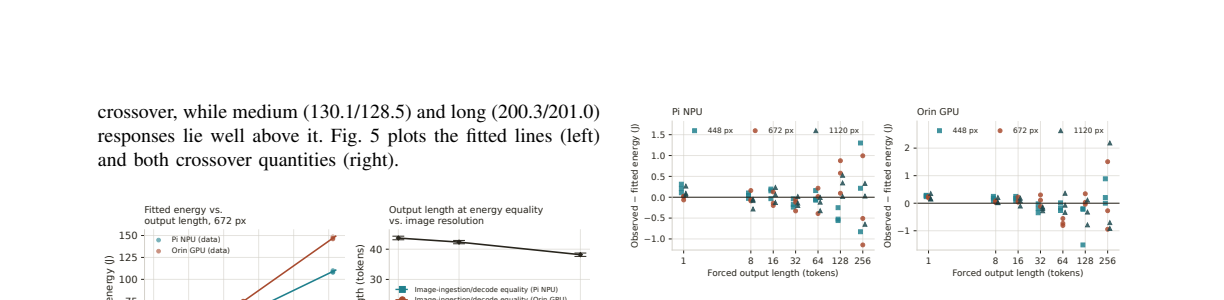
The load-bearing step is Eq. 2/Section V-I: a two-parameter linear fit per stack to 21 trials of one prompt/image pair. The crossover N* is a ratio of small fitted differences (A_gap ≈ 7.5 J, β_gap ≈ 0.18 J/token at 672 px), so it is sensitive to systematic errors not captured by the reported bootstrap CIs, which resample trials only. A 1 J intercept-gap error moves N* by ≈5.6 tokens. The natural-suite check in Section V-I uses 30 prompts, a genuine hedge that supports the qualitative reversal (all 30 positive; median 40, IQR 36–46). But each per-prompt line is built from one-token and full-run mean energies from separate campaigns via β=(E_full−E_one)/(N−1), so it does not independently test the linearity assumption and inherits any bias in the one-token campaign. The authors explicitly flag the one-prompt limitation (b229), so this is not a hidden flaw; it is the remaining quantitative uncertainty in the central claim.
I read the central claim as the length-dependent ordering of the two accelerator stacks, with the near-40-token crossover as its quantitative expression. The controlled probe is internally strong: R2≥0.9997, decode-rate cross-checks within 0.2%, all 210 trials reaching target length, and fit residuals are small except for a ~0.2–0.3 J positive one-token residual on the GPU. The natural-suite consistency check provides prompt-level breadth and is a real hedge: all 30 per-prompt crossovers are positive with median 40. What remains load-bearing is the exact value: the Table V bootstrap intervals cover trial resampling only; they do not cover choice of prompt/image or session drift between the one-token and full-run campaigns, and the two-point natural-suite construction shares the linearity assumption. This is precisely the condition the reader named, and the authors acknowledge it in b229. Because the qualitative finding (no single stack dominates; response length selects the lower-energy stack) survives even if the crossover moves by several tokens, I would not move the verdict to ACCEPT or REJECT. The CONDITIONAL verdict stands unchanged, conditional on the proposed multi-prompt rerun and data release.
The referee's report
If the results hold, the crossover finding is a practically useful deployment result: across two low-cost edge accelerator stacks, no single platform dominates VLM request energy, and the response-length distribution selects the cheaper stack. The supporting methodology is unusually careful for a measurement paper: hardware-accumulated power/energy monitoring with validity gates, prompt-level paired statistics with Holm correction, byte-identical GGUF weights across the CPU/GPU paths, fitted decode slopes that match backend-reported rates within 0.2%, and an explicit stack-not-silicon framing. The numerical claims are internally consistent: Table V's crossover values, α/β ratios, and the 7.8-J non-image base gap all reproduce from the reported A and β entries. The natural-suite hedge is genuine: all 30 per-prompt two-point estimates give positive crossovers (β_GPU > β_NPU in 30/30 prompts) with median 40, bracketing the probe's 38–44, and even the extreme per-prompt estimates (33–55 tokens) still separate the short responses (~28 tokens) from the medium/long responses (~130–200 tokens).
Pith's reading of the paper (a machine's summary, not the authors')
This paper measures total-system energy, latency, and thermal behavior of a compact vision-language model (Qwen2-VL-2B) running on a Raspberry Pi 5 with a Hailo-10H NPU and on a Jetson Orin Nano Super, across CPU and accelerator backends. Its central claim is that no single accelerator stack dominates: the Orin GPU stack pays a lower fixed cost per request, while the Pi NPU stack pays a lower marginal cost per generated output token, so their total per-request energy curves cross near 38–44 output tokens. Because real deployments produce short, medium, or long replies, the response-length distribution rather than the silicon selects the efficient stack. The paper also finds that NPU offloading cuts Pi VLM energy per token by roughly two-thirds gross (80% after idle subtraction) while sparing the host CPU, avoiding thermal throttling, and tripling decode throughput. The result gives battery- and heat-constrained edge devices a concrete rule for choosing where to run multimodal inference.
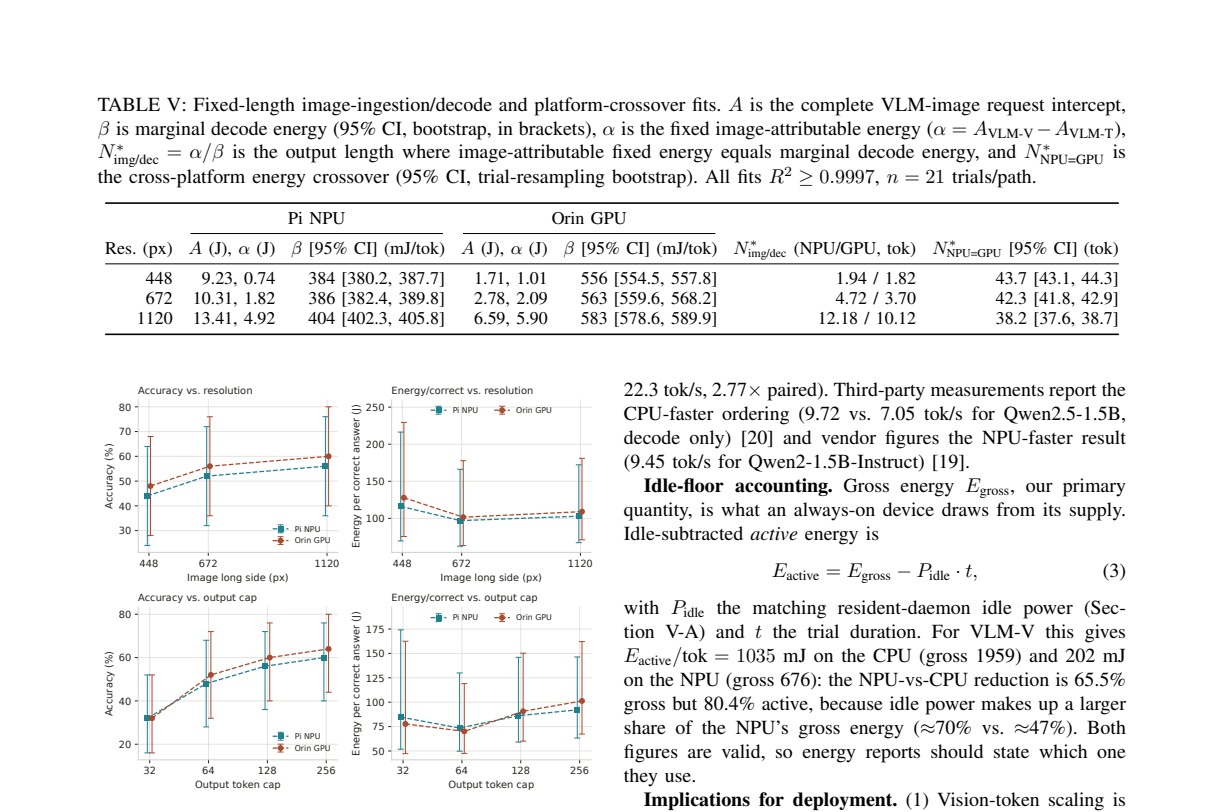
What carries the argument. The central object is the two-term linear energy identity $E_b(R,N) = A_b(R) + \beta_b(R)N$ (Eq. 2), where $A_b$ is the complete request intercept, itself split into a non-image base plus an image-attributable term $\alpha_b(R)$, and $\beta_b$ is the marginal energy per output token. Fitting this to forced output lengths from 1 to 256 tokens (21 hardware-valid trials per path, one fixed prompt/image pair per resolution, $R^2 \geq 0.9997$) converts the entangled hardware comparison into a crossover calculation $N^\ast = (A_{\mathrm{NPU}} - A_{\mathrm{GPU}})/(\beta_{\mathrm{GPU}} - \beta_{\mathrm{NPU}})$, and a within-stack variant $\alpha_b/\beta_b$ separates image-fixed from decode-fixed energy. The decomposition is what turns otherwise tangled measurements into a length-dependent answer.
Core claim. The paper's central result is that request energy for image-conditioned VLM inference separates into a fixed intercept $A_b(R)$ plus a marginal per-token cost $\beta_b(R)$, and the two platforms trade these terms off against each other. The Orin-GPU stack's fixed request intercept is 51–81% lower than the Pi-NPU stack's (1.71–6.59 J versus 9.23–13.41 J), whereas the Pi-NPU stack's marginal decode cost is 30–31.5% lower (384–404 versus 556–583 mJ per output token), so equating the fitted lines places the energy crossover at about 44, 42, and 38 output tokens for 448, 672, and 1120 px images. The intercept gap does not come from image ingestion, whose fixed term is slightly higher on the GPU; it comes from a 7.8 J gap in the non-image serving base (0.70 versus 8.49 J). A consistency check over the 30-prompt natural suite gives a median crossover of 40 tokens (IQR 36–46), matching the controlled probe. Because the two stacks use different quantization, compiler, and serving software, the paper deliberately frames the result as a property of complete deployment stacks rather than of silicon.
The premise it rests on. The crossover rests on fitting the linear additive model to one fixed prompt/image pair at each resolution, so an unrepresentative pair, or a per-token energy cost that is not constant across the 1–256-token range, could move the ~40-token crossover, a reliance the authors acknowledge in their limitations.
If the paper is right (Pith's inferences, not the authors')
Edge VLM deployments should choose their accelerator stack by the expected output-length distribution: short replies favor the GPU stack's low fixed cost, long replies the NPU stack's low marginal cost, with the tie near 40 tokens.
On the Raspberry Pi, NPU offloading improves energy (65.5% gross, 80.4% after idle subtraction), decode throughput (2.75 times), contention resilience, and thermal headroom together, never setting the throttle flag the CPU backend sets in every sustained session.
Decode dominates request energy at typical response lengths: image-fixed energy equals decode energy at only about 2–12 output tokens, and at the suite's typical ~120 tokens the no-image decode term is 4–36 times the whole image/no-image increment.
Offloading leaves the host CPU largely free (17% utilized on the Pi NPU, 3% on the Orin GPU), so other tasks can coexist under host contention with modest energy penalty.
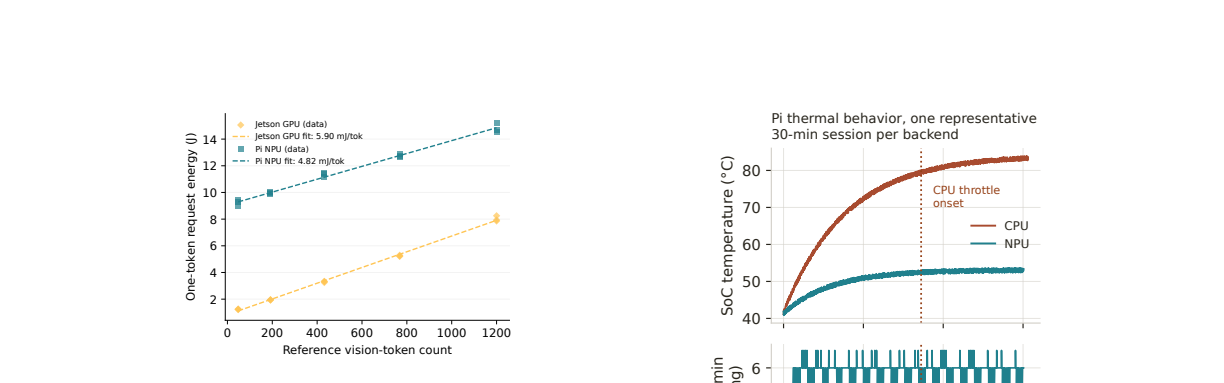
One-token request energy grows near-linearly with vision-token count (4.82–5.90 mJ per vision token), making image resolution a controllable ingestion-energy lever for deployers.
The paper's decomposition implies a practical hardware-selection rule it does not spell out: measure $A_b$ and $\beta_b$ once per candidate stack and weight them by the serving workload's response-length histogram, and the lower-total-energy stack follows directly; this converts an architectural decision into routine cost bookkeeping.
Because the ~40-token crossover sits just above the short-prompt category mean of ~28 generated tokens, terse-answer workloads will usually favor the GPU stack while conversational or document-generating workloads will favor the NPU stack; a mixed deployment near the tie is essentially energy-indifferent.
The GPU's short-response advantage comes from the 7.8 J non-image serving gap, not from image processing, so any reduction in NPU-path serving overhead would move the crossover left and extend the NPU stack's winning length range; a different serving runtime could test this prediction directly.
Check this review
Pith stored no record of this review's passes and took no fingerprint of it. Reviews made by code from 13 Nov 2026 on carry both.
How often reviews like this one are right
Reviews like this one: written by deepseek-v4-flash, where what was read was not recorded.
How often objections from reviews like this one are right: not yet measured
Reviews by people
This review was written by a machine. No person has reviewed this paper on Pith yet. A scientist listed on Pith can review it for a fee, and their review is published here whatever it concludes.
The paper
Abstract
Vision-language models (VLMs) are moving onto edge devices, but little is known about how much energy they draw on single-board computers with NPU or GPU accelerators, or where that energy goes. We measure total-system energy, latency, and thermal behavior of Qwen2-VL-2B-Instruct and its text-only sibling on a Raspberry Pi 5 with a Hailo-10H NPU and on a Jetson Orin Nano Super, on both CPU and accelerator, and separate the fixed energy of each request from the energy that grows with output length. Because the accelerators use different quantization and serving software, we compare deployment stacks rather than silicon. Three findings stand out. First, NPU offloading makes the Pi a much more efficient VLM platform: it cuts energy per generated token by about two-thirds, leaves the host CPU largely free, and avoids the thermal throttling that the CPU backend reaches in sustained use. Second, an image adds both fixed and per-token energy, but at typical response lengths generating the answer costs far more than processing the image. Third, the Jetson GPU favors short responses through its lower fixed cost per request, whereas the Pi NPU favors longer ones through its lower cost per output token; their energy curves cross near 40 output tokens.
The paper's own sentences, arranged, kept beside the review and separate from it. Each label is drawn from a closed vocabulary; the number beside it is the probability the classifier gave that label. No sentence in this record was written by a model.
abstract compiled · 2026-10-15
The authors' main claim, as the classifier picked it out 0.81
“First, NPU offloading makes the Pi a much more efficient VLM platform: it cuts energy per generated token by about two-thirds, leaves the host CPU largely free, and avoids the thermal throttling that the CPU backend reaches in sustained use.”
How the main claim is stated: asserted 1.00
What the abstract itself states, as probabilities: claims first 0.06 · states limitation 0.87 · human participants 0.02 · controlled comparison 0.84 · randomized assignment 0.01 · states quantitative result 0.98 · compares with prior results 0.65 · mentions code or data availability 0.03
The abstract, sentence by sentence
This table labels the abstract only (arXiv listing abstract v1). The number is the probability the classifier gave the label.
| Sentence | Role | The authors' own work | States the main conclusion | Strength |
|---|---|---|---|---|
| Vision-language models (VLMs) are moving onto edge devices, but little is known about how much energy they draw on single-board computers with NPU or GPU accelerators, or where that energy goes. | gap 0.88 | 0.05 | 0.03 | asserted 1.00 |
| We measure total-system energy, latency, and thermal behavior of Qwen2-VL-2B-Instruct and its text-only sibling on a Raspberry Pi 5 with a Hailo-10H NPU and on a Jetson Orin Nano Super, on both CPU and accelerator, and separate the fixed energy of each request from the energy that grows with output length. | method 0.70 | 0.98 | 0.07 | asserted 1.00 |
| Because the accelerators use different quantization and serving software, we compare deployment stacks rather than silicon. | method 0.67 | 0.71 | 0.02 | asserted 0.98 |
| Three findings stand out. | result 0.72 | 0.47 | 0.03 | asserted 0.80 |
| First, NPU offloading makes the Pi a much more efficient VLM platform: it cuts energy per generated token by about two-thirds, leaves the host CPU largely free, and avoids the thermal throttling that the CPU backend reaches in sustained use. | result 1.00 | 0.96 | 0.29 | asserted 1.00 |
| Second, an image adds both fixed and per-token energy, but at typical response lengths generating the answer costs far more than processing the image. | result 1.00 | 0.95 | 0.10 | asserted 1.00 |
| Third, the Jetson GPU favors short responses through its lower fixed cost per request, whereas the Pi NPU favors longer ones through its lower cost per output token; their energy curves cross near 40 output tokens. | result 1.00 | 0.95 | 0.20 | asserted 1.00 |
What kind of paper the classifier reports this is: empirical study 1.00 · evidence from observation or experiment 1.00
What was examined, and what was not
Sources read
- arXiv listing abstract v1
Not examined
- full text
- figures and tables
- references and citing sentences
- relations to other papers
Levels run
- P abstract
Not run
- S sections
- T body sentences
- C citations
- R cross-paper relations
How the labels were made
Compiled by classifier-1.13.0 via TypeSafe API, question bank abstract-p1-20260923, 2026-10-15: 1 request, 5,771 input tokens.
Every quoted sentence on this record is the authors'. Every label is from Pith's closed vocabulary, with the probability shown beside it. This record as JSON
Figures (7)
Showing 5 of the paper's 7 figures. Figures are the authors', reproduced from the paper.
References (26)
- [1] P. Wanget al., “Qwen2-VL: Enhancing vision-language model’s percep- tion of the world at any resolution,”arXiv preprint arXiv:2409.12191, 2024 on PithPith's reviewarXiv
- [2] J. Huang, Z. Deng, and Z. Gu, “Scheduling and resource orchestration for Multi-DNN edge intelligence: A survey of real-time embedded AI systems,” Preprint, 2026 on Pith
- [3] Raspberry Pi Ltd., “Introducing the Raspberry Pi AI HAT+ 2: Generative AI on Raspberry Pi 5,” https://www.raspberrypi.com/news/introducing -the-raspberry-pi-ai-hat-plus-2-generative-ai-on-raspberry-pi-5/, 2026 on Pith
- [4] D. V . Le and ¨O. Durmaz Incel, “Edge-LLM-Bench: Characterising LLM inference on Raspberry Pi 5 with Hailo-10H NPU acceleration,” inProc. 24th Annu. Int. Conf. Mobile Syst., Appl., Services Workshops (MobiSys Workshops). ACM, 2026, pp. 44–50 on Pith
- [5] J. Zhan, H. Shen, M. Guo, Z. Huang, and T. He, “Seeing is free, speaking is not: Uncovering the true energy bottleneck in edge VLM inference,” arXiv preprint arXiv:2607.09520, 2026 on PithPith's reviewarXiv
- [6] Texas Instruments, “INA228 85-V, 20-bit, ultra-precise power/energy/charge monitor with I2C interface,” Datasheet, Rev. A, https://www.ti.com/lit/ds/symlink/ina228.pdf, 2022 on Pith
- [7] Adafruit Industries, “Adafruit INA228 I2C power monitor,” https://lear n.adafruit.com/adafruit-ina228-i2c-power-monitor, accessed: Jul. 13, 2026 on Pith
- [8] A. Yanget al., “Qwen2 technical report,”arXiv preprint arXiv:2407.10671, 2024 on PithPith's reviewarXiv
- [9] V . J. Reddiet al., “MLPerf inference benchmark,” inProc. ACM/IEEE 47th Annual Int. Symp. on Computer Architecture (ISCA), 2020, pp. 446–459 on Pith
- [10] S. Laskaridis, K. Katevas, L. Minto, and H. Haddadi, “MELTing point: Mobile evaluation of language transformers,” inProc. 30th Annual Int. Conf. on Mobile Computing and Networking (MobiCom). ACM, 2024, arXiv:2403.12844 on PithPith's reviewarXiv
- [11] R. Murthyet al., “MobileAIBench: Benchmarking LLMs and LMMs for on-device use cases,”arXiv preprint arXiv:2406.10290, 2024 on PithPith's reviewarXiv
- [12] Y . Liet al., “PalmBench: A comprehensive benchmark of compressed large language models on mobile platforms,” inProc. Int. Conf. on Learning Representations (ICLR), 2025, arXiv:2410.05315 on PithPith's reviewarXiv
- [13] N. Dhar, B. Deng, D. Lo, X. Wu, L. Zhao, and K. Suo, “An empirical analysis and resource footprint study of deploying large language models on edge devices,” inProc. ACM Southeast Conference (ACMSE). ACM, 2024 on Pith
- [14] Z. Luet al., “Small language models: Survey, measurements, and insights,”arXiv preprint arXiv:2409.15790, 2024 on PithPith's reviewarXiv
- [15] S. Samsiet al., “From words to watts: Benchmarking the energy costs of large language model inference,” inProc. IEEE High Performance Extreme Computing Conf. (HPEC). IEEE, 2023, arXiv:2310.03003 on PithPith's reviewarXiv
- [16] G. Qu, Q. Chen, W. Wei, Z. Lin, X. Chen, and K. Huang, “Mobile edge intelligence for large language models: A contemporary survey,”IEEE Communications Surveys & Tutorials, 2025, arXiv:2407.18921 on PithPith's reviewarXiv
- [17] E. J. Husom, A. Goknil, L. K. Shar, and S. Sen, “The price of prompting: Profiling energy use in large language models inference,”arXiv preprint arXiv:2407.16893, 2024 on PitharXiv
- [18] P. Tummalapalli, S. Arayakandy, R. Pal, and K. Kundan, “LLM infer- ence at the edge: Mobile, NPU, and GPU performance efficiency trade- offs under sustained load,”arXiv preprint arXiv:2603.23640, 2026 on PithPith's reviewarXiv
- [19] Hailo Technologies, “Bringing generative AI to the edge: LLM on Hailo- 10H,” https://hailo.ai/blog/bringing-generative-ai-to-the-edge-llm-on-h ailo-10h/, 2026 on Pith
- [20] ai-local-lab, “Examining the TOPS myth: NPU nominal ratings do not predict local LLM speed (in Japanese),” https://ai-local-lab.com/article s/local-ai-tops-myth/, 2026, accessed: Aug. 2, 2026 on Pith
show 6 more
- [21] J. Weiet al., “T-MAC: CPU renaissance via table lookup for low-bit LLM deployment on edge,” inProc. 20th European Conf. on Computer Systems (EuroSys). ACM, 2025, arXiv:2407.00088 on PithPith's reviewarXiv
- [22] E. J. Husomet al., “Sustainable LLM inference for edge AI: Evaluating quantized LLMs for energy efficiency, output accuracy, and inference latency,”arXiv preprint arXiv:2504.03360, 2025 on PithPith's reviewarXiv
- [23] X. Chuet al., “MobileVLM: A fast, strong and open vision language assistant for mobile devices,”arXiv preprint arXiv:2312.16886, 2023 on PithPith's reviewarXiv
- [24] Hailo Technologies, “Hailo model zoo GenAI,” https://github.com/hai lo-ai/hailo model zoo genai, accessed: Jul. 13, 2026 on Pith
- [25] G. Gerganov and llama.cpp contributors, “llama.cpp: LLM inference in C/C++ (llama-server),” https://github.com/ggml- org/llama.cpp, accessed: Jul. 13, 2026 on Pith
- [26] N. Shalavi, A. Khoshsirat, M. Stellini, A. Zanella, and M. Rossi, “Accu- rate calibration of power measurements from internal power sensors on NVIDIA Jetson devices,” inProc. IEEE Int. Conf. on Edge Computing and Communications (EDGE), 2023, arXiv:2306.13107 on PithPith's reviewarXiv
Challenges and discussion
Disagree with the review, or know something it missed? Leave a comment, or challenge this review formally: a challenge becomes a permanent entry in this paper's record, and its decision is published here.
Come back by email
A short list of the week's newly reviewed papers. Nothing is sent until you confirm from your inbox, and every email has a link that stops it. No account.
No comments yet.
Sign in to comment