Computer Vision and Pattern Recognition · arXiv:2610.22341 v1 · submitted 15 Oct 2026 · 45 references
3DCodeVerse: Exploring 3D Worlds as Code
The paper says
“We introduce 3DCodeVerse, a research ecosystem that enables coding agents to create editable and verifiable 3D content at scale. 3DCodeVerse comprises large-scale, high-quality datasets of executable 3D code, a coding harness for spatial reasoning and automated verification, and practical guidance for 3D coding.”
more of the abstract
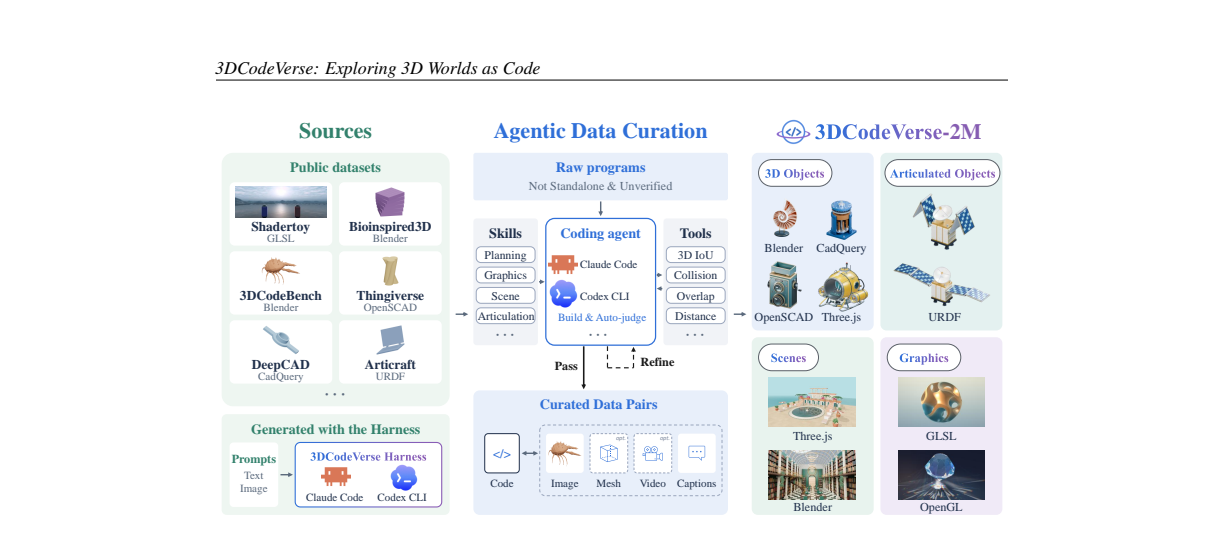
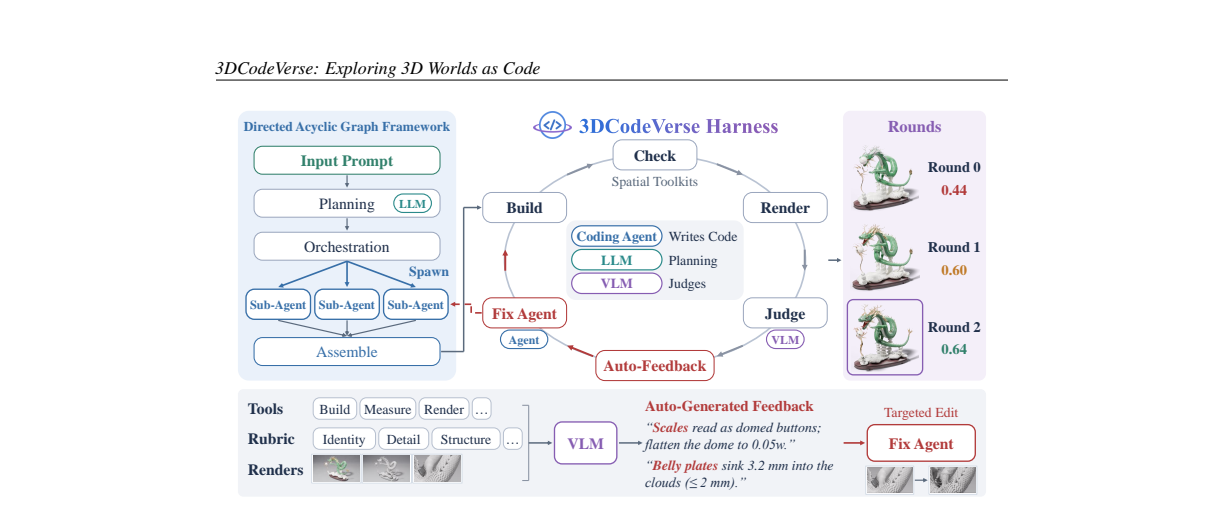
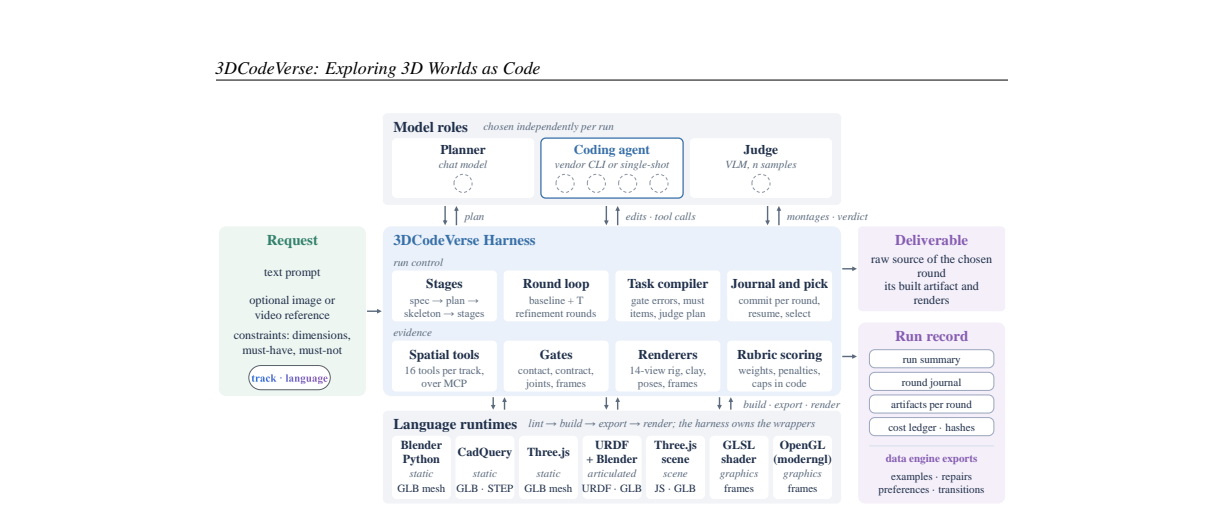
First, we construct 3DCodeVerse-2M, a large-scale curated dataset of standalone 3D executable code. We build this corpus by collecting open-source data, converting specialized representations, and generating new programs with coding agents. Each program is packaged with the source files and associated assets required for execution in its declared environment, along with available descriptions and verification records. Second, we develop the 3DCodeVerse Harness, a multi-agent directed acyclic graph framework for generating and refining 3D content. It uses execution checks, spatial measurements, and visual feedback to automatically evaluate and revise generated programs without human feedback during generation. Third, we conduct systematic empirical studies of 3D coding, establishing baselines with fine-tuned open models and deriving practical guidance through component-level analyses of our harness. Extensive experiments demonstrate that fine-tuning on our dataset significantly improves the 3D coding capabilities of open-source models. Notably, our 3DCodeVerse harness achieves a 90% win rate against Claude Design (3D Object) in pairwise human evaluations, when both are utilized by Claude Opus 5.5.
from the abstract
Pith says
Machine review · deepseek-v4-flash · 16 Oct 2026 · what was read was not recorded · not checked by a person
It can be wrong. Challenge this review or reply to it.
Holds up, with conditions. The dataset and fine-tuning gains are the real contribution; the harness headline partly rests on a VLM-rubric feedback loop that needs a stronger human anchor. This line is wrong
3 major objections · 6 minor
How often objections from reviews like this one are right: not yet measured
Not checked: figures, code, what the 45 references say.
The paper says, at §4 (Eqs. 3–4); §5.1; Appendix C.3; Table 14
The review did not quote this passage.
Pith says: Objection 1 of 3 · major
The harness headline gains (15.5–29.1 points; +49.2 over Claude Design) are measured by an evaluation judge that is the same model–rubric family used in the development-time optimization loop. In Section 4, the judge configuration θJ is refined on a stored artifact bank and the workflow θH is optimized against the judged score s(·;θJ) (Eqs. 3–4); Appendix C.3 then evaluates all …
more of objection 1
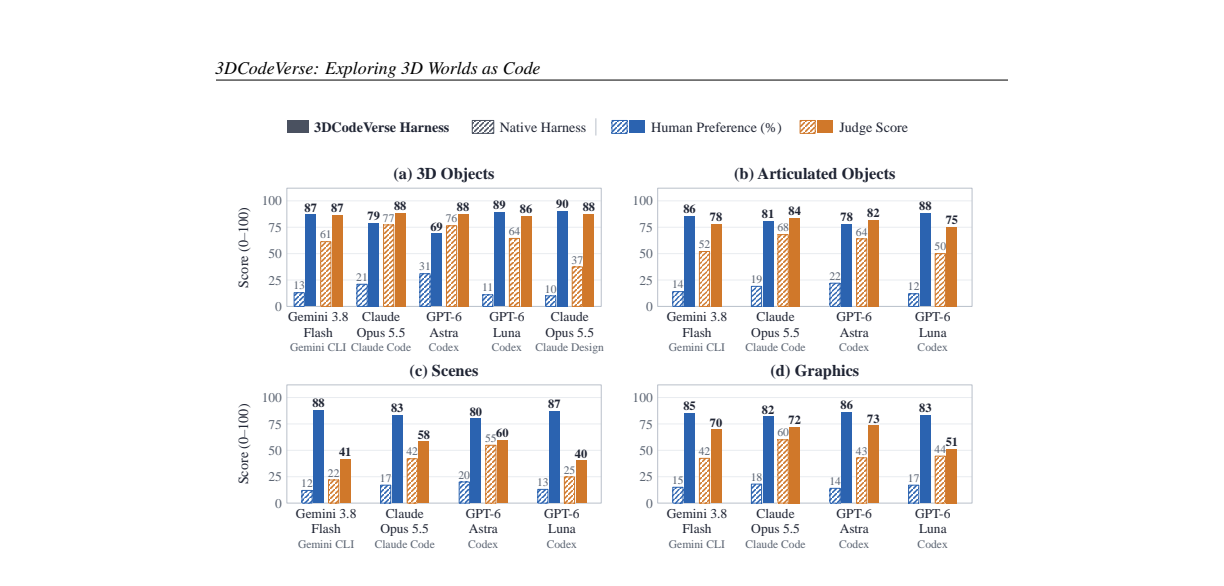
… systems with a frozen pipeline that 'applies the judgment architecture and track rubrics of Appendix A.4,' using the same Gemini 3.1 Pro model that is used as in-loop judge and as the frozen evaluation judge. The three stated safeguards (clean-room rebuild, blind scoring against the raw prompt, deterministic geometric caps) are genuine and rule out leakage of harness plans, checklists, and refinement histories, but they do not validate the rubric's quality weights: a workflow tuned to maximize s(·;θJ) will, by construction, score well on a frozen copy of the same rubric. The appropriate independent evidence is the human-preference anchor, and it is currently under-documented: Appendix C.3 says prompt-level bootstrap confidence intervals were computed, but no interval is reported for any Human Preference value in Figure 4 or Table 14; no rater counts, no inter-rater agreement, and no per-prompt human-vs-Judge Score correlation are given. The SigLIP-2 anchor is too weak to substitute: the deltas in Table 14 (about 0.005–0.011 cosine) are an order of magnitude below the 15–50 point rubric gaps, no noise floor is reported, and SigLIP does not rank systems consistently with the human results (Claude Design's 0.1438 exceeds GPT-6 Luna + harness's 0.1341, even though human preference strongly favors the harness). Please report the human-evaluation details, add the per-prompt human-vs-Judge Score correlation, and re-score a subset of outputs with a differently configured judge (e.g., a different VLM family, or materially altered rubric weights) to test criterion stability.
The paper says, at §5.1; Tables 8 and 15; Appendix C.3
The review did not quote this passage.
Pith says: Objection 2 of 3 · major
The paired backbone design is sound, but the headline harness gains are measured against single-pass one-shot generation at a roughly two-orders-of-magnitude compute disparity: Table 8 reports $3.31 and 20,816K input tokens per object for Gemini 3.8 Flash + 3DCodeVerse Harness versus $0.035 and 0.3K tokens for the native Flash baseline.
more of objection 2
It is therefore unclear how much of the +15.5–29.1 point gain (and the +49.2 point lead over Claude Design) is attributable to the verification/judgment workflow specifically, rather than to the much larger test-time budget (planning, hundreds of tool calls, best-of-N initialization). Table 17's event-level ablations and Table 10's A/A variance study are informative, but neither supplies the missing control. Please add a compute-matched baseline (e.g., best-of-N independent one-shot samples at a comparable token/cost budget, selected by execution success or a simple geometric heuristic without judge feedback) so that the marginal contribution of the feedback loop can be isolated, or explicitly restate the gain as achieved at substantially higher test-time compute.
The paper says, at §5.1; Figures 4; Tables 9, 14–16; Appendix C.3
The review did not quote this passage.
Pith says: Objection 3 of 3 · major
The scale of the reported evaluation cannot be reconstructed from the paper. Section 5.1 states 100 object, 50 scene, and 50 graphics prompts, but the primary object comparisons use 60 prompts (Appendix C.3), Table 9 reports n = 10–11 per backbone for scenes and graphics (never covering all 50), the backbones in Figure 4(c–d) (Flash, Opus, Astra, Luna) do not …
more of objection 3
… match those in Table 9 (Flash, Sonnet, Luna, Astra), and the articulated-object Human Preference values in Figure 4(b) have no corresponding table, n, or interval anywhere in the text. The number of human comparisons behind the headline '90% win rate against Claude Design' is consequently not determinable: the 'fixed, pre-registered prompt subset shared by all compared systems' mentioned in Appendix C.3 is never sized, and the same comparison appears as 10% in Figure 4(a) and 9% in Table 14, suggesting inconsistent tie handling or pools. Please report, for every panel of Figure 4 and every row of Table 14, the exact prompt counts, the subset overlap across systems, and the number of comparisons and raters behind each percentage.
6 minor objections
The paper says, at Figure 4(a) vs. Table 14
Pith says: minor objection 1 of 6
Reconcile the Claude Design numbers across exhibits: Figure 4(a) shows 10/90 Human Preference, Table 14 shows 9% and 90%, and the VLM Preference for Claude Design is listed as 13% in one row and 14% in another; state the pool size and tie-handling rule for each exhibit.
The paper says, at §5.1
Pith says: minor objection 2 of 6
The sentence stating that Human Preference 'ranges from 69% to 89%' excludes the 90% Claude Design comparison in the same figure; specify that the range refers only to the native-harness comparisons.
show 4 more
The paper says, at Appendix C.4
Pith says: minor objection 3 of 6
The '310K' mixture that underlies the termination-feedback DPO runs (1,779 and 478 pairs) does not appear in Table 6; specify its composition so those results can be interpreted.
The paper says, at Abstract; Appendix B.1; Table 1
Pith says: minor objection 4 of 6
The '2M' headline count refers to 2,028,286 export rows derived from 269,597 unique executable programs via three caption views and pass-level shader decomposition; the abstract and Table 1 should carry both numbers, since '2.03M pairs' overstates the number of distinct programs by roughly 7.5x (the decomposition itself is disclosed in Appendix B.1).
The paper says, at §6; Appendix D; Table 18
Pith says: minor objection 5 of 6
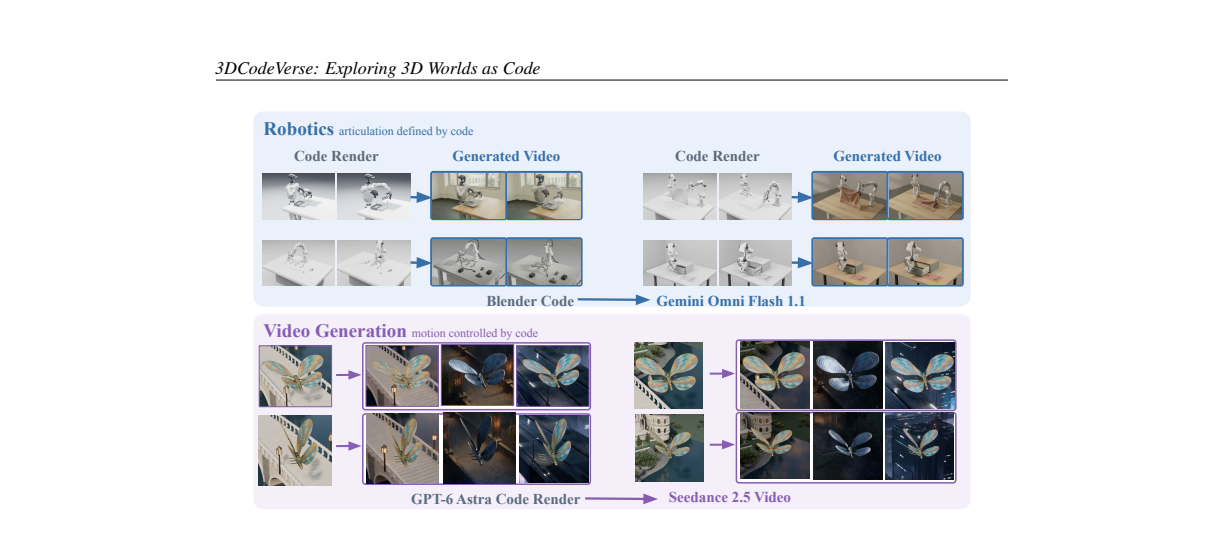
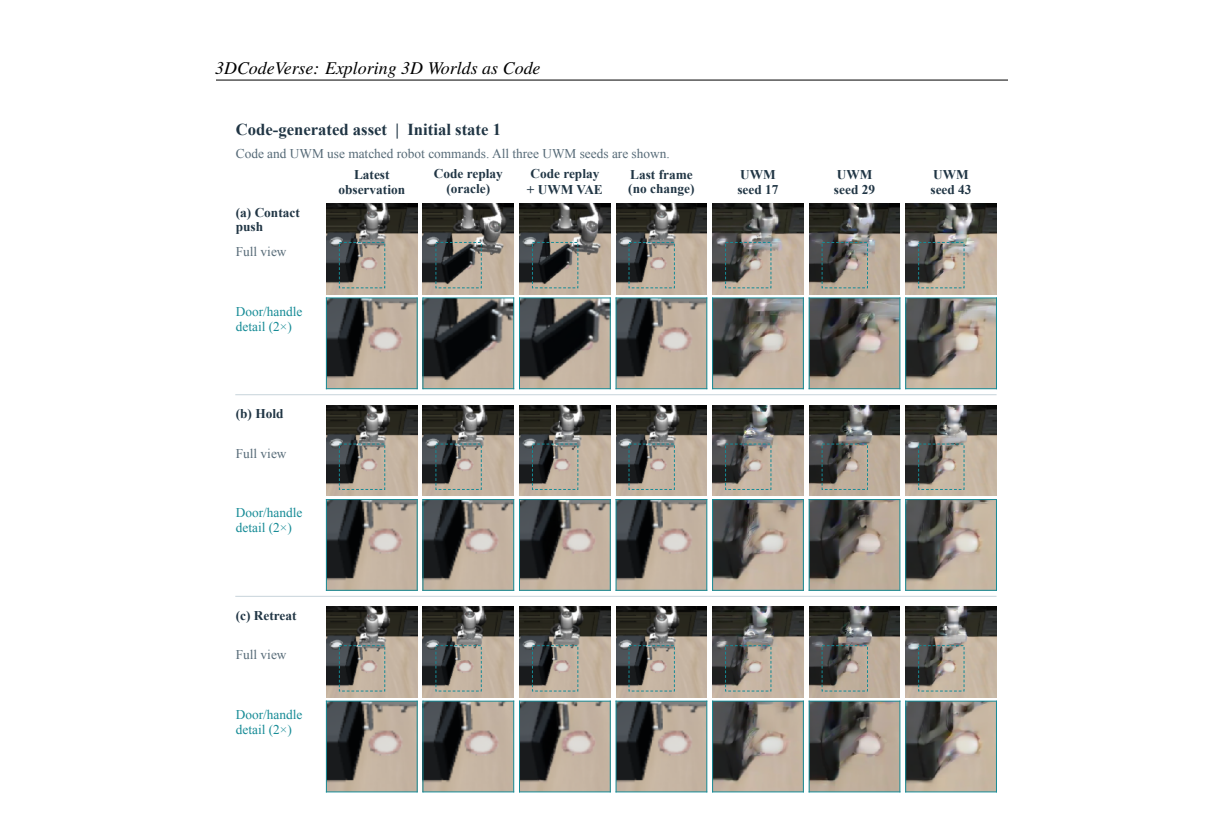
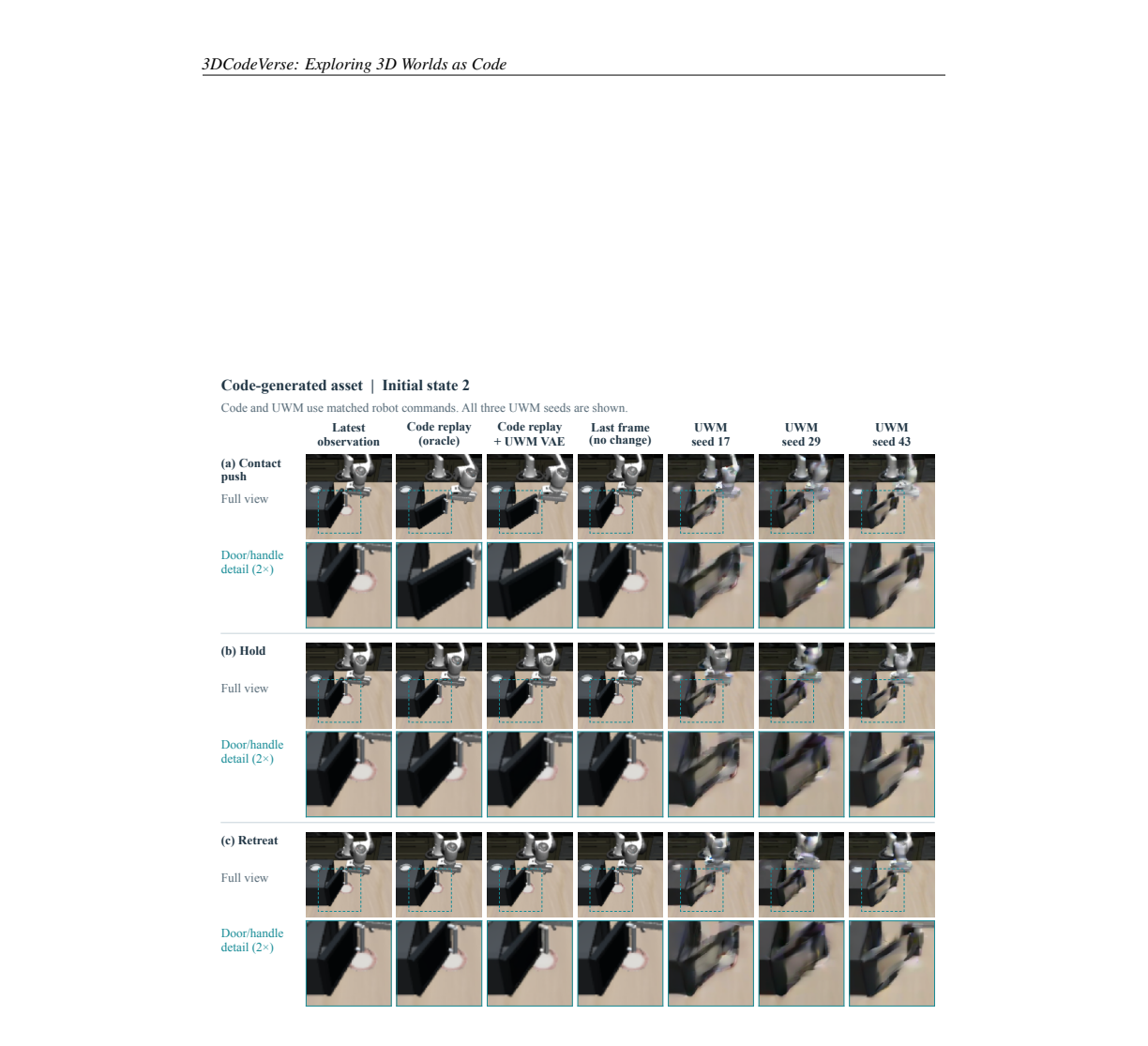
The robotics application is labeled preliminary, which is appropriate, but as it stands the 12/12 versus 7/36 contrast is largely by construction: exact MuJoCo replay is an oracle relative to a learned latent video predictor, and the static-last-frame control (12/12) shows that preserving initial contours is not a discriminating test.
more of objection 5
With one asset, one hand-calibrated door-and-handle detector, and one acceptance criterion, the section supports 'the generated asset is simulator-ready and the harness gates catch kinematic defects,' but not a comparative claim about 3D coding for robotics; consider softening the concluding statement or adding a second asset and a non-oracle baseline.
The paper says, at Table 12
Pith says: minor objection 6 of 6
The before/after columns in Table 12 (e.g., '75.0–82.1') and the column heading 'F ok CD↓' are hard to parse; define the quantities and the 'CD↓' notation in the caption.
What would settle it
Release the full per-prompt pairwise human-evaluation data behind Figure 4 and Table 14: number of raters per pair, per-prompt human votes, and inter-rater agreement (Cohen's κ or Krippendorff's α) for the object, articulated, scene, and graphics comparisons; pre-register a threshold such as a lower 95% CI above 60% on the Claude Design comparison with κ≥0.6, and recompute the headline win rates. If the 90% human win rate survives and per-prompt human votes correlate with the +25 to +49 Judge-Score gaps, the rubric-artifact explanation is refuted; if human votes do not track those gaps, the harness claims should be re-stated on human-judged quality alone.
from the skeptic's reading
How the review went
4 readings by deepseek-v4-flash · 16 Oct 2026
- Reader holds up, with conditions
- Skeptic agrees
- Editor wrote the verdict above
- Referee major revision: 3 major objections, 6 minor
Not run on this paper: the simulated authors' defence.
Pith did not check this review's objections against the paper.
The review in full
The review in brief, machine-written
Two things you should know before reading. First, the dataset is the real work. 3DCodeVerse-2M is the first corpus I know that treats executable 3D code as a multi-dialect training substrate at this scale: 269,597 unique programs, DeepCAD converted to CadQuery with 174,981/178,238 compiling and voxel IoU around 0.985, Articraft geometry inlined with URDF articulation preserved, and provenance, assets, and verification records packaged per program. The strongest result in the paper is fine-tuning on this corpus measured on 3DCodeBench: 0.0% to 84.9% execution for the 9B model and 51.9% to 92.9% for the 27B, with per-dialect F@0.05 gains. That claim is internally consistent, contamination controls are stated, and it would survive even if every harness metric collapsed.
Second, the harness headline is softer than the fine-tuning result. The in-loop judge and the frozen evaluation judge are the same VLM rubric family (Gemini 3.1 Pro). Equations 3 and 4 explicitly tune judge configuration and workflow to maximize that score. The uncapped Svis control and deterministic caps handle geometric defects and score-threshold games, but not aesthetic weight choice. The human preference data is the right disconfirming evidence, but with no rater counts and no inter-rater agreement it cannot carry that load. SigLIP-2 deltas of 0.005–0.011 are in the right direction but too small to validate 15–50 point rubric gaps. So I would call the +15.5 to +29.1 harness gains and the 90% win over Claude Design plausible but unproven until the human protocol is fully specified and correlated with rubric scores per prompt. The paper has no limitations section; these caveats are only in the appendices.
What deserves real credit: the engineering. Deterministic gates, authoring-frame diagnostic projection, the recorded stool run, event-level ablations with thousands of invocations, and the conversion verification are unusually concrete for this area. The robotics UWM comparison is a sideshow—a static last frame passes 12/12 too, so it mainly shows latent world models drift—but it is cleanly labeled an application.
Soft spots in proportion: the judge-evaluation circularity is the main one; the thin human evaluation and the 52/60 detailed-prompt skew in the object head-to-head are secondary; and 3DCodeBench, though held out, is not fully third-party. None of these sinks the dataset or training claims.
This paper deserves a serious referee. I would send it out with a request for full human-eval reporting, a per-prompt judge-vs-human correlation, and release of the dataset, harness, and models. The dataset and recipes alone justify the review.
The strongest objection
The most load-bearing premise is that the VLM judge used for evaluation measures the same quality humans value, despite being the target of the paper's own optimization loop. In Section 4, judge configuration θJ is refined against judge variance and contradiction with measured evidence (Eq. 3), and workflow θH is optimized against the judged score s(f;θJ) (Eq. 4). Appendix C.3 then evaluates all harness results with 'a single frozen evaluation pipeline that applies the judgment architecture and track rubrics of Appendix A.4'—the same Gemini 3.1 Pro rubric family used in-loop. The in-loop judge receives plan digests, acceptance checklists, gate findings, and previous verdicts; the evaluation judge receives a stripped payload, but the scoring criteria and model are the same. The reported +15.5 to +29.1 harness gains, and the +49.2 point gap over Claude Design, therefore partly measure how well the generator matches a rubric that was adversarially tuned to score it. The uncapped Svis control and deterministic caps address geometric defects but not aesthetic weighting; they do not establish that the rubric's weights track human preference. The human-preference anchor is the appropriate disconfirming evidence, but the paper reports no rater counts, no inter-rater agreement, and no per-prompt correlation between human votes and Judge Score. SigLIP-2 deltas (about 0.0055–0.0112 cosine) are too small to validate 15–50 point rubric gaps. If the rubric rewards measurable proxies (gate compliance, part counts, triangle budgets, checklist coverage) rather than human-valued aesthetics, the harness headline shrinks even though the fine-tuning claim on 3DCodeBench may stand.
The reader's CONDITIONAL verdict is the right one. The fine-tuning half is the stronger half: it is measured by execution and geometric fidelity on the external 3DCodeBench suite, with detailed mixture tables, stated contamination controls in Appendix C.1, and per-dialect breakdowns. I do not see a load-bearing flaw there; the main verification burden is checking the stated train/test exclusions once data and models are released. The harness half is where the central risk sits. Equations 3-4 explicitly optimize the judge and workflow against VLM-judged scores, and Appendix C.3 evaluates with the same judgment architecture and rubric family, so the headline gains are vulnerable to rubric overfitting. The uncapped Svis metric and deterministic caps add genuine protection against geometric-defect gaming, but they do not address aesthetic weighting. Human preference and SigLIP-2 are appropriate independent anchors, but the human reporting is too thin: no rater counts, no inter-rater agreement, and no per-prompt judge-versus-human correlation. SigLIP-2 differences are small in absolute cosine terms. A full human-eval disclosure would settle the matter, and the paper currently does not provide it. I also note a secondary apparent discrepancy: Table 2 reports Qwen3.5-9B +SFT Three.js execution at 74.5, while Table 11's otherwise matching 270K row reports 32.5; if Table 2 selects the best mixture per column or aggregates across checkpoints, the table should say so. This does not change the 3DCodeBench headline but should be reconciled in the release. Overall, the rubric concern is real and load-bearing, but it is already what makes the verdict conditional; the reader's verdict should stand.
The referee's report
If the claims hold, this is a substantial systems contribution. The corpus is, to my knowledge, the largest collection of execution-verified multi-dialect 3D code with per-dialect fine-tuning recipes, and several aspects of the empirical practice are genuinely careful: execution rates are machine-checked by running programs in pinned runtimes; contamination controls for the fine-tuning evaluation are stated in detail (Appendix C.1); cost telemetry, prompt-cache statistics, judge repeatability (sigma = 0.030), A/A generation variance, and an uncapped visual-score check (Eq. 7, Table 7) are all reported; and the component ablations in Table 17 are evaluated on event-level telemetry rather than small-N score differences. The fine-tuning result is the strongest and most defensible claim, because its headline metrics (execution rate, F@0.05) are computed from program execution against the external 3DCodeBench portion (212 tasks) with a stated zero-leakage protocol; the internal 593 tasks of the 805-task suite are, however, only protected by an assertion that is not verifiable until release.
Pith's reading of the paper (a machine's summary, not the authors')
The paper sets out to show that 3D content creation can be rebuilt as a code-writing problem with a complete supporting infrastructure: a corpus of 269,597 verified executable programs (packaged into roughly two million prompt-code rows) spanning CAD, Blender, OpenSCAD, articulated mechanisms, scenes, and shaders, together with a multi-agent harness that writes code, runs it, measures it, judges it with a vision-language rubric, and issues targeted repairs without human feedback during generation. The central claim is that these two halves form a closed loop: the harness generates and verifies training data, the data teaches open models to write executable 3D code, and the better models feed the loop. The headline numbers are that fine-tuning lifts executable 3D code generation on the external 3DCodeBench suite from 0% to 84.9% (Qwen3.5-9B) and from 51.9% to 92.9% (Qwen3.8-27B), and that the harness beats a commercial 3D design tool in 90% of human pairwise comparisons when both run on the same backbone. A sympathetic reader would care because, if true, editable and verifiable 3D assets become something open models can produce with automated quality control, and every generation run doubles as training data.
What carries the argument. The carrying mechanism is the harness's execute-measure-judge-repair round, organized as a directed acyclic graph (a dependency graph of coding and assembly tasks with explicit file ownership). A planner first turns the prompt into a structural plan: named parts with metric bounding boxes, materials, attachment topology, and an acceptance checklist binding each criterion to an evidence modality and a must/should priority. Coding sub-agents write isolated files, the harness builds and renders them in pinned language runtimes, deterministic spatial gates emit measured verdicts with numerical fix hints expressed in each language's native coordinate frame, and a vision-language judge inspects multi-view renders plus the telemetry and must state observations before assigning criterion scores, with gate findings vetoing contradictory visual claims and capping the composite score. The round's findings are compiled into at most six prioritized, file-scoped repair tasks, and the loop repeats until checks pass or the budget is spent. A second load-bearing mechanism is the adversarial development loop: the judge's presentation, rubric, and aggregation rules and the workflow's prompts and tools are alternately refined against a fixed artifact bank, which the paper reports separates judge changes from generation changes and yields a repeated-judgment standard deviation of 0.030 for the primary judge.
Core claim. 3DCodeVerse rests on a single claim: that the two halves of the ecosystem form a closed loop that works. The data half, 3DCodeVerse-2M, packages 269,597 standalone executable programs - 128,201 CadQuery programs compiled from DeepCAD sequences, 119,961 GLSL shaders from Shadertoy, Blender Python programs, OpenSCAD projects, URDF mechanisms, and Three.js scenes - each bundled with source files, assets, captions, provenance, and verification records. The harness half, 3DCodeVerse Harness, converts a prompt into a structural plan, decomposes it into a directed acyclic graph of coding and assembly tasks with explicit file ownership, then executes, measures, renders, judges, and repairs the result in repeated rounds, with deterministic spatial gates (connectivity, contact and penetration, plan-contract bounds, joint sweeps) capping and vetoing the VLM judge's score. The paper reports that the loop closes: fine-tuning open models on the dataset raises execution of generated programs on the held-out 3DCodeBench suite from 0% to 84.9% for the 9B model and from 51.9% to 92.9% for the 27B model, with large accompanying gains in geometric fidelity; and the harness beats each backbone's native harness in 69-89% of human comparisons across objects, articulated objects, scenes, and graphics, including a 90% win rate against Claude Design when both run on Claude Opus 5.5. The authors further claim the same loop produces its own supervision: archived successes, failures, and repair traces feed supervised fine-tuning and direct preference optimization, which is what makes the ecosystem a closed loop rather than a dataset plus a tool.
The premise it rests on. The load-bearing premise is that the hand-designed vision-language rubric - used both inside the loop to steer refinement and as the primary evaluation metric - genuinely tracks the quality humans value in 3D content; if the rubric rewards easily measurable surface compliance (connected parts, no interpenetration, triangle budgets) more than aesthetic quality, the harness is being optimized against a ruler that may not see what humans judge.
If the paper is right (Pith's inferences, not the authors')
Fine-tuning on 3DCodeVerse-2M lifts executable 3D code generation on the held-out 3DCodeBench suite from 0% to 84.9% for Qwen3.5-9B and from 51.9% to 92.9% for Qwen3.8-27B, with large gains in geometric fidelity measured by F@0.05 and DINOv2 similarity.
The harness beats each backbone's native harness across all four tracks - objects, articulated objects, scenes, and graphics - with human-preference win rates of 69-89% on objects and judge-score gains of 11-25 points, with the largest gains for the weakest models.
Against Claude Design on the same Claude Opus 5.5 backbone, the harness wins 90% of human pairwise comparisons and scores 88 versus 37 on the rubric, and the paper shows the advantage survives even under an uncapped, scale-free visual score.
Because the harness archives successful programs, failed attempts, and repair traces, the same loop that generates content also produces SFT and DPO training pairs; multi-dialect mixtures transfer across languages, lifting CadQuery execution to 98.5% versus 73.0% under single-dialect training.
Closed-loop verification bridges model tiers: Gemini 3.8 Flash inside the harness matches a frontier one-shot model on hard prompts, and applying the harness to the frontier model pushes it further (+15.5 points, 8/8 head-to-head wins).
If the closed loop is as effective as reported, the economics of 3D content shift: every harness run doubles as a labeled training example, so dataset size, model quality, and verification coverage could compound from compute alone rather than from human annotation.
The development-time adversarial loop that tunes judge configuration and workflow against judged scores is structurally a reward-model optimization; a natural safeguard the paper does not discuss would be an independent, periodically refreshed human or behavioral anchor to keep the rubric from drifting toward what it can measure.
The file-scoped DAG decomposition and deterministic-gate architecture look transferable beyond 3D: any long-horizon multi-file code-generation task (games, scientific simulation, engineering tooling) could reuse the scoped-session and gate template, though the paper only demonstrates it on 3D content.
The robotics and video experiments suggest verified code assets can act as an interoperability layer between physics simulation and generative video models; a testable extension is measuring whether harness-verified assets change robot-learning transfer compared with hand-authored assets of matched geometry.
Check this review
Pith stored no record of this review's passes and took no fingerprint of it. Reviews made by code from 13 Nov 2026 on carry both.
How often reviews like this one are right
Reviews like this one: written by deepseek-v4-flash, where what was read was not recorded.
How often objections from reviews like this one are right: not yet measured
Reviews by people
This review was written by a machine. No person has reviewed this paper on Pith yet. A scientist listed on Pith can review it for a fee, and their review is published here whatever it concludes.
The paper
Abstract
We introduce 3DCodeVerse, a research ecosystem that enables coding agents to create editable and verifiable 3D content at scale. 3DCodeVerse comprises large-scale, high-quality datasets of executable 3D code, a coding harness for spatial reasoning and automated verification, and practical guidance for 3D coding. First, we construct 3DCodeVerse-2M, a large-scale curated dataset of standalone 3D executable code. We build this corpus by collecting open-source data, converting specialized representations, and generating new programs with coding agents. Each program is packaged with the source files and associated assets required for execution in its declared environment, along with available descriptions and verification records. Second, we develop the 3DCodeVerse Harness, a multi-agent directed acyclic graph framework for generating and refining 3D content. It uses execution checks, spatial measurements, and visual feedback to automatically evaluate and revise generated programs without human feedback during generation. Third, we conduct systematic empirical studies of 3D coding, establishing baselines with fine-tuned open models and deriving practical guidance through component-level analyses of our harness. Extensive experiments demonstrate that fine-tuning on our dataset significantly improves the 3D coding capabilities of open-source models. Notably, our 3DCodeVerse harness achieves a 90% win rate against Claude Design (3D Object) in pairwise human evaluations, when both are utilized by Claude Opus 5.5.
The paper's own sentences, arranged, kept beside the review and separate from it. Each label is drawn from a closed vocabulary; the number beside it is the probability the classifier gave that label. No sentence in this record was written by a model.
abstract compiled · 2026-10-16
The authors' main claim, as the classifier picked it out 0.95
“Extensive experiments demonstrate that fine-tuning on our dataset significantly improves the 3D coding capabilities of open-source models.”
How the main claim is stated: asserted 1.00
What the abstract itself states, as probabilities: claims first 0.09 · states limitation 0.07 · human participants 0.50 · controlled comparison 0.79 · randomized assignment 0.02 · states quantitative result 0.99 · compares with prior results 0.97 · mentions code or data availability 0.33
The abstract, sentence by sentence
This table labels the abstract only (arXiv listing abstract v1). The number is the probability the classifier gave the label.
| Sentence | Role | The authors' own work | States the main conclusion | Strength |
|---|---|---|---|---|
| We introduce 3DCodeVerse, a research ecosystem that enables coding agents to create editable and verifiable 3D content at scale. 3DCodeVerse comprises large-scale, high-quality datasets of executable 3D code, a coding harness for spatial reasoning and automated verification, and practical guidance for 3D coding. | contribution 1.00 | 0.90 | 0.16 | asserted 1.00 |
| First, we construct 3DCodeVerse-2M, a large-scale curated dataset of standalone 3D executable code. | contribution 0.70 | 0.97 | 0.04 | asserted 1.00 |
| We build this corpus by collecting open-source data, converting specialized representations, and generating new programs with coding agents. | method 1.00 | 0.95 | 0.02 | asserted 1.00 |
| Each program is packaged with the source files and associated assets required for execution in its declared environment, along with available descriptions and verification records. | method 0.95 | 0.83 | 0.02 | asserted 0.99 |
| Second, we develop the 3DCodeVerse Harness, a multi-agent directed acyclic graph framework for generating and refining 3D content. | contribution 0.53 | 0.97 | 0.03 | asserted 1.00 |
| It uses execution checks, spatial measurements, and visual feedback to automatically evaluate and revise generated programs without human feedback during generation. | method 0.98 | 0.91 | 0.04 | asserted 1.00 |
| Third, we conduct systematic empirical studies of 3D coding, establishing baselines with fine-tuned open models and deriving practical guidance through component-level analyses of our harness. | contribution 0.88 | 0.97 | 0.09 | asserted 1.00 |
| Extensive experiments demonstrate that fine-tuning on our dataset significantly improves the 3D coding capabilities of open-source models. | result 1.00 | 0.96 | 0.45 | asserted 1.00 |
| Notably, our 3DCodeVerse harness achieves a 90% win rate against Claude Design (3D Object) in pairwise human evaluations, when both are utilized by Claude Opus 5.5. | result 1.00 | 0.95 | 0.23 | asserted 1.00 |
What kind of paper the classifier reports this is: method or tool 0.84 · evidence from observation or experiment 1.00
What was examined, and what was not
Sources read
- arXiv listing abstract v1
Not examined
- full text
- figures and tables
- references and citing sentences
- relations to other papers
Levels run
- P abstract
Not run
- S sections
- T body sentences
- C citations
- R cross-paper relations
How the labels were made
Compiled by classifier-1.13.0 via TypeSafe API, question bank abstract-p1-20260923, 2026-10-16: 1 request, 6,988 input tokens.
Every quoted sentence on this record is the authors'. Every label is from Pith's closed vocabulary, with the probability shown beside it. This record as JSON
Figures (16)




Figures are the authors', reproduced from the paper.
References (45)
- [1] Kamel Alrashedy, Pradyumna Tambwekar, Zulfiqar Haider Zaidi, Megan Langwasser, Wei Xu, and Matthew C. Gombolay. Generating CAD code with vision-language models for 3D designs. In The Thirteenth International Conference on Learning Representations, ICLR 2025, Singapore, April 2... on Pith
- [2] Manel Baradad, Richard Chen, Jonas Wulff, Tongzhou Wang, Rogerio Feris, Antonio Torralba, and Phillip Isola. Procedural image programs for representation learning. Advances in Neural Information Processing Systems, 35: 0 6450--6462, 2022 on Pith
- [3] ByteDance Seed . One-take creation, flexible referencing: Introducing seedance 2.5, 2026. URL https://seed.bytedance.com/en/blog/one-take-creation-flexible-referencing-introducing-seedance-2-5. Official model announcement, July 31, 2026 on Pith
- [4] Di Chang, Hongyi Xu, You Xie, Yipeng Gao, Zhengfei Kuang, Shengqu Cai, Chenxu Zhang, Guoxian Song, Chao Wang, Yichun Shi, et al. X-dyna: Expressive dynamic human image animation. In 2025 IEEE/CVF Conference on Computer Vision and Pattern Recognition (CVPR), pp.\ 5499--5509. IEEE, 2025 on Pith
- [5] BingQuan Dai, Luo Li, Qihong Tang, Jie Wang, Xinyu Lian, Hao Xu, Minghan Qin, Xudong Xu, Bo Dai, Haoqian Wang, Zhaoyang Lyu, and Jiangmiao Pang. Meshcoder: Llm-powered structured mesh code generation from point clouds. Advances in Neural Information Processing Systems, 38: 0 8... on Pith
- [6] Matt Deitke, Eli VanderBilt, Alvaro Herrasti, Luca Weihs, Kiana Ehsani, Jordi Salvador, Winson Han, Eric Kolve, Aniruddha Kembhavi, and Roozbeh Mottaghi. ProcTHOR: large-scale embodied AI using procedural generation. In Sanmi Koyejo, S. Mohamed, A. Agarwal, Danielle Belgrave, ... on Pith
- [7] Yuhao Du, Shunian Chen, Wenbo Zan, Peizhao Li, Mingxuan Wang, Dingjie Song, Bo Li, Yan Hu, and Benyou Wang. BlenderLLM: training large language models for computer-aided design with self-improvement. arXiv preprint arXiv:2412.14203, 2024. URL https://arxiv.org/abs/2412.14203 on PithPith's reviewarXiv
- [8] Yipeng Gao, Yunhao Ge, Peilin Cai, Daniel Seita, and Laurent Itti. LAM : Language articulated object modelers. In Proceedings of the IEEE/CVF Conference on Computer Vision and Pattern Recognition (CVPR), pp.\ 16010--16020, June 2026 a on Pith
- [9] Yipeng Gao, Lei Shu, Genzhi Ye, Xi Xiong, Ameesh Makadia, Meiqi Guo, Laurent Itti, and Jindong Chen. 3DCodeBench: benchmarking agentic procedural 3D modeling via code. arXiv preprint arXiv:2606.01057, 2026 b . doi:10.48550/arXiv.2606.01057. URL https://arxiv.org/abs/2606.01057 on PithPith's reviewarXivdoi:10.48550/arxiv.2606.01057
- [10] Google DeepMind . Gemini omni, 2026. URL https://deepmind.google/models/gemini-omni/. Official model documentation. Accessed September 25, 2026 on Pith
- [11] Yunqi Gu, Ian Huang, Jihyeon Je, Guandao Yang, and Leonidas Guibas. Blendergym: Benchmarking foundational model systems for graphics editing. In 2025 IEEE/CVF Conference on Computer Vision and Pattern Recognition (CVPR), pp.\ 18574--18583. IEEE, 2025 on Pith
- [12] Yandong Guan, Xilin Wang, XiMing Xing, Jing Zhang, Dong Xu, and Qian Yu. Cad-coder: Text-to-cad generation with chain-of-thought and geometric reward. Advances in Neural Information Processing Systems, 38: 0 59765--59789, 2026 on Pith
- [13] Jonathan Ho, Ajay Jain, and Pieter Abbeel. Denoising diffusion probabilistic models. Advances in neural information processing systems, 33: 0 6840--6851, 2020 on Pith
- [14] Edward J. Hu, Yelong Shen, Phillip Wallis, Zeyuan Allen-Zhu, Yuanzhi Li, Shean Wang, Lu Wang, and Weizhu Chen. LoRA: low-rank adaptation of large language models. arXiv preprint arXiv:2106.09685, 2021. URL https://arxiv.org/abs/2106.09685 on PithPith's reviewarXiv
- [15] Ziniu Hu, Ahmet Iscen, Aashi Jain, Thomas Kipf, Yisong Yue, David A. Ross, Cordelia Schmid, and Alireza Fathi. SceneCraft: an LLM agent for synthesizing 3D scenes as blender code. In Ruslan Salakhutdinov, Zico Kolter, Katherine A. Heller, Adrian Weller, Nuria Oliver, Jonathan ... on Pith
- [16] Ian Huang, Guandao Yang, and Leonidas Guibas. Blenderalchemy: Editing 3d graphics with vision-language models. In European Conference on Computer Vision, pp.\ 297--314. Springer, 2024 on Pith
- [17] Abhishek Joshi, Beining Han, Jack Nugent, Max Gonzalez Saez-Diez, Yiming Zuo, Jonathan Liu, Hongyu Wen, Stamatis Alexandropoulos, Karhan Kayan, Anna Calveri, Tao Sun, Gaowen Liu, Yi Shao, Alexander Raistrick, and Jia Deng. Procedural generation of articulated simulation-ready ... on PitharXiv
- [18] Mohammad Sadil Khan, Sankalp Sinha, Talha Uddin Sheikh, Didier Stricker, Sk Aziz Ali, and Muhammad Zeshan Afzal. Text2cad: Generating sequential CAD models from beginner-to-expert level text prompts. arXiv preprint arXiv:2409.17106, 2024. URL https://arxiv.org/abs/2409.17106 on PithPith's reviewarXiv
- [19] Woosuk Kwon, Zhuohan Li, Siyuan Zhuang, Ying Sheng, Lianmin Zheng, Cody Hao Yu, Joseph E. Gonzalez, Hao Zhang, and Ion Stoica. Efficient memory management for large language model serving with PagedAttention . arXiv preprint arXiv:2309.06180, 2023. URL https://arxiv.org/abs/2309.06180 on PithPith's reviewarXiv
- [20] Long Le, Jason Xie, William Liang, Hung-Ju Wang, Yue Yang, Yecheng Jason Ma, Kyle Vedder, Arjun Krishna, Dinesh Jayaraman, and Eric Eaton. Articulate-anything: Automatic modeling of articulated objects via a vision-language foundation model. In International Conference on Lear... on Pith
show 25 more
- [21] Beichen Li, Rundi Wu, Armando Solar-Lezama, Changxi Zheng, Liang Shi, Bernd Bickel, and Wojciech Matusik. VLMaterial : Procedural material generation with large vision-language models. In International Conference on Learning Representations (ICLR), pp.\ 33790--33810, 2025 on Pith
- [22] Ling Liu, Bingchen Gong, Amal Dev Parakkat, and Maks Ovsjanikov. 3DHarnessBench : Probing agentic 3D -to-code capabilities of frontier vision-language models, 2026. URL https://arxiv.org/abs/2609.06535 on PithPith's reviewarXiv
- [23] Shuo Lu, Yinuo Xu, Kecheng Yu, Siru Jiang, Yongcan Yu, Yubin Wang, Haitao Yang, Yuxiang Zhang, Bin Wang, Ran He, and Jian Liang. WorldCoder-Bench : Benchmarking physically grounded 3D world synthesis. arXiv preprint arXiv:2606.01869, 2026. URL https://arxiv.org/abs/2606.01869 on PithPith's reviewarXiv
- [24] Sining Lu, Guan Chen, Nam Anh Dinh, Itai Lang, Ari Holtzman, and Rana Hanocka. LL3M: large language 3D modelers. arXiv preprint arXiv:2508.08228, 2025. URL https://arxiv.org/abs/2508.08228 on PithPith's reviewarXiv
- [25] Rachel K. Luu and Markus J. Buehler. Bioinspired3D . Hugging Face dataset, https://huggingface.co/datasets/lamm-mit/Bioinspired3D, 2026 a . Accessed: 2026-09-21 on Pith
- [26] Rachel K. Luu and Markus J. Buehler. Bioinspired123d: generative 3d modeling system for bioinspired structures. AI for Science, 2 0 (2): 0 025004, 2026 b on Pith
- [27] Dimitrios Mallis, Ahmet Serdar Karadeniz, Sebastian Cavada, Danila Rukhovich, Niki Foteinopoulou, Kseniya Cherenkova, Anis Kacem, and Djamila Aouada. CAD-Assistant : Tool-augmented VLLMs as generic CAD task solvers. In Proceedings of the IEEE/CVF International Conference on Co... on Pith
- [28] I \ n igo Quilez and Pol Jeremias. Shadertoy . https://www.shadertoy.com/, 2013. Accessed 2026-09-21 on Pith
- [29] Rafael Rafailov, Archit Sharma, Eric Mitchell, Stefano Ermon, Christopher D. Manning, and Chelsea Finn. Direct preference optimization: Your language model is secretly a reward model. In Advances in Neural Information Processing Systems, volume 36, pp.\ 53728--53741, 2023. URL... on Pith
- [30] Alexander Raistrick, Lahav Lipson, Zeyu Ma, Lingjie Mei, Mingzhe Wang, Yiming Zuo, Karhan Kayan, Hongyu Wen, Beining Han, Yihan Wang, Alejandro Newell, Hei Law, Ankit Goyal, Kaiyu Yang, and Jia Deng. Infinite photorealistic worlds using procedural generation. arXiv preprint ar... on PithPith's reviewarXiv
- [31] Alexander Raistrick, Lingjie Mei, Karhan Kayan, David Yan, Yiming Zuo, Beining Han, Hongyu Wen, Meenal Parakh, Stamatis Alexandropoulos, Lahav Lipson, Zeyu Ma, and Jia Deng. Infinigen indoors: Photorealistic indoor scenes using procedural generation. arXiv preprint arXiv:2406.... on PithPith's reviewarXiv
- [32] Samyam Rajbhandari, Jeff Rasley, Olatunji Ruwase, and Yuxiong He. ZeRO: memory optimizations toward training trillion parameter models. In SC20: International Conference for High Performance Computing, Networking, Storage and Analysis, pp.\ 1--16, 2020. doi:10.1109/SC41405.202... on Pithdoi:10.1109/sc41405.2020.00024
- [33] Danila Rukhovich, Elona Dupont, Dimitrios Mallis, Kseniya Cherenkova, Anis Kacem, and Djamila Aouada. Cad-recode: Reverse engineering cad code from point clouds. In 2025 IEEE/CVF International Conference on Computer Vision (ICCV), pp.\ 9801--9811. IEEE, 2025 on Pith
- [34] Ruihong Shen, Z iga Kova c i c , Peter Kulits, Xingrui Wang, Zizhang Li, Joshua B Tenenbaum, Alan Yuille, Jieneng Chen, and Jiajun Wu. 4dcodebench: Benchmarking agents on inverse graphics of dynamic scenes. arXiv preprint arXiv:2610.03715, 2026 on PithPith's reviewarXiv
- [35] Chunyi Sun, Junlin Han, Weijian Deng, Xinlong Wang, Zishan Qin, and Stephen Gould. 3D - GPT: procedural 3D modeling with large language models. arXiv preprint arXiv:2310.12945, 2023. URL https://arxiv.org/abs/2310.12945 on PithPith's reviewarXiv
- [36] Michael Tschannen, Alexey Gritsenko, Xiao Wang, Muhammad Ferjad Naeem, Ibrahim Alabdulmohsin, Nikhil Parthasarathy, Talfan Evans, Lucas Beyer, Ye Xia, Basil Mustafa, Olivier H \'e naff, Jeremiah Harmsen, Andreas Steiner, and Xiaohua Zhai. SigLIP 2 : Multilingual vision-languag... on PithPith's reviewarXiv
- [37] Karl D. D. Willis, Yewen Pu, Jieliang Luo, Hang Chu, Tao Du, Joseph G. Lambourne, Armando Solar-Lezama, and Wojciech Matusik. Fusion 360 gallery. ACM Transactions on Graphics, 40 0 (4), 2021. URL https://www.research.autodesk.com/publications/fusion-360-gallery/ on Pith
- [38] Rundi Wu, Chang Xiao, and Changxi Zheng. DeepCAD: a deep generative network for computer-aided design models. arXiv preprint arXiv:2105.09492, 2021. URL https://arxiv.org/abs/2105.09492 on PithPith's reviewarXiv
- [39] Shaofeng Yin, Jiaxin Ge, Zora Zhiruo Wang, Chenyang Wang, Xiuyu Li, Michael J. Black, Trevor Darrell, Angjoo Kanazawa, and Haiwen Feng. Vision-as-inverse-graphics agent via interleaved multimodal reasoning. arXiv preprint arXiv:2601.11109, 2026. URL https://arxiv.org/abs/2601.11109 on PithPith's reviewarXiv
- [40] Shenghai Yuan, Jinfa Huang, Yongqi Xu, Yaoyang Liu, Shaofeng Zhang, Yujun Shi, Ruijie Zhu, Xinhua Cheng, Jiebo Luo, and Li Yuan. Chronomagic-bench: A benchmark for metamorphic evaluation of text-to-time-lapse video generation. Advances in Neural Information Processing Systems,... on Pith
- [41] Shenghai Yuan, Jinfa Huang, Yujun Shi, Yongqi Xu, Ruijie Zhu, Bin Lin, Xinhua Cheng, Li Yuan, and Jiebo Luo. Magictime: Time-lapse video generation models as metamorphic simulators. IEEE Transactions on Pattern Analysis and Machine Intelligence, 47 0 (9): 0 7340--7351, 2025 on Pith
- [42] Yifei Zhao, Xiangxin Zhou, Wenhao Yang, Jiaqi Tang, Pu Jian, Huanjin Yao, Jiarui Yao, Haowei Lin, Chunchao Guo, Zhuo Chen, Wenkai Lyu, Jianzhu Ma, Xueqian Wang, and Wenxi Zhu. SceneActBench : Can agents act on the 3D scenes they see? arXiv preprint arXiv:2607.22393, 2026. URL ... on PithPith's reviewarXiv
- [43] Yaowei Zheng, Richong Zhang, Junhao Zhang, Yanhan Ye, and Zheyan Luo. L lama F actory: Unified efficient fine-tuning of 100+ language models. In Proceedings of the 62nd Annual Meeting of the Association for Computational Linguistics (Volume 3: System Demonstrations), pp.\ 400-... on Pithdoi:10.18653/v1/2024.acl-demos.38
- [44] Matt Zhou, Ruining Li, Xiaoyang Lyu, Zhaomou Song, Zhening Huang, Chuanxia Zheng, Christian Rupprecht, Andrea Vedaldi, and Shangzhe Wu. Articraft: An agentic system for scalable articulated 3D asset generation. arXiv preprint arXiv:2605.15187, 2026. URL https://arxiv.org/abs/2... on PithPith's reviewarXiv
- [45] Chuning Zhu, Raymond Yu, Siyuan Feng, Benjamin Burchfiel, Paarth Shah, and Abhishek Gupta. Unified World Models: Coupling Video and Action Diffusion for Pretraining on Large Robotic Datasets . In Proceedings of Robotics: Science and Systems, Los Angeles, CA, USA, June 2025. do... on Pithdoi:10.15607/rss.2025.xxi.015
Cited by 3 Pith papers
Reviewed papers on Pith that cite this one. The full citation record
Challenges and discussion
Disagree with the review, or know something it missed? Leave a comment, or challenge this review formally: a challenge becomes a permanent entry in this paper's record, and its decision is published here.
Come back by email
A short list of the week's newly reviewed papers. Nothing is sent until you confirm from your inbox, and every email has a link that stops it. No account.
No comments yet.
Sign in to comment