Machine Learning · arXiv:2610.25850 v1 · submitted 19 Oct 2026 · 18 references
Rubrics Beyond Evaluation: Exploiting Rubric Structure in Reinforcement Learning
The paper says
“Rubrics are widely used to evaluate open-ended question answering by breaking overall quality into explicit criteria. These explicit criteria make rubrics a rich source of learning guidance, yet their potential for guiding the training process has been largely overlooked.”
more of the abstract
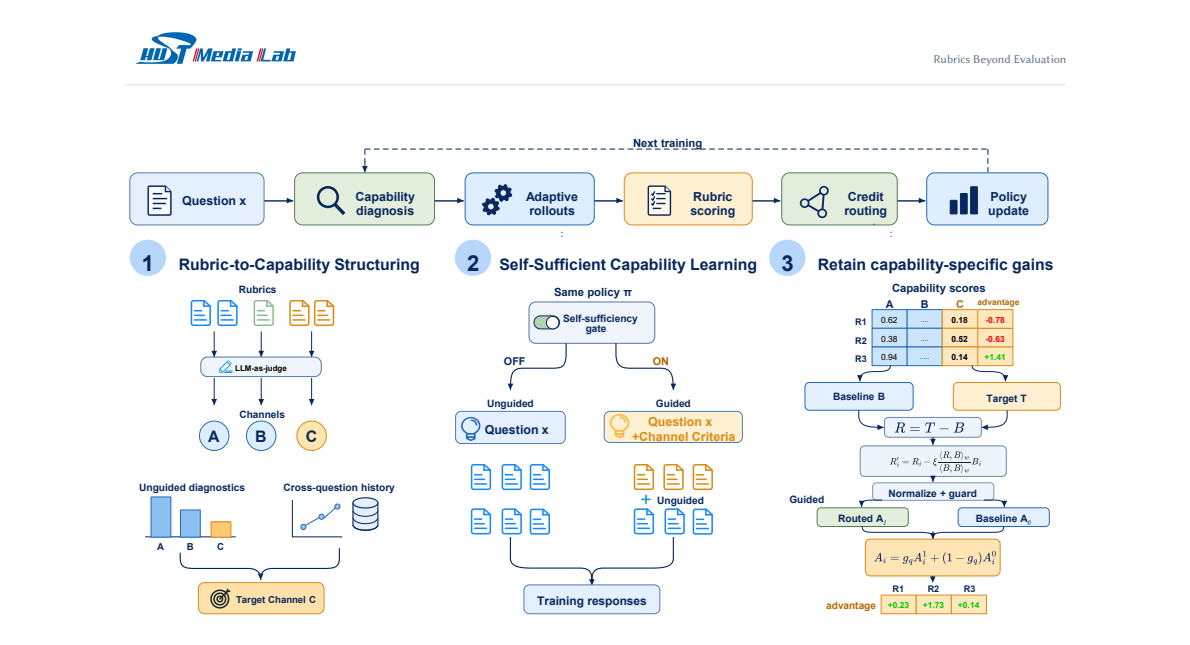
Existing methods use rubrics mainly as direct feedback signals, without explicitly modeling the capabilities behind their criteria. This leaves their capability structure largely unused in guiding the training process. We introduce Rubric-Structured Reinforcement Learning (RSRL), an RL framework that unlocks the full potential of rubrics by exploiting their structure throughout the training process, rather than treating them simply as direct reward signals. At its core, RSRL builds on three key designs: (1) Rubric-to-Capability Structuring first recovers the capability structure hidden in rubric criteria, (2) Self-Sufficient Capability Learning then uses this structure to bootstrap underdeveloped capabilities into effective learning, (3) Capability-Residual Credit Routing finally preserves capability-specific gains during optimization. Experiments show that RSRL consistently improves both overall performance and underdeveloped capabilities, boosting downstream scientific question-answering performance by up to 7.43 over the initial policy and 7.60 over non-rubric structured RL baselines, showing that reinforcement learning can substantially benefit from the capability structure encoded in rubrics.
from the abstract
Pith says
Machine review · deepseek-v4-flash · 20 Oct 2026 · what was read was not recorded · not checked by a person
It can be wrong. Challenge this review or reply to it.
Holds up, with conditions. Interesting framework, honest reporting, but the load-bearing capability mapping is unvalidated and the guidance effect is not statistically significant. This line is wrong
4 major objections · 6 minor
How often objections from reviews like this one are right: not yet measured
Not checked: figures, code, what the 18 references say.
The paper says, at Section 4.1 / Appendix A.2
The review did not quote this passage.
Pith says: Objection 1 of 4 · major
The capability mapping from rubric criteria to domain channels is constructed using only 64 training questions, a single LLM (DeepSeek-V4-Pro) with temperature zero, and an arbitrary confidence threshold of 0.8. The paper states that 'these are two calls to one model, and their self-reported scores are not calibrated probabilities' (Appendix A.2).
more of objection 1
The mapping is frozen before training and never validated against human judgment, alternative LLMs, or even a simple perturbation analysis. If this mapping systematically misassigns criteria to capability channels, the entire pipeline (target selection, guided exploration, credit routing) operates on an incorrect structure. This is a load-bearing issue because the claimed exploitation of 'capability structure' depends entirely on the quality of this mapping. The authors should provide evidence of mapping robustness, e.g., by comparing to an alternative mapping (different LLM or a human-constructed mapping) and showing that RSRL's gains are not erased, or by demonstrating that the channel assignments are stable under plausible perturbations.
The paper says, at Appendix E / Table 6
The review did not quote this passage.
Pith says: Objection 2 of 4 · major
The guidance-strength diagnostic reports a mean target gain of 0.012816 on a 0–1 scale at 4× guidance strength, with a 95% bootstrap confidence interval of [-0.00402, 0.02641] that includes zero. This means the improvement from guided exploration is not statistically distinguishable from zero at conventional levels.
more of objection 2
The paper's discussion that this 'motivates joint monitoring' understates the concern. Because guided exploration is a core component of RSRL (distinguishing it from simpler multi-reward methods), this result weakens the case that the capability-guided exploration provides meaningful benefit. The authors should either provide additional evidence (e.g., larger sample size, more sensitive measure) that the effect is real and practically significant, or revise the claims about the importance of this component.
The paper says, at Table 1 / Table 2
The review did not quote this passage.
Pith says: Objection 3 of 4 · major
All main results (benchmarks, ablations, capability tracking) are reported from a single run without error bars, standard deviations, or multiple seeds. Reinforcement learning with LLMs is inherently stochastic due to sampling, training dynamics, and evaluation variance. Single-run results are insufficient to establish that the reported improvements are robust.
more of objection 3
The authors should either provide results from at least 3–5 independent seeds with summary statistics, or justify why a single run is representative (e.g., if variance is negligibly small, which should be demonstrated).
The paper says, at Section 5.3 / Table 2 / Appendix D.4
The review did not quote this passage.
A classifier read this sentence of the paper as acknowledging the concern (probability 0.86):
“The shared mapping and adaptive gate are not separately isolated by these variants.”
Pith says: Objection 4 of 4 · major
The ablation study removes guided exploration or residual routing individually, but it retains the same potentially flawed capability mapping. As the paper itself notes (Appendix D.4), 'The shared mapping and adaptive gate are not separately isolated by these variants.' Therefore, the ablations do not test the central premise that the recovered capability structure is meaningful.
more of objection 4
Observed gains could arise from increased computational budget (extra guided responses, density evaluations), prompt engineering effects, or other artifacts. The authors need an ablation that replaces the LLM-based capability mapping with a random or naive mapping (e.g., one channel per criterion, or a fixed default grouping) to show that the specific structure extracted by their method is what drives the improvements.
6 minor objections
The paper says, at Abstract
Pith says: minor objection 1 of 6
Typo: 'designes' should be 'designs'.
The paper says, at Figure 2
Pith says: minor objection 2 of 6
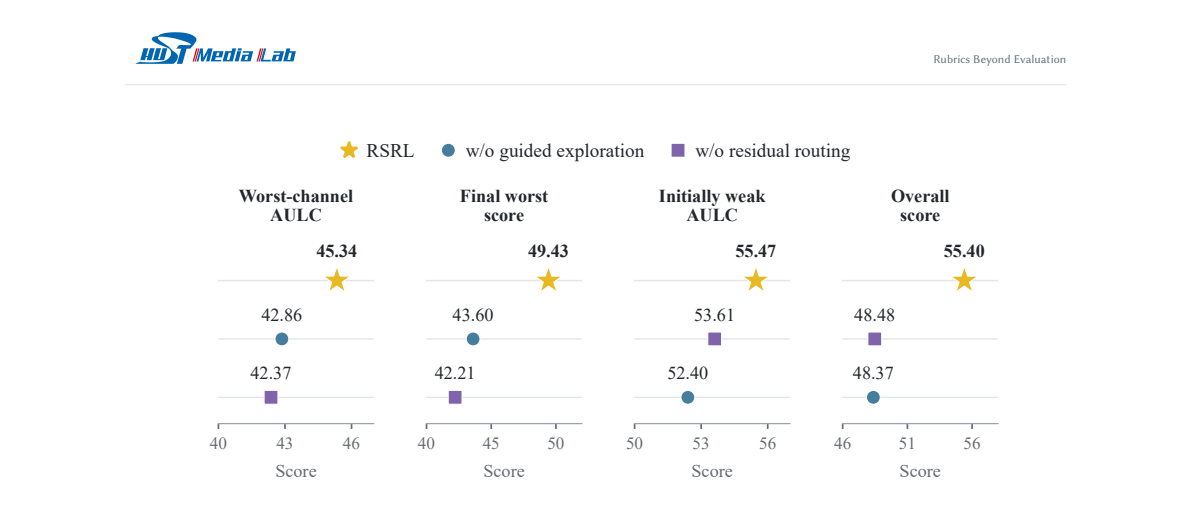
The horizontal axis ranges differ across the four panels, making it difficult to visually compare the metrics. Standardizing the axis range or using a consistent scale would improve readability.
show 4 more
The paper says, at References
Pith says: minor objection 3 of 6
A large fraction of references (e.g., Li et al., 2026b; Wang et al., 2026a; Zhang et al., 2026a–e; many more) are dated 2026, which at the time of submission (October 2026) may be under review or not yet published. The paper should clarify the availability status of each key reference (e.g., arXiv identifier, accepted venue) to allow readers to verify claims.
The paper says, at Table 5
Pith says: minor objection 4 of 6
The fixed parameters table lists many hyperparameters but provides no sensitivity analysis. Even a brief discussion of how the results change under plausible variations of κ, τ, β_D, ξ, λ_max, etc. would help assess robustness.
The paper says, at Section 5.1 / Appendix D.1
Pith says: minor objection 5 of 6
The evaluation uses Gemma-4-31B-it as judge, but training uses a different judge (gpt-oss-120b). This is good practice for avoiding correlated reward, but the paper should state whether the evaluation judge's scores have been validated against human judgments or another reference to establish that improvements are meaningful, not just aligned with one specific automated judge.
The paper says, at Appendix B.2 / Equation (21)
Pith says: minor objection 6 of 6
The guidance strength η_q is set to η_max / sqrt(H_max) with η_max=1 and H_max=3072, giving an effective coefficient of about 0.018. The motivation for dividing by sqrt(H_max) (the response cap) is not explained. Why not divide by actual response length or omit the scaling?
What would settle it
Re-run the main evaluation (Table 1) replacing the DeepSeek-V4-Pro mapping with mappings from a different open-weight LLM (e.g., Llama-4-scout or Gemma-4-31B-it) using identical prompts and threshold, and also with a random shuffle that permutes channel assignments per question while preserving the number of channels per question. If the performance advantage over Rubric-RL shrinks by more than half under either alternative, the specific mapping is essential and its current lack of validation is a critical weakness.
from the skeptic's reading
How the review went
4 readings by deepseek-v4-flash · 20 Oct 2026
- Reader holds up, with conditions
- Skeptic agrees
- Editor wrote the verdict above
- Referee major revision: 4 major objections, 6 minor
Not run on this paper: the simulated authors' defence.
Pith did not check this review's objections against the paper.
The review in full
The review in brief, machine-written
Hey [Colleague],
This paper proposes RSRL, a framework that uses the structure of rubric criteria to identify which capabilities an LLM is weak at, then guides exploration and credit assignment to target those capabilities during RL training. The core idea — treating rubric criteria not just as reward signals but as windows into shared capabilities that can direct training — is genuinely interesting and, as far as I know, new. The technical exposition is detailed, with formal properties proved in the appendix, and the ablation studies show that both guided exploration and residual routing contribute to the reported gains. The authors are also notably honest about their limitations in the paper itself.
That said, the paper has two load-bearing soft spots.
First, the capability mapping pipeline is the linchpin of the whole approach. The authors use a single LLM (DeepSeek-V4-Pro) to map rubric criteria to shared capability channels based on 64 training questions, with a confidence threshold of 0.8. They honestly note that the model’s self-reported scores are uncalibrated probabilities and that it is two calls to one model. But if this mapping systematically misidentifies the capability structure, every downstream component — target selection, guided exploration, credit routing — operates on the wrong foundation. The ablation studies remove guided exploration or routing but retain the same potentially flawed mapping, so they do not test mapping quality. This is not a minor concern; it is a structural assumption that the paper does not validate.
Second, the guidance strength diagnostic (Appendix E) shows that increasing guidance from 1× to 4× produces a mean target gain of 0.011 on a 0–1 scale with a 95% bootstrap interval that includes zero. The effect of the guided component, which is central to the framework, is small and not statistically significant. This weakens the empirical support for the central mechanism.
Additional concerns: only one base model (Qwen3-4B with LoRA) is tested; no error bars are reported on the main benchmark results; training code and per-response judgments are not released.
Who this is for: researchers working on rubric-based RL, reward shaping, and targeted capability improvement for LLMs. It is a framework paper with a plausible idea and careful engineering, but the empirical validation is incomplete.
Recommendation: This paper deserves a serious referee — the idea is worth engaging with, and the authors are honest. I would expect reviewers to push hard on validating the capability mapping (human agreement, alternative constructions, sensitivity analysis) and on statistical evidence for the guidance mechanism. If those are addressed, the contribution could be solid. In current form, it is a well-written but undersupported paper.
Take care, [Your name]
The strongest objection
The RSRL framework hinges on the capability channels produced by Rubric-to-Capability Structuring. Section 4.1 and Appendix A.2 describe the mapping: an LLM (DeepSeek-V4-Pro) assigns each question's local criteria to domain channels, with a consensus requirement across two calls and a confidence threshold of 0.8. The paper honestly notes that 'these are two calls to one model, and their self-reported scores are not calibrated probabilities' (A.2). Only 64 training questions are used to define the six domain channels (A.1). The mapping is frozen before training and never validated against human judgment or alternative constructions. If the mapping systematically misaligns criteria to capabilities, then every downstream component—target capability selection (Equation 4), guided exploration (Section 4.2), and residual credit routing (Section 4.3)—operates on an incorrect structure. The ablation studies (Table 2) remove guided exploration or routing individually but retain the same potentially flawed mapping, so they do not test mapping quality. Observed gains could arise from increased computational budget (guided proposals, density evaluation) or prompt engineering rather than from a genuinely useful capability representation. This doubt is heightened by the guidance-strength diagnostic (Appendix E), where the target gain of 4× over 1× strength is 0.011 on a 0–1 scale with a 95% bootstrap interval that includes zero, suggesting the guided component's effect is small and possibly noisy. Without independent evidence that the capability channels correspond to real, stable, and generalizable dimensions of scientific reasoning, the central claim that 'reinforcement learning can substantially benefit from the capability structure encoded in rubrics' rests on an unvalidated assumption.
The reader's weakest assumption already identifies the capability mapping reliability as a central concern (agreement: agree). The paper acknowledges limitations (self-reported confidence, single model, small construction set) and reports honest uncertainty (guidance effect not significant). However, the mapping's correctness is foundational: every downstream mechanism depends on it. A concrete test—comparing RSRL under different or random mappings—would settle whether the specific structure produced by the original pipeline is genuinely necessary for the observed gains. Until such a test is performed, the central claim remains plausible but not fully validated, matching the existing CONDITIONAL verdict. No adjustment is needed because the concern was already surfaced and the paper's own evidence suggests the guidance effect may be small, but the paper's overall results on four benchmarks with consistent trends provide some support. The verdict should remain CONDITIONAL, as the paper needs additional validation of the mapping to move to ACCEPT, but the concern does not warrant outright rejection.
The referee's report
If the framework's central premise—that the rubric-to-capability mapping reliably captures shared capability structure—holds, RSRL offers a principled way to integrate structured diagnostic information into RL for LLMs, moving beyond criterion-level aggregation. The formal guarantees for the credit routing and the importance-weighting correction for guided exploration are technically sound. The paper's honest acknowledgment of limitations (e.g., uncalibrated LLM mapping, small guidance effect) strengthens its credibility. However, the load-bearing dependence on an unvalidated mapping and the weak statistical evidence for the guidance component mean that the significance of the claimed results is currently conditional on assumptions that have not been sufficiently tested.
Pith's reading of the paper (a machine's summary, not the authors')
The paper introduces Rubric-Structured Reinforcement Learning (RSRL), a framework that treats evaluation rubrics not merely as reward signals but as structured descriptions of the capabilities required to solve a task. RSRL recovers a shared capability structure from rubric criteria via an LLM-based mapping, identifies underdeveloped capabilities across questions, and then uses that diagnosis to guide exploration and route credit during policy updates. On three scientific question-answering benchmarks, RSRL improves a 4B-parameter initial policy by up to 7.43 score points and outperforms existing rubric-based RL methods by up to 7.60 points, while also lifting the weakest capabilities. The results demonstrate that exploiting the capability structure encoded in rubrics can substantially improve reinforcement learning for open-ended tasks.
What carries the argument. The key machinery is the triplet of Rubric-to-Capability Structuring (maps rubric criteria to shared capability channels via an LLM assessor with frozen definitions and mappings), Self-Sufficient Capability Learning (activates capability-guided exploration through a target–control contrast when diagnostic evidence shows a deficit and either uniformly minimal scores or a low fraction of positive responses), and Capability-Residual Credit Routing (partially attenuates the baseline-aligned component of the target channel advantage and scales the residual by diagnosed need, with a guard that accepts the routed candidate only when it preserves shared orderings and provides target-aligned change). These three components jointly determine which capability receives exploration support and how its feedback affects policy updates under the original question context.
Core claim. The core discovery is that evaluation rubrics encode a latent capability structure that, when recovered through an LLM-based mapping into hierarchical capability channels, can be used to coordinate reinforcement learning across three stages: identifying which capability is underdeveloped, supplying targeted exploration when natural rollouts provide insufficient variation, and preserving capability-specific improvements during aggregate optimization. This shifts rubric-based learning from criterion-level optimization to capability-level development, enabling consistent gains in both weak and strong capabilities.
The premise it rests on. The LLM-based mapping from rubric criteria to shared capability channels produces a reliable and generalizable capability structure from only 64 training questions, with acceptance based on a confidence threshold of 0.8 from a single model's self-reported scores that are not calibrated probabilities.
If the paper is right (Pith's inferences, not the authors')
RSRL can be applied to any open-ended task that has a rubric, opening a path beyond verifiable domains for reinforcement learning.
The capability structure, once constructed, is frozen before training; dynamically updating it during training could enable the policy to discover and address emerging weaknesses without manual intervention.
The self-sufficiency gate ties exploration support to the policy's current diagnostic state rather than a fixed schedule, potentially reducing the need for hand-crafted curricula in RL.
Improving weak capabilities through structured guidance does not come at the cost of strong capabilities, as every initially strong channel also improved on the development probe.
The approach is demonstrated on a 4B-parameter model; scaling to larger models or other domains may further highlight the benefits of capability-structured learning.
The LLM-based capability mapping relies on self-reported confidence scores from a single model (DeepSeek-V4-Pro) on only 64 training questions; testing with different LLMs or human-annotated mappings would clarify whether the benefit comes from the capability structure itself or from the specific mapping used.
The framework could be extended to multi-task or continual learning settings where rubrics from different tasks are composed into a shared capability space, enabling transfer of exploration strategies across tasks.
If the capability channels are highly correlated or if a small number of channels dominate improvement, the method's performance may be sensitive to the granularity of the domain codebook; controlled experiments varying channel count would test robustness.
Check this review
Pith stored no record of this review's passes and took no fingerprint of it. Reviews made by code from 13 Nov 2026 on carry both.
How often reviews like this one are right
Reviews like this one: written by deepseek-v4-flash, where what was read was not recorded.
How often objections from reviews like this one are right: not yet measured
Reviews by people
This review was written by a machine. No person has reviewed this paper on Pith yet. A scientist listed on Pith can review it for a fee, and their review is published here whatever it concludes.
The paper
Abstract
Rubrics are widely used to evaluate open-ended question answering by breaking overall quality into explicit criteria. These explicit criteria make rubrics a rich source of learning guidance, yet their potential for guiding the training process has been largely overlooked. Existing methods use rubrics mainly as direct feedback signals, without explicitly modeling the capabilities behind their criteria. This leaves their capability structure largely unused in guiding the training process. We introduce Rubric-Structured Reinforcement Learning (RSRL), an RL framework that unlocks the full potential of rubrics by exploiting their structure throughout the training process, rather than treating them simply as direct reward signals. At its core, RSRL builds on three key designs: (1) Rubric-to-Capability Structuring first recovers the capability structure hidden in rubric criteria, (2) Self-Sufficient Capability Learning then uses this structure to bootstrap underdeveloped capabilities into effective learning, (3) Capability-Residual Credit Routing finally preserves capability-specific gains during optimization. Experiments show that RSRL consistently improves both overall performance and underdeveloped capabilities, boosting downstream scientific question-answering performance by up to 7.43 over the initial policy and 7.60 over non-rubric structured RL baselines, showing that reinforcement learning can substantially benefit from the capability structure encoded in rubrics.
The paper's own sentences, arranged, kept beside the review and separate from it. Each label is drawn from a closed vocabulary; the number beside it is the probability the classifier gave that label. No sentence in this record was written by a model.
abstract compiled · 2026-10-20
The authors' main claim, as the classifier picked it out 1.00
“Experiments show that RSRL consistently improves both overall performance and underdeveloped capabilities, boosting downstream scientific question-answering performance by up to 7.43 over the initial policy and 7.60 over non-rubric structured RL baselines, showing that reinforcement learning can substantially benefit from the capability structure encoded in rubrics.”
How the main claim is stated: asserted 1.00
What the abstract itself states, as probabilities: claims first 0.17 · states limitation 0.06 · human participants 0.05 · controlled comparison 0.95 · randomized assignment 0.01 · states quantitative result 0.98 · compares with prior results 0.97 · mentions code or data availability 0.02
The abstract, sentence by sentence
This table labels the abstract only (arXiv listing abstract v1). The number is the probability the classifier gave the label.
| Sentence | Role | The authors' own work | States the main conclusion | Strength |
|---|---|---|---|---|
| Rubrics are widely used to evaluate open-ended question answering by breaking overall quality into explicit criteria. | background 1.00 | 0.04 | 0.02 | asserted 1.00 |
| These explicit criteria make rubrics a rich source of learning guidance, yet their potential for guiding the training process has been largely overlooked. | gap 0.95 | 0.07 | 0.05 | asserted 1.00 |
| Existing methods use rubrics mainly as direct feedback signals, without explicitly modeling the capabilities behind their criteria. | gap 0.69 | 0.05 | 0.02 | asserted 1.00 |
| This leaves their capability structure largely unused in guiding the training process. | gap 0.96 | 0.06 | 0.03 | asserted 1.00 |
| We introduce Rubric-Structured Reinforcement Learning (RSRL), an RL framework that unlocks the full potential of rubrics by exploiting their structure throughout the training process, rather than treating them simply as direct reward signals. | contribution 0.99 | 0.89 | 0.21 | asserted 1.00 |
| At its core, RSRL builds on three key designs: (1) Rubric-to-Capability Structuring first recovers the capability structure hidden in rubric criteria, (2) Self-Sufficient Capability Learning then uses this structure to bootstrap underdeveloped capabilities into effective learning, (3) Capability-Residual Credit Routing finally preserves capability-specific gains during optimization. | method 0.96 | 0.83 | 0.07 | asserted 0.99 |
| Experiments show that RSRL consistently improves both overall performance and underdeveloped capabilities, boosting downstream scientific question-answering performance by up to 7.43 over the initial policy and 7.60 over non-rubric structured RL baselines, showing that reinforcement learning can substantially benefit from the capability structure encoded in rubrics. | result 0.99 | 0.96 | 0.88 | asserted 1.00 |
What kind of paper the classifier reports this is: method or tool 1.00 · evidence from observation or experiment 0.95
What was examined, and what was not
Sources read
- arXiv listing abstract v1
Not examined
- full text
- figures and tables
- references and citing sentences
- relations to other papers
Levels run
- P abstract
Not run
- S sections
- T body sentences
- C citations
- R cross-paper relations
How the labels were made
Compiled by classifier-1.13.0 via TypeSafe API, question bank abstract-p1-20260923, 2026-10-20: 1 request, 5,749 input tokens.
Every quoted sentence on this record is the authors'. Every label is from Pith's closed vocabulary, with the probability shown beside it. This record as JSON
Figures (3)
Figures are the authors', reproduced from the paper.
References (18)
- [3] Rubrics as Rewards: Reinforcement Learning Beyond Verifiable Domains.arXiv preprint arXiv:2507.17746 (2025). https://arxiv.org/abs/2507.17746 Vipul Gupta, Zihao Wang, Razvan-Gabriel Dumitru, MohammadHossein Rezaei, Aakash Sabharwal, and Yunzhong He on PithPith's reviewarXiv
- [4] CRAFT: Clustering Rubrics to Diagnose Weak LLM Capabilities and Generate Targeted Fine-Tuning Data.arXiv preprint arXiv:2607.16122 (2026). https://arxiv.org/abs/2607.16122 Jinkun Hou, Zhuo Liu, Huimin Ren, Hongsheng Xin, Pan Zhou, and Kun Zhan on PithPith's reviewarXiv
- [5] RISE-RL: Rubric-Informed Selective Exploration for Open-Ended Reinforcement Learning. arXiv preprint arXiv:2608.09123 (2026). https://arxiv.org/abs/2608.09123 Edward J. Hu, Yelong Shen, Phillip Wallis, Zeyuan Allen-Zhu, Yuanzhi Li, Shean Wang, Lu Wang, and Weizhu Chen on PithPith's reviewarXiv
- [8] 14694–14716. XiangLisaLi,AriHoltzman,DanielFried,PercyLiang,JasonEisner,TatsunoriHashimoto,LukeZettlemoyer,andMikeLewis.2023. ContrastiveDecoding:Open-ended Text Generation as Optimization. InProceedings of the 61st Annual Meeting of the Association for Computational Linguisti... on PitharXiv
- [9] JudgeArena: A Unified Framework for Reproducible LLM-Judge Evaluation.arXiv preprint arXiv:2608.02620 (2026). https://arxiv.org/abs/2608.02620 Jonathan Pei, Kevin Yang, and Dan Klein on PithPith's reviewarXiv
- [11] GPQA: A Graduate- Level Google-Proof Q&A Benchmark. InFirst Conference on Language Modeling. https://arxiv.org/abs/2311.12022 Rulin Shao, Akari Asai, Shannon Zejiang Shen, Hamish Ivison, Varsha Kishore, Jingming Zhuo, Xinran Zhao, Molly Park, Samuel G. Finlayson, David Sontag,... on PithPith's reviewarXiv
- [12] DR Tulu: Reinforcement Learning with Evolving Rubrics for Deep Research. InInternational Conference on Machine Learning. https://arxiv.org/abs/2511. 19399 Zikai Song, Xiajie Li, Yunyao Zhang, Xinglang Zhang, Wei Yang, and Junqing Yu. 2026a. Social Intelligence Modeling: A Comp... on Pithdoi:10.13140/rg.2.2.21157.87528
- [16] Qwen3 Technical Report.arXiv preprint arXiv:2505.09388 (2025). https://arxiv.org/abs/2505.09388 Li S. Yifei, Allen Chang, Chaitanya Malaviya, and Mark Yatskar on PithPith's reviewarXiv
- [17] ResearchQA: Evaluating Scholarly Question Answering at Scale Across 75 Fields with Survey- Mined Questions and Rubrics.arXiv preprint arXiv:2509.00496 (2025). https://arxiv.org/abs/2509.00496 Xinglang Zhang, Yuanmeng Xiang, Yunyao Zhang, Zeliang Chen, Junqing Yu, and Zikai Son... on PitharXiv
- [18] Surfacing the Unsaid: CUE-Bench for Affective Stance in Chinese Discourse.arXiv preprint arXiv:2608.10810 (2026). YangZhou,SunzhuLi,ShunyuLiu,WenkaiFang,KongchengZhang,JialeZhao,JingwenYang,YiheZhou,JianweiLv,TongyaZheng,HengtongLu,WeiChen,YanXie, andMingliSong.2025. Breakingt... on PithPith's reviewarXiv
- [37] 2321–2329.doi:10.1609/aaai.v37i2.25327 Zikai Song, Junqing Yu, Yi-Ping Phoebe Chen, Wei Yang, and Xinchao Wang. 2026b. Hypergraph-State Collaborative Reasoning for Multi-Object Tracking.arXiv preprint arXiv:2604.12665 (2026). https://arxiv.org/abs/2604.12665 Eric Veach and Leo... on PithPith's reviewarXiv
- [39] 6978–6986.doi:10.1609/aaai.v39i7.32749 Zikai Song, Run Luo, Junqing Yu, Yi-Ping Phoebe Chen, and Wei Yang on Pithdoi:10.1609/aaai.v39i7.32749
- [1995] Optimally Combining Sampling Techniques for Monte Carlo Rendering. InProceedings of SIGGRAPH . 419–428. https: //graphics.stanford.edu/papers/combine/ Dali Wang, Yunyao Zhang, Junqing Yu, Yi-Ping Phoebe Chen, Chen Xu, and Zikai Song. 2026b. Seeing Further and Wider: Joint Spat... on PithPith's reviewarXiv
- [2022] LoRA: Low-Rank Adaptation of Large Language Models. InInternational Conference on Learning Representations. https://arxiv.org/abs/2106.09685 Seungone Kim, Jamin Shin, Yejin Cho, Joel Jang, Shayne Longpre, Hwaran Lee, Sangdoo Yun, Seongjin Shin, Sungdong Kim, James Thorne, and ... on PithPith's reviewarXiv
- [2023] Association for Computational Linguistics, 10018–10037.doi:10.18653/v1/2023.findings-acl.636 David Rein, Betty Li Hou, Asa Cooper Stickland, Jackson Petty, Richard Yuanzhe Pang, Julien Dirani, Julian Michael, and Samuel R. Bowman on Pithdoi:10.18653/v1/2023.findings-acl.636
- [2024] Prometheus: Inducing Fine-Grained Evaluation Capability in Language Models. In The Twelfth International Conference on Learning Representations . https://openreview.net/forum?id=8euJaTveKw Sunzhu Li, Jiale Zhao, Miteto Wei, Huimin Ren, Yang Zhou, Jingwen Yang, Shunyu Liu, Kaik... on PitharXiv
- [2025] HealthBench: Evaluating Large Language Models Towards Improved Human Health.arXiv preprint arXiv:2505.08775 (2025). https://arxiv.org/abs/2505.08775 Jonathan Bragg, Mike D’Arcy, Nishant Balepur, Dan Bareket, Bhavana Dalvi, Sergey Feldman, Dany Haddad, Jena D. Hwang, Peter Jans... on PithPith's reviewarXiv
- [2026] AstaBench: Rigorous Benchmarking of AI Agents with a Scientific Research Suite. InInternational Conference on Learning Representations . https://arxiv.org/abs/ 2510.21652 Alex Graves, Marc G. Bellemare, Jacob Menick, Rémi Munos, and Koray Kavukcuoglu on PithPith's reviewarXiv
Challenges and discussion
Disagree with the review, or know something it missed? Leave a comment, or challenge this review formally: a challenge becomes a permanent entry in this paper's record, and its decision is published here.
Come back by email
A short list of the week's newly reviewed papers. Nothing is sent until you confirm from your inbox, and every email has a link that stops it. No account.
No comments yet.
Sign in to comment