Artificial Intelligence · arXiv:2610.26469 v1 · submitted 19 Oct 2026 · 28 references
VeriCUA: Learning Proactive Verification for Reliable GUI Agent Rewards
The paper says
“Reinforcement learning for computer-use agents increasingly relies on proactive reward agents that interact with the post-execution GUI environment to verify what recorded screenshots cannot reveal.”
more of the abstract
The reliability of such verification hinges on two coupled decisions: what to check and when to stop. Existing methods leave these decisions to prompted foundation models. However, neither scaling up the model nor providing few-shot examples reliably improves verification: prompted Judges ranging from 4B to GPT-5.4 all plateau at 68%-70% macro-average agreement. This is because the value of a check depends on the environment rather than the task alone, and becomes apparent only through execution. Learning from execution is itself constrained, as the Actor's terminal state cannot be faithfully replicated during training, allowing only one verification attempt per state. We introduce VeriCUA, a proactive reward agent that learns its verification strategy from these single attempts. A trainable Judge decides what to check and when to stop, while a frozen Probe executes the checks in the live environment. Online reinforcement learning optimizes the Judge for both verdict correctness and efficient Probe use, with returns normalized across terminal states. Trained only on OSWorld and evaluated without further training on MobileWorld and WebArena-Verified, VeriCUA achieves the highest reward agreement across all three benchmarks and lies on the agreement-cost Pareto frontier among proactive verifiers. It surpasses few-shot GPT-5.4 by 5.36 points with 47.6%-59.8% fewer Probe tokens, and even a 1B VeriCUA exceeds every prompted Judge. As the reward for Actor RL, it raises task success by 3.21 points overall and 5.40 points on held-out multi-application tasks. These results identify the verification strategy, not verifier scale, as the key to reliable GUI rewards.
from the abstract
Pith says
Machine review · deepseek-v4-flash · 20 Oct 2026 · what was read was not recorded · not checked by a person
It can be wrong. Challenge this review or reply to it.
Holds up, with conditions. A genuinely new training recipe for proactive GUI reward verification with clean ablations, whose headline numbers are all measured on a re-execution-stable trajectory slice whose selectivity is never reported — worth refereeing, needs that fixed. This line is wrong
2 major objections · 6 minor
How often objections from reviews like this one are right: not yet measured
Not checked: figures, code, what the 28 references say.
The paper says, at §3.1 and Appendix D
The review did not quote this passage.
A classifier read this sentence of the paper as acknowledging the concern (probability 0.87):
“Re- execution may not reproduce it, identical screenshots can hide different application state, and probing itself changes it.”
Pith says: Objection 1 of 2 · major
All agreement numbers in Table 1 and all Pareto-frontier points in Figure 4 are computed only on trajectories that pass the six-re-execution screen (identical executable outcome plus final-screen pHash similarity above 0.95), yet the screen's selectivity is never reported. The filter is internally justified, and the comparison among verifiers on the accepted subset is internally fair, but the paper's claims …
more of objection 1
… are about deployment usefulness, and this filtered distribution matches neither the training distribution (live, unfiltered, one attempt per state; Section 2.4) nor the deployment distribution (Section 3.4). The authors acknowledge the underlying problem in Section 2.4 ('Re-execution may not reproduce it, identical screenshots can hide different application state, and probing itself changes it'), which is exactly why the acceptance rate matters: if a substantial fraction of Actor terminal states is discarded, the headline 74.08% macro agreement and the 5.36-point margin over few-shot GPT-5.4 describe the filtered distribution rather than the live states the deployed reward agent actually sees. The partial deployment-distribution evidence in Appendix H, Table 10 (81.4% vs 77.8% agreement on live Actor-RL rollouts, p<0.001) supports the trained-versus-prompted ranking on OSWorld, but it is confounded because the two reward sources induce different Actor trajectory distributions, and it does not cover MobileWorld or WebArena-Verified; moreover, the live-rollout figures move in opposite directions from the filtered figures for the two verifiers (trained 81.4 vs 82.00; prompted 77.8 vs 73.73), so filtered agreement cannot be assumed to predict live agreement. Please report the acceptance rate per benchmark, and either verify the trained-versus-prompted ranking on live unfiltered rollouts for at least the two transfer benchmarks, or show on screen-rejected trajectories that still have executable outcomes that the ranking is unchanged.
The paper says, at Tables 1–2
The review did not quote this passage.
Pith says: Objection 2 of 2 · major
The headline tables report no confidence intervals or significance tests, although the paper demonstrates the relevant tools in Appendix C (Wilson intervals) and Appendix H (two-proportion tests). The per-benchmark margins are small relative to sample size: on WebArena-Verified (100 trajectories, Avg@4) VeriCUA-4B leads the prompted 4B Judge by 1.25 points (62.75 vs 61.50), on MobileWorld by 4.00 points (77.50 vs …
more of objection 2
… 73.50), and on OSWorld over prompted GPT-5.4 by 0.12 points (82.00 vs 81.88); the first two are within the typical width of a 95% Wilson interval for roughly 400 judgments. Similarly, the OOD Pass@4 margin over prompted VERICUA in Table 2 is 2.70 points on 74 tasks, i.e., about two tasks. Without intervals or tests, the quantitative claims summarized in the abstract (5.36-point macro gain; +3.21 and +5.40 Pass@4) cannot be separated from trajectory-level noise, and the reader cannot tell whether the per-benchmark 'highest agreement' claims are meaningful individually.
6 minor objections
The paper says, at Appendix D
Pith says: minor objection 1 of 6
Cost accounting excludes JUDGE tokens. The cross-backbone justification is fair for the GPT-5.4 and Kimi-K2.6 comparisons, but for the same-backbone rows (prompted vs trained VERICUA on Qwen3-VL-4B-Thinking) the tokenizers are identical, so reporting judge-plus-probe tokens there would show whether the trained Judge's additional calls offset its probe savings; as written, the Figure 4 frontier should be read as probe-cost-only.
The paper says, at Table 9
Pith says: minor objection 2 of 6
The reward magnitudes in Table 9 (+1.0/+0.7/−0.7/−0.3/−1.0) are free parameters chosen on OSWorld and shared across all transfer and downstream results, but they are never ablated. Figure 5(b) abates the probe-round budget K but not the reward schedule; a small sensitivity sweep, or at least a statement of how the values were chosen, would address the concern that the learned stopping behavior is tuned to these specific values.
show 4 more
The paper says, at §3.2
Pith says: minor objection 3 of 6
The paper states that few-shot examples shift agreement by at most 1.02 points, but the shift is negative for Kimi-K2.6 (69.62% to 68.60%). A sentence explaining why (for example, that the two shared references in Appendix I.3 are task-unrelated and may bias check formulation) would make the plateau claim easier to interpret.
The paper says, at Figure 5(a)
Pith says: minor objection 4 of 6
Figure 5(a) splits agreement into judgments 'With Probe' and 'Without Probe', but the main text does not define these splits; state whether they partition verification attempts by whether the PROBE was invoked at least once.
The paper says, at §3.1
Pith says: minor objection 5 of 6
The evaluation is described as '414, 100, and 100 trajectories' without stating whether these counts are before or after the Appendix D re-execution screen; clarifying this is part of the selectivity question raised in Major Comment 1.
The paper says, at Figure 4
Pith says: minor objection 6 of 6
Figure 4 places passive verifiers and VAGEN on the same probe-token axis although their cost definitions differ (Appendix D bills VAGEN for its full loop, and passive verifiers incur zero probe tokens by construction); a one-line note that the frontier is defined only among proactive verifiers would prevent over-reading the figure.
What would settle it
Recompute the Table 1 comparison with the Section 3.1 and Appendix D screen removed: for each trajectory take a single fresh re-execution, run VeriCUA-4B, VeriCUA-1B, prompted Qwen3-VL-4B, and few-shot GPT-5.4 each in their own re-executed environment, evaluate that re-execution's outcome directly with the executable evaluator, and compute Avg@4 macro agreement and Probe-token cost on the full unfiltered set for all three benchmarks. Also report the fraction of trajectories passing the current six-run screen per benchmark.
from the skeptic's reading
How the review went
4 readings by deepseek-v4-flash · 20 Oct 2026
- Reader holds up, with conditions
- Skeptic agrees
- Editor wrote the verdict above
- Referee major revision: 2 major objections, 6 minor
Not run on this paper: the simulated authors' defence.
Pith did not check this review's objections against the paper.
The review in full
The review in brief, machine-written
Two things to know. The training recipe is genuinely new: a trainable Judge decides what to check and when to stop, a frozen Probe executes the checks, and the whole thing is trained under a single-attempt-per-terminal-state constraint with a terminal reward that couples verdict correctness to whether probing was used. The second thing: every headline number — Table 1 agreements, the 5.36-point margin over few-shot GPT-5.4, the Pareto frontier in Figure 4 — is computed on trajectories that passed a six-re-execution stability screen, and the paper never reports how selective that screen is. That is the paper's biggest soft spot, and the stress-test note has it right.
Credit where it's due. The ablations are the best part: holding backbone, prompts, Probe, and round budget fixed, training adds 4.5–21 points over prompted Judges at the same size, so the gains are attributable to the learned policy, not the architecture. Zero-shot transfer from OSWorld to MobileWorld and WebArena is a clean design, and the Probe-scale robustness check (82.0–82.7 over 35B to 4B, with Wilson intervals) plus the live-rollout tracking during downstream Actor RL show they know how to report uncertainty correctly; the main tables just don't. The executable evaluator is external ground truth and training/evaluation trajectories are disjoint, so the central comparison is not circular. Code is released and full prompts are in the appendix. Cost accounting counts Probe tokens only, and their stated reason for excluding Judge tokens is defensible.
The filter concern, in proportion. The screen is internally justified — it keeps the Probe's environment consistent with the recorded screenshots the Judge sees — and both trained and prompted verifiers are measured on the same slice, so the comparison is fair on that slice. But the paper's own motivation says re-execution frequently fails to reproduce terminal states (b35), which cuts against the slice being representative of either training (one live attempt per state) or deployment (live rollouts during Actor RL). The one deployment-distribution check, Appendix H, still favors the trained verifier (81.4 vs 77.8, p<0.001), so the ranking is not unseated — but that check is OSWorld-only and the two Actors evolve on different trajectory distributions. Reporting the screen's acceptance rate, results on the discarded slice, or a live-state evaluation on all three benchmarks would close this. A referee should push on exactly this.
Minor: no confidence intervals on the headline Table 1 and Table 2 numbers; free hyperparameters (reward magnitudes, K, stability thresholds) were selected on OSWorld, which anchors the headline result; the +3.21 downstream gain is against no reward, and the marginal gain over the prompted verifier is +1.43; the Pareto frontier is over Probe tokens only.
Who it's for: anyone working on GUI/computer-use reward modeling. It deserves a serious referee, and I'd take it to a reading group.
The strongest objection
Section 3.1 and Appendix D restrict verifier evaluation to trajectories whose executable outcome is stable across six re-executions and whose final-screen pHash similarity exceeds 0.95. Every agreement number in Table 1 (including the 74.08% macro and the 5.36-point margin) and the Pareto-frontier claim in Figure 4 are computed on this filtered slice. The filter is internally justified (it keeps the environment the Probe sees consistent with the recorded screenshots the Judge is given), but the paper never reports how selective it is, even though its own motivation (b35; Section 2.4) asserts that re-execution frequently fails to reproduce terminal states. Three distribution shifts make this load-bearing. Training uses live, unfiltered terminal environments (one attempt per state, Section 2.4); the headline evaluation uses re-execution-stable environments; deployment (Actor RL, Section 3.4) again uses live states. The filtered evaluation therefore describes neither the training nor the deployment distribution. The only deployment-distribution comparison (Appendix H, Table 10) is OSWorld-only and confounded because the prompted-reward and trained-reward Actors evolve on different trajectory distributions; it also reports lower absolute agreement (81.4% on live rollouts) than the filtered OSWorld figure (82.00%). If the screen discards a substantial fraction of trajectories, or if prompted verifiers are relatively stronger where recorded evidence and live state diverge, the trained-over-prompted ranking and the Pareto statement need not transfer to the states a deployed reward agent actually encounters. The authors acknowledge re-execution non-reproducibility (b35) but quantify neither the screen's effect nor the ranking outside the filtered slice.
The central claim is comparative: a small learned verification policy can match or beat a prompted frontier verifier and improve downstream Actor RL. The load-bearing evidence is the agreement evidence (Table 1, Figure 4) because the thesis 'strategy, not scale' and the 5.36-point headline are agreement claims, and that evidence comes from the re-execution-stable slice. The paper's own framing (b35) says re-execution may not reproduce terminal states and that identical screenshots can hide different state; this is exactly why the evaluation screen exists, yet the paper never reports the screen's selectivity or checks the trained-vs-prompted ranking on the unfiltered distribution. Since the screen removes the states the paper itself says are hardest, and since the deployed reward agent (Section 3.4) verifies live states, the headline agreement numbers and the Pareto statement could overstate deployment behavior. The comparison is symmetric across verifiers, so this is not an internal-validity flaw; it is an external-validity gap between the filtered evaluation slice and the deployment distribution. Credit where due: the within-backbone ablations are clean (Figure 5a: training alone adds 4.50 to 21.11 points with Judge backbone, Probe, prompts, and budget held fixed), the 1B result is striking, Appendix C reports Wilson intervals for the Probe-scale robustness check, and code is released; none of these, however, measures what happens outside the filtered slice. The one deployment-distribution measurement the paper makes is Appendix H (trained 81.4% vs prompted 77.8% agreement during Actor RL), but it is OSWorld-only, is confounded by the different Actor distributions each reward induces, and reports lower absolute agreement than the filtered figure. A secondary concern, which I do not elevate to the main attack, is statistical fragility: the 5.36-point macro margin is carried by MobileWorld (+11.25 on N=100) and WebArena-Verified (+4.25), while OSWorld, where a trained verifier should benefit most, shows only +0.60 over few-shot GPT-5.4; Table 1 lacks confidence intervals and Table 2's OOD gain is roughly two tasks out of 74. If confirmed, that would weaken magnitudes but not the qualitative conclusion, so it is less load-bearing than the filtered-slice question. On balance the CONDITIONAL verdict stands, and the proposed unfiltered-protocol comparison plus retention-rate report would settle the main uncertainty.
The referee's report
If the results hold, the paper makes a substantial empirical contribution: it shows that the verification strategy can be learned from single-attempt execution and that a small trained Judge (even 1B) can outperform much larger prompted verifiers, with measurable downstream gains in Actor RL. The design has real strengths: the same-backbone prompted-versus-trained comparisons in Table 1 isolate the learned policy from architecture, Probe, and prompts; the executable evaluator is external ground truth with disjoint training and evaluation trajectories, and the MobileWorld and WebArena-Verified results are zero-shot, so the central comparison is not circular; the paper provides informative ablations (training stages, Probe-round budget, Probe scale with Wilson intervals) and live-rollout evidence during downstream RL (Appendix H, with p-values); and the method is specified precisely enough to reproduce (Eqs. 1–4 and 7, Table 9). The main risks are the external validity of the re-execution-filtered evaluation protocol and the absence of statistical reporting in the headline tables, both addressed in the major comments.
Pith's reading of the paper (a machine's summary, not the authors')
The paper argues that how a GUI verifier decides what to check and when to stop matters more than how large the verifier model is. Prompted verifiers from a 4B model up to GPT-5.4 all plateau near 68–70% macro-average agreement regardless of scale or few-shot examples, because a check's value only becomes clear during execution in the live environment. VeriCUA instead learns its verification strategy: a trainable Judge decides which task conditions to verify and when the evidence suffices for a terminal verdict, while a frozen Probe executes those checks in the post-execution GUI. Trained on OSWorld alone and evaluated without retraining on MobileWorld and WebArena-Verified, the 4B VeriCUA reaches 74.08% macro-average agreement, beats few-shot GPT-5.4 by 5.36 points while using 47.6–59.8% fewer Probe tokens, and as an Actor reward raises Pass@4 by 3.21 points overall and 5.40 points on held-out multi-application tasks. Even the 1B VeriCUA outperforms every prompted Judge, which the authors read as evidence that the learned strategy, not model scale, carries the reliability.
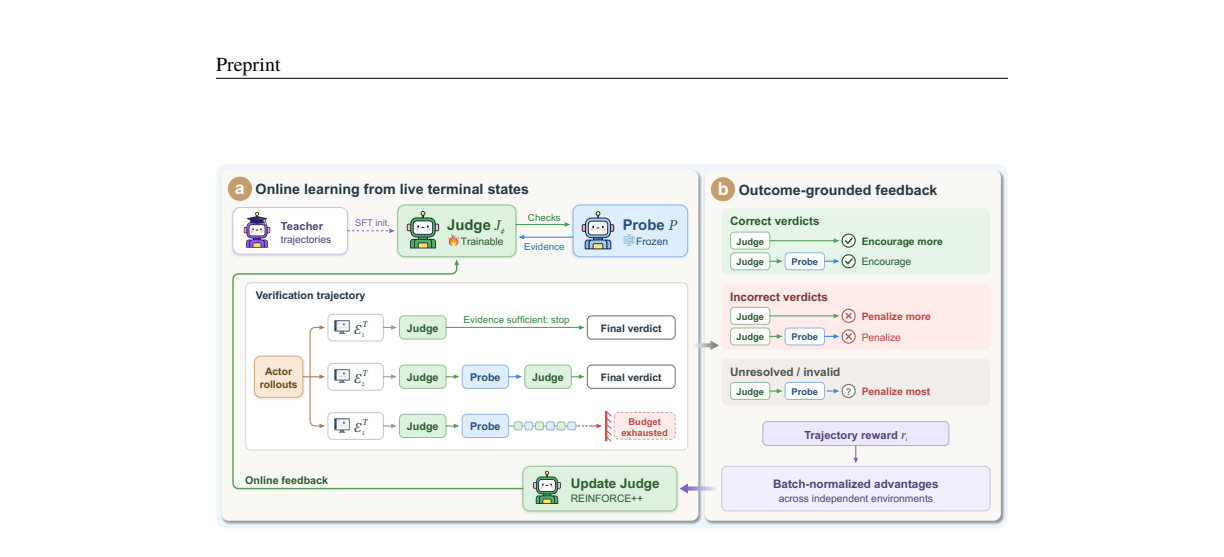
What carries the argument. The load-bearing object is the Judge–Probe verification loop. At each call the trainable Judge $J_\phi$ receives the task $x$ and verification history $H^{(k)}$ and emits a verdict $v^{(k)}\in\{\text{success},\text{failure},\text{uncertain}\}$ together with status-annotated checks $C^{(k)}$; a success or failure verdict terminates verification, while an uncertain verdict with budget remaining passes only the unresolved checks to the frozen Probe $P$, which acts in the live terminal environment and returns evidence $e^{(k)}$ that is concatenated into the next round's history. Checks are generated at round 0 and only their statuses update thereafter, so the Judge's decision space is exactly the what-to-check and when-to-stop pair. The Judge is trained with a terminal reward schedule that rewards a correct verdict reached without probing more than after probing ($+1.0$ vs $+0.7$), penalizes a wrong verdict without probing more than with probing ($-0.7$ vs $-0.3$), and penalizes unresolved or invalid outputs most ($-1.0$); this lets a single attempt per state signal both verdict correctness and the stopping decision. Because each terminal state allows one attempt, REINFORCE++ with batch-normalized terminal returns replaces same-state rollout comparisons, and the loss averages a clipped likelihood-ratio surrogate over newly generated Judge tokens only, excluding context tokens and Probe outputs.
Core claim. The central claim is that reliable GUI rewards for computer-use agents come from learning the verification strategy — which task conditions to check and when to stop — rather than from scaling or prompting the verifier model. Under the same Judge–Probe architecture, prompts, and probing budget, training the Judge improves macro-average agreement by 4.50, 8.62, and 21.11 points over the prompted 4B, 2B, and 1B Judges respectively, so the gains are attributable to the learned policy, not the architecture. The key constraint is that an Actor's terminal GUI state admits only one verification attempt: re-execution need not reproduce it, identical screenshots can hide different application state, and probing itself alters the state (they state this explicitly in the deferred-evaluation discussion). VeriCUA trains under this single-attempt constraint by assigning each complete verification trajectory a terminal reward that couples verdict correctness with whether the Probe was used, and normalizing returns across independent terminal environments in each batch with REINFORCE++, so no same-state rollout group or environment forking is required. The learned strategy transfers to unseen mobile and web environments and, as the frozen reward source for downstream Actor RL, raises task success by 3.21 points overall and 5.40 points on the held-out MultiApp split.
The premise it rests on. The agreement and downstream numbers are measured only on Actor trajectories whose outcome was stable across six re-executions with identical executable result and final-screen pHash similarity above 0.95, so if real GUI rollouts frequently end in non-reproducible terminal states, the reported 74.08% agreement and the +3.21 Pass@4 improvement describe a filtered distribution rather than the deployment distribution.
If the paper is right (Pith's inferences, not the authors')
A small learned verification policy (down to 1B parameters) can replace a much larger prompted verifier as a GUI reward source, at 47.6–59.8% lower Probe-token cost in the headline configuration.
The learned strategy transfers zero-shot across desktop, mobile, and web GUI environments after training on OSWorld alone, with the 4B and 1B Judges ranking first and second on both unseen benchmarks.
The trained Judge stays effective across Probe scales within a model family (82.00–82.73% agreement, no retraining), indicating the strategy resides in the Judge while the Probe mainly executes it.
As the frozen reward source for Actor RL, VeriCUA raises downstream Pass@4 by 3.21 points overall and by 5.40 points on held-out multi-application tasks, with a lower false-negative rate than the prompted verifier during Actor training.
The 68–70% plateau across prompted models suggests the same failure mode — checks whose value is only revealed by execution — should appear in other interactive-reward settings, making the single-attempt learned-verifier recipe a candidate structure for GUI-adjacent domains such as tool use and embodied control.
A testable extension is to push the probe budget $K$ beyond the saturated value of 2 and check whether agreement continues to rise or flattens, and to measure whether the trained Judge's early-stopping already captures the bulk of the remaining gain.
Because the Judge transfers across environments while each environment uses its own frozen Probe, one could test whether a single shared Probe without per-environment specialization would degrade either agreement or Probe-token cost, isolating how much of the transfer lives in check formulation versus evidence execution.
Check this review
Pith stored no record of this review's passes and took no fingerprint of it. Reviews made by code from 13 Nov 2026 on carry both.
How often reviews like this one are right
Reviews like this one: written by deepseek-v4-flash, where what was read was not recorded.
How often objections from reviews like this one are right: not yet measured
Reviews by people
This review was written by a machine. No person has reviewed this paper on Pith yet. A scientist listed on Pith can review it for a fee, and their review is published here whatever it concludes.
The paper
Abstract
Reinforcement learning for computer-use agents increasingly relies on proactive reward agents that interact with the post-execution GUI environment to verify what recorded screenshots cannot reveal. The reliability of such verification hinges on two coupled decisions: what to check and when to stop. Existing methods leave these decisions to prompted foundation models. However, neither scaling up the model nor providing few-shot examples reliably improves verification: prompted Judges ranging from 4B to GPT-5.4 all plateau at 68%-70% macro-average agreement. This is because the value of a check depends on the environment rather than the task alone, and becomes apparent only through execution. Learning from execution is itself constrained, as the Actor's terminal state cannot be faithfully replicated during training, allowing only one verification attempt per state. We introduce VeriCUA, a proactive reward agent that learns its verification strategy from these single attempts. A trainable Judge decides what to check and when to stop, while a frozen Probe executes the checks in the live environment. Online reinforcement learning optimizes the Judge for both verdict correctness and efficient Probe use, with returns normalized across terminal states. Trained only on OSWorld and evaluated without further training on MobileWorld and WebArena-Verified, VeriCUA achieves the highest reward agreement across all three benchmarks and lies on the agreement-cost Pareto frontier among proactive verifiers. It surpasses few-shot GPT-5.4 by 5.36 points with 47.6%-59.8% fewer Probe tokens, and even a 1B VeriCUA exceeds every prompted Judge. As the reward for Actor RL, it raises task success by 3.21 points overall and 5.40 points on held-out multi-application tasks. These results identify the verification strategy, not verifier scale, as the key to reliable GUI rewards.
The paper's own sentences, arranged, kept beside the review and separate from it. Each label is drawn from a closed vocabulary; the number beside it is the probability the classifier gave that label. No sentence in this record was written by a model.
abstract compiled · 2026-10-20
The authors' main claim, as the classifier picked it out 1.00
“These results identify the verification strategy, not verifier scale, as the key to reliable GUI rewards.”
How the main claim is stated: asserted 0.99
What the abstract itself states, as probabilities: claims first 0.11 · states limitation 0.47 · human participants 0.03 · controlled comparison 0.92 · randomized assignment 0.02 · states quantitative result 0.99 · compares with prior results 0.99 · mentions code or data availability 0.03
The abstract, sentence by sentence
This table labels the abstract only (arXiv listing abstract v1). The number is the probability the classifier gave the label.
| Sentence | Role | The authors' own work | States the main conclusion | Strength |
|---|---|---|---|---|
| Reinforcement learning for computer-use agents increasingly relies on proactive reward agents that interact with the post-execution GUI environment to verify what recorded screenshots cannot reveal. | background 1.00 | 0.06 | 0.03 | asserted 1.00 |
| The reliability of such verification hinges on two coupled decisions: what to check and when to stop. | background 0.92 | 0.13 | 0.04 | asserted 1.00 |
| Existing methods leave these decisions to prompted foundation models. | background 0.79 | 0.04 | 0.02 | asserted 1.00 |
| However, neither scaling up the model nor providing few-shot examples reliably improves verification: prompted Judges ranging from 4B to GPT-5.4 all plateau at 68%-70% macro-average agreement. | gap 0.52 | 0.65 | 0.07 | asserted 1.00 |
| This is because the value of a check depends on the environment rather than the task alone, and becomes apparent only through execution. | interpretation 0.53 | 0.27 | 0.09 | asserted 1.00 |
| Learning from execution is itself constrained, as the Actor's terminal state cannot be faithfully replicated during training, allowing only one verification attempt per state. | background 0.54 | 0.21 | 0.02 | asserted 1.00 |
| We introduce VeriCUA, a proactive reward agent that learns its verification strategy from these single attempts. | contribution 0.99 | 0.89 | 0.07 | asserted 1.00 |
| A trainable Judge decides what to check and when to stop, while a frozen Probe executes the checks in the live environment. | method 0.95 | 0.79 | 0.05 | asserted 1.00 |
| Online reinforcement learning optimizes the Judge for both verdict correctness and efficient Probe use, with returns normalized across terminal states. | method 1.00 | 0.85 | 0.05 | asserted 0.99 |
| Trained only on OSWorld and evaluated without further training on MobileWorld and WebArena-Verified, VeriCUA achieves the highest reward agreement across all three benchmarks and lies on the agreement-cost Pareto frontier among proactive verifiers. | result 1.00 | 0.96 | 0.19 | asserted 1.00 |
| It surpasses few-shot GPT-5.4 by 5.36 points with 47.6%-59.8% fewer Probe tokens, and even a 1B VeriCUA exceeds every prompted Judge. | result 1.00 | 0.95 | 0.14 | asserted 1.00 |
| As the reward for Actor RL, it raises task success by 3.21 points overall and 5.40 points on held-out multi-application tasks. | result 1.00 | 0.93 | 0.08 | asserted 1.00 |
| These results identify the verification strategy, not verifier scale, as the key to reliable GUI rewards. | interpretation 1.00 | 0.86 | 0.92 | asserted 0.99 |
What kind of paper the classifier reports this is: method or tool 1.00 · evidence from observation or experiment 0.99
What was examined, and what was not
Sources read
- arXiv listing abstract v1
Not examined
- full text
- figures and tables
- references and citing sentences
- relations to other papers
Levels run
- P abstract
Not run
- S sections
- T body sentences
- C citations
- R cross-paper relations
How the labels were made
Compiled by classifier-1.13.0 via TypeSafe API, question bank abstract-p1-20260923, 2026-10-20: 1 request, 9,564 input tokens.
Every quoted sentence on this record is the authors'. Every label is from Pith's closed vocabulary, with the probability shown beside it. This record as JSON
Figures (7)




Figures are the authors', reproduced from the paper.
References (28)
- [1] Xie, Tianbao and Zhang, Danyang and Chen, Jixuan and Li, Xiaochuan and Zhao, Siheng and Cao, Ruisheng and Hua, Toh Jing and Cheng, Zhoujun and Shin, Dongchan and Lei, Fangyu and Liu, Yitao and Xu, Yiheng and Zhou, Shuyan and Savarese, Silvio and Xiong, Caiming and Zhong, Victo... on Pithdoi:10.52202/079017-1650
- [2] Bai, Hao and Zhou, Yifei and Cemri, Mert and Pan, Jiayi and Suhr, Alane and Levine, Sergey and Kumar, Aviral , booktitle =. doi:10.52202/079017-0397 , pages = on Pithdoi:10.52202/079017-0397
- [3] Wang, Taiyi and Wu, Zhihao and Liu, Jianheng and Hao, Jianye and Wang, Jun and Shao, Kun , booktitle = on Pith
- [4] Xia, Yu and Fan, Jingru and Chen, Weize and Yan, Siyu and Cong, Xin and Zhang, Zhong and Lu, Yaxi and Lin, Yankai and Liu, Zhiyuan and Sun, Maosong , title =. Proceedings of the 63rd Annual Meeting of the. 2025 , address =. doi:10.18653/v1/2025.acl-long.945 , pages = on Pithdoi:10.18653/v1/2025.acl-long.945
- [5] Qi, Zehan and Liu, Xiao and Iong, Iat Long and Lai, Hanyu and Sun, Xueqiao and Sun, Jiadai and Yang, Xinyue and Yang, Yu and Yao, Shuntian and Xu, Wei and Tang, Jie and Dong, Yuxiao , booktitle = on Pith
- [6] Dai, Gaole and Jiang, Shiqi and Cao, Ting and Yang, Yuqing and Li, Yuanchun and Tan, Rui and Li, Mo and Qiu, Lili , booktitle = on Pith
- [7] Kong, Quyu and Zhang, Xu and Yang, Zhenyu and Gao, Nolan and Liu, Chen and Tong, Panrong and Cai, Chenglin and Zhou, Hanzhang and Zhang, Jianan and Chen, Liangyu and Liu, Zhidan and Hoi, Steven and Wang, Yue , title =. Proceedings of the 64th Annual Meeting of the. 2026 , addr... on Pithdoi:10.18653/v1/2026.acl-long.278
- [8] Zhang, Ziyun and Wang, Zezhou and Zhang, Xiaoyi and Guo, Zongyu and Li, Jiahao and Li, Bin and Lu, Yan , title =. Proceedings of the 64th Annual Meeting of the. 2026 , address =. doi:10.18653/v1/2026.acl-long.1313 , pages = on Pithdoi:10.18653/v1/2026.acl-long.1313
- [9] Yu, Tianyu and Wang, Zefan and Wang, Chongyi and Huang, Fuwei and Ma, Wenshuo and He, Zhihui and Cai, Tianchi and Chen, Weize and Huang, Yuxiang and Zhao, Ranchi and Xu, Bokai and Cui, Junbo and Xu, Yingjing and Ruan, Liqing and Zhang, Luoyuan and Liu, Hanyu and Tang, Jingkun ... on Pith
- [10] El Hattami, Amine and Thakkar, Megh and Chapados, Nicolas and Pal, Christopher , title =. Workshop on Scaling Environments for Agents , year = on Pith
- [11] Yang, Chenyu and Su, Shiqian and Liu, Shi and Dong, Xuan and Yu, Yue and Su, Weijie and Wang, Xuehui and Liu, Zhaoyang and Zhu, Jinguo and Li, Hao and Wang, Wenhai and Qiao, Yu and Zhu, Xizhou and Dai, Jifeng , title =. 2025 , eprint = on Pith
- [12] Cui, Chaoqun and Huang, Jing and Wang, Shijing and Zheng, Liming and Kong, Qingchao and Zeng, Zhixiong , title =. 2026 , eprint = on Pith
- [13] Zhang, Jiazheng and Fu, Ziche and Xi, Zhiheng and Jing, Wenqing and Chai, Mingxu and He, Wei and Zhang, Guoqiang and Fan, Chenghao and An, Chenxin and Chen, Wenxiang and Liu, Zhicheng and Pan, Haojie and Zhu, Dingwei and Gui, Tao and Zhang, Qi and Huang, Xuanjing , title =. Fi... on Pithdoi:10.18653/v1/2026.findings-acl.1156
- [14] Cai, Shaofei and Qin, Yulei and Lin, Haojia and Xu, Zihan and Li, Gang and Shi, Yuchen and Li, Zongyi and Mao, Yong and Cai, Siqi and Tan, Xiaoyu and Liang, Yitao and Li, Ke and Sun, Xing , title =. 2025 , eprint = on Pith
- [15] Shi, Chenrui and Wu, Yuwei and Liu, Yang and Feng, Ruining and Shang, Zirui and Gao, Zhi and Fan, Lifeng and Sun, Che , title =. 2026 , eprint = on Pith
- [16] Li, Zehao and Wu, Zhenyu and Zhao, Yibo and Yang, Bowen and Xie, Jingjing and Liu, Zhaoyang and Liu, Zhoumianze and Jin, Kaiming and Liang, Jianze and Li, Zonglin and Wu, Feng and Zhou, Bowen and Wang, Zun and Ding, Zichen , title =. 2026 , eprint = on Pith
- [17] Rosset, Corby and Sharma, Pratyusha and Zhao, Andrew and Gonzalez-Fernandez, Miguel and Awadallah, Ahmed , title =. 2026 , eprint = on Pith
- [18] Shao, Zhihong and Wang, Peiyi and Zhu, Qihao and Xu, Runxin and Song, Junxiao and Bi, Xiao and Zhang, Haowei and Zhang, Mingchuan and Li, Y. K. and Wu, Y. and Guo, Daya , title =. 2024 , eprint = on Pith
- [19] Hu, Jian and Liu, Jason Klein and Xu, Haotian and Shen, Wei , title =. 2025 , eprint = on Pith
- [20] Cao, Yuan and Ran, Dezhi and Wu, Mengzhou and Guo, Yuzhe and Chen, Xin and Li, Ang and Cao, Gang and Zhi, Gong and Yu, Hao and Li, Linyi and Yang, Wei and Xie, Tao , title =. 2026 , eprint = on Pith
show 8 more
- [21] Han, Qijun and Tu, Haoqin and Wang, Zijun and Dai, Haoyue and Zhou, Yiyang and Lau, Nancy and Cardenas, Alvaro A. and Xu, Yuhui and Xu, Ran and Xiong, Caiming and Zheng, Zeyu and Yao, Huaxiu and Zhou, Yuyin and Xie, Cihang , title =. 2026 , eprint = on Pith
- [22] Xue, Taofeng and Peng, Chong and Huang, Mianqiu and Guo, Linsen and Han, Tiancheng and Wang, Haozhe and Wang, Jianing and Zhang, Xiaocheng and Yang, Xin and Zhao, Dengchang and Ding, Jinrui and Ma, Xiandi and Xie, Yuchen and Pei, Peng and Cai, Xunliang and Qiu, Xipeng , title ... on Pith
- [23] Bai, Shuai and Cai, Yuxuan and Chen, Ruizhe and Chen, Keqin and Chen, Xionghui and Cheng, Zesen and Deng, Lianghao and Ding, Wei and Gao, Chang and Ge, Chunjiang and Ge, Wenbin and Guo, Zhifang and Huang, Qidong and Huang, Jie and Huang, Fei and Hui, Binyuan and Jiang, Shutong... on Pith
- [24] Yao, Yuan and Yu, Tianyu and Zhang, Ao and Wang, Chongyi and Cui, Junbo and Zhu, Hongji and Cai, Tianchi and Li, Haoyu and Zhao, Weilin and He, Zhihui and Chen, Qianyu and Zhou, Huarong and Zou, Zhensheng and Zhang, Haoye and Hu, Shengding and Zheng, Zhi and Zhou, Jie and Cai,... on Pith
- [25] Lv, Bowen and Liu, Xiao and Ren, Yanyu and Lai, Hanyu and Jing, Bohao and Zhang, Hanchen and Zhao, Yanxiao and Yao, Shuntian and Tang, Jie and Dong, Yuxiao , title =. 2026 , eprint = on Pith
- [26] Lai, Hanyu and Liu, Xiao and Zhao, Yanxiao and Xu, Han and Zhang, Hanchen and Jing, Bohao and Ren, Yanyu and Yao, Shuntian and Dong, Yuxiao and Tang, Jie , booktitle = on Pith
- [27] Wang, Bowen and Lu, Dunjie and Wang, Junli and Bai, Tianyi and Liu, Shixuan and Zhang, Zhipeng and Wang, Haiquan and Hu, Hao and Xie, Tianbao and Bai, Shuai and Liu, Dayiheng and Shen, Que and Lin, Junyang and Yu, Tao , title =. 2026 , eprint = on Pith
- [28] 2026 , howpublished = on Pith
Cited by 1 Pith paper
Reviewed papers on Pith that cite this one. The full citation record
- How Complete Must an Environment Be to Train a Capable GUI Agent? cs.CV · Nov 2026
Challenges and discussion
Disagree with the review, or know something it missed? Leave a comment, or challenge this review formally: a challenge becomes a permanent entry in this paper's record, and its decision is published here.
Come back by email
A short list of the week's newly reviewed papers. Nothing is sent until you confirm from your inbox, and every email has a link that stops it. No account.
No comments yet.
Sign in to comment