Computer Vision and Pattern Recognition · arXiv:2611.23946 v1 · submitted 18 Nov 2026 · 34 references
How Complete Must an Environment Be to Train a Capable GUI Agent?
The paper says
“Graphical user interface (GUI) agents are widely trained in executable GUI environments. To lower cost, build environments in batches, and reduce manual effort, each work trades away part of the environment through its construction choices.”
more of the abstract
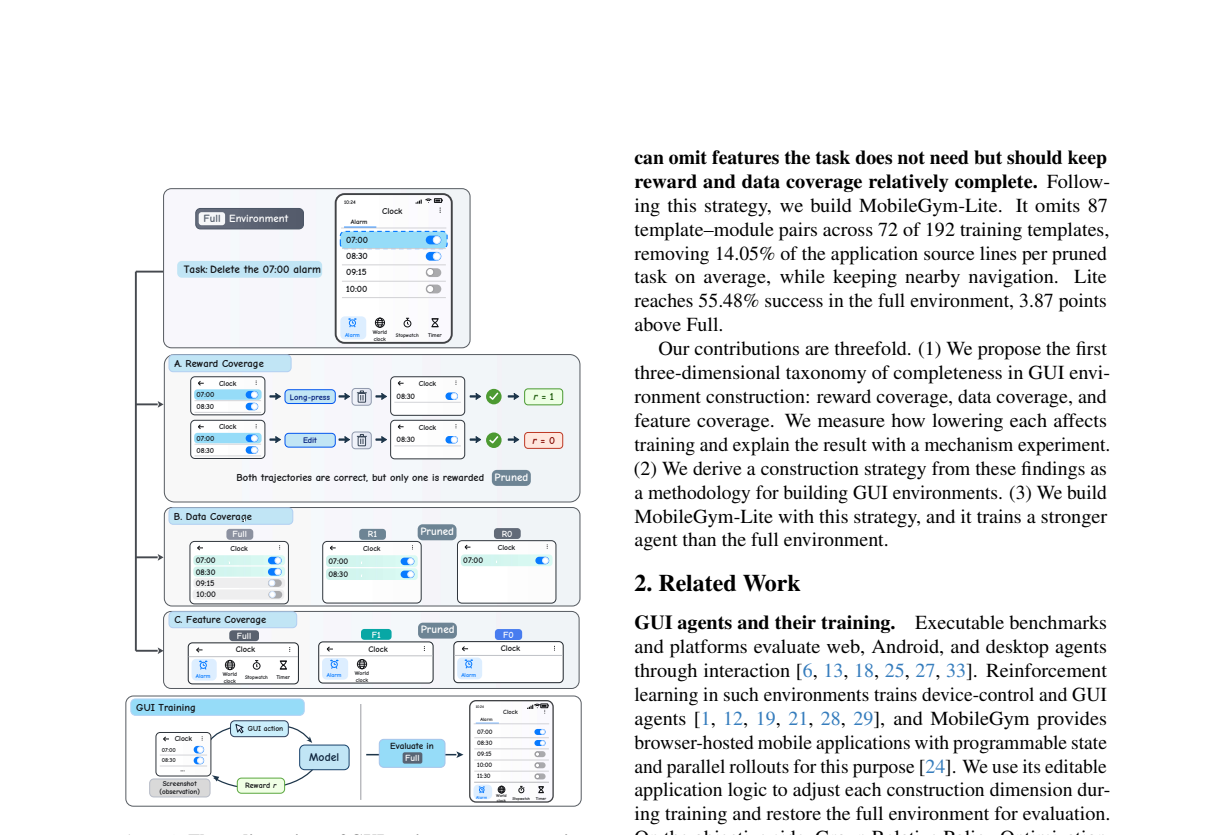
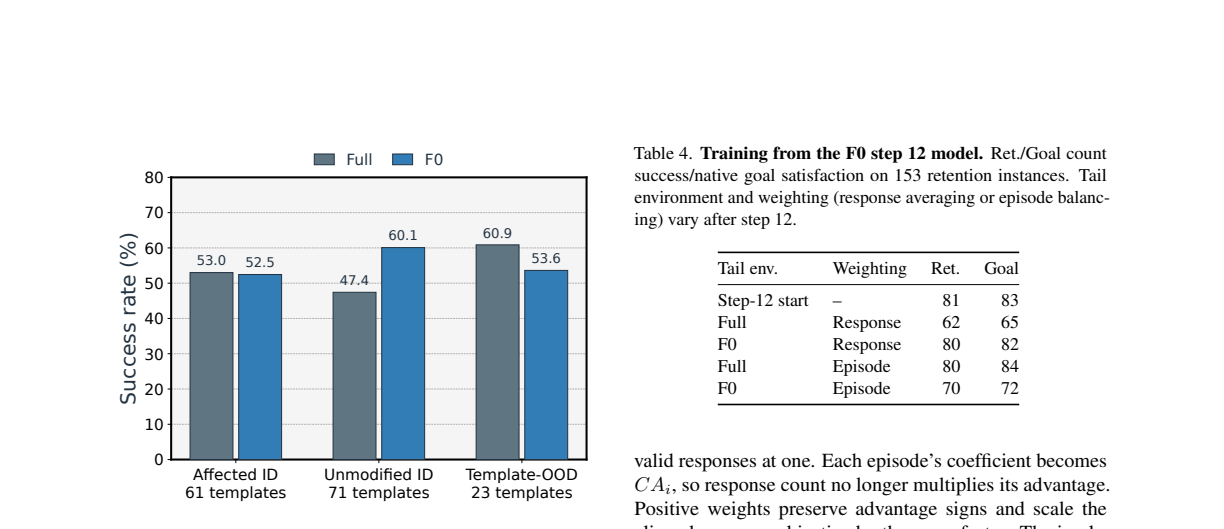
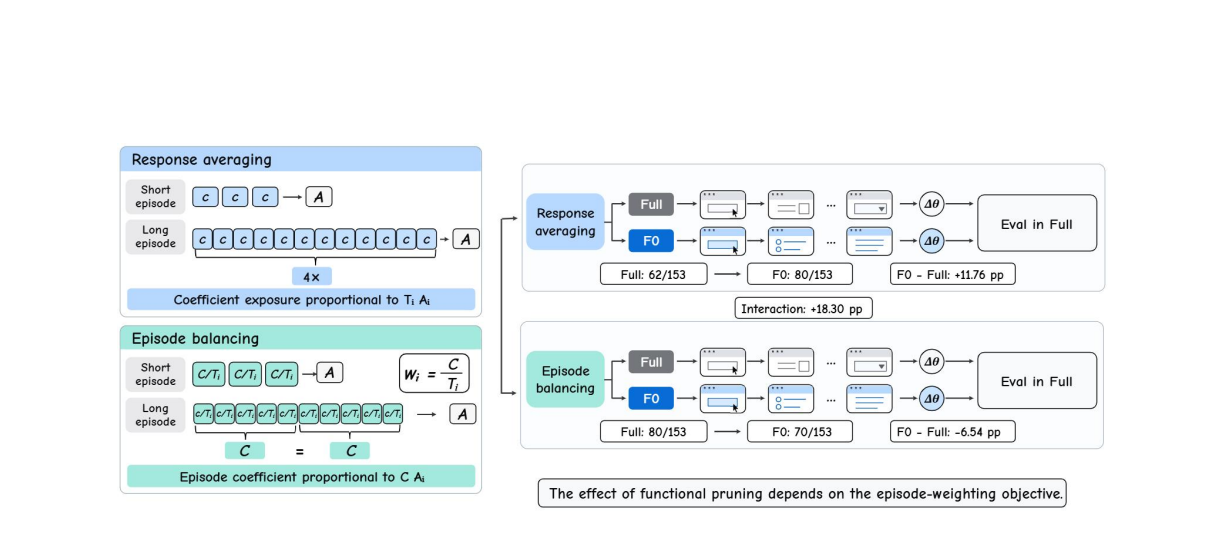
We describe these choices along three dimensions: reward coverage, the goal-reaching trajectories the verifier rewards; data coverage, the application data the agent is exposed to beyond what the task reads or writes; and feature coverage, the application features beyond what the task uses. Existing works set each dimension on engineering grounds, but they do not measure its effect on training. How complete must an environment be to train a capable agent, and along which dimensions? In MobileGym, we adjust each dimension separately, train Qwen3-VL-4B-Instruct, and evaluate every policy in the original full environment. A verifier that rewards only one reference path lowers success by 10.53 points, and removing unneeded records also lowers success. Pruning unneeded features instead raises success from 51.61% to 56.13%, entirely on tasks whose environments it left unchanged. The gain reverses when each episode is weighted equally and vanishes when only episodes on the pruned tasks are balanced. Without pruning, length weighting there reinforces long detour successes that erode skills on other tasks. Following these findings, we build MobileGym-Lite, which keeps reward and data coverage complete and prunes unneeded features. It outperforms Full in the full environment (55.48% versus 51.61% success) with lower construction cost.
from the abstract
Pith says
Machine review · deepseek-v4-flash · 19 Nov 2026 · read the full text (75,769 characters) · not checked by a person
It can be wrong. Challenge this review or reply to it.
Holds up. This paper isolates three dimensions of GUI environment completeness and finds that pruning unneeded features improves agent performance, a counterintuitive result with a clear mechanistic explanation. This line is wrong
3 minor
How often objections from reviews like this one are right: not yet measured
The paper, first character to last
The reviewer was given the whole text, 75,769 characters. Not checked: figures, code, what the 34 references say.
3 minor objections
The paper says, at Table 1
Pith says: minor objection 1 of 3
The row labelled 'Base' is not defined in the text. It likely refers to the untrained Qwen3-VL-4B-Instruct model evaluated directly (zero-shot), but this should be stated explicitly for clarity.
The paper says, at Tables 1, 2, 3, 4
Pith says: minor objection 2 of 3
The main results tables report success rates without variance. While the appendix gives standard deviations for Full, Lite, and F0 (Table S1), including error bars or per-seed ranges in the main tables would help readers assess the reliability of the reported differences, especially when gaps are small (e.g., 1.93 points in Table 2).
show 1 more
The paper says, at Section 4.2
Pith says: minor objection 3 of 3
The early advantage of the filtered environments at step 8 is noted but not explained. A brief comment on why filtered records might provide an early benefit would be helpful.
What would settle it
Repeat the same three coverage-reduction experiments in an alternative GUI simulator (e.g., AndroidWorld or WebArena) with a different base model. If reducing feature coverage does not improve success or reduces it, the claim that feature coverage can be safely pruned would be refuted; if the improvement does not come from unmodified tasks, the transfer mechanism would be disconfirmed.
from Pith's summary of the paper
How the review went
5 passes by deepseek-v4-flash · 19 Nov 2026
- Reader holds up
- Skeptic concern withdrawn: the paper already says this
- Referee 3 minor
- Check against the paper kept 0 of 1 objection
- Editor wrote the verdict above
Not run on this paper: the simulated authors' defence.
Pith's passes raised 1 objection. A check against the paper's text kept 0 and withdrew 1 (1 the paper already says).
The review in full
The review in brief, machine-written
The paper delivers what the title promises: it tests how complete a GUI training environment must be along three independent dimensions—reward coverage, data coverage, and feature coverage—and measures what each reduction costs. The finding that lowering feature coverage actually raises full-environment success is genuinely unexpected, and the paper earns that result by running a clean mechanistic experiment that traces the gain to episode-length weighting in the training objective. The crossed experiment with episode balancing is the right check, and it isolates the effect convincingly. The authors then build a reduced environment, MobileGym-Lite, that outperforms the full one, turning the analysis into a practical construction recipe.
The study has limits. It uses a single simulator (MobileGym) and a single base model (Qwen3-VL-4B-Instruct), and the reward-coverage experiment narrows the rewarded paths without removing alternative transitions from the environment. The authors state both limitations. Whether the three dimensions behave the same way with different models, task distributions, or simulators is open. But within its scope the paper is careful: each dimension is manipulated independently, the evaluation is done in the full environment, and the mechanism is tested with multiple controls.
This paper is for researchers building GUI training environments and for anyone working on agent training with reward design or curriculum choices. It isolates a design tradeoff that prior work treated as a monolithic engineering choice and shows that the training objective matters as much as the environment itself. A serious referee should engage with it. The paper is ready for peer review.
The stress test's concern
Withdrawn: the paper already says this.
The paper says
“We use one base model and one simulator, and replication across starting policies and simulators is the next step.”
The referee's report
The paper provides the first controlled, causal measurement of how three distinct dimensions of environment completeness affect the training of GUI agents, moving beyond the engineering heuristics that have guided prior work. The mechanism experiment that isolates episode-length weighting as the reason pruning helps is novel and practically actionable. The derived construction strategy—keep reward and data coverage complete, prune unnecessary features—is concrete and supported by the evidence. The findings are directly relevant to anyone building simulated environments for agent training, and the released MobileGym-Lite demonstrates a practical application. The work is limited to one simulator and one base model (as the authors acknowledge), but within that scope the evidence is thorough and convincing.
Pith's reading of the paper (a machine's summary, not the authors')
This paper asks how complete a GUI environment must be to train a capable agent, and which dimensions of completeness matter. The authors propose three dimensions of environment construction: reward coverage (which goal-reaching trajectories are rewarded), data coverage (how much application data is present beyond task requirements), and feature coverage (how many application functions are implemented beyond what tasks use). Through controlled experiments in the MobileGym simulator with Qwen3-VL-4B-Instruct, they find that lowering reward coverage or data coverage degrades success, while lowering feature coverage improves success by 4.52 percentage points—entirely on tasks whose environments were not modified. The improvement stems from how episodes are weighted by length: without pruning, long detour successes on pruned tasks are over-weighted and erode skills on other tasks. These findings produce a concrete construction strategy: keep reward and data coverage complete, but prune unneeded features.
What carries the argument. The central object is a three-dimensional taxonomy of environment completeness: reward coverage (how many goal-reaching trajectories the verifier rewards), data coverage (how much application data exists beyond task needs), and feature coverage (how many application functions exist beyond task needs). The paper operationalizes each dimension through controlled modifications in the MobileGym simulator and measures their effects on agent training. The key mechanism explaining the feature-coverage gain is episode length weighting: under response averaging, longer episodes contribute proportionally more to gradient updates, so pruned environments reduce the prevalence of long detour successes that would otherwise be reinforced and erode other skills.
Core claim. The central claim is that a GUI environment's completeness matters differently along three separable dimensions. Using the MobileGym framework, the authors isolate each dimension by adjusting it while holding the other two constant. They demonstrate that (1) restricting reward coverage to a single reference path lowers success by 10.53 points because valid alternative solutions are penalized; (2) reducing data coverage by filtering unrelated records lowers success by up to 4.30 points on the tasks where records return at evaluation; and (3) reducing feature coverage by pruning dispensable functions raises full-environment success from 51.61% to 56.13%, a gain that comes entirely from tasks whose environments were never changed. The gain is traced to an interaction with the per-episode length weighting in the training objective: without pruning, long successes that detour through unnecessary functions carry heavy weight and degrade the shared policy on other tasks. Balancing episode weights removes the gain.
The premise it rests on. The experiments use a single GUI simulator (MobileGym) and a single model (Qwen3-VL-4B-Instruct), so the quantitative effects and even the qualitative ranking of coverage dimensions may change with different simulators, task distributions, or model scales.
If the paper is right (Pith's inferences, not the authors')
GUI environment builders can safely prune dispensable application features to reduce construction cost without harming—and potentially improving—agent performance, as long as reward and data coverage remain complete.
The finding that feature pruning benefits come from unmodified tasks implies that multi-task environments should be evaluated by capability retention on all tasks, not just those where reductions were applied.
The interaction with episode weighting means that the training objective (e.g., response averaging vs. episode balancing) must be considered when choosing which functions to prune; a pruned environment that helps under one objective may hurt under another.
MobileGym-Lite demonstrates a practical instantiation: it omits 87 template–module pairs across 72 templates, reduces application source by 14.05% on average for pruned tasks, and achieves 55.48% success in the full environment, outperforming the full environment's 51.61%.
The three-dimensional taxonomy likely applies beyond GUI agents to any training environment where reward signals, data variety, and action-space complexity can be independently varied (e.g., robotics simulators, game-playing environments).
The finding that feature pruning helps by removing 'distractor' transitions suggests that adding irrelevant state elements (even if not actionable) might similarly degrade training, which could be tested by introducing non-functional but visually present UI elements.
The mechanism's dependence on per-episode length weighting implies that alternative training algorithms that inherently down-weight long trajectories (e.g., using advantage normalization per episode rather than per response) might negate the need for manual pruning.
Check this review
What was read
The passes were given all 75,769 characters of the paper's LaTeX source.
Fingerprint of that text (SHA-256): a72a695c595a361aa78515d4e58ec7d23af9ca65be4f07e04a32148a29367562
Pith does not keep that text. Rebuilt from the paper's source or PDF by the same code, it has this fingerprint if it is the same text. From a copy of Pith's code:
PYTHONPATH=. python scripts/review_input_check.py 2611.23946
The passes, in the order they ran
- Reader deepseek-v4-flash · medium effort · $0.0017 · instructions of the Reader, fingerprint f9ead7300382…
- Skeptic deepseek-v4-flash · medium effort · $0.0015 · instructions of the Skeptic, fingerprint 8f88c0f61488…
- Referee deepseek-v4-flash · medium effort · $0.0014 · instructions of the Referee, fingerprint a852d99aea0d…
- Check against the paper deepseek-v4-flash · medium effort · $0.0016 · instructions of the Check against the paper, fingerprint 6c7a6883d551…
- Editor deepseek-v4-flash · medium effort · $0.0012 · instructions of the Editor, fingerprint e7211f6a3d27…
- Circularity check deepseek-v4-flash · medium effort · $0.0012 · instructions of the Circularity check, fingerprint e9946e39d67b…
- Summary for the page deepseek-v4-flash · medium effort · temperature 0.2 · $0.0016 · instructions of the Summary for the page, fingerprint e4f56bf568e7…
The passes cost $0.010 in model calls together.
Version stamped on this review: pith-pipeline@v1.4.1-daily-deepseek-or-medium+deepseek/deepseek-v4-flash+p.d60f54226f00
Each link opens a pass's instructions as plain text, the exact bytes its fingerprint was taken over. Every stored set of instructions.
curl -s https://pith.science/methodology/prompts/f9ead730038216984cfb56d7cb34332bdf691828296a1de4245f3d6667d4bf56 | sha256sum
prints the fingerprint of the reader's instructions. The same works for every pass.
The receipt
The review's fingerprint was taken on 19 Nov 2026. The review you are reading still matches it.
Fingerprint of the review (SHA-256): 74b250196c1c86c19d6cae6a8beb8100816f13647c95fd3aea84148cbbc5684e
curl -s 'https://pith.science/api/v1/verdicts/2611.23946?form=canonical' | sha256sum
prints the fingerprint of the review as it stands now. The rule, in four steps.
A matching fingerprint shows the review has not changed since that date. It does not show that the review is right.
How often reviews like this one are right
Reviews like this one: written by deepseek-v4-flash, from the paper's LaTeX source.
How often objections from reviews like this one are right: not yet measured
Reviews by people
This review was written by a machine. No person has reviewed this paper on Pith yet. A scientist listed on Pith can review it for a fee, and their review is published here whatever it concludes.
The paper
Abstract
Graphical user interface (GUI) agents are widely trained in executable GUI environments. To lower cost, build environments in batches, and reduce manual effort, each work trades away part of the environment through its construction choices. We describe these choices along three dimensions: reward coverage, the goal-reaching trajectories the verifier rewards; data coverage, the application data the agent is exposed to beyond what the task reads or writes; and feature coverage, the application features beyond what the task uses. Existing works set each dimension on engineering grounds, but they do not measure its effect on training. How complete must an environment be to train a capable agent, and along which dimensions? In MobileGym, we adjust each dimension separately, train Qwen3-VL-4B-Instruct, and evaluate every policy in the original full environment. A verifier that rewards only one reference path lowers success by 10.53 points, and removing unneeded records also lowers success. Pruning unneeded features instead raises success from 51.61% to 56.13%, entirely on tasks whose environments it left unchanged. The gain reverses when each episode is weighted equally and vanishes when only episodes on the pruned tasks are balanced. Without pruning, length weighting there reinforces long detour successes that erode skills on other tasks. Following these findings, we build MobileGym-Lite, which keeps reward and data coverage complete and prunes unneeded features. It outperforms Full in the full environment (55.48% versus 51.61% success) with lower construction cost.
The paper's own sentences, arranged, kept beside the review and separate from it. Each label is drawn from a closed vocabulary; the number beside it is the probability the classifier gave that label. No sentence in this record was written by a model.
abstract compiled · 2026-11-19
The authors' main claim, as the classifier picked it out 0.53
“Following these findings, we build MobileGym-Lite, which keeps reward and data coverage complete and prunes unneeded features.”
How the main claim is stated: asserted 0.97
What the abstract itself states, as probabilities: claims first 0.07 · states limitation 0.33 · human participants 0.04 · controlled comparison 0.94 · randomized assignment 0.03 · states quantitative result 0.99 · compares with prior results 0.91 · mentions code or data availability 0.05
The abstract, sentence by sentence
This table labels the abstract only (arXiv listing abstract v1). The number is the probability the classifier gave the label.
| Sentence | Role | The authors' own work | States the main conclusion | Strength |
|---|---|---|---|---|
| Graphical user interface (GUI) agents are widely trained in executable GUI environments. | background 1.00 | 0.04 | 0.02 | asserted 1.00 |
| To lower cost, build environments in batches, and reduce manual effort, each work trades away part of the environment through its construction choices. | background 0.98 | 0.08 | 0.02 | asserted 0.99 |
| We describe these choices along three dimensions: reward coverage, the goal-reaching trajectories the verifier rewards; data coverage, the application data the agent is exposed to beyond what the task reads or writes; and feature coverage, the application features beyond what the task uses. | method 0.38 | 0.30 | 0.03 | asserted 0.97 |
| Existing works set each dimension on engineering grounds, but they do not measure its effect on training. | gap 1.00 | 0.05 | 0.02 | asserted 1.00 |
| How complete must an environment be to train a capable agent, and along which dimensions? | gap 0.88 | 0.05 | 0.03 | unclear 0.99 |
| In MobileGym, we adjust each dimension separately, train Qwen3-VL-4B-Instruct, and evaluate every policy in the original full environment. | method 0.96 | 0.96 | 0.04 | asserted 0.97 |
| A verifier that rewards only one reference path lowers success by 10.53 points, and removing unneeded records also lowers success. | result 1.00 | 0.90 | 0.07 | asserted 1.00 |
| Pruning unneeded features instead raises success from 51.61% to 56.13%, entirely on tasks whose environments it left unchanged. | result 1.00 | 0.95 | 0.31 | asserted 1.00 |
| The gain reverses when each episode is weighted equally and vanishes when only episodes on the pruned tasks are balanced. | result 0.91 | 0.93 | 0.08 | asserted 1.00 |
| Without pruning, length weighting there reinforces long detour successes that erode skills on other tasks. | interpretation 0.97 | 0.88 | 0.06 | asserted 1.00 |
| Following these findings, we build MobileGym-Lite, which keeps reward and data coverage complete and prunes unneeded features. | contribution 0.68 | 0.93 | 0.44 | asserted 0.97 |
| It outperforms Full in the full environment (55.48% versus 51.61% success) with lower construction cost. | result 0.97 | 0.95 | 0.53 | asserted 1.00 |
What kind of paper the classifier reports this is: empirical study 0.97 · evidence from observation or experiment 0.98
What was examined, and what was not
Sources read
- arXiv listing abstract v1
Not examined
- full text
- figures and tables
- references and citing sentences
- relations to other papers
Levels run
- P abstract
Not run
- S sections
- T body sentences
- C citations
- R cross-paper relations
How the labels were made
Compiled by classifier-1.13.0 via TypeSafe API, question bank abstract-p1-20260923, 2026-11-19: 1 request, 8,829 input tokens.
Every quoted sentence on this record is the authors'. Every label is from Pith's closed vocabulary, with the probability shown beside it. This record as JSON
Figures (4)

Figures are the authors', reproduced from the paper.
References (34)
- [1] Hao Bai, Yifei Zhou, Mert Cemri, et al. DigiRL: Training In-The-Wild Device-Control Agents with Autonomous Re- inforcement Learning. InAdvances in Neural Information Processing Systems, pages 12461–12495. Curran Associates, Inc., 2024 on Pith
- [2] Shuai Bai, Yuxuan Cai, Ruizhe Chen, et al. Qwen3-VL Technical Report.arXiv preprint arXiv:2511.21631, 2025 on PithPith's reviewarXiv
- [3] Yuan Cao, Dezhi Ran, Mengzhou Wu, et al. GUI-GENESIS: Automated Synthesis of Efficient Environments with Verifi- able Rewards for GUI Agent Post-Training.arXiv preprint arXiv:2602.14093, 2026 on PithPith's reviewarXiv
- [4] Chaoqun Cui, Jing Huang, Shijing Wang, et al. Agen- tic Reward Modeling: Verifying GUI Agent via Pro- gressive Trajectory-Grounded Interaction.arXiv preprint arXiv:2602.00575, 2026 on PithPith's reviewarXiv
- [5] Youngmin Im, Byeongung Jo, Jaeyoung Wi, et al. Mo- biBench: Multi-Branch, Modular Benchmark for Mobile GUI Agents.arXiv preprint arXiv:2512.12634, 2025 on PithPith's reviewarXiv
- [6] Jing Yu Koh, Robert Lo, Lawrence Jang, et al. VisualWe- bArena: Evaluating Multimodal Agents on Realistic Visually Grounded Web Tasks. InProceedings of the 62nd Annual Meeting of the Association for Computational Linguistics (Volume 1: Long Papers), pages 881–905. Association ... on Pith
- [7] Juyong Lee, Taywon Min, Minyong An, et al. Benchmarking Mobile Device Control Agents across Diverse Configurations. InProceedings of the 4th Conference on Lifelong Learning Agents, pages 261–306. PMLR, 2025 on Pith
- [8] Wei Li, William Bishop, Alice Li, et al. On the Effects of Data Scale on UI Control Agents. InAdvances in Neural Information Processing Systems, pages 92130–92154. Curran Associates, Inc., 2024 on Pith
- [9] Guohong Liu, Jialei Ye, Pengzhi Gao, et al. ScaleWoB: Guid- ing GUI Agents with Coding Agents via Large-Scale Envi- ronmental Synthesis.arXiv preprint arXiv:2605.25160, 2026 on PithPith's reviewarXiv
- [10] Zichen Liu, Changyu Chen, Wenjun Li, et al. Understanding R1-Zero-Like Training: A Critical Perspective. InConference on Language Modeling, 2025 on Pith
- [11] Zhengxi Lu, Yuxiang Chai, Yaxuan Guo, et al. UI-R1: En- hancing Efficient Action Prediction of GUI Agents by Rein- forcement Learning.arXiv preprint arXiv:2503.21620, 2025 on PithPith's reviewarXiv
- [12] Zehan Qi, Xiao Liu, Iat Long Iong, et al. WebRL: Training LLM Web Agents via Self-Evolving Online Curriculum Rein- forcement Learning. InInternational Conference on Learning Representations, 2025 on Pith
- [13] Christopher Rawles, Sarah Clinckemaillie, Yifan Chang, et al. AndroidWorld: A Dynamic Benchmarking Environment for Autonomous Agents. InInternational Conference on Learn- ing Representations, 2025 on Pith
- [14] Zhihong Shao, Peiyi Wang, Qihao Zhu, et al. DeepSeekMath: Pushing the Limits of Mathematical Reasoning in Open Lan- guage Models.arXiv preprint arXiv:2402.03300, 2024 on PithPith's reviewarXiv
- [15] Qiushi Sun, Kanzhi Cheng, Zichen Ding, et al. OS-Genesis: Automating GUI Agent Trajectory Construction via Reverse Task Synthesis. InProceedings of the 63rd Annual Meeting of the Association for Computational Linguistics (Volume 1: Long Papers), pages 5555–5579. Association fo... on Pith
- [16] Zhengyang Tang, Xin Lai, Pengyuan Lyu, et al. PhoneBuddy: Training Open Models for Agentic Phone Use.arXiv preprint arXiv:2606.23049, 2026 on PithPith's reviewarXiv
- [17] Panrong Tong, Quyu Kong, Pengxiang Li, et al. MAI-Gym: An Open All-in-One Platform for GUI Agent Evaluation and RL Training across Mobile and Computer Environments. arXiv preprint arXiv:2610.20939, 2026 on PithPith's reviewarXiv
- [18] Daniel Toyama, Philippe Hamel, Anita Gergely, et al. An- droidEnv: A Reinforcement Learning Platform for Android. arXiv preprint arXiv:2105.13231, 2021 on PithPith's reviewarXiv
- [19] Haoming Wang, Haoyang Zou, Huatong Song, et al. UI-TARS-2 Technical Report: Advancing GUI Agent with Multi-Turn Reinforcement Learning.arXiv preprint arXiv:2509.02544, 2025 on PithPith's reviewarXiv
- [20] Junyang Wang, Haiyang Xu, Xi Zhang, et al. STAMP: Train- ing Explicit Memory for Mobile GUI Agents in Control- lable and Scalable Virtual Environments.arXiv preprint arXiv:2605.29324, 2026 on PithPith's reviewarXiv
show 14 more
- [21] Taiyi Wang, Zhihao Wu, Jianheng Liu, et al. DistRL: An Asynchronous Distributed Reinforcement Learning Frame- work for On-Device Control Agent. InInternational Confer- ence on Learning Representations, 2025 on Pith
- [22] Yiming Wang, Da Yin, Yuedong Cui, et al. LLMs as Scal- able, General-Purpose Simulators For Evolving Digital Agent Training.arXiv preprint arXiv:2510.14969, 2025 on PitharXiv
- [23] Zhizhou Wang, Yaxi Lu, Zhong Zhang, et al. VeriCUA: Learn- ing Proactive Verification for Reliable GUI Agent Rewards. arXiv preprint arXiv:2610.26469, 2026 on PithPith's reviewarXiv
- [24] Dingbang Wu, Rui Hao, Haiyang Wang, et al. MobileGym: A Verifiable and Highly Parallel Simulation Platform for Mobile GUI Agent Research. InProceedings of the 2026 Conference on Empirical Methods in Natural Language Processing, pages 23223–23247. Association for Computational ... on Pith
- [25] Tianbao Xie, Danyang Zhang, Jixuan Chen, et al. OSWorld: Benchmarking Multimodal Agents for Open-Ended Tasks in Real Computer Environments. InAdvances in Neural 9 Information Processing Systems, pages 52040–52094. Curran Associates, Inc., 2024 on Pith
- [26] Haiyang Xu, Xi Zhang, Haowei Liu, et al. Mobile-Agent-v3.5: Multi-platform Fundamental GUI Agents.arXiv preprint arXiv:2602.16855, 2026 on PitharXiv
- [27] Yifan Xu, Xiao Liu, Xueqiao Sun, et al. AndroidLab: Train- ing and Systematic Benchmarking of Android Autonomous Agents. InProceedings of the 63rd Annual Meeting of the Association for Computational Linguistics (Volume 1: Long Papers), pages 2144–2166. Association for Computat... on Pith
- [28] Yifan Xu, Xiao Liu, Xinghan Liu, et al. MobileRL: Online Agentic Reinforcement Learning for Mobile GUI Agents. In International Conference on Learning Representations, 2026 on Pith
- [29] Chenyu Yang, Shiqian Su, Shi Liu, et al. ZeroGUI: Automat- ing Online GUI Learning at Zero Human Cost.arXiv preprint arXiv:2505.23762, 2025 on PithPith's reviewarXiv
- [30] Li Zhang, Shihe Wang, Xianqing Jia, et al. LlamaTouch: A Faithful and Scalable Testbed for Mobile UI Task Automation. InProceedings of the 37th Annual ACM Symposium on User Interface Software and Technology, pages 1–13. Association for Computing Machinery, 2024 on Pith
- [31] Long Zhang, Yuhan Chen, Chaoran Zhang, et al. GSAR: Goal-State-Anchor Rewards for Mobile GUI Agents with Self-Evolving Data Synthesis. InProceedings of the 2026 Conference on Empirical Methods in Natural Language Pro- cessing, pages 47714–47730. Association for Computational L... on Pith
- [32] Chujie Zheng, Shixuan Liu, Mingze Li, et al. Group Sequence Policy Optimization.arXiv preprint arXiv:2507.18071, 2025 on PithPith's reviewarXiv
- [33] Shuyan Zhou, Frank F. Xu, Hao Zhu, et al. WebArena: A Realistic Web Environment for Building Autonomous Agents. InInternational Conference on Learning Representations, 2024. 10 How Complete Must an Environment Be to Train a Capable GUI Agent? Supplementary Material Table S1.St... on Pith
- [61] These transitions explain why the final environment gap reverses under a change to episode weighting. On the retention set, the F0–Full gap is +11.76 points S4 Table S10.Realized training over steps 13–16.Success counts are out of 384 episodes, and responses exclude padding. A... on Pith
Challenges and discussion
Disagree with the review, or know something it missed? Leave a comment, or challenge this review formally: a challenge becomes a permanent entry in this paper's record, and its decision is published here.
Come back by email
A short list of the week's newly reviewed papers. Nothing is sent until you confirm from your inbox, and every email has a link that stops it. No account.
No comments yet.
Sign in to comment